绝密★启用前
2026 年高考二轮信息必刷卷02
英  语
考情速递
高考・新动向
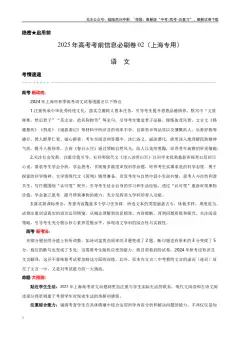
题型保持上海高考英语稳定结构,重点考查语言基础与语用能力。选材凸显时代性与人文
性,紧扣 “立德树人” 与跨学科融合趋势:语法填空围绕 “说服的艺术” 展开,衔接
职场沟通与人际交往;阅读 A 篇(字幕使用趋势)贴近数字生活,B 篇(家乡怀旧)聚焦
情感成长,C 篇(正念科技)紧跟科技生活潮流,D 篇(莎士比亚环球剧院)融合文化传
承与教育公平,增强文化意识与人文素养。命题注重语篇真实性,强调在具体语境中考查
语言理解与运用能力,如对说服技巧、文化传播方式的细节考查。
高考・新情境
命题情境紧跟时代热点与生活实际,覆盖三大主题语境。语法填空以 “职场说服” 为情
境,提供实用沟通方法,贴合未来职业发展;阅读 A 篇(年轻人字幕使用习惯)融入社交
媒体、多屏观看等新兴生活方式,贴近学生兴趣;B 篇(育空堡村与费尔班克斯生活对
比)聚焦乡愁与成长,引发情感共鸣;C 篇(正念科技)探讨科技与生活的平衡,引导健
康生活理念;六选四(AI 预测自然灾害)融合科技与防灾,体现科学素养培养。情境设置
兼具思想性与实用性,引导学生多角度思考现实问题。
命题・大预测
阅读语篇选材将更趋多元,说明文聚焦社会热点(如数字生活、科技伦理)、文化传承
(如莎士比亚戏剧普及),记叙文侧重情感体验与成长反思(如乡愁与生活变迁),应用
文强调信息传递与价值观引导(如词汇趋势解读)。命题将深化逻辑分析与跨文化视角考
查,推理判断、词义猜测题需结合语境与文化背景(如环球剧院的文化传播逻辑、字幕使
用的文化成因),信息整合题注重对多维度内容的归纳,引导辩证思考(如科技的利弊、
文化传承的方式)。语用能力考查更注重实用性,六选四聚焦语篇连贯与逻辑衔接(如 AI
防灾的技术逻辑展开),完形填空侧重情感与语境适配(如字幕使用中的心理与行为关
联),翻译与书面表达聚焦真实情境(如课程选择建议),强调表达的准确性与流畅性。
(时间105 分钟,满分115 分)
考生注意:
1. 答题前,考生务必在答题纸上用钢笔或水笔清楚填写姓名、准考证号,并用铅笔正 确
涂写准考证号。
2. 答案必须全部涂写在答题纸上。如用铅笔答题,或写在试卷上也一律不给分。
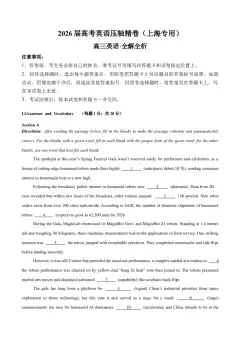
I. Grammar and Vocabulary   (每题1 分;共20 分)
Section A
Directions: After reading the passage below, fill in the blanks to make the passage coherent and
grammatically correct. For the blanks with a given word, fill in each blank with the proper form of
the given word; for the other blanks, use one word that best fits each blank.
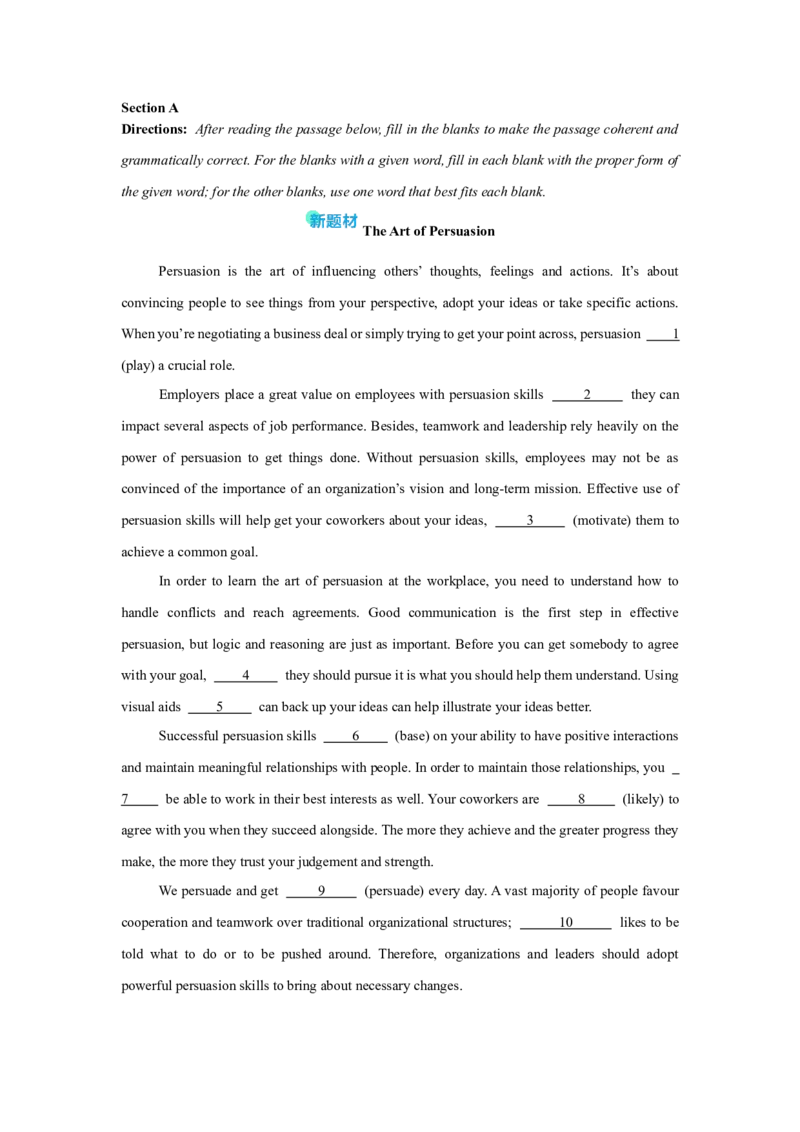
The Art of Persuasion
Persuasion is the art of influencing others’ thoughts, feelings and actions. It’s about
convincing people to see things from your perspective, adopt your ideas or take specific actions.
When you’re negotiating a business deal or simply trying to get your point across, persuasion     1
(play) a crucial role.
Employers place a great value on employees with persuasion skills     2     they can
impact several aspects of job performance. Besides, teamwork and leadership rely heavily on the
power of persuasion to get things done. Without persuasion skills, employees may not be as
convinced of the importance of an organization’s vision and long-term mission. Effective use of
persuasion skills will help get your coworkers about your ideas,     3     (motivate) them to
achieve a common goal.
In order to learn the art of persuasion at the workplace, you need to understand how to
handle conflicts and reach agreements. Good communication is the first step in effective
persuasion, but logic and reasoning are just as important. Before you can get somebody to agree
with your goal,     4     they should pursue it is what you should help them understand. Using
visual aids     5     can back up your ideas can help illustrate your ideas better.
Successful persuasion skills     6     (base) on your ability to have positive interactions
and maintain meaningful relationships with people. In order to maintain those relationships, you
7     be able to work in their best interests as well. Your coworkers are     8     (likely) to
agree with you when they succeed alongside. The more they achieve and the greater progress they
make, the more they trust your judgement and strength.
We persuade and get     9     (persuade) every day. A vast majority of people favour
cooperation and teamwork over traditional organizational structures;      10      likes to be
told what to do or to be pushed around. Therefore, organizations and leaders should adopt
powerful persuasion skills to bring about necessary changes.
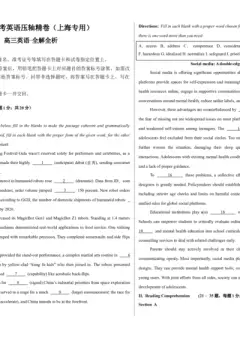
Section B
Directions: Fill in each blank with a proper word chosen from the box. Each word can be used
only once. Note that there is one word more than you need.
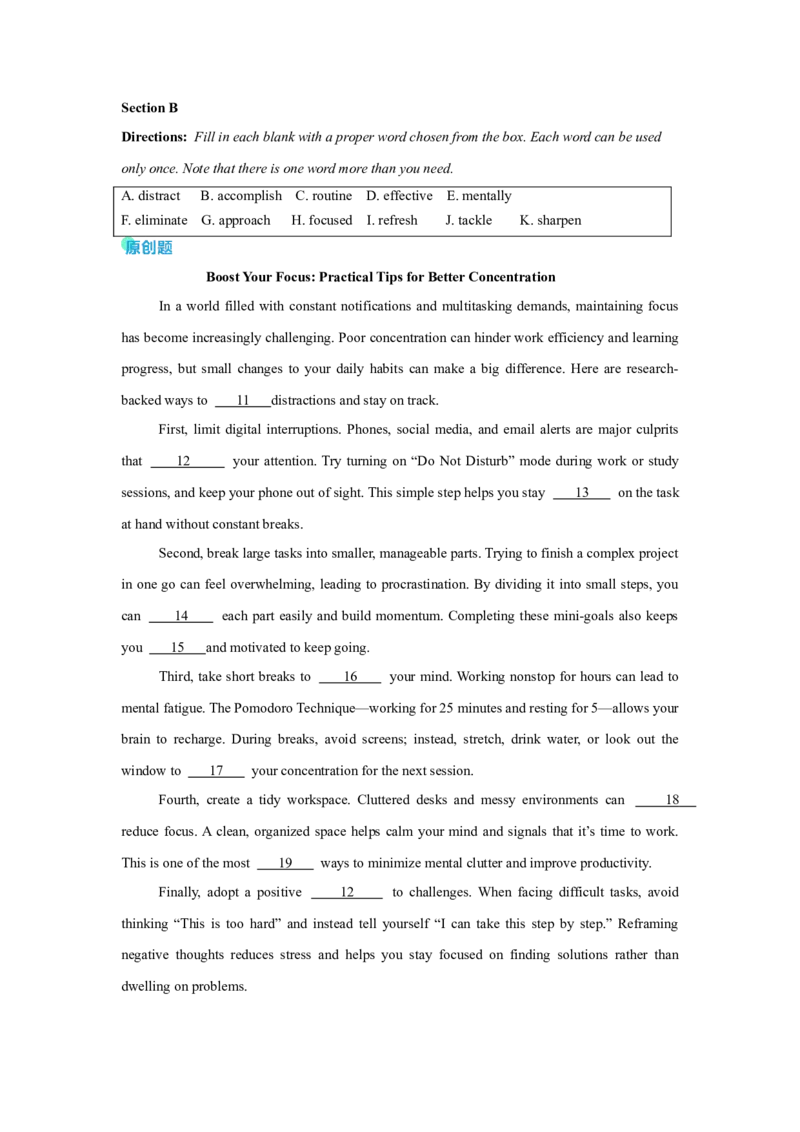
A. distract   B. accomplish  C. routine  D. effective  E. mentally
F. eliminate  G. approach   H. focused  I. refresh    J. tackle    K. sharpen
Boost Your Focus: Practical Tips for Better Concentration
In a world filled with constant notifications and multitasking demands, maintaining focus
has become increasingly challenging. Poor concentration can hinder work efficiency and learning
progress, but small changes to your daily habits can make a big difference. Here are research-
backed ways to    11   distractions and stay on track.
First, limit digital interruptions. Phones, social media, and email alerts are major culprits
that    12     your attention. Try turning on “Do Not Disturb” mode during work or study
sessions, and keep your phone out of sight. This simple step helps you stay    13    on the task
at hand without constant breaks.
Second, break large tasks into smaller, manageable parts. Trying to finish a complex project
in one go can feel overwhelming, leading to procrastination. By dividing it into small steps, you
can    14    each part easily and build momentum. Completing these mini-goals also keeps
you    15   and motivated to keep going.
Third, take short breaks to    16    your mind. Working nonstop for hours can lead to
mental fatigue. The Pomodoro Technique—working for 25 minutes and resting for 5—allows your
brain to recharge. During breaks, avoid screens; instead, stretch, drink water, or look out the
window to    17    your concentration for the next session.
Fourth, create a tidy workspace. Cluttered desks and messy environments can    18
reduce focus. A clean, organized space helps calm your mind and signals that it’s time to work.
This is one of the most    19    ways to minimize mental clutter and improve productivity.
Finally, adopt a positive    12    to challenges. When facing difficult tasks, avoid
thinking “This is too hard” and instead tell yourself “I can take this step by step.” Reframing
negative thoughts reduces stress and helps you stay focused on finding solutions rather than
dwelling on problems.
II.
Reading Comprehension    (41 – 55 题,每题1 分;56 – 70 题,每题2
分;共45 分)
Section A
Directions: For each blank in the following passage there are four words or phrases marked
A, B, C and D. Fill in each blank with the word or phrase that best fits the context.
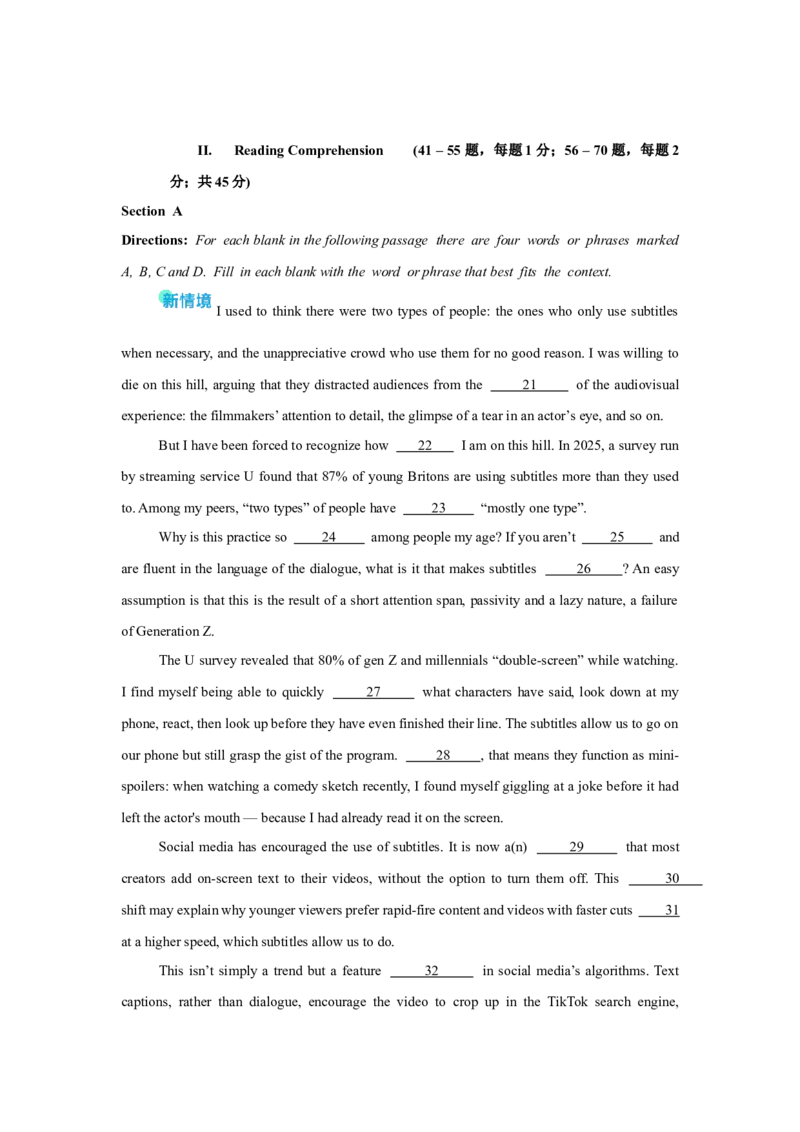
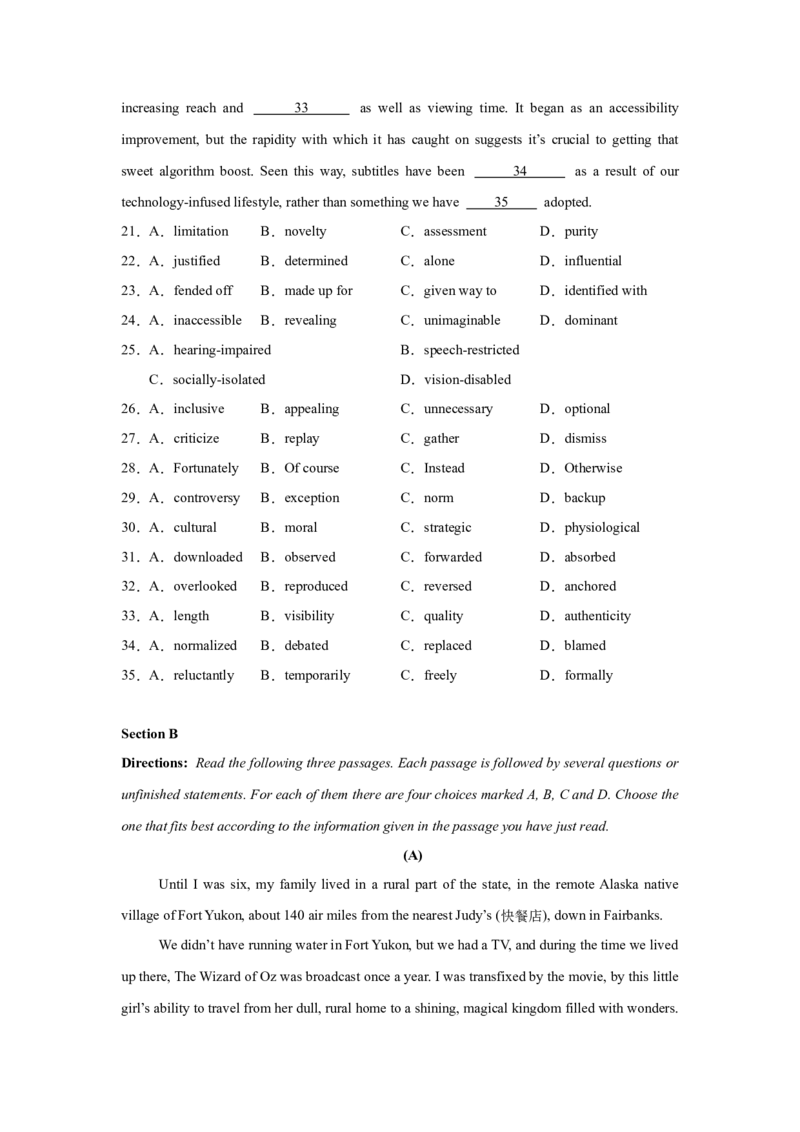
I used to think there were two types of people: the ones who only use subtitles
when necessary, and the unappreciative crowd who use them for no good reason. I was willing to
die on this hill, arguing that they distracted audiences from the     21     of the audiovisual
experience: the filmmakers’ attention to detail, the glimpse of a tear in an actor’s eye, and so on.
But I have been forced to recognize how    22    I am on this hill. In 2025, a survey run
by streaming service U found that 87% of young Britons are using subtitles more than they used
to. Among my peers, “two types” of people have     23     “mostly one type”.
Why is this practice so     24     among people my age? If you aren’t     25     and
are fluent in the language of the dialogue, what is it that makes subtitles     26    ? An easy
assumption is that this is the result of a short attention span, passivity and a lazy nature, a failure
of Generation Z.
The U survey revealed that 80% of gen Z and millennials “double-screen” while watching.
I find myself being able to quickly     27     what characters have said, look down at my
phone, react, then look up before they have even finished their line. The subtitles allow us to go on
our phone but still grasp the gist of the program.     28    , that means they function as mini-
spoilers: when watching a comedy sketch recently, I found myself giggling at a joke before it had
left the actor's mouth — because I had already read it on the screen.
Social media has encouraged the use of subtitles. It is now a(n)     29     that most
creators add on-screen text to their videos, without the option to turn them off. This     30

shift may explain why younger viewers prefer rapid-fire content and videos with faster cuts     31
at a higher speed, which subtitles allow us to do.
This isn’t simply a trend but a feature     32     in social media’s algorithms. Text
captions, rather than dialogue, encourage the video to crop up in the TikTok search engine,
increasing reach and     33     as well as viewing time. It began as an accessibility
improvement, but the rapidity with which it has caught on suggests it’s crucial to getting that
sweet algorithm boost. Seen this way, subtitles have been     34     as a result of our
technology-infused lifestyle, rather than something we have     35     adopted.
21.A.limitation
B.novelty
C.assessment
D.purity
22.A.justified
B.determined
C.alone
D.influential
23.A.fended off
B.made up for
C.given way to
D.identified with
24.A.inaccessible
B.revealing
C.unimaginable
D.dominant
25.A.hearing-impaired
B.speech-restricted
C.socially-isolated
D.vision-disabled
26.A.inclusive
B.appealing
C.unnecessary
D.optional
27.A.criticize
B.replay
C.gather
D.dismiss
28.A.Fortunately
B.Of course
C.Instead
D.Otherwise
29.A.controversy
B.exception
C.norm
D.backup
30.A.cultural
B.moral
C.strategic
D.physiological
31.A.downloaded
B.observed
C.forwarded
D.absorbed
32.A.overlooked
B.reproduced
C.reversed
D.anchored
33.A.length
B.visibility
C.quality
D.authenticity
34.A.normalized
B.debated
C.replaced
D.blamed
35.A.reluctantly
B.temporarily
C.freely
D.formally
Section B
Directions: Read the following three passages. Each passage is followed by several questions or
unfinished statements. For each of them there are four choices marked A, B, C and D. Choose the
one that fits best according to the information given in the passage you have just read.
(A)
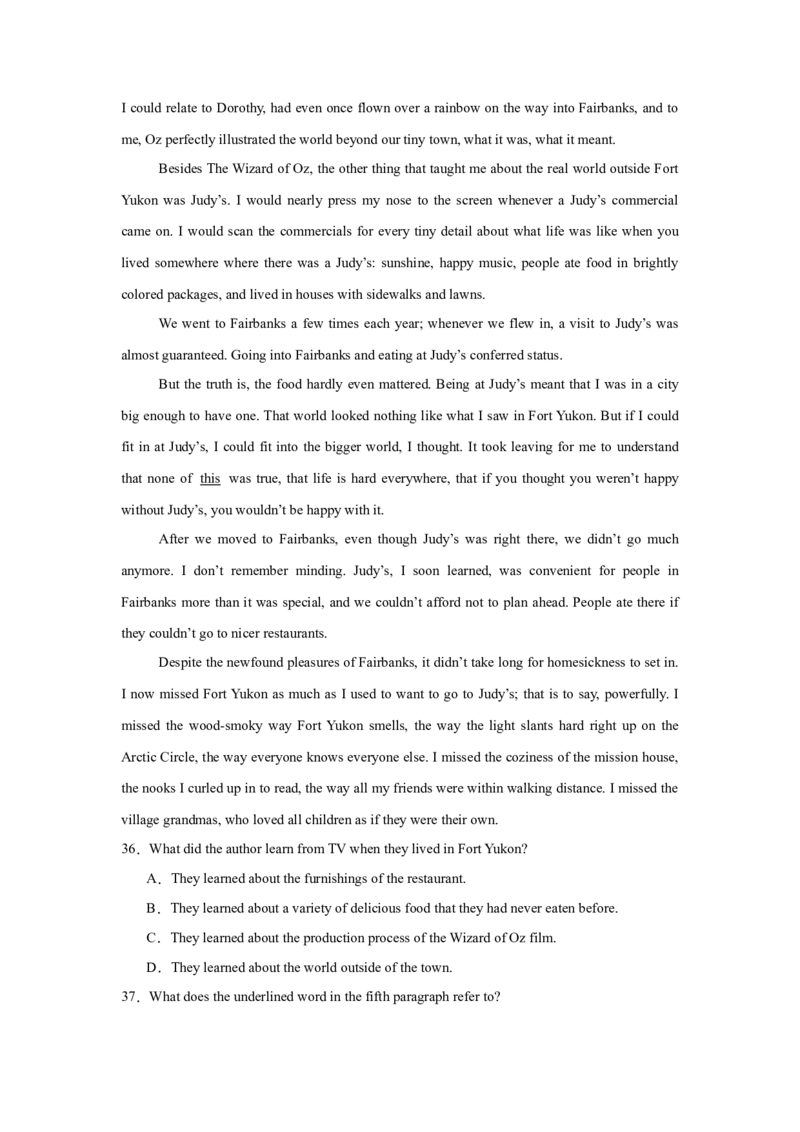
Until I was six, my family lived in a rural part of the state, in the remote Alaska native
village of Fort Yukon, about 140 air miles from the nearest Judy’s (快餐店), down in Fairbanks.
We didn’t have running water in Fort Yukon, but we had a TV, and during the time we lived
up there, The Wizard of Oz was broadcast once a year. I was transfixed by the movie, by this little
girl’s ability to travel from her dull, rural home to a shining, magical kingdom filled with wonders.
I could relate to Dorothy, had even once flown over a rainbow on the way into Fairbanks, and to
me, Oz perfectly illustrated the world beyond our tiny town, what it was, what it meant.
Besides The Wizard of Oz, the other thing that taught me about the real world outside Fort
Yukon was Judy’s. I would nearly press my nose to the screen whenever a Judy’s commercial
came on. I would scan the commercials for every tiny detail about what life was like when you
lived somewhere where there was a Judy’s: sunshine, happy music, people ate food in brightly
colored packages, and lived in houses with sidewalks and lawns.
We went to Fairbanks a few times each year; whenever we flew in, a visit to Judy’s was
almost guaranteed. Going into Fairbanks and eating at Judy’s conferred status.
But the truth is, the food hardly even mattered. Being at Judy’s meant that I was in a city
big enough to have one. That world looked nothing like what I saw in Fort Yukon. But if I could
fit in at Judy’s, I could fit into the bigger world, I thought. It took leaving for me to understand
that none of this was true, that life is hard everywhere, that if you thought you weren’t happy
without Judy’s, you wouldn’t be happy with it.
After we moved to Fairbanks, even though Judy’s was right there, we didn’t go much
anymore. I don’t remember minding. Judy’s, I soon learned, was convenient for people in
Fairbanks more than it was special, and we couldn’t afford not to plan ahead. People ate there if
they couldn’t go to nicer restaurants.
Despite the newfound pleasures of Fairbanks, it didn’t take long for homesickness to set in.
I now missed Fort Yukon as much as I used to want to go to Judy’s; that is to say, powerfully. I
missed the wood-smoky way Fort Yukon smells, the way the light slants hard right up on the
Arctic Circle, the way everyone knows everyone else. I missed the coziness of the mission house,
the nooks I curled up in to read, the way all my friends were within walking distance. I missed the
village grandmas, who loved all children as if they were their own.
36.What did the author learn from TV when they lived in Fort Yukon?
A.They learned about the furnishings of the restaurant.
B.They learned about a variety of delicious food that they had never eaten before.
C.They learned about the production process of the Wizard of Oz film.
D.They learned about the world outside of the town.
37.What does the underlined word in the fifth paragraph refer to?
A.Adapting to Judy’s, you can get a foothold in a big city.
B.Judy’s is very popular with migrant workers in every city.
C.Weekend life without Judy’s food can be extremely difficult.
D.Judy’s has a pivotal role in fast-paced cities.
38.What was their attitude towards Judy’s when they moved to Fairbanks?
A.They almost stopped visiting fast-food restaurants.
B.They still yearned for the fast food restaurants.
C.They quit the habit of eating fast food in Judy’s.
D.They chose healthier foods instead of fast food.
39.What is the last paragraph of the passage about?
A.The review of daily work.
B.The nostalgia (怀旧) for their home town.
C.The transition in lifestyle.
D.The way of daily commute.
(B)
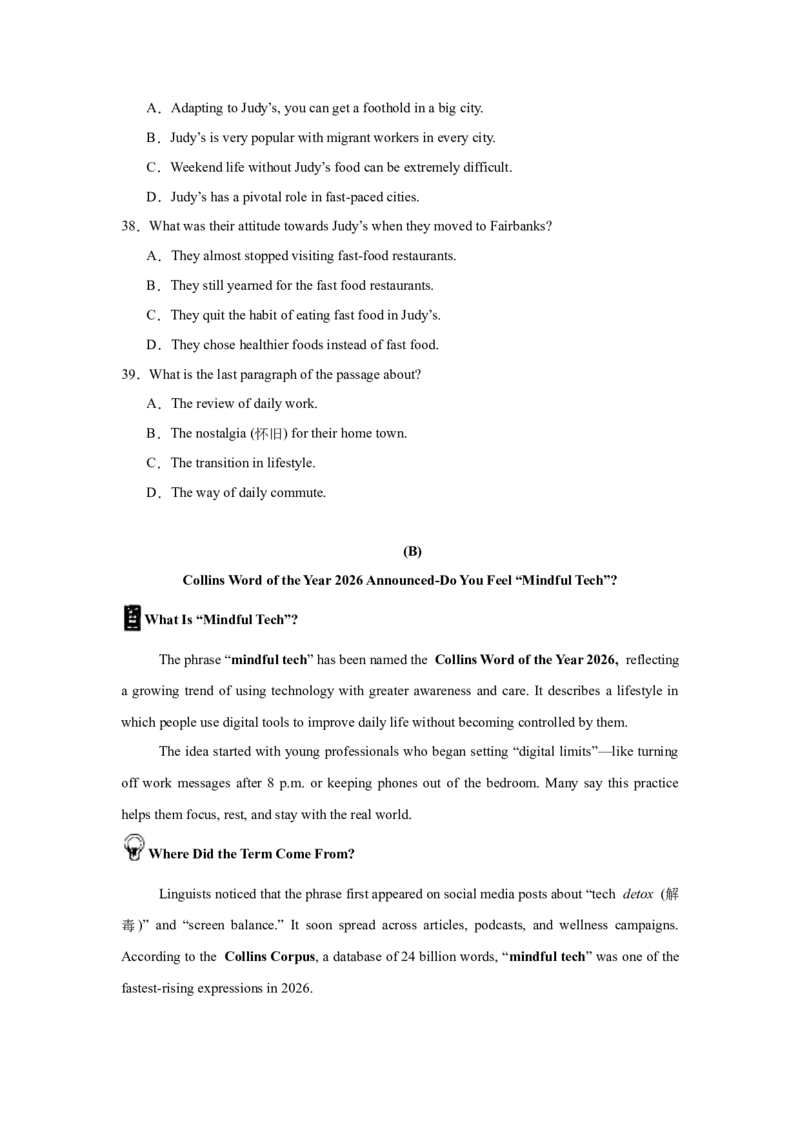
Collins Word of the Year 2026 Announced-Do You Feel “Mindful Tech”?
What Is “Mindful Tech”?
The phrase “mindful tech” has been named the Collins Word of the Year 2026, reflecting
a growing trend of using technology with greater awareness and care. It describes a lifestyle in
which people use digital tools to improve daily life without becoming controlled by them.
The idea started with young professionals who began setting “digital limits”—like turning
off work messages after 8 p.m. or keeping phones out of the bedroom. Many say this practice
helps them focus, rest, and stay with the real world.
Where Did the Term Come From?
Linguists noticed that the phrase first appeared on social media posts about “tech detox (解
毒)” and “screen balance.” It soon spread across articles, podcasts, and wellness campaigns.
According to the Collins Corpus, a database of 24 billion words, “mindful tech” was one of the
fastest-rising expressions in 2026.
Why It Matters
Experts believe the term captures a shift in modern culture: people want to enjoy innovation
without losing control of their attention or emotions. As one researcher said, “It’s not about
avoiding technology, it’s about designing a healthier relationship with it.”
Other Shortlisted Words
·Sleep syncing—adjusting sleep schedules to match natural light cycles.
·Eco-swap—replacing everyday products with sustainable options.
·Text ghosting—suddenly stopping online communication.
·Quiet quitting 2.0—doing one’s job well but refusing unpaid overtime.
40.According to the passage, what does “mindful tech” mean?
A.Using technology in an innovative way.
B.Using technology with awareness and balance.
C.Living a digital-free life to improve concentration.
D.Limiting online communication to work-related content.
41.Which of the following best explains why the term “mindful tech” matters?
A.It reveals that new expressions are constantly emerging.
B.It encourages people to avoid ineffective digital communication.
C.It indicates that people are turning away from online communication.
D.It shows that people want harmony between technology and well-being.
42.What do the shortlisted words in the passage have in common?
A.They relate to new technologies.
B.They are popular on social websites.
C.They show how people adjust to new trends.
D.They describe those disappearing old habits.
(C)
Shakespeare’s plays were so popular in the 16th and 17th centuries because they
were good — and because they were cheap. Productions at the Globe, the cultural landmark of
London, saw audiences cram in, with the cheapest “seats” being no seats at all, but standing places
in the “pit” below the stage. Few complained, even as their knees no doubt protested, thanks to the
quality of what unfolded in front of them.
The same holds true in 2025: standing tickets are still only £10, or £5 if you book early
enough, and the theatre remains as spectacular as ever. This summer’s Romeo and Juliet, for
instance, is full of life. The audience roars with laughter at all the right moments. It is a far cry
from the miscommunication and heavy-handed teaching at General Certificate of Secondary
Education (GCSE) that has put generations of students off Shakespeare.
For Michelle Terry, the artistic director at Shakespeare’s Globe, making theatre accessible is
vital to turning around perceptions, and the cheap tickets certainly help. The pricing, Terry
reckons, gives audiences the chance to make their mind up about Shakespeare without pressure.
The low entry fee gives audiences “the right to have an opinion”. “You can say, I am not having a
good time, and I can afford to leave,” she says.
While access for all is the goal, the team are aware of the role that Shakespeare plays in the
national curriculum and make every effort to ensure as many students as possible can see its plays.
Each year it tries to programme at least one of the GCSE texts, and in 2023-24 more than 120,000
students visited the Globe to see Shakespeare live, 26,000 of them for free.
School visitors aren’t the only ones keen to see Shakespeare. Today the Globe truly lives up
to its name, with a third of visitors last year coming from abroad, from 147 different countries. For
Terry, bringing people together from all walks of life is central to making theatre accessible —
especially in today’s political climate where people are becoming increasingly polarised,
isolationist, individualist.
43.Shakespeare’s Globe in the 16th and 17th centuries ________.
A.provided tickets from five pounds
B.impressed visitors with quality shows
C.smartly dealt with viewers’ complaints
D.offered more standing places than seats.
44.According to the passage, Globe’s current success is due to ________.
affordable prices
①
engaging performance
②
comfortable environment
③
enrollment of foreign performers
④
cultivation of prospective visitors
⑤
encouragement of free art appreciation
⑥
A.①②④⑥
B.①②⑤⑥
C.①③⑤⑥
D.②③④⑤
45.What can be inferred about GCSE?
A.Its texts are funded by private organizations like the Globe.
B.It ignores the importance of Shakespeare plays for students.
C.It intends to free students from the burden of Shakespeare plays.
D.Its teaching robs students of the joy of learning Shakespeare plays.
46.The passage is mainly about ________.
A.the popularity of Shakespeare’s plays
B.the influence of Shakespeare’s plays
C.the development of a famous theater
D.the accessibility of a famous theater
Section C
Directions: Read the following passages. Fill in each blank with a proper sentence given in
the box. Each sentence can be used only once. Note that there are two more sentences than
you need.
How AI Will Help Predict Natural Disasters
Beneath California lie faults—places where rocks slide past, over, or under one another.
When they move at an alarming rate, the ground shakes violently, causing destructive earthquakes.
Nothing can be done to stop them, but understanding where they are likely to happen and how
powerful they may be means communities can prepare.
     47      They employ seismometers (地震仪) to record seismic waves—a bit like
music, with notes and rhythm changes that reveal what created them, where they lie, and how they
behave.
Because California is so geologically active, the region has massive amounts of data.      48
Many tiny, imperceptible quakes are difficult to spot, especially when their signals are similar to
background noise from traffic.
Inspired by machine-learning programs that can identify and categorize elements within
images with unmatched accuracy, a researcher at Caltech applied a similar idea to seismology. He
used algorithms (算法) to search for patterns of tiny quakes in seismic data and soon identified
nearly two million hidden events from 2008 to 2017. This revealed a complex network of faults
that previous studies had missed.
Although early programs could only find quakes similar to those they had been trained on,
newer self-learning systems can recognize novel events and make predictions about the future.
49      They are now used across California to spot slowly slow-moving earthquake faults
invisible to traditional methods.
     50      In areas at high risk of earthquakes like Tokyo, for instance, AI software
analyzes images from cameras positioned around the city to recognize fires and building collapses
and to alert authorities instantly. Such systems save precious time for search and rescue. While AI
will not replace human scientists, it is becoming as ordinary—and as vital—as the seismometers
themselves.
A.AI may also improve earthquake early-warning systems.
B.In some way, AI, trained with enough data, may one day take the place of human instincts.
C.It is covered in so many seismometers that there is more data than human experts could
reasonably handle.
D.These machine-learning programs are still evolving and have gone beyond detecting quiet
quakes and hidden faults.
E.To reduce the effects of future disasters, researchers draw maps of the underworld, charting
every fault and monitoring its behavior.
F.Such programs as mentioned are still being tested for real-life applications.
IV. Summary Writing   (10 分)
Directions: Read the following passage. Summarize the main idea and the main point(s) of the
passage in no more than 60 words. Use your own words as far as possible.
51.Directions: Read the following passage. Summarize the main idea and the main point(s) of
the passage in no more than 60 words. Use your own words as far as possible.
Kids Losing Fine Motor Skills?
Amy Hornbeck can tell something is off the moment her students step into the classroom.
Once, kids arrived with pockets full of rocks and items collected during outdoor adventures. Now,
they come with their eyes glued to a screen. And it shows: they can’t zip their coats, turn the pages
of a book, or even hold a spoon properly. Today’s children are losing critical fine motor skills—
the small, precise movements required to tie a shoelace, write with a pen, or build a tower. Here’s
what parents need to know.
Time spent on screens—whether phones, tablets, eBooks, or TV—all adds up to time kids
aren’t crafting, drawing, and building. While learning math or creating digital art can be
educational, it doesn’t develop the fine motor control that comes from writing, cutting, or
coloring.
Hornbeck adds that kids’ decreasing ability to focus on a task, especially one requiring
effort, is a key contributor to declining fine motor skills. Take puzzles, for example. Completing
one involves strategy, flipping pieces, and trial and error. But Hornbeck says, “A lot of kids simply
say, ‘Nope.’ They’re used to playing on a computer, which spins the piece for you.” She adds,
“Tablets provide a lot more immediate support than is available in real life.”
Convenience in parenting has also impacted skill development, says Hornbeck. Elastic
pants without zippers or buttons save time on busy mornings, and pre-packaged snacks eliminate
mess — but these shortcuts deprive kids of opportunities to practice zipping, buttoning, or using
tools.
Hornbeck suggests parents get children off their screens. Also, parents should look for
opportunities to challenge their children and insert fine motor activities into daily tasks, such as
cutting coupons or cooking together, looking for stones on the way to school, pouring cups, and
squeezing sponges in the bath, etc.
_______________________________________________________________________________
_______________________________________________________________________________
_______________________________________________________________________________
_______________________________________________________________________________
_______________________________________________________________________________
_______________________________________________________________________________
______________________________________________________________________________
V. Translation  (第1-2 句,每句3 分;第3 句,4 分;第4 句5 分;共15 分)
Directions: Translate the following sentences into English, using the words given in the brackets.
52.这株植物今年再度刷新了最晚开花纪录。(flower)

53.这片草莓园人气爆棚,采摘必须提前三天线上预定。(book)


54.年轻人喜欢逛完博物馆后选购特色文创产品,无论是自用还是送人都很合适。
(which)

55.我们正在努力营造一种积极的工作氛围,每个人都能参与决策,畅所欲言,充分发挥
潜力。(entitle)

VI. Guided Writing (25 分)
56.Directions: Write an English composition in 120-150 words according to the instructions
given below in Chinese.
随着教材改革,学校的相关课程也将做出调整,备选的英语选修课(selective course)有“戏
剧欣赏” (Drama Appreciation)、“英语辩论” (English Debate)以及“英语播客制作”
(Podcast Production)。请你选出最希望参与的课程,并详细说明你选择它的原因。
_______________________________________________________________________________
_______________________________________________________________________________
_______________________________________________________________________________
_______________________________________________________________________________
_______________________________________________________________________________
________________________________________________________