【上好课】2025年高考一轮复习知识清单
专题39 阅读理解之猜测词义题(讲案)原卷版
(快问快答+思维导图+考法点拨+真题再练+名校模拟)
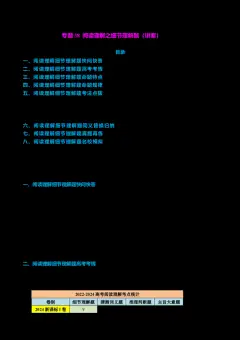
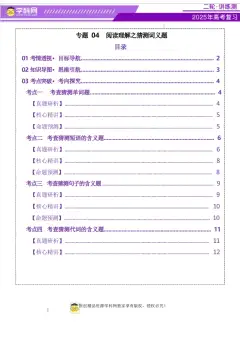
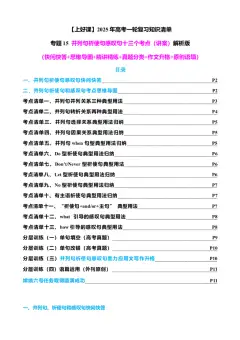
目录
一、阅读理解猜测词义题快问快答 P1
二、阅读理解猜测词义题高考考情 P2
三、阅读理解猜测词义题命题特点 P2
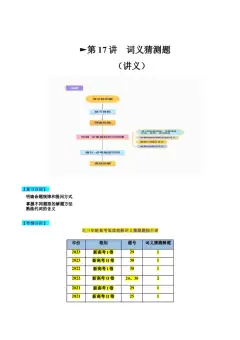
四、阅读理解猜测词义题思维导图 P 3
五、阅读理解猜测词义题考法点拨 P3
考法一:利用释义法猜词 P 3
考法二:利用构词法猜词 P 3
考法三:利用因果关系猜词 P 4
考法四:利用对比关系猜词 P 4
考法五:利用上下文解题 P 5
考法六:利用同义关系解题 P 5
考法七:利用生活常识解题 P 5
考法八:利用就近原则判指代 P 6
六、阅读理解猜测词义题真题演练(7 例) P 6
七、阅读理解猜测词义题名校模拟(15 篇) P 9
模拟一:生词类猜测词义题 P 9
模拟二:短语类猜测词义题 P 15
模拟三:句子类猜测词义题 P 22
模拟四:代词类猜测词义题 P 23
一、阅读理解猜测词义题快问快答
Q1:阅读理解猜测词义题有什么特点?
A1:猜测词义题属于阅读基础题型,每年必考,难度不大,需要有满分意识。
Q2:阅读理解猜测词义题做题步骤如何?
A2:一是“找词”--先从题干中提取关键性(题眼),二是“定位”--寻找与此关键词相关的段落、语句做
好标记,三是“代入”--仔细比对四个选项与文中细节的细微区别,最后确定答案。
Q3:阅读理解猜测词义题有哪些考查方向?
A3:阅读理解猜测词义题有四大考查方向:一是考查短语语境猜测,二是考查生词语境猜测,三是考查
句子语境理解,四是考查代词语境猜测。
Q4:如何提高阅读理解细节题正答率?
A4:一要掌握阅读理解猜测词义题命题规律和选项特征,二要不断扩大词汇量,尤其是3500高考高频词
汇,三要广泛进行阅读实践和专项训练,积累经验,摸索出一套行之有效的个性化做题模式,四要重视
纠错,探寻错误原因,防止出现类似错误。
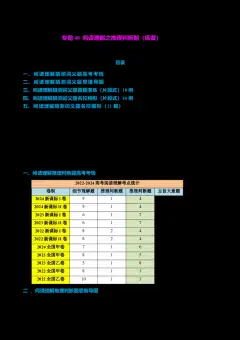
二、阅读理解猜测词义题高考考情猜测词义题基本上是阅读理解每年必考的题型。此类题型旨在考查考生根据上下文推断单词、短语
或句子的本意或外延含义的能力,既可以考查生词的意义,也可以考查熟词的新意,还可以是对替代词
所替代内容的判断。除了直接命题的生词外,阅读文章时,常常也会遇到一些过去未见过的词,但这类
生词的词义大都可以通过上下文推断出来。
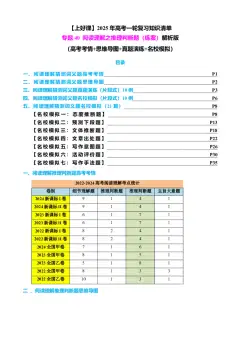
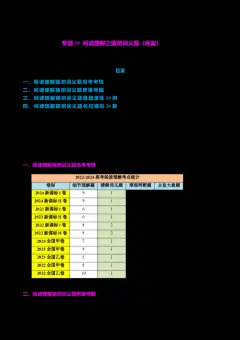
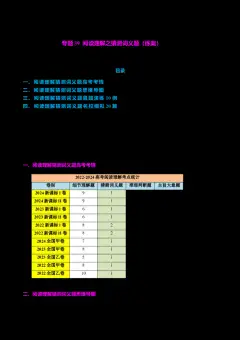
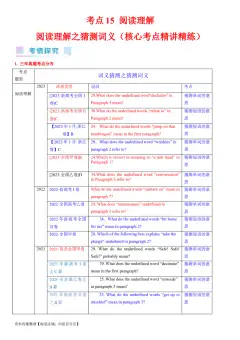
2022-2024高考阅读理解考点统计
卷别 细节理解题 猜测词义题 推理判断题 主旨大意题
2024新课标I卷 9 1 4 1
2024新课标II卷 9 1 4 1
2023新课标I卷 6 1 7 1
2023新课标II卷 6 1 7 1
2022新课标I卷 8 2 4 1
2022新课标II卷 8 2 4 1
2024全国甲卷 7 1 6 1
2023全国甲卷 8 1 5 1
2023全国乙卷 5 1 8 1
2022全国甲卷 8 1 3 3
2022全国乙卷 10 1 3 1
三、阅读理解猜测词义题命题特点
特殊疑问句形式:以疑问词what开头引出的问题;通常涉及四种形式:生词型、短语型、句子型、代词
型。
28. What does the underlined phrase “shine through” in paragraph 2 mean?(2024新课标I卷,短语型)
32. What does the phrase “In the wrong hands” in paragraph 2 probably mean? (2024新课标II卷,短语型)
26. Which best explains the phrase "take. . . up notch" in paragraph 3? (2024全国甲卷,短语型)
24. What does the underlined word “it” in the first paragraph refer to? (2024浙江1月卷,代词型)
29. What does the underlined word “declutter” in paragraph 3 mean? (2023新课标I卷,生词型)
30. What do the underlined words “relate to” in paragraph 2 mean? (2023新课标I卷,短语型)
24. Which is closest in meaning to “a dab hand” in paragraph 1? (2023新课标II卷,短语型)
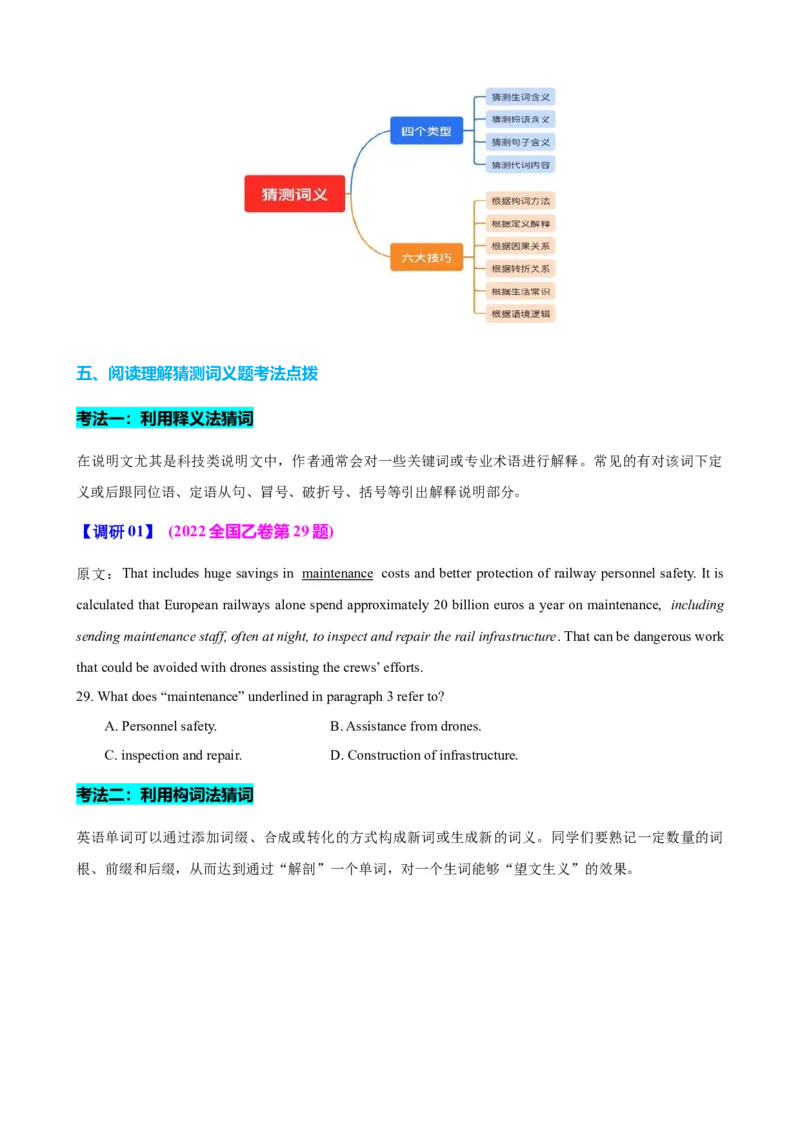
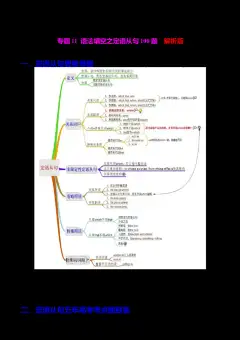
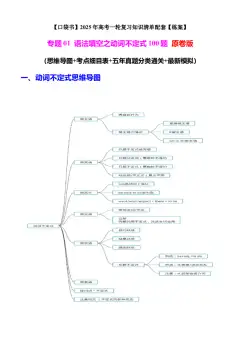
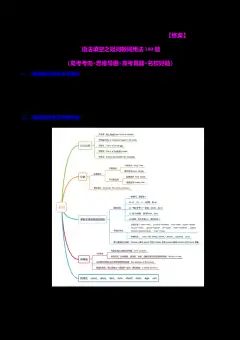
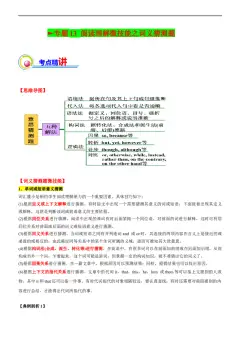
四、阅读理解猜测词义题思维导图五、阅读理解猜测词义题考法点拨
考法一:利用释义法猜词
在说明文尤其是科技类说明文中,作者通常会对一些关键词或专业术语进行解释。常见的有对该词下定
义或后跟同位语、定语从句、冒号、破折号、括号等引出解释说明部分。
【调研01】 (2022全国乙卷第29题)
原文:That includes huge savings in maintenance costs and better protection of railway personnel safety. It is
calculated that European railways alone spend approximately 20 billion euros a year on maintenance, including
sending maintenance staff, often at night, to inspect and repair the rail infrastructure. That can be dangerous work
that could be avoided with drones assisting the crews’ efforts.
29. What does “maintenance” underlined in paragraph 3 refer to?
A. Personnel safety. B. Assistance from drones.
C. inspection and repair. D. Construction of infrastructure.
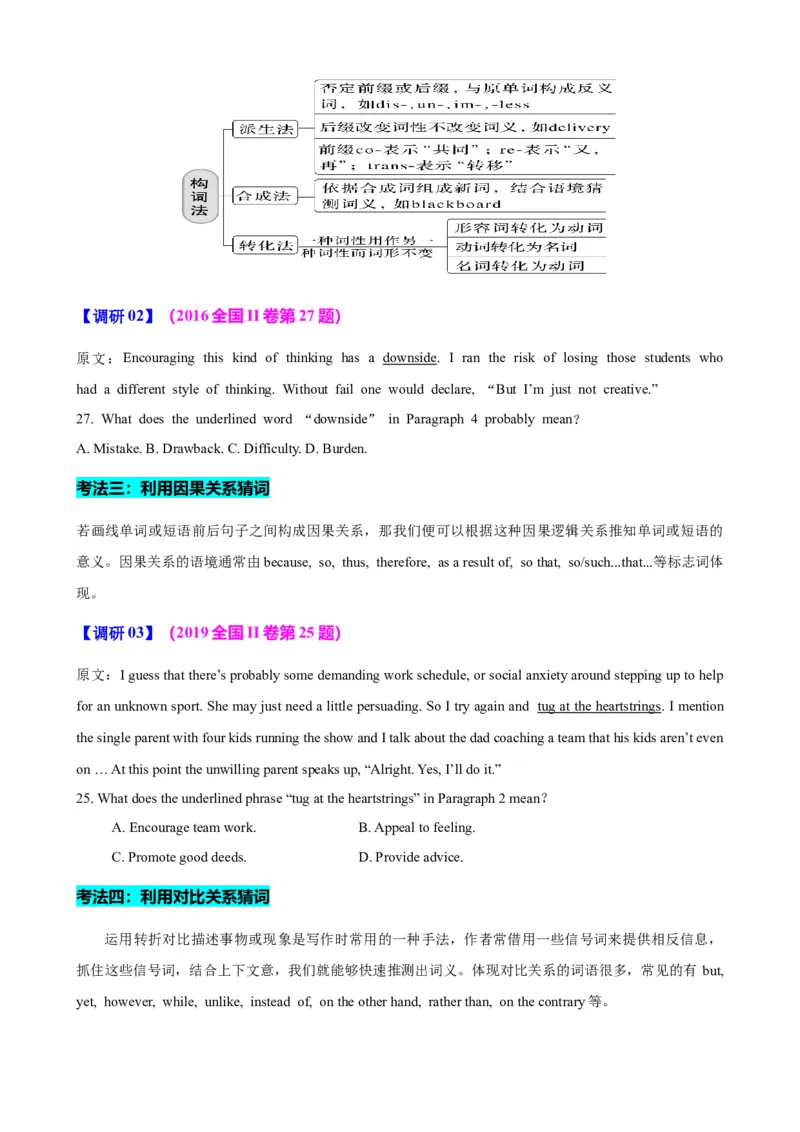
考法二:利用构词法猜词
英语单词可以通过添加词缀、合成或转化的方式构成新词或生成新的词义。同学们要熟记一定数量的词
根、前缀和后缀,从而达到通过“解剖”一个单词,对一个生词能够“望文生义”的效果。【调研02】(2016全国II卷第27题)
原文:Encouraging this kind of thinking has a downside. I ran the risk of losing those students who
had a different style of thinking. Without fail one would declare, “But I’m just not creative.”
27. What does the underlined word “downside” in Paragraph 4 probably mean?
A. Mistake. B. Drawback. C. Difficulty. D. Burden.
考法三:利用因果关系猜词
若画线单词或短语前后句子之间构成因果关系,那我们便可以根据这种因果逻辑关系推知单词或短语的
意义。因果关系的语境通常由because, so, thus, therefore, as a result of, so that, so/such...that...等标志词体
现。
【调研03】(2019全国II卷第25题)
原文:I guess that there’s probably some demanding work schedule, or social anxiety around stepping up to help
for an unknown sport. She may just need a little persuading. So I try again and tug at the heartstrings. I mention
the single parent with four kids running the show and I talk about the dad coaching a team that his kids aren’t even
on … At this point the unwilling parent speaks up, “Alright. Yes, I’ll do it.”
25. What does the underlined phrase “tug at the heartstrings” in Paragraph 2 mean?
A. Encourage team work. B. Appeal to feeling.
C. Promote good deeds. D. Provide advice.
考法四:利用对比关系猜词
运用转折对比描述事物或现象是写作时常用的一种手法,作者常借用一些信号词来提供相反信息,
抓住这些信号词,结合上下文意,我们就能够快速推测出词义。体现对比关系的词语很多,常见的有 but,
yet, however, while, unlike, instead of, on the other hand, rather than, on the contrary等。【调研04】(2020新高考卷Ⅰ第33题)
原文:According to a recent study in the Journal of Consumer Research, both the size and consumption
habits of our eating companions can influence our food intake. And contrary to existing research that
says you should avoid eating with heavier people who order large portions(份), it’s the beanpoles with
big appetites you really need to avoid.
33. What does the underlined word “beanpoles” in paragraph 1 refer to?
A. Big eaters. B. Overweight persons. C. Picky eaters. D. Tall thin persons.
考法五:利用上下文解题
有些猜测词义句意题找不到以上标志或线索,我们可以利用上下文提供的语境进行合乎逻辑的综合分析
进而推测词义句意。
【调研05】(2022新高考II卷第24题)
原文:We journalists live in a new age of storytelling, with many new multimedia tools. Many young people
don't even realize it's new. For them, it’s just normal.
This hit home for me as I was sitting with my 2-year-old grandson on a sofa over the Spring Festival
holiday. I had brought a children's book to read. It had simple words and colorful pictures—a perfect match for his
age.
24. What do the underlined words “hit home for me” mean in paragraph 2?
A. Provided shelter for me. B. Became very clear to me.
C. Took the pressure off me. D. Worked quite well on me.
考法六:利用同义关系解题
画线单词或短语前后有时会出现与之同义或近义的词语或结构,这时我们可从熟悉的词语中推知生词的
含义。常见的表示同义关系的词或短语有and, or, like, as well, similarly, too, also, either等。
【调研06】(2015四川卷第44题)
原文:And it is not just robins that are being kept awake by artificial light. Blackbirds and seagulls are also being
more nocturnal.
44. What does the underlined word “nocturnal” in Paragraph 5 mean?
A. Active at night. B. Inactive at night.
C. Active during the day. D. Inactive during the day.考法七:利用生活常识解题
在仅靠分析篇章内在逻辑关系和语境无法猜出词义时,我们可以借助生活经验和普通常识确定词义。
【调研07】(2020江苏卷第61题)
原文:For those who can stomach it, working out before breakfast may be more beneficial for health than eating
first, according to a study of meal timing and physical activity.
61. The underlined expression “stomach it” in Paragraph 1 most probably means “ _______ ”.
A. digest the meal easily B. manage without breakfast
C. decide wisely what to eat D. eat whatever is offered
考法八:利用就近原则判指代
代词指代题原则上从上文寻找线索,确定答案。基本点是单数还是复数,指人还是指物。
【调研08】(2022新高考II卷第30题)
原文:"We need something on the books that can change people's behavior,” said Félix W. Ortiz, who pushed for
the state's 2001 ban on hand-held devices by drivers. If the Textalyzer bill becomes law, he said, "people are going
to be more afraid to put their hands on the cell phone."
30. What does the underlined word "something" in the last paragraph refer to?
A. Advice. B. Data. C. Tests. D. Laws.
六、阅读理解猜测词义题真题演练
【演练01】(2024新课标I卷第28题)
When reading texts of several hundred words or more, learning is generally more successful when it’son paper than onscreen. A large amount of research confirms this finding. The benefits of print reading
particularly shine through when experimenters move from posing simple tasks – like identifying the main
idea in a reading passage – to ones that require mental abstraction – such as drawing inferences from a text.
28. What does the underlined phrase “shine through” in paragraph 2 mean?
A. Seem unlikely to last. B. Seem hard to explain.
C. Become ready to use. D. Become easy to notice.
【演练02】(2024新课标II卷第32题)
In the wrong hands, such a book could prove as complicated to process as the computer code (代码) that
powers AI but, thankfully, Campbell has more than two decades’ professional experience translating the heady
into the understandable. She writes from the practical angle of a business person rather than as an academic,
making for a guide which is highly accessible and informative and which, by the close, will make you feel almost
as smart as AI.
32. What does the phrase “In the wrong hands” in paragraph 2 probably mean?
A. If read by someone poorly educated.
B. If reviewed by someone ill-intentioned.
C. If written by someone less competent.
D. If translated by someone unacademic.
【演练03】(2023新课标I卷第29题)
Part one concludes by introducing my suggested method for adopting this philosophy: the digital declutter.
This process requires you to step away from optional online activities for thirty days. At the end of the thirty days,
you will then add back a small number of carefully chosen online activities that you believe will provide massive
benefits to the things you value.
29. What does the underlined word “declutter” in paragraph 3 mean?
A. Clear-up. B. Add-on. C. Check-in. D. Take-over.
【演练04】(2023新课标II卷第30题)
In this “book of books,” artworks are selected and arranged in a way that emphasizes these connections
between different eras and cultures. We see scenes of children learning to read at home or at school, with the book
as a focus for relations between the generations. Adults are portrayed (描绘) alone in many settings and poses —
absorbed in a volume, deep in thought or lost in a moment of leisure. These scenes may have been painted
hundreds of years ago, but they record moments we can all relate to.
30. What do the underlined words “relate to” in paragraph 2 mean?
A. Understand. B. Paint.
C. Seize. D. Transform.【演练05】(2023全国甲卷第24题)
Terri Bolton is a dab hand when it comes to DIY (do-it-yourself). Skilled at putting up shelves and piecing
together furniture, she never pays someone else to do a job she can do herself.
24. Which is closest in meaning to “a dab hand” in paragraph 1?
A. An artist. B. A winner. C. A specialist. D. A pioneer.
【演练06】(2023全国乙卷第24题)
In addition to the problem of miscomprehension from both sides, there are victories accidentally or
deliberately twisted, especially when only the victors know how to write. Those who are on the losing side
often have only their things to tell their stories. The Caribbean Taino, the Australian Aboriginals, the African
people of Benin and the Incas, all of whom appear in this book, can speak to us now of their past
achievements most powerfully through the objects they made: a history told through things gives them back
a voice. When we consider contact (联系) between literate and non-literate societies such as these, all our
first-hand accounts are necessarily twisted, only one half of a dialogue. If we are to find the other half of that
conversation, we have to read not just the texts, but the objects.
34. What does the underlined word “conversation” in paragraph 3 refer to?
A. Problem. B. History. C. Voice. D. Society.
【演练07】(2023全国甲卷第26题)
Animals can express their needs using a lot of ways. For instance, almost all animals have distinct vocals (声
音)that they rely on to either ask for help, scare away any dangerous animals or look for shelter. But cats are
special creatures who possess amazing vocalization skills. They are able to have entire conversations with humans
using meows and you're able to interpret it. If a pet cat is hungry, it will keep meowing to attract attention and find
food. However, when a cat is looking for affection, they tend to produce stretched and soft meows. Meowing
starts as soon as a baby cat is brought to life and uses it to get the mother's attention and be fed.
Cats have many heightened senses, but their sense of smell is quite impressive. They use their noses to assess
their environment and look out for any signs of danger. They will sniff out specific areas before they choose a
place to relax. However, another way the cats are able to distinguish between situations is by looking for familiar
smells. Your cat will likely smell your face and store the smell in its memory and use it to recognize you in the
future. That's why most pet cats are able to tell immediately if their owners were around any other cats, which
they don't usually like.
Dogs are known for their impressive fetching habit, but cats take this behavior up a notch. Many cats will
find random objects outside and bring them to their owners. This is a very old habit that's been present in all kinds
of predators (食肉动物). Cats bring gifts for their owners to show they love you. These adorable little hunters arejust doing something that it's been in their nature since the beginning of time. So just go along with it!
24. What can be learned about cats' meowing from the first paragraph?
A. It's a survival skill. B. It's taught by mother cats.
C. It's hard to interpret. D. It's getting louder with age.
25. How does a pet cat assess different situations?
A. By listening for sounds. B. By touching familiar objects.
C. By checking on smells. D. By communicating with other cats.
26. Which best explains the phrase "take. . . up notch" in paragraph 3?
A. Perform appropriately. B. Move faster.
C. Act strangely. D. Do better.
27. What is a suitable title for the text?
A. Tips on Finding a Smart Cat B. Understanding Your Cat's Behavior
C. Have Fun with Your Cat D. How to Keep Your Cat Healthy
七、阅读理解猜测词义题名校模拟
【模拟一:生词类猜测词义题】
【模拟01】(23-24高三下·陕西渭南·阶段练习)Pick up any packaged processed food, and there’s a decent
chance that one of its listed ingredients will be “natural flavor”. The ingredient sounds good, particularly in
contrast to “artificial flavor”. But what exactly does natural flavor mean? It refers to extracts (提取物) got from
natural sources like. When consumers see “natural flavor” on a label, they are unlikely to assume that someone is
squeezing the juice from oranges into their bottle. They know even though natural flavor must come from natural
sources, it needn’t all come from the plant or meat. For example, orange flavor might contain not only orange
extract, but also extracts from bark and grass. Nor is the common belief true that ingredients extracted from nature
are necessarily safer than something artificially made.
So if flavors like orange are needed, why not just use oranges? The answer comes down to “availability,
cost and sustainability”, according to flavor chemist Gary Reineccius of the University of Minnesota. “If you’re
going to use all your grapes on grape soda,” Reineccius says, “you don’t have any grapes for wine making; the
products are going to be exorbitant and most people can’t afford them.”
Actually, while chemists make natural flavors by extracting chemicals from natural ingredients, artificial
flavors are made by creating the same chemicals artificially. The reason why companies bother to use natural
flavors rather than artificial flavors is simple: marketing. “Many of these products have health titles,” says Platkin,
professor from Hunter College. “Consumers may be talked to believe products with natural flavors are healthier,though they’re nutritionally no different from those with artificial flavors. Natural flavors may involve more forest
clear-cutting and carbon emissions from transport than flavors created in the lab.”
Platkin suggests getting more transparent labeling on packaging that describes exactly what the natural or
artificial flavors are, so consumers are not misled into buying one product over another because of “natural
flavors”. Reineccius also offers some simple guidance: “Don’t buy anything because it says ‘natural flavors’. Buy
it because you like it.”
1.Which is a misunderstanding about the “natural flavor” juice according to Paragraph 1?
A.It comes from 100% original fruit.
B.It is nothing but advertising tricks.
C.It is absolutely safer than juice with artificial flavors.
D.It certainly contains extracts made in the lab.
2.What does the underlined word “exorbitant” in Paragraph 2 probably mean?
A.Suitable. B.Expensive. C.Official. D.Flexible.
3.Why do companies use natural flavors in their products?
A.To promote the sales. B.To cut the costs.
C.To advocate a healthy diet. D.To avoid food safety issues.
4.What can we conclude from the passage?
A.Cary and Platkin hold opposite perspectives.
B.Natural flavors are more environmentally-friendly.
C.Companies are banned to produce artificial flavor food.
D.Natural and artificial flavors are more alike than you think.
【模拟02】(2024·山西运城·二模)While growing up in California in the 1980s, Winifred Frick never
saw a condor(秃鹰) in the wild. The population of North America’s largest bird, Gymnogyps californianus, had
declined to nearly zero by 1987 because so many were shot, poisoned or captured.
The few remaining wild condors were brought into zoos in the early 1980s as part of a captive breeding(圈
养)program. Gradually, a small group of the birds reproduced, and eventually many of the condors were released
back into the wild.
Today, Frick, a conservation biologist, and her 14-year-old son can admire condors flying in the sky while
hiking along the Pacific coast. Nearly 350 of the species, whose wings can span nearly 3 meters, once again fly
over parts of California and Arizona.
The condors’ happy ending is thanks in large part to the U. S. Endangered Species Act, or ESA, enacted on
December 28, 1973. The act currently protects more than 2,300 species. These include more than 900 plants and atleast 160 marine species.
“When it comes to preventing plants and animals from going extinct, the ESA is one of the most powerful
laws we have,” says Frick. “The ESA is about protecting wildlife for our future generations.”
If a species is thought to be threatened or endangered with going extinct, it goes through a strict process to
determine whether it should be added to the endangered species list. Once a species makes the list, government
agencies create a plan to help it recover. This might mean describing ways to restore its habitat or identifying
ways to halt threats to a species. For instance, being listed under the act makes it illegal to use, kill or catch any of
these organisms. It also bans the import of any endangered foreign animals, as well as any meat or products made
from them.
The ESA has written plenty of success stories over the past half-century. So far, the act has helped keep 99
percent of species under its protection from extinction.
5.Why did the zoos keep wild condors captive in the 1980s?
A.To relocate their natural habitat. B.To restore the condor population.
C.To make way for hiking activities. D.To honor a conservation biologist.
6.What are the figures in paragraph 4 intended to tell us?
A.The survival rate of the condors is high. B.Many species are faced with extinction.
C.The ESA has been recognized by the public. D.The ESA contributes a lot to species protection.
7.What does the underlined word “halt” in paragraph 6 probably mean?
A.Stop. B.Track. C.Transform. D.Replace.
8.What’s the best title for the text?
A.The ESA Has Saved Many Species B.Quantities of Species Are Dying Out
C.The ESA Shares the Story of Condors D.Wild Animals Are in Need of Protection
【模拟 03】(2024·浙江金华·三模)The US economy seems strong with high employment, falling
inflation (通货膨胀), and growth. However, the reality is far less optimistic for ordinary American workers.
A March 6 survey by the Savings website showed that 47% of US parents financially support their adult
children to cope with rising living costs. Gen Zers (18-27) are the most likely to receive such aid, averaging
$1,515 per month. Still, even older parents assist their Millennial and Generation X adult children, accounting for
21% of support. Common expenses include groceries, tuition, and health insurance.
Why are so many US adults struggling? Soaring food prices are a major factor. The US Department of
Agriculture predicts a 2.5% increase in food prices in 2024. Meanwhile, stable housing remains an elusive dream
for many, with the average 30-year fixed-rate mortgage (抵押贷款) reaching at almost 8% in October 2023,
according to the Mortgage Bankers Association. This high cost prices many Americans out of homeownership.The final piece of the puzzle is falling salaries. Previous generations were able to count on graduating from
college as the key to landing a job that paid well. But now, young US graduates have found that they earn less
than their parents. According to a CNBC analysis, college graduate salaries have decreased more than 10 percent
in four decades after adjusting for inflation. In other words, steadily declining salaries make it even harder for
young Americans to cope with steadily rising costs.
With Gen Zers in the US struggling under financial pressures, so do the older generations supporting them,
as their generosity puts their prospects for retirement at risk. The Savings website discovered that working parents
were found to contribute 2.4 times more to support adult children than they contribute to their retirement accounts
each month.
Essentially, while the US economy remains floating, we might witness multiple generations of Americans
sinking in their own lifeboats in the years ahead.
9.What did the March 6 survey find out about adult children in the US?
A.Nearly half of them are financially dependent.
B.Over half of Gen Zers are financially struggling.
C.21 percent of Generation X receive parental help.
D.A majority of them rely on their parents for education.
10.What does the underlined word “elusive” in paragraph 3 most probably mean?
A.Readily accessible. B.Difficult to achieve.
C.Often misunderstood. D.Commonly sought after.
11.What can be inferred from the article about people in the US?
A.Graduates’ financial struggles are temporary.
B.Government policies favor older generations.
C.Financial pressures affect both the young and the old.
D.Salaries for graduates tend to keep pace with inflation.
12.What is the author’s attitude toward the future prospects of Americans?
A.Negative. B.Positive. C.Reserved. D.Ambiguous.
【模拟04】(2024·陕西榆林·三模)Fingerprints have been used to identify individuals for centuries.
But now scientists may have finally figured out how those patterns are formed, according to a paper published in
the journal Cell in February.
Previous studies have shown that fingerprints can be influenced by the shape and size of the blood vessels
in the skin and how fast the different layers of skin grow. Denis Headon at the University of Edinburgh, UK, and
his colleagues started their study from a new viewpoint: how genes affect fingerprint patterns. They identified thegenes related to limb (肢体) development, which could serve as the groundwork for print formation, according to
their work published in 2022.
However, many genes are not involved in the process. “The key is how they form,” Headon told Nature, a
science journal. The team studied the ridges (脊) on mouse toes and human cells grown artificially.
They found two kinds of elements work against each other. A protein called WNT, which is important in
skin development, promotes ridge formation. Another molecule (分子), called BMP, impedes the ridges. With the
two elements “fighting” each other, they create the patterns of waves. The team also changed the timing and the
location of the origins of the waves in experiments. They discovered that the waves would collide in different
ways, which helps to create the diversity of print patterns.
Interestingly, the analysis of the fingerprint patterns supported the Turing reaction-diffusion system. It was
first proposed by UK scientist Alan Turing in 1952 to describe a self-organizing system that creates patterns in
nature, such as the feather patterns in birds and stripes on zebra. The researchers also built a computer model that
can recreate print patterns by following the Turing system.
Based on the new study, it may be possible that the structures of human skin might be all generated by the
same mechanism, Sarah Millar, a US biologist, told the website Science News. However, more studies on how the
skin matures are needed to solve the mystery.
13.What did Denis Headon and his colleagues focus on in their study?
A.The relation between skin growth and fingerprint formation.
B.The influence of blood vessels on fingerprint patterns.
C.The impact of genes on fingerprint patterns.
D.The analysis of mouse toes’ ridges.
14.What approach did the researchers adopt to conduct the study?
A.They experimented with mouse toes and artificial human cells.
B.They compared mouse toes with human hands.
C.They did research on human hand anatomy.
D.They planted human cells in mouse toes.
15.What does the underlined word “impedes” in paragraph 4 most probably mean?
A.Supports. B.Stops. C.Generates. D.Influences.
16.What can be inferred about the study from the last paragraph?
A.It uncovers how the skin is generated. B.It promotes Alan Turing’s theory.
C.It may further research on skin maturation. D.It shows the mechanism of skin formation.
【模拟 05】(2024·湖南·二模)An ordinary day in 2008, first grade teacher Alvin Irby stopped by aBronx barbershop after school for a haircut. Before long, one of his students came in.
“He is getting antsy; he’s kind of looking bored,” Irby recalled. “I’m looking at this student (thinking), ‘He
should be practicing his reading.’ But I didn’t have a book.” That moment stayed with Irby, and five years later he
started Barbershop Books. Since 2013, the nonprofit has brought more than 50,000 free children’s books to more
than 200 barbershops in mainly Black neighborhoods across the country.
According to Irby, they are putting books in a male-centered space. “Less than 2% of teachers are Black
males and many Black boys are raised by single moms. Black boys don’t see Black men reading.” So, Irby
involves the barbers in his mission—training them to engage boys about reading.
“We want them to encourage kids to use the reading spaces,” he said. “Then they can talk to them about
how they like reading, how funny a book was, or tell them about another book another kid was reading.” Irby
believes that talking about books with a Black man can be powerful for the boys he serves. “Our goal is not to
turn barbers into tutors,” he said. “This is an opportunity to provide boys with male role models.”
Denny Moe was the first barber to work with Irby. Moe had previously offered video games at his Harlem
shop, to bring in extra income, but he was willing to forego that to help the community. “I decided to pay it
forward by getting rid of the video games, putting books in here, just to get the kids’ minds going,” he said. “You
want to make an impact.”
And that’s what keeps Irby motivated. “I’m just excited that we get to create a safe space for boys to do
something that’s really life changing,” he said. “That’s what I really believe reading is. It unlocks potential.”
17.What inspired Irby to launch the project Barbershop Books?
A.His encounter with his student in the barber’s.
B.His childhood experience in his neighborhood.
C.His bad impression on Black men.
D.Barbers’ enthusiasm and generosity.
18.What does Irby intend the barbers to do in the project?
A.To collect books for Black boys.
B.To set a good example as a behaved citizen.
C.To help Black boys comprehend books.
D.To draw Black boys to reading.
19.What does the underlined word “forego” in paragraph 5 probably mean?
A.Give up. B.Build up. C.Give away. D.Open up.
20.What has contributed to the success of the project?
A.Black boys’ increased interest in reading.B.New policies concerning barbers’ shops.
C.Irby’s firm belief in the power of reading.
D.Effective cooperation between Irby and Denny Moe.
【模拟二:短语类猜测词义题】
【模拟06】(2024·江西吉安·模拟预测)A century ago, kids were transported to school by all kinds of
random vehicles. Because there were no national standards, it was up to states or individual school districts to hire
buses, trucks and even horse-drawn wagons to convey kids to and from school.
Frank Cyr didn’t like this system. Back in the 1930s, Cyr was a professor at Teachers College, Columbia
University, and an advocate for rural education. Cyr traveled the country conducting a study of school
transportation. “In many cases, standards have been set up by more or less hit-and-miss methods,” reported Cyr
in a New York Times article. He decided that something needed to be done to keep America’s schoolkids safe.
So in 1939, Cyr organized a conference in New York City dedicated to improving and standardizing the
American school bus. He invited educators, transportation officials from 48 states and bus manufacturers to design
a newer, safer school bus. At the meeting, Cyr hung up 50 paint samples on the walls of the conference room and
formed a special committee to pick a winner. They chose the symbolic yellow-orange color that was originally
known as “National School Bus Chrome”.
Cyr wasn’t a scientist or a safety expert, but he instinctively made the connection between bright colors,
visibility and vehicle safety. “Based upon the standards of 1939, yellow was a very intelligent choice,” says Dr.
Stephen Solomon, a retired optometrist (验光师) and founder of Visibility in Motion, which does consulting for
emergency services providers. “The colors that are most easily seen by the human eye are the yellows — the
yellow-green to yellow to greenish-yellow,” says Solomon. “That’s at the peak of the visibility range.”
Solomon explains that color vision is determined by photoreceptor cells in the retina (视网膜) called cones
(视锥细胞). There are three types of cones, each tuned to detect different wavelengths of light: red, green and
blue. Yellow light stimulates both the red and green cones at the same time, which is why the eye is most sensitive
to colors in the yellow range.
21.What does the underlined word “hit-and-miss” in paragraph 2 probably mean?
A.Random. B.Similar. C.Effective. D.Special.
22.What do we learn about the 1939 meeting?
A.Many schoolkids were invited.
B.A prize was chosen to award a winner.
C.Cyr was appointed as a transportation official.D.The color yellow was selected for school buses.
23.Why is yellow a distinct color for the eye?
A.It has different wavelengths.
B.It determines photoreceptor cells.
C.It affects two cones at the same time.
D.It covers the most visibility range.
24.What can be a suitable title of this text?
A.Why Are School Buses Yellow? B.Cyr: Father of School Buses
C.1939: a Year of School Bus Standards D.What Vehicles Are Safe for Kids?
【模拟07】(2024·安徽芜湖·模拟预测)Virtual reality (VR) is quickly becoming the new technological
frontier. However, a set of challenges and hurdles need to be overcome, including things like low latency, the high
refresh rate, high resolution and a wide field of view.
Now that we can actually build VR headsets that begin to meet these requirements, we are seeing a rising
interest in VR. As it rises, so does the interest in creating new media to be experienced by using VR. Journalism is
a medium built on relevance. Journalists should always be finding new ways to tell stories and deliver content. VR
is a goldmine for storytelling. What better way to tell a story to someone than to put them right in the center of it?
By using VR, the consumer isn’t just reading or watching something played out; they’re experiencing it.
The super-realistic effect of VR allows people to connect them with the subject matter on a much deeper level
than just reading about it. Any storyteller wanting to do something more interesting than their peers should surely
be considering the power of VR.
The question of VR, though, is not how powerful it is. It is apparent that the question of VR is its
availability. Telling stories must be easy to do, and access to those stories must be readily available. This is the
biggest challenge that VR faces. If the tools to tell a story with VR aren’t easy to pick up and learn, VR will fail. If
VR isn’t both top-of-the-line and affordable, VR will fail.
Accessibility is one concern for Thomas Hallaq. However, he thinks VR is still very promising. Hallaq said,
“We’re seeing more technology becoming accessible, and more people having access to that technology. Just look
at smartphones.” If the technology is widely available and companies can overcome the hurdles, VR will succeed
in being a desirable means of storytelling. Like radio, TV and the Internet before it, VR will change the way we
tell stories.
25.Why is VR considered a power tool for journalism?
A.It entertains the consumers. B.It delivers content very fast.
C.It is equipped with improved headsets. D.It gets people’s senses fully involved.26.What is the biggest challenge for VR as a journalism tool?
A.Easy access. B.New resources.
C.Public acceptance. D.Technical barriers.
27.What does the underlined expression “top-of-the-line” in paragraph 4 probably mean?
A.The longest in history. B.The highest in price.
C.The best in quality. D.The largest in quantity.
28.Which of the following is the best title for the text?
A.Approaches to employing VR.
B.VR: the future of storytelling.
C.Secrets of the increasing popularity of VR.
D.Storytelling ability: the quality of journalists.
【模拟08】(23-24高三下·福建宁德·期末)Brown mud is found on coastlines around the UK. It might
not look very exciting but in fact it supports wildlife that does a very important job. Scientists in Scotland have
just begun a study of coastal mud. They are sifting (筛选) through it to find the creatures living there, which could
provide a natural solution to climate change.
Some of the mud-burrowing (泥土穴居) creatures feed on tiny organisms such as algae and plankton.
These organisms absorb carbon. If algae and plankton are left in the sea they eventually die, rot (腐烂) and give
out carbon dioxide (CO₂) gas into the atmosphere, which contributes to global warming. Instead, many are pulled
down into the sea bed by mud-burrowing creatures, where the carbon they contain is stored, for hundreds of years.
Dr Ceri Lewis is leading a team of scientists who are measuring which creatures are best at storing carbon
in the sea be d off the west coast of Scotland. “There are some fantastic, wonderful animals living in ocean mud,
all doing these important jobs,” Lewis told The Times newspaper. In the area, there are at least 200 species of
invertebrates (animals without backbones). The scientists’ work includes scooping up mud from the sea bed,
sifting it to find the invertebrates, and measuring how much carbon each one stores.
Lewis’s study is part of a huge five-year project called the Convex Seascape Survey. It is measuring how
much carbon is stored in coastal areas all around the world, and how much more could be stored in the future.
Lewis admits that mud isn’t the first thing people think of when looking for solutions to climate change, but, she
says, “It couldn’t be a more important time to work out how we can best use nature’s power to lock carbon away.”
29.What can be learned about the mud-burrowing creatures?
A.They can absorb carbon.
B.They give out carbon in the sea.
C.They help to lock carbon away.D.They contribute to global warming.
30.What does the underlined phrase “scooping up” in paragraph 3 probably mean?
A.Spooning up. B.Making up.
C.Looking up. D.Cleaning up.
31.Why does Lewis want to measure carbon in his study?
A.To store much more carbon.
B.To study the secrets of the sea.
C.To sort out the creatures in the sea.
D.To seek a natural solution to climate change.
32.What can be inferred from the last paragraph?
A.Greater importance should be attached to coastal mud.
B.Climate change depends on the amount of carbon.
C.Human beings should use natural power to break down carbon.
D.The most important time to measure costal mud is in the five years.
【模拟 09】(2024·河北衡水·模拟预测)Flaco the owl (猫头鹰) is gone, but his life had all the
elements of a classic hero’s story, not soon forgotten. Flaco lived a dozen years in a comfortable cage in the
Central Park Zoo where little happened and less was needed. His life was a safe existence without freedom. Then,
a year ago, someone released him.
On Friday, when he died of injury, perhaps from a collision (碰撞) with a Manhattan apartment building’s
glass windows, his death offered us a chance to reckon with the question at the heart of many a hero’s journey:
Can we put a price on freedom?
Flaco’s liberation from his cage came at a cost — he spent the final year of his life free, but threatened from
all sides by a booming city. Was it worth it?
Almost from the moment he was released, Flaco became a symbol of hope for many of the people who
followed his story and recognized parts of themselves in him. Some saw him as the symbol of the American
dream, an outsider who had come to Manhattan and made a life for himself here, like millions of others who
arrived penniless and unconnected in search of freedom.
As a result, he flew around the city. We were terrified that he’d succumb to (屈服于) the dangers of city
life. Flaco had no experience living outside a cage, and New Yorkers initially doubted his chances of survival. We
worried that he’d eat a rat with enough poison in its system to kill him. But Flaco never looked back. Perhaps
freedom itself was the home he’d discovered.
And though we feared for him, his new life excited us. How many of us, our circumstances familiar andsale, are too frightened to seek our more fully realized selves?
How many of us, viewing our confinements as nothing out of the ordinary, have long stopped wondering
what our wings are for?
Have we not all desired a life beyond the range of the one we lead? Flaco showed that our desire is not
misplaced. His choice proved a truth that given a chance, living things choose freedom of movement.
33.What do the underlined words “reckon with” in Paragraph 2 probably mean?
A.Bring up. B.Deal with. C.Reflect on. D.Look into.
34.What happened to Flaco the owl after he was released from his cage?
A.He died a natural death.
B.He was caught and returned to the zoo.
C.He died from a collision with a building.
D.He lived a free life but faced many threats.
35.What was the initial reaction of New Yorkers towards Flaco’s release?
A.They were excited and supportive.
B.They were worried about his survival.
C.They were indifferent and unconcerned.
D.They were angry and opposed to his release.
36.What does the author want to convey through the story of Flaco?
A.The importance of protecting wildlife.
B.The risks and rewards of seeking freedom.
C.The value of overcoming challenges in life.
D.The need for more awareness about animal rights.
【模拟10】(2024·北京·高考真题)The notion that we live in someone else’s video game is irresistible
to many. Searching the term “simulation hypothesis” (模拟假说) returns numerous results that debate whether the
universe is a computer simulation — a concept that some scientists actually take seriously. Unfortunately, this is
not a scientific question. We will probably never know whether it’s true. We can, instead, use this idea to advance
scientific knowledge.
The 18th-century philosopher Kant argued that the universe ultimately consists of things-in-themselves that
are unknowable. While he held the notion that objective reality exists, he said our mind plays a necessary role in
structuring and shaping our perceptions. Modern sciences have revealed that our perceptual experience of the
world is the result of many stages of processing by sensory systems and cognitive (认知的) functions in the brain.
No one knows exactly what happens within this black box. If empirical (实证的) experience fails to reveal reality,reasoning won’t reveal reality either since it relies on concepts and words that are contingent on our social,
cultural and psychological histories. Again, a black box.
So, if we accept that the universe is unknowable, we also accept we will never know if we live in a
computer simulation. And then, we can shift our inquiry from “Is the universe a computer simulation? ” to “Can
we model the universe as a computer simulation? ” Modelling reality is what we do. To facilitate our
comprehension of the world, we build models based on conceptual metaphors (隐喻) that are familiar to us. In
Newton’s era, we imagined the universe as a clock. In Einstein’s, we uncovered the standard model of particle (粒
子) physics.
Now that we are in the information age, we have new concepts such as the computer, information
processing, virtual reality, and simulation. Unsurprisingly, these new concepts inspire us to build new models of
the universe. Models are not the reality, however. There is no point in arguing if the universe is a clock, a set of
particles or an output of computation. All these models are tools to deal with the unknown and to make
discoveries. And the more tools we have, the more effective and insightful we can become.
It can be imagined that comparable to the process of building previous scientific models, developing the
“computer simulation” metaphor-based model will also be a hugely rewarding exercise.
37.What does the author intend to do by challenging a hypothesis?
A.Make an assumption. B.Illustrate an argument.
C.Give a suggestion. D.Justify a comparison.
38.What does the phrase “contingent on” underlined in Paragraph 2 probably mean?
A.Accepted by. B.Determined by. C.Awakened by. D.Discovered by.
39.As for Kant’s argument, the author is _________.
A.appreciative B.doubtful C.unconcerned D.disapproving
40.It is implied in this passage that we should _________.
A.compare the current models with the previous ones
B.continue exploring the classical models in history
C.stop arguing whether the universe is a simulation
D.turn simulations of the universe into realities up.
【模拟三:句子类猜测词义题】
【模拟11】(2024·江苏徐州·模拟预测)After promotions or engagements, many people’s impulse is to
share good news with their nearest and dearest, or post on social media for all to see. Yet a study suggests that we
are better off keeping our cards closer to our chests, for “positive secrets” can leave us feeling “energized andinvigorated”.
Researchers at Columbia University conducted five experiments with 2,500 people and found that more
than three quarters of participants instinctively wanted to tell someone else straight away when they had some
good news. The study stated, “Prior research on secrecy has focused on the effects of negative secrets, secrets that
involve information that people consider unpleasant, objectionable, or embarrassing. Although negative secrets
have been found to be tiring, we propose that positive secrets can be energizing”.
We define feelings of energy as feeling alive, alert, active and invigorated. Delaying the moment when you
share your good news with others allows you to spend more time savouring the information, reflecting on its
meaning or considering possible joyful reactions to sharing the secret.
Participants in the study were shown 40 types of common good news. They were asked which they had
personally experienced, which they had shared with others and which they had kept secret, at least for a while, and
how these experiences made them feel. They were also asked to imagine they had a piece of good news and to
picture two scenarios(场景), one in which they choose not to tell their partner until the end of the day, and one in
which they try to call their partner but cannot get through, so have to wait until later. The first scenario, involving
a deliberate choice to keep the secret for a few hours, led to positive feelings, while the second did not.
However, the researchers admitted that some “positive” secrets would not make you happy. This could be
those kept secret to avoid embarrassment, such as when a piece of good news may make others feel worse about
their own situation.
41.What does the underlined sentence imply?
A.Keeping good news a secret. B.Giving your heart to your partner.
C.Sharing good news with others. D.Preventing your card from being seen.
42.What is paragraph 3 mainly about?
A.What is the proper time to share good news.
B.What secrets are suitable for us to share.
C.How we should define feelings of energy.
D.Why delaying sharing good news is recommended.
43.How did the researchers get their findings?
A.By making comparisons. B.By analyzing previous studies.
C.By demonstrating statistics. D.By referring to literary review.
44.Which of the following sharing may lead to embarrassment?
A.You post your college acceptance letter on Tik Tok.
B.You talk about success before your partner who failed.C.You tell your parents that you have won a scholarship.
D.You fail to put through to tell your wife your promotion.
【模拟四:代词类猜测词义题】
【模拟12】(2024·安徽合肥·模拟预测)Colorado’s Grays Peak rises 14,278 feet above sea level, high
enough that trees can’t grow towards the top, though there are plenty of bushes, rocks, etc. It was in this
unforgiving place that Bev Wedelstedt was unlucky enough to have a bitter experience.
It was August 2018, and Wedelsted,56, was on her way back down the trail (小路) with three friends. A
storm was upon, and they were anxious to get off the mountain. When they approached a rocky drop of a couple
of feet, Wedelstedt decided that instead of shaking down on her hip — the safe way to go — she would leap. Then
she landed on her left leg and heard a snap (劈啪声).
Every step after that was painful. Before long, she had to stop. As one friend ran down to get help, a
number of other hikers, all strangers, attempted to help her down the narrow trail by walking on either side of her
to support her weight, but that proved slow and dangerous.
Finally, one hiker, Matt, asked her, “How do you feel about a fireman’s carry?” Before she knew it, he
lifted her over his shoulder. Matt clearly couldn’t carry her all the way down by himself. So six hikers and one of
her friends followed. Three hours and two mountainous miles later, this human conveyor belt finally met the
ambulance men, who took Wedelstedt to the hospital.
Now Wedelstedt has mostly recovered from her ill-fated hike, but she knows she’ll never shake one thing
from that day: the memory of the band of strangers who came to her rescue. “I told them I wanted to meet a lot of
guys, but this isn’t the way I wanted to do it. I’m still in awe now,” she said.
45.What is the writing purpose of the first paragraph?
A.To call on readers to have a trip there.
B.To introduce the scenery of Grays Peak.
C.To show the difficult situation for hikers.
D.To describe Wedelstedt’s favorite travel.
46.What does the underlined word “that” in paragraph 3 refer to?
A.Walking down the rocky mountain.
B.Supporting Wedelstedt to walk.
C.Leaping from the mountain top.
D.Keeping Wedelstedt on the trail.
47.How did strangers help Wedelstedt?A.By giving her encouragement. B.By supporting her on both sides.
C.By following her all the way. D.By carrying her by turns.
48.What does Wedelstedt want to convey in the last paragraph?
A.She is still scared nowadays. B.She will forget the sad event.
C.She has a fresh good memory. D.She is respectful to the strangers.
【模拟13】(2024·新疆乌鲁木齐·三模)Matt counted his new year gifts one more time as he tucked a
robot-shaped eraser into each envelope. He prepared gifts for everyone for the next day's party.
When Matt got to school the next day, he saw a new girl in his classroom. She stood near Ms. Robins and
looked around shyly. "This is Dorothy," said Ms. Robins. "Will someone volunteer to show her around today?"
Matt raised his hand. He liked helping new kids feel welcome. "Thanks, Matt," Ms. Robins said. "Now let's get
busy with our work so we're done in time for the party." That's when Matt realized he didn't have a gift for
Dorothy. No one else would have one either. He felt a sad lump in his stomach.
As he showed Dorothy around, he was careful not to mention the party. At lunchtime, he walked Dorothy to
the lunchroom, still worried about what would happen at the party. Dorothy had brought a packed lunch, so Matt
showed her where she should sit and went back to his usual seat. While eating, Matt suddenly remembered that
kids often included candy hearts with the new year gifts they exchanged. An idea popped into his head. He
whispered it to the kids around him. Soon everyone at the table was nodding and whispering.
When they were back in the classroom after lunch, Matt told Ms. Robins about their plan. Ms. Robins
agreed with a nodding smile. It was math time, so Matt invited Dorothy to study with him. He made sure Dorothy
sat with her back to the room so she wouldn't notice her new classmates passing around an exquisite paper bag
Ms. Robins prepared to collect their candy hearts.
Before long, it was party time. They played games and then had cookies and juice. Finally, they passed out
their gifts. The room buzzed with happy chatter. Matt saw the sad look on Dorothy's face as she glanced at other
kids' desks overflowing with envelopes.
"Here's your gift, Dorothy," Matt said, placing the paper bag in front of her. "It's from everyone."
Dorothy stared at the beautiful bag full of "hearts".
"We wanted you to have a special New Year's Day too," said Matt.
"Thank you," Dorothy said, smiling at her new classmates. "It really is a special day!"
49.Why did Matt feel a sad lump in his stomach?
A.He was guilty for forgetting about Dorothy.
B.He was worried that Dorothy would be angry.
C.He was afraid Dorothy wouldn't like the party.D.He was concerned that Dorothy would feel left out.
50.What does the underlined word "it" refer to in paragraph 3?
A.Keeping the party a secret. B.Gathering candy hearts as a gift.
C.Inviting Dorothy to study together. D.Including candy hearts in every gift.
51.Which of the following words best describes Matt?
A.Innovative. B.Considerate. C.Modest. D.Generous.
52.What's the best title for the text?
A.A Hearty Welcome B.A New Year Tradition
C.The First Day of School D.The Reward of Kindness
【模拟14】(2024·广东·二模)“You like pottery (陶艺) more than you like science,” a family member
said. I knew the comment was made lightly, but I felt frustrated and disappointed. I had worked so hard to achieve
a balance between my scientific and artistic pursuits. Why was my creative side still seen as a weakness and a
disturbance, in opposition to my science?
As a little girl, I created art by breaking up eggshells, dying them, and gluing them to a cloth. I also
conducted science experiments with my mom, a high school science teacher, on the back porch. In college, I loved
my chemistry courses and research work, and I regarded cooking as my creative outlet, hosting weekly dinner
parties for friends.
Yet I heard time and again that creative expression and science were not possible together. When my
college roommate concluded with a personality test that I was the “creative” type, the rest of my friends said that
couldn’t be right, because “I was a scientist and therefore was not creative.” As I was preparing for graduate
school and studying for the chemistry GRE test, I realized I talked about science the same way I would paint a
picture, explaining concepts in broad strokes (粗线条地) — in part because I struggled to remember technical
scientific terminology. I worried my way of thinking wouldn’t fit in with “proper” scientists. In the end, though,
my desire to pursue a scientific career won out. I figured I would continue to find a way to balance my research
with my creative pursuits, regardless of what others thought.
When in graduate school I found pottery, which I could pursue on evenings and weekends. After my first
class, I was attracted. It has inspired me to more intentionally mix my art with my science. I keep a notebook at
my lab table filled with words of mug (马克杯) designs inspired by my experiments. Through the challenge of
getting my paper into its core concepts in such a way that it could be displayed on a mug, I gained a better
understanding of my project. Pottery has now turned into a way for me to train my brain to be creative and think
outside the box.
53.What did the family member think of the author’s pottery?A.It still had room for improvement.
B.It would relax the author in her work.
C.It made up for the author’s weakness.
D.It did no good to the author’s career.
54.How did the author show her creativity as a college student?
A.By dying eggshells.
B.By performing science experiments.
C.By doing some cooking.
D.By attending social parties.
55.What can be inferred about the author from paragraph 3?
A.She didn’t get along well with her classmates in college.
B.She nearly gave up her pursuit of art.
C.She once doubted her way of understanding science.
D.She was angry about being misunderstood by friends.
56.What does the underlined word “it” in the last paragraph refer to?
A.The notebook. B.The design of the mug.
C.The challenge of the paper. D.The author’s science research.
【模拟 16】(2024·黑龙江·三模)Soot (烟灰) pollution is speeding up climate-driven melting in
Antarctica, a new study suggests, raising questions about how to protect the delicate continent from an increasing
number of humans who want to visit the place.
“It really makes us question, ‘Is our presence really needed?’” says Alia Khan, one of the authors of the
new study. “We have quite a large black carbon footprint in Antarctica, which is enhancing snow and ice melt.”
Black carbon is the leftover thing from burning plants or fossil fuels. Soot in Antarctica comes primarily
from waste gases of cruise ships (游轮), vehicles and airplanes, although some pollution travels on the wind from
other parts of the globe. The dark particles (微粒) coat white snow and absorb heat from the sun the way a black
T-shirt does on a warm day. The blanket of dark bits speeds up melting, which has already been happening more
quickly because of global warming.
When snow and ice are uncovered, they reflect an enormous amount of sunlight before it can turn into heat.
“These are the mirrors on our planet,” says Sonia Nagorski, a scientist at the University of Alaska Southeast.
“When those mirrors are covered in a film of dark bits, they don’t send back that much light and heat. That means
more heat is trapped on Earth, speeding up melting and contributing to global warming.”
As a scientist who personally visits Antarctica every year, Khan says she is troubled by her own researchresults. On the one hand, she goes to Antarctica to collect crucial data about how quickly the snow and ice there
are disappearing. “But then when we come to conclusions like this, it really does make us think twice about how
frequently we need to visit the continent,” she says, “and what kinds of regulations should be placed on tourism as
well.” That could mean requiring that cruise ships and vehicles be electric, for example, or limiting the number of
visitors each year.
57.What does the underlined word “It” refer to in Paragraph 2?
A.That thick snow and ice cover Antarctica all year round.
B.More and more people’s hoping to explore Antarctica.
C.Stopping soot from approaching Antarctica.
D.Tapping natural resources in Antarctica.
58.Why is a black T-shirt spoken of in Paragraph 3?
A.To make a guess. B.To make a comment.
C.To make a comparison. D.To make a conclusion.
59.What does Sonia Nagorski express in Paragraph 4?
A.Heat can be made full use of in Antarctica.
B.Uncovered snow and ice can trap more heat.
C.Speeding up melting can slow down global warming.
D.Snow and ice covered with dark particles reflect less sunlight.
60.What can we infer from what Khan says in the last paragraph?
A.She helps make regulations about travel in Antarctica.
B.She often leads tourists to visit Antarctica.
C.Trips to Antarctica should be controlled.
D.Tourism can help to develop Antarctica.