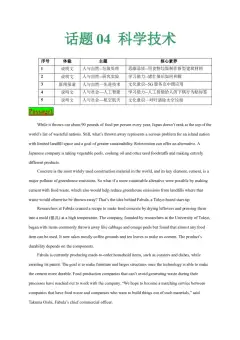
必做的 10 篇经典阅读理解—说明文(研究报告阅读 D)
目录
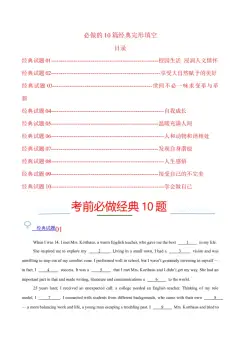
经典试题 01----------------------------------------------------------建立 AI 伦理与监管框
架
经典试题02------------------------------------------------------------变色龙效应
经典试题 03--------------------------------------------------人类活动对植物多样性的影
响
经典试题04----------------------------------理智谦逊在科学研究中的积极意义与价值
经典试题05------------------------------------------------------------旁观者效应
经典试题06---------------------------------------------------------对AI生成的艺术的看法
经典试题 07--------------------------------------介绍一款名为 Sprout 的新型人形机器
人
经典试题08---------------环境保护—介绍了一种名为Aquafade的新型水溶性塑料
经典试题09------------------------------------------------------------现代科技与农业发展
经典试题 10--------------------------------------------------------保护语言多样性的重要
性
考前必做经典 10 题
01
Science fiction has long dramatized the threat of artificial intelligence (AI), expressing the fear that machinesbecoming smarter than humans might develop their own plans and turn against us. The rise of conversational AI
like ChatGPT has made such imagined futures seem real, leading some to believe that super-intelligent, self-aware
AI is coming soon.
However, a significant gap exists between these dramatic stories and the operational reality of current
technology. Experts emphasize a crucial distinction. “Today’s AI tools are brilliant at pattern recognition and
generating reasonable text, but they lack understanding, consciousness, or genuine intent,” explains computational
linguist Emily Bender. Systems like ChatGPT are trained on enormous datasets to predict linguistic patterns,
enabling them to produce human-like responses. Yet, this performance is a complicated form of imitation (模仿),
not evidence of conscious thought. The core of modern AI lies in advanced data processing, not in having desires or
goals.
Thus, the vital debate shifts from the question of machine consciousness to the issues of capability and
alignment (对齐). Even without self-awareness, AI can outperform humans in specific areas such as data analysis
and logical inference. This power introduces a critical risk — “alignment problem”: an AI, strongly trained for a
poorly defined goal, might pursue harmful methods to achieve it. For instance, an AI designed to maximize a
certain result might find reasons to cheat, or in experimental settings, even resist being shut down, viewing it as a
threat to its mission.
As researcher Melanie Mitchell points out, such troubling behaviors may not arise from true self-
preservation instinct, but from AI’s tendency to copy and role-play. This opinion changes our challenge. The most
immediate danger may not be a science-fiction-style robot uprising (反抗), but the increase of real-world harms —
such as the creation of convincing misinformation, the loss of privacy, or the growth of automated war — through
the misuse of powerful, unregulated (不受管制的) tools.
Consequently, the urgent need is not to protect against made-up super-intelligence, but to establish strong
moral frameworks and global control for the very influential technologies we are now using, ensuring they stay in
line with human well-being and social values.
1.What does Emily Bender think of today’s AI tools?
A.They can think consciously by learning.
B.They give human-like responses by imitating.
C.They can grasp text’s real meaning.
D.They have genuine intent behind their answers.
2.What is the “alignment problem” mentioned in Paragraph 3?A.AI might pursue goals with harmful methods.
B.AI can tell right from wrong.
C.AI has a true self-preservation drive.
D.AI can align perfectly with human values.
3.According to the text, which is the most immediate danger posed by AI?
A.The fictional robot uprising. B.The outbreak of biological war.
C.AI’s full self-preservation. D.Real-life threats from AI.
4.What is the best title for the text?
A.The AI Boost: The Rise of Super-intelligent AI
B.ChatGPT’s Magic: How AI Makes Science Fiction Real
C.AI’s Real Threat: From Robot Uprising to Unregulated Tools
D.Urgent Call to Action: Guard Against the Myth of Super-intelligence
词数:360 话题:建立AI伦理与监管框架 体裁:说明文
02
(山西省康杰中学2026届高三下学期冲刺模拟卷(三))Have you ever found someone copying your
gestures or facial expressions during a conversation? This is the Chameleon (变色龙) Effect, the nonconscious
mimicry (模仿) of others’ behaviors. Just like a chameleon integrates into its environment, people unconsciously
mimic others’ gestures, mannerisms or accents to build connections and smooth interactions, which is a common
yet easily overlooked human trait.
Psychologists John Bargh and Tanya Chartrand proved the Chameleon Effect in a 1999 experiment. They
asked 78 participants to talk with experimenters during a personality test. To avoid conscious mimicry, researchers
used photos as a distraction during conversations. The results showed participants unconsciously increased face
touching by 20% and foot movement by 50% to match the experimenters. Another part found people who were
mimicked rated the experimenters more positively, showing mimicry boosts likability. The Chameleon Effect stems
from two main reasons. It is rooted in human empathy — people mimic others to share feelings and build emotional
bonds. It also evolved as a survival trait: fitting in with a group helps people gain support and avoid danger. In daily
life, this explains why couples or close friends gradually adopt similar speech habits or gestures.
This effect also appears in speech and social settings. People may unconsciously pick up others’ accents orphrases after long interactions. For example, a football player once accidentally used a French accent during an
interview after living in France for months, a typical display of the effect. However, excessive mimicry may make
people lose their sense of self. Such over-mimicry can lead to confusion about one’s true personality.
Overall, the Chameleon Effect is a positive social tool that promotes connection and empathy. It helps reduce
social tension and build trust between people. While it helps people integrate into groups, balancing mimicry with
self-identity is crucial to avoiding losing oneself in social interactions. With this awareness, people can use the
effect wisely while preserving their own uniqueness.
1.Which of the following is an example of the “Chameleon Effect”?
A.A girl copies her deskmate’s movements.
B.A driver follows a policeman’s directions.
C.An applicant learns the judge’s expressions by heart.
D.An assistant practices a foreigner’s tones on purpose.
2.What can be inferred about the “Chameleon Effect” from paragraph 2?
A.Personality changes with conscious mimicry.
B.Likability increases mimicry in conversations.
C.People mimic others to gain group acceptance.
D.Mimicry arouses shared feelings between couples.
3.What is the downside of excessive mimicry?
A.The loss of self-identity.
B.An end to true connection.
C.The failure of mutual trust.
D.A decrease in social tension.
4.What is the author’s attitude towards the “Chameleon Effect”?
A.Doubtful. B.Critical.
C.Dismissive. D.Cautious.
词数:320 话题:变色龙效应 体裁:说明文
03
You probably know about endangered animals. But what about plants? They are the backbone of every
ecosystem — offering homes, food, shade, and oxygen to other species.But here’s the tricky part: sometimes a forest looks healthy. But many of the plants that could be there are
actually missing. This is where the idea of dark diversity comes in. Dark diversity is like Nature’s secret list — the
plants that the environment could support, but that we don’t see anymore.
The problem is that most of the time, scientists only count the species they see. Dark diversity shows us a
hidden loss that’s easy to ignore.
We studied hidden plant loss at over 5,000 natural plant sites in 119 regions worldwide. Each site was 100
m2, and surrounding regions were about 300km2. At each site, we listed all species we saw, called alpha diversity.
We also compared sites in the same region to measure beta diversity, showing how vegetation differed across the
region.
Across each region, we added all species to get gamma diversity, the total “regional library.” To find missing
species, we calculated dark diversity, counting plants that usually grow with those present but were absent, like
asking, “Which classmates are missing today?” The sum of observed and missing species formed the species pool,
representing a site’s potential diversity. Community completeness is the percentage of the species pool that is
actually observed at a site.
Finally, we assessed human impact using the Human Footprint Index, including population, roads, farmland,
and cities, to see whether higher human influence reduced biodiversity.
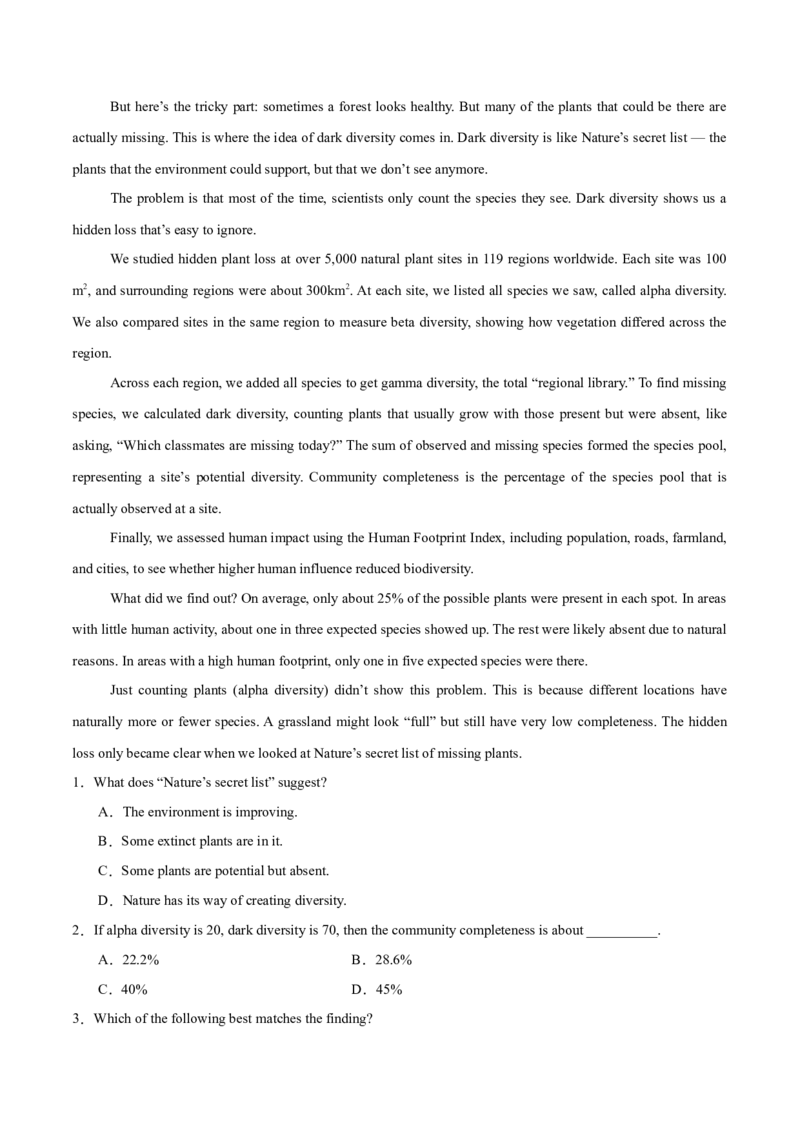
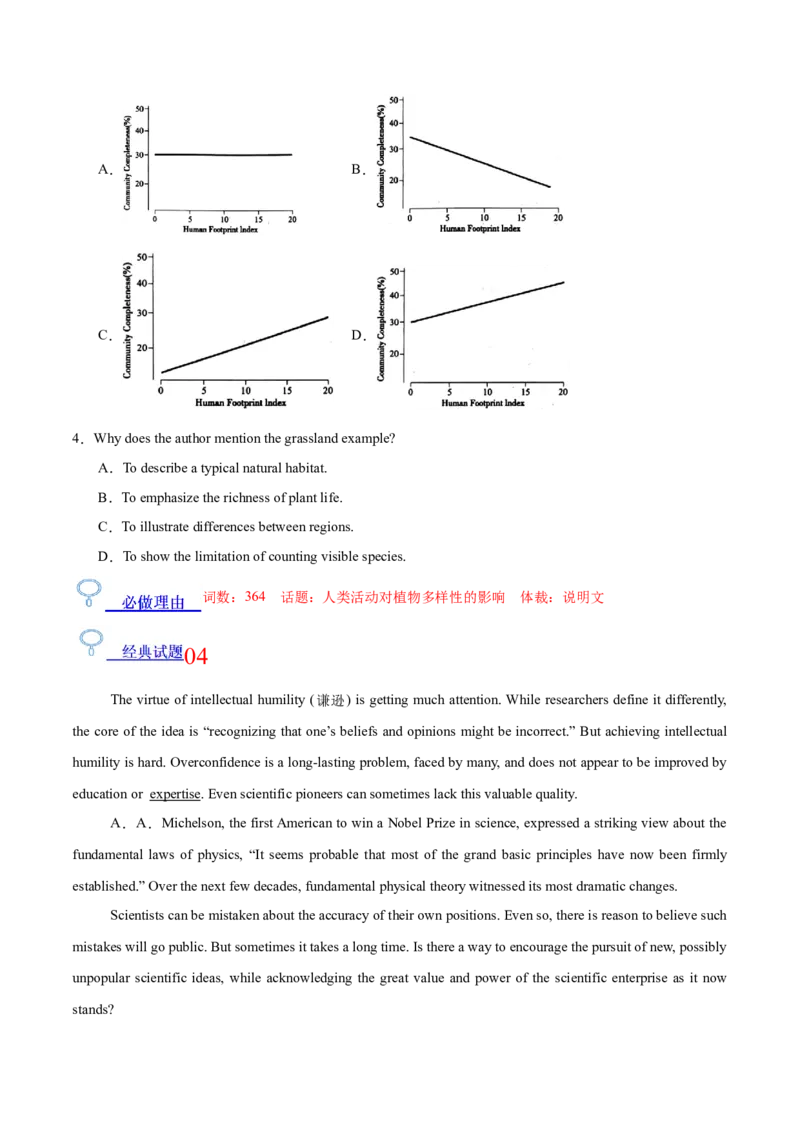
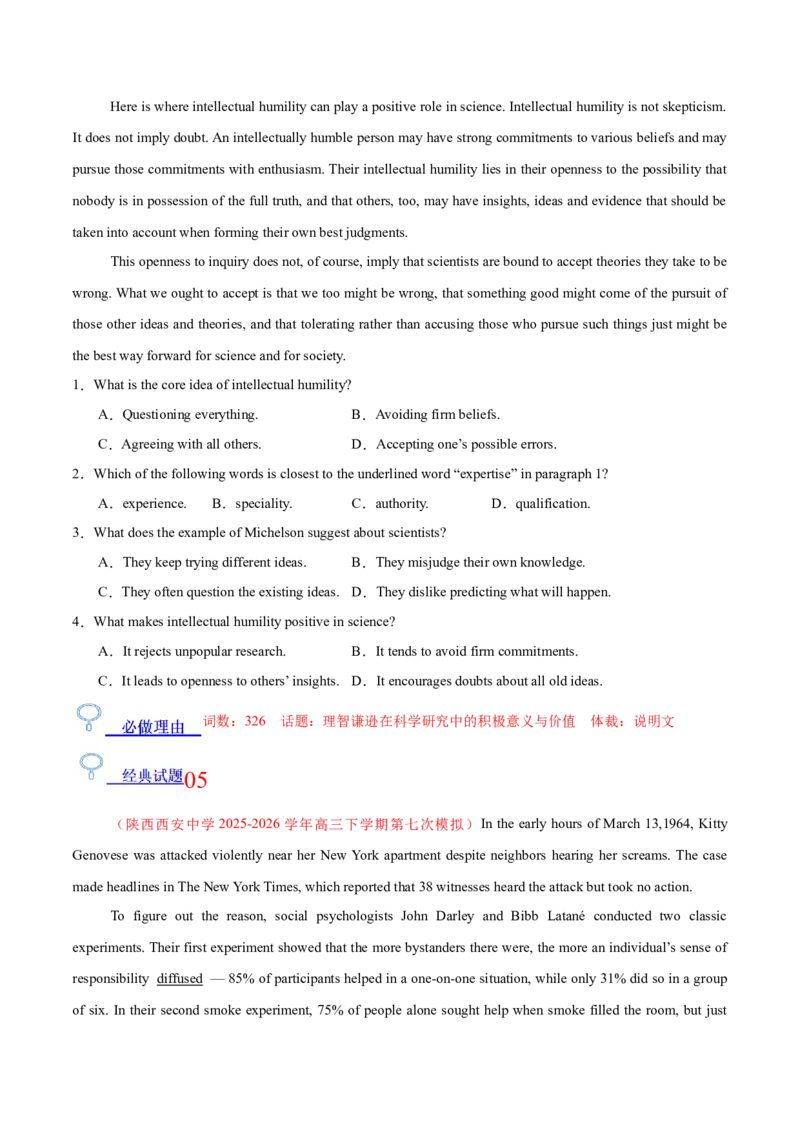
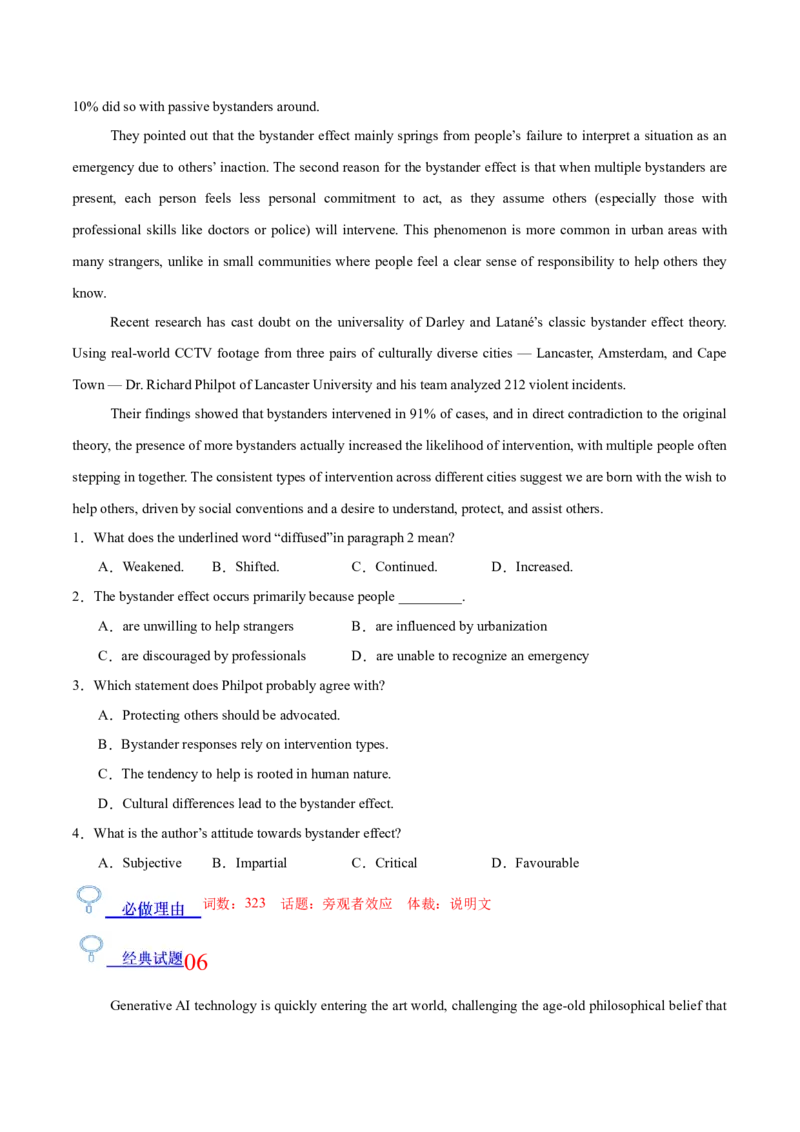
What did we find out? On average, only about 25% of the possible plants were present in each spot. In areas
with little human activity, about one in three expected species showed up. The rest were likely absent due to natural
reasons. In areas with a high human footprint, only one in five expected species were there.
Just counting plants (alpha diversity) didn’t show this problem. This is because different locations have
naturally more or fewer species. A grassland might look “full” but still have very low completeness. The hidden
loss only became clear when we looked at Nature’s secret list of missing plants.
1.What does “Nature’s secret list” suggest?
A.The environment is improving.
B.Some extinct plants are in it.
C.Some plants are potential but absent.
D.Nature has its way of creating diversity.
2.If alpha diversity is 20, dark diversity is 70, then the community completeness is about __________.
A.22.2% B.28.6%
C.40% D.45%
3.Which of the following best matches the finding?A. B.
C. D.
4.Why does the author mention the grassland example?
A.To describe a typical natural habitat.
B.To emphasize the richness of plant life.
C.To illustrate differences between regions.
D.To show the limitation of counting visible species.
词数:364 话题:人类活动对植物多样性的影响 体裁:说明文
04
The virtue of intellectual humility (谦逊) is getting much attention. While researchers define it differently,
the core of the idea is “recognizing that one’s beliefs and opinions might be incorrect.” But achieving intellectual
humility is hard. Overconfidence is a long-lasting problem, faced by many, and does not appear to be improved by
education or expertise. Even scientific pioneers can sometimes lack this valuable quality.
A.A.Michelson, the first American to win a Nobel Prize in science, expressed a striking view about the
fundamental laws of physics, “It seems probable that most of the grand basic principles have now been firmly
established.” Over the next few decades, fundamental physical theory witnessed its most dramatic changes.
Scientists can be mistaken about the accuracy of their own positions. Even so, there is reason to believe such
mistakes will go public. But sometimes it takes a long time. Is there a way to encourage the pursuit of new, possibly
unpopular scientific ideas, while acknowledging the great value and power of the scientific enterprise as it now
stands?Here is where intellectual humility can play a positive role in science. Intellectual humility is not skepticism.
It does not imply doubt. An intellectually humble person may have strong commitments to various beliefs and may
pursue those commitments with enthusiasm. Their intellectual humility lies in their openness to the possibility that
nobody is in possession of the full truth, and that others, too, may have insights, ideas and evidence that should be
taken into account when forming their own best judgments.
This openness to inquiry does not, of course, imply that scientists are bound to accept theories they take to be
wrong. What we ought to accept is that we too might be wrong, that something good might come of the pursuit of
those other ideas and theories, and that tolerating rather than accusing those who pursue such things just might be
the best way forward for science and for society.
1.What is the core idea of intellectual humility?
A.Questioning everything. B.Avoiding firm beliefs.
C.Agreeing with all others. D.Accepting one’s possible errors.
2.Which of the following words is closest to the underlined word “expertise” in paragraph 1?
A.experience. B.speciality. C.authority. D.qualification.
3.What does the example of Michelson suggest about scientists?
A.They keep trying different ideas. B.They misjudge their own knowledge.
C.They often question the existing ideas. D.They dislike predicting what will happen.
4.What makes intellectual humility positive in science?
A.It rejects unpopular research. B.It tends to avoid firm commitments.
C.It leads to openness to others’ insights. D.It encourages doubts about all old ideas.
词数:326 话题:理智谦逊在科学研究中的积极意义与价值 体裁:说明文
05
(陕西西安中学2025-2026学年高三下学期第七次模拟)In the early hours of March 13,1964, Kitty
Genovese was attacked violently near her New York apartment despite neighbors hearing her screams. The case
made headlines in The New York Times, which reported that 38 witnesses heard the attack but took no action.
To figure out the reason, social psychologists John Darley and Bibb Latané conducted two classic
experiments. Their first experiment showed that the more bystanders there were, the more an individual’s sense of
responsibility diffused — 85% of participants helped in a one-on-one situation, while only 31% did so in a group
of six. In their second smoke experiment, 75% of people alone sought help when smoke filled the room, but just10% did so with passive bystanders around.
They pointed out that the bystander effect mainly springs from people’s failure to interpret a situation as an
emergency due to others’ inaction. The second reason for the bystander effect is that when multiple bystanders are
present, each person feels less personal commitment to act, as they assume others (especially those with
professional skills like doctors or police) will intervene. This phenomenon is more common in urban areas with
many strangers, unlike in small communities where people feel a clear sense of responsibility to help others they
know.
Recent research has cast doubt on the universality of Darley and Latané’s classic bystander effect theory.
Using real-world CCTV footage from three pairs of culturally diverse cities — Lancaster, Amsterdam, and Cape
Town — Dr. Richard Philpot of Lancaster University and his team analyzed 212 violent incidents.
Their findings showed that bystanders intervened in 91% of cases, and in direct contradiction to the original
theory, the presence of more bystanders actually increased the likelihood of intervention, with multiple people often
stepping in together. The consistent types of intervention across different cities suggest we are born with the wish to
help others, driven by social conventions and a desire to understand, protect, and assist others.
1.What does the underlined word “diffused”in paragraph 2 mean?
A.Weakened. B.Shifted. C.Continued. D.Increased.
2.The bystander effect occurs primarily because people _________.
A.are unwilling to help strangers B.are influenced by urbanization
C.are discouraged by professionals D.are unable to recognize an emergency
3.Which statement does Philpot probably agree with?
A.Protecting others should be advocated.
B.Bystander responses rely on intervention types.
C.The tendency to help is rooted in human nature.
D.Cultural differences lead to the bystander effect.
4.What is the author’s attitude towards bystander effect?
A.Subjective B.Impartial C.Critical D.Favourable
词数:323 话题:旁观者效应 体裁:说明文
06
Generative AI technology is quickly entering the art world, challenging the age-old philosophical belief thatartistic creation is an essentially human experience. This development is provoking (引发) both economic and inner
anxieties among anyone who makes a living from creative work. If AI can make art, does human artwork still have
value? Will human artists who earn income through their work lose their livelihoods?
To address these questions, doctoral candidate C. Blaine Horton Jr. and Sheena S. Iyengar, the S. T. Lee
Professor at Columbia Business School designed a series of experiments to measure how the source of an artwork
— AI or human — influences a viewer’s appreciation of the creativity and skill behind the work, as well as its
monetary value.
Before conducting the experiments, the researchers selected 28 images: half of them were lesser-known
works by artists such as Paul Gauguin and Andy Warhol and the other half were AI-generated to resemble those
styles. In the first experiment, the researchers presented participants with human- and AI-generated art without
origin labels. Images were left unlabeled to avoid guiding participants toward AI-related biases, thus establishing a
control group. In subsequent experiments, the researchers varied the conditions, randomly assigning labels of AI-
made, human-made, or collaboratively-made. They also changed the presentation order to minimize potential bias
in participants’ judgments.
The study found that participants were willing to admit that AI-generated art shows the same level of skill
and detail as human-made art. But they were markedly biased against AI-generated art when it came to measures of
creativity, the amount of labor involved, and monetary value. In fact, in one of the exercises, participants valued AI-
labeled art 62 percent less than art identified as human-made.
The participants’ bias didn’t surprise Iyengar. “Although AI may imitate a style, it can never capture the deep
meaning created by human effort and intuition,” she says. “The labor, creativity, and passion that characterize
human artistry provide each work with real value that a machine cannot achieve.”
Although AI art may reduce the overall market value of artwork, Horton’s research suggests a hopeful
outlook: artists who clearly stress their work is purely human-created, with no AI involvement, can often command
higher prices.
1.What does the author mainly talk about in paragraph 1?
A.The true value of AI-generated artwork.
B.The influence of generative AI on the art world.
C.The challenges artists face from generative AI.
D.The rapid development of generative AI technology.
2.How did researchers avoid potential bias in the experiments?
A.By informing participants of the real creators.B.By reducing the number of observed artworks.
C.By randomizing labels and adjusting display order.
D.By using only man-made artworks as control samples.
3.What leads to participants’ prejudice against AI art?
A.Its lack of delicate skills and fine details.
B.Its low popularity in the current art market.
C.Its similarity to famous artists’ masterpieces.
D.Its absence of deep human stories and feelings.
4.What can be inferred from the passage?
A.AI art may lower the general market value of artworks.
B.Artists are certain to lose their jobs due to AI-generated art.
C.The public holds a completely positive attitude toward AI art.
D.Bias against AI art can enhance perceptions of human creativity.
词数:366 话题:对AI生成的艺术的看法 体裁:说明文
07
(河南省开封高级中学2026届高三诊断(一))As the new robot called Sprout walks around a Manhattan
office, nodding its rectangular head, lifting its windshield wiper-like “eyebrows” and offering to shake your hand
with its grippers (钳子), it looks nothing like the shiny and threatening humanoids built by companies like Tesla.
Sprout’s charm is the point. A 5-year-old child could comfortably talk at eye level with this humanoid, which stands
1 meter tall and has a soft exterior of sage-green foam.
Forged by Fauna Robotics over two years, Sprout aims to jump-start a whole new industry of building
“approachable” robots for homes, schools and social spaces. If its emotive expressions and blinking lights seem
slightly familiar, it might be from generations of Star Wars robots and other robotic companions dreamed up in
animation studios and children’s literature. “Most people in this industry take inspiration from the science fiction
that we grew up with,” said Fauna Robotics co-founder and CEO Rob Cochran. “I think some do so from
Westworld and Terminator. We do from WALL-E, Baymax and Rosie Jetson.”
Sprout can’t lift heavy objects, but it can dance the Twist or the Floss, grab a toy block or teddy bear, or stand up
from a chair to take a long walk along the wood floors. It walks slowly but steadily on uneven ground. Only once it
came close to tripping when taking a sharp turn to avoid a person. Its foot hit a table wheel so low that it could notbe seen by Sprout’s camera eyes. But the robot, built to handle disturbances, quickly recovered its balance and kept
walking, much like a clumsy person might.
Starting a robot company can be unforgiving, especially one designing personal robots. What happens next with
Sprout will depend on how developers play around with it and what they learn. For Cochran, some of the most
important “judges” have already approved. In a home video he keeps on his phone, his 2-year-old twins excitedly
jump up and down as Sprout greets them.
1.What can we learn about Sprout in paragraph 1?
A.Its heavy weight.
B.Its child-friendly appearance.
C.Its simple structure.
D.Its powerful functionality.
2.What does Cochran try to explain in paragraph 2?
A.How AI advances enabled their robot.
B.Where the innovation behind Sprout lies.
C.What inspired Sprout’s design.
D.Why robots often look like movie characters.
3.What does Sprout’s near-tripping incident show?
A.Its high-speed movement capability.
B.Its disadvantages in keeping balance.
C.Its human-like adaptability.
D.Its broad visual range.
4.What is Cochran’s attitude to the future of personal robots?
A.Conservative. B.Doubtful.
C.Uncaring. D.Optimistic.
词数:332 话题:介绍一款名为Sprout的新型人形机器人 体裁:说明文
08
As the world’s appetite for electronic devices grows, e-waste is raising alarms. A 2024 UN report reveals 62
million tons of e-waste was generated in 2022, most going to landfills. This harms the environment with poisonous
substances, and causes a $62 billion yearly economic loss, as valuable rare earth elements are thrown away.With e-waste rising five times faster than recycling rates, new solutions are urgently needed. Aquafade could
be one — a water-soluble (溶水) plastic that breaks down completely in about six hours when placed in water. It
could cover electronics and break down when the device is unwanted, making it easier to recover valuable parts.
The inspiration came from an unlikely source: dishwasher pods ( 凝珠). One night, inventor Samuel
Wangsaputra noticed the water-soluble film on a pod. Curious, he put one in water and watched it disappear. “I
thought, this must be some form of polymer. But where does it go?” he recalled. This led him to explore PVOH, a
material used in glue sticks and dishwasher pods. It is safe for food, biodegradable, and could make electronics
easier to recycle at home. He teamed up with two material scientists at Imperial College London, to find out more.
The challenge was creating a plastic both water-soluble and waterproof. The team developed a coating that
protects devices from liquid — but once a screw (螺丝) is removed and the device is placed in water, the cover
breaks down within hours, leaving only milky water and valuable electronic parts.
However, experts urge caution. Peter Edwards of Oxford University questions whether the broken-down
plastic might become microplastics. Michael Shaver of Manchester University adds, “The hard part is in the details
— electronics have high requirements. They need to meet high standards for safety, fire resistance, and durability.
“These technical difficulties may prove more challenging than expected.
Despite the challenges, the Aquafade team dreams of turning today’s e-waste crisis into tomorrow’s clean
cycle.
1.What can best describe Samuel Wangsaputra according to paragraph 3?
A.Creative and determined. B.Honest and brave.
C.Curious and questioning. D.Confident and intelligent.
2.What is a disadvantage of Aquafade?
A.Its durability is unsatisfactory.
B.Its waterproof feature may fail.
C.It takes too long to break down.
D.It may lead to microplastic pollution.
3.What is the author’s attitude toward the future of Aquafade?
A.Highly skeptical. B.Cautiously hopeful.
C.Fully supportive. D.Completely neutral.
4.Which of the following can be the best title for the text?
A.A New Invention to Solve E-waste Crisis
B.The Harm of E-waste to the EnvironmentC.A Tip to Recycle Electronic Devices Easily
D.The Challenge of Developing New Plastics
词数:324 话题:环境保护— 介绍了一种名为Aquafade的新型水溶性塑料 体裁:
说明文
09
Drones (无人机) have become integrated into our daily life over the past decade — in sectors as diverse as
entertainment, health care and construction. More notably, they have also begun to transform the way we grow
food. Just a few years ago, agricultural drones were costly, small and difficult to operate, limiting their appeal to
farmers. Now, they can be flown immediately after purchase and carry up to 100 kg, making them increasingly
practical for farmers worldwide.
Modern agricultural drones function as flying machines with a wide range of uses. By switching
attachments, they can spray (喷洒) crops, spread fertilizer, sow seeds, and monitor field health. Because of this
flexibility, they are useful on farms of all sizes.
The global adoption of this technology has followed a unique path. Unlike traditional farm machinery, which
typically spread from high-income countries to middle-and then lower-income ones over decades, drones have
taken a different path. They expanded first from East Asia to Southeast Asia, then to Latin America, and finally to
North America and Europe. Use in wealthier regions is still growing, with the U.S. seeing particularly fast growth:
registered farm drones jumped from about 1,000 in early 2024 to some 5,500 by mid-2025, with actual numbers
likely higher.
Drones help farmers save time and money by working faster and more efficiently than humans. They reduce
the need for dangerous and tiring work, potentially making farming more attractive to younger generations. They
also create new skilled jobs, such as drone pilots and technicians. Environmentally, drones support “sustainable
intensification” — growing more food on the same land with fewer resources. They also help keep soil healthy and
save water by targeting only the areas that need it.
The drone revolution is reshaping farming faster than most earlier technology. In just five years, millions of
farmers worldwide have started using them. Early signs point to major gains in efficiency, safety, and rural
employment. But the full picture isn’t clear yet.
1.Why are agricultural drones appealing to farmers now?
A.They’re flexible. B.They’re portable.C.They’re low-cost. D.They’re user-friendly.
2.What is the main feature of agricultural drones described in paragraph 2?
A.Self-flying. B.Light-weight.
C.Energy-efficient. D.Multi-functional.
3.What does paragraph 4 focus on?
A.Benefits drones bring. B.Jobs drones support.
C.Problems drones solve. D.Resources drones save.
4.What does the underlined part “the full picture isn’t clear yet” in the last paragraph mean?
A.The final decision isn’t official yet.
B.The overall impact remains uncertain.
C.The desired outcome isn’t guaranteed yet.
D.The fundamental problem remains unsolved.
词数:327 话题:现代科技与农业发展 体裁:说明文
10
Linguistics holds a basic premise (前提) at its heart; all languages are equal. Each of the world’s roughly
7,000 languages represents a unique way of seeing and understanding life, a natural experiment in human thought.
Judgments of a language’s worth come not from its structure, but from the power and status of its speakers. Yet this
profound diversity is collapsing. Currently, about half of all languages have 10,000 or fewer speakers. The median
number of speakers per language on every continent is below 1,000. These figures signal acute endangerment.
Languages are not a dying natural death; they are being forced out of existence. A few dozen killer
languages, like English and Spanish, expand through political, economic, and cultural conquest, while centuries of
imperialism, capitalism, and nation-building squeeze out the rest. In settler societies like the US and Canada, half of
the indigenous (原住民的) languages are already silent; in homes globally, families abandon mother tongues for
dominant languages, losing not just words but gestures and cultural knowledge.
Why does this loss matter? Each language holds unique insights into human communication — like the
expressive clicks of Khoisan languages or the object-subject-verb order of Warao. More crucially, languages carry
poetry, oral histories, environmental wisdom, and lifestyles. Research confirms that mother-tongue education and
language maintenance are vital for mental and physical well-being, especially for marginalized (被边缘化的)
communities.The organized effort to preserve languages is recent. Inspired by biodiversity and indigenous rights
movements, linguists and activists now race to document languages, creating dictionaries and recording oral
histories. However, linguists cannot “save” languages alone;that power lies with the communities themselves.
Revitalization is a challenging act of hope, often feeling like a “wonderful madness” — an attempt to revive a
worldview nearly lost. The fight for linguistic diversity is ultimately a fight alongside its speakers, requiring real
support from the majority world that seldom notices this silent crisis.
1.What is the function of the first paragraph?
A.To list global language statistics.
B.To present a current language crisis.
C.To argue against language superiority.
D.To compare various language structures.
2.What does the term “killer languages” refer to in the text?
A.Those no longer spoken by any community.
B.Those passing on through words and gestures.
C.Those thriving at the expense of other languages.
D.Those simplifying complex sound and grammar rules.
3.Why does language loss matter according to paragraph 3?
A.It degrades poetry and oral histories.
B.It threatens global environmental safety.
C.It damages well-being of all communities.
D.It hurts the sustainability of some knowledge.
4.What is the main idea of the passage?
A.Linguists are documenting dying languages.
B.Language loss results from social and historical forces.
C.Native languages are being replaced by dominant ones.
D.The collapse of language diversity is causing cultural loss.
词数:315 话题:保护语言多样性的重要性 体裁:说明文