一模前专题练02 阅读四选一
说明文
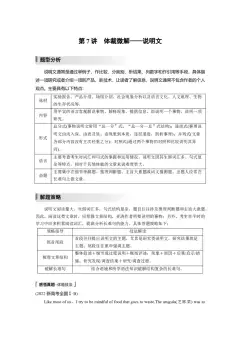
【体裁特点】
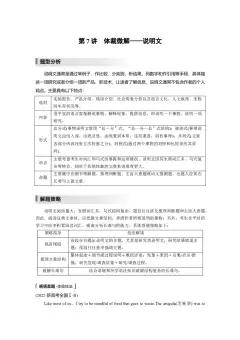
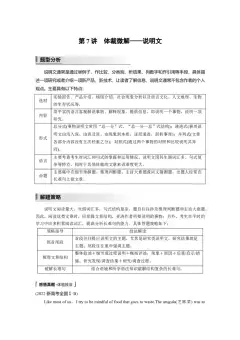
说明文是指运用较为朴实的语言来客观地解释某个问题、某种现象类的文章。说明文的总体结构通常
分为三个部分:说明对象、说明过程和归纳总结;从段落组织方式上分,常见的有以下五种结构:总分式
结构(总→分→总;总→分;分→总);并列式结构(段落之间是平行关系,并且相对独立);对照式结构(结
构形式是一正一反);递进式结构(文章各部分内容形成一层更进一层的形式);连贯式结构(说明的各层次之
间是按照事物发张过程来安排层次,前后互相承接)。
说明文常见的说明方法有:定义与诠释、举例与引用、分类与图表、比较与比喻和分析与综合等。了
解说明文的写作手法、说明方法,理清文章结构是解题的关键之一。
【考情概览】
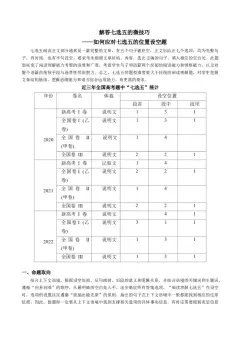
近五年高考阅读理解C、D 篇主要考查说明文,偶尔会出现议论文。说明文中科普说明文占比较大。
高考说明文体裁的阅读材料通常多为科普读物(包括介绍最新科技、重大成就等)、自然现象和新产品、新
工艺介绍以及人文地理、风土人情等等。
高考阅读理解题中CD 篇,特别是D 篇是一道非常拉分的题。为什么会拉分,因为它难度大,具体体
现在下列五个“难点”:一是熟词僻义、课标衍生词、某些专业术语让考生处处碰壁;二是篇幅长以及较
多结构复杂的长难句让考生阅读时步履维艰;三是纷繁复杂的题材(甚至有些题材考生闻所未闻)让考生不
知所云;四是复杂的篇章结构、说明/描述方式、方法的多样性、层次性让考生应接不暇。五是四类题型
(细节理解题、推理判断题<包括篇章结构的推断>、主旨大意题以及词义猜测题)的全面考查让考生疲于奔
命。
【解题锦囊】
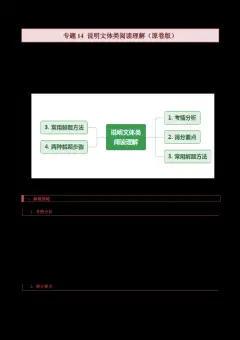
1. 快速浏览——整体把握说明对象
如果文章有标题那首先就要抓住文章的标题明确说明对象;其次可抓住文章的结构归纳说明对象。一
般说明文往往都会围绕一个主要问题或内容进行说明,而有的说明文则需要我们把小说明点归纳起来,构
成全文的说明对象。
2. 先题再文——带着题干通读全文
在对文章进行快速浏览之后,开始第二遍仔细阅读。在阅读前,需要先看题干,之后带着题干进行阅
读,才能做到把握全局、有所侧重。
3. 精准定位——重点研读几个片段
在仔细审读文章后,想必对文章已经有了深刻的印象与认识,此时再次回归问题,将考查内容(主要是
细节理解题和推理判断题)在原文中定位,重点研读定位的几个片段。研读的重点是利用“三步法”结合简
单句、并列句和复合句的知识破解与解题有关的长难句:抽丝剥茧找主干、条分缕析理枝叶、聚零为整破
整句。破解长难句的基础是要了解长难句句型的特点:①带有较多附属成分的简单句;②含有多个分句的
并列句;③含有多个分句的主从句;④复杂分句结构;⑤省略、倒装、虚拟、同位语、插入语等复杂语法
现象。
【典例】(与解题有关的)例句均选自【2024·浙江1 月卷D 篇】
1. But as we’ve reshaped the world around us, dramatically reducing the cost and effort involved in obtaining
calories, we still have the same brains we had thousands of years ago, and this mismatch is at the heart of why so
many of us struggle to resist tempting foods that we know we shouldn’t eat.
抽丝剥茧找主干:
条分缕析理枝叶:
聚零为整破整句:
2. Therefore, just as we need to be more thoughtful about our caloric consumption, we also need to be more
thoughtful about our information consumption, resisting the temptation of the mental “junk food” in order to
manage our time most effectively.
抽丝剥茧找主干:
条分缕析理枝叶:
聚零为整破整句:
3. We’ re not tempted(诱惑)by sugary treats, but by our computers, phones, and tablets—all the devices that
connect us to the global delivery system for various types of information that do to us what marshmallows do to
preschoolers.
抽丝剥茧找主干:
条分缕析理枝叶:
聚零为整破整句:
【典例】
【2025·浙江1 月卷C 篇】
A novel design approach to gardening has been gaining in popularity worldwide. Referred to as matrix
planting, this approach aims for nature to do a lot more of the heavy lifting in the garden, and even some of the
designing. Eschewing fertilizers(化肥)and power tools, it’s based on an elegantly simple principle: to garden more
like nature does.
The concept was born when German city planners sought to plant large areas of parkland after World War II
in a reproducible way that would need minimal maintenance. Planners created planting mixes that could be used
modularly( 模块化). In a matrix garden, plants with similar cultural needs are grouped so that they will grow
together above and below ground, forming a cooperative ecosystem that conserves water and discourages weeds.
Dutch plantsman and designer Piet Oudolf’s gardens popularized this style, adding artistic flavors to the
planting mixes while playing with color and form, including four-season interest and serving the needs of wildlife.
Beautiful year-round, they invite you to enjoy the smallest detail, from the sound of grasses in the gentle wind to
the sculpture of odd-looking seed heads.
It takes a lot of thought to look this natural. While matrix gardens appear wild, they are carefully planned,
with cultural needs the first consideration. Led by the concept of “right plant, right place,” they match plants that
enjoy the same soil, sun and weather conditions, and arrange them according to their patterns of growth.
The benefits are substantial for both gardener and planet. With human inputs dramatically reduced, the
garden’s ecology can develop well. Established matrix gardens should not need the life support we give most
gardens: fertilizer, dividing, regular watering. Compared to traditional garden plots, they increase carbon
absorption, reduce stormwater runoff and boost habitat and biodiversity significantly.
28. What does the underlined word “Eschewing” in the first paragraph mean?
A. Running out of.
B. Keeping away from. C. Putting up with.
D. Taking advantage of.
29. Why was the idea of matrix planting introduced?
A. To control weeds in large gardens.
B. To bring in foreign species of plants.
C. To conserve soil and water resources.
D. To develop low-maintenance parkland.
30. Which of the following best describes Piet Oudolf’s gardens?
A. Traditional.
B. Odd-looking.
C. Tasteful.
D. Well-protected.
31. Which of the following can be a suitable title for the text?
A. The future of gardening is WILD.
B. Nature treats all lives as EQUALS.
C. Matrix gardens need more CARE.
D. Old garden plots work WONDERS.
【典例】
【2025·浙江1 月卷D 篇】
As new technologies take on increasingly humanlike qualities, there’s been a push to make them genderless.
“People are stereotyping(形成刻板印象)their gendered objects in very traditional ways,” says Ashley Martin, a
Stanford associate professor of organizational behavior. Removing gender from the picture altogether seems like a
simple way to fix this. Yet as Martin has found in her work, gender is one of the fundamental ways people form
connections with objects, particularly those designed with human characteristics.
In her study, Martin asked participants to rate their attachment to male, female, and genderless versions of a
digital voice assistant and a self-driving car known as “Miuu.” It was found that gender increased users’ feelings of
attachment to these devices and their interest in purchasing them. For example, participants said they would be less
likely to buy a genderless voice assistant than versions with male or female voices.
While gendering a product may be good marketing, it may also strengthen outdated or harmful ideas about
power and identity. The stereotypes commonly associated with men, such as competitiveness and dominance, are
more valued than those associated with women. These qualities, in turn, are mapped onto products that have been
assigned a gender.
Martin’s study also found that creating a genderless object was difficult. For instance, if an object’s name
was meant to sound genderless, like Miuu, participants would still assign a gender to it — they would assume Miuu
was a “he” or “she.”
Martin sees a silver lining, however: She believes that anthropomorphism(拟人化)“provides an opportunity
to change stereotypes.” When women are put into positions of leadership like running companies, it reduces
negative stereotypes about women. Similarly, anthropomorphized products could be created to take on
stereotype-inconsistent roles — a male robot that assists with nursing or a female robot that helps do calculations,
for instance.
32. What is the purpose of making new technologies genderless?
A. To reduce stereotypes.
B. To meet public demand.
C. To cut production costs.
D. To encourage competition.
33. What were the participants probably asked to do in the study?
A. Design a product.
B. Respond to a survey.
C. Work as assistants.
D. Take a language test.
34. Why is it difficult to create genderless objects?
A. They cannot be mass-produced.
B. Naming them is a challenging task.
C. People assume they are unreliable.
D. Gender is rooted in people’s mind.
35. What does the last paragraph mainly talk about?
A. The quality of genderless products.
B. The upside of gendering a product.
C. The meaning of anthropomorphism.
D. The stereotypes of men and women.
C-1
(2026 届福建省福州市高三上学期一模)Imagine you’re writing a poem, rhymes must be paired up before
you start a new line. It turns out that AI does something similar when Claude, a large language model(LLM), is
given the first line “he saw a carrot and had to grab it”, it begins thinking about words like “rabbit” almost
immediately, writing the next sentence to end at the appropriate rhyme.
Such forethought is unexpected. Scientists at Anthropic, the lab that developed Claude, built a tool and they
discovered some unexpected complexity.
The tool, a “digital microscope”, lets scientists look at which parts of the AI’s neural(神经的)network light
up when it’s working on different tasks. If a particular area of the LLM lights up whenever it produces words like
rabbit, then that gets marked as being related to rabbits.
This has let the team solve some open questions in AI research, for example, whether a multilingual(多语言
的)chatbot has awareness of concepts beyond language. When Claude is asked for the opposite of “big” in English,
or the same concept in Chinese, the same feature lights up in every case, before more language-specific circuits
kick in to “translate” the concept of smallness into a particular word. This suggests that AI might have a deeper
understanding of the world than we thought.
Other insights, though, are less encouraging. When Claude itself is asked to reason, printing out its chain of
thought to answer maths questions, the microscope suggests that the way the model says it reached a conclusion,
and what it actually thought, might not always be the same. Worse still, ask a leading question — suggesting that
the answer “might be 4”, and it will specifically add numbers that ultimately lead it to agree with the question, even
if the suggestion is wrong.
But being able to gain insight into the mind of an LLM provides clues as to how to stop it doing the same in
the future. The goal, after all, is not to have to do brain surgery, but to know what it’s thinking.
28. What does the writer intend to show through the example in paragraph 1?
A. AI can write texts as programmed.
B. AI can plan sentences in advance.
C. AI can deal with complex tasks.
D. AI can simplify rhyming lines.
29. How does “digital microscope” function in the research?
A. By tracking AI’s thinking activities.
B. By working on different jobs.
C. By activating AI’s “brain” potential.
D. By matching language patterns.
30. What can be inferred from paragraph 5 about Claude?
A. It may make stuff up.
B. It may skip chains of thought.
C. It may leave clues out.
D. It may give logical reasoning.
31. Which of the following titles best suits this text?
A. Why AI Still gets It Wrong
B. Chatbots’ Language Magic
C. Looking Inside AI’s Mind
D. The Rise of AI Chatbots
C-2
(2026 届浙江省强基联盟高三上学期10 月一模)As the global population continues to expand, traditional
farming methods are struggling to provide enough food. However, an innovative agricultural company in Compton,
Los Angeles, may have the solution. Their revolutionary farming system could transform food production, offering
remarkable efficiency and sustainability.
It’s far from the storybook picture of a farm — no mud, no boots, no hens pecking in the yard. Unlike
conventional farms, this high-tech facility operates without soil, heavy machinery, or pesticides. Instead, it relies on
automation and advanced plant science to maximize output. Using precisely calibrated(符合标准的)LED lighting
and nutrient delivery systems, the facility produces up to 350 times more yields compared to traditional farms while
using just 10% of the water — and it can be replicated(复制)almost anywhere.
The entire process — from planting seeds to packaging produce — is automated. From the moment a worker
tips seeds into the sowing machine, robots take over. Nearly 80 plant scientists study best growing conditions for
each plant, working with over 100 engineers who translate these findings into hardware and software solutions.
“Plants are really just little software programs,” explains one of the scientists. By studying plant DNA
without changing it, scientists can program qualities like growth, flavor, and nutrition. For instance, exposing plants
to blue light at specific growth cycles creates leaves with a satisfying crunch at harvest. The same principles can
enhance antioxidant levels in vegetables by up to 40%. Since crops never contact soil, pesticides, or human hands,
they require no washing — reducing both water waste and contamination risks.
One of the greatest threats to the natural world is habitat loss due to farmland expansion. If successful, farms
like this could reduce deforestation while meeting food demands. Yet the high costs — including energy-intensive
artificial lighting — may block global adoption, particularly in developing nations where infrastructure is limited.
Could this be the future of agriculture? With its incredible efficiency, minimal environmental impact, and
potential for worldwide replication, this high-tech farming model may soon become essential in feeding our
growing world — if the challenges of scaling and affordability can be overcome.
28. What is the main feature of the innovative farming system?
A. It demands water-free technology.
B. It gets high yields with little input.
C. It is widely introduced in the world.
D. It mixes old and new farming methods.
29. What is the scientists’ major role in the process of the farming system?
A. They are gene editors.
B. They are machine operators.
C. They are system monitors.
D. They are plant programmers.
30. What may limit the worldwide spread of this farming system?
A. Low public acceptance.
B. Great farmland loss.
C. Poor production facilities.
D. High energy demands.
31. What is the author’s attitude toward the future of agriculture?
A. Optimistic.
B. Critical.
C. Indifferent.
D. Doubtful.
C-3
(2026 届湖北省武汉市部分高中高三上学期九月调研)With a surface hot enough to melt lead in its
atmosphere, Venus has been described as “Earth’s evil twin” — similar in size, yet worlds apart. The question of
whether Venus was ever habitable has long been a hot topic among scientists. Some astronomers believe the planet
was once much more hospitable, but a recent research by Tereza Constantinou, a PhD student from the University
of Cambridge, has now dealt a blow to the idea that it ever hosted life as we know it.
Constantinou noted that early in the formation of Venus, the planet was covered in a vast sea of magma(岩
浆). If this cooled quickly, water would form oceans or be trapped as it crystallised(结晶), meaning the planet’s
interior(内部)would be water-rich. As a result, water would be released when volcanoes erupt. “If you look at any
photos of volcanism on Earth, you can see these large clouds coming out. Most of that is water,” said Constantinou.
But if the magma cooled slowly, water would have ended up as steam in the atmosphere. In this situation, water
would not be trapped inside the interior of the planet.
Constantinou and his colleagues studied changes in the Venusian atmosphere to cast light on the water
content of its interior. When they analysed the amount of substances being refilled, they found very little water was
being added. In other words, volcanic eruptions are “dry”. “The shortage of water in volcanic release reflects an
equally dry Venusian interior,” said Constantinou. The team announced that their findings did not support the
theory that Venus had surface oceans of water in its past, or a habitable climate.
Their conclusion could soon be tested. Later this decade, NASA is set to launch a mission to carry out fly-
bys of Venus. Constantinou said resolving the question could help astronomers rule out Venus as a habitable planet
now that the dry interior of Venus suggests it never has the oceans of liquid water traditionally thought necessary
for life to begin.
28. What is the finding of the recent research?
A. Venus is Earth’s identical twin.
B. Venus sets the whole world apart.
C. Venus was unlikely to sustain life.
D. Venus was more habitable than thought.
29. What is paragraph 2 mainly talking about concerning the research?
A. Its methods.
B. Its procedures. C. Its potential impact. D. Its theoretical foundation.
30. How did Constantinou and his colleagues draw their conclusion?
A. By analysing the changes of water content.
B. By studying the properties of substances.
C. By investigating the components of water.
D. By examining the differences of volcanoes.
31. What can the finding be used to do according to Constantinou?
A. Carry out more fly-bys.
B. Identify upcoming threats.
C. Conduct Venus observations.
D. Narrow down astronomers’ search.
C-4
(2026 届山东省聊城市百师联盟高三上学期第一次调研)Yellowstone’s wolves are helping a new
generation of young aspen(山杨)trees to grow tall and join the forest — the first new generation of such trees in
Yellowstone’s northern range in 80 years.
Gray wolves had disappeared from Yellowstone National Park by 1930 following extensive habitat loss,
human hunting and government wolf-killing programs. Without these wolves, populations of deer grew quickly. At
their peak population, an estimated 18,000 deer ranged across the park, living on grasses as well as the leaves of
trees like aspen. This prevented young trees from establishing themselves, and surveys in the 1990s found no young
aspen trees. But when wolves were reintroduced in 1995, the picture began to change. As wolf numbers rose, the
deer population in the park dropped sharply, and it is now down to about 2,000.
In the new study, published in the journal Forest Ecology and Management, Luke Painter and his colleagues
from Oregon State University surveyed aspen stands. “We’re seeing significant new growth of young aspen and this
is the first time that we’ve found it in our plots since the 1940s,” Painter said.
However, while Yellowstone’s aspen are recovering, they aren’t out of the woods just yet. The deer
population has declined, but bison(野牛)numbers have increased in recent years. Bison are a lot harder for wolves
to take down, said Painter, so increasing numbers of bison may be emerging as a new restriction on aspen in some
areas.
The re-emergence of aspen has widespread effects, Painter said. “Aspen are a key species for biodiversity.
The aspen trees let more sunlight through their leaves, which creates a habitat that supports a lot of diversity of
plants.”
“The paper shows the important ecological benefits occurring from the restoration of wolves to Yellowstone
National Park,” Dominick Spracklen, a professor at the University of Leeds, said. “Ecosystems that lack large
carnivores(食肉动物)are often increasingly out of balance. While reintroducing carnivores raises important
challenges around human-wildlife coexistence, this work brings the significant ecological benefits in the long run.”
28. What can be inferred about Yellowstone Park before 1930 according to the text?
A. Deer population reached its peak.
B. Human activities slightly affected wolves.
C. Bison were the main species in the park.
D. Gray wolves existed with deer there.
29. What does the underlined sentence in paragraph 4 mean?
A. The aspen trees are too young to make a forest.
B. The aspen trees cannot get rid of survival threat.
C. Other tree species may hold back aspen’s recovery.
D. Yellowstone is not the best habitat for aspen trees.
30. What is Professor Spracklen’s attitude toward carnivore restoration in ecosystems?
A. Favorable.
B. Skeptical.
C. Disapproving.
D. Worried.
31. Which of the following can be a suitable title for the text?
A. The History of Gray wolves in Yellowstone
B. The Return of Gray wolves Revives Aspen Trees
C. The Challenges of Human-Wildlife Coexistence Grow
D. The Restoration of Large Carnivores in National Parks
D-1
(2026 届广东省大湾区高三上学期普通高中毕业年级联合模拟)Natural disasters like earthquakes usually
cause interruptions to communications, posing great challenges to rescue efforts. So in 2008, China launched the
Tiantong Project to set up a satellite communication system accessible to the public.
Now the project has led to major advances in satellite communication and mobile phone development. In
2021 the Tiantong satellites formed a network covering the entire Asia-Pacific region. In August, 2023, Huawei
released the world’s first smartphone that supported satellite calls, by directly connecting to the Tiantong satellites.
On December 18, 2023, a 6.2-magnitude earthquake hit Gansu, causing widespread communication interruptions.
Thanks to the Tiantong satellites, many of those trapped in the disaster were able to connect with the outside world
through the satellite calling function on their smartphones.
Direct satellite connectivity for mobile phones was previously believed to be impossible. To reach a small
smartphone, the satellite needs to produce a very powerful signal. When a large number of different high-power
signals flood the satellite’s transmitting antenna(传输天线)at the same time, they can lower the quality of satellite
calls and, in severe cases, cause the entire system to collapse. Since the 1970s, nearly all the previous commercial
communication satellite networks have experienced such major failures. This issue, known as PIM, was once a
bottleneck for further development of satellite communication technology.
To solve this problem, Chinese physicists have established a physical model that can predict the occurrence
of PIM with incredible accuracy. Based on this work, Chinese scientists developed the world’s first PIM
simulation( 模拟)software, which, in turn, helped Chinese engineers develop a series of effective technologies
against PIM. These key scientific and technological breakthroughs enable the Tiantong satellites to transmit and
receive electromagnetic(电磁)waves in 800 different frequency bands and, meanwhile, resist daily temperature
changes of up to 160°C.
Solving the PIM problem in such tough working conditions is extremely challenging. The success of
Tiantong exhibits the hard work of the project team and marks China’s leading position in this technical field
around the globe.
32. What was probably the original intention of the Tiantong Project?
A. To promote mobile phone development.
B. To build a natural disaster rescue system.
C. To develop commercial satellite technology.
D. To build an emergency communication system.
33. What is the primary cause of PIM?
A. Collapse of the systems.
B. Overload of strong signals.
C. Lack of physical models.
D. Equipment of low qualities.
34. What does the author want to prove by mentioning previous satellite networks?
A. The risk of satellite networks.
B. The necessity of solving PIM.
C. The fault of satellite networks.
D. The difficulty of solving PIM.
35. What plays a key role in the success of the Chinese team?
A. Their close cooperation.
B. The powerful satellites.
C. Their accurate prediction.
D. The PIM software model.
D-2
(2026 届河北省衡水市高三上学期第二次调研考试二)The Galle Trilingual Inscription has been officially
inscribed(刻写)in the UNESCO Memory of the World Register. The stele(石碑)was constructed over 600 years ago
during Zheng He’s expeditions.
The stele’s rounded top features two dragons playing with a pearl. It is the only one surviving overseas that is
related to Zheng’s voyages. It’s still distinguishable today. It tells us that Zheng paid respect to religious sites and
made celebration offerings during his visits. Carved in three languages — Chinese, Tamil and Persian — the stele
has a historical value beyond words.
“There are many multilingual inscriptions in the world, but most of them are bilingual,” says Wang Hongmin
from the National Archives Administration of China. “Among the tri-lingual ones, only two include Chinese. The
Galle Trilingual Inscription is the only one inscribed in Chinese, Persian and Tamil.”
The inscription records Zheng’s offerings of equal value to several deities(神祇). “This practice reflects the
Zheng’s respect for religious diversity,” says Wang Deyan from the North China University of Technology.
This year marks the 620th anniversary of Zheng’s voyages. The explorer first set sail from Nanjing in 1405
and traveled as far as the eastern coast of Africa. At the time, Ceylon(now Sri Lanka)served as a key maritime
center in the Indian Ocean. It played a vital role in connecting Asian countries with the Arab world. Wang Deyan
added.
“Experts generally agree that Zheng stopped in Ceylon on almost every voyage,” notes Wang Deyan. “He
was on cordial terms with the local people. Their interactions not only facilitated cultural exchanges but also laid a
solid foundation for trade between China and Ceylon at that time.”
China and Sri Lanka have maintained a long-standing and close partnership in the study and preservation of
the Galle Trilingual Inscription. It is a symbol of the historical relationship between the two nations and a reminder
to cherish cultural diversity.
32. Why is the Galle Trilingual Inscription special?
A. It is inscribed in three languages.
B. It has complicated structure.
C. It was built by local people.
D. It can still be recognized.
33. What role does paragraph 5 play in the text?
A. Detailing the stele’s features.
B. Providing historical context.
C. Describing preservation efforts.
D. Highlighting international cooperations.
34. Which can replace the underlined phrase in paragraph 6?
A. Deeply absorbed by.
B. In cautious reliance on.
C. Constantly disturbed by.
D. In a friendly relationship with.
35. What can be inferred about the stele from the last paragraph?
A. It shows cultural ties.
B. It is newly discovered.
C. It is stored in two countries.
D. It records conflicts between nations.
D-3
(2026 届湖北省湖北省部分市州高三上学期9 月调研)Microscopic plastic pieces are everywhere, and a
new study reveals they exist in bottled water at concentrations 10 to 100 times higher than previously estimated.
Researchers from Columbia University and Rutgers University found roughly 240,000 detectable plastic pieces in a
typical liter of bottled water, with the study published in the Proceedings of the National Academy of Sciences.
The researchers used stimulated Raman scattering microscopy and machine learning to detect seven common
plastics, testing three unnamed bottled water brands. About 10% of these particles( 微粒)are microplastics(5
millimeters to 1 micrometer), and 90% are nanoplastics(纳米塑料)(less than 1 micrometer). Microplastics have
already been found in human lungs, blood and placentas. “Nanoplastics could be even more dangerous than
microplastics because when inside the human body, the smaller it goes, the easier for it to be misidentified as the
natural component of the cell,” says Wei Min, a Columbia chemistry professor and co-author on the study.
The International Bottled Water Association(IBWA)stated it had “very limited notice” to review the study,
arguing the new detection method needs to be fully reviewed by the scientific community and more research needs
to be done to develop standardized methods for measuring and quantifying nanoplastics in our environment. It
added there is no scientific agreement on the potential health impacts of nano and microplastic particles and media
reports unnecessarily scare consumers.
Phoebe Stapleton, another co-author of the study, says researchers already know that nanoplastics are in
water. “But if you can’t quantify them or create images of them, it’s hard to believe they really exist. The
importance of our team’s research is that it now reveals this clearly — it not only provides computer-generated
images, but also lets us measure the nanoplastics. Even more importantly, it offers chemical analysis of those
measurements.” she says, adding that the research helps people better understand how much plastic humans usually
take into their bodies and what effects it has.
32. How does the author introduce the new findings?
A. By giving examples.
B. By quoting an expert.
C. By defining a concept.
D. By providing statistics.
33. What could make nanoplastics a greater threat compared with microplastics?
A. Difficulty in detecting it.
B. Failure to create its image.
C. Larger quantity than microplastics.
D. High concentration levels in bottled water.
34. What is IBWA’s attitude towards the study?
A. Objective.
B. Approving.
C. Doubtful.
D. Indifferent.
35. What is Phoebe Stapleton’s remark mainly about?
A. Uniqueness of the study.
B. Significance of the study.
C. Potential application of the study.
D. Possible direction for further study.
D-4
(2026 届湖南省湖南省高三上学期十月阶段监测联考一模)The Himalayan wolf and snow leopard are top
predators( 捕食者)in alpine ecosystems. Across the diverse landscapes of the Asian highlands, herding( 放
牧)communities exhibit varying attitudes toward snow leopards and wolves. Although snow leopards cause greater
livestock loss, these communities generally show greater tolerance and acceptance toward snow leopards. This
illustrates the predator paradox, where the more damaging predator is contradictorily more tolerated.
Attitude toward snow leopards and wolves in the Himalayas are shaped by factors like religion and culture.
Snow leopards hold significant cultural and spiritual value, especially in Buddhism. Local folk tales boost snow
leopards’ awe, portraying them as holy beings linked to spiritual beliefs of the communities. In contrast to the awe
for snow leopards, wolves are widely disliked and feared. This negative view stems from folklore, where wolves
are portrayed as sly(狡猾的)and merciless predators. These tales shape public view, fostering hostility(敌意)and
fear toward wolves.
Conservation efforts in the Himalayas primarily concentrate on snow leopards, often overlooking other
sympatric carnivores(食肉动物), like wolves. Consequently, programs for population monitoring, habitat
preservation, and livestock insurance mainly benefit snow leopards, leaving wolves with minimal attention or
resources. Additionally, key policy documents prioritize snow leopard conservation efforts, neglecting the
ecological significance of wolves. This mistake slows down carnivore protection and makes local communities feel
bitter toward wolves.
Interestingly, this difference exists despite both snow leopard and Himalayan wolf being globally classified
as Vulnerable on the IUCN Red List.
Both snow leopards and wolves are crucial to the Himalayan ecosystem, but conservation has
overwhelmingly favored snow leopards. This imbalance in attention and resources worsens the challenges faced by
wolves, highlighting the need for a balanced approach to conserve both species effectively.
32. What phenomenon does the “predator paradox” describe in paragraph 1?
A. Top predators always cause livestock loss.
B. More harmful predators are more accepted locally.
C. Locals tolerate different top predators equally.
D. Conservation focuses on more tolerated predators.
33. How do Himalayan herding communities view wolves?
A. As sacred Buddhist beings.
B. As tricky, fearsome hunters.
C. Less threatening than snow leopards.
D. As necessary contributors to the ecosystem.
34. What effect may the overlook of wolf conservation have?
A. It puts snow leopards in danger.
B. It worsens locals’ bitterness of wolves.
C. It improves the alpine ecosystem balance.
D. It slows the protection of carnivores overall.
35. What can be a suitable title for the text?
A. Why Protect Snow Leopards More?
B. Who’s More Tolerated?
C. How to Save Wolves?
D. Where’s the Balance?