专题 03 完形填空之说明文和议论文
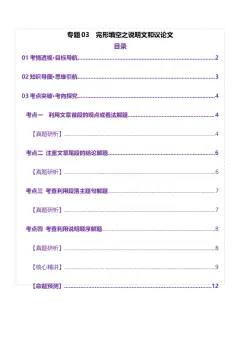
目 录
完形填空之说明文和议论文 ------------------------------------------------------------------------------------1
( 最 新 模 拟 ) 完 形 填 空 之 说 明
文-------------------------------------------------------------------------------------------------2
( 最 新 模 拟 ) 完 形 填 空 之 议 论
文-------------------------------------------------------------------------------------------------703 完形填空之说明文和议论文
最新模拟演练
完形填空之说明文
1.(2024·河南省许平洛济四市高三第二次质量检测)
Owning chickens may be nothing special for you, but in the life of a chicken, we catch a glimpse (一瞥) of an
important truth.
You see, when a hen lays her egg, she labors to make sure the 1 are just right to promote life for that
little chick. She must lay it in a 2 spot. She also must apply heat to the egg for it to 3 .
In the life of this baby chick though, there comes a point that is necessary but that is often 4 . As the
egg begins to crack and slowly break 5 , what you will not see is the mother hen 6 the chick to get
the shell off. No matter how hard the chick 7 , pushes and strains (拉紧) itself, the mother hen will not do
the 8 for it.
At this point, someone can see the 9 of this chick and think the mother does not 10 her young.
This person can then seek to help the chick and 11 the pieces of the shell. However, if such a thing really
happens, often this person 12 does not save the chick’s life but rather 13 its death.
This 14 stage is essential for the chick. It will produce within the chick the 15 that will
allow it to live and thrive (茁壮成长).
1.A.actions B.experiences C.conditions D.chances
2.A.safe B.remote C.shady D.new
3.A.hatch B.live C.move D.continue
4.A.evaluated B.checked C.made D.overlooked
5.A.up B.open C.free D.away
6.A.urging B.preferring C.assisting D.encouraging
7.A.rolls B.knocks C.jumps D.shakes
8.A.work B.harm C.exercise D.same
9.A.depression B.confusion C.growth D.struggle10.A.take in B.care about C.play with D.bring up
11.A.collect B.remove C.throw D.spread
12.A.carelessly B.impatiently C.unknowingly D.purposely
13.A.slows B.causes C.faces D.prevents
14.A.beginning B.developing C.resting D.falling
15.A.nutrition B.health C.luck D.strength
2.(2024·山西省优生联考高三上学期1月考试)
Aloha is perhaps one of the most recognized words in the world. Many 1 use it to brand their goods
and services. But there is more to it in Hawaii. It’s the spirit to 2 one another all the time, not only when
a(n) 3 strikes. And it was the 4 spirit of aloha that has brought warmth and strength to those
who have 5 the deadliest wildfire in modern US history that swept across the historic city of Lahaina just
a week ago.
Arica Lynn Souza, whose 6 was burned to the ground on August 8, describes aloha as being there
when something happens and when someone 7 help. She thinks that it is the spirit of aloha that makes
Lahaina so 8 .
“I 9 with my two babies and a very small bag. The only reason why we’re able to have clothes on
our backs and everything else is due to this kind of aloha feeling within our community and with each other.”
Kaliko Kaauamo is a Hawaiian-language expert and curriculum designer. When asked what aloha looks like,
she quickly paints a 10 picture, “Aloha is the guy whose home was burned down, who has no clothes,
finds his slippers, puts them on and 1 1 finds someone else to help without expecting anything 1 2
. It’s a philosophy. It’s an appreciation. It’s a 1 3 love that we are born and raised with.”
During a disaster, community members usually 1 4 to help each other. But it is the 1 5
emotional attachment sets Hawaii apart from the rest of the world.
1.A.children B.businesses C.speakers D.families
2.A.treat B.greet C.praise D.help
3.A.disaster B.phenomenon C.idea D.incident
4.A.terrible B.tasty C.traditional D.expensive
5.A.started B.survived C.missed D.recorded
6.A.forest B.shop C.home D.school
7.A.needs B.accepts C.ignores D.dislikes
8.A.cold B.comfortable C.reasonable D.special9.A.escaped B.dropped C.argued D.separated
10.A.vivid B.bright C.funny D.sad
11.A.carelessly B.immediately C.unnecessarily D.hardly
12.A.in person B.in advance C.in return D.in ruins
13.A.romantic B.realistic C.conditional D.selfless
14.A.turn B.tend C.refuse D.pretend
15.A.constant B.unhealthy C.understandable D.sudden
3.(2024·上海市徐汇区高三上学期一模)
Acupuncture(针灸), an ancient Chinese medical practice, has been the remedy for countless patients for
thousands of years. Before modern medicine came to life, ancient Chinese used stone tools to 1 pain. Over
time, this primitive practice 2 evolved into a comprehensive and profound medical system and 3
the root of acupuncture.
Acupuncture is a treatment that aims to 4 the body’s self-regulating functions. Its therapeutic
principles are in line with the 5 concepts of traditional Chinese medicine, which emphasizes all-inclusive
treatment, meridian(经络) adjustment, balance of bodily functions and overall physiological well-being.
Practices can 6 in forms, including needle insertion, cupping and scraping. Needle insertion, the most
common method, is 7 by inserting hair-thin needles into meridians, 8 specific points on the body
that 9 vital energy (the qi). Practitioners lift, twirl and rotate needles to unblock the flow of energy; 10
yin and yang balance; and stimulate the body’s innate 11 to heal itself.
Looking beyond China, acupuncture has become a global 12 . Over the years, acupuncture has seen
many advancements in scientific research and modern medicine. It is now a mainstream 13 and
complementary treatment for a variety of weaknesses. According to a 2019 WHO report, acupuncture is used in 113
of its 120 member countries, 14 its widespread recognition and application.
As an ancient Chinese medical 15 with a rich history and deep cultural significance, acupuncture is an
embodiment of profound cultural heritage and a holistic path to healing.
1.A.relieve B.resume C.release D.rebel
2.A.radically B.gradually C.reluctantly D.randomly
3.A.cultivated B.evaluated C.shaped D.eliminated
4.A.promote B.reflect C.alternate D.perform
5.A.occasional B.philosophical C.considerable D.mechanical6.A.arise B.heal C.vary D.survive
7.A.taken over B.ended up C.figured out D.carried out
8.A.or B.and C.while D.with
9.A.block B.generate C.motivate D.channel
10.A.terrify B.stimulate C.reserve D.restore
11.A.willingness B.instinct C.potential D.nutrient
12.A.liberty B.therapy C.curiosity D.wonderland
13.A.proportion B.alternative C.procedure D.affection
14.A.illustrating B.predicting C.featuring D.nominating
15.A.assessment B.occupation C.practice D.obedience
4.(2024·河南省信阳市浉河区信阳高级中学高三上学期1月月考)
Today was another enlightening day at my new American school. Back in China, lunchtime is a 1
hour. We eat, talk, and most importantly, take a short nap (小睡) to 2 for the afternoon. This relaxing
routine of our midday break allowed for a 3 escape from the day’s demands. But here? It’s like a 4
against the clock.
The bell rang, and everyone 5 to the cafeteria. I followed, naively (天真地) thinking I’d have 6
time to eat and perhaps even close my eyes for a moment. However, I barely had time to finish my sandwich before
the next bell hit. Where did the time go?
And the nap? Forget about it. There’s no 7 for that comfort here. In China, we have these cozy mats
in the classroom for our post-lunch rest. But in America, the 8 of napping in school seems as 9
to them as the absence of a nap is to me.
At first, I felt quite sleepy in the afternoon classes. I 10 that brief break we get in China. But then I
noticed something. Even without the nap, my classmates were hardly tired. Perhaps they’re used to this fast
schedule, or maybe they 11 on pure youthful energy. Who knows?
I’m beginning to 12 that life here is simply faster. People eat 13 , converse rapidly, and
shift swiftly. It’s a(n) 14 with the life style back in China, but perhaps it’s not harmful, just another 15
of life.
1.A.cherished B.productive C.fixed D.secure
2.A.fight B.recharge C.settle D.evaluate
3.A.narrow B.secret C.desperate D.peaceful4.A.march B.test C.race D.game
5.A.paraded B.wandered C.leapt D.rushed
6.A.inadequate B.sufficient C.limited D.golden
7.A.excuse B.doubt C.boundary D.access
8.A.concept B.application C.benefit D.knowledge
9.A.scary B.odd C.awkward D.shallow
10.A.replaced B.postponed C.missed D.supported
11.A.operate B.insist C.concentrate D.reflect
12.A.consider B.question C.grasp D.imagine
13.A.regularly B.hurriedly C.properly D.eventually
14.A.agreement B.interaction C.connection D.contrast
15.A.manner B.circumstance C.moment D.challenge
5.(2024·黑龙江省哈尔滨市第三中学校高三上学期1月期末)
Years ago, I lived in the English midlands and would walk the same route along the local canal each evening.
On winter mornings, I would see the 1 sight of bird flocks dancing across the landscape, a distant
cacophony (刺耳的嘈杂声) 2 above the fields. They were jackdaws (寒鸦), the smallest member of the
crow family.
Research led by Masters student Alex Dibnah asked: Why are jackdaws so loud when they 3 ? Then
he began to work with a team. The team’s 4 was that the morning calls might be a jackdaw version of “
5 ”. Each individual’s call might 6 as an “I’m in!” helping them coordinate (协调) their 7 .
To test this, the researchers artificially 8 call levels during the jackdaws’ morning cacophony using
speakers at their sleeping sites. When extra calls were played, the jackdaws 9 earlier, showing they use
calls as a check-in system.
Individual jackdaws 10 from leaving with the flock because they get more social information like
where to find food, they can maximize their time spent finding food, and they’re less 11 being
attacked. This sort of decision-making isn’t 12 to jackdaws — it’s been reported in other species as
well.
So, the cacophony of jackdaws in the morning is a clever solution to 13 a large group. If you’re
14 by the noise, find comfort in the fact that the louder they get, the sooner they’ll leave you in 15
.1.A.frightening B.peaceful C.familiar D.unusual
2.A.fading B.stopping C.changing D.rising
3.A.fly B.gather C.appear D.return
4.A.evidence B.theory C.experiment D.difficulty
5.A.fitting in B.breaking in C.stepping in D.signing in
6.A.resign B.count C.check D.rank
7.A.movement B.progress C.gesture D.demand
8.A.created B.graded C.increased D.maintained
9.A.settled B.left C.escaped D.arrived
10.A.benefit B.learn C.suffer D.keep
11.A.in defense of B.in control of C.at risk of D.at the sight of
12.A.common B.essential C.open D.unique
13.A.joining B.organizing C.mastering D.warning
14.A.bothered B.impressed C.surprised D.fascinated
15.A.trouble B.wonder C.peace D.charge
完形填空之议论文
1.(2024·广东省深圳市龙岗区高三上学期1月期末)
City walk gains popularity among young Chinese. Different from the fast-paced “special forces style” (特种部
队式) tourism, city walk is 1 and not very purposeful.
To a certain extent, “special forces style” tourism is just a(n) 2 of regular travel, where young
people spend 9 hours in a city with the same travel guides and check-in list. By comparison, city walk allows
people to explore a city 3 without deliberately joining the 4 at popular tourist spots or waiting
in 5 lines outside popular restaurants for hours. People 6 the past and present of a city as a
local resident. After all, time is not 7 and the need for travel is not so pressing any more.
While “special forces style” tourists 8 fast pace and purposefulness, city walkers are completely
slow and free. What really matters is 9 wandering. People expect that a trip frees themselves from high
10 and repetitive daily life. Since such words as leisure, 11 and purposelessness are associated
with city walk, it seems not difficult to understand why young people are 12 about it.
When we were children in school, 45 minutes of class was worth a 10 minute 13 . As we have
14 and started working hard, we always want to 15 freedom in life during free time. City walkis a path where we can freely choose, plan, and explore.
1.A.costly B.leisurely C.brief D.normal
2.A.innovation B.lesson C.repetition D.secret
3.A.eagerly B.rapidly C.freely D.precisely
4.A.sellers B.crowds C.audiences D.hosts
5.A.quiet B.straight C.formal D.long
6.A.discover B.develop C.remember D.determine
7.A.abundant B.unique C.precious D.urgent
8.A.ignore B.understand C.emphasize D.explain
9.A.aimless B.occasional C.individual D.meaningless
10.A.reputation B.tension C.expectation D.recognition
11.A.creativity B.efficiency C.speed D.relaxation
12.A.anxious B.particular C.enthusiastic D.cautious
13.A.break B.leave C.discussion D.exercise
14.A.stood up B.grown up C.teamed up D.shown up
15.A.escape B.spread C.restrict D.pursue
2.(2024·重庆市第一中学校高三上学期10月阶段性考试)
My sense of leadership has been shaped by my father, whose 25 years in public education have positively
impacted many students. On the last day of each school year he would come home with many cards and gifts, from
both 1 students graduating and former students who stopped by to thank him. Apart from his role as a
respected teacher, my father was also a 2 who helped others learn to find themselves, rather than direct their
actions or words through 3 . I’ve come to believe that power is the ability to 4 people to evolve,
and that successful 5 is measured only by the success and well-being of the people around you.
As a result of this understanding, I’ve 6 an active presence in my high school’s peer tutoring program.
Since I also hope to become a 7 , this experience has helped me better understand the skills needed to help
people 8 their educational obstacles.
Coaching in 9 is another mode of leadership that I hope to keep. Powerlifting has had a major place in
my after-school life. I’ve found the strength sport environment to be really 10 , because everyone can
participate in it. In addition, it 11 cooperation and support. This goes back to the measurement of
encouraging success and 12 of others.
The path to becoming a more 13 leader comes from establishing bonds and developing skillsalongside other people, so that eventually your ability to lead follows 14 from your experience and
abilities you’ve practiced over years of work. By 15 oneself and others, we eventually become a true
leader and educator.
1.A.wealthy B.familiar C.generous D.current
2.A.consultant B.volunteer C.leader D.psychologist
3.A.education B.morality C.patience D.authority
4.A.inspire B.ask C.order D.beg
5.A.friendship B.membership C.hardship D.leadership
6.A.maintained B.noticed C.refused D.known
7.A.player B.father C.programmer D.teacher
8.A.encounter B.overcome C.establish D.ignore
9.A.music B.sport C.dance D.science
10.A.accessible B.depressing C.competitive D.clean
11.A.stresses B.compares C.avoids D.replaces
12.A.money B.action C.happiness D.fame
13.A.demanding B.selfish C.effective D.optimistic
14.A.wildly B.naturally C.occasionally D.formally
15.A.playing with B.lifting up C.showing off D.giving away
3.(2024·河南省洛阳市等三地名校高三上学期开学联考)
Starting a career in engineering can be challenging. You know what you 1 : experience, a network, and
often the confidence that everything will 2 .
My advice to young engineers is: Focus on your 3 , and stop worrying about your weaknesses. Of
course, you must 4 problems in areas where you are weak, but 5 spending too much effort on them.
Chances are that you will never be perfect in those areas, so it makes no 6 in wasting your energy.
Of course, there will be times when things are hard, but if you believe in yourself and have a 7 of where
you want to go and develop your strengths——they’ll 8 you apart, you will go far.
The biggest challenge I have faced in my career is being a woman in a 9 profession. When I started
working, I was the only female engineer in my division. Though I was as 10 as my colleagues, it was
tough to get them to accept me as their 11 . Instead of feeling upset, I chose to focus on my strengths as a
woman engineer to earn their respect. 12 , they accepted me.
Thankfully, the gender 13 has improved since I first started. Now, I have several female engineersworking in my team. As the head, I get a thrill from 14 people in roles and on projects according to their
abilities and seeing them achieve great results. Helping a person 15 by focusing on her strengths gives me
a huge amount of satisfaction.
1.A.approve B.lack C.envy D.face
2.A.bring out B.put out C.work out D.leave out
3.A.strengths B.hobbies C.routines D.priorities
4.A.expand B.identify C.observe D.address
5.A.avoid B.ignore C.practise D.escape
6.A.compromise B.excuse C.mistake D.sense
7.A.practice B.luck C.review D.vision
8.A.keep B.take C.set D.tell
9.A.narrow-minded B.male-dominated C.old-fashioned D.female-centred
10.A.stubborn B.humorous C.capable D.realistic
11.A.equal B.opponent C.contemporary D.friend
12.A.Occasionally B.Originally C.Frequently D.Eventually
13.A.characteristic B.role C.balance D.preference
14.A.placing B.inspiring C.concerning D.updating
15.A.explore B.develop C.compete D.qualify
4.(2024·江西省贵溪市实验中学高三第四次模拟检测)
When my daughter completes a task, I can’t help but praise her. It’s only natural to give praise where praise is
1 , right? But is there such a thing as too much praise?
According to psychologist Katherine Phillip, children don’t 2 from constant praise as much as we’d
like to think. “Parents often praise, 3 they are building their child’s self-confidence. 4 over-
praising can have a negative effect,” says Phillip. “When we use the same praise 5 , it may become empty
and no longer 6 by the child. It can also become a (an) 7 that anything they do must be rewarded
with praise. This may lead to the child avoiding taking risks due to 8 of disappointing their parents.”
Does this mean we should 9 all the praise? Phillip says no. “The key to healthy praise is to focus on
the process 10 the outcome. It is the recognition of a child’s attempt, or the process in which they
achieved something, that is 11 ,” she says. “Parents should encourage their child to take the risks needed
to learn and grow.”
So how do we break the 12 of praise we’re all so accustomed (习惯) to? Phillip says it’s importantto 13 the distinction between “person praise” and “process praise”. “Person praise is simply saying how
14 someone is. It’s a form of personal judgement. Process praise is 15 of the efforts the person has
just undertaken. Children who receive person praise, are more likely to feel shame after losing,” says Phillip.
1.A.normal B.intelligent C.due D.grateful
2.A.analyze B.define C.profit D.reflect
3.A.convincing B.believing C.claiming D.debating
4.A.Therefore B.Moreover C.Meanwhile D.However
5.A.merely B.rarely C.gradually D.repeatedly
6.A.constructed B.understood C.prized D.evaluated
7.A.curiosity B.potential C.virtue D.expectation
8.A.lack B.fear C.infection D.presence
9.A.do away with B.get away with C.look up to D.give way to
10.A.other than B.rather than C.or rather D.more than
11.A.emotional B.remarkable C.essential D.accessible
12.A.pattern B.custom C.tendency D.response
13.A.identify B.confirm C.clarify D.classify
14.A.annoying B.disturbing C.great D.crucial
15.A.completion B.objective C.consequence D.acknowledgement
5.(2023·福建省七地市高中毕业班第一次质量检测)There was a young boy at a beautiful beach digging
sands using his plastic tools. While his other friends were playing the whole time, the little boy spent his day 1
his sandcastle. He even 2 a moat (护城河) using a spoon, a bridge with a 3 ,and walls for his
castle.
After a whole long day, he finished his 4 sandcastle until the waves washed his hard work. Holding
back his tears, the boy didn’t get mad and 5 decided to study the waves that 6 his creation.
The boy was aware of the 7 and saw it a couple of times already. He already knew how to do things
better. He felt no 8 , regret, or fear any more whenever the waves came. He just smiled, 9 his tools
and left. He knew that the tide was beyond his 10 and he couldn’t do anything about it. What he could
do though is how to 11 those situations.
Basically, no matter where you are, the waves of life will always 12 you. What matters most is how
you behave during those moments and what they 13 about yourselves along this 14 calledlife. Keep calm while looking at things from different viewpoints because sometimes all it takes for 15
to happen in your life is by looking at things through different lenses!
1.A.creating B.picturing C.drawing D.watching
2.A.kept B.made C.crossed D.defended
3.A.bucket B.stone C.rope D.stick
4.A.old B.royal C.dream D.solid
5.A.therefore B.instead C.still D.nevertheless
6.A.supported B.perfected C.copied D.destroyed
7.A.castle B.construction C.sand D.tide
8.A.sorrow B.doubt C.hesitation D.excitement
9.A.held up B.picked up C.searched for D.threw away
10.A.belief B.repair C.control D.awareness
11.A.talk about B.draw upon C.react to D.fight against
12.A.search B.take C.recognize D.find
13.A.know B.teach C.judge D.beat
14.A.distance B.line C.journey D.circle
15.A.changes B.crashes C.events D.attacks