押北京卷第 35-39 题
信息还原(七选五 )
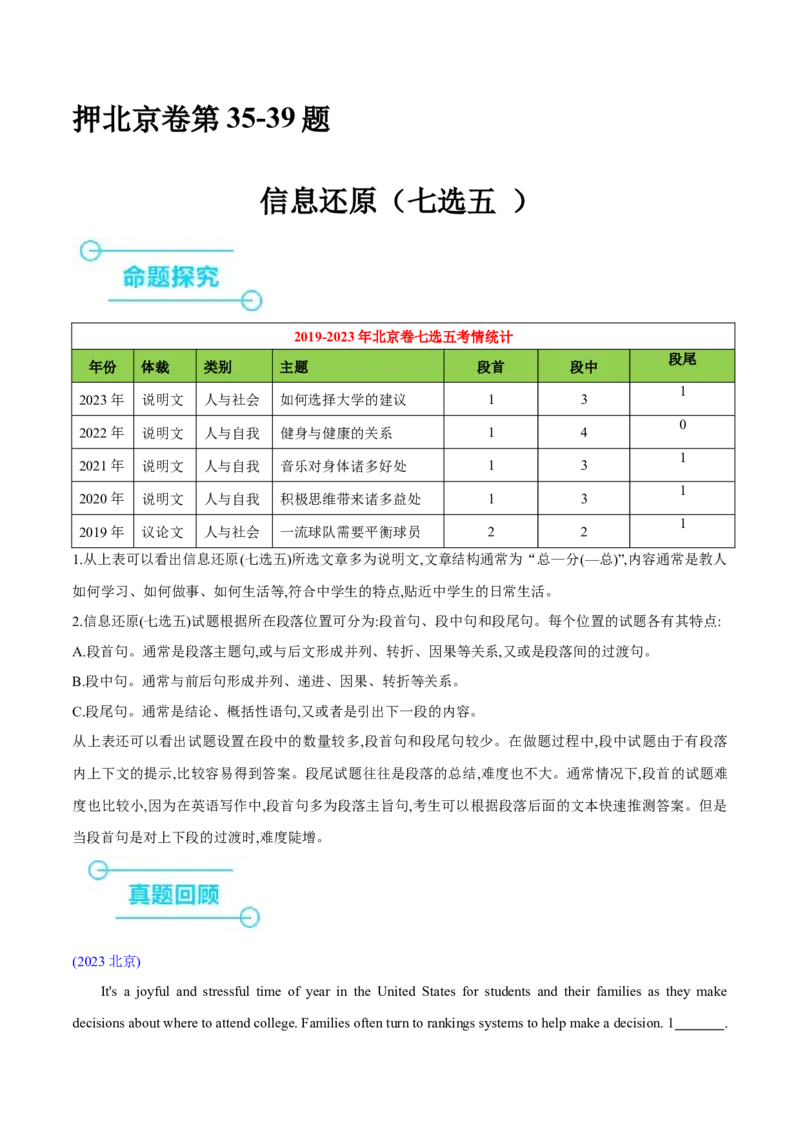
2019-2023年北京卷七选五考情统计
段尾
年份 体裁 类别 主题 段首 段中
1
2023年 说明文 人与社会 如何选择大学的建议 1 3
0
2022年 说明文 人与自我 健身与健康的关系 1 4
1
2021年 说明文 人与自我 音乐对身体诸多好处 1 3
1
2020年 说明文 人与自我 积极思维带来诸多益处 1 3
1
2019年 议论文 人与社会 一流球队需要平衡球员 2 2
1.从上表可以看出信息还原(七选五)所选文章多为说明文,文章结构通常为“总—分(—总)”,内容通常是教人
如何学习、如何做事、如何生活等,符合中学生的特点,贴近中学生的日常生活。
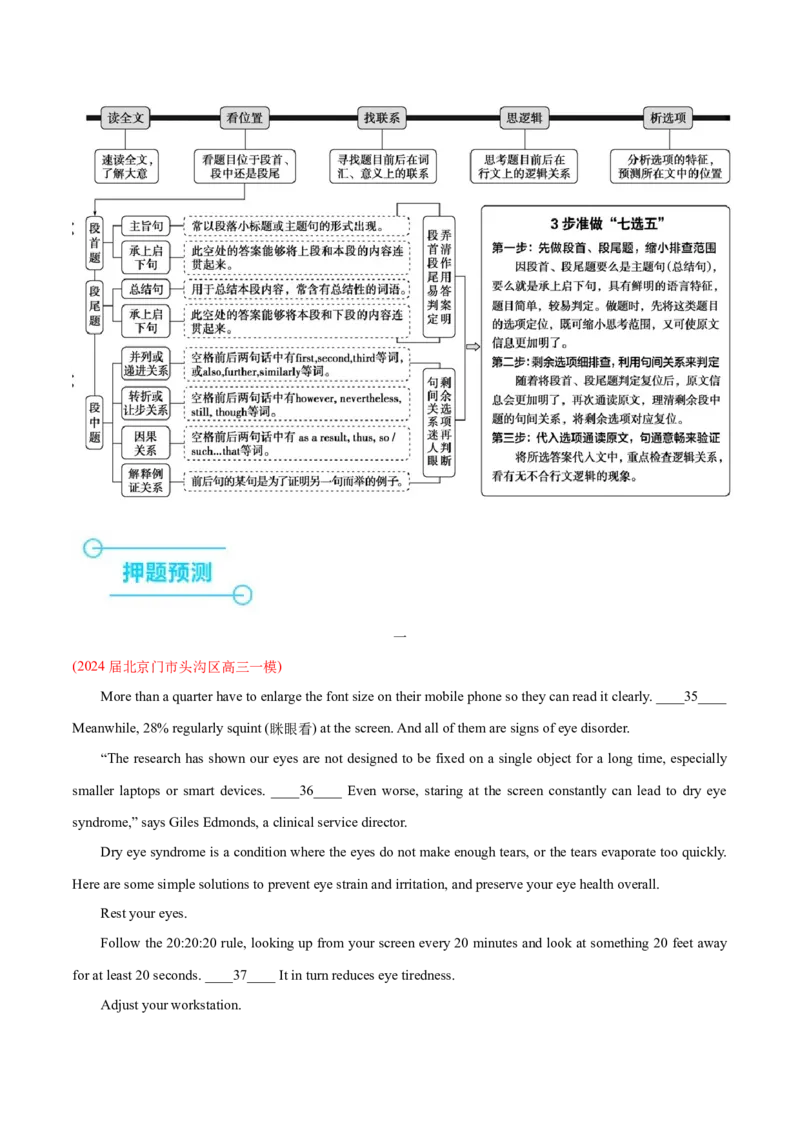
2.信息还原(七选五)试题根据所在段落位置可分为:段首句、段中句和段尾句。每个位置的试题各有其特点:
A.段首句。通常是段落主题句,或与后文形成并列、转折、因果等关系,又或是段落间的过渡句。
B.段中句。通常与前后句形成并列、递进、因果、转折等关系。
C.段尾句。通常是结论、概括性语句,又或者是引出下一段的内容。
从上表还可以看出试题设置在段中的数量较多,段首句和段尾句较少。在做题过程中,段中试题由于有段落
内上下文的提示,比较容易得到答案。段尾试题往往是段落的总结,难度也不大。通常情况下,段首的试题难
度也比较小,因为在英语写作中,段首句多为段落主旨句,考生可以根据段落后面的文本快速推测答案。但是
当段首句是对上下段的过渡时,难度陡增。
(2023北京)
It's a joyful and stressful time of year in the United States for students and their families as they make
decisions about where to attend college. Families often turn to rankings systems to help make a decision. 1 .When I talk to families as a scholar of higher education, they're often surprised that teaching excellence is not
counted in rankings. 2 .
Emerging research suggests that courses in lower-ranked universities, on average, scored higher on teaching
than courses in higher-ranked universities. 3 .The absence of teaching excellence from the rankings is
surprising given the link between high-quality teaching and student success. Quality teaching is one of the most
important predictors of a wide range of college outcomes.
Rankings, however, are only one reason why a low value is placed on teaching in higher education.
Administrators often don't view teaching excellence as a way to increase enrolment(注册) or funding. 4 .
Research shows that the more time instructors spend on teaching, the lower their salary. What is the result? Many
instructors continue to teach using traditional lectures, which lead to lower success rates.
5 . Nevertheless, not much will change until schools with high-quality teaching are rewarded with
more resources, higher rankings and increased enrolments. In the long term, universities, organisations that rank
schools, and others should work to make teaching a valued, core part of the mission.
What should students and their families do? They should give strong consideration to universities where high-
quality teaching is valued, even though the schools may be ranked lower.
A. Higher education has achieved its true potential.
B. Therefore, it's not highly valued in hiring or promotion.
C. Quality teaching has been an important reputation-building factor.
D. However, the rankings ignore a critical factor:the quality of teaching.
E. Efforts to improve teaching at the university level have recently emerged.
F. They're even more surprised at how teaching is undervalued by universities.
G. In fact, universities often shift emphasis from teaching to other ranking factors.一
(2024届北京门市头沟区高三一模)
More than a quarter have to enlarge the font size on their mobile phone so they can read it clearly. ____35____
Meanwhile, 28% regularly squint (眯眼看) at the screen. And all of them are signs of eye disorder.
“The research has shown our eyes are not designed to be fixed on a single object for a long time, especially
smaller laptops or smart devices. ____36____ Even worse, staring at the screen constantly can lead to dry eye
syndrome,” says Giles Edmonds, a clinical service director.
Dry eye syndrome is a condition where the eyes do not make enough tears, or the tears evaporate too quickly.
Here are some simple solutions to prevent eye strain and irritation, and preserve your eye health overall.
Rest your eyes.
Follow the 20:20:20 rule, looking up from your screen every 20 minutes and look at something 20 feet away
for at least 20 seconds. ____37____ It in turn reduces eye tiredness.
Adjust your workstation.Change your screen settings to ensure that the brightness and contrast are balanced correctly, as well as
making fonts larger. Also, be mindful of how your workstation is positioned. Adjust your screen ensuring it is 15—
20 degrees below eye level and around 50—70 cm away from the eyes. ___38___
Reduce glare (眩光).
____39____. Try reducing this by attaching an anti-glare screen to your monitor or laptop to avoid external
light shining onto the screen. Glasses wearers can also have lenses treated with an anti-glare coating.
A. People should try to reduce the time spent on the screen.
B. One can read his favorite paper books instead of e-books.
C. Half confess they’re forced to enlarge images to see them clearly.
D. Another thing to focus on is to make sure your room is properly lit.
E. Looking into the distance helps relax the focusing muscles of your eyes.
F. Reflections on your computer screen can cause glare and lead to eye fatigue.
G. They may feel uncomfortable, painful, tired and even start to itch (发痒) or burn.
二
(2024届北京市东城区等5区高三下学期一模)
“Find your passion!” When discussing future career options or selecting a major in college, your parents often
say this. The very expression is meant to inspire. But is it good advice?
“Finding” a passion implies that it already exists and is simply waiting to be discovered. Unfortunately, this
idea is not what science tells us. ___35___
To study this, researchers use a framework of “fixed” and “growth” mindsets.They argue that encouraging
people to “find” their passion may cause them to eventually believe that interests and passions are inborn and
relatively unchangeable. ___36___ In contrast, people who view interests and passions as developed have a growth
mindset of interest.
Researchers have revealed that a fixed mindset of interest can decrease creativity. If people believe they are
limited to only a few inborn interests and, in consequence, do not explore other areas, they may miss seeing
important connections across domains. ___37___
Evidently, people can do a lot to embrace a growth mindset of interest. First, realize that your interests and
passions aren’t pre-existing. Take an active role in developing your passions. Second, practise positive self-talk.
When you lack interest in a new task, pay attention to your inner dialogue. ___38___For example, change “I’m not
interested in this” to “I’m not interested in this yet, but I know that interest can develop with time and engagement.”
___39___But a growth mindset of interest will help you remain open and curious. The science tells us weshould work toward loving what we do. We might become more creative and resilient as a result.
A. So can a growth mindset of interest be taught?
B. Instead passions, like interests, are developed.
C. People who think this have a fixed mindset of interest.
D. Of course, not every activity will become a burning passion.
E. As such,seeing interests as fixed limits their creative potential.
F. Don’t expect that pursuing new interests will always be easy or exciting.
G. Replace self-critical thoughts with positive ones that encourage growth and learning.
三
(2024届北京市西城区高三下学期一模)
Most of us are actually terrible at giving gifts. About $70 billion worth of presents are returned every year in
the U. S. ____35____ Here are three ways to improve your gift-giving game around the holidays.
Stop trying to make your gifts so delightful. ____36____ We want something from giving: those looks of
delight. Those exclamations. This is why items like hyper-specific kitchen gadgets and fancy vintage clocks all
seem like fantastic gifts. But it turns out, recipients often want things that are far more practical — things they can
actually use.
____37____ Just give people what they ask for. A study looked at Amazon wish lists to determine if people
were more appreciative of gifts from the list versus gifts that were total surprises. It turned out that people who got
gifts that weren’t on their list considered them as less thoughtful and less personal. ____38____
How can we create a gift-giving plan that is as emotional as we desire? Humans love to feel connected. And
one way we do that is by sharing interests with others. So if you want to learn how to give better gifts, put yourself
in the recipient’s shoes and try to think of something you both share. Maybe it’s the love for a sport, drinking wine,
or some other hobby. ____39____ And because you picked something you share, they will feel more connected to
you and appreciate your gift more.
A. So how do we get less terrible?
B. Surprise is overrated — we’re happier to get what we ask for.
C. So what's the most practical gift you can give that people might actually be grateful for?
D. The long-term pleasure of the receiver may not be observed and therefore is discounted.
E. Once you’ve found a shared interest, go and find a useful gift related to this interest.
F. What recipients care about is how much value they’re going to get from the gift over a longer time period.
G. Research has shown that givers are consumed by the moment of unwrapping a gift even more than the gift itself.四
All the feels
You can make your picture book memorable by concentrating on emotional connection. This works across
every principle of writing, regardless of age range or genre (文体), because it is universally recognized. 1
The reason why emotional connection works is that emotion is a fundamental human experience. 2 It
also brings us together and reminds us that although we have differences, people are fundamentally the same. By
bringing emotion into your story, you tap into that consciousness. The story feels more real to us. It is consistent
with us, and as a result, we have a richer reading experience.
3 This is useful for your picture book writing, such as choosing vocabulary to use or adopting a
suitable linguistic style. Once you know the genre of a book, you can think about the kind of emotional storytelling
a reader would expect from this genre.
For example, if it’s a funny picture book, your reader is clearly expecting to laugh. Make sure they laugh. If
it’s an adventure story, your reader will be expecting to feel excitement, anticipation and probably a little mild fear.
If it’s a heartwarming story, your reader expects to feel warm, comforted and overflowing with love. 4
Another reason for including emotion in your picture book is to really get your reader inside your character’s
head. Firstly, it helps build on the young reader’s emotional development and understanding of self and others.
5 As well as caring about character, an emotion-filled picture book therefore keeps us on our toes.
If you want your story to stand out amongst other stories, give your reader something to remember — a strong
emotional connection.
A.Secondly, it creates interest in the character.
B.It helps us make sense of the world around us.
C.An emotional ending in a picture book works well.
D.When we feel something, we will have sharp minds.
E.This is obviously not a complete list, but it is a starting point.
F.Here is why it works and how you can use it in your picture book writing.
G.Picture books have many different genres and your job is to know which genre your story sits in.
五
Which is healthier: a bag of crisps or a vegetable salad? That is easy. Now which is healthier: a pizza made
from scratch or one made from the same basic ingredients, with the same number of calories, pulled out of a box in
the freezer? Many people would instinctively(本能地) say the former, perhaps showing a vague concern withprocessed food. Such food can often be delicious. And there is much to cheer about calories being cheap and
abundant. 1
What’s the distinction between “ultra-processed food(upf)” and “processed food”? Almost everything people
consume is processed in some form. Rice is harvested; animals are butchered. Upf is usually described as
“formulations of ingredients, made by a series of industrial processes, many requiring advanced equipment and
technology”. 2 The one in the freezer, with its extra, modified ingredients, is upf.
Upf harms people in ways both known and unknown. It seems to affect the trillions of bacteria that contribute
to health in a range of ways. Calorie-rich but usually nutrient-poor, upf contributes to obesity(肥胖症).
Upf displaces healthier alternatives, particularly for poor people. 3 Extra weight was once a sign of
wealth, but among British and American women today, obesity rates are higher at lower-income levels.
4 Additives that may be safe in small quantities may be harmful in combination with other chemicals
or when consumed regularly. If we are what we eat, considering the impact of upf is essential.
5 People who live in so-called “food swamps”, where upf is everywhere but real food is harder to
reach, could spend large amounts of time and money seeking out fresh food, but that is not how most people live.
There is nothing wrong with the odd fast-food trip, but anyone who can afford to eat less upf probably should.
A.Environment matters, too.
B.It’s cheap to produce and buy.
C.But that cheapness and abundance come at a cost.
D.Even foods labeled “natural” or “organic” can be processed.
E.A pizza made from scratch contains minimally processed food.
F.Some people have a particular weakness for salty potato crisps.
G.The reasons why upf can be harmful are not always clear, even to scientists.
六
It’s a joyful and stressful time of year in the United States for students and their families as they make
decisions about where to attend college. Families often turn to rankings systems to help make a decision. 1
When I talk to families as a scholar of higher education, they’re often surprised that teaching excellence is not
counted in rankings. 2
Emerging research suggests that courses in lower-ranked universities, on average, scored higher on teaching
than courses in higher-ranked universities. 3 The absence of teaching excellence from the rankings is
surprising given the link between high-quality teaching and student success. Quality teaching is one of the mostimportant predictors of a wide range of college outcomes.
Rankings, however, are only one reason why a low value is placed on teaching in higher education.
Administrators often don’t view teaching excellence as a way to increase enrolment (注册) or funding. 4
Research shows that the more time instructors spend on teaching, the lower their salary. What is the result? Many
instructors continue to teach using traditional lectures, which lead to lower success rates.
5 Nevertheless, not much will change until schools with high-quality teaching are rewarded with
more resources, higher rankings and increased enrolments. In the long term, universities, organisations that rank
schools, and others should work to make teaching a valued, core part of the mission.
What should students and their families do? They should give strong consideration to universities where high-
quality teaching is valued, even though the schools may be ranked lower.
A.Higher education has achieved its true potential.
B.Therefore, it’s not highly valued in hiring or promotion.
C.Quality teaching has been an important reputation-building factor.
D.However, the rankings ignore a critical factor: the quality of teaching.
E.Efforts to improve teaching at the university level have recently emerged.
F.They’re even more surprised at how teaching is undervalued by universities.
G.In fact, universities often shift emphasis from teaching to other ranking factors.
七
Children love getting dirty. 1 But getting muddy could have a powerful effect on their wellbeing,
too.
“Don’t get dirty!” was once a constant family warning, as parents despairingly watched their children spoil
their best clothes. Whether they were running through farmers’ fields, climbing trees or catching tadpoles, it was
inevitable that children’s whites would turn brown before the day was over.
Today, many parents may secretly wish their children had the chance to pick up a bit of dirt. With the rise of
urbanism, and the temptation of video games and social media, contact with nature is much rarer than in the past.
2
What is gained in laundry bills may be lost in the child’s wellbeing. According to recent research, the dirt
outside is teaming with friendly microorganisms. 3
Many of the psychological benefits of outdoor play are already well established. Natural scenes provide the
perfect level of stimulation, which is thought to help recharge the brain when it is tired and easily distractible.Supporting this theory, one study from 2009 found that children with ADHD (多动症) were better able to
concentrate following a 20-minute walk in the park, compared to a 20-minute walk on the streets of a well-kept
urban area. 4 The authors recommended using such “doses of nature” as a safe and accessible way of
supporting children with ADHD, alongside other tools.
5 For example, the act of mudding and kneading materials like mud or sand can help children
develop the way their senses and movement interact, known as sensorimotor development. This allows the child to
gradually understand his or her bodily signals.
A.For many, there is simply no opportunity to get muddy.
B.Being close to grass and trees seemed to have had a beneficial effect on their minds.
C.Besides these restorative effects, outdoor play can offer valuable learning experiences.
D.They are drawn to puddles like muddy magnets, with no regard for footwear or the color of their clothing.
E.As for the child’s physical health, the most obvious advantage of outdoor play may be the exercise.
F.People who grow up on farms are less likely to develop asthma, allergies, or auto-immune disorders.
G.They can train the immune system and build resilience to a range of illnesses, including allergies and asthma.
八
In some ways, it is surprising that languages change. After all, they are passed down through the generations
reliably enough for parents and children to communicate with each other. 1 For example, while Japanese
has changed relatively little over a thousand years, English evolved rapidly in just a few centuries. Many present
day speakers find Shakespear’s sixteenth-century plays difficult and Chaucer’s fourteenth-century The Canterbury
Tales nearly impossible to read.
Languages change for a variety of reasons. Large-scale shifts often occur in response to social, economic, and
political pressures, as there are many examples of language change fueled by invasions, colonization, and
migration. 2 Frequently, the needs of speakers drive language change. New technologies industries,
products and experiences simply require new words. By using new and emerging terms, we all drive language
change. But the unique way that individuals speak also fuels language change because no two individuals use a
language in exactly the same way. 3 Through our day-to-day interactions, we pick up words and savings
from other people and integrate them into our speech. Teens and young adults, for example, often use different
words and phrases from their parents. Some of them spread through the population and slowly change the language.
4 Vocabulary can change quickly as new words are borrowed from other languages, or as words get
coined, combined, or shortened. Some words are even created through misinterpretation of form. As noted in theLinguistic Society of America’s publication Is English Changing?, the word pea is one such example. Up until
about four hundred years ago, pease could refer to either a single pea or many peas. At some point, people assumed
that pease was the plural form of a new word, pea, based on the way pease sounded. While vocabulary can change
quickly, sentence structure — the order of words in a sentence changes more slowly. 5 For example,
during the Great Vowel Shift five hundred years ago, the pronunciation of vowels in English changed dramatically.
This shift represents the biggest difference between the pronunciation of Middle English and Modern English.
A.Changes in sound are somewhat harder to document but just as interesting.
B.Yet linguists find that all living languages change over time — at different rates though.
C.As long as people are using a language, that language will undergo some change.
D.All natural languages change, and language change affects all areas of language use.
E.The three main areas of language that change over time are vocabulary, sentence structure, and pronunciation.
F.Even without these kinds of influences, a language can change dramatically if enough users adopt a new way of
speaking.
G.The vocabulary and phrases people use depend on where they live, their age, education level, social status and
other factors.
九
How does it feel when you solve your problem by yourself? Things may not always go as planned. 1
Being resourceful means finding smart and creative ways to solve a problem, using whatever resources you
have at the time. 2 They can also be anything else that’s useful, such as information, advice or your own
experience. It also means trusting your instincts, the ability you’re born with, rather than through training and being
confident about your ability to face challenges. A resourceful person is not the one getting cross or panicking when
something goes wrong. They’re thinking about how to solve the problem.
3 When we learn to solve problems for ourselves rather than immediately going to others for help, it
can help to build our confidence, help us feel more independent, and feel better about making decisions. Being
resourceful may not help you avoid problems, but thinking creatively about how you can deal with them will make
you feel less stressed and more prepared next time. 4 This can boost self-esteem, that is, how you feel
about yourself.
When you’re facing a challenge, try to focus on the actual problem rather than how you feel about it. Think
about where and when it happened and what the causes are. Next, think up as many solutions to the problem as you
can. 5 Finally, review what has and hasn’t worked, so you’re equipped to deal with a situation next time.And remember, no one is expected to solve all problems by themselves. If you have a tricky problem that
you’re unable to solve, then ask a trusted adult for help.
A.You also learn what you’re good at.
B.Here is how you can be more resourceful.
C.They can be practical things like pens and paper.
D.Resourcefulness is a skill that’s good for you in lots of ways.
E.These may be famous mottos that always inspire us to move on.
F.Weigh up what’s good and bad about each one and choose the best.
G.But being resourceful can help you stay calm and deal with tricky situations.
十
Every day, thousands of rangers patrol national parks and other protected areas in Africa. Their job is fraught
with danger, both from hostile humans armed with automatic weapons and from the unappreciative and potentially
aggressive wildlife, armed with tusks, teeth and claws, which they are helping to preserve. 1
That is particularly true of data on poaching (偷猎), which remains, in both senses of the word, an elephantine
problem. Since 2006 African elephant populations have declined by around 30%. In 2021, according to Monitoring
the Illegal Killing of Elephants (MIKE), a conservation programme, around 40% of elephant deaths were a result of
poaching.
2 The MIKE data show a welcome fall in rates throughout the 2010s, but according to research
published in 2020 by Scott Schlossberg of Elephants Without Borders, a charity, this can be attributed entirely to a
decline in eastern Africa.
Elsewhere, there is great variation in the pressure on animals like elephants. Some parks, like Garamba in the
Democratic Republic of Congo (DRC), are badly hit — with more than 90% of the bodies found by rangers being
victims of poachers. 3 To untangle the factors influencing poaching, Timothy Kuiper of the University of
Cape Town, Eleanor Milner-Gulland at Oxford, and a team of collaborators have analysed data collected for MIKE
by rangers from 64 sites in 30 African countries over the course of 19 years. They correlated these with potentially
relevant factors, both natural and human, and have published their findings in the Proceedings of the Royal Society.
Natural variables such as habitat type, they discovered, make little difference. 4 Unsurprisingly, low
household wealth, poor health, poor law enforcement and poor national governance all contributed to higher rates
of poaching. So did the price of ivory.
5 For there did not seem to be much. The impact was a consequence of a few special cases in DRC,the Central African Republic and Ethiopia, rather than a general rule about young men with guns behaving badly.
One factor that was unquantifiable, and therefore untestable, according to Dr Kuiper, was local political will to
preserve wildlife. But this study does nevertheless confirm observations made elsewhere, that the best form of
conservation is a prosperous population.
A.Human ones predominate.
B.The severity of elephant poaching varies from place to place.
C.Humans are the biggest factor defining elephant ranges across Africa.
D.There was one unexpected result, though — the impact of armed conflict.
E.But their work is important, not least because the data they collect are crucial to conservation planning.
F.In others, like Chobe, in Botswana, less than 10% of dead elephants discovered have been killed illegally.
G.Current discussion of how to reduce poaching focuses on two areas: reducing demand and reducing supply.