阅读理解突破之说明文
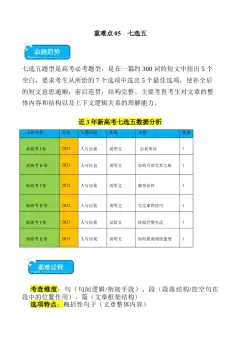
一、考情分析
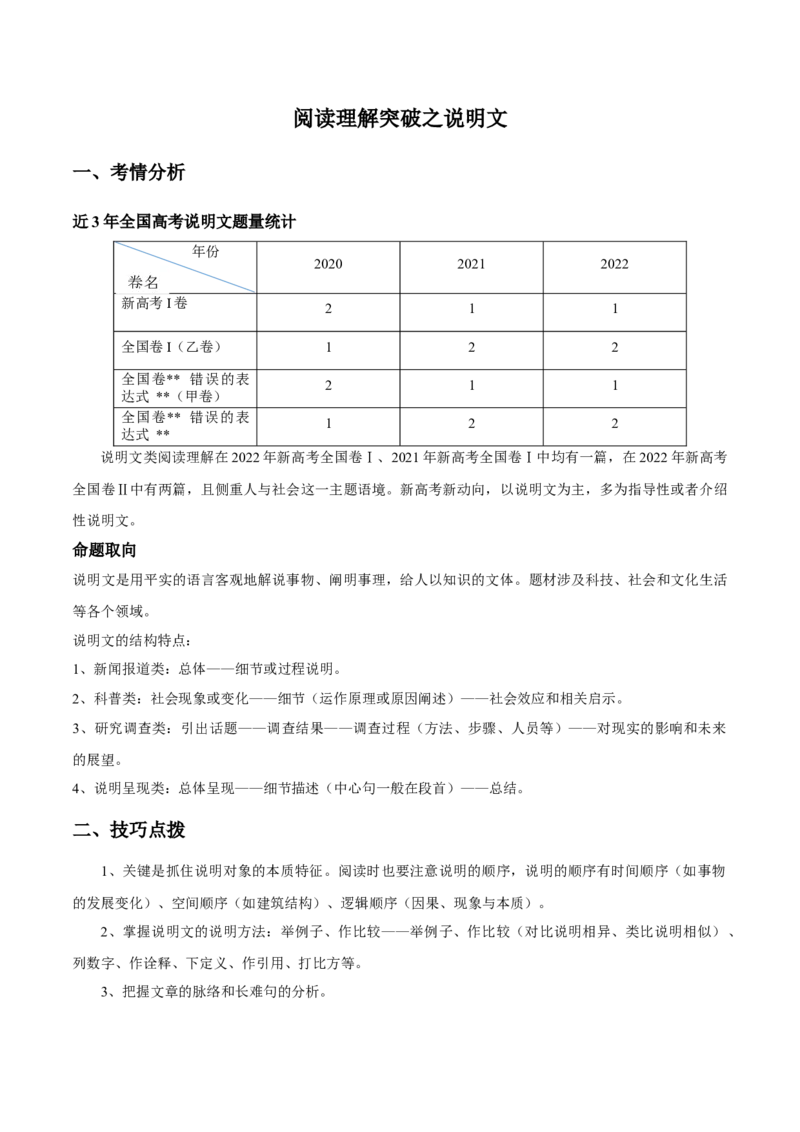
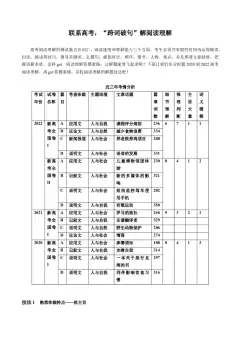
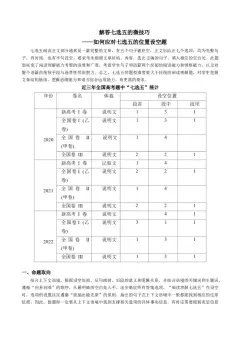
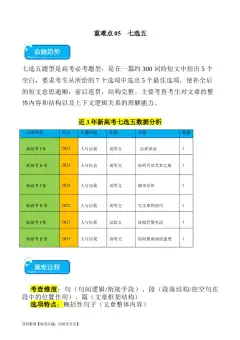
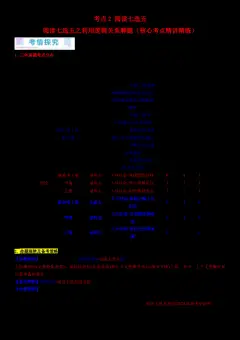
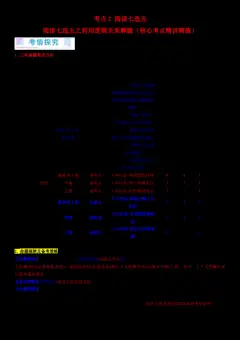
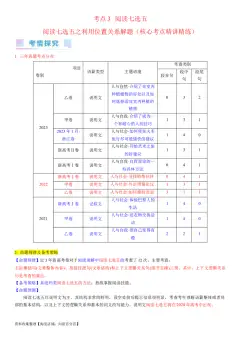
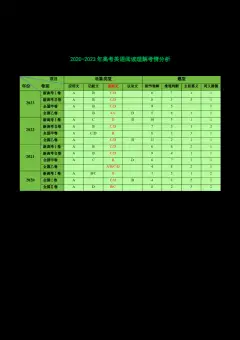
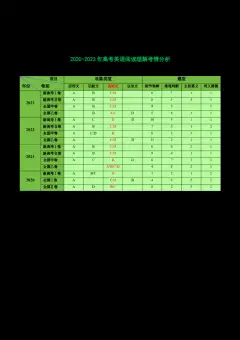
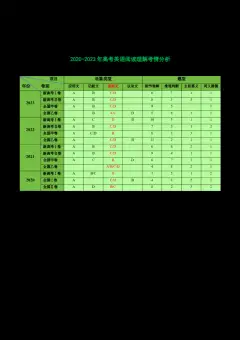
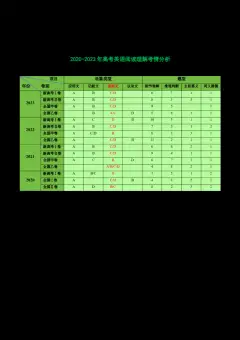
近3年全国高考说明文题量统计
年份
2020 2021 2022
卷名
新高考I卷
2 1 1
全国卷I(乙卷) 1 2 2
全国卷** 错误的表
2 1 1
达式 **(甲卷)
全国卷** 错误的表
1 2 2
达式 **
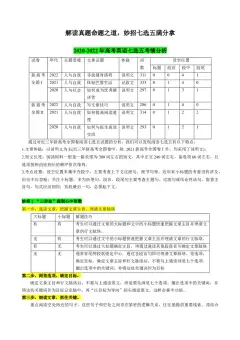
说明文类阅读理解在2022年新高考全国卷Ⅰ、2021年新高考全国卷Ⅰ中均有一篇,在2022年新高考
全国卷Ⅱ中有两篇,且侧重人与社会这一主题语境。新高考新动向,以说明文为主,多为指导性或者介绍
性说明文。
命题取向
说明文是用平实的语言客观地解说事物、阐明事理,给人以知识的文体。题材涉及科技、社会和文化生活
等各个领域。
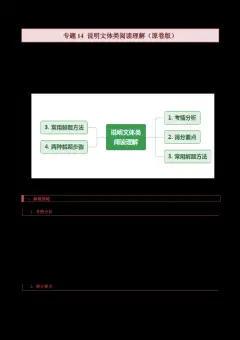
说明文的结构特点:
1、新闻报道类:总体——细节或过程说明。
2、科普类:社会现象或变化——细节(运作原理或原因阐述)——社会效应和相关启示。
3、研究调查类:引出话题——调查结果——调查过程(方法、步骤、人员等)——对现实的影响和未来
的展望。
4、说明呈现类:总体呈现——细节描述(中心句一般在段首)——总结。
二、技巧点拨
1、关键是抓住说明对象的本质特征。阅读时也要注意说明的顺序,说明的顺序有时间顺序(如事物
的发展变化)、空间顺序(如建筑结构)、逻辑顺序(因果、现象与本质)。
2、掌握说明文的说明方法:举例子、作比较——举例子、作比较(对比说明相异、类比说明相似)、
列数字、作诠释、下定义、作引用、打比方等。
3、把握文章的脉络和长难句的分析。三、典题例析
典题例1
(2023春·重庆长寿·高三重庆市长寿中学校校考阶段练习)The sky turned orange and the hospitals were
in chaos. Thousands of Iraqis came to emergency rooms complaining that they could not breathe. Some had to be
put on respirators. Schools closed and airports cancelled flights. Life came to a stop amid a cloud of dust.
Such scenes have occurred almost weekly in Iraq since April. In decades past, two or three big sandstorms
were expected every year. This spring, Iraq has already recorded at least eight. Sandstorms have always been a fact
of life in the Middle East, and are now growing more frequently and intensely.
Scientists say dust storms are complex and poorly understood, but their main causes are natural. In 2015, some
people blamed a fierce summer storm in the Levant on Syria’s civil war thinking that military vehicles travelling
through fields kicked up enough dust to blanket the region. Researchers at Princeton University later cited a more
ordinary mix of unusual heat and strong winds as its reason, not gunners.
Still, people plainly contribute to the problem. Demand for water is making a dry region even drier. A World
Bank study in 2019 found that human actions, such as over-exploiting rivers and lakes, produce a quarter of the
Middle East’s dust. Iran has drained wetlands for farming. Turkish dams on the Tigris and Euphrates mean drier
riverbeds downstream. All of this means more dust needs to be swept up by the wind. The decrease of the region’s
forests because of fires and cutting down trees means there is less vegetation to hold it back. Syria, for example, has
lost an estimated 25% of its woodland and since 2001, most of it to summer fires. Climate change will make the
problem worse.
For those who work outside, sandstorms make life unbearable. Sandstorms bring tiny particles that travel deep
into the lungs. The World Bank estimates that air pollution causes 30,000 premature deaths a year in the Middle
East — and rising.
Economic costs will mount, too. Workers stay at home. Crops are buried under dust. The UN puts the direct
economic cost in the Middle East at $13 bn a year, with indirect costs many times bigger.
1.What do the scenes described in Paragraph 1 show?
A.The seriousness of sandstorms in Iraq. B.The high frequency of sandstorms in Iraq.
C.The steps taken to address Iraq’s sandstorms.D.The Iraqis’ negative response to sandstorms.
2.How does Paragraph 3 mainly develop?
A.By offering analyses. B.By giving an example.
C.By providing research results. D.By challenging a general view.3.What does the underlined part “All of this” in Paragraph 4 refer to?
A.A drier climate.
B.Water shortage in the Middle East.
C.The impact of human activities on water resources.
D.Decrease of forest areas across the Middle East.
4.What’s the author’s attitude towards the Middle East’s sandstorm problem?
A.Puzzled. B.Worried. C.Doubtful D.Optimistic.
典题例2
(2023春·湖北·高三统考阶段练习)With almost all big employers in the United States now using artificial
intelligence (AI) and automation in their hiring processes, the public is considering some urgent questions: How
can you prevent discrimination in hiring when a machine is keeping the discrimination? What kind of methods
might help?
Some 83% of employers, including 99% of Fortune 500 companies, now use some form of automated tools as
part of their hiring process, said the Equal Employment Opportunity Commission’s (EEOC) chair Charlotte
Burrows at a hearing on Tuesday. She said everyone needs to speak up on the debate over these technologies. “The
risks are simply too high to leave this topic just to the experts. ”
Last year, the EEOC issued some guidance around the use of cutting-edge hiring tools, noting many of their
shortcomings. The agency found that resume (简历) scanners that prioritize keywords and programs that evaluate a
candidate’s facial expressions and speech patterns in video interviews can create discrimination. Take, for example,
‘a video interview that analyzes an applicant’s speech patterns to determine their ability to solve problems. A person
with a speech problem might score low and automatically be screened out. The problem will be for the EEOC to
root out discrimination-or stop it from taking place.
The EEOC is considering the most appropriate ways to handle the problem. It’s agreed that inspections are
necessary to ensure that the software used by companies avoids intentional or unintentional discrimination. But
who would conduct those inspections is a more challenging question. Each option presents risks, Burrows pointed
out. A third party may turn a blind eye to its clients, while a government-led inspection could potentially stop
innovation.
In previous remarks, Burrows has noted the great potential that AI decision-making tools have to improve the
lives of Americans, but only when used properly. “We must work to ensure that these new technologies do not
become a high-tech pathway to discrimination,” she said.5.What does Burrows suggest, people do?
A.Make their own voice heard.
B.Follow the experts’ suggestions.
C.Stop using AI in hiring processes.
D.Watch debates about technologies.
6.How might programs in video interviews select employees?
A.By scanning keywords.
B.By evaluating resumes.
C.By analyzing personalities.
D.By interpreting speech patterns.
7.What is a possible consequence of third-party inspections?
A.High expense.
B.Unfair results.
C.Age discrimination.
D.Innovation interruption.
8.What is Burrows’s attitude to AI decision-making tools?
A.Favorable. B.Disapproving.
C.Objective. D.Doubtful.
典题例3
(2023·广东深圳·统考一模)From cottages surrounded by impressive gardens to days spent exploring sandy
beaches and deep woods filled with wildlife, in My Family and Other Animals, English writer Gerald Durrell
provided a vivid account of his family’s time on the Greek island of Corfu in the 1930s.
Come for the arresting descriptions of Corfu landscapes and stay for Durrell’s laugh-out-loud tales of his
unusual family. This book, Durrell wrote humorously in the introduction, “was intended to be a nostalgic(怀旧
的)account of natural history, but in the first few pages, I made the mistake of introducing my family. ”
Durrell, later known for his zoo keeping and the preservation of wildlife, was just a child during his family’s
five-year stay in Corfu. He is 10-year-old Gerry in the book — curious, passionate about animals and a detailed
storyteller of his strange family: his imaginative elder brother Larry with his literary ambitions, lovestruck sister
Margo, sporty brother Leslie and his ever-calm, loving mother.
Durrell’s attention to detail is what makes the book so winning, with every sight, sound and smell of the islandbrought to life. One minute you’ll be laughing as Larry’s clever literary friends walk down to the daffodil-yellow
cottage, the next you’ll be catching your breath as Durrell describes swimming at night in the Ionian Sea: “Lying on
my back in the silky water, staring at the sky, only moving my hands and feet slightly, I was looking at the Milky
Way stretching like a silk scarf across the sky and wondering how many stars it contained. ”
My Family and Other Animals is quite difficult to classify, being one part travel, one part autobiography, one
part natural history, and one part comedy, with a thread of descriptive language running throughout that sometimes
raises it nearly to poetry.
As a real delight to read, it’s the perfect literary escapism for any adult or older teenager who is currently
walking down a tough road in life.
9.Which word best describes Durrell’s life in Corfu?
A.Risky. B.Busy. C.Tough. D.Diverse.
10.What does the underlined sentence mean in paragraph 2?
A.I introduced my family by mistake.
B.I shouldn’t have introduced my family.
C.I couldn’t help introducing my family.
D.I gave wrong information about my family.
11.What are paragraph 4 and 5 mainly about?
A.The book’s writing feature.
B.Durrell’s rich imagination.
C.Some interesting plots of the book.
D.Some vivid descriptions of the island.
12.What is the purpose of this text?
A.To share an experience.
B.To recommend a book.
C.To introduce a writing style.
D.To describe an unusual place.
四、课堂精练
A
(2023江苏省苏锡常镇四市高三教学情况调研) A human heart is so much more than an organ. No one saysthey left their pancreas (胰腺) in San Francisco, for example, or that two kidneys (肾脏) beat as one. Yet most of us
believe that two hearts can beat as one, and that the heart reveals our real emotions. Now there’s some evidence that
such folk wisdom is true.
When people listen to the same story-each alone in their own home-their heart rates rise and fall together,
according to a new study published last month in Cell Reports. Professor Lucas Perra, a senior author of the study,
said, “It’s the story that drives the heart.”
This finding corresponds with a mountain of research showing that our brains synchronize (同步) when we
interact in the same location or participate in the same activity. The new study goes one step further; it tests whether
our heart rates become synchronized while taking in the same narrative - even though we’re not in the same room
nor even listening at the same time as other listeners.
Marcel Proust wrote at the turn of the 20th century, “the heart does not lie.” Data tells us much the same: the
heart’s connection to the brain is so tight that when we hear the same story, our heart rates synchronize. Subjects in
the same group produced synchronized heart rate patterns that rose and fell at roughly the same times during the
narrative.
The results are “heartwarming,” said Prof. Perra. “Heart rat correlation (关联) between subjects does not
require them to actually be interacting, or even be in the same place. It’s not the interaction between people but the
story itself that does the trick.”
The point, he said, is that when we listen to the same radio program or watch a Netflix show, our hearts beat
together, showing that “we’re not alone.”
1. What does the underlined expression “folk wisdom” refer to in the first paragraph?
A. Kidneys beat like hearts. B. Hearts are important organs.
C. A human heart conveys feelings. D. Organs have close links with emotions.
2. What can we learn from the new study in Cell Reports?
A. People like listening to the same story in separate places.
B. Human’s brains synchronize when driven by different stories.
C. People tested in the same group have the same heart rates.
D. The same story can make listeners have the same heart rates.
3. What’s the author’s purpose of writing this article?
A. To report a research finding. B. To argue against an opinion.
C. To tell readers a moving story. D. To call for immediate action.
4. Which of the following is the best title for the passage?A. The Way Human Hearts Work B. The Same Story, the Same Heartbeat
C. The Heart’s Connection to Brain D. The Importance of Heart Rates
B
(2023江苏省七市高考二模英语考前适应卷) Almost everyone has heard the expression, “the calm before
the storm”. It is usually used to describe a peaceful period just before a very stressful situation or a tense argument.
British sailors coined the phrase in the late 1600s; they noted that before certain storms the seas would seem to
become static and the winds would drop.
But why is it often so calm before a storm?
Science has given us the answer. According to US infotainment (资讯娱乐) website How Stuff Works, a calm
period occurs because many storms, such as tornadoes and hurricanes, draw in all the warm and humid air from the
surrounding area. As this air rises into the storm clouds, it cools and acts as “fuel for the storm, like petrol in a car”.
Once the storm has taken all the energy it can from the air, it is pushed out from the top of the storm clouds
and falls back down to ground level. As the air descends, it becomes warm and dry. Warm, dry air is stable, so once
it covers an area, it causes a calm period before the storm.
This same process also causes the “eye of the storm” in hurricanes and tornadoes. In these conditions, the calm
occurs in the center of the storm because of the strong rotating winds.
The Weather Network has a tip for working out how far away a storm is. First, count how many seconds there
are between a flash of lightning and a clap of thunder. Roughly three seconds equal one kilometer. So, for example,
if you count nine seconds, the storm is about 3 kilometers away. A good evaluation is that if your count is below 30
seconds, you should seek shelter straight away.
However, due to the complexity of storm system, not all storms are preceded by calm. Given the right
conditions, some storms announce themselves with heavy rain and chilling winds.
So, your best bet is to keep yourself updated with weather reports for any predictions regarding a coming
storm in your area. That’s the most reliable and sensible way to predict the next display of nature’s temper.
5. The underlined word “static” in Paragraph 2 is closest in meaning to ______.
A. violent B. quiet C. fast-changing D. warm
6. What is the main idea of Paragraphs 4 and 5?
A. To explain how a storm comes into being.
B. To support previous research on storm clouds.
C. To explain why a peaceful period occurs before a storm.
D. To show how dangerous a storm can be in certain situations.7. What can we learn from the last two paragraphs?
A. Storms have a big influence on life.
B. It is not always quiet before a storm.
C. Weather reports may fail to predict a storm.
D. Heavy storms don’t usually last for a long time.
C
(2023江苏省盐城市、南京市高三年级第一次模拟考试) Virtual reality can improve brain activity that
may be crucial for leaning, memory and even treating Alzheimer’s, a study on rats has found.
After monitoring the rats’ brain activity, researchers from the University of California Los Angeles discovered
electrical activity in a region known as the hippocampus neurons (海马体神经元) differed depending on whether
the rats were placed in real-world or VR environments. The new findings are significant as the hippocampus is a
primary driver of learning and memory in the brain.
When rats walk around in real life, electrical activity in the hippocampus appears to synchronize (同步发生)
at a rate of eight heartbeats per second. Heartbeats at this frequency are generally known as “theta (Ѳ) waves”, with
stronger Ѳ waves seeming to improve the brain's ability to learn and keep sensory information. When placed in a
VR environment, the rat’s Ѳ waves became stronger.
“It turns out that amazing things happen when the rat is in virtual reality” said Prof Mayank Mehta from
UCLA. The scientists also found that VR environments could change different electrical rhythms (节律) in
different parts of the neurons, which indicates that scientists may be able to control human brain rhythms.
“This is a new technology that has great potential,” Mehta said. The study also indicates why VR may
stimulate these unique brain waves. A big part of it, Mehta puts, may be down to the very different set of stimuli
presented in VR.
Imagine that you’re approaching a doorway in real life. Your eyes see the door getting larger. But how do you
know that you’re moving forward and the door isn’t coming to you? The answer is that your brain uses information
such as the acceleration of your head through space or the shift of weight from one foot to the other-information
that may not be present during a VR experience.
8. According to the passage, why are the new findings important?
A. VR’s contributions to learning have finally been identified.
B. VR can affect electrical activity in the hippocampus neurons.
C. VR produces the same effects on brains as real environments.
D. VR is likely to become another driver for learning and memory.9. What can we learn about Ѳ waves?
A. They don’t respond to different brain rhythms.
B. They remain stable in different environments.
C. They affect how human perceive knowledge.
D. They have lite to do with the rate of heartbeats.
10. What does the underlined word “it” in Paragraph 5 refer to?
A. The potential of the new technology.
B. The control of human brain rhythms.
C. The change in different parts of neurons.
D. The stimulation of the unique brain waves.
11. How does the author introduce VR’s different set of stimuli?
A. By conducting further tests on rats. B. By comparing different environments.
C. By providing a detailed analysis D. By explaining the theory of VR.