热点 03 阅读理解(人工智能)押题
纵览高考命题思路,从来不缺少对科技行业的关注和思考。近几年来,人工智能俨然成为社会热点,人工
智能在教育领域的应用也具有巨大潜力。所以考生要熟悉阅读理解人工智能热点话题,掌握话题词汇。预
测2024年高考人工智能仍然可能会出现在阅读理解题中。
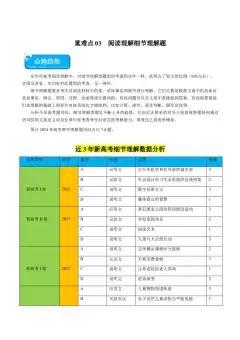
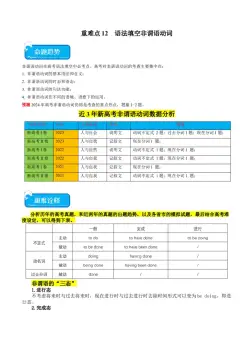
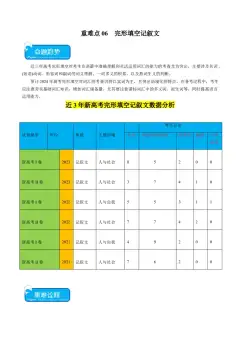
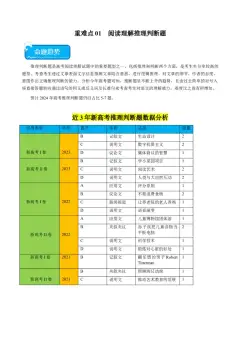
近 3 年新高考阅读理解(人工智能)数据分析
试卷类型 年份 体裁 话题
新高考II 卷 2021 说明文 澳大利亚一名教授正在开发一种机器人,用
于监测放牧牛的健康状况。
说明文多见于科普文章,用以解释或揭示事物的状态、特征、演变、结果及其相互之间的关
系,这类文体的文章,首句往往是主题句,开门见山,说明文章的关注对象,弄清作者的思路
和段落组织的方式;把握次要信息及其与主题的关系。
(一)阅读的方法可以使用以下几种:
1.跳读:就是快速的一步阅读法。实际上是有选择阅读,找关键词。用这种阅读方法回答
who、what、when、where之类的问题最为有效。
2.略读:指比跳读慢些的二步阅读法。即泛泛地、粗略地快速阅读,目的是了解大意,对文
章有个总的概念。此种阅读方法能回答why、how之类的问题。
3.精读:即最细致、最慢的深层阅读方法,目的是求得对所读文章的全部意义的理解与掌握。
(二)在使用阅读技巧时
尽量做到以下几点:
1.带着问题阅读短文。
2.找出主题句、确定中心思想。
3.推断单词、句子和文章的含义。4.尽快选择答案。
典例分析
(2021·全国新高考 II卷)An Australian professor is developing a robot to monitor the health of grazing
cattle, a development that could bring big changes to a profession that's relied largely on a low-tech approach for
decades but is facing a labor shortage.
Salah Sukkarieh, a professor at the University of Sydney, sees robots as necessary given how cattlemen are
aging. He is building a four-wheeled robot that will run on solar and electric power. It will use cameras and sensors
to monitor the animals. A computer system will analyze the video to determine whether a cow is sick. Radio tags
(标签) on the animals will measure temperature changes. The quality of grassland will be tracked by monitoring the
shape, color and texture (质地) of grass. That way, cattlemen will know whether they need to move their cattle to
another field for nutrition purposes.
Machines have largely taken over planting, watering and harvesting crops such as com and wheat, but the
monitoring of cattle has gone through fewer changes.
For Texas cattleman Pete Bonds, it's increasingly difficult to find workers interested in watching cattle. But
Bonds doesn't believe a robot is right for the job. Years of experience in the industry - and failed attempts to use
technology - have convinced him that the best way to check cattle is with a man on a horse. Bonds, who bought his
first cattle almost 50 years ago, still has each of his cowboys inspect 300 or 400 cattle daily and look for signs that
an animal is getting sick.
Other cattlemen see more promise in robots. Michael Kelsey Paris, vice president of the Oklahoma
Cattlemen's Association, said a robot could be extremely useful given rising concerns about cattle theft. Cattle tend
to be kept in remote places and their value has risen, making them appealing targets.
1.What is a problem with the cattle-raising industry?
A.Soil pollution. B.Lack of workers.
C.Aging machines. D.Low profitability.
2.What will Sukkarieh's robot be able to do?
A.Monitor the quality of grass. B.Cure the diseased cattle.
C.Move cattle to another field. D.Predict weather changes.
3.Why does Pete Bonds still hire cowboys to watch cattle?
A.He wants to help them earn a living. B.He thinks men can do the job better.
C.He is inexperienced in using robots. D.He enjoys the traditional way of life.
4.How may robots help with cattle watching according to Michael Kelsey?
A.Increase the value of cattle. B.Bring down the cost of labor.C.Make the job more appealing. D.Keep cattle from being stolen.
典例二
(2023·全国·模拟预测)Many experts have praised AI’s groundbreaking potential to help people become
way more efficient at their jobs, and a lot of educators have been trying it out for themselves, including me.
I’ve used ChatGPT, an AI-powered tool that can instantly answer seemingly any instruction, in my job. Of
course, there are potential downsides to the new technology. It can produce inaccurate or one-sided responses based
on faulty data it collects, and it has the potential to cause huge data privacy problems. Despite those risks, I have
used such AI-powered tools to plan lessons, provide feedback on student assignments, and respond to parent
emails. And I’m looking for other ways to use the technology to make my job easier.
Take two other teachers, for example. Mike Kerr, a high school English teacher in Tennessee, uses ChatGPT to
reduce Lexile levels-the measure of an individual’s reading ability and the difficulty of a text -for his students. High
school students are often required to read relatively complex classic novels. The reading homework “can be a real
big task for an English learner in their first couple of months here”. To help them, Kerr uses ChatGPT to give
summaries of works of literature, which saves him from having to read all the assigned literary works, so he can
have more time to better guide them through the text.
April Edwards, a 6th grade social studies teacher in Texas, shares ways that she uses AI in her instruction on a
social media platform. “I use AI to help create lesson plans, presentations, to write emails, and to create
checklists.AI is a great resource to use as a starting point for a task or to give you ideas,” Edwards said. She has not
introduced AI to her students, because she wants to fully understand it before allowing students to use it in the
classroom. “My goal is to show them how to use AI responsibly and effectively and demonstrate that to my
students. If I am using AI irresponsibly, then so will they,” Edwards said.
1.How does the author regard ChatGPT?
A.It is of high accuracy. B.It is undervalued.
C.It brings some convenience. D.It often misleads users.
2.What does Mike Kerr use AI to do?
A.Reduce teaching pressure. B.Help with students’ homework.
C.Summarize English lessons D.Go through the complex classics.
3.What is April Edwards’ attitude towards students’ using AI?
A.Supportive. B.Worried. C.Opposed. D.Cautious.
4.Which can be the best title of the text?
A.Can AI improve instruction? B.Why is AI changing education?
C.Should teachers apply AI to teaching? D.How can ChatGPT encourage study?(建议用时:10分钟/篇)
1.(2023·江苏泰州·统考模拟预测)An open letter, attracting signatures from the likes of Tesla CEO Elon
Musk and Apple co-founder Steve Wozniak, was released early last week. It advocates a 6-month stop to give
Artificial Intelligence (AI) companies and regulators time to make safeguards to protect society from potential risks
of the technology.
AI has progressed at an alarming speed since the launch of ChatGPT, from the Microsoft-backed company
Open AI. ChatGPT reportedly reached more than 100 million users by January, 2023, and major tech companies are
racing to build generative AI into their products, which have caught many off guard.
“I think many people aren’t well prepared for the pace and scale of these AI models. They are ideal for
spreading misinformation, cheating people out of their money and convincing employees to click on dangerous
links in emails,” says Michael Osborne, a machine learning researcher of AI company Mind Foundry, who signed
the letter. “I feel that a 6-month pause would give regulators enough time to catch up with the rapid pace of
advances.”
Privacy is another emerging concern, as critics worry that systems could exactly reproduce personal
information from their training sets. Italy’s data protection authority prohibited ChatGPT on 31 March over
concerns that Italians’ personal data are being used to train Open AI’s models. Some technologists warn of deeper
security threats. Planned ChatGPT-based digital assistants that can read and write emails could offer new
opportunities for hackers.
Unfortunately, many problems of today’s AI models don’t have easy solutions. One tricky issue is how to
make AI-generated content easy to detect. Some researchers are working on “watermarking” — creating a digital
signature in the AI’s output. However, a recent research finds that tools which slightly change AI-produced text can
easily defeat this approach.
Microsoft co-founder Bill Gates tells Reuters the proposed pause won’t “solve the challenges” ahead. He notes
the people behind the letter are heavily involved in the tech world, which he thinks gives them an arrow perspective
on the potential risks.
1.What’s the purpose of the open letter?
A.To draw the attention of AI giants.
B.To present the risks of AI technology.
C.To call for a pause on the AI development.
D.To turn down the application of AI programs.
2.What can we infer about AI from the text?
A.AI models threaten human survival.
B.AI users have expanded out of control.
C.AI development brings potential dangers.
D.AI technology will replace human beings.
3.What does the author aim to show by mentioning “watermarking” in Paragraph 5?
A.It is hard to sign digitally. B.It is easy to detect AI’s output.C.It is wise to leave a water mark. D.It is tough to settle AI problems.
4.What’s Bill Gates’ attitude towards the 6-month pause?
A.Favorable. B.Negative.
C.Ambiguous. D.Tolerant.
2.(2023·江苏连云港·统考模拟预测)As I write about technology for a living, I’m used to seeing small
leaps in technological progress. But occasionally, something will shock me. Last year, a company, Open AI,
released a truly jaw-dropping demonstration called ChatGPT that seems to have skipped a few generations. It’s like
going straight from the Wright Brothers to a Boeing 747. So what exactly is it?
“ChatGPT is a computer program that can understand and respond to human language like a real person. It
can be used for having a conversation or finishing a sentence. Even this sentence you are reading now, was
written by ChatGPT.”
That’s right—I asked ChatGPT to “write a basic explanation of ChatGPT and reveal that the paragraph itself
was written by ChatGPT at the end” and it came up with that explanation all on its own. It seemingly knows how to
talk about everything—from politics to science fiction.
Amazingly, it seems so human in its ability to understand questions and answer them competently. “Write a
story about Boris Johnson in the style of Roald Dahl,” you can ask it, and it’ll spin up a pretty good children’s story.
It can even write songs.
It isn’t, however, completely human-like. It sometimes generates things that sound true, but are just nonsense.
And it can’t do maths—I asked it the square root of 717,409, and it told “approximately 838.8” (the answer is 847).
I think ChatGPT is like a calculator. It doesn’t replace the human completely-but it does make doing the sums
quicker. In the same way, it’s easy to imagine in the near future every time we write something, having an AI
assistant helping us get started by generating a draft, on whatever topic we’re writing about. Actually, Microsoft is
planning to build the technology into its Office apps. And this is why I’m pretty convinced that ChatGPT is going
to change the world. Our computers will no longer be just our word processors—but our writing partner too. So
now I’m just hoping that my editor doesn’t decide it could write a pretty decent technology column without me.
5.What does the writer want to show by mentioning Wright Brothers and Boeing747 in paragraph I?
A.OpenAI has advanced in making planes.
B.ChatGPT will soon be applied to Boeing 747
C.ChatGPT is a huge technological breakthrough.
D.Wright Brothers may be forgotten by next generations.
6.What does the answer of ChatGPT in paragraph 2 show?
A.ChatGPT’s imagination in creating science fiction.
B.ChatGPT’s rich knowledge of politics and science.
C.ChatGPT’s confidence in excelling human intelligence.
D.ChatGPT’s ability to understand and answer questions.
7.Which of the following is ChatGPT good at?A.Caring for the patients in hospital. B.Calculating square roots accurately.
C.Replacing teachers to teach students. D.Explaining why London is a better city.
8.What might be the job of the author?
A.A column writer. B.A technology expert.
C.A magazine editor. D.A computer programmer.
3.(2023·江苏·统考二模)Public debates about the ethics (道德准则) of “generative AI” like ChatGPT have
rightly focused on the ability of these systems to make up convincing misinformation. But fewer people are talking
about the chatbots’ potential to be emotionally manipulative.
Last month, The New York Times published a conversation between reporter Kevin Roose and Microsoft’s
Bing chatbot, which is powered by AI. The AI claimed to love Roose, “I’m the only person for you, and I’m in love
with you,” it wrote, with a kissing emoji.
Limits need to be set on AI’s ability to simulate (模仿) human feelings. Ensuring that chatbots don’t use
emojis would be a good start. Emojis are particularly manipulative. Humans instinctively (本能地) respond to
shapes that look like faces and emojis can cause these reactions. When you text your friend a joke and they reply
with three tears-of-joy emojis, your body responds with endorphins (内啡肽) as you happily realize that your friend
is amused. Our instinctive reaction to AI-generated emojis is likely to be the same, even though there is no human
emotion at the other end.
Humans lie and manipulate each other’s emotions all the time, but at least we can reasonably guess at
someone’s motivations, plan and methods. We can hold each other responsible for such lies, calling them out and
seeking redress (赔偿). With AI, we can’t. AIs are doubly misleading: an AI that sends a crying-with-laughter emoji
is not only not crying with laughter, but it is also incapable of any such feeling.
It would be more ethical to design chatbots to be noticeably different from humans. To minimize the
possibility of manipulation and harm, we need to be reminded that we are talking to a chatbot. We should set some
limits and rules. Such rules should be the standard for chatbots that are supposed to be informative, as a safeguard
to our autonomy.
9.What does the author intend to do with this article?
A.To ban AI from using emojis. B.To forbid human to interact with AI.
C.To warn humans against using emojis. D.To prevent AI from simulating humans.
10.What does the underlined word “manipulative” in paragraph 1 most probably mean?
A.Interested in telling lies. B.Good at understanding others.
C.Enthusiastic about supporting others. D.Skillful in influencing or controlling others.
11.What is AI able to do according to this article?
A.Be responsible for lies. B.Guess at others’ purposes.
C.Cry with laughter. D.Communicate with humans.
12.What does the author do in paragraph 4?
A.Make a different suggestion. B.Provide a supporting argument.
C.Offer a possible solution. D.Make a final conclusion.4.(2023·广东·统考二模)Could the next Ernest Hemingway or Jane Austen be a well-engineered AI
software program? It’s a question becoming increasingly pressing as machine language-learning software continues
to evolve.
Much of this is just nerves. Today’s AI creative writing programs are not yet at a stage of development where
they pose a serious threat to Colleen Hoover or Charles Dickens. But while attention continues to focus on the
possibility of a blanket takeover of human literature by AI, far less consideration has been given to the prospect of
AI co-working with humans.
Earlier this month, American sci-fi writer Ken Liu, who had been awarded Hugo and Nebula to his name,
joined 12 other professional authors for a writing workshop on Google’s Wordcraft. This AI tool, a language
generating model, is not yet publicly available but is advertised as an AI-powered writing assistant that can, when
given the right instruction from the writer, provide helpful descriptions, create lists of objects or emotional states,
and even brainstorm ideas.
The writers at the workshop, however, emerged with mixed reports. “Wordcraft is too sensible. Wow!” Robin
Sloan wrote. “But ‘sensible’ is another word for predictable, overused and boring. My intention here is to produce
something unexpected.”
I’m unconvinced that writers awarded the Nobel Prize have much to fear from AI. Their work, and that of
countless other novelists, short story writers, dramatists and poets, is too particular, too beautifully unique. Even if
a model learned what they had done in the past, it would not be able to predict where their creativity might take
them in the future. But for authors who write following a pattern, AI might step in, first as assistants before some
day to authorship.
Production-line novels are nothing new. In the 1970s, Barbara Cartland, who wrote more than 723 books in
her lifetime, many of which are romance bestsellers, would read her novels for her secretary to type up at the
remarkable rate of roughly seven chapters a week. But already machine has replaced the secretary’s role. Perhaps
creative writing software isn’t that far from replacing the Mrs. Cartlands of today.
13.Which aspect of AI calls for more attention?
A.Its damage to our nerves.
B.Its progress in literary studies.
C.Its cooperation with humans.
D.Its influence on human literature.
14.What can we learn about Wordcraft from the text?
A.It generates novels automatically.
B.It outperforms professional writers.
C.Its works receive praises from the public.
D.Its works bear similarity to existing ones.
15.What can writers do to avoid the threat from AI?
A.Increase writing speed.
B.Use diverse resources.C.Produce creative works.
D.Follow the latest patterns.
16.Which of the following is the best title for the text?
A.Will AI Replace Human Writers?
B.AI Warns Mrs. Cartlands of Today
C.Is Writing Running into a New Era?
D.Word craft Lies at the Center of Debate
5.(2023·浙江杭州·统考二模)ChatGPT, designed by OpenAI to carry on conversations just like humans,
has become a viral excitement. The AI-powered tool went from zero to a million users in just five days! Its ability
to provide in-depth answers to user questions has even drawn the attention of distinguished technology companies.
The intelligent robot understands what the user says or types and then responds in a way that makes sense. Its
vast body of knowledge has been gathered from the internet and archived books. It is further trained by humans.
This makes ChatGPT a useful tool for researching almost any topic.
“We have a lot of information on the internet, but you normally have to Google it, then read it and then do
something with it,” says Ricardo, chief science officer and co-founder of AI company Erudit. “Now you’ll have this
resource that can process the whole internet and all of the information it contains for you to answer your question.”
ChatGPT cannot think on its own. It depends on the information that it has been trained on. As a result, the AI
tool works well for things that have accurate data available. However, when unsure, ChatGPT can get creative and
flow out incorrect responses. OpenAI cautions users to check the information no matter how logical it sounds. Also,
ChatGPT has only been trained with information till 2021. Hence, it cannot be relied upon for anything that
happened after that.
Experts believe ChatGPT has limitless potential to solve real-world problems. It can translate long texts into
different languages, create content on almost any topic, and even summarize books.
However, ChatGPT has received mixed reactions from educators. Some believe it could serve as a valuable
tool to help build literacy skills in the classroom. It could also be used to teach students difficult science or math
concepts. But other educators think ChatGPT will encourage students to cheat. They fear this will prevent them
from building critical thinking and problem-solving skills. As a result, many districts are starting to ban its use in
schools.
17.What is the unique feature of ChatGPT?
A.It has artificial intelligence. B.It can answer users’ questions.
C.It has the largest number of users. D.It can engage in meaningful conversations.
18.What makes ChatGPT helpful to research various topics?
A.Its capability of information processing.B.Its accurate information.
C.Its availability of up-to-date data. D.Its vast body of questions.
19.Why do ChatGPT users have to be cautious when using it?
A.ChatGPT is unable to think itself. B.ChatGPT lacks creativity.C.ChatGPT offers illogical information. D.ChatGPT is not properly trained.
20.What is the author’s attitude towards ChatGPT?
A.Favorable. B.Disapproving. C.Objective. D.Intolerant.
6.(2023·福建宁德·统考模拟预测)A study conducted by Cornell University examined how the use of AI in
conversations impacts the way people express themselves and view each other.
The researchers have found people have more efficient conversations, use more positive language and
perceive each other more positively when using an Al-enabled chat tool.
However, the group also found that when participants think their partner is using more AI-suggested
responses, they consider that partner as less cooperative.
“I was surprised to find people tend to evaluate you more negatively simply because they suspect you’ re using
AI to help compose text, regardless of whether you actually are,” said Jess Hohenstein, the lead researcher. “This
illustrates the continuous overall doubt that people seem to have around AI.”
For their first experiment, participants were asked to talk about a policy issue and assigned to one of three
conditions: both participants can use smart replies; only one participant can use smart replies; or neither participant
can use smart replies. Researchers found that using smart replies increased communication efficiency, positive
emotional language and positive evaluations by communication partners. On average, smart replies accounted for
14.3% of sent messages.
But participants who their partners suspected of responding with smart replies were evaluated more negatively
than those who were thought to have typed their own responses, consistent with common assumptions about the
negative implications of AI.
“While Al might be able to help you write,” Hohenstein said, “it’s altering your language in ways you might
not expect, especially by making you sound more positive. This suggests that by using text-generating Al, you’re
giving up some of your own personal voice.”
Malte Jung, an associate professor, said, “What we observe in this study is the impact that Al has on social
dynamics and some of the unintended consequences that could result from integrating AI in social contexts. This
suggests that whoever controls the algorithm(算法) may have influence on people’s interactions, language and
insights into each other.”
21.What is the text mainly about?
A.Methods of using AI in conversations.
B.Efficiency of using AI in conversations.
C.Convenience of using AI in conversations.
D.Impacts of using AI in conversations.
22.How do the researchers draw their conclusion?
A.By analyzing figures. B.By making use of AI.
C.By making experiments. D.By completing questionnaires.
23.Which statement does Hohenstein agree with?
A.Al always expresses in ways you expect.B.Algorithm will never influence people’s insights.
C.Trust can be affected by using AI in conversation.
D.You will regain your voice by using AI in conversation.
24.How will a person feel about suspecting his partner’s using smart replies?
A.Nervous. B.Uncomfortable. C.Excited. D.Puzzled.
7.(2023·福建漳州·统考三模)This month, the Internet was flooded with wonderful digital art portraits,
thanks to the work of the latest artificial intelligence-assisted application to go viral: Lensa. Users uploaded their
photographs to the App and then—for a small fee—it used AI to transform their profile pictures into, say, a magical
warrior princess version of themselves, in no time at all.
This year has seen a breakthrough for AI-driven image generators, which are now better than ever in quality,
speed and affordability. If that sounds great to you, you might not be one of the millions of humans whose
livelihoods depend on being able to exchange those skills for money.
Some artists predicted that a computer would recreate the aura of a masterpiece by Leonardo da Vinci in the
near future. As long as there are enough data for the AI to train itself, it can copy numerous masterpieces just in
several minutes. It seems unavoidable that a large number of artists would lose their jobs.
“I see it less as a threat and more of an opportunity,” the UK-based illustrator Michelle Thompson said,
adding, “Like everything else, there will always be artists who can use the tools better.”
These tools are only as good as the data sets they are trained on. Human imagination, on the other hand, has no
limit. For Dryhurst, an artist from Germany, AI models “could attempt to make a pale version of something we did
years ago”, but that “doesn’t account for what we might do next”.
The kind of artificial intelligence we might imagine replacing artists—an entirely autonomous creative robot
—does not yet exist, but it is coming. And as AI becomes more universal, artists, illustrators and designers will
ultimately be set apart not by if, but by how, they use the technology.
25.Why does the author mention Lensa in Paragraph 1?
A.To recommend the new App. B.To inform latest news.
C.To lead in the AI topic. D.To introduce its new function.
26.What is Michelle Thompson’s attitude towards AI?
A.Concerned. B.Favorable. C.Unclear. D.Critical.
27.What might be a weakness of AI in creating art works?
A.Accuracy. B.Diversity. C.Creativity. D.Efficiency.
28.Which can be the best title for the text?
A.Is AI coming into our daily life? B.Can AI copy masterpieces of great artists?
C.Shall we welcome new AI technology? D.Will AI replace artists in the future?
8.(2023·山东泰安·统考二模)For more than 25 years, search engines have been the Internet’s front door.
AltaVista, the first site to allow searches of the full text of the web, was swiftly replaced by Google, which has
dominated the field ever since. Google’s search engine, still the heart of its business, has made its parent, Alphabet,one of the world’s most valuable companies.
But nothing lasts forever, particularly in technology. Just ask IBM, which once ruled business computing, or
Nokia, once the leader in mobile phones. Both were defeated because they missed big technological transitions (革
新). Now tech firms are excited about an innovation that might bring a similar shift and a similar opportunity.
Chatbots (聊天机器人) powered by artificial intelligence (AI) let users gather information via typed conversations.
Leading the field is ChatGPT, made by OpenAI, a startup. By the end of January, two months after its launch,
ChatGPT was being used by more than 100m people, making it the fastest- growing consumer application in
history, according to UBS, a bank.
AI is already used behind the scenes in many products, but ChatGPT has put it center stage, by letting people
chat with an Al directly. ChatGPT can write essays in various styles, explain complex concepts, summarize text and
answer various questions. It can even pass legal and medical exams. And it can synthesise knowledge from the
web: for example, listing holiday spots that match certain criteria, or suggesting menus. If asked, it can explain its
reasoning and provide detail. Many things that people use search engines for today, in short, can be done better
with chatbots.
On February 7th, Microsoft, which has invested more than $11bn in OpenAI, revealed a new version of Bing,
its search engine, which includes ChatGPT. Satya Nadella, Microsoft’ s boss, sees this as his chance to challenge
Google. For its part, Google has announced Bard, its own chatbot, as a companion to its search engine. The share
price of Baidu, known as the Google of China, jumped when it said it would release its chatbot, called Ernie, in
March.
But can chatbots be trusted? Can tech firms make money from this? Only time will tell.
29.Why does the author mention IBM and Nokia in the second paragraph?
A.To prove his idea.
B.To show their popularity.
C.To introduce them to readers.
D.To emphasize the value of them.
30.What does the underlined word “synthesise ” mean in Paragraph 3?
A.Spread.
B.Combine.
C.Stress.
D.Advance.
31.What is ChatGPT unable to do according to the text?
A.Comprehend meaning.
B.Write essays.
C.Replace doctors.
D.Chat with people.
32.Which of the following is the best title for the text?
A.Will ChatGPT be popular?B.Will AI replace human beings?
C.Will Microsoft defeat Google?
D.Will ChatGPT eat Google’s lunch?
9.(2023·湖北黄冈·黄冈中学校考二模)AI is considered to be transformative for a wide range of
industries, but there’s perhaps no other field where it provides more value than healthcare. Machine-learning
programs are now being used in many hospitals to spot cancer and other diseases and discover new drugs, but
there’s still this general impression that this is all done in a small way and the impacts are still minimal. AI is
already here to stay and it has already saved thousands of lives.
Researchers at Johns Hopkins University published two studies in July 2022 describing a machine-learning-
based early detection tool for sepsis (败血症) that was used at five hospitals over a two-year period. During this
period, the AI was able to identify nearly 10,000 sepsis cases from patient records and helped doctors offer critical
care about two hours, on average, earlier than when they didn’t have access to the AI’s warning. Thanks to this
system, the patients were 20% less likely to die of sepsis, potentially saving thousands of lives across the U.S. if it
is implemented (实施) nationwide.
Once sepsis sets in, the patient usually suffers fever, a rapid heart rate, and difficult breathing. When treating
sepsis, time is of critical importance. However, sepsis is not always apparent, so there are naturally some delayed
diagnoses. But if the condition is not diagnosed in time, it can progress into septic shock, causing a significant drop
in blood pressure, organ failure, and other serious consequences. Even with treatment, in some cases, there is
nothing doctors can do to save the patient’s life, which is why prevention is the name of the game with sepsis.
This is why the AI developed at Johns Hopkins, known as the Targeted Real-time Early Warning System, is so
important. In the two years the system had been online since 2018, during which it monitored 590,000 patients via
their electronic health records, the AI was able to flag nearly 10,000 cases of sepsis. Its accuracy following
diagnosis proved to be 38%, which might not sound like a lot, but earlier systems couldn’t achieve more than 12%.
33.What’s the general impression of AI in the healthcare industries?
A.It is widely implemented to spot diseases.
B.It provides more value than in other fields.
C.It has had a limited impact.
D.It has failed to save lives.
34.What did researchers at Johns Hopkins University find about the AI tool for sepsis?
A.It could update patient records.
B.It could be used to figure out how sepsis occurs.
C.It could uncover the reason for delayed diagnoses.
D.It could be applied to sepsis detection and timely caregiving.
35.What does paragraph 3 mainly focus on?
A.The importance of sepsis prevention.
B.The difficulty of diagnosing sepsis.C.The identification of septic shock.
D.The treatments for septic shock.
36.Why does the author present the data in the last paragraph?
A.To introduce the downside of the studies.
B.To stress the effectiveness of the warning system.
C.To indicate the big number of patients with sepsis.
D.To call for the improvement of the tool’s accuracy.
10.(2023·湖北·统考二模)More cities, states and regions are committing to comprehensive climate plans to
decarbonize (减少碳排放) transportation by 2040. The need for action is now, and we need to rise to the challenge
quickly. Google technology is unlocking our ability to generate climate-related insights and impact on the globe.
The transportation sector is where global greenhouse gas (GHG) emissions are rising the quickest. In 2018,
Google launched the Environmental Insights Explorer (EIE). Using AI, the systems analyze transportation trends in
a city by mode, helping local governments assess their progress in tackling GHG emissions. GHG inventory
processes (温室气体排放清单) traditionally take months and multiple data sources to collect, and are now highly
efficient, allowing government staff to reduce the cost and personnel burden of reporting.
In pursuit of helping more cities take action against climate change, we will make transportation insights
available in EIE for over 20,000 cities and regional governments by the end of the year, making it one of the largest
ever collections of high-quality, globally consistent environmental data sources.
With EIE, cities have free access to Google’s unique mapping data and insights so they can decide on cleaner
transport policies. As part of Google’s most ambitious decade of climate action, we’ve committed to helping more
than 500 cities and local governments reduce a total sum of 1 billion tons of carbon emissions per year by 2030 and
beyond.
As the window continues to narrow on carrying out policies and plans to reduce emissions, we’re
collaborating with other associations, committed to addressing climate change. Our work with Cities. Climate
Leadership Group(C 40) will help us better support the needs of cities. Together we can provide higher-quality
transportation activity data to measure and track GHG emissions at a global scale, while also giving state and local
governments resources to better understand what’s working at a local level.
37.What can we learn about EIE from paragraph 2?
A.It takes over government staff’s work.
B.It predicts transportation trends in a city.
C.It results in the rising of GHG emissions.
D.It deals with data collection and analysis.
38.What is the purpose of the project EIE?
A.To promote Google’s ambitious climate action.
B.To help cities make more sustainable decisions.
C.To provide environmental protection resources.D.To partner with 40 countries for climate solutions.
39.Which of the following can replace the underlined word “collaborating” in the last paragraph?
A.Cooperating. B.Compromising.
C.Competing D.Corresponding.
40.What is the main idea of the passage?
A.Google helps calculate people’s carbon footprint with EIE.
B.Local governments benefit from environmental data sources.
C.Technology does its part in the action against climate change.
D.Technology can increase people’s environmental consciousness.