押新高考卷第 28-31 题
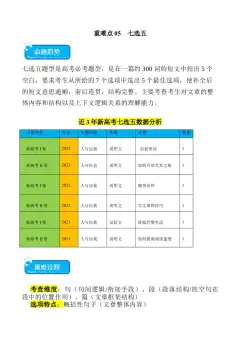
阅读理解 C 篇 说明文
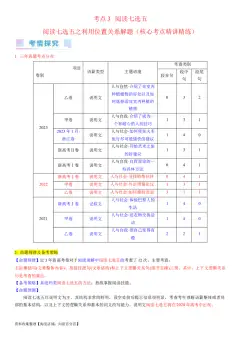
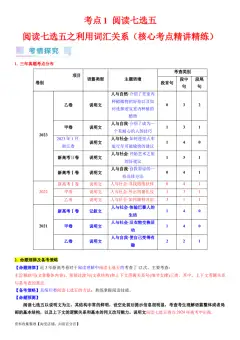
【三年考情回顾】
C篇
语篇 卷别 体裁 主题内容
I卷 说明文 数字极简主义生活方式的优点,倡导简单的数字生活方式
2023年新
C篇
高考卷
II卷 说明文 印刷书籍和阅读对人类的重要意义
I卷 新闻报道 养鸡提升老年人幸福感
2022年新
C篇
高考卷
II卷 说明文 使用Textalyzer(短信监控器)的技术来监控司机在开车
I卷 说明文 人与自然:湿地破坏,保护环境
2021年新 C篇
高考卷
II卷 记叙文 捐资助学
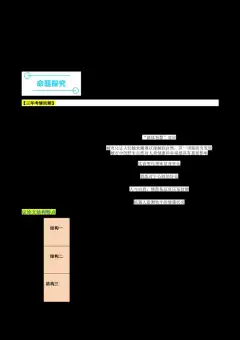
说明文文章特点
1. 提出问题
问题解决型
2. 分析问题
3. 解决问题
1. 概括文章的主旨大意
一般具体型
2. 按照时间、空间等顺序来阐述主题
3. 得出结论
1. 介绍一种新技术或新产品。涉及其功能、材料、工作原理、市场前景等方面。
介绍说明型
2. 按照事物之间的内在联系进行介绍。如:现象--本质;主要--次要;原因--结果
等。(2023年新高考卷I卷)On March 7, 1907, the English statistician Francis Galton published a paper which
illustrated what has come to be known as the “wisdom of crowds” effect. The experiment of estimation he
conducted showed that in some cases, the average of a large number of independent estimates could be quite
accurate.
This effect capitalizes on the fact that when people make errors, those errors aren’t always the same. Some
people will tend to overestimate, and some to underestimate. When enough of these errors are averaged together,
they cancel each other out, resulting in a more accurate estimate. If people are similar and tend to make the same
errors, then their errors won’t cancel each other out. In more technical terms, the wisdom of crowds requires that
people’s estimates be independent. If for whatever reasons, people’s errors become correlated or dependent, the
accuracy of the estimate will go down.
But a new study led by Joaquin Navajas offered an interesting twist (转折) on this classic phenomenon. The
key finding of the study was that when crowds were further divided into smaller groups that were allowed to have a
discussion, the averages from these groups were more accurate than those from an equal number of independent
individuals. For instance, the average obtained from the estimates of four discussion groups of five was
significantly more accurate than the average obtained from 20 independent individuals.
In a follow-up study with 100 university students, the researchers tried to get a better sense of what the group
members actually did in their discussion. Did they tend to go with those most confident about their estimates? Did
they follow those least willing to change their minds? This happened some of the time, but it wasn’t the dominant
response. Most frequently, the groups reported that they “shared arguments and reasoned together”. Somehow,
these arguments and reasoning resulted in a global reduction in error. Although the studies led by Navajas have
limitations and many questions remain, the potential implications for group discussion and decision-making are
enormous.
1.What is paragraph 2 of the text mainly about?
A.The methods of estimation. B.The underlying logic of the effect.
C.The causes of people’s errors. D.The design of Galton’s experiment.
2.Navajas’ study found that the average accuracy could increase even if ________.
A.the crowds were relatively small B.there were occasional underestimatesC.individuals did not communicate D.estimates were not fully independent
3.What did the follow-up study focus on?
A.The size of the groups. B.The dominant members.
C.The discussion process. D.The individual estimates.
4.What is the author’s attitude toward Navajas’ studies?
A.Unclear. B.Dismissive. C.Doubtful. D.Approving.
(2023 年新高考卷 I 卷)The goal of this book is to make the case for digital minimalism, including a
detailed exploration of what it asks and why it works, and then to teach you how to adopt this philosophy if you
decide it’s right for you.
To do so, I divided the book into two parts. In part one, I describe the philosophical foundations of digital
minimalism, starting with an examination of the forces that are making so many people’s digital lives increasingly
intolerable, before moving on to a detailed discussion of the digital minimalism philosophy.
Part one concludes by introducing my suggested method for adopting this philosophy: the digital declutter.
This process requires you to step away from optional online activities for thirty days. At the end of the thirty days,
you will then add back a small number of carefully chosen online activities that you believe will provide massive
benefits to the things you value.
In the final chapter of part one, I’ll guide you through carrying out your own digital declutter. In doing so, I’ll
draw on an experiment I ran in 2018 in which over 1,600 people agreed to perform a digital declutter. You’ll hear
these participants’ stories and learn what strategies worked well for them, and what traps they encountered that you
should avoid.
The second part of this book takes a closer look at some ideas that will help you cultivate (培养) a sustainable
digital minimalism lifestyle. In these chapters, I examine issues such as the importance of solitude (独处) and the
necessity of cultivating high-quality leisure to replace the time most now spent on mindless device use. Each
chapter concludes with a collection of practices, which are designed to help you act on the big ideas of the chapter.
You can view these practices as a toolbox meant to aid your efforts to build a minimalist lifestyle that works for
your particular circumstances.
5.What is the book aimed at?
A.Teaching critical thinking skills. B.Advocating a simple digital lifestyle.
C.Solving philosophical problems. D.Promoting the use of a digital device.6.What does the underlined word “declutter” in paragraph 3 mean?
A.Clear-up. B.Add-on. C.Check-in. D.Take-over.
7.What is presented in the final chapter of part one?
A.Theoretical models. B.Statistical methods.
C.Practical examples. D.Historical analyses.
8.What does the author suggest readers do with the practices offered in part two?
A.Use them as needed. B.Recommend them to friends.
C.Evaluate their effects. D.Identify the ideas behind them.
说明文答题策略
1. 通读全文,把握主题知大意
考生在有限的时间里,充分利用略读、扫读、跳读等技巧速读全文,抓住关键词、高频词、主题句、标
题、副标题、插图、表格等关键信息,把握文章结构,快速确定文章主旨大意。
2. 关注细节,理清思路与脉络
记叙文多以时间或空间为线索展开故事;议论文通常包含论点、论据和结论,通过解释、举例来阐述观点;
说明文往往有明确的写作顺序。抓住这些特点并结合文章细节,可以在最短的时间内理清文章思路,把握
主旨大意。
3. 删繁就简,突破难句捕
遇到结构复杂的句子,要善于略去修饰成分,如定语(从句)、状语(从句)、同位语(从句)等,抓住句
子的关键成分,即句子的主干成分,如主语、谓语和宾语,从而迅速锁定句子意思
4. 技巧助力,轻松应考走捷径
在阅读理解的过程中,只要考生把握高考命题的规律,熟练运用略读、扫读、跳读等阅读技巧,就可以获
得事半功倍的效果,提高正确率
(2024·辽宁·二模)German physicist Albert Einstein is one of the most famous scientists of all time, the
personification of genius and the subject of a whole industry of scholarship. In The Einsteinian Revolution, two
experts on Einstein’s life and his theory of relativity— Israeli physicist Hanoch Gutfreund and German historian ofscience Jürgen Renn— offer an original and penetrating (犀利的) analysis of Einstein’s revolutionary contributions
to physics and our view of the physical world.
For the first time ever, by setting Einstein’s work in the long course of the evolution of scientific knowledge,
Gutfr eund and Renn discover the popular misconception of Einstein as an unconventional scientific genius who
single-handedly created modern physics—and by pure thought alone.
As a large part of the book explains, Einstein typically argued that science progresses through steady
evolution, not through revolutionary breaks with the past. He saw his theory of relativity not as something from
scratch, but a natural extension of the classical physics developed by pioneers such as Italian astronomer Galileo
Galilei and English physicist Isaac Newton in the sixteenth and seventeenth centuries, as well as nineteenth-century
physicists.
The authors highlight how classical physics cannot be separated cleanly from modern Einsteinian physics. The
book also includes substantial sections on Polish astronomer Nicolaus Copernicus and Galileo whose methods
inspired Einstein. When Einstein considered himself as standing on their shoulders, he meant that, without their
contributions, he would not have formulated (阐述) the theory of relativity.
The Einsteinian Revolution is an important and thought-provoking contribution to the scholarly literature on
Einstein and his surprising scientific creativity between 1905 and 1925. Gutfreund and Renn might not have given
the final answer as to why Einstein, of all people, revolutionized physics in the way that he did. But they argue in
fascinating detail that, to understand his genius, one must take into account not just the earlier history of physics but
also the history of knowledge more broadly. Although not always an easy read, the book will interest physicists and
historians alike.
9.What’s the attitude of Gutfreund and Renn to the popular viewpoint on Einstein?
A.Opposing. B.Favorable. C.Ambiguous. D.Indifferent.
10.What does the underlined phrase “from scratch” probably mean?
A.From nothing. B.Up to a certain standard.
C.By learning from others. D.With previous knowledge.
11.What does the author mean to say by mentioning the famous physicists?
A.Their ideas were rejected by Einstein.
B.Their devotion to physics impressed Einstein.
C.Their research contributed to Einstein’s success.
D.Their hard work deserved the worldwide respect.12.Where is the text most probably taken from?
A.A guidebook to a course. B.An introduction to a book.
C.An essay on Albert Einstein. D.A review of physics development.
(2024·江苏南京·二模)“Anxiety.” The very word invites discomfort. Its effects—shortness of breath,
pounding heart, muscle tension—are outright upsetting. But, as a clinician, I find that we tend to miss out on many
valuable opportunities presented by this human emotion. In and of itself, anxiety is not deadly, nor is it a disease.
Quite the contrary: it is an indicator of brain and sensory health. Once we accept that it is a normal, though
uncomfortable, part of life, we can use it to help us.
We all know working out at the gym is hard. By nature, a “good workout” is uncomfortable, since it involves
pushing our physical strength past what we can easily do. The sweet spot of exercise is always a somewhat
challenging experience. Similarly, if you want to be emotionally stronger, you need to face some tension. For
example, one effective treatment for fear is exposure therapy (疗法), which involves gradually encountering things
that make one anxious, reducing fear over time.
Humans are social creatures. When my patients learn to open up to their partners about their anxieties, they
almost always report a greater sense of emotional closeness. Also, as international relationship expert Sue Johnson
teaches, when we express our need for connection during challenging moments (e.g., “I’m having a hard time right
now and could really use your support”), it creates greater connection and turns our anxiety into love.
From time to time, we find ourselves at the end of our rope. Our responsibilities pile up, our resources break
down, and we feel uncomfortably anxious—what we’re experiencing is called stress. Simply put, the demands
placed upon us outweigh our available resources, just like a set of scales (天平) going out of balance. Focusing on
work and pretending everything is OK only leads to disastrous results. Medical treatment for stress may function
for a while, but it tends to make things worse in the long run. The only solution to deal with stress is to do the
mathematics to balance the scales.
13.What does the author say about anxiety?
A.It is an invitation to diseases.
B.It indicates stable mental health.
C.It costs us many valuable chances.
D.It is a natural emotional expression.
14.Why does the author mention “good workout” in paragraph 2?A.To prove how exercise influences emotions.
B.To suggest an effective way to challenge limits.
C.To explain how anxiety builds emotional strength.
D.To show a positive connection between mind and body.
15.What is paragraph 3 mainly about?
A.The key to closeness is partners’ support.
B.Sharing anxieties improves relationships.
C.Humans are defined by their social nature.
D.Expressing feelings keeps us off anxieties.
16.According to the last paragraph, how can we deal with stress?
A.Devote more energy to our work.
B.Increase resources available to us.
C.Seek professional medical treatment.
D.Master advanced mathematical skills.
(2024·黑龙江·一模)German physicist Albert Einstein is one of the most famous scientists of all time, the
personification of genius and the subject of a whole industry of scholarship. In The Einsteinian Revolution, two
experts on Einstein’s life and his theory of relativity, Israeli physicist Hanoch Gutfreund and German historian of
science Jurgen Renn, offer an original and penetrating(犀利的)analysis of Einstein’s revolutionary contributions to
physics and our view of the physical world.
By setting Einstein’s work in the long course of the evolution of scientific knowledge, Gutfreund and Renn
discover the popular misconception of Einstein as an unconventional scientific genius who single-handedly created
modern physics—and by pure thought alone.
As a large part of the book explains, Einstein typically argued that science progresses through steady
evolution, not through revolutionary breaks with the past. He saw his theory of relativity not as something from
scratch, but a natural extension of the classical physics developed by pioneers such as Italian astronomer Galileo
Galilei and English physicist Isaac Newton in the sixteenth and seventeenth centuries, as well as nineteenth-century
physicists.
The authors highlight how classical physics cannot be separated cleanly from modern Einsteinian physics. The
book also includes substantial sections on Polish astronomer Nicolaus Copernicus and Galileo whose methodsinspired Einstein. When Einstein considered himself as standing on their shoulders, he meant that, without their
contributions, he would not have formulated(阐述)the theory of relativity.
The Einsteinian Revolution is an important and thought-provoking contribution to the scholarly literature on
Einstein and his surprising scientific creativity between 1905and 1925.Gutfreund and Renn might not have given
the final answer as to why Einstein, of all people, revolutionized physics in the way that he did. But they argue in
fascinating detail that, to understand his genius, one must take into account not just the earlier history of physics but
also the history of knowledge more broadly. Although not always an easy read, the book will interest physicists and
historians alike.
17.Where is the text most probably taken from?
A.An introduction to a book. B.An essay on Albert Einstein.
C.A guidebook to a course. D.A review of physics development.
18.What’s the attitude of Gutfreund and Renn to the popular viewpoint of Einstein?
A.Opposing. B.Favorable. C.Ambiguous. D.Indifferent.
19.What does the underlined phrase “from scratch” in the third paragraph probably mean?
A.With previous knowledge. B.Up to a certain standard.
C.From learning from others. D.From the very beginning.
20.What does the author mean to say by mentioning the famous physicists?
A.Their ideas were rejected by Einstein.
B.Their devotion to physics impressed Einstein.
C.Their researches contribute to Einstein’s success.
D.Their hard work deserved the worldwide respect.
(2024·浙江·二模)Babies as young as 4 months old who are born into a bilingual (双语的) environment
show distinct and potentially advantageous brain patterns for speech processing. Our early-life experiences can
have lifelong effects on our behavior. The brain is most sensitive to its environment during the first year of life,
which is thought to be a critical period for language development.
Previous studies have looked into the brain mechanisms that underlie (构成……的基础) speech processing in
babies who hear just one language. To better understand this in bilingual-exposed infants, Borja Blanco at the
University of Cambridge and his colleagues compared how 31 babies who only heard Spanish and 26 babies who
heard Spanish and Basque, all aged 4 months, responded to Spanish recordings of The Little Prince by Antoine deSaint-Exupery.
The team used an imaging technique called functional near-infrared spectroscopy (fNIRS) to measure changes
in brain activities. In the Spanish-only babies, the recordings caused activation in areas which play a role in speech
processing. In the bilingual-exposed babies, the recordings similarly evoked these responses, but they were larger
and wider. These infants also had activation in equivalent areas of their brains’ right hemispheres ( 脑半球 ).
When the recordings were then played backwards as a control arm of the experiment, the infants exposed to just
Spanish had larger responses to the backwards speech, while those to Spanish and Basque had similar brain patterns
as before. This may be because the bilingual infants take longer to register their primary language, in this case
Spanish, as hearing both this and Basque reduces their overall exposure to either language.
If this is the case, it could help them be sensitive to linguistic differences and enable them to learn to
distinguish between languages at a younger age. The researchers note that a bilingual environment stimulates
changes in the brain mechanisms underlying speech processing in young infants, adding weight to the idea that the
neural basis of learning two or more languages is established very early in life.
21.Why was the study conducted?
A.To reveal the impact of bilingual exposure. B.To confirm the pattern of brain mechanism.
C.To conclude the factors for speech processingD.To explore the potentials for language development.
22.What is paragraph 3 mainly about?
A.Theory basis. B.Study methods.
C.Research findings D.Technical assistance,
23.What can we learn from the research?
A.Bilingual-exposed babies are more sensitive.
B.Bilingual-exposed babies are more linguistically critical.
C.Bilingual-exposure reduces babies’ linguistic competence.
D.Bilingual-exposure reduces babies’ overall language exposure.
24.Which of the following statements might the researchers agree with?
A.Immigrants speak better languages.
B.Mixed race families own more linguistic potential.
C.Exchange students show greater learning capability.
D.Overseas workers have higher language proficiency.
(2024·云南昆明·一模)Rushing down the path, the traceur (跑酷者) is on the lookout for his next obstaclessuch as fire escapes, walls, or fences. As soon as he realizes a massive brick wall stands between him and where he
wants to be, he unintentionally grabs on the wall with his hands and lifts himself to stand on top of it. His next
move is a jump that lands him back on solid ground; however, noticing that he is unstable, he rolls to avoid injury.
Traceurs are athletes who perform remarkable gymnastics actions in urban environments. Serious traceurs are
fascinated not just by the physical challenges of Parkour, but by its philosophy. Those who learn to excel at Parkour
claim to develop not just physical fitness, but increased self-confidence and critical thinking skills, as they train
themselves to find ways around every obstacle in their paths.
Because of these philosophical foundations, Parkour is often described by traceurs as more of a lifestyle or an
art form than a sport. Passionate traceurs are determined to keep Parkour from becoming a competitive attempt.
Competition, they argue, devalues the philosophical theory behind Parkour. People who practice Parkour should be
more concerned with their relationship to the environment than with a ticking clock, a score, or a cheering crowd.
Furthermore, traceurs should work with each other to improve confidence, awareness, and unity. Competition, they
argue, only brings about feelings of conflict and disharmony.
While Parkour purists suggest that the philosophy behind Parkour helps to limit injuries, they must remember
that not everyone who tries to leap over a mailbox is an experienced traceur trying to get in touch with his or her
environment. Adolescents attempting to carry out these acrobatic (杂技的) skills could severely injure themselves.
So while newcomers to Parkour might be eager to investigate this art of movement, it would be wise for them to
remember the physicality behind the philosophy. After all, philosophy is not much good to a broken leg.
25.Why does the author describe a traceur at the beginning?
A.To illustrate what Parkour is like. B.To teach ways of avoiding injuries.
C.To explain different Parkour moves. D.To highlight the popularity of sports.
26.How can Parkour enhance a traceur’s self-confidence?
A.By strengthening physical fitness. B.By winning Parkour competitions.
C.By building faith in conquering barriers.D.By grasping some philosophical theories.
27.What do we know about serious and pure traceurs?
A.They are aware of how to treat injuries.
B.They suggest individual efforts in the sport.
C.They stress the relationship to the environment.
D.They are more concerned with remarkable actions.
28.What does the author advise newcomers to do?A.Face physical challenges boldly. B.Learn from experienced traceurs.
C.Start from leaping over a mailbox. D.Consider the risk of severe harm.
(2024·湖北武汉·一模)Many think 2024 could be the year more people have the tools to follow through on
New Year’s resolutions about weight loss. If they can afford them and manage to stick with them, people can turn to
a new generation of remarkably effective weight-loss drugs, also called GLP-1s, which offer the potential for
substantial weight loss.
Wegovy, which was approved in 2021, and Zepbound, which got the nod from the U.S. Food and Drug
Administration in 2023, are the most effective publicly available weight-loss drugs ever made. Wegovy has been
shown to help people shed as much as 16% of their body weight, in combination with exercise and diet.
Zepbound’s highest dose, along with lifestyle changes, has helped people lose as much as 27% of their body weight
over 18 months.
Although long-term data isn’t available, these drugs appear to be the safest to date. A large number of people
suffer from gastrointestinal distress (肠胃不适) on the medications, including vomiting, nausea and diarrhea; but
more serious side effects, like those previous weight-loss drugs, have been rare. Wegovy also appears to reduce the
risk of a repeating heart attack or stroke for people with pre-existing disease.
So far, both drugs have been hard for patients to access. Suppliers have had trouble making enough of the
medicines to meet the skyrocketing demand. And insurance companies haven’t covered the cost of the drugs, which
can run from about $1,000 to over $1,300 a month.
Paying for them should become easier in 2024, as supplies rise up and insurance companies could bow to
market pressure and cover more of the cost.
Also in the new year, there are more GLP-1 drugs on the way and in more forms. Both Wegovy and Zepbound
are delivered as weekly shots. Pill versions are under development as are other medications, some of which could
help people lose even more weight.
There’s a major unknown factor with these drugs, which could become better understood in the coming years.
Experts can’t say if people will be able to keep the weight off if they don’t make lifestyle changes and stop taking
the drugs.
29.What is Paragraph 3 mainly about?
A.The side effects of the two drugs. B.The safety of the two drugs.C.The advantages of the two drugs. D.The doubt about the two drugs.
30.Which is the reason for the shortage of the two drugs?
A.The technology to make the medicines is not mature.
B.They are expensive, sold at around $1,000 for each shot.
C.They are not currently included in the medical insurance.
D.There are no pill versions of the two drugs on the market.
31.Which statement about GLP-1 drugs is correct?
A.They are mainly injected into patients at present.
B.They can effectively reduce weight by 27% per year.
C.The doubt about the drugs will be cleared in the coming year.
D.The drugs will substantially solve the weight issue once and for all.
32.What is the author’s attitude towards the development of GLP-1 drugs?
A.Doubtful. B.Critical. C.Objective. D.Hopeful.
(2024·河北·二模)There’re plenty of fresh fruits and vegetables available in local markets. But while those
red juicy strawberries look fresh, consumers have no way of knowing how long the fruit can be stored at home. The
same goes for distribution centers and supermarkets.
Now, the food technology startup OneThird, located in the Netherlands, is looking to change that with an
infrared (红外线) scanner that can accurately predict how long fresh fruits and vegetables will last. The startup is
named OneThird because one-third of food is wasted due to spoilage (变质) every year.
The startup’s founders were inspired by a UK company that uses this type of technology in the medical field
and decided to see if it was applicable for food. “I looked at the challenges in the food-supply chain and found out
that 40 percent of food waste is fresh produce. One of the biggest causes of waste is that nobody knows shelf life.”
founder and CEO of OneThird, Marco Snikkers said.
Quality inspections at farms and distribution centers are done manually (手动地). An inspector checks the
fruits and vegetables and makes notes about the size and quality. Then the food is sent to consumers without
considering travel time or how long the produce will remain usable.
Using the infrared scanner at the distribution center means that inspectors can use the information to approve
shipments that will ensure the produce can be distributed on a timely basis. This means that a shipment of rip e
tomatoes will not be sent long distances away.
OneThird’s scanner combines the technology of optical scanners, image modeling, and Artificial Intelligenceto provide accurate shelf-life predictions.
The startup found that the technology can reduce up to 25 percent produce waste that was caused by spoilage.
“Global food waste has an enormous environmental impact; reducing global food waste cuts global greenhouse gas
emissions and promotes global food security,” said Jacob Smith, a climate expert from the University of Maine.
33.What problem does OneThird aim to solve?
A.The high cost of storing fresh fruits and vegetables.
B.Inefficient quality inspections at distribution centers.
C.Food waste caused by uncertainty about its shelf life.
D.Consumers’ difficulty judging the freshness of produce.
34.What inspired OneThird to come up with the idea of using infrared scanner?
A.The use of the device in another field. B.Observation of the food-supply chain.
C.Consumer demands for fresher produce.D.Experts’advice on food waste reduction.
35.What can we learn about the manual quality inspections?
A.They are time-consuming and costly. B.They are not performed at a regular time.
C.The inspectors tend to make wrong judgement. D.The shipping time is not
taken into consideration.
36.What’s Jacob’s attitude to OneThird’s effort?
A.Approving. B.Doubtful. C.Tolerant. D.Dismissive.
(2024·山东枣庄·二模)Even if you haven’t held a conversation with Siri or Alexa, you’ve likely
encountered a chatbot online. They often appear in a chat window that pops up with a friendly greeting: Thank you
for visiting our site.How can I help you today? Depending on the site, the chatbot is programmed to respond
accordingly and even ask follow-up questions.
Chatbots are a form of conversational AI designed to simplify human interaction with computers. They are
programmed to simulate human conversation and exhibit intelligent behavior that is equivalent to that of a human.
Chatbots communicate through speech or text. Both rely on artificial intelligence technologies like machine
learning and natural language processing (NLP), which is a branch of artificial intelligence that teaches machines to
read, analyze and interpret human language. This technology gives chatbots a baseline for understanding language
structure and meaning. NLP, in essence, allows the computer to understand what you are asking and how to
appropriately respond.
With developments in deep learning and reinforcement learning, chatbots can interpret more complexities inlanguage and improve the dynamic nature of conversation between human and machine. Essentially, a chatbot tries
to match what you’ve asked to an intent that it understands. The more a chatbot communicates with you, the more it
understands and the more it learns to communicate like you and others with similar questions. Your positive
responses reinforce its answers, and then it uses those answers again.
From customer service chatbots online to personal assistants in our homes,chatbots have started to enter our
lives. In almost every industry, companies are using chatbots to help customers easily navigate their websites,
answer simple questions and direct people to the relevant points of contact. Personal assistants like Siri and Alexa
are designed to respond to a wide range of scenarios and queries, from current weather and news updates to
personal calendars, music selections and random questions.
37.Why does the author mention Siri and Alexa in Paragraph 1?
A.To explain how a chatbot works. B.To show where to find a chatbot.
C.To give examples of chatbots. D.To compare different chatbots.
38.What is the basis of chatbots?
A.Language study. B.Data transmission.
C.Social interaction. D.Natural language processing.
39.What does the underlined word “reinforce” in paragraph 4 mean?
A.Inspire. B.Strengthen. C.Organize. D.Match.
40.What is the last paragraph mainly about?
A.The future trend of chatbots. B.The author’s predictions.
C.The effects of chatbots. D.The applications of chatbots.