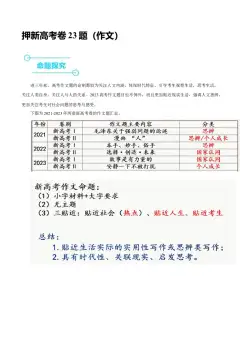
押新高考卷第 24-27 题
阅读理解 B 篇 记叙文
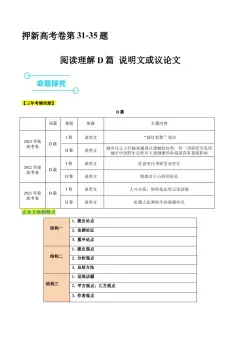
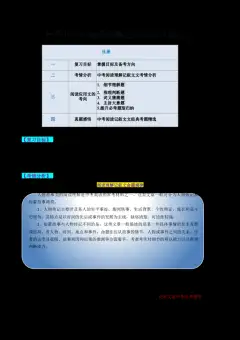
【三年考情回顾】
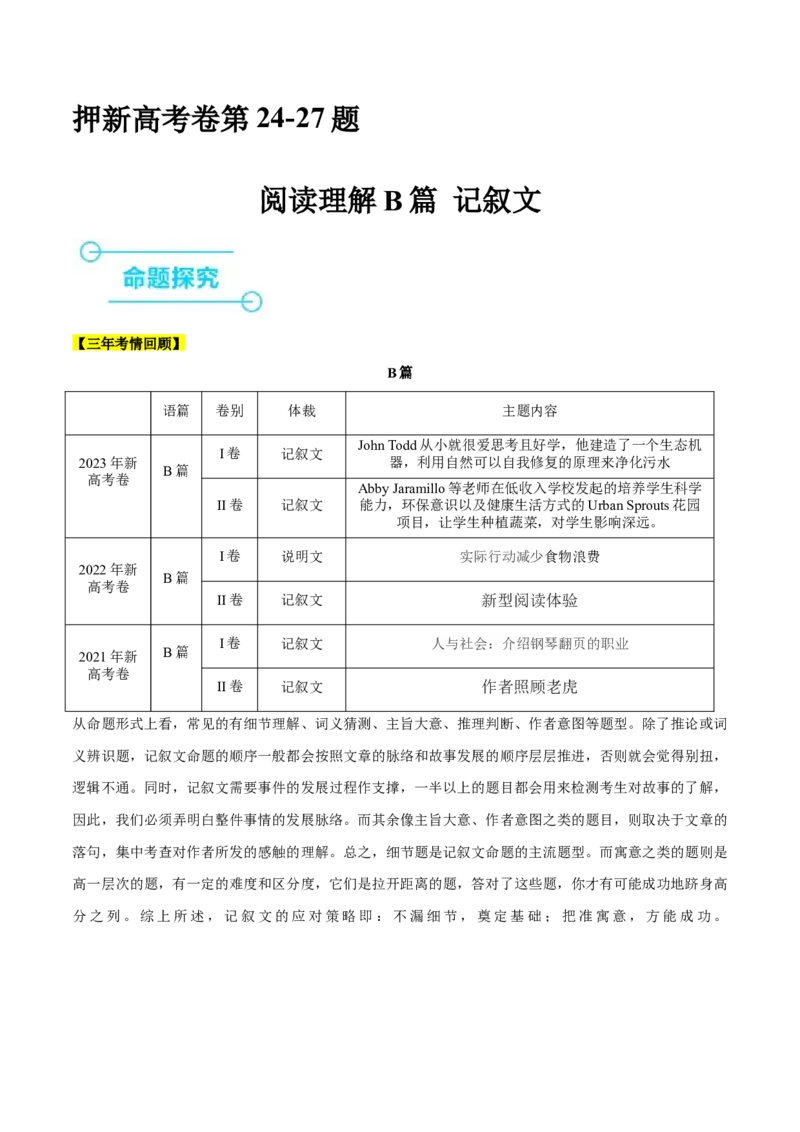
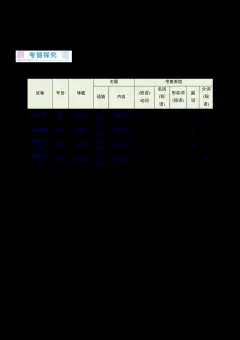
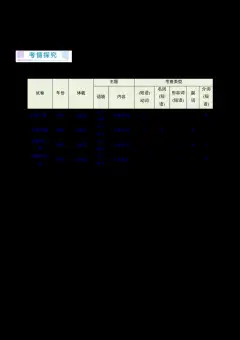
B篇
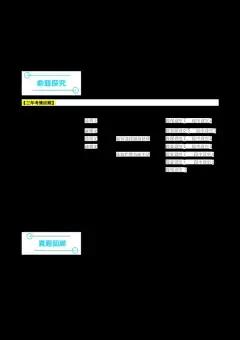
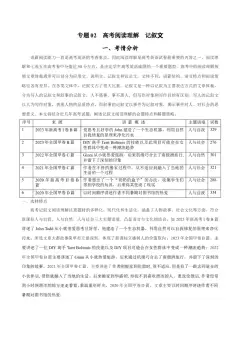
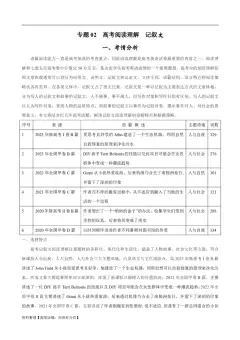
语篇 卷别 体裁 主题内容
John Todd从小就很爱思考且好学,他建造了一个生态机
I卷 记叙文
2023年新 器,利用自然可以自我修复的原理来净化污水
B篇
高考卷
Abby Jaramillo等老师在低收入学校发起的培养学生科学
II卷 记叙文 能力,环保意识以及健康生活方式的Urban Sprouts花园
项目,让学生种植蔬菜,对学生影响深远。
I卷 说明文 实际行动减少食物浪费
2022年新
B篇
高考卷
II卷 记叙文 新型阅读体验
I卷 记叙文 人与社会:介绍钢琴翻页的职业
2021年新
B篇
高考卷
II卷 记叙文 作者照顾老虎
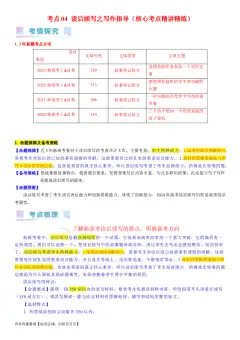
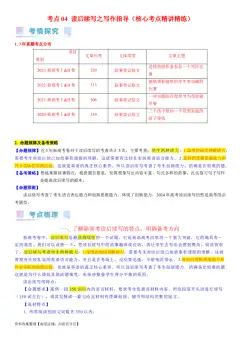
从命题形式上看,常见的有细节理解、词义猜测、主旨大意、推理判断、作者意图等题型。除了推论或词
义辨识题,记叙文命题的顺序一般都会按照文章的脉络和故事发展的顺序层层推进,否则就会觉得别扭,
逻辑不通。同时,记叙文需要事件的发展过程作支撑,一半以上的题目都会用来检测考生对故事的了解,
因此,我们必须弄明白整件事情的发展脉络。而其余像主旨大意、作者意图之类的题目,则取决于文章的
落句,集中考查对作者所发的感触的理解。总之,细节题是记叙文命题的主流题型。而寓意之类的题则是
高一层次的题,有一定的难度和区分度,它们是拉开距离的题,答对了这些题,你才有可能成功地跻身高
分之列。综上所述,记叙文的应对策略即:不漏细节,奠定基础;把准寓意,方能成功。记叙文 (2023年新高考卷I卷,B)
When John Todd was a child, he loved to explore the woods around his house, observing how nature solved
problems. A dirty stream, for example, often became clear after flowing through plants and along rocks where tiny
creatures lived. When he got older, John started to wonder if this process could be used to clean up the messes
people were making.
After studying agriculture, medicine, and fisheries in college, John went back to observing nature and asking
questions. Why can certain plants trap harmful bacteria (细菌)? Which kinds of fish can eat cancer-causing
chemicals? With the right combination of animals and plants, he figured, maybe he could clean up waste the way
nature did. He decided to build what he would later call an eco-machine.
The task John set for himself was to remove harmful substances from some sludge ( 污泥). First, he
constructed a series of clear fiberglass tanks connected to each other. Then he went around to local ponds and
streams and brought back some plants and animals. He placed them in the tanks and waited. Little by little, these
different kinds of life got used to one another and formed their own ecosystem. After a few weeks, John added the
sludge.
He was amazed at the results. The plants and animals in the eco-machine took the sludge as food and began to
eat it! Within weeks, it had all been digested, and all that was left was pure water.
Over the years, John has taken on many big jobs. He developed a greenhouse — like facility that treated
sewage (污水) from 1,600 homes in South Burlington. He also designed an eco-machine to clean canal water in
Fuzhou, a city in southeast China.
“Ecological design” is the name John gives to what he does. “Life on Earth is kind of a box of spare parts for
the inventor,” he says. “You put organisms in new relationships and observe what’s happening. Then you let these
new systems develop their own ways to self-repair.”
1.What can we learn about John from the first two paragraphs?
A.He was fond of traveling. B.He enjoyed being alone.
C.He had an inquiring mind. D.He longed to be a doctor.
2.Why did John put the sludge into the tanks?
A.To feed the animals. B.To build an ecosystem.C.To protect the plants. D.To test the eco-machine.
3.What is the author’s purpose in mentioning Fuzhou?
A.To review John’s research plans. B.To show an application of John’s idea.
C.To compare John’s different jobs. D.To erase doubts about John’s invention.
4.What is the basis for John’s work?
A.Nature can repair itself. B.Organisms need water to survive.
C.Life on Earth is diverse. D.Most tiny creatures live in groups.
(2023年新高考卷 II卷)Turning soil, pulling weeds, and harvesting cabbage sound like tough work for
middle and high school kids. And at first it is, says Abby Jaramillo, who with another teacher started Urban
Sprouts, a school garden program at four low-income schools. The program aims to help students develop science
skills, environmental awareness, and healthy lifestyles.
Jaramillo’s students live in neighborhoods where fresh food and green space are not easy to find and fast food
restaurants outnumber grocery stores. “The kids literally come to school with bags of snacks and large bottles of
soft drinks,” she says. “They come to us thinking vegetables are awful, dirt is awful, insects are awful.” Though
some are initially scared of the insects and turned off by the dirt, most are eager to try something new.
Urban Sprouts’ classes, at two middle schools and two high schools, include hands-on experiments such as soil
testing, flower-and-seed dissection, tastings of fresh or dried produce, and work in the garden. Several times a year,
students cook the vegetables they grow, and they occasionally make salads for their entire schools.
Program evaluations show that kids eat more vegetables as a result of the classes. “We have students who say
they went home and talked to their parents and now they’re eating differently,” Jaramillo says.
She adds that the program’s benefits go beyond nutrition. Some students get so interested in gardening that
they bring home seeds to start their own vegetable gardens. Besides, working in the garden seems to have a calming
effect on Jaramillo’s special education students, many of whom have emotional control issues. “They get outside,”
she says, “and they feel successful.”
5.What do we know about Abby Jaramillo?
A.She used to be a health worker. B.She grew up in a low-income family.
C.She owns a fast food restaurant. D.She is an initiator of Urban Sprouts.
6.What was a problem facing Jaramillo at the start of the program?
A.The kids’ parents distrusted her. B.Students had little time for her classes.C.Some kids disliked garden work. D.There was no space for school gardens.
7.Which of the following best describes the impact of the program?
A.Far-reaching. B.Predictable.
C.Short-lived. D.Unidentifiable.
8.What can be a suitable title for the text?
A.Rescuing School Gardens B.Experiencing Country Life
C.Growing Vegetable Lovers D.Changing Local Landscape
记叙文答题策略
No.1 顺藤摸瓜
记叙文中有大量的事件发展过程中的细节,包括记叙文的5W(what, who, when, where, why)要素。因
此我们作答细节题的时候,就没有那么复杂,一般只需要由前到后,从上到下,一题一题地做就可以了。
No.2 左顾右盼 在做题过程中,我们大都不能在文中找到与题干一字不差的词语或句子。这时我们需要
认真研究问题,抓住题干中的关键词语,然后到文中准确地找到与之相关的语句,或是疑似语句的位置,
接着去左顾,或右盼,在前句或后句寻找线索。
No.3 刨根问底
如前所述,主旨大意题或推理判断、作者意图题等实际上是同一类型的问题,或者说是可用同种方法
解答的题型。在解答此类题目的时候,不可被题干的表象所迷惑,要像剥洋葱一样,一层一层地剥;在四
个可选项中,一个一个地去证实,去排除。特别是解答推论或暗指类的题目,比如"What can be inferred
from …?"或是What does the author imply in…?"之类的题目,文中所陈述的往往不是答案。我们要在文前
文后去查找,在字里行间里去寻觅。有时还少不了借助自己的生活经验和常理来体会这言外之意。
No.4 拨云见日
每年的高考阅读题中,特别是记叙文的阅读题,都会出现一至两道词义猜测题。而这些词汇往往是你
素昧平生的,或者和你有点头之交,在文中却另有新意的,总之,猜的是那些在高考词汇表要求之外的词
汇。小小的一个词,一个短语,考核的不是你的语法的熟练程度,也不是你的记忆力,而是你对文章通篇
或者一个段落的整体把握和变通能力。(2024·河北·二模)I didn’t go to Santiago, Chile to look for friendship. In fact, Chile was not even on my
wish list.
A mid-life crisis woman, I got a chance to study abroad. I only wanted to learn about global business, taste
South American cuisine, and check “study abroad” off my wish list.
On the fifth day, I joined a group for a neighborhood work project aided by the anti-poverty ( 扶贫)
organization. Our tasks were to build a water tower and paint the community center. Upon arrival, I couldn’t
believe my eyes. It was like a scene out of a horrible film. That moment redefined poverty for me because I had
never seen such terrible living conditions. As advised, I showed no signs of the motional battle going on inside me.
Just as I was about to start work on painting, a request came through for a few volunteers to he Nadia, a local
resident who volunteered to cook for us. I raised my hand to help because I wanted spend time with the people of
the neighborhood despite my shortage of Spanish speaking skills.
Nadia had a sincere smile but not overly friendly. Even without speaking each other’s language we started to
learn about one another. We chatted about our children, our upbringing, shared picture of our family, struggled to
instruct each other to communicate in the other’s language, and laugh many times.
After we fed everybody and the dishes were washed, my day was over. But I found myself hesitant to leave. It
was as if I had known her my entire life. I had not predicted the unselfishness heart I would encounter, and it was
moving.
As we were waiting for the car to pick us up, Nadia showed me her plants that are well-maintains. I could see
that despite the hard conditions she was passionate about life. She made me long to be stronger person. She showed
me that poverty was external, but happiness was internal. I was seeking to give 100 percent for a well-intentioned
cause, but I left receiving 200 percent from her.
9.What was the author’s initial purpose of going to Chile?
A.To find new friends while traveling. B.To participate in an anti-poverty project.
C.To fulfill the desire to study abroad. D.To gain a graduate certificate in business.
10.What did the author do after seeing the living conditions in the neighborhood?
A.She decided to relieve the poverty. B.She kept her emotions well hidden.
C.She comforted the shocked volunteers. D.She refused to continue the present task.11.Why did the author volunteer to work with Nadia?
A.She felt very sympathetic toward Nadia.
B.She longed to interact with the local residents.
C.She wanted to improve her Spanish speaking skills.
D.She preferred cooking to painting the community center.
12.What did the author learn from Nadia?
A.True friends are never apart in heart.
B.Happiness is defined by a positive attitude.
C.Language is not a barrier to great connections.
D.Unselfishness is putting others before ourselves.
(2024·内蒙古呼和浩特·一模)Eradajere Oleita thinks she may have a partial solution to two of her
country’s problems: garbage and poverty. It’s called the Chip Bag Project. The 26-year-old student and
environmentalist from Detroit is asking a favor of local snack lovers: Rather than throw your empty chip bags into
the trash, donate them so she can turn them into sleeping bags for the homeless.
Chip waters drop off their empty bags from Doritos. Lays. and other favorites at two locations in Detroit:a
print shop and a clothing store. where Oleita and her volunteer helpers collect them. After they clean the chip bags
in soapy hot water, they slice them open, lay them flat, and iron them together. They use padding (衬垫) and liners
(衬里) from old coats to line the insides.
It takes about four hours to sew a sleeping bag and each takes around 150 to 300 chip bags depending on
whether they’re single-serve or family size. The result is a sleeping bag that is “waterproof lightweight and easy to
carry around”. Oleita told the Detroit News.
Since its start in 2020, the Chip Bag Project has collected more than 800,000 chip bags and, as of last
December, created 110 sleeping bags. Sure, it would be simpler to raise the money to buy new sleeping bags. But
that’s only half the goal for Oleita — whose family moved to the United States from Nigeria a decade ago with the
hope of attaining a better life —and her fellow volunteers. “We are devoted to making an impact not only socially,
but environmentally,”she says.
And, of course, there’s the symbolism of rescuing bags that would otherwise land in the trash and using them
to help the homeless. It’s a powerful reminder that environmental problem and poverty often go hand in hand. As
Oleita told hourdetroit.com, “I think it’s time to show connections between all of these issues.”13.What did Oleita ask the snack lovers to do with their empty chip bags?
A.To turn them into sleeping bags. B.To give them away to her.
C.To throw them into the trash. D.To donate them to the homeless directly.
14.What do we know about the sleeping bag made by Chip Bag Project?
A.Its size is adjustable. B.It is only made of old coats.
C.It has the function of heating D.It is portable.
15.What can be inferred from the last two paragraphs?
A.The aim of the project is more than social issues.
B.Poverty results from environmental problems.
C.Oleita’s project made 110 sleeping bags per month.
D.Oleita started the project mainly to raise money.
16.Which words can best describe Oleita?
A.Hardworking and loyal. B.Talented and social.
C.Responsible and creative. D.Selfless and modest.
(2024·湖北·一模)There can be no doubt that Stephen King, New York Time’s Best-Selling author, has
found success in many aspects, but it wasn’t always like this. King witnessed tragedy and horrors from the very
beginning. When he was 2 years old, his father told his mom that he was going out to get cigarettes but in fact, he
never came back, he had abandoned his family.
This left his mother Ruth to care for Stephen and his elder brother David on her own. Ruth was forced to move
often, desperately looking for work as she was now the only provider of the family, and she had to rely on relatives
most of the time. One day Stephen went out to play with friends and when he came back, he wasn’t even able to
speak a single word, it seemed he was hurt mentally or something, but he still got the courage to continue forward.
It turned out that one of his friends was hit by a train and died, which left an emotional scar on him.
King, later on, dropped out of school due to some serious health concerns and was told that he had to enlist (入
伍) again the next fall, which demotivated him too. Although Stephen King didn’t see his childhood as something
extraordinary or special, he did say that he was always fascinated by scary things.
People used to acknowledge the King family by their love of literature, in fact whenever Stephen’s mom used
to go out, she didn’t hire a babysitter, for the kids used to read novels to each other so they would not get bored.
Stephen King’s love of stories was developed from a very young age and he carried that tradition with his ownchildren along with his wife Tabitha.
In 1973, Stephen King started his amazing journey of success when he published his first novel “Carrie”,
which is scary. The rest followed from after that as he published many amazing books like The Shining, IT,
Firestarter, and Cujo. All of these books became instant classics and got their own movie and television shows
adaptions.
17.What is the main reason leading Stephen King to become a best-selling author?
A.His in-born writing talents. B.His unfortunate childhood.
C.His excellent promotion skills. D.His mom’s miserable experiences.
18.What left Stephen King not even speaking a single word?
A.He was knocked down by a passing train.
B.He was badly criticized by a close classmate.
C.He was depressed by the constant moves.
D.He was heart-struck by the pass-away of a friend.
19.What does the underlined word “demotivated” in paragraph 3 mean?
A.Discouraged. B.Refreshed.
C.Embarrassed. D.Aroused.
20.Why didn’t Stephen’s mom hire a babysitter?
A.The family was too poor to hire a babysitter.
B.The children were too naughty to be looked after.
C.The children could actually entertain themselves.
D.The children were young enough to care for themselves.
(2024·广西柳州·三模)It’s been 20 years since a cookbook changed my life. Before reading every page in
Nigella Lawson’s Feast, I didn’t give much thought lo what I ate. Cooking was a boring task I wasn’t particularly
good at. Moreover, fear of calories and not being able to fit into my jeans left little room for enjoying things like
“chocolate cake”. Nigella, the author of Nigella Lawson’s Feast transformed my relationship with food, changing it
from a source of panic to one of limitless pleasure. Leafing through the pages of Feast, I began to think of the
women who shaped my cooking. They not only influenced me strongly with their words, recipes and passion for
the art of eating, but they also left their mark on the culinary (烹饪的) world.
Take Eugénie Brazier, for example, who grew up with barely enough to eat yet with plenty of determination to
achieve great things. After years of hard work on farms and later as a humble cook, she used the little savings shehad to open La Mère Brazier, a restaurant that would attract the likes of celebrities. A second location followed, and
in 1933, she became the first chef ever to hold six Michelin stars simultaneously (同时地). Known as the mother of
modern French cooking, Brazier’s simple yet elegant food changed the way Britain ate.
What Brazier did for the UK, the passionate Julia Child did for America. At a time when TV dinners and
tinned foods were gaining popularity, she inspired home cooks to try elegant recipes, teaching them about the use of
quality ingredients in an approachable way.
While Julia Child tempted us with her recipes, it was the American author Fisher who enlightened us with her
fine cooking prose (散文). In her brilliant essays, she praised the pleasures of the table and explored connections
between food and culture. One of my favorite books is Love in a Dish, a charming collection of culinary
experiences that transport you to French villages and even describe how the love of food can potentially save a
marriage!
21.How does the author introduce the topic?
A.By giving examples. B.By raising a question.
C.By describing his experience. D.By offering facts.
22.Which words can best describe Brazier?
A.Friendly and determined. B.Considerate and brave.
C.Generous and intelligent. D.Ambitious and successful.
23.What do Fisher’s works focus on?
A.The ingredients of food. B.The story behind food.
C.The significance of food. D.The origin of food.
24.What’s the author’s purpose of writing this passage?
A.To motivate readers to cook at home. B.To market high-quality cooking books.
C.To honor some exceptional women cooks. D.To share his passion for cooking.
(2024·安徽池州·二模)In 1999, Giuliana Furci, founder and founding director of the Fungi (真菌)
Foundation, developed a deep interest in fungi. They were everywhere, and the 20-year-old took particular joy in
the variety of mushrooms: small and button-shaped; tall and umbrella-like; round with red caps topped with white
flakes. Some were commonly found in people’s diets, for they were rich in nutrients such as vitamin, fiber, minerals
and protein.
But Furci also quickly realized that these fungi went largely ignored in Chile, where there were fewguidebooks and an almost total lack of policies and resources to protect them from over-harvesting and other
human activities. Determined to correct this, Furci wrote a field guide and set up the Fungi Foundation—a
nonprofit dedicated to fungi conservation. In her guide, special attention went to the role of fungi in the ecosystem.
“Life on the planet wouldn’t exist without fungi,” said Greg Mueller, a mushroom conservation expert.
“Because of their relationship with forests and trees, we can’t survive without fungi. In terms of the health of the
planet, they’re incredibly important to humans and the overall ecosystem.” Fungi can break down plants and
animals, thus cycling nutrients and increasing their availability in the soil. They are also important contributors to
the soil carbon stock through the same process. What’s more, fungi have been found to help degrade (降解) various
pollutants, such as plastic. And mycelium (菌丝体), which is the root structure of mushrooms, is now being used to
replace unsustainable materials, such as plastic and animal-based products.
Because of these, exploration of fungi was expanded at a faster pace. However, some were already listed as
critically endangered. In 2010, Furci took an even bigger step—with other environmental nonprofits, she put
forward a proposal for the government to systematically assess how large new developments such as housing,
dams, and highways affect fungi. In 2012, a law was passed and Chile became the first country in the world to
protect fungi by law.
25.What can we learn about Furci from the first two paragraphs?
A.She enjoyed collecting mushrooms.
B.She was fond of cooking mushrooms.
C.She worried about the situation of fungi.
D.She had a habit of writing field guidebooks.
26.What is Paragraph 3 of the text mainly about?
A.The life on earth without fungi.
B.The importance of fungi on earth.
C.The relations between trees and fungi.
D.The practical uses of fungi in the future.
27.How did Furci protect the ecosystem?
A.By writing free instructions on plants.
B.By starting a non-profit ecotourism company.
C.By raising awareness of the importance of fungi.
D.By passing laws to ban over-harvesting mushrooms.28.Which of the following best describes Furci’s work?
A.Ground-breaking. B.Debatable.
C.Romantic. D.Unmatched.
(2024·江苏南京·二模)Emest Owusu was 13 in 1980 when he was given the opportunity to appear in the
audience of a BBC show, and ask Thatcher how she felt about being called the Iron Lady. This encounter re-
emerged in a BBC’s programme recently.
At the time of their meeting, Owusu was on free school meals, living on a public estate in Brixton, south
London, where he and his sister were being raised by their mother Rose, a struggling hairdresser.
Now 57, Owusu looks remarkably similar even with a greying beard. But his life has been transformed. The
father of three is a human resources director, and the first black captain of the Addington golf club in its 110-year
history. As a black guy, it is about breaking the glass ceiling. Speaking in its clubhouse, Owusu describes his rise in
social status (地位) as a “Thatcherite Journey”. And he says it began by asking the woman herself. “To this day it
still has an impact. My confidence changed from that sliding-door moment. Something about her connected with
me.”
Thatcher told Owusu she enjoyed being called the Iron Lady. “I think it’s rather a praise, don’t you?” she said,
“Because so often people have said to me if you’re in your job you’ve got to be soft and warm and human, but
you’ve got to have a touch of steel.” Owusu recalls the moment, “I just remember her eye contact. She was
answering me, not the camera. She welcomed the question saying you’ve got to be firm in this world. And that
stuck with me.”
After the show was broadcast, Owusu said he became “a little hero in Brixton for a good three months”.
Owusu added, “It all gave me extra confidence. Doors might not have opened so quickly. It was one of those key
moments to make you do things maybe you wouldn’t otherwise have done.”
29.What do we know about Owusu when he was 13?
A.He met with Thatcher twice.
B.He joined a famous golf club.
C.He hosted a BBC’s programme.
D.He lived at the bottom of society.
30.What do the underlined words “sliding-door moment” in paragraph 4 probably mean?
A.Turning point. B.Important decision.C.Social status. D.Remarkable achievement.
31.Based on the text, what made a big difference to Owusu?
A.Others’ treating him equally at work.
B.Others’ voting him a hero in Brixton.
C.Thatcher’s efforts to preserve his dignity.
D.Thatcher’s faith in the necessity of toughness.
32.Which of the following is a suitable title for the text?
A.The Art of Dialogue B.The Power of Confidence
C.A Life-changing Meeting D.A Status-improving Tale
(2024·陕西汉中·二模)Aged 15 in high school, I was talkative and outgoing, often betting that nobody else
would do their homework, so I needn’t either. I did not enjoy geometry (几何), although I liked the philosophical
approach of our teacher, Mrs Trenholm. She told us that geometry was about humankind’s ability to work things
out.
A month or so into the year we started on Euclidean geometry. We were all struggling and I was probably the
most vocal (敢于直言的) in class about it. Mrs Trenholm set us homework — to prove two angles in a complex
geometric shape are equal. She pulled me aside as we were leaving class and said, “Don’t talk your way out of
this.”
I went home, worked on it for 20 minutes and gave up. Later I decided to try again. My handwriting was
messy, and I noticed that if I made the diagram neater and bigger, I could see where I probably went wrong. At
about 5 am, I got it and felt like my brain had been rewired!
I handed it in the next day. Mrs Trenholm would never embarrass students in front of everyone. So she came to
me and handed me the paper with a little check mark in the corner. She looked right at me and asked, “Did you do
this?” When I said yes, she nodded and went back to the front of the class, declaring, “One of you now understands
Euclidean geometry. Let’s keep going so everybody will get it.”
From then on, I found that if I concentrated and worked hard, I could understand and even enjoy a subject. I
went on to study maths and physics at university, took a master’s degree in applied science and became a nuclear
research scientist. I became someone who no longer allowed myself the freedom to talk myself out of dealing with
problems, or give up when things seemed too difficult.
33.How can we describe the author from the first two paragraphs?A.He was not skilled at socializing. B.He always had bets with others.
C.He was absorbed in philosophy. D.He had trouble studying geometry.
34.Why did Mrs Trenholm pull the author aside after class?
A.To warn him not to talk too much. B.To give him some tips on homework.
C.To make him take homework seriously. D.To encourage him to try more approaches.
35.What was Mrs Trenholm’s initial feeling about the author’s homework?
A.Excited. B.Relieved. C.Disapproving. D.Disbelieving.
36.What did the author want to express through the last paragraph?
A.He would go for more freedom. B.The maths puzzle was a life changer.
C.That lesson taught him to think twice. D.His university life was pretty colorful.
(2024·青海海南·一模)I grew up in Florida, surrounded by my extended family, but we can trace our
ancestry back to Texas when it still belonged to Mexico. Our language, customs and even the names my ancestors
called themselves have since largely been lost to forced assimilation (同化). Yet our oral traditions, expressed
through storytelling, poetry and jokes, persist.
My grandmother and mother taught me, a lovely girl, that the natural world around us has stories to tell if you
listen closely. After all, language is not unique to humans. One of my earliest memories is sitting on my
grandmother’s cracked concrete porch watching one of the many doves she had nursed back to health land in her
raised hand after she called out to it. When dark storm clouds gathered over the half-finished roof, my mother
would take a steak knife from the kitchen to the outside of the house, pointing it to the sky to cut the rain away. My
friends thought it was magical how nature seemed to bend to my mother’s will.
It makes sense that I became an author. My life is built around stories. When I lived in New York and Los
Angeles, I’d have to hike very far to find a piece of nature to be in—the rare tree in downtown Los Angeles, or the
ginkgoes near Inwood Hill Park in New York City. Now in East Tennessee, I walk a few steps past my porch, into
my garden—two small pieces of land that borders my two-story white and greenish-blue farmhouse. When I first
moved here, non-native European grass blanketed the thirsty clay, red as dried blood. I dug up eight garden beds in
the middle of that grass, filling them with plants native to my region: cone flowers and aromatic aster, bee balm and
Virginia blue bells. I tried growing squash peppers, yellow watermelon and white eggplant but the plants
languished. My land seems to want nothing but flowers. So I am trying my hand at planting zinnias, cosmos and
dahlias instead.If I am creatively blocked, I walk barefoot on the earth, no matter what the season, allowing stories to feed the
roots of my entire body. If I have a plot hole I need to fix, I visit my lemon and lime basil, keeping my fingers with
their sweet scents (气味).
37.What plays a role in keeping traditions alive in the author’s view?
A.A close family relationship. B.The practice of storytelling.
C.The values of society members. D.An atmosphere of growth.
38.What does the third paragraph mainly talk about?
A.How the author became a gardening expert.
B.How the author fed himself with stories.
C.How the author connected with nature.
D.How the author was inspired by stories.
39.Which can best replace the underlined word “languished” in paragraph 3?
A.Stood out. B.Survived. C.Developed. D.Faded away.
40.What can be inferred about the author from the text?
A.She’s a very responsible person.
B.She’s a nature-loving writer.
C.She’s a passionate traveller.
D.She’s a professional gardener.