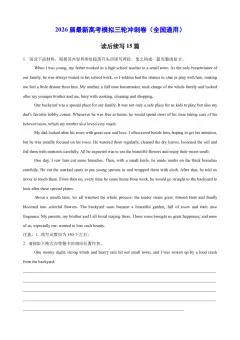
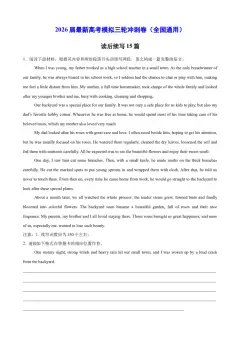
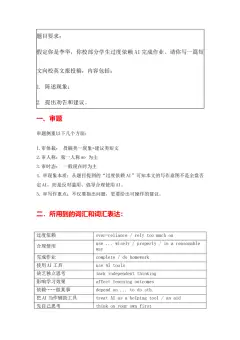
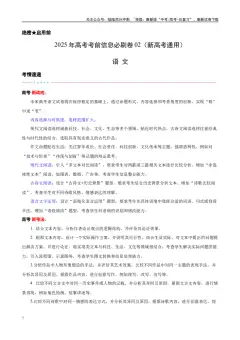
必做的10 篇经典7 选5
目录
经典试题01------------------------------------------------------------慢阅读的意义
经典试题02------------------------------------------------------------自我成长
经典试题03------------------------------------------------------“我”通与父亲的温暖故
事
经典试题04------------------------------------------------------------阅读经典文学作品
经典试题05------------------------------------------------------------挫败感的积极作用
经典试题06------------心理学常识——内向与外向两种性格类型的特点、动态变
化
经典试题07------------------------------------------------------------邻里关系
经典试题08------------------------------------------------------------自律
经典试题09-----------------------------------------------------有意的认知和行为塑造性
格
经典试题10------------------------------------------------------------自我反思
01
In an age of digital distraction, speed is celebrated. We skim news headlines, scroll social media, and jump
between texts, treating reading as a task to finish quickly rather than an experience to enjoy.

 1

  Yet a quiet
movement called slow reading is encouraging people to rediscover the depth and joy of reading at a gentle pace.
Slow reading is the practice of engaging with a text mindfully, taking time to understand ideas, appreciate
考前必做经典10 题
language, and reflect on meaning. It contrasts sharply with speed reading, which prioritizes quantity over quality,
and digital reading, which encourages skimming and multitasking.

 2

  It is a richer, more meaningful way
to interact with written words. When we read slowly, we activate deeper parts of the brain involved in analysis,
empathy, and reflection.
The rise of digital media has made slow reading harder to practice. Screens are designed for quick
consumption, with hyperlinks, notifications, and short paragraphs that discourage deep focus.

 3

  This
“digital attention deficit(缺失)” affects learning, work, and mental well-being.


 4

  It applies to any text, from articles to poems. Simple techniques can help anyone adopt the
practice: setting aside dedicated time without devices, reading aloud, taking notes, and pausing to reflect on key
points. These small changes turn reading from a hurried chore into a calming, rewarding activity.
The slow reading movement is not against technology or progress. It simply reminds us that reading is a
human experience, not a performance criterion. By slowing down, we reconnect with the power of words to inspire,
challenge, and transform us. In a fast-paced world, slow reading is not just a skill.

 5

 .
A.It is a form of self-care.
B.Slow reading is not just for books.
C.It reduces stress and improves mental clarity.
D.Advocates argue that slow reading is not inefficient.
E.A wide range of content is easily accessible on digital devices.
F.This rushed approach weakens comprehension, memory, and critical thinking.
G.Many people admit failing to read a long article or book without feeling restless.
词数:270  话题:慢阅读的意义  体裁:说明文
02
Life is an incredible journey, and your teenage years are one of its most exciting chapters.

 1

  You
are stepping into adulthood! Greater independence brings more opportunities to shape your own path. This is the
perfect time to learn, explore, and understand yourself better. Equipped with knowledge and self-awareness, you
can make thoughtful decisions that will build a meaningful future.
You might feel certain about your dreams, or you might still be searching for your passion.

 2

  Stay
curious, keep learning, and the right path will gradually reveal (显现) itself to you.


 3

  It’s natural to seek more privacy and personal space. However, remember that your family
remains a source of love and support. While becoming your own person, try to balance growing independence with
gratitude and connection. At this stage, friendships often take center stage — choose friends who uplift and inspire
you.

 4
This phase is a bridge between youth and adulthood. Some people will walk alongside you for years, while
others may only share part of the journey. Goodbyes — like leaving school — can be bittersweet, but each
connection teaches you something valuable.
You are now the author of your life. No one can write it for you. Every choice you make from this point
forward is yours.

 5

  Life is a gift — live it with purpose, kindness, and joy!
A.Either is completely normal.
B.You have the strength to handle them.
C.Value the friends who encourage you to grow.
D.Therefore, choosing wisely becomes your responsibility.
E.A genuine friend supports you through ups and downs.
F.Growing up brings both new freedoms and new responsibilities.
G.Your family has been your first and longest-lasting support system.
词数:236  话题:自我成长  体裁:说明文
03
As a child growing up there are many different paths available to navigate one’s way through adolescence
into adulthood. I was fortunate to have had the guidance of my father, who had many hobbies in his life.

 1
He loved talking about them to anyone who would listen.


 2

  I was always looking for pennies — whether given as change or picked up off the ground — and
checking to see if they were “Wheaties”, pennies made from 1909 to 1958. Some Lincoln Wheat Cents were quite
valuable, but for me, the real joy was the search itself.
My father passed away last week. Although he will be missed, there is no sadness in his passing. He lived
nearly 97 years of a full and meaningful life. During his final moments, I whispered in his ear that I needed a sign
after he left us.

 3
The next day, my sister and I were going through his old clothes when something fell out and hit the floor —
it was a 1928 Wheat penny. There was no way to know how long it had been there. Some might call it a
coincidence.

 4

  The fact that it was also a Wheat penny proved what I already knew — it was him. It
could have easily been put aside with the clothes, but it found its way to me.
Later, I was talking to my neighbor and told him the story.

 5

  However, a few days later, he came
over with a bag of pennies he had. Inside it, he found two more 1928 Wheat pennies — one for each of my sisters.
Our father is no longer with us, but he is still here.
A.He passed the habit on to me.
B.I figured he wouldn’t think any more of it.
C.To me, it was my father handing me the coin.
D.Old coins carried the quiet weight of the past.
E.Collecting coins was one of his greatest interests.
F.It specifically involved a 1928 coin — the year he was born.
G.His soft words and warm hands supported me through my youth.
词数:284  话题:“我”通与父亲的温暖故事  体裁:记叙文(记叙文不能忽视)
04
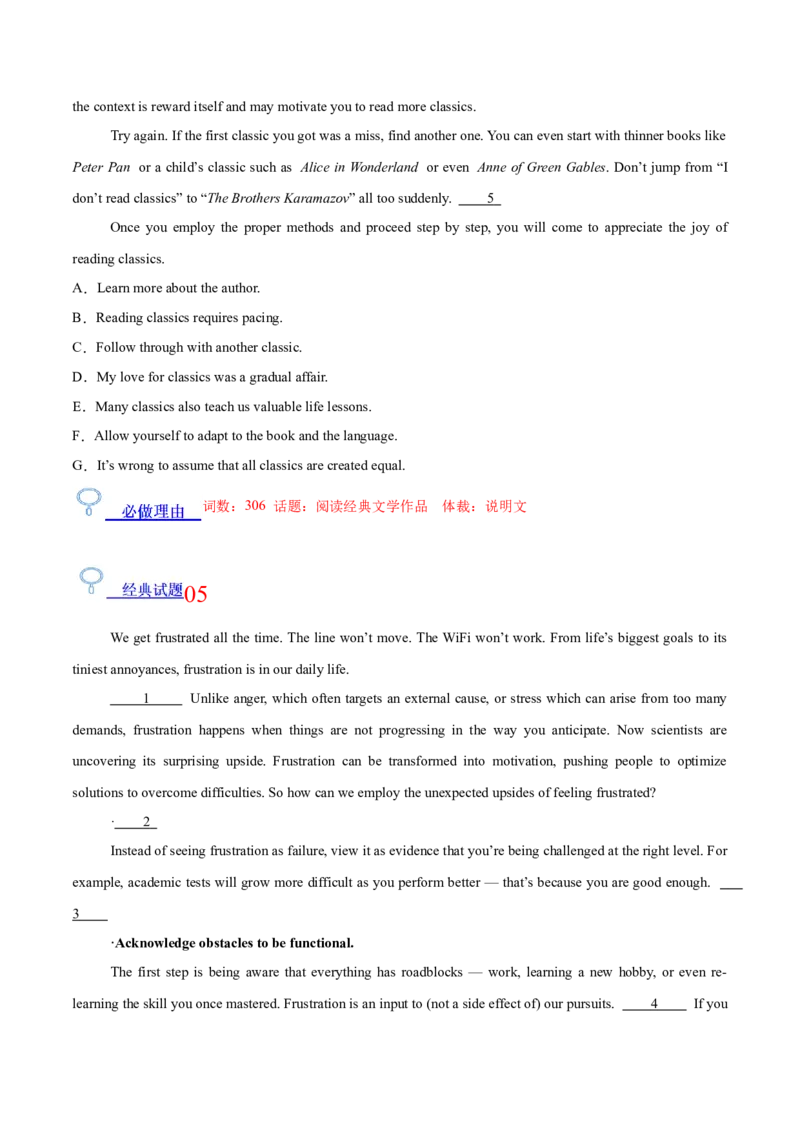
How to Appreciate A Classic
Classics are often seen as books read by literature majors or intellectuals. They seem rather exclusive and
distant.

 1

  The classics and I began as acquaintances, grew to be friends, and finally became close confidantes
(密友)  with private jokes between us. So how does one approach a classic?
Find your classic era. The term classic applies to a wide range of books across a long period of time.

 2
Not every classic is as thick as Tolstoy’s Anna Karenina. Like all forms of literature, there are genres (类型) within
the classics selection of a bookstore. By finding your era, there’s always something that may appeal to you.
Read slow and get immersed. Classics aren’t written in our modern tongue. They bear clear traces of the time
when they were published. Given the challenges involved, I suggest reading your first classic slowly.

 3

  It’s
like immersing yourself in a different world. It would take a few interactions to get the hang of it, but you do get it
eventually.


 4

  Once immersed, you rather get a hang of the language, and it is best to read another one. Maybe
read a book from the same author. In this way, the next book becomes easier to read. The ease in the language and
the context is reward itself and may motivate you to read more classics.
Try again. If the first classic you got was a miss, find another one. You can even start with thinner books like
Peter Pan or a child’s classic such as Alice in Wonderland or even Anne of Green Gables. Don’t jump from “I
don’t read classics” to “The Brothers Karamazov” all too suddenly.

 5
Once you employ the proper methods and proceed step by step, you will come to appreciate the joy of
reading classics.
A.Learn more about the author.
B.Reading classics requires pacing.
C.Follow through with another classic.
D.My love for classics was a gradual affair.
E.Many classics also teach us valuable life lessons.
F.Allow yourself to adapt to the book and the language.
G.It’s wrong to assume that all classics are created equal.
词数:306 话题:阅读经典文学作品  体裁:说明文
05
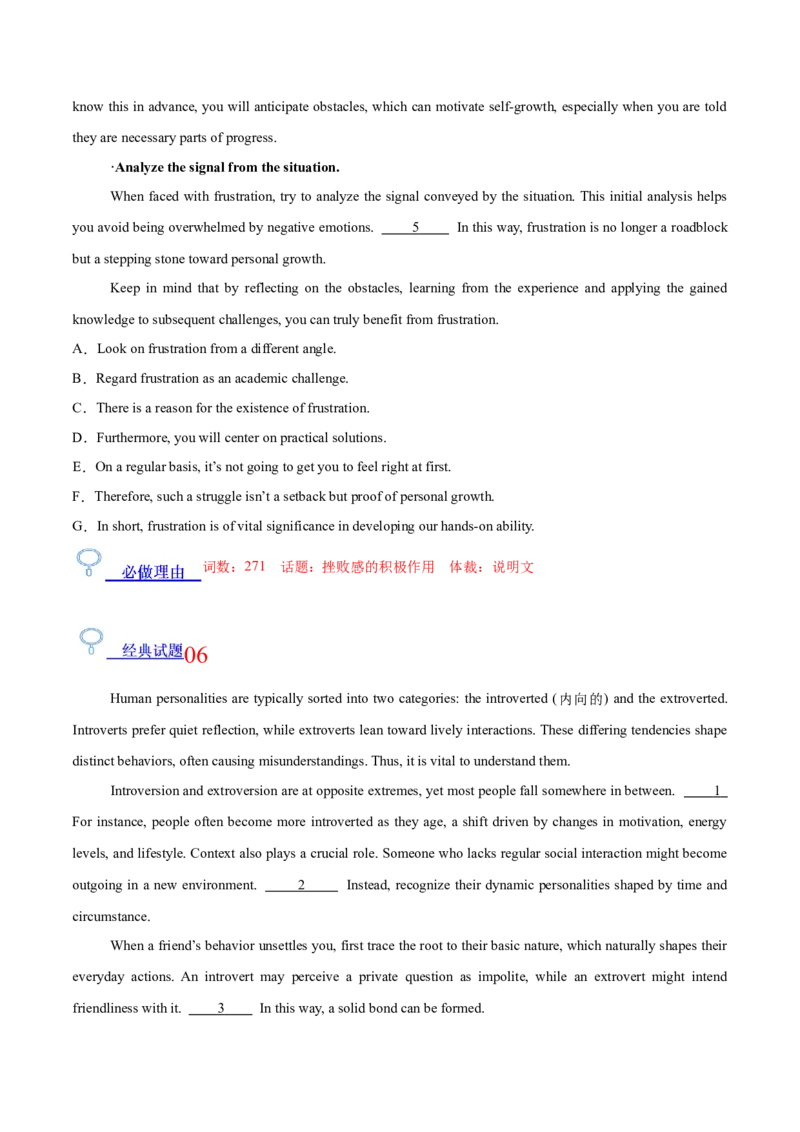
We get frustrated all the time. The line won’t move. The WiFi won’t work. From life’s biggest goals to its
tiniest annoyances, frustration is in our daily life.


 1

  Unlike anger, which often targets an external cause, or stress which can arise from too many
demands, frustration happens when things are not progressing in the way you anticipate. Now scientists are
uncovering its surprising upside. Frustration can be transformed into motivation, pushing people to optimize
solutions to overcome difficulties. So how can we employ the unexpected upsides of feeling frustrated?
·

 2
Instead of seeing frustration as failure, view it as evidence that you’re being challenged at the right level. For
example, academic tests will grow more difficult as you perform better — that’s because you are good enough.
3


·Acknowledge obstacles to be functional.
The first step is being aware that everything has roadblocks — work, learning a new hobby, or even re-
learning the skill you once mastered. Frustration is an input to (not a side effect of) our pursuits.

 4

  If you
know this in advance, you will anticipate obstacles, which can motivate self-growth, especially when you are told
they are necessary parts of progress.
·Analyze the signal from the situation.
When faced with frustration, try to analyze the signal conveyed by the situation. This initial analysis helps
you avoid being overwhelmed by negative emotions.

 5

  In this way, frustration is no longer a roadblock
but a stepping stone toward personal growth.
Keep in mind that by reflecting on the obstacles, learning from the experience and applying the gained
knowledge to subsequent challenges, you can truly benefit from frustration.
A.Look on frustration from a different angle.
B.Regard frustration as an academic challenge.
C.There is a reason for the existence of frustration.
D.Furthermore, you will center on practical solutions.
E.On a regular basis, it’s not going to get you to feel right at first.
F.Therefore, such a struggle isn’t a setback but proof of personal growth.
G.In short, frustration is of vital significance in developing our hands-on ability.
词数:271  话题:挫败感的积极作用  体裁:说明文
06
Human personalities are typically sorted into two categories: the introverted (内向的) and the extroverted.
Introverts prefer quiet reflection, while extroverts lean toward lively interactions. These differing tendencies shape
distinct behaviors, often causing misunderstandings. Thus, it is vital to understand them.
Introversion and extroversion are at opposite extremes, yet most people fall somewhere in between.

 1
For instance, people often become more introverted as they age, a shift driven by changes in motivation, energy
levels, and lifestyle. Context also plays a crucial role. Someone who lacks regular social interaction might become
outgoing in a new environment.

 2

  Instead, recognize their dynamic personalities shaped by time and
circumstance.
When a friend’s behavior unsettles you, first trace the root to their basic nature, which naturally shapes their
everyday actions. An introvert may perceive a private question as impolite, while an extrovert might intend
friendliness with it.

 3

  In this way, a solid bond can be formed.
Since these character differences easily cause tensions, open dialogue becomes crucial when conflicts arise.
4

  And since this is a shared effort, you and your friend must both speak up. If you’re more introverted, you can
request pauses to share your ideas; if your friend is more extroverted, he can focus on listening more, which fosters
balanced interaction.


 5

  Introverts do well in quiet reflection, offering others a sense of calm and ease. Extroverts, by
contrast, shine with energy, lifting spirits and breaking the stillness. This is why we should embrace each friend
with an admiring mindset. We must reject rigid labels, honor differences, and bridge gaps through respect.
A.Personality styles are never fixed.
B.The first step is to clearly voice your needs.
C.However, these conflicts can be worked out.
D.Such misunderstandings don’t come from rudeness, just differences.
E.Given these differences, set aside judgment and respect these distinctions.
F.Every personality, whether introverted or extroverted, has remarkable strengths.
G.Therefore, avoid labeling friends simply as absolute “introverts” or “extroverts”.
词数:263  话题:心理学常识——内向与外向两种性格类型的特点、动态变化  体
裁:说明文
07
For years, I kept a careful distance from the people around me. Living in a busy city apartment, I learned to
move through shared spaces quietly.

 1

  It wasn’t that I disliked others; keeping to myself just seemed
easier. Independence mattered to me, and needing no one felt like part of being a grown-up.


 2

  Without warning, the power went out. The building fell into complete darkness. I sat alone in my
apartment, the cold air pressing in as my phone went dead. The silence was familiar. Yet this time, it seemed
different. Less comforting. More exposed.
A soft knock broke the stillness. It was my neighbour from 3B, someone I recognised but hardly knew. She
held a candle and mentioned that a few residents were gathering in the hallway and invited me to join them. I
hesitated. Staying alone felt safe, but something felt unsettled.

 3
People sat on the floor, sharing blankets, tea, and quiet conversation. I listened more than I spoke. The man I
had once assumed was unfriendly turned out to be a retired doctor with a dry sense of humour.

 4

  I
realized how easily distance can turn into detachment (疏离).
When the lights finally returned, the hallway looked the same, but it felt different. I didn’t suddenly become
outgoing, nor did I abandon my need for space.

 5

  It’s about knowing when to let them in. Now, when I
step into the elevator, I don’t automatically lower my eyes. Sometimes, I look up.
A.After a moment, I stepped outside.
B.I avoided eye contact and unnecessary conversation.
C.I began to question my decision to join the conversation.
D.Most neighbours in the building kept to themselves as well.
E.As the night progressed, my long-held belief began to loosen.
F.But I understood something new: maturity isn’t about shutting others out.
G.That belief was challenged one night when a violent storm swept through the city.
词数:250  话题:邻里关系  体裁:记叙文
08
Ways to Boost Your Self-Discipline
Contrary to popular belief, self-discipline does not come along by denying yourself something or being strict
with yourself.

 1

 . In other words, it is a positive effort, not one of denial or negativity. This is how you get
there.
Set clear goals so when it comes down to it, you can think first, and act later. When you have knowledge that
a greater reward is at stake (得失难料), you are going to have an easier time letting go of immediate satisfaction.
2

 . When following this process, you will think twice before acting on a sudden urge.
Motivate yourself to win and remember that life doesn’t happen to you, it happens for you. Anxiety arises
from the belief that you are not in control of your life circumstances but are a victim of them. Change your mindset
to being a victor of your life.

 3

 .
Know your triggers and control the stress response. Certain situations, people or even foods will cause your
stress response to be triggered.

 4

 . Who and what causes you to feel impulsive (易冲动的)? It could be
lack of sleep, or it could be a tendency to feel overly criticized by your boss. By knowing your triggers, you can
either avoid them or develop ways to deal with them.


 5

 . Either invite friends or family members to join you or ask for their support to remind you of
your long-term goals. The key here is that no one is allowed to criticize you or cause you to feel guilt or shame.
Instead, they are to remind you to love yourself and help you get back on track when you slip up.
A.Your job is to pay attention.
B.Seek some reliable partners.
C.Ask for some critical reviews.
D.It is about loving yourself and developing new habits.
E.It will help you follow your heart and improve your performance.
F.That will set the stage for you to regain your power and your inner motivation.
G.Then you can prioritize your list according to what you want to achieve in the future.
词数:285  话题:自律  体裁:说明文
09
Have you ever taken a personality test? If you’re like me, you’ve consulted BuzzFeed to discover which
Taylor Swift song perfectly matches your soul.

 1

  But even some “serious” personality tests used to
guide educational and career choices are also problematic. They assume your personality is fixed — implying
you’re forever stuck with the personality you’re born with.
But modern personality research suggests that personality can and does change over time.

 2

If you shift your mindset to believe that “being on time shows respect”, take pride in arriving early, and develop
consistent habits like setting an alarm, you are changing. If you maintain these changes in your thoughts, emotions
and behaviors over time — voila! — you are reliable. Personality: changed.
Data confirms this idea. Generally, personality changes across a person’s life span. As people age, they tend
to experience fewer negative emotions and more positive ones. They are more responsible, more positive, and are
less judgmental of others.

 3

  You can accelerate this transformation through intentional cognitive-
behavioral changes.
First, you must examine your thinking patterns. For example, if you believe that “people only care about
themselves,” you are more likely to act defensively. This leads to the second step: changing your behavior. If you
are always defensive, others might snap at you or walk away. This only confirms your belief that you can’t trust
others.

 4

  If you try behaving more openly — perhaps sharing your difficulties with a co-worker —
you may see that they respond with kindness. This positive experience helps change your outlook.
In the end, these strategies work because your personality is simply your usual way of thinking and acting.
5


A.To break this cycle, try a new response.
B.But you don’t have to wait for time to do the work.
C.Suppose, for instance, you’re not super dependable.
D.It might be obvious that such quizzes are not scientific.
E.Some people change a lot and some people hold pretty steady.
F.You may believe they describe you accurately, even when they don’t.
G.By making small, daily changes, you can craft the personality you desire.
词数:277  话题:有意的认知和行为塑造性格  体裁:说明文
10
Self-reflection is a mindful practice of turning your attention inward to observe your thoughts, feelings, and
behaviors. It needn’t be long. In fact, quick pauses bring powerful insights.

 1
Do a morning intention check. Before you jump into your day, take a moment to ask yourself, “What is one
thing I want to focus on today?” For example, you might decide, “Today, I’ll focus on being patient” or “I’ll stay
calm.”

 2

  Instead of reacting automatically, you’re more aware of your goal.
Enjoy mindful moments during the day. Pause briefly to check in with yourself.

 3

  It could be
when you are waiting in line, or even just before replying to a message. Ask yourself, “How am I feeling right
now?” For example, you might notice tension building before a meeting or realize you’re feeling distracted.
Acknowledging these feelings helps you stay grounded and make conscious choices. These small mindful moments
connect you to yourself during chaos.


 4

  At the end of your day, take a few minutes to reflect. Ask yourself questions like, “What went
well today?” and “What could I have done differently?” For instance, you might realize you handled a difficult
conversation better than expected, or left a project until the last minute. This reflection isn’t about judgment; it’s
about learning and growth.
Self-reflection is a simple yet powerful habit that can transform the way you understand yourself and manage
life. If you’re new, don’t overdo it.

 5

  Additionally, trust that every thoughtful pause brings you closer to a
more mindful and fulfilling life.
A.Conduct an evening review.
B.Engage in nighttime learning.
C.It could be during a coffee break.
D.Just start small and be patient with yourself.
E.Below are easy examples you can try anytime.
F.This tiny pause can replace casual reactions with thoughtful responses.
G.The key is to avoid distractions and stay focused on the present moment.
词数:257  话题:自我反思  体裁:说明文