2026 届高考英语压轴精卷(广东专用)
满分120 分,考试时间120 分钟。
注意事项:
1.答卷时,考生应清晰识字过的词汇或者书写自己的学校、班级、姓名座位号和考号填写在答题卡相应的
位置上,再用2B 铅笔把号码对应填涂黑。
2.选择题每小题选出答案区后,用2B 铅笔把答案卡上对应题目的答案标号涂黑;如需改动,用橡皮擦干净
后,再选涂其他答案;不能答在试卷上。
3.非选择题必须用黑色字迹的钢笔或签字笔作答,答案必须写在答题卡各题目指定区域内的相应位置上;
如需改动,先划掉原来的答案,然后再写上新的答案;不准使用铅笔或涂改液。不按以上要求作答的答案
无效。
4.考生必须保证答题卡的整洁,考试结束后,将试卷和答题卡一并交回。
第一部分 阅读(共两节,满分50 分)
第一节(共15 小题;每小题2.5 分,满分37.5 分)
阅读下列短文,从每题所给的A、B、C、D 四个选项中选出最佳选项。
A
Dear Jack,
I remember the moment — it truly hit me that your autism(自闭症) lasted forever. I had already mentally
planned our trips up north with the boys. I was going to spend endless hours playing baseball with you — like
Grandpa did with me.
When we said goodbye to kindergarten I knew it was real. I spent some time being sad. Now you are 8.
You still have no words. We have never had one of those father-son moments I pictured when you were a baby. But
I’m learning that’s OK. I still have unbelievable things to offer as your dad, even if they weren’t the things I
originally expected.
You have taught me to be patient. You have taught me that it’s OK to be different and to be sad when life
doesn’t go as planned. You have taught me that it is OK to talk about those feelings and fight for what is right.
Stand up and say this is wrong, and encourage others to stand up for you and say the same.
My job on this earth is to create a world for you and other kids like you. Be the voice you don’t have, and
build the kind of community which I want to see you grow up in. I used to shy a way from contacting people with
disabilities or just not consider them. Before you were born, I was so caught up in my own world that I probably
wouldn’t have even noticed. Now, I see things differently. I notice. You did that for me. And hope my example will
do that for others.
Your mom and I have spent 8 years trying to find your voice. And honestly, we don’t know if we ever will.
I promise you I will spend my life keeping you safe and making this world better for you.
1.What can be learned about the author?
A.He is at a loss what to do to help Jack.
B.He is to blame for Jack’s present condition.
C.He has changed his attitude to the disabled.
D.He hasn’t accepted the reality up to now.
2.How does the author sound in the text?
A.Ashamed.
B.Caring.
C.Regretful.
D.Indifferent.
3.In which section of a magazine may this text appear?
A.Science.
B.Entertainment.
C.Sports.
D.Relationship.
B
For years, my life was measured in notifications. The moment I woke up, my hand would instinctively reach
for my smartphone. Emails, social media updates, and news alerts dictated the rhythm of my day. I was constantly
connected, yet I felt increasingly anxious and scattered. The breaking point came during a family dinner last month.
I looked up to find my parents and sister engaged in a lively conversation, while I was busy scrolling through a feed
of strangers’ vacation photos. I realized I was physically present but mentally absent.
The next day, I decided to try a “digital detox.” The rules were simple: no screens after 8 PM and no phone
during meals. The first two days were agonizing. I felt a phantom vibration in my pocket constantly. I found myself
reaching for a device that wasn’t there. The silence in the evenings, once filled with the blue light of my screen, felt
deafening.
However, by the fourth day, something shifted. I started reading the novel that had been gathering dust on
my nightstand. I actually listened to my sister’s stories about her college life. I noticed the way the sunlight hit the
trees in the afternoon. Without the constant dopamine hits from likes and comments, my brain began to slow down.
I am not suggesting we should abandon technology entirely. It is a powerful tool for work and connection.
But this experiment taught me that we need to control our devices, not let them control us. Now, I still use my
phone, but I have set boundaries. I’ve learned that the most high-definition moments in life happen when we look
up from our screens and truly see the world around us.
4.What made the author decide to start a “digital detox”?
A.The pressure from work emails.
B.A realization during a family dinner.
C.The advice from her sister.
D.The boredom of scrolling through photos.
5.How did the author feel during the first two days of the detox?
A.Relaxed and peaceful.
B.Angry and frustrated.
C.Uncomfortable and restless.
D.Excited and energetic.
6.What positive change happened to the author by the fourth day?
A.She finished writing a novel.
B.She stopped using her phone completely.
C.She became more attentive to real life.
D.She started getting more likes on social media.
7.What is the main purpose of the text?
A.To criticize the development of smartphone technology.
B.To share a personal experience of reducing screen time.
C.To explain the scientific reasons for phone addiction.
D.To encourage people to spend more time with family.
C
When engineers struggle to design a quieter high-speed train, they often look to the sky. Specifically, they
look at the kingfisher, a bird that can dive into water with barely a splash. This approach is called biomimicry —
innovation inspired by nature. It is based on the idea that after 3.8 billion years of evolution, nature has already
solved many of the problems we face today.
One of the most famous examples of biomimicry is the Japanese Shinkansen bullet train. Originally, the train
created a loud sonic boom when exiting tunnels due to air pressure build-up. An engineer, who was also a bird-
watcher, redesigned the train’s nose to mimic the long, sharp beak of the kingfisher. This change not only
eliminated the noise but also made the train 10% faster and 15% more energy-efficient.
Another fascinating application is in architecture. The Eastgate Centre in Zimbabwe uses a cooling system
inspired by termite mounds. Termites maintain a constant temperature inside their mounds despite the fluctuating
heat outside by opening and closing a series of heating and cooling vents. Similarly, the Eastgate Centre uses
natural convection currents to regulate temperature, using 90% less energy than conventional buildings of the same
size.
Biomimicry is not just about copying shapes; it is about understanding the principles behind them. As we
face global challenges like climate change and resource depletion, looking to nature for sustainable solutions is
becoming more critical. From Velcro, which was inspired by burrs sticking to a dog’s fur, to wind turbine blades
modeled after whale fins, nature proves to be the ultimate research and development laboratory.
8.Why does the author mention the kingfisher in Paragraph 1?
A.To explain how birds catch fish in the water.
B.To introduce the concept of biomimicry.
C.To describe the habitat of the kingfisher.
D.To compare birds with high-speed trains.
9.What was the result of redesigning the Shinkansen train?
A.It became quieter and more efficient.
B.It could carry more passengers.
C.It became slower but safer.
D.It eliminated the need for tunnels.
10.How does the Eastgate Centre save energy?
A.By using solar panels on the roof.
B.By copying the termite’s method of temperature control.
C.By planting trees around the building.
D.By using materials from termite mounds.
11.What is the author’s attitude towards biomimicry?
A.Skeptical.
B.Indifferent.
C.Critical.
D.Positive.
D
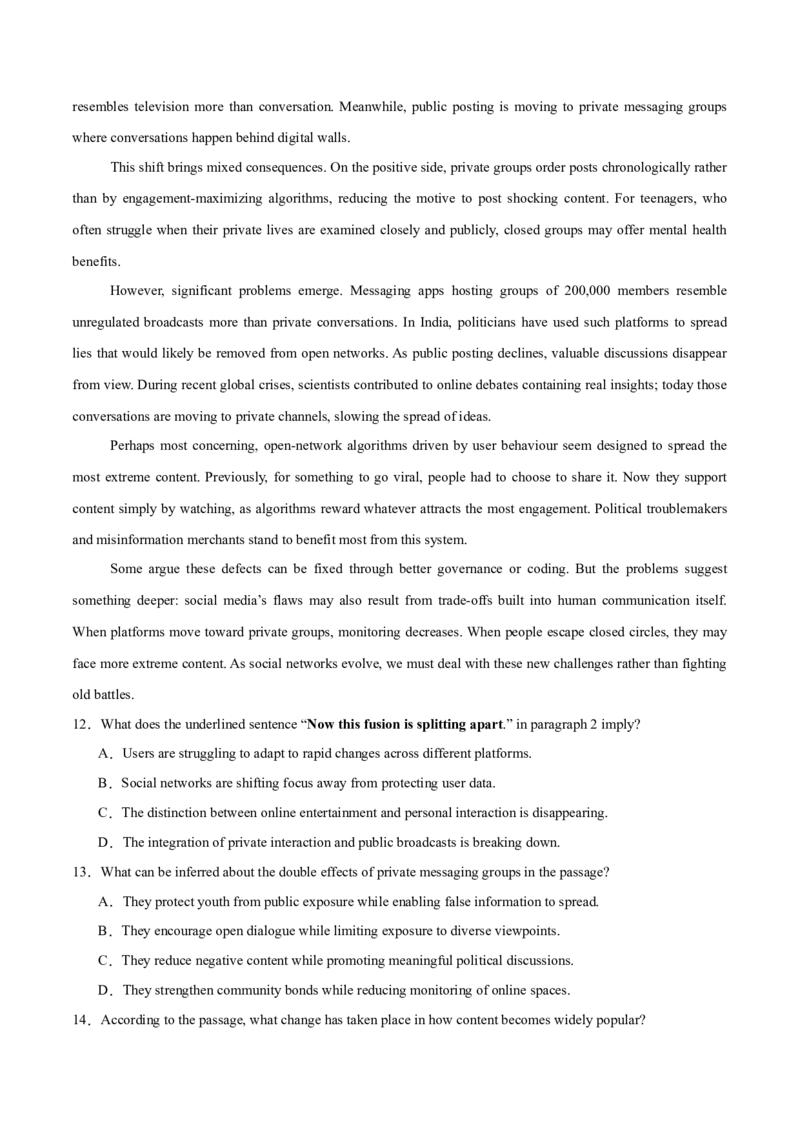
The social media landscape is now undergoing a quiet but profound transformation. The question arises: are
platforms becoming less social just as they become more popular?
The traditional magic of online social networks was their ability to combine personal interactions with mass
communication. Friends shared updates; networks spread them widely. Now this fusion is splitting apart. Status
updates from people you know are being replaced by algorithm-selected videos from strangers — content that
resembles television more than conversation. Meanwhile, public posting is moving to private messaging groups
where conversations happen behind digital walls.
This shift brings mixed consequences. On the positive side, private groups order posts chronologically rather
than by engagement-maximizing algorithms, reducing the motive to post shocking content. For teenagers, who
often struggle when their private lives are examined closely and publicly, closed groups may offer mental health
benefits.
However, significant problems emerge. Messaging apps hosting groups of 200,000 members resemble
unregulated broadcasts more than private conversations. In India, politicians have used such platforms to spread
lies that would likely be removed from open networks. As public posting declines, valuable discussions disappear
from view. During recent global crises, scientists contributed to online debates containing real insights; today those
conversations are moving to private channels, slowing the spread of ideas.
Perhaps most concerning, open-network algorithms driven by user behaviour seem designed to spread the
most extreme content. Previously, for something to go viral, people had to choose to share it. Now they support
content simply by watching, as algorithms reward whatever attracts the most engagement. Political troublemakers
and misinformation merchants stand to benefit most from this system.
Some argue these defects can be fixed through better governance or coding. But the problems suggest
something deeper: social media’s flaws may also result from trade-offs built into human communication itself.
When platforms move toward private groups, monitoring decreases. When people escape closed circles, they may
face more extreme content. As social networks evolve, we must deal with these new challenges rather than fighting
old battles.
12.What does the underlined sentence “Now this fusion is splitting apart.” in paragraph 2 imply?
A.Users are struggling to adapt to rapid changes across different platforms.
B.Social networks are shifting focus away from protecting user data.
C.The distinction between online entertainment and personal interaction is disappearing.
D.The integration of private interaction and public broadcasts is breaking down.
13.What can be inferred about the double effects of private messaging groups in the passage?
A.They protect youth from public exposure while enabling false information to spread.
B.They encourage open dialogue while limiting exposure to diverse viewpoints.
C.They reduce negative content while promoting meaningful political discussions.
D.They strengthen community bonds while reducing monitoring of online spaces.
14.According to the passage, what change has taken place in how content becomes widely popular?
A.Official sources now receive priority treatment over amateur productions.
B.Emotional appeal has become less important than factual accuracy in driving views.
C.Content popularity now depends more on algorithmic promotion than active sharing.
D.The role of user recommendation has been replaced by quality assessment systems.
15.Which of the following would be the most suitable title for the passage?
A.The Rise of Private Messaging
B.From Public Square to Private Chat
C.Why Algorithms Are Ruining Social Media
D.The Future of Online Communities
第二节(共5 小题, 每小题2. 5 分, 共12. 5 分)
阅读下面短文, 从短文后的选项中选出可以填入空白处的最佳选项。选项中有两项为多余选项。
Life is an incredible journey, and your teenage years are one of its most exciting chapters.     16     You
are stepping into adulthood! Greater independence brings more opportunities to shape your own path. This is the
perfect time to learn, explore, and understand yourself better. Equipped with knowledge and self-awareness, you
can make thoughtful decisions that will build a meaningful future.
You might feel certain about your dreams, or you might still be searching for your passion.     17

Stay curious, keep learning, and the right path will gradually reveal (显现) itself to you.
    18     It’s natural to seek more privacy and personal space. However, remember that your family
remains a source of love and support. While becoming your own person, try to balance growing independence with
gratitude and connection. At this stage, friendships often take center stage — choose friends who uplift and inspire
you.     19
This phase is a bridge between youth and adulthood. Some people will walk alongside you for years, while
others may only share part of the journey. Goodbyes — like leaving school — can be bittersweet, but each
connection teaches you something valuable.
You are now the author of your life. No one can write it for you. Every choice you make from this point
forward is yours.     20     Life is a gift — live it with purpose, kindness, and joy!
A.Either is completely normal.
B.You have the strength to handle them.
C.Value the friends who encourage you to grow.
D.Therefore, choosing wisely becomes your responsibility.
E.A genuine friend supports you through ups and downs.
F.Growing up brings both new freedoms and new responsibilities.
G.Your family has been your first and longest-lasting support system.
第二部分 语言运用(共两节, 满分30 分)
第一节(共15 小题;每小题1 分, 共15 分)
阅读下面短文,从每题所给的A、B、C、D 四个选项中选出可以填入空白处的最佳选项。
At 42, I walked into a community college classroom for the first time, feeling like a fish out of water. I’d
dropped out of high school when I was 17,     21     myself to a lifetime of low-wage labor, convinced that I
was “not     22     enough” for academic work. For decades, I had tried to avoid any situation that might     23
my lack of education, building a small but safe life around that     24    .
It was my daughter’s struggle with dyslexia (读写困难) that     25     me to step out of my comfort
zone. Watching her     26     to learn in spite of constant setbacks, I felt ashamed of my own long-held     27
. I enrolled in a basic English course, and that first day, I sat in the back, my hands     28    , certain I’d be
found out as an“impostor(骗子)”.
Instead, that classroom became a space where I     29     to rewrite my story. I didn’t just learn grammar
and writing; I learned to     30     my own voice, to stop defining myself by my    31     decades earlier.
Over three years, I worked my way through every course,     32     my associate’s degree at the age of 45.
People often ask why I     33     so much stress to go back to school. The answer isn’t just the degree.
It’s about learning that growth doesn’t have a(n)     34     date, and that you are never too     35     to
reshape who you are.
21.A.adjusting
B.restricting
C.training
D.devoting
22.A.intelligent
B.ambitious
C.wealthy
D.mature
23.A.abandon
B.cover
C.expose
D.justify
24.A.ambition
B.fear
C.strength
D.principle
25.A.advised
B.allowed
C.reminded
D.pushed
26.A.hesitate
B.refuse
C.fight
D.pretend
27.A.self-doubt
B.self-respect
C.self-control
D.self-discipline
28.A.waving
B.shaking
C.folding
D.clapping
29.A.refused
B.happened
C.began
D.failed
30.A.silence
B.imitate
C.hear
D.claim
31.A.prejudice
B.mistake
C.achievement
D.adventure
32.A.missing
B.earning
C.forgetting
D.declining
33.A.put up with
B.made up for
C.got rid of
D.took charge of
34.A.possible
B.early
C.due
D.abstract
35.A.old
B.weak
C.busy
D.poor
第二节(共10 小题;每小题1. 5 分, 满分15 分)
阅读下面短文,在空白处填入1 个适当的单词或括号内单词的正确形式。
Painter’s passion helps villagers realize their dreams on rural canvases
“With this paintbrush, I want to show my fellow villagers the world,” says 39-year-old Wu Chengyan. In
2023, when he was painting a landscape for his wife’s grandfather, an idea to create art for his hometown’s seniors
36     (generate). Inspired by the animated film Ne Zha 2 in early 2025, he painted over 10 murals, turning his
village into     37     is now called “Ne Zha Village.” The murals quickly drew tourists,     38

(dramatic) boosting the local economy. In December, Wu spent five days painting a majestic Tian’anmen Rostrum
(城楼) on a large wall. “My hand     39     (tremble), I painted the national emblem (国徽),” he recalls. When
it was finished, elderly     40     (onlooker) in the village applauded.
The artworks attracted crowds from across the province. During the New Year holiday, the village saw
50,000-60,000 daily visitors,     41     over 400 stalls set up to meet demand. Thanks to the tourism boom, the
village has upgraded its roads, planning to connect with nearby     42     (scene) spots while developing
agricultural bases.
So far, Wu     43     (complete) more than 40 murals, featuring landmarks like the Temple of Heaven
and the Great Wall,     44     portrait of scientist Yuan Longping, and characters from Black Myth: Wukong,
transforming the village into an open-air gallery. Several young villagers now wish to learn painting from him. “I
plan to open a studio and work with others     45     (fill) every blank wall with art,” Wu says.
第三部分 写作(共两节,满分40 分)
第一节(满分15 分)
46.你校英语社团举办主题为“Labor Shapes Us”演讲活动,请你以上周参与的一次校园食堂帮厨劳动实践,
写一篇演讲稿。内容包括:
1.具体劳动过程;
2.你的劳动感悟。
注意:
1.写作词数应为80 左右;
2.请按如下格式在答题卡的相应位置作答。
Labor Shapes Us
____________________________________________________________________________________________
____________________________________________________________________________________________
____________________________________________________________________________________________
____________________
第二节(满分25 分)
47.阅读下面材料,根据其内容和所给段落开头语续写两段,使之构成一篇完整的短文。
At twenty, I joined the Navy hoping to see the world, but after four and a half years, I returned home, got
married, went back to school for my teaching degree, and had three children. I lost my own identity in the busy life
of being a mom, student and wife.
One evening, everything changed. My husband went out with his brother. All the children were staying
elsewhere — one at my best friend’s house, the other two at my parents’. For the first time in years, I was
completely alone in a quiet house. I was supposed to go out too, but I didn’t. Now, I didn’t know what to do.
I felt a sudden panic. Without my family around, who was I? I had become so dependent on my role as a
caretaker that I had forgotten how to be just “Lisa”. Nearly in tears, I called my parents’ house to say I’d pick up the
kids early. I explained I was alone and didn’t know what to do with myself. My dad listened and said, “You know
what? Just do Lisa things then.”
“Lisa things?” I asked, confused.
“Yes! A hobby, a movie, an interest. Whatever it is you want to do but don’t have time for.” For ten years, I
had cared for everyone but myself. I had lost my own dreams and interests. That night, I didn’t go out. Instead, I
found a pen and a notebook. I made lists — things I used to enjoy, things I dreamed of as a girl. I wrote about my
frustrations (沮丧) and my hopes. As the pages filled, a calm settled over me. For the first time in a long time, I was
thinking about what I wanted, not what everyone else needed. I realized I loved stories. I remembered how I used to
write little tales in high school.
注意:1.续写词数应为150 个左右;
2.请按如下格式在答题卡的相应位置作答。
I decided to start writing again, just for myself.
____________________________________________________________________________________________
____________________________________________________________________________________________
____________________________________________________________________________________________
____________________________________________________________________________________________
______________________________________________________________________________________
Months later, I received a call from the magazine.
____________________________________________________________________________________________
____________________________________________________________________________________________
____________________________________________________________________________________________
____________________________________________________________________________________________
______________________________________________________________________________________