2026 届高考英语压轴精卷02(全国一卷)
(考试时间:120 分钟  试卷满分:150 分)
注意事项:
1.答卷前,考生务必将自己的姓名、准考证号等填写在答题卡和试卷指定位置上。
2.回答选择题时,选出每小题答案后,用铅笔把答题卡上对应题目的答案标号涂黑。如需改动,用
橡皮擦干净后,再选涂其他答案标号。回答非选择题时,将答案写在答题卡上。写在本试卷上无效。
3.考试结束后,将本试卷和答题卡一并交回
第一部分  听力(共两节,满分 30 分)
做题时,先将答案标在试卷上。录音内容结束后,你将有两分钟的时间将试卷上的答案转涂到答题卡上。
第一节(共5 小题;每小题1.5 分,满分7.5 分)
听下面5 段对话。每段对话后有一个小题,从题中所给的A、B、C 三个选项中选出最佳选项。听完每
段对话后,你都有10 秒钟的时间来回答有关小题和阅读下一小题。每段对话读两遍。
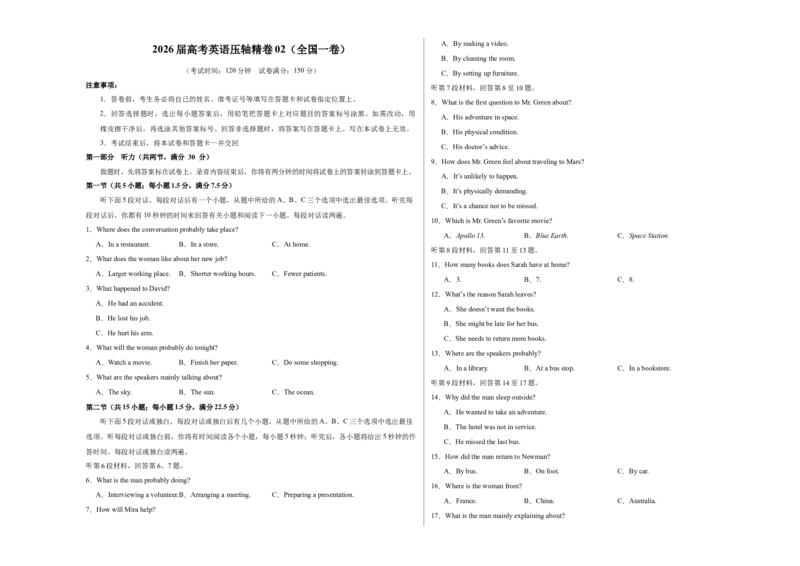
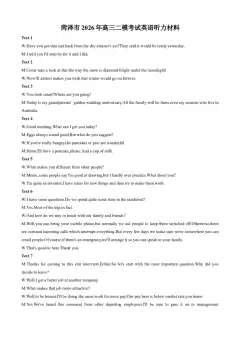
1.Where does the conversation probably take place?
A.In a restaurant.
B.In a store.
C.At home.
2.What does the woman like about her new job?
A.Larger working place.
B.Shorter working hours.
C.Fewer patients.
3.What happened to David?
A.He had an accident.
B.He lost his job.
C.He hurt his arm.
4.What will the woman probably do tonight?
A.Watch a movie.
B.Finish her paper.
C.Do some shopping.
5.What are the speakers mainly talking about?
A.The sky.
B.The sun.
C.The ocean.
第二节(共15 小题;每小题1.5 分,满分22.5 分)
听下面5 段对话或独白。每段对话或独白后有几个小题,从题中所给的A、B、C 三个选项中选出最佳
选项。听每段对话或独白前,你将有时间阅读各个小题,每小题5 秒钟;听完后,各小题将给出5 秒钟的作
答时间。每段对话或独白读两遍。
听第6 段材料,回答第6、7 题。
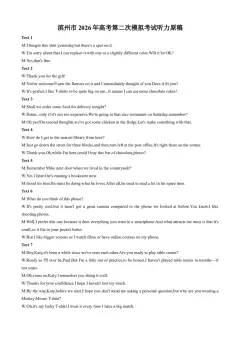
6.What is the man probably doing?
A.Interviewing a volunteer.B.Arranging a meeting.
C.Preparing a presentation.
7.How will Mira help?
A.By making a video.
B.By cleaning the room.
C.By setting up furniture.
听第7 段材料,回答第8 至10 题。
8.What is the first question to Mr. Green about?
A.His adventure in space.
B.His physical condition.
C.His doctor’s advice.
9.How does Mr. Green feel about traveling to Mars?
A.It’s unlikely to happen.
B.It’s physically demanding.
C.It’s a chance not to be missed.
10.Which is Mr. Green’s favorite movie?
A.Apollo 13.
B.Blue Earth.
C.Space Station.
听第8 段材料,回答第11 至13 题。
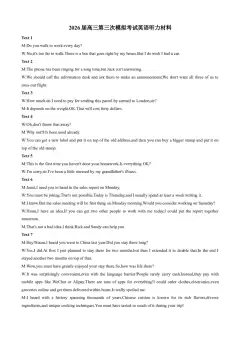
11.How many books does Sarah have at home?
A.3.
B.7.
C.8.
12.What’s the reason Sarah leaves?
A.She doesn’t want the books.
B.She might be late for her bus.
C.She needs to return more books.
13.Where are the speakers probably?
A.In a library.
B.At a bus stop.
C.In a bookstore.
听第9 段材料,回答第14 至17 题。
14.Why did the man sleep outside?
A.He wanted to take an adventure.
B.The hotel was not in service.
C.He missed the last bus.
15.How did the man return to Newman?
A.By bus.
B.On foot.
C.By car.
16.Where is the woman from?
A.France.
B.China.
C.Australia.
17.What is the man mainly explaining about?
A.A nice hotel.
B.A holiday plan.
C.A travel experience.
听第10 段材料,回答第18 至20 题。
18.What is the announcement about?
A.A writing contest.
B.A trip to Canada.
C.Research into wildlife.
19.When is the deadline for the article?
A.14 January.
B.19 February.
C.15 April.
20.What does a winner need to send?
A.The pictures.
B.The home address.
C.The school information.
第二部分  阅读(共两节, 满分50 分)
第一节(共15 小题;每小题2.5 分, 满分37.5 分)
阅读下列短文, 从每题所给的A、B、C 和D 四个选项中选出最佳选项。
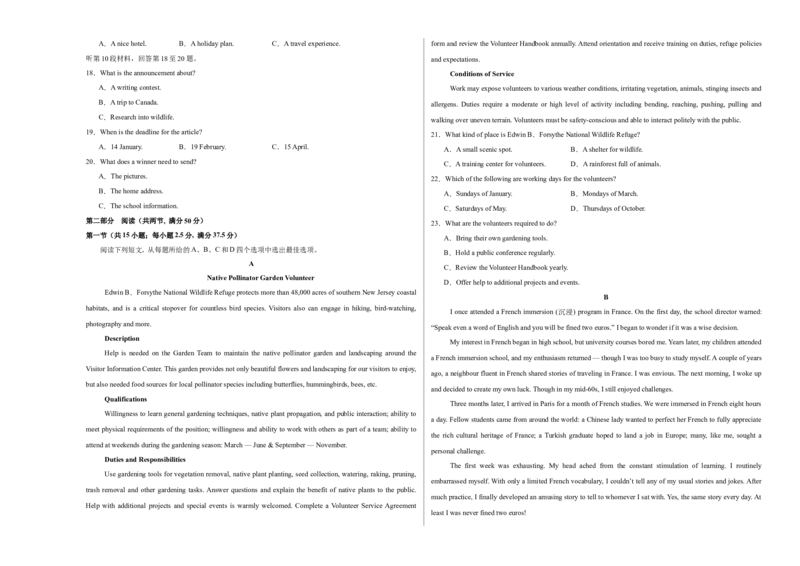
A
Native Pollinator Garden Volunteer
Edwin B.Forsythe National Wildlife Refuge protects more than 48,000 acres of southern New Jersey coastal
habitats, and is a critical stopover for countless bird species. Visitors also can engage in hiking, bird-watching,
photography and more.
Description
Help is needed on the Garden Team to maintain the native pollinator garden and landscaping around the
Visitor Information Center. This garden provides not only beautiful flowers and landscaping for our visitors to enjoy,
but also needed food sources for local pollinator species including butterflies, hummingbirds, bees, etc.
Qualifications
Willingness to learn general gardening techniques, native plant propagation, and public interaction; ability to
meet physical requirements of the position; willingness and ability to work with others as part of a team; ability to
attend at weekends during the gardening season: March — June & September — November.
Duties and Responsibilities
Use gardening tools for vegetation removal, native plant planting, seed collection, watering, raking, pruning,
trash removal and other gardening tasks. Answer questions and explain the benefit of native plants to the public.
Help with additional projects and special events is warmly welcomed. Complete a Volunteer Service Agreement
form and review the Volunteer Handbook annually. Attend orientation and receive training on duties, refuge policies
and expectations.
Conditions of Service
Work may expose volunteers to various weather conditions, irritating vegetation, animals, stinging insects and
allergens. Duties require a moderate or high level of activity including bending, reaching, pushing, pulling and
walking over uneven terrain. Volunteers must be safety-conscious and able to interact politely with the public.
21.What kind of place is Edwin B.Forsythe National Wildlife Refuge?
A.A small scenic spot.
B.A shelter for wildlife.
C.A training center for volunteers.
D.A rainforest full of animals.
22.Which of the following are working days for the volunteers?
A.Sundays of January.
B.Mondays of March.
C.Saturdays of May.
D.Thursdays of October.
23.What are the volunteers required to do?
A.Bring their own gardening tools.
B.Hold a public conference regularly.
C.Review the Volunteer Handbook yearly.
D.Offer help to additional projects and events.
B
I once attended a French immersion (沉浸) program in France. On the first day, the school director warned:
“Speak even a word of English and you will be fined two euros.” I began to wonder if it was a wise decision.
My interest in French began in high school, but university courses bored me. Years later, my children attended
a French immersion school, and my enthusiasm returned — though I was too busy to study myself. A couple of years
ago, a neighbour fluent in French shared stories of traveling in France. I was envious. The next morning, I woke up
and decided to create my own luck. Though in my mid-60s, I still enjoyed challenges.
Three months later, I arrived in Paris for a month of French studies. We were immersed in French eight hours
a day. Fellow students came from around the world: a Chinese lady wanted to perfect her French to fully appreciate
the rich cultural heritage of France; a Turkish graduate hoped to land a job in Europe; many, like me, sought a
personal challenge.
The first week was exhausting. My head ached from the constant stimulation of learning. I routinely
embarrassed myself. With only a limited French vocabulary, I couldn’t tell any of my usual stories and jokes. After
much practice, I finally developed an amusing story to tell to whomever I sat with. Yes, the same story every day. At
least I was never fined two euros!
Gradually, the immersion worked. My brain shifted to French at the school gate. One day, I met an American
lady I had spoken with in English the day before in a restaurant. On school grounds, I walked past her without a
greeting — paying a thousand euros as punishment would do! During the four weeks, I made significant progress.
On the last day, I presented a paper in French.
Attending the program inspired me to continue my French learning. And I’ve signed up for another session
this spring. I can’t wait to get there and embarrass myself again!
24.Why did the author question her decision on the first day of the program?
A.It was too boring.
B.It cost much money.
C.It had a strict rule.
D.It had a tight schedule.
25.What drove the author to start French studies in Paris?
A.Her children’s French learning.
B.The desire to prove herself young.
C.More free time after retirement.
D.Her neighbor’s travelling experiences.
26.Why did the author walk past the American lady without greeting her?
A.She was in a hurry.
B.She failed to recognize her.
C.She was afraid of being fined.
D.She focused on her French thinking.
27.What does the author want to convey?
A.Well begun is half done.
B.It’s never too late to learn.
C.Rules are made to be broken.
D.You can’t teach an old dog new tricks.
C
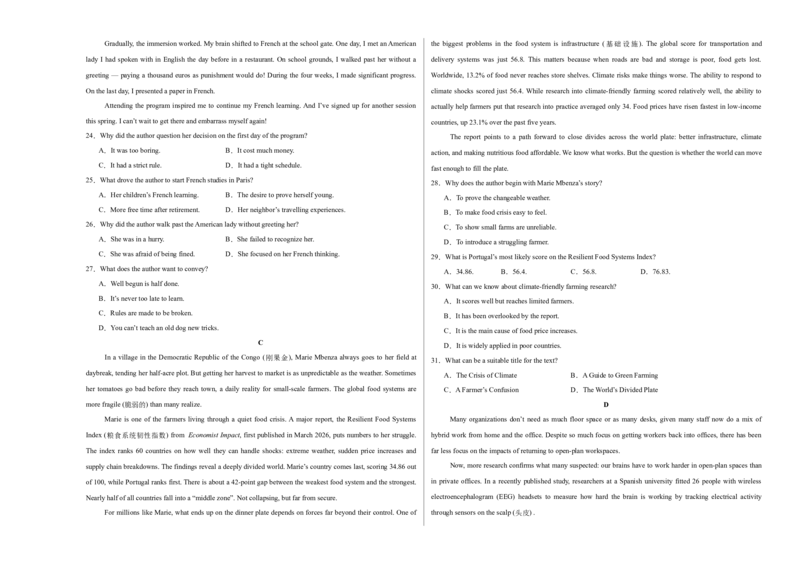
In a village in the Democratic Republic of the Congo (刚果金), Marie Mbenza always goes to her field at
daybreak, tending her half-acre plot. But getting her harvest to market is as unpredictable as the weather. Sometimes
her tomatoes go bad before they reach town, a daily reality for small-scale farmers. The global food systems are
more fragile (脆弱的) than many realize.
Marie is one of the farmers living through a quiet food crisis. A major report, the Resilient Food Systems
Index (粮食系统韧性指数) from Economist Impact, first published in March 2026, puts numbers to her struggle.
The index ranks 60 countries on how well they can handle shocks: extreme weather, sudden price increases and
supply chain breakdowns. The findings reveal a deeply divided world. Marie’s country comes last, scoring 34.86 out
of 100, while Portugal ranks first. There is about a 42-point gap between the weakest food system and the strongest.
Nearly half of all countries fall into a “middle zone”. Not collapsing, but far from secure.
For millions like Marie, what ends up on the dinner plate depends on forces far beyond their control. One of
the biggest problems in the food system is infrastructure ( 基础设施). The global score for transportation and
delivery systems was just 56.8. This matters because when roads are bad and storage is poor, food gets lost.
Worldwide, 13.2% of food never reaches store shelves. Climate risks make things worse. The ability to respond to
climate shocks scored just 56.4. While research into climate-friendly farming scored relatively well, the ability to
actually help farmers put that research into practice averaged only 34. Food prices have risen fastest in low-income
countries, up 23.1% over the past five years.
The report points to a path forward to close divides across the world plate: better infrastructure, climate
action, and making nutritious food affordable. We know what works. But the question is whether the world can move
fast enough to fill the plate.
28.Why does the author begin with Marie Mbenza’s story?
A.To prove the changeable weather.
B.To make food crisis easy to feel.
C.To show small farms are unreliable.
D.To introduce a struggling farmer.
29.What is Portugal’s most likely score on the Resilient Food Systems Index?
A.34.86.
B.56.4.
C.56.8.
D.76.83.
30.What can we know about climate-friendly farming research?
A.It scores well but reaches limited farmers.
B.It has been overlooked by the report.
C.It is the main cause of food price increases.
D.It is widely applied in poor countries.
31.What can be a suitable title for the text?
A.The Crisis of Climate
B.A Guide to Green Farming
C.A Farmer’s Confusion
D.The World’s Divided Plate
D
Many organizations don’t need as much floor space or as many desks, given many staff now do a mix of
hybrid work from home and the office. Despite so much focus on getting workers back into offices, there has been
far less focus on the impacts of returning to open-plan workspaces.
Now, more research confirms what many suspected: our brains have to work harder in open-plan spaces than
in private offices. In a recently published study, researchers at a Spanish university fitted 26 people with wireless
electroencephalogram (EEG) headsets to measure how hard the brain is working by tracking electrical activity
through sensors on the scalp (头皮) .
Participants completed simulated office tasks in two settings: an open-plan space with colleagues nearby, and
an enclosed pod (舱) with a glass panel. Researchers focused on the frontal brain — responsible for attention and
filtering distractions — and measured brain waves.
The study found that the same tasks done inside the enclosed pod vs the open-plan workspace produced
completely opposite patterns. In the work pod, the study found beta waves — associated with active mental
processing — dropped significantly over the experiment. This meant people’s brains needed progressively less effort
to sustain the same work. The open-plan office testing showed the reverse. Gamma waves, linked to complex mental
processing, climbed steadily. Theta waves, which track both working memory and mental exhaustion, increased. In
other words, in the open-plan office participants’ brains had to work harder to maintain performance. In contrast, the
pod blocked out most background noise and visual disturbances, allowing participants’ brains to work more
efficiently.
The ability to focus without interruption and distraction is a fundamental requirement for modern knowledge
work. Yet the value of uninterrupted work continues to be undervalued in workplace design. Creating zones where
workers can match their workplace environment to the task is essential. To get more done, with less strain on our
brains, better design at work should be seen as a necessity.
32.What is the function of the first paragraph?
A.To reveal the research findings.
B.To explain hybrid work’s popularity.
C.To provide the research background.
D.To stress the benefits of open offices.
33.What did the researchers use the wireless EEG headsets for?
A.Measuring the speed of the sensors.
B.Monitoring the intensity of brain activity.
C.Testing the quality of wireless signals.
D.Tracking the subjects’ physical conditions.
34.What did the study find?
A.Private pods boost efficiency.
B.Theta waves are linked to creativity.
C.Open offices help focus better.
D.Gamma waves drop in open offices.
35.What does the author suggest in the last paragraph?
A.Conducting further research.
B.Adopting hybrid work models.
C.Prioritizing open-plan offices.
D.Tailoring workplaces to tasks.
第二节(共5 小题;每小题2. 5 分, 满分12. 5 分)
阅读下面短文, 从短文后的选项中选出可以填入空白处的最佳选项。选项中有两项为多余选项。
Have you ever considered how safe your online life is? Our world is deeply connected through the Internet,
making online security, or cybersecurity, a vital concern for everyone.     36     Each of us, from children to
adults, plays a key role in building a safer digital space for our families and communities.
    37     Always use strong, unique passwords for different accounts, combining letters, numbers, and
symbols. Be careful about what you share online and think twice before clicking on unknown links or opening
emails from strangers. These basic steps are like locking your door at home. They create the first and most important
line of defense against common online threats.
Moreover, our choices affect wider circles. When you teach a family member how to spot a suspicious
message, you protect your whole home network. Schools that educate students about responsible online behavior
help create a safer environment for the entire class. By choosing to update our software regularly, we not only
protect our own devices but also help stop the spread of harmful programs.     38
Besides, families can make online safety a shared goal.     39     They can agree on rules for screen time
and online sharing. Discussing what to do if someone encounters a cyberbully or a strange request builds trust and
prepares everyone. Working on this common goal brings families closer and makes the digital world less mysterious
and safer for all ages.
Finally, a secure Internet is a shared responsibility. It requires good technology from companies and smart
laws from governments.     40     When we all commit to being responsible digital citizens, we build a stronger
and kinder online community. Let’s start today by checking our own habits and talking to those around us. Together,
we can ensure the Internet remains a positive space for learning, sharing, and connecting.
A.This isn’t just a job for experts.
B.Besides, avoid public Wi-Fi for security.
C.Instead, promote digital literacy worldwide.
D.Personal safety starts with simple habits.
E.Most importantly, it requires careful behavior from every user.
F.Parents and children can learn about privacy settings together.
G.Our individual actions truly contribute to the online security of our local community.
第三部分 语言运用(共两节,满分30 分)
第一节(共15 小题,每小题1 分,满分15 分)
阅读下面短文, 从每题所给的A、B、C 和D 四个选项中选出可以填入空白处的最佳选项。
I got my first job at a burger restaurant. I had years of volunteer experience and before graduation, I
successfully     41     a pre-employment training program, so I believed that I was     42     to enter the
working world.
After several weeks of searching, I managed to     43     an interview. Arriving at the restaurant for my
interview, I was nervous but excited about how     44     the place was. During the interview, I was     45

about the fact that I was hearing impaired (损伤). Knowing my problem, the boss was very     46    . He told
me that he wanted me to     47    . After a follow-up interview, I met with my employment consultant and got
the news that I was     48    . All the efforts I had been making had finally     49    .
At first, I was given a six-hour shift, and cheerfully ended the day having received     50     from my
boss. Unfortunately, the next month I was     51     to work only 8 hours a week. My boss     52     that
business was slow and assured me that the lack of shifts wasn’t connected to my     53    . Two months later, I
finished my contract and my first job was done.
This experience may not have gone as     54     as I had expected, but I’m grateful that my boss looked
past my hearing and saw me first. More importantly, it showed me I’m capable. That first imperfect job proved I
belong in the working world, and I know the right     55     is coming.
41.A.completed
B.documented
C.launched
D.sponsored
42.A.anxious
B.curious
C.forced
D.prepared
43.A.conduct
B.decline
C.secure
D.postpone
44.A.grand
B.familiar
C.peaceful
D.remote
45.A.desperate
B.honest
C.sensitive
D.hesitant
46.A.Accommodating B.ambitious
C.demanding
D.suspicious
47.A.recover
B.lead
C.try
D.resign
48.A.promoted
B.hired
C.replaced
D.awarded
49.A.died down
B.ran out
C.slowed down
D.worked out
50.A.instructions
B.mercy
C.comments
D.praise
51.A.trained
B.allowed
C.contracted
D.selected
52.A.accepted
B.joked
C.complained
D.explained
53.A.appearance
B.performance
C.experience
D.personality
54.A.smoothly
B.normally
C.steadily
D.naturally
55.A.reason
B.decision
C.fit
D.solution
第二节(共10 小题;每小题1.5 分 ,满分15 分)
阅读下面短文,在空白处填入1 个适当的单词或括号内单词的正确形式。
China has identified urban renewal as a key part of the draft outline of the 15th Five-Year Plan (2026-2030)
and is ready to launch an ambitious new urban development agenda. The draft outline, recently    56    (submit)
to the fourth session of the 14th National People’s Congress for review, emphasizes shifting urban policy from
outward    57    (expand) to intensive inward development, encouraging compact, efficient and eco-friendly
redevelopment instead of unchecked spatial growth.
China’s first-tier cities, including Beijing, Shanghai, Guangzhou and Shenzhen, have long been core to its
urbanization.    58    large number of residential and commercial properties built between the late 1980s and
early 2000s are no longer sufficient    59    (meet) modern social, environmental and technological demands in
the face of population shifts.
Aimed at revitalizing aging districts, stabilizing the housing market and promoting affordable housing
reforms, urban renewal will be a    60    (center) driver of China’s economic development over the next five
years. It will link the renovation of old neighborhoods, replacement of outdated infrastructure and improvement of
inefficient land use, thus    61    (create) strong redevelopment demand at all levels. These efforts will also boost
employment in construction, renovation and related industries, breathing new life    62    the domestic economy.
At present, pilot programs, including Shanghai’s neighborhood-level “micro-renewal”, Guangzhou’s district-
level regeneration, and Beijing’s old-city preservation,    63    (be) under way. Moreover, a strategy,    64
is intended to enhance urban governance, has been introduced. It is in line with national goals of improving
government responsiveness, upgrading public services,     65     integrating digital systems, and will reshape
China’s society and economy in the long run.
第四部分 写作(共两节, 满分40 分)
第一节(满分15 分)
66.假定你是李华,上周末你参加了一次社区志愿服务活动。请你给英国朋友 Richard 写一封邮件分享此事,
内容包括:
1.你承担的任务;
2.你的感想。
注意:
1.写作词数应为80 个左右;
2.请按如下格式在答题卡的相应位置作答。
Dear Richard,
_____________________________________________________________________________________________
_____________________________________________________________________________________________
_____________________________________________________________________________________________
_____________________________________________________________________________________________
________________________________________________________________________________________
Yours,
Li Hua
第二节(满分25 分)
67.阅读下面材料,根据其内容和所给段落开头语续写两段,使之构成一个完整的故事。
I used to think history was the most boring subject in high school. To me, it was nothing more than long lists
of dates, names, and exam points that felt far removed from real life. While teachers spoke passionately about
dynasties and ancient systems, I focused on memorizing just enough to pass tests. Once the exam was over,
everything faded from my mind. I believed history belonged to textbooks, not to students like me who worried about
rankings and future applications.
That attitude began to change in my second term of senior high school, when China’s visa-free (免签) policy
led to a noticeable increase in foreign tourists. Our school received a notice calling for student volunteers to guide
international visitors at major landmarks, including the Great Wall and the Forbidden City. I applied mainly because
of my English skills and the chance to earn a volunteer certificate (证书), not because I cared about history. Before
my first task, we were given training materials filled with historical background. As I leafed through the pages, my
old impatience returned. There were too many details, too many unfamiliar terms ( 术语). Still, I forced myself to
prepare, telling myself it was just another task to complete.
On the morning of my first tour, I stood at the foot of the Great Wall with a group of visitors gathering around me.
Clouds hung over the mountains, and the stone steps went upward beyond sight. As I began my introduction, my
voice sounded nervous and my explanations felt unnatural. But as we climbed higher, questions followed — about
why the wall was built along the mountains, who built it, and what it meant to the people who once defended it.
Looking out over the endless mountains, I fell into deep thought. For the first time, the answers were no longer lines
in the textbook. The stones under my feet felt strong and real. I realized that what I was sharing was not just
information, but a story.注意:(1)续写词数应为150 个左右;(2)请按如下格式在答题卡的相应位置作答。
I cleared my throat and began to tell the story behind the Great Wall.
_____________________________________________________________________________________________
_____________________________________________________________________________________________
_____________________________________________________________________________________________
_____________________________________________________________________________________________
_______________________________________________________________________________
That evening, as I opened my history textbook at home, I realized it no longer felt the same.
_____________________________________________________________________________________________
_____________________________________________________________________________________________
_____________________________________________________________________________________________
_____________________________________________________________________________________________
_______________________________________________________________________________