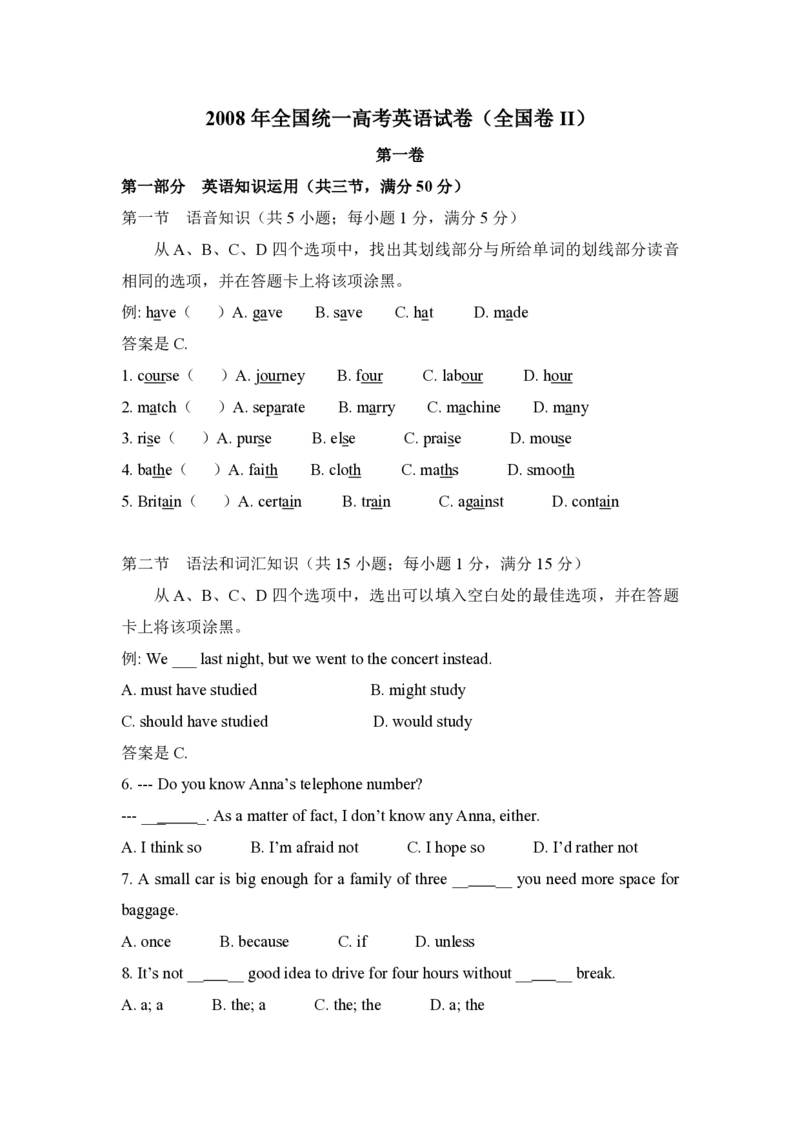
2008 年全国统一高考英语试卷(全国卷II)
第一卷
第一部分  英语知识运用(共三节,满分50 分)
第一节  语音知识(共5 小题;每小题1 分,满分5 分)
从A、B、C、D 四个选项中,找出其划线部分与所给单词的划线部分读音
相同的选项,并在答题卡上将该项涂黑。
例: have(   )A. gave
B. save
C. hat
D. made
答案是C.
1. course(   )A. journey
B. four
C. labour
D. hour
2. match(   )A. separate
B. marry
C. machine
D. many
3. rise(   )A. purse
B. else
C. praise
D. mouse
4. bathe(   )A. faith
B. cloth
C. maths
D. smooth
5. Britain(   )A. certain
B. train
C. against
D. contain

第二节  语法和词汇知识(共15 小题;每小题1 分,满分15 分)
从A、B、C、D 四个选项中,选出可以填入空白处的最佳选项,并在答题
卡上将该项涂黑。
例: We ___ last night, but we went to the concert instead.
A. must have studied
B. might study
C. should have studied
D. would study
答案是C.
6. --- Do you know Anna’s telephone number?
--- ___
_. As a matter of fact, I don’t know any Anna, either.
A. I think so
B. I’m afraid not
C. I hope so
D. I’d rather not
7. A small car is big enough for a family of three __   __ you need more space for
baggage.
A. once
B. because
C. if
D. unless
8. It’s not __   __ good idea to drive for four hours without __   __ break.
A. a; a
B. the; a
C. the; the
D. a; the
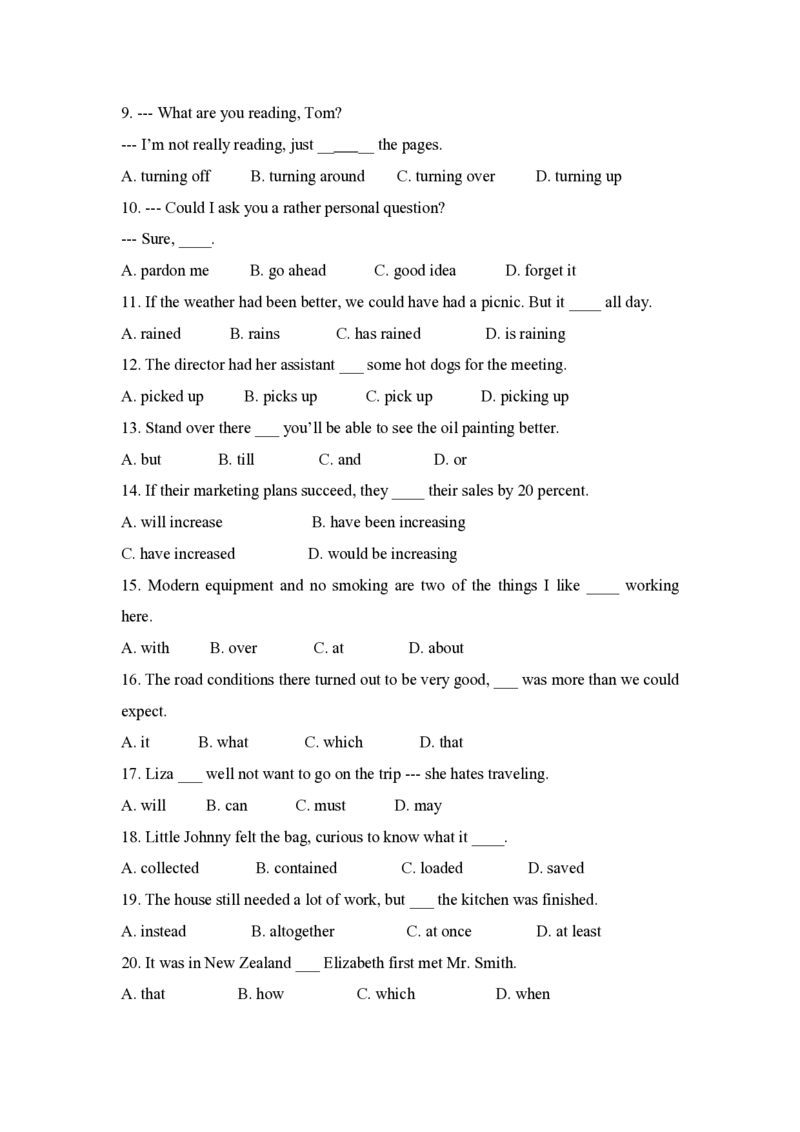
9. --- What are you reading, Tom?
--- I’m not really reading, just __   __ the pages.
A. turning off
B. turning around
C. turning over
D. turning up
10. --- Could I ask you a rather personal question?

--- Sure, ____.
A. pardon me
B. go ahead
C. good idea
D. forget it
11. If the weather had been better, we could have had a picnic. But it ____ all day.
A. rained
B. rains
C. has rained
D. is raining
12. The director had her assistant ___ some hot dogs for the meeting.
A. picked up
B. picks up
C. pick up
D. picking up
13. Stand over there ___ you’ll be able to see the oil painting better.
A. but
B. till
C. and
D. or
14. If their marketing plans succeed, they ____ their sales by 20 percent.
A. will increase
B. have been increasing
C. have increased
D. would be increasing
15. Modern equipment and no smoking are two of the things I like ____ working
here.
A. with
B. over
C. at
D. about
16. The road conditions there turned out to be very good, ___ was more than we could
expect.
A. it
B. what
C. which
D. that
17. Liza ___ well not want to go on the trip --- she hates traveling.
A. will
B. can
C. must
D. may
18. Little Johnny felt the bag, curious to know what it ____.
A. collected
B. contained
C. loaded
D. saved
19. The house still needed a lot of work, but ___ the kitchen was finished.
A. instead
B. altogether
C. at once
D. at least
20. It was in New Zealand ___ Elizabeth first met Mr. Smith.
A. that
B. how
C. which
D. when

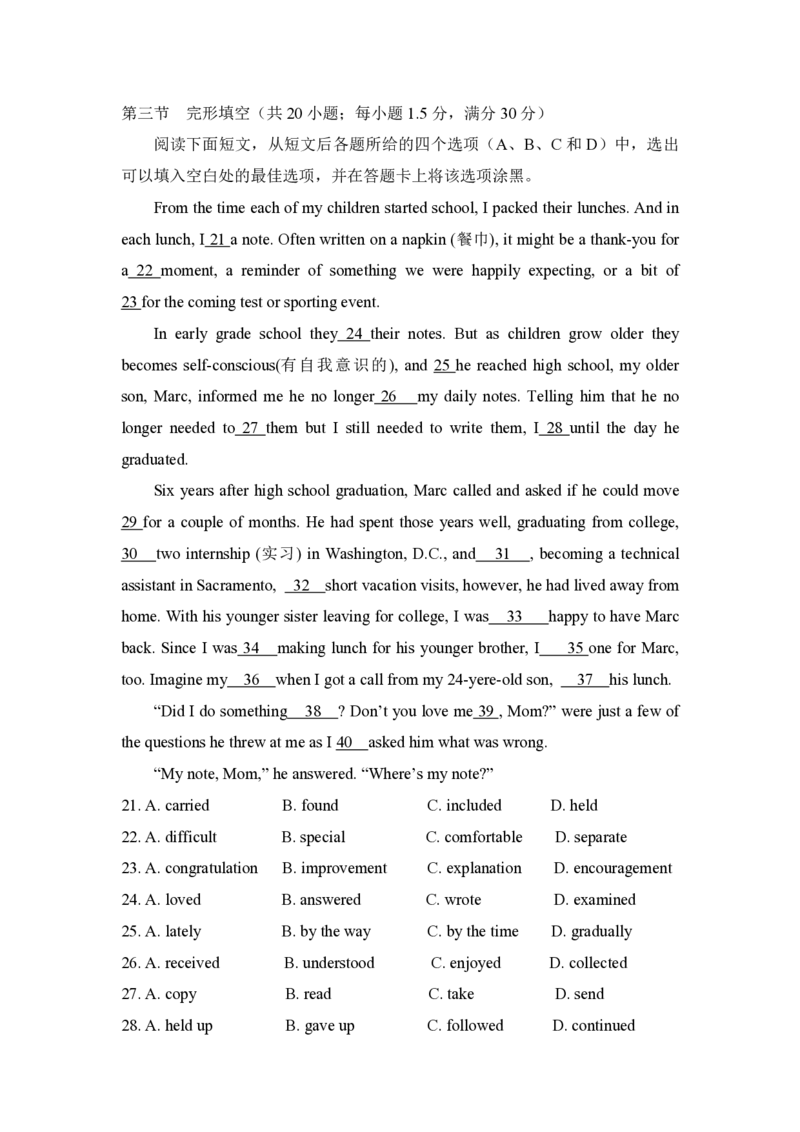
第三节  完形填空(共20 小题;每小题1.5 分,满分30 分)
阅读下面短文,从短文后各题所给的四个选项(A、B、C 和D)中,选出
可以填入空白处的最佳选项,并在答题卡上将该选项涂黑。
From the time each of my children started school, I packed their lunches. And in
each lunch, I 21 a note. Often written on a napkin (餐巾), it might be a thank-you for
a 22 moment, a reminder of something we were happily expecting, or a bit of
23 for the coming test or sporting event.
In early grade school they 24 their notes. But as children grow older they
becomes self-conscious(有自我意识的), and 25 he reached high school, my older
son, Marc, informed me he no longer 26  my daily notes. Telling him that he no
longer needed to 27 them but I still needed to write them, I 28 until the day he
graduated.
Six years after high school graduation, Marc called and asked if he could move
29 for a couple of months. He had spent those years well, graduating from college,
30  two internship (实习) in Washington, D.C., and  31  , becoming a technical
assistant in Sacramento,  32  short vacation visits, however, he had lived away from
home. With his younger sister leaving for college, I was  33   happy to have Marc
back. Since I was 34  making lunch for his younger brother, I   35 one for Marc,
too. Imagine my  36  when I got a call from my 24-yere-old son,   37  his lunch.
“Did I do something  38  ? Don’t you love me 39 , Mom?” were just a few of
the questions he threw at me as I 40  asked him what was wrong.
“My note, Mom,” he answered. “Where’s my note?”
21. A. carried
B. found
C. included
D. held
22. A. difficult
B. special
C. comfortable
D. separate
23. A. congratulation   B. improvement
C. explanation
D. encouragement
24. A. loved
B. answered
C. wrote
D. examined
25. A. lately
B. by the way
C. by the time
D. gradually
26. A. received
B. understood
C. enjoyed
D. collected
27. A. copy
B. read
C. take
D. send
28. A. held up
B. gave up
C. followed
D. continued
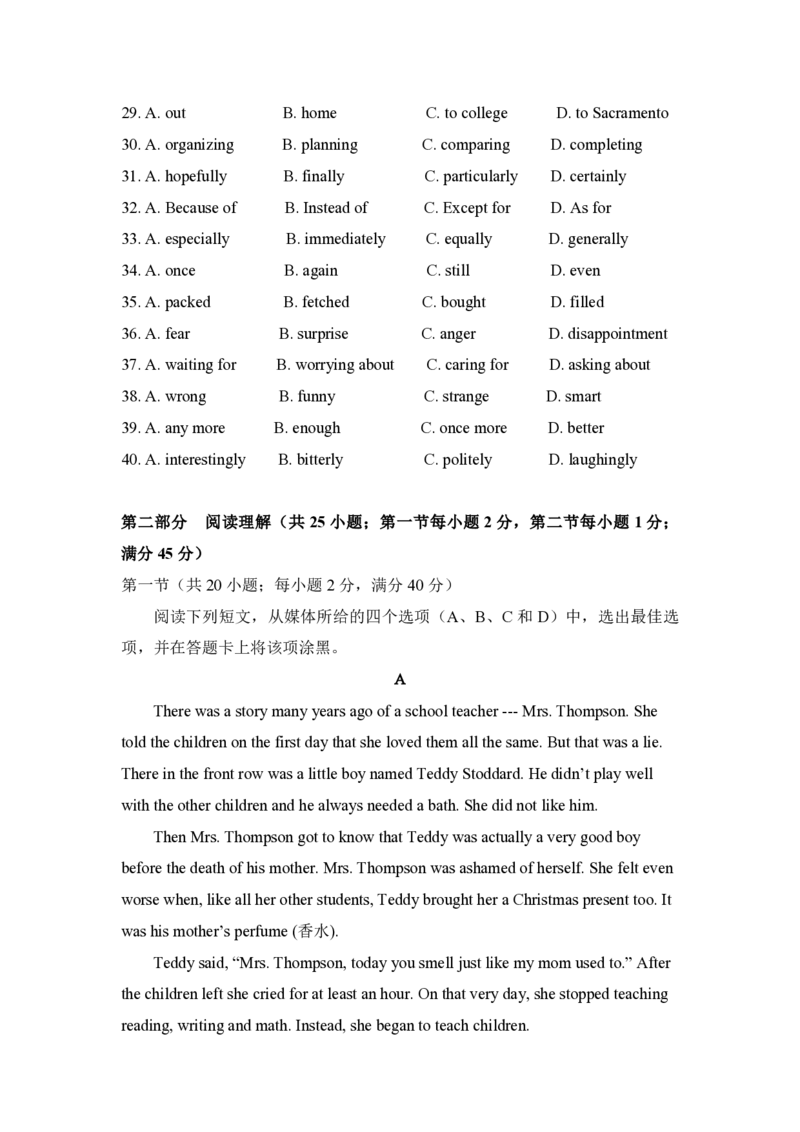
29. A. out
B. home
C. to college
D. to Sacramento
30. A. organizing
B. planning
C. comparing
D. completing
31. A. hopefully
B. finally
C. particularly
D. certainly
32. A. Because of
B. Instead of
C. Except for
D. As for
33. A. especially
B. immediately
C. equally
D. generally
34. A. once
B. again
C. still
D. even
35. A. packed
B. fetched
C. bought
D. filled
36. A. fear
B. surprise
C. anger
D. disappointment
37. A. waiting for
B. worrying about
C. caring for
D. asking about
38. A. wrong
B. funny
C. strange
D. smart
39. A. any more
B. enough
C. once more
D. better
40. A. interestingly
B. bitterly
C. politely
D. laughingly

第二部分  阅读理解(共25 小题;第一节每小题2 分,第二节每小题1 分;
满分45 分)
第一节(共20 小题;每小题2 分,满分40 分)
阅读下列短文,从媒体所给的四个选项(A、B、C 和D)中,选出最佳选
项,并在答题卡上将该项涂黑。
A
There was a story many years ago of a school teacher --- Mrs. Thompson. She
told the children on the first day that she loved them all the same. But that was a lie.
There in the front row was a little boy named Teddy Stoddard. He didn’t play well
with the other children and he always needed a bath. She did not like him.
Then Mrs. Thompson got to know that Teddy was actually a very good boy
before the death of his mother. Mrs. Thompson was ashamed of herself. She felt even
worse when, like all her other students, Teddy brought her a Christmas present too. It
was his mother’s perfume (香水).
Teddy said, “Mrs. Thompson, today you smell just like my mom used to.” After
the children left she cried for at least an hour. On that very day, she stopped teaching
reading, writing and math. Instead, she began to teach children.
Mrs. Thompson paid particular attention to Teddy. The boy’s mind seemed to
come alive. The more she encourage him, the faster he improved. By the end of the
sixth grade, Teddy had become one of the smartest children in the class.
Six years went by before she got a note from Teddy. He wrote that he had
finished high school, third in his class, and she was still the best teacher he ever had in
his whole life. He went to college. Mrs. Thompson got two more letters from him
with the last one signed, Theodore F. Stoddard, M. D. (医学博士).
The story doesn’t end there. On his wedding day, Dr. Stoddard whispered in
Mrs. Thompson’s ear, “Thank you, Mrs. Thompson, for believing in me. You made
me feel important and showed me that I could make a difference.”
Mrs. Thompson, with tears in her eyes, whispered back, “Teddy, you have it all
wrong. You were the one who taught me that I could make a difference. I didn’t know
how to teach until I met you.”
41. What did Mrs. Thompson do on the first day of school?
A. She made Teddy feel ashamed.
B. She asked the children to play with Teddy.
C. She changed Teddy’s seat to the front row.
D. She told the class something untrue about herself.
42. What did Mrs. Thompson find out about Teddy?
A. He often told lies.
B. He was good at math.
C. He needed motherly care.
D. He enjoyed playing with others.
43. In what way did Mrs. Thompson change?
A. She taught fewer school subjects.
B. She became stricter with her students.
C. She no longer liked her job as a teacher.
D. She cared more about educating students.
44. Why did Teddy thank Mrs. Thompson at his wedding?
A. She had kept in touch with him.
B. She had given him encouragement.
C. She had sent him Christmas presents.
D. She had taught him how to judge people.

B
The Queen’s English is now sounding less upper-class, a scientific study of the
Queen’s Christmas broadcasts had found. Researchers have studied each of her
messages to the Commonwealth countries since 1952 to find out the change in her
pronunciation from the noble Upper Received to the Standard Received.
Jonathan Harrington, a professor at Germany’s University of Munich, wanted to
discover whether accent (口音) changers recorded over the past half century would
take place within one person. “As far as I know, there just is nobody else for whom
there is this sort of broadcast records,” he said.
He said the noble way of pronouncing vowels (元音) had gradually lost ground
as the noble upper-class accent over the past years. “Her accent sounds slightly less
noble than it did 50 years ago. But these are very, very small and slow changes that
we don’t notice from year to year.”
“We may be able to relate it to changes in the social classes,” he told The Daily
Telegraph, a British newspaper. “In 1952 she would have been hears saying ‘thet men
in the bleck het’. Now it would be ‘that man in the black hat’. And ‘hame’ rather than
‘home’. In the 1950s she would have been ‘lorst’, but by the 1970s ‘lost’.”
The Queen’s broadcast is a personal message to the Commonwealth countries.
Each Christmas, the 10-minute broadcast is put on TV at 3 pm in Britain as many
families are recovering from their traditional turkey lunch (传统火鸡午餐).
The results were published (发表) in the Journal of Phonetics.
45. The Queen’s broadcasts were chosen for the study mainly because ______.
A. she has been Queen for many years
B. she has a less upper-class accent now
C. her speeches are familiar to many people
D. her speeches have been recorded for 50 years
46. Which of the following is an example of a less noble accent in English?
A. “duaty”
B. “citee”
C. “hame”
D. “lorst”
47. We may infer from the text that the Journal of Phonetics is a magazine on _____.
A. speech sounds
B. Christmas customs
C. TV broadcasting
D. personal messages
48. What is the text mainly about?
A. The relationship between accents and social classes.
B. The Queen’s Christmas speeches on TV.
C. The changes in a person’s accent.
D. The recent development of the English language.

C
Do you know of anyone who uses the truth to deceive (欺骗)? When someone
tells you something that is true, but leaves out important information that should be
included, he can give you a false picture.
For example, some might say, “I just won a hundred dollars on the lottery (彩
票). It was great. I took that dollar ticket back to the store and turned it in for one
hundred dollars!”
This guy’s a winner, right? Maybe, maybe not. We then discover that he bought
$200 worth of tickets, and only one was a winner. He’s really a big loser!
He didn’t say anything that was false, but he left out important information on
purpose. That’s called a half-truth. Half-truths are not technically lies, but they are
just as dishonest.
Some politicians often use this trick. Let’s say that during Governor Smith’s last
term, her state lost one million jobs and gained three million jobs. Then she seeks
another term. One of her opponents (对手) says, “During Governor Smith’s term, the
state lost one million jobs!” that’s true. However, and honest statement would have
been, “During Governor Smith’s term, the state had a net gain of two million jobs.”
Advertisers (广告商) will sometimes use half-truths. It’s against the law to make
false statements so they try to mislead you with the truth. An advertisement might say,
“Nine out of ten doctors advised their patients to take Yucky Pills to cure toothache.”
It fails to mention that they only asked ten doctors and nine of them work for the
Yucky Company.
This kind of deception happens too of often. It’s a sad fact of life: Lies are lies,
and sometimes the truth can lie as well.
49. How much did the lottery winner lose?
A. One hundred dollars.
B. Two hundred dollars.
C. Three hundred dollars.
D. Four hundred dollars.
50. We may infer that the author believes people should _______.
A. buy lottery tickets
B. make use of half-truths
C. not take anything at face value
D. not trust the Yucky Company
51. What do the underline words “net gain” in Paragraph 5 mean?
A. final increase
B. big advantage
C. large share
D. total saving
52. What can we know from the example of the Yucky Pill advertisement?
A. False statements are easy to see through.
B. Half-truths are often used to mislead people.
C. Doctors like to act in advertisements.
D. Advertisements are based on facts.

D
Something in chocolate could be used to stop coughs and lead to more effective
medicines, say UK researchers.
Their study found that theobromine, found in cocoa, was nearly a third more
effective in stopping coughs than codeine, which was considered the best cough
medicine at present.
The Imperial College London researchers who published their results online said
the discovery could lead to more effective cough treatment. “While coughing is not
necessarily harmful (有害的) it can have a major effect on the quality of life, and this
discovery could be a huge step forward in treating this problem,” said Professor Peter
Barnes.
Ten healthy volunteers (志愿者) were given theobromine, codeine or placebo, a
pill that contains no medicine, during the experiment. Neither the volunteers nor the
researchers knew who received which pill. The researchers then measured levels of
capsaicin, which is used in research to cause coughing and as a sign of how well the
medicine are stopping coughs.
The team found that, when the volunteers were given theobromine, the capsaicin
need to produce a cough was around a third higher than in the placebo group. When
they were given codeine they need only slightly higher levers of capsaicin to cause a
cough compared with the placebo.
The researchers said that theobromine worked by keeping down a verve activity
(神经活动), which cause coughing. They also found that unlike some standard cough
treatments, theobromine caused no side effects such as sleepiness.
53. According to Professor Barnes, theobromine ______.
A. cannot be as effective as codeine
B. can be harmful to people’s health
C. cannot be separated from chocolate   D. can be a more effective cure for coughs
54. What was used in the experiment to cause coughing?
A. Theobromine.
B. Codeine.
C. Capsaicin.
D. Placebo.
55. We learn from the text that volunteers in the experiment _____.
A. were patients with bad coughs
B. were divided into the three groups
C. received standard treatments
D. suffered little side effects
56. Which of the following would be the best title for the text?
A. Codeine: A New Medicine
B. Chocolate May Cure Coughs
C. Cough Treatment: A Hard Case
D. Theobromine Can Cause Coughs

E
Attractions in Wisconsin
Wisconsin Historical Museum
30 N. Carroll Street on Madison’s Capitol Square
Discover Wisconsin’s history and culture (文化) on four floors of exhibits. Open
for public program. Admission is free.
Open Tuesday through Saturday, 9:00 am --- 4:00 pm.
(608) 264-6555  www.wisconsinhistory.org/museum
Swiss historical village
612 Seventh Ave., New Glarus
The Swiss Historical Village offers a delightful look at pioneer life in America’s
heartland. 14 buildings in the village give a full picture of every day life in the
nineteenth-century Midwest.
Tue. --- Fri., May 1st --- October 31st, 10:00 am --- 4:00 pm. Admission is $20.
(608) 527-2317  www.swisshistoricalvillage.com
Artisan Gallery & Creamery Café
6858 Paoli Rd., Paoli, WI
One of the largest collections of fine arts and crafts (手工艺品) in Wisconsin.
Over 5000 sp. ft. of exhibition space in a historic creamery. While visiting enjoy a
wonderfully prepared lunch at our café overlooking the Sugar River. Just minutes
from Madison!
Gallery open Tue. --- Sun., 10:00 am --- 5:00 pm.
Café open Wed. --- Sat., 11:00 am --- 3:00 pm.
Sun. brunch with wine, 10:00 --- 3:00 pm.
(608) 845-6600  www.artisangal.com
Christopher Columbus Museum
239 Whitney St., Columbus
World-class exhibit --- 2000 quality souvenirs (纪念品) marking Chicago’s 1893
World Columbian Exhibition. Tour buses are always welcome.
Open daily, 8:15 am --- 4:00 pm.
(920) 623-1992  www.columbusantiquemall.com
57. Which of the following is on Capitol Square?
A. Wisconsin Historical Museum.
B. Swiss Historical Village.
C. Artisan Gallery & Creamery Café.
D. Christopher Columbus Museum.
58. Where can you go for a visit on Monday?
A. Wisconsin Historical Museum.
B. Swiss Historical Village.
C. Artisan Gallery & Creamery café.
D. Christopher Columbus Museum.
59. Where can visitors have lunch?
A. At Wisconsin Historical Museum.
B. At Swiss Historical Village.
C. At Artisan Gallery & Creamery Café.
D. At Christopher Columbus Museum.
60. We learn from the text that___________.
A. Swiss Historical Village is open for half a year
B. Christopher Columbus Museum overlooks a river
C. tickets are needed for Wisconsin Historical Museum
D. Artisan Gallery & Creamery Café are open daily for 4 hours

第二节(共5 小题; 每小题1 分, 满分5 分)
根据对话内容,从对话后的选项中选出能填入空白处的最佳选项.选项中有
两项多余选项.
--- Can you help me?
--- Sure, what’s the problem?
---    61   .
--- Well, how about San Francisco? We went there last year and had a great time.
---    62
--- Well, there is Golden Gate Bridge of course, and Golden Gate Park. It’s a really
big park. You can go for long walks or take a rest in the Japanese Tea Garden. It’s
beautiful there.
---    63
--- There is also a place called Fisherman’s Wharf. That’s really popular with tourists.
There are lots of shops, cafes and restaurants. And from there you can go on a boat
trip to Alcatraz. You know, it’s a small but very beautiful island.
---    64
--- No, you can’t stay on the island; there aren’t any hotels. You can only go for the
day. I think I’ve still got a book about San Francisco. I can lend it to you.
---    65

A. What can you do there?
B. Oh, great! What a great place to stay in!
C. What an idea! What is the best time to go there?
D. I can’t decide where to go for the holiday --- any ideas?
E. Thanks a lot. San Francisco, here I come!
F. Hmm, that sounds good.
G. How can I go there?

第二卷 (非选择题)
第三部分  写作(共三节, 满分55 分)
第一节  单词拼写 (共10 小题; 每小题1 分, 满分10 分)
根据下列句子及所给汉语注释, 在答题卡相应的位置上写出空缺处各单词
的正确形式. (每空只写一词)
66. Lisa, I didn’t __________(认出)you --- you’ve had your hair cut!
67. I usually just have a __________(三明治)for lunch.
68. Mr. White announced that he would go to China in ___________(二月).
69. The story was first written in English and later ___________(翻译)into
Chinese.
70. The village children like to go __________(游泳)in the nearby river.
71. One of our _________(邻居)kept a very beautiful garden.
72. The English teacher gives the class a __________ (听写)almost every day.
73. David turned and walked off in the ___________(相反)direction.
74. I suggest that we have ____________(定期)meetings.
75. Rose rushed _____________(向楼下)to answer the door.

第二节  短文该错(共10 小题; 每小题1.5 分, 满分15 分)

此题要求改正所给短文中的错误。对标有题号的每一行作出判断:如无错
误,在答题卡的相应位置上画一个勾(√);如有错误(每行只有一个错误),则
按下列情况改正:
此行多一个词:把多余的词写在答题卡相应的位置上,用斜线(\)划掉。
此行缺一个词:在答题卡相应的位置上写出该加的词,并附带前(后)
词。
此行错一个词:在答题卡相应的位置上写出该错词和改正后的词。
If I have the honor to be chose to work for the
76. ___________
29th Olympic Games, I will at first improve my
77.___________
English so that I can talk easily about foreign visitor.
78. ___________
Second, I will learn more about history of the
79. __________
Olympics as good as the 2008 Olympic Games. Third,
80. __________
since I was familiar with Beijing, I can help visitors find
81. __________
their ways in the city. Finally, I should be able to tell
82. __________
visitors about our history and culture and show
83. _________
them their great achievements. In short, I will do
84._________
my best to help making the Games a success.
85. _________

第三节  书面表达(满分30 分)
假定你是李华, 你的英国朋友Peter 来信向你咨询如何才能学好中文. 请你
根据下列要点写回信.
要点:1. 参加中文学习班;
2. 看中文书刊、电视;
3. 学唱中文歌曲;
4. 交中国朋友。
注意:1. 词数100 左右;
2. 可适当增加细节,以使行文连贯;
3. 开头语已为你写好。

June 8, 2008
Dear Peter,

I’m glad to receive your letter asking for my advice on how to learn Chinese
well.
_____________________________________________________________________
_____________________________________________________________________
_____________________________________________________________________
_____________________________________________________________________
_____________________________________________________________________
_____________________________________________________________________
_____________________________________________________________________
Best wishes,
Li Hua