2026 届各地最新高考模拟卷 完形填空汇编(一)
(1)
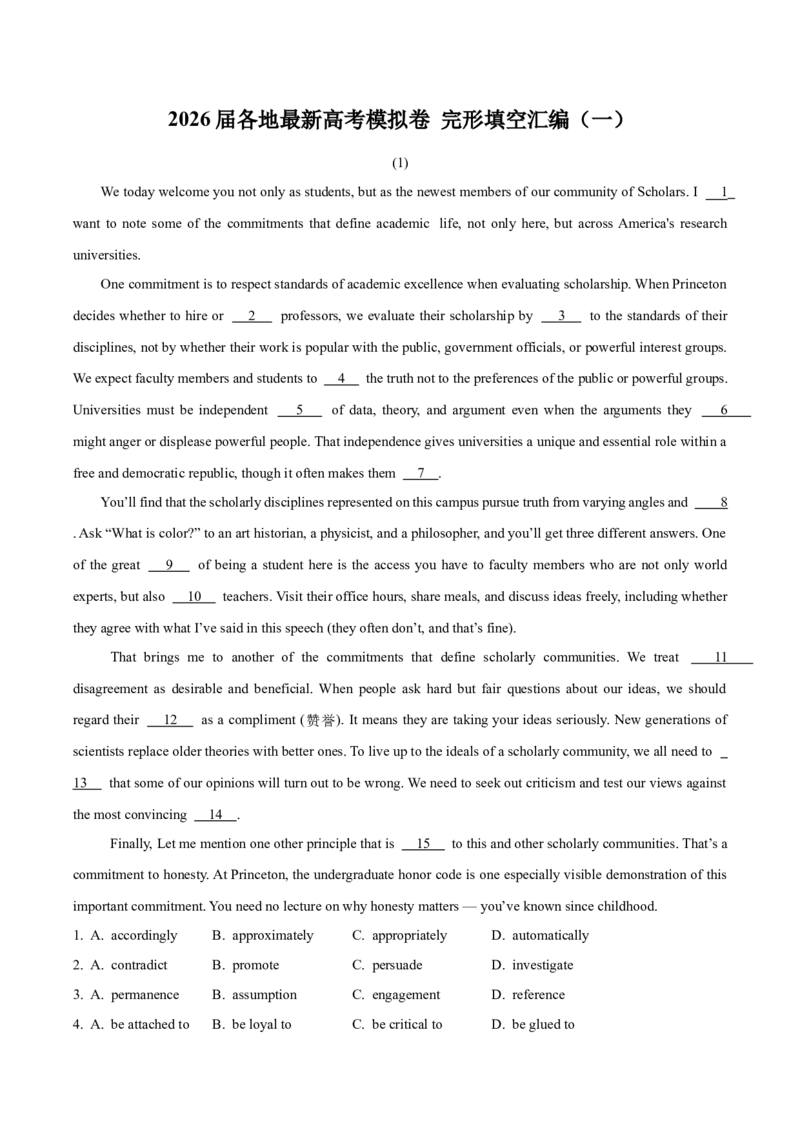
We today welcome you not only as students, but as the newest members of our community of Scholars. I     1
want to note some of the commitments that define academic life, not only here, but across America's research
universities.
One commitment is to respect standards of academic excellence when evaluating scholarship. When Princeton
decides whether to hire or   2   professors, we evaluate their scholarship by   3   to the standards of their
disciplines, not by whether their work is popular with the public, government officials, or powerful interest groups.
We expect faculty members and students to   4   the truth not to the preferences of the public or powerful groups.
Universities must be independent   5   of data, theory, and argument even when the arguments they   6

might anger or displease powerful people. That independence gives universities a unique and essential role within a
free and democratic republic, though it often makes them   7  .
You’ll find that the scholarly disciplines represented on this campus pursue truth from varying angles and     8
. Ask “What is color?” to an art historian, a physicist, and a philosopher, and you’ll get three different answers. One
of the great   9   of being a student here is the access you have to faculty members who are not only world
experts, but also   10   teachers. Visit their office hours, share meals, and discuss ideas freely, including whether
they agree with what I’ve said in this speech (they often don’t, and that’s fine).
That brings me to another of the commitments that define scholarly communities. We treat   11

disagreement as desirable and beneficial. When people ask hard but fair questions about our ideas, we should
regard their   12   as a compliment (赞誉). It means they are taking your ideas seriously. New generations of
scientists replace older theories with better ones. To live up to the ideals of a scholarly community, we all need to
13   that some of our opinions will turn out to be wrong. We need to seek out criticism and test our views against
the most convincing   14  .
Finally, Let me mention one other principle that is   15   to this and other scholarly communities. That’s a
commitment to honesty. At Princeton, the undergraduate honor code is one especially visible demonstration of this
important commitment. You need no lecture on why honesty matters — you’ve known since childhood.
1. A. accordingly
B. approximately
C. appropriately
D. automatically
2. A. contradict
B. promote
C. persuade
D. investigate
3. A. permanence
B. assumption
C. engagement
D. reference
4. A. be attached to
B. be loyal to
C. be critical to
D. be glued to
5. A. sources
B. dimensions
C. categories
D. distributions
6. A. identify
B. restore
C. perceive
D. generate
7. A. consistent
B. controversial
C. apparent
D. conventional
8. A. opponents
B. perspectives
C. sessions
D. phenomena
9. A. procedures
B. conferences
C. privileges
D. entertainments
10. A. dedicated
B. contemporary
C. domestic
D. alternative
11. A. desperate
B. comprehensive
C. respectful
D. optimistic
12. A. guarantee
B. property
C. inquiry
D. superiority
13. A. analyse
B. stimulate
C. deny
D. recognize
14. A. assignments
B. initiatives
C. consultations
D. objections
15. A. fundamental
B. primitive
C. dynamic
D. subsequent
(2)
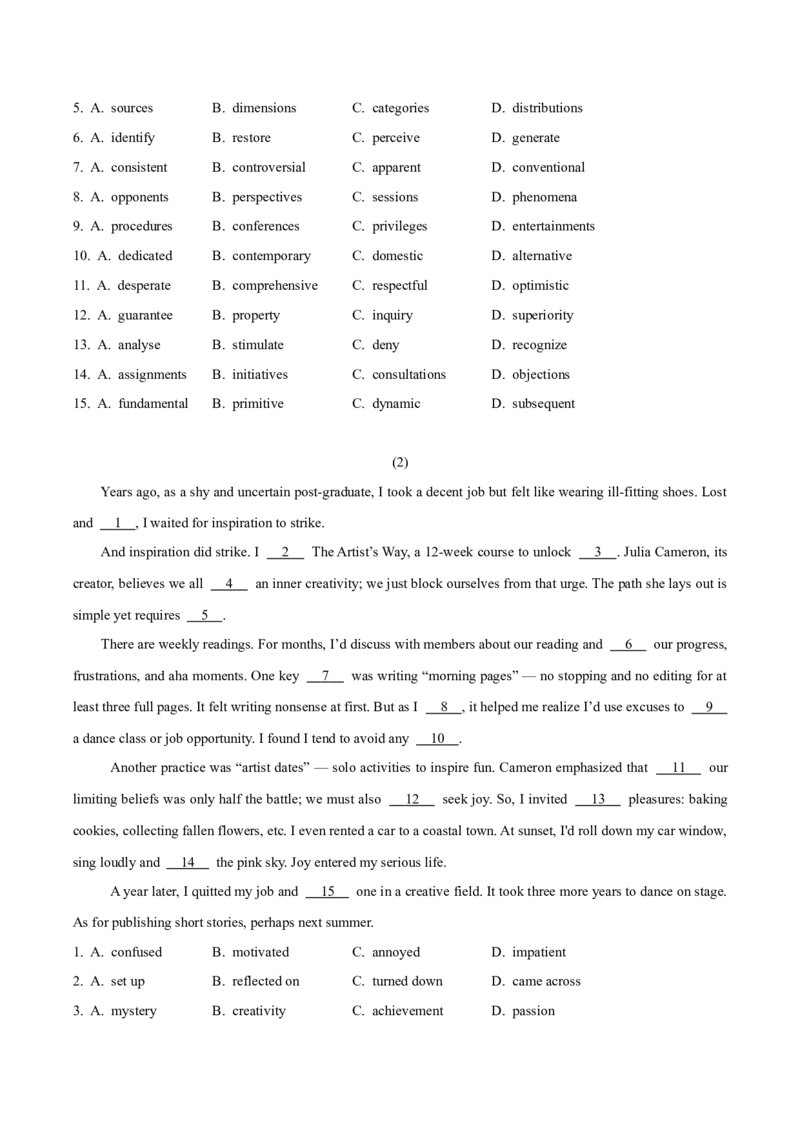
Years ago, as a shy and uncertain post-graduate, I took a decent job but felt like wearing ill-fitting shoes. Lost
and   1  , I waited for inspiration to strike.
And inspiration did strike. I
  2
   The Artist’s Way, a 12-week course to unlock
  3
  . Julia Cameron, its
creator, believes we all
  4
   an inner creativity; we just block ourselves from that urge. The path she lays out is
simple yet requires     5      .
There are weekly readings. For months, I’d discuss with members about our reading and     6       our progress,
frustrations, and aha moments. One key
  7
   was writing “morning pages” — no stopping and no editing for at
least three full pages. It felt writing nonsense at first. But as I     8      , it helped me realize I’d use excuses to     9
a dance class or job opportunity. I found I tend to avoid any     10
      .
Another practice was “artist dates” — solo activities to inspire fun. Cameron emphasized that
  11

   our
limiting beliefs was only half the battle; we must also
  12

   seek joy. So, I invited
  13

   pleasures: baking
cookies, collecting fallen flowers, etc. I even rented a car to a coastal town. At sunset, I'd roll down my car window,
sing loudly and     14
       the pink sky. Joy entered my serious life.
A year later, I quitted my job and     15
       one in a creative field. It took three more years to dance on stage.
As for publishing short stories, perhaps next summer.
1. A. confused
B. motivated
C. annoyed
D. impatient
2. A. set up
B. reflected on
C. turned down
D. came across
3. A. mystery
B. creativity
C. achievement
D. passion
4. A. display
B. expect
C. possess
D. mention
5. A. flexibility
B. commitment
C. fortune
D. cooperation
6. A. memorize
B. deny
C. share
D. forget
7. A. contest
B. suggestion
C. trial
D. task
8. A. persisted
B. surveyed
C. complained
D. wondered
9. A. establish
B. take
C. abandon
D. miss
10. A. risk
B. guidance
C. strategy
D. praise
11. A. promoting
B. recognizing
C. illustrating
D. preserving
12. A. helplessly
B. humbly
C. actively
D. cautiously
13. A. original
B. permanent
C. intense
D. simple
14. A. admire
B. paint
C. decorate
D. brighten
15. A. designed
B. landed
C. refused
D. inquired
(3)
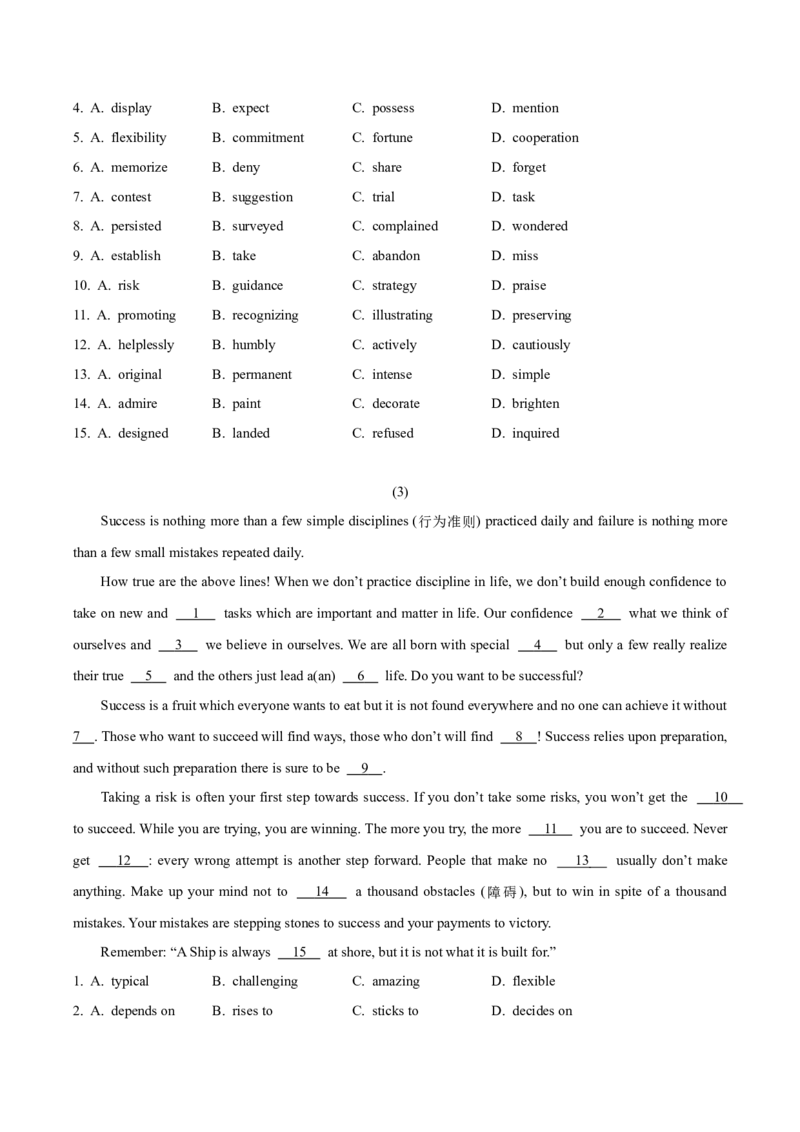
Success is nothing more than a few simple disciplines (行为准则) practiced daily and failure is nothing more
than a few small mistakes repeated daily.
How true are the above lines! When we don’t practice discipline in life, we don’t build enough confidence to
take on new and   1   tasks which are important and matter in life. Our confidence
  2
   what we think of
ourselves and
  3
   we believe in ourselves. We are all born with special
  4
   but only a few really realize
their true     5       and the others just lead a(an)     6       life. Do you want to be successful?
Success is a fruit which everyone wants to eat but it is not found everywhere and no one can achieve it without
7      . Those who want to succeed will find ways, those who don’t will find     8      ! Success relies upon preparation,
and without such preparation there is sure to be     9      .
Taking a risk is often your first step towards success. If you don’t take some risks, you won’t get the
  1  0
to succeed. While you are trying, you are winning. The more you try, the more
  1  1

  you are to succeed. Never
get
  12

  : every wrong attempt is another step forward. People that make no
  1 3
   usually don’t make
anything. Make up your mind not to
  14

   a thousand obstacles ( 障碍), but to win in spite of a thousand
mistakes. Your mistakes are stepping stones to success and your payments to victory.
Remember: “A Ship is always     15
       at shore, but it is not what it is built for.”
1. A. typical
B. challenging
C. amazing
D. flexible
2. A. depends on
B. rises to
C. sticks to
D. decides on
3. A. why
B. that
C. whether
D. when
4. A. types
B. qualities
C. personalities
D. materials
5. A. wonders
B. dreams
C. potential
D. creativity
6. A. colorful
B. average
C. normal
D. comfortable
7. A. contribution
B. explosion
C. concentration
D. efforts
8. A. excuses
B. fantasies
C. adventures
D. targets
9. A. hope
B. injuries
C. solutions
D. failure
10. A. resources
B. desires
C. opportunities
D. schedules
11. A. likely
B. ready
C. free
D. fortunate
12. A. fancy
B. excited
C. tough
D. discouraged
13. A. mistakes
B. decisions
C. advances
D. promises
14. A. attract
B. overcome
C. press
D. adapt
15. A. super
B. horrible
C. narrow
D. safe
(4)
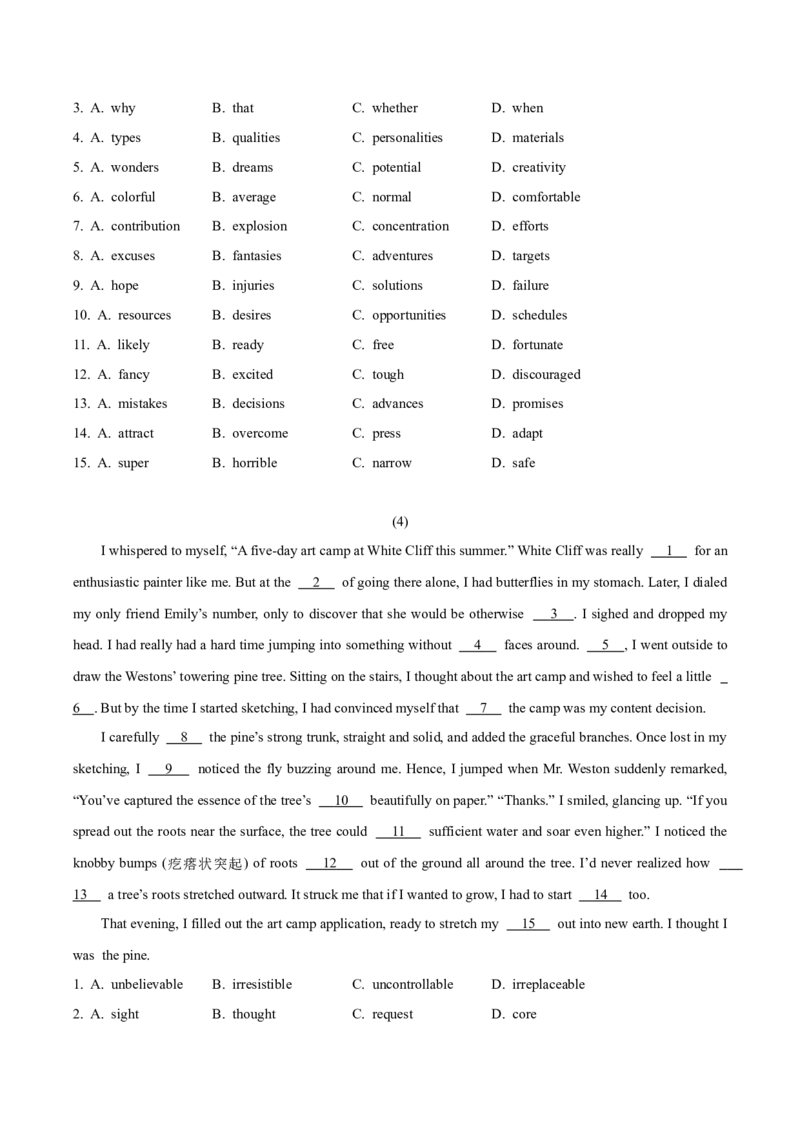
I whispered to myself, “A five-day art camp at White Cliff this summer.” White Cliff was really     1       for an
enthusiastic painter like me. But at the     2       of going there alone, I had butterflies in my stomach. Later, I dialed
my only friend Emily’s number, only to discover that she would be otherwise
  3
  . I sighed and dropped my
head. I had really had a hard time jumping into something without
  4
   faces around.
  5
  , I went outside to
draw the Westons’ towering pine tree. Sitting on the stairs, I thought about the art camp and wished to feel a little
6      . But by the time I started sketching, I had convinced myself that     7       the camp was my content decision.
I carefully     8       the pine’s strong trunk, straight and solid, and added the graceful branches. Once lost in my
sketching, I
  9
   noticed the fly buzzing around me. Hence, I jumped when Mr. Weston suddenly remarked,
“You’ve captured the essence of the tree’s
  10

   beautifully on paper.” “Thanks.” I smiled, glancing up. “If you
spread out the roots near the surface, the tree could
  11

   sufficient water and soar even higher.” I noticed the
knobby bumps (疙瘩状突起) of roots
  12

   out of the ground all around the tree. I’d never realized how
13
       a tree’s roots stretched outward. It struck me that if I wanted to grow, I had to start     14
       too.
That evening, I filled out the art camp application, ready to stretch my     15
       out into new earth. I thought I
was the pine.
1. A. unbelievable
B. irresistible
C. uncontrollable
D. irreplaceable
2. A. sight
B. thought
C. request
D. core
3. A. rejected
B. attracted
C. occupied
D. addicted
4. A. familiar
B. gentle
C. confident
D. beautiful
5. A. Delighted
B. Relieved
C. Shocked
D. Frustrated
6. A. cleverer
B. luckier
C. happier
D. braver
7. A. skipping
B. attending
C. reserving
D. delaying
8. A. wrote
B. watched
C. drew
D. cut
9. A. desperately
B. narrowly
C. barely
D. suddenly
10. A. magic
B. function
C. mystery
D. strength
11. A. supply
B. fetch
C. absorb
D. contain
12. A. sticking
B. hiding
C. digging
D. lifting
13. A. well
B. far
C. deep
D. long
14. A. reaching out
B. growing up
C. wising up
D. turning out
15. A. life
B. roots
C. camp
D. interests
(5)
I was born with a genetic disease that causes severe weakness in my limbs. My disability means I’ve never
been able to stand or walk, but in the water, I was weightless and could move more   1  . So my   2

memories of my childhood are of learning to swim in school PE lessons. It was the only sport I was ever able to
3   participate in, without being assigned to watch. Back in class, with wet hair and sore eyes, I felt like a(n)     4
.
As I approached adolescence, I underwent further surgery, which left me even less   5  . Visiting the
hydrotherapy (水疗法) pool was my final   6   to return to the water. I now needed specialist equipment to get
me into the pool. It was a stressful and   7   experience, far from the fun I remembered. I knew I would never
8   again! I cried the whole way home. My tears weren’t just because of the loss-they were a(n)   9  , too. Self-
forgiveness! And I made a decision: I was never going back in the water again.
But now I want to     10
       myself for the first time. Like other disabled people who are always forced to fit in,
I often feel a social
  11

   to push myself, to ignore my body’s needs, to be a high achiever,
  1  2       miserable
or exhausted. Giving up on swimming was a tough lesson about accepting the     13
       of my body. It was the first
big loss in my life, but I know there will be others as I age. I’ve learned it’s OK to     1  4

  what my body could do
before, but it’s also important to find ways to adapt and     15
       what I can do.
1. A. awkwardly
B. freely
C. gracefully
D. painfully
2. A. earliest
B. bitterest
C. fondest
D. shortest
3. A. fully
B. hesitantly
C. dependently
D. violently
4. A. amateur
B. human
C. equal
D. bystander
5. A. pessimistic
B. speechless
C. isolated
D. mobile
6. A. time
B. effort
C. permission
D. outcome
7. A. unique
B. worthwhile
C. unnecessary
D. alarming
8. A. walk
B. swim
C. stand
D. breathe
9. A. acceptance
B. agreement
C. solution
D. recovery
10. A. turn to
B. look out for
C. attend to
D. stand up for
11. A. environment
B. circle
C. pressure
D. movement
12. A. however
B. before
C. until
D. unless
13. A. desires
B. limitations
C. strengths
D. requirements
14. A. bear
B. prove
C. deny
D. miss
15. A. enjoy
B. change
C. handle
D. imagine
(6)
I’m a teacher at a local high school. One day, I found myself     1       a brilliant moment in the cafeteria. During
lunch, I noticed one of my
  2
   Jason holding up his tray (托盘) with a confused expression.
  3
  , he was
having trouble deciding where to sit in the
  4
   cafeteria. After some hesitation, he approached a table where a
few students were absorbed in their own     5       and asked if he could join them. They welcomed him, and he     6
, looking content.
Moments later, another student approached the table and asked if he could join them. Jason seized the     7


to introduce an element of fun and challenge. He asked the boy if he could answer a riddle before joining them.
Interested, the boy     8      , and Jason presented him with the riddle: “What has     9       but can’t open locks?” After
a moment of thought, the boy admitted he didn’t know the answer. With a mischievous grin, Jason pointed to the
piano in the corner of the cafeteria and
  10

   that the answer was “a piano”. The other students
  11

  . The
table soon became known as the “riddle table”, attracting students who were     12
       to solve riddles for the chance
to join.
As a teacher, I couldn’t help but appreciate the
  13

   and friendship unfolded during the lunch period. It
turns out that sometimes, a little intellectual challenge can     14
       a random cafeteria table into the hottest spot in
school. Definitely a     15
       move by Jason.
1. A. witnessing
B. bringing
C. providing
D. exploring
2. A. teachers
B. customers
C. students
D. colleagues
3. A. Ideally
B. Obviously
C. Modestly
D. Literally
4. A. fashionable
B. splendid
C. beautiful
D. crowded
5. A. professions
B. territories
C. conversations
D. situations
6. A. ran away
B. settled in
C. stepped out
D. looked up
7. A. opportunity
B. emphasis
C. advocate
D. absence
8. A. resisted
B. calmed
C. hesitated
D. agreed
9. A. doors
B. arms
C. keys
D. legs
10. A. insisted
B. revealed
C. suggested
D. thought
11. A. laughed
B. exploded
C. shouted
D. apologized
12. A. clever
B. tired
C. eager
D. afraid
13. A. creativity
B. kindness
C. mission
D. relation
14. A. load
B. inject
C. feed
D. turn
15. A. curious
B. genius
C. suitable
D. powerful
(7)
In 2007, our family settled in the small town of Busselton. As a new migrant to Australia, the first thing that I
wanted to do was     1       its wide-open spaces.
After hearing a neighbour talk about     2       a cycling trail called The Munda Biddi that runs through the bush,
I researched the trail and became excited about riding it. I bought some
  3
   and began planning. What I didn’t
realize was how     4       it was to ride through bush land and forests in the hot season.
The Munda Biddi Trail was new, and mobile phone
  5
   along the route was poor. My map reading skills
would be put to the test. The terrain (地形) was generally flat, but few navigational landmarks were
  6
   in the
thick forests. However, I started
  7
  , following the trail to my destination. After a while the trail markers
became difficult to find. I hadn’t met any other     8       along the route. By midday, the     9       became unbearable
and my skin was dry and salty. The original   10   was to stay overnight at a tourist park near Logue Brook Dam
(水坝), but I had no idea where I was. After moving slowly along the sandy trail for about two hours, I was
overjoyed to see cycle tracks that looked
  11

  . Feeling encouraged, I cycled on, keeping a sharp eye on the
tracks, but     12
       realizing I was back on my own path.
Discouraged, I stopped and
  13

   my bike in the open in the hope that it would be seen from the air and
rested in the shade. In a half sleep, I heard the
  14

   sound of a motor and looked skywards, but the sound
disappeared. A while later I heard it again, but this time it sounded closer. I     15
       myself up and walked to where
the sound was coming. As I reached the top of the hill, I gasped in disbelief: There before me was Logue Brook
Dam!
1. A. examine
B. extend
C. embrace
D. enhance
2. A. exploring
B. paving
C. checking
D. building
3. A. books
B. bikes
C. maps
D. sticks
4. A. thrilling
B. scary
C. risky
D. rewarding
5. A. quality
B. coverage
C. display
D. application
6. A. acceptable
B. visible
C. suitable
D. changeable
7. A. cautiously
B. eagerly
C. steadily
D. hesitantly
8. A. drivers
B. joggers
C. cyclists
D. hikers
9. A. heat
B. cold
C. wind
D. rain
10. A. agreement
B. routine
C. requirement
D. plan
11. A. recent
B. smooth
C. strange
D. messy
12. A. turned up
B. ended up
C. kicked off
D. set off
13. A. laid
B. fixed
C. displayed
D. loaded
14. A. familiar
B. distinct
C. sharp
D. distant
15. A. woke
B. freed
C. warmed
D. forced
(8)
I have become an empty nester (空巢者) since my boy started university. When he came home after his first
year, we faced huge late-night kitchen chaos and his     1       our previously orderly home. Honestly, it caused much
more annoyance than I cared to admit. That summer was     2      . Therefore, after his third year, my son and I had a
truly insightful conversation.
I asked his advice on how I could handle his such behaviors. His response was surprisingly
  3
  . He just
said that there was no secret plan to drive me crazy. He was merely being a
  4
   unaware teenager. He likely
hadn’t     5       half the times I’d asked him to clean up. Each time the task went undone, I grew angrier until I was
6      . But he often genuinely     7       why I was so mad.
That conversation was a     8      . It seemed as if I’d been     9       a look behind the curtain to understand what
was going on. I thought about how I could
  10

   my prior approach. I could lead with kindness and aim for
11   over cleanliness. I began with baby steps by
  12

   reminding him that he needed to tidy his room to use
the family car.
My new approach was met by signs of positive
  13

  . That summer was over. As my boy was leaving the
nest, I     14
       that as a parent, I was always adjusting and learning that the best way to hold on was learning to
1  5      .
1. A. messing
B. creating
C. maintaining
D. restoring
2. A. pleasant
B. rough
C. busy
D. hot
3. A. plain
B. encouraging
C. typical
D. cautious
4. A. self-taught
B. self-centred
C. self-disciplined
D. self-driven
5. A. forgotten
B. recorded
C. registered
D. written
6. A. crazy
B. silent
C. tired
D. tough
7. A. suspected
B. wondered
C. realized
D. regretted
8. A. game changer
B. road block
C. green light
D. deal breaker
9. A. denied
B. blocked
C. guaranteed
D. gifted
10. A. advocate
B. adopt
C. shift
D. justify
11. A. freedom
B. protection
C. peace
D. control
12. A. proudly
B. angrily
C. desperately
D. calmly
13. A. resistance
B. view
C. change
D. sense
14. A. pointed out
B. made out
C. tried out
D. figured out
15. A. create
B. bargain
C. praise
D. communicate
(9)
The school autumn trip finally came, after what seemed like centuries of waiting in anticipation. Jumping off
the bus, we all cheered in
  1
  , with the worry
  2
   hanging over our minds completely replaced by our
smiles.
The New Zealand scooter (滑板车) is a mini-car sliding down a hill using only gravity without power. It held
much     3       for my friend Xu who was a thrill-seeker, but not for me.
Eventually, it was our
  4
  . “Woo hoo!” No sooner had I put on my helmet than he rushed out,   5

smoothly around a turn and then disappeared. Swinging in the scooter, I took a
  6
   and tightly held the control
lever (控制杆). “It’s a piece of cake for you,” an inner voice from my mind     7       me. Then I gathered my courage
to slowly     8       my grasp on the brake.
Zooming down the slope, I could     9       the wind whistling in my ears. It went so fast that the green trees and
bushes along the path became   10   shadows. I gradually grasped the key to keep
  11

   as I glided through
sharp turns one after another. I began to enjoy the feeling of the smooth
  12

  . I even surpassed some of the
other students. Finally, I reached the ground, safe and sound. Xu was
  13

   there waiting for me. I grinned (咧
嘴笑) from ear to ear. “Turned out not to be so
  14

   after all,” I thought. The experience had such thrills and
spills that we even wanted to     15
       it again!
1. A. anxiety
B. confidence
C. delight
D. belief
2. A. eventually
B. accidentally
C. deliberately
D. previously
3. A. appeal
B. value
C. ground
D. risk
4. A. request
B. invitation
C. turn
D. plan
5. A. recovered
B. challenged
C. grabbed
D. accelerated
6. A. rest
B. chance
C. breath
D. walk
7. A. warned
B. encouraged
C. surprised
D. confused
8. A. regained
B. loosened
C. secured
D. prevent
9. A. feel
B. allow
C. stop
D. avoid
10. A. vague
B. mental
C. missing
D. permanent
11. A. peace
B. balance
C. distance
D. resistance
12. A. interacting
B. bouncing
C. sliding
D. changing
13. A. instead
B. even
C. never
D. already
14. A. content
B. scary
C. delicate
D. capable
15. A. try
B. share
C. make
D. see
(10)
Xia Yujie, owner of China’s first accessible pub — Pub HandyCup, had his left hand disabled in a middle
school medical accident. The experience gave him a unique
  1
   on disability and life, fueling his wish to build
a(n)
  2
   social space. After studying law in China and the US on a scholarship, he noticed a
  3
  : public
places had basic accessible facilities, but the disabled lacked relaxing, barrier-free social spots.
This observation
  4
   his dream of a pub for all. After months of preparation, it
  5
   on Shanghai’s
Xinhua Road in May 2024. Every corner is
  6
   designed, with ramps, wide wheelchair passages, adjustable
tables and dual-height bars for easy socializing.
Practical     7       fill the space: Braille (盲文) maps, rounded table corners and free hearing-aid batteries, all
8       the visually and hearing-impaired. The pub’s name, a take on “handicap”, is a meaningful     9       of breaking
barriers with inclusion.
It has been a popular pub for all, including 38-year-old Fu Ming, a disabled business owner,
  10

   to
promoting accessibility. As a loyal     11
      , he moves around the pub with ease in a wheelchair and shares Xia’s
1  2       that accessibility means equal convenience for all.
Xia sees himself as a bridge between the disabled and able-bodied. The pub frees him from the seriousness of
his legal work, letting him fully     13
       his sense of wonder and creativity to run his business. To him, it’s     14
just a business, but a warm space blurring   15   between people and making inclusion a daily reality.
1. A. comment
B. perspective
C. decision
D. influence
2. A. cosy
B. affordable
C. inclusive
D. functional
3. A. gap
B. conflict
C. fault
D. dilemma
4. A. followed
B. inspired
C. realized
D. recorded
5. A. floated
B. boomed
C. expanded
D. opened
6. A. thoughtfully
B. randomly
C. roughly
D. beautifully
7. A. warnings
B. appliances
C. details
D. demands
8. A. attending to
B. providing for
C. siding with
D. relying on
9. A. tradition
B. symbol
C. dimension
D. pattern
10. A. addicted
B. accustomed
C. exposed
D. dedicated
11. A. participant
B. colleague
C. tourist
D. regular
12. A. vision
B. promise
C. memory
D. experience
13. A. hide
B. ignore
C. embrace
D. achieve
14. A. more like
B. far from
C. along with
D. other than
15. A. boundaries
B. similarities
C. friendships
D. connections