第1 页(共7 页)
2013 年北京市高考英语试卷
第一部分:听力理解(共三节,30 分)
第一节(共 5 小题;每小题 1.5 分,共 7.5 分)
听下面 5 段对话,每段对话后有一道小题,从每题所给的 A、B、C 三个选项中选出最佳选
项,听完每段对话后, 你将有 10 秒钟的时间来回答有关小题和阅读下一小题。
例: What is the man going to rend?
A. A newspaper
B. A magazine
C. A book
答案是 A
1. What room does the man want?
A. Single


B. Double


C. Twin
2. What will the man buy?
A. Vegetables


B. Meat


C. Bread
3. What does the man plan to do?
A. Go fishing


B. Go jogging

C. Go camping
4. How much is the change?
A. $8


B. $ 42


C. $50
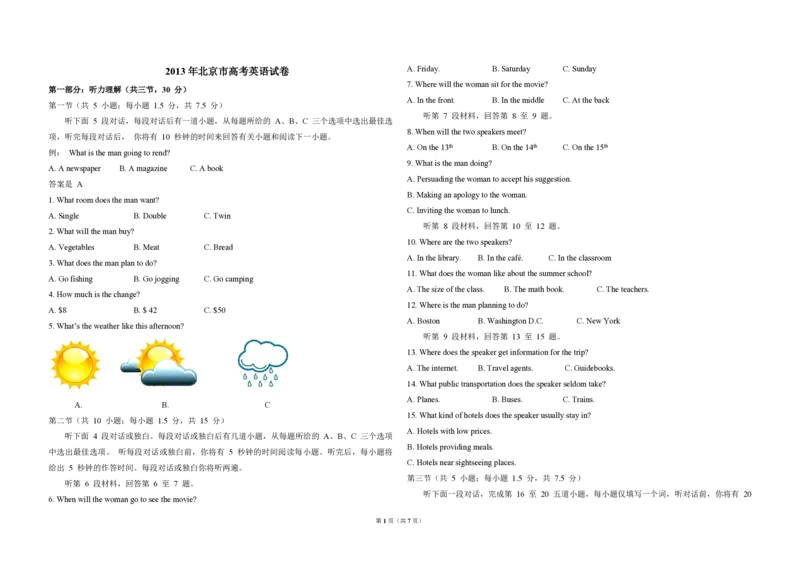
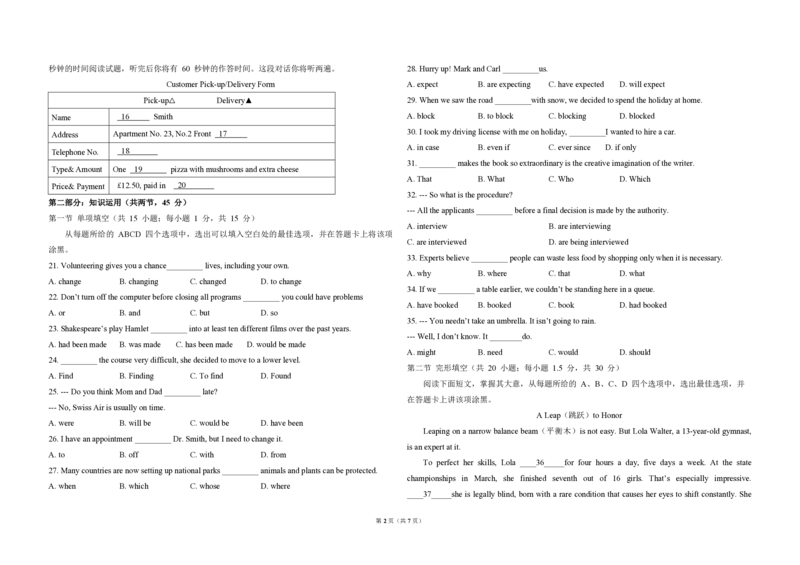
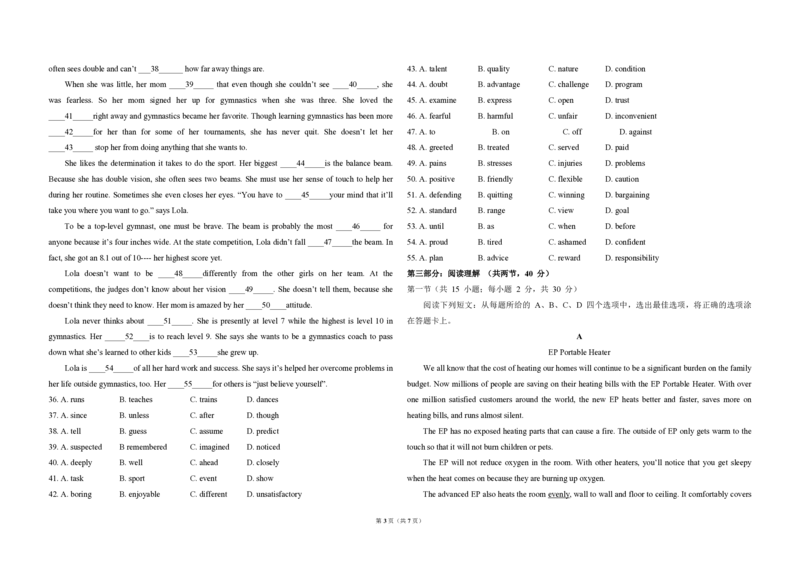
5. What’s the weather like this afternoon?


   A.


B.


C
第二节(共 10 小题;每小题 1.5 分,共 15 分)
听下面 4 段对话或独白。每段对话或独白后有几道小题,从每题所给的 A、B、C 三个选项
中选出最佳选项。 听每段对话或独白前,你将有 5 秒钟的时间阅读每小题。听完后,每小题将
给出 5 秒钟的作答时间。每段对话或独白你将听两遍。
听第 6 段材料,回答第 6 至 7 题。
6. When will the woman go to see the movie?
A. Friday.


B. Saturday

C. Sunday
7. Where will the woman sit for the movie?
A. In the front.

B. In the middle
C. At the back
听第 7 段材料,回答第 8 至 9 题。
8. When will the two speakers meet?
A. On the 13th


B. On the 14th

C. On the 15th
9. What is the man doing?
A. Persuading the woman to accept his suggestion.
B. Making an apology to the woman.
C. Inviting the woman to lunch.
听第 8 段材料,回答第 10 至 12 题。
10. Where are the two speakers?
A. In the library.
B. In the café.

C. In the classroom
11. What does the woman like about the summer school?
A. The size of the class.     B. The math book.
C. The teachers.
12. Where is the man planning to do?
A. Boston


B. Washington D.C.
C. New York
听第 9 段材料,回答第 13 至 15 题。
13. Where does the speaker get information for the trip?
A. The internet.
B. Travel agents.

C. Guidebooks.
14. What public transportation does the speaker seldom take?
A. Planes.


B. Buses.


C. Trains.
15. What kind of hotels does the speaker usually stay in?
A. Hotels with low prices.
B. Hotels providing meals.
C. Hotels near sightseeing places.
第三节(共 5 小题;每小题 1.5 分,共 7.5 分)
听下面一段对话,完成第 16 至 20 五道小题,每小题仅填写一个词,听对话前,你将有 20
第2 页(共7 页)
秒钟的时间阅读试题,听完后你将有 60 秒钟的作答时间。这段对话你将听两遍。
Customer Pick-up/Delivery Form
Pick-up△
Delivery▲
Name
   16      Smith
Address
 Apartment No. 23, No.2 Front  17

Telephone No.
   18

Type& Amount
One  19
  pizza with mushrooms and extra cheese
Price& Payment
£12.50, paid in   20

第二部分:知识运用(共两节,45 分)
第一节 单项填空(共 15 小题;每小题 1 分,共 15 分)
从每题所给的 ABCD 四个选项中,选出可以填入空白处的最佳选项,并在答题卡上将该项
涂黑。
21. Volunteering gives you a chance_________ lives, including your own.
A. change


B. changing

C. changed

D. to change
22. Don’t turn off the computer before closing all programs _________ you could have problems
A. or


B. and


C. but


D. so
23. Shakespeare’s play Hamlet _________ into at least ten different films over the past years.
A. had been made
B. was made
C. has been made
D. would be made
24. _________ the course very difficult, she decided to move to a lower level.
A. Find


B. Finding

C. To find


D. Found
25. --- Do you think Mom and Dad _________ late?
--- No, Swiss Air is usually on time.
A. were


B. will be


C. would be

D. have been
26. I have an appointment _________ Dr. Smith, but I need to change it.
A. to


B. off


C. with


D. from
27. Many countries are now setting up national parks _________ animals and plants can be protected.
A. when


B. which


C. whose


D. where
28. Hurry up! Mark and Carl _________us.
A. expect


B. are expecting
C. have expected
D. will expect
29. When we saw the road _________with snow, we decided to spend the holiday at home.
A. block


B. to block

C. blocking

D. blocked
30. I took my driving license with me on holiday, _________I wanted to hire a car.
A. in case


B. even if


C. ever since
D. if only
31. _________ makes the book so extraordinary is the creative imagination of the writer.
A. That


B. What


C. Who


D. Which
32. --- So what is the procedure?
--- All the applicants _________ before a final decision is made by the authority.
A. interview


B. are interviewing

C. are interviewed


D. are being interviewed
33. Experts believe _________ people can waste less food by shopping only when it is necessary.
A. why


B. where


C. that


D. what
34. If we _________ a table earlier, we couldn’t be standing here in a queue.
A. have booked
B. booked


C. book


D. had booked
35. --- You needn’t take an umbrella. It isn’t going to rain.

--- Well, I don’t know. It ________do.
A. might


B. need


C. would


D. should
第二节 完形填空(共 20 小题;每小题 1.5 分,共 30 分)
阅读下面短文,掌握其大意,从每题所给的 A、B、C、D 四个选项中,选出最佳选项,并
在答题卡上讲该项涂黑。
A Leap(跳跃)to Honor
Leaping on a narrow balance beam(平衡木)is not easy. But Lola Walter, a 13-year-old gymnast,
is an expert at it.
To perfect her skills, Lola ____36_____for four hours a day, five days a week. At the state
championships in March, she finished seventh out of 16 girls. That’s especially impressive.
____37_____she is legally blind, born with a rare condition that causes her eyes to shift constantly. She
第3 页(共7 页)
often sees double and can’t ___38______ how far away things are.
When she was little, her mom ____39_____ that even though she couldn’t see ____40_____, she
was fearless. So her mom signed her up for gymnastics when she was three. She loved the
____41_____right away and gymnastics became her favorite. Though learning gymnastics has been more
____42_____for her than for some of her tournaments, she has never quit. She doesn’t let her
____43_____ stop her from doing anything that she wants to.
She likes the determination it takes to do the sport. Her biggest ____44_____is the balance beam.
Because she has double vision, she often sees two beams. She must use her sense of touch to help her
during her routine. Sometimes she even closes her eyes. “You have to ____45_____your mind that it’ll
take you where you want to go.” says Lola.
To be a top-level gymnast, one must be brave. The beam is probably the most ____46_____ for
anyone because it’s four inches wide. At the state competition, Lola didn’t fall ____47_____the beam. In
fact, she got an 8.1 out of 10---- her highest score yet.
Lola doesn’t want to be ____48_____differently from the other girls on her team. At the
competitions, the judges don’t know about her vision ____49_____. She doesn’t tell them, because she
doesn’t think they need to know. Her mom is amazed by her ____50____attitude.
Lola never thinks about ____51_____. She is presently at level 7 while the highest is level 10 in
gymnastics. Her _____52____is to reach level 9. She says she wants to be a gymnastics coach to pass
down what she’s learned to other kids ____53_____she grew up.
Lola is ____54_____of all her hard work and success. She says it’s helped her overcome problems in
her life outside gymnastics, too. Her ____55_____for others is “just believe yourself”.
36. A. runs

B. teaches


C. trains

D. dances
37. A. since

B. unless


C. after

D. though
38. A. tell


B. guess


C. assume

D. predict
39. A. suspected
B remembered

C. imagined
D. noticed
40. A. deeply

B. well


C. ahead

D. closely
41. A. task

B. sport


C. event

D. show
42. A. boring

B. enjoyable

C. different
D. unsatisfactory
43. A. talent

B. quality


C. nature

D. condition
44. A. doubt

B. advantage

C. challenge
D. program
45. A. examine
B. express


C. open

D. trust
46. A. fearful

B. harmful

C. unfair

D. inconvenient
47. A. to


B. on


C. off


D. against
48. A. greeted

B. treated


C. served

D. paid
49. A. pains

B. stresses

C. injuries

D. problems
50. A. positive

B. friendly

C. flexible
D. caution
51. A. defending
B. quitting

C. winning
D. bargaining
52. A. standard
B. range


C. view

D. goal
53. A. until

B. as


C. when

D. before
54. A. proud

B. tired


C. ashamed
D. confident
55. A. plan

B. advice


C. reward

D. responsibility
第三部分:阅读理解 (共两节,40 分)
第一节(共 15 小题;每小题 2 分,共 30 分)
阅读下列短文:从每题所给的 A、B、C、D 四个选项中,选出最佳选项,将正确的选项涂
在答题卡上。
A
EP Portable Heater
We all know that the cost of heating our homes will continue to be a significant burden on the family
budget. Now millions of people are saving on their heating bills with the EP Portable Heater. With over
one million satisfied customers around the world, the new EP heats better and faster, saves more on
heating bills, and runs almost silent.
The EP has no exposed heating parts that can cause a fire. The outside of EP only gets warm to the
touch so that it will not burn children or pets.
The EP will not reduce oxygen in the room. With other heaters, you’ll notice that you get sleepy
when the heat comes on because they are burning up oxygen.
The advanced EP also heats the room evenly, wall to wall and floor to ceiling. It comfortably covers
第4 页(共7 页)
an area up to 350 square feet. Other heaters heat rooms unevenly with most of the heat concentrated to the
center of the room. And they only heat an area a few feet around the heater. With the EP, the temperature
will not vary in any part of the room.
The EP comes with a 3-year warranty(保修) and a 60-day. No questions asked. Satisfaction
guarantee. If you are not totally satisfied, return it to our expertise and your money will be given back to
you.
Now, we have a special offer for 10 days, during which you can enjoy a half price discount and a
free delivery. if you order that, we reserve the right to either accept or reject order requests at the
discounted price.
Take action right now!
56. What is mainly discussed in paragraph 2?
A. the heat of the EP


B. the safety of the EP
C. the appearance of the EP


D. the material of the EP
57. From the passage, we can learn that the EP _________.
A. doesn’t burn up oxygen


B. runs without any noise
C. makes people get sleepy


D. is unsuitable for children and pets
58. The underlined word “evenly” in paragraph 4 probably means_________.
A. continuously
B. separately
C. quickly

D. equally
59. The main purpose of the passage is to_______.
A. persuade people to buy the product
B. advise people to save on heating bills
C. report the new development of portable heaters
D. compare the difference of different heart brands
B
Tail Spin
Two dolphins race around in a big pool in the Ocean Park. The smaller dolphin Grace, shown off a
few of her tricks, turning around and waving hello to the crowd. The most amazing thing about her,
however, is that she’s even swimming at all. She doesn’t have a tail.
Grace lost her tail as a baby when she got caught up in a fish trap.
When the dolphin arrived at the Ocean Park in December 2005, she was fighting for her life. “Is she
going to make it?” Her trainer, Abbey Stone, feared the worst. Grace did make it --- but her tail didn’t.
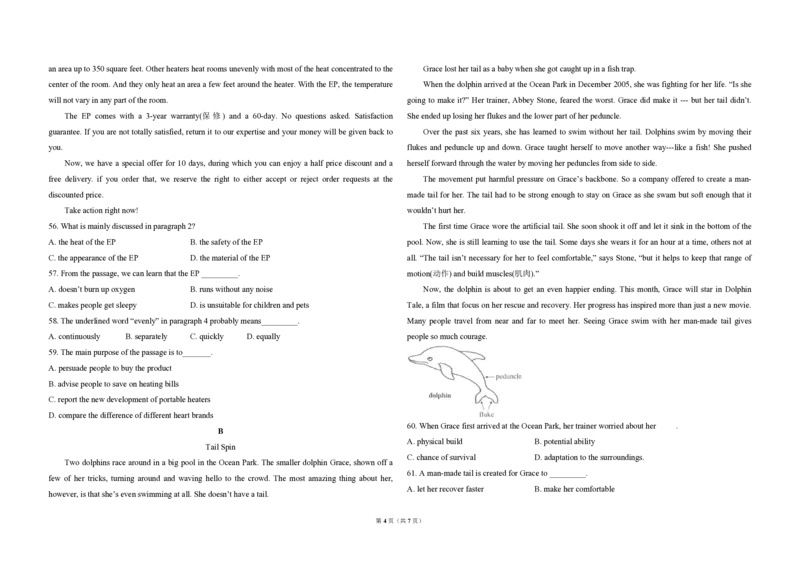
She ended up losing her flukes and the lower part of her peduncle.
Over the past six years, she has learned to swim without her tail. Dolphins swim by moving their
flukes and peduncle up and down. Grace taught herself to move another way---like a fish! She pushed
herself forward through the water by moving her peduncles from side to side.
The movement put harmful pressure on Grace’s backbone. So a company offered to create a man-
made tail for her. The tail had to be strong enough to stay on Grace as she swam but soft enough that it
wouldn’t hurt her.
The first time Grace wore the artificial tail. She soon shook it off and let it sink in the bottom of the
pool. Now, she is still learning to use the tail. Some days she wears it for an hour at a time, others not at
all. “The tail isn’t necessary for her to feel comfortable,” says Stone, “but it helps to keep that range of
motion(动作) and build muscles(肌肉).”
Now, the dolphin is about to get an even happier ending. This month, Grace will star in Dolphin
Tale, a film that focus on her rescue and recovery. Her progress has inspired more than just a new movie.
Many people travel from near and far to meet her. Seeing Grace swim with her man-made tail gives
people so much courage.

60. When Grace first arrived at the Ocean Park, her trainer worried about her
.
A. physical build


B. potential ability
C. chance of survival


D. adaptation to the surroundings.
61. A man-made tail is created for Grace to _________.
A. let her recover faster


B. make her comfortable
第5 页(共7 页)
C. adjust her way of swimming

D. help her perform better tricks
62. The story of Grace inspires people to_______.
A. stick to their dreams


B. treat animals friendly
C. treasure what they have


D. face difficulties bravely
C
Does Fame Drive You Crazy?
Although being famous might sound like a dream come true, today’s star, feeling like zoo animals,
face pressures that few of us can imagine. They are at the center of much of the world’s attention.
Paparazzi (狗仔队) camp outside their homes, cameras ready. Tabloids (小报) publish thrilling stories
about their personal lives. Just imagine not being able to do anything without being photographed or
interrupted for a signature.
According to psychologist Christina Villareal, celebrities — famous people — worry constantly
about their public appearance. Eventually, they start to lose track of who they really are, seeing
themselves the way their fans imagine them, not as the people they were before everyone knew their
names. “Over time,” Villareal says, “they feel separated and alone.”
The phenomenon of tracking celebrities has been around for ages. In the 4th century B.C., painters
followed Alexander the Great into battle, hoping to picture his victories for his admirers. When Charles
Dickens visited America in the 19th century, his sold-out readings attracted thousands of fans, leading
him to complain (抱怨) about his lack of privacy. Tabloids of the 1920s and 1930s ran articles about film-
stars in much the same way that modern tabloids and websites do.
Being a public figure today, however, is a lot more difficult than it used to be. Superstars cannot
move about without worrying about photographers with modern cameras. When they say something silly
or do something ridiculous, there is always the Internet to spread the news in minutes and keep their
“story” alive forever.
If fame is so troublesome, why aren’t all celebrities running away from it? The answer is there are
still ways to deal with it. Some stars stay calm by surrounding themselves with trusted friends and family
or by escaping to remote places away from big cities. They focus not on how famous they are but on what
they love to do or whatever made them famous in the first place.
Sometimes a few celebrities can get a little justice. Still, even stars who enjoy full justice often
complain about how hard their lives are. They are tired of being famous already.
63. It can be learned from the passage that stars today________.
A. are often misunderstood by the public


B. can no longer have their privacy protected
C. spend too much on their public appearance
D. care little about how they have come into fame
64. What is the main idea of Paragraph 3?
A. Great heroes of the past were generally admired.
B. The problem faced by celebrities has a long history.
C. Well-known actors are usually targets of tabloids.
D. Works of popular writers often have a lot of readers.
65. What makes it much harder to be a celebrity today?
A. Availability of modern media.

B. Inadequate social recognition.
C. Lack of favorable chances.


D. Huge population of fans.
66. What is the author’s attitude toward modern celebrity?
A. Sincere.

B. Skeptical.

C. Disapproving.

D. Sympathetic.
D
Multitasking
People who multitask all the time may be the worst at doing two things at once, a new research
suggests. The findings, based on performances and self-evaluation by about 275 college students, indicate
that many people multitask not out of a desire to increase productivity, but because they are easily
distracted (分心) and can’t focus on one activity. And “those people turn out to be the worst at handling
different things,” said David Sanbonmatsu, a psychologist at the University of Utah.
Sanbonmatsu and his colleagues gave the students a set of tests and asked them to report how often
they multitasked, how good they thought they were at it, and how sensation-seeking (寻求刺激) or
imperative (冲动) they were. They then evaluated the participants’ multitasking ability with a tricky
mental task that required the students to do simple mathematical calculations while remembering a set of
第6 页(共7 页)
letters.
Not surprisingly, the scientists said, most people thought they were better than average at
multitasking, and those who thought they were better at it were more likely to report using a cellphone
while driving or viewing multiple kinds of media at once. But those who frequently deal with many things
at the same time were found to perform the worst at the actual multitasking test. They also were more
likely to admit to sensation-seeking and impulsive behavior, which connects with how easily people get
bored and distracted.
“People multitask not because it’s going to lead to greater productivity, but because they’re
distractible, and they get sucked into things that are not as important.” Sanbonmatsu said.
Adam Gazzaley, a researcher at the University of California, San Francisco, who was not a member
of the research group, said one limitation of the study was that it couldn’t find out whether people who
start out less focused toward multitasking or whether people’s recognizing and understanding abilities
change as a result of multitasking.
The findings do suggest, however, why the sensation-seeker who multitask the most may enjoy risky
distracted driving. “People who are multitasking are generally less sensitive to risky situations.” said Paul
Atchley, another researcher not in the group. “This may partly explain why people go in for these
situations even though they’re dangerous.”
67. The research led by Sanbonmatsu indicates that people who multitask ________.
A. seek high productivity constantly
B. prefer handling different things when getting bored
C. are more focused when doing many things at a time
D. have the poorest results in doing various things at the same time
68. When Sanbonmatsu and his colleagues conducted their research, they________.
A. assessed the multitasking ability of the students
B. evaluated the academic achievements of the students
C. analyzed the effects of the participants’ tricky mental tasks
D. measured the changes of the students’ understanding ability
69. According to Sanbonmatsu, people multitask because of their________.
A. limited power in calculation
B. interests in doing things differently
C. inability to concentrate on one task
D. impulsive desire to try new things
70. From the last paragraph, we can learn that multitaskers usually________.
A. drive very skillfully


B. go in for different tasks
C. fail to react quickly to potential dangers
D. refuse to explain the reasons for their behavior
第二节(共 5 小题;每小题 2 分。共 10 分)
根据短文内容,从短文后的七个选项中选出正确的填入空白处。选项中有两项为多余选项。
Urbanization
Until relatively recently, the vast majority of human beings lived and died without ever seeing a city.
The first city was probably founded no more than 5,500 years ago.  ____71____. In fact, nearly
everyone lived on farms or in tiny rural (乡村的) villages. It was not until the 20th century that Great
Britain became the first urban society in history--- a society in which the majority of people live in cities
and do not farm for a living.
Britain was only the beginning. ____72____.The process of urbanization--- the migration (迁移) of
people from the countryside to the city--- was the result of modernization, which has rapidly transformed
how people live and where they live.
In 1990, fewer than 40% of Americans lived in urban areas. Today, over 82% of Americans live in
cities. Only about 2% live on farms. ____73____. Large cities were impossible until agriculture became
industrialized. Even in advanced agricultural societies. It took about ninety-five people on farms to feed
five people in cities. ____74____. Until modern times, those living in cities were mainly the ruling
elite(精英) and the servants, laborers and professionals who served them. Cities survived by taxing
farmers and were limited in size by the amount of surplus food that the rural population produced and by
the ability to move this surplus from farm to city.
Over the past two centuries, the Industrial Revolution has broken this balance between the city and
第7 页(共7 页)
the country. ____75____. Today, instead of needing ninety-five farmers to feed five city people, one
American farmer is able to feed more than a hundred non-farmers.
A. That kept cities very small.
B. The rest live in small towns.
C. The effects of urban living on people should be considered.
D. Soon many other industrial nations become urban societies.
E. But even 200 years ago, only a few people could live in cities.
F. Modernization drew people to the cities and made farmers more productive.
G. Modern cities have destroyed social relations and the health of human beings.
第四部分:书面表达(共两节,35 分)
第一节 情景作文(20 分)
假设你是红星中学高三(1)班的学生李华,请按照以下四幅图的先后顺序,用英文写一篇周
记。记述爸爸出差期间,妈妈生病,你照顾她的过程。
注意:1. 周记的开头已经为你写好。
2. 词数不少于 60.

Last Monday,


第二节 开放作文(15 分)
请根据下面提示。写一篇作文。词数不少于 50.
You are discussing the following picture with your English friend Jim. Now you are telling him how
you understand the picture and what makes you think so.