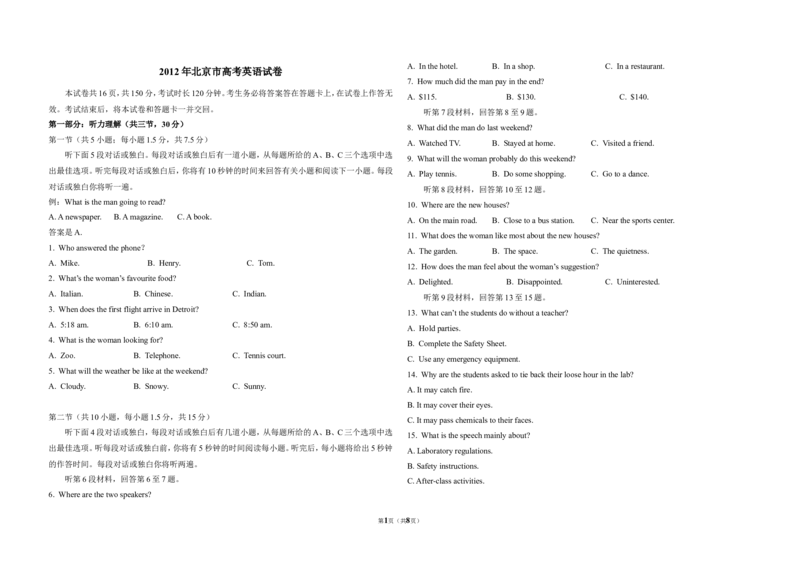
2012 年北京市高考英语试卷
本试卷共16 页,共150 分,考试时长120 分钟。考生务必将答案答在答题卡上,在试卷上作答无
效。考试结束后,将本试卷和答题卡一并交回。
第一部分:听力理解(共三节,30 分)
第一节(共5 小题;每小题1.5 分,共7.5 分)
听下面5 段对话或独白。每段对话或独白后有一道小题,从每题所给的A、B、C 三个选项中选
出最佳选项。听完每段对话或独白后,你将有10 秒钟的时间来回答有关小题和阅读下一小题。每段
对话或独白你将听一遍。
例:What is the man going to read?
A. A newspaper.      B. A magazine.       C. A book.
答案是A.
1. Who answered the phone?
A. Mike.
B. Henry.
C. Tom.
2. What’s the woman’s favourite food?
A. Italian.
B. Chinese.
C. Indian.
3. When does the first flight arrive in Detroit?
A. 5:18 am.
B. 6:10 am.
C. 8:50 am.
4. What is the woman looking for?
A. Zoo.
B. Telephone.
C. Tennis court.
5. What will the weather be like at the weekend?
A. Cloudy.
B. Snowy.
C. Sunny.
第二节(共10 小题,每小题1.5 分,共15 分)
听下面4 段对话或独白,每段对话或独白后有几道小题,从每题所给的A、B、C 三个选项中选
出最佳选项。听每段对话或独白前,你将有5 秒钟的时间阅读每小题。听完后,每小题将给出5 秒钟
的作答时间。每段对话或独白你将听两遍。
听第6 段材料,回答第6 至7 题。
6. Where are the two speakers?
A. In the hotel.
B. In a shop.
C. In a restaurant.
7. How much did the man pay in the end?
A. $115.
B. $130.
C. $140.
听第7 段材料,回答第8 至9 题。
8. What did the man do last weekend?
A. Watched TV.
B. Stayed at home.
C. Visited a friend.
9. What will the woman probably do this weekend?
A. Play tennis.
B. Do some shopping.
C. Go to a dance.
听第8 段材料,回答第10 至12 题。
10. Where are the new houses?
A. On the main road.
B. Close to a bus station.
C. Near the sports center.
11. What does the woman like most about the new houses?
A. The garden.
B. The space.
C. The quietness.
12. How does the man feel about the woman’s suggestion?
A. Delighted.
B. Disappointed.
C. Uninterested.
听第9 段材料,回答第13 至15 题。
13. What can’t the students do without a teacher?
A. Hold parties.
B. Complete the Safety Sheet.
C. Use any emergency equipment.
14. Why are the students asked to tie back their loose hour in the lab?
A. It may catch fire.
B. It may cover their eyes.
C. It may pass chemicals to their faces.
15. What is the speech mainly about?
A. Laboratory regulations.
B. Safety instructions.
C. After-class activities.
第1页(共8页)
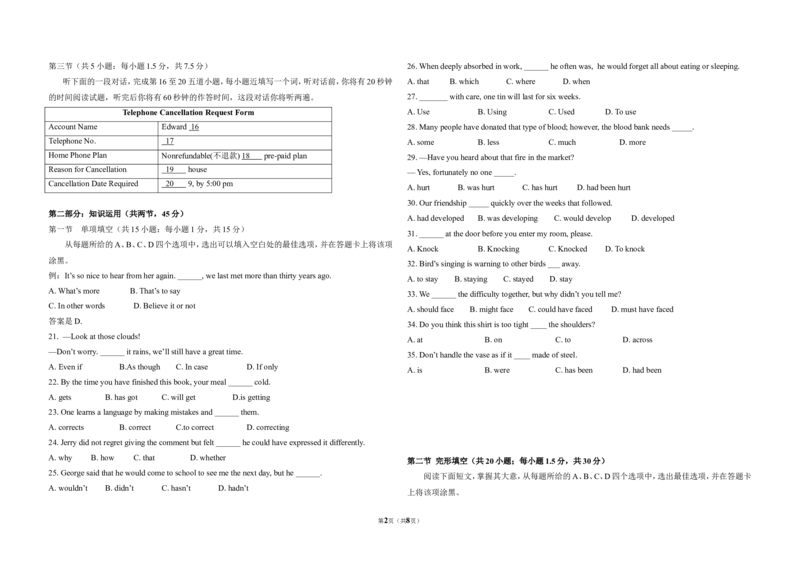
第三节(共5 小题:每小题1.5 分,共7.5 分)
听下面的一段对话,完成第16 至20 五道小题,每小题近填写一个词,听对话前,你将有20 秒钟
的时间阅读试题,听完后你将有60 秒钟的作答时间,这段对话你将听两遍。
Telephone Cancellation Request Form
Account Name
Edward  16
Telephone No.
  17
Home Phone Plan
Nonrefundable(不退款) 18


  pre-paid plan
Reason for Cancellation
  19


    house
Cancellation Date Required
  20


    9, by 5:00 pm
第二部分:知识运用(共两节,45 分)
第一节  单项填空(共15 小题:每小题1 分,共15 分)
从每题所给的A、B、C、D 四个选项中,选出可以填入空白处的最佳选项,并在答题卡上将该项
涂黑。
例:It’s so nice to hear from her again. ______, we last met more than thirty years ago.
A. What’s more               B. That’s to say
C. In other words             D. Believe it or not
答案是D.
21. —Look at those clouds!
—Don’t worry. ______ it rains, we’ll still have a great time.
A. Even if
B.As though     C. In case
D. If only
22. By the time you have finished this book, your meal ______ cold.
A. gets
B. has got
C. will get
D.is getting
23. One learns a language by making mistakes and ______ them.
A. corrects
B. correct
C.to correct
D. correcting
24. Jerry did not regret giving the comment but felt ______ he could have expressed it differently.
A. why        B. how         C. that
D. whether
25. George said that he would come to school to see me the next day, but he ______.
A. wouldn’t
B. didn’t
C. hasn’t
D. hadn’t
26. When deeply absorbed in work, ______ he often was, he would forget all about eating or sleeping.
A. that         B. which
C. where
D. when
27. _______ with care, one tin will last for six weeks.
A. Use
B. Using
C. Used
D. To use
28. Many people have donated that type of blood; however, the blood bank needs _____.
A. some
B. less
C. much
D. more
29. —Have you heard about that fire in the market?
— Yes, fortunately no one _____.
A. hurt
  B. was hurt
    C. has hurt
D. had been hurt
30. Our friendship _____ quickly over the weeks that followed.
A. had developed
B. was developing    C. would develop    D. developed
31. ______ at the door before you enter my room, please.
A. Knock
B. Knocking
C. Knocked
D. To knock
32. Bird’s singing is warning to other birds ___ away.
A. to stay        B. staying        C. stayed        D. stay
33. We ______ the difficulty together, but why didn’t you tell me?
A. should face
   B. might face
    C. could have faced
   D. must have faced
34. Do you think this shirt is too tight ____ the shoulders?
A. at
B. on
C. to
D. across
35. Don’t handle the vase as if it ____ made of steel.
A. is
B. were
C. has been
D. had been
第二节 完形填空(共20 小题;每小题1.5 分,共30 分)
阅读下面短文,掌握其大意,从每题所给的A、B、C、D 四个选项中,选出最佳选项,并在答题卡
上将该项涂黑。
第2页(共8页)
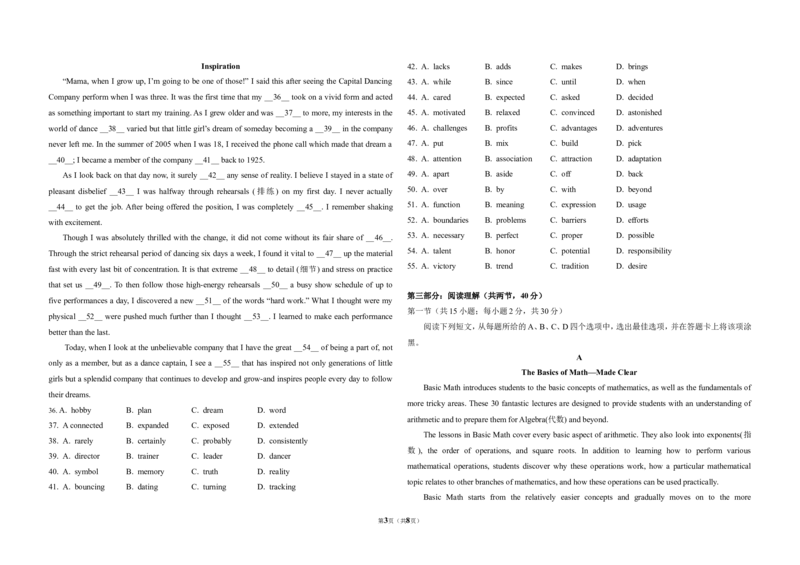
Inspiration
“Mama, when I grow up, I’m going to be one of those!” I said this after seeing the Capital Dancing
Company perform when I was three. It was the first time that my __36__ took on a vivid form and acted
as something important to start my training. As I grew older and was __37__ to more, my interests in the
world of dance __38__ varied but that little girl’s dream of someday becoming a __39__ in the company
never left me. In the summer of 2005 when I was 18, I received the phone call which made that dream a
__40__; I became a member of the company __41__ back to 1925.
As I look back on that day now, it surely __42__ any sense of reality. I believe I stayed in a state of
pleasant disbelief __43__ I was halfway through rehearsals ( 排练) on my first day. I never actually
__44__ to get the job. After being offered the position, I was completely __45__. I remember shaking
with excitement.
Though I was absolutely thrilled with the change, it did not come without its fair share of __46__.
Through the strict rehearsal period of dancing six days a week, I found it vital to __47__ up the material
fast with every last bit of concentration. It is that extreme __48__ to detail (细节) and stress on practice
that set us __49__. To then follow those high-energy rehearsals __50__ a busy show schedule of up to
five performances a day, I discovered a new __51__ of the words “hard work.” What I thought were my
physical __52__ were pushed much further than I thought __53__. I learned to make each performance
better than the last.
Today, when I look at the unbelievable company that I have the great __54__ of being a part of, not
only as a member, but as a dance captain, I see a __55__ that has inspired not only generations of little
girls but a splendid company that continues to develop and grow-and inspires people every day to follow
their dreams.
36. A. hobby
B. plan
C. dream
D. word
37. A connected
B. expanded
C. exposed
D. extended
38. A. rarely
B. certainly
C. probably
D. consistently
39. A. director
B. trainer
C. leader
D. dancer
40. A. symbol
B. memory
C. truth
D. reality
41. A. bouncing
B. dating
C. turning
D. tracking
42. A. lacks
B. adds
C. makes
D. brings
43. A. while
B. since
C. until
D. when
44. A. cared
B. expected
C. asked
D. decided
45. A. motivated
B. relaxed
C. convinced
D. astonished
46. A. challenges
B. profits
C. advantages
D. adventures
47. A. put
B. mix
C. build
D. pick
48. A. attention
B. association
C. attraction
D. adaptation
49. A. apart
B. aside
C. off
D. back
50. A. over
B. by
C. with
D. beyond
51. A. function
B. meaning
C. expression
D. usage
52. A. boundaries
B. problems
C. barriers
D. efforts
53. A. necessary
B. perfect
C. proper
D. possible
54. A. talent
B. honor
C. potential
D. responsibility
55. A. victory
B. trend
C. tradition
D. desire
第三部分:阅读理解(共两节,40 分)
第一节(共15 小题;每小题2 分,共30 分)
阅读下列短文,从每题所给的A、B、C、D 四个选项中,选出最佳选项,并在答题卡上将该项涂
黑。
A
The Basics of Math—Made Clear
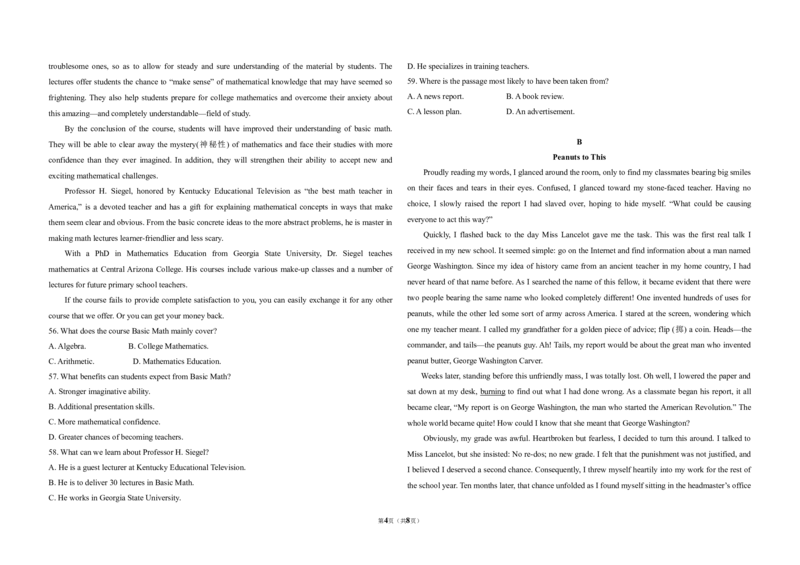
Basic Math introduces students to the basic concepts of mathematics, as well as the fundamentals of
more tricky areas. These 30 fantastic lectures are designed to provide students with an understanding of
arithmetic and to prepare them for Algebra(代数) and beyond.
The lessons in Basic Math cover every basic aspect of arithmetic. They also look into exponents(指
数), the order of operations, and square roots. In addition to learning how to perform various
mathematical operations, students discover why these operations work, how a particular mathematical
topic relates to other branches of mathematics, and how these operations can be used practically.
Basic Math starts from the relatively easier concepts and gradually moves on to the more
第3页(共8页)
troublesome ones, so as to allow for steady and sure understanding of the material by students. The
lectures offer students the chance to “make sense” of mathematical knowledge that may have seemed so
frightening. They also help students prepare for college mathematics and overcome their anxiety about
this amazing—and completely understandable—field of study.
By the conclusion of the course, students will have improved their understanding of basic math.
They will be able to clear away the mystery(神秘性) of mathematics and face their studies with more
confidence than they ever imagined. In addition, they will strengthen their ability to accept new and
exciting mathematical challenges.
Professor H. Siegel, honored by Kentucky Educational Television as “the best math teacher in
America,” is a devoted teacher and has a gift for explaining mathematical concepts in ways that make
them seem clear and obvious. From the basic concrete ideas to the more abstract problems, he is master in
making math lectures learner-friendlier and less scary.
With a PhD in Mathematics Education from Georgia State University, Dr. Siegel teaches
mathematics at Central Arizona College. His courses include various make-up classes and a number of
lectures for future primary school teachers.
If the course fails to provide complete satisfaction to you, you can easily exchange it for any other
course that we offer. Or you can get your money back.
56. What does the course Basic Math mainly cover?
A. Algebra.                     B. College Mathematics.
C. Arithmetic.                   D. Mathematics Education.
57. What benefits can students expect from Basic Math?
A. Stronger imaginative ability.
B. Additional presentation skills.
C. More mathematical confidence.
D. Greater chances of becoming teachers.
58. What can we learn about Professor H. Siegel?
A. He is a guest lecturer at Kentucky Educational Television.
B. He is to deliver 30 lectures in Basic Math.
C. He works in Georgia State University.
D. He specializes in training teachers.
59. Where is the passage most likely to have been taken from?
A. A news report.
B. A book review.
C. A lesson plan.
D. An advertisement.
B
Peanuts to This
Proudly reading my words, I glanced around the room, only to find my classmates bearing big smiles
on their faces and tears in their eyes. Confused, I glanced toward my stone-faced teacher. Having no
choice, I slowly raised the report I had slaved over, hoping to hide myself. “What could be causing
everyone to act this way?”
Quickly, I flashed back to the day Miss Lancelot gave me the task. This was the first real talk I
received in my new school. It seemed simple: go on the Internet and find information about a man named
George Washington. Since my idea of history came from an ancient teacher in my home country, I had
never heard of that name before. As I searched the name of this fellow, it became evident that there were
two people bearing the same name who looked completely different! One invented hundreds of uses for
peanuts, while the other led some sort of army across America. I stared at the screen, wondering which
one my teacher meant. I called my grandfather for a golden piece of advice; flip (掷) a coin. Heads—the
commander, and tails—the peanuts guy. Ah! Tails, my report would be about the great man who invented
peanut butter, George Washington Carver.
Weeks later, standing before this unfriendly mass, I was totally lost. Oh well, I lowered the paper and
sat down at my desk, burning to find out what I had done wrong. As a classmate began his report, it all
became clear, “My report is on George Washington, the man who started the American Revolution.” The
whole world became quite! How could I know that she meant that George Washington?
Obviously, my grade was awful. Heartbroken but fearless, I decided to turn this around. I talked to
Miss Lancelot, but she insisted: No re-dos; no new grade. I felt that the punishment was not justified, and
I believed I deserved a second chance. Consequently, I threw myself heartily into my work for the rest of
the school year. Ten months later, that chance unfolded as I found myself sitting in the headmaster’s office
第4页(共8页)
with my grandfather, now having an entirely different conversation. I smiled and flashed back to the
embarrassing moment at the beginning of the year as the headmaster informed me of my option to skip
the sixth grade. Justice is sweet!
60. What did the author’s classmates think about his report?
A. Controversial.     B. Ridiculous.       C. Boring.       D. Puzzling.
61. Why was the author confused about the task?
A. He was unfamiliar with American history.
B. He followed the advice and flipped a coin.
C. He forgot his teacher’s instruction.
D. He was new at the school.
62. The underlined word “burning” in Para. 3 probably means _______.
A. annoyed        B. ashamed         C. ready          D. eager
63. In the end, the author turned things around _______.
A. by redoing his task
B. through his own efforts
C. with the help of his grandfather
D. under the guidance of his headmaster
C
Decision-making under Stress
A new review based on a research shows that acute stress affects the way the brain considers the
advantages and disadvantages, causing it to focus on pleasure and ignore the possible negative (负面的)
consequences of a decision.
The research suggests that stress may change the way people make choices in predictable ways.
“Stress affects how people learn,” says Professor Mara Mather. “People learn better about positive
than negative outcomes under stress.”
For example, two recent studies looked at how people learned to connect images(影像) with either
rewards or punishments. In one experiment, some of the participants were first stressed by having to give
a speech and do difficult math problems in front of an audience; in the other, some were stressed by
having to keep their hands in ice water. In both cases, the stressed participants remembered the rewarded
material more accurately and the punished material less accurately than those who hadn’t gone through
the stress.
This phenomenon is likely not surprising to anyone who has tried to resist eating cookies or smoking
a cigarette while under stress – at those moments, only the pleasure associated with such activities comes
to mind. But the findings further suggest that stress may bring about a double effect. Not only are
rewarding experiences remembered better, but negative consequences are also easily recalled.
The research also found that stress appears to affect decision-making differently in men and women.
While both men and women tend to focus on rewards and less on consequences under stress, their
responses to risk turn out to be different.
Men who had been stressed by the cold-water task tended to take more risks in the experiment while
women responded in the opposite way. In stressful situations in which risk-taking can pay off big, men
may tend to do better, when caution weighs more, however, women will win.
This tendency to slow down and become more cautious when decisions are risky might also help
explain why women are less likely to become addicted than men: they may more often avoid making the
risky choices that eventually harden into addiction.
64. We can learn from the passage that people under pressure tend to ______.
A. keep rewards better in their memory
B. recall consequences more effortlessly
C. make risky decisions more frequently
D. learn a subject more effectively
65. According to the research, stress affects people most probably in their ______.
A. ways of making choices
B. preference for pleasure
C. tolerance of punishments
D. responses to suggestions
66. The research has proved that in a stressful situation, ______.
A. women find it easier to fall into certain habits
B. men have a greater tendency to slow down
第5页(共8页)
C. women focus more on outcomes
D. men are more likely to take risks
D
Wilderness
“In wilderness( 荒野) is the preservation of the world.” This is a famous saying from a writer
regarded as one of the fathers of environmentalism. The frequency with which it is borrowed mirrors a
heated debate on environmental protection: whether to place wilderness at the heart of what is to be
preserved.
As John Sauven of Greenpeace UK points out, there is a strong appeal in images of the wild, the
untouched; more than anything else, they speak of the nature that many people value most dearly. The
urge to leave the subject of such images untouched is strong, and the danger exploitation(开发) brings to
such landscapes(景观) is real. Some of these wildernesses also perform functions that humans need—the
rainforests, for example, store carbon in vast quantities. To Mr. Sauven, these “ecosystem services” far
outweigh the gains from exploitation.
Lee Lane, a visiting fellow at the Hudson Institute, takes the opposing view. He acknowledges that
wildernesses do provide useful services, such as water conservation. But that is not, he argues, a reason to
avoid all human presence, or indeed commercial and industrial exploitation. There are ever more people
on the Earth, and they reasonably and rightfully want to have better lives, rather than merely struggle for
survival. While the ways of using resources have improved, there is still a growing need for raw materials,
and some wildernesses contain them in abundance. If they can be tapped without reducing the services
those wildernesses provide, the argument goes, there is no further reason not to do so. Being untouched is
not, in itself, a characteristic worth valuing above all others.
I look forwards to seeing these views taken further, and to their being challenged by the other
participants. One challenge that suggests itself to me is that both cases need to take on the question of
spiritual value a little more directly. And there is a practical question as to whether wildernesses can be
exploited without harm.
This is a topic that calls for not only free expression of feelings, but also the guidance of reason.
What position wilderness should enjoy in the preservation of the world obviously deserves much more
serious thinking.
67. John Sauven holds that_____.
A. many people value nature too much
B. exploitation of wildernesses is harmful
C. wildernesses provide humans with necessities
D. the urge to develop the ecosystem services is strong
68. What is the main idea of Para. 3?
A. The exploitation is necessary for the poor people.
B. Wildernesses cannot guarantee better use of raw materials.
C. Useful services of wildernesses are not the reason for no exploitation.
D. All the characteristics concerning the exploitation should be treated equally.
69. What is the author’s attitude towards this debate?
A. Objective.      B. Disapproving.      C. Sceptical.       D. Optimistic.
70. Which of the following shows the structure of the passage?
A.
B.
第6页(共8页)
C.
D.
CP: Central Point
P: Point
Sp: Sub-point(次要点)
C: Conclusion
第二节(共5 小题 ;每小题2 分,共10 分)
根据短文内容,从短文后的七个选项中选出能填入空白处的最佳选项。选项中有两项为多余选
项。
Empathy
Last year, researchers from the University of Michigan reported that empathy, the ability to
understand other people, among college students had dropped sharply over the past 10 years. __71__
Today, people spend more time alone and are less likely to join groups and clubs.
Jennifer Freed, a co-director of a teen program, has another explanation. Turn on the TV, and you’re
showered with news and reality shows full of people fighting, competing, and generally treating one
another with no respect. __72__
There are good reasons not to follow those bad examples. Humans are socially related by nature.
__73__ Researchers have also found that empathetic teenagers are more likely to have high self-respect.
Besides, empathy can be a cure for loneliness, sadness, anxiety, and fear.
Empathy is also an indication of a good leader. In fact, Freed says, many top companies report that
empathy is one of the most important things they look for in new managers. __74__ “Academics are
important. But if you don’t have emotional (情感的) intelligence, you won’t be as successful in work or
in your love life,” she says.
What’s the best way to up your EQ (情商)? For starters, let down your guard and really listen to
others. __75__
To really develop empathy, you’d better volunteer at a nursing home or a hospital, join a club or a
team that has a diverse membership, have a “sharing circle” with your family, or spend time caring for
pets at an animal shelter.
A. Everyone is different, and levels of empathy differ from person to person.
B. That could be because so many people have replaced face time with screen time, the researchers said.
C. “One doesn’t develop empathy by having a lot of opinions and doing a lot of talking,” Freed says.
D. Humans learn by example—and most of the examples on it are anything but empathetic.
E. Empathy is a matter of learning how to understand someone else—both what they think and how they
feel.
F. Good social skills—including empathy—are a kind of “emotional intelligence” that will help you
succeed in many areas of life.
G. Having relationships with other people is an important part of being human—and having empathy is
decisive to those relationships.
第四部分:书面表达(共两节,35 分)
第一节 情景作文(20 分)
假设你是红星中学高三(1)班的学生李华,校报英文版正在开展“续写雷锋日记”活动。请根
据以下四幅图的先后顺序,将你所做的一件好事以日记形式记述下来,向校报投稿。
注意:1.日记的开头已为你写好。
      2.词数不少于60。
第7页(共8页)
 Saturday, June 2                                                  Fine
This morning


第二节开放作文(15 分)
请根据下面提示,写一篇短文。词数不少于50。
You are discussing the following picture with your English friend Jim. Now you are telling him how
you understand the picture and what makes you think so.

第8页(共8页)