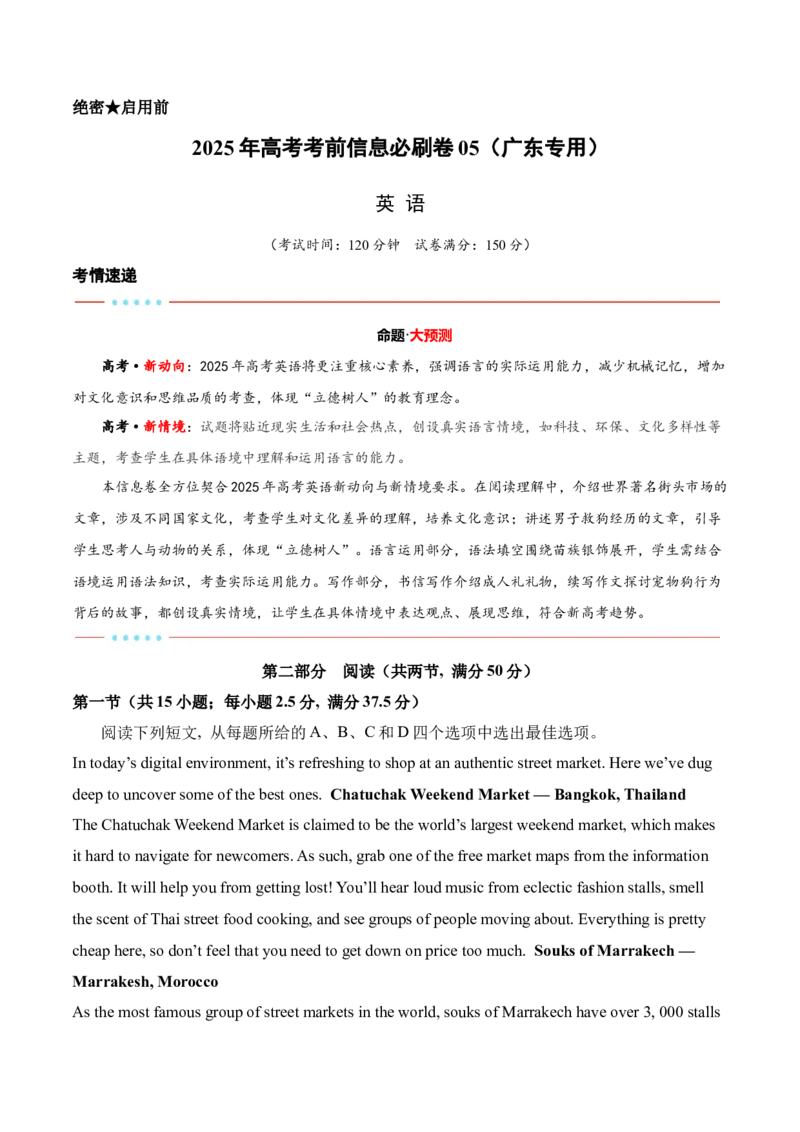
绝密★启用前
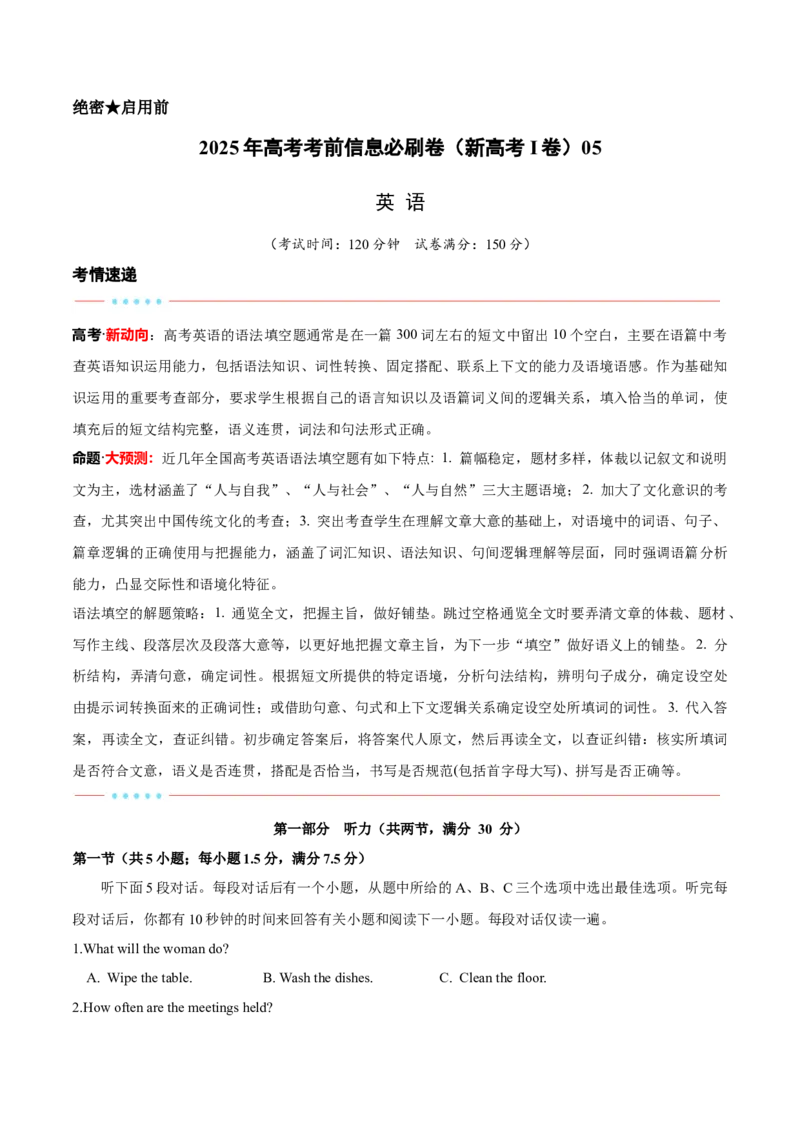
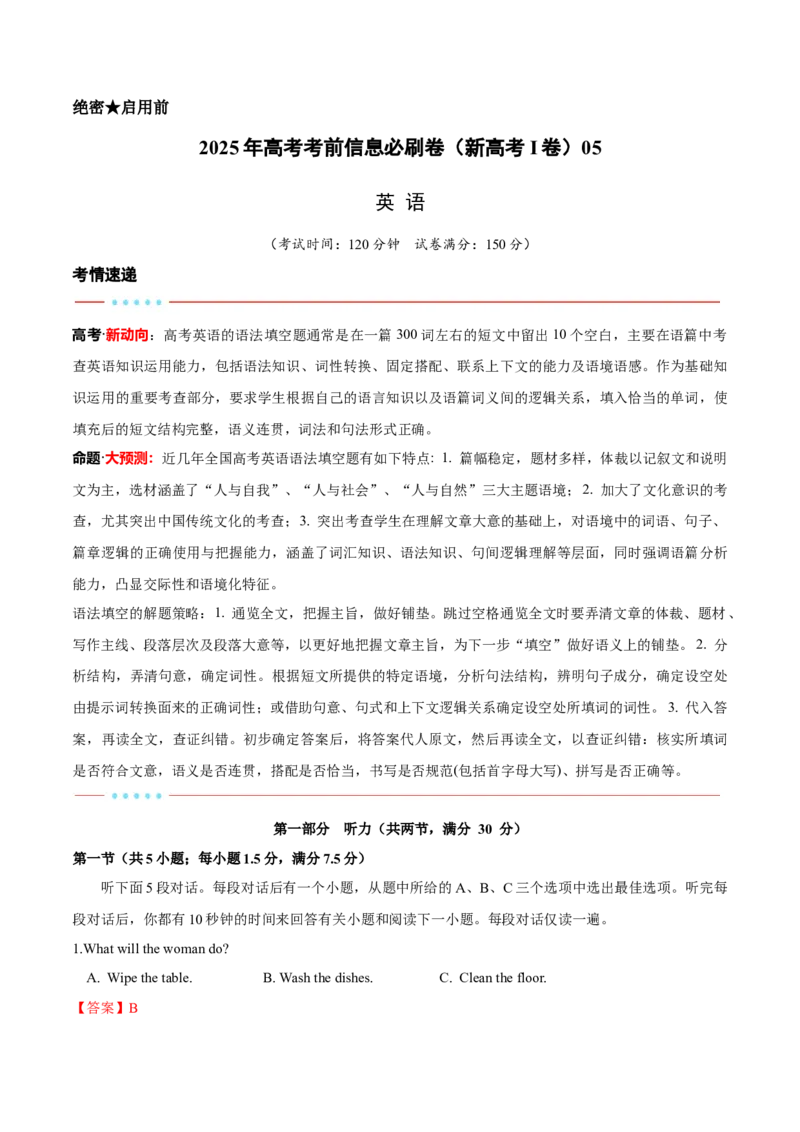
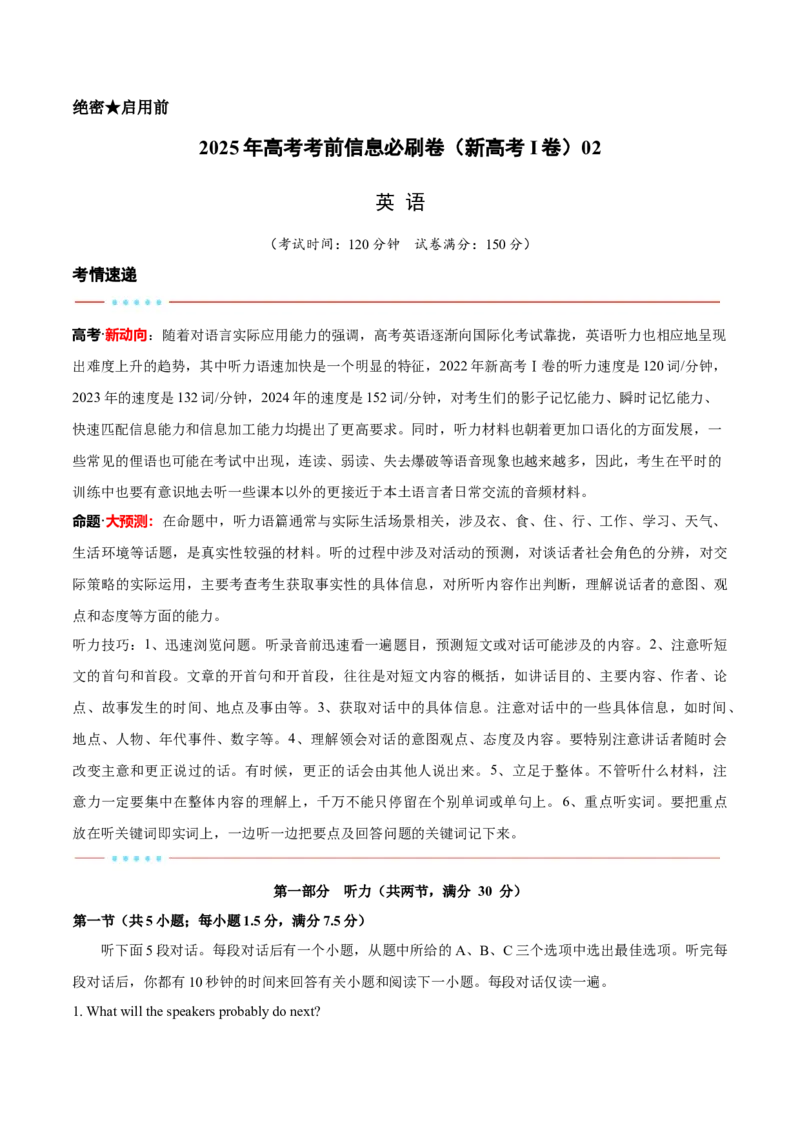
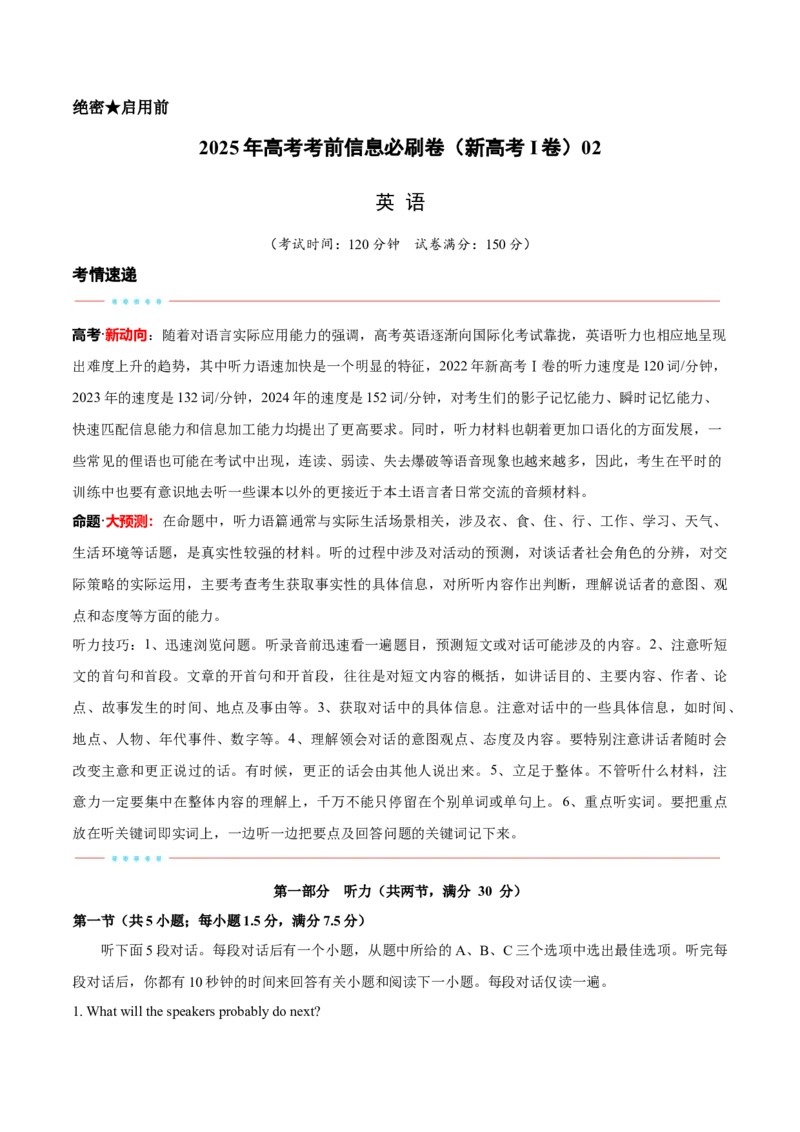
2025年高考考前信息必刷卷(新高考I卷)05
英 语
(考试时间:120分钟 试卷满分:150分)
考情速递
高考·新动向:高考英语的语法填空题通常是在一篇 300词左右的短文中留出10个空白,主要在语篇中考
查英语知识运用能力,包括语法知识、词性转换、固定搭配、联系上下文的能力及语境语感。作为基础知
识运用的重要考查部分,要求学生根据自己的语言知识以及语篇词义间的逻辑关系,填入恰当的单词,使
填充后的短文结构完整,语义连贯,词法和句法形式正确。
命题·大预测:近几年全国高考英语语法填空题有如下特点: 1. 篇幅稳定,题材多样,体裁以记叙文和说明
文为主,选材涵盖了“人与自我”、“人与社会”、“人与自然”三大主题语境;2. 加大了文化意识的考
查,尤其突出中国传统文化的考查;3. 突出考查学生在理解文章大意的基础上,对语境中的词语、句子、
篇章逻辑的正确使用与把握能力,涵盖了词汇知识、语法知识、句间逻辑理解等层面,同时强调语篇分析
能力,凸显交际性和语境化特征。
语法填空的解题策略:1. 通览全文,把握主旨,做好铺垫。跳过空格通览全文时要弄清文章的体裁、题材、
写作主线、段落层次及段落大意等,以更好地把握文章主旨,为下一步“填空”做好语义上的铺垫。2. 分
析结构,弄清句意,确定词性。根据短文所提供的特定语境,分析句法结构,辨明句子成分,确定设空处
由提示词转换面来的正确词性;或借助句意、句式和上下文逻辑关系确定设空处所填词的词性。3. 代入答
案,再读全文,查证纠错。初步确定答案后,将答案代人原文,然后再读全文,以查证纠错:核实所填词
是否符合文意,语义是否连贯,搭配是否恰当,书写是否规范(包括首字母大写)、拼写是否正确等。
第一部分 听力(共两节,满分 30 分)
第一节(共5小题;每小题1.5分,满分7.5分)
听下面5段对话。每段对话后有一个小题,从题中所给的A、B、C三个选项中选出最佳选项。听完每
段对话后,你都有10秒钟的时间来回答有关小题和阅读下一小题。每段对话仅读一遍。
1.What will the woman do?
A. Wipe the table. B. Wash the dishes. C. Clean the floor.
2.How often are the meetings held?A. Once a day. B. Once a week. C. Once a month.
3.What does the man mean?
A. He is going blind.
B. He likes darkness.
C. He can't bear the strong light.
4.Where does the conversation probably take place?
A. On a mountain. B. In a gym. C. At the speakers' home.
5.What did the man think of the garden?
A. It was beautiful. B. It was crowded. C. It was inspiring.
第二节(共15小题;每小题1.5分,满分22.5分)
听下面5段对话或独白。每段对话或独白后有几个小题,从题中所给的A、B、C三个选项中选出最佳
选项。听每段对话或独白前,你将有时间阅读各个小题,每小题5秒钟;听完后,各小题将给出5秒钟的
作答时间。每段对话或独白读两遍。
听第6段材料,回答第6、7题。
6.How will the woman give the lucky money to William?
A. By WeChat Pay. B. By bank transfer. C. In cash.
7.What will William probably do during the holiday?
A. Attend classes.
B. Join his family for dinner.
C. Travel to his grandparents’ house.
听第7段材料,回答第8至10题。
8.Why does the woman think young people prefer public transportation?
A. Decrease in income.
B. Difficulty of parking.
C. Convenience of public transportation.
9.Why does the woman like cars?
A. They run fast. B. They are cheap. C. They can go anywhere.
10.When did the man get rid of his vehicle?
A. A year ago. B. Half a year ago. C. One month ago.
听第8段材料,回答第11至13题。
11.Why does Lisa want the new job?
A. It pays more money.B. It offers her career promotion.
C. It will be easy as she's done it before.
12.How did Lisa find out about the job?
A. From a co-worker.
B. From an advertisement.
C. From someone working there.
13.How many children does Lisa have?
A. Two. B. Three. C. Four.
听第9段材料,回答第 14 至17题。
14.What is the conversation mainly about ?
A. Suggestions about adopting a pet.
B. Ways of learning to look after a dog.
C. Job applications to an animal shelter.
15.What does the woman like best about working at a shelter?
A. Cleaning the cages.
B. Getting along with pets.
C. Interacting with other volunteers.
16.What does the woman regret about her volunteering work?
A. The lack of pay.
B. The long working hours.
C. The inability to adopt all the pets.
17.What will the man probably do next?
A. Buy a dog.
B. Talk to his roommate.
C. Contact a shelter near him.
听第 10段材料,回答第 18至20题。
18.What made sweet foods special in ancient civilizations?
A. They were hard to make.
B. They were the safest foods.
C. They were only for important persons.
19.When was the cupcake invented?
A. In the 1800s. B. In the 1300s. C. In the 1200s.20.Why did it take so long for more recipes to be published?
A. The materials were too expensive.
B. People perfected desserts early on.
C. More demand for sugar was needed.
第二部分 阅读(共两节, 满分50分)
第一节(共15小题;每小题2.5分, 满分37.5分)
阅读下列短文, 从每题所给的A、B、C和D四个选项中选出最佳选项。
A
Naples is raw and unapologetically real. It’s the soul of Italy, filled with confusing streets, ancient history, and
delicious food. Unlike the polished tourist centers of Rome or Florence, Naples offers a genuinely unspoiled
experience. It doesn’t try to put on a show to impress; instead, it simply exists in its pure and raw form, and that’s
exactly what makes it an unforgettable destination.
Royal Palace of Naples
Royal Palace of Naples is a must-visit for history and architecture lovers. Located in the heart of the city, it
showcases the lifestyle of Italian royalty with grand halls, elegant staircases, and fantastic art collections. The
palace offers breathtaking rooms with frescoes (壁画) and views of the Bay of Naples, creating a unique cultural
experience.
Address: Piazza del Plebiscito, 1, 80132, Napoli NA
Bagno Elena Beach
This beach is an ideal place to relax and cool off after a busy day of sightseeing. It’s family-friendly, with
clean, calm waters and smooth sand. While there is an entrance fee, it’s affordable and well worth it, as this is the
best beach option within the city. Plus, you’ll enjoy a unique view of Naples with the cityscape in the background.
Address: Via Posillipo, 14, 80123 Napoli NA
Napoli Sotterranea
While Naples has much to offer above ground, one often overlooked aspect is the city beneath the city. This
tour allows you to explore hidden tunnels and ancient remains, providing a unique glimpse into centuries of Naples’
history that you might never have imagined.
Address: Piazza San Gaetano 68 Naples
Castel Nuovo
This castle, standing for over 800 years, is another iconic landmark of Naples. Its entrance is truly striking,
featuring an arch framed by two towering columns. Inside, you’ll find a museum filled with incredible artwork,offering plenty to explore.
Address: Via Vittorio Emanuele Ⅲ, 80133 Napoli NA
21.What about Naples impresses visitors most?
A.Its cuisine. B.Its elegance. C.Its primitiveness. D.Its geography.
22.What is special about Napoli Sotterranea?
A.It charges an entrance fee.
B.It has clean and calm waters.
C.It displays the ancient people’s imagination.
D.It provides an underground exploration.
23.What do Royal Palace of Naples and Castel Nuovo have in common?
A.They are suitable for the daring. B.They house amazing art collections.
C.They are located in the city center. D.They feature the same entrance style.
B
Growing up, I disliked writing. It was the last thing I wanted to do and it’s one reason why I pursued science
in the first place. In high school, I hated writing essays. For hours, I stared at blank pages, trying to turn my
scattered thoughts into fluent sentences and I often received papers marked with numerous corrections. I began to
wonder if I was simply not cut out for writing. And that was OK. I didn’t have to be good at everything.
I focused instead on my love for math and science. I took comfort there, knowing objective truth could be
found if I searched methodically. In college, I studied engineering and joined a research lab to gain hands-on
experience. My first project was to improve the efficiency of a magnetic component. Despite initial disappointing
results, I continued through numerous designs. Eventually, we developed a design that halved energy losses. I was
delighted — until my professor told me to write that research paper.
I knew that if I wanted to become a researcher, I would need to spend time penning papers. But I was scared
of failing. In a panic, I asked a graduate student in my lab for help. We defined a goal for the paper, and I carefully
wrote an outline. But when I asked him for feedback, I soon found the paper covered in red marks. He explained
that red didn’t mean I was a bad writer. Writing isn’t a one-and-done thing. It requires revising your work, often
several times. Suddenly it occurred to me, “Hadn’t I done the same thing when I was searching for an efficient
design?”
I polished my paper’s outline into sentences and paragraphs, guided by feedback. Though my first draft
wasn’t perfect, with help, I enjoyed the process of improving it. Writing has since become one of my favorite parts
of research, helping me organize my thoughts. I’ve even started writing popular science articles, which I nevercould have imagined during my early struggles with essays.
24.What did the author initially think of writing?
A.A piece of cake. B.A ray of sunshine.
C.A nut hard to crack. D.A diamond in the rough.
25.What was the author’s main challenge in the research project?
A.Designing the magnetic component.
B.Cooperating with the research team.
C.Collecting the experimental data.
D.Writing the research paper.
26.What did the author learn from her writing and research?
A.Both require trial and error. B.Both consume time and money.
C.Both offer promotion and reputation. D.Both involve burden and stress.
27.What helped the author improve writing?
A.Discovering objective standards in writing.
B.Following good examples of other students.
C.Publishing several academic papers successfully.
D.Constantly working on writing and improving.
C
What acts of kindness will make us the happiest, and who tends to benefit the most? A newly-published review
of decades of kindness research provides some answers.
In this paper, researchers analyzed the results from 126 research articles looking at almost 200, 000
participants from around the world. The studies they chose measured well-being in various ways, including both
mental and physical health. Some were experiments, where people did a kindness practice to observe its effects,
while others just surveyed people about how kind and happy they were.
As expected, people who were kind tended to have higher well-being. Lead researcher Bryant Hui was
astounded that the relationship wasn't stronger than it was, but he was still encouraged by the results.
One thing Hui and his colleagues found was that people who performed random, informal acts of kindness,
like bringing a meal to a sad friend, tended to be happier than people who performed more formal acts of kindness,
like volunteering in a soup kitchen.
The researchers also found that people who were kind tended to be higher in "eudaimonic happiness"(a sense
of meaning and purpose in life) more than "hedonic happiness"(a sense of pleasure and comfort). Perhaps thismakes sense, given that being kind takes effort, which reduces comfort but could make people feel better about
themselves and their abilities, which would provide a sense of meaning.
Being kind came with greater eudaimonic happiness for women than for men, too. According to Hui, this
could be because, in many cultures, women are expected to be kinder than men; so, they may have more to gain
from it. And younger participants experienced more happiness when they were kind than older participants, perhaps
for developmental reasons, he says.
Hui isn't sure why acting kind might have these different effects on different groups, but he points to theories
put forth by researcher Elizabeth Midlarsky: Being kind may make us feel better about ourselves as a person or
about the meaning of our lives, help us forget our own troubles and stresses, or help us be more socially-connected
with others.
28.What does the data in the second paragraph intend to show?
A.The recent paper is worthy of being read. B.The recent paper gives convincing results.
C.Kindness is always a hot topic of research. D.Kindness is closely linked to one's well-being.
29.What does the underlined word "astounded" in paragraph 3 mean?
A.Afraid. B.Certain. C.Excited. D.Surprised.
30.Which of the following acts of kindness can make one feel happier according to paragraph 4?
A.Volunteering in a hospital. B.Cleaning a community.
C.Returning a lost item to its owner. D.Collecting donations for the poor.
31.What do the researchers find from the paper?
A.Being kind has different effects on different groups.
B.Eudaimonic happiness makes people feel comfort.
C.The younger experienced more happiness than the older.
D.Female participants are kinder than male ones.
D
An overall transformation is needed for the planet to adapt people’s pursuit of well-being. A new study by an
international team of researchers explores a Theory of Planetary Social Pedagogy as a driver of a transformative
process based on a learning society.
The Theory of Planetary Social Pedagogy is a way of learning applicable to all societal sectors. According to
it, people, societies and the world are an interlinked, systemic body. Such a worldview can make life meaningful,
increase people’s experiences of belonging and inclusion, expand the scope of care, and help people identify their
opportunities to influence.In a time marked by crises, learning to be one with the world is increasingly essential. In many ways, our
everyday lives are linked with all other life on Earth. According to Professor Arto O. Salonen of the University of
Eastern Finland, the study’s lead author, the most important reason behind the upgrading (升级) planetary crises is
people’s being separated from their surrounding reality.
He says, “As we try for a comprehensive sustainability transition (转变), we need increasingly powerful and
more systemic interpretations of reality. ” The current strategy for a sustainable future emphasizes economic and
technological progress,but that is not enough. Learning is needed, too. A learning society relies on changes in its
citizens’ values, beliefs and worldviews.
“How we become aware of our everyday connection to other people and nature at the level of our emotions,
body and mind stands at the core of the sustainability transition,” says Erkka Laininen, a co-author of the study.
Having an experience of belonging to and being part of the world strengthens people’s sense of meaningfulness and
their agency needed in building a sustainable future.
The transformative power of a learning society can be a key factor in the green transformation going into all
society, in which citizens’ consumer behaviour and ways of living, moving and producing food and energy are
organized in new ways. Conceptions of work and the economy can be reformed, too.
A sustainable future is not about life becoming more miserable—it’s about life becoming richer and more
meaningful as hope for the future grows stronger.
32.Why is Theory of Planetary Social Pedagogy mentioned?
A.To stress learning to be one with the world.
B.To suggest reforming citizens’ ways of living.
C.To describe how the theory is being improved.
D.To tell if a sustainable future is significant.
33.What is the main reason for increasing global crises according to Professor Salonen?
A.The planet is reaching its limits.
B.Humans break away from the reality.
C.Old ideas of well-being are being questioned.
D.Progress in economy and technology is unbalanced.
34.What can we conclude from the text?
A.A sustainable future is based on a learning society.
B.Humans, societies and the world were connected more.
C.Ending the present strategy for future is needed.D.Global crises have resulted in wrong worldviews.
35.How does the author support the theme of the text?
A.By introducing a theory. B.By making a comparison.
C.By using researchers’ arguments. D.By providing study processes.
第二节(共5小题;每小题2. 5分, 满分12. 5分)
阅读下面短文, 从短文后的选项中选出可以填入空白处的最佳选项。选项中有两项为多余选项。
Perhaps you’ve stopped doing what you want because you’re afraid of what others think of you. You feel that
you must do what they expect and that you must meet their expectations, otherwise you’ll lose their approval. If
this is the case, it’s time to start working on your self-esteem (自尊). 36 .
Think about yourself, about what you really like and are interested in. You must lead your life independently.
You must do what you want without being affected by what others think. 37 , because you’ve always
done everything to gain the approval of others. You need to get out of that zone, move to new places, and explore
your full potential.
By surrounding yourself with people who think like you, you’ll realize that you don’t feel judged. Then,
you’ll start doing what you really want. 38 . Your new friends will integrate into your life and you’ll also
keep your genuine friends. On the other hand, those who are always ready to see the negative and question what
you’re trying to do will gradually fade away.
To overcome your fear of what others think and of their non-approval, you should start talking about your
plans. 39 . By talking to them, you’ll be able to organize your plans and ideas. You’ll feel confident in
yourself and you’ll be able to go on your new path without any fear.
40 . You’ll find barriers along your way. However, you must trust in yourself and seek the
necessary strength to move forward. People in your environment often don’t understand what you do no matter how
much you explain it, so ignore them.
A.However, you might feel afraid to do it
B.There is no need to think about what you want
C.You don’t have to change your circle of friends
D.Then, you’ll be able to do what you want freely
E.Your life belongs to you, as well as your actions
F.It’s unavoidable that not everything will be plain sailing
G.For instance, you could share your intention with your friends
第三部分 语言运用(共两节,满分30分)第一节(共15小题,每小题1分,满分15分)
阅读下面短文, 从每题所给的A、B、C和D四个选项中选出可以填入空白处的最佳选项。
I never planned on learning Chinese. Even when I found out I was going to Shanghai, I assumed that I would
be able to 41 with English. It didn’t take long for me to realize how naïve (天真的) I was. Chinese
characters are totally foreign and 42 . I quickly got sick of not being able to understand anything, and I
decided to 43 for the Chinese class offered by my university.
I had Chinese every weekday, after which I spent at least an hour 44 the lesson. In the evening, my
friends and I quizzed each other on the 45 we had to memorize. More importantly, I made a conscious
46 to communicate in Chinese in stores and restaurants. I was 47 when I was able to maintain a simple
conversation with the locals.
When I 48 achieved A’s on my Chinese exams, I thought it was time to take a break from studying
for Chinese every day and focus on my other classes. Unfortunately, this turned out to be a(n) 49 . Not only
were my study habits 50 , the lessons themselves were getting harder. I had to start over in terms of
coming up with and 51 new study habits.
With finals coming up, I have established my golden rule: there isn’t a(n) 52 way to learn a new
language. Once you commit and accept that you are a 53 , it becomes an ongoing process of exploration,
failure, reassessment, and trying again. Am I fluent now? Not even 54 . And I may never be. But I learned
how to be honest with myself and push through 55 .
41.A.get by B.carry on C.fit in D.keep up
42.A.inflexible B.incomprehensible C.unmemorable D.unacceptable
43.A.register B.provide C.account D.prepare
44.A.evaluating B.adapting C.reviewing D.presenting
45.A.structures B.articles C.characters D.rules
46.A.effort B.statement C.appointment D.commitment
47.A.relaxed B.delighted C.shocked D.moved
48.A.exceptionally B.obviously C.randomly D.regularly
49.A.challenge B.mistake C.accident D.escape
50.A.changing B.emerging C.worsening D.developing
51.A.kicking B.posing C.breaking D.maintaining
52.A.innovative B.useful C.available D.perfect
53.A.follower B.beginner C.supporter D.winner54.A.close B.ready C.sure D.right
55.A.shortcomings B.hesitations C.setbacks D.disasters
第二节(共10小题;每小题1.5分 ,满分15分)
阅读下面短文,在空白处填入1个适当的单词或括号内单词的正确形式。
You’ve probably heard 56 Chinese culture is packed with: ancient and modern methods for staying
fit. Baduanjin, which literally means Eight Pieces of Brocade, is 57 excellent traditional Chinese health
maintenance Chi Kung. This style centers on breathing—by 58 (take) slow, deep breaths, it helps muscles
relax and calms the mind as well.
Baduanjin, which originated in the Bei Song Dynasty has a history of more than 800 years. Over time it
59 (develop) into many different styles. There are a total of eight movements in Baduanjin, each with 60
(it) own characteristics and specific focus. The movements are very slow and intentional—each exercise is done
about 3 times 61 moving onto the next exercise in the sequence.
Regular practice of Baduanjin is believed to bring numerous health 62 (benefit). The great
advantage of Baduanjin lies in its accessibility. It doesn’t require much space or time and uses special breathing
63 concentration techniques to improve health. People of all ages and fitness levels can practice it without any
special 64 (equip) or prior experience. Whether 65 (perform) in the park or the comfort of
one’s home, Baduanjin provides gentle yet effective care for both body and mind.
第四部分 写作(共两节, 满分40分)
第一节(满分15分)
66.暑假即将来临,某英文报社举办以 “BE A GOOD TOURIST” 为主题的征文活动,你打算投稿。请根
据以下要点写一篇短文:
1.谈谈旅游的现状问题;
2.建议如何当一个好的游客。
注意:1.写作词数应为80左右;
2.请按格式在答题卡的相应位置作答。
BE A GOOD TOURIST
____________________________________________________________________________________________
____________________________________________________________________________________________
____________________________________________________________________________________________
____________________________________________________________________________________________
____________________________________________________________________________________________第二节(满分25分)
67.阅读下面材料,根据其内容和所给段落开头语续写两段,使之构成一篇完整的短文。
Thoughts don’t have to be “real” or “true” to create failure or success in our lives. They just have to be
believed.
Tim had always been weak in math. In high school, he had failed algebra (代数) three times before he
eventually passed. Gradually, he began to accept it as an unchangeable fact. Then in college, the biggest problem
that stood between him and his degree came in junior year— he had to take statistics, about which all the horror
stories were circulating.
One day he was called into his professor’s office. Professor Fine, a short, stout man with thinning hair and a
forever smile, sat on the front of his desk reading Tim’s record. “My son, this is your lucky day.” he looked up and
repeated, “This is indeed your lucky day. You’re going to be great in stats (统计数据).” He had a huge smile on his
face.
“How’s that, Doc?” Tim asked.
The professor shrugged. “You have the second kind of mind. Listen. First kind of minds are the kids who do
well in algebra but don’t get stats. But second kind of mind is like yours. Kids who don’t get algebra understand
statistics with no problem. They are different kinds of math that take different kinds of mind. Since you failed
algebra three times, I’d guess you’d get an A in stats.” He raised his hands over his head.
“Really?” Tim asked, confused.
Professor Fine jumped to the floor and looked square (诚实的) in his eyes. “Really, and I’m happy for you.
You never gave up, and now it’s going to pay off.” Then he shook Tim’s hand and slapped his back with great
enthusiasm.
Tim was wild with joy at the news.
After that day, each time they met, there was a smile of approval on Professor Fine’s face and an enthusiastic
handshake. Eventually, Tim began to tell his friends how well he expected to do in statistics.
注意:
1.续写词数应为150左右;
2.请按如下格式在答题卡的相应位置作答。
This unusual change in attitude affected all Tim’s grades. ________________________________________
____________________________________________________________________________________________
____________________________________________________________________________________________
________________________________________________________________________________________________________________________________________________________________________________________
____________________________________________________________________________________________
After the graduation ceremony, Tim went to professor Fine’s office._________________________________
____________________________________________________________________________________________
____________________________________________________________________________________________
____________________________________________________________________________________________
____________________________________________________________________________________________
____________________________________________________________________________________________