押上海卷 56-66 题
阅读理解 ABC 篇
【题型解读】
多项选择式阅读是上海高考英语测试的重点题型之一。这部分包含三篇阅读文章,难度由易到难;每
篇语篇的长度通常在280-450词左右;选材既注重题材的多样化、现代化和生活化,又综合地反映了政治、
经济、文化和生活的各个方面,贴近生活、贴近时代,突显了语言和文化相结合的特点。而且所选的语篇
材料更趋于地道的语言使用,体现了“原汁原味”的特点,语篇中的生词量加大且句式结构多样,明显增
加了长难句的比例。体裁上,A篇多为记叙文和说明文为主;B篇多为应用文,如报告、影评等非连续性
的文本,也有说明文;C篇多为论述文和说明文。每篇文章下的题目都是四选一式的选择题,每篇设题数
量为3~4题不等,但三篇的总题数为11题。
这三篇阅读理解主要检测考生对语篇的整体把握能力、根据所提供的语境分析的能力以及综合利用有
效信息解决实际问题的能力。其具体的测量目标为:
(1)能理解文章的基本内容
(2)能根据上下文正确理解词语和句子
(3)能归纳段落或文章的主旨大意
(4)能推断文章中的隐含的意思。
【答题点津】
第一步:通读题目,快速阅读短文
先读题干(即问题)和选项,明确题干要求,然后带着问题去读文章,要把有关 WHO,WHAT,
WHERE,HOW和WHY等方面内容用笔圈画出来。这种方法在英语中称为 scanning,就是寻读。快速阅
读一遍弄清段落大意,对全文有一个整体了解,阅读时从宏观入手,掌握中心意思,注意那些用以说明中
心意思的主要事实和细节,抓住关键词,弄清作者写此篇文章的目的及意图。如遇到生词,应先跳过,继
续通读全文,切忌长时间死抠生词,因为有些生词并不影响对全文的理解,还有一些词可以通过上下文推测其含义。
第二步:明确每题考查点,认真逐题作答
明确每题的考查点后,根据第一步带着问题阅读短文,锁定文中每题的具体句子或段落,选择下列方
法中与题目相匹配的进行答题。
(1)正选法与排除法
正选法即根据所读材料内容从正面选择最佳答案。如果在有些情况下从正面选择答案有困难,考生则
可以考虑选用排除法,即排除四个选项中的三个错误选项,那么剩下的选项即为正确答案。排除法是解答
阅读理解题的常用方法,对于那些不合情理或荒谬的选项、与短文内容相反的选项、与短文内容不相关的
选项、虽在短文中出现但答非所间的选项,都可以采用排除法。
(2)定位法与跳读法
定位法即根据题干和选项所提供的信息直接从原文中找到相应的句子(即定位),然后进行比较和分
析(尤其要注意一些同义转换),从而找出正确答案。跳读法即根据题干和选项所提供的信息跳读原文,
并找到相关的句子(有时可能是几个句子)或段落,然后进行分析和推理等,从而找出正确答案。
(3)概括法与推理法
概括法是根据所读材料概括文章主题、要点、标题和中心思想等;而推理法则指根据所读材料的字面
意思,通过语篇的逻辑关系以及各个细节的信息和暗示,推敲作者的态度,理解文章的寓意,悟出作者的
言外之意和弦外之音。此时切忌就事论事、以偏概全,也不能主观臆想、随意揣测,更不能以自己的观点
代替作者的观点。
(4)常识法与背景法
利用已有的常识进行识别和判断的方法。背景法与常识法相似,指考生充分运用所读材料的信息答题。
第三步:仔细校对所选答案
做完所有题目后,再读一遍短文,逐一检查所有答案是否有误。如果有拿不定主意的答案,不要随意
更改。一定要从原文中找到依据,方可更正。
1.【2023年6月上海英语高考真题】
(A)
In the vast, untouched expanse of wilderness, Isla and her faithful golden retriever(猎犬), Finn danced in a
harmony of souls. Together, they weaved through myriad terrains, from shadowed forests echoing with ancientsecrets to rugged mountain paths that touched the heavens. Their bond was not of mere circumstance, but of shared
dreams, Isla sought quiet away from the urban noise, while every rustle and murmur of the wild ignited Finn's
spirit.
As dawn's first light kissed the earth, Isla deliberately packed away memories of the nigh while Finn, with
eager anticipation, wagged ( 摇摆)his tail, eager for the day's melodies. Their journey was not charted by maps or
compasses, but by the gentle touches of their hearts, caressed by nature's ideal breezes.
One dusky evening, painted with deep red colors and ethereal purples, an unexpected storm took them off
guard, Raindrops, heavy with sorrow, transformed familiar trails into flowing streams, in a desperate bid for refuge,
Isla was trapped by the fierce embrace of the currents. It twas Finn's instinctive courage that shone brightly in that
moment of despair, as he moved forward suddenly, securing her backpack with a steadfast grip, drawing her back
to safety's shore.
Nestled in u rocky embrace, they clung to each other against the storm's fury. Isla whispered tales of bygone
days and distant horizons into Finn's eager cars, In return , he moved slowly and complained weakly, weaving tales
without words, sharing a symphony of silent stories.
When the storm's rage decreased, the world they knew was covered in unfamiliarity. Trails they once danced
upon had vanished, and landmarks whispered in unfamiliar tongues. For the first time, Isla felt the weight of
disorientation. But Finn, with unwavering confidence, stepped forward, trusting his instincts to unveil the path
ahead.
As days melted into weeks, just when hope seemed a distant star, the embrace of a hidden village hugged them
gently, Interested by the long exciting journey, villagers welcomed them ,their journey becoming woven into the
picture of local legend. But the wild's temptation could not be ignored. Restored, the two partners ventured once
more into the embrace of nature, carrying with them the blessings and hopes of newfound friends.
Through the rich and colorful picture of their adventures, it became evident that their true strength was not in
conquering the elements but in the unyielding bond they shared. The wild was but a stage for their eternal ballet of
friendship and perseverance.
56. What connected Isla to Finn?
A. The untouched expanse of wilderness.
B. Shadowed forests echoing with ancient secrets.
C.Circumstance and shared dreams.
D. The urban noise.57. What drove Isla into despair?
A. A dusk of crimson and purple.
B. A sudden storm.
C. The familiar trails.
D. A rocky embrace.
58. What were the villagers interested in?
A. Finn's confidence and intuition.
B. Isla's respect for nature.
C. Isla and Finn's exciting journey
D. The wild's temptation.
59. What can we learn from the passage?
A. Isla and Finn made their journeys based on a map or a compass.
B. Finn failed to pull Isla back to the safety of shore.
C, The villagers wove Isla and Finn's journey into local legend.
D. Isla and Finn's real strength lied in conquering harsh environments.
(B)
The Motivated Sequence (序列) of Public Speech
The motivated sequence gets its name partly because it follows john Dewey's problem solution model for
thinking and partly because it makes attractive analyses of these problems and their solutions by tying them to
human motives. That is, the motivated sequence is both problem-driven and motivation-centered.
There are five basic steps in the motivated sequence
1.You must get people to attend to some problem, or to feel discomfort strongly enough to want to hear more.
2. You can create more specific wants or desires, a personal sense of need.
3. When wants or needs are created, you can attempt to satisfy them by showing what can be done to solve the
problem or relieve the sense of discomfort.
4. Simply describing a course of action may not be enough, so in the fourth place you can visualize the world
as it would look if the actions were carried out, and what it might be like if they were not.
5. With that,if you have done these four tasks well, accidence members should be ready to act --to put into
practice the proposed solution to their problems.
Five steps Audience responsel.Attention I want to listen.
Getting attention
2.Need Something needs to be done.
Showing the need :
Describing the solution
3.Satisfaction This is what to do to satisfy the need.
Satisfying the need :
presenting the solution
4.Visualization _________ ? _________
Visualizing the results
5. Action l will do this.
Requesting action or approval
The motivated sequence can be used to structure many different sorts of speeches, It could be used, for
example, in a speech urging your classmates to join a blood donors’ association. Or, you could use it to sell a friend
insurance. And you can also use it to talk about social problems, such as the environment and the economic crisis.
60. What do we know about the motivated sequence?
A. It is the basic principle of problem-solution model.
B. It has nothing to do with human motivation.
C. It's both problem-driven and motivation-centered.
D. There are six basic steps in the motivated sequence.
6l. What can the motivated sequence be used for?
A. A speech urging your classmates to quit a blood donors’ association.
B. A speech to get your friends to promote a blood donors' association
C. A speech to get your friends to sell insurance.
D, A speech on the environmental and economic crisis.
62. Xiao Wang is trying to persuade his classmates to join a blood donors’ association. Help him draft a speech by
putting the following five sentences in the right order based on the motivated sequence.
(1 ) With the steady supply of blood , emergencies will be met with timely treatment
(2)You can help by filling out the blood donors"cards l am passing out.
(3)Our area is short of blood of all types to meet emergency needs.
(4) A man died last night in a traffic accident because he lost too much blood.
(5)A blood donors' association guarantees a predictable, steady supply of blood to the medical community.
A. (4 ) (3) (5) (1) (2) B. (4 ) (2) (3) (1) (5)
C. (4 ) (5) (3) (1) (2) D. (4 ) (2) (1) (5) (3)
(C)The universe expands with every passing second, stretching the space between galaxies like dough rising in an
oven. But just how fast is this expansion happening? As telescopes like Hubble strive to answer this fundamental
question, they encounter a perplexing gap between theoretical predictions and observed data.
Hubble's measurements indicate a faster rate of expansion in the modern universe compared to what was
expected based on observations of the universe more than 13 billion years ago by the European Space Agency's
Planck satellite. This inconsistency has been a subject of scientific inquiry for several years. However, it remains
uncertain whether differences in measurement techniques or chance variations are responsible for this disparity.
Recent data from the Hubble telescope have significantly reduced the possibility that this discrepancy is
merely a statistical fluke, with the chances now estimated at only 1 in 100,000. This marks a substantial
improvement from previous estimates, which placed the odds at 1 in 3,000 less than a year ago. These precise
measurements from Hubble lend weight to the hypothesis that new physics may be necessary to reconcile the
observed mismatch.
Lead researcher Adam Riess, a Nobel laureate from the Space Telescope Science Institute and Johns Hopkins
University, describes the tension between the early and late universe as one of the most exciting developments in
cosmology in decades. He emphasizes that the growing disparity cannot be dismissed as a random occurrence and
suggests that it may signal the need for a deeper understanding of the cosmos.
To determine distances in the universe, scientists rely on a "cosmic distance ladder" method. This involves
accurately measuring distances to nearby galaxies and then using progressively distant galaxies as reference points.
By observing stars like Cepheid variables, astronomers can calibrate this distance ladder. Riess and his team have
been refining these measurements since 2005, aiming to improve our understanding of cosmic distances.
In their latest study, astronomers used Hubble to observe 70 Cepheid variables in the Large Magellanic Cloud.
By comparing these stars with their more distant counterparts in galaxies hosting supernovae, they refined their
measurement of the Hubble constant, reducing its uncertainty from 2.2% to 1.9%. Despite this increased precision,
their calculated Hubble constant remains at odds with the value predicted by observations of the early universe
conducted by Planck.
The Planck satellite, which maps the cosmic microwave background – a remnant of the universe's early stages
– provides crucial data for understanding the universe's expansion. However, the discrepancy between these
measurements and those from Hubble underscores the need for further investigation and the potential for new
discoveries in cosmology.
63. Where do measurements of the early universe come from?A. The space between galaxies.
B.Measurements from Hubble and other telescopes
C. European Space Agency's Planck satellite.
D. The latest Hubble data.
64. Which of the following statements is in line with Adam Riess’ opinion?
A. The expansion speed of the modern universe is faster than expected
B. New physics may be needed to explain this mismatch.
C, It is unlikely that this discrepancy occurred by chance.
D. Hubble's tension is the most exciting development in cosmology in decades.
65. What do scientists use to determine the distance of things in the universe?
A. A cosmic distance ladder.
B. Accurate measurements of distances.
C.Milepost markers.
D. The Hubble constant.
66. What did Riess’ team do?
A. They used the Hubble Space Telescope to observe pulsating stars
B. They improved the comparison between
C.They raised the uncertainty of the Hubble constant to 2.2%
D. They reduced the uncertainty in their Hubble constant value to 1.9.
2.【2022年7月上海英语高考真题】
(A)
Contemporary artist Nick Smith creates pixelated ( 像素化的 ) works with hand placed colour-chips,
synonymous with colour swatches (色块), cleverly combining text and image to create interesting and fascinating
collaged (拼贴的) works.
With a previous career in Interior Design spanning 11 years, Nick references his concept design background
throughout his work, reworking the design using unique colour swatches in hand-made collages,placing his work
firmly in the fine art category. From his first collage experiment back in 2011 of Warhol's"Marilyn’, when he
assembled a tessellation(镶嵌技术)of swatches as a challenge, this eventually inspired his career as an artist and
determined his unique style he is now known for
The multi-layered element of his work, which marries image and word, allows Nick to explore complex art-
historical concepts. The text employed is often narrative, which can be read in sequence adding another element ofintrigue and interest to the work. This additional element of text, placed under the empty space of each swatch,
creates either complimentary or subversive meanings. Nick deliberately leaves these word/image constructions
open to viewer interpretation, sparking new debates and meanings.
Each P -series, such as Psychology 2015, Purgatory 2019, explores complicatedly researched concepts, which
are always the crucial starting point for each new series of work Producing large-scale works to micro-chip
collages, and multiple sell out print editions,Nick continues to develop his popular and recognizable art.
PSYCOLOURGY January 2015 Lawrence Alkin Gallery, London
Smith's debut solo exhibition with Lawrence Alkin Gallery in Soho,London, launched his unique visual
reworking of classic paintings from the 20th Century canon. Universally known works, including David Hockney’s.
‘ The Bigger Splash ’ , Andy Warhol's 'Soup Cans’ and Leonardo da Vinci’s ‘ Monn Lisa’ were all recast,creating
original collages that enquire ideas of depiction, digitization and recognition A sell out show,with numerous
successful subsequent print releases, Psychology forged Smith’s path to a place among Britain's notable
contemporary artists.
PURGATORY-December 2019 Context,Art Miaml
Purgatory is a shiny, sticky, glossy exploration of our societies attitude and approach to our excess, addictions
and desires.
Excerpts from Dante's Purgatory are woven through colourful works depicting popular covetable
consumables, creating symbolic representations of the seven sins, Dante explore possible penance (忏悔) for our
earthly suffering lending to spiritual growth. The results of these pairings offer a humorous, nostalgic and
subversive opportunity to question our choices, our history and our future.
56. What made Nick launch his art career?
A. His deep love of fascinating collaged works
B. His first collage work Warhol's ' Marilyn
C. The challenge of piecing a tessellation of swatches
D. The collage experiment dating back to 2012.
57.Which of the following statements about the text Nick uses is true
A. His text contains concepts of art.
B. His text is usually illustrative.
C. His text can be read sequentially
D. His text elements are very simple
58.What do we know about PSYCOLOURGY?A. It opened Smith's unique visual reinvention of classic 21th-century paintings
B.David Hockney's' Mona Lisa’ has been recreated by Lawrence Alkin Gallery
C.The original collages affirm the ideas of depiction , digitisation and recognition.
D. It opened Smith's path to becoming one of Britain's leading contemporary artists
59.What is the topic of this passage?
A. Some useful ways to create collaged works
B,The life of contemporary artist Nick Smith.
C.Information about Psychology and Purgatory.
D.The introduction to Nick Smith's works
(B)
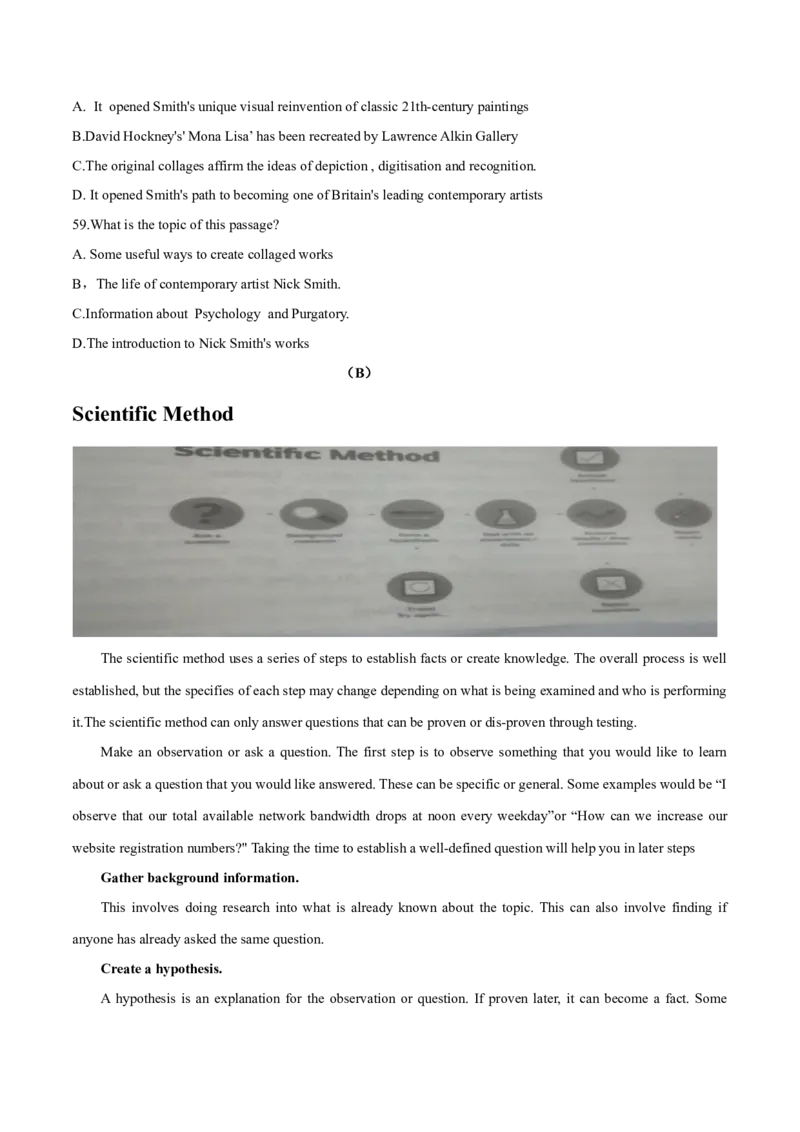
Scientific Method
The scientific method uses a series of steps to establish facts or create knowledge. The overall process is well
established, but the specifies of each step may change depending on what is being examined and who is performing
it.The scientific method can only answer questions that can be proven or dis-proven through testing.
Make an observation or ask a question. The first step is to observe something that you would like to learn
about or ask a question that you would like answered. These can be specific or general. Some examples would be “I
observe that our total available network bandwidth drops at noon every weekday”or “How can we increase our
website registration numbers?" Taking the time to establish a well-defined question will help you in later steps
Gather background information.
This involves doing research into what is already known about the topic. This can also involve finding if
anyone has already asked the same question.
Create a hypothesis.
A hypothesis is an explanation for the observation or question. If proven later, it can become a fact. Someexamples would be “ Our employees watching online videos during lunch is using our internet bandwidth” or “Our
website visitors don't see our registration form.’
Create a prediction and perform a test.
Create a testable prediction based on the hypothesis. The test should establish a noticeable change that can be
measured or observed using empirical analysis, it is also important to control for other variables during the test.
Some examples would be “If we block video-sharing sites, our available bandwidth will not go down significantly
during lunch or " If we make our registration box bigger, a greater percentage of visitors will register for our
website than before the change.
Analyze the results and draw a conclusion
Use the metrics established before the test see if the results match the prediction. For example,“ After blocking
video-sharing sites , our bandwidth utilization only went down by10% from before; this is not enough of a change
lo be the primary cause of the network congestion’ or ‘ After increasing the size of the registration box , the percent
of sign-ups went from 2% of total page views to 5% , showing that making the box larger results in more
registrations.
Share the conclusion or decide what question to ask next; Document the results of your experiment.
By sharing the results with others , you also increase the total body of knowledge available. Your experiment
may have also led to other questions , or if your hypothesis is dis-proven you may need to create a new one and test
that. For example , " Because user activity is not the cause of excessive bandwidth use , we now suspect that an
automated process is running at noon everyday.
60. What is the important role of collecting background information
A.Make full preparation [or the research questions
B. Understand the knowledge of existing research results
C. Provide evidence to refute the research conclusion.
D. Encourage researchers to reflect deeply on their work
61 In which case would it be necessary to create a new hypothesis for retesting
A. The research hypothesis has been fully proved
B. The research results lead to other related issues
C. The scope of test data needs to be expanded again
D.The background investigation is not objective enough
62 What can we infer from this passage?
A.Creating a question will help you in the following stepB..Collecting information includes research on an unknown subject
C.The test should establish a change that cannot be measured easily
D.You may need to create a pew hypothesis if the old one is overturned
( C )
Business innovation is an organization's process for introducing new ideas, workflows methodologies, services
or products. Like IT innovation, which calls for using technology new ways to create a more efficient and agile
organization , business innovation should enable the achievement of goals across the entire organization, with
sights set on accomplishing core business aims and initiatives. Innovation often begins with idea generation ,
wherein ideas are narrowed down during brainstorming sessions, after which leaders consider the business viability
, feasibility and desirability of each idea.existing products, services or processes; or it should solve a problem; or it
should reach new customers. Recent examples of business innovation include the introduction of the Dyson
vacuum cleaner, whose creator and namesake James Dyson declared in advertisements that he set out to build a
better product by applying industrial cyclone technologies to the household appliance.
The purpose of the business innovation process is to create value for the organization. That value can come
from creating new revenue opportunities or driving more revenue through existing channels: from creating
efficiencies that save time, money or both; or from improvements to productivity or performance. In short,
innovation should lead to higher profits Additionally, the results of an organization’s innovation process should
yield a competitive advantage; it should help the organization to grow and reach-or, better still, exceed -strategic
objectives
Innovation and invention are closely linked,but the two terms are not interchangeable. An invention ts an
entirely new creation The process of business innovation can produce an invention, but the term is broader in scope
and includes the application of an existing concept or practice in a new way.or applying new technology to an
existing product or process to improve upon it. To better understand the difference,consider this:The telephone is an
invention,but the smartphone is an innovation.
Business innovation can also be classified as either revolutionary or evolutionary. Revolutionary business
innovation yields a drastic change in a product, service, process, etc. which often destroys or supplants an existing
business model This is also known as radical innovation. Evolutionary or incremental innovation involves smaller,
more continuous improvements that, while important, are not drastic enough to shift a company or market into a
new paradigm. Disruptive innovation is a category that emphasizes the destructive aspect of revolutionary
innovation: this term applies to business innovation that lends to the creation of a new market that displaces anexisting one or. similarly, a significant upheaval in a category of products or services.
Business innovation, like most business initiatives, hits both benefits and risks. Organizations should
recognize on the negative tide that the bushiness innovation process can be a costly undertaking than does not
always produce a rectum on investment (ROI); that ideas considered likely to succeed could still fail; and that
stakeholders could fight the changes required to be successful. On the other hand, organizations need to weigh
those risks against the benefits of business innovation.
63. What does the underlined word in the first paragraph mean?
A. Persuasibility B. Scarcity C. Generality D. Practicability
64. What is the purpose of business innovation?
A. Create value benefits for the enterprise
B. Reform the management structure of enterprises
C.Encourage staff to make more inventions
D. Upgrade the product performance
65 Which of the following is true about innovation and invention?
A. They are essentially the same concept
B. They can replace each other in the context
C.They can bring huge commercial benefits
D.They are closely related but have different conceptual scopes
66. What is the main content of this passage?
A. The precautions for brainstorming meetings
B. The considerations for business innovation
C. The difference between innovation and invention
D. The revolutionary change in business innovation
【细节题】
细节题在阅读理解中是属于最简单的题型,其特点就是一般都能在文章中直接或间接的找到答案,因
此在做题时可以先快速浏览一下题目,明确读文章时需要关注的重点,进而略读和精读相结合,最大化的
利用好考场上的时间。(ABC篇尽量控制在20分钟内完成)
1. 事实(判断)题事实题需要学生能够根据文章提供的现有信息和应有常识去理清文章的大概,对于此类题目,第一遍
的略读是快速找到信息的关键,在根据题干中的时间、地点、人物返回原文的同时,也可以适当根据出题
的顺序返回原文。
判断题本质上是由四个事实题组合而成的,做题时首先明确是选错误的还是正确的,与事实题一样,
判断题的每个选项都需要返回原文,不能仅依靠印象去判断对错。
Eg. Albuvirtide(艾博卫泰,一种抗艾药物)is better than most second-line drugs-drugs used when
first-line standard drugs fail-in developed countries because of lower toxicity (毒性) and fewer side
effects.
Q: Albuvirtide is
A. a China-developed long-acting oral AIDS drug.
B. undergoing a clinical test on dogs to assure its safety.
C. more efficient than other AIDS drugs and has fewer side effects.
D. the only AIDS drug that has entered the last round of clinical trials.
解题思路:
事实(判断)题的特点是,文章当中有具体出现选项信息,要求考生准确定位信息并且具
备paraphrase(用英语解释英语)的能力,这也是为什么课堂上Yuki要带领同学们不停地进行同义词切换
训练。如,上题中选项C正是对文中信息”better than most second-line drugs”的paraphrase。
2. 推理题
推理题是在具体事实的基础上,加以逻辑的判断和推理,其题目中会含有 infer/imply等关键词,
与事实题的不同的地方在于:推理题并非只是原文的简单复述,不要将直接表达当成了间接推理。
Eg.The injection solution could give an alternative to patients ... if it could be included in the country's
health insurance system.
Q: We can infer from the passage that
A. Albuvirtide can spare patients from taking oral drugs every day.
B. the health insurance system has room for further improvement.
C. most AIDS drugs being used now were developed in last century.
D. China is leading the whole world in the field of AIDS research.
解题思路:
推理题的特点是,一般不会在文中出现相同的信息。最狡猾的题目,一般会以同义词切换
或者 paraphrase 的方式来迷惑考生,切记不要掉入陷阱。根据文章虚拟语气的表达”if it could be
included in the country's health insurance system”(如果它能被纳入国家的医疗保险体系就好了)可以推断出并没有纳入医保体系,故而推出医保体系还有发展空间,完美对应选项B。
【理解题】
理解题在阅读理解中更偏向于考察对词汇和前后句关系的掌握程度,既要理解字面的意思,也要理解
深层的含义,其答案设置通常是用不同的词语或句型表达相同的意思。
1. 词汇(指代)题
词汇题会将原文中的单词或词组划出,要求辨别其含义;词汇题的关键并不在于划出的词汇,
而在于它前后文的理解,对于难度较大的生词来说自然如此,而对于熟悉的考纲词汇亦是如此,其常见的
含义往往并非是正确答案。
指代题会要求辨别一些指代词( it / one / that / this / those / these)的指代关系,与词汇题
一样,首先要返回原文定位该词,同时向前和向后搜索相关的名词找出答案。
Eg. So it feels counterintuitive for a review of 26 studies to conclude that napping in children over
two years of age may not be a good idea at all.
Q: The word "counterintuitive" in para.2 most probably means
A. difficult B. unreasonable
C. revolutionary D. meaningless
解题思路:
这一类题的特点是有前后逻辑联系,后文得到的研究结论”napping in children over two years
of age may not be a good idea”(超过两岁的儿童午睡并不是一个好主意),显然违反人们的正常认知,
十分不合理的;没看出后面的逻辑也没有关系,因为Yuki在课上讲过前缀couter-有“反对”之意,而
intuitive有直觉的意思,这两个词大家有一定的熟悉度,连在一起就是“违反直觉的”,故而选择B选项,
以后作文中想用高级词汇,就可以把unreasonable换成counterintuitive了。
Eg.The British Museum, however, insists that it exists to tell the story of cultural achievement
throughout the world, from the dawn of human history over two million years ago until the present day.
The museum considers itself an important resource for the world: the breadth and depth of its collection
allows the world public to re-examine cultural identities and explore the complex network of
interconnected world cultures.
Q: The underlined "it" refers to
A. the British Museum
B. the Greek government
C. the ParthenonD. the British Museum Board of Trustees
解题思路:
这一类题目的特点,一般来说在临近位置找信息,定位黄色信息可以得知,it指代前面的the
British Museum, 自信地选择A选项。
2. 句子题
题干中明确指出原文中的一句话,要求理解其意思,同样也是返回原文对出题的句子进行上下
文分析,正确答案与原句之间往往是一种同义关系。
Eg. At 55 degrees, there were negligible differences. But when testers measured again on days when
the temperature was in the low 70s and high 80s, they got fewer miles per gallon with the A/C on.
Q: At which temperature is there a most noticeable difference in fuel economy between running A/C and
opening the window?
A. 40°F B. 51°F C. 55°F D. 73°F
解题思路:
句子理解性题目,首先用近似词(包括不同的词性的近似词甚至反义词)定位所需要的信
息,进行理解。题干中的noticeable(显而易见的)和文章里的negligible(可以忽略的)是反义词关系,
确定but后面的内容正是题目所需要的信息,解锁信息70-80之间只有73,从而选出D。
【宏观题】
宏观题在阅读理解中属于难度较大的拉分题型,其更强调学生对于全文内在逻辑的宏观把控能力,包
括对作者的态度、意图的理解,对情感的把控,和对全文主旨的辨析。(宏观题需要把控全文,故不放具
体的题目,仅列举常见的提问方式)
1.态度(情感)题
作者的态度分为三大类(对这些形容词要十分熟悉):客观objective/中立neutral、支持support/赞同
assentient/乐观optimistic、反对oppose/批评critical/怀疑suspect/悲观pessimistic,判断作者态度和情感的最
好方法就是在阅读文章的同时找到带有感情色彩的词语,并根据作者列举的例子来判断其情感倾向。
Q: What’s the author’s attitude towards …?
2.主旨题
主旨题通常是文章的最后一道题,如果时间允许的话,尽量再去略读一遍原文,在略读过程中,
可以将所有的example和细节描绘跳过,把反复出现的高频词语和带有明显概括性或主观态度的句子划出,
开头结尾是提供主旨信息的高频段落,但很多同学习惯于只看开头和结尾,也要特别注意首末段会设置的
文字陷阱。当然,选项也是可能有突破点的,最具概括性的选项往往也是正确选项。Q: Which of the following best states the main idea of the passage?
1. 【2024·金山区·二模】
(A)
There is no known date for when the ancient Greeks or Romans first shared their stories about gods, monsters
and heroes. But for the modern myth known as Star Wars, that date is May 25,1977, when the original movie
opened in theaters and kicked off a global phenomenon that spanned films, TV shows, novels, comic books, toys,
lunchboxes, bed sheets and more. Even today, Star Wars remains an enduring touchstone (检验标准) of pop
culture. Critically praised or not, the movies continue to be a big hit.
And just as we know when the mythology began, we also know who invented it: writer-director George Lucas.
His inspiration, he told TIME in 1977, was “all the books and films and comics that I liked when I was a child…
My main reason for making it was to give young people an honest, wholesome fantasy life, the kind my generation
had.”
No one could predict just how much Lucas’ creation would catch on — not even Lucas himself or the film’s
star Mark Hamill, who played young hero Luke Skywalker. “I had no idea it would be as successful as it was,”
Hamill said in 2017, marking the original film’s 40th anniversary. “I just thought I would be a fan of this even if I
weren’t involved.”
Before Lucas created Star Wars, he had an even more ambitious goal — to blow up the ways of Old
Hollywood. And he did. Star Wars introduced a new era of moviemaking, one that saw the development of
amazing special effects and the tools to achieve them. After this legend, filmmakers felt free to bring their wildest
ideas to life in totally realistic ways that left audiences thrilled.
Why did Star Wars become such a powerful force? Hamill credits its ability to satisfy the human need for
escapism. “People value the idea of going away to some happy place,” he said, “whether it’s Oz or Narnia or
Middle Earth or Hogwarts. I think it appeals to children of all ages. It doesn’t matter if you’re 6 or 60. It appeals to
the optimistic young idealism that I think every person has, however buried it might be.”
56. What can we learn from the first paragraph?
A. People should keep digging into the history of ancient myths.
B. More products associated with Star Wars have been created.
C. Some people’s criticism of Star Wars made it less popular than before.
D. Star Wars is more successful in the business field than in the entertainment field.
57. Why did George Lucas invent Star Wars?
A. To break the old rules and traditions of making films.
B. To appeal to the optimistic young men to pursue their dreams.C. To encourage other filmmakers to bring their wild ideas to life.
D. To offer young people an as good and healthy fantasy life as he had.
58. Star Wars can have such a great influence mainly because ______.
A. it meets people’s pursuit for a place to escape
B. it symbolizes the beginning of the modern myth
C. the special effects offer amazing viewing experience
D. the main actors in this film are very popular among the public
59. This passage is written to _____________.
A. inspire people to be optimistic and ideal
B. introduce the basic information about Star Wars
C. recommend the talented writer-director George Lucas
D. criticize the fact that Star Wars is not as well made as before
(B)
Looking for a career change? Check out these unconventional options!
The Waterslide Tester
When the pool where he worked as a lifeguard was closed during the COVID-19 pandemic, Guillaume Pop
took jobs at various other pools that were virtually deserted. In one video on the social platform, he pretended to
be a “professional waterslide tester”. Unexpectedly, Pop became a social media sensation. He was then hired to
“test” slides and other facilities at water parks and swimming pools all over France. “It’s the best job in the world,”
declares Pop, whose videos have received 80 million views. “I’m not behind a desk. I’m active and outside in the
sun. In fact, all the children tell me they want to be a waterslide tester!”
The Reindeer Herder
Finnish Lapland is home to around 200,000 wild reindeer. Anne Ollila, one of the 4,000 owners of these
animals, works in this harsh but beautiful region with her big family. She gave up her job as a sociology researcher
in 2010 to devote herself to reindeer herding full time. In summer, Ollila sleeps during the day and walks up to 12
miles a night through marsh and forest, enduring all kinds of insects. In deepest winter there is little daylight.
Grasslands are frozen and the reindeer move into the forest for protection. “Life here isn’t easy but it’s how nature
works,” says Ollila, “I love the environment, the animals and the freedom. Also, I have a sense of belonging to
something bigger than me, to the chain of life through the generations.”
The Zombie Trainer
Stevie Douglas, a 52-year-old Scot, has taught people how to behave like all varieties of the undead. A big fan
of horror movies, Douglas noticed the zombies he saw in films were often unconvincing. “Their movement was
poor and I thought I could do better.” So, in 2012, he formed ScareScotland to provide zombies for films andevents such as horror conventions. A year later they started a zombie training program, which took off when they
received a request for 300 zombies for a three-week-long interactive production. “What we do is very specific.”
says Douglas. Many people enjoy being frightened, and he’s happy to oblige them.
60. What do the three people introduced in the passage above have in common?
A. Their jobs are dangerous, unstable and low-paid.
B. Their jobs are well received throughout the world.
C. They have great passion and pride in what they do.
D. They need professional qualifications to do their job.
61. What does Guillaume Pop like most about his job?
A. It has a sense of freedom.
B. It is full of vigor and energy.
C. It is what he has been doing for decades.
D. It satisfies people’s wishes to be frightened.
62. Who is most probably interested in this passage?
A. Employees who are considering switching jobs.
B. Students who are applying for ideal universities.
C. Children who are interested in unusual activities.
D. Graduates who are deciding on their essay topics.
(C)
The phrase “coin toss” is a classic equivalent to randomness. But since
at
least the 18th century, mathematicians have suspected that even fair coins
tend to land on one side slightly more often than the other. Proving this
tiny bias (偏见), however, would require hundreds of thousands of
carefully recorded coin tosses, making laboratory tests a nightmare.
František Bartoš, currently a Ph.D. candidate at the University of Amsterdam, became fascinated by this
challenge four years ago. He couldn’t round up enough volunteers to investigate it at first. “Nobody was stupid
enough to spend a couple of weekends tossing coins,” he says. But after he began his Ph.D. studies, he tried again,
recruiting 47 volunteers (many of them friends and fellow students) from six countries. Multiple weekends of coin
tossing later, the team had performed 350,757 tosses, breaking the previous record of 40,000.The tossed coins, according to previous findings, landed with the same side facing upward as before the toss
50.8 percent of the time. The large number of throws allows statisticians to conclude that the nearly one percent
bias isn’t a fluke. “We can be quite sure there is a bias in coin tosses after this data set,” Bartoš says.
The leading theory explaining the subtle advantage comes from a 2007 physics study by statistician Persi
Diaconis and his colleagues, whose calculations predicted a same-side bias of 51 percent. From the moment a coin
is launched into the air, its entire path in the air — including whether it lands on heads or tails — can be
calculated by the laws of mechanics. The researchers determined that coins in the air barely turn around their
symmetrical axis (对称轴); instead they tend to move off-center unsteadily, which causes them to spend a little
more time in the air with their initial “up” side on top.
For day-to-day decisions, coin tosses are as good as random because a one percent bias isn’t perceptible with
just a few coin tosses, says another statistician who wasn’t involved in the new research. Still, the study’s
conclusions should eliminate any doubt that still exists regarding the coin toss’s slim bias.
It isn’t difficult to prevent this bias from influencing your coin-toss matches; simply concealing the coin’s
starting position before tossing it should do the trick. Alternatively, you can do away with tossing altogether by
shaking the coin between your palms. But if your friends are unaware of the tiny bias, you may as well benefit from
your slight advantage. After all, 51 percent odds beat a lot.
63. Why was it difficult to prove the tiny bias in coin tosses?
A. Because it required a large number of trials and loads of tests.
B. Because few scientists and researchers were interested in this topic.
C. Because scientists lacked the ability and technique to conduct this study.
D. Because previous researches failed many times and scientists lost confidence.
64. The meaning of the underlined word fluke in paragraph 3 most probably refers to something that
____________.
A. happens by accident B. can be planned in advance
C. occurs under specific conditions D. can be gained by practice
65. What can we imply from the last paragraph?
A. This one percent bias matters little in real life.
B. We should rely on this one percent bias to help us.
C. Though unnoticeable, we may still take advantage of this bias.
D. Relying on the one percent bias to win a coin-toss match is unfair.
66. What is the best title of this passage?
A. Risk-takers? Experts recommend coin-toss matches.B. Luck or Maths? Here’re some tips on tossing coins.
C. Coin collectors? There’re stories behind each coin.
D. Heads or Tails? Research suggests it’s not 50-50.
2. 【2024·闵行区·二模】
(A)
Growing up in Ukraine, Vadim didn’t know what it was like to live in a safe, stable home. His parents were
alcoholics who would often beat him. They’d even stuff him into a wine container, breaking his little body and
leaving only a small opening at the top so he could breathe and see—but only just a little.
By the time Vadim turned 9, he was living in an orphanage (孤儿院). Unfortunately, as is the case with far
too many little ones, his life only got worse there. Not only was he hurt, but he was placed in a room on the third
floor, making it impossible to get downstairs in a wheelchair.
This left Vadim crawling up and down the stairs, an activity that was both physically and mentally exhausting.
He’d often be late for meals. If the food wasn’t already gone by the time he arrived, other kids would steal from
him.
Then, a chain effec t began when some special folks visited the orphanage. They told him a story about a
spiritual figure who advocated love and forgiveness. This conversation helped the 14-year-old find his faith and, in
turn, he had more hope than he ever had before.
Today, Vadim is on longer the boy subject to fate. He is a father to his own kids, and his life couldn’t be more
different or better. Over the years, he’s discovered a gift for expressing himself through art. This inspired Tim
Tebow Foundation, an organization fighting for the most vulnerable (脆弱的) people around the world, to ask if
he’d like to create a piece that represented what it looked and felt
like for him to have gone from “darkness to light.”
The result? A truly remarkable painting that features
Vadim, in his wheelchair, leaving behind his old home, including
the wine container his parents stuffed him into. His new direction
includes a beautiful forest full of fall leaves and bright light,
showing the hope he is said to have found in the inspiring story.
56. According to the passage, Vadim’s parents treated him ________.
A. abusively B. forgivingly C. thoughtfully D. strictly57. Why did Vadim crawl up and down the stairs when living in the orphanage?
A. Because his little roommates often did damage to his wheelchair.
B. Because other children would take his meal without permission.
C. Because he couldn’t use the wheelchair to go downstairs from a high floor.
D. Because getting downstairs was demanding for him physically and mentally.
58.The phrase “ a chain effec t ” in paragraph 4 refers to _________.
A. an effective treatment for Vadim’s disability
B. a series of positive changes occurring in Vadim’s life
C. a sense of hope from the story of a spiritual figure
D. a helping hand from Tim Tebow Foundation
59. What is the message that Vadim wants to convey in his remarkable painting?
A. He admires the beauty and harmony of nature.
B. He leads a miserable life with his own kids.
C. He excels in delicate painting techniques.
D. He says farewell to the past and harvests happiness.
(B)
The Role of Crowdfunding in Business Growth
Crowdfunding is a fundraising method that makes use of the power of the Internet and social networks. It
involves raising small amounts of money from a large number of individuals or investors, typically through online
platforms. These platforms connect entrepreneurs (创业者) with potential backers who contribute funds to
support a specific project, business, or idea.
Types of Crowdfunding
Reward-Based Crowdfunding—Backers get a reward, such as a product sample or easy access, in exchange
for their contribution. This model is popular for startups and creative projects.
Equity (股权) Crowdfunding—Investors receive shares or equity in the business in exchange for their
funding. This model is ideal for small businesses looking to raise substantial capital and is subject to specific
regulations.
Debt Crowdfunding—Entrepreneurs borrow money from backers and agree to repay it with interest over
time. This model is similar to a loan and is suitable for businesses with a clear repayment plan.
Tips for a Successful Crowdfunding Campaign
Set clear goals: Define your funding goal, the purpose of the funds, and how you’ll use the money.Persuasive story: Make an appealing and genuine story about your business. Explain why it matters and how
backers’ contributions will make a difference.
Engage your network: Mobilize your existing network of friends, family, and professional contacts to support
your campaign. Their initial contributions can build momentum (动力).
Transparency: Be transparent and honest about your project’s progress and any challenges you encounter.
Backers appreciate honesty.
Fulfill promises: Once your campaign is successful, fulfill your promises to backers timely and communicate
regularly.
60. According to the passage, which of the following is accurate about crowdfunding?
A. Reward-Based Crowdfunding is the most popular type of crowdfunding.
B. Backers can get the same kinds of rewards in the three types of crowdfunding.
C. Crowdfunding is a fundraising technique that relies on offline platforms.
D. Debt Crowdfunding is fit for businesses with a specific repayment schedule.
61. The 4th tip “Transparency” probably means “________”.
A. carefulness B. perseverance C. frankness D. optimism
62. The owners of Exploding Kittens, a card game corporation established six years ago, plan to raise a large sum
of capital to start a promotion campaign. They are highly recommended to________.
A. prefer Reward-Based Crowdfunding to Equity Crowdfunding
B. draft an attractive story about the campaign based on real information
C. realize their promises to backers on time even if the campaign is a failure
D. compare the initial support provided by different existing contacts
(C)
Hundreds of people die at sea every year due to ship and airplane accidents. Emergency teams have little time
to rescue those in the water because the probability of finding a person alive falls dramatically after six hours.
Beyond tides and challenging weather conditions, unsteady coastal currents often make search and rescue
operations extremely difficult.
New insight into coastal flows gained by an international research team led by George Haller, Professor of
Nonlinear Dynamics at ETH Zurich, promises to enhance the search and rescue techniques currently in use. Using
tools from dynamical systems theory and ocean data, the team has developed an algorithm (算法) to predict where
objects and people floating in water will go. “Our work has a clear potential to save lives,” says Mattia Serra, the
first author of a study recently published in Nature Communications.In today’s rescue operations at sea, complicated models of ocean dynamics and weather forecasting are used to
predict the path of floating objects. For fast-changing coastal waters, however, such predictions are often inaccurate
due to uncertain boundaries and missing data. As a result, a search may be launched in the wrong location, causing
a loss of precious time.
Haller’s research team obtained mathematical results predicting that objects floating on the ocean’s surface
should gather along a few special curves (曲线) which they call TRansient Attracting Profiles (TRAPs). These
curves can’t be seen with our eyes but can be tracked from instant ocean surface current data using recent
mathematical methods developed by the ETH team. This enables quick and precise planning of search paths that
are less sensitive to uncertainties in the time and place of the accident.
In cooperation with a team from MIT, the ETH team tested their new, TRAP-based search algorithm in two
separate ocean experiments near Martha’s Vineyard, which is on the northeastern coast of the United States.
Working from the same real-time data available to the Coast Guard, the team successfully identified TRAPs in the
region in real-time. They found that buoys and manikins (浮标和人体模型) thrown in the water indeed quickly
gathered along these emerging curves. “Of several competing approaches tested in this project, this was the only
algorithm that consistently found the right location”, says Haller.
“Our results are rapidly obtained, easy to interpret, and cheap to perform,” points out Serra. Haller stresses:
“Our hope is that this method will become a standard part of the tool kit of coast guards everywhere.”
63.In a search and rescue operation, ________.
A. the survival rate drops to almost zero after six hours
B. the use of dynamics leads to the wrong location
C. weather conditions are a determining factor
D. changing currents present a challenge
64. The main significance of the new algorithm is ________.
A. accurately predicting weather conditions during rescue operations
B. dependence on satellite technology to locate distressed individuals at sea
C. cost-effective, efficient tracking of objects and individuals in coastal waters
D. predicting the exact time and location of ocean accidents
65. Paragraph 5 mainly talks about ________.
A. the collection of data
B. the testing of the algorithmC. the identification of the TRAPs
D. the cooperation of two research teams
66. Which of the following is the best title for the passage?
A. How Mathematics Can Save Lives at Sea
B. How Coastal Waters Affect Saving Lives
C. Why Algorithms Are Popular in Rescue Operations
D. Why Success Rates of Rescue Operations Have Fallen