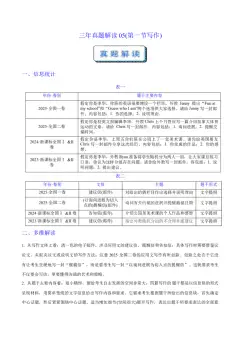
2026 年高考英语三轮押题07:阅读理解之说明文
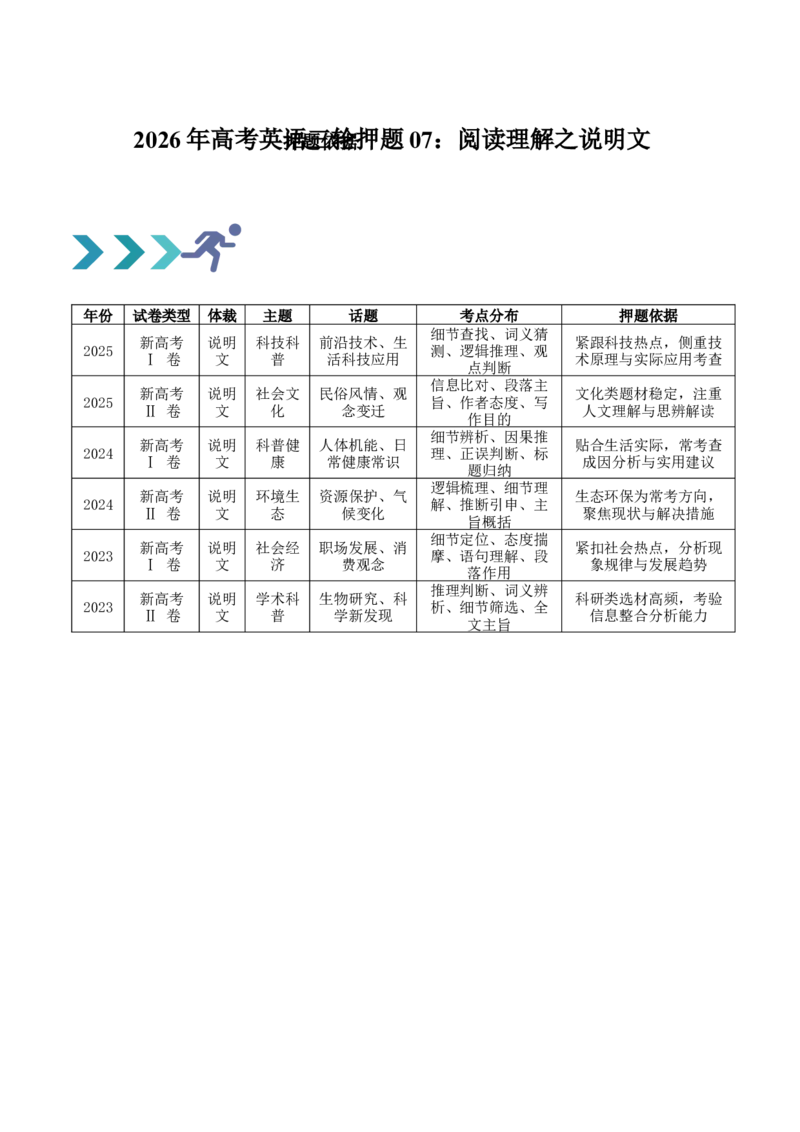
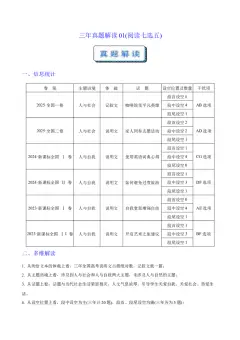
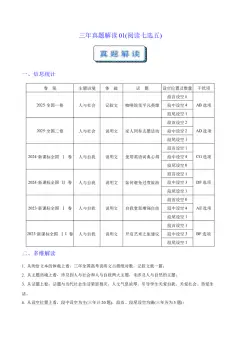
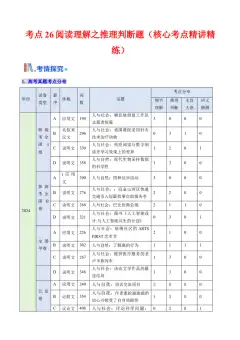
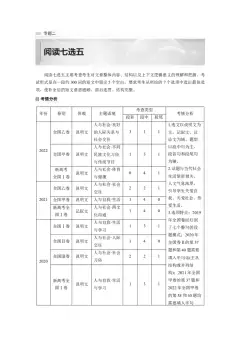
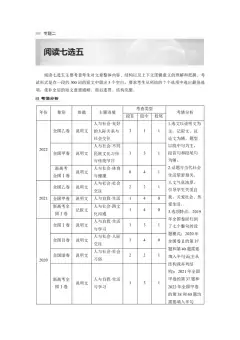
年份
试卷类型
体裁
主题
话题
考点分布
押题依据
2025
新高考
Ⅰ 卷
说明
文
科技科
普
前沿技术、生
活科技应用
细节查找、词义猜
测、逻辑推理、观
点判断
紧跟科技热点,侧重技
术原理与实际应用考查
2025
新高考
Ⅱ 卷
说明
文
社会文
化
民俗风情、观
念变迁
信息比对、段落主
旨、作者态度、写
作目的
文化类题材稳定,注重
人文理解与思辨解读
2024
新高考
Ⅰ 卷
说明
文
科普健
康
人体机能、日
常健康常识
细节辨析、因果推
理、正误判断、标
题归纳
贴合生活实际,常考查
成因分析与实用建议
2024
新高考
Ⅱ 卷
说明
文
环境生
态
资源保护、气
候变化
逻辑梳理、细节理
解、推断引申、主
旨概括
生态环保为常考方向,
聚焦现状与解决措施
2023
新高考
Ⅰ 卷
说明
文
社会经
济
职场发展、消
费观念
细节定位、态度揣
摩、语句理解、段
落作用
紧扣社会热点,分析现
象规律与发展趋势
2023
新高考
Ⅱ 卷
说明
文
学术科
普
生物研究、科
学新发现
推理判断、词义辨
析、细节筛选、全
文主旨
科研类选材高频,考验
信息整合分析能力
押题依据
题型一、科普知识
词数
话题
体裁
考点
押题理由
约320 词
健康生活・
季节与睡眠
规律
科普说明文
细节理解、词义猜
测、段落作用、主旨
大意
贴合日常健康热点,常考生活科普类阅
读;题型覆盖高考高频四大题型,词汇
与句式难度适配高二期末考纲,侧重信
息定位与逻辑分析能力考查。
“If you feel like sleeping more in the winter, you’re not alone, ”said Dr. Raj, an associate professor of
clinical medicine, citing research that found at least a third of American adults reported they sleep more in the
winter. The 188 patients undergoing sleep studies at St. Hedwig Hospital in Berlin slept about an hour longer in
winter than they did in summer, which the authors said wasn’t statistically significant. But participants did get 30
more minutes of rapid eye movement, or REM, sleep during winter.
The REM phase of sleep is the sweet spot of sleep cycles, characterized by more dreaming and faster heart
rate and breathing than in other stages. It’s “an essential stage of sleep that helps with memory, concentration, mood
regulation and immune function,” Raj said.
The desire for, or occurrence of, more sleep during winter may have to do with how light fluctuates
throughout the year. “Our bodies receive signals from the sun when it comes to our circadian rhythm (生理节奏),
meaning that when it is bright outside we tend to be active, but when the sun goes down, you may tend to feel
tired,” Raj said. “The decrease in sunlight causes an increase in melatonin, a hormone made in the body that
regulates sleep-wake cycles.” With the earlier production of melatonin during winter, “it would be natural to
assume that a healthy person also would need more sleep during the winter,” said Dr. Weiss, a research assistant
professor.
And light influences not only sleep quantity but also sleep quality. “REM sleep is highly affected by light
and darkness, so when during the winter we have less light, the body is going to basically overcompensate by
giving more REM sleep,” said Dr. Tal, a psychologist specializing in sleep issues.
Humans still don’t need to hibernate ( 冬眠), Weiss said, nor can we afford to due to our social and
occupational obligations. “But we can make adjustments in a better way during winter,” she said. “To help our
bodies make this transition from sleep to wake, it’s important to have light exposure in the morning during winter
months,” Weiss said.
1.What can be learned about REM sleep from the study?
A.It rose by half an hour in winter.
押题预测
核心题型及具体解决方法
B.It made up most of the extra sleep.
C.It was the only sleep stage measured.
D.It stayed unchanged as sleep time grew.
2.What does the underlined word “fluctuates” mean?
A.Varies.
B.Fades.
C.Travels.
D.Reflects.
3.What is the function of paragraph 3?
A.To criticize the Berlin study.
B.To present a counterargument.
C.To offer practical sleep advice.
D.To explain the science behind winter sleep.
4.Which of the following is the best title for the passage?
A.Why Hibernate?
B.What’s REM Sleep?
C.How to Sleep Better?
D.Why More Winter Sleep?
词数
话题
体裁
考点
押题理由
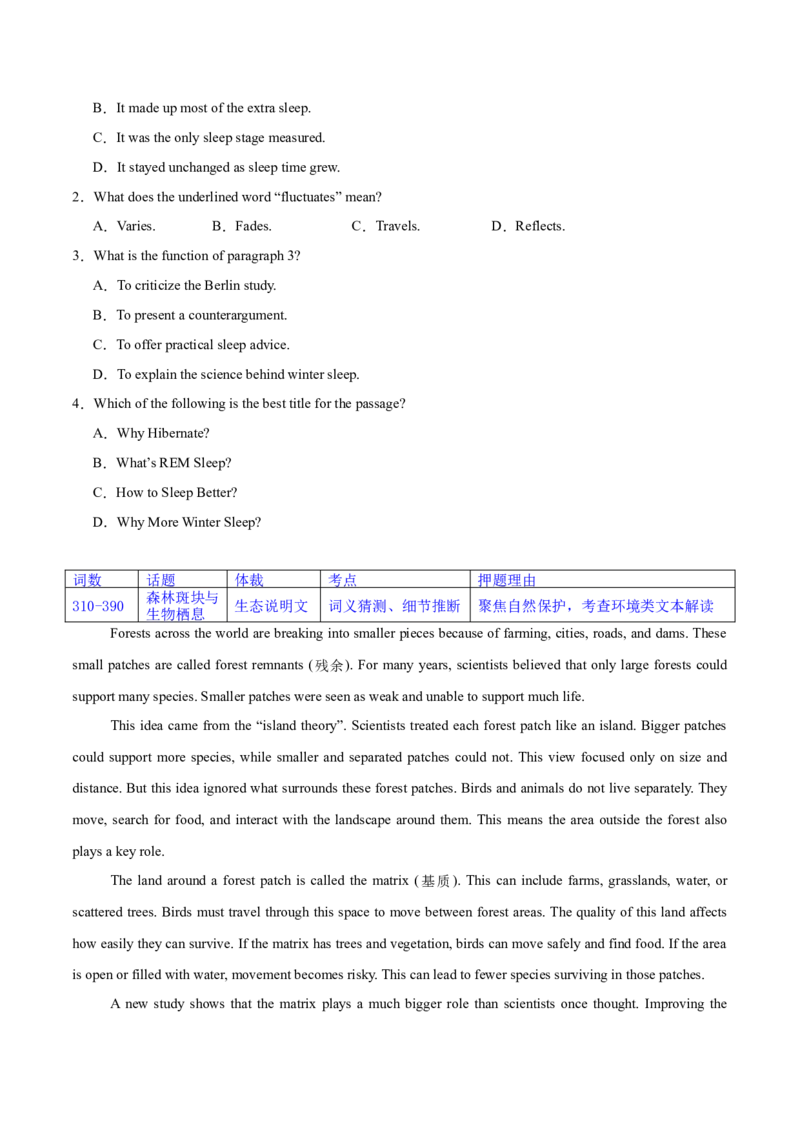
310-390
森林斑块与
生物栖息
生态说明文
词义猜测、细节推断
聚焦自然保护,考查环境类文本解读
Forests across the world are breaking into smaller pieces because of farming, cities, roads, and dams. These
small patches are called forest remnants (残余). For many years, scientists believed that only large forests could
support many species. Smaller patches were seen as weak and unable to support much life.
This idea came from the “island theory”. Scientists treated each forest patch like an island. Bigger patches
could support more species, while smaller and separated patches could not. This view focused only on size and
distance. But this idea ignored what surrounds these forest patches. Birds and animals do not live separately. They
move, search for food, and interact with the landscape around them. This means the area outside the forest also
plays a key role.
The land around a forest patch is called the matrix ( 基质). This can include farms, grasslands, water, or
scattered trees. Birds must travel through this space to move between forest areas. The quality of this land affects
how easily they can survive. If the matrix has trees and vegetation, birds can move safely and find food. If the area
is open or filled with water, movement becomes risky. This can lead to fewer species surviving in those patches.
A new study shows that the matrix plays a much bigger role than scientists once thought. Improving the
surrounding land can help even small forest patches support many bird species. Forest patches surrounded by trees
supported more bird species than those surrounded by open areas. Even a small increase in tree cover made a big
difference.
This finding is important because it shows that people can improve biodiversity without increasing forest
size. By adding trees and improving nearby land, even small forests can become rich habitats. “I hope the finding
will inform more effective land-use policy and encourage governments and landowners to invest in wildlife-
friendly farming practices that support both biodiversity and agricultural productivity,” noted Dr. Chase
Mendenhall from Slippery Rock University.
5.What can we learn about the traditional “island theory” in paragraph 2?
A.It overestimated small patches.
B.It valued the harmony of nature.
C.It focused on land quality over size.
D.It overlooked the impact of settings.
6.What can be inferred about the matrix in paragraph 3?
A.It blocks birds’ movement.
B.It limits birds’ food sources.
C.It is related to species’ survival.
D.It mainly provides water for forests.
7.What conclusion can be drawn from the new study in paragraph 4?
A.Better surroundings boost biodiversity.
B.Small patches are helpless for bird species.
C.Forest size matters most for biodiversity.
D.Open areas are better than tree-covered ones.
8.What is Dr. Chase Mendenhall’s attitude towards the new finding?
A.Skeptical.
B.Optimistic.
C.Conservative.
D.Critical.
词数
话题
体裁
考点
押题理由
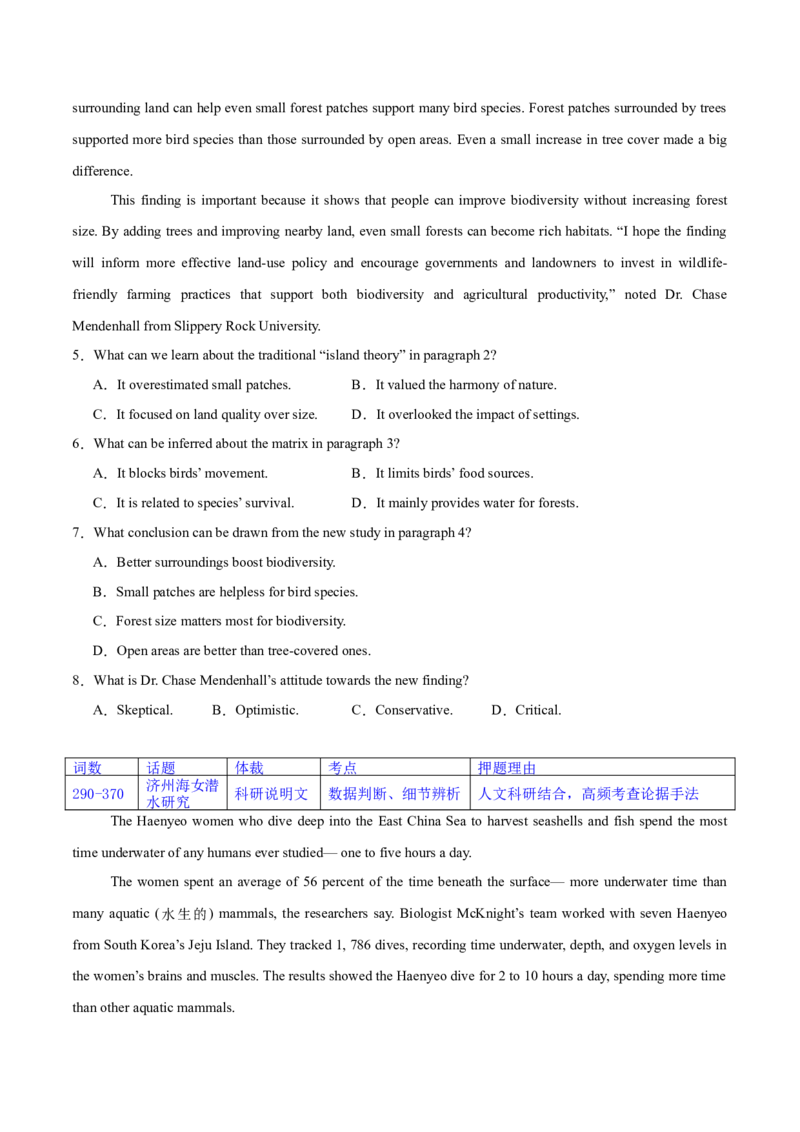
290-370
济州海女潜
水研究
科研说明文
数据判断、细节辨析
人文科研结合,高频考查论据手法
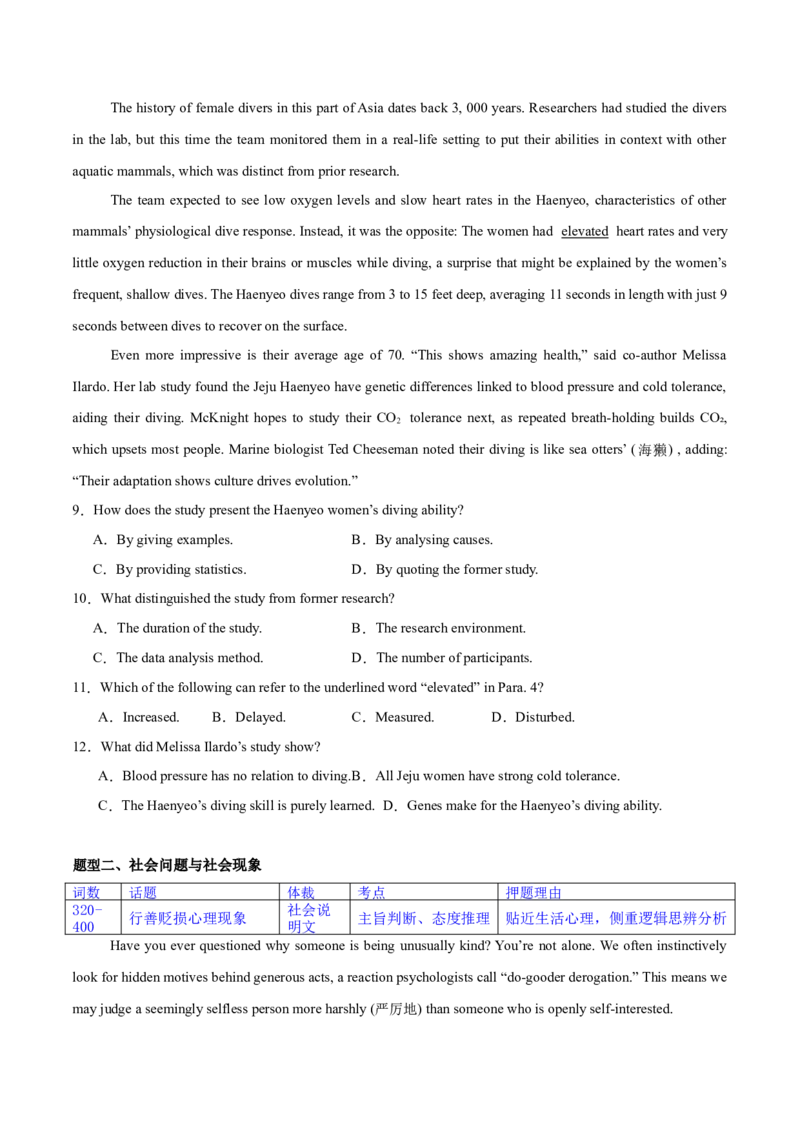
The Haenyeo women who dive deep into the East China Sea to harvest seashells and fish spend the most
time underwater of any humans ever studied— one to five hours a day.
The women spent an average of 56 percent of the time beneath the surface— more underwater time than
many aquatic (水生的) mammals, the researchers say. Biologist McKnight’s team worked with seven Haenyeo
from South Korea’s Jeju Island. They tracked 1, 786 dives, recording time underwater, depth, and oxygen levels in
the women’s brains and muscles. The results showed the Haenyeo dive for 2 to 10 hours a day, spending more time
than other aquatic mammals.
The history of female divers in this part of Asia dates back 3, 000 years. Researchers had studied the divers
in the lab, but this time the team monitored them in a real-life setting to put their abilities in context with other
aquatic mammals, which was distinct from prior research.
The team expected to see low oxygen levels and slow heart rates in the Haenyeo, characteristics of other
mammals’ physiological dive response. Instead, it was the opposite: The women had elevated heart rates and very
little oxygen reduction in their brains or muscles while diving, a surprise that might be explained by the women’s
frequent, shallow dives. The Haenyeo dives range from 3 to 15 feet deep, averaging 11 seconds in length with just 9
seconds between dives to recover on the surface.
Even more impressive is their average age of 70. “This shows amazing health,” said co-author Melissa
Ilardo. Her lab study found the Jeju Haenyeo have genetic differences linked to blood pressure and cold tolerance,
aiding their diving. McKnight hopes to study their CO2 tolerance next, as repeated breath-holding builds CO₂,
which upsets most people. Marine biologist Ted Cheeseman noted their diving is like sea otters’ ( 海獭) , adding:
“Their adaptation shows culture drives evolution.”
9.How does the study present the Haenyeo women’s diving ability?
A.By giving examples.
B.By analysing causes.
C.By providing statistics.
D.By quoting the former study.
10.What distinguished the study from former research?
A.The duration of the study.
B.The research environment.
C.The data analysis method.
D.The number of participants.
11.Which of the following can refer to the underlined word “elevated” in Para. 4?
A.Increased.
B.Delayed.
C.Measured.
D.Disturbed.
12.What did Melissa Ilardo’s study show?
A.Blood pressure has no relation to diving.B.All Jeju women have strong cold tolerance.
C.The Haenyeo’s diving skill is purely learned. D.Genes make for the Haenyeo’s diving ability.
题型二、社会问题与社会现象
词数
话题
体裁
考点
押题理由
320-
400
行善贬损心理现象
社会说
明文
主旨判断、态度推理
贴近生活心理,侧重逻辑思辨分析
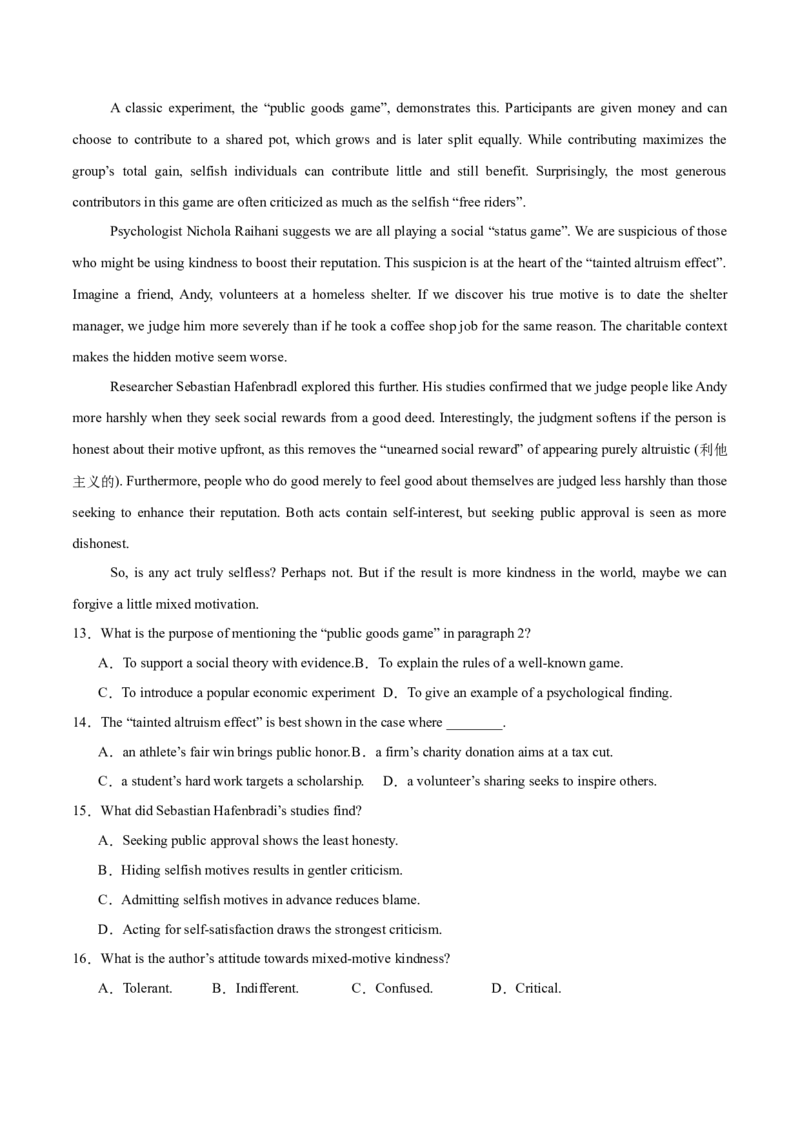
Have you ever questioned why someone is being unusually kind? You’re not alone. We often instinctively
look for hidden motives behind generous acts, a reaction psychologists call “do-gooder derogation.” This means we
may judge a seemingly selfless person more harshly (严厉地) than someone who is openly self-interested.
A classic experiment, the “public goods game”, demonstrates this. Participants are given money and can
choose to contribute to a shared pot, which grows and is later split equally. While contributing maximizes the
group’s total gain, selfish individuals can contribute little and still benefit. Surprisingly, the most generous
contributors in this game are often criticized as much as the selfish “free riders”.
Psychologist Nichola Raihani suggests we are all playing a social “status game”. We are suspicious of those
who might be using kindness to boost their reputation. This suspicion is at the heart of the “tainted altruism effect”.
Imagine a friend, Andy, volunteers at a homeless shelter. If we discover his true motive is to date the shelter
manager, we judge him more severely than if he took a coffee shop job for the same reason. The charitable context
makes the hidden motive seem worse.
Researcher Sebastian Hafenbradl explored this further. His studies confirmed that we judge people like Andy
more harshly when they seek social rewards from a good deed. Interestingly, the judgment softens if the person is
honest about their motive upfront, as this removes the “unearned social reward” of appearing purely altruistic (利他
主义的). Furthermore, people who do good merely to feel good about themselves are judged less harshly than those
seeking to enhance their reputation. Both acts contain self-interest, but seeking public approval is seen as more
dishonest.
So, is any act truly selfless? Perhaps not. But if the result is more kindness in the world, maybe we can
forgive a little mixed motivation.
13.What is the purpose of mentioning the “public goods game” in paragraph 2?
A.To support a social theory with evidence.B.To explain the rules of a well-known game.
C.To introduce a popular economic experiment D.To give an example of a psychological finding.
14.The “tainted altruism effect” is best shown in the case where ________.
A.an athlete’s fair win brings public honor.B.a firm’s charity donation aims at a tax cut.
C.a student’s hard work targets a scholarship.
D.a volunteer’s sharing seeks to inspire others.
15.What did Sebastian Hafenbradi’s studies find?
A.Seeking public approval shows the least honesty.
B.Hiding selfish motives results in gentler criticism.
C.Admitting selfish motives in advance reduces blame.
D.Acting for self-satisfaction draws the strongest criticism.
16.What is the author’s attitude towards mixed-motive kindness?
A.Tolerant.
B.Indifferent.
C.Confused.
D.Critical.
词数
话题
体裁
考点
押题理由
300-380
Z 世代共享
餐桌文化
社会文化说
明文
段落主旨、细节理解
时代热点话题,代际观念类常考
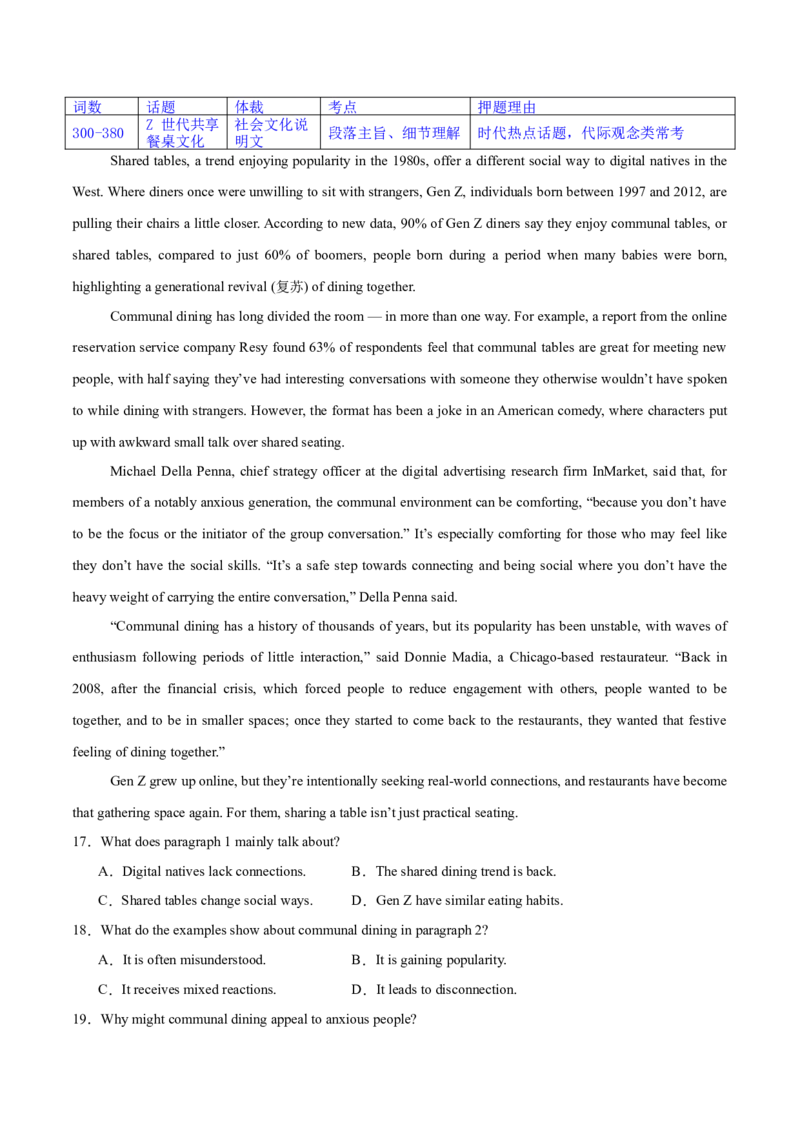
Shared tables, a trend enjoying popularity in the 1980s, offer a different social way to digital natives in the
West. Where diners once were unwilling to sit with strangers, Gen Z, individuals born between 1997 and 2012, are
pulling their chairs a little closer. According to new data, 90% of Gen Z diners say they enjoy communal tables, or
shared tables, compared to just 60% of boomers, people born during a period when many babies were born,
highlighting a generational revival (复苏) of dining together.
Communal dining has long divided the room — in more than one way. For example, a report from the online
reservation service company Resy found 63% of respondents feel that communal tables are great for meeting new
people, with half saying they’ve had interesting conversations with someone they otherwise wouldn’t have spoken
to while dining with strangers. However, the format has been a joke in an American comedy, where characters put
up with awkward small talk over shared seating.
Michael Della Penna, chief strategy officer at the digital advertising research firm InMarket, said that, for
members of a notably anxious generation, the communal environment can be comforting, “because you don’t have
to be the focus or the initiator of the group conversation.” It’s especially comforting for those who may feel like
they don’t have the social skills. “It’s a safe step towards connecting and being social where you don’t have the
heavy weight of carrying the entire conversation,” Della Penna said.
“Communal dining has a history of thousands of years, but its popularity has been unstable, with waves of
enthusiasm following periods of little interaction,” said Donnie Madia, a Chicago-based restaurateur. “Back in
2008, after the financial crisis, which forced people to reduce engagement with others, people wanted to be
together, and to be in smaller spaces; once they started to come back to the restaurants, they wanted that festive
feeling of dining together.”
Gen Z grew up online, but they’re intentionally seeking real-world connections, and restaurants have become
that gathering space again. For them, sharing a table isn’t just practical seating.
17.What does paragraph 1 mainly talk about?
A.Digital natives lack connections.
B.The shared dining trend is back.
C.Shared tables change social ways.
D.Gen Z have similar eating habits.
18.What do the examples show about communal dining in paragraph 2?
A.It is often misunderstood.
B.It is gaining popularity.
C.It receives mixed reactions.
D.It leads to disconnection.
19.Why might communal dining appeal to anxious people?
A.It provides group topics to discuss.
B.It allows them to present social skills.
C.It enables them to be the talk’s focus.
D.It offers a less pressured way to socialize.
20.What do Donnie Madia’s words imply?
A.Communal dining caught on after 2008.
B.Crises discourage people from exploring.
C.Restaurants need to create the festive feeling.
D.Social disconnection stimulates communal dining.
词数
话题
体裁
考点
押题理由
330-410
旅行纪念品
价值探讨
人文说明文
句意理解、主旨归纳
生活感悟类选材,设问角度灵活
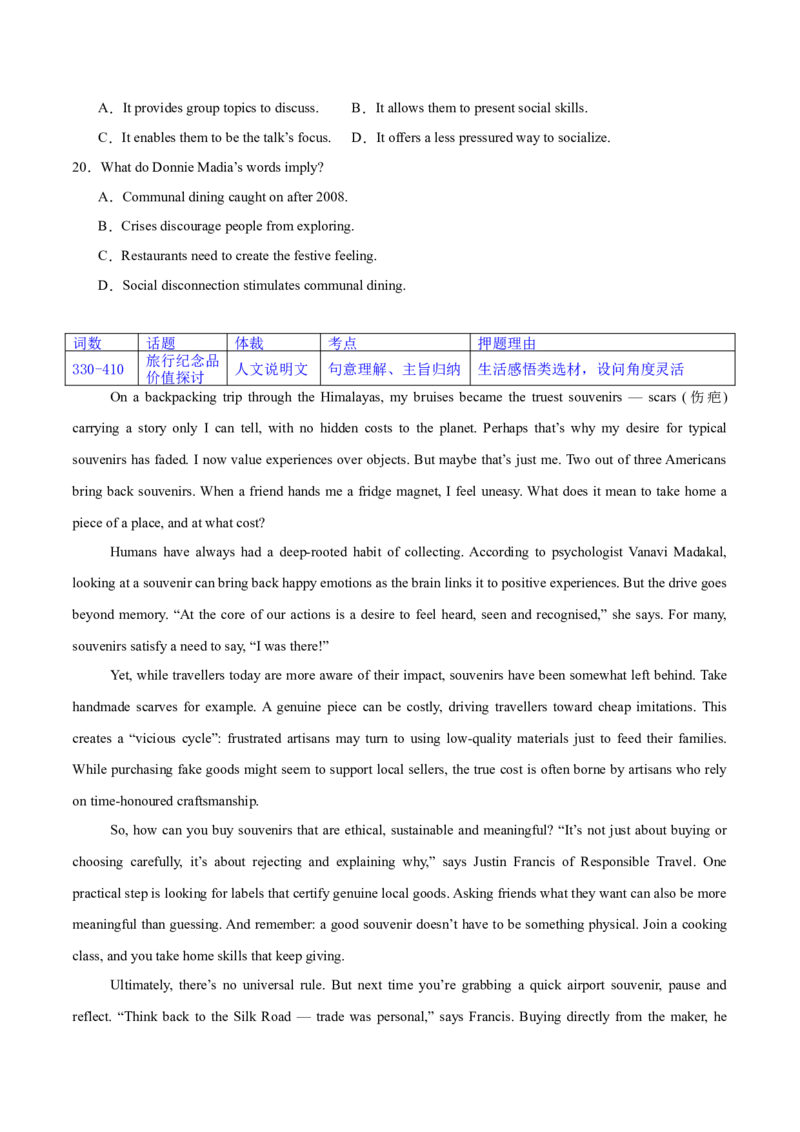
On a backpacking trip through the Himalayas, my bruises became the truest souvenirs — scars ( 伤疤)
carrying a story only I can tell, with no hidden costs to the planet. Perhaps that’s why my desire for typical
souvenirs has faded. I now value experiences over objects. But maybe that’s just me. Two out of three Americans
bring back souvenirs. When a friend hands me a fridge magnet, I feel uneasy. What does it mean to take home a
piece of a place, and at what cost?
Humans have always had a deep-rooted habit of collecting. According to psychologist Vanavi Madakal,
looking at a souvenir can bring back happy emotions as the brain links it to positive experiences. But the drive goes
beyond memory. “At the core of our actions is a desire to feel heard, seen and recognised,” she says. For many,
souvenirs satisfy a need to say, “I was there!”
Yet, while travellers today are more aware of their impact, souvenirs have been somewhat left behind. Take
handmade scarves for example. A genuine piece can be costly, driving travellers toward cheap imitations. This
creates a “vicious cycle”: frustrated artisans may turn to using low-quality materials just to feed their families.
While purchasing fake goods might seem to support local sellers, the true cost is often borne by artisans who rely
on time-honoured craftsmanship.
So, how can you buy souvenirs that are ethical, sustainable and meaningful? “It’s not just about buying or
choosing carefully, it’s about rejecting and explaining why,” says Justin Francis of Responsible Travel. One
practical step is looking for labels that certify genuine local goods. Asking friends what they want can also be more
meaningful than guessing. And remember: a good souvenir doesn’t have to be something physical. Join a cooking
class, and you take home skills that keep giving.
Ultimately, there’s no universal rule. But next time you’re grabbing a quick airport souvenir, pause and
reflect. “Think back to the Silk Road — trade was personal,” says Francis. Buying directly from the maker, he
believes, is “the purest form of commerce.”
21.What does the author imply by saying “my bruises became the truest souvenirs”?
A.Souvenirs can harm the planet.
B.Injuries are unexpected souvenirs.
C.We should say no to travel souvenirs.
D.Personal stories make the best souvenirs.
22.What aspect of souvenirs does paragraph 2 focus on?
A.Their emotional appeal.
B.Their long history.
C.Their growing popularity.
D.Their cultural value.
23.What is the consequence of the vicious cycle?
A.Souvenirs get standardised.
B.Tourism hurts the local economy.
C.Traditional skills are put at risk.
D.Local sellers lose their customer base.
24.What is the writing purpose of the passage?
A.To promote genuine local products.
B.To explore the true meaning of souvenirs.
C.To compare different types of souvenirs.D.To discourage people from buying souvenirs.
题型三、人工智能
词数
话题
体裁
考点
押题理由
320-
400
妈祖气象预警系统
科技
说明
文
细节推断、词义
猜测
中国科技输出,契合家国热点命题
China is actively sharing its early warning technologies with the world, offering solutions that help
developing countries better prepare for extreme weather. From AI-powered forecasting models to emergency
response systems, the country is making significant contributions to a United Nations program known as Early
Warnings for All.
At the heart of these efforts is MAZU, a homegrown early warning system developed by China’s weather
service. Powered by artificial intelligence, MAZU is designed to help nations reduce weather-related risks. Its name
comes from a sea goddess traditionally believed to protect against sea disasters. It also stands for “multi-risk, alert,
zero-gap, and universal.”
MAZU offers a comprehensive package of hard technology and soft measures. It includes a cloud-based
early warning system, an emergency response framework, and a “call-to-action” mechanism that ensures high-level
warnings lead to immediate action. The system is flexible and can be customized to meet the specific needs of
different countries.
In Fujian, a coastal province often hit by typhoons, MAZU has been put into practice through a “1262”
disaster prevention model. This model identifies key risk areas 12 hours in advance, places rescue forces six hours
ahead, and warns high-risk townships two hours before a weather event. When Typhoon Danas struck in July, the
system helped Fuzhou prepare by draining rivers ahead of time, greatly reducing possible damage.
MAZU has also been shared with other countries. Its city version, MAZU-Urban, has been tested in over 35
countries across Asia, Africa, and Oceania. In March, it successfully predicted rainfall in Kampala, Uganda, and
winds at Lake Victoria. The Uganda National Weather Service expressed thanks for the support. The system can be
adapted to local conditions by using disaster data and emergency standards of different areas.
China plans to continue supporting developing nations through training programs and technological
cooperation. As an official from China’s weather service said, “The introduction of MAZU marks China’s shift
from an active participant in global weather efforts to a contributor to major international plans and a provider of
global public goods.”
25.What can be inferred about MAZU?
A.It relies on fixed procedures for all users.
B.It helps different nations avoid sea disasters.
C.It limits application to specific disaster types.
D.It integrates cultural roots into modern technology.
26.What does the underlined word “customized” in paragraph 3 mean?
A.Tailored.
B.Assessed.
C.Employed.
D.Tested.
27.Why does the author mention the “1262” model?
A.To stress the rapid advancement of MAZU.
B.To prove the practical effectiveness of MAZU.
C.To showcase the creative design of MAZU.
D.To highlight the wide popularity of MAZU.
28.What is the author’s purpose in writing the text?
A.To illustrate MAZU’s global recognition.
B.To explain AI’s role in weather forecasting.
C.To present a Chinese solution to global challenges.
D.To introduce the development of AI-powered models.
词数
话题
体裁
考点
押题理由
310-390
AI 野生动
物虚假影像
科技科普说
明文
细节查找、观点判断
人工智能前沿话题,现实意义强
A video on social media shows a leopard entering the backyard of a house where a child is playing, and a cat
scares it away, protecting the child. The video has gained over a million “likes” and has been shared more than
15,000 times. Believe it or not, the video is totally created by artificial intelligence (AI).
A new study has raised concerns that AI-generated wildlife images and videos could potentially bias public
knowledge of wild animals and weaken critical conservation efforts. Researchers from the University of Córdoba in
Spain found that several features of modern life can intensify the problem — including our heavy reliance on social
media, our tendency to anthropomorphize (人格化) animal behavior, and people’s increasing separation from the
natural world.
“Our findings indicate that some posts are concerning because they do not reflect reality, which can
contribute to misinformation,” study co-author José Guerrero Casado told Popular Science. “For effective
biodiversity conservation, it is essential that society is well informed.”
Examples provided in the study range from affectionate predator-prey ( 捕食者与猎物) interactions to
humans interacting with dangerous wild animals, as well as videos of animals attacking people, which can generate
unwarranted fear and cause harmful responses toward wildlife. Other misleading content shows AI-generated
animals with inaccurate physical characteristics, places species in locations where they do not exist, or describes
endangered species as being more common or less at risk than they are in reality.
“When these types of images and videos are frequently exposed to people, it could lead to reduced support
for conservation projects. What’s more, as AI technology advances, it will become more difficult to identify real
wildlife imagery from false content, increasing the likelihood that misleading posts will spread unchecked,” Casado
added.
To help deal with these potential issues, the researchers recommend integrating media literacy in classrooms
and launching public awareness efforts to give people the tools to judge whether what they see on social media is
real. They hope their findings will encourage the public to think more critically about the wildlife-content they find
online.
29.What is one of the negative impacts of AI-generated wildlife content?
A.It reduces people’s interest in social media.
B.It increases human-wildlife conflicts in reality.
C.It misleads public opinion about wild animals.
D.It slows down the development of AI technology.
30.What does the underlined word “unwarranted” in paragraph 4 mean?
A.Unnecessary.
B.Unconscious.
C.Constant.
D.Hidden.
31.Why will misleading content spread more easily in the future?
A.It is free from review.
B.It is easy to get public attention.
C.People will rely less on social media.
D.AI-generated content will be harder to tell.
32.What do the researchers suggest doing about the problems?
A.Banning AI from creating wildlife-related content.
B.Promoting media literacy and mass consciousness.
C.Encouraging the public to avoid social media.
D.Limiting the sharing of wildlife videos online.
词数
话题
体裁
考点
押题理由
340-420
人工智能人
机协作
科技议论文
细节推理、主旨把握
AI 应用热议,侧重利弊辩证考查
Since ChatGPT’s release three years ago, Artificial Intelligence (AI) has rapidly transformed from an online
novelty into essential infrastructure (基础设施). It now serves as a silent helper in offices, an uncredited partner in
classrooms, and even “ears” in exam rooms. A report shows 84% of high school students use AI for schoolwork.
For companies, AI’s promise of cheap labor is highly attractive, with global spending on AI reaching hundreds of
billions of dollars last year.
Nevertheless, people often view AI as a competition between humans and machines — a misleading
perception that needs to be corrected. The reality is humans working with machines, often within budget limits and
imperfect systems. While companies develop smarter AI models, its daily applications are most significant. For
example, a doctor can pass tiring record-writing to AI, allowing her to focus more on patients. A call center can also
respond in 35 languages at 3 a.m. without a large multilingual team.
Despite these benefits, the danger is that harm from AI may grow faster than its good effects. Deepfakes ( 深
度伪造) can become powerful weapons: a false video can destroy a person’s reputation long before it is proven
fake. An incorrect AI-generated fact might be a minor issue in homework, but it can be extremely risky in medical
records.
Even without harmful intentions, AI significantly changes how people make judgments. AI-generated results
often appear confident and well-considered, yet they are not always reliable. An AI “copilot” can reassign work and
responsibility, but what is offered as help frequently requires human oversight. While AI offers speed, it also forces
users to repeatedly decide whether to trust its suggestions.
This change can be seen widely: hospitals trying to improve care without lowering quality, communities
struggling with fast-spreading fake videos, and workers using AI to save time or avoid duties. When a technology’s
strengths are easy to praise and its weaknesses easy to ignore, who should pay for its mistakes?
33.Why does the author mention the numbers in Paragraph 1?
A.To criticize the improper use of AI.
B.To show the popularity of AI in daily life.
C.To stress the benefits of AI over its harms.
D.To compare the uses of AI in different areas.
34.Which word best describes the relationship between humans and AI?
A.Competitive.
B.Distant.
C.Cooperative.
D.Independent.
35.What can be learned about AI-generated results according to the text?
A.They ensure the safety of medical records.
B.They enhance people’s judgment accuracy.
C.They improve the quality of schoolwork.D.They require careful human checking.
36.What is the author’s primary concern about AI?
A.Its high electricity consumption.
B.Its quick spread of fake videos.
C.Its responsibility for making errors.
D.Its technical progress in the future.
题型四、环境生态
词数
话题
体裁
考点
押题理由
330-
410
城市热岛效应治理
环境
说明
文
细节辨析、逻辑
梳理
气候环境高频考点,成因对策常考
The “urban heat island” (UHI) effect, a phenomenon where metropolitan areas experience significantly
higher temperatures than their rural surroundings, is a formidable and intensifying challenge for cities worldwide.
This thermal discrepancy, which can escalate to a staggering 3-4°C or more, is not merely a matter of discomfort; it
acts as a pernicious multiplier of climate change impacts, driving up energy consumption, exacerbating public
health crises, and destabilizing local ecosystems. The primary culprits are the fundamental alterations humans make
to the landscape. Vast expanses of natural vegetation, which cool the air through shading and the process of
evapotranspiration-where plants release water vapor-are supplanted by asphalt, concrete, and brick. These materials
possess high thermal mass, aggressively absorbing solar radiation by day and slowly releasing it as heat throughout
the night, effectively trapping cities in a thermal blanket that prevents normal nocturnal cooling. This foundational
issue is critically compounded by anthropogenic waste heat, the byproduct of energy expended by vehicles,
industrial facilities, and the very air conditioning systems deployed to combat the rising temperatures.
The consequences of this amplified heat are systemic and severe. Surging demand for air conditioning during
heatwaves places immense, often dangerous, strain on power grids, increasing the risk of blackouts precisely when
cooling is most vital. This creates a vicious feedback loop: higher energy use generates more waste heat, which in
turn raises ambient temperatures further. From a public health perspective, the UHI effect is particularly insidious
because it often elevates nighttime temperatures most significantly. Since the human body relies on cooler
nighttime periods for physiological recovery from daytime heat stress, the loss of this respite leads to a marked
increase in heat-related morbidity and mortality, disproportionately affecting the elderly, the very young, and those
with pre-existing health conditions.
Mitigation strategies, therefore, must be as multi-faceted as the problem itself. Increasing urban greenery is
the most direct countermeasure. This goes beyond mere parks; it includes integrating green roofs and walls on
buildings, planting shade trees along streetscapes, and creating “pocket parks” in underutilized spaces. A
complementary approach involves re-engineering the urban fabric itself through the use of “cool materials.” These
innovative pavements and building surfaces are designed to have higher solar reflectance (albedo) and improved
thermal emissivity, meaning they reflect more sunlight and release absorbed heat more readily than conventional
materials. Cities like Los Angeles have experimented with coating streets in light-gray reflective sealant, with
studies showing measurable surface temperature reductions.
While technological and design solutions are crucial, experts like Dr. Michael Chen, an urban climatologist
at the University of Toronto, caution that “we cannot simply engineer our way out of the heat island effect without
also addressing the root cause: our patterns of energy consumption and urban sprawl.” Ultimately, combating the
UHI effect is not just about cooling cities; it is a fundamental component of building urban resilience, improving
public health outcomes, and creating more sustainable and livable environments for the future, requiring an
integrated strategy of smart design, policy, and community engagement.
37.What is the main topic of the passage?
A.The technological history of air conditioning.
B.The causes, consequences, and mitigation strategies for urban heat islands.
C.A comparison of architectural styles in different cities.
D.The health benefits of urban gardening programs.
38.According to paragraph 1, how do materials like asphalt and concrete contribute to the UHI effect?
A.They produce cold air that sinks into the ground.
B.They absorb heat by day and release it slowly at night, disrupting normal cooling cycles.
C.They directly absorb moisture from the air, making it drier and hotter.
D.They block wind flows that would otherwise cool the city.
39.The author mentions the “vicious feedback loop” in paragraph 2 to illustrate that:
A.Hotter weather naturally leads to more outdoor activities.
B.Efforts to cool cities with air conditioning can unintentionally make the problem worse.
C.Power grids are becoming more efficient every year.
D.Public health warnings are effective at reducing energy use.
40.Which of the following would Dr. Michael Chen most likely consider a limited solution to the UHI effect?
A.Planting thousands of new street trees across a metropolitan area.
B.Mandating the use of cool, reflective materials on all new buildings.
C.Launching a public education campaign about nighttime heat risks.
D.Focusing only on reflective paints without changing high energy consumption patterns.
词数
话题
体裁
考点
押题理由
300-380
绿色宜居城
市建设
城市人文说
明文
细节理解、标题归纳
生态城市题材,价值观导向鲜明
Guimarães, a historic city in northern Portugal often called the “birthplace of the nation,” has been named
European Green Capital for 2026. Unlike previous winners known mainly for recycling or emission cuts, this city
stands out for a broader vision: designing urban spaces to improve people’s health, especially that of children and
young people.
City planners have focused on streets for people rather than cars. Green corridors now connect parks,
creating safe, tree-lined pathways for walking and cycling. River restoration projects have turned polluted
waterways into attractive public spaces where families gather. These nature-based solutions do more than beautify
— they make active living the easiest choice. Studies show that when green spaces are accessible, people move
more. For young people, safe routes to school mean they can walk or cycle without parents worrying about traffic.
The PEGADAS Programme, a cross-border initiative, takes this approach further by involving youth
directly. It brings together thousands of students from Portugal and Spain to take part in environmental projects.
Participants monitor local wildlife, plant trees, and design initiatives encouraging peers to walk or cycle to school.
By giving young people real responsibilities, the program helps them form lasting habits of active living while
building environmental awareness. It transforms what could be abstract concepts into tangible, meaningful
experiences.
Guimarães offers a powerful lesson: cities can be designed for health. The choice is not between
environmental sustainability and human wellbeing — properly understood, they are the same goal. As one official
put it, “We are not building a sustainable city for its own sake. We are building a city where people — especially
young people — can live well.”
41.How does Guimarães encourage active living?
A.By restricting private car use.
B.By offering bike-sharing programs.
C.By building convenient waterways.
D.By designing people-friendly streets.
42.What does the PEGADAS Programme allow young people to do?
A.Learn wildlife facts.
B.Join in design projects.
C.Turn ideas into actions.
D.Know abstract concepts.
43.What does the official’s statement show?
A.The city puts people first.
B.The city promotes its practice.
C.The city prioritizes sustainability.
D.The city values its development.
44.What can be a suitable title for the text?
A.Guimarães’ Green Solutions.
B.European Green Capital for 2026.
C.Green Cities Built for Citizen’s Wellbeing.
D.Guimarães’ Green Vision of Health Living.