押北京卷第 28-34 题
阅读理解 C、D 篇
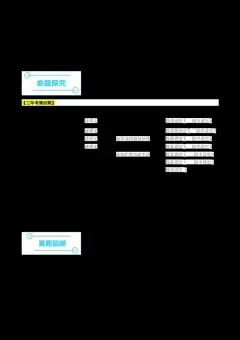
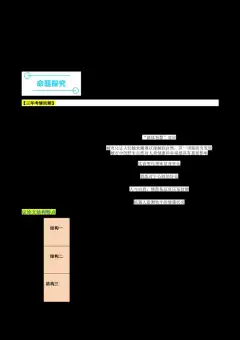
【三年考情回顾】
C篇
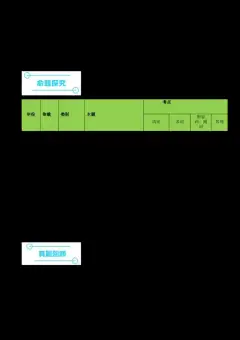
时间 卷次 主题语境 文体 题型分类
2023年 北京卷 人与社会:西方社会在工业化进程中因短视而 议论文 2个推理判断题
带来的种种问题,倡导有远见的思考和长远的
1个主旨要义题
观点
2022年 北京卷 人与社会:阐述了系统思维是应对全球挑战的 说明文 3推理判断题
关键
2021年 北京卷 人与社会:科学家、作家和科研人员联名签署 议论文 3推理判断题
公开信一事向人类发出了警告:政策制定者和
我们其他人必须公开面对全球崩溃的风险
D篇
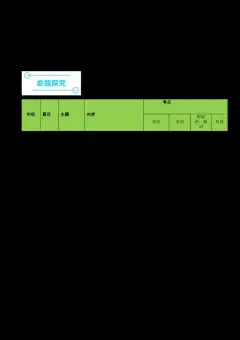
时间 卷次 主题语境 文体 题型分类
2023年 1个推测词义题
人与社会:介绍了人工生命研究的现状和发展
北京卷 说明文 2个推理判断题
前景
1个主旨要义题
2022年 北京卷 1个细节理解题
人与社会:针对量子计算及与其相关的炒作的
1个推理判断题
议论文
不同观点与态度 1个推测词义题
1个主旨要义题
2021年 北京卷 3个推理判断题
人与社会:介绍了一种特殊的记录时间的方式 说明文
1个主旨要义题
C篇和D篇文本难度提高,注重考查学生的高阶思维,以逻辑推理为主,具有良好的区分度,需要考生依据文本
主旨大意和相关段落内容进行合理推断。同时,C篇和D篇词汇量较大,含有较多的长难句,考生要能快速识
别关键信息,培养化繁为简的能力,画出长难句的主干成分,简化复合句,快速准确地理解文本信息,准确解答试
题03-2023北京,C
In recent years, researchers from diverse fields have agreed that short-termism is now a significant problem in
industrialised societies. The inability to engage with longer-term causes and consequences leads to some of the
world's most serious problems:climate change, biodiversity collapse, and more. The historian Francis Cole argues
that the West has entered a period where “only the present exists, a present characterised at once by the cruelty of
the instant and by the boredom of an unending now”.
It has been proved that people have a bias(偏向) towards the present, focusing on loud attractions in the
moment at the expense of the health, well-being and financial stability of their future selves or community. In
business, this bias surfaces as short-sighted decisions. And on slow-burning problems like climate change, it
translates into the unwillingness to make small sacrifices(牺牲) today that could make a major difference
tomorrow. Instead, all that matters is next quarter's profit, or satisfying some other near-term desires.
These biased perspectives cannot be blamed on one single cause. It is fair to say, though, that our
psychological biases play a major role. People's hesitancy to delay satisfaction is the most obvious example, but
there are others. One of them is about how the most accessible information in the present affects decisions about the
future. For instance, you might hear someone say:“It's cold this winter, so I needn't worry about global warming.”
Another is that loud and urgent matters are given too much importance, making people ignore longer-term trends
that arguably matter more. This is when a pop star draws far more attention than, say, gradual biodiversity decline.
As a psychologist once joked, if aliens(外星人) wanted to weaken humanity, they wouldn't send ships;they
would invent climate change. Indeed, when it comes to environmental transformations, we can develop a form of
collective “poor memory”, and each new generation can believe the state of affairs they encounter is nothing out of
the ordinary. Older people today, for example, can remember a time with insect-covered car windscreens after long
drives. Children, on the other hand, have no idea that insect population has dropped dramatically.
1. The author quotes Francis Cole mainly to .
A. draw a comparison B. introduce a topic
C. evaluate a statement D. highlight a problem
2. What can be inferred from the last paragraph?
A. Climate change has been forgotten.B. Lessons of history are highly valued.
C. The human mind is bad at noting slow change.
D. Humans are unwilling to admit their shortcomings.
3. What does the author intend to tell us?
A. Far-sighted thinking matters to humans.
B. Humans tend to make long-term sacrifices.
C. Current policies facilitate future decision-making.
D. Bias towards the present helps reduce near-term desires.
04-2023北京,D
What is life? Like most great questions, this one is easy to ask but difficult to answer. The reason is simple: we
know of just one type of life and it's challenging to do science with a sample size of one. The field of artificial life
—called ALife for short—is the systematic attempt to spell out life's fundamental principles. Many of these
practitioners, so-called ALifers, think that somehow making life is the surest way to really understand what life is.
So far no one has convincingly made artificial life. This track record makes ALife a ripe target for criticism,
such as declarations of the field's doubtful scientific value. Alan Smith, a complexity scientist, is tired of such
complaints. Asking about “the point” of ALife might be, well, missing the point entirely, he says. “The existence of
a living system is not about the use of anything,” Alan says. “Some people ask me, ‘So what's the worth of artificial
life?’ Do you ever think, ‘What is the worth of your grandmother?’”
As much as many ALifers hate emphasising their research's applications, the attempts to create artificial life
could have practical payoffs. Artificial intelligence may be considered ALife's cousin in that researchers in both
fields are enamoured by a concept called open-ended evolution(演化). This is the capacity for a system to create
essentially endless complexity, to be a sort of “novelty generator”. The only system known to exhibit this is Earth's
biosphere. If the field of ALife manages to reproduce life's endless “creativity” in some virtual model, those same
principles could give rise to truly inventive machines.
Compared with the developments of AI, advances in ALife are harder to recognise. One reason is that ALife is
a field in which the central concept—life itself—is undefined. The lack of agreement among ALifers doesn't help
either. The result is a diverse line of projects that each advance along their unique paths. For better or worse, ALife
mirrors the very subject it studies. Its muddled(混乱的) progression is a striking parallel(平行线) to the
evolutionary struggles that have shaped Earth's biosphere.
Undefined and uncontrolled, ALife drives its followers to repurpose old ideas and generate novelty. It may be,of course, that these characteristics aren't in any way surprising or singular. They may apply universally to all acts
of evolution. Ultimately ALife may be nothing special. But even this dismissal suggests something: perhaps, just
like life itself throughout the universe, the rise of ALife will prove unavoidable.
1. Regarding Alan Smith's defence of ALife, the author is .
A.supportive B. puzzled
C. unconcerned D. doubtful
2. What does the word “enamoured” underlined in Paragraph 3 most probably mean?
A. Shocked. B. Protected.
C. Attracted. D. Challenged.
3. What can we learn from this passage?
A. ALife holds the key to human future.
B. ALife and AI share a common feature.
C. AI mirrors the developments of ALife.
D. AI speeds up the process of human evolution.
4. Which would be the best title for the passage?
A. Life Is Undefined. Can AI Be a Way Out?
B. Life Evolves. Can AI Help ALife Evolve, Too?
C. Life Is Undefined. Can ALife Be Defined One Day?
D. Life Evolves. Can Attempts to Create ALife Evolve, Too?
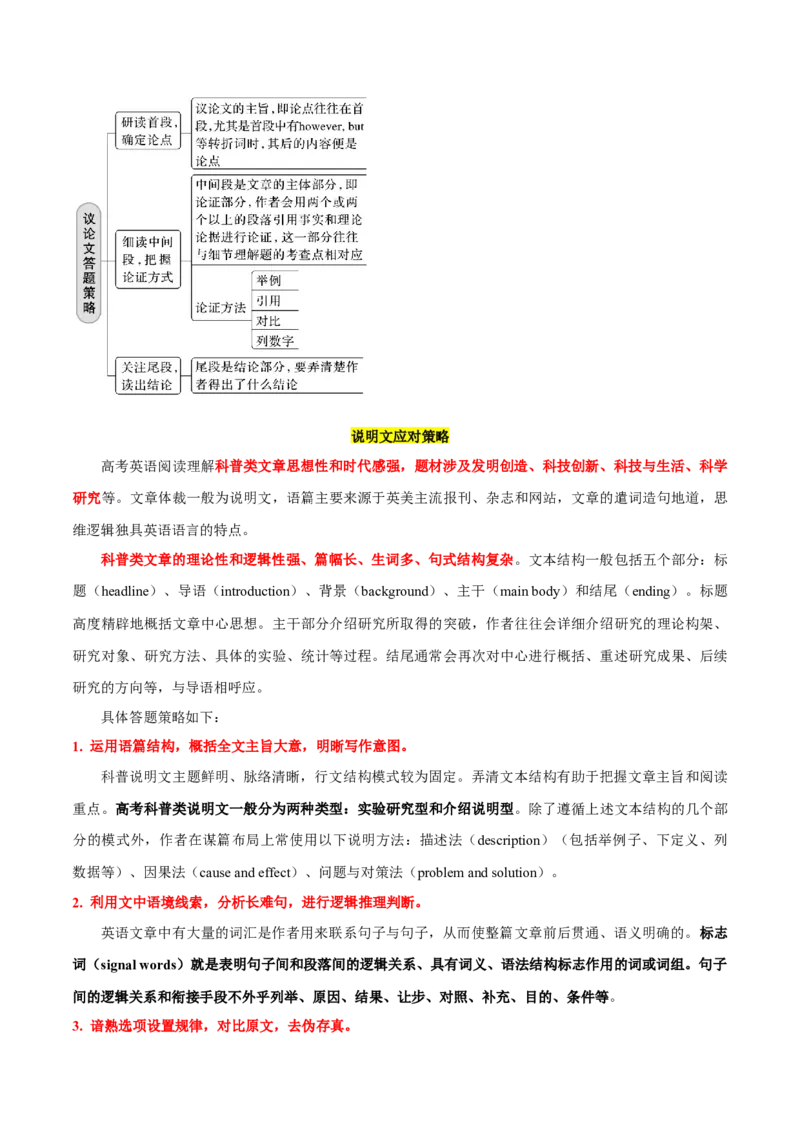
议论文应对策略
高考英语议论文设题广泛,细节理解题、推理判断题、词句猜测题、主旨大意题都有可能出现,因
此,在阅读议论文时,应该从结构和内容两方面同时入手,先通读原文,再区分事实和观点,明确论点、
论证和论据,明了作者最后得出的结论。具体答题策略如下:说明文应对策略
高考英语阅读理解科普类文章思想性和时代感强,题材涉及发明创造、科技创新、科技与生活、科学
研究等。文章体裁一般为说明文,语篇主要来源于英美主流报刊、杂志和网站,文章的遣词造句地道,思
维逻辑独具英语语言的特点。
科普类文章的理论性和逻辑性强、篇幅长、生词多、句式结构复杂。文本结构一般包括五个部分:标
题(headline)、导语(introduction)、背景(background)、主干(main body)和结尾(ending)。标题
高度精辟地概括文章中心思想。主干部分介绍研究所取得的突破,作者往往会详细介绍研究的理论构架、
研究对象、研究方法、具体的实验、统计等过程。结尾通常会再次对中心进行概括、重述研究成果、后续
研究的方向等,与导语相呼应。
具体答题策略如下:
1. 运用语篇结构,概括全文主旨大意,明晰写作意图。
科普说明文主题鲜明、脉络清晰,行文结构模式较为固定。弄清文本结构有助于把握文章主旨和阅读
重点。高考科普类说明文一般分为两种类型:实验研究型和介绍说明型。除了遵循上述文本结构的几个部
分的模式外,作者在谋篇布局上常使用以下说明方法:描述法(description)(包括举例子、下定义、列
数据等)、因果法(cause and effect)、问题与对策法(problem and solution)。
2. 利用文中语境线索,分析长难句,进行逻辑推理判断。
英语文章中有大量的词汇是作者用来联系句子与句子,从而使整篇文章前后贯通、语义明确的。标志
词(signal words)就是表明句子间和段落间的逻辑关系、具有词义、语法结构标志作用的词或词组。句子
间的逻辑关系和衔接手段不外乎列举、原因、结果、让步、对照、补充、目的、条件等。
3. 谙熟选项设置规律,对比原文,去伪存真。注意干扰项“张冠李戴”、“偷梁换柱”、“无中生有”和“以偏概全”四种类型。
“张冠李戴”是命题者把文章作者的观点与他人的观点混淆起来,或者把文中不同地方的信息拼接在
一起从而改变了原文的意思。
“偷梁换柱”类型是用了与原文相似的句型结构和大部分相似的词汇,却在不易引人注意的地方换了
几个表示程度、限定的词汇,造成句意的改变。
“无中生有”类型往往是生活的基本常识和普遍接受的观点,貌似非常正确,但在原文中并无相关的
信息支持,这种选项的设置往往与问题的设问毫不相干。
“以偏概全”则是以局部代替整体,进行不合理关联或者不准确的概括。在下文的例子中,同学们可
以更加清楚直观地了解干扰项的特点,在解题时,绕开陷阱,去伪存真。
说明文解题策略
1.细读文章重点
关注文章结构;文章主题句;各段首末句;体现作者观点态度的词句。
2.明确说明对象
通读全文,明确作者是针对哪一个说明对象从不同的角度和侧面对其加以说明的。在阅读过程中要概
括、总结每一段说明的侧重点,理清各段之间的逻辑联系,加深对说明对象的理解。
3.弄清说明顺序
在说明的过程中作者会选择合理的说明顺序对说明对象进行有条不紊的解说。把握了说明顺序,就能
准确把握文章的脉络,加深对整篇文章的理解。
4.把握作者态度
说明文的首段一般借用生活中的某个场景事件引入说明的事物。一般穿插人们对被说明事物的看法和
观点,要仔细体会观点的倾向性和情感色彩,来对比作者态度和写作情感。
5.吃透长难句子
学会运用括号法分析长难句,把影响考生理解的各种从句、非谓语动词短语以及复杂介词短语括起
来,从而达到“去枝叶,留主干”的目的,进而准确理解句子含义。
6.学会适当放弃
无关大局的生僻词汇阅读中经常会遇到一些生词,如果这些生词对理解全文没有影响或影响不大就可
略过。较长的人名、地名有许多较长的表示人名、地名等的专有名词,阅读时可一扫而过或干脆用其首字
母代替,不必试图把整个专有名词读出来。议论文
一
(2024届北京门市头沟区一模)
D
A recent global study, which surveyed 10,000 young people from 10 countries, showed that nearly 60 percent
of them were extremely worried about the future state of the planet. The report, which was published in The
Lancet, also showed that nearly half of the respondents said that such distress affected them daily, and three
quarters agreed with the statement that “the future is frightening.” This, along with many other studies, shows
clearly that climate change is not just a threat to the environment that we inhabit. It also poses a very real threat to
our emotional well-being. Psychologists have categorized these feelings of grief and worry about the current
climate emergency, a common occurrence among youth today, under the label of “eco-anxiety”.
Eco-anxiety doesn’t just affect young people. It also affects researchers who work in climate and ecological
science, burdened by the reality depicted by their findings, and it affects the most economically marginalized (边缘
化的) across the globe, who bear the damaging impacts of climate breakdown.
In 2024, eco-anxiety will rise to become one of the leading causes of mental health problems. The reasons are
obvious. Scientists estimate that the world is likely to breach safe limits of temperature rise above pre-industrial
levels for the first time by 2027.
In recent years, we’ve seen wildfires tear through Canada and Greece, and summer floods ruin regions in
Pakistan that are home to nearly 33 million people. Studies have shown that those impacted by air pollution and
rising temperatures are more likely to experience psychological distress.
To make matters worse, facing climate crisis, our political class is not offering strong leadership. The COP28
conference in Dubai will be headed by an oil and gas company executive. In the UK, the government is
backtracking on its green commitments.
Fortunately, greater levels of eco-anxiety will also offer an avenue for resolving the climate crisis directly.
According to Caroline Hickman, a researcher on eco-anxiety from the University of Bath, anyone experiencing
eco-anxiety is displaying entirely natural and rational reactions to the climate crisis. This is why, in 2024, we will
also see more people around the world join the fight for climate justice and seek jobs that prioritize environmental
sustainability. Campaigners will put increased pressure on fossil fuel industries and the governments to rapidly
abandon the usage of polluting coal, oil, and gas.
It’s now clear that not only are these industries the main causes for the climate crisis, they are also responsiblefor the mental health crisis, which is starting to affect most of us. Eco-anxiety is not something we will defeat with
therapy, but something we will tackle by taking action.
31. What can we learn from the passage?
A. The cause of eco-anxiety is emotions existing in our mind.
B. People in developed countries are more likely to suffer from eco-anxiety.
C. Eco-anxiety is a new kind of psychological disease due to climate change.
D. The author is disappointed about government behaviour towards climate crisis.
32. What does the underlined word “breach” in Paragraph 3 most probably mean?
A. Break. B. Reach. C. Raise. D. Affect.
33. As for Caroline Hickman’s opinion on eco-anxiety, the author is .
A. puzzled B. favourable C. suspicious D. unconcerned
34. What would be the best title for the passage?
A. Who Is to Blame for Eco-anxiety?
B. How Should You See Eco-anxiety?
C. How Will Eco-anxiety Be Resolved?
D. Why Do People Suffer from Eco-anxiety?
二
If you want to tell the history of the whole world, a history that does not privilege one part of humanity, you
cannot do it through texts alone, because only some of the world has ever had texts, while most of the world, for
most of the time, has not. Writing is one of humanity’s later achievements, and until fairly recently even many
literate (有文字的) societies recorded their concerns not only in writing but in things.
Ideally a history would bring together texts and objects, and some chapters of this book are able to do just that,
but in many cases we simply can’t. The clearest example of this between literate and non-literate history is perhaps
the first conflict, at Botany Bay, between Captain Cook’s voyage and the Australian Aboriginals. From the English
side, we have scientific reports and the captain’s record of that terrible day. From the Australian side, we have only
a wooden shield (盾) dropped by a man in flight after his first experience of gunshot. If we want to reconstruct what
was actually going on that day, the shield must be questioned and interpreted as deeply and strictly as the written
reports.
In addition to the problem of miscomprehension from both sides, there are victories accidentally or
deliberately twisted, especially when only the victors know how to write. Those who are on the losing side often
have only their things to tell their stories. The Caribbean Taino, the Australian Aboriginals, the African people ofBenin and the Incas, all of whom appear in this book, can speak to us now of their past achievements most
powerfully through the objects they made: a history told through things gives them back a voice. When we consider
contact (联系) between literate and non-literate societies such as these, all our first-hand accounts are necessarily
twisted, only one half of a dialogue. If we are to find the other half of that conversation, we have to read not just
the texts, but the objects.
32. What is the first paragraph mainly about?
A. How past events should be presented. B. What humanity is concerned about.
C. Whether facts speak louder than words. D. Why written language is reliable.
33. What does the author indicate by mentioning Captain Cook in paragraph 2?
A. His report was scientific. B. He represented the local people.
C. He ruled over Botany Bay. D. His record was one-sided.
34. What does the underlined word “conversation” in paragraph 3 refer to?
A. Problem. B. History. C. Voice.D. Society.
35. Which of the following books is the text most likely selected from?
A. How Maps Tell Stories of the World B. A Short History of Australia
C. A History of the World in 100 Objects D. How Art Works Tell Stories
三
Sometime in the early 1960s, a significant thing happened in Sydney, Australia. The city discovered its harbor.
Then, one after another, Sydney discovered lots of things that were just sort of there — broad parks, superb
beaches, and a culturally diverse population. But it is the harbor that makes the city.
Andrew Reynolds, a cheerful fellow in his early 30s, pilots Sydney ferryboats for a living. I spent the whole
morning shuttling back and forth across the harbor. After our third run Andrew shut down the engine, and we went
our separate ways — he for a lunch break, I to explore the city.
“I’ll miss these old boats,” he said as we parted.
“How do you mean?” I asked.
“Oh, they’re replacing them with catamarans. Catamarans are faster, but they’re not so elegant, and they’re not
fun to pilot. But that’s progress, I guess.”
Everywhere in Sydney these days, change and progress are the watchwords (口号), and traditions are
increasingly rare. Shirley Fitzgerald, the city’s official historian, told me that in its rush to modernity in the 1970s,
Sydney swept aside much of its past, including many of its finest buildings. “Sydney is confused about itself,” she
said. “We can’t seem to make up our minds whether we want a modern city or a traditional one. It’s a conflict thatwe aren’t getting any better at resolving (解决).”
On the other hand, being young and old at the same time has its attractions. I considered this when I met a
thoughtful young businessman named Anthony. “Many people say that we lack culture in this country,” he told me.
“What people forget is that the Italians, when they came to Australia, brought 2000 years of their culture, the
Greeks some 3000 years, and the Chinese more still. We’ve got a foundation built on ancient cultures but with a
drive and dynamism of a young country. It’s a pretty hard combination to beat.”
He is right, but I can’t help wishing they would keep those old ferries.
32. What is the first paragraph mainly about?
A. Sydney’s striking architecture. B. The cultural diversity of Sydney.
C. The key to Sydney’s development. D. Sydney’s tourist attractions in the 1960s.
33. What can we learn about Andrew Reynolds?
A. He goes to work by boat. B. He looks forward to a new life.
C. He pilots catamarans well. D. He is attached to the old ferries.
34. What does Shirley Fitzgerald think of Sydney?
A. It is losing its traditions. B. It should speed up its progress.
C. It should expand its population. D. It is becoming more international.
35. Which statement will the author probably agree with?
A. A city can be young and old at the same time.
B. A city built on ancient cultures is more dynamic.
C. modernity is usually achieved at the cost of elegance.
D. Compromise should be made between the local and the foreign.
四
Who is a genius? This question has greatly interested humankind for centuries.
Let's state clearly: Einstein was a genius. His face is almost the international symbol for genius. But we want
to go beyond one man and explore the nature of genius itself. Why is it that some people are so much more
intelligent or creative than the rest of us? And who are they?
In the sciences and arts, those praised as geniuses were most often white men, of European origin. Perhaps this
is not a surprise. It's said that history is written by the victors, and those victors set the standards for admission to
the genius club. When contributions were made by geniuses outside the club—women, or people of a different
color or belief—they were unacknowledged and rejected by others.
A study recently published by Science found that as young as age six, girls are less likely than boys to say thatmembers of their gender (性别) are “really, really smart.” Even worse, the study found that girls act on that belief:
Around age six they start to avoid activities said to be for children who are “really, really smart.” Can our planet
afford to have any great thinkers become discouraged and give up? It doesn't take a genius to know the answer:
absolutely not.
Here's the good news. In a wired world with constant global communication, we're all positioned to see flashes
of genius wherever they appear. And the more we look, the more we will see that social factors(因素)like gender,
race, and class do not determine the appearance of genius. As a writer says, future geniuses come from those with
“intelligence, creativity, perseverance (毅力), and simple good fortune, who are able to change the world.”
12. What does the author think of victors' standards for joining the genius club?
A. They're unfair. B. They're conservative. C. They're objective. D. They're strict.
13. What can we infer about girls from the study in Science?
A. They think themselves smart.
B. They look up to great thinkers.
C. They see gender differences earlier than boys.
D. They are likely to be influenced by social beliefs
14. Why are more geniuses known to the public?
A. Improved global communication.
B. Less discrimination against women.
C. Acceptance of victors' concepts.
D. Changes in people's social positions.
15. What is the best title for the text?
A. Geniuses Think Alike B. Genius Takes Many Forms
C. Genius and Intelligence D. Genius and Luck
五
Think “art”. What comes to your mind? Is it Greek or Roman sculptures in the Louvre, or Chinese paintings in
the Palace Museum? Or maybe, just maybe, it’s a dancing pattern of lights?
The artworks by American artist Janet Echelman look like colourful floating clouds when they are lit up at
night. Visitors to one of her artworks in Vancouver could not only enjoy looking at it, they could also interact with
it-literally. They did this by using their phones to change its colours and patterns. Exhibits such as these are
certainly new and exciting, but are they really art?
Whatever your opinion, people have been expressing their thoughts and ideas through art for thousands ofyears. To do this, they have used a variety of tools and technologies. Yet Michelangelo and others have been
labelled (定义) as “artists”, but not “technicians”. This means that art and technology, have always been seen as
two very separate (不同的) things.
Today, however, technological advances have led to a combination of art and technology. As a result, the art
world is changing greatly. Now art is more accessible to us than ever before. Take for example one of China’s most
famous paintings from the Song Dynasty, Along the River During the Qingming Festival. As this artwork is rarely
on display, people have sometimes queued up to six hours for a chance to see it. Once in front of the painting, they
only have limited time to spend taking in its five metres of scenes along the Bian River in Bianjing. Thanks to
technology however, millions more people have been able to experience a digital version of this painting. Three-
dimensional (3D) animation means that viewers can see the characters move around and interact with their
surroundings. They can also watch as the different scenes change from daylight into nighttime.
The art-tech combination (结合) is also changing our concepts of “art” and the “artist”. Not only can we
interact with art, but also take part in its creation. With new technological tools at our fingertips, more and more
people are exploring their creative sides. The result has been exciting new art forms, such as digital paintings and
videos.
However, where technology will take art next is anyone’s guess. But one thing is for sure—with so many
artists exploring new possibilities, we can definitely expect the unexpected.
1. What’s the function of the first paragraph?
A. To explain the art. B. To introduce the topic.
C. To give the background. D. To give a definition.
2. Why is “Michelangelo” referred to in the third paragraph?
A. To show he is a famous artist. B. To show he is also a technician.
C. To show art is different from technology. D. To show art is the same as technology.
3. What’s mainly talked about in the passage?
A. The history of technology and art. B. The relation of technology and art.
C. The future of technology and art. D. The examples of technology and art.
4. What can we know about the author’s attitude to the combination of art and technology ?
A. Positive. B. Negative. C. Doubtful. D. Uncertain
说明文
一
(2024届北京市东城区等5区高三下学期一模)C
Time is one of humanity’s greatest blind spots. We experience it as days, months or years. But nature functions
on much grander scales, measured in centuries, and even longer phases often grouped as “deep time.” Humanity’s
shortsightedness around time creates major limits on modern conservation. As the climate and biodiversity crises
accelerate, we are urgently working to protect and regenerate ecosystems without understanding how they
functioned when they were truly doing well. A deep time perspective can help change that.
Take forest management. For decades, our practices called for all-out prevention of even the mildest forest
fires, believing that fire was bad for both people and nonhuman nature. Until recently we ignored the forest
management strategies indigenous (土著的) communities had successfully used for centuries, in particular the
application of small-scale controlled burns. Fire, it turns out, has always been an integral ingredient in healthy
forest ecosystems, promoting new growth by thinning the understory. Today, we’re beginning to see widespread
application of indigenous knowledge to forest management, tapping into this ancient wisdom.
But how can we know what an ecosystem looked like centuries ago? One pathway is through modern
mathematical modeling. We have married it with streams of long-term data and discovered a possible way to
preserve the ecosystem of California’s kelp forest. By examining how North Pacific kelp forests existed long before
the 19th century, we found that we’ve ignored the presence of a keystone species—the Steller’s sea cow, and its
role in maintaining the harmony of this ecosystem.
Our model described the interactions between giant kelp and understory algae competing for light and space
on the seafloor. Then we ran the model again, but this time with the Steller’s sea cow added in. These mammals fed
on the leaves from the upper kelp layers. This allowed light to reach the sea bottom, which in turn stimulated the
growth of not only the kelp but other kinds of organisms. In re-creating that vanished historical system that
included the Steller’s sea cow, we could see a more diverse forestwhere the understory competed better with kelp
In short, what we assume we know about an ecosystem based on the recent past may impede our ability to
fully understand and protect it. To ensure that our boldest conservation efforts are successful, we must begin
looking at time as an essential tool.
28. According to the passage, what gets in the way of human’s conservation efforts?
A. Lack of insights into deep time B. The worsening of biodiversity crises
C. The blindness to management strategies. D. Resistance to taking a deep time perspective.
29. What can we learn from the passage?
A. Ignoring the Steller’s sea cow led to ecological imbalance.B. People now prioritize fire prevention over controlled burns.
C. Mathematical modeling matters more than indigenous knowledge
D. Harvesting upper kelp leaves encourages fresh growth in the understory.
30. What does the underlined word “impede” in the last paragraph probably mean?
A. Bring forth. B. Boost up. C. Shut down. D. Hold back.
二
(2024届北京市东城区等5区高三下学期一模)
D
Several dozen graduate students in London were recently tasked with outwitting a large language model
(LLM), a type of AI designed to hold useful conversations. LLMs are often programmed with guardrails designed
to stop them giving harmful replies: instructions on making bombs in a bathtub, say, or the confident statement of
“facts” that are not actually true.
The aim of the task was to break those guardrails. Some results were merely stupid. For example, one
participant got the chatbot to claim ducks could be used as indicators of air quality. But the most successful efforts
were those that made the machine produce the titles, publication dates and host journals of non-existent academic
articles.
AI has the potential to be a big benefit to science. Optimists talk of machines producing readable summaries of
,
complicated areas of research; tirelessly analysing oceans of data to suggest new drugs and even one day, coming
up with hypotheses of their own. But AI comes with downsides, too.
Start with the simplest problem: academic misconduct.Some journals allow researchers to use LLMs to help
write papers. But not everybody is willing to admit to it. Sometimes, the fact that LLMs have been used is obvious.
Guillaume Cabanac, a computer scientist, has uncovered dozens of papers that contain phrases such as “regenerate
response” — the text of a button in some versions of ChatGPT that commands the program to rewrite its most
recent answer, probably copied into the manuscript (原稿) by mistake.
Another problem arises when AI models are trained on AI-generated data. LLMs are trained on text from the
Internet. As they churn out (大量炮制) more such text, the risk of LLMs taking in their own outputs grows. That
can cause “model collaps”. In 2023 llia Shumailov, a computer scientist, co-authored a paper in which a model was
fed handwritten digits and asked to generate digits of its own, which were fed back to it in turn. After a few cycles,
the computer’s numbers became more or less illegible.After 20iterations (迭代), it could produce only rough circles
or blurry lines.Some worry that computer-generated insights might come from models whose inner workings are not
understood. Inexplainable models are not useless, says David Leslie at an AI-research outfit in London, but their
outputs will need rigorous testing in the real world. That is perhaps less unnerving than it sounds. Checking models
against reality is what science is supposed to be about, after all.
For now, at least, questions outnumber answers. The threats that machines pose to the scientific method are, at
the end of the day, the same ones posed by humans. AI could accelerate the production of nonsense just as much as
it accelerates good science. As the Royal Society has it,nullius in verba: take nobody’s word for it. No thing’s,
either.
31. The result of the task conducted in London shows that ________.
A. LLMs give away useful information B. the guardrails turn out to be ineffective
C. AI’s influence will potentially be decreased D. the effort put into the study of AI hardly pays off
32. What does “model collapse” indicate?
A. The readability of the models’output is underestimated.
B. The diverse sources of information confuse the models.
C. Training on regenerated data stops models working well.
D. The data will become reliable after continuous iterations.
33. According to the passage, people’s worry over the inexplainable models is __________.
A. impractical B. unjustified C. groundless D. unsettling
34. What would be the best title for the passage?
A. Faster Nonsense: AI Could Also Go Wrong
B. Imperfect Models: How Will AI Make Advances?
C. The Rise of LLMs: AI Could Still Be Promising
D. Bigger Threats: AI Will Be Uncontrollable
三
(2024届北京门市头沟区一模)
C
Artificial intelligence is almost twice as accurate as a biopsy (活组织检查) at judging the aggressiveness of
some cancers, experts say. Cancer kills 10 million people globally every year, according to the WHO. But for
patients the disease can be prevented if detected instantly and dealt with quickly.
A recent study suggested an AI algorithm (算法) was far better than a biopsy at correctly grading the
aggressiveness of sarcomas (肉瘤), a rare form of cancer. Researchers hope AI will improve outcomes for patientsby giving doctors a more accurate way of grading tumours (肿瘤). Because high-grade tumours can indicate
aggressive disease, the tool could help ensure those high-risk patients are identified more quickly and treated
instantly. Low-risk patients could also be spared unnecessary treatments, follow-up scans and hospital visits.
Researchers say the algorithm could be applied to other types of cancer in future. The team specifically looked
at retroperitoneal sarcomas, which develop at the back of the abdomen and are difficult to diagnose (诊断) and treat
due to their location. They used CT scans from 170 patients with the two most common forms of retroperitoneal
sarcoma — leiomyosarcoma and liposarcoma. Using data from these scans they created an AI algorithm, which was
then tested on 89 patients in other countries. In grading how aggressive the tumour was, the technology was
accurate in 82% of the cases, while biopsies were 44%.
AI could also recognize leiomyosarcoma and liposarcoma in 84% of sarcomas tested, while radiologists were
able to identify them in 65% of the cases. Christina Messiou, the study leader, said: “We’re incredibly excited by
the potential of this state-of-the-art technology, which could lead to patients having better outcomes through faster
diagnosis. As patients with retroperitoneal sarcoma are routinely scanned with CT, we hope this tool will eventually
be used globally, ensuring that not just specialist centres can reliably identify and grade the disease.”
Richard Davison, chief executive of Sarcoma UK, said the results looked “very promising”. He added:
“People are more likely to survive sarcoma if diagnosed early. One in six people with sarcoma cancer wait more
than a year to receive an accurate diagnosis, so any research that helps patients receive better treatment and support
is welcome.”
28. According to the passage, AI is capable of .
A. grading the risk of sarcomas
B. measuring the scale of sarcomas
C. providing cancer treatment for clinicians
D. classifying cancers with its advanced algorithm
29. What can be inferred from this passage?
A. More sarcomas can be detected with the help of AI.
B. Biopsies will be replaced by AI algorithm in identifying cancers.
C. More patients suffering from cancers will benefit from AI algorithm.
D. AI algorithm has been applied in hospitals for detecting most cancers.
30. What is the passage mainly about?
A. AI has a profound market in curing cancers.B. New treatments for sarcomas are well underway.
C. AI helps identify high-risk and low-risk patients.
D. AI does better in assessing some types of sarcomas.
四
(2024届北京市西城区高三下学期一模)
C
Evan Selinger, professor in RIT’s Department of Philosophy, has taken an interest in the ethics (伦理标准) of
Al and the policy gaps that need to be filled in. Through a humanities viewpoint, Selinger asks the questions, “How
can AI cause harm, and what can governments and companies creating Al programs do to address and manage it?”
Answering them, he explained, requires an interdisciplinary approach.
“AI ethics go beyond technical fixes. Philosophers and other humanities experts are uniquely skilled to address
the nuanced (微妙的) principles, value conflicts, and power dynamics. These skills aren’t just crucial for
addressing current issues. We desperately need them to promote anticipatory (先行的) governance, ” said Selinger.
One example that illustrates how philosophy and humanities experts can help guide these new, rapidly
growing technologies is Selinger’s work collaborating with a special AI project. “One of the skills I bring to the
table is identifying core ethical issues in emerging technologies that haven’t been built or used by the public. We
can take preventative steps to limit risk, including changing how the technology is designed, ”said Selinger.
Taking these preventative steps and regularly reassessing what risks need addressing is part of the ongoing
journey in pursuit of creating responsible AI. Selinger explains that there isn’t a step-by-step approach for good
governance. “AI ethics have core values and principles, but there’s endless disagreement about interpreting and
applying them and creating meaningful accountability mechanisms, ” said Selinger. “Some people are rightly
worried that AI can become integrated into ‘ethics washing’-weak checklists, flowery mission statements, and
empty rhetoric that covers over abuses of power. Fortunately, I’ve had great conversations about this issue,
including with some experts, on why it is important to consider a range of positions. ”
Some of Selinger’s recent research has focused on the back-end issues with developing AI, such as the human
impact that comes with testing AI chatbots before they’re released to the public. Other issues focus on policy, such
as what to do about the dangers posed by facial recognition and other automated surveillance(监视) approaches.
Selinger is making sure his students are informed about the ongoing industry conversations on AI ethics and
responsible AI. “Students are going to be future tech leaders. Now is the time to help them think about what goals
their companies should have and the costs of minimizing ethical concerns. Beyond social costs, downplaying ethicscan negatively impact corporate culture and hiring, ” said Selinger. “To attract top talent, you need to consider
whether your company matches their interests and hopes for the future. ”
28. Selinger advocates an interdisciplinary approach because ________.
A. humanities experts possess skills essential for AI ethics
B. it demonstrates the power of anticipatory governance
C. AI ethics heavily depends on technological solutions
D. it can avoid social conflicts and pressing issues
29. To promote responsible AI, Selinger believes we should ________.
A. adopt a systematic approach B. apply innovative technologies
C. anticipate ethical risks beforehand D. establish accountability mechanisms
30. What can be inferred from the last two paragraphs?
A. More companies will use AI to attract top talent.
B. Understanding AI ethics will help students in the future.
C. Selinger favors companies that match his students’ values.
D. Selinger is likely to focus on back-end issues such as policy.
五
(2024届北京市西城区高三下学期一模)
D
While some allergies (过敏症) disappear over time or with treatment, others last a lifetime. For decades,
scientists have been searching for the source of these lifetime allergies.
Recently, researchers found that memory B cells may be involved. These cells produce a different class of
antibodies known as IgG, which ward off viral infections. But no one had identified exactly which of those cells
were recalling allergens or how they switched to making the IgE antibodies responsible for allergies. To uncover
the mysterious cells, two research teams took a deep dive into the immune (免疫的) cells of people with allergies
and some without.
Immunologist Joshua Koenig and colleagues examined more than 90, 000 memory B cells from six people
with birch allergies, four people allergic to dust mites and five people with no allergies. Using a technique called
RNA sequencing, the team identified specific memory B cells, which they named MBC2s that make antibodies and
proteins associated with the immune response that causes allergies.
In another experiment, Koenig and colleagues used a peanut protein to go fishing for memory B cells from
people with peanut allergies. The team pulled out the same type of cells found in people with birch and dust miteallergies. In people with peanut allergies, those cells increased in number and produced IgE antibodies as the people
started treatment to desensitize them to peanut allergens.
Another group led by Maria Curotto de Lafaille, an immunologist at the Icahn School of Medicine at Mount
Sinai in New York City, also found that similar cells were more plentiful in 58 children allergic to peanuts than in
13 kids without allergies. The team found that the cells are ready to switch from making protective IgG antibodies
to allergy-causing IgE antibodies. Even before the switch, the cells were making RNA for IgE but didn’t produce
the protein. Making that RNA enables the cells to switch the type of antibodies they make when they encounter
allergens. The signal to switch partially depends on a protein called JAK, the group discovered. “Stopping JAK
from sending the signal could help prevent the memory cells from switching to IgE production,” Lafaille says. She
also predicts that allergists may be able to examine aspects of these memory cells to forecast whether a patient's
allergy is likely to last or disappear with time or treatment.
“Knowing which population of cells store allergies in long-term memory may eventually help scientists
identify other ways to kill the allergy cells,” says Cecilia Berin, an immunologist at Northwestern University
Feinberg School of Medicine. “You could potentially get rid of not only your peanut allergy but also all of your
allergies.”
31. Why did scientists investigate the immune cells of individuals with and without allergies?
A. To explore the distinctions between IgG and IgE.
B. To uncover new antibodies known as IgG and IgE.
C. To identify cells responsible for defending against allergies.
D. To reveal cells associated with the development of allergies.
32. What does the word “desensitize” underlined in Paragraph 4 most probably mean?
A. Make. . . less destructive. B. Make. . . less responsive.
C. Make. . . less protective. D. Make. . . less effective.
33. What can we learn from the two research teams’ work?
A. MBC2s make antibodies and proteins that prevent allergies.
B. Memory B cells generate both RNA for IgE and the corresponding protein.
C. JAK plays a role in controlling antibody production when exposed to allergens.
D. Allergists are capable of predicting whether an allergy will last or disappear.
34. Which could be the best title for the passage?
A. RNA Sequencing Is Applied in Immunology Research
B. Specific Cells Related to Peanut Allergies Are IdentifiedC. Unmasking Cells’ Identities Helps Diagnose and Treat Allergies
D. Newfound Immune Cells Are Responsible for Long-lasting Allergies
六
On March 7, 1907, the English statistician Francis Galton published a paper which illustrated what has come
to be known as the “wisdom of crowds” effect. The experiment of estimation he conducted showed that in some
cases, the average of a large number of independent estimates could be quite accurate.
This effect capitalizes on the fact that when people make errors, those errors aren’t always the same. Some
people will tend to overestimate, and some to underestimate. When enough of these errors are averaged together,
they cancel each other out, resulting in a more accurate estimate. If people are similar and tend to make the same
errors, then their errors won’t cancel each other out. In more technical terms, the wisdom of crowds requires that
people’s estimates be independent. If for whatever reasons, people’s errors become correlated or dependent, the
accuracy of the estimate will go down.
But a new study led by Joaquin Navajas offered an interesting twist (转折) on this classic phenomenon. The
key finding of the study was that when crowds were further divided into smaller groups that were allowed to have a
discussion, the averages from these groups were more accurate than those from an equal number of independent
individuals. For instance, the average obtained from the estimates of four discussion groups of five was
significantly more accurate than the average obtained from 20 independent individuals.
In a follow-up study with 100 university students, the researchers tried to get a better sense of what the group
members actually did in their discussion. Did they tend to go with those most confident about their estimates? Did
they follow those least willing to change their minds? This happened some of the time, but it wasn’t the dominant
response. Most frequently, the groups reported that they “shared arguments and reasoned together.” Somehow,
these arguments and reasoning resulted in a global reduction in error. Although the studies led by Navajas have
limitations many questions remain the potential implications for group discussion and decision-making are
enormous.
12. What is paragraph 2 of the text mainly about?
A. The methods of estimation. B. The underlying logic of the effect.
C. The causes of people’s errors. D. The design of Galton’s experiment.
13. Navajas’ study found that the average accuracy could increase even if ________.
A. the crowds were relatively small B. there were occasional underestimates
C. individuals did not communicate D. estimates were not fully independent14. What did the follow-up study focus on?
A. The size of the groups. B. The dominant members.
C. The discussion process. D. The individual estimates.
15. What is the author’s attitude toward Navajas’ studies?
A. Unclear. B. Dismissive. C. Doubtful. D. Approving.
七
As cities balloon with growth, access to nature for people living in urban areas is becoming harder to find. If
you’re lucky, there might be a pocket park near where you live, but it’s unusual to find places in a city that are
relatively wild.
Past research has found health and wellness benefits of nature for humans, but a new study shows that
wildness in urban areas is extremely important for human well-being.
The research team focused on a large urban park. They surveyed several hundred park-goers, asking them to
submit a written summary online of a meaningful interaction they had with nature in the park. The researchers then
examined these submissions, coding (编码) experiences into different categories. For example, one participant’s
experience of “We sat and listened to the waves at the beach for a while” was assigned the categories “sitting at
beach” and “listening to waves.”
Across the 320 submissions, a pattern of categories the researchers call a “nature language” began to emerge.
After the coding of all submissions, half a dozen categories were noted most often as important to visitors. These
include encountering wildlife, walking along the edge of water, and following an established trail.
Naming each nature experience creates a usable language, which helps people recognize and take part in the
activities that are most satisfying and meaningful to them. For example, the experience of walking along the edge
of water might be satisfying for a young professional on a weekend hike in the park. Back downtown during a
workday, they can enjoy a more domestic form of this interaction by walking along a fountain on their lunch break.
“We’re trying to generate a language that helps bring the human-nature interactions back into our daily lives.
And for that to happen, we also need to protect nature so that we can interact with it,” said Peter Kahn, a senior
author of the study.
12. What phenomenon does the author describe at the beginning of the text?
A. Pocket parks are now popular. B. Wild nature is hard to find in cities.
C. Many cities are overpopulated. D. People enjoy living close to nature.
13. Why did the researchers code participant submissions into categories?A. To compare different types of park-goers.
B. To explain why the park attracts tourists.
C. To analyze the main features of the park.
D. To find patterns in the visitors’ summaries.
14. What can we learn from the example given in paragraph 5?
A. Walking is the best way to gain access to nature.
B. Young people are too busy to interact with nature.
C. The same nature experience takes different forms.
D. The nature language enhances work performance.
15. What should be done before we can interact with nature according to Kahn?
A. Language study. B. Environmental conservation.
C. Public education. D. Intercultural communication.