第 07 讲 阅读理解说明文
目录
01 模拟基础练
【题型一】科普类说明文的考查
【题型二】动植物介绍类说明文的考查
【题型三】社会文化类说明文的考查
02 重难创新练
03 真题实战练
题型一 科普类说明文的考查
1.(23-24高三·江西赣州·期中)In 2022, a New Zealand woman became the first to receive a gene-editing
treatment to permanently lower her cholesterol (胆固醇). The woman had heart disease, along with an inherited
risk for high cholesterol. But scientists behind the experimental treatment are considering how it could help pretty
much anyone.
The trial is a potential turning point for CRISPR, the editing tool they used. Since the technology was first
programmed to edit genomes (基因组) about a decade ago, we’ve seen CRISPR from scientific labs made much
progress. But the first experimental treatments have focused on rare genetic disorders. They are working on more
possibilities treating common disease like high cholesterol.
The cholesterol-lowering treatment, developed by Verve Therapeutics, relies on a form of gene editing called
base editing, or “CRISPR 2.0”. It’s a more targeted approach. Instead of simply making cuts to shut off specific
genes, scientists can now exchange a single DNA base for another. In theory, this should be safer because you’re
less likely to cut an important gene by mistake, and you can be less likely to make mistakes that may occur when
DNA repairs itself after being cut.
An even newer form of CRISPR could take things further still. Prime Editing — or “CRISPR 3.0” — allows
scientists to put chunks (块) of DNA into a genome. If it works in people, it could let scientists replace disease-
causing genes.
Together, these newer forms of CRISPR could broaden the possibilities of gene editing to take on many
conditions — not all of them genetic. Someday, people may have the option to add genes thought to protect againsthigh blood pressure, or certain diseases, to their genetic code.
All CRISPR treatments are experimental at this point, and we don’t know if they’re safe. Some argue we
should focus on treating those with severe diseases in the meantime. But if these new forms of CRISPR do work,
they could help many others.
1.What are scientists focusing on in the gene-editing treatment?
A.Its great success. B.Its wider application.
C.Its immediate effects. D.Its target patients.
2.Why does the author think that CRISPR 2.0 is theoretically safer?
A.It can shut off specific genes. B.It can avoid potential errors.
C.It’s likely to reduce DNA base damage. D.It provides protection for the genome.
3.What could be the innovative practice of Prime Editing?
A.Making cuts to shut off specific genes. B.Providing treatment for genetic diseases.
C.Exchanging a single DNA base for another. D.Taking the place of disease-causing genes.
4.What can be inferred from the text?
A.CRISPR treatments haven’t entered human trials.
B.Prime editing is being tested in the scientific lab.
C.Prime editing targets diseases caused by genetic disorders.
D.Verve’s cholesterol-lowering treatments are approved for use.
2.(2024·四川达州·二模)With the ocean covering more than 70% of the Earth’s surface, the National
Oceanic and Atmospheric Administration (NOAA) said scientists and researchers had depended on sonar (声呐)
technologies to understand and map the sea floor which had charted only about 10% of the world’s ocean. For the
ocean and coastal waters in the US, the number is just around 35%.
We know less about our planet’s ocean than what we know about the far side of the moon or the surface of
Mars. Part of the reason for the lack of observation is the challenge of powering an underwater camera. Researchers
have used ships to recharge cameras or observed with a camera tied to a ship to solve the issue, which is expensive
and unsuitable for long-term observations.
Recently, researchers at the Massachusetts Institute of Technology (MIT) have taken a major step to iron out
this problem by developing a battery-free, wireless underwater camera that could harvest energy underwater on its
own for long periods.
To keep power consumption as low as possible, the researchers used off-the-shelf, ultra-low-power imaging
sensors. The device takes color photos, even in dark underwater environments, and sends image data wirelessly
through the water.
The camera is powered by sound. It changes mechanical energy from sound waves traveling through water
into electrical energy that powers its imaging and communications equipment. After getting and encoding image
data, the camera also uses sound waves to send the data to a receiver that reconstructs the image. Those sound
waves could come from any source, like a passing ship or marine life. As it doesn’t need a power source, thecamera could run for weeks on end before getting it back, enabling scientists to search remote parts of the ocean for
new species.
Now that researchers have demonstrated a working prototype (原型), they plan to enhance the device so it is
practical in real-world settings. For future application, these cameras may be used to take images of ocean pollution
and create more accurate models to monitor climate change to better understand how climate change impacts the
underwater world, and advance various undersea scientific fields.
5.What do the data in paragraph 1 mainly show?
A.Undersea exploration is poor in the US.
B.Much of the planet’s ocean remains unexplored.
C.The mapping of the sea floor is time-consuming.
D.Technology development matters a lot to sea observation.
6.What limits the researchers’ undersea exploration according to the text?
A.The complexity of the sea environment.
B.The concern about potential sea pollution.
C.The shortage of investment in ocean exploration.
D.The inability to effectively power underwater cameras.
7.What does the underlined phrase “iron out” in paragraph 3 probably mean?
A.Overcome. B.Face.
C.Analyze. D.Illustrate.
8.Which of the following can best describe the MIT underwater camera?
A.Secure and stable. B.Expensive but effective.
C.Impractical but advanced. D.Self-sufficient and energy-saving.
3.(2024·湖北武汉·三模)Scientists have found a way to decode (解码) a stream of words in the brain
using MRI scans and artificial intelligence. The system reconstructs the main point of what a person hears or
imagines, rather than trying to copy each word, a team reports.“It’s getting at the ideas behind the words, the
meaning, says Alexander Huth, an author of the study.”
Previous efforts to decode language have relied on sensors placed directly on the surface of the brain. The
sensors detect signals in areas involved in expressing words. But the Texas team’s approach is an attempt to
“decode more freeform thought,” says Marcel Just, a professor of psychology at Carnegie Mellon University.
The new study came about as part of an effort to understand how the brain processes language. Researchers
had three people spend up to 16 hours each in a functional MRI scanner which detects signs of activity across the
brain. Participants wore headphones that streamed audio from the Internet. Those streams of words produced
activity all over the brain, not just in areas associated with speech and language. After participants listened to hours
of stories in the scanner, the MRI data was sent to a computer. It learned to match specific patterns of brain activity
with certain streams of words. Then came a paraphrased version of what a participant heard.
The MRI approach is currently slower and less accurate than an experimental communication system beingdeveloped for paralyzed people, where people get a sheet of electrical sensors implanted directly on the surface of
the brain. With an MRI-based system, no one has to get surgery.
But future versions of MRI scans could raise moral questions. “What if you can read out the word that
somebody is just thinking in their head? That’s potentially a harmful thing.” Huth says. This technology can’t really
read minds uncontrollably, though. It only works when a participant is actively cooperating with scientists. Still,
systems that decode language could someday support people who are unable to speak because of a brain injury or
disease. They are also assisting scientists in understanding how the brain processes words and thoughts.
9.What is special about the Texas team’s study?
A.Brain can be reconstructed. B.Expression can be perfected.
C.Meanings can be comprehended. D.Sensor signals can be improved.
10.What is paragraph 3 mainly about?
A.The process of an experiment. B.Patterns of brain activity.
C.Steps of word matching. D.The way of speech decoding.
11.What can be implied about MRI scans from the last paragraph?
A.They are a double-edged sword. B.They are potentially harmful to life.
C.They are helpful to treat brain disease. D.They are well worth researching.
12.Which can be a suitable title for the text?
A.A Decoder That Can Read Your Mind B.MRI Scanner: Raise a moral question
C.MRI Scanner: Still a Long Way to Go D.A Decoder That Can Convey Meaning
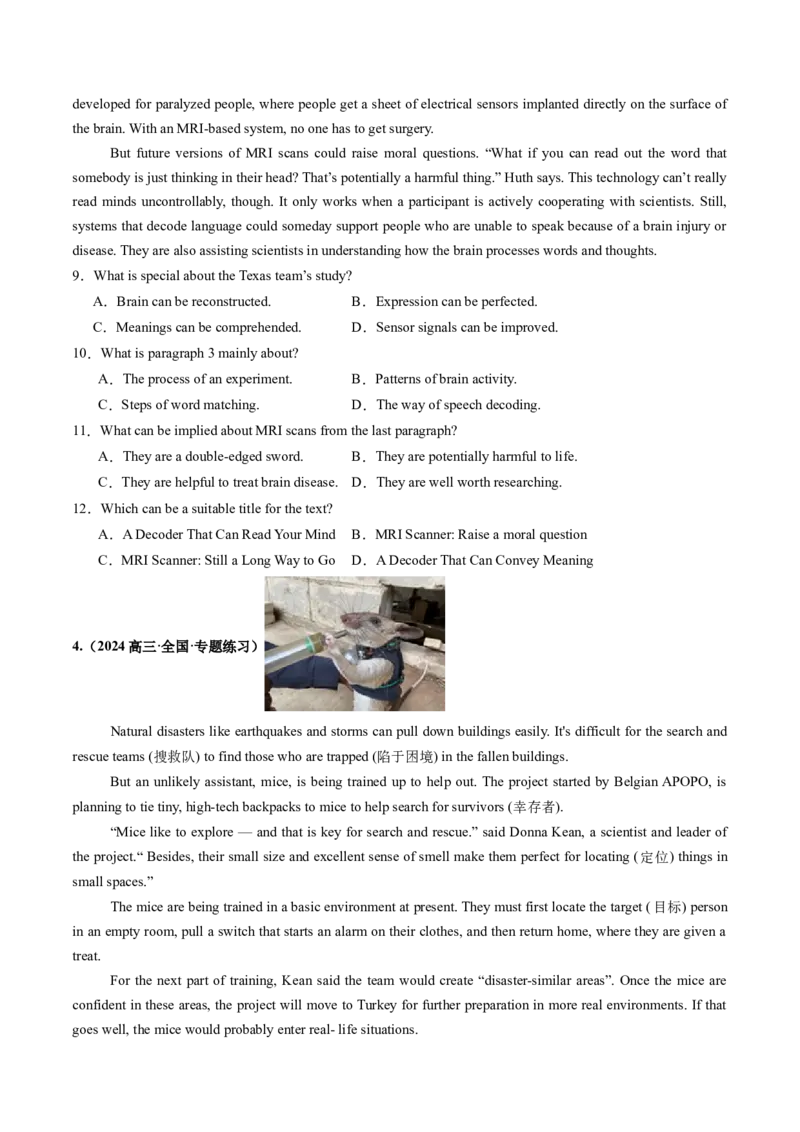
4.(2024高三·全国·专题练习)
Natural disasters like earthquakes and storms can pull down buildings easily. It's difficult for the search and
rescue teams (搜救队) to find those who are trapped (陷于困境) in the fallen buildings.
But an unlikely assistant, mice, is being trained up to help out. The project started by Belgian APOPO, is
planning to tie tiny, high-tech backpacks to mice to help search for survivors (幸存者).
“Mice like to explore — and that is key for search and rescue.” said Donna Kean, a scientist and leader of
the project.“ Besides, their small size and excellent sense of smell make them perfect for locating (定位) things in
small spaces.”
The mice are being trained in a basic environment at present. They must first locate the target (目标) person
in an empty room, pull a switch that starts an alarm on their clothes, and then return home, where they are given a
treat.
For the next part of training, Kean said the team would create “disaster-similar areas”. Once the mice are
confident in these areas, the project will move to Turkey for further preparation in more real environments. If that
goes well, the mice would probably enter real- life situations.The mice are still in the early progress of training. And APOPO is working with the Eindhoven University of
Technology to develop a backpack with a video camera, a two-way microphone, and a locating tool to help
communicate with survivors.
“Together with the backpack and the training, the mice are very useful for search and rescue,” said Kean.
“Even if our mice find just one survivor, we would be happy to know they have made a difference somewhere.”
13.According to the passage, What’s the reason for mice to be chosen for search and rescue?
① Because their nature of exploring.
② Because their small sizes.
③ Because their ability to smell something.
④ Because their perfect eyesight in the dark.
A.①②③ B.①③④ C.②③④ D.①②④
14.Which paragraph tells how the mice are trained?
A.Paragraph 1. B.Paragraph 2.
C.Paragraph 3. D.Paragraph 4.
15.What can we learn from the passage?
A.Donna Kean is a survivor in an earthquake.
B.The mice are being trained in real-life situations.
C.APOPO scientists haven’t invented the high-tech backpack.
D.The mice are often given a treat before they complete the task.
16.What does Donna Kean think of the project?
A.Nervous. B.Interesting.
C.Hopeful. D.Impossible.
5.(2024·河南郑州·三模)Robots doing housework is nothing new with the latest achievements in
robotics. Recently, a robot called Mobile Aloha caught the attention of many at the beginning of 2024, with short
videos of it cooking at someone’s home becoming popular in January.
Developed by a team of researchers at Stanford University in the US, the robot can handle everything for a
dish, whether it is cutting vegetables or cracking eggs. It also does well in various household tasks like watering
plants, petting cats, cleaning the floor and doing washing. It even knows to shake the pillow (枕头) after putting on
a pillowcase. An Internet user joked under one video that as long as this thing doesn’t try to kill him while he is
asleep, he is in real need of it.
However, a following video posted by one of the researchers, Tony Zhao, and showing Mobile Aloha’s
failures proved that the idea of having a robot servant may just be wishful thinking. In the video, Mobile Aloha
randomly broke glasses and plates, crashed into cupboards and even burned a pot.
It turns out that Mobile Aloha is not a complete self-learning system that can independently deal with new
environments. It relies on demonstrations by human operators in its surroundings, meaning that the robot needs to
learn from human behavior before completing each task. Also, according to the team, the robot achieves a 95%
success rate in removing red wine stains (污渍), 80% in pushing chairs, and a mere 40% in frying shrimp. In short,it’s far from perfect.
The behavioral problems of AI robots have been bothering scientists for decades. Although AI robots do
pretty well in things requiring high-level reasoning like math, they perform worse than a one-year-old child when it
comes to simple tasks demanding abilities of sense, reflexes (本能反应) and mobility, among others.
As the team observed, the interaction between the arm and the base of Mobile Aloha would get quite
complex if more flexibility is required in a task. Even a slight deviation (偏差) in the base settings might lead to
significant drift in the arms’ motions, resulting in failure to complete the task.
17.What can be known about Mobile Aloha according to paragraph 2?
A.It sells well among housewives. B.It can help one to do housework.
C.It was developed by IT scientists. D.It is badly needed by Internet users.
18.Why is Tony Zhao’s video about Mobile Aloha mentioned?
A.To prove its online popularity. B.To display its powerful functions.
C.To show it needs further improvement. D.To suggest it should work under one’s help.
19.How can Mobile Aloha best complete a new task?
A.By operating independently. B.By copying humans’ behavior.
C.By learning from previous tasks. D.By turning to programmers for help.
20.Which type of task may AI robots be poor at?
A.Deep learning. B.Precise calculation.
C.Logical thinking. D.Behavioral flexibility.
6.(2024·湖北·一模)Tom is an expert from a robotics company who can communicate smoothly with
people through computers, phones, and other means. However, when facing the crowd on site, he will feel uneasy.
His boss arranged for Tom to showcase to the audience the innovative work their company is doing. In response to
the boss’ trust in him, Tom bravely began preparing for this matter.
One day, while watching TV, he happened to see a program where the ventriloquist (腹语术者) Arthur
interacted with the audience through a dummy (假人) to convey information. This gave him inspiration. The next
day, he discussed his idea with his colleagues in the company and everyone supported his plan. On the day of the
exhibition, they arrived at the scene early and prepared everything, although Tom was still a bit nervous.
The much-anticipated presentation started. The presenter began with a light-hearted joke and then proceeded
to share some interesting facts about Reality Robotics Company before revealing the innovative work the company
was undertaking. Throughout the presentation, there were no pauses or instances of Tom’s dreaded phrase: “but
what I really meant to say was.” The audience was impressed by the innovative product the presenter described and
hoped for a demonstration to see how effective the new invention was. As the presentation drew to a close, the
presenter said calmly and confidently, “And now I would like to share this stage with the man who invented me.”
Tom walked onto the stage, looking exactly like the presenter. The “identical twins” took the audience by
surprise. Tom then spoke slowly, “What you have just witnessed is a demonstration of the latest invention from the
company — a presentation robot.” Suddenly it all clicked and the audience erupted in cheers. Tom then explainedhow the company created such a robot and programmed it to speak. “As you could see and hear, it had the
confidence I could never exhibit in such a presentation. We can model it into an exact copy of you.” The audience
got excited at the prospect. The boss smiled approvingly. Maybe Tom deserved a promotion, he thought.
21.What’s Tom’s problem?
A.He tended to get nervous easily.
B.He failed to win his boss’ recognition.
C.Ho was not confident to speak in front of the public.
D.He can’t communicate with people in his daily life.
22.What do we know about the presenter?
A.He was quite serious.
B.He didn’t live up to Tom’s expectations.
C.He was inspired by the dummy that Arthur worked with.
D.Though confident, he was a bit nervous giving the presentation.
23.What does Tom’s company do?
A.It creates innovative robots. B.It helps present new ideas.
C.It advertises new products. D.It produces ventriloquist’s dummies.
24.What mainly contributes to the presentation’s success?
A.Luck and humor. B.Teamwork and creativity.
C.Caution and responsibility. D.Courage and friendliness.
题型二 动植物介绍类说明文的考查
7.(2024·江西·二模)Coastal communities around the world are using coir, material from coconuts (a kind
of large fruit), to reduce shoreline erosion (侵蚀). People use coir to build barriers, protecting beaches from getting
washed away by the force of waves. The material is common and costs a lot less than barriers made of other
materials, like wood, steel or concrete.
One project is being built along part of an eroded riverbank in Neptune, New Jersey. The effort has already
greatly improved areas that were badly damaged by erosion during Superstorm Sandy in 2012. “We’re always
trying to reduce wave energy while protecting the shoreline,” said Tim Dillingham, the director of the group who
runs the project. “And whenever we can, we like to use nature-based solutions.”
The coconut-based material is designed to break down over time. But before it does, it is sometimes pre-
seeded with shoreline plants and grasses. The coir material holds the plants in place as they grow, finally breaking
down and leaving the established plants in place to keep the shoreline from eroding.
In Boston, Julia Hopkins from Northeastern University is also using coir, wood chips and other material to
create barriers to slow the force of waves. A test project has four coconut-based barriers in waterways around
Boston. Hopkins is pleased with the results she has seen so far. She said the coconut material is not costly and is
actually being recycled rather than thrown away.
The method does not always work, however. In 2016, the Felix Neck Wildlife Sanctuary (a wildlifeprotection area) in Edgartown, Massachusetts, built barriers around a salt marsh, an area of coastal grassland, that
had eroded in the past. While the effort did help reduce erosion for a while, the material did not last long because of
strong waves.
“It got blown out many times,” said Suzan Bellincampi, the sanctuary’s director.“ We had it in place for a
few years and we decided not to fix it again. The project was really interesting in terms of what we wanted to do
and how we changed it. It works in some places; it doesn’t work in all places.”
25.What are communities near the coast doing?
A.They are making use of wave energy.
B.They are building barriers to prepare for storms.
C.They are fighting to stop shoreline erosion.
D.They are developing new materials from coconuts.
26.What might the underlined word “established” in paragraph 3 mean?
A.Well developed. B.Ready to plant. C.Newly planted. D.Hard to find.
27.What is Hopkins’ attitude towards coconut-based barriers?
A.Carefree. B.Favorable. C.Unclear. D.Doubtful.
28.Why is the project in a sanctuary mentioned in the last but one paragraph?
A.To encourage more places to follow the method.
B.To stress the importance of using the method to protect nature.
C.To show that the method is not a one-size-fits-all solution.
D.To explain how to change the method according to local conditions.
8.(2024·辽宁沈阳·三模)Cut into the trunk of a pine tree, and you will see a familiar series of concentric
(同中心的) rings. But not all trunks tell the same story. A study published in November reveals that the world’s
oldest trees had a very different structure.
Some 370 million years ago, cladoxylopsid trees stood at least eight meters tall, covered by branches instead
of leaves. Today their rare remains reveal little about their insides; in most cases their inner structures had rotted
before the trees fossilize, and storms had filled them with sand. But the recent find of two well-preserved fossils in
China has exposed the trees’ inner workings — which are like no other species studied before.
The cladoxylopsid tree was empty inside. Around the edges were thick, vertical strands (缕) containing
xylem (木质部), a plant tissue that conducts water and mineral salts from the roots to all other parts. Modern trees
add new layers of multiple xylem as they grow, creating a woody trunk with a single set of concentric rings. But in
cladoxylopsids, “each strand of xylem had its own growth rings,” says scientist Christopher M. Berry of Cardiff
University in Wales.
Over a tree’s lifetime the strands would weave and cross. “It’s just incredibly complex,” Berry says. He
likens these networks of flexible tissues and structures to the Eiffel Tower—if tower could grow, extend and split
itself apart over time.
Although the cladoxylopsid tree has no living descendants today, it is very important. Brigitte Meyer-Berthaud, a scientist, explains that these trees were among “the major carbon reservoirs of the Paleozoic”, a time
period from 542 million to 251 million years ago. Cladoxylopsids made up our planet’s first forests, capturing
carbon from the atmosphere and playing a part in adjusting Earth’s climate. Given this fact, maybe we should study
these trees for the forests.
29.What makes it hard to study cladoxylopsid trees?
A.Their thick leaves. B.Their amazing height.
C.Their poorly preserved remains. D.Their fossilized inner structures.
30.What do we know about cladoxylopsid trees?
A.They had many separate growth rings.
B.Their solid cores contributed to their growth.
C.They had a single set of regular concentric rings.
D.Their roots needed more mineral salts than water.
31.Why does the author mention “the Eiffel Tower” in paragraph 4?
A.To stress the beauty of the Eiffel Tower.
B.To prove the economic status of the tree.
C.To disclose how limited the tree’s lifetime is.
D.To show how complex the tree’s networks are.
32.Why should we study cladoxylopsid trees?
A.They were the only trees present during the Paleozoic era.
B.They helped scientists better protect rich historical culture.
C.They played a significant role in shaping the Earth as it is.
D.They determined the carbon content in the Earth’s atmosphere.
9.(2024·江西·二模)Inside a large room at the International Center for Agricultural Research in the Dry
Areas (ICARDA), tens of thousands of seeds are stored at a constant temperature of -20℃. Some of them may hold
keys to helping us face the future.
“Our center holds as many as 120,000 varieties of seeds. Many of them come from crops as old as
agriculture itself. Other seeds were selected by researchers who’ve hiked in the past four decades through forests
and mountains in the Middle East, Asia and North Africa, searching for wild relatives of wheat, rice, legumes and
other crops that are important to the human diet,” says Mariana Yazbek, who manages the research center.
The research center, formed in the 1970s, once mostly helped farmers in poorer countries in hot and dry
climates. But now it also sends seeds to scientists in Europe, Canada and the United States, to improve certain
crops’ resistance to the effects of climate change.
“What we are collecting is a sample of the diversity that we have in nature,” adds Yazbek. “We save seeds in
case extreme droughts, floods or other catastrophic events should wipe out plant species. These wild relatives of
crops have witnessed so many different climates. The qualities that help them adapt and survive in these conditions
are stored in their DNA.We have this diversity and it can be a tool to help us face the future.”Yazbek says scientists are particularly interested in crops like the legume because it absorbs a lot of
greenhouse gas CO from the atmosphere. It also releases N into the soil, meaning the farmers have to use less
2
chemical fertilizer. And the legume takes very little water to grow because it produces sugar alcohols that act as
humectants, a substance that attracts and absorbs water and saves the plant from freezing or drying out.
In another case, a wild wheat seed collected in Iran has allowed scientists in the US to develop new wheat
varieties resistant to the Hessian fly, a harmful insect that causes tens of millions of dollars in damage to American
crops every year.
33.What can be learned about ICARDA?
A.It has a complete collection of seeds.
B.It just helps the undeveloped countries.
C.It used to develop seeds for rich countries.
D.It focuses on saving ancient and wild seeds.
34.Which is closest in meaning to the underlined word “catastrophic” in paragraph 4?
A.Important. B.Wasteful. C.Terrible. D.Unforgettable.
35.What can be inferred about the legume?
A.It will grow much better in wet areas.
B.It is friendly to the environment and soil.
C.It will become the main crop for humans.
D.It has difficulty in adapting to cold climate.
36.Which of the following is a suitable title for the text?
A.Seeds Stored at ICARDA May Help Us Improve Our Crops
B.A New Invaluable Seed Bank Is Constructed at ICARDA
C.Scientists Have Made Breakthroughs in Ancient Seed Study
D.New Seeds Are Successfully Developed for North America
10.(2024·江苏盐城·模拟预测)The male western tanager (唐纳雀) looks like a little flame, while females
are less showy, a dusty yellow. In the spring, they prepare to move thousands of miles to the Mountain West of
Central America, flying through grasslands, deserts, and occasionally, suburban yards.
To fuel them on their lengthy journey, western tanagers fill up on insects and berries. But as global climate
change causes spring to start earlier, birds such as western tanagers are arriving at their destination after what’s
known as “green-up”, when flowers begin blooming and insects emerge. According to a study published in early
March in the journal PNAS, this kind of timing mismatch between migrants (迁移动物) and their food sources,
which is happening across North America, could have serious consequences for migratory birds’ survival. “In
discussing climate change, we often focus on warming,” says Scott Loss, a co-author of the study. “But the length
and timing of seasons — like when winter ends and spring begins — are some of the most dramatic effects of
climate change.”
Loss and his colleagues used satellite imagery from 2002 to 2021 to calculate the average start of springgreen-up along the typical migration routes of 150 North American bird species, then compared that timing with the
current green-up. They found that spring is indeed beginning earlier along birds’ migration routes. “By contrary,
previous studies have mainly focused on songbirds in Eastern North America,” says Morgan Tingley, an
ornithologist at UCLA, “but this new investigation shows that bird species in the West and at different levels of the
food web might be just as vulnerable (脆弱的).”
“Part of it is knowing which species are vulnerable to various threats,” Loss says. “This adds to the
knowledge about vulnerability of a wide range of bird species.” And he hopes that the information will serve to
highlight the urgent need to lower greenhouse-gas emissions as fast as possible. “It’s really important, if we can’t
address climate change immediately, to try to stop habitat loss as much as we can.”
37.What may pose a direct threat to western tanagers’ survival?
A.Global warming. B.The duration of changing seasons.
C.Loss of habitats due to human activities.D.Decreased access to foods during migration.
38.What is unique about the new study on birds like western tanagers?
A.It covers a wider geographic range. B.It reveals the decline in bird populations.
C.It centers on the adaptation of bird species. D.It ensures the existence of a timing mismatch.
39.What does Loss suggest we do to safeguard migratory birds?
A.Lessen the effects of climate change. B.Preserve ecosystems for bird species.
C.Address emissions and habitat loss. D.Expand researches on threats to birds.
40.Where is the text most likely from?
A.A scientific journal. B.A bird-watching guidebook.
C.A website about climate change. D.A magazine about wildlife conservation.
11.(24-25高三·广西柳州·开学考试)The humble beaver (海狸) could hold the key to saving our water,
according to a new research at has found how their da m building skills protect the rivers threatened by climate
change.
The research, done on the rivers in Colorado, found the wooden banners built by beavers raise water level
upstream. As it builds up, the water flows into surrounding soils and secondary waterways. These acts separate out
extra nutrients and pollutants before water reenters the main channel downstream.
Extreme weather events, such as severe storms, impact water quality in major river systems. Droughts and
floods are becoming more frequent, and the scientists have also found they are contributing to an increase in the
American beaver in the US, and consequently an explosion of dam building.
The team chose to monitor a 40-kilometer stretch of the East River. They reviewed data on water levels
gathered hourly by sensors fixed in the river and the areas along the river.
They also collected water samples, including from below the ground’s surface to monitor nutrient and
pollutant levels. The researchers compared water quality along the stretch during a historically dry year, to water
quality the following year when water levels were unusually high. They also compared these year-long datasets to
water quality during the nearly three-month period, starting in late July2018, when the beaver dam blocked the
river.The study revealed the dams increased nitrate (硝酸盐) by nearly 50% by increasing the pressure of the
water flow upstream 10 times over, which pushed more water out into the surrounding areas. The nitrates are
absorbed and digested by tiny organisms in the soil. This helped increase the oxygen content and quality in the
rivers.
Beavers’ hard work is responsible for the land they love.
41.What do the wooden barriers created by beavers act as?
A.Waterways. B.Samples.
C.Dams. D.Sensors.
42.What is the direct result of frequent droughts and floods in Colorado?
A.More dams emerge on the rivers.
B.More American beavers appear in the US.
C.More pollutants are removed from the rivers.
D.More oxygen is created in the rivers.
43.Why did the researchers collect water samples from below the ground’s surface?
A.To keep an eye on the water quality.
B.To improve the nutrient of the stretch.
C.To remove pollutants from the river.
D.To decrease the effect caused by the flood.
44.What is the main idea of the text?
A.Dams do good to water quality.
B.Beavers contribute to climate change.
C.Extreme weather catches researchers’ eyes.
D.Beavers help protect rivers against climate change.
12.(2024·湖北襄阳·三模)Medicine is not exclusively a human invention. Many other animals, from
insects to birds to nonhuman primates, have been known to self-medicate with plants and minerals for infections
and other conditions.
Behavioral ecologist Helen Morrogh-Bernard of the Borneo Nature Foundation has spent decades studying
the island’s orangutans (猩猩) and says she has now found evidence they use plants in a previously unseen
medicinal way.
During more than 20, 000 hours of formal observation, Morrogh-Bernard and her colleagues watched 10
orangutans occasionally chew a particular plant (which is not part of their normal diet) into a foamy lather (泡沫)
and then rub it into their fur. The apes spent up to 45 minutes at a time massaging the mixture onto their upper arms
or legs. The researchers believe this behavior is the first known example of a nonhuman animal using a topical
painkiller.
Local people use the same plant Dracaena cantleyi, an unremarkable-looking plant with stalked leaves-to
treat aches and pains. Morrogh-Bernard’s co-authors studied its chemistry. They added extracts (提出物) from theplant to human cells that had been grown in a dish and had been artificially stimulated to produce cytokines, an
immune system response that causes inflammation (炎症) and discomfort. The plant extract reduced the production
of several types of cytokines, the scientists reported the finding in a study published last November in Scientific
Reports.
The results suggest that orangutans use the plant to reduce inflammation and treat pam. Such findings could
help identify plants and chemicals that might be useful for human medications.
In creatures such as insects, the ability to self-medicate is almost certainly innate: woolly bear caterpillars
infected with flies seek out and eat plant substances that are poisonous to the flies. But more complex animals may
learn such tricks after an initial discovery by one member of their group.
For example, an orangutan may have rubbed the plant on its skin to try to treat parasites and realized that it
also had a pleasant pain-killing effect. That behavior may then have been passed on to other orangutans. Because
this type of-self-medication is seen only in south-central Borneo, Morrogh-Bernard says, it was probably learned
locally.
45.What do we know about Dracaena cantleyi?
A.It can serve as a pain killer. B.It is orangutans normal diet.
C.It is a plant with a foamy lather. D.L can function as building materials.
46.How did Morrogh-Bernard’s team prove the plant’s healing properties?
A.By studying the plant’s chemistry. B.By observing apes eating the plant.
C.By extracting cytokines from the plant. D.By watching local people using the plant.
47.What is the significance of the findings?
A.Botanists can better understand plants.
B.Scientists can find a new way to study apes.
C.Doctors may have the power to cure more diseases.
D.Drug companies may find new materials for medicine.
48.What can we learn according to the passage?
A.Medicine is a human unique invention. B.Plant extracts are the best to treat-pain.
C.Humans and animals have a lot in common. D.Insects have the natural ability to self medication.
题型三 社会文化类说明文的考查
13.(24-25高三·湖北武汉·阶段练习)It’s one of the most common questions adults ask children: what do
you want to be when you grow up? Although childhood is supposed to be fun, kids also discuss important topics
regarding their futures. Now, a new study finds that children who set big goals regarding their future status and
education often set themselves up for success as they age.
The findings, published in the Journal of Personality and Social Psychology, are the first to reveal a
connection between life goal development and future success in school or the workplace. Rodica Damian, an
associate professor of psychology at the University of Houston, and other researchers discovered that as children
grow up, their goals naturally begin to change. However, as some childhood goals fall away, other goals related to afamily stay strong. These include being close to relatives, building more friendships or finding a romantic partner,
and even becoming more involved in your community or helping others.
During the study, researchers compared how their goals evolved as children moved from adolescence to
adulthood and how a person’s goals impacted their success in school and as an employee later on. Overall, a child’s
goals focusing on their education and future status were the most consistent predictors (预测因素) of income in
adulthood. Simply put, when a child dreams big about doing well in school or achieving great success as an adult,
these goals accurately paint a picture of how successful these children will be. So, the message is simple: dream big
and dream of success, kids! Those goals can drive you to success when you grow up!
“Our work proves a strong connection between a child’s life goals, educational achievement, and future
occupational outcomes. This information is valuable for parents and educators who can use it to encourage children
to set ambitious goals. Additionally, it helps develop strategies to support individuals in achieving their goals and
reaching their full potential,” Damian concludes.
49.What does the study mainly focus on?
A.Why children change their dreams over time.
B.Whether childhood goals relate to future success.
C.Whether early education determines future career.
D.How childhood experiences impact a person’s choice.
50.Which of the following goals remains strong as children grow up?
A.Connecting with others.
B.Achieving academic success.
C.Hunting for a high-salary job
D.Improving personal social status.
51.What message does the author convey in paragraph 3?
A.Dreaming big is potentially associated with success.
B.Childhood achievement s greatly affect future careers.
C.Educational goals may be more achievable than others.
D.Adjusting goals can create new opportunities for success.
52.What is the purpose of the last paragraph?
A.To explain the purpose of the study. B.To offer suggestions for future studies.
C.To stress the significance of the study. D.To point out the limitations of the study.
14.(24-25高三·浙江宁波·开学考试)The Nobel Prize is one of the most prestigious awards in the world.
It was established by Alfred Nobel, a Swedish chemist, engineer, and inventor. Nobel was known for inventing
dynamite. However, he was concerned about how his inventions could be used for destructive purposes in war.
Thus, in his will, he stipulated that his fortune be used to establish prizes in physics, chemistry, physiology or
medicine, literature, and peace.
The first Nobel Prizes were awarded in 1901. Since then, the Nobel Prize has been awarded to countlessoutstanding individuals who have made significant contributions to their respective fields. The Nobel Prize in
Physics and Chemistry often recognizes revolutionary discoveries and advancements in science. The Nobel Prize in
Physiology or Medicine honors breakthroughs in the understanding and treatment of diseases. The Nobel Prize in
Literature rewards outstanding literary works that have a profound impact on humanity. The Nobel Peace Prize is
given to those who have worked tirelessly to promote peace and resolve conflicts.
Winning a Nobel Prize is not only a great honor but also brings attention to the important work being done in
various fields. It inspires future generations of scientists, writers, and peacemakers to strive for excellence and
make the world a better place.
53.Who established the Nobel Prize?
A.A Swedish physicist. B.A Swedish chemist.
C.A Swedish engineer. D.A Swedish inventor.
54.What was Alfred Nobel known for inventing?
A.Gunpowder. B.Dynamite. C.Electricity. D.The telephone.
55.How many fields does the Nobel Prize cover?
A.Three. B.Four. C.Five. D.Six.
56.Which field does the Nobel Prize in Physiology or Medicine honor?
A.Discoveries in physics. B.Breakthroughs in treating diseases.
C.Outstanding literary works. D.Efforts to promote peace.
15.(2024·四川成都·模拟预测)Minimizing the environmental damage that new roads cause is generally
regarded as a good thing. But to do that, it helps to understand just how new roads cause the damage of which they
are accused.
Recently, a group of researchers led by Dr. Gonzalez conducted an experiment and proved that immigration
is good for the health of animal populations. A road destroys only a small part of the habitat, thus destroying just a
few local populations of creatures. So the argument that road-building itself is bad for biodiversity is not self-
evidently correct. Those who nevertheless hold this view say that apparently separate local populations of animals
are, in fact, parts of much larger populations connected via migration.
According to this theory, when a local population struggles to move about — because of an epidemic, for
example — individuals from neighboring communities can fill the gaps.
The implications of the theory are straightforward. Cut local populations off from each other and each is
more likely to disappear. And roads are good at doing just that. Testing the theory with experimental roads,
however, would be expensive. Dr. Gonzalez’s brainwave was to do the whole thing on a much smaller scale.
The team studied moss-covered rocks. On some rocks the researchers left the moss untouched; on others
they made “roadways” across to leave the moss isolated. After waiting six months, they found that in the disturbed
habitats nearly all the bug population had declined compared with undisturbed moss, and 40% of the species had
become extinct.
The real test came in the second part of the experiment. In this, the researchers removed moss much as
before, but they left narrow moss paths to bridge the no-bug’s-land between islands. The islands with bridges didfar better than isolated islands — a result that supports the notion that population exchange is necessary to keep an
ecosystem healthy.
Whether these results can be translated to large-scale ecosystems remains uncertain. But if they can, they
would cause more, not less, concern about the ecological effects of road-building. On the other hand, they also
suggest a way out. In Britain, tunnels are often built under roads for animals of regular habits, such as badgers (獾),
to be able to travel their traditional routes without having to fight with traffic. Extending that principle, perhaps
special bridges might be a cheap way of letting man and nature rub along a bit better.
57.What’s the main idea of the passage?
A.Calling on us to stop building roads for a healthy ecosystem.
B.Warning us of potential dangers of animal immigration.
C.Informing us of the environmental damage caused by new roads.
D.Suggesting a new way to avoid the damage caused by new roads.
58.Dr. Gonzalez’s experiment found that __________.
A.building roads is expensive
B.immigration is good for animals
C.roads cut off animal immigration
D.tunnels should be built under roads
59.How does the author present his point?
A.By analyzing facts. B.By giving examples.
C.By providing scientific findings. D.By comparing possible effects.
60.According to the passage, which of the following statements will the writer agree with?
A.The impact of road-building is not as serious as we thought.
B.Road-building is beneficial to animal immigration.
C.Environmental damage caused by road-building is still uncertain.
D.Environmental damage caused by road-building might be lessened.
16.(2024·辽宁·模拟预测)I am asked repeatedly why anyone would want to keep an “ugly” building or a
building that is dirty and clearly in need of work. I guess you could say we preservationists (文物保护者) look at
buildings through a different angle — an angle that can see the swan in the ugly duck, the story in the simple lines,
and the book behind the cover.
The Queen Emma Building is remembered by many as one of the ugliest buildings in town. Yet the angle
from which a preservationist views the building is that it is uniquely constructed with an artistical sun shield to
block the sunlight, a decorative wall designers used concrete bricks to form. Unfortunately, it was removed in 2011,
making the building one of many contemporary buildings in town.
Other times, when a beautiful site is replaced by a “horrible” building, people hate it and can’t get over their
anger, even when that “horrible” building becomes an important part of our story. This is particularly true in San
Francisco with many Victorian buildings, which are many. preservationists’ favorite. Yes, it was a tragedy thatmany Victorian buildings. got torn down several decades ago, but those losses also tell another important story. It
tells the story of the 1950s and 1960s when there was hope for a more equal society with inexpensive housing for
the working class. Should that history be wiped from our memories?
Preservation is not just about keeping pretty, well-kept buildings, but about holding on to parts of our history
— not just the history of huge events, but the story of how everyone used to go to a certain corner market. Our
history cannot be told only in buildings that meet someone’s criteria of beauty; sometimes our history is painful, but
no less important.
61.Which section might the passage come from?
A.Opinion and Views. B.Health and Well-being.
C.Space and Exploration. D.Business and Finance.
62.How does the author feel about removing the sun shield of the Queen Emma Building?
A.It’s incredible. B.It’s regrettable. C.It’s inspiring. D.It’s entertaining.
63.Why were many Victorian buildings in San Francisco tom down?
A.To wipe the history of the Victorian era.
B.To make land available for cheap housing.
C.To ease the deep anger of the working class.
D.To revive the architecture of the Victorian era
64.What is the author’s purpose in writing this passage?
A.To analyze the role of preservationists.
B.To introduce buildings with historical value.
C.To explain why architects make ugly buildings.
D.To stress the significance of preserving “ugly” buildings.
17.(2024·江西赣州·二模)Mayan civilization was a Central American (Mesoamerican) civilization that
covered one third of Central America. Mayan civilization is famous for its fully developed written language,
striking art, huge architecture, and advanced mathematical and astronomical knowledge. These features came out of
the Preclassic Period but reached their highest development in the Classic Period (250 to 900 AD). When it
prospered (繁荣), it was one of the most densely populated and culturally active societies in the world.
Mayan civilization was not one single empire, but rather many separate city-states which had a common
cultural background. Strangely, after the Classic Period, these cities stopped to be centers of importance. Mayan
culture continued and still exists today but in a rural setting. One question that interests scholars is why these cities
just disappeared. They were swallowed up by the tropical jungles. Travelers and scholars rediscovered them and
have studied them only in the last two hundred years or so. In fact, scholars have debates about what happened, but
some factors seem to be part of the explanation of why they disappeared.
Toward the end there was large-scale, continuous warfare among the city-states. The rulers were highly
competitive and made fierce wars on one another. Another factor considered is overpopulation. Scholars indicate
that the Mayan population reached up to 200 people per square kilometer, among the highest in the pre-industrialworld. Overpopulation led to overuse of the tropical forest, the source of their food.
Research from the pollen (花粉) indicates that there was almost no tropical forest left. This led to damage to
the environment of the area, further resulting in a lack of water and then drought. Thus warfare, overpopulation,
overuse of resources, and destruction of the environment appear to be active factors involved in the disappearance
of Mayan cities.
65.What is the function of the first paragraph?
A.To present a different view. B.To provide the main topic.
C.To lead to the main topic. D.To provide the text’s road-map.
66.Which of the following has puzzled Mayan scholars?
A.The disappearance of Mayan cities. B.The continuation of Mayan culture.
C.The city-states’ cultural background. D.The creation of Mayan civilization.
67.What was the consequence of overuse of the tropical forest?
A.Serious flood. B.Overpopulation. C.Continuous wars. D.Food shortage.
68.What is the best title for this passage?
A.The Fall of Mayan Cities
B.The Golden Age of Mayan Cities
C.Tropical Jungles and Mayan Civilization
D.Mayan Civilization in the Classic Period
题型 阅读理解
A
(23-24 高三·上海·阶段练习)For the arts “to mean more, to more people,” as Arts Council England
(ACE) argues that they should, would be excellent. Music, drama, dance, visual arts, poetry and literature are
among the most precious human achievements. To live in a country in which these are more widely shared and
enjoyed would be proof that we are making progress. The point is not to entertain or educate people, or bring
communities together. Nor is it all about boosting jobs and investment. Imagination has intrinsic (内在的) value,
and research carried out by ACE in the course of preparing its 10-year strategy showed that people from all walks
of life value and get pleasure from cultural activities.
Positioning itself as a development agency, ACE will now hope to win government backing for a change of
direction that orients it away from the biggest and most prestigious national institutions and towards the towns,
villages and grassroots organizations that should be similarly deserving of attention. There, it envisions a role for
itself “building the identity and prosperity of places,” bringing professional artists together with voluntary groups,particular in areas that have previously not been well represented on the cultural map.
ACE’s chair, Sir Nicholas Serota, quotes the first world war centenary (百年纪念) project devised by the
artist, Jeremy Deller, and theatre director, Rufus Norris, as the model of what he wants his organization to be about.
By dressing up volunteers as soldiers, and orchestrating their encounters with members of the public in settings
across England, the artists succeeded in “dissolving the barriers between artists and audiences.”
The emphasis on participation — on culture as something that more people should actually do — is newer.
This is the difference between being in a play or a band and buying tickets to watch them, and for ACE to play a
more active role in promoting the former would be beneficial. This begins in childhood, and ACE clearly hopes that
the government will think again about policies that have seen music, drama and other arts subjects systematically
downgraded in favour of science, technology and maths.
To what extent the vision is realized will depend in part on whether ACE’s ambitions catch the government’s
interest sufficiently to influence the upcoming spending review, and provide a counterweight to the scorn (轻视)
that is regularly poured on the humanities. Around £400m has been cut from local government arts budgets since
2010, and ACE cannot plug this gap. The closure of youth clubs and live music venues, and growing financial
pressures linked to the property market, are among other reasons for this worrisome narrowing of opportunities. So
far Boris Johnson has offered few signs that he has in mind a starring role for the arts in post-Brexit Britain,
although 2022’s Festival of Brexit is one such event. ACE’s plan should boost the profile of all those, in
government and outside, who are arguing for more.
1.The purpose of making arts available to more people is to __________.
A.enlighten people from all walks of life
B.consolidate various communities
C.create job opportunities for artists
D.maximize the natural value of art
2.According to the passage, ACE is most likely to promote the arts of ___________.
A.national institutions
B.commercial centers
C.local governments
D.towns and villages
3.Which of the following statements would Sir Nicholas Serota most probably agree with?
A.Audiences with little education can also gain pleasure from cultural activities.
B.Artists and audiences can create and enjoy the arts together without barriers.
C.The soldiers and volunteers should vividly show scenes about the First World War.
D.Science, technology and maths are more important than humanities and arts nowadays.
4.What can be inferred from the last paragraph?
A.For the arts to get revitalized more extensive efforts are needed.
B.The current British government has done enough to promote arts.
C.ACE should narrow the financial gap left by the local government.D.Many performing venues have closed due to the rising property market.
B
(2024·上海·模拟预测)Animal products could produce electricity, one British power company warns —
and to give consumers a choice, it's offering what it calls the world’s first vegan electricity.
Ecotricity, a renewable energy provider in the U.K., announced its electricity and gas would be certified
vegan after it claimed half of British homes are powered by electricity made from animal byproducts. Company
founder Dale Vince accused companies that consider themselves “ethical” or “green” of keeping consumers in the
dark about their “secret ingredient.” “We need clear labeling of energy sourcing so that people can make informed
choices,” he said in a statement.
The company offers “vegan energy” in wind and solar power, and it’s developing “sea power” produced by
wave oscillation and marine currents. None of Ecotricity’s electrical sources contains animal byproducts that the
company knew of before it made the announcement, but it registered with the Vegan Society to certify its green
status.
Though not widely disclosed, it’s fairly common for power companies to derive electricity from animals
through anaerobic digestion (厌氧消化). Animal waste is generally considered a clean, renewable energy source.
Turning manure into fuel eliminates a sizeable chunk of carbon pollution and lessens power companies’ reliance on
“dirtier” fossil fuels like coal and oil. Plus, animals provide a limitless supply of waste, while Earth’s natural gas
stores are finite, so crackers wouldn’t need to drill into rock to extract it.
Cows are pictured at a Wagyu cattle breeding center in June in Petit-Mars, France. A U.K. energy company
announced the first “vegan electricity” after warning consumers about animal byproducts in energy production.
After anaerobic digestion, farmers can use the liquid remains of the manure as fertilizer and make chips for
animal bedding from the solid leftovers, chemical engineer David Simakov told Popular Science.
“We are talking about producing the amount of renewable natural gas enough to heat thousands of homes
from just a single large landfill site,” he said. “We need to stop pumping carbon from underground into the
atmosphere and start caring about introducing more and more renewable energy to make our lives more
sustainable.”
Renewable energy only accounts for 11 percent of energy consumption in the U.S., according to the Energy
Information Administration. Fossil fuels and nuclear energy generate more than 80 percent of the country’s
electricity, and that’s unlikely to change: like other clean energy sources, anaerobic digestion is still more expensive
than traditional sources of energy.
5.According to Dale Vince, ____________________.
A.it’s necessary for consumers to know how electricity is produced
B.people don’t need to make choices of whether to use vegan electricity
C.vegan electricity and gas shouldn’t use animal byproducts
D.it’s not certain whether Ecotricity has used animal byproducts
6.In Paragraph 2, “secret ingredient” refers to ___________________.
A.an energy provider
B.vegan energyC.animal waste
D.energy labelling
7.What can be inferred from the passage?
A.It’s forbidden to get exploited natural gas since it is limited.
B.Clean energy may not replace fossil fuels to be used by families.
C.Power companies can rely on animal waste to produce clean energy.
D.The waste of cows is first used to produce clean energy in the world.
8.What does the author think of clean energy?
A.It has been a mainstream.
B.It has a promising future.
C.Consumers tend to use more clean energy now.
D.Its producing cost has decreased its popularity.
1.(2024新课标II卷)
Given the astonishing potential of AI to transform our lives, we all need to take action to deal with our AI-
powered future, and this is where AI by Design: A Plan for Living with Artificial Intelligence comes in. This
absorbing new book by Catriona Campbell is a practical roadmap addressing the challenges posed by the
forthcoming AI revolution (变革).
In the wrong hands, such a book could prove as complicated to process as the computer code (代码) that
powers AI but, thankfully, Campbell has more than two decades’ professional experience translating the heady into
the understandable. She writes from the practical angle of a business person rather than as an academic, making for
a guide which is highly accessible and informative and which, by the close, will make you feel almost as smart as
AI.
As we soon come to learn from AI by Design, AI is already super-smart and will become more capable,
moving from the current generation of “narrow-AI” to Artificial General Intelligence. From there, Campbell says,
will come Artificial Dominant Intelligence. This is why Campbell has set out to raise awareness of AI and its future
now-several decades before these developments are expected to take place. She says it is essential that we keep
control of artificial intelligence, or risk being sidelined and perhaps even worse.
Campbell’s point is to wake up those responsible for AI-the technology companies and world leaders-so they
are on the same page as all the experts currently developing it. She explains we are at a “tipping point” in history
and must act now to prevent an extinction-level event for humanity. We need to consider how we want our future
with Al to pan out. Such structured thinking, followed by global regulation, will enable us to achieve greatness
rather than our downfall.AI will affect us all, and if you only read one book on the subject, this is it.
32. What does the phrase “In the wrong hands” in paragraph 2 probably mean?
A. If read by someone poorly educated.B. If reviewed by someone ill-intentioned.
C. If written by someone less competent. D. If translated by someone unacademic.
33. What is a feature of AI by Design according to the text?
A. It is packed with complex codes. B. It adopts a down-to-earth writing style.
C. It provides step-by-step instructions.D. It is intended for AI professionals.
34. What does Campbell urge people to do regarding AI development?
A. Observe existing regulations on it.
B. Reconsider expert opinions about it.
C. Make joint efforts to keep it under control.
D. Learn from prior experience to slow it down.
35. What is the author’s purpose in writing the text?
A. To recommend a book on AI. B. To give a brief account of AI history.
C. To clarify the definition of AI. D. To honor an outstanding AI expert.
2.(2024全国甲卷)
The Saint Lukas train doesn’t accept passengers—it accepts only the sick. The Saint Lukas is one of five
government-sponsored medical trains that travel to remote towns in central and eastern Russia. Each stop lasts an
average of two days, and during that time the doctors and nurses on board provide rural(乡村)populations with
basic medical care, X-ray scans and prescriptions.
“People started queuing to make an appointment early in the morning,” says Emile Ducke, a German
photographer who traveled with the staff of the Saint Lukas for a two-week trip in November through the vast
regions(区域)of Krasnoyarsk and Khakassia.
Russia’s public health care service has been in serious need of modernization. The government has struggled
to come up with measures to address the problem, particularly in the poorer, rural areas east of the Volga River,
including arranging doctor’s appointments by video chat and expanding financial aid programs to motivate doctors
to practice medicine in remote parts of the country like Krasnoyarsk.
The annual arrival of the Saint Lukas is another attempt to improve the situation. For 10 months every year,
the train stops at about eight stations over two weeks, before returning to the regional capital to refuel and
restock(补给). Then it starts all over again the next month. Most stations wait about a year between visits.
Doctors see up to 150 patients every day. The train’s equipment allows for basic checkups. “I was very
impressed by the doctors and their assistants working and living in such little space but still staying focused and
very concerned,” says Ducke. “They were the best chance for many rural people to get the treatment they want. ”
28. How is the Saint Lukas different from other trains?
A. It runs across countries. B. It reserves seats for the seniors.
C. It functions as a hospital. D. It travels along a river.
29. What can we infer from paragraph 3 about Krasnoyarsk?A. It is heavily populated. B. It offers training for doctors.
C. It is a modern city. D. It needs medical aid.
30. How long can the Saint Lukas work with one supply?
A. About a year. B. About ten months.
C. About two months. D. About two weeks.
31. What is Ducke’s attitude toward the Saint Lukas’ services?
A. Appreciative. B. Doubtful C. Ambiguous. D. Cautious.
3.(2024浙江1月卷)
The Stanford marshmallow (棉花糖) test was originally conducted by psychologist Walter Mischel in the late
1960s. Children aged four to six at a nursery school were placed in a room. A single sugary treat, selected by the
child, was placed on a table. Each child was told if they waited for 15 minutes before eating the treat, they would be
given a second treat. Then they were left alone in the room. Follow-up studies with the children later in life showed
a connect ion between an ability to wait long enough to obtain a second treat and various forms of success.
As adults we face a version of the marshmallow test every day. We’ re not tempted (诱惑) by sugary treats, but
by our computers, phones, and tablets — all the devices that connect us to the global delivery system for various
types of information that do to us what marshmallows do to preschoolers.
We are tempted by sugary treats because our ancestors lived in a calorie-poor world, and our brains developed
a response mechanism to these treats that reflected their value — a feeling of reward and satisfaction. But as we’ve
reshaped the world around us, dramatically reducing the cost and effort involved in obtaining calories, we still have
the same brains we had thousands of years ago, and this mismatch is at the heart of why so many of us struggle to
resist tempting foods that we know we shouldn’t eat.
A similar process is at work in our response to information. Our formative environment as a species was
information-poor, so our brains developed a mechanism that prized new information. But global connectivity has
greatly changed our information environment. We are now ceaselessly bombarded (轰炸) with new information.
Therefore, just as we need to be more thoughtful about our caloric consumption, we also need to be more
thoughtful about our information consumption, resisting the temptation of the mental “junk food” in order to
manage our time most effectively.
32. What did the children need to do to get a second treat in Mischel’s test?
A. Take an examination alone.
B. Show respect for the researchers.
C. Share their treats with others.
D. Delay eating for fifteen minutes.
33. According to paragraph 3, there is a mismatch between ___________.
A. the calorie-poor world and our good appetites
B. the shortage of sugar and our nutritional needs
C. the rich food supply and our unchanged brains
D. the tempting foods and our efforts to keep fit34. What does the author suggest readers do?
A. Absorb new information readily.
B. Be selective information consumers.
C. Use diverse information sources.
D. Protect the information environment.
35. Which of the following is the best title for the text?
A. Eat Less, Read More
B. The Bitter Truth about Early Humans
C. The Later, the Better
D. The Marshmallow Test for Grownups
4.(2024新课标I卷)
In the race to document the species on Earth before they go extinct, researchers and citizen scientists have
collected billions of records. Today, most records of biodiversity are often in the form of photos, videos, and other
digital records. Though they are useful for detecting shifts in the number and variety of species in an area, a new
Stanford study has found that this type of record is not perfect.
“With the rise of technology it is easy for people to make observations of different species with the aid of a
mobile application,” said Barnabas Daru, who is lead author of the study and assistant professor of biology in the
Stanford School of Humanities and Sciences. “These observations now outnumber the primary data that comes
from physical specimens (标本), and since we are increasingly using observational data to investigate how species
are responding to global change, I wanted to know: Are they usable?”
Using a global dataset of 1.9 billion records of plants, insects, birds, and animals, Daru and his team tested
how well these data represent actual global biodiversity patterns.
“We were particularly interested in exploring the aspects of sampling that tend to bias (使有偏差) data, like
the greater likelihood of a citizen scientist to take a picture of a flowering plant instead of the grass right next to it,”
said Daru.
Their study revealed that the large number of observation-only records did not lead to better global coverage.
Moreover, these data are biased and favor certain regions, time periods, and species. This makes sense because the
people who get observational biodiversity data on mobile devices are often citizen scientists recording their
encounters with species in areas nearby. These data are also biased toward certain species with attractive or eye-
catching features.
What can we do with the imperfect datasets of biodiversity?
“Quite a lot,” Daru explained. “Biodiversity apps can use our study results to inform users of oversampled
areas and lead them to places – and even species – that are not well-sampled. To improve the quality of
observational data, biodiversity apps can also encourage users to have an expert confirm the identification of their
uploaded image.”
32. What do we know about the records of species collected now?
A. They are becoming outdated. B. They are mostly in electronic form.C. They are limited in number. D. They are used for public exhibition.
33. What does Daru’s study focus on?
A. Threatened species. B. Physical specimens.
C. Observational data. D. Mobile applications.
34. What has led to the biases according to the study?
A. Mistakes in data analysis. B. Poor quality of uploaded pictures.
C. Improper way of sampling. D. Unreliable data collection devices.
35. What is Daru’s suggestion for biodiversity apps?
A. Review data from certain areas. B. Hire experts to check the records.
C. Confirm the identity of the users. D. Give guidance to citizen scientists.
5.(2024新课标I卷)
We all know fresh is best when it comes to food. However, most produce at the store went through weeks of
travel and covered hundreds of miles before reaching the table. While farmer’s markets are a solid choice to reduce
the journey, Babylon Micro-Farm (BMF) shortens it even more.
BMF is an indoor garden system. It can be set up for a family. Additionally, it could serve a larger audience
such as a hospital, restaurant or school. The innovative design requires little effort to achieve a reliable weekly
supply of fresh greens.
Specifically, it’s a farm that relies on new technology. By connecting through the Cloud, BMF is remotely
monitored. Also, there is a convenient app that provides growing data in real time. Because the system is
automated, it significantly reduces the amount of water needed to grow plants. Rather than watering rows of soil,
the system provides just the right amount to each plant. After harvest, users simply replace the plants with a new
pre-seeded pod (容器) to get the next growth cycle started.
Moreover, having a system in the same building where it’s eaten means zero emissions ( 排放) from
transporting plants from soil to salad. In addition, there’s no need for pesticides and other chemicals that pollute
traditional farms and the surrounding environment.
BMF employees live out sustainability in their everyday lives. About half of them walk or bike to work. Inside
the office, they encourage recycling and waste reduction by limiting garbage cans and avoiding single-use plastic.
“We are passionate about reducing waste, carbon and chemicals in our environment,” said a BMF employee.
28. What can be learned about BMF from paragraph 1?
A. It guarantees the variety of food. B. It requires day-to-day care.
C. It cuts the farm-to-table distance. D. It relies on farmer’s markets.
29. What information does the convenient app offer?
A. Real-time weather changes. B. Current condition of the plants.
C. Chemical pollutants in the soil. D. Availability of pre-seeded pods.
30. What can be concluded about BMF employees?
A. They have a great passion for sports.
B. They are devoted to community service.C. They are fond of sharing daily experiences.
D They have a strong environmental awareness.
31. What does the text mainly talk about?
A. BMF’s major strengths. B. BMF’s general management.
C. BMF’s global influence. D. BMF’s technical standards.
6.(2024全国甲卷)
Animals can express their needs using a lot of ways. For instance, almost all animals have distinct vocals (声
音)that they rely on to either ask for help, scare away any dangerous animals or look for shelter. But cats are
special creatures who possess amazing vocalization skills. They are able to have entire conversations with humans
using meows and you're able to interpret it. If a pet cat is hungry, it will keep meowing to attract attention and find
food. However, when a cat is looking for affection, they tend to produce stretched and soft meows. Meowing starts
as soon as a baby cat is brought to life and uses it to get the mother's attention and be fed.
Cats have many heightened senses, but their sense of smell is quite impressive. They use their noses to assess
their environment and look out for any signs of danger. They will sniff out specific areas before they choose a place
to relax. However, another way the cats are able to distinguish between situations is by looking for familiar smells.
Your cat will likely smell your face and store the smell in its memory and use it to recognize you in the future.
That's why most pet cats are able to tell immediately if their owners were around any other cats, which they don't
usually like.
Dogs are known for their impressive fetching habit, but cats take this behavior up a notch. Many cats will find
random objects outside and bring them to their owners. This is a very old habit that's been present in all kinds of
predators (食肉动物). Cats bring gifts for their owners to show they love you. These adorable little hunters are just
doing something that it's been in their nature since the beginning of time. So just go along with it!
24. What can be learned about cats' meowing from the first paragraph?
A. It's a survival skill. B. It's taught by mother cats.
C. It's hard to interpret. D. It's getting louder with age.
25. How does a pet cat assess different situations?
A. By listening for sounds. B. By touching familiar objects.
C. By checking on smells. D. By communicating with other cats.
26. Which best explains the phrase "take. . . up notch" in paragraph 3?
A. Perform appropriately. B. Move faster.
C. Act strangely. D. Do better.
27. What is a suitable title for the text?
A. Tips on Finding a Smart Cat B. Understanding Your Cat's Behavior
C. Have Fun with Your Cat D. How to Keep Your Cat Healthy
7.(2024浙江1月卷)
On September 7, 1991, the costliest hailstorm (花暴) in Canadian history hit Calgary’s southern suburbs. As aresult, since 1996 a group of insurance companies have spent about $2million per year on the Alberta Hail
Suppression Project. Airplanes seed threatening storm cells with a chemical to make small ice crystals fall as rain
before they can grow into dangerous hailstones. But farmers in east-central Alberta — downwind of the hail project
flights — worry that precious moisture (水分) is being stolen from their thirsty land by the cloud seeding.
Norman Stienwand, who farms in that area, has been addressing public meetings on this issue for years
“Basically, the provincial government is letting the insurance companies protect the Calgary-Edmonton urban area
from hail,” Mr. Stienwan d says, “but they’re increasing drought risk as far east as Saskatchewan.”
The Alberta hail project is managed by Terry Krauss, a cloud physicist who works for Weather Modification
Inc. of Fargo, North Dakota. “We affect only a very small percentage of the total moisture in the air, so we cannot
be cousing drought.” Dr. Krauss says. “In fact, we may be helping increase the moisture downwind by creating
wetter ground.”
One doubter about the safety of cloud seeding is Chuck Doswell, a research scientist who just retired from the
University of Oklahoma. “In 1999, I personally saw significant tornadoes (龙卷风) form from a seeded storm cell
in Kansas,” Dr. Doswell says. “Does cloud seeding create killer storms or reduce moisture downwind? No one
really knows, of course, but the seeding goes on.”
Given the degree of doubt, Mr. Stienwand suggests, “it would be wise to stop cloud seeding.” In practice,
doubt has had the opposite effect. Due to the lack of scientific proof concerning their impacts, no one has succeeded
in winning a lawsuit against cloud-seeding companies. Hence, private climate engineering can proceed in relative
legal safety.
28. What does the project aim to do?
A. Conserve moisture in the soil.
B. Prevent the formation of hailstones.
C. Forecast disastrous hailstorms.
D. Investigate chemical use in farming.
29. Who are opposed to the project?
A. Farmers in east-central Alberta.
B. Managers of insurance companies.
C. Provincial government officials.
D. Residents of Calgary and Edmonton
30. Why does Dr. Doswell mention the tornadoes he saw in 1999?
A. To compare different kinds of seeding methods.
B. To illustrate the development of big hailstorms.
C. To indicate a possible danger of cloud seeding.
D. To show the link between storms and moisture.
31. What can we infer from the last paragraph?
A. Scientific studies have proved Stienwand right.
B. Private climate engineering is illegal in Canada.
C. The doubt about cloud seeding has disappeared.D. Cloud-seeding companies will continue to exist.
8.(2023新课标II卷)
As cities balloon with growth, access to nature for people living in urban areas is becoming harder to find. If
you’re lucky, there might be a pocket park near where you live, but it’s unusual to find places in a city that are
relatively wild.
Past research has found health and wellness benefits of nature for humans, but a new study shows that
wildness in urban areas is extremely important for human well-being.
The research team focused on a large urban park. They surveyed several hundred park-goers, asking them to
submit a written summary online of a meaningful interaction they had with nature in the park. The researchers then
examined these submissions, coding (编码) experiences into different categories. For example, one participant’s
experience of “We sat and listened to the waves at the beach for a while” was assigned the categories “sitting at
beach” and “listening to waves.”
Across the 320 submissions, a pattern of categories the researchers call a “nature language” began to emerge.
After the coding of all submissions, half a dozen categories were noted most often as important to visitors. These
include encountering wildlife, walking along the edge of water, and following an established trail.
Naming each nature experience creates a usable language, which helps people recognize and take part in the
activities that are most satisfying and meaningful to them. For example, the experience of walking along the edge
of water might be satisfying for a young professional on a weekend hike in the park. Back downtown during a
workday, they can enjoy a more domestic form of this interaction by walking along a fountain on their lunch break.
“We’re trying to generate a language that helps bring the human-nature interactions back into our daily lives.
And for that to happen, we also need to protect nature so that we can interact with it,” said Peter Kahn, a senior
author of the study.
12. What phenomenon does the author describe at the beginning of the text?
A. Pocket parks are now popular.
B. Wild nature is hard to find in cities.
C. Many cities are overpopulated.
D. People enjoy living close to nature.
13. Why did the researchers code participant submissions into categories?
A. To compare different types of park-goers.
B. To explain why the park attracts tourists.
C. To analyze the main features of the park.
D. To find patterns in the visitors’ summaries.
14. What can we learn from the example given in paragraph 5?
A. Walking is the best way to gain access to nature.
B. Young people are too busy to interact with nature.
C. The same nature experience takes different forms.
D. The nature language enhances work performance.15. What should be done before we can interact with nature according to Kahn?
A. Language study.
B. Environmental conservation.
C. Public education.
D. Intercultural communication.
9.(2023全国甲卷)
Grizzly bears, which may grow to about 2.5 m long and weigh over 400 kg, occupy a conflicted corner of the
American psyche-we revere (敬畏) them even as they give us frightening dreams. Ask the tourists from around the
world that flood into Yellowstone National Park what they most hope to see, and their answer is often the same: a
grizzly bear.
“Grizzly bears are re-occupying large areas of their former range,” says bear biologist Chris Servheen. As
grizzly bears expand their range into places where they haven’t been seen in a century or more, they’re increasingly
being sighted by humans.
The western half of the U.S. was full of grizzlies when Europeans came, with a rough number of 50,000 or
more living alongside Native Americans. By the early 1970s, after centuries of cruel and continuous hunting by
settlers, 600 to 800 grizzlies remained on a mere 2 percent of their former range in the Northern Rockies. In 1975,
grizzlies were listed under the Endangered Species Act.
Today, there are about 2,000 or more grizzly bears in the U.S. Their recovery has been so successful that the
U.S. Fish and Wildlife Service has twice attempted to delist grizzlies, which would loosen legal protections and
allow them to be hunted. Both efforts were overturned due to lawsuits from conservation groups. For now, grizzlies
remain listed.
Obviously, if precautions (预防) aren’t taken, grizzlies can become troublesome, sometimes killing farm
animals or walking through yards in search of food. If people remove food and attractants from their yards and
campsites, grizzlies will typically pass by without trouble. Putting electric fencing around chicken houses and other
farm animal quarters is also highly effective at getting grizzlies away. “Our hope is to have a clean, attractant-free
place where bears can pass through without learning bad habits,“ says James Jonkel, longtime biologist who
manages bears in and around Missoula.
32. How do Americans look at grizzlies?
A. They cause mixed feelings in people.
B. They should be kept in national parks.
C. They are of high scientific value.
D. They are a symbol of American culture.
33. What has helped the increase of the grizzly population?
A. The European settlers’ behavior.
B. The expansion of bears’ range.
C. The protection by law since 1975.
D. The support of Native Americans.34. What has stopped the U. S. Fish and Wildlife Service from delisting grizzlies?
A. The opposition of conservation groups.
B. The successful comeback of grizzlies.
C. The voice of the biologists.
D. The local farmers’ advocates.
35. What can be inferred from the last paragraph?
A. Food should be provided for grizzlies.
B. People can live in harmony with grizzlies.
C. A special path should be built for grizzlies.
D. Technology can be introduced to protect grizzlies.
10.(2023浙江1月卷)
According to the Solar Energy Industry Association, the number of solar panels installed(安装)has grown
rapidly in the past decade, and it has to grow even faster to meet climate goals. But all of that growth will take up a
lot of space, and though more and more people accept the concept of solar energy, few like large solar panels to be
installed near them.
Solar developers want to put up panels as quickly and cheaply as possible, so they haven’t given much
thought to what they put under them. Often, they’ll end up filling the area with small stones and using chemicals to
control weeds. The result is that many communities, especially in farming regions, see solar farms as destroyers of
the soil.
“Solar projects need to be good neighbors,” says Jordan Macknick, the head of the Innovative Site Preparation
and Impact Reductions on the Environment(InSPIRE)project. “They need to be protectors of the land and
contribute to the agricultural economy.” InSPIRE is investigating practical approaches to “low-impact” solar
development, which focuses on establishing and operating solar farms in a way that is kinder to the land. One of the
easiest low-impact solar strategies is providing habitat for pollinators(传粉昆虫).
Habitat loss, pesticide use, and climate change have caused dramatic declines in pollinator populations over
the past couple of decades, which has damaged the U.S. agricultural economy. Over 28 states have passed laws
related to pollinator habitat protection and pesticide use. Conservation organizations put out pollinator-friendliness
guidelines for home gardens, businesses, schools, cities—and now there are guidelines for solar farms.
Over the past few years, many solar farm developers have transformed the space under their solar panels into
a shelter for various kinds of pollinators, resulting in soil improvement and carbon reduction. “These pollinator-
friendly solar farms can have a valuable impact on everything that’s going on in the landscape,” says Macknick.
32. What do solar developers often ignore?
A. The decline in the demand for solar energy.
B. The negative impact of installing solar panels.
C. The rising labor cost of building solar farms.
D. The most recent advances in solar technology.
33. What does InSPIRE aim to do?
A. Improve the productivity of local farms.B. Invent new methods for controlling weeds.
C. Make solar projects environmentally friendly.
D. Promote the use of solar energy in rural areas.
34. What is the purpose of the laws mentioned in paragraph 4?
A. To conserve pollinators. B. To restrict solar development.
C. To diversify the economy. D. To ensure the supply of energy.
35. Which of the following is the best title for the text?
A. Pollinators: To Leave or to Stay B. Solar Energy: Hope for the Future
C. InSPIRE: A Leader in Agriculture D. Solar Farms: A New Development