考点 25 阅读理解之细节理解题(核心考点精讲精
练)
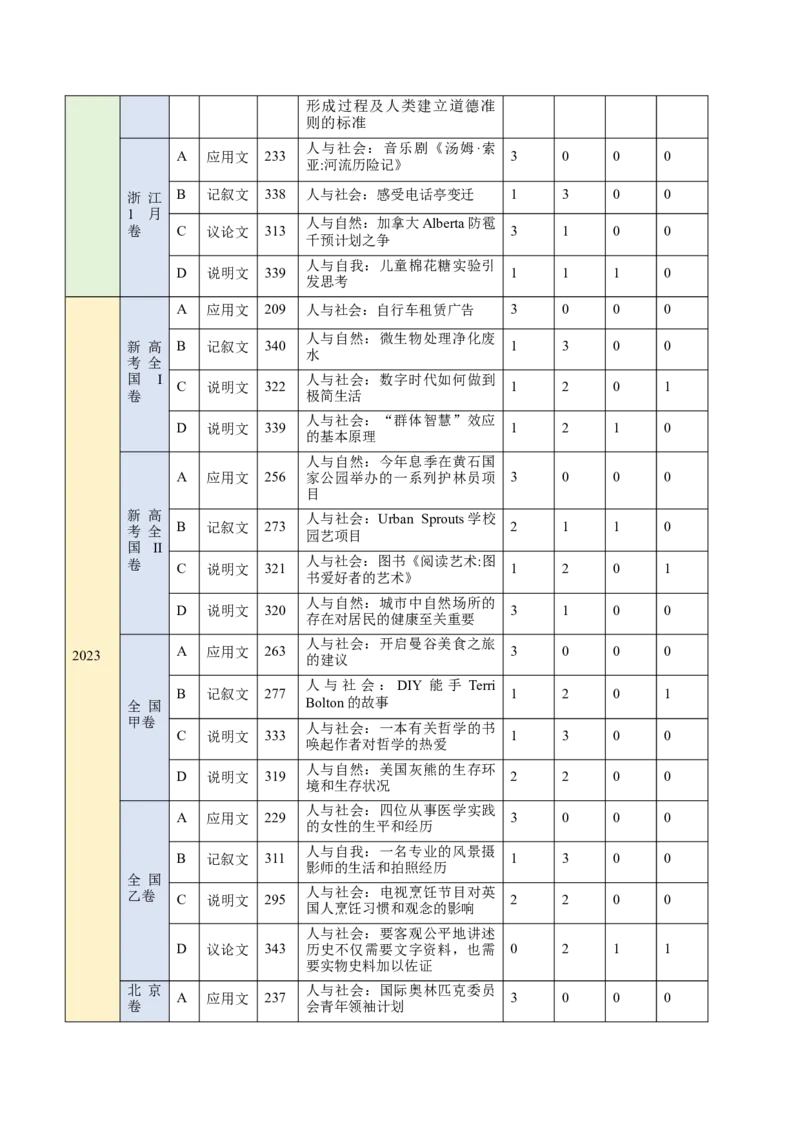
1. 高考真题考点分布
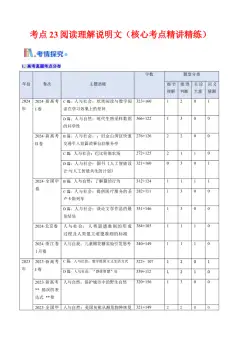
考点分布
试卷 篇 词
年份 体裁 话题
类型 序 数 细节 推理 主旨 词义
理解 判断 大意 猜测
人与社会:栖息地修复工作队
A 应用文 199 3 0 0 0
志愿者招募
新 高 夹叙来 人与社会:美国兽医采用针灸
B 296 0 3 1 0
考 全 议文 技术治疗动物
国 I 人与社会:纸质阅读与数字阅
C 说明文 339 1 2 0 1
卷 读在学习效果上的差异
人与自然:现代生物采样数据
D 说明文 358 1 3 0 0
的科学性
( 应 用
A 290 人与自然:四种徒步活动 3 0 0 0
文
新 高 人与社会::旧金山湾区快速
B 说明文 276 2 2 0 0
考 全 交通引入短篇故事自助服务亭
国 II
C 说明文 268 人与社会:巴比伦微农场 2 1 1 0
卷
人与社会:图书《人工智能设
D 说明文 321 0 3 0 1
计:与人工智能共生的计划》
2024
人与社会:哈佛社区的 ARTS
A 应用文 226 2 1 0 0
FIRST艺术节
全 国
B 说明文 302 人与自然:了解猫的行为 1 1 1 1
甲卷
人与社会:提供医疗服务的圣
C 说明文 267 1 3 0 0
卢卡斯列车
人与社会:谈论文学作品的最
D 说明文 348 1 3 0 0
佳结局
A 应用文 240 人与自我:语言交流项目 3 0 0 0
人与自我:作者重拾画油画的
B 记叙文 354 1 3 0 0
信心并接受了自身局限性
北 京
卷 人与社会:讨论科学问题:
C 议论文 408 宇宙是否是由计算机模拟生 0 3 0 1
成的
D 说明文 384 人与社会:人类道德准则的 1 1 1 0形成过程及人类建立道德准
则的标准
人与社会:音乐剧《汤姆·索
A 应用文 233 3 0 0 0
亚:河流历险记》
浙 江 B 记叙文 338 人与社会:感受电话亭变迁 1 3 0 0
1 月
人与自然:加拿大Alberta防雹
卷 C 议论文 313 3 1 0 0
千预计划之争
人与自我:儿童棉花糖实验引
D 说明文 339 1 1 1 0
发思考
A 应用文 209 人与社会:自行车租赁广告 3 0 0 0
人与自然:微生物处理净化废
新 高 B 记叙文 340 1 3 0 0
水
考 全
国 I 人与社会:数字时代如何做到
C 说明文 322 1 2 0 1
卷 极简生活
人与社会:“群体智慧”效应
D 说明文 339 1 2 1 0
的基本原理
人与自然:今年息季在黄石国
A 应用文 256 家公园举办的一系列护林员项 3 0 0 0
目
新 高 人与社会:Urban Sprouts学校
B 记叙文 273 2 1 1 0
考 全
园艺项目
国 II
卷
人与社会:图书《阅读艺术:图
C 说明文 321 1 2 0 1
书爱好者的艺术》
人与自然:城市中自然场所的
D 说明文 320 3 1 0 0
存在对居民的健康至关重要
人与社会:开启曼谷美食之旅
A 应用文 263 3 0 0 0
2023 的建议
人 与 社 会 : DIY 能 手 Terri
B 记叙文 277 1 2 0 1
全 国
Bolton的故事
甲卷
人与社会:一本有关哲学的书
C 说明文 333 1 3 0 0
唤起作者对哲学的热爱
人与自然:美国灰熊的生存环
D 说明文 319 2 2 0 0
境和生存状况
人与社会:四位从事医学实践
A 应用文 229 3 0 0 0
的女性的生平和经历
人与自我:一名专业的风景摄
B 记叙文 311 1 3 0 0
影师的生活和拍照经历
全 国
乙卷 人与社会:电视烹饪节目对英
C 说明文 295 2 2 0 0
国人烹饪习惯和观念的影响
人与社会:要客观公平地讲述
D 议论文 343 历史不仅需要文字资料,也需 0 2 1 1
要实物史料加以佐证
北 京 人与社会:国际奥林匹克委员
A 应用文 237 3 0 0 0
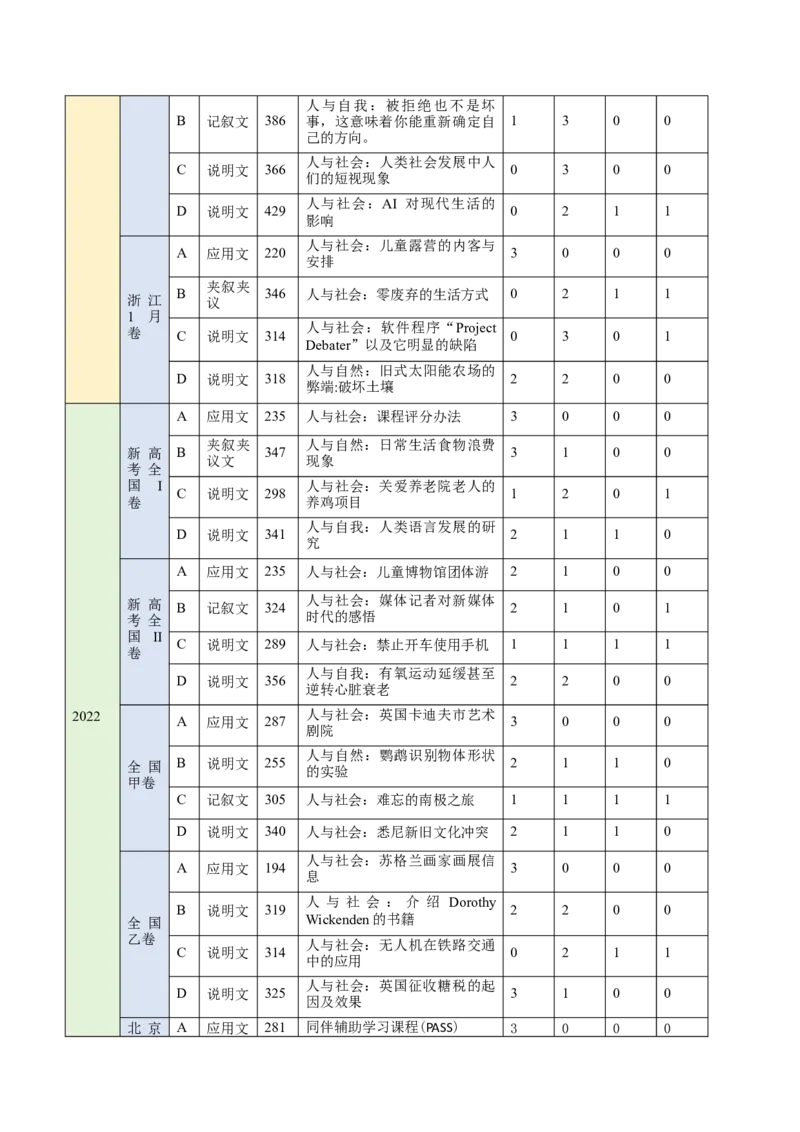
卷 会青年领袖计划人与自我:被拒绝也不是坏
B 记叙文 386 事,这意味着你能重新确定自 1 3 0 0
己的方向。
人与社会:人类社会发展中人
C 说明文 366 0 3 0 0
们的短视现象
人与社会:AI 对现代生活的
D 说明文 429 0 2 1 1
影响
人与社会:儿童露营的内客与
A 应用文 220 3 0 0 0
安排
夹叙夹
B 346 人与社会:零废弃的生活方式 0 2 1 1
浙 江 议
1 月
人与社会:软件程序“Project
卷 C 说明文 314 0 3 0 1
Debater”以及它明显的缺陷
人与自然:旧式太阳能农场的
D 说明文 318 2 2 0 0
弊端:破坏土壤
A 应用文 235 人与社会:课程评分办法 3 0 0 0
夹叙夹 人与自然:日常生活食物浪费
新 高 B 347 3 1 0 0
议文 现象
考 全
国 I 人与社会:关爱养老院老人的
C 说明文 298 1 2 0 1
卷 养鸡项目
人与自我:人类语言发展的研
D 说明文 341 2 1 1 0
究
A 应用文 235 人与社会:儿童博物馆团体游 2 1 0 0
新 高 人与社会:媒体记者对新媒体
B 记叙文 324 2 1 0 1
考 全 时代的感悟
国 II
C 说明文 289 人与社会:禁止开车使用手机 1 1 1 1
卷
人与自我:有氧运动延缓甚至
D 说明文 356 2 2 0 0
逆转心脏衰老
2022 人与社会:英国卡迪夫市艺术
A 应用文 287 3 0 0 0
剧院
人与自然:鹦鹉识别物体形状
全 国 B 说明文 255 2 1 1 0
的实验
甲卷
C 记叙文 305 人与社会:难忘的南极之旅 1 1 1 1
D 说明文 340 人与社会:悉尼新旧文化冲突 2 1 1 0
人与社会:苏格兰画家画展信
A 应用文 194 3 0 0 0
息
人 与 社 会 : 介 绍 Dorothy
B 说明文 319 2 2 0 0
全 国
Wickenden的书籍
乙卷
人与社会:无人机在铁路交通
C 说明文 314 0 2 1 1
中的应用
人与社会:英国征收糖税的起
D 说明文 325 3 1 0 0
因及效果
北 京 A 应用文 281 同伴辅助学习课程(PASS) 3 0 0 0参加保护自然活动治愈好了焦
B 记叙文 348 3 1 0 0
虑
卷
解决全球挑战的重要方法——
C 说明文 415 1 2 0 0
系统思维
量子计算真的会像它的宣传那
D 议论文 400 1 1 1 1
样成功吗?
Merebeth--自营宠物运输专
A 记叙文 353 0 2 0 1
家。
浙 江 文章按照时间顺序讲述了蒸汽
B 说明文 283 0 3 0 0
1 月 时代和电力时代的联系。
卷
经常锻炼的中年女性在老年时
C 说明文 342 罹患失智症的几率会大大降 3 1 0 0
低。
2. 命题规律及备考策略
【命题规律】
根据表格分析可知,近三年来阅读理解考查细节理解题共104次,所占比重较大,占比大约60%左右。细
节理解题一般根据短文提供的信息和事实进行提问,命题人往往通过对文章细节加以改写来考查考生准确
理解细节的能力。一般包括:
1.直接信息题。
2.间接信息题。
3.数字计算题。
4.排列顺序题。
【备考策略】
做细节理解题时,大多数学生易出现的问题是阅读速度太慢,缺乏一定的快速阅读技巧,考生要培养自己
快速获取信息的能力。解答此类试题时,不必通篇细看原文,而常常可采取 “带着问题找答案”的方法.
先从问题中抓住关键性词语。然后以此为线索。要快速地辨认和记忆事实或细节,就要恰当地运用略读及
查读的技巧快速在文章中寻找与此问题相关的段落、语句.仔细品味,对照比较.确定答案。除了运用扫
读法(scanning)外,还可以兼用排除法.将“无此细节”和“与此细节相反”的选项排除。3.【命题预测】
预测2025年高考英语阅读理解试题难度会保持相对稳定,细节理解题仍然会以直接信息题、间接信息题和
数字计算题为主。
【必备基础知识】
一、【命题解读】
1.文章题材丰富
英语试卷中所有语篇都围绕“人与自我”“人与社会"以及“人与自然"三大主题语境,题材涉及故事、科
普、人文、社会现象、文化活动等。
2.短文体裁广泛
短文体裁包括记叙文、说明文、议论文、应用文和新闻报道等。
3. 题型分布不均近3年全国卷高考阅读理解以突出考查考生理解和运用语言解决问题的基本能力。以考查
细节理解推理判断为主,以考查词句猜测、主旨大意为辅。
4.语篇特点鲜明
(1)原汁原味:高考语篇一般选自各大主流英文报刊和媒体网站,新材料尽量原汁原味。
(2)词汇量大;高考语篇词汇量丰富,含有大量派生词、词性转换词、熟词生义词以及英语短语和习语。
(3)长难句多:高考语篇含有大量的长句和难句,句子结构复杂。
常见的命题方式通常有:
1.特殊疑问句形式。以when, where, what, which, who, how much/many等疑问词开头引出的问题;
2. 以是非题的形式。true /false, not true / false或EXCEPT,近年这种题型较少;
3. 以According to… 开头提问方式;
4. 以填空题的形式,如:
(1)To avoid attracting mountain lions, people are advised________.(2)By the first sentence of the passage author means that________.
(3)It seems that now a country’s economy depends much on________.
(4)If you are interested in knowing about what people’s life will be, you may visit________.
(5)The policemen were told “to look the other way” (the underlined part in Paragraph 2) so that________ .
(6)The policeman who said “Good evening” to Rolls wanted to________.
二、【解题策略】
1. 若针对举例子,名人名言出题,只需要例子,名言前后的内容,然后与选项核对。
2. 在出现一些关键词,如however、but、moreover、therefore、thus时,要特别注意句子前后意义的转折,
递进,因果等关系。
3. 细节题的答案一般是同义替换项或者同义转换项。
4. 选项中有绝对语气词的一般不是答案。如:must, never, the most, all, merely, only, have to, any,no,
completely, none,等。但不是绝对,也有例外。
5. 注意选项中的副词,形容词和介词短语等与原文是否一致。如:must, may often, should, usually, might,
most, more or less, likely, all, never, few等存在程度不同,经常被偷换,往往被忽视。
6. 细节题干扰项特点:与原文内容相反;与原文内容一半相符,一半不同; 叙述过于绝对化;原文没有提及。
01 直接信息题--定位比对找答案
直接信息题常以应用文的形式出现在考题中,涉及的话题有:广告类、活动安排类、书籍或电影介绍类、演
出信息类等。设问方式多为以5W1H(what,who,when,where,why和how)等开头的特殊疑问句。解此类
试题常用“定位比对”法。解题流程如下:
【2024新课标Ⅰ卷】HABITAT RESTORATION TEAM
Help restore and protect Marin's natural areas from the Marin Headlands to Bolinas Ridge. We'll explore
beautiful park sites while conducting invasive (侵入的) plant removal, winter planting, and seed collection. HabitatRestoration Team volunteers play a vital role in restoring sensitive resources and protecting endangered species
across the ridges and valleys.
GROUPS
Groups of five or more require special arrangements and must be confirmed in advance. Please review the List
of Available Projects and fill out the Group Project Request Form.
AGE, SKILLS, WHAT TO BRING
Volunteers aged 10 and over are welcome. Read our Youth Policy Guidelines for youth under the age of 15.
Bring your completed Volunteer Agreement Form. Volunteers under the age of 18 must have the
parent/guardian approval section signed.
We'll be working rain or shine. Wear clothes that can get dirty. Bring layers for changing weather and a
raincoat if necessary.
Bring a personal water bottle, sunscreen, and lunch.
No experience necessary. Training and tools will be provided. Fulfills (满足) community service requirements.
UPCOMING EVENTS
Time Meeting Location
Sunday, Jan. 15 10:00 am — 1:00 pm Battery Alexander Trailhead
Sunday, Jan. 22 10:00 am — 2:30 pm Stinson Beach Parking Lot
Sunday, Jan. 29 9:30 am — 2:30 pm Coyote Ridge Trailhead
21. What is the aim of the Habitat Restoration Team?
A. To discover mineral resources. B. To develop new wildlife parks.
C. To protect the local ecosystem. D. To conduct biological research.
22. What is the lower age limit for joining the Habitat Restoration Team?
A. 5. B. 10. C. 15. D. 18.
23. What are the volunteers expected to do?
A. Bring their own tools. B. Work even in bad weather.
C. Wear a team uniform. D. Do at least three projects.
(2024·河南南阳·模拟预测)The Music Educator Award, presented by the Recording Academy and
Grammy Museum, recognizes those who have made a significant contribution to music education. This year it wentto Annie Ray, a teacher at Annandale High School in Fairfax County, Virginia. She was honored for her efforts to
make music accessible to all students, particularly those with disabilities.
Ray attended the awards ceremony in Los Angeles, took photos with pop stars and brought home a $10,000
prize and matching grant (补助金) for her school’s music program. But she considers the award to be her students.
Ray loved music and was regarded as a music talent at an early age. She was inspired by the diversity of the
Annandale community, which she says represents over 60 countries. There are a lot of cultures that might typically
clash (冲突), but they come together in this very beautiful harmony. So she created the Crescendo Orchestra (管弦
乐队) for students with disabilities, as well as a parent orchestra that teaches nearly 200 caregivers a year to play
the same instrument as their child.
The orchestra is about much more than just making music, however. It gives students a chance to develop
their cooperation skills and learn the art of improving something. “I really push my students to be bold, go out of
their comfort zones, challenge themselves and become confident,” Ray said. “Meanwhile, they completely changed
my educational approaches. I learn to teach them according to their own abilities and pace.”
At the Grammys, what impressed her was that many famous performers agreed that a good music educator
can change one’s life, which made her feel what she did was rewarding.
But she faces some challenges. One is that not many people understand how much music educators’ work
matters. Another challenge is resources. Her school desperately needs new instruments but lacks enough money.
“It is a hard profession, but I never give up. There’s nothing else like it,” Ray said.
4.What motivated Ray to create the Crescendo Orchestra?
A.The cultural diversity. B.Her talent for music.
C.Her disabled students’ desire. D.The Annandale community’s advice.
5.What effect does Ray have on her students?
A.They made greater musical achievements.
B.They took comfort from life’s improvements.
C.They became more cooperative and confident.
D.They developed effective learning approaches.
6.What challenge is Ray facing now?
A.Shortage of funds. B.Hardship of being a teacher.
C.Lack of reward for work. D.Disapproval from music educators.02 间接信息题--同义转换定答案
间接信息题常在记叙文、说明文或议论文中考查,会涉及“人与自我”“人与社会’和“人与白然”三大
主题语境。解此类试题常用“同义转换”法。解题流程如下:
高频同义转换(名词类)
achievement=recognition
approach=way=method=means
career=occupation
circumstance=environment=atmosphere
creation=innovation
comment=remark=review(make a comment
on)data=statistics
colleague=coworker
direction=discipline=guideline
essay=passage=article=text
experiment=trial
gratitude=appreciation
feature=characteristics
luggage=baggage=package
manners=etiquette
material=resource
novel=fiction
origin=pioneer
option=choice=selection
personality=character
rule=regulation=principle
Realize=come true
stress=pressure高频同义转换(动词类)
book=reserve=order
complete = fulfill =accomplish= achieve
conduct=carry out
delay=put off=postpone
declare=announce=inform
divide=separate=part with
document=record
encourage = motivate =stimulate = spur
guarantee=ensure
improve=promote
ignore=turn one’s back to
please=amuse=entertain
preserve=protect
ruin=destroy=damage=violate
give=supply=provide=offer
overuse=abuse
reject=refuse=turn down=decline
receive=accept
see=observe=notice=spot
search=explore
connect=link=relate=associate
explode=blow out
discourage=frustrate
rent=hire
prove=turn out
remove=get rid of
admire=appreciate
possess=own
decide=determine=resolve to do
get= obtain= acquire= gain= possess
高频同义转换(形容词副词类)
delicious=tasty
attentive=focused
original=initial
final=eventual
obvious=evident=Striking
accurate=exact
outstanding=brilliant==remarkable=distinctive
authentic=true=genuine
thrilling=frightening
thrilled=excited
average=ordinary=common=universal
time-honored=has a long history
dull=boring
daring=brave
extra=additional
glad=pleased=delighted
touched=moved
significant=vital=key=essential=primary=elementary
accessible=available=at hand
appropriate=proper=suitableappealing=attractive
immediately=quickly=at once=in rarely=hardly=seldom
approximately=about=nearly=almost=practically
complex=complicated
safe=secure
高频同义转换(高频短语类)
ahead of time=in advance=previous
places of interest=tourist attraction
result in=lead to=contribute to
be accustomed to=be used to doing
meet/satisfy/fulfill one’s demand/requirement/need
prevent...from=keep...from=stop...from
join in=take part in=participate in
=involve in=be engaged in
get ready for=be prepared for
focus on =concentrate on
transform A into B=turn A into B
in the long term=in the long run
in...sense=in a way=to some degree=at some point
hold on to=insist
take action=take measures=take steps to
keep in touch with=contact
in some respect=to some degree=at some point
deal with=cope with=handle with=address
at the same time=meanwhile
on the spot=on the scene
be proud of=take pride in
as a matter of fact=in fact=to tell you the truth
head into=leave for
arrive at=reach=get to=approach
in spite of=despite
from one’s perspective=from one’s point of view
try doing=attempt to
be filled with=be charged with=be full of
prefer to do A rather than do B
prefer A to B
prefer doing A to doing B
run into=come across
take the place of=replace
come into effect=put...into practice/use
from time to time=once in a while
be caught in=be trapped in
consist of =be made up of
for a moment=for a while
a collection of =a series of
figure out=find out
bright up=light up
roll around=turn up
give...a lecture=deliver a speech
draw one’s attention=attract one’s attention
be desperate for=desire for=be thirsty for
in favor of=favorable【2024新课标ⅠⅠ卷】We all know fresh is best when it comes to food. However, most produce at the store
went through weeks of travel and covered hundreds of miles before reaching the table. While farmer’s markets are
a solid choice to reduce the journey, Babylon Micro-Farm (BMF) shortens it even more.
BMF is an indoor garden system. It can be set up for a family. Additionally, it could serve a larger audience
such as a hospital, restaurant or school. The innovative design requires little effort to achieve a reliable weekly
supply of fresh greens.
Specifically, it’s a farm that relies on new technology. By connecting through the Cloud, BMF is remotely
monitored. Also, there is a convenient app that provides growing data in real time. Because the system is
automated, it significantly reduces the amount of water needed to grow plants. Rather than watering rows of soil,
the system provides just the right amount to each plant. After harvest, users simply replace the plants with a new
pre-seeded pod (容器) to get the next growth cycle started.
Moreover, having a system in the same building where it’s eaten means zero emissions (排放) from
transporting plants from soil to salad. In addition, there’s no need for pesticides and other chemicals that pollute
traditional farms and the surrounding environment.
BMF employees live out sustainability in their everyday lives. About half of them walk or bike to work. Inside
the office, they encourage recycling and waste reduction by limiting garbage cans and avoiding single-use plastic.
“We are passionate about reducing waste, carbon and chemicals in our environment,” said a BMF employee.
8. What can be learned about BMF from paragraph 1?
A. It guarantees the variety of food. B. It requires day-to-day care.
C. It cuts the farm-to-table distance. D. It relies on farmer’s markets.
9. What information does the convenient app offer?
A. Real-time weather changes. B. Current condition of the plants.
C. Chemical pollutants in the soil. D. Availability of pre-seeded pods.
(2024·黑龙江吉林·模拟预测)It took an ill screech owl (鸣角鸮) to teach a scientist the value of up-
close-and-personal study.
In his Harvad talk, Carl Safina, an ecologist and author of Alfie and Me: What Owls Know, What Humans
Believe, recalled that the chick was found dying in his backyard. Safina took it in and planned to nurse it back to
health and then perform release. But the owlet's flight feathers didn't grow properly. Safina delayed the release.
Over those extended months, Safina got to know Alfie in ways that moved and changed him.
“An owl found me and then I was watching ‘an owl’,” he said. “It was no longer an owl after a while, it was
‘she’ because she had a history with me. This little owl, who was with me much longer than I thought she would be,
became an individual to me by that history and all those interactions.”
The bond with Alfie strengthened to the point that, when she was finally released, she created a territory with
Safina's home at its center. Safina was able to spend hours each day observing her in the woods as she learned totake care of herself in the wild, met two mates, and raised chicks of her own.
When he heard Alfie calling, Safina said, he'd call back and she'd land nearby. Their closeness allowed him
to learn more things about screech owls. Field guides, for example, describe two known calls but he identified six,
some of which you have to be quite close to hear. The relationship also opened a window for Safina onto
personality differences between Alfie and her mates.
When pointed out that his approach to Alfie—including the act of naming her—ran counter to widespread
scientific practice, Safina said he wasn't concerned about violating (违反) convention, particularly if something
interesting like individual personality differences among owls could be learned.
The experience caused Safina to think more deeply about humankind's relationship with nature and the kind
of personal connection he was able to feel with a wild individual. “What I learned from Alfie is that all sentient (有
情感的) beings seek a feeling of well-being and freedom of movement,” Safina said. “That's a guide to what's right
and what's wrong to me.”
4.What do we know about Alfie?
A.She developed a close bond with Safina.
B.She was a fictional character in Safina's book.
C.She intentionally landed in Safina's backyard.
D.She was dying because of the broken flight feathers.
5.What happened after Safina released Alfie?
A.Alfie chose to stay with Safina at his home.
B.They maintained a continous communication.
C.Alfie met mates and raised chicks by herself.
D.Safina kept his distance from her to prevent attachment.
6.What did Safina achieve in his study?
A.Recording six different calls of the screech owl.
B.Identifying different types of owls by their calls.
C.Learning how to release owls back into the wild.
D.Understanding personality differences among owls.
03 数字计算题--整合推算得答案
数字计算题一般会涉及时间、年龄、价钱、数量、距离等的简单计算。一般来说,计算量都比较小,容易
计算。但是英语阅读中的数字计算必须要找出计算背后所隐含的信息。这些“暗”信息会涉及对某个难句
的理解,从这个角度上讲,理解文中相应的复杂句是解这类题的关键。
数字计算题的话题有:1.广告类:2.故事类:3.科普知识类;4.史地自然类;5.文化教育类。
设问方式以when,in which year,how many/much等疑问词(组)开头引出问题解此类试题常用“整合推算”
法。解题流程如下:(2023全国乙卷C篇)
According to a new study from market analysts, 1 in 5 Britons say that watching cookery programmes on TV
has encouraged them to try different food. Almost one third say they now use a wider variety of ingredients (配料)
than they used to, and just under 1 in 4 say they now buy better quality ingredients than before. One in four adults
say that TV chefs have made them much more confident about expanding their cookery knowledge and skills, and
young people are also getting more interested in cooking. The UK’s obsession (痴迷) with food is reflected through
television scheduling. Cookery shows and documentaries about food are broadcast more often than before. With an
increasing number of male chefs on TV, it’s no longer “uncool” for boys to like cooking.
10. Which is the percentage of the people using more diverse ingredients now?
A. 20%. B. 24%. C. 25%. D. 33%.
【2023·江苏南通·高三如皋市搬经中学校联考期中】
Welcome to our stand-up comedy classes
This is the workshop where beginners have grown into headliners and headliners have grown into stars. Our
workshop stresses stand-up comedy writing and performing — the two key components of stand-up comedy.
Our classes are conducted by award-winning, comedy director and writer Stephen Rosenfield and his stand-up
staff. They are conducted so that when it’s time for your club performance, you will have solidly written, funny
material and you will be well rehearsed and ready to perform beyond your expectations. These stand-up comedy
classes are offered to both beginners and advanced students. The workshop consists of group classes, private
coaching sessions and a performance at Gotham or West Side Comedy Club.
Seats available: 2
Start date: May 17th
In-person show: May 20th at Gotham Comedy Club
Live streamed show: May 22nd on YouTubeFees:
If you are a first time student: $410. If you are a returning student: $350.
We accept cash, checks or credit cards.
Your instructor: Becky Veduccio
Becky has been a professional comedian, writer and actress for over 15 years. She has performed stand-up
comedy in New York, Los Angeles, Las Vegas and London. Besides, she has appeared in commercials, theater and
feature films. And she competed in the 2018 season of America’s GotTalent.
Her film works include Return to Me, Maid in Manhattan and Random Hearts. As a writer, she was chosen as
one of Parenting. com’s top five “Favorite Mommy Bloggers” for her humorous articles on the website. In 2015,
she won the New York Press Club Award for humorous writing. As an instructor, Becky has taught stand-up
comedy to every age group — from elementary school kids and teenagers to university students and adults. She
believes everyone has a comedic voice.
2. How much will a returning student save on the fee?
A. $10. B. $50. C. $60. D. $80.
04 细节理解题常见失误
失误点1,似是而非,不求甚解
Coming in a close second-and often wrongly mentioned as the most distant land is Easter Island, which lies 1,260
miles east of its nearest neighbor, Pitcairn Island, and 2,300 miles west of South America.The mountainous 64-
square-mile island was settled around the Sth century.supposedly by people who were lost at sea. They had no
connection with the outside world for more than a thousand years, giving them plenty of time to build more than1,
000 huge stone figures, called moai , for which the island is most famous.
Q:Which of the following is most famous for moai?
A. Tristan da Cunha. B. Pitcairn Island. C. Easter Island. D. St. Helena.
失误点 2粗心大意,审题不严
Wang Hao, who won the men's doubles title with Chen Qi last Monday, played with spirit to beat Wang Liqin 11-
9, 13-11, 11-5, 11-9. Wang Hao said it was his mental toughness that made the difference. “I was disappointed by
my performances in past championships and the last two Olympic Games. But I have tried to pull myself together
and prepared well, This is the result. ”Wang Hao said he had always understood the importance of physical training
and technical skills, Now he knows the need for mental preparation as well. Having two Olympic silvers had left
him feeling bitter (痛苦的). The bitterness perhaps
explains why he has not always played at his best in the past.
Q: From Wang Hao, we can know the main reason for his beating Wang Ligin is _____.
A. his technical skills
B. his physical training
C. his mental toughnessD. his past experience
失误点 3、自以为是,脱离原文
How do people climb the wall? To climb, you need special shoes and harness(保护带) around your chest to hold
you. There are ropes tied to your harness. The ropes hold you in place so that you don't fall. A beginner's wall is
usually about 15feet high, and you climb straight up. There are small pieces of metal that stick out for you to stand
on and hold on to. Sometimes it's easy to see the new piece of metal.Sometimes,it's not, The most difficult is to
control your fear, It's normal for humans to be afraid of falling, so it's difficult not to feel fear, But when you move
away from the wall,the harness and the ropes hold you, and you begin to feel safe. You move slowly until you
reach the top.
Q: The most difficult thing to do in wall climbing is_____.
A. to tie ropes to your harness
B. to control your fear.
C. to move away from the wall
D. to climb straight up
(最新模拟试题演练)
Passage 1
【2024届安徽省皖北协作区高三下学期3月模拟】Nowhere is the interconnection of the natural world
more evident than in the delicate balance of its ecosystems. These books examine the secret to that balance, making
complex concepts accessible to readers just beginning their scientific journeys.
The Elephant
By Jenni Desmond.Illustration: by the author. 2018.
The caring nature,intelligence,and incredible size of African and Asian elephants shine through in
Desmond’s magnificent presentation of these mammals. Her illustrations are showstoppers, and the text includes
general characteristics and habits. Desmond’s writing,precise and inviting, calls attention to the elephant’s role as a
keystone species in the ecosystem and humans’ roles in elephants’ declining numbers.
Beavers
By Rachel Poliquin. Illustration: by Nicholas John Frith. 2018.
This first in the Superpower Field Guide series, about the natural world’s resident superheroes, offers
effervescent examinations of a beaver’s super characteristics. Poliquin explains in simple but exact language how
these “wet land warriors” chew down trees,build dams and lodges,and most awesome of all, function as a keystone
species to create entire new ecosystems.
The Wolves Are BackBy Jean Craighead George. Illustration: by Wendell Minor. 2008.
As George follows one wolf s growth from pup to adult, the emphasis is not as much on the wolves and their
habits but on how their presence has changed the ecosystem of Yellowstone and returned its natural balance.
Minor’s finely detailed illustrations feature spectacularly rendered animals in the foreground of the bold, western
landscapes. Together the words and pictures make for a highly effective and enjoyable explanation of how the
presence of one animal can profoundly affect an ecosystem.
21.Who illustrates the book The Elephant?
A.Jenni Desmond
B.Nicholas John Frith.
C.Rachel Poliquin.
D.Wendell Minor.
22.What can we learn from the text?
A.Poliquin describes beavers using complex language.
B.George does the research mainly on the wolves and their habits.
C.Desmond’s writing focuses on humans’ active roles in elephant conservation.
D.The species mentioned above are likely to influence the ecosystem.
23.Where is the text probably taken from?
A.A zoo guidebook.
B.An academic article:
C.A nature magazine.
D.A research report.
Passage 2
【2024届东北三省四市教研联合体高考模拟(二)】Unlike other major destinations, Rome doesn’t
have a huge number of hostels (旅社). In fact, there are less than 40 listed on Hostel World. So we’ve analyzed
each hostel to bring you detailed information about hostels in Rome. Click to read more.
TYPICAL ROME HOSTEL PRICES
Hostels in Rome are generally reasonably priced. Most hostels, regardless of quality, will start around Eur
25-32 / night in summer. You might be able to find some around Eur 20 / night but those are tough to obtain in
advance. The cheapest hostels will cost around Eur 18 / night — but don’t expect very good quality.
Check Hostel World to get exact prices for your dates as prices are always varying.
QUICK FACTS ABOUT ROME HOSTELS
Cheap Beds & Good Hostels Go Early: Hostel prices are fairly standardized but the quality does vary.
The best options get booked up quickly (especially in summer).
Tourism Tax: Rome requires all hotels, hostels and apartment rentals to collect a tourist tax from all guests.
It’s usually Eur 3.50 / night / person so don’t be surprised by this extra fee.Areas Neighborhoods: Most of Rome’s hostels are located near Rome’s Termini train station. It’s not the best
part of town but not that bad (just be a little extra careful at night).
Check the Hostel Type: Every hostel has its own personality so we suggest picking a hostel that matches up
to your travel style. For example, some hostels are party hostels which are great for having a fun time but not great
for sleeping.
Check-In Times: A lot of hostels have late check-in times around 2 pm — 4 pm) , but nearly all will let you
store your luggage if you arrive before check-in.
1.What might be the minimum cost if you stay in a Rome hostel for two nights?
A.Eur 18. B.Eur 36. C.Eur 43. D.Eur 47.
2.What do most Roman hostels offer?
A.Quality service. B.Tourism tax relief.
C.A quiet sleeping environment. D.Luggage storage before check-in.
3.Where can you probably read the text?
A.On a website. B.In a report. C.In a poster. D.In a brochure.
Passage 3
【2024 届东北三省四市教研联合体高考模拟(二)】New research paints a lifestyle picture of the
beloved pandas in China’s Wolong Nature Reserve, and the new study indicates pandas are around others more than
previously thought. They use scent (气味) marking to keep track of both family members and friends, leave updates
about life events, and check out the dating scene.
Thomas Connor, lead author of the study, spent months watching for signs of pandas. “Once you’ve gotten
an eye for it, you can see on hill tops and different trails the scent-marking trees, and the pandas seem to be doing
this a lot,” Connor says. “It is pretty evident that they are exchanging information through scent marking behavior.”
To link the marked trees with an understanding of panda’s social structure, the researchers needed to
document nearby panda communities. Connor teamed up with coauthor Ken Frank who said, “I told him that once
he has data on which pandas are close to each other, we can use the techniques and theories that apply to humans to
understand their social networks. And these scent trees are a social media. Like Facebook, you don’t have to be in
the same place at the same time. It allows one to broadcast to many, and it’s a record.
Connor dug into a wealth of data he had collected in the form of fresh panda waste, which is the gold
standard of panda watching. Information from the waste allowed them to identify specific pandas in the area around
the scent-marking trees, and showed if these pandas were related to each other.
The discoveries in this study show that pandas are a part of coupled human and natural systems where
humans share their habitat. Anything about how they live and what they need can ultimately help inform good
conservation policies and maybe understand our own behavior a little more.
8.Who tend to go around the pandas’ scent-marking trees?
A.Their family. B.Some strange pandas.
C.Their keepers. D.Meat-sourced animals.
9.Why did pandas make so many scent markings according to Thomas Connor?
A.Because they need to extend their domain.B.Because they use them to exchange information.
C.Because they want to expose themselves to others.
D.Because they tend to keep away from humans.
10.What is paragraph 4 mainly about?
A.The purpose of the study. B.The research strategy of the study.
C.The further finding of the study. D.The influence of the discoveries.
11.What is the author’s purpose of writing the text?
A.To introduce a new research on pandas.
B.To explain the pandas’ scent marking behavior.
C.To emphasize the significance of knowing pandas.
D.To call for action to protect pandas.
Passage 4
【2024届广东省高三下学期二模】As a mushroom scientist, you are vastly outnumbered, with estimates
suggesting that there are between 2.2 million and 3.8 million species of fungi (真菌), the majority of which are yet
to be identified. However, professionals in the field are not alone in their efforts to uncover new species. An
enthusiastic community of amateurs has emerged, bridging the gap between professionals and non-professionals.
These amateurs have even made significant discoveries. One such amateur is Taylor Lockwood, a 74-year-old
mushroom enthusiast and professional photographer.
In 1984, while living on the Mendocino coast of California, Taylor Lockwood developed a fascination with
mushrooms. “Outside my cottage were these amazing mushrooms,” he says. “And it was as if these mushrooms
looked at me and said, ‘Taylor, go out and tell the world how pretty we are.’” Lockwood answered their call and
purchased camera equipment to capture their true nature. His passion for photographing mushrooms was so intense
that he would even dig holes next to the mushrooms to get the perfect angle for his shots.
In the Monongahela National Forest, Taylor Lockwood discovered an unusual mushroom that looked like
tiny fingers wearing off-white gloves. Upon deeper investigation, fungi researcher Amy Rossman confirmed that it
was a “hazel glove” mushroom, which is a rare find. “Mushrooms are not like plants,” Rossman says. “They don’t
come up at the same time every year, and so sometimes it can be decades between when a fungus fruits.” Rossman
says that’s why it’s so valuable to have people like Taylor Lockwood searching through the forest with a trained
eye.
A few years ago, Taylor Lockwood realized that still photos weren’t sufficient, so he chose to create time-
lapse (延时拍摄的) videos of mushrooms. “When I do time-lapse, I see so much life happening around the
mushrooms—insects, worms and other small creatures interacting with them,” he says. Lockwood’s love for art is
evident in his approach to filming mushrooms over time. Although he appreciates the scientific aspect of his work,
he identifies himself as an artist at heart.
4.What can we learn about mushroom amateurs from paragraph 1?
A.They keep close track of the growth of fungi.B.They help identify new species of mushroom.
C.They replace professional scientists in the field.
D.They classify the majority of mushroom species.
5.What inspired Lockwood to photograph mushrooms?
A.His desire for knowledge.
B.His curiosity about nature.
C.The beauty of nearby mushrooms.
D.The appeal of outdoor photography.
6.Which of the following best describes Lockwood according to paragraph 3?
A.Skilled and observant.
B.Focused and flexible.
C.Talented and optimistic.
D.Organized and responsible.
7.Why did Lockwood decide to make time-lapse videos of mushrooms?
A.To improve his photography techniques.
B.To capture dynamic life in an artistic way.
C.To collect biological data for deeper research.
D.To use a new approach to scientific studies.
Passage 5
【2024届广东省高三下学期二模】For decades, scientists thought of the brain as the most valuable and
consequently most closely guarded part of the body. Locked safely behind the blood-brain barrier, it was broadly
free of the harm of viruses and the battles started by the immune system (免疫系统). Then, about 20 years ago,
some researchers began to wonder: is the brain really so separated from the body? The answer, according to a
growing body of evidence, is no.
The list of brain conditions that have been associated with changes elsewhere in the body is long and
growing. Changes in the makeup of the microorganisms in the digestive system have been linked to disorders such
as Parkinson’s disease. There is also a theory that infection during pregnancy could lead to brain diseases in babies.
The effect is two-way. There is a lengthening list of symptoms not typically viewed as disorders of the
nervous system, but the brain plays a large part in them. For example, the development of a fever is influenced by a
population of nerve cells that control body temperature and appetite. Evidence is mounting that cancers use nerves
to grow and spread.
The interconnection between the brain and body has promising implications for our ability to both
understand and treat illnesses. If some brain disorders start outside the brain, then perhaps treatments for them
could also reach in from outside. Treatments that take effect through the digestive system, the heart or other organs,
would be much easier and less risky than those that must cross the blood-brain barrier.
It also works in the opposite direction. Study shows mice have healthier hearts after receiving stimulation toa brain area involved in positive emotion and motivation. Activation of the brain reward centre — called the ventral
tegmental area (VTA) — seems to cause immune changes that contribute to it. Working out how this happens could
help to destroy cancers, enhance responses to vaccines and even re-evaluate physical diseases that, for centuries,
have not been considered as being psychologically driven.
8.What do the researchers focus on about the brain?
A.Its protecting system. B.Its exposure to diseases.
C.Its controlling function. D.Its connection to the body.
9.How does the author support his idea in paragraph 2?
A.By explaining a theory. B.By providing examples.
C.By making comparisons. D.By presenting cause and effect.
10.Which best describes treatments that do not cross the blood-brain barrier?
A.Cheaper. B.More specific.
C.Safer. D.More direct.
11.What does the study suggest in the last paragraph?
A.Brain health depends on immune changes.
B.Brain stimulation leads to negative emotions.
C.The brain can help enhance psychological health.
D.The brain may be key to treating physical diseases.
Passage 6
【2024届河北省高三下学期大数据应用调研联合测评七】
Despite his complex mind, Einstein was known to be a lot of fun. You must have seen his iconic (标志性的)
photo, but you might not know the backstory. The photo was taken by Arthur Sasse, on March 14, 1951, Einstein’s
seventy-second birthday. In the photo, we can see Einstein sitting in a car, between his wife, Elsa, and Dr. Frank
Aydelotte, the head of the Institute for Advanced Study.
The story goes that as they were leaving his birthday celebration for their home in Princeton, New Jersey,
Einstein was repeatedly asked to smile at the camera. But when Snsse asked for one last photo he made a funny
face. Einstein liked the resulting image so much, that he immediately ordered multiple copies so he could sign and
send them to friends as a joke. Later on, he used this photo to make greeting cards.
Einstein rarely let others get in the way of his fun. He was quick to joke. He rarely wore socks thinking that
the shoes should do the job. He let his mustache and hair grow and gave interviews on his porch (门廊) in pink
slippers. His commitment to fun ran deep — and yet when Sasse sent his photo to editors for publication, they
debated whether it was even appropriate to make it public, given Einstein’s eminence. It only saw the light of day
because Sasse related how much the great scientist himself loved the image.
According to Walter Isaacson’s biography, Einstein: His Life and Universe, the personalities that
contributed most to Einstein’s greatness were curiosity and non-conformism (不墨守成规). Scientific Lo studies
suggest that humor and intelligence are associated. People who show a gift for lun also seem have superiorcognitive abilities. Fun has so many levels. The best part is that no matter what fun means to you, it can lead you to
stand out from the ordinary.
24.What was Einstein doing when the iconic photo was taken?
A.He was joking about Sasse. B.He was making a funny face.
C.He was celebrating his birthday. D.He was smiling at the camera.
25.What does the underlined word “eminence” mean in Paragraph 3?
A.Being loving and caring. B.Being humorous and funny.
C.Being famous and respected. D.Being sharp-minded and considerate.
26.What can we know about the iconic photo?
A.It was taken to record his life. B.It was not published until years later.
C.It shows Einstein being interviewed on the porch. D.It was taken to celebrate an instance birthday.
27.What might be Walter Isaacson’s agree?
A.Best humor means high-level fun. B.Curiosity leads to non-conformism.
C.Humorous people tend to be intelligent. D.Greatness should be defined by scientific standards.
Passage 7
【2024届河北省高三下学期大数据应用调研联合测评七】
The Voynich manuscript (手稿) is a 234-page book filled with writing in a strange language now called
Voynichese. It also features many strange drawings of unknown plants, people and charts. Based on the images
alone, it seems to have something to do with medicine.
The language in the manuscript appears nowhere else and has become one of the greatest linguistic riddles of
our day, Since its discovery, it has attracted researchers, been called a hoax (骗局), and been the subject of a huge
number of articles.
By carbon dating the manuscript, researchers are pretty confident that it was constructed in the early 1400s.
And through the magic of linguistic analysis, most people agree that the manuscript is not a hoax. Or, if it is, it’s a
very, very complex hoax.
A paper published in 2016 by computer scientist Greg Kondrak and his student Bradley Hauer gained a lot of
attention. Their theory was based on the idea that Voynichese was made with a substitution cipher (替代密码). That
means it was written in a real language, and then each of the letters in that language was replaced by a specific
Voynichese letter.
This is where the computing power comes in. By having a computer compare the text of the Voynich
manuscript to 380 languages, Kondrak and Hauer ran the substitution cipher through as many languages as possible
and determined if the text would make sense. In the end, they figured out that the original language was Hebrew,
and they even translated some of the text. There are a few problems with their results, though: they compared the
manuscript to modern Hebrew, not 15th-century Hebrew; they had to make “spelling corrections” for it to make
sense; and, possibly most egregious (过分的) of all, they got their results using a translating app.
Despite all the innovations in code-breaking over the last century, the Voynich manuscript still rejects ouradvances. If Voynichese is indeed ever solved, artificial intelligence could very likely play a role.
28.What can be an agreed point about the Voynich manuscript?
A.It’s a medical book. B.It has magic power.
C.It was made in the 1400s. D.It tells the story of a complex hoax.
29.What does Kondrak believe?
A.Voynichese was an endangered language. B.Voynichese will be replaced soon.
C.Voynichese was made by somebody. D.Voynichese will attract more attention.
30.What can be inferred about Kondrak’s research?
A.Its samples were insufficient. B.It failed to get the text to make sense.
C.It didn’t determine the original language.D.Its conclusion was not convincing enough.
31.What does the author express in the last paragraph?
A.Doubt. B.Expectation. C.Determination. D.Concern.
Passage 8
【2024届湖北省高三下学期五月联考二模】Any schoolchild knows that a whale breathes through its
blowhole. Fewer know that a blowhole is a nostril (鼻孔) slightly changed by evolution into a form more useful for
a mammal that spends its life at sea. And only a dedicated expert would know that while toothed whales, such as
sperm whales, have one hole, baleen (鲸须) whales, such as humpback and Rice whales, have two.
Even among the baleen whales, the placing of those nostrils differs. In some species they are close together.
In others, they are much further apart. In a paper published in Biology Letters Conor Ryan, a marine biologist at the
Scottish Association for Marine Science, suggests why that might be. Having two nostrils, he argues, helps whales
smell in stereo (立体空间).
Many types of baleen whales eat tiny animals known as zooplankton (浮游动物), which they catch by
filtering (过滤) them from seawater using the sheets of fibrous baleen that have replaced teeth in their mouths. But
to eat something you first have to find it. Toothed whales do not hunt by scent. In fact, the olfactory bulb—the part
of the brain that processes smell—is absent in such creatures. But baleen whales still have olfactory bulbs, which
suggests smell remains important. And scent can indeed give zooplankton away. Zooplankton like to eat other tiny
creatures called phytoplankton (浮游植物). When these are under attack, they release a special gas called dimethyl
sulphide, which in turn attracts baleen whales.
Most animals have stereoscopic senses. Having two eyes, for instance, allows an animal to compare the
images from each in order to perceive depth. Having two ears lets them locate the direction from which a sound is
coming. Dr Ryan theorized that paired blowholes might bring baleen whales the same sorts of benefits.
The farther apart the sensory organs are, the more information can be extracted by the animal that bears
them. The researchers used drones to photograph the nostrils of 143 whales belonging to 14 different species. Sure
enough, baleen whales that often eat zooplankton, such as the North Atlantic right whale, have nostrils that are
farther apart than do those, such as humpback whales, that eat zooplankton occasionally. Besides allowing them to
breathe, it seems that some whales use their blowholes to determine in which direction dinner lies.8.What do we know about whales’ nostrils according to the first two paragraphs?
A.They are adapted ones. B.They are developed merely for smell.
C.They are not easy to detect. D.They are fixed universally in numbers.
9.What plays a role when baleen whales hunt zooplankton?
A.The teeth that baleen whales have.
B.The smell that phytoplankton send.
C.The sound waves that zooplankton create.
D.The chemical signals that zooplankton give off.
10.How is the concept of stereoscopic senses explained in paragraph 4?
A.By quoting a theory. B.By using examples.
C.By making contrast. D.By making inferences.
11.What is the position of nostrils related to according to the last paragraph?
A.The sense of smell. B.The possibility to attract food.
C.The ability to locate food. D.The ability to communicate.
Passage 9
【2024届湖北省十堰市高三下学期 5月份大联考】About eight years ago, Li Jinglong and Guan Dian
visited the Palace Museum in Beijing. The cloisonne (景泰蓝瓷器) objects on display attracted them in particular.
They spent hours looking at those beautiful objects. They just couldn’t take their eyes off them.
Born and raised in Beijing, 35-year-old Li is no stranger to cloisonne, since there were a pair of cloisonne
vases in his grandparents’ home. His wife, 34-year-old Guan, who learned to paint as a child and later became a
designer after graduating from the Beijing Institute of Fashion Technology, is also familiar with cloisonne, as it
appears in her art books. As a result of their visit, the couple made the daring decision to open a workshop.
“We learned cloisonne after seeing the pieces displayed in the Palace Museum. We wanted to turn our hobby
into a career, so that people could enjoy and learn to make the craft themselves,” said Li, who worked in a finance
company before quitting his job to launch Handcraft Addicted, a DIY workshop where participants can make
cloisonne. Since 2018, they have opened three workshops in Beijing. They are happy to give people a glimpse of
the traditional techniques of cloisonne as part of a DIY experience.
Instead of focusing on making traditional cloisonne objects , such as plates and vases, the workshop allows
participants to create the designs they want on surface of glass, resin (树脂) or wood. Although the process has
been simplified, it is still not easy for people trying cloisonne for the first time to succeed. Participants spend
months making one piece, which they take home or give friends as presents. It’s a luxury for people to spend time
alone and fully focus on one thing nowadays because of the fast pace of life. Participants come to the workshop not
only to create art, but also to take a break from their busy lives.
24.What can we learn about the couple?
A.They both grew up in Beijing. B.They both majored in cloisonne art.
C.They both quit their previous jobs. D.They are both familiar with cloisonne.25.What inspired the couple to open Handcraft Addicted?
A.Their grandparents’ cloisonne vases. B.Their hobby in handcraft techniques.
C.Cloisonne objects in Guan’s art books. D.Cloisonne on exhibition in the Palace Museum.
26.In Handcraft Addicted, ______.
A.the first attempt is often simple
B.participants relax themselves while creating art
C.the couple make cloisonne objects by themselves
D.it is a luxury to make traditional cloisonne objects
27.Which of the following can best describe the couple?
A.Modest. B.Generous. C.Creative. D.Outgoing.
Passage 10
【2024届江西省重点中学盟校高三下学期二模】On March 5, 2024, Riken Yamamoto became the 53rd
winner of the Pritzker Architecture Prize since it was established in 1979 and the 9th architect from Japan to be
awarded the prize.
Yamamoto was born in 1945. His projects, ranging from private residences to public housing, are located
throughout the world. His signature works include Nagoya Zokei University (Nagoya, Japan, 2022), The Circle at
Zürich Airport (Zürich, Switzerland, 2020), Tianjin Library (Tianjin, China, 2012), Pangyo Housing (Seongnam,
South Korea, 2010).
“Yamamoto has spent his entire life creating architecture that enriches the lives of those communities in a
very generous and quiet way,” Deborah Berke, head of the Yale School of Architecture, told NPR. “My favorite is
the Yokosuka Museum of Art. When I was there, I felt that I was part of something larger. That was really magical.”
The building Yamamoto is proud of might be the transparent firehouse he designed in Hiroshima. “The place
is especially popular with children. They like to see the firemen training,” the architect said with a smile. “It’s
covered with glass, so they can see the firefighters’ activities from the outside.”
Deconstructing traditional concepts of freedom and privacy while rejecting longstanding conditions that have
reduced housing into a commodity (商品) without relation to neighbors, Yamamoto defines community as a sense
of sharing one space and tries to bridge cultures, histories and multi-generational citizens, by adapting international
influence and modernist architecture to the needs of the future.
“For me, to recognize space is to recognize an entire community,” Yamamoto said. “The current architectural
approach emphasizes privacy, while ignoring the necessity of societal relationships. However, we can honor the
freedom of each individual while still living together in architectural space as a harmonious community.”
“One of the things we need most in the future of cities is to create conditions through architecture that
multiply the opportunities for people to come together and interact. By reconsidering boundary between public and
private lives, Yamamoto contributes positively beyond the belief to enable communities,” says Tom Pritzker, chair
of the Hyatt Foundation, which sponsors the award.
24.Which building does Deborah Berke like most?A.The Circle at Zürich Airport. B.Pangyo Housing.
C.The Yokosuka Museum of Art. D.Nagoya Zokei University.
25.What has made the firehouse in Hiroshima so popular with children?
A.The magic roof. B.The interesting toys.
C.The beautiful walls. D.The training activities.
26.What does Riken Yamamoto stress in his design?
A.Social interaction. B.Individual freedom.
C.National tradition. D.Futuristic appearance.
27.What is Tom Pritzker’s attitude to the majority of the existing urban buildings?
A.Unclear. B.Disapproving. C.Unconcerned. D.Favorable.
2024年
Passage 1
【2024新课标Ⅰ卷】HABITAT RESTORATION TEAM
Help restore and protect Marin's natural areas from the Marin Headlands to Bolinas Ridge. We'll explore
beautiful park sites while conducting invasive (侵入的) plant removal, winter planting, and seed collection. Habitat
Restoration Team volunteers play a vital role in restoring sensitive resources and protecting endangered species
across the ridges and valleys.
GROUPS
Groups of five or more require special arrangements and must be confirmed in advance. Please review the List
of Available Projects and fill out the Group Project Request Form.
AGE, SKILLS, WHAT TO BRING
Volunteers aged 10 and over are welcome. Read our Youth Policy Guidelines for youth under the age of 15.
Bring your completed Volunteer Agreement Form. Volunteers under the age of 18 must have the
parent/guardian approval section signed.
We'll be working rain or shine. Wear clothes that can get dirty. Bring layers for changing weather and a
raincoat if necessary.
Bring a personal water bottle, sunscreen, and lunch.
No experience necessary. Training and tools will be provided. Fulfills (满足) community service requirements.
UPCOMING EVENTS
Time Meeting Location
Sunday, Jan. 15 10:00 am — 1:00 pm Battery Alexander Trailhead
Sunday, Jan. 22 10:00 am — 2:30 pm Stinson Beach Parking Lot
Sunday, Jan. 29 9:30 am — 2:30 pm Coyote Ridge Trailhead21. What is the aim of the Habitat Restoration Team?
A. To discover mineral resources. B. To develop new wildlife parks.
C. To protect the local ecosystem. D. To conduct biological research.
22. What is the lower age limit for joining the Habitat Restoration Team?
A. 5. B. 10. C. 15. D. 18.
23. What are the volunteers expected to do?
A. Bring their own tools. B. Work even in bad weather.
C. Wear a team uniform. D. Do at least three projects.
Passage 2
【2024新课标ⅠⅠ卷】Choice of Walks for Beginner and Experienced Walkers
The Carlow Autumn Walking Festival is a great opportunity for the beginner, experienced or advanced walker
to enjoy the challenges of Carlow’s mountain hikes or the peace of its woodland walks.
Walk 1 — The Natural World
With environmentalist Éanna Lamhna as the guide, this walk promises to be an informative tour. Walkers are
sure to learn lots about the habitats and natural world of the Blackstairs.
Date and Time: Saturday, 1st October, at 09:00
Start Point: Scratoes Bridge
Walk Duration: 6 hours
Walk 2 — Introduction to Hillwalking
Emmanuel Chappard, an experienced guide, has a passion for making the great outdoors accessible to all. This
mountain walk provides an insight into the skills required for hillwalking to ensure you get the most from future
walking trips.
Date and Time: Sunday, 2nd October, at 09:00
Start Point: Deerpark Car Park
Walk Duration: 5 hours
Walk 3 — Moonlight Under the Stars
Walking at night-time is a great way to step out of your comfort zone. Breathtaking views of the lowlands of
Carlow can be enjoyed in the presence of welcoming guides from local walking clubs. A torch (手电筒) along with
suitable clothing is essential for walking in the dark. Those who are dressed inappropriately will be refused
permission to participate.
Date and Time: Saturday, 1st October, at 18:30
Start Point: The Town Hall
Walk Duration: 3 hours
Walk 4 — Photographic Walk in Kilbrannish Forest
This informative walk led by Richard Smyth introduces you to the basic principles of photography in the wild.
Bring along your camera and enjoy the wonderful views along this well-surfaced forest path.Date and Time: Sunday, 2nd October, at 11:45
Start Point: Kilbrannish Forest Recreation Area
Walk Duration: 1.5 hours
1. Which walk takes the shortest time?
A. The Natural World. B. Introduction to Hillwalking.
C. Moonlight Under the Stars. D. Photographic Walk in Kilbrannish Forest.
2. What are participants in Walk 3 required to do?
A. Wear proper clothes. B. Join a walking club.
C. Get special permits. D. Bring a survival guide.
3. What do the four walks have in common?
A. They involve difficult climbing. B. They are for experienced walkers.
C. They share the same start point. D. They are scheduled for the weekend.
Passage 3
【2024 全国甲卷】Each ARTS FIRST festival is a unique annual celebration of the Harvard community's
artistic creativity. We invite you to join us for the coming ARTS FIRST. We look forward to welcoming you as we
showcase the creativity of the Harvard arts community through performances, art exhibitions and art-making
activities. The festival is a public event for Harvard and community members of all ages.
Light Awash in Watercolor
Learn about the materials and qualities of watercolor paint with experts from the Harvard Art Museums
Materials Lab. Try your hand at some of the painting tricks used by artists whose works will be in the upcoming
exhibition of American Watercolors 1880-1990: Into the Light.
Spineless Artists: Invertebrate Creativity
From webs to cocoons, invertebrates (无脊椎动物) create some of nature's most delicate and beautiful
designs. Join Javier Marin from the Harvard Museum of Natural History to learn how insects and other
invertebrates dance, inspire fashion and create art, while making your own spineless artists out of craft (手工艺)
materials.
Wheel Throwing
Join instructors from the Ceramics Program and great potters from Quincy, Cabot and Mather Houses for
demonstrations using the potter's wheel. Then create your own masterpiece!
Knitting and Pom-Pom Making
Join the Harvard Undergraduate Knitting Circle to make pom-poms and tassels out of thread, or pick up a pair
of needles and learn to knit (编织).
1. What do we know about ARTS FIRST?
A. It is an exhibition of oil paintings. B. It offers art courses for all ages.
C. It presents recreational activities. D. It is a major tourist attraction.
2. Which program will you join if you're interested in drawing pictures?
A. Light Awash in Watercolor. B. Spineless Artists: Invertebrate Creativity.C. Wheel Throwing. D. Knitting and Pom-Pom Making.
3. What can you do together with Javier Marin?
A. Practice a traditional dance. B. Make handcrafts.
C. Visit a local museum. D. Feed invertebrates.
Passage 4
【2024北京卷】The Language Exchange Programme allows students in pairs to communicate in two
different languages they wish to share and learn each week. Students record short entries after each partner meeting
noting the language skills practised and the topics discussed. Each pair of students meets three times throughout the
term with a teacher who decides if the exchange is effective. Students who successfully complete the programme
will receive one credit each.
Requirements for completion:
•One welcoming session on the second Friday of the term
•18 weekly one-hour pair meetings
•Weekly progress reports for all pair meetings
•At least three pair-teacher meetings
•One five-minute final video
Sign up!
The sign-up and registration process is as follows:
•Students sign up and indicate the languages they can share and languages they are interested in learning.
•Based on the information entered by each student, potential pairs are identified.
•Proficiency (熟练) levels are confirmed through coursework or placement tests.
•Once a pair has been determined to be suitable, the students will be contacted individually with a special
permission number to register for the programme.
Reminders:
Signing up for the programme does not automatically mean that you will be able to register and participate.
Pairs are matched by languages of interest and proficiency levels. Since there are many factors involved in the
pairing process, not all students who sign up will be matched with a partner and be able to register for the
programme.
21. In the programme, students will _________.
A. chair daily meetings B. evaluate the exchange
C. meet teachers each week D. practise their language skills
22. To complete the programme, students are required to _________.
A. development tests B. participate in pair meetings
C. welcome new students D. work on weekly videos
23. What do students need to do during the registration?
A. Indicate their languages of interest. B. Select their own coursework.
C. Make individual contact. D. Choose their partners.Passage 5
【2024浙江1月卷】Tom Sawyer Play Is an Adventure
A 35-minute hand-clapping, foot-stomping musical version of a Mark Twain favorite returns with this Tall
Stacks festival.
“Tom Sawyer: A River Adventure” has all the good stuff, including the fence painting, the graveyard, the
island and the cave. It is adapted by Joe McDonough, with music by David Kisor. That’s the local stage writing
team that creates many of the Children’s Theatre of Cincinnati’s original musicals, along with the holiday family
musicals at Ensemble Theatre.
This year Nathan Turner of Burlington is Tom Sawyer, and Robbie McMath of Fort Mitchell is Huck Finn.
Tumer, a 10th-grader at School for Creative and Performing Arts, is a familiar presence on Cincinnati’s stages.
He is a star act or of Children’s Theatre, having played leading roles in “The Legend of Sleepy Hollow” and “The
Wizard of Oz,” and is fresh from Jersey Production “Ragtime”.
McMath is a junior at Beechwood High School. He was in the cast of “Tom Sawyer” when it was first
performed and is a Children’s Theatre regular, with five shows to his credit. This summer he attended Kentucky’s
Governor’s School for the Arts in Musical Theatre.
Note to teachers: Children’s Theatre has a study guide demonstrating how math and science can be taught
through “Tom Sawyer.” For downloadable lessons, visit the official website of Children’s Theatre.
1. Who wrote the music for “Tom Sawyer: A River Adventure”?
A. David Kisor. B. Joe McDonough.
C. Nathan Turner. D. Robbie McMath.
2. What can we learn about the two actors?
A. They study in the same school. B. They worked together in ”Ragtime“.
C. They are experienced on stage. D. They became friends ten years ago.
3. What does Children’s Theatre provide for teachers?
A. Research funding. B. Training opportunities.
C. Technical support. D. Educational resources.
Passage 6
【2024新课标Ⅰ卷】“I am not crazy,” says Dr. William Farber, shortly after performing acupuncture (针
灸) on a rabbit. “I am ahead of my time.” If he seems a little defensive, it might be because even some of his
coworkers occasionally laugh at his unusual methods. But Farber is certain he’ll have the last laugh. He’s one of a
small but growing number of American veterinarians (兽医) now practicing “holistic” medicine-combining
traditional Western treatments with acupuncture, chiropractic (按摩疗法) and herbal medicine.
Farber, a graduate of Colorado State University, started out as a more conventional veterinarian. He became
interested in alternative treatments 20 years ago when he suffered from terrible back pain. He tried muscle-relaxing
drugs but found little relief. Then he tried acupuncture, an ancient Chinese practice, and was amazed that he
improved after two or three treatments. What worked on a veterinarian seemed likely to work on his patients. So,
after studying the techniques for a couple of years, he began offering them to pets.
Leigh Tindale’s dog Charlie had a serious heart condition. After Charlie had a heart attack, Tindale says, shewas prepared to put him to sleep, but Farber’s treatments eased her dog’s suffering so much that she was able to
keep him alive for an additional five months. And Priscilla Dewing reports that her horse, Nappy, “moves more
easily and rides more comfortably” after a chiropractic adjustment.
Farber is certain that the holistic approach will grow more popular with time, and if the past is any indication,
he may be right: Since 1982, membership in the American Holistic Veterinary Medical Association has grown from
30 to over 700. “Sometimes it surprises me that it works so well,” he says. “I will do anything to help an animal.
That’s my job.”
24. What do some of Farber’s coworkers think of him?
A. He’s odd. B. He’s strict. C. He’s brave. D. He’s rude.
25. Why did Farber decide to try acupuncture on pets?
A. He was trained in it at university. B. He was inspired by another veterinarian.
C. He benefited from it as a patient. D. He wanted to save money for pet owners.
26. What does paragraph 3 mainly talk about?
A. Steps of a chiropractic treatment. B. The complexity of veterinarians’ work.
C. Examples of rare animal diseases. D. The effectiveness of holistic medicine.
27. Why does the author mention the American Holistic Veterinary Medical Association?
A. To prove Farber’s point. B. To emphasize its importance.
C. To praise veterinarians. D. To advocate animal protection.
Passage 7
【2024 浙江 1 月卷】When was the last time you used a telephone box? I mean to make an actual phone
,
call — not to shelter from the rain. Ages ago right? The last time I used a phone box for its intended purpose
was…2006. I was conducting auditions (试演) for my play in my tiny old shared house in London. Hoping to
impress some talented actors to come and work for me for nothing, I spread some throws over the sofas and lit
candles to make it seem a bit more ”young professional”.
As I rushed outdoors to empty the wastepaper baskets, the door swung shut behind me. Suddenly I was locked
outside. My mobile phone was inside, but luckily there was a telephone box across the street. So, I called Directory
Assistance, got put through to our landlady’s managing agent, and had a spare key sent to me with just enough time
to get back in before the actors arrived.
As it has been many years since I last used one, I should hardly be surprised that then are no longer any public
telephones near my house. The last one standing has just been turn into a “mini community library”: any passer-by
can “borrow” a book from its shelves return it later, or replace it with another title from their own collection.
For a few months after the “library” opened, I didn’t bother taking a look, as I had assumed that it would be
stuffed full of cheese love stories. Then I noticed fork conducting spring cleans dropping boxes of voluminous
books on various subjects there. And these books were free. This unbeatable price-point encouraged me to
experiment with dozens of titles that I would never normally consider buying. And I’ve discovered some great
books!
If I ever get trapped outside my house again, my local telephone box will, sadly no longer be able to connectme with my keys. But it can certainly keep me entertained while I wait for my wife to rescue me.
4. What does the underlined word “it” in the first paragraph refer to?
A. The play. B. The shared house.
C. The sofa. D. The telephone box.
5. Why did the author use the telephone box in 2006?
A. To place an urgent call. B. To put up a notice.
C. To shelter from the rain. D. To hold an audition.
6. What do we know about the “mini community library”?
A. It provides phone service for free. B. Anyone can contribute to its collection.
C. It is popular among young readers. D. Books must be returned within a month.
7. Why did the author start to use the “library”?
A. He wanted to borrow some love stories.
B. He was encouraged by a close neighbour.
C. He found there were excellent free books.
D. He thought it was an ideal place for reading.
Passage 8
【2024全国甲卷】Animals can express their needs using a lot of ways. For instance, almost all animals have
distinct vocals (声音) that they rely on to either ask for help, scare away any dangerous animals or look for shelter.
But cats are special creatures who possess amazing vocalization skills. They are able to have entire conversations
with humans using meows and you're able to interpret it. If a pet cat is hungry, it will keep meowing to attract
attention and find food. However, when a cat is looking for affection, they tend to produce stretched and soft
meows. Meowing starts as soon as a baby cat is brought to life and uses it to get the mother's attention and be fed.
Cats have many heightened senses, but their sense of smell is quite impressive. They use their noses to assess
their environment and look out for any signs of danger. They will sniff out specific areas before they choose a place
to relax. However, another way the cats are able to distinguish between situations is by looking for familiar smells.
Your cat will likely smell your face and store the smell in its memory and use it to recognize you in the future.
That's why most pet cats are able to tell immediately if their owners were around any other cats, which they don't
usually like.
Dogs are known for their impressive fetching habit, but cats take this behavior up a notch. Many cats will find
random objects outside and bring them to their owners. This is a very old habit that's been present in all kinds of
predators (食肉动物). Cats bring gifts for their owners to show they love you. These adorable little hunters are just
doing something that it's been in their nature since the beginning of time. So just go along with it!
4. What can be learned about cats' meowing from the first paragraph?
A. It's a survival skill. B. It's taught by mother cats.
C. It's hard to interpret. D. It's getting louder with age.
5. How does a pet cat assess different situations?
A. By listening for sounds. B. By touching familiar objects.
C. By checking on smells. D. By communicating with other cats.6. Which best explains the phrase "take. . . up notch" in paragraph 3?
A. Perform appropriately. B. Move faster. C. Act strangely. D. Do better.
7. What is a suitable title for the text?
A. Tips on Finding a Smart Cat B. Understanding Your Cat's Behavior
C. Have Fun with Your Cat D. How to Keep Your Cat Healthy
Passage 9
【2024新课标Ⅰ卷】In the race to document the species on Earth before they go extinct, researchers and
citizen scientists have collected billions of records. Today, most records of biodiversity are often in the form of
photos, videos, and other digital records. Though they are useful for detecting shifts in the number and variety of
species in an area, a new Stanford study has found that this type of record is not perfect.
“With the rise of technology it is easy for people to make observations of different species with the aid of a
mobile application,” said Barnabas Daru, who is lead author of the study and assistant professor of biology in the
Stanford School of Humanities and Sciences. “These observations now outnumber the primary data that comes
from physical specimens (标本), and since we are increasingly using observational data to investigate how species
are responding to global change, I wanted to know: Are they usable?”
Using a global dataset of 1.9 billion records of plants, insects, birds, and animals, Daru and his team tested
how well these data represent actual global biodiversity patterns.
“We were particularly interested in exploring the aspects of sampling that tend to bias (使有偏差) data, like
the greater likelihood of a citizen scientist to take a picture of a flowering plant instead of the grass right next to it,”
said Daru.
Their study revealed that the large number of observation-only records did not lead to better global coverage.
Moreover, these data are biased and favor certain regions, time periods, and species. This makes sense because the
people who get observational biodiversity data on mobile devices are often citizen scientists recording their
encounters with species in areas nearby. These data are also biased toward certain species with attractive or eye-
catching features.
What can we do with the imperfect datasets of biodiversity?
“Quite a lot,” Daru explained. “Biodiversity apps can use our study results to inform users of oversampled
areas and lead them to places — and even species — that are not well-sampled. To improve the quality of
observational data, biodiversity apps can also encourage users to have an expert confirm the identification of their
uploaded image.”
32. What do we know about the records of species collected now?
A. They are becoming outdated. B. They are mostly in electronic form.
C. They are limited in number. D. They are used for public exhibition.
33. What does Daru’s study focus on?
A. Threatened species. B. Physical specimens.
C. Observational data. D. Mobile applications.
34. What has led to the biases according to the study?A. Mistakes in data analysis. B. Poor quality of uploaded pictures.
C. Improper way of sampling. D. Unreliable data collection devices.
35. What is Daru’s suggestion for biodiversity apps?
A. Review data from certain areas. B. Hire experts to check the records.
C. Confirm the identity of the users. D. Give guidance to citizen scientists.
Passage 10
【2024 全国甲卷】The Saint Lukas train doesn’t accept passengers—it accepts only the sick. The Saint
Lukas is one of five government-sponsored medical trains that travel to remote towns in central and eastern Russia.
Each stop lasts an average of two days, and during that time the doctors and nurses on board provide rural(乡
村)populations with basic medical care, X-ray scans and prescriptions.
“People started queuing to make an appointment early in the morning,” says Emile Ducke, a German
photographer who traveled with the staff of the Saint Lukas for a two-week trip in November through the vast
regions(区域)of Krasnoyarsk and Khakassia.
Russia’s public health care service has been in serious need of modernization. The government has struggled
to come up with measures to address the problem, particularly in the poorer, rural areas east of the Volga River,
including arranging doctor’s appointments by video chat and expanding financial aid programs to motivate doctors
to practice medicine in remote parts of the country like Krasnoyarsk.
The annual arrival of the Saint Lukas is another attempt to improve the situation. For 10 months every year,
the train stops at about eight stations over two weeks, before returning to the regional capital to refuel and
restock(补给). Then it starts all over again the next month. Most stations wait about a year between visits.
Doctors see up to 150 patients every day. The train’s equipment allows for basic checkups. “I was very
impressed by the doctors and their assistants working and living in such little space but still staying focused and
very concerned,” says Ducke. “They were the best chance for many rural people to get the treatment they want. ”
8. How is the Saint Lukas different from other trains?
A. It runs across countries. B. It reserves seats for the seniors.
C. It functions as a hospital. D. It travels along a river.
9. What can we infer from paragraph 3 about Krasnoyarsk?
A. It is heavily populated. B. It offers training for doctors.
C. It is a modern city. D. It needs medical aid.
10. How long can the Saint Lukas work with one supply?
A. About a year. B. About ten months.
C. About two months. D. About two weeks.
11. What is Ducke’s attitude toward the Saint Lukas’ services?
A. Appreciative. B. Doubtful C. Ambiguous. D. Cautious.
Passage 11
【2024新课标ⅠⅠ卷】We all know fresh is best when it comes to food. However, most produce at the storewent through weeks of travel and covered hundreds of miles before reaching the table. While farmer’s markets are
a solid choice to reduce the journey, Babylon Micro-Farm (BMF) shortens it even more.
BMF is an indoor garden system. It can be set up for a family. Additionally, it could serve a larger audience
such as a hospital, restaurant or school. The innovative design requires little effort to achieve a reliable weekly
supply of fresh greens.
Specifically, it’s a farm that relies on new technology. By connecting through the Cloud, BMF is remotely
monitored. Also, there is a convenient app that provides growing data in real time. Because the system is
automated, it significantly reduces the amount of water needed to grow plants. Rather than watering rows of soil,
the system provides just the right amount to each plant. After harvest, users simply replace the plants with a new
pre-seeded pod (容器) to get the next growth cycle started.
Moreover, having a system in the same building where it’s eaten means zero emissions (排放) from
transporting plants from soil to salad. In addition, there’s no need for pesticides and other chemicals that pollute
traditional farms and the surrounding environment.
BMF employees live out sustainability in their everyday lives. About half of them walk or bike to work. Inside
the office, they encourage recycling and waste reduction by limiting garbage cans and avoiding single-use plastic.
“We are passionate about reducing waste, carbon and chemicals in our environment,” said a BMF employee.
8. What can be learned about BMF from paragraph 1?
A. It guarantees the variety of food. B. It requires day-to-day care.
C. It cuts the farm-to-table distance. D. It relies on farmer’s markets.
9. What information does the convenient app offer?
A. Real-time weather changes. B. Current condition of the plants.
C. Chemical pollutants in the soil. D. Availability of pre-seeded pods.
10. What can be concluded about BMF employees?
A. They have a great passion for sports.
B. They are devoted to community service.
C. They are fond of sharing daily experiences.
.
D They have a strong environmental awareness.
11. What does the text mainly talk about?
A. BMF’s major strengths. B. BMF’s general management.
C. BMF’s global influence. D. BMF’s technical standards.
Passage 12
【2024浙江1月卷】On September 7, 1991, the costliest hailstorm (雹暴) in Canadian history hit Calgary’s
southern suburbs. As a result, since 1996 a group of insurance companies have spent about $2million per year on
the Alberta Hail Suppression Project. Airplanes seed threatening storm cells with a chemical to make small ice
crystals fall as rain before they can grow into dangerous hailstones. But farmers in east-central Alberta —
downwind of the hail project flights — worry that precious moisture (水分) is being stolen from their thirsty land
by the cloud seeding.Norman Stienwand, who farms in that area, has been addressing public meetings on this issue for years
“Basically, the provincial government is letting the insurance companies protect the Calgary-Edmonton urban area
from hail,” Mr. Stienwan d says, “but they’re increasing drought risk as far east as Saskatchewan.”
The Alberta hail project is managed by Terry Krauss, a cloud physicist who works for Weather Modification
Inc. of Fargo, North Dakota. “We affect only a very small percentage of the total moisture in the air, so we cannot
be cousing drought.” Dr. Krauss says. “In fact, we may be helping increase the moisture downwind by creating
wetter ground.”
One doubter about the safety of cloud seeding is Chuck Doswell, a research scientist who just retired from the
University of Oklahoma. “In 1999, I personally saw significant tornadoes (龙卷风) form from a seeded storm cell
in Kansas,” Dr. Doswell says. “Does cloud seeding create killer storms or reduce moisture downwind? No one
really knows, of course, but the seeding goes on.”
Given the degree of doubt, Mr. Stienwand suggests, “it would be wise to stop cloud seeding.” In practice,
doubt has had the opposite effect. Due to the lack of scientific proof concerning their impacts, no one has succeeded
in winning a lawsuit against cloud-seeding companies. Hence, private climate engineering can proceed in relative
legal safety.
8. What does the project aim to do?
A. Conserve moisture in the soil. B. Prevent the formation of hailstones.
C. Forecast disastrous hailstorms. D. Investigate chemical use in farming.
9. Who are opposed to the project?
A. Farmers in east-central Alberta. B. Managers of insurance companies.
C. Provincial government officials. D. Residents of Calgary and Edmonton
10. Why does Dr. Doswell mention the tornadoes he saw in 1999?
A. To compare different kinds of seeding methods.
B. To illustrate the development of big hailstorms.
C. To indicate a possible danger of cloud seeding.
D. To show the link between storms and moisture.
11. What can we infer from the last paragraph?
A. Scientific studies have proved Stienwand right.
B. Private climate engineering is illegal in Canada.
C. The doubt about cloud seeding has disappeared.
D. Cloud-seeding companies will continue to exist.
Passage 13
【2024北京卷】Franz Boas’s description of Inuit (因纽特人) life in the 19th century illustrates the probable
moral code of early humans. Here, norms (规范) were unwritten and rarely expressed clearly, but were well
understood and taken to heart. Dishonest and violent behaviours were disapproved of; leadership, marriage and
interactions with other groups were loosely governed by traditions. Conflict was often resolved in musical battles.
Because arguing angrily leads to chaos, it was strongly discouraged. With life in the unforgiving Northern Canadabeing so demanding, the Inuit’s practical approach to morality made good sense.
The similarity of moral virtues across cultures is striking, even though the relative ranking of the virtues may
vary with a social group’s history and environment. Typically, cruelty and cheating are discouraged, while
cooperation, humbleness and courage are praised. These universal norms far pre-date the concept of any moralising
religion or written law. Instead, they are rooted in the similarity of basic human needs and our shared mechanisms
for learning and problem solving. Our social instincts (本能) include the intense desire to belong. The approval of
others is rewarding, while their disapproval is strongly disliked. These social emotions prepare our brains to shape
our behaviour according to the norms and values of our family and our community. More generally, social instincts
motivate us to learn how to behave in a socially complex world.
The mechanism involves a repurposed reward system originally used to develop habits important for self-care.
Our brains use the system to acquire behavioural patterns regarding safe routes home, efficient food gathering and
dangers to avoid. Good habits save time, energy and sometimes your life. Good social habits do something similar
in a social context. We learn to tell the truth, even when lying is self-serving; we help a grandparent even when it is
inconvenient. We acquire what we call a sense of right and wrong.
Social benefits are accompanied by social demands: we must get along, but not put up with too much. Hence
self-discipline is advantageous. In humans, a greatly enlarged brain boosts self-control, just as it boosts problem-
solving skills in the social as well as the physical world. These abilities are strengthened by our capacity for
language, which allows social practices to develop in extremely unobvious ways.
32. What can be inferred about the forming of the Inuit’s moral code?
A. Living conditions were the drive. B. Unwritten rules were the target.
C. Social tradition was the basis. D. Honesty was the key.
33. What can we learn from this passage?
A. Inconveniences are the cause of telling lies. B. Basic human needs lead to universal norms.
C. Language capacity is limited by self-control. D. Written laws have great influence on virtues.
34. Which would be the best title for this passage?
A. Virtues: Bridges Across Cultures B. The Values of Self-discipline
C. Brains: Walls Against Chaos D. The Roots of Morality
Passage 14
【2024 浙江 1 月卷】The Stanford marshmallow (棉花糖) test was originally conducted by psychologist
Walter Mischel in the late 1960s. Children aged four to six at a nursery school were placed in a room. A single
sugary treat, selected by the child, was placed on a table. Each child was told if they waited for 15 minutes before
eating the treat, they would be given a second treat. Then they were left alone in the room. Follow-up studies with
the children later in life showed a connect ion between an ability to wait long enough to obtain a second treat and
various forms of success.
As adults we face a version of the marshmallow test every day. We’ re not tempted (诱惑) by sugary treats, but
by our computers, phones, and tablets — all the devices that connect us to the global delivery system for various
types of information that do to us what marshmallows do to preschoolers.
We are tempted by sugary treats because our ancestors lived in a calorie-poor world, and our brains developeda response mechanism to these treats that reflected their value — a feeling of reward and satisfaction. But as we’ve
reshaped the world around us, dramatically reducing the cost and effort involved in obtaining calories, we still have
the same brains we had thousands of years ago, and this mismatch is at the heart of why so many of us struggle to
resist tempting foods that we know we shouldn’t eat.
A similar process is at work in our response to information. Our formative environment as a species was
information-poor, so our brains developed a mechanism that prized new information. But global connectivity has
greatly changed our information environment. We are now ceaselessly bombarded (轰炸) with new information.
Therefore, just as we need to be more thoughtful about our caloric consumption, we also need to be more
thoughtful about our information consumption, resisting the temptation of the mental “junk food” in order to
manage our time most effectively.
12. What did the children need to do to get a second treat in Mischel’s test?
A. Take an examination alone. B. Show respect for the researchers.
C. Share their treats with others. D. Delay eating for fifteen minutes.
13. According to paragraph 3, there is a mismatch between ___________.
A. the calorie-poor world and our good appetites
B. the shortage of sugar and our nutritional needs
C. the rich food supply and our unchanged brains
D. the tempting foods and our efforts to keep fit
14. What does the author suggest readers do?
A. Absorb new information readily. B. Be selective information consumers.
C. Use diverse information sources. D. Protect the information environment.
15. Which of the following is the best title for the text?
A. Eat Less, Read More B. The Bitter Truth about Early Humans
C. The Later, the Better D. The Marshmallow Test for Grownups
Passage 15
【2024新课标ⅠⅠ卷】 Do you ever get to the train station and realize you forgot to bring something to
read? Yes, we all have our phones, but many of us still like to go old school and read something printed.
Well, there’s a kiosk (小亭) for that. In the San Francisco Bay Area, at least.
“You enter the fare gates (检票口) and you’ll see a kiosk that is lit up and it tells you can get a one-minute, a
three-minute, or a five-minute story,” says Alicia Trost, the chief communications officer for the San Francisco Bay
Area Rapid Transit — known as BART. “You choose which length you want and it gives you a receipt-like short
story.”
It’s that simple. Riders have printed nearly 20,000 short stories and poems since the program was launched last
March. Some are classic short stories, and some are new original works.
Trost also wants to introduce local writers to local riders. “We wanted to do something where we do a call to
artists in the Bay Area to submit stories for a contest,” Trost says. “And as of right now, we’ve received about 120
submissions. The winning stories would go into our kiosk and then you would be a published artist.”
Ridership on transit (交通) systems across the country has been down the past half century, so could shortstories save transit?
Trost thinks so.
“At the end of the day all transit agencies right now are doing everything they can to improve the rider
experience. So I absolutely think we will get more riders just because of short stories,” she says.
And you’ll never be without something to read.
4. Why did BART start the kiosk program?
A. To promote the local culture. B. To discourage phone use.
C. To meet passengers’ needs. D. To reduce its running costs.
5. How are the stories categorized in the kiosk?
A. By popularity. B. By length.
C. By theme. D. By language.
6. What has Trost been doing recently?
A. Organizing a story contest. B. Doing a survey of customers.
C. Choosing a print publisher. D. Conducting interviews with artists.
7. What is Trost’s opinion about BART’s future?
A. It will close down. B. Its profits will decline.
C. It will expand nationwide. D. Its ridership will increase.
2022年阅读理解
Passage16
【2023年新高考全国Ⅱ卷】Yellowstone National Park offers a variety of ranger programs throughout the
park, and throughout the year. The following are descriptions of the ranger programs this summer.
Experiencing Wildlife in Yellowstone (May 26 to September 2)
Whether you’re hiking a backcountry trail (小径), camping, or just enjoying the park’s amazing wildlife from
the road, this quick workshop is for you and your family. Learn where to look for animals and how to safely enjoy
your wildlife watching experience. Meet at the Canyon Village Store.
Junior Ranger Wildlife Olympics (June 5 to August 21)
Kids can test their skills and compare their abilities to the animals of Yellowstone. Stay for as little or as long
as your plans allow. Meet in front of the Visitor Education Center.
Canyon Talks at Artist Point (June 9 to September 2)
From a classic viewpoint, enjoy Lower Falls, the Yellowstone River, and the breathtaking colors of the canyon
(峡谷) while learning about the area’s natural and human history. Discover why artists and photographers continue
to be drawn to this special place. Meet on the lower platform at Artist Point on the South Rim Drive for this short
talk.
Photography Workshops (June 19 &July 10)
Enhance your photography skills — join Yellowstone’s park photographer for a hands-on program to inspire
new and creative ways of enjoying the beauty and wonder of Yellowstone.
6/19 — Waterfalls &Wide Angles: meet at Artist Point.
7/10 — Wildflowers &White Balance: meet at Washburn Trailhead in Chittenden parking area.
1. Which of the four programs begins the earliest?A. Photography Workshops. B. Junior Ranger Wildlife Olympics.
C. Canyon Talks at Artist Point. D. Experiencing Wildlife in Yellowstone.
2. What is the short talk at Artist Point about?
A. Works of famous artists. B. Protection of wild animals.
C. Basic photography skills. D. History of the canyon area.
3. Where will the participants meet for the July 10 photography workshop?
A. Artist Point. B. Washburn Trailhead.
C. Canyon Village Store. D. Visitor Education Center.
Passage 17
【2023年全国乙卷】PRACTITIONERS
Jacqueline Felice de Almania (c.1322) James Barry (c.1789 — 1865) was
highlights the suspicion that women practicing born Margaret Bulkley in Ireland but,
medicine faced. Born to a Jewish family in dressed as a man, she was accepted by
Florence, she moved to Paris where she worked Edinburgh University to study medicine.
as a physician and performed surgery. In 1322 She qualified as a surgeon in 1813, then
she was tried for practicing unlawfully. In spite joined the British Army, serving overseas.
of the court hearing testimonials (证明) of her Barry retired in 1859, having practiced her
ability as a doctor, she was banned from entire medical profession living and
medicine. working as a man.
Tan Yunxian (1461 — 1554) was a Chinese Rebecca Lee Crumpler (1831 —
physician who learned her skills from her 1895) worked as a nurse for eight years
grandparents. Chinese women at the time could before studying in medical college in
not serve apprenticeships (学徒期) with doctors. Boston in 1860. Four years later, she was
However, Tan passed the official exam. Tan the first African American woman to
treated women from all walks of life. In 1511, receive a medical degree. She moved to
Tan wrote a book, Sayings of a Female Doctor, Virginia in 1865, where she provided
describing her life as a physician. medical care to freed slaves.
1. What did Jacqueline and James have in common?
A. Doing teaching jobs. B. Being hired as physicians.
C. Performing surgery. D. Being banned from medicine.
2. How was Tan Yunxian different from the other practitioners?
A. She wrote a book. B. She went through trials.
C. She worked as a dentist. D. She had formal education.
3. Who was the first African American with a medical degree?
.
A Jacqueline Felice de Almania. B. Tan Yunxian.
C. James Barry. D. Rebecca Lee Crumpler.Passage18
【2023年全国甲卷】Where to Eat in Bangkok
Bangkok is a highly desirable destination for food lovers. It has a seemingly bottomless well of dining options.
Here are some suggestions on where to start your Bangkok eating adventure.
Nahm
Offering Thai fine dining. Nahm provides the best of Bangkok culinary (烹饪的) experiences. It’s the only
Thai restaurant that ranks among the top 10 of the word’s 50 best restaurants list. Head Chef David Thompson, who
received a Michelin star for his Loodon-based Thai restaurant of the same name, opened this branch in the
Metropolitan Hotel in 2010.
Issaya Siamese Club
Issaya Siamese Club is internationally known Thai chef Ian Kittichai’s first flagship Bangkok restaurant. The
menu in this beautiful colonial house includes traditional Thai cuisine combined with modern cooking methods.
Bo.lan
Bo.lan has been making waves in Bangkok’s culinary scene since it opened in 2009. Serving hard-to-find Thai
dishes in an elegant atmosphere, the restaurant is true to Thai cuisine’s roots, yet still manages to add a special
twist. This place is good for a candle-lit dinner or a work meeting with colleagues who appreciate fine food. For
those extremely hungry, there’s a large set menu.
Gaggan
Earning first place on the latest “Asia’s 50 best restaurants” list, progressive Indian restaurant Gaggan is one of
the most exciting venues(场所) to arrive in Bangkok in recent years. The best table in this two-story colonial Thai
home offers a window right into the kitchen, where you can see chef Gaggan and his staff in action. Culinary
theater at its best.
21. What do Nahm and Issaya Siamese Club have in common?
A. They adopt modern cooking methods. B. They have branches in London.
C. They have top-class chefs. D. They are based in hotels.
22. Which restaurant offers a large set menu?
A. Gaggan. B. Bo.lan. C. Issaya Siamese Club. D. Nahm.
23. What is special about Gaggan?
A. It hires staff from India. B. It puts on a play every day.
C. It serves hard-to-find local dishes. D. It shows the cooking process to guests.
Passage 19
【2023年北京卷】The International Olympic Committee(IOC)Young Leaders programme empowers talents
to make a positive difference in their communities through sport. Twenty-five Young Leaders are being selected
every two years for a four-year period. They promote the Olympic values, spreading the message of sport for good.
To be an IOC Young Leader, you need to first complete the 4-Week Learning Sprint (冲刺).
4-Week Learning Sprint
The 4-Week Learning Sprint, which will take place during November 2023, is a virtual learning programme.
The sessions can be attended live or watched back after they are made available on the IOC channel. Each week,participants will be asked to complete a topic﹣specific reflection task.
The 4-Week Learning Sprint is open to anyone, with the target audience aged between 20 and 28.
After successfully completing the 4-Week Learning Sprint, you will need to submit a plan for a sport﹣based
project, which you will work on if selected as an IOC Young Leader.
Requirements for the Applicants
•You have successfully completed the 4-Week Learning Sprint.
•You have completed your high school studies.
•You have at least one year of work experience.
•You have strong public speaking skills.
•You are self-motivated and committed.
•You are passionate about creating positive change in your community.
•You are open to being coached and advised by experts and peers (同伴).
•You are able to work with people from different backgrounds.
21. In the 4-Week Learning Sprint, participants will ________.
A. create change in their community B. attend a virtual learning programme
C. meet people from different backgrounds D. promote the IOC Young Leaders project
22. If selected as an IOC Young Leader, one will need to ________.
A. complete a reflection task each week B. watch sports on the IOC channel
C. work on a sport-based project D. coach and advise their peers
23. Which is a requirement for the applicants?
A. Spreading the message of sport for good. B. Having at least one-year work experience.
C. Showing great passion for project planning. D. Committing themselves to becoming an expert.
Passage 20
【2023年北京卷】The International Olympic Committee(IOC)Young Leaders programme empowers talents
to make a positive difference in their communities through sport. Twenty-five Young Leaders are being selected
every two years for a four-year period. They promote the Olympic values, spreading the message of sport for good.
To be an IOC Young Leader, you need to first complete the 4-Week Learning Sprint (冲刺).
4-Week Learning Sprint
The 4-Week Learning Sprint, which will take place during November 2023, is a virtual learning programme.
The sessions can be attended live or watched back after they are made available on the IOC channel. Each week,
participants will be asked to complete a topic﹣specific reflection task.
The 4-Week Learning Sprint is open to anyone, with the target audience aged between 20 and 28.
After successfully completing the 4-Week Learning Sprint, you will need to submit a plan for a sport﹣based
project, which you will work on if selected as an IOC Young Leader.
Requirements for the Applicants
.
•You have successfully completed the 4-Week Learning Sprint
•You have completed your high school studies.
•You have at least one year of work experience.•You have strong public speaking skills.
•You are self-motivated and committed.
•You are passionate about creating positive change in your community.
•You are open to being coached and advised by experts and peers (同伴).
•You are able to work with people from different backgrounds.
21. In the 4-Week Learning Sprint, participants will ________.
A. create change in their community B. attend a virtual learning programme
C. meet people from different backgrounds D. promote the IOC Young Leaders project
22. If selected as an IOC Young Leader, one will need to ________.
A. complete a reflection task each week B. watch sports on the IOC channel
C. work on a sport-based project D. coach and advise their peers
23. Which is a requirement for the applicants?
A. Spreading the message of sport for good. B. Having at least one-year work experience.
C. Showing great passion for project planning. D. Committing themselves to becoming an expert.
Passage 21
【2023年北京卷】The International Olympic Committee(IOC)Young Leaders programme empowers talents
to make a positive difference in their communities through sport. Twenty-five Young Leaders are being selected
every two years for a four-year period. They promote the Olympic values, spreading the message of sport for good.
To be an IOC Young Leader, you need to first complete the 4-Week Learning Sprint (冲刺).
4-Week Learning Sprint
The 4-Week Learning Sprint, which will take place during November 2023, is a virtual learning programme.
The sessions can be attended live or watched back after they are made available on the IOC channel. Each week,
participants will be asked to complete a topic﹣specific reflection task.
The 4-Week Learning Sprint is open to anyone, with the target audience aged between 20 and 28.
After successfully completing the 4-Week Learning Sprint, you will need to submit a plan for a sport﹣based
project, which you will work on if selected as an IOC Young Leader.
Requirements for the Applicants
.
•You have successfully completed the 4-Week Learning Sprint
•You have completed your high school studies.
•You have at least one year of work experience.
•You have strong public speaking skills.
•You are self-motivated and committed.
•You are passionate about creating positive change in your community.
•You are open to being coached and advised by experts and peers (同伴).
•You are able to work with people from different backgrounds.
21. In the 4-Week Learning Sprint, participants will ________.A. create change in their community B. attend a virtual learning programme
C. meet people from different backgrounds D. promote the IOC Young Leaders project
22. If selected as an IOC Young Leader, one will need to ________.
A. complete a reflection task each week B. watch sports on the IOC channel
C. work on a sport-based project D. coach and advise their peers
23. Which is a requirement for the applicants?
A. Spreading the message of sport for good. B. Having at least one-year work experience.
C. Showing great passion for project planning. D. Committing themselves to becoming an expert.
Passage 22
【2023年新高考全国Ⅰ卷】When John Todd was a child, he loved to explore the woods around his house,
observing how nature solved problems. A ditry stream, for example, often became clear after flowing through
plants and along rocks where tiny creatures lived. When he got older, John started to wonder if this process could
be used to clean up the messes people were making.
After studying agriculture, medicine, and fisheries in college, John went back to observing nature and asking
questions. Why can certain plants trap harmful bacteria (细菌)? Which kinds of fish can eat cancer-causing
chemicals? With the right combination of animals and plants, he figured, maybe he could clean up waste the way
nature did. He decided to build what he would later call an eco-machine.
The task John set for himself was to remove harmful substances from some sludge (污泥). First, he
constructed a series of clear fiberglass tanks connected to each other. Then he went around to local ponds and
streams and brought back some plants and animals. He placed them in the tanks and waited. Little by little, these
different kinds of life got used to one another and formed their own ecosystem. After a few weeks, John added the
sludge.
He was amazed at the results. The plants and animals in the eco-machine took the sludge as food and began to
eat it! Within weeks, it had all been digested, and all that was left was pure water.
,
Over the years John has taken on many big jobs. He developed a greenhouse-like facility that treated sewage
(污水) from 1,600 homes in South Burlington. He also designed an eco-machine to clean canal water in Fuzhou, a
city in southeast China.
“Ecological design” is the name John gives to what he does. “Life on Earth is kind of a box of spare parts for
the inventor,” he says. “You put organisms in new relationships and observe what’s happening. Then you let these
new systems develop their own ways to self-repair.”
4. What can we learn about John from the first two paragraphs?
A. He was fond of traveling. B. He enjoyed being alone.
C. He had an inquiring mind. D. He longed to be a doctor.
5. Why did John put the sludge into the tanks?
A. To feed the animals. B. To build an ecosystem.
C. To protect the plants. D. To test the eco-machine.
6. What is the author’s purpose in mentioning Fuzhou?
A. To review John’s research plans. B. To show an application of John’s idea.C. To compare John’s different jobs. D. To erase doubts about John’s invention.
7. What is the basis for John’s work?
A. Nature can repair itself. B. Organisms need water to survive.
C. Life on Earth is diverse. D. Most tiny creatures live in groups.
Passage 23
【2023年全国甲卷】Terri Bolton is a dab hand when it comes to DIY (do-it-yourself). Skilled at putting up
shelves and piecing together furniture, she never pays someone else to do a job she can do herself.
She credits these skills to her late grandfather and builder Derek Lloyd. From the age of six, Terri, now 26,
accompanied Derek to work during her school holidays. A day’s work was rewarded with £5 in pocket money. She
says: “I’m sure I wasn’t much of a help to start with, painting the rooms and putting down the flooring throughout
the house. It took weeks and is was backbreaking work, but I know he was proud of my skills.”
Terri, who now rents a house with friends in Wandsworth, South West London, says DIY also saves her from
losing any deposit when a tenancy (租期) comes to an end. She adds: “I’ve moved house many times and I always
like to personalise my room and put up pictures, so, it’s been useful to know how to cover up holes and repaint a
room to avoid any charges when I’ve moved out.”
With millions of people likely to take on DIY projects over that coming weeks, new research shows that more
than half of people are planning to make the most of the long, warm summer days to get jobs done. The average
spend per project will be around £823. Two thirds of people aim to improve their comfort while at home. Two fifth
wish to increase the value of their house. Though DIY has traditionally been seen as male hobby, the research
shows it is women now leading the charge.
24. Which is closest in meaning to “a dab hand” in paragraph 1?
A. An artist. B. A winner. C. A specialist. D. A pioneer.
25. Why did Terri’s grandfather give her £5 a day?
A. For a birthday gift. B. As a treat for her work.
C. To support her DIY projects. D. To encourage her to take up a hobby.
26. How did Terri avoid losing the deposit on the house she rented?
A. By making it look like before. B. By furnishing it herself.
C. By splitting the rent with a roommate. D. By cancelling the rental agreement.
27. What trend in DIY does the research show?
A. It is becoming more costly. B. It is getting more time-consuming.
C. It is turning into a seasonal industry. D. It is gaining popularity among females.
Passage 24
【2023年北京卷】Sitting in the garden for my friend’s birthday. I felt a buzz (振动) in my pocket. My heart
raced when I saw the email sender’s name. The email started off: “Dear Mr Green, thank you for your interest” and
“the review process took longer than expected.” It ended with “We are sorry to inform you…”and my vision
blurred (模糊). The position—measuring soil quality in the Sahara Desert as part of an undergraduate research
programme — had felt like the answer I had spent years looking for.
I had put so much time and emotional energy into applying, and I thought the rejection meant the end of theroad for my science career.
So I was shocked when, not long after the email, Professor Mary Devon, who was running the programme,
invited me to observe the work being done in her lab. I jumped at the chance, and a few weeks later I was equally
shocked—and overjoyed—when she invited me to talk with her about potential projects I could pursue in her lab.
What she proposed didn’t seem as exciting as the original project I had applied to, but I was going to give it my all.
I found myself working with a robotics professor on techniques for collecting data from the desert remotely.
That project, which I could complete from my sofa instead of in the burning heat of the desert, not only survived
the lockdown but worked where traditional methods didn’t. In the end, I had a new scientific interest to pursue.
When I applied to graduate school, I found three programmes promising to allow me to follow my desired
research direction. And I applied with the same anxious excitement as before. When I was rejected from one that
had seemed like a perfect fit, it was undoubtedly difficult. But this time I had the perspective (视角) to keep it from
sending me into panic. It helped that in the end I was accepted into one of the other programmes I was also excited
about.
Rather than setting plans in stone, I’ve learned that sometimes I need to take the opportunities that are offered,
even if they don’t sound perfect at the time, and make the most of them.
24. How did the author feel upon seeing the email sender’s name?
A. Anxious. B. Angry. C. Surprised. D. Settled.
25. After talking with Professor Devon, the author decided to ________.
A. criticise the review process B. stay longer in the Sahara Desert
C. apply to the original project again D. put his heart and soul into the lab work
26. According to the author, the project with the robotics professor was ________.
A. demanding B. inspiring C. misleading D. amusing
27. What can we learn from this passage?
A. An invitation is a reputation. B. An innovation is a resolution.
C. A rejection can be a redirection. D. A reflection can be a restriction.
Passage 25
【2023年全国乙卷】What comes into your mind when you think of British food? Probably fish and chips, or
a Sunday dinner of meat and two vegetables. But is British food really so uninteresting? Even though Britain has a
reputation for less-than-impressive cuisine, it is producing more top class chefs who appear frequently on our
television screens and whose recipe books frequently top the best seller lists.
It’s thanks to these TV chefs rather than any advertising campaign that Britons are turning away from meat-
and-two-veg and ready-made meals and becoming more adventurous in their cooking habits. It is recently reported
that the number of those sticking to a traditional diet is slowly declining and around half of Britain’s consumers
would like to change or improve their cooking in some way. There has been a rise in the number of students
applying for food courses at UK universities and colleges. It seems that TV programmes have helped change what
people think about cooking.
According to a new study from market analysts, 1 in 5 Britons say that watching cookery programmes on TV
has encouraged them to try different food. Almost one third say they now use a wider variety of ingredients (配料)than they used to, and just under 1 in 4 say they now buy better quality ingredients than before. One in four adults
say that TV chefs have made them much more confident about expanding their cookery knowledge and skills, and
young people are also getting more interested in cooking. The UK’s obsession (痴迷) with food is reflected through
television scheduling. Cookery shows and documentaries about food are broadcast more often than before. With an
increasing number of male chefs on TV, it’s no longer “uncool” for boys to like cooking.
8. What do people usually think of British food?
A. It is simple and plain. B. It is rich in nutrition.
C. It lacks authentic tastes. D. It deserves a high reputation.
9. Which best describes cookery programme on British TV?
A. Authoritative. B. Creative. C. Profitable. D. Influential.
10. Which is the percentage of the people using more diverse ingredients now?
A. 20%. B. 24%. C. 25%. D. 33%.
11. What might the author continue talking about?
A. The art of cooking in other countries. B. Male chefs on TV programmes.
C. Table manners in the UK. D. Studies of big eaters.
Passage 26
【2023年全国甲卷】Grizzly bears, which may grow to about 2.5 m long and weigh over 400 kg, occupy a
conflicted corner of the American psyche — we revere (敬畏) them even as they give us frightening dreams. Ask
the tourists from around the world that flood into Yellowstone National Park what they most hope to see, and their
answer is often the same: a grizzly bear.
“Grizzly bears are re-occupying large areas of their former range,” says bear biologist Chris Servheen. As
grizzly bears expand their range into places where they haven’t been seen in a century or more, they’re increasingly
being sighted by humans.
The western half of the U.S. was full of grizzlies when Europeans came, with a rough number of 50,000 or
more living alongside Native Americans. By the early 1970s, after centuries of cruel and continuous hunting by
settlers, 600 to 800 grizzlies remained on a mere 2 percent of their former range in the Northern Rockies. In 1975,
grizzlies were listed under the Endangered Species Act.
Today, there are about 2,000 or more grizzly bears in the U.S. Their recovery has been so successful that the
U.S. Fish and Wildlife Service has twice attempted to de-list grizzlies, which would loosen legal protections and
allow them to be hunted. Both efforts were overturned due to lawsuits from conservation groups. For now, grizzlies
remain listed.
Obviously, if precautions (预防) aren’t taken, grizzlies can become troublesome, sometimes killing farm
animals or walking through yards in search of food. If people remove food and attractants from their yards and
campsites, grizzlies will typically pass by without trouble. Putting electric fencing around chicken houses and other
farm animal quarters is also highly effective at getting grizzlies away. “Our hope is to have a clean, attractant-free
place where bears can pass through without learning bad habits,” says James Jonkel, longtime biologist who
manages bears in and around Missoula.
32. How do Americans look at grizzlies?A. They cause mixed feelings in people.
B. They should be kept in national parks.
C. They are of high scientific value.
D. They are a symbol of American culture.
33. What has helped the increase of the grizzly population?
.
A The European settlers’ behavior.
B. The expansion of bears’ range.
C. The protection by law since 1975.
D. The support of Native Americans.
34. What has stopped the U. S. Fish and Wildlife Service from de-listing grizzlies?
A. The opposition of conservation groups.
B. The successful comeback of grizzlies.
C. The voice of the biologists.
D. The local farmers’ advocates.
35. What can be inferred from the last paragraph?
A. Food should be provided for grizzlies.
B. People can live in harmony with grizzlies.
C. A special path should be built for grizzlies.
D. Technology can be introduced to protect grizzlies.
Passage 27
【2023 年浙江 1 月卷】According to the Solar Energy Industry Association, the number of solar panels
installed(安装)has grown rapidly in the past decade, and it has to grow even faster to meet climate goals. But all of
that growth will take up a lot of space, and though more and more people accept the concept of solar energy, few
like large solar panels to be installed near them.
Solar developers want to put up panels as quickly and cheaply as possible, so they haven’t given much thought
to what they put under them. Often, they’ll end up filling the area with small stones and using chemicals to control
weeds. The result is that many communities, especially in farming regions, see solar farms as destroyers of the soil.
“Solar projects need to be good neighbors,” says Jordan Macknick, the head of the Innovative Site Preparation
and Impact Reductions on the Environment(InSPIRE)project. “They need to be protectors of the land and
contribute to the agricultural economy.” InSPIRE is investigating practical approaches to “low-impact” solar
development, which focuses on establishing and operating solar farms in a way that is kinder to the land. One of the
easiest low-impact solar strategies is providing habitat for pollinators(传粉昆虫).
Habitat loss, pesticide use, and climate change have caused dramatic declines in pollinator populations over
the past couple of decades, which has damaged the U.S. agricultural economy. Over 28 states have passed laws
related to pollinator habitat protection and pesticide use. Conservation organizations put out pollinator-friendliness
guidelines for home gardens, businesses, schools, cities—and now there are guidelines for solar farms.
Over the past few years, many solar farm developers have transformed the space under their solar panels into a
shelter for various kinds of pollinators, resulting in soil improvement and carbon reduction. “These pollinator-friendly solar farms can have a valuable impact on everything that’s going on in the landscape,” says Macknick.
32.What do solar developers often ignore?
A.The decline in the demand for solar energy.
B.The negative impact of installing solar panels.
C.The rising labor cost of building solar farms.
D.The most recent advances in solar technology.
33.What does InSPIRE aim to do?
A.Improve the productivity of local farms.
B.Invent new methods for controlling weeds.
C.Make solar projects environmentally friendly.
D.Promote the use of solar energy in rural areas.
34.What is the purpose of the laws mentioned in paragraph 4?
A.To conserve pollinators. B.To restrict solar development.
C.To diversify the economy. D.To ensure the supply of energy.
35.Which of the following is the best title for the text?
A.Pollinators: To Leave or to Stay B.Solar Energy: Hope for the Future
C.InSPIRE: A Leader in Agriculture D.Solar Farms: A New Development
Passage 28
【2023年全国甲卷】 I was about 13 when an uncle gave me a copy of Jostein Gaarder’s Sophie’s World. It
was full of ideas that were new to me, so I spent the summer with my head in and out of that book. It spoke to me
and brought me into a world of philosophy (哲学).
That love for philosophy lasted until I got to college. Nothing kills the love for philosophy faster than people
who think they understand Foucault, Baudrillard, or Confucius better than you — and then try to explain them.
Eric Weiner’s The Socrates Express: In Search of Life Lessons from Dead Philosophers reawakened my love
for philosophy. It is not an explanation, but an invitation to think and experience philosophy.
Weiner starts each chapter with a scene on a train ride between cities and then frames each philosopher’s work
in the context (背景) of one thing they can help us do better. The end result is a read in which we learn to wonder
like Socrates, see like Thoreau, listen like Schopenhauer, and have no regrets like Nietzsche. This, more than a
book about understanding philosophy, is a book abour learning to use philosophy to improve a life.
He makes philosophical thought an appealing exercise that improves the quality of our experiences, and he
does so with plenty of humor. Weiner enters into conversation with some of the most important philosophers in
history, and he becomes part of that crowd in the process by decoding (解读) their messages and adding his own
interpretation.
The Socrates Express is a fun, sharp book that draws readers in with its apparent simplicity and gradually
pulls them in deeper thoughts on desire, loneliness, and aging. The invitation is clear: Weiner wants you to pick up
a coffee or tea and sit down with this book. I encourage you to take his offer. It’s worth your time, even if time issomething we don’t have a lot of.
28. Who opened the door to philosophy for the author?
A. Foucault. B. Eric Weiner.
C. Jostein Gaarder. D. A college teacher.
29. Why does the author list great philosophers in paragraph 4?
A. To compare Weiner with them.
B. To give examples of great works.
C. To praise their writing skills.
D. To help readers understand Weiner’s book.
30. What does the author like about The Socrates Express?
A. Its views on history are well-presented.
B. Its ideas can be applied to daily life.
C. It includes comments from readers.
D. It leaves an open ending.
31. What does the author think of Weiner’s book?
A. Objective and plain.
B. Daring and ambitious.
C. Serious and hard to follow.
D. Humorous and straightforward.
D. Humorous and straightforward.
Passage 29
【2023年浙江1月卷】A machine can now not only beat you at chess, it can also outperform you in debate.
Last week, in a public debate in San Francisco, a software program called Project Debater beat its human
opponents, including Noa Ovadia, Israel’s former national debating champion.
Brilliant though it is, Project Debater has some weaknesses. It takes sentences from its library of documents
and prebuilt arguments and strings them together. This can lead to the kinds of errors no human would make. Such
wrinkles will no doubt be ironed out, yet they also point to a fundamental problem. As Kristian Hammond,
professor of electrical engineering and computer science at Northwestern University, put it: “There’s never a stage
at which the system knows what it’s talking about.”
What Hammond is referring to is the question of meaning, and meaning is central to what distinguishes the
least intelligent of humans from the most intelligent of machines. A computer works with symbols. Its program
specifies a set of rules to transform one string of symbols into another. But it does not specify what those symbols
mean. Indeed, to a computer, meaning is irrelevant. Humans, in thinking, talking, reading and writing, also work
with symbols. But for humans, meaning is everything. When we communicate, we communicate meaning. What
matters is not just the outside of a string of symbols, but the inside too, not just how they are arranged but what they
mean.
Meaning emerges through a process of social interaction, not of computation, interaction that shapes the
content of the symbols in our heads. The rules that assign meaning lie not just inside our heads, but also outside, insociety, in social memory, social conventions and social relations. It is this that distinguishes humans from
machines. And that’s why, however astonishing Project Debater may seem, the tradition that began with Socrates
and Confucius will not end with artificial intelligence.
28.Why does the author mention Noa Ovadia in the first paragraph?
A.To explain the use of a software program.
B.To show the cleverness of Project Debater.
C.To introduce the designer of Project Debater.
D.To emphasize the fairness of the competition.
29.What does the underlined word “wrinkles” in paragraph 2 refer to?
A.Arguments. B.Doubts. C.Errors. D.Differences.
30.What is Project Debater unable to do according to Hammond?
A.Create rules. B.Comprehend meaning.
C.Talk fluently. D.Identify difficult words.
31.What can we learn from the last paragraph?
A.Social interaction is key to understanding symbols.
B.The human brain has potential yet to be developed.
C.Ancient philosophers set good examples for debaters.
D.Artificial intelligence ensures humans a bright future.
2022年阅读理解
Passage1
【2022年新高考全国Ⅰ 卷】Grading Policies for Introduction to Literature
Grading Scale
90-100, A; 80-89, B; 70-79, C; 60-69, D; Below 60, E.
Essays (60%)
Your four major essays will combine to form the main part of the grade for this course: Essay 1 = 10%; Essay
2 = 15%; Essay 3 = 15%; Essay 4 = 20%.
Group Assignments (30%)
Students will work in groups to complete four assignments (作业) during the course. All the assignments will
be submitted by the assigned date through Blackboard, our online learning and course management system.
Daily Work/In-Class Writings and Tests/Group Work/Homework (10%)
Class activities will vary from day to day, but students must be ready to complete short in-class writings or
tests drawn directly from assigned readings or notes from the previous class' lecture/discussion, so it is important to
take careful notes during class. Additionally, from time to time I will assign group work to be completed in class or
short assignments to be completed at home, both of which will be graded.
Late Work
An essay not submitted in class on the due date will lose a letter grade for each class period it is late. If it is not
turned in by the 4th day after the due date, it will earn a zero. Daily assignments not completed during class will geta zero. Short writings missed as a result of an excused absence will be accepted.
1. Where is this text probably taken from?
A. A textbook. B. An exam paper. C. A course plan. D. An academic article.
2. How many parts is a student’s final grade made up of?
A. Two. B. Three. C. Four. D. Five.
3. What will happen if you submit an essay one week after the due date?
A. You will receive a zero. B. You will lose a letter grade.
C. You will be given a test. D. You will have to rewrite it.
Passage2
【2022年全国乙卷】Henry Raeburn (1756-1823)
The Exhibition
This exhibition of some sixty masterpieces celebrating the life and work of Scotland’s best loved painter, Sir
Henry Raeburn, comes to London. Selected from collections throughout the world, it is the first major exhibition of
his work to be held in over forty years.
Lecture Series
Scottish National Portrait (肖像画) Gallery presents a series of lectures for the general public. They are held in
the Lecture Room. Admission to lectures is free.
An Introduction to Raeburn Raeburn’s English Contemporaries
Sunday 26 Oct., 15.00 Thursday 30 Oct., 13.10
DUNCAN THOMSON JUDY EGERTON
Characters and Characterisation in Raeburn and Artist’s Training in the
Raeburn’s Portraits 18th Century
Thursday 6 Nov., 13.10 Thursday 13 Nov., 13.10
NICHOLAS PHILLIPSON MARTIN POSTLE
Exhibition Times
Monday-Saturday 10.00-17.45 Sunday 12.00-17.45
Last admission to the exhibition: 17.15. There is no re-admission.
Closed: 24-26 December and 1 January.
Admission
£4. Children under 12 years accompanied by an adult are admitted free.
Schools and Colleges
A special low entrance charge of £2 per person is available to all in full-time education, up to and including
those at first degree level, in organised groups with teachers.
1. What is the right time for attending Raeburn’s English Contemporaries?
A. Sun. 26 Oct. B. Thurs. 30 Oct. C. Thurs. 6 Nov. D. Thurs.13 Nov.
2. How much would a couple with two children under 12 pay for admission?
A. £4. B. £8. C. £12. D. £16.3. How can full-time students get group discounts?
A. They should go on Sunday mornings. B. They should come from art schools.
C. They must be led by teachers. D. They must have ID cards with them.
Passage 3
【2022年全国乙卷】Henry Raeburn (1756-1823)
The Exhibition
This exhibition of some sixty masterpieces celebrating the life and work of Scotland’s best loved painter, Sir
Henry Raeburn, comes to London. Selected from collections throughout the world, it is the first major exhibition of
his work to be held in over forty years.
Lecture Series
Scottish National Portrait (肖像画) Gallery presents a series of lectures for the general public. They are held in
the Lecture Room. Admission to lectures is free.
An Introduction to Raeburn Raeburn’s English Contemporaries
Sunday 26 Oct., 15.00 Thursday 30 Oct., 13.10
DUNCAN THOMSON JUDY EGERTON
Characters and Characterisation in Raeburn and Artist’s Training in the
Raeburn’s Portraits 18th Century
Thursday 6 Nov., 13.10 Thursday 13 Nov., 13.10
NICHOLAS PHILLIPSON MARTIN POSTLE
Exhibition Times
Monday-Saturday 10.00-17.45 Sunday 12.00-17.45
Last admission to the exhibition: 17.15. There is no re-admission.
Closed: 24-26 December and 1 January.
Admission
£4. Children under 12 years accompanied by an adult are admitted free.
Schools and Colleges
A special low entrance charge of £2 per person is available to all in full-time education, up to and including
those at first degree level, in organised groups with teachers.
1. What is the right time for attending Raeburn’s English Contemporaries?
A. Sun. 26 Oct. B. Thurs. 30 Oct. C. Thurs. 6 Nov. D. Thurs.13 Nov.
2. How much would a couple with two children under 12 pay for admission?
A. £4. B. £8. C. £12. D. £16.
3. How can full-time students get group discounts?
A. They should go on Sunday mornings. B. They should come from art schools.
C. They must be led by teachers. D. They must have ID cards with them.Passage 4
【2022年全国甲卷】Theatres and Entertainment
St David’s Hall
St David’s Hall is the award winning National Concert Hall of Wales standing at the very heart of Cardiff’s
entertainment centre. With an impressive 2,000-seat concert hall, St David’s Hall is home to the annual Welsh
Proms Cardiff. It presents live entertainment, including pop, rock, folk, jazz, musicals, dance, world music, films
and classical music.
The Hayes, Cardiff CF 10 1 AH
www.stdavidshallcardiff.co.uk
The Glee Club
Every weekend this is “Wales” premier comedy club where having a great time is the order for both audiences
and comedy stars alike. It is hard to name a comedy star who hasn’t been on the stage here. If you are looking for
the best comedies on tour and brilliant live music, you should start here.
Mermaid Quay, Cardiff Bay, Cardiff CF 10 5 BZ
www.glee.co.uk/cardiff
Sherman Cymru
Sherman Cymru’s theatre in the Cathays area of Cardiff reopened in February 2012. This special building is a
place in which theatre is made and where children, artists, writers and anyone else have the opportunity (机会) to
do creative things. Sherman Cymru is excited to present a packed programme of the very best theatre, dance, family
shows and music from Wales and the rest of the world.
Senghennydd Road, Cardiff CF 24 4 YE
www.shermancymru.co.uk
New Theatre
The New Theatre has been the home of quality drama, musicals, dance and children’s shows for more than 100
years. Presenting the best of the West End along with the pick of the UK’s touring shows, the New Theatre is
Cardiff’s oldest surviving traditional theatre. Be sure to pay a visit as part of your stay in the city.
Park Place, Cardiff CF 10 3 LN
www.newtheatrecardiff.co.uk
1. Where is the Welsh Proms Cardiff hosted?
A. At the New Theatre. B. At the Glee Club.
C. At Sherman Cymru. D. At St David’s Hall.
2. What can people do at the Glee Club?
A. Watch musicals. B. Enjoy comedies.
C. See family shows. D. Do creative things.
3. Which website can you visit to learn about Cardiff’s oldest surviving theatre?
A. www.newtheatrecardiff.co.uk B. www.shermancymru.co.uk
C. www.glee.co.uk/cardiff D. www.stdavidshalleardiff.co.uk
Passage 5【2022年北京卷】Peer ( 同伴 ) Assisted Study Sessions (PASS) is a peer-facilitated learning programme
available to students enrolled ( 注册 ) in most core units of study in our business school.
PASS involves weekly sessions where you work in groups to tackle specially prepared problem sets, based
around a unit of study you’re enrolled in.
PASS doesn’t re-teach or deliver new content. It’s an opportunity to deepen your understanding of the key
points from lecture materials while you are applying your skills to solve problems.
You work interactively with your peers. As a peer group, you decide what is covered in each session. That
way, PASS directly responds to your needs and feedback.
Registration in Term 2 will open at 9 am, 21 September 2022.
Waiting lists
If a session is full, you can register for the waiting list. We will email you if a place becomes available or if a
new session is to be held.
When you are placed on a waiting list, we will email you a number which tells you where you are on the list.
If you are close to the front of the list, you have a good chance of gaining a place in the programme in the near
future.
Deregistering
If you miss two PASS sessions in a row, you will be deregistered and your place will be given to someone on
the waiting list. Make sure you fill in the attendance sheet at each session to record your attendance.
You’ll be informed by email if you are being deregistered as a result of missing sessions. If you believe you
have received the email in error, email the PASS office at passoffice@umbs. edu..
21. In PASS, students ________.
A. attend new lectures B. decide their own schedules
C. prepare problem sets in groups D. use their skills to solve problems
22. What can students do if a session is full?
A. Fill in the attendance sheet. B. Sign up for the waiting list.
C. Report their needs and feedback. D. Email the office their numbers on the list.
23. Students will be deregistered if ________.
A. they send emails in error B. they fail to work interactively
C. they give their places to others D. they miss two sessions in a row
Passage 6
【2022年天津卷第二次】Getting into college is a big step for high school graduates, and it comes with a lot
of changes. For most students, it’s the first time they’re living away from home and managing their own life. Not
surprisingly, adapting to this new lifestyle can be challenging. The following four tips will make high school
graduates better prepared for college life.
Goal setting
When setting goals, whether they’re academic, career, or personal, re-member they should be attainable but
not too easy, so that you really have to push yourself to achieve them, and feel rewarded when you do. Writing
down your goals and breaking down each huge, long-term goal into smaller more practical ones can help make itfeel more real, and writing out a plan for achieving it can give you a roadmap to success.
Interpersonal skills
At college, you will interact with fellow students, professors, librarians, and many others. Strong interpersonal
skills will help you build relationships during this time, and get more out of them. If you feel that your interpersonal
skills need some work, practice asking thoughtful questions and listening closely, develop your understanding by
putting yourself in someone else’s shoes, and enhance your self-confidence.
Studying
With fewer in-class hours and more on-your-own learning, you’re required to really digest learning material
rather than simply memorize facts. To be successful in college you’ll need to learn how to integrate large amounts
of information obtained through reading, do research, and write papers. Organization is the key, so if you are not
someone who is naturally organized, set up your study schedule.
Budgeting
Managing money is a critical life skill, and for many, it is at college that they develop it for the first time. Start
by estimating your financial balance. Then give high priority to the expenses on basic needs and determine how
much money to set aside every month to cover those costs. Don’t forget about savings…and the fun stuff(movies,
dinners out), too.
36. Who is this passage most probably written for?
A. College teachers.
B. University graduates.
C. High school teachers.
D. Would-be college students.
37. What is the author’s suggestion for reaching a huge goal?
A. Divide it into smaller, more achievable ones.
B. Reward oneself for each goal one has set.
C. Purchase a clear, updated roadmap.
D. Push oneself to an upper level.
38. One of the suggested ways to enhance your interpersonal skills is to ________.
A. prepare complicated questions
B. try on someone else’s shoes
C. listen to others carefully
D. take advantage of others
39. What is the key to successful college study according to the author?
A. Being well-organized.
B. Being well-informed.
C. Effective reading skills.
D. Reliable research methods.
40. To learn how to manage money, the first thing to do is________.
A. save money for financial investmentB. estimate one’s income and expenses
C. set aside money for fun activities
D. open a personal bank account
Passage7
【2022年新高考全国Ⅱ卷】We journalists live in a new age of storytelling, with many new multimedia
tools. Many young people don’t even realize it’s new. For them, it’s just normal.
This hit home for me as I was sitting with my 2-year-old grandson on a sofa over the Spring Festival holiday.
I had brought a children’s book to read. It had simple words and colorful pictures — a perfect match for his age.
Picture this: my grandson sitting on my lap as I hold the book in front so he can see the pictures. As I read, he
reaches out and pokes (戳) the page with his finger.
What’s up with that? He just likes the pictures, I thought. Then I turned the page and continued. He poked the
page even harder. I nearly dropped the book. I was confused: Is there something wrong with this kid?
Then I realized what was happening. He was actually a stranger to books. His father frequently amused the
boy with a tablet computer which was loaded with colorful pictures that come alive when you poke them. He
thought my storybook was like that.
Sorry, kid. This book is not part of your high-tech world. It’s an outdated, lifeless thing. An antique, like your
grandfather. Well, I may be old, but I’m not hopelessly challenged, digitally speaking. I edit video and produce
audio. I use mobile payment. I’ve even built websites.
There’s one notable gap in my new-media experience, however: I’ve spent little time in front of a camera,
since I have a face made for radio. But that didn’t stop China Daily from asking me last week to share a personal
story for a video project about the integration of Beijing, Tianjin and Hebei province.
Anyway, grandpa is now an internet star — two minutes of fame! I promise not to let it go to my head. But I
will make sure my 2-year-old grandson sees it on his tablet.
4. What do the underlined words “hit home for me” mean in paragraph 2?
A. Provided shelter for me. B. Became very clear to me.
C. Took the pressure off me. D. Worked quite well on me.
5. Why did the kid poke the storybook?
A. He took it for a tablet computer. B. He disliked the colorful pictures.
C. He was angry with his grandpa. D. He wanted to read it by himself.
6. What does the author think of himself?
A. Socially ambitious. B. Physically attractive.
C. Financially independent. D. Digitally competent.
7. What can we learn about the author as a journalist?
A. He lacks experience in his job. B. He seldom appears on television.
C. He manages a video department. D. He often interviews internet stars.
Passage 8
【2022年北京卷】My name is Alice. Early last year, I was troubled by an anxiety that crippled ( 削弱 ) my
ability to do anything. I felt like a storm cloud hung over me. For almost a year I struggled on, constantly staring atthis wall that faced me. My perfectionist tendencies were the main root of this: I wanted to be perfect at whatever I
did, which obviously in life is not possible, but it consumed me.
One day, I attended a presentation by wildlife conservationist Grant Brown at my high school. His presentation
not only awed and inspired me, but also helped emerge an inner desire to make a difference in the world. I joined a
pre-presentation dinner with him and that smaller setting allowed me to slowly build up my courage to speak one-
on-one with him—an idea that had seemed completely impossible. This first contact was where my story began.
A month later, Brown invited me to attend the World Youth Wildlife Conference. Looking back, I now see that
this would be the first in a series of timely opportunities that my old self would have let pass, but that this new and
more confident Alice enthusiastically seized. Shortly after I received his invitation, applications to join the Youth
for Nature and the Youth for Planet groups were sent around through my high school. I decided to commit to
completing the applications, and soon I was a part of a growing global team of young people working to protect
nature. Each of these new steps continued to grow my confidence.
I am writing this just six months since my journey began and I’ve realised that my biggest obstacle ( 障碍 )
this whole time was myself. It was that voice in the back of my head telling me that one phrase that has stopped so
many people from reaching their potential: I can’t. They say good things come to those who wait; I say: grab every
opportunity with everything you have and be impatient. After all, nature does not require our patience, but our
action.
24. What was the main cause for Alice’s anxiety?
A. Her inability to act her age. B. Her habit of consumption.
C. Her desire to be perfect. D. Her lack of inspiration.
25. How did Grant Brown’s presentation influence Alice?
A. She decided to do something for nature. B. She tasted the sweetness of friendship.
C. She learned about the harm of desire. D. She built up her courage to speak up.
26. The activities Alice joined in helped her to become more ________.
A. intelligent B. confident C. innovative D. critical
27. What can we learn from this passage?
A. Practice makes perfect. B. Patience is a cure of anxiety.
C. Action is worry’s worst enemy. D. Everything comes to those who wait.
Passage 9
【2022年天津卷第二次】I’m an 18-year-old pre-medical student, tall nd good-looking, with two short story
books and quite a number of essays my credit. Why am I singing such praises of myself? Just to explain that he
attainment of self-pride comes from a great deal of self-love, and to attain it, one must first learn to accept oneself
as one is. That was where my struggle began.
Born and raised in Africa,I had always taken my African origin as burden. My self-dislike was further fueled
when my family had to relocate to Norway, where I attended a high school. Compared to all the white girls around
me, with their golden hair and delicate lips, I ,a black girl, had curly hair and full, red lips. My nose often had a thin
sheet of sweat on it, whatever the weather was. I just wanted to bury myself in my shell crying “I’m so different!”
What also contributed to my self-dislike was my occasional stuttering (口吃), which had weakened my self-confidence. It always stood between me and any fine opportunity. I’d taken it as an excuse to avoid any public
speaking sessions, and unknowingly let it rule over me.
Fortunately, as I grew older, there came a turning point. One day a white girl caught my eye on the school bus
when she suddenly turned back. To my astonishment, she had a thin sheet of sweat on her nose too, and it was in
November! “Wow,” I whispered to myself, “this isn’t a genetic(遗传的) disorder after all. It’s perfectly normal.”
Days later, my life took an-other twist(转折). Searching the internet for stuttering cures, I accidentally learned that
such famous people as Isaac Newton and Winston Churchill also stuttered. I was greatly relieved and then an idea
suddenly hit me—if I’m smart, I shouldn’t allow my stuttering to stand between me and my success.
Another boost to my self-confidence came days later as I was watching the news about Oprah Winfrey, the
famous talkshow host and writer—she’s black too! Whenever I think of her story and my former dislike of my
color, I’m practically filled with shame.
Today, I’ve grown to accept what I am with pride; it simply gives me feeling of uniqueness. The idea of self-
love has taken on a whole new meaning for me: there’s always something fantastic about us, and what w need to do
is learn to appreciate it.
41. What affected the author’s adjustment to her school life in Norway!
A. Her appearance
B. Social discrimɪnation.
C. Her changing emotions.
D. The climate in Norway.
42. What did the author’s occasional stuttering bring about according on Paragraph 3?
A. Her lack of self-confidence.
B. Her loss of interest in school.
C. Her unwillingness to greet her classmates.
D. Her desire for chances to improve herself.
43. How did the author feel on noticing the similarity between her and ne girl on the bus?
A. Blessed and proud.
B. Confused and afraid.
C. Amazed and relieved.
D. Shocked and ashamed.
44. What lesson did the author learn from the cases of Newton and Churchill?
A. Great minds speak alike.
B. Stuttering is no barrier to success.
C. Wisdom counts more than hard work.
D. Famous people can’t live with their weaknesses.
45. What can best summarize the message contained in the passage?
A. Pride comes before a fall.
B. Where there is a will, there is a way.
C. Self-acceptance is based on the love for oneself..
D Self-love is key to the attainment of self-pride.
Passage 10
【2022年新高考全国Ⅰ 卷】Like most of us, I try to be mindful of food that goes to waste. The arugula (芝
麻菜)was to make a nice green salad, rounding out a roast chicken dinner. But I ended up working late. Then
friends called with a dinner invitation. I stuck the chicken in the freezer. But as days passed, the arugula went bad.
Even worse, I had unthinkingly bought way too much; I could have made six salads with what I threw out.
In a world where nearly 800 million people a year go hungry, “food waste goes against the moral grain,” as
Elizabeth Royte writes in this month’s cover story. It’s jaw-dropping how much perfectly good food is thrown away
— from “ugly” (but quite eatable) vegetables rejected by grocers to large amounts of uneaten dishes thrown into
restaurant garbage cans.
Producing food that no one eats wastes the water, fuel, and other resources used to grow it. That makes food
waste an environmental problem. In fact, Royte writes, “if food waste were a country, it would be the third largest
producer of greenhouse gases in the world.”
If that’s hard to understand, let’s keep it as simple as the arugula at the back of my refrigerator. Mike Curtin
sees my arugula story all the time — but for him, it's more like 12 bones of donated strawberries nearing their last
days. Curtin is CEO of DC Central Kitchen in Washington, D.C., which recovers food and turns it into healthy
meals. Last year it recovered more than 807,500 pounds of food by taking donations and collecting blemished (有
瑕疵的) produce that otherwise would have rotted in fields. And the strawberries? Volunteers will wash, cut, and
freeze or dry them for use in meals down the road.
,
Such methods seem obvious yet so often we just don’t think. “Everyone can play a part in reducing waste,
whether by not purchasing more food than necessary in your weekly shopping or by asking restaurants to not
include the side dish you won’t eat,” Curtin says.
4. What does the author want to show by telling the arugula story?
A. We pay little attention to food waste. B. We waste food unintentionally at times.
C. We waste more vegetables than meat. D. We have good reasons for wasting food.
5. What is a consequence of food waste according to the test?
A. Moral decline. B. Environmental harm.
C. Energy shortage. D. Worldwide starvation.
6. What does Curtin’s company do?
A. It produces kitchen equipment. B. It turns rotten arugula into clean fuel.
C. It helps local farmers grow fruits. D. It makes meals out of unwanted food.
7. What does Curtin suggest people do?
A. Buy only what is needed. B. Reduce food consumption.
.
C Go shopping once a week. D. Eat in restaurants less often.
Passage 11
【2022年新高考全国Ⅰ 卷】Human speech contains more than 2,000 different sounds, from the common
“m” and “a” to the rare clicks of some southern African languages. But why are certain sounds more common than
others? A ground-breaking, five-year study shows that diet-related changes in human bite led to new speech soundsthat are now found in half the world’s languages.
More than 30 years ago, the scholar Charles Hockett noted that speech sounds called labiodentals, such as “f”
and “v”, were more common in the languages of societies that ate softer foods. Now a team of researchers led by
Damián Blasi at the University of Zurich, Switzerland, has found how and why this trend arose.
They discovered that the upper and lower front teeth of ancient human adults were aligned (对齐), making it
hard to produce labiodentals, which are formed by touching the lower lip to the upper teeth. Later, our jaws
changed to an overbite structure (结构), making it easier to produce such sounds.
The team showed that this change in bite was connected with the development of agriculture in the Neolithic
period. Food became easier to chew at this point. The jawbone didn’t have to do as much work and so didn’t grow
to be so large.
Analyses of a language database also confirmed that there was a global change in the sound of world
languages after the Neolithic age, with the use of “f” and “v” increasing remarkably during the last few thousand
years. These sounds are still not found in the languages of many hunter-gatherer people today.
This research overturns the popular view that all human speech sounds were present when human beings
evolved around 300,000 years ago. ”The set of speech sounds we use has not necessarily remained stable since the
appearance of human beings, but rather the huge variety of speech sounds that we find today is the product of a
complex interplay of things like biological change and cultural evolution,“ said Steven Moran, a member of the
research team.
12. Which aspect of the human speech sound does Damián Blasi’s research focus on?
A. Its variety. B. Its distribution. C. Its quantity. D. Its development.
13. Why was it difficult for ancient human adults to produce labiodentals?
A. They had fewer upper teeth than lower teeth.
B. They could not open and close their lips easily.
C. Their jaws were not conveniently structured.
.
D Their lower front teeth were not large enough.
14. What is paragraph 5 mainly about?
A. Supporting evidence for the research results.
B. Potential application of the research findings.
C. A further explanation of the research methods.
D. A reasonable doubt about the research process.
15. What does Steven Moran say about the set of human speech sounds?
A. It is key to effective communication. B. It contributes much to cultural diversity.
C. It is a complex and dynamic system. D. It drives the evolution of human beings.
Passage 12
【2022年全国乙卷】The Government's sugar tax on soft drinks has brought in half as much money as
Ministers first predicted it would generate, the first official data on the policy has shown.
First announced in April, 2016, the tax which applies to soft drinks containing more than 5g of sugar per100ml, was introduced to help reduce childhood obesity(肥胖). It is believed that today's children and teenagers
are consuming three times the recommended level of sugar, putting them at a higher risk of the disease.
Initially the sugar tax was expected to make £520m a year for the Treasury. However, data of the first six
months showed it would make less than half this amount. At present it is expected to generate £240m for the year
ending in April 2019, which will go to school sports.
It comes after more than half of soft drinks sold in shops have had their sugar levels cut by manufacturers(制
造商)so they can avoid paying the tax. Drinks now contain 45 million fewer kilos of sugar as a result of
manufacturers' efforts to avoid the charge, according to Treasury figures. Since April drinks companies have been
forced to pay between 18p and 24p for every litre of sugary drink they produce or import, depending on the sugar
content.
However, some high sugar brands, like Classic Coca Cola, have accepted the sugar tax and are refusing to
change for fear of upsetting consumers. Fruit juices, milk-based drinks and most alcoholic drinks are free of the tax,
as are small companies manufacturing fewer than 1m litres per year.
Today's figures, according to one government official, show the positive influence the sugar tax is having by
raising millions of pounds for sports facilities(设施)and healthier eating in schools. Helping the next generation
to have a healthy and active childhood is of great importance, and the industry is playing its part.
12. Why was the sugar tax introduced?
A. To collect money for schools. B. To improve the quality of drinks.
C. To protect children’s health. D. To encourage research in education.
13. How did some drinks companies respond to the sugar tax?
A. They turned to overseas markets. B. They raised the prices of their products.
C. They cut down on their production. D. They reduced their products’ sugar content.
14. From which of the following is the sugar tax collected?
A. Most alcoholic drinks. B. Milk-based drinks. C. Fruit juices. D. Classic Coke.
15. What can be inferred about the adoption of the sugar tax policy?
A. It is a short-sighted decision. B. It is a success story.
C. It benefits manufacturers. D. It upsets customers.
Passage 13
【2022年全国甲卷】Goffin’s cockatoos, a kind of small parrot native to Australasia, have been shown to
have similar shape-recognition abilities to a human two-year-old. Though not known to use tools in the wild, the
birds have proved skilful at tool use while kept in the cage. In a recent experiment, cockatoos were presented with a
box with a nut inside it. The clear front of the box had a “keyhole” in a geometric shape, and the birds were given
five differently shaped “keys” to choose from. Inserting the correct “key” would let out the nut.
In humans, babies can put a round shape in a round hole from around one year of age, but it will be another
year before they are able to do the same with less symmetrical (对称的) shapes. This ability to recognize that a
shape will need to be turned in a specific direction before it will fit is called an “allocentric frame of reference”. In
the experiment, Goffin’s cockatoos were able to select the right tool for the job, in most cases, by visual recognition
alone. Where trial-and-error was used, the cockatoos did better than monkeys in similar tests. This indicates thatGoffin’s cockatoos do indeed possess an allocentric frame of reference when moving objects in space, similar to
two-year-old babies.
The next step, according to the researchers, is to try and work out whether the cockatoos rely entirely on visual
clues (线索), or also use a sense of touch in making their shape selections.
4. How did the cockatoos get the nut from the box in the experiment?
A. By following instructions. B. By using a tool.
C. By turning the box around. D. By removing the lid.
5. Which task can human one-year-olds most likely complete according to the text?
A. Using a key to unlock a door. B. Telling parrots from other birds.
C. Putting a ball into a round hole. D. Grouping toys of different shapes.
6. What does the follow-up test aim to find out about the cockatoos?
A. How far they are able to see. B. How they track moving objects.
C. Whether they are smarter than monkeys. D. Whether they use a sense of touch in the test.
7. Which can be a suitable title for the text?
A. Cockatoos: Quick Error Checkers B. Cockatoos: Independent Learners
C. Cockatoos: Clever Signal-Readers D. Cockatoos: Skilful Shape-Sorters
Passage 14
【2022年全国甲卷】As Ginni Bazlinton reached Antarctica, she found herself greeted by a group of little
Gentoo penguins(企鹅) longing to say hello. These gentle, lovely gatekeepers welcomed her and kick-started what
was to be a trip Ginni would never forget.
Ever since her childhood, Ginni, now 71, has had a deep love for travel. Throughout her career(职业) as a
professional dancer, she toured in the UK, but always longed to explore further When she retired from dancing and
her sons eventually flew the nest, she decided it was time to take the plunge.
After taking a degree at Chichester University in Related Arts, Ginni began to travel the world, eventually
getting work teaching English in Japan and Chile. And it was in Chile she discovered she could get last-minute
cheap deals on ships going to Antarctica from the islands off Tierra del Fuego, the southernmost tip of the South
American mainland. “I just decided wanted to go,” she says. “I had no idea about what I’d find there and I wasn’t
nervous, I just wanted to do it. And I wanted to do it alone as I always prefer it that way.”
In March 2008, Ginni boarded a ship with 48 passengers she’d never met before, to begin the journey towards
Antarctica. “From seeing the wildlife to witnessing sunrises, the whole experience was amazing. Antarctica left an
impression on me that no other place has,” Ginni says. “I remember the first time I saw a humpback whale; it just
rose out of the water like some prehistoric creature and I thought it was smiling at us. You could still hear the
operatic sounds it was making underwater.”
The realization that this is a precious land, to be respected by humans, was one of the biggest things that hit
home to Ginni.
8. Which of the following best explains “take the plunge” underlined in paragraph 2?
A. Try challenging things. B. Take a degree.
C. Bring back lost memories. D. Stick to a promise.9. What made Ginni decide on the trip to Antarctica?
A. Lovely penguins. B. Beautiful scenery.
C. A discount fare. D. A friend’s invitation.
10. What does Ginni think about Antarctica after the journey?
A. It could be a home for her. B. It should be easily accessible.
C. It should be well preserved. D. It needs to be fully introduced.
.
11 What is the text mainly about?
A. A childhood dream. B. An unforgettable experience.
C. Sailing around the world. D. Meeting animals in Antarctica.
Passage 15
【2022年浙江卷1月】 The benefits of regular exercise are well documented but there ?s a new bonus to
add to the ever-growing list. New researchers found that middle-aged women who were physically fit could be
nearly 90 percent less likely to develop dementia in later life, and as they did, it came on a decade later than less
sporty women.
Lead researcher Dr. Helena Horder, of the University of Gothenburg in Sweden, said : "These findings are
exciting because ifs possible that improving people's cardiovascular ('ll、血管 )fitness in middle age could
delay or even prevent them from developing dementia. ”
For the study, 191 women with an average age of 50 took a bicycle exercise test until they were exhausted to
measure their peak (最大值的) cardiovascular capacity. The average peak workload was measured at 103
watts.
A total of 40 women met the criteria for a high fitness level, or 120 watts or higher. A total of 92 women were
in the medium fitness category; and 59 women were in the low fitness category, defined as a peak workload of 80
watts or less, or having their exercise tests stopped because of high blood pressure, chest pain or other
cardiovascular problems.
These women were then tested for dementia six times over the following four decades. During that time, 44 of
the women developed dementia. Five percent of the highly fit women developed dementia, compared to 25 percent
of the women with medium fitness and 32 percent of the women with low fitness.
"However, this study does not show cause and effect between cardiovascular fitness and dementia, it only
shows an association. More research is needed to see if improved fitness could have a positive effect on the risk of
dementia and also to look at when during a lifetime a high fitness level is most important. " She also admitted that a
relatively small number of women were studied, all of whom were form Sweden, so the results might not be
applicable to other groups.
4. What is on the ever-growing list mentioned in the first paragraph?
A. Positive effects of doing exercises.
B. Exercises suitable for the middle-aged.
C. Experimental studies on diseases.
D. Advantages of sporty woman over man
5. Why did the researchers ask the woman to do bicycle exercise?A. To predict their maximum heart rate.
B. To assess their cardiovascular capacity
C. To change their habits of working out
D. To detect their potential health problems
6. What do we know about Dr Horder's study?
A. It aimed to find a cure for dementia.
B. Data collection was a lengthy process.
C. Some participants withdrew from it.
D. The results were far from satisfactory.
7. Which of the following is the best title for the text?
A. More Women Are Exercising to Prevent Dementia
B. Middle-Aged Women Need to Do More Exercise
C. Fit Women Are Less Likely to Develop Dementia
D. Biking Improves Women*s Cardiovascular Fitness
Passage 16
【2022年天津卷第二次】Ralph Emerson once said that the purpose of life is not to be happy, but to be
useful, to be loving, to make some difference in he world. While we appreciate such words of wisdom, we rarely
try to follow them in our lives.
Most people prefer to live a good life themselves, ignoring their responsibilities for the world. This narrow
perception of a good life may provide short-term benefits, but is sure to lead to long-term harm and suffering. A
good life based on comfort and luxury may eventually lead to more pain be-cause we spoil our health and even our
character, principles, ideals, and relationships.
What then, is the secret of a good life? A good life is a process, not a state of being : a direction, not a
destination. We have to earn a good life by first serving others without any expectation in return because their
happiness is the very source of our own happiness. More importantly, we must know ourselves inside out. Only
when we examine ourselves deeply can we discover our abilities and recognize our limitations, and then work
accordingly to create a better world.
The first requirement for a good life is having a loving heart. When we do certain right things merely as a duty,
we find our job so tiresome that we’ll soon burn out. However, when we do that same job out of love, we not only
enjoy what we do, but also do it with an effortless feeling.
However, love alone is insufficient to lead a good life. Love sometimes blinds us to the reality. Consequently,
our good intentions may not lead to good results. To achieve desired outcome, those who want to do good to others
also need to equip themselves with accurate world knowledge. False knowledge is more dangerous than ignorance.
If love is the engine of a car knowledge is the steering wheel(方向盘). If the engine lacks power, th car can’t move;
if the driver loses control of the steering, a road accident probably occurs. Only with love in heart and the right
knowledge in mind can we lead a good life.
With love and knowledge, we go all out to create a better world by doing good to others. When we see the
impact of our good work on the world we give meaning to our life and earn lasting joy and happiness.51. What effect does the narrow perception of a good life have on us?
A. Making us simple-minded B. Making us short-signted.
C. Leading us onto a busy road. D. Keeping us from comfort and luxury.
52. According to the author, how can one gain true happiness?
A. Through maintaining good health.
B. By going through pain and suffering.
C. By recognizing one’s abilities and limitations.
D. Through offering help much needed by others.
53. According to Paragraph 4, doing certain right things with a loving heart makes one________.
A. less selfish B. less annoying
C. more motivated D. more responsible
54. In what case may good intentions fail to lead to desired results?
A. When we have wrong knowledge of the world.
B. When our love for the world is insufficient.
C. When we are insensitive to dangers in life.
D. When we stay blind to the reality.
55. According to Paragraph 5, life can be made truly good when ________.
A. inspired by love and guided by knowledge
B. directed by love and pushed by knowledge
C. purified by love and enriched by knowledge
D. promoted by love and defined by knowledge
Passage17
【2022年全国乙卷】In 1916, two girls of wealthy families, best friends from Auburn, N. Y.—Dorothy
Woodruff and Rosamond Underwood—traveled to a settlement in the Rocky Mountains to teach in a one-room
schoolhouse. The girls had gone to Smith College. They wore expensive clothes. So for them to move to Elkhead,
Colo. to instruct the children whose shoes were held together with string was a surprise. Their stay in Elkhead is the
subject of Nothing Daunted: The Unexpected Education of Two Society Girls in the West by Dorothy Wickenden,
who is a magazine editor and Dorothy Woodruff’s granddaughter.
Why did they go then? Well, they wanted to do something useful. Soon, however, they realized what they had
undertaken.
They moved in with a local family, the Harrisons, and, like them, had little privacy, rare baths, and a blanket of
snow on their quilt when they woke up in the morning. Some mornings, Rosamond and Dorothy would arrive at the
schoolhouse to find the children weeping from the cold. In spring, the snow was replaced by mud over ice.
In Wickenden’s book, she expanded on the history of the West and also on feminism, which of course
influenced the girls’ decision to go to Elkhead. which entailed (牵涉) drilling through the Rockies, often in
blinding snowstorms. The book ends with Rosamond and Dorothy’s return to Auburn.
Wickenden is a very good storyteller. The sweep of the land and the stoicism (坚忍) of the people move her to
some beautiful writing. Here is a picture of Dorothy Woodruff, on her horse, looking down from a hill top: “Whenthe sun slipped behind the mountains, it shed a rosy glow all around them. Then a full moon rose. The snow was
marked only by small animals: foxes, coyotes, mice, and varying hares, which turned white in the winter.”
4. Why did Dorothy and Rosamond go to the Rocky Mountains?
A. To teach in a school. B. To study American history.
C. To write a book. D. To do sightseeing.
5. What can we learn about the girls from paragraph 3?
A. They enjoyed much respect. B. They had a room with a bathtub.
.
C They lived with the local kids. D. They suffered severe hardships.
6. Which part of Wickenden’s writing is hair-raising?
A. The extreme climate of Auburn. B. The living conditions in Elkhead.
C. The railroad building in the Rockies. D. The natural beauty of the West.
7. What is the text?
A. A news report. B. A book review. C. A children’s story. D. A diary entry.
2021年阅读理解
Passage1
【2021年新高考全国Ⅰ 卷】Rome can be pricey for travelers, which is why many choose to stay in a hostel
( 旅 社 ). The hostels in Rome offer a bed in a dorm room for around $25 a night, and for that, you’ll often get to
stay in a central location (位置) with security and comfort.
Yellow Hostel
If I had to make just one recommendation for where to stay in Rome, it would be Yellow Hostel. It’s one of the
best-rated hostels in the city, and for good reason. It’s affordable, and it’s got a fun atmosphere without being too
noisy. As an added bonus, it’s close to the main train station.
Hostel Alessandro Palace
If you love social hostels, this is the best hostel for you in Rome. Hostel Alessandro Palace is fun. Staff
members hold plenty of bar events for guests like free shots, bar crawls and karaoke. There’s also an area on the
rooftop for hanging out with other travelers during the summer.
Youth Station Hostel
If you’re looking for cleanliness and a modern hostel, look no further than Youth Station. It offers beautiful
furnishings and beds. There are plenty of other benefits, too; it doesn’t charge city tax; it has both air conditioning
and a heater for the rooms; it also has free Wi-Fi in every room.
Hotel and Hostel Des Artistes
Hotel and Hostel Des Artistes is located just a 10-minute walk from the central city station and it’s close to all
of the city’s main attractions. The staff is friendly and helpful, providing you with a map of the city when you
arrive, and offering advice if you require some. However, you need to pay 2 euros a day for Wi-Fi.
21. What is probably the major concern of travelers who choose to stay in a hostel?
A. Comfort. B. Security.
C. Price. D. Location.22. Which hotel best suits people who enjoy an active social life?
A. Yellow Hostel. B. Hostel Alessandro Palace.
C. Youth Station Hostel. D. Hotel and Hostel Des Artistes.
23. What is the disadvantage of Hotel and Hostel Des Artistes?
A. It gets noisy at night. B. Its staff is too talkative.
C. It charges for Wi-Fi. D. It’s inconveniently located.
Passage 2
【2021年新高考全国Ⅱ 卷】Things to Do in Yorkshire This Summer
Harrogate Music Festival
Since its birth, Harrogate Music Festival has gone from strength to strength. This year, we are celebrating our
50th anniversary. We begin on 1st June with Manchester Camerata and Nicola Benedetti, presenting an amazing
programme of Mozart pieces.
Dates:1 June-31 July
Tickets:£12-£96
Jodie's Fitness Summer Classes
As the summer months roll in, our Georgian country estate makes the perfect setting for an outdoor fitness
session. Come and work out with our qualified personal trainer, Jodie McGregor, on the grounds of the Middleton
Lodge estate.
We will be holding a free taster session on 23rd May, at 10 am, to demonstrate the variety of effective and
active exercises. There are eight spaces available for the taster session. Advance bookings are
required(info@middletonlodge.co.uk.paris)
Dates:23 May-11 July
Tickets: £7.50 per session
Felt Picture Making
Working from an inspirational picture, this workshop at Helmsley Arts Centre will teach you the techniques
you will need to recreate your picture in wool.
We will also discuss the origins of felt, what enables wool fibres to become felt and how the processes we use
work.
Dates: 12 June-12 July
Tickets: £40 including materials
Figure It Out!-Playing with Math
A new exhibition in Halifax uses everyday activities to explain the hidden math principles we all use on a
regular basis. Pack a bag, cut a cake, guess which juice container holds the most liquid, and much more. Discover
how architects, product designers and scientists use similar skills in their work.
Dates:7 May-10 June
Tickets: Free
1. What should you do if you want to attend the taster session of Jodie's fitness classes?
A. Join a fitness club. B. Pay a registration fee.C. Make a booking. D. Hire a personal trainer.
2. How much is the ticket for Felt Picture Making?
A. £7.50. B. £12. C. £40. D. £96.
3. Which of the following starts earliest?
A. Harrogate Music Festival. B. Jodie's Fitness Summer Classes.
C. Felt Picture Making. D. Figure It Out!-Playing with Math.
Passage 3
【2021年全国甲卷】A Take a view, the Landscape(风景)Photographer of the Year Award, was the idea
of Charlie Waite, one of today's most respected landscape photographers.Each year, the high standard of entries has
shown that the Awards are the perfect platform to showcase the very best photography of the British landscape.Take
a view is a desirable annual competition for photographers from all comers of the UK and beyond.
It was an extremely cold winter's evening and freezing fog hung in the air. I
climbed to the top of a small rise and realised that the mist was little more than a few
Mike Shepherd(2011)
feet deep, and though it was only a short climb, I found myself completely above it and
Skiddaw in Winter
looking at a wonderfully clear view of Skiddaw with the sum setting in the west. I used
Cumbria, England
classical techniques, translated from my college days spent in the darkroom into
Photoshop, to achieve the black—and—white image(图像).
I was back in my home town of Macclesfield to take some winter images. Walking
Timothy Smith(2014) up a path through the forest towards Shutlingsloe. a local high point, I came across a
Macclesfield Forest small clearing and immediately noticed the dead yellow grasses set against the fresh
Cheshire, England snow. The small pine added to the interest and I placed it centrally to take the view from
the foreground right through into the forest.
1. Who would most probably enter for Take a view?
A. Writers. B. Photographers. C. Painters. D. Tourists.
2. What do the works by Shepherd and Smith have in common?
A. They are winter images.
B. They are in black and white.
C. They show mountainous scenes.
D. They focus on snow—covered forests.
3. Where can the text be found?
A. In a history book. B. In a novel. C. In an art magazine. D. In a biography.
Passage 4
【2021年全国乙卷】The Biggest Stadiums in the World
People have been pouring into stadiums since the days of ancient Greece. In around 80 A.D., the Romans built
the Colosseum, which remains the world’s best known stadium and continues to inform contemporary design.Rome’s Colosseum was 157 feet tall and had 80 entrances, seating 50,000 people. However, that was small fry
compared with the city’s Circus Maximus, which accommodated around 250,000 people.
These days, safety regulations-not to mention the modern sports fan’s desire for a good view and comfortable
seat—tend to keep stadium capacities(容量) slightly lower. Even soccer fans tend to have a seat each; gone are
the days of thousands standing to watch the match.
For the biggest stadiums in the world, we have used data supplied by the World Atlas list so far, which ranks
them by their stated permanent capacity, as well as updated information from official stadium websites.
All these stadiums are still funtiona1, still open and still hosting the biggest events in world sport.
·Rungrado 1st of May Stadium, Pyongyang D.P.R. Korea. Capacity: 150,000. Opened: May 1,1989.
·Michigan Stadium, Ann Arbor, Michigan, U. S. Capacity: 107,601. Opened: October 1, 1927.
·Beaver Stadium, State College, Pennsylvania, U. S. Capacity: 106,572. Opened: September 17, 1960.
·Ohio Stadium, Columbus, Ohio, U. S. Capacity: 104,944. Opened: October 7,1922.
·Kyle Field, College Station, Texas, U. S. Capacity: 102,512. Opened: September 24, 1927.
21. How many people could the Circus Maximus hold?
A. 104,944. B. 107,601. C. About 150,000. D. About 250,000.
22. Of the following stadiums, which is the oldest?
A. Michigan Stadium. B. Beaver Stadium. C. Ohio Stadium. D. Kyle Field.
23. What do the listed stadiums have in common?
A. They host big games. B. They have become tourist attractions.
C. They were built by Americans. D. They are favored by architects.
Passage 5
【2021年北京卷】If you are planning to start a career in the field of education,science,or culture,then
an internship(实习) at UNESCO will be ideal for you.
Who can apply?
You have completed your full-time university studies;or.
You are studying in a graduate program for a master's degree.
Applicants in technical assignments must have reached the last year of their studies in a technical
institution.
What are the requirements?
You must be at least 20 years old.
You should have a good command (掌握) of either English or French.
You must have an excellent knowledge of office-related software.
You should be able to work well in a team and adapt to an international working environment.
You should possess strong interpersonal and communication skills.
What do you need to prepare?
Visa:You should obtain the necessary visas.
Travel:You must arrange and finance your travel to and from the location where you will do yourinternship.
Medical insurance:You must show proof of a comprehensive health insurance valid(有效的)in the
target country for the entire period of the internship.UNESCO will provide limited insurance coverage up to
USD30,000 for the internship period.
Medical certificate:You must provide a medical certificate indicating you are fit to work.
Motivation letter:You should have your motivation letter ready before filling out the application
form.
Your application will be accessed by UNESCO managers and will stay in our database for six months.We do
not respond to every candidate.If selected,you will be contacted by a manager.If you do not receive any
update within six months,it means that your application has not been successful.
21. According to this passage,applicants are required to________.
A. hold a master's degree in science
B. have international work experience
C. be fluent in either English or French
D. present a letter from a technical institution
22. What will UNESCO provide for the internship period?
A. Limited medical insurance coverage.
B. Training in communication skills.
C. A medical certificate for work.
D. Financial support for travel.
23. What should applicants do before filling out the application form?
A. Contact UNESCO managers. B. Get access to the database.
C. Keep a motivation letter at hand. D. Work in a team for six months.
Passage 6
【2021年天津卷第二次】When starting college, most students enjoy a week's stay on campus before classes
actually begin. What should you do with that time? Below are several tips to ease(使熟悉) yourself into college
life.
Participating in Campus Welcome Activities
Most universities host welcome events before the academic year officially begins, including freshmen
orientations (迎新会),campus picnics, and entertainments like concerts.
Participating in such events is a great way to learn about school facilities and understand campus culture: What
do students do for fiin? What are their favorite classes? What is the history of your university? It can help you
observe campus life outside the classroom.
Exploring Campus
Getting to know where essential campus resources are—such as the student advising center, psychological
services, and the tutoring center~~will make your first few weeks on campus a lot easier, because you won't have to
look for them while still getting used to your classes.Take some time to check out the buildings where your classes will be held. This will prevent you from getting
lost in the first few days of classes, and familiarize you with how long it takes to get from place to place. If you're
worried about taking classes one after another in different buildings, a quick test run won't hurt. That way, you will
avoid potential time delays in getting to your classes.
Starting a Routine
Before getting too excited about all of the fun things you will be able to do during the week, remember that
you do have a pretty big schedule change coming up. Starting classes means being in different places at different
times, so it’s a great idea to start getting used to that routine right this week.
What helps you most is to schedule your sleep. Following the planned time will ensure you have enough sleep
to get to those early classes and stay wide awake.
If you have other daily routines, such as exercising or talking on the phone with family, work those into your
day-to-day life before classes start so that you get a better idea of how they fit in with your schedule.
36. By participating in campus welcome activities, freshmen can .
A. learn about campus culture
B. get their course schedule
C. have a physical examination
D. take an entrance test
37. Why are freshmen advised to have a quick test run between buildings ?
A. To see how many facilities they can use.
B. To avoid being late for future classes.
C. To help those getting lost on campus.
D. To practice running on their way to class.
38. When is it best for freshmen to start getting used to the new routine?
A. On the first day of their classes.
B. Before the orientation week.
C. After their first-day classes.
D. During the orientation week.
39. What does the author suggest freshmen do to stay focused in class?
A. Take physical exercise before class.
B. Leave their phones powered off.
C. Take early classes every day.
.
D Keep to the sleep schedule.
40. What is the author's purpose in writing this passage?
A. To offer some tips on making an easier start at college.
B. To remind freshmen about the first day of school.
C. To help freshmen organize campus activities.
D. To share his college experience with the reader.Passage 7
【2021年天津卷第一次】 Job for You!
Family Alliance Meal Delivery
Family Alliance is looking for people who can
deliver hot Chinese meals one to two times a Lancaster Design
week for people with disabilities in north suburban We provide full furnishings, like donated kitchen
Fairfield County. equipment and furniture items, for the new homes of
All applicants must have a driver's license and people who were oncehomeless.
access to a car. Gas will be covered for each We need people who can work at our warehouse (仓
delivery. 库)sorting and packing items to be delivered to
Working hours: 10 a.m. to 1 p.m. Tuesdays and families, repair donated furniture and more. Candidates
Fridays will be matched with a task based on skill set.
For more information, contact Charles Chen Interested? Submit your application to
at cchen@famd.com www.lancasterdesign.org
Or call 740-6668988 Or call 740-6119735
Lancaster Weekly
Would you like the opportunity to earn extra cash Parkview Nursing Home
close to home? If so we have a vacancy in our Caregivers are wanted. We seek people who are patient
team which would suit you. and caring, and who have experience and interest in
Both adults and youngsters aged 13+ are required working with older adults.
to deliver our newspaper. You may I have to cover As part of the package, initial and follow-up training
some distance. Bicycles are available if needed. sessions are provided and accommodation is available
Working hours: 8 a.m. to 10 a.m. Saturdays if required.
For more information For more details, visit us at Unit 3 Park View Lane
Call 740-6538360 Or contact Ellen White at 740-6968399
36.Which job requires a driver's license?
A.Delivering meals.
B.Delivering newspapers.
C.Working at the warehouse.
D.Working at the nursing home.
37.Which of the following is TRUE about the Lancaster Design job?
A.Applicants are expected to design furniture.
B.Work is arranged according to one's skill set.
C.It involves collecting furniture from homes.
D.It favors applicants who are homeless.38.A middle-school student is most likely to be hired by.
A.Family Alliance Meal Delivery
B.Lancaster Design
C.Lancaster Weekly
D.Parkview Nursing Home
39.Which number should you call if you want to work with the elderly?
A.740-6668988.
B.740-6119735.
C.740-6538360.
D.740-6968399.
Passage8
【2021年新高考全国Ⅰ 卷】By day, Robert Titterton is a lawyer. In his spare on stage beside pianist Maria
Raspopova — not as a musician but as her page turner. “I’m not a trained musician, but I’ve learnt to read music so
I can help Maria in her performance.”
Mr Titterton is chairman of the Omega Ensemble but has been the group’s official page turner for the past four
years. His job is to sit beside the pianist and turn the pages of the score so the musician doesn’t have to break the
flow of sound by doing it themselves. He said he became just as nervous as those playing instruments on stage.
“A lot of skills are needed for the job. You have to make sure you don’t turn two pages at once and make sure
you find the repeats in the music when you have to go back to the right spot.” Mr Titterton explained.
Being a page turner requires plenty of practice. Some pieces of music can go for 40 minutes and require up to
50 page turns, including back turns for repeat passages. Silent onstage communication is key, and each pianist has
their own style of “nodding” to indicate a page turn which they need to practise with their page turner.
But like all performances, there are moments when things go wrong. “I was turning the page to get ready for
the next page, but the draft wind from the turn caused the spare pages to fall off the stand,” Mr Titterton said,
“Luckily I was able to catch them and put them back.”
Most page turners are piano students or up-and-coming concert pianists, although Ms Raspopova has once
asked her husband to help her out on stage.
“My husband is the worst page turner,” she laughed. “He’s interested in the music, feeling every note, and I
have to say: ‘Turn, turn!’ “Robert is the best page turner I’ve had in my entire life.”
24. What should Titterton be able to do to be a page turner?
A. Read music. B. Play the piano.
C. Sing songs. D. Fix the instruments.
25. Which of the following best describes Titterton’s job on stage?
A. Boring. B. Well-paid.
C. Demanding. D. Dangerous.
26. What does Titterton need to practise?
A. Counting the pages. B. Recognizing the “nodding”.
C. Catching falling objects. D. Performing in his own style.27. Why is Ms Raspopova’s husband “the worse page turner”?
.
A He has very poor eyesight. B. He ignores the audience.
C. He has no interest in music. D. He forgets to do his job.
Passage 9
【2021年新高考全国Ⅱ 卷】I have worked as a keeper at the National Zoo, Paris for 11 years. Spot and
Stripe are the first tiger cubs that have ever been born here. Globally, a third of Sumatran cubs in zoos don't make it
to adulthood, so I decided to give them round-the-clock care at home.
I've got two children—the younger one, Kynan, was extremely happy about the tigers arriving - but all of us
really looked forward to being part of their lives and watching them grow. I wasn't worried about bringing them
into my home with my wife and kids. These were cubs. They weighed about 2.5 kg and were so small that there
was absolutely no risk.
As they grew more mobile, we let them move freely around the house during the day, but when we were
asleep we had to contain them in a large room, otherwise they'd get up to mischief. We'd come down in the
morning to find they'd turned the room upside down, and left it looking like a zoo.
Things quickly got very intense due to the huge amount of energy required to look after them. There were
some tough times and I just felt extremely tired. I was grateful that my family was there to help. We had to have a
bit of a production line going, making up “tiger milk”, washing baby bottles, and cleaning the floors.
When Spot and Stripe were four months old, they were learning how to open doors and jump fences, and we
knew it really was time for them to go. It was hard for us to finally part with them. For the first few days, Kynan
was always a bit disappointed that the cubs weren't there.
I'm not sad about it. I'm hands-on with them every day at the zoo, and I do look back very fondly on the time
that we had them.
4. Why did the author bring the tiger cubs home?
A. To ensure their survival. B. To observe their differences.
C. To teach them life skills. D. To let them play with his kids.
5. What do the underlined words “get up to mischief” mean in paragraph 3?
A. Behave badly. B. Lose their way. C. Sleep soundly. D. Miss their mom.
6. What did the author think of raising the tiger cubs at home?
A. Boring. B. Tiring. C. Costly. D. Risky.
7. Why did the author decide to send Spot and Stripe back to the zoo?
A. They frightened the children. B. They became difficult to contain.
C. They annoyed the neighbours. D. They started fighting each other.
Passage10
【2021年新高考全国Ⅱ 卷】A British woman who won a S1 million prize after she was named the World's
Best Teacher will use the cash to bring inspirational figures into UK schools.
Andria Zafirakou,a north London secondary school teacher, said she wanted to bring about a classroom
revolution (变革). “We are going to make a change, ”she said.“I’ve started a project to promote the teaching of the
arts in our schools.”The project results from the difficulties many schools have in getting artists of any sort - whether an up-and-
coming local musician or a major movie star - into schools to work with and inspire children.
Zafirakou began the project at Alperton Community School, her place of work for the past twelve years. “I've
seen those magic moments when children are talking to someone they are inspired by - their eyes are shining and
their faces light up,” she said. “We need artists . more than ever in our schools."
Artist Michael Craig-Martin said: “Andria's brilliant project to bring artists from all fields into direct contact
with children is particularly welcome at a time when the arts are being downgraded in schools." It was a mistake to
see the arts as unnecessary, he added.
Historian Sir Simon Schama is also a supporter of the project. He said that arts education in schools was not
just an add-on. “It is absolutely necessary. The future depends on creativity and creativity depends on the young.
What will remain of us when artificial intelligence takes over will be our creativity, and it is our creative spirit, our
visionary sense of freshness,that has been our strength for centuries."
8. What will Zafirakou do with her prize money?
A. Make a movie. B. Build new schools.
C. Run a project. D. Help local musicians.
9. What does Craig-Martin think of the teaching of the arts in UK schools?
A. It is particularly difficult. B. It increases artists' income.
C. It opens children's mind. D. It deserves greater attention.
10. What should be stressed in school education according to Schama?
A. Moral principles. B. Interpersonal skills.
C. Creative abilities. D. Positive worldviews.
11. Which of the following is a suitable title for the text?
A. Bring Artists to Schools B. When Historians Meet Artists
C. Arts Education in Britain D. The World's Best Arts Teacher
Passage 11
【2021年北京卷】I remember the day during our first week of class when we were informed about our
semester(学期) project of volunteering at a non-profit organization.When the teacher introduced us to the
different organizations that needed our help,my last choice was Operation Iraqi Children (OIC).My first
impression of the organization was that it was not going to make enough of a difference with the plans I had in
mind.
Then,an OIC representative gave us some details,which somewhat interested me.After doing some
research, I believed that we could really do something for those kids.When I went online to the OIC website,I
saw pictures of the Iraqi children.Their faces were so powerful in sending a message of their despair(绝望)
and need that I joined this project without hesitation.We decided to collect as many school supplies as possible,
and make them into kits——one kit,one child.
The most rewarding day for our group was project day,when all the efforts we put into collecting the itemsfinally came together.When I saw the various supplies we had collected,it hit me that every kit we were to build
that day would eventually be in the hands of an Iraqi child.Over the past four months,I had never imagined how
I would feel once our project was completed.While making the kits,I realized that I had lost sight of the true
meaning behind it.I had only focused on the fact that it was another school project and one I wanted to get a good
grade on.When the kits were completed,and ready to be sent overseas,the warm feeling I had was one I would
never forget.
In the beginning,I dared myself to make a difference in the life of another person.Now that our project is
over,I realize that I have affected not only one life,but ten.With our efforts,ten young boys and girls will
now be able to further their education.
24. How did the author feel about joining the OIC project in the beginning?
A. It would affect his/her initial plans.
B. It would involve traveling overseas.
.
C It would not bring him/her a good grade.
D. It would not live up to his/her expectations.
25. What mainly helped the author change his/her attitude toward the project?
A. Images of Iraqi children. B. Research by his/her classmates.
C. A teacher's introduction. D. A representative's comments.
26. The author's OIC project group would help ten Iraqi children to________..
A. become OIC volunteers B. further their education
C. study in foreign countries D. influence other children
27. What can we conclude from this passage?
A. One's potential cannot always be underrated.
B. First impression cannot always be trusted.
C. Actions speak louder than words.
D. He who hesitates is lost.
Passage 12
【2021年浙江卷6月】Leslie Nielsen’s childhood was a difficult one, but he had one particular shining star
in his life — his uncle, who was a well-known actor. The admiration and respect his uncle earned inspired Nielsen
to make a career (职业) in acting. Even though he often felt he would be discovered to be a no-talent, he moved
forward, gaining a scholarship to the Neighborhood Playhouse and making his first television appearance a few
years later in 1948. However, becoming a full-time, successful actor would still be an uphill battle for another eight
years until he landed a number of film roles that finally got him noticed.
But even then, what he had wasn’t quite what he wanted. Nielsen always felt he should be doing comedy but
his good looks and distinguished voice kept him busy in dramatic roles. It wasn’t until 1980 — 32 years into his
career — that he landed the role it would seem he was made for in Airplane! That movie led him into the second
half of his career where his comedic presence alone could make a movie a financial success even when movie
reviewers would not rate it highly.Did Nielsen then feel content in his career? Yes and no. He was thrilled to be doing the comedy that he always
,
felt he should do but even during his last few years, he always had a sense of curiosity, wondering what new role
or challenge might be just around the comer. He never stopped working, never retired.
Leslie Nielsen’s devotion to acting is wonderfully inspiring. He built a hugely successful career with little
more than plain old hard work and determination. He showed us that even a single desire, never given up on, can
make for a remarkable life.
1. Why did Nielsen want to be an actor?
A. He enjoyed watching movies. B. He was eager to earn money.
.
C. He wanted to be like his uncle D. He felt he was good at acting.
2. What do we know about Nielsen in the second half of his career?
A. He directed some high quality movies. B. He avoided taking on new challenges.
C. He focused on playing dramatic roles. D. He became a successful comedy actor.
3. What does Nielsen’s career story tell us?
A. Art is long, life is short. B. He who laughs last laughs longest.
C. It’s never too late to learn. D. Where there’s a will there’s a way.
Passage 13
【2021年浙江卷6月】We live in a town with three beaches. There are two parts less than 10 minutes’ walk
from home where neighborhood children gather to play. However, what my children want to do after school is pick
up a screen — any screen — and stare at it for hours. They are not alone. Today's children spend an average of four
and a half hours a day looking at screens, split between watching television and using the Internet.
In the past few years, an increasing number of people and organisations have begun coming up with plans to
counter this trend. A couple of years ago film-maker David Bond realised that his children, then aged five and three,
were attached to screens to the point where he was able to say “chocolate” into his three-year-old son’s ear without
getting a response. He realised that something needed to change, and, being a London media type, appointed
himself “marketing director from Nature”. He documented his journey as he set about treating nature as a brand to
be marketed to young people. The result was Project Wild Thing, a film which charts the birth of the World
Network, a group of organisations with the common goal of getting children out into nature.
“Just five more minutes outdoors can make a difference,” David Bond says. “There is a lot of really interesting
evidence which seems to be suggesting that if children are inspired up to the age of seven, then being outdoors will
be on habit for life.” His own children have got into the habit of playing outside now: “We just send them out into
the garden and tell them not to come back in for a while.”
Summer is upon us. There is an amazing world out there, and it needs our children as much as they need it. Let
us get them out and let them play.
4. What is the problem with the author’s children?
A. They often annoy their neighbours. B. They are tired of doing their homework.
C. They have no friends to play with D. They stay in front of screens for too long.
5. How did David Bond advocate his idea?
A. By making a documentary film. B. By organizing outdoor activities.C. By advertising in London media. D. By creating a network of friends.
6. Which of the following can replace the underlined word “charts” in paragraph 2?
A. records B. predicts C. delays D. confirms
7. What can be a suitable title for the text?
A. Let Children Have Fun B. Young Children Need More Free Time
C. Market Nature to Children D. David Bond: A Role Model for Children
Passage 14
【2021年浙江卷1月】 More than 25 years ago, Saroo Brierley lived in rural(农村)India. One day, he
played with his brother along the rail line and fell asleep. When he woke up and found himself alone, the 4-year-old
decided his brother might be on the train he saw in front of him-so he got on.
That train took him a thousand miles across the country to a totally strange city. He lived on the streets, and
then in an orphanage(孤儿院). There, he was adopted by an Australian family and flown to Tasmania.
As he writes in his new book, A Long Way Home, Brierley couldn't help but wonder about his hometown back
in India. He remembered landmarks, but since he didn't know his town's name, finding a small neighborhood in a
vast country proved to be impossible.
Then he found a digital mapping program. He spent years searching for his hometown in the program's
satellite pictures. In 2011, he came across something familiar. He studied it and realized he was looking at a town's
central business district from a bird's-eye view. He thought, “On the right-hand side you should see the three-
platform train station”—and there it was. "And on the left-hand side you should see a big fountain"-and there it
was. Everything just started to match.
When he stood in front of the house where he grew up as a child, he saw a lady standing in the entrance.
"There's something about me, " he thought—and it took him a few seconds but he finally remembered what she
used to look like.
In an interview Brierley says, "My mother looked so much shorter than I remembered. But she came forth and
walked forward, and I walked forward, and my feelings and tears and the chemical in my brain, you know, it was
like a nuclear fusion(核聚变). I just didn't know what to say, because I never thought seeing my mother would
ever come true. And here I am, standing in front of her. ”
1.Why was Brierley separated from his family about 25 years ago?
A.He got on a train by mistake.
B.He got lost while playing in the street.
C.He was taken away by a foreigner.
D.He was adopted by an Australian family.
2.How did Brierley find his hometown?
A.By analyzing old pictures.
B.By travelling all around India.
C.By studying digital maps.
D.By spreading his story via his book.
3.What does Brierley mainly talk about in the interview?A.His love for his mother.
B.His reunion with his mother.
C.His long way back home.
D.His memory of his hometown.
Passage15
【2021年天津卷第二次】When people ask me how I started writing, I find myself describing an urgent need
that I felt to work with language. Having said that, I did not know for a long time what I was looking for. It was not
until I followed this feeling to its source that I discovered I had a passion fbr writing. With some encouragement
from my colleagues, I had one of my poems published. This bit of success, however, was the point where my
problem began.
Back in 1978, I had to travel between three different campuses in the morning, teaching freshman
composition. Afternoons I spent taking my daughter to her ballet and horse-riding lessons. I composed my lectures
on the way, and that was all the thinking time I had. When I returned home, there was not enough of me left fbr
writing after a full working day.
As a way out, I decided to get up two hours before my usual time. My alarm was set fbr 5:00 A.M. The first
day I shut it off because I had placed it within arm's reach. The second day I set two clocks, one on my night table,
and one out in the hallway. I had to jump out of bed and run to silence it before my family was awoken. This was
when my morning writing began.
Since that first morning in 1978, I have been following the habit to this day, not making or accepting many
excuses for not writing. I wrote my poems in this manner for nearly ten years before my first book was published.
When I decided to write a novel, I divided my two hours: the first for poetry, the second fbr fiction. Well or badly, I
wrote at least two pages a day. This is how my novel, The Line of the Sun. was finished. If I had waited to have the
time, I would still be waiting to write my novel.
What I got out of getting up in the dark to work is the feeling that I am in control. For many people, the initial
sense of urgency to create easily dies away because it requires making the tough decision: taking the time to create,
stealing it from yourself if ifs the only way.
41. What motivated the author to start her writing career?
A. Her strong wish to share.
B. Her keen interest in writing.
C. Her urgent need to make a living.
D. Her passionate desire fbr fame.
42. What problem did the author face when she decided to begin her writing?
A. She was too exhausted to write after a busy day.
B. She had trouble in deciding on her writing style.
C. She had to take time to discipline her daughter.
D. She was unsure about her writing skills.
43. Why did the author place an alarm clock in the hallway?A. In case the clock in her room broke down.
B. In case she failed to hear the ringing.
C. To force herself out of bed.
D. To wake up her family.
44. How did the author manage to finish her novel?
A. By sticking to writing every morning.
B. By writing when her mind was most active.
C. By drawing inspirations from classic novels.
D. By reducing her teaching hours at school.
45. What can we learn from the author's success in her writing career?
A. It is never too late to change your job.
B. Imaginative ideas die away if not taken in time.
C. A tight schedule is no excuse fbr lack of action.
D. Daily life provides ideas fbr creative writing.
Passage 16
【2021年新高考全国Ⅱ 卷】An Australian professor is developing a robot to monitor the health of grazing
cattle, a development that could bring big changes to a profession that's relied largely on a low-tech approach for
decades but is facing a labor shortage.
Salah Sukkarieh, a professor at the University of Sydney, sees robots as necessary given how cattlemen are
aging. He is building a four-wheeled robot that will run on solar and electric power. It will use cameras and sensors
to monitor the animals. A computer system will analyze the video to determine whether a cow is sick. Radio tags
(标签) on the animals will measure temperature changes. The quality of grassland will be tracked by monitoring the
shape, color and texture (质地) of grass. That way, cattlemen will know whether they need to move their cattle to
another field for nutrition purposes.
Machines have largely taken over planting, watering and harvesting crops such as com and wheat, but the
monitoring of cattle has gone through fewer changes.
For Texas cattleman Pete Bonds, it's increasingly difficult to find workers interested in watching cattle. But
Bonds doesn't believe a robot is right for the job. Years of experience in the industry - and failed attempts to use
technology - have convinced him that the best way to check cattle is with a man on a horse. Bonds, who bought his
first cattle almost 50 years ago, still has each of his cowboys inspect 300 or 400 cattle daily and look for signs that
an animal is getting sick.
Other cattlemen see more promise in robots. Michael Kelsey Paris, vice president of the Oklahoma
Cattlemen's Association, said a robot could be extremely useful given rising concerns about cattle theft. Cattle tend
to be kept in remote places and their value has risen, making them appealing targets.
12. What is a problem with the cattle-raising industry?
A. Soil pollution. B. Lack of workers.
C. Aging machines. D. Low profitability.13. What will Sukkarieh's robot be able to do?
A. Monitor the quality of grass. B. Cure the diseased cattle.
C. Move cattle to another field. D. Predict weather changes.
14. Why does Pete Bonds still hire cowboys to watch cattle?
A. He wants to help them earn a living. B. He thinks men can do the job better.
C. He is inexperienced in using robots. D. He enjoys the traditional way of life.
15. How may robots help with cattle watching according to Michael Kelsey?
A. Increase the value of cattle. B. Bring down the cost of labor.
C. Make the job more appealing. D. Keep cattle from being stolen.
Passage 17
【2021年全国甲卷】Port Lympne Reserve, which runs a breeding (繁育) programme, has welcomed the
arrival of a rare black rhino calf (犀牛幼崽). When the tiny creature arrived on January 31, she became the 40th
black rhino to be born at the reserve. And officials at Port Lympne were delighted with the new arrival, especially
as black rhinos are known for being difficult to breed in captivity (圈养).
Paul Beer, head of rhino section at Port Lympne, said: “Obviously we're all absolutely delighted to welcome
another calf to our black rhino family. She's healthy, strong and already eager to play and explore. Her mother,
Solio, is a first-time mum and she is doing a fantastic job. It's still a little too cold for them to go out into the open,
but as soon as the weather warms up, I have no doubt that the little one will be out and about exploring and playing
every day.”
The adorable female calf is the second black rhino born this year at the reserve, but it is too early to tell if the
calves will make good candidates to be returned to protected areas of the wild. The first rhino to be born at Port
Lympne arrived on January 5 to first-time mother Kisima and weighed about 32kg. His mother, grandmother and
great grandmother were all born at the reserve and still live there.
According to the World Wildlife Fund, the global black rhino population has dropped as low as 5500, giving
the rhinos a “critically endangered” status.
4. Which of the following best describes the breeding programme?
A. Costly. B. Controversial. C. Ambitious. D. Successful.
5. What does Paul Beer say about the new-born rhino?
A. She loves staying with her mother. B. She dislikes outdoor activities.
C. She is in good condition D. She is sensitive to heat.
6. What similar experience do Solio and Kisima have?
A. They had their first born in January. B. They enjoyed exploring new places
C. They lived with their grandmothers. D. They were brought to the reserve young
7. What can be inferred about Porn Lympne Reserve?
A. The rhino section will be open to the public.
B. It aims to control the number of the animals.
C. It will continue to work with the World Wildlife Fund.
D. Some of its rhinos may be sent to the protected wild areas.Passage 18
【2021年全国乙卷】During an interview for one of my books, my interviewer said something I still think
about often. Annoyed by the level of distraction(干扰)in his open office, he said, “That’s why I have a
membership at the coworking space across the street — so I can focus”. His comment struck me as strange. After
all, coworking spaces also typically use an open office layout(布局). But I recently came across a study that
shows why his approach works.
The researchers examined various levels of noise on participants as they completed tests of creative thinking.
They were randomly divided into four groups and exposed to various noise levels in the background, from total
silence to 50 decibels(分贝), 70 decibels, and 85 decibels. The differences between most of the groups were
statistically insignificant; however, the participants in the 70 decibels group — those exposed to a level of noise
similar to background chatter in a coffee shop — significantly outperformed the other groups. Since the effects
were small, this may suggest that our creative thinking does not differ that much in response to total silence and 85
decibels of background noise.
But since the results at 70 decibels were significant, the study also suggests that the right level of background
noise — not too loud and not total silence — may actually improve one’s creative thinking ability. The right level
of background noise may interrupt our normal patterns of thinking just enough to allow our imaginations to wander,
without making it impossible to focus. This kind of “distracted focus” appears to be the best state for working on
creative tasks.
So why do so many of us hate our open offices? The problem may be that, in our offices, we can’t stop
ourselves from getting drawn into others’ conversations while we’re trying to focus. Indeed, the researchers found
that face-to-face interactions and conversations affect the creative process, and yet a coworking space or a coffee
shop provides a certain level of noise while also providing freedom from interruptions.
32. Why does the interviewer prefer a coworking space?
A. It helps him concentrate. B. It blocks out background noise.
C. It has a pleasant atmosphere. D. It encourages face-to-face interactions.
33. Which level of background noise may promote creative thinking ability?
A. Total silence. B. 50 decibels C. 70 decibels. D. 8 5 decibels.
34. What makes an open office unwelcome to many people?
A. Personal privacy unprotected. B. Limited working space.
C. Restrictions on group discussion. D. Constant interruptions.
35. What can we infer about the author from the text?
A. He’s a news reporter.
B. He’s an office manager.
C. He’s a professional designer.
D. He’s a published writer.
Passage 19
【2021年浙江卷6月】If you ever get the impression that your dog can "tell" whether you look content or
annoyed, you may be onto something. Dogs may indeed be able to distinguish between happy and angry humanfaces, according to a new study
Researchers trained a group of 11 dogs to distinguish between images(图像)of the same person making either
a happy or an angry face. During the training stage, each dog was shown only the upper half or the lower half of the
person's face. The researchers then tested the dogs' ability to distinguish between human facial expressions by
showing them the other half of the person's face on images totally different from the ones used in training. The
researchers found that the dogs were able to pick the angry or happy face by touching a picture of it with their noses
more often than one would expect by random chance.
The study showed the animals had figured out how to apply what they learned about human faces during
training to new faces in the testing stage. "We can rule out that the dogs simply distinguish between the pictures
based on a simple cue, such as the sight of teeth," said study author Corsin Muller. "Instead, our results suggest that
the successful dogs realized that a smiling mouth means the same thing as smiling eyes, and the same rule applies
to an angry mouth having the same meaning as angry eyes."
"With our study, we think we can now confidently conclude that at least some dogs can distinguish human
facial expressions," Muller told Live Science.
At this point, it is not clear why dogs seem to be equipped with the ability to recognize different facial
expressions in humans. "To us, the most likely explanation appears to be that the basis lies in their living with
humans, which gives them a lot of exposure to human facial expressions," and this exposure has provided them
with many chances to learn to distinguish between them, Muller said.
8. The new study focused on whether dogs can_________.
A. distinguish shapes B. make sense of human faces
C. feel happy or angry D. communicate with each other
9. What can we learn about the study from paragraph 2?
A. Researchers tested the dogs in random order.
B. Diverse methods were adopted during training.
C. Pictures used in the two stages were different
D. The dogs were photographed before the lest.
10. What is the last paragraph mainly about?
A. A suggestion for future studies. B. A possible reason for the study findings.
C. A major limitation of the study D. An explanation of the research method.
Passage 20
【2021年浙江卷1月】 At the start of the 20th century, an American engineer named John Elfreth Watkins
made predictions about life today. His predictions about slowing population growth, mobile phones and increasing
height were close to the mark. But he was wrong in one prediction: that everybody would walk 10 miles a day.
Today, in Australia, most children on average fall 2, 000 steps short of the physical activity they need to avoid
being overweight. In the early 1970s, 40 per cent of children walked to school, while in 2010, it was as low as 15
per cent.
The decline is not because we have all become lazy. Families are pressed for time, many with both parents
working to pay for their house, often working hours not of their choosing, living in car-dependent neighborhoodswith limited public transport.
The other side of the coin is equally a deprivation: for health and well-being, as well as lost opportunities(机
会)for children to get to know their local surroundings. And for parents there are lost opportunities to walk and
talk with their young scholar about their day.
Most parents will have eagerly asked their child about their day, only to meet with a “good”, quickly followed
by "I'm hungry". This is also my experience as a mother. But somewhere over the daily walk more about my son's
day comes out. I hear him making sense of friendship and its limits. This is the unexpected and rare parental
opportunity to hear more.
Many primary schools support walking school-bus routes(路线), with days of regular, parent-
accompanied walks. Doing just one of these a few times a week is better than nothing. It can be tough to begin and
takes a little planning-running shoes by the front door, lunches made the night before, umbrellas on rainy days and
hats on hot ones-but it's certainly worth trying.
4.Why does the author mention Watkins' predictions in the first paragraph?
A.To make comparisons. B.To introduce the topic.
C.To support her argument. D.To provide examples.
5.What has caused the decrease in Australian children's physical activity?
A.Plain laziness. B.Health problems.
C.Lack of time. D.Security concerns.
6.Why does the author find walking with her son worthwhile?
A.She can get relaxed after work. B.She can keep physically fit.
C.She can help with her son's study. D.She can know her son better.
Passage21
【2021年天津卷第二次】In the fictional worlds of film and TV, artificial intelligence (Al) has been
described as so advanced that it is indistinguishable from humans. But what if we're actually getting closer to a
world where Al is capable of thinking and feeling?
Tech company UneeQ is heading for its "digital humans", which appear life like on the screen not only in
terms of language, but also because of facial movements: raised eyebrows, a smile, even a nod. They look close to a
human, but not quite.
What lies beneath UneeQ9 s digital humans? Their 3D faces are modeled on actual human features. Speech
recognition enables them to understand what a person is saying, and natural language processing is used to work
out a response. Meanwhile, another Al company, Soul Machines, is taking a more biological approach, with a
"digital brain", that imitates aspects of the human brain to adjust the emotions "fblt" and "expressed" by its "digital
people".
Shiwali Mohan, an Al scientist at the Palo Research Center, is skeptical of these digital beings. "They're
humanlike in their looks and the way they sound, but that in itself is not being human," she says. "Human qualities
also involve how you think, how you approach problems, and how you break them down; and that takes a lot of
algorithmic (算 法)design. Designing for human-level intelligence is a different attempt than designing images thatbehave like humans." She then continues, “If something looks like a human, we have high expectations of them,
but they might behave differently in ways that humans just instinctively (直觉地)know how other humans react.
Yet the demand is there, with UneeQ seeing high adoption of its digital employees across the financial, health
care, and commercial sectors (行业). "Unless these sectors make their business models much more efficient
digitally, they might be left behind," says Chetan Dube, UneeQ9s CEO.
Some other companies are taking their digital beings a step further, enabling organizations and individuals to
create digital humans themselves using free-access platforms they provide. "The biggest motivation for such
platforms is to popularize Al," Dube says.
Mohan is cautious about this approach, yet she supports the purpose behind these digital beings and is
optimistic about where they are headed. "As we develop more advanced Al technology, we would then have to use
new ways of communicating with that technology,she says. "'Hopefully, all of that is designed to support humans in
their goals."
46. According to Para. 2, in what respect(s) do UneeQ9s "digital humans" resemble human beings?
A. In the way they move around.
B. In the way they act and react.
C. In observation and analysis.
D. In speech and facial expressions.
47. Soul Machines’digital brain is a technological breakthrough because it .
A. leams to make proper emotional responses
B. tends to imitate human beings' tone vividly
C. recognizes the speech sounds it receives
D. processes the natural language it hears
48. In Mohan's opinion, what human quality is lacking in digital beings?
A. Calculating brain.
.
B Language skills.
C. Instinctive judgements.
D. Problem-solving ability.
49. What makes many sectors employ digital humans?
A. The fear of falling behind in efficiency.
B. The urgency to promote e-commerce.
C. The wish to spread digital technology.
D. The need to upgrade the health care system.
50. What does Mohan think of the future of digital beings?
A. It's well planned.
B. It is promising.
C. It is uncertain.
D. It's quite hopeless.
Passage22【2021年天津卷第二次】Art is everywhere. Any public space has been carefully designed by an artistic
mind to be both functional and beautiful. Why, then, is art still so widely considered to be "the easy subject" at
school, insignificant to wider society, a waste of time and effort?
Art can connect culture with commercial products in a way that not many other things can; art generates
money and holds significant emotional and cultural value within communities. When people attend a concert, they
are paying for music, sure, maybe even hotel rooms, meals, and transport, but they also gain an incredible
experience, a unique atmosphere and a memory that will go through the rest of their lives. People don't just want
material things anymore, they want to experience life一the arts are a perfect crossover (交迭)between culture
and commerce.
Furthermore, the arts can bring communities together, reducing loneliness and making people feel safer. Social
bonds are created among individuals when they share their arts experiences through reflection and discussion, and
their expression of common values through artworks in honour of events significant to a nation's experience.
The arts clearly have a pretty positive impact on physical and psychological health. It is found that people who
frequent cultural places or participate in artistic events are more likely to gain good health compared to those who
do not; more engagement with the arts is linked to a higher level of people's wellbeing. The Royal Society of Public
Health discovered that music and art, when used in hospitals, help to improve the conditions of patients by reducing
stress, anxiety and blood pressure.
Children who are involved with the arts make greater achievements in their education: those engaged with
drama have greater literary ability while others taking part in musical practice exhibit greater skills in math and
languages. Kids with preference fbr the arts have a greater chance of finding employment in the future.
Participating in the arts is essential fbr child development; encouraging children to express themselves in
constructive ways could help to form healthy emotional responses in later life.
Vital to human life, art is celebrated and used by nations across the world for various purposes. Life without
art would be boring and dead still, fbr art is a part of what makes us human.
51. Art products differ from most other commercial products because .
A. most people purchase them for collection
B. they are more expensive and less accessible
C. they have both commercial and cultural values
D. their prices may climb up as time passes
52. By sharing their arts experiences, community members can .
A. keep the community safe from illnesses
B. develop a stronger tie between them
C. learn to appreciate their own works of art
D. offer honourable solutions to their problems
53. What can we learn about people who are involved in artistic activities?
A. They enjoy better living conditions.
B. They like to compare themselves with others.
C. They are particularly good at both music and art.D. They tend to be healthier physically and mentally.
54. How does kids' engagement with the arts benefit them?
A. It promotes their academic performance and emotional growth.
B. It gives them more confidence in exhibiting their learning skills.
C. It inspires their creativity in designing their future career.
D. It helps to make responsible people out of them.
55. What is the best title for this passage?
A. How Art Cures Our Hearts
B. Art: A Blessing to Humankind
C. How Art Benefits Communities
D. Art: A Bridge Between Cultures
Passage23
【2021年天津卷第一次】 A trial project by the Montreal Children's Hospital suggested that the use of
medical hypnosis(催眠)can reduce pain and anxiety in patients. The project also resulted in a reduction in the
amount of medicines used to perform medical-imaging imaging(医学影像) procedures.
“During the examination children don't move. It works perfectly. It's amazing,“ said Johanne L'Ecuyer, a
medical-imaging technologist at the hospital.
The project was inspired by a French team from Rouen University Hospital Centre where examinations are
done under hypnosis instead of general anesthesia(麻醉).
A French medical-imaging technologist-also a hypnotist — was invited to train a few members in the medical-
imaging department of the children's hospital. In all, 80 examinations were conducted for the project between
January and September, 2019, focusing on the imaging procedures that would cause anxiety.
Hypnosis is not a state of sleep: It is rather a modified(改变的)state of consciousness. The technologist will
guide the patient to this modified state—an imaginary world that will disassociate itself more and more from the
procedure that follows.
“The technologist must build up a story with the patient," Ms. L'Ecuyer said. "The patient is left with the
power to choose what he wants to talk about. Do you play sports? Do you like going to the beach? We establish a
subject that we will discuss throughout the procedure."
Everything that happens next during the procedure must be related to this story — an injection (注射)
becomes the bite of an insect; the heat on the skin becomes the sensation of the sun and a machine that rings
becomes a police car passing nearby.
“The important thing is that the technologist associates what is happening outside the patient's body with what
the patient sees in his head," Ms. L'Ecuyer said. "It requires creativity on the part of the technologist, imagination, a
lot of patience and kindness."
The procedure appealed to the staff a lot when it was introduced in January. It spread like wildfire that
someone from France was here to train the technologists," Ms. L'Ecuyer said. She added that she had a line of
staff at her door wanting to take the training.
45.One of the results produced by the trial project is ________ .A.a better understanding of children
B.less use of certain medicines
C.new medical-imaging technology
D.an improved reputation of the hospital
46.The French technologist came to the children's hospital to ________.
A.assist in treating a patient
B.carry out hypnosis training
C.start up a new department
D.learn about the procedure
47.According to Paragraph 5, hypnosis works by ________.
A.creating a perfect world for patients
B.forcing patients into a state of deep sleep
C.putting patients into an unconscious state
D.leading patients' consciousness away from reality
48.What can we learn about the story used in the procedure?
A.It should keep pace with the procedure.
B.It reflects the patient's creativity.
C.It is selected by the technologist.
D.It tells what doctors are doing to the patient.
49.The procedure was received among the staff with ________.
A.uncertainty
B.enthusiasm
C.worry
D.criticism
50.What is the passage mainly about?
A.An easy way to communicate with patients.
B.The standard method of conducting hypnosis.
C.An introduction of medical-imaging technology.
D.The use of hypnosis in medical-imaging procedures.
Passage 24
【2021年天津卷第一次】About five weeks ago, I noticed the skin of our pet lizard was growing dusty. It
worried me. I reported the strange surface on the skin of the lizard to my husband and children the next morning.
Seconds later, our lizard emerged from its tank with its old skin flowing behind it.
I didn't think about it much until a morning last week when I knocked my favorite teapot off the table. It burst
into hundreds of pieces. As I swept up the mess, I wondered why we had been breaking so many things over the
months.
The destruction started three months ago. It was my husband's birthday. He had just lost his job. Theuncertainty was starting to wear on us, so I wanted to do something special.
“Let's make a cake for Dad!” I cried.
My kids screamed with joy. We baked, iced and sprinkled for most of the day. Candles on the cake! Balloons
on the walls! Flowers on the table!
Two hours before my husband came back home from another job interview, my daughter climbed up to grab a
glass vase from a high shelf. It fell and crashed beside the cake. Tiny pieces of glass were everywhere. She sobbed
loudly as I threw the cake away. My husband had banana pudding for his birthday.
Three days ago, the light in our living room suddenly went out. After several frustrating hours of unsuccessful
attempts to fix it, my husband suggested watching the Michael Jordan documentary series The Last Dance.
The poignancy of Jordan retiring from his beloved basketball to play baseball and what had pushed him to
make such a tough decision took me by surprise. As I watched him take off his basketball uniform and replace it
with a baseball uniform, I saw him leaving behind the layer that no longer served him, just as our lizard had.
Neither of them chose the moment that had transformed them. But they had to live with who they were after
everything was different. Just like us. I realized that we have to learn to leave the past behind.
Humans do not shed skin as easily as other animals. The beginning of change is upsetting. The process is
tiring. Damage changes us before we are ready. I see our lizard, raw and nearly new.
Jordan said that no matter how it ends, it starts with hope. With our tender, hopeful skin, that is where we
begin.
40.What can we learn about the pet lizard from Paragraph 1?
A.Its tank grew dirty. B.Its old skin came off.
C.It got a skin disease. D.It went missing.
41.Why did the author's husband have banana pudding for his birthday?
A.The birthday cake was ruined. B.The author made good puddings.
C.Pudding was his favorite dessert. D.They couldn't afford a birthday cake.
42.Why does the author mention The Last Dance in the passage?
A.To prove a theory. B.To define a concept.
C.To develop the theme. D.To provide the background.
43.The underlined part "leaving behind the layer" in Paragraph 8 can be understood as .
A.letting go of the past B.looking for a new job
C.getting rid of a bad habit D.giving up an opportunity
44.What does the author most likely want to tell us?
A.Love of family helps us survive great hardships. B.It's not the end of the world if we break things.
C.We should move on no matter what happens.D.Past experiences should be treasured.