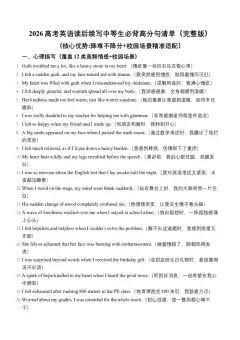
必做的10 篇经典语法填空
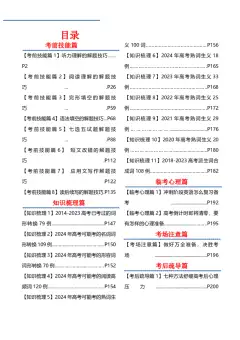
目录
经典试题01------------------------------------------------------------外国人感受中国魅力
经典试题02---------------------------------------------------------“中国式养生”文化热
潮
经典试题03-----------------------------------------------------茶马古道承载云南商贸历
史
经典试题04------------------------------------------------------------水的象征意义
经典试题05------------------------------------------------------------乡村农业振兴
经典试题06------------------------------------------------------------东西方文化交融
经典试题07------------------------------------------------------------中国传统文化
经典试题08------------------------------------------------------------传播中华文明
经典试题09------------------------------------------------------------中国书法
经典试题10------------------------------------------------------------阅读——旧书新知
01
阅读下面短文,在空白处填入1 个适当的单词或括号内单词的正确形式。
Early in the morning, an active and lively scene unfolds in every corner of China. Eva Molaro,

 1
Italian media professional, stretches along with a group of early risers to welcome the new day. At a busy airport
shop, Kazakh airline representative Igor Marchuk pays conveniently with his phone. Downstairs in a neighborhood
courtyard, French entrepreneur Sua parks her bike and, smiling,

 2

  (answer) a neighbor’s greeting in
Chinese: “Chi guo la (I’ve eaten)!”
Recently, the hashtags (话题标签) “Very Chinese Time” and “Becoming Chinese” have gone viral online,
考前必做经典10 题
inspiring more foreigners to imitate daily Chinese habits with great enthusiasm. Instead of just

 3
(sample) a short “Chinese experience”, they choose to settle in China and truly appreciate the Chinese lifestyle.


 4

  spreads globally is not China in its full

 5

  (complex), but daily bits. Molaro’s most
cherished “China moments” are hidden in simple daily details: a cup of hot water and morning exercise. She has
lived in China for nearly two decades, developing a deep affection for simple

 6

  (comfort) like hot water
and traditional Chinese medicine. She has also taken to outdoor exercise, joining her Chinese neighbors

 7
singing and dancing in public squares, and drawing inspiration from the

 8

  (remark) vitality of Chinese
seniors. She sincerely expects to be just like them in her later years, full of passion,

 9

  (engage) in the
community and open to dialogue.
With more people experiencing the rhythms of daily life, China’s charm is

 10


  (steady) gaining
worldwide recognition.
词数:248  话题:外国人感受中国魅力  体裁:记叙文
02
Under titles such as #BecomingChinese, what is customary in Shanghai or Chengdu is being presented as an
ideal lifestyle abroad — from Brooklyn to London to Berlin. This phenomenon represents a global, digital
experiment in living according to the principles of yangsheng —

 1

  ancient Chinese art of “nourishing
(滋养) life”.
This cultural wave comes from digital creators like Emma Peng,

 2

  role is to serve as cultural
translators. Peng,

 3

  (raise) in China before moving to the United States, also explains traditional Chinese
4

  (practice) on her social media accounts, translating them into the modern language of wellness.


 5

  others explaining traditional concepts like qi or yin and yang, Emma Peng spares no effort
6

  (express) long-standing Chinese customs in the modern language of Western wellness, using terms like
“detox”, “lower cortisol” and “heal your gut”.
The content has been well accepted by global audiences. Comments under their videos often mirror people’s
curiosity and

 7

  (appreciate), with users from different countries sharing how they have

 8
(successful) integrated these habits into their own wellness routines, like drinking warm water,

 9

  (use)
facial massage (按摩) tools or prioritizing certain foods.
Some shared: “I’ve been Chinese for a week and now I love rice porridge for breakfast.” “I’ve never been so
regular since finding out I’m Chinese.” “My mom’s stomachache has eased up since she

 10


  (start)
drinking warm water. This change is gold.”
词数:235  话题:“中国式养生”文化热潮  体裁:说明文
03
Older people in Yunnan can still remember the days when merchants with mules (骡子)

 1

  (travel)
along the Tea Horse Road, moving slowly through this millennium-old network of trading routes in the 1980s.
Today, retracing their steps is a good way to explore the region’s history and culture and the guided

 2
(activity) help “bring alive” stories about the past.
The businessmen carried tea from Yunnan’s “steamy” southern valleys in exchange

 3

  horses and
medicinal herbs in Xizang. Lijiang, in the north of the province, was

 4

  major staging post. Popular now
with tourists, the city is appealing, set against a background of snow-capped Himalayan peaks.
In its lively morning market, you’ll hear a dozen different dialects spoken — Yunnan is home to roughly 25
of China’s

 5

  (recognise) ethnic groups, including the Naxi, in

 6

  heartland lies in Lijiang.
Indeed, the first village named Baoshan Stone City on the road north has

 7

  (air) courtyards and roofs
with flat pieces of baked clay, seeming unchanged since its founding 1, 300 years ago.
From Baoshan, the road climbs ever higher,

 8

  (snake) through forests and wide valleys. The low-
profile Naxi houses give way to Tibetan farmhouses, where you often find yourself admiring the

 9

  (rich)
painted walls alone.
To conclude, following the Tea Horse Road allows travelers

 10


  (walk) in the footsteps of
ancient merchants and taste Yunnan’s lasting culture.
词数:23  话题:茶马古道承载云南商贸历史  体裁:说明文
04
Water plays a crucial role in shaping self-identity and our relationship with the environment. In Chinese
culture, water is a fundamental symbol representing nature and harmony, deeply

 1

  (involve) in
philosophy and mythology. It is

 2

  source of peace for ancient thinkers and is regarded as aesthetically
(审美上) powerful in Chinese art and architecture, integrating the human world with the natural one.
Chinese philosophy,

 3

  (particular) Daoism, views water as the model for cosmic (宇宙的) and
social order. Daoism, formed in the 6th century BC,

 4

  (believe) humans should live in harmony with
nature’s Dao — the natural flow of life. The Daode Jing emphasizes the virtues of water, illustrating

 5
its qualities shape and guide the principles of social life and personal conduct to a remarkable extent.
In Chinese art, the landscape concept of "shanshui" combines mountains — representing

 6

  (still),
and water — representing change, symbolizing the harmony

 7

  brevity (短暂 ) and continuity in nature.
Ancient Chinese architecture, such as Hongcun, integrates water systems

 8

  reflect the anatomy (解剖)
of an ox,

 9

  (display) the human-nature balance.
Water demonstrates our connection to nature and reminds us of

 10


  (environment) crises, like
polluted rivers. They highlight the importance of remembering our ancestral ties to this essential element.
词数:212  话题:水在中国文化、哲学、艺术及建筑中的象征意义  体裁:说明文
05
In the rural areas of Guangxi, a young woman named Lai Yuanyuan

 1

  (become) a beacon of hope
for local farmers so far. After graduating and returning from her studies in 2018, she noticed a pressing issue: the
local kumquats (金桔) were

 2

  excellent quality, yet farmers struggled to sell them at a good price due to
limited market access.


 3

  (determine) to change the situation, Lai decided to utilize the Internet. In 2019, she set up

 4
online shop and introduced live streaming to the village. At first, many villagers were skeptical,

 5
(wonder) if a phone could really help sell fruit. However, Lai patiently taught the farmers how to interact with
viewers. Her efforts proved successful. Viewers were impressed by the purity of her products and her

 6
(enthusiastic). The turnover of the shop increased

 7

  (significant), benefiting hundreds of households in
the region.
Lai’s story is just one example of China’s Rural Revitalization ( 振兴) strategy, which shows that the
countryside is a vast stage

 8

  talent can shine. By combining modern technology with traditional
agriculture, she has helped allow farmers to trade directly with customers. “Going to college was not to leave my
hometown, but to come back far

 9

  (good) prepared,” she said. “My dream is

 10


  (make) our
village wealthy and attract more young people back.”
词数:223  话题:乡村农业振兴 体裁:说明文
06
In Jingdezhen, the “porcelain (瓷器) capital” of China, a new cultural dialogue is taking shape in blue and
white. In

 1

  quiet studio, Turkish artist Dilan Atasayar paints flowing lines on pure white porcelain.
Centuries ago, Jingdezhen exported its ceramics (陶瓷制品), including exquisite blue-and-white porcelain,
2

  Central Asia, West Asia, Europe and Africa via the ancient Silk Road, greatly

 3

  (influence) the
development of porcelain making in places like Iznik.
Growing up in Iznik, Atasayar spent her childhood exploring these Eastern treasures in local

 4
(museum). After spending years studying traditional ceramic arts in Türkiye, Atasayar decided to trace the roots of
that inspiration. She

 5

  (admit) to a doctoral program at Jingdezhen Ceramic University in 2023, and
Chinese ceramic techniques and underglaze painting have been the focus of her studies as she works

 6
(master) them. Her exploration has gone beyond traditional ceramics. What she seeks is not simple imitation (模仿),
 but a deeper understanding of how cultures can learn from each other.
Atasayar’s

 7

  (dedicate) has truly borne sweet fruit. Her work,

 8

  (display) in an
exhibition, shows clouds and flowers dancing together on a single vase. In this meeting of East and West, Chinese
culture is not only remembered, but

 9

  (constant) renewed, proving the Silk Road is still alive in art.
Atasayar is not alone in her creative pursuit. Today, Jingdezhen hosts thousands of international artists

10


  often find new inspiration in old traditions.
词数:241  话题:东西方文化交融  体裁:记叙文
07
Tai Chi, also known as Taijiquan, took the spotlight on the global stage on the first International Taijiquan
Day. On Nov. 5, 2025, the United Nations Educational, Scientific and Cultural Organization (UNESCO) set March
21 as the annual International Taijiquan Day in Uzbekistan, highlighting its status as both

 1

  intangible
(非物质的) cultural heritage and a global fitness practice.
“The date choice around the Chinese solar term Chunfen conveys Tai Chi’s core value: the

 2
(pursue) of dynamic balance between life and nature,” said Ekarat Janrathitikarn, dean of the Maritime Silk Road
Confucius Institute in Thailand, who

 3

  (practice) Taijiquan for nearly 10 years and calls himself a
4

  (devote) fan of Tai Chi.
Chunfen, or the vernal equinox,

 5

  (occur) when the Sun is positioned directly above the Earth’s
equator, bringing day and night into equal length and

 6

  (fall) between March 19 and 22 on the Gregorian
calendar. This year, it fell on March 20,

 7

  (perfect) reflecting the core philosophy of Tai Chi.
Today, Taijiquan serves

 8

  a new bridge for cultural exchange and mutual learning. By hosting
various cultural and tourist activities for the First International Taijiquan Day, Nanping City,

 9

  runs the
Wuyi Mountain area, aims to promote Tai Chi-themed training while boosting health and

 10


  (well)
tourism by leveraging (利用) its scenic landscapes and rich tea culture.
词数:224  话题:中国传统文化  体裁:说明文
08
An exhibition and academic conference highlighting the civilization of the ancient Shu Kingdom in China
opened on Saturday in Oxford, England,

 1

  around 160 guests attending the opening ceremony.


 2

  (title) “Behind the Masks: Discovering Sanxingdui and Jinsha,” the event at St Anne’s College,
University of Oxford, showcases the latest archaeological

 3

  (discovery) from the renowned Sanxingdui
and Jinsha archaeological sites in southwest China,

 4

  date back approximately 3,600 to 2,800 years.
Through photographs, multimedia installations and copies of artifacts, the exhibition introduces visitors to
the artistic splendor and

 5

  (spirit) imagination of China’s ancient Shu civilization.
The exhibition displays 14 reconstructed relic replicas (复制品),

 6

  it adopts high-tech experiences
allowing attendees to

 7

  (virtual) explore archaeological sites, offering a dynamic encounter between
archaeology and digital technology.
A conference held the same afternoon

 8

  (bring) together experts and scholars in the fields of
archaeology and cultural heritage from China and Britain

 9

  (exchange) insights on recent findings and
opportunities for future collaboration.
The exhibition runs until November 12. The Sanxingdui Museum and the Jinsha Site Museum serve as co-
organizers, alongside

 10


  number of other institutions.
词数:186 话题:传播中华文明  体裁:说明文
09
The art of Chinese calligraphy has been regarded not just as a visual art but as a reflection of one’s character
and cultivation. It was believed that we could judge a person’s integrity and wisdom by

 1

  naturally flows
from their brush. When

 2

  (evaluate) calligraphy, experts look for “spirit resonance” (气韵) — a quality
extremely difficult to define, yet instantly recognizable to the

 3

  (train) eye. It is this pursuit of spiritual
expression that lifts calligraphy to a high art form.
This philosophical depth is evident in the works of Wang Xizhi,

 4

  calligrapher of the Eastern Jin
Dynasty, whose masterpiece “Lantingji Xu”

 5

  (celebrate) for centuries as the “world’s best running
script,” not only for its artistic excellence but also for the philosophy it

 6

  (contain). The preface (序言)
is a beautiful essay reflecting on the passing nature of life and the joy of friendship. The original work is lost to
history,

 7

  its aesthetic principles live on through countless copies.
Today, although typing has

 8

  (large) replaced handwriting in daily life, calligraphy is experiencing
a revival. It serves as a balance to the digital world, offering

 9

  (individual) a way to slow down, focus
their minds, and reconnect with their cultural heritage. What makes this art form enduring is how it transforms ink
on paper

 10


  a living record of the human spirit.
词数:228  话题:中国书法  体裁:说明文
10
Famous Chinese painter and writer Feng Jicai once said, “Old and new books hold diverse

 1
(meaning). New books take you into unknown worlds, while old books often leave you humbled by the limits of
your knowledge.”
That view is resonating (引起共鸣) with China’s younger readers, who

 2

  (draw) to the charm of old
books,

 3

  (specific) the sense of history and the passage of time.

 4

  trend was evident at last year’s
“The Temple of Earth and Me” Beijing Book Fair.
The fair featured 13 themed sections, among

 5

  the “Old Books, New Knowledge” section has
emerged as a focal point, as it combines exhibitions, sales, events, and publishing initiatives

 6

  (create) what
organizers call “an interactive reading space with cultural depth.”
For many book-fair-goers, old books stand out

 7

  a unique presence among the thousands of new
titles on sale each year. “Old books carry knowledge from years past. Today, by reusing them, we also embrace
sustainable

 8

  (consume), which reduces waste,” said Sun Chun, a manager at the shop.
Whether visitors hope to collect an edition with historical character, hunt for rare historical relics,

 9
simply come across a copy marked with a former reader’s notes, the fair invites them to wander through the book
stands slowly and choose carefully,

 10


 (absorb) in the smell of ink and the sense of time captured in old
pages.
词数:230  话题:阅读——旧书新知  体裁:新闻报道