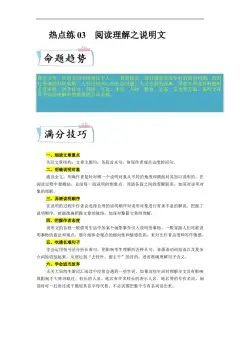
必做的10 篇经典说明文—阅读理解C 篇
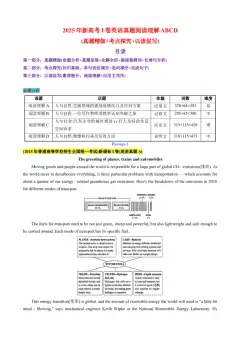
目录
经典试题01-----------------------------------------体育课与户外教育对年轻人毅力培
养
经典试题02------------------------------------------------------------“决策疲劳”
经典试题03------------------------------------------------------------科技与动物保护
经典试题04-----------------------------------------------爆发力与青少年学业成绩的关
系
经典试题05------------------------------------------------------记忆晶体存储和DNA 存储
经典试题06--------------------------------------------------------太空生活对宇航员的影
响
经典试题07-------------------------------创新过程中的“顿悟时刻”和 “被认可时
刻”
经典试题08----------------------------------------------------气候目标与生物保护的矛盾
经典试题09-----------------------------------------------以平衡的态度看待生活中的速
度
经典试题10------------------------------------------------------------科技与环保
01
Picture yourself halfway up a winding trail, lungs burning, legs trembling, the summit still out of sight. You
考前必做经典10 题
want to stop but you don’t. Something quiet and steady inside keeps you moving. That inner force, psychologists
call grit (毅力) — the combination of persistence (坚持) and passion that keeps us going after goals.
A new study from researchers at the China University of Geosciences explored what really develops that
quality in young adults — routine workouts in the gym or unpredictable adventures in the wild. Over 1,200
university students took part in a 16–18-week course in either traditional physical education or outdoor education.
Their grit levels were measured before and after the courses from two aspects: persistence of effort and consistency
of interest. The answer, it turns out, lies somewhere between sweat and scenery.
Both groups improved, but the difference was striking. Outdoor education produced bigger gains across
every measure of grit, especially persistence. Students who spent a term facing real-world challenges became
mentally stronger. That sense of mastery — “I can handle this” — builds the same kind of grit linked to lower
anxiety, better dealing with stress, and greater life satisfaction. In contrast, traditional PE improved students’
persistence but actually reduced their interest consistency — their ability to stay engaged with long-term goals.
Repetitive routines, limited autonomy, and predictable settings may weaken curiosity over time. Outdoor education,
however, thrives on uncertainty.
Newness doesn’t just keep us entertained; it keeps us engaged. From the perspective of Self-Determination
Theory, outdoor programs meet the three psychological needs that fuel motivation: autonomy (you choose how to
face challenges), competence (you see progress), and relatedness (you rely on teammates). Together, they create a
powerful recipe for inner motivation.
This study shows that the environment we learn in shapes not just our bodies but our minds’ ability to
persist.In a world of digital distraction (分心) and instant satisfaction, outdoor education reminds us that grit grows
through hardship. For anyone seeking for long-term change, the message is simple: step outside.
1.Which one is most beneficial to the development of grit?
A.Running on the same school track.
B.Swimming in a sports center pool.
C.Climbing mountains in a natural park.
D.Playing basketball in an indoor stadium.
2.What does the underlined word “thrives” in paragraph 3 mean?
A.Focuses.
B.Grows.
C.Depends.
D.Survives.
3.Why is Self-Determination Theory mentioned in paragraph 4?
A.To explain outdoor programs’ motivational effect.
B.To analyze the physical benefits of newness in life.
C.To introduce the popularity of outdoor education.
D.To define the key driving factors of motivation.
4.What is the main idea of the text?
A.Grit contributes to the long-term change. B.Outdoor challenges build a tougher mind.
C.Natural scenery improves mental health.D.Routine workouts weaken inner motivation.
词数:338  话题:体育课与户外教育对年轻人毅力培养  体裁:说明文
02
If you’ve ever found yourself scratching your head over a decision when the answer is obvious, now there’s
a scientific reason behind it. “The problem is ‘decision fatigue’ — a psychological phenomenon that influences the
quality of your choices after a long day of decision making, causing indecision or poor choices.” says Evan
Polman, a leading psychologist.
Physicians who have been on the job for several hours, for example, are more likely to prescribe antibiotics
( 开抗生素) to patients when it's unwise to do so. “Probably it’s because it’s simple and easy to write a
prescription and consider a patient case closed rather than investigate further,” Polman says.
But interestingly, decision fatigue goes away when you are making the decision for someone else. When
people imagine themselves as advisers and imagine their own choices as belonging to someone else, they feel less
tired and rely less on decision shortcuts to make those choices. “By taking upon the role of adviser rather than
decision maker, one does not suffer the consequences of decision fatigue,” he says. “It’s as if there’s something fun
and relieving about making someone else’s choice.”
“Getting input from others not only offers a fresh idea and thought process; it often also includes riskier
choices. While this sounds undesirable, it can be quite good,” says Polman. “When people experience decision
fatigue, they have a tendency to choose to go with the status quo ( 现状),” he says. “But the status quo can be
problematic, since a change in the course of action can sometimes be important and lead to a positive outcome.” In
order to achieve a successful outcome or reward, some level of risk is almost always essential. “People with
decision fatigue will likely choose to do nothing over something,” he says, “That’s not to say that risk is always
good, but it is related to taking action whereas decision fatigue certainly leads to inaction.”
“Just because you can make good choices for others doesn’t mean you’ll do the same for yourself,” Polman
cautions. “Research has found that women negotiate higher salaries for others than they do for themselves,” he
says, adding that people slip in and out of decision roles.
1.Decision fatigue may cause people to make decisions that are_______________.
A.reasonable
B.objective
C.unwise
D.smart
2.Which of the following may be made by a person with decision fatigue?
A.A consumer buys a lot of food to prepare for a dinner.
B.A judge makes a less convincing judgment late in the day.
C.A student plans to finish his math homework in the morning.
D.A physician advises the patient to drink more water after examination.
3.What are people likely to do when decision fatigue sets in?
A.They stop trying anything new.
B.They adopt a totally new idea.
C.They tend to make risky decisions.
D.They turn to physicians for advice.
4.What does Polman say about taking some risks in decision making?
A.It will often end in regret.
B.It is likely to cause serious consequences.
C.It will enable people to be more creative.
D.It is necessary to achieve successful outcome.
词数:364 话题:介绍了“决策疲劳”这一心理现象  体裁:说明文
03
Facial recognition software used to study the social behavior of individual Greylag Geese (灰雁) in Europe
will soon be used to monitor another rare geese species, the Cape Baren Goose in South Australia. The technology
was used to assess how each bird responds to images of themselves, other mates or partners. Researchers found that
it could be used to monitor and record endangered wildlife.
The program tested each goose face with life size 2D images of members of the Greylag Goose flock. With
97% accuracy, each goose face could be correctly assigned within a photo library containing 6,000 possible
matches. “Next, the team placed life-sized photos in a grassy field to see whether geese behave differently to each
image, which they did,” says Professor Kleindorfer.
It was found that the geese approached the photo of their partners more quickly, gave friendly contact calls
and fed for longer. In contrast, when they saw a picture of themselves — a goose they had never seen before —
they made angry sounds and took longer to approach food, if they fed at all.
The latest findings into visual cues of individuality not only give insights into the birds’ social structure but
illustrate how the software to monitor individual faces or body patterns can be monitored using photographs
collected in the field — for animal numbers and movements — in conservation efforts.
“Animal welfare could also be enhanced through the use of photographs in captivity ( 圈养),” says Dr
Colombelli-Negrel. “A photo might reduce the sense of isolation in a social species held in captivity or serve as a
‘soft introduction’ before a new animal is introduced into an enclosure. Perhaps captive individuals in group-living
species express reduced anxiety when exposed to a photograph of an unknown and smaller conspecific.”
1.What makes it possible for facial recognition software to monitor animals?
A.Its research on animal behaviors.
B.Its ability to identify different faces.
C.Its photo library of Greylag Geese.
D.Its advanced tracking technology.
2.What is probably the geese’s reaction to a picture of themselves?
A.Excited.
B.Indifferent.
C.Aggressive.
D.Friendly.
3.What do animal photos do to captive animals?
A.Avoid conflicts between them.
B.Provide entertainment for them.
C.Release their negative emotions.
D.Introduce species to them.
4.What can be a suitable title for the text?
A.How Endangered Animals Can Be Saved.
B.What Difficulties Animal Protection Will Face.
C.How Facial Recognition Benefits Animals.
D.What Photos Can Boost Animals’ Moods.
词数:297  话题:科技与动物保护  体裁:说明文
04
Academic achievement is a key indicator of adolescents’ development and future potential. While physical
activity is known to benefit physical and mental health, its indirect effects on academic performance are less
understood. A recent study set out to explore exactly this connection, thus helping schools design better
interventions for students.
The study examined over 360 high school students with an average age of 17. Using multiple models,
researchers analyzed how physical activity level, exercise duration and types of activity influenced academic
performance. Contrary to their expectations, the amount of time students spent exercising showed no significant
correlation with their grades. Instead, one specific component stood out as a significant predictor.
That component was explosive strength (爆发力), measured through the countermovement (反向运动) jump
test. Students who performed better in this jump test tended to achieve higher academic scores. Statistical analysis
revealed that jump performance and age significantly affected the academic performance model, with a p-value of
0.14. Together, these factors explained approximately 9.3% of the variation in academic grades.
What explains this connection? The researchers suggest that explosive strength may indicate overall
neurological health and cognitive function. Developing such fitness requires discipline and goal-setting — skills
that are transferred directly to academic pursuits. Moreover, biochemical changes associated with improved fitness,
such as enhanced blood flow to the brain, may create better conditions for learning. For high school students facing
pressure from exams, even 20 minutes of moderate exercise can serve as a reset button for an overwhelmed mind.
This study highlights that improving targeted physical fitness does not distract from academic success, but
effectively facilitates it. For students buried in textbooks and papers, this finding offers a scientific basis to take
regular short breaks from their desks — not as a way to avoid study responsibilities, but as a practical strategy to
promote overall learning efficiency. The most essential implication for senior high school students is that nurturing
physical fitness, particularly explosive strength, is not a luxury to be delayed until after exams, but an indispensable
part of preparing the mind to meet the toughest academic challenges.
1.What was the unexpected discovery made by the researchers?
A.Multiple components predicted grades.
B.Physical activity level led to high grades.
C.Exercise duration was unrelated to grades.
D.Different sports varied in effects on grades.
2.What does the underlined phrase “reset button” in Paragraph 4 probably mean?
A.A button to restart a machine.
B.A method to refresh the mind.
C.A way to get your mind off study.
D.A means to relieve physical stress.
3.What does the author imply in the last paragraph?
A.Academic success requires trading exercise for study.
B.Taking breaks reflects weak dedication to schoolwork.
C.Targeted physical training supports academic efforts.
D.Explosive strength alone ensures academic performance.
4.Which of the following is probably the best intervention schools design for students?
A.Organizing Tai Chi workshops.
B.Doubling daily jogging time.
C.Offering distance running training.
D.Doing standing long jump practice.
词数:348  话题:爆发力与青少年学业成绩的关系  体裁:说明文
05
In the era of the internet, AI, smart homes and autonomous cars, there’s one thing we just can’t stop
producing data. We are expected to generate 394 trillion zettabytes of the stuff every year by 2028, according to the
analyst company IDC. Every time we watch a YouTube video, send an email, or ask an AI chatbot a question —
data is created. Although data seems invisible, it is processed and housed in physical places — data centers, for
which demand is now proving unsatisfiable.
The problem of storing this rapidly growing data has inspired novel solutions. One such approach is
“memory crystals,” developed by Peter Kazansky, a researcher from Kyoto University. By burning tiny perforations
into the glass, data can be encoded in five dimensions, using differences in light orientation, strength, and spatial
position (individual 3D pixels with x, y, z coordinates). This method allows for extremely high density, with up to
360 TB stored on a 5-inch glass disk.
Another promising solution is DNA storage, first proposed by Soviet physicist Mikhail Samoilovich Neiman.
In this method, digital data is mapped onto DNA’s four bases (A, T, C, and G), represented as 01, 00, 11, and 10,
creating a physical form of data. A favorite line among DNA data storage researchers is that “you could store all of
the data in the world in a teaspoon.” But its practical application still faces hurdles, especially in terms of cost and
data access efficiency.
Heinis, a professor in data management at Imperial College London, says: “Kazansky’s ‘memory crystals’ is
a direct competitor to DNA storage. But DNA might have an edge for we will always be able to read DNA, due to
its wide-ranging medical applications. With other technologies, like ‘memory crystals’, the question is how long the
read device will be around.”
Of course, solving the long-term data storage problem is an important part of the solution to energy-guzzling
data centers. But do we really need all the data that we produce?
1.What problem does the author point out in paragraph 1?
A.The rapid growth of global data production.
B.The rising demand for automated equipment.
C.The efficiency of data-processing technologies.
D.The challenge of storing the ever-growing data.
2.What gives memory crystals their high data density?
A.Heat-resistant glass.
B.Computer-controlled drilling.
C.High-intensity light.
D.Multi-dimensional encoding.
3.What can be inferred from Heinis’s words?
A.DNA storage has stronger reliability.
B.DNA storage keeps larger data storage capacity.
C.DNA storage owns a wider range of application.
D.DNA storage will soon replace memory crystals.
4.What does the author suggest in the last paragraph?
A.Reduce data center noise.
B.Cut data centers’ energy use.
C.Stop over-storage of data.
D.Upgrade storage technology.
词数:332  话题:记忆晶体存储和DNA 存储  体裁:说明文
06
In space, astronauts have to learn to live without gravity — whether they’re aboard the International Space
Station (ISS) or on a journey to the moon. While space adventurers do experience microgravity conditions beyond
Earth, that gravitational influence is so minimal that you can think of it as a virtually weightless environment. But
while floating around might sound fun, even simple tasks like holding an object can pose unique challenges. So,
scientists have wondered, how does the brain adapt to this kind of lifestyle?
In a new study, researchers from the Université catholique de Louvain and Ikerbasque, the Basque
Foundation for Science, explored how astronauts’ brains adapt to weightlessness. The team studied changes in how
astronauts grip objects when going from Earth to space and then back to Earth again.
The results were a little stranger than you might expect, and could have serious consequences for future
astronaut safety. “What we observed was totally unexpected,” lead author Philippe Lefèvre, a Professor of
Biomedical Engineering, Université catholique de Louvain, told Space.com.
The researchers found that months after returning to Earth from space, astronauts had trouble exerting the
correct amount of force to properly grip an object. In fact, their brains were so used to gripping weightless objects
in space that it took them months back on Earth to readjust. Similarly, the team also found that, while in space,
astronauts actually applied more force than necessary to grip objects because their brains still expected the presence
of gravity.
Essentially, both during a mission in space and after returning to Earth, astronauts “misinterpret sensory
feedback,” Lefèvre said. Living on Earth with the force of gravity, we know that if we let go of an object, both
inertia (惯性) and the weight of the object (a combination of mass and gravity) will cause it to fall. In space, only
inertia causes objects to move. For instance, simply letting go of an object won’t make it fall, but tapping down on
it would have the same visual effect because you’ve added a manual force, but while we might know this
intellectually, it turns out that it takes some time for our brains to catch up to our gravity (or gravity-less
surroundings).
1.What situation do space travelers experience in the universe?
A.They are faced with the completely gravity-free space.
B.The microgravity conditions beyond Earth are minimal.
C.They had difficulty using the proper amount of force.
D.They are floating in an unreal weightless environment.
2.Why did astronauts in space apply more force than necessary to grip objects?
A.Because objects in space become heavier due to microgravity.
B.Because their brains still expected gravity to be present.
C.Because they were not familiar with the effect of inertia.
D.Because sensory feedback was amplified in space.
3.What aspect is mainly discussed in the last paragraph?
A.Cause and effect
B.Comparison and contrast
C.Example and citing
D.Highlight and focus
4.Which of the following is the best title for the passage?
A.Astronauts Learn to Hold Objects in a Weightless Environment
B.Astronauts Face Grip Strength Challenge in Space and on Earth
C.Why Astronauts Use Wrong Grip Force in Space and on Earth
D.The Physics of Inertia and Gravity in Space Confuses Astronauts
词数:367  话题:太空生活对宇航员的影响  体裁:说明文
07
The “eureka moment” — that sudden breakthrough insight — is celebrated as the peak of innovation. Yet
this story is incomplete: while the initial idea provides crucial energy, it guarantees neither success nor continued
forward drive.
Most innovations unfold over time. Ancient Greek scientist Archimedes still had to develop the mathematics
and practical tools after his bath-time insight — a process demanding persistence and toughness. Initial inspiration
alone cannot sustain long-term progress. We need moments that renew our belief and drive along the way.
This is where the “videmus moment” proves vital. Coined by Swedish author Fredrik Haren from the Latin
“we see,” it describes the instant someone else truly grasps your idea and says, “Oh, I see!” That recognition makes
innovators feel they are no longer alone. Research shows that supportive peer (同伴) feedback strengthens creative
self-belief and sustains idea generation over time, providing a second wave of confidence and drive.
Haren considers the videmus moment as significant as the eureka moment, creating “two peaks” of creative
energy rather than just one. He illustrates the videmus moment with a gardening metaphor he calls “idealing” — a
mix of “idea” and “seedling (幼苗)”. While an idea’s potential is initially visible only to its planter, like a seed
hidden in soil, the moment it emerges and others see it, its possibility expands collectively. This shift from private
to shared insight is key for innovation.
Such moments, however, aren’t guaranteed. To invite them, we may need to take intentional action. First,
share ideas with the right people — those who understand the field and whose feedback you trust. Second, treat
confusion as useful feedback; refine your idea for clarity. Third, communicate simply, allowing others to ask
questions rather than flooding them with details. Cultivating (营造) an environment where constructive feedback is
welcomed can significantly increase the likelihood of experiencing these validating exchanges.
When seeking feedback, watch out for artificial validation. True videmus moments arise not from close
friends and family, but when someone unconnected truly recognizes your idea’s value. These moments of being
truly seen often become life’s most meaningful highlights.
1.What does the example of Archimedes serve as?
A.Support for an argument.
B.Historical comparison.
C.Challenge to tradition.
D.Theoretical background.
2.What is the key result of a “videmus moment”?
A.The idea gets protected.
B.The innovator feels seen and motivated.
C.A right partner is found.
D.The work gains public attention.
3.What does the underlined word “validating” in paragraph 5 mean?
A.Harmonious.
B.Complex.
C.Shallow.
D.Appreciative.
4.What is the main purpose of the text?
A.To compare two creative stages.
B.To discuss a need for recognition.
C.To present a way to keep creating.
D.To explain how to seek feedbacks.
词数:352  话题:创新过程中的“顿悟时刻(eureka moment)”和 “被认可时刻
(videmus moment)”    体裁:说明文
08
Europe is racing to secure minerals for its clean energy future. Lithium ( 锂) and copper are essential for
electric vehicle batteries, solar panels, and wind turbines. Under its Critical Raw Materials Act, the EU has named
23 mining projects as “strategic”, aiming to produce 10% of its annual critical raw material needs domestically by
2030.
But there is a hidden cost to this ambition. A new investigation reveals that over half of these strategic
mining projects are located within one kilometer of protected Natura 2000 sites — Europe’s most important
network of nature reserves.
In Spain, the Mina Doade lithium project sits less than a kilometer from protected Atlantic heathlands —
home to endangered species like the Iberian wolf. Local residents have fiercely opposed it. “They say lithium is
strategic — but for us, water is strategic,” said one forestry worker. In Finnish Lapland, the Sakatti mining project,
which aims to extract (提取) copper and nickel, partially overlaps with the Viiankiaapa wetland reserve. Finland’s
state land manager has warned that the project’s environmental assessment failed to resolve uncertainties about
potential impacts on groundwater. Globally, a 2024 study found that 71% of transition-linked mines are located in
ecologically sensitive areas.
This exposes a fundamental contradiction. The very technologies designed to combat climate change may
end up destroying the biodiversity we also seek to protect. Environmentalists warn that Europe is lowering its
guard. The Critical Raw Materials Act expedites permits for strategic projects, potentially going around the strict
protections that Natura 2000 sites normally enjoy. “In the name of climate goals, we are cutting environmental
standards that protect both nature and people,” said a legal advisor at Friends of the Earth.
The path forward is not to abandon the green transition, but to pursue it more thoughtfully. This means
prioritizing recycling over new mining, ensuring strict environmental assessments, and recognizing that the
cheapest option for clean energy may come at too high a cost for nature.
1.What does the author try to illustrate in the first two paragraphs?
A.The shortage of skilled workers for mining.
B.The high cost of extracting lithium and copper.
C.The EU’s reliance on imports of its raw materials.
D.The potential threat of mining to the environment.
2.Why does the author mention Spain and Finland in Paragraph 3?
A.To reveal assessment issues.
B.To show the local opposition.
C.To illustrate mining-nature conflicts.
D.To highlight environmental protection.
3.What does the underlined word “expedites” in Paragraph 4 most probably mean?
A.Speeds up.
B.Slows down.
C.Takes away.
D.Sets aside.
4.What can be a suitable title for the text?
A.Whose duty?
B.Who to blame?
C.What’s the dilemma?
D.How to solve?
词数:326  话题:气候目标与生物保护的矛盾  体裁:说明文
09
In his book Speed: How it Explains the World, Vaclav Smil explores the concept of speed, which humans
have long regarded as impressive, magical and highly desirable. He interprets speed from two aspects: the physical
rate at which objects move within a certain time and a broader measure of changes in individuals, groups and social
systems. Adopting a data-based approach, the book covers a wide range of topics, from natural events including
volcanoes and species evolution to human creations such as traditional sailing ships and modern supercomputers.
Technological innovations, especially the replacement of animal power with steam and electric power, have
greatly raised the pace of life and production. Faster transportation, more efficient production and extraordinary
economic growth have taken place worldwide. People’s average life expectancy has increased greatly, and
advanced technology makes rapid medical progress possible.
Nevertheless, the uncontrolled desire for speed brings obvious disadvantages. High work pressure caused by
extreme efficiency leads to more accidents in workplaces like factories and warehouses. Higher driving speed
sharply increases the risk of serious injury or death in traffic accidents. For commercial airplanes, high speed
results in extremely high fuel consumption, so speed has to be balanced with economic benefits. Moreover, heavy
traffic in urban areas actually reduces people’s real travelling speed.
Smil regards himself as a speed sceptic (怀疑论者). He is not against speed itself but advocates a reasonable
and balanced attitude. We should welcome higher speed where it brings real benefits, such as timely medical
treatment, and slow down where it threatens safety, the environment or social equality. We should never seek speed
blindly or run after it for its own sake.
Reviewer Richard Dunn agrees with Smil’s central opinion but argues that the book should focus more on
contemporary society rather than the long history of the Earth. He also questions whether continuous growth,
instead of speed, is the key concern in modern politics and economy. He believes deeper reflections on modern
lifestyle would make the book more meaningful and practical.
1.How does Smil develop his ideas in the book?
A.By giving living guidance.
B.By covering different fields.
C.By telling historical stories.
D.By showing economic data.
2.What is a probable result of overseeking speed?
A.More green transport.
B.Reduced traffic pressure.
C.Unexpected risks at work.
D.Quicker medical development.
3.What can be learned about Smil’s book?
A.It ignores Earth’s history.
B.It advocates continuous progress.
C.It offers modern lifestyle advice.
D.It focuses less on modern society.
4.What is the best title for the text?
A.Take a Wise Look at Life’s Pace
B.Avoid Hidden Risks in Daily Life
C.Master Skills of Modern Technologies
D.Raise Work Efficiency in Good Ways
词数:333  话题:以平衡的态度看待生活中的速度  体裁:说明文
10
Satellites can now track ocean garbage from space, marking a potential “game changer” for tracking the
annoying problem of marine litter, new research suggests. The study, published in Nature Communications,
suggests that even satellites that haven’t been specially designed to detect floating garbage may be useful in the
battle against a rising tide of ocean pollution.
Thirty million tons of plastic pollution have already piled up in the world’s oceans, research suggests, with
the number projected to rise in coming years. But tracking litter as it floats on the sea surface has historically
proved difficult for scientists because the garbage covers a relatively small part of Earth’s surface, making it almost
impossible to accurately monitor from space.
In an attempt to find another way to track ocean garbage, an international group of researchers analyzed
300,000 satellite images of the Mediterranean Sea. They were on the hunt for litter windrows ( 长条带) that,
researchers suspected, might be a good indicator of litter concentration in a given ocean area.
Between July 2015 and September 2021, the satellites took images of 14,374 litter windrows covering about
36 square miles of sea surface. The longest were up to 14.3 miles. The researchers used the imagery to calculate the
concentration of the litter in windrow areas, identifying hot spots near Algeria, Libya, southwest Italy and the
northern Adriatic Sea. Thickly populated areas had higher nearby litter concentration, they found.
The analysis suggests “much of the litter remains near its land-based source,” the researchers write, though
ocean currents and winds affect the litter, and floods and rainstorms in particular pushed the litter farther out to sea.
These “pulses” of litter caused concentration to peak in the spring and autumn and decline during winter.
Though the satellites weren’t designed to track garbage, they helped identify the location and magnitude (规
模) of waste while “opening new prospects” for litter tracking and considering litter windrows’ potential roles as
habitats for marine life, the researchers write. The researchers propose that future satellite missions include litter-
specific tracking devices.
1.Why is it hard to track ocean litter from space?
A.It piles up underwater.
B.It breaks down too fast.
C.It occupies a limited area.
D.It moves with currents.
2.What did the researchers discover with satellites?
A.Causes of marine pollution.
B.Distribution rules of ocean waste.
C.Ways to tackle litter concentration.
D.Link between climate and ocean life.
3.What does the underlined word “pulses” probably mean in paragraph 5?
A.Periodic bursts.
B.Slight changes.
C.Natural forming.
D.Long-term spread.
4.What does the author stress in the last paragraph?
A.Threats to marine life.
B.Value of satellites’ litter detection.
C.Concerns on waste tracking.
D.Prospects for marine observation.
词数:338  话题:科技与环保  体裁:说明文