话题 08 中国文化
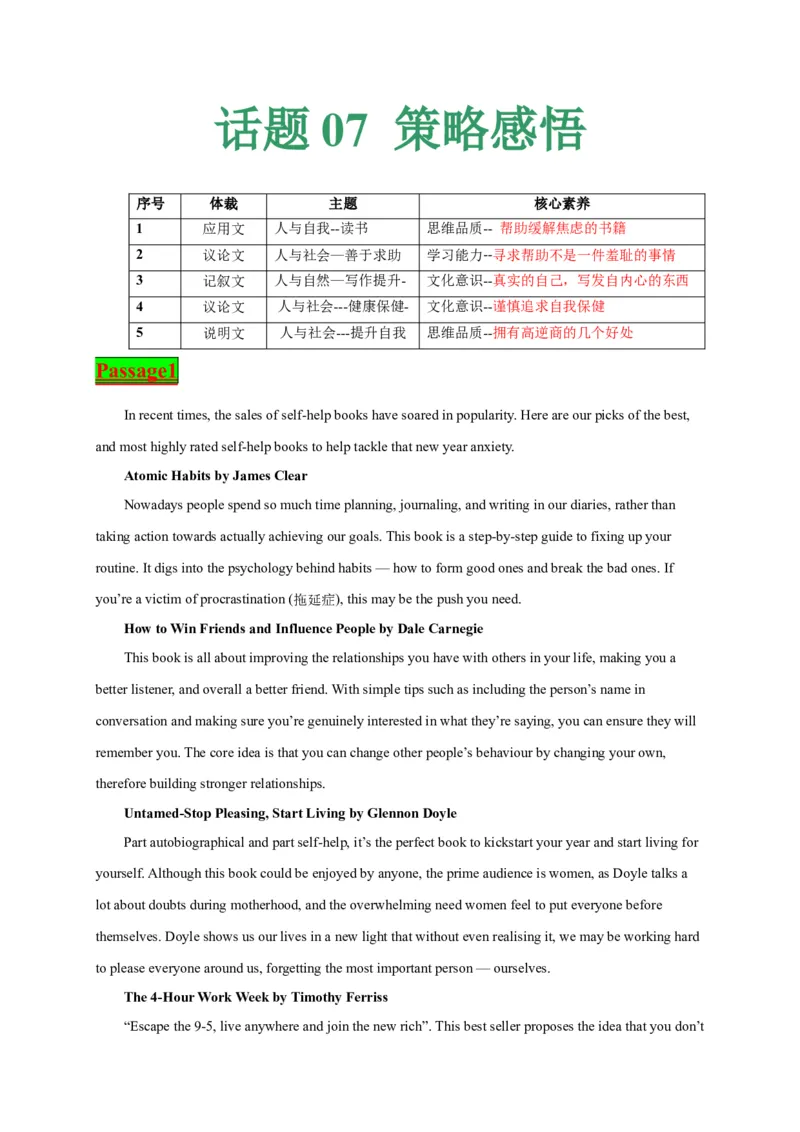
序号 体裁 主题 核心素养
1 应用文 人与社会-活动介绍 文化意识--中国传统节日大寒
2 说明文 人与社会—文化遗产 学习能力-非物质文化遗产-水密舱壁技术
3 说明文 人与社会—文化介绍-- 文化意识--中国古代茶艺:茶百戏。
4 记叙文 人与社会---文化使者 文化意识--留学生逐梦中国的故事
5 记叙文 人与社会---中国诗歌 文化意识--推广中国文化
Passage1
The traditional Chinese solar calendar divides the year into 24 solar terms. Major Cold, or da han in
Chinese, is the last solar term in the annual solar calendar. Here are some things about Major Cold.
Cold current
During Major Cold, as the cold current moves southward, the weather is often cold to the extreme.
Though the related data in China show that the lowest temperature in a year is usually recorded during the
Major Cold period, it may not be as cold as Minor Cold in most areas on the whole since spring is
approaching.
Dispelling (驱散) cold
During Major Cold, the freezing weather has a big influence on Chinese people’s lives. Rather than
take up outdoor activities, people tend to reduce movements and choose to stay at home to keep fit in
various ways. For example, to stay warm, people in Beijing have a habit of eating dispelling cold cake, a
kind of rice cake that is thought good to warm and nourish. Besides, in Chinese, “rice cake” has the same
pronunciation with the words “higher in a new year”, which symbolizes good luck and continual
promotion. For another example, residents in Nanjing, Jiangsu Province like to drink nourishing chicken
soup during Major Cold.
The ending and the beginning
Major Cold often coincides with the end of the year, so the folk customs of this period have an added
sense of farewell to the old and welcoming the new. With the traditional Spring Festival around the corner,
people are busy making preparations for it, like stocking up delicacies, sweeping and decorating. The
cheerfulness of the reunion adds warmth to the cold winter days.1.What is the feature of Major Cold?
A.Lasting much longer than Minor Cold.
B.Being colder than Minor Cold on average.
C.Resulting from cold current moving southward.
D.Dropping to the lowest temperature of the year.
2.How do Chinese people respond to Major Cold?
A.By eating specific food to keep warm. B.By expressing new year’s resolution.
C.By doing exercise to keep healthy. D.By decorating their houses to dispel cold.
3.In which part of a newspaper may the text appear?
A.Diet. B.News. C.Culture. D.Art.
Passage2
Invented in the Tang Dynasty and widely adopted after the Song Dynasty in Fujian, the watertight-
bulkhead (水密舱壁) technology permits the construction of ocean-going ships with watertight
compartments(隔层). If one or two cabins are accidentally damaged at sea, water will not flood the other
cabins and the ships will remain afloat.
The experience and working methods of watertight-bulkhead technology are transmitted orally from
master to apprentices. However, the need for Chinese junks(中国式帆船) has decreased sharply as wooden
ships have been replaced by steel-hulled ships, and today only three masters can claim full command of this
technology. Associated building costs have also increased owing to a shortage in raw materials. Therefore,
the inheritance(继承) of this heritage is decreasing, and inheritors are forced to seek alternative
employment.
Zhang Guohui, a 77-year-old inheritor of the watertight-bulkhead techniques used to make Chinese
junks, has been making ships for more than six decades. Coming from a poor family in a fishing town in
East China’s Fujian Province, Zhang started to make a living at the age of 16 fishing on the open seas,
which is where he developed a keen interest in constructing boats. As a fast learner, Zhang was later sent to
shipyards in the cities of Quanzhou and Xiamen in Fujian
Province, where he received training and became a master of traditional Chinese junks and gained fame
because of his extremely skilled craftsmanship in the construction of these junks.
In fear that the traditional skills would die someday, Zhang started to restore old ships and make model
junks for the museum with his 20 years of shipbuilding skills. “The restored ancient ships are the historicalwitnesses of Quanzhou as a maritime center of the East and Southeast Asia trade network,” said Zhang,
adding that he finds the work meaningful since younger generations can learn from exhibitions of ancient
ships that their ancestors had advanced shipbuilding technology at an early stage of development. “As long
as I’m alive, I’ll keep passing on the heritage,” he said.
4.What function is expected of the watertight-bulkhead technology?
A.To prevent ships from sinking. B.To reduce the weight of ships.
C.To allow ships to sail faster. D.To help ships resist strong winds.
5.Which of the following is the purpose of paragraph 2?
A.To prove the significance of steel-hulled ships.”
B.To stress the complex process of building wooden ships.
C.To present people’s efforts to pass down cultural heritages.
D.To show difficulties of inheriting watertight-bulkhead technology.
6.What can we learn about Zhang Guohui from paragraph 3?
A.He supports his family by fishing.
B.He was born with a talent for shipbuilding.
C.He has devoted himself to constructing boats.
D.He has won many awards for restoring ancient ships.
7.What does Zhang Guohui convey in his words?
A.Traditional culture should be innovated with the times.
B.The ancient ship trade originated from Quanzhou in China.
C.It is necessary for modern students to learn shipbuilding skills.
D.It is worth passing on traditional skills from generation to generation.
Passage3
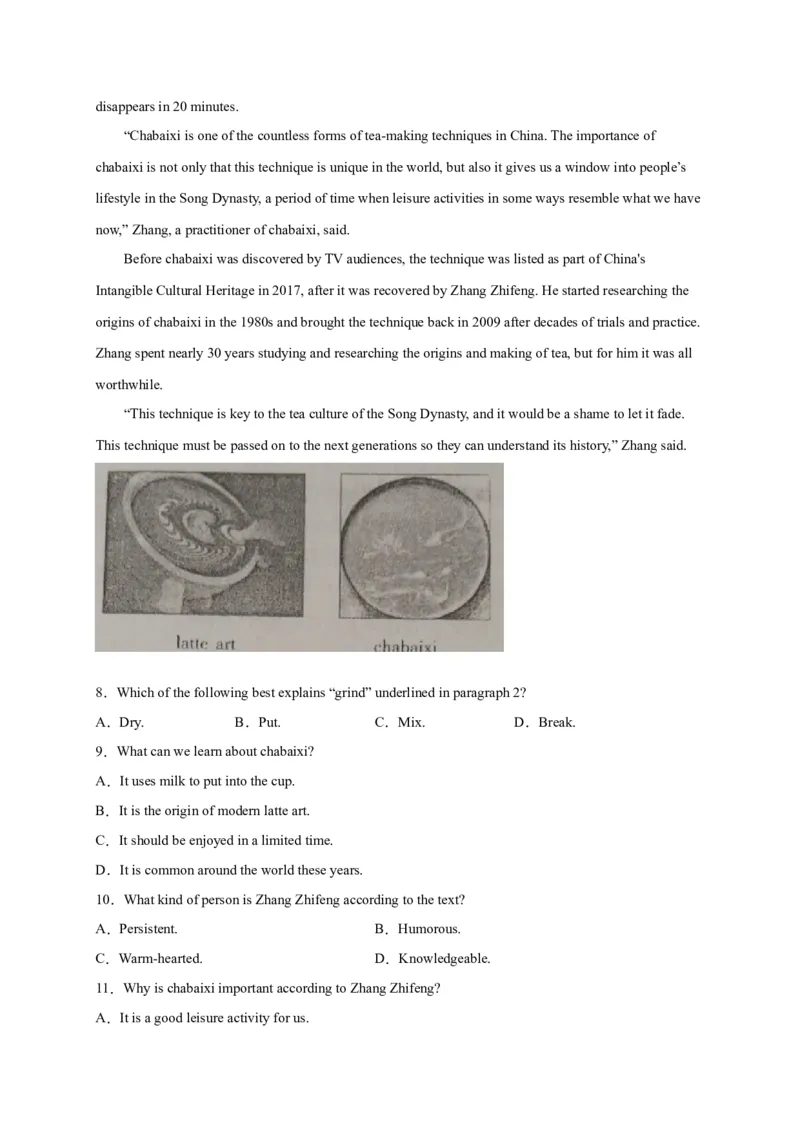
By drawing patterns on the surface of a cup of tea, chabaixi, an ancient Chinese tea trick displayed in a
recent TV drama, has gone popular for its apparent similarity with modern latte art. However, ten years
ago, this distinctive technique was close to disappearing completely.
Chabaixi can create endless patterns such as bamboos and mountains or even calligraphy. There are
over a dozen steps: grind tea for fine powder (粉末), pour boiled water,stir the mixture,and draw the
patterns. It is different from making latte because people use clear water as the object to put into the cup
instead of milk. But when the water touches the surface of whipped tea, it turns into a white color anddisappears in 20 minutes.
“Chabaixi is one of the countless forms of tea-making techniques in China. The importance of
chabaixi is not only that this technique is unique in the world, but also it gives us a window into people’s
lifestyle in the Song Dynasty, a period of time when leisure activities in some ways resemble what we have
now,” Zhang, a practitioner of chabaixi, said.
Before chabaixi was discovered by TV audiences, the technique was listed as part of China's
Intangible Cultural Heritage in 2017, after it was recovered by Zhang Zhifeng. He started researching the
origins of chabaixi in the 1980s and brought the technique back in 2009 after decades of trials and practice.
Zhang spent nearly 30 years studying and researching the origins and making of tea, but for him it was all
worthwhile.
“This technique is key to the tea culture of the Song Dynasty, and it would be a shame to let it fade.
This technique must be passed on to the next generations so they can understand its history,” Zhang said.
8.Which of the following best explains “grind” underlined in paragraph 2?
A.Dry. B.Put. C.Mix. D.Break.
9.What can we learn about chabaixi?
A.It uses milk to put into the cup.
B.It is the origin of modern latte art.
C.It should be enjoyed in a limited time.
D.It is common around the world these years.
10.What kind of person is Zhang Zhifeng according to the text?
A.Persistent. B.Humorous.
C.Warm-hearted. D.Knowledgeable.
11.Why is chabaixi important according to Zhang Zhifeng?
A.It is a good leisure activity for us.B.It can be seen in many places in China now.
C.It is the most important tea-making technique in China.
D.It makes us know more about Chinese traditional culture.
Passage4
For one overseas student who has been in China for over a decade, learning the moves and culture
associated with Chinese martial arts(武术) has been his most valuable experience.
So uley mane Hima Oumarou, a Nigerien student at Hebei University in Baoding, Hebei province,
first came to the university in 2012 as an undergraduate, not only for an education, but also to achieve his
dream of learning the Chinese martial art of kung fu. He became a fan of kung fu after watching movies
starring famous martial artists such as Jackie Chan and Jet Li.
During his studies in Baoding, Oumarou joined the university’s martial arts association and studied
under Duan Shuxing, one of the association’s instructors. Following Duan’s instructions, Oumarou began to
practice basic moves in 2015, including Eight Extremities Fist, or bajiquan, as well as the associated art of
tai chi.
“Learning martial arts has not been easy because I was not young when I started,” the 36-yea--old
said, adding that he was forced to overcome difficulties and make more of an effort to learn more advanced
moves.
As far as his instructor is concerned, Oumarou is hardworking and energetic. “He always trains hard
and has made great progress in the past seven years,” Duan said.
So far, Oumarou has mastered multiple boxing techniques and knows how to use many traditional
Chinese weapons.
Apart from the skills he’s learned, martial arts have brought him more. He has made many Chinese
friends through learning kung fu and has been to many places around China to participate in competitions.
Oumarou is now a doctoral student and is expected to graduate this year. In the future, he plans to
open a kung fu center in Niger after he graduates, and to become an instructor and teach youngsters martial
arts. He thinks that will also help him better understand the spirit of martial arts, and also become a cultural
communicator between China and Niger.
12.What can we learn about Oumarou from paragraph 1 and paragraph 2?
A.He went abroad to realize his dream over ten years ago.
B.He came to China only to learn Chinese martial arts.C.He had a terrible experience travelling around China.
D.He had a passion for kung fu after becoming an actor.
13.Why is learning martial arts challenging to Oumarou?
A.He didn’t set out to practice martial arts at an early age.
B.He took a negative attitude toward learning martial arts.
C.He encountered an extremely impatient instructor.
D.He had to deal with too much schoolwork every day.
14.What will Oumarou probably do after graduation?
A.He will compete in more competitions in China.
B.He will become an artist starring in action movies.
C.He will travel in China together with his friends.
D.He will instruct children in martial arts in Niger.
15.Which words can best describe Oumarou?
A.energetic and humorous
B.determined and hardworking
C.generous and talented
D.selfless and positive
Passage5
“Looking up, I find the moon bright; Bowing, in homesickness I’m drowned.” When Ifeoma Gladys
from Nigeria, first read the line from Li Bai’s Thoughts on a Tranquil Night, the girl felt the poet’s
experiences and emotions (情感). “I can’t help but feel homesick,” said Gladys, 22, who is studying
Chinese Language and Literature at Southwest University.
From then on, the Nigerian girl fell in love with ancient Chinese poetry. ____16____For example, in
Li Bai’s poem Hard Is the Way of the World, Gladys felt the ambition and faith of tile poet. While reading
Cao Cao’s A Short Song, she learned that life is short and thus we should let go of the difficulties we
couldn’t overcome and value the present. ____17____In her eyes, it is how it can travel over the mountains
and spread from the ancient past to the present, but never change its original intention, keeping its truth and
emotional weight.
“This is what many popular novels and online articles are unable to do,” said the Nigerian girl.
____18____For example, Li Bai wrote, “Heaven has made us talents; we’re not made in vain. A thousandgold coins spent, more will turn up again.” About 1,000 years later, Goethe, a German poet, would say
something quite similar -____19____“Behind the beautiful poems, I discovered the wisdom of the Chinese
people, the charm of Chinese culture, and the worldwide basis of Chinese culture as well,” said Gladys.
Now, the girl hopes to become a professional translator.____20____
A.She learned Chinese culture and wisdom through it.
B.What is the most attractive part of ancient Chinese poetry?
C.She gradually found foreign poems are different to Chinese poems.
D.How can ancient Chinese poetry attract so many people around the world?
E.The person born with a talent is meant to use it and will find great happiness.
F.She wants to promote Chinese culture and connect China with the whole world.
G.But she’s more surprised how the cultural quality of Chinese poetry can reach audiences worldwide
【参考答案】
1 . D 2 . A 3 . C
【导语】这是一篇应用文。文章主要介绍了中国传统节日大寒的特点和节日活动。
1.细节理解题。根据第二段中“During Major Cold, as the cold current moves southward, the weather
is often cold to the extreme.(大寒期间,随着冷流南下,天气往往冷到极点)”可知,大寒的特色是降
至一年中最低温度。故选D。
2.细节理解题。根据第三段中“For example, to stay warm, people in Beijing have a habit of eating
dispelling cold cake, a kind of rice cake that is thought good to warm and nourish. Besides, in Chinese,
“rice cake” has the same pronunciation with the words “higher in a new year”, which symbolizes good luck
and continual promotion. For another example, residents in Nanjing, Jiangsu Province like to drink
nourishing chicken soup during Major Cold. (例如,为了保暖,北京人有吃驱寒糕的习惯,这种年糕
被认为具有保暖和滋补的作用。此外,在汉语中,“年糕”与“新的一年更高”谐音,象征着好运
和不断晋升。再比如,江苏南京的居民喜欢在大寒期间喝滋补鸡汤)”可知,中国人通过吃特定的食
物来保暖来应对大寒。故选A。
3.推理判断题。根据第一段“The traditional Chinese solar calendar divides the year into 24 solar
terms. Major Cold, or da han in Chinese, is the last solar term in the annual solar calendar. Here are some
things about Major Cold.(中国传统的阳历将一年分为24个节气。大寒,或中国的大寒,是每年阳历
的最后一个节气。这里有一些关于大寒的事情)”可推知,文章选自文化部分。故选C。
4 . A 5 . D 6 . C 7 . D【导语】这是一篇说明文。文章介绍了发明于唐代,宋代以后在福建被广泛采用的水密舱壁技术,
现在随着木船被钢铁船所取代,今天只有三位大师可以完全掌握这项技术,几近失传,这是宝贵的
中国非物质文化遗产。并介绍了一位致力于该项技术推广与宣传的传承人——张国辉老人。
4.细节理解题。根据第一段“If one or two cabins are accidentally damaged at sea, water will not flood
the other cabins and the ships will remain a float.(如果一两个舱室在海上意外损坏,水不会淹没其他舱
室,船只将保持漂浮)”可知,水密舱壁技术可以在船只部分受损的情况下,仍可以继续保持漂浮不
下沉。故选A项。
5.推理判断题。根据第二段内容“The experience and working methods of watertight-bulkhead
technology are transmitted orally from master to apprentices. However, the need for Chinese junks(中国式
帆船) has decreased sharply as wooden ships have been replaced by steel-hulled ships, and today only three
masters can claim full command of this technology. Associated building costs have also increased owing to
a shortage in raw materials. Therefore, the inheritance(继承) of this heritage is decreasing, and inheritors
are forced to seek alternative employment.(水密舱壁技术的经验和工作方法由师傅口头传授给徒弟。
然而,随着木船被钢壳船所取代,对中国舢板的需求急剧减少,今天只有三位大师可以声称完全掌
握这项技术。由于原材料短缺,相关的建筑费用也增加了。因此,这一遗产的继承性正在减少,继
承者被迫寻找替代工作)”可知,本段在讲述当今时代传承这项技术的种种困难。故选D项。
6.推理判断题。根据第三段首“Zhang Guohui, a 77-year-old inheritor of the watertight-bulkhead
techniques used to make Chinese junks, has been making ships for more than six decades.( 继承了制造中
国帆船的防水舱壁技术 的77岁老人张国辉,已经有60多年的造船经验)”可知,张国辉老人一生都
致力于造船事业。故选C项。
7.推理判断题。根据最后一段中“‘The restored ancient ships are the historical witnesses of
Quanzhou as a maritime center of the East and Southeast Asia trade network,’ said Zhang, adding that he
finds the work meaningful since younger generations can learn from exhibitions of ancient ships that their
ancestors had advanced shipbuilding technology at an early stage of development.(张国辉说:‘这些被修
复的古船是泉州作为东亚和东南亚贸易网络海上中心的历史见证。’他又补充说他认为这项工作很
有意义,因为年轻一代可以从古船展览中了解到他们的祖先在早期发展阶段拥有先进的造船技术)”
可知,老人说这些话表明他认为致力于代代传承这一传统技艺是有意义的,是值得的。故选D项。
8 . D 9 . C 10 . A 11 . D
【导语】本文为一篇说明文。文章介绍了2017年被列入中国非物质文化遗产的中国古代茶艺:茶
百戏。8.词句猜测题。根据划线词下文“for fine powder (粉末), pour boiled water, stir the mixture, and draw
the patterns. (细粉,倒开水,搅拌混合物,画图案)”及常识可知,此处指把茶叶磨成细粉。由此可
知,划线词grind意为“磨碎,碾碎”,与break意思相近。故选D项。
9.细节理解题。根据第二段最后一句“But when the water touches the surface of whipped tea, it turns
into a white color and disappears in 20 minutes. (但当水接触到打发茶的表面时,它会变成白色,并在
20分钟内消失)”可知,茶百戏的图案持续时间不长,只能在有限的20分钟内欣赏到。故选C项。
10.推理判断题。根据第四段“Before chabaixi was discovered by TV audiences, the technique was
listed as part of China's Intangible Cultural Heritage in 2017, after it was recovered by Zhang Zhifeng. He
started researching the origins of chabaixi in the 1980s and brought the technique back in 2009 after
decades of trials and practice. Zhang spent nearly 30 years studying and researching the origins and making
of tea, but for him it was all worthwhile. (在茶百戏被电视观众发现之前,在张志峰恢复后,这项技术
于2017年被列入中国非物质文化遗产。他从上世纪80年代开始研究茶白戏的起源,经过几十年的
尝试和实践,2009年又将这一技术带了回来。张花了近30年的时间研究和研究茶的起源和制作方
法,但对他来说,这一切都是值得的。)”可知,张志峰花了近30年事件研究茶百戏,并成功将茶百
戏列入中国非物质文化遗产。由此推知,张有坚持不懈的精神。故选A项。
11.细节理解题。根据最后一段“‘This technique is key to the tea culture of the Song Dynasty, and it
would be a shame to let it fade. This technique must be passed on to the next generations so they can
understand its history,’ Zhang said. (‘这项技术是宋代茶文化的关键,如果让它消失就太可惜了。这项
技术必须传给下一代,这样他们才能了解它的历史,’张说)”可知,茶百戏源自宋代茶文化,了解
茶百戏有助于了解中国传统文化。故选D项。
12 . A 13 . A 14 . D 15 . B
【导语】这是一篇记叙文,文章主要介绍了河北大学尼日尔籍留学生So uley mane Hima Oumarou
逐梦中国的故事。他痴迷武术,认为武术加深了对中国的了解,他表示未来愿做一名中尼文化交流
的使者。
12.推理判断题。根据第一段中“For one overseas student who has been in China for over a decade(对
于一个在中国待了十多年的留学生来说)”及第二段中“So uley mane Hima Oumarou, a Nigerien
student at Hebei University in Baoding, Hebei province, first came to the university in 2012 as an
undergraduate, not only for an education, but also to achieve his dream of learning the Chinese martial art
of kung fu.(2012年,来自河北省保定市河北大学的尼日尔学生So uley mane Hima Oumarou作为一
名本科生第一次来到这所大学,不仅是为了学习,也是为了实现他学习中国武术功夫的梦想)”可知,十多年前,Oumarou为了实现自己的梦想出国了。故选A。
13.细节理解题。根据第四段中“‘Learning martial arts has not been easy because I was not young
when I started,’ the 36-year-old said(‘学习武术并不容易,因为我开始学习的时候已经不年轻了,’这
位36岁的人说)”可知,Oumarou并没有在很小的时候就开始练习武术,所以这对他来说有挑战性。
故选A。
14.细节理解题。根据最后一段中“In the future, he plans to open a kung fu center in Niger after he
graduates, and to become an instructor and teach youngsters martial arts.(未来,他计划毕业后在尼日尔
开设一家功夫中心,并成为一名教练,教授年轻人武术)”可知,Oumarou毕业后可能会在尼日尔教
孩子们武术,故选D。
15.推理判断题。根据第二段中“So uley mane Hima Oumarou, a Nigerien student at Hebei University
in Baoding, Hebei province, first came to the university in 2012 as an undergraduate, not only for an
education, but also to achieve his dream of learning the Chinese martial art of kung fu.(2012年,来自河北
省保定市河北大学的尼日尔学生So uley mane Hima Oumarou作为一名本科生第一次来到这所大学,
不仅是为了学习,也是为了实现他学习中国武术功夫的梦想)”和第五段中“As far as his instructor is
concerned, Oumarou is hardworking and energetic.(在他的导师看来,Oumarou工作勤奋,精力充沛)”
可知,Oumarou到异国十余年追逐自己的武术梦想,说明他很有决心,且他很勤奋。故选B。
16 . A 17 . B 18 . G 19 . E 20 . F
【导语】这是一篇记叙文。文章讲述尼日利亚女孩Ifeoma Gladys中国的古诗,并从古诗了解到了
中国的文化和古人的智慧。现在她打算成为一名专业的翻译,推广中国文化。
16.根据上文“From then on, the Nigerian girl fell in love with ancient Chinese poetry. (从那时起,这
个尼日利亚女孩爱上了中国古诗)”和下文“For example, in Li Bai’s poem Hard Is the Way of the
World, Gladys felt the ambition and faith of tile poet. While reading Cao Cao’s A Short Song, she learned
that life is short and thus we should let go of the difficulties we couldn’t overcome and value the present.
(例如,在李白的诗《行路难》中,格拉迪斯感受到了诗人的雄心壮志和信念。在阅读曹禺的《短
歌行》时,她了解到生命是短暂的,因此我们应该放下无法克服的困难,珍惜现在)”可知,尼日利
亚女孩Ifeoma Gladys爱上了中国故事,并从一些诗中了解到了中国文化和人生哲理。A项“She
learned Chinese culture and wisdom through it.(她从中学到了中国文化和智慧)”符合题意,承上启下,
下文是对选项的举例说明。故选A。
17.根据下文“In her eyes, it is how it can travel over the mountains and spread from the ancient past to
the present, but never change its original intention, keeping its truth and emotional weight.(在她眼中,就是它如何翻山越岭,从古代传播到现在,但始终不改变初衷,保持其真实性和情感分量)”推知,上
文提问Ifeoma Gladys觉得中国古诗中最吸引她的是什么。B项“What is the most attractive part of
ancient Chinese poetry?(中国古代诗歌中最吸引人的部分是什么?)”符合题意,引出下文,下文回答
了选项的问题。故选B。
18.根据下文“For example, Li Bai wrote, “Heaven has made us talents; we’re not made in vain. A
thousand gold coins spent, more will turn up again. About 1,000 years later, Goethe, a German poet, would
say something quite similar -(例如,李白写道:“天生我材必有用,千金散尽还复来”。大约1000
年后,德国诗人歌德也说过类似的话)”可知,让Ifeoma Gladys感到意外的是中国诗歌所表现的东西
在晚些时候的西方也出现过。G项“But she’s more surprised how the cultural quality of Chinese poetry
can reach audiences worldwide.(但更令她惊讶的是,中国诗歌的文化品质能够使世界各地的人都明
白)”符合题意,下文是对选项内容的举例说明。故选G。
19.根据上文“For example, Li Bai wrote, “Heaven has made us talents; we’re not made in vain. A
thousand gold coins spent, more will turn up again. About 1,000 years later, Goethe, a German poet, would
say something quite similar -(例如,李白写道:“天生我材必有用,千金散尽还复来”。大约1000
年后,德国诗人歌德也说过类似的话)”推知,下文应之处歌德说的那句和李白诗歌内容相似的话是
什么。E项“The person born with a talent is meant to use it and will find great happiness.(天生有天赋的
人注定要利用它,并会找到巨大的幸福)”符合题意,该句和李白诗歌所呈现的意义一致。故选E。
20.空处位于段末应承接上文。根据上文“Now, the girl hopes to become a professional translator.(现
在,这个女孩希望成为一名专业的翻译)”推知,下文应陈述她想成为翻译的目的。F项“She wants
to promote Chinese culture and connect China with the whole world.(她想推广中国文化,将中国与全世
界联系起来)”符合题意。故选F。