话题 05 周围的人
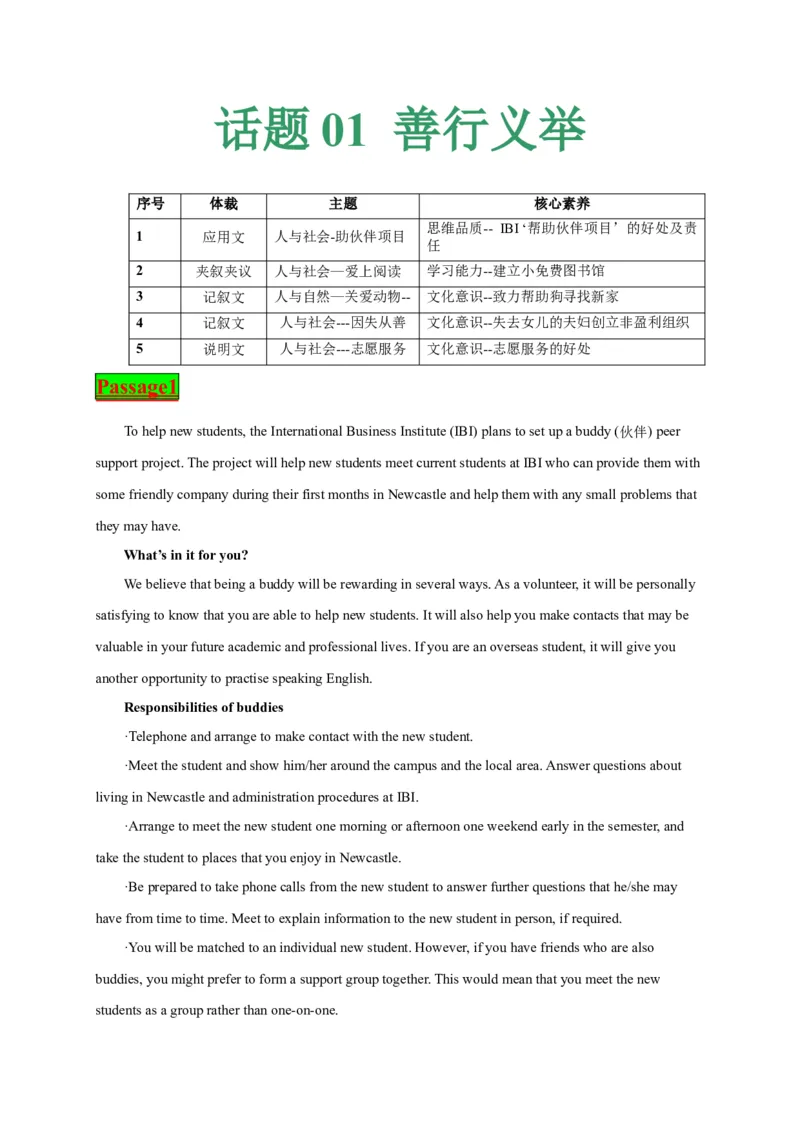
序号 体裁 主题 核心素养
1 新闻报道 人与自我-健康饮食 思维品质--为孩子提供不同寻常食材的妈妈
2 夹叙夹议 人与自我—生活故事 学习能力—因父爱而重新学习吉他
3 记叙文 人与社会—社会关系 文化意识--如何与陌生人互动交往的研究
4 夹叙夹议 人与社会---合作交流- 文化意识--对虚拟世界的友谊的探讨
5 说明文 人与社会---方法策略 文化意识--与孩子进行坦诚交谈
Passage1
When it comes to making lunch for their kids, moms and dads have usual favorites. For some parents
in the US, those favorites are peanut butter and jelly sandwiches-also known as PB&.Js. Fruit like apples
and bananas are also popular.
But one mother has an unusual go-to ingredient for her children’s lunches. Jenny Mollen uses funny-
looking candy eyes. She has learned that her children will eat any healthy food if it has edible eyeballs
attached. The “eyeballs” are really pieces of candy.
Her children laugh while they eat healthy foods like bell peppers, kiwis, or dates. Mollen says candy
“eyes” make lunch more fun.
“Honestly, first of all, just buy yourself some candy googly eyes. They are tried-and-true,” she said.
She admits that “you lose something nutritionally” by giving children candy. But she thinks that getting
children to eat healthy food by putting candy on it is worth it.
Mollen’s lunch tricks bring together food and craft. She uses tricks because her two sons hate to eat
different kinds of foods. So, she decorates their food to resemble animals or even their favorite Pokémon
characters. She makes edible “bugs” made from dates, pretzel sticks for the legs, and, of course, candy
“eyes”. She also uses leftover Chinese food to make panda bears from rice and seaweed.
Mollen says her lunch projects are easy to do. And her sons think they have won a big prize at their
midday meal. Mollen says making fun-looking, artful lunches for her children helps ease her guilt as she is
a working mom. Her artful lunches are her way of reminding her children that she is thinking of them.
Mollen says she also wants to teach them healthy eating habits. She says that by getting kids to eat
vegetables at a young age, they will grow up to eat healthy foods later in life. She also says it is a good wayto get children to try foods from other cultures. If they need to be “tricked” sometimes, that is okay.
1.What’s the purpose of Mollen’s lunch projects?
A.To make her children’s day.
B.To remind people to save food.
C.To persuade other parents to follow suit.
D.To ensure her children’s healthy diet.
2.What is typical of Mollen’s lunch?
A.It contains all kinds of food.
B.It is made up of candy.
C.It combines art and nutrition.
D.It is full of Chinese styles.
3.How have Mollen’s lunch projects affected her children?
A.They have taken to their fun-looking lunches.
B.They have broaden their knowledge of food.
C.They have bonded with their favorite animals.
D.They have swept to victory in the meal competitions.
4.What are the last two paragraphs mainly about?
A.Mollen’s plans for cooking lunches.
B.The benefits of Mollen’s lunch tricks.
C.Mollen’s expectations of her children.
D.The culture elements in Mollen’s lunch.
Passage2
Yesterday, after arriving in Madrid, I knocked on a stranger’s door. “I searched on the website. Will
you give me lessons?” I asked. This was the reason I’d come to Spain. Because I once believed I was meant
to be a female flamenco (弗拉门戈) guitarist.
Forty-five years ago, when I was two, my father also came to Madrid and knocked on strangers’ doors.
A well-known classical guitarist, he admired flamenco a lot, and in Spain he learnt from anyone willing to
teach him. He approached performers in bars, made friends with street musicians and managed to study
with Paco de Lucia, the greatest flamenco guitarist of our time.
I started playing classical guitar when I was five. My father’s hands exploded across the strings likefireworks. I practised while he instructed and criticized. I played till I had sharp pain in my fingertips. By
age seven, I was called a child genius.
Then, at 11, I quit. Heartbroken, my father distanced himself. Guiltily, I followed suit. Soon we spoke
only when necessary. Our relationship didn’t rebound until, in my early 20s, I found myself pulled back to
guitar.
When I was in my early 30s, he got sick. Before he died a few years later, my father told me there
were almost no female flamenco guitarists in the world. If I kept practising, I could be one of the first. I
promised, and he left me his guitar. But after he died, I couldn’t bear to play it. He’d spent so much time
with his arms around that instrument, and it seemed an extension of his own body. Holding it gave my grief
an unbearable tangibility (可触知). So for 13 years it sat mostly untouched, coming out only when my son
Ellis begged to see it. He was careful with his grandfather’s instrument in a way that made me want to pass
it down to him — both the guitar and the music. Problem was, I couldn’t really play anymore.
Now, Antonia is sitting with me in her living room, teaching me patiently. I have been here for only
two days, and already my fingers hurt. It’s a sharp pain, like when a fallen-asleep limb (肢体) returns to
life. The feeling delights me. It means I’m doing something right.
5.Which can best describe the father when he was learning flamenco?
A.Cautious. B.Hopeless. C.Depressed. D.Devoted.
6.Which has the similar meaning with the underlined word “rebound” in paragraph 4?
A.Improve. B.Break. C.Suffer. D.Blossom.
7.Why did the author leave the guitar untouched?
A.She intended to pass it down to her son.
B.It reminded her of her unpleasant past.
C.Deep sorrow drowned her at the sight of it.
D.Carrying it made her feel a sense of burden.
8.Which of the following can be the best title for the text?
A.Guitar Lessons From Strangers
B.Love for Father on the String Again
C.Adventures for Music Lovers in Spain
D.Journey to Success as a Flamenco Guitarist
Passage3In conversations with strangers, people commonly tend to think they should speak less than half the
conversation time to be likable. But we’ve discovered this idea is wrong. Our data shows that people tend
to think they should speak about 45% of the time to be likable in a one-on-one conversation with someone
new. However, it appears speaking up a bit more is actually a better strategy.
In our research, we randomly assigned people to speak for 30%, 40%, 50%, 60% of the time in a
conversation with someone new. We found that the more they spoke, the more they were liked by their new
partners. This was only one study with 116 participants, but the outcome is supported by other researchers’
findings. For example, a previous study randomly assigned one in a pair to take on the role of “speaker”
and the other to take on the role of “listener. ” After engaging in 12-minute interactions, listeners liked
speakers more than speakers liked listeners because listeners felt more similar to speakers than speakers did
to listeners. This outcome suggests the reason people prefer those who speak up: Learning more about a
new partner can make you feel like you have more in common with him or her.
Further, we assigned people to speak for up to 70% and even 90% of the time. The result shows it is
not an ideal strategy. Our research does not suggest people hold down a conversational partner but rather
that they feel comfortable speaking up more than they usually might.
Research like ours can help people gain a ‘more reasonable understanding of social interactions with
new people and become more confident about how to make a good first impression. It has the obvious
benefit of allowing us to carefully control speaking time. However, it does not reflect more natural
conversations. Future research should figure out whether our findings generalize to more natural
interactions.
9.What is the common belief concerning conversations with strangers?
A.Speaking a little less is preferred.
B.Speaking half the time is the best.
C.Listeners are more likable than speakers.
D.Listeners fail to control the conversations.
10.How was the research carried out?
A.By analyzing speaking habits.
B.By making comparisons.
C.By listing examples.
D.By collecting data.
11.What is the disadvantage of the research?A.The conversation time is limited.
B.Further study is hard to continue.
C.The findings are less widely appliable.
D.Interactions with strangers are missing.
12.In which situation can the research finding be applied?
A.Attending a family gathering.
B.Partying with your friends.
C.Meeting a new teacher.
D.Making a public speech
Passage4
“I’ll be there in a few minutes. I’m playing a game with a friend, a guy named Scuzzball,” my 15-
year-old son shouted from his room. “Oh, what is Scuzzball’s real name?” I asked. “I have no idea.” He
said. “Where is he from?” I continued. He responded, “I think somewhere in Canada. Oh, wait, it doesn’t
even matter because Scuzzball just left the game and he has been replaced with a robot.”
“Your friend is replaced by artificial intelligence?” “It doesn’t matter, Dad. It happens all the time! The
game continues.” My son doesn’t mind playing with a person or a robot, which is typical of gamers these
days. I wonder whether the face-to-face experience of friendship that I grew up with will be lost by our
children.
Aristotle, a great thinker and educator, has pointed out that shallow friendship is easily formed but also
easily abandoned because such bonds are fragile. Deep friendship, by contrast, is when you care for your
friend for his sake, not for any benefit you can get. This is selfless friendship. You can have only a couple
of these friends because they require lots of time and effort. You must make sacrifices for each other.
Presence in friendship requires “being with” and “doing for”. Perhaps the most defining feature of
deep friendship is “doing for”, as my friend has my back in trouble or brings me soup when I’m sick. Only
strong bonds have the power to motivate real sacrifices. But it is unclear why online “friends” would bother
to do the hard work of friendship. When I asked my students whether they had people in their lives who
would bring them soup when they were sick, they laughed at my Stone Age question and said they’d just
order soup online themselves.
Digital life fills and absorbs waking life time so that people do not join in example case of friendship,
like sports, collective arts, free range childhoods, etc. In this way, digital life produces false friendships.13.How does the author lead in the topic of the text?
A.By quoting famous mottoes.
B.By introducing an online game.
C.By showing robots’ irreplaceable role.
D.By presenting a parent-child conversation.
14.What does the author mainly explain in Paragraph 3?
A.Impact of selfish friendship.
B.The meaning of deep friendship.
C.Selfless sacrifices in friendship.
D.The formation of shallow friendship.
15.What can we infer from Paragraph 4?
A.Ordering food online for friends is an example of “being with”.
B.The students thought highly of the teacher’s question.
C.Virtual friends won’t make real sacrifices.
D.Robots will have our back in trouble.
16.Which of the following can be a suitable title for the text?
A.The Benefits of Digital Life
B.Digitalized Friendship
C.Face-to-face Communication
D.The Sacrifices of Online Friends
Passage5
At times, talking to kids can feel like learning a foreign language. Unfortunately, there’s no handy
phrasebook or translation app that can make you sound friendly, encouraging, and firm all at the same time.
Don’t worry. ____17____ . Following these, you can have an open and honest chat with any kids in your
life.
Sit or kneel at their level
Lowering yourself makes you a lot more approachable. Even if you’re keeping things light and
friendly, a child might feel threatened if you’re towering over them. Instead, grab a seat or take a knee near
the child, so they don’t have to look up at you. ____18____.
____19____
Kids love talking about their interests and preferences. As far as conversations go, asking aboutfavorites is a pretty safe go-to topic. You might ask about their favorite singer, or what TV shows they like
to watch. ____20____. You could ask if they have a dog or cat at home, and what its name is.
Ask for help or advice
____21____. Share a light-hearted, not-too-serious problem you’ve run into during your daily routine.
Maybe you have trouble heading to bed at a good time, or you can never find your car keys before heading
to work. The child will love a chance to figure out a solution to your problem, whether it’s big or small.
A.Develop common interests.
B.Chat about relatable topics.
C.Children love to solve “adult” problems.
D.This can help take the edge off your conversation.
E.We’ve put together plenty of conversational tips and tricks.
F.Additionally, favorite colors are another safe and comfortable topic.
G.You could even ask about their favorite animals, or compare favorite pets.
【参考答案】
1 . D 2 . C 3 . A 4 . B
【导语】本文为一篇新闻报道。文章介绍了一位花心思为孩子提供不同寻常的食材的妈妈,她的做
法不但让孩子的午饭变得有趣、健康,还让孩子知道妈妈在想着他们。
1.推理判断题。根据第二段“But one mother has an unusual go-to ingredient for her children’s
lunches. Jenny Mollen uses funny-looking candy eyes. She has learned that her children will eat any
healthy food if it has edible eyeballs attached. (但有一位母亲为孩子们的午餐提供了一种不同寻常的食
材。珍妮·莫伦(Jenny Mollen)使用了有趣的糖果眼睛。她知道她的孩子们会吃任何有可食用眼球的
健康食物。)”可知,莫伦的午餐计划的目的是让孩子吃健康食物。故选D项。
2.细节理解题。根据第四段“But she thinks that getting children to eat healthy food by putting candy
on it is worth it.(但她认为,通过在食品上放糖果来让孩子们吃健康食品是值得的。)”可知,莫伦的
午餐是健康食物,第五段“Mollen’s lunch tricks bring together food and craft. She uses tricks because
her two sons hate to eat different kinds of foods. So, she decorates their food to resemble animals or even
their favorite Pokémon characters. She makes edible ‘bugs’ made from dates, pretzel sticks for the legs,
and, of course, candy ‘eyes’. She also uses leftover Chinese food to make panda bears from rice and
seaweed.(莫伦的午餐技巧将食物和手艺结合在一起。她耍了些小花招,因为她的两个儿子都不喜欢
吃不同的食物。所以,她把他们的食物装饰成动物,甚至是他们最喜欢的Pokémon角色。她用枣子做了可食用的‘虫子’,椒盐饼干棒做腿,当然,还有糖果‘眼睛’。她还用剩余的中国食物——
大米和海藻——制作熊猫。)”可知,莫伦的午餐有艺术性。所以莫伦的午餐结合了艺术和营养。故
选C项。
3.推理判断题。根据第三段“Her children laugh while they eat healthy foods like bell peppers, kiwis,
or dates. Mollen says candy ‘eyes’ make lunch more fun. (她的孩子们一边吃着甜椒、猕猴桃或红枣等
健康食品,一边笑。莫伦说,‘糖果眼睛’让午餐更有趣。)”可知,莫伦的孩子们吃着这些食物很
是开心,说明他们已经喜欢上了看起来很有趣的午餐。故选A项。
4.段落大意题。根据最后第二段“Mollen says making fun-looking, artful lunches for her children
helps ease her guilt as she is a working mom. Her artful lunches are her way of reminding her children that
she is thinking of them. (莫伦说,作为一名职业母亲,为孩子们制作看起来有趣、有艺术感的午餐有
助于减轻她的内疚感。她巧妙的午餐是她提醒孩子们她在想他们的方式。)”,以及最后一段
“Mollen says she also wants to teach them healthy eating habits. She says that by getting kids to eat
vegetables at a young age, they will grow up to eat healthy foods later in life. She also says it is a good way
to get children to try foods from other cultures. If they need to be ‘tricked’ sometimes, that is okay. (莫伦说,
她还想教他们健康的饮食习惯。她说,让孩子们在很小的时候就吃蔬菜,他们长大后会吃健康的食
物。她还表示,这是让孩子们尝试其他文化食物的好方法。如果他们有时需要被‘欺骗’,那也没
关系。)”可知,这两段阐述了莫伦的午餐技巧给孩子以及她本人带来的好处,午餐拉近了她和孩子
的距离,为孩子长大以后的健康饮食习惯奠定基础,也使孩子了解其他文化的食物。故选B项。
5 . D 6 . A 7 . C 8 . B
【导语】这是一篇记叙文。文章主要讲述了作者受父亲的影响学习弗拉门戈吉他,虽然中途放弃过,
但出于对父亲的爱最终又重新学习吉他,虽然苦但是作者认为这是正确的事情。
5.推理判断题。根据文章第二段“A well - known classical guitarist, he admired flamenco a lot, and in
Spain he learnt from anyone willing to teach him. He approached performers in bars, made friends with
street musicians and managed to study with Paco de Lucia, the greatest flamenco guitarist of our time.(作
为一个著名的古典吉他手,他非常欣赏弗拉门戈,在西班牙,他向任何愿意教他的人学习。他在酒
吧接触表演者,与街头音乐家交朋友,并设法向当代最伟大的弗拉门戈吉他手帕科·德·卢西亚学
习。)”可推知,“挚爱的、热衷的”最能描述这位父亲学习弗拉门戈时的情景。故选D项。
6.词句猜测题。根据画线词的上文“Soon we spoke only when necessary.(不久,我们只在必要的时
候才说话。)”和下文“in my early 20s, I found myself pulled back to guitar.(在我20岁出头的时候,我
发现自己又回到了吉他的怀抱。)”可知,有段时间作者很少和父亲讲话,直到20多岁时,作者重回吉他的怀抱,由此推知,那时他们的关系有改善。从而推知,画线词是“改善”的意思,与
improve同义。故选A项。
7.细节理解题。根据文章第五段“He’d spent so much time with his arms around that instrument, and it
seemed an extension of his own body. Holding it gave my grief an unbearable tangibility.(他花了很长时间
用胳膊抱着乐器,它似乎是他身体的延伸。拿着它,我的悲伤变得难以承受)”可知,作者之所以没
有动吉他是因为一看到它,她就感到深深的悲伤。故选C项。
8.主旨大意题。分析全文内容可知,文章主要讲述了作者受父亲的影响学习弗拉门戈吉他,虽然
中途放弃过,但出于对父亲的爱最终又重新学习吉他,虽然苦但是作者认为这是正确的事情。整体
来看父爱贯穿于全文,所以B选项“对父亲的爱再次悬在弦上”能概括文章大意,适合用作文章标
题。故选B项。
9 . A 10 . B 11 . C 12 . C
【导语】本文是一篇说明文。文章介绍了一项关于如何与陌生人互动交往的研究。
9.细节理解题。根据第一段中“In conversations with strangers, people commonly tend to think they
should speak less than half the conversation time to be likable.(在与陌生人交谈时,人们通常倾向于认
为他们说话少于一半的时间才能讨人喜欢。)”,可知,关于与陌生人交谈的普遍看法是“少说一
点是最好的”,故选A。
10.细节理解题。根据第二段中“In our research, we randomly assigned people to speak for 30%, 40%,
50%, 60% of the time in a conversation with someone new. We found that the more they spoke, the more
they were liked by their new partners.(在我们的研究中,我们随机分配了一些人,让他们在与陌生人
对话时,用30%、40%、50%、60%的时间说话。我们发现,他们说得越多,他们的新合作伙伴就
越喜欢他们。)”,可知,研究是“通过“比较说话时间”来实施的。故选B。
11.细节理解题。根据最后一段中“However, it does not reflect more natural conversations. Future
research should figure out whether our findings generalize to more natural interactions.(然而,它并没有
反映出更自然的对话。未来的研究应该弄清楚我们的发现是否适用于更自然的相互作用。)”,可
知,这项研究的缺点是“这些发现的适用性不那么广泛”,故选C。
12.推理判断题。通读全文可知,文章介绍了一项关于如何与陌生人互动交往的研究,该研究发现
可以应用于“与一位新老师初次见面”,其中new是关键词,故选C。
13 . D 14 . B 15 . C 16 . B
【导语】这是一篇夹叙夹议文。文章对虚拟世界的友谊进行了探讨并产生了结论——作者认为数字
生活产生了虚假的友谊。13.推理判断题。根据第一段““I’ll be there in a few minutes. I’m playing a game with a friend, a guy
named Scuzzball,” my 15-year-old son shouted from his room. “Oh, what is Scuzzball’s real name?” I
asked. “I have no idea.” He said. “Where is he from?” I continued. He responded, “I think somewhere in
Canada. Oh, wait, it doesn’t even matter because Scuzzball just left the game and he has been replaced with
a robot.”(“我几分钟后就到。我在和一个朋友玩游戏,一个叫Scuzzball的家伙,”我15岁的儿子在
他的房间里喊道。“哦,Scuzzball的真名是什么?”我问。“我不知道。”他说。“他是哪里
人?”我接着说到。他回答说:“我想在加拿大的某个地方。哦,等等,这根本不重要,因为
Scuzzball刚刚离开了比赛,他被一个机器人取代了。”)”可知,作者通过呈现一段亲子对话来引出
文章的主题。故选D。
14.主旨大意题。根据第三段最后四句“Deep friendship, by contrast, is when you care for your friend
for his sake, not for any benefit you can get. This is selfless friendship. You can have only a couple of these
friends because they require lots of time and effort. You must make sacrifices for each other.(相比之下,
深厚的友谊是你关心你的朋友是为了他,而不是为了你能得到什么好处。这就是无私的友谊。你只
能有几个这样的朋友,因为他们需要大量的时间和精力。你们必须为彼此做出牺牲。)”可知,作者
主要在第3段解释了深厚友谊的意义。故选B。
15.推理判断题。根据第四段第三句和第四句“Only strong bonds have the power to motivate real
sacrifices. But it is unclear why online “friends” would bother to do the hard work of friendship.(只有牢固
的纽带才能激励人们做出真正的牺牲。但目前尚不清楚为什么网上的“朋友”会费心去做艰难的友
谊工作。)”可知,虚拟朋友不会做出真正的牺牲。故选C。
16.主旨大意题。根据第二段最后一句“I wonder whether the face-to-face experience of friendship
that I grew up with will be lost by our children.(我不知道我们的孩子是否会失去我成长过程中面对面
的友谊体验。)”,第三段第一句“Aristotle, a great thinker and educator, has pointed out that shallow
friendship is easily formed but also easily abandoned because such bonds are fragile.(伟大的思想家和教
育家亚里士多德指出,肤浅的友谊很容易形成,但也很容易放弃,因为这种联系是脆弱的。)”,第
四段第一句“Presence in friendship requires “being with” and “doing for”. (友谊的存在需要“与”和
“为”。)”和最后一段“Digital life fills and absorbs waking life time so that people do not join in
example case of friendship, like sports, collective arts, free range childhoods, etc. In this way, digital life
produces false friendships.(数字生活充满并吸收了清醒的生活时间,因此人们不会加入友谊的例子,
如体育、集体艺术、自由放养的童年等。就这样,数字生活产生了虚假的友谊。)”可知,文章对虚
拟世界的友谊进行了探讨并产生了结论。故选B。17 . E 18 . D 19 . B 20 . G 21 . C
【导语】这是一篇说明文。文章介绍了如何与孩子进行坦诚交谈的策略。
17.E选项“我们收集了很多谈话技巧。”与上文“Unfortunately, there’s no handy phrasebook or
translation app that can make you sound friendly, encouraging, and firm all at the same time. Don’t worry.
(不幸的是,没有一本方便的短语手册或翻译应用程序可以让你同时听起来友好、鼓舞人心、坚定。
别担心)”形成转折,表明虽然没有与孩子进行坦诚交流的手册或应用软件,但这篇文章中给出了相
关建议或技巧(这也是文章的目的所在),且下文“Following these, you can have an open and honest
chat with any kids in your life. (遵循这些,你可以与生活中的任何孩子进行坦诚的交谈)”中的“these”
指代E选项中的“plenty of conversational tips and tricks”,E选项“我们收集了很多谈话技巧。”切
题。故选E项。
18.由上文“Lowering yourself makes you a lot more approachable. Even if you’re keeping things light
and friendly, a child might feel threatened if you’re towering over them. Instead, grab a seat or take a knee
near the child, so they don’t have to look up at you. (降低自己的位置会让你变得更加平易近人。即使你
保持轻松友好的态度,如果你站得比孩子高,他们可能会感到威胁。相反,拿把椅子坐下或者跪下
靠近孩子,这样他们就不必抬头看你了)”可知,家长位置比孩子高会让孩子感到威胁,作者举例相
反的情况,家长拿把椅子坐下或者跪下靠近孩子,孩子就不用仰视父母,这是在说父母和孩子谈话
时在孩子的水平坐或者跪的好处,D选项“这有助于消除你谈话中的紧张情绪。”切题。故选D项。
19.该空选择小标题,需总结下文。由下文“Kids love talking about their interests and preferences. As
far as conversations go, asking about favorites is a pretty safe go-to topic. You might ask about their
favorite singer, or what TV shows they like to watch. (孩子们喜欢谈论他们的兴趣和喜好。就对话而言,
询问最喜欢的话题是一个非常安全的话题。你可能会问他们最喜欢的歌手,或者他们喜欢看什么电
视节目)”和“You could ask if they have a dog or cat at home, and what its name is. (你可以问他们家里
有没有狗或猫,它叫什么名字)”可知,想要与孩子进行坦诚交谈,作者建议谈论与孩子们生活息息
相关的话题,B选项“谈论相关话题。”切题。故选B项。
20.G选项“你甚至可以问他们最喜欢的动物,或者比较他们最喜欢宠物。”引出与孩子们生活息
息相关的话题之一——谈论宠物,才可衔接下文“You could ask if they have a dog or cat at home, and
what its name is. (你可以问他们家里有没有狗或猫,它叫什么名字)”,G选项“你甚至可以问他们最
喜欢的动物,或者比较他们最喜欢宠物。”切题。故选G项。
21.由小标题“Ask for help or advice (寻求帮助或建议)”可知,想要与孩子进行坦诚交谈,作者建
议大人们要向孩子们寻求帮助或建议,该空应该提及父母们可以这样做的原因,C选项“孩子们喜欢解决‘成年人’的问题。”可以是其原因,呼应下文“The child will love a chance to figure out a
solution to your problem, whether it’s big or small. (孩子会喜欢有机会为你的问题找到解决方案,无论
是大问题还是小问题)”,C选项“孩子们喜欢解决‘成年人’的问题。”切题。故选C项。