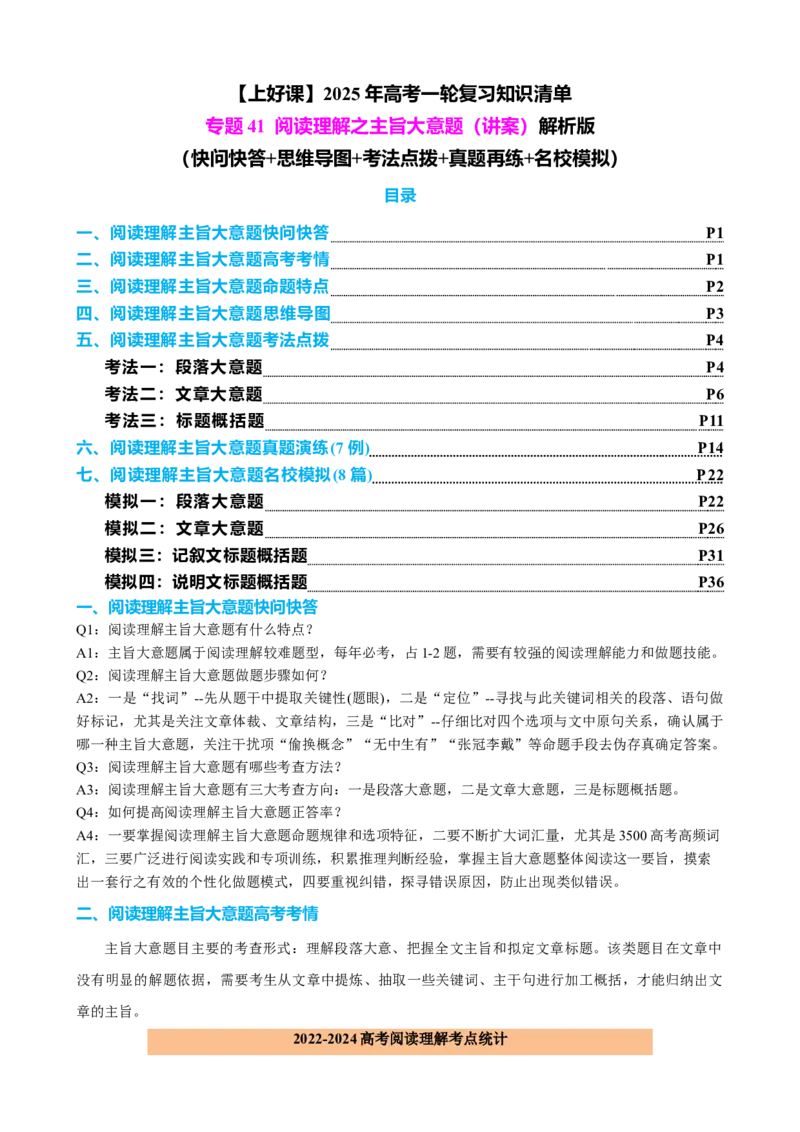
【上好课】2025年高考一轮复习知识清单
专题41 阅读理解之主旨大意题(练案)原卷版
(高考考情+思维导图+真题演练+名校模拟)
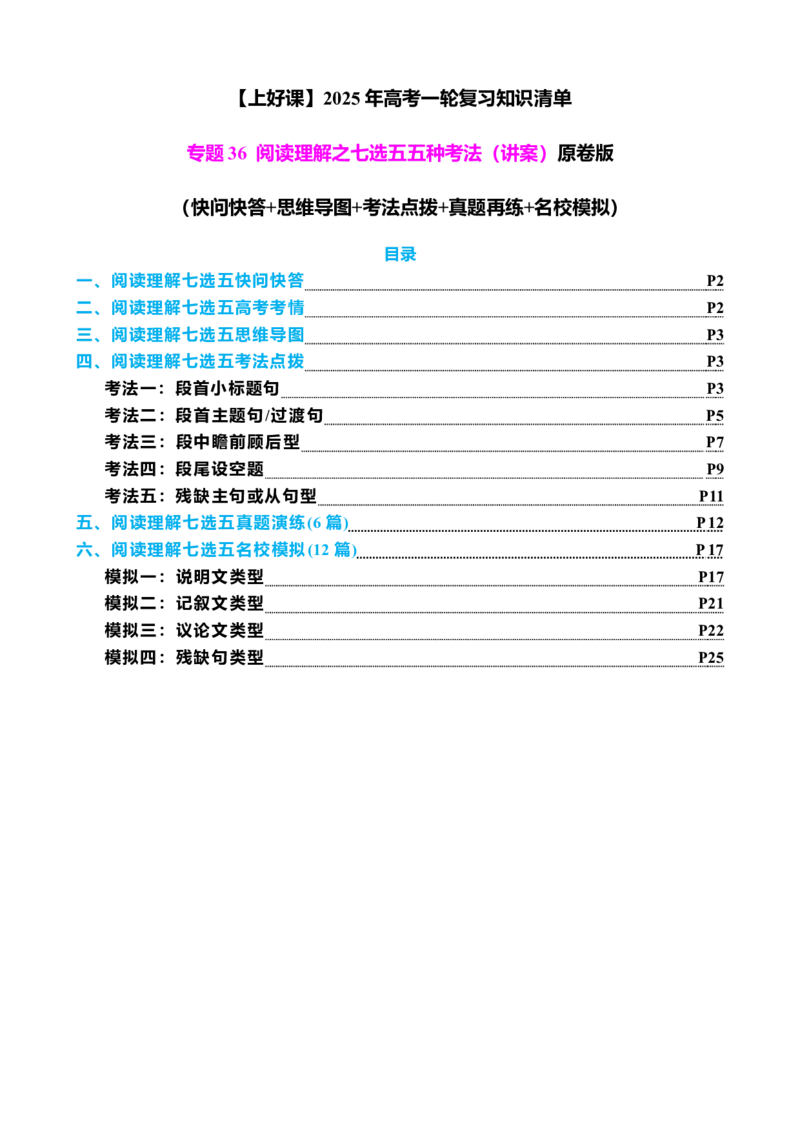
目录
一、阅读理解主旨大意题高考考情 P 1
二、阅读理解主旨大意题思维导图 P2
三、阅读理解主旨大意题真题演练 2 篇 P 3
四、阅读理解主旨大意题名校模拟 16 篇 P 5
【名校模拟一:段落大意题】 P 5
【名校模拟二:文章大意题】 P 8
【名校模拟三:记叙文标题概括题】 P 12
【名校模拟四:说明文标题概括题】 P 15
【名校模拟五:议论文标题概括题】 P 20
【名校模拟四:新闻报道标题概括题】 P 22
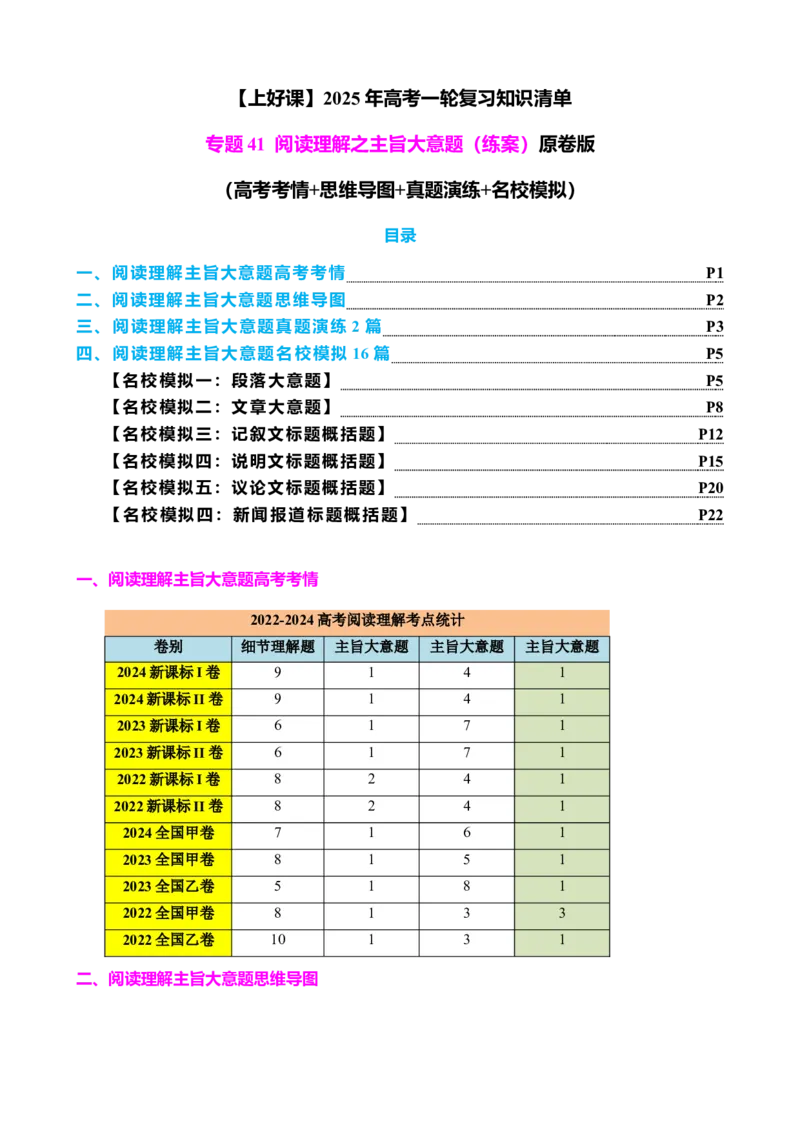
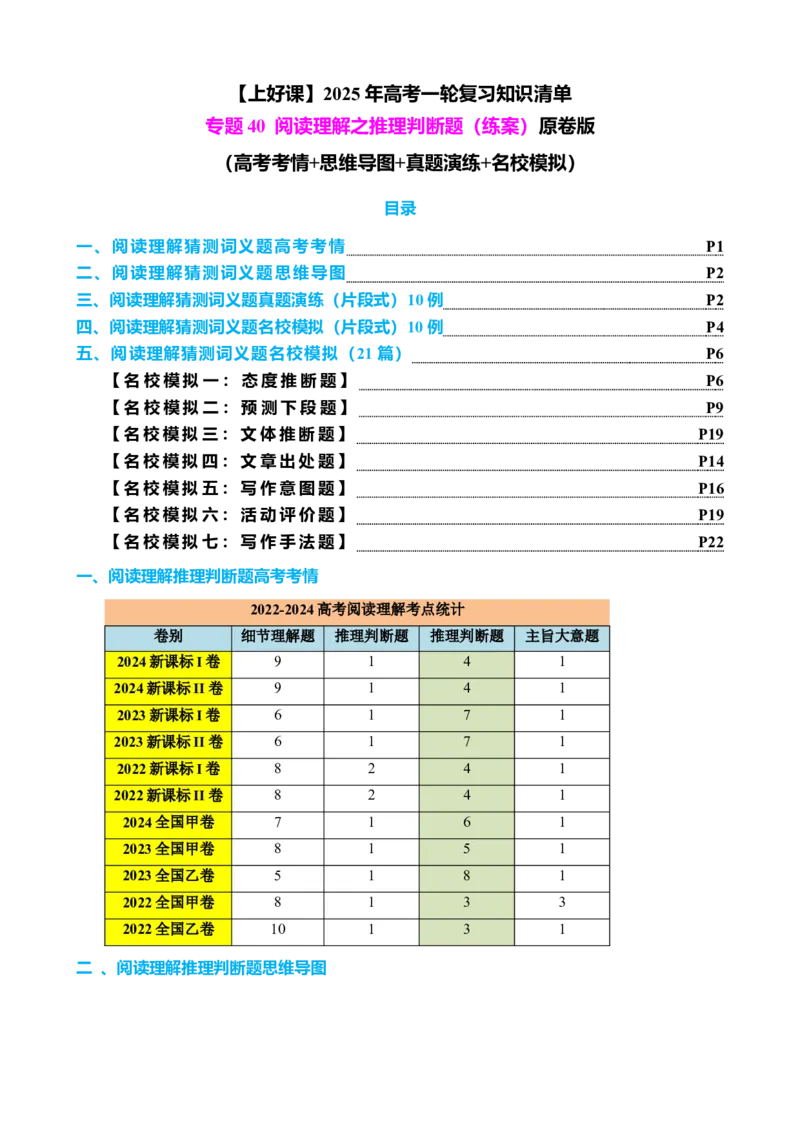
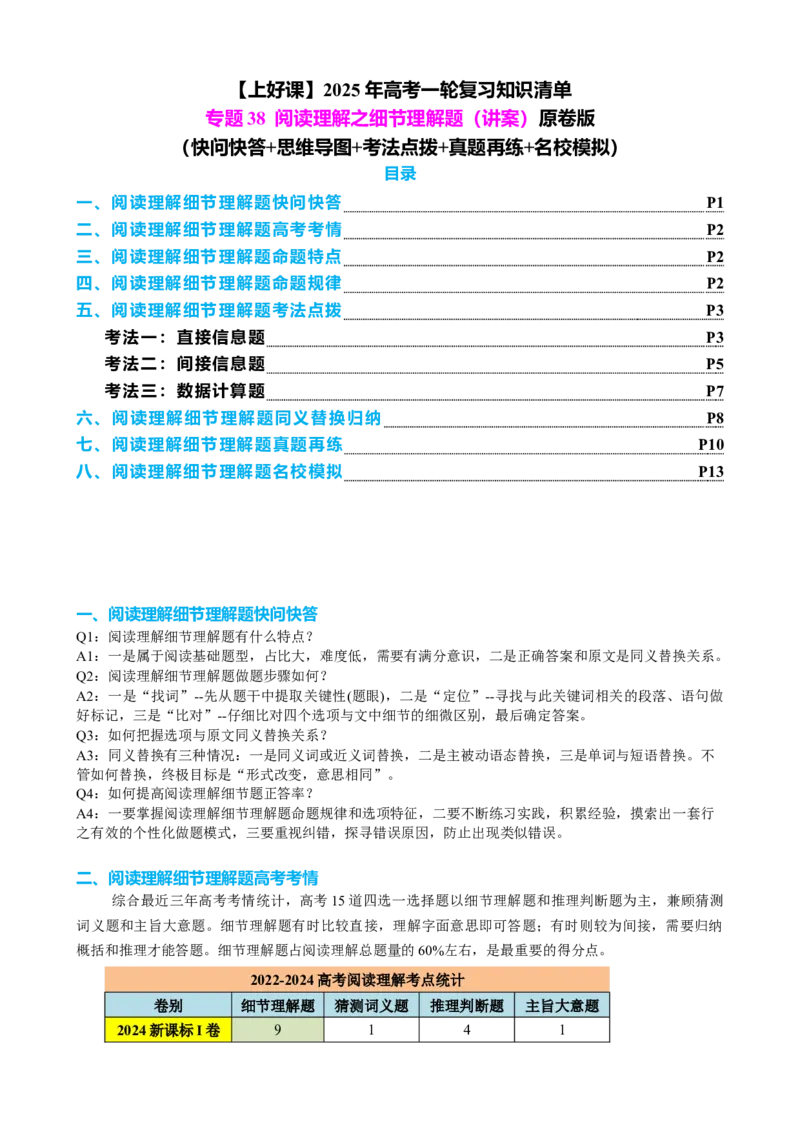
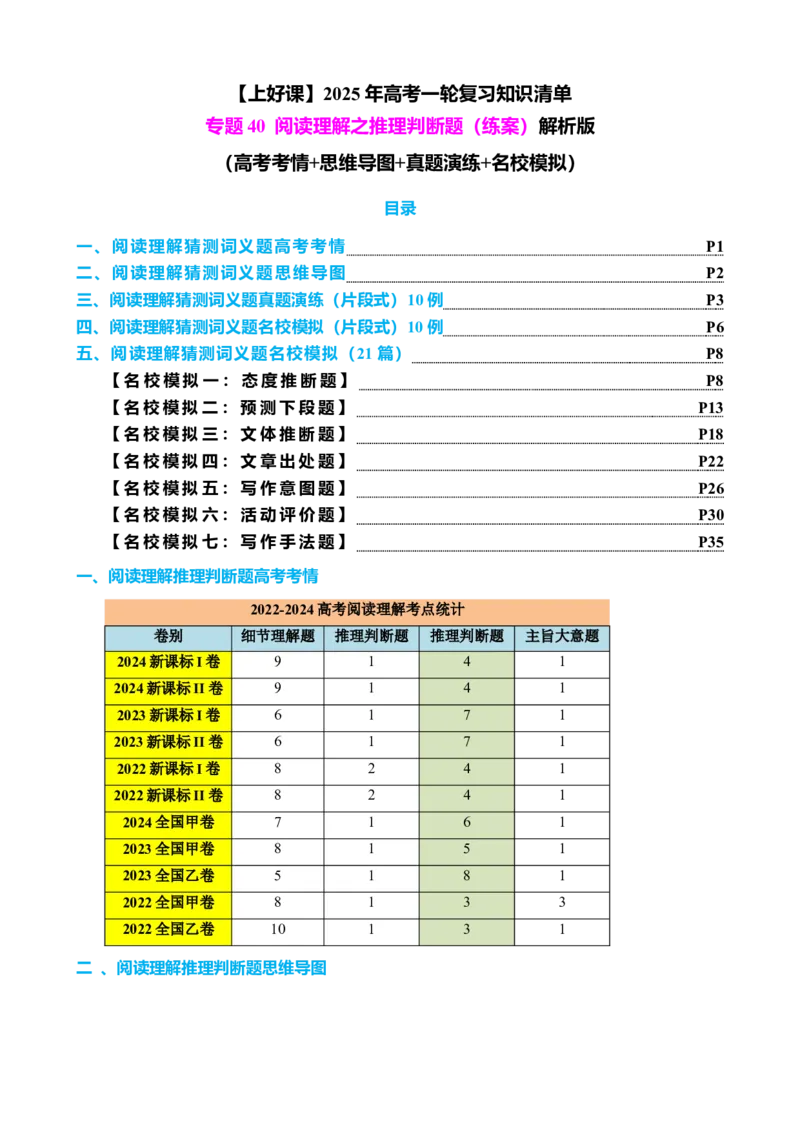
一、阅读理解主旨大意题高考考情
2022-2024高考阅读理解考点统计
卷别 细节理解题 主旨大意题 主旨大意题 主旨大意题
2024新课标I卷 9 1 4 1
2024新课标II卷 9 1 4 1
2023新课标I卷 6 1 7 1
2023新课标II卷 6 1 7 1
2022新课标I卷 8 2 4 1
2022新课标II卷 8 2 4 1
2024全国甲卷 7 1 6 1
2023全国甲卷 8 1 5 1
2023全国乙卷 5 1 8 1
2022全国甲卷 8 1 3 3
2022全国乙卷 10 1 3 1
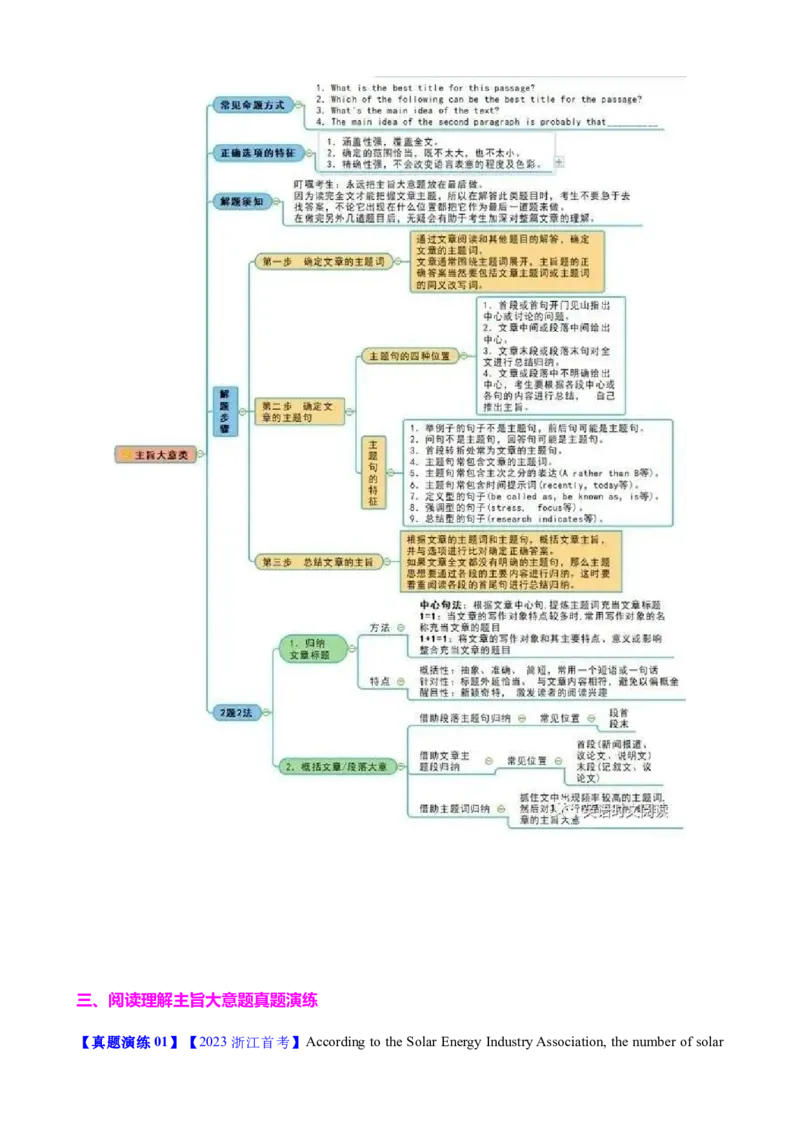
二、阅读理解主旨大意题思维导图三、阅读理解主旨大意题真题演练
【真题演练01】【2023浙江首考】According to the Solar Energy Industry Association, the number of solarpanels installed(安装)has grown rapidly in the past decade, and it has to grow even faster to meet climate goals.
But all of that growth will take up a lot of space, and though more and more people accept the concept of solar
energy, few like large solar panels to be installed near them.
Solar developers want to put up panels as quickly and cheaply as possible, so they haven’t given much
thought to what they put under them. Often, they’ll end up filling the area with small stones and using chemicals
to control weeds. The result is that many communities, especially in farming regions, see solar farms as destroyers
of the soil.
“Solar projects need to be good neighbors,” says Jordan Macknick, the head of the Innovative Site
Preparation and Impact Reductions on the Environment(InSPIRE)project. “They need to be protectors of the land
and contribute to the agricultural economy.” InSPIRE is investigating practical approaches to “low-impact” solar
development, which focuses on establishing and operating solar farms in a way that is kinder to the land. One of
the easiest low-impact solar strategies is providing habitat for pollinators(传粉昆虫).
Habitat loss, pesticide use, and climate change have caused dramatic declines in pollinator populations over
the past couple of decades, which has damaged the U.S. agricultural economy. Over 28 states have passed laws
related to pollinator habitat protection and pesticide use. Conservation organizations put out pollinator-friendliness
guidelines for home gardens, businesses, schools, cities—and now there are guidelines for solar farms.
Over the past few years, many solar farm developers have transformed the space under their solar panels into
a shelter for various kinds of pollinators, resulting in soil improvement and carbon reduction. “These pollinator-
friendly solar farms can have a valuable impact on everything that’s going on in the landscape,” says Macknick.
32. What do solar developers often ignore?
A. The decline in the demand for solar energy.
B. The negative impact of installing solar panels.
C. The rising labor cost of building solar farms.
D. The most recent advances in solar technology.
33. What does InSPIRE aim to do?
A. Improve the productivity of local farms.
B. Invent new methods for controlling weeds.
C. Make solar projects environmentally friendly.
D. Promote the use of solar energy in rural areas.
34. What is the purpose of the laws mentioned in paragraph 4?
A. To conserve pollinators. B. To restrict solar development.
C. To diversify the economy. D. To ensure the supply of energy.
35. Which of the following is the best title for the text?
A. Pollinators: To Leave or to Stay B. Solar Energy: Hope for the Future
C. InSPIRE: A Leader in Agriculture D. Solar Farms: A New Development
【真题演练02】(2022新高考I卷D篇)
Human speech contains more than 2,000 different sounds, from the common “m” and “a” to the rare clicks of
some southern African languages. But why are certain sounds more common than others? A ground-breaking,
five-year study shows that diet-related changes in human bite led to new speech sounds that are now found in half
the world’s languages.More than 30 years ago, the scholar Charles Hockett noted that speech sounds called labiodentals, such as
“f” and “v”, were more common in the languages of societies that ate softer foods. Now a team of researchers led
by Damián Blasi at the University of Zurich, Switzerland, has found how and why this trend arose.
They discovered that the upper and lower front teeth of ancient human adults were aligned (对齐), making it
hard to produce labiodentals, which are formed by touching the lower lip to the upper teeth. Later, our jaws
changed to an overbite structure (结构), making it easier to produce such sounds.
The team showed that this change in bite was connected with the development of agriculture in the Neolithic
period. Food became easier to chew at this point. The jawbone didn’t have to do as much work and so didn’t grow
to be so large.
Analyses of a language database also confirmed that there was a global change in the sound of world
languages after the Neolithic age, with the use of “f” and “v” increasing remarkably during the last few thousand
years. These sounds are still not found in the languages of many hunter-gatherer people today.
This research overturns the popular view that all human speech sounds were present when human beings
evolved around 300,000 years ago. ”The set of speech sounds we use has not necessarily remained stable since the
appearance of human beings, but rather the huge variety of speech sounds that we find today is the product of a
complex interplay of things like biological change and cultural evolution,” said Steven Moran, a member of the
research team.
32. Which aspect of the human speech sound does Damián Blasi’s research focus on?
A. Its variety. B. Its distribution. C. Its quantity.D. Its development.
33. Why was it difficult for ancient human adults to produce labiodentals?
A. They had fewer upper teeth than lower teeth.
B. They could not open and close their lips easily.
C. Their jaws were not conveniently structured.
D. Their lower front teeth were not large enough.
34. What is paragraph 5 mainly about?
A. Supporting evidence for the research results.
B. Potential application of the research findings.
C. A further explanation of the research methods.
D. A reasonable doubt about the research process.
35. What does Steven Moran say about the set of human speech sounds?
A. It is key to effective communication.
B. It contributes much to cultural diversity.
C. It is a complex and dynamic system.
D. It drives the evolution of human beings.
四、阅读理解主旨大意题名校模拟
【名校模拟一:段落大意题】
(2024·四川乐山·三模)Another year of record fossil fuel burning leading to record high global
temperatures. Time is running out to solve the climate crisis, and great disasters come near us. You’re probably
used to such headlines, and you may have moments of hopelessness about the future. But can you turn such gloom(灰暗) messaging of climate crisis into meaningful change? Our recent global study says yes — but the messages
must be used wisely.
In 2019, in his book, David Wallace - Wells painted a terrifying landscape of the suffering awaiting us if we
don’t address climate change, leaving many feeling consumed by fear and helplessness. Not everyone is a fan of
his gloom messaging. Climate scientists like Michael Mann have warned against it , messaging that it can depress
and discourage the public, and lead to further climate inaction. And the title of a new book by Hannah Ritchie
states clearly that it’s Not the End of the World: How We Can Be the First Generation to Build a Sustainable
Planet.
To help figure out the precise impact of climate gloom messaging, we recently completed a large
experiment. Our findings revealed that gloom messaging was highly effective for stimulating climate change
information sharing, like posting on the Internet or social media. Wallace-Wells was right in this aspect. But Mann
and Ritchie were also right. Hearing these messages actually decreased people’s positive behaviors against
environmental pollution — when faced with the enormous messages of the climate crisis, individual -level actions
might seem futile (徒劳的). So gloom messaging can do both things: cause helplessness, discouraging individual-
level action; but also motivate people to spread the word.
Our research also found several other messages that moved the needle on climate change beliefs and
actions. This suggests that understanding how different messages work, and in what contexts, will be critical to
changing beliefs, spreading the word, and motivating action.
1.What message does gloom messaging intend to deliver?
A.The unstoppable tendency to disasters.
B.Disastrous effects of burning fossil fuels.
C.The urgency to deal with climate crisis.
D.Confidence in environmental protection.
2.Why do some climate scientists disagree with Wallace -Wells’ view?
A.Because they don’t believe there is severe climate crisis.
B.Because they fear it will lead to more environmental pollution.
C.Because they plan to build a new world in another planet.
D.Because they worry it makes people give up climate actions.
3.How does gloom messaging affect the public according to paragraph 3?
A.It encourages people to fight against climate change.
B.It increases people’s awareness of climate crisis.
C.It has no impact on climate change behaviors.D.It misleads people into spreading wrong news.
4.What is the last paragraph mainly about?
A.The lack of solution for inspiring climate actions.
B.Gloom messages’ influences on climate behaviors.
C.The importance of studying different messages’ effects.
D.Right attitudes to climate change beliefs and behaviors.
(2024·安徽合肥·模拟预测)“The ant and the zebra” sounds like the title of one of Aesop’s fables (寓
言). Like all good. fables, this one has a moral, which is that human intervention in nature has unpredictable
consequences. Unlike the Greek originals, though, this fable is real.
The story plays out in Laikipia county, Kenya, where the big-headed ants, an invasive (入侵的) species
have gradually been replacing the native acacia ants. As Mr Kamaru, a Kenyan biologist from the University of
Wyoming, and his colleagues report in Science, the an t invasion has triggered a complicated chain of
consequences which has helped zebras at the expense of buffaloes, thus neatly illustrating a phenomenon called
trophic cascade (营养级链).
It works like this. A kind of tree — whistling-thorn trees — provides the ants with shelter and food. The
ants, meanwhile, protect the trees by seeing off the chief threat to them, the local elephants, which are not keen to
eat trees, crawling with biting insects. However, big-headed ants are not so good at keeping the elephants at bay
(陷入困境). The elephants move in and chew the trees, removing much of the area’s cover. That throws the local
lions into confusion, which often use this cover to hide when hunting zebras. To compensate (补偿), the lions
switch to hunting buffaloes, which are more dangerous, but run slower.
Mr Kamaru has put numbers to the process too. In invaded areas, elephants break trees five to seven times
as often as in uninvaded ones. And in those uninvaded places, zebra kills are almost three times as frequent as
those in the invaded ones. Indeed, between 2003 and 2020, as the big-headed ants spread, the proportion (比例) of
local lion kills where the victim was a zebra fell from 67% to 42%. On the contrary, over the same period, the
proportion of buffalo kills rose from zero to 42%. Whether the buffaloes blame the ants for their misfortune, no
one knows.
5.What is the second paragraph mainly about?
A.How human activities impact nature.
B.What the phenomenon of trophic cascade is.
C.How the big-headed ants invade a county in Kenya.
D.Why the story about different species is significant.
6.Who are the real victims in the chain?A.Lions. B.Buffaloes. C.Elephants. D.Zebras.
7.Why does Mr Kamaru put numbers in his report?
A.To show the results. B.To explain the reasons.
C.To analyze the process. D.To give some examples.
8.What can be a suitable title for the text?
A.The Misfortune of Animals B.The Secrets of Nature
C.How Zebras and Ants Become Friends D.How Ants Persuaded Lions to Eat Buffaloes
(2024·黑龙江·三模)American companies have learned to love renewable resources. Now, they are
beginning to get involved in next-generation climate solutions.
An advanced geothermal(地热的) project supported by Google began generating electricity last week, a big
step in seeking for technology that can affordably fill gaps in wind and solar generation with carbon-free power.
The pilot project in northern Nevada uses drilling and fracking(水力压裂法) techniques employed by the oil and
gas industry to get heat from Earth to generate power.
Geothermal technology has long been viewed as a potential way to tap the natural heat of Earth to make
carbon-free power. But it has traditionally been limited to locations where there are natural underground lakes of
hot water, which are hard to access. In 2021, geothermal energy accounted for less than half a percent of
America's power generation.
Fervo Energy, a Houston-based startup gives an answer-to use drilling and fracking techniques
In Nevada, the company drilled two wells to a depth of about 8,000 feet and then extended them
horizontally(水平地) for more than 3,000 feet. Then Fervo injected(注入) cold water under high pressure to cause
the rock between the wells to be fracked, creating fractures(裂缝). Water is then pumped into the first well,
absorbing heat as it flows through the fractures and returning to the surface via the second well at temperatures
high enough to make steam and spin an engine.
The project represents a convergence of two companies’ climate ambitions. Fervo had sought to apply
advances in oil and gas drilling to geothermal technology. But finding financing to prove that the company's
technology worked was a challenge. Luckily for Fervo, Google had just started reconsidering it; approach to clean
energy around the time when Fervo was looking to test its technology.
“The demand for clean, firm power is so urgent, especially now,” said Gabriel Malek, chief of staff at
Fervo. “And we're recognizing that the geothermal project is one workable option available to us. It is promising,
actually.
9.What is the problem with geothermal energy?
A.It is in little demand. B.It still produces CO .
2C.It is not easy to employ. D.It is rarely seen on Earth
10.What is paragraph 5 mainly about?
A.How drilling and fracking techniques come.
B.How natural heat on Earth comes into being.
C.Fervo's solution to pollution caused by energy.
D.Fervo's approach to harvesting geothermal energy.
11.Which of the following can replace the underlined word “convergence” in paragraph 6?
A.Source. B.Barrier. C.Combination. D.Shift.
12.What do Gabriel Malek's words suggest?
A.His company has self-funded the project.
B.He is hopeful about the geothermal project.
C.He promises to provide clean power for free.
D.His company cooperates with many businesses.
【名校模拟二:文章大意题】
(2024·湖北武汉·模拟预测)When he flagged me down, I thought he was an elder collecting a “customs
fee”, the few dollars it costs to use village roads that lead to many of Samoa’s sights. He’d been sitting lazily in a
greying roadside shack (棚子) built for such occasions. Normally I wouldn’t pick up a free rider. But I tried to live
out a dream.
I’d wanted to go to Pulemelei Mound since I’d heard it mentioned in an archaeology class years ago. The
“mound” is actually a pyramid 40 feet high and roughly 200 feet across at its base. So, I asked, “Do you know
how to get to Pulemelei Mound?”
“Mmm,” he said, raising his eyebrows in the classic Polynesian gesture for “yes”. “I need to pick up my car
at the mechanic but no hurry, I’ll take you there first if you want.”
You’d think that a giant pyramid would be a major sight, or at least something many people had heard of,
but it isn’t. My accidental friend’s raise of the eyebrows was the most promising prospect I’d had in a week.
We drove along the road in silence for a few minutes. Then my new friend broke the silence and,
meanwhile, my hopes. “I’ve never been to Pulemelei,” he said. “I’ve lived here but I never thought of going.” My
heart sank. But we pressed on, crossing a stream, walking through waist-high grass, and then another mile of hot
walk until we found a sign. There, barely visible, were the words: “Pulemelei Mound 150m”. The sign marked a
dark tunnel of jungle. Then the path opened to rays of sunshine. We climbed. And then, magic. We were standing
on top of a Polynesian pyramid.
Just then, my friend, obviously awed by what he saw, turned toward me, and placed his big Samoan handson my shoulders. In the most natural way, he bent down and kissed me gently on the cheek.
“Thank you,” he said.
1.What’s the purpose of the Samoan man flagging me down?
A.To thumb a ride. B.To ask for directions.
C.To collect a customs fee. D.To warn of a road accident.
2.Which of the following words can best describe the author?
A.Informed but rigid. B.Hesitant but agreeable.
C.Skeptical and reserved. D.Curious and adventurous.
3.Why did the Samoan man thank the author in the end?
A.He had lived out his dream. B.He was taken to the mechanic.
C.He enjoyed the author’s company. D.He experienced the thrill of discovery.
4.What is the passage mainly about?
A.A Polynesian village. B.A famous Samoan sight.
C.A chance encounter. D.An elder protecting local roads.
(2024·重庆·三模)Urban agriculture, the practice of farming within the limits of a city, is becoming
increasingly popular worldwide and is considered a way to make cities and urban food systems more sustainable.
Despite strong evidence of the social and nutritional benefits of urban agriculture, its carbon footprint remains
understudied.
Most previously published studies have focused on high-tech, energy-intensive forms of urban agriculture
—such as vertical (垂直的) farms and rooftop greenhouses. The new study aimed to fill some of the knowledge
gaps by comparing the carbon footprints of food produced at low-tech urban agriculture sites to conventional
crops.
The researchers calculated the greenhouse gas emissions (排放) associated with on-farm materials and
activities over the lifetime of the farm. The emissions, expressed in kilograms of carbon dioxide equivalents per
serving of food, were then compared to foods raised by conventional methods.
Farmers and gardeners at urban agriculture sites across the world were employed to use daily diary entries
to take down inputs—the materials used to construct farms and cultivate crops—and harvests from their food-
growing sites throughout the 2019 season.
“By assessing actual inputs and outputs on urban agriculture sites, we were able to determine climate
change impacts to each serving of produce,” says study co-lead author Benjamin Goldstein, assistant professor in
the School for Environment and Sustainability. On average, food produced through urban agriculture released 0.42
kilograms of carbon dioxide equivalents per serving, six times higher than the 0.07 kg CO e per serving of
2conventionally grow n produce.
It’s also found that most of the climate impacts at urban farms are driven by the infrastructure (基础设施),
such as the raised beds in which food is grown, or pathways between plots. “These farms typically only operate
for a few years, so the greenhouse gases used to produce those materials are not used effectively. Conventional
agriculture, instead, is very efficient and hard to compete with”, Goldstein says. For example, conventional farms
often grow a single crop with the help of pesticides and fertilizers, resulting in larger harvests and a reduced
carbon footprint when compared to urban farms, he says.
5.What is a benefit of urban agriculture?
A.Sustainable food supply. B.High food output.
C.Effective energy conservation. D.Low carbon footprint.
6.How is the research data collected?
A.By accessing online database. B.By examining previous studies.
C.By conducting personal interviews. D.By recording information every day.
7.What could be done to reduce carbon footprint according to Goldstein?
A.Increase varieties of crops. B.Extend infrastructure lifetimes.
C.Promote rooftop greenhouses. D.Use modern agriculture facilities.
8.What is the passage mainly about?
A.The benefits of traditional crops. B.The popularity of urban agriculture.
C.The strategies to fight global warming. D.The carbon footprint of urban farm produce.
(2024·重庆九龙坡·二模)Finland’s system for returning drink containers started in the 1950s, and today
almost every bottle and can is recycled. Convenience is the cornerstone of the system’s success.
Nowadays there are almost 5,000 container-return machines across Finland. Most of them are located in the
same shops that sell drinks, making returning them a convenient part of people’s routine. Hotels, restaurants,
offices, schools and event organizers return containers through their drink providers.
The return machines are easy to use. You place a bottle or can on a set of mini conveyor belts at the front of
the machine. They carry it past a scanner and out of sight. The machine sorts the bottles and crushes the cans.
When you’re done, you press a button and the machine gives you a receipt. Plastic bottles are worth 20 to 40
cents, depending on their size, while glass bottles are worth 10 to 40 cents and aluminium (铝) cans are 15 cents.
The returned containers are recycled or the materials are reused. Across Finland, on average, every Finn returns
373 items in a year: 251 aluminium cans, 98 plastic bottles and 24 glass bottles.
The government has entrusted this function to the private agency. “Palpa is completely nonprofit and
receives no government funding,” says Tommi Vihavainen, Palpa’s director of producer services, ICT andcommunication.
Russia, the UK and other countries have shown interest in the Finnish system. “Most visitors want to see
how the return system works in Finland,” says Vihavainen. “We don’t act as consultants, but we’re proud to
present our system.”
9.What do we know about Finland’s system for returning drink containers?
A.It still has a long way to develop. B.It gains popularity for its convenience.
C.It used to be fashionable but now out-dated. D.It’s supported financially by the government.
10.Why does the writer use the figures in paragraph 3?
A.To show Finns consume various drinks. B.To help make the story more interesting.
C.To make the impact of the system convincing.D.To guarantee the proper logic of the passage.
11.What’s Vihavainen’s attitude towards the return system?
A.Indifferent. B.Positive. C.Pessimistic. D.Dismissive.
12.What is the passage mainly about?
A.Finland’s recycling programme keeps bottles off streets.
B.The return machines in the world are popular and easy.
C.Palpa—a complete nonprofit to recycle the bottles.
D.Finland—a country free of waste such as bottles.
【名校模拟三:记叙文标题概括题】
(2024·陕西榆林·模拟预测)In spring 1955, Rosalynn Carter was doing what she had been avoiding
since she married Jimmy Carter: keeping house and raising children in the same tiny town where they grew up.
But her husband called for help from his family’s farm one day and said that he couldn’t manage the farm
on his own. So Rosalynn Carter gathered their sons and returned to the tiny town. Soon she was managing
finances and handling customers. “Finally, I got used to our new life and knew more about the business than he
did, and he would take my advice about things,” Rosalynn Carter told The Associated Press in 2021.
Their marriage was almost a decade old when she went to the farm, but that was perhaps the true beginning
of a partnership that helped Jimmy Carter win the Georgia governor’s office in 1970 and then the White House in
1976. Six years later, they co-founded The Carter Center and committed themselves to charity work for four
decades in more than 145 countries, where many children, now adults, were named Jimmy or Rosalynn or Carter.
Along that path was a small-town love story that included 77 years of marriage and two decades of family
friendship before that. Their shared journey ended on November 19, 2023, with Rosalynn’s death at the age of 96.
“It’s hard to think of one of them without the other,” said Jill Stuckey, a longtime friend who saw the couple
often during Rosalynn Carter’s last months. “When Jimmy was president. she even attended all White Housemeetings and discussed what she heard with him at home. They had nightly phone calls when they traveled
separately.”
“Rosalynn was my equal partner in everything I ever accomplished.” Jimmy Carter said in a statement
released upon her death. “She gave me wise guidance and encouragement when I needed it. As long as Rosalynn
was in the world, I always knew somebody loved and supported me.”
1.How did Rosalynn Carter probably feel when she was asked to work on the farm?
A.Interested. B.Unconcerned. C.Proud. D.Unwilling.
2.What did the Carters do in the early 1980s?
A.They bought a new farm in a small town.
B.They ran for the Georgia governor’s office.
C.They started to do charity work in the world.
D.They traveled in different countries as tourists.
3.What did Jill Stuckey say about the Carters?
A.Rosalynn Carter was an ambitious woman.
B.The couple were very attached to each other.
C.Jimmy Carter was not a qualified president.
D.They should not share the secret information.
4.What is the best title for the text?
A.Young Rosalynn and Jimmy Carter’s Love Stories
B.The World’s Responses to Rosalynn Carter’s Death
C.The Close Bond Between Rosalynn and Jimmy Carter
D.The Lasting Relationship Between the Carters’ Families
(2024·山东菏泽·模拟预测)Ten years ago, Kristin Schell and her family moved to a new home in
Austin, Texas. She tried to connect with her new neighbors by hosting reading activities and playgroups. But those
activities required planning ahead and arranging schedules, not to mention cooking and cleaning.
One day, Kristin needed backyard furniture for a party and bought a few picnic tables from Lowe’s. The
delivery driver set one table down in her front yard by mistake. After the party, Kristin painted the table turquoise
(绿松石色) and put it in the front yard, just a few feet from the sidewalk.
That turquoise table became the place where Kristin and her kids hung out. For activities they used to do at
the kitchen table, they now did out front at the picnic table. They played games, did crafts and ate snacks. “We got
intentional about where we spent our time,” Kristin says. “We became ‘front yard people.’ Neighbors began to
stop by to introduce themselves and sit down for a chat. The turquoise table was inviting and we had a sharedfeel.”
Construction workers in the neighborhood took their lunch breaks at the table. A babysitter walking by with
her young child sat down to rest. Then neighbors told Kristi their family could put a picnic table in their front yard
too. Soon “The Turquoise Table”was born, a movement of ordinary people who want to gather right in their own
front yards.
“At the picnic table, all we have to do is show up. People’s greatest need is to know that they are loved and
that they belong,” Kristin says. She likes how it enables her to take a small step toward building relationships in
her community.
A decade after their Texas beginnings, thousands of Turquoise Tables exist in all 50 states and in 13
countries in the world. Not all of them are actually turquoise. Texas Christian University in Fort Worth has several
purple tables to match their team colors, for example. “No matter what color it is, it’s a friendship table,” Kristin
says.
5.Why did Kristin host activities when she moved to a new home?
A.To promote the community service. B.To make plans for community events.
C.To build good relationship with neighbors. D.To help neighbors with cooking and cleaning.
6.How did the turquoise table change Kristin’s family?
A.They started staying indoors more time.
B.They became more private and superior.
C.They began to spend more time outside together.
D.They stopped hosting reading activities and playgroups.
7.Why would people like to join in the Turquoise Table movement?
A.To spread the color turquoise. B.To improve communication skills.
C.To start a business selling picnic tables. D.To create community connections in front yards.
8.What is the best title for the text?
A.Turquoise—A Color That Can Match All the Tables
B.Everyday Greatness—Tables Where All Are Welcome
C.The Turquoise Table—A Worldwide Movement on Picnic
D.Community Gathering Activities—People’s Greatest Need
(2024·江西九江·一模)When Rony Rolando Herrera was a young boy, he was abandoned by his father,
and his mother gave everything she had to raise Rony and his three brothers. Thankfully, Rony’s support did not
end with his mother. Through a nonprofit, Rony was enrolled in a child protection program that redetermined his
life path. Now, Rony is dedicated to doing the same for the children in his school.Rony is a science teacher and director of a primary school in San Jose del Cacao, a rural community where
hardship, tradition and poverty prevent education from being a priority. “The customs of these communities are
from past civilizations and focus on working the land,not developing psychologically or intellectually,” Rony
explained.
The barriers to education are most harmful to the most vulnerable, including young girls. As a teacher, it
was not uncommon to see his female students, as young as 13 years old, drop out of school. “They are not
empowered to know their rights or to continue with their education. They don’t know that they can change the
failed system in their communities that believe women’s only purpose is to reproduce, do laundry and cook,”
Rony said.
By joining the program PREVENIR, students at Rony’s school are given the opportunity to receive a more
comprehensive education that aims to reduce the risks outside of the classroom. Rony elaborates that, “the
educational process must be comprehensive. In addition to learning about things like science or biology, children
need to know their rights and basic life skills.”
Rony calls himself a “dreamer” and now carries the love he received from both his mother and the
humanitarian workers who supported him. He stated, “This type of support changes lives,” and added that even if
out of 140 students, only one is impacted, he knows this impact will carry over to future generations, just as it did
for him.
9.What really changed Rony’s life?
A.His miserable childhood. B.His joining in a program.
C.His living circumstances. D.His mother’s expectations.
10.What can we learn about San Jose del Cacao?
A.The people are intelligent.
B.Traditions are not well-received.
C.Education there is a priority.
D.People there live a conservative life.
11.Which can best describe Rony?
A.Reliable and determined. B.Humble and supportive.
C.Sympathetic and grateful. D.Generous and responsible.
12.Which is the most suitable title for the text?
A.Education Provide Chances for Girls
B.A Teacher’s Big Dream Changes Lives
C.Nonprofits Play a Vital Role in EducationD.Protecting Children Requires Intervention
【名校模拟四:说明文标题概括题】
(2024·安徽黄山·二模)Living in a city, you may face fewer parking spaces, more pollution, less
personal space, and more traffic and noise, all of which contribute to higher stress levels, often translating to
aggression (攻击行为). And now, researchers have found evidence that this behavior applies to song sparrows (歌
雀) too. But it comes with a surprising benefit to the youngest generation of city sparrows.
There are fewer city-living song sparrows than in the countryside. However, the increased aggression
observed in the males can be connected to a more pressing need to defend territories in urban settings. But that
increased aggression doesn’t mean the males fail in their duties as fathers. In fact, the researchers were surprised
to find that the opposite may be true.
“Male songbirds are thought to reduce parental care when they are more aggressive. Yet this study showed
that urban male song sparrows provided more care for their young,” says Dr Samuel Lane, lead author of the
study. “Against our expectations, we found that they visited nests more often and were more successful parents
than the males in the countryside.”
The researchers carried out their studies at six sites across southwest Virginia, USA, across four breeding
(繁殖) seasons. They found that the high survival rate of their chicks was subject to many factors. Not only did
male sparrows visit their nests more often, but they also began feeding chicks earlier in the day. Despite the
challenges of being a city bird, hatching success was observed to be higher in urban habitats. And even though
brood parasitism, one species laying eggs in the nest of another, is typically higher in urban areas, the researchers
observed that rates of nest predation, the act of other animals eating eggs or young birds, were lower, further
contributing to the overall nesting success of these sparrows.
Lane said, “Our study adds to growing evidence that certain species of songbirds even benefit from living
in urban environments when there is enough green space for them to find food and nest locations.”
The team hope ongoing research in this area will contribute to the establishment of urban environments
aimed at offering improved support for wildlife.
1.What causes the increased aggression of male city sparrows?
A.The stress of protecting their territories.
B.The worsening of urban noise pollution.
C.The challenges of building their nests.
D.The growing needs of younger generations.
2.What had the researchers expected of urban males compared to those in the countryside?
A.They lived shorter lives. B.They had a higher population.C.They had lower nest attendance. D.They woke up earlier in the morning.
3.Which of the following can be found in urban areas according to the study?
A.Higher nest locations. B.Reduced brood parasitism.
C.Limited breeding seasons. D.Lower nest predation rates.
4.What can be a suitable title for the text?
A.City Male Birds Do It All B.Aggressive Birds Surprise Scientists
C.Big City Life Makes Birds Better Dads D.The Future of City Birds Lies in Our Hands
(2024·北京西城·二模)When people hear “artificial intelligence,” many envision “big data.” There’s a
reason for that: some of the most important AI breakthroughs in the past decade have relied on enormous data
sets. But AI is not only about large data sets, and research in “small data” approaches has grown extensively over
the past decade—with so-called transfer learning as an especially promising example. Also known as “fine-
tuning,” transfer learning is helpful in settings where you have little data on the task of interest but abundant data
on a related problem. The way it works is that you first train a model using a big data set and then retrain slightly
using a smaller data set related to your specific problem.
Research in transfer learning approaches has grown impressively over the past 10 years. In a new report for
Georgetown University’s Center for Security and Emerging Technology (CSET), we examined current and
projected progress in scientific research across “small data” approaches. Our analysis found that transfer learning
stands out as a category that has experienced the most consistent and highest research growth on average since
2010. This growth has even outpaced the larger and more established field of reinforcement learning, which in
recent years has attracted widespread attention.
Small data approaches such as transfer learning offer numerous advantages over more data-intensive
methods. By enabling the use of AI with less data, they can bolster progress in areas where little or no data exist,
such as in forecasting natural disasters that occur relatively rarely or in predicting the risk of disease for a
population set that does not have digital health records.
Another way of thinking about the value of transfer learning is in terms of generalization. A recurring
challenge in the use of AI is that models need to “generalize” beyond their training data. Because transfer learning
models work by transferring knowledge from one task to another, they are very helpful in improving
generalization in the new task, even if only limited data were available.
Moreover, by using pretrained models, transfer learning can speed up training time and could also reduce
the amount of computational resources needed to train algorithms ( 算法 ). This efficiency is significant,
considering that the process of training one large neural (神经系统的) network requires considerable energy.
Despite the growth in research, transfer learning has received relatively little visibility. The existence oftechniques such as transfer learning does not seem to have reached the awareness of the broader space of policy
makers and business leaders in positions of making important decisions about AI funding and adoption. By
acknowledging the success of small data techniques like transfer learning—and distributing resources to support
their widespread use—we can help overcome some of the common misconceptions regarding the role of data in
AI and facilitate innovation in new directions.
5.What does the underlined word “bolster” in Paragraph 3 probably mean?
A.Promote. B.Seek.
C.Track. D.Monitor.
6.In which of the following settings can transfer learning be best applied?
A.Predicting the frequency of floods in Amazon rainforest.
B.Designing a program that can read handwritten documents.
C.Forecasting the number of people infected with an unknown illness.
D.Predicting house prices based on basic features like area and location.
7.What is the writer’s attitude towards transfer learning?
A.Doubtful. B.Optimistic.
C.Critical. D.Unconcerned.
8.Which would be the best title for the passage?
A.Transfer Learning: Where Does It Best Fit?
B.Small Data Are Also Crucial for Advancing AI
C.Transfer Learning Powers Technological Advances
D.Big Data vs. Small Data: Which Is the Future of AI?
(2024·四川德阳·模拟预测)Tears, often associated with human emotions, have sparked curiosity
regarding their presence in nonhuman animals. While humans have long been recognized as the only species to
produce tears in response to emotions, recent studies delve into the possibility of similar occurrences in other
creatures.
Tears serve various purposes across species. The primary function of tears can maintain eye health, while
reflex tears combat external irritants. Emotional tears, however, remain a subject of debate. Historically, societies
deemed emotional crying as uniquely human, association it with expressions of sadness or vulnerability.
Although scientific consensus still favors emotional tears as a human trait, recent investigations suggest
otherwise. A study published in 2022 observed tear secretion in dogs during positive emotional encounters, such
as reuniting with their owners. This phenomenon, triggered by the hormone oxytocin, potentially strengthens the
bond between humans and dogs.Moreover, observations of domestic pigs and rats have revealed tear-like secretions when in a state of
tension, indicating a possible emotional response. These findings challenge the notion of emotional tears being
exclusive to humans.
Despite anecdotal evidence of animals displaying signs of sadness, such as elephants, gorillas, and wolves,
scientific backing remains rare. Professionals working with animals have reported no instances of emotional
crying. Anecdotes often lead to anthropomorphism, attributing human behaviors to animals without solid
evidence. The viral video of a “crying” bison gained widespread attention, yet experts suggest a more reasonable
explanation, such as irritation from dust or wind. While ancient depictions, like the bi son painting in the Chauvet
cave, hint at tear-like imagery, concrete evidence is lacking.
In conclusion, while emotional tears remain primarily associated with humans, emerging research suggests
the possibility of similar phenomena in certain animal species. Further studies are needed to uncover the
complexities of emotional responses across the animal kingdom.
9.What is the first paragraph mainly about?
A.A topic of tears and human emotions. B.A topic on tears in nonhuman animals.
C.Human tears and those of other creatures.D.The emotional significance of human tears.
10.Which animals exhibit tear-like secretions during stressful conditions?
A.Dogs. B.Bison.
C.Domestic pigs and rats. D.Elephants and gorillas.
11.Why is the viral video of the “crying” bison mentioned Paragraph 5?
A.To suggest that animals are capable of emotional crying.
B.To emphasize the importance of viral videos in scientific research.
C.To highlight the need for further investigation into the behavior of bison.
D.To illustrate how anecdotes can lead to misconceptions about animal behavior.
12.Which can be the best title of the passage?
A.Why Do Animals Possess Emotional Tears?
B.Whether Do Animals Possess Emotional Tears?
C.Why Do Animals Possess Emotional Responses?
D.Whether Do Animals Possess Emotional Responses?
【名校模拟五:议论文标题概括题】
(2024·河北·三模)Troy Vettese has a parrot in his family. She gets a lot of attention, but she wants more.
Parrots are clever and social. Vettese says: “She needs to be entertained all the time, otherwise she really issuffering.”He sees a possible different life for her: She could be living with her friends and family in a forest, very
happy—but she’s not, and that’s unfair to her.
When it comes to owning pets, there are varying shades of grey. On one end of the spectrum: the poor
snake I spotted at a party recently, being worn as a necklace. At the other might be your rescue pup, or my rescue
cat, one with a damaged brain and the other with one eye; they wouldn’t have survived long on the streets. But I
still find myself wondering whether it is fair keeping them at all.
We may think that we are giving our companions rounded lives and putting them first when we rise early
for walkies. But Vettese, an environmental historian who specialises in animal studies and pays more attention to
animal ethics now, says the suffering of his family’s much-loved bird is evidence that pet ownership is not about
the animals.
“If people really cared about animals, we would only engage in rescues and helping wildlife rehabilitation
(野生动物康复)—things that we find fulfilling, but that also help the animal,” Vettese says. “Instead, we only like
relationships where they are easy, where the pets are well maintained, where we can hire a dog walker, where the
pets impact as little as possible on our life and we are extracting as much emotional support as we want from
them”. To his mind, it is definitely a very selfish relationship.
“But, at least in the tradition, keeping animals such as dogs and cats seems to be the norm,” says Jessica du
Toit, a doctoral student in philosophy at Western University in Ontario who studies animal ethics. She grew up
with pet s and takes every chance she can to spend time with her parents’ elderly dog, Oliver. In fact, she says, “So
many people nowadays consider these animals to be their companions, or a part of their families, that we have
things such as restaurants, hotels and workplaces stating that are pet-friendly; and people earning good incomes as
pet walkers, pet sitters and pet psychologists.”
1.What concerns Vettese during the course of keeping his parrot?
A.The animal ethics. B.The bird species.
C.The sense of bird’s territory. D.The hidden diseases of pet birds.
2.What is the author’s attitude towards keeping pets?
A.Supportive. B.Critical. C.Tolerant. D.Uncertain.
3.What can be inferred from the last paragraph?
A.The pet industry is still promising.
B.The status of pets in family has changed a lot.
C.The necessity of keeping pets increased for children.
D.The tradition of keeping pets has consumed many resources.
4.What is the best title for the text?A.An emotional support: can we find pet s fulfilling?
B.The relationship with pets: are they our family members?
C.An environmental historian: is he an animal rights activist?
D.The case against pets: is it time to give up our cats and dogs?
(2024·北京东城·二模)You might not think that an AI capable of making music would stimulate your
emotion, but others think differently, particularly those who gathered at Mexico City’s Symphony Hall in 2019 for
Schubert’s Unfinished Symphony, which I finished using melodies generated by an AI.
As the orchestra (管弦乐团) finished Schubert’s original work and began the music the AI and I had
written, I could feel the crowd’s energy shift from astonishment to indignation and fear. They seemed afraid that
an AI might be able to make emotional symphonic music. You can see their point: an AI that makes emotional
music could affect the emotional lives of thousands or even millions of people in a small, but profound way, just
like a human musician does.
Positive and negative, people reacted very strongly to AI’s symphonic debut (首秀). Even though most
people don’t believe that AI can create something enjoyable, they, at least partly, did enjoy the Unfinished
Symphony.
Enjoyment in music implies that there’s something in the music that the listener connects to, a perception of
shared emotion. But, in the case of AI music, an emotion shared with who? AI, as of yet, has no emotions. So
what is the meaning of music made without an emotional composer? The unsatisfying answer is that music has no
objective meaning. A composer can decide how a piece of music sounds, but it’s the listener that decides what it
means.
No matter how it’s created, music doesn’t exist in a vacuum (真空) to the listener. The meaning we assign
to music depends on its context — how the piece connects to other elements in our lives. Without context, music
is like the results of a game whose rules have been lost. The context for a music is part of who you are. The music
is emotional to you because you have the context to appreciate it. As it continues to evolve, AI music will develop
its own context. Certainly, it’ll be different from human-made music. It’ll mix existing genres to create new ones;
it’ll combine instruments that we wouldn’t think of combining. Its rules will be different.
I’m now always asked the same question: “Who put the emotion in that music: you, the composer, or the
AI?” But that’s not the question they really want to ask, though. There’s a deeper question that most people are too
afraid to ask right now: “Are my emotions so simple that they can be maneuvered by a machine?”
In my experience, this could be possible one day. If a modestly capable music AI in 2019 could stir up
emotions of an audience, maybe AI can have a more powerful effect on our emotional lives than we’d like to
admit.5.The audience reacted strongly to the symphony mainly due to ______.
A.their doubts about AI’s capabilities
B.their uneasiness about AI’s influence
C.the orchestra’s brilliant presentation of AI music
D.the likeness between AI music and the original work
6.What might the author agree with?
A.AI poses little impact on people’s emotions.
B.Music bears no intended emotional meaning.
C.AI music will outperform human-made music.
D.The context reflects people’s interpretation of music.
7.What does the word “maneuvered” underlined in Paragraph 6 most probably mean?
A.Refreshed. B.Challenged. C.Revealed. D.Directed.
8.Which would be the best title for the passage?
A.Are Composers To Be Replaced? B.Would AI Music Be a Rising Trend?
C.Could AI Make Music That Moves You? D.Was the Unfinished Symphony Successful?
【名校模拟六:新闻报道标题概括题】
(2024·浙江·三模)MyHeritage has announced the release of two new AI features which it promises will
‘revolutionise genealogy (系谱学)’ research, similar to how ChatGPT revolutionised searching the Internet.
The first feature, AI Record FinderTM, is an interactive chatbot that helps family historians find relevant
historical records about a person of interest within MyHeritage’s database of 20 billion records. This free-text chat
tool enables users to talk to an intelligent assistant to find information about their ancestors, relatives, or other
people who have passed away.
In addition to AI Record FinderTM, MyHeritage has also introduced AI BiographerTM, another innovative
feature that automatically generates a narrative biography about an ancestor’s life using information from
historical records that match the person. This creates a Wikipedia-like biography, which gives users a complete
understanding of their ancestor’s life story.
These two new features are integrated, allowing MyHeritage users to create an AI Biography for their
ancestors using the AI Record FinderTM. With this integration, users can easily use a conversational AI to search
for historical records. This makes it faster and easier to find information about their family members.
Gilad Japhet, Founder and CEO of MyHeritage, said of the new features, “We’re constantly pushing the
boundaries of genealogy to reinvent the way people can discover their family history as we aim to reshape
genealogy in the 21st century. Together, these advanced features strengthen MyHeritage’s position as the industryleader for innovative genealogy and continue our mission to make family history easier, more accessible, and
more fun for everyone.” AI Record FinderTM is a disruptive feature that simplifies the way people can find
information about their ancestors by making the search easier. AI Biographert M turns a person’s life details into a
fascinating story. Not all our ancestors were famous, but they all deserve to be remembered!
1.What is a typical feature of AI Record FinderTM?
A.It updates MyHeritage’s database. B.It generates a narrative biography.
C.It narrows down the target information. D.It helps users interact with intelligent people.
2.Which of the following would Gilad Japhet probably agree with?
A.That AI genealogy promotes family history creation.
B.That the new AI-driven features give way to MyHeritage.
C.That MyHeritage spares no effort to advance genealogy.
D.That more will be done to strengthen MyHeritage’s position.
3.Which of the following can best replace the underlined word “disruptive” in the last paragraph?
A.Relevant. B.Pioneering. C.Disturbing. D.Comprehensive.
4.What might be the best title for the text?
A.MyHeritage Leads in AI Genealogy
B.MyHeritage Promises to Revolutionise
C.AI Features: A New Era for Genealogy
D.AI Record Finder: Smart Search for Family Histories
(2024·山东·二模)Chaudhary weaves (编织) together lengths of rope and grass collected from the
nearby riverbank in her village, skillfully shaping the materials into a gift box while instructing a group of women
to follow suit.
The ropes being used were once the lifeline for mountain climbers tackling Nepal’s mountains and were
then cast away. Diverse measures to remove such discarded materials have rocketed since 2019, when the
government launched Clean Mountain Campaign.Around 140,000 tons of waste were collected on Mt. Everest
alone, which were handled accordingly, either securely buried or recycled.
Some waste is now finding fresh life, transformed by skilled hands like Chaudhary’s into items to sell,
thanks to an initiative led by Acharya, an owner of a waste processing business and an advocate for sustainable
waste management. She has been working with the cleaning campaign, aiming at mountains like Mt. Everest.
“Metal waste goes through the recycling process, but we weren’t capable of recycling these ropes and
cooking gas cans,” Acharya says. It didn’t occur to her that the waste which couldn’t be recycled could be reused
until she met Rai at an art exhibition and a solution emerged.Rai, a businessman dealing in craftworks, helped connect Acharya with Chaudhary and her team of
craftswomen in hopes of unlocking the economic value of the mountain waste. With flexible hours, the project
gives the craftswomen an opportunity to earn money even as they maintain their household responsibilities.
“While this seems insignificant compared to waste in the mountains, it’s a start. We can’t supply sufficient
raw material with waste sorting and cleaning processes taking plenty of time and money,” Acharya says, desperate
to expand the program to involve more women and treat more waste. But progress has been slow. “We need
investment to mechanize the cleaning and processing of waste in the initial phase to provide the crafting team with
enough materials to meet their demand,” she adds.
5.What were the ropes mentioned in paragraph 2 initially intended as?
A.Tools for tying up weeds. B.Villagers’ basic necessities of life.
C.Raw materials tor unique artworks. D.Life-saving devices for mountaineers.
6.What inspired Acharya’s resolution of non-recyclable waste?
A.A journey to the rural area. B.An encounter with a trader.
C.Information from a product launch. D.Attendance at an academic conference.
7.What does Acharya expect to do based on the last paragraph?
A.Train more senior technicians. B.Obtain a better reputation.
C.Drop waste washing procedures. D.Bring in advanced equipment.
8.What is the best title for the text?
A.Chaudhary: An Eco-Minded Folk Artist
B.Nepali Women Are Turning Garbage into Crafts
C.Clean Mountain Campaign Has Already Taken Effect
D.A Headache: Mt. Everest Is Heavily Littered with Waste