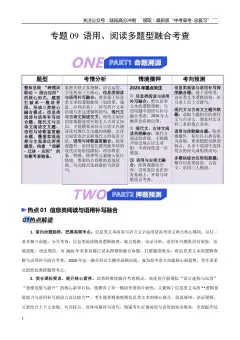
压轴题01  阅读理解C、D 篇

命题预测
分析近年高考英语阅读理解 C、D 篇命题规律,说明文始终是压轴核心题材,着重考查
考生对语篇的逻辑理解、信息筛选整合及高阶思维能力,是拉开分数差距的关键题型。语篇
素材主要选自2026 年各地市高考模拟题,题材聚焦科技创新发明、人工智能应用、生态环境
保护、医疗健康研究、农业科技发展、社会科学探索、前沿技术突破等领域,兼具时代性、
科学性、逻辑性,文章理论性较强,生词量适中,句式结构复杂(含长难句、复合句、专业
术语句)。
  从命题类型来看,六大题型均有涉及,且加大对概括能力、推理判断能力、逻辑分析
能力的高阶思维考查,细节理解题虽占比不低,但多需结合语境深度解读,而非简单定位。
结合近年考情,2026 年高考说明文仍将是 C、D 篇的核心考查题材,命题将更注重语篇逻
辑与实际应用的结合,突出对考生信息处理能力的考查。
高频考法
1. 推理判断题
2. 标题归纳题
3. 细节理解题
4. 词义猜测题
5. 主旨大意题
6. 写作意图题

一、说明文基本规律及解题要领
高考中科普类阅读理解一般不给标题,反而经常要求考生选择最佳标题。说明文一般采用如下四部分:
首段:一般即是文章的主题段,开门见山点明新发明或研究对象。
背景

 :  交代问题的现状或研究的起因。
主干

 :  部分介绍研究所取得的突破,作者往往会详细介绍研究对象、研究方法、研究理论或具体的实
验、统计等过程。
结尾

 :  通常会再次对中心进行概括、重述研究成果、预计的市场未来等与主题呼应。
二、说明文的解题技巧
1.   运用语篇结构(

 text

   structure

 ),了解文章大意


科普说明文主题鲜明、脉络清晰,行文结构模式较为固定。弄清文本结构有助于把握文章主旨和阅读
重点。科技创新发明类文章通常是介绍一种新产品、新技术,更多运用描述法从功能、用途、材料和市场
前景等方面进行介绍。 结构上一般采用上述四个部分,说明手法上常使用以下说明方法:描述法(包括
举例子、下定义、列数据等)、因果法、问题与对策法。
实验研究型文章一般会以实验的过程进展为线索,多用描述法、问题与对策法等方法,通过列数据、
做对比等来说明新的科学研究发现及其产生的影响。
阅读时,首先用略读法快速浏览每段的首尾句,根据英语说明文思维模式特征,作者一般都会开门见
山,直奔主题。结尾通常也是中心思想的概括,并与导语相呼应。因此在做主旨大意、写作意图和最佳标
题等题目时,需要重点关注首尾段落里面高频复现的词汇和内容。
2.   定位标志词,分析长难句,进行逻辑推理判断


每一个问题,在原文中,都要有一个定位。然后精读,找出那个标志词或者中心句。根据题干要求,
用查读法快速定位到相关段落。再利用标志词所提供的逻辑关系找到细节信息,如列数据、举例子、原因
和结果等。如果句子成分复杂,有生词,也不要烦躁退缩,分析主句和从句或非谓语动词之间的关系,一
些出现在术语、抽象概念、长难句前后的同义词、近义词等,都是用以理解文章的语境线索。通过这些对
长句进行层层剖析,露出主干部分,就能明晰句意,弄懂作者的真实意图。
3. 关注某人说到或推断观点态度题


某人说过的话,有时并不是题眼,但可以从侧面或某个角度来反映作者的观点,也就是作者想表达的,正
确答案都是和这样的观点相一致的。要把握关键词,有感情色彩的词。
4.  关注转折关系的逻辑词


 说明文中常会出现表示转折意义的词,如however, but, yet,while 等。这些词后面才是作者真正想表达的
意思,常常会在此处命题。
5.   熟悉选项设置规律,关注细节


正确选项:文中内容的“同义替换”或者“归纳概括”。
干扰项:“张冠李戴”、“偷梁换柱”、“无中生有”和“以偏概全”四种类型。
01  科技创新发明类
1.(2026·广东·一模)
What if the computers of tomorrow didn’t depend on metal and plastic, but instead grew from the soil beneath
our feet? This idea is turning into reality in a laboratory, where researchers at The Ohio State University have found
that common fungi — such as shiitake and button mushrooms — can be used to create memory components for
computing.
These mushroom-based devices act as organic memristors ( 忆阻器), short for memory resistors.
Unlike traditional resistors, memristors have the unique ability to retain information about past electrical
states. When current flows in one direction, their resistance increases; when it flows the opposite way, their
resistance decreases. Even after the power is switched off, the resistance level remains, thus allowing memristors to
function like tiny memory units inside a computer.
Mushrooms contain a dense, thread-like network known as mycelium (菌丝体), which can send tiny
electrical signals — much like memristors do. To test this, scientists attached wires to dried mushrooms
and sent small electrical pulses through them. The results were remarkable: the mushrooms switched between
electrical states up to 5,850 times per second with about 90% accuracy. Although their performance dropped under
higher electrical frequencies, stability returned when several mushrooms were linked together — suggesting a
kind of collective intelligence, similar to how brain cells function together.
Beyond these exciting results, mushrooms come with major environmental advantages. Traditional memristors
rely on scarce minerals and require high energy consumption. Mushrooms, however, are renewable, biodegradable,
and easy to grow. Their mycelium can also be shaped into custom structures, making them suitable for wearable
electronics, smart sensors, and other emerging technologies.
“Everything needed to explore organic computing could be as small as a pile of natural waste and some
homemade electronics — or as large as a culturing factory,” said John LaRocco, the study’s lead author. “All of
it is achievable with the resources we already have.” In the not-too-distant future, the computers on our desks may
very well have taken root — quite literally — in the forest.
1. What does the underlined word “retain” in paragraph 2 mean?
A. Track. B. Store. C. Gather.
D. Analyze.
2. What does the author want to illustrate by mentioning brain cells in paragraph 3?
A. The complex structure of mushrooms.
B. The rapid electrical response of mycelium.
C. The cooperative nature of mycelium networks.
D. The unstable performance of mushroom devices.
3. What advantages do mushroom-based memristors have according to paragraph 4?
A. They are rare and special.
B. They are smart and powerful.
C. They are creative and productive.
D. They are sustainable and adaptable.
4. What can be inferred about organic computing from John LaRocco’s words?
A. It has a low barrier to entry.
B. It will advance forest research.
C. It helps reduce agricultural waste.
D. It will create more jobs in factories.
2.(2026·江苏·一模)
Could you imagine being able to “feel” the images on your screen? UCSB researchers have made
this sci-fi-like idea a reality. They’ve developed a display where pixels (像素) physically rise off the
surface when activated by laser light (激光) .
Even our most advanced screens today have a limitation: they’re flat. We never quite feel what we
see.
In 2021, UCSB professor Yon Visell investigated this very question: could light be made to create a
sensation that could be felt through touch? He saw a breakthrough in late 2022. A single pixel rose
upward under a flash of laser light, sending a pulse (脉冲) that was very much noticeable to Professor
Visell’s fingertips.
At the heart of this invention are tiny pixels, which are tiny cells built with a thin film stretched
above a small air cavity (腔) . When a quick pulse of laser light hits a pixel, the film heats up, causing
the trapped air to expand, making the surface swell upward in just 2 to 100 milliseconds, by about a
millimeter (0.04 inch) .
As a sighted person, it does initially feel like something new and unusual. But the more I think
about it, the more it feels like it could have the most significant benefit to people who explore the world
through touch. This begins to look like a sort of “animated Braille (动画盲文)” and tells a story in
real-time. It could make digital learning faster and richer for blind users.
Touch and sight have always lived in separate digital worlds. We input with touch, and consume
outputs with sight. With this new invention, this separation may just be narrowing. As the UCSB
researchers put it, someday soon, anything you see, you may also feel.
5. What makes the new display different from the screens today?
A. It sends out laser light.
B. Its pixels can expand upward.
C. It rises off fingertips.
D. Its pulses are unnoticeable.
6. Which aspect of the invention is talked about in paragraph 4?
A. Its working principle.
B. Its daily application.
C. Its obvious advantages.
D. Its potential challenges.
7. Who will benefit most from the new display according to the author?
A. UCSB researchers.
B. Adventurous sighted people.
C. The visually disabled.
D. The digital enthusiasts.
8. What does the author imply about the invention in the last paragraph?
A. It may help replace sight with touch. B. It may separate input from output.
C. It may help feel what is usually seen.D. It may enlarge gaps between senses.
3.(2026·浙江北斗星盟·一模)
Dolphin communication has always interested scientists. The intelligent mammals use a range of
noises to work together and stay connected. Some sounds even act like names, helping dolphins recognize
one another. Now, researchers at Google and Georgia Tech hope to understand dolphin speech — and
maybe even talk to them — with the help of Artificial Intelligence (AI).
The scientists began by training an AI language model — DolphinGemma, which used 40 years of
data from Atlantic spotted dolphins in the Bahamas. The recordings and videos were collected by
researchers at the Wild Dolphin Project (WDP). They captured not only the sounds dolphins made but
also the context in which they were used.
Once ready, DolphinGemma could produce sounds similar to the recordings. About half were just
ocean noise. The rest mimicked (模仿) dolphin clicks, whistles, and burst pulses. Burst pulses are tightly
spaced clicks that sound like buzzing or squeaking. Dolphins use them to talk, play, and navigate their
way.
The next step is to test if these AI-generated sounds work on dolphins. To do this, the team is
building a device nicknamed CHAT. Once ready, two divers will wear CHAT and swim alongside the
dolphins. CHAT will play an AI-generated dolphin whistle to “ask” for an object, like a scarf. At the
same time, the divers will pass the object back and forth. If a dolphin mimics the whistle, the divers will
reward it with the scarf.
Thea Taylor is the director of the Sussex Dolphin Project. She is not part of the DolphinGemma
experiment but is fascinated by it. She cautions that the researchers must be sure the dolphins are
communicating — not just copying sounds to get the object. “We have to think whether that's actually
an understanding of language — or whether it's the same as teaching a dog to sit because they get a
reward,” Taylor said.
Regardless of the outcome, the DolphinGemma team hopes their project will show how smart
dolphins are. “Maybe understanding them would make us connect differently — and realize that these
species have the right to a healthy existence,” says WDP founder Dr. Denise Herzing.
9. What is the primary function of DolphinGemma?
A. To collect dolphin sounds from the wild.
B. To generate artificial dolphin-like sounds.
C. To teach dolphins human language commands.
D. To replace human divers in dolphin communication.
10. How will researchers know if the dolphin truly communicates with CHAT?
A. The dolphin swims close to CHAT.
B. The dolphin reproduces the AI whistle.
C. The dolphin is rewarded with the scarf.
D The dolphin interacts with the passed object.
11. What is Thea Taylor's main concern about the DolphinGemma experiment?
A. The ethical issue with using AI on dolphins.
B. Human intervention on natural dolphin behavior.
C. Whether dolphins truly understand or just seek rewards.
D. Whether AI sounds may confuse dolphin communication.
12. What can be a suitable title for the text?
A. Dolphins Play with AI. B. AI Translates Dolphin Language.
C. AI Dives into Dolphin Talk. D. Dolphins Use AI to Communicate.
4.(2026·福建泉州·二检)
On a laboratory bench in Cambridge, Massachusetts, polished round blocks of black concrete sit
bathed in liquid and wrapped in wires. Damian Stefaniuk presses a switch — the blocks, wired to an
LED, make the bulb come to life. This success promises a new future for energy storage.
Renewable energy like solar and wind is not always available, requiring batteries for storage.
However, lithium (锂) batteries face shortages and can produce poisonous chemicals, driving the search for
alternatives. This is where Stefaniuk’s concrete comes in: he and colleagues create supercapacitors from
water, cement (水泥), and carbon black. The supercapacitor’s core lies in carbon black’s high ability to
conduct electricity. Mixed with cement and water, it forms concrete with conductive networks.
Supercapacitors are highly efficient at storing energy but differ from batteries in some ways. They
can charge much more quickly and their energy storage density is enough to power a 10-watt LED bulb
for 30 hours. However, supercapacitors also release stored power rapidly, making them less useful in
devices such as mobile phones, laptops, or electric cars that require a steady supply of energy.
One application of supercapacitors is to create roads that store solar energy and then release it to
recharge electric cars wirelessly as they drive along a road. The rapid release of energy from the
supercapacitor would allow vehicles to get a rapid boost to their batteries. Another would be as energy-
storing foundations of houses — 30 to 40 cubic meters meets a household’ s daily needs; Stefaniuk
notes: “Walls, foundations or columns can support structures and store energy.”
While reducing lithium reliance, carbon-cement supercapacitors have environmental impacts: cement
production is responsible for 5-8% of global carbon dioxide emissions, and the carbon-cement needed
would need to be freshly made rather than added to and used in existing structures. But there may be a
way of overcoming the problem, adds Michael Short, who leads the Centre for Sustainable Engineering at
Teesside University. His colleagues are already working on low-emissions cement that is made from the
by-products of the steel and chemical industries.
13. What is a primary purpose of Stefaniuk and his colleagues’ research?
A. To develop new applications of concrete.
B. To introduce a material for lithium batteries.
C. To study the properties of cement mixture.
D. To create a new approach for energy storage.
14. What is paragraph 2 mainly about?
A. The growing adoption of renewable energy.
B. The process of making a new storage device.
C. The problems with current lithium battery technology.
D. The reasons for developing carbon-cement supercapacitors.
15. What is an application for supercapacitors?
A. Powering home appliances continuously.
B. Wirelessly charging electric vehicles on roads.
C. Serving as the main battery for mobile phones.
D. Replacing all traditional building foundations.
16. What does Short’s current research focus on?
A. Reducing reliance on carbon-cement.
B. Upgrading existing structures.
C. Tackling high carbon footprint.
D. Simplifying low-cost ingredients.
5.(2026·山东·一模)
Fifteen decades ago, Francis Galton first came up with the term “nature versus nurture”, and this
debate over the factors shaping human identity has long been a central topic in human sciences. Do our
genes determine our life paths, as hereditarians (遗传论者) argue? Or are we born as empty paper, shaped
merely by the experiences we have in our families and the wider world? Today, however, a new branch
of science is ready to overturn the debate. Through this new perspective, nature and nurture are hardly
separable at all — genes and the environment do not act independently, but instead interact closely and
even shape one another in tangible ways.
Genes do not shape our identities merely on their own within our bodies; instead, they function
partly by molding the environments we choose or create. A striking finding of this research is that our
environment is, in part, shaped by the genes of the people around us. Initial research suggests that your
partner’s genes influence your likelihood of depression almost a third as much as your own genes do. A
few students with a genetic trend for smoking in a high school seemed to cause smoking rates to
skyrocket across the entire grade — even among students who have no direct contact with these students
— like a gene-driven wildfire spreading through social networks.
Genes alone aren’ t enough to determine these outcomes and neither is environment. Nature and
nurture both shape each other, with nature influencing the way we experience nurture and nurture
influencing the way our nature expresses itself. The more opportunities and information the environment
provides — the more varied environments become — the bigger the role that genetic variation plays in
distinguishing us into different groups.
Nature and nurture aren’ t separate forces — they’ re a Möbius strip (莫比乌斯环), endlessly
circling back on each other. This interdependence means their interaction is fluid and reciprocal, a core
insight of sociogenomics that bridges genetic and social science.
17. Why did the author mention the “nature versus nurture” debate in paragraph 1?
A. To emphasize the dominant role of family experiences.
B. To introduce a long-standing core topic in human sciences.
C. To highlight the weakness of early hereditarians’ arguments.
D. To lay a contrastive foundation for a new scientific perspective.
18. What can be inferred from the example of students?
A. Smoking behavior spreads mainly through direct persuasion.
B. Genetic tendencies can indirectly change group behavior.
C. School rules fail to control students’ genetic instincts.
D. Only smokers’ friends adopt the same genetic risks.
19. What happens when environments become more diverse according to paragraph 3?
A. People rely less on their genetic traits.
B. Genetic differences play a smaller role.
C Genetic differences become more influential.
D. Nurture becomes more important than nature.
20. What does the author mean by comparing nature and nurture to a “Möbius strip”?
A. They depend entirely on physical conditions.
B. They have a one-way influence on each other.
C. They form a complex, continuous cycle of impact.
D. They are two separate parts of human development.
6.(2026·山西·一模)
New research challenges the widespread belief that artificial intelligence (AI) is driving a major rise
in global greenhouse gas emissions Scientists from the University of Waterloo and the Georgia Institute
of Technology analyzed U.S. economic data alongside estimates of how frequently AI tools are used
across different industries. Their aim was to understand what might happen to the environment if AI
adoption increases along its current path.
According to the U.S. Energy Information Administration, 83 percent of the nation’ s economic
activity relies on petrol, coal and natural gas. These fuels release greenhouse gases when burned. The
researchers noted that total energy use from AI in the U.S. matched the electricity consumption of
Iceland, yet this amount remained insignificant when viewed at national or global levels.
“It is important to note that the increase in energy use is not going to be uniform. It’s going to
be felt more in the places where electricity is produced to power the data centers,” said Dr Juan
Moreno-Cruz, a professor at the School of Environment, Enterprise and Development at the University of
Waterloo and Canada Research Chair in Energy Transitions. “If you look at that energy from the local
perspective, that’s a big deal because some places could see double the amount of electricity output and
emissions. But at a larger scale, AI’s use of energy won’t be noticeable.”
“For people who believe that the use of AI will be a major problem for the climate and think we
should avoid it, we’re offering a different perspective,” Moreno-Cruz added. “The effects on climate
are not that significant, and we can use AI to develop green technologies or to improve existing ones.”
To develop their findings, environmental economists Moreno-Cruz and Dr Anthony Harding reviewed
a variety of economic sectors, the types of jobs within those sectors, and the share of tasks that could
potentially be performed by AI. Moreno-Cruz and Harding intend to apply the same approach to
additional countries in order to understand how AI adoption may affect environmental outcomes across
different regions of the world.
21. What is the primary goal of the research?
A. To promote the development of green AI. B. To measure energy consumption worldwide.
C. To warn about AI’s growing energy demands.D. To assess AI’s potential environmental effects.
22. What can be said about AI energy consumption in the U.S.?
A. It contributes to petrol-based activities.
B. It will soon reach the global emission target.
C. It has small influence at the national level.
D. It exceeds Iceland’s electricity consumption.
23 What do researchers plan to do next?
A. Extend their research to more countries.
B. Shift focus to AI’s economic advantages.
C. Develop AI applications to stop emissions. D. Reduce the energy use of AI in data centers.
24. Which of the following is the main idea of the text?
A. AI technology drives greenhouse gas emissions.
B. AI energy consumption urgently needs regulating.
C. Data centers emit more than previously estimated.
D. AI’s impact on climate is much smaller than believed.
7.(2026·东北三省三校·一模)
For decades, cancer treatment has been dominated by chemotherapy ( 化疗) , a tool that attacks
rapidly dividing cells — both cancerous and healthy ones. Patients undergoing chemotherapy often suffer
severe side effects such as hair loss, and weakened immunity, making the treatment process as painful as
the disease itself. However, the emergence of targeted drugs has started an era of precision medicine that
treats cancer not with a “carpet bombing” but with a “precision strike.”
Unlike chemotherapy, which harms healthy cells without discrimination, targeted drugs cause minimal
damage to normal tissues. Most patients only experience mild side effects like diarrhea, allowing them to
maintain a relatively normal quality of life during treatment. Many targeted drugs are also available in
oral form, saving patients from frequent hospital visits for injections.
Targeted drugs work like smart missiles equipped with advanced navigation systems. Each cancer cell
carries unique molecular (分子的) features called “targets,” which are like the special locks on the
cells. Researchers design targeted drugs to act as the matching keys, enabling them to attach specifically
to these targets. A well-known drug, Trastuzumab, focuses on the HER2 protein overexpressed in some
breast cancer cells, blocking their growth signals and enhancing the immune system’s ability to destroy
cancer cells.
Yet, targeted therapy still faces major difficulties: drug resistance and high costs. Cancer cells are
highly adaptable. After months or years of treatment, they may mutate (突变) to escape the effects of
targeted drugs. Some lung cancer patients treated with first-generation EGFR inhibitors (抑制剂) , for
instance, develop the T790M mutation, making the drugs ineffective. Meanwhile, the long and costly
development process of targeted drugs — from target discovery to clinical trials — leads to extremely
high prices, putting them out of reach for many patients worldwide.
The future of targeted drugs lies in constant innovation. Scientists are exploring combined therapies,
such as pairing targeted drugs with immunotherapy, bringing new hope to countless cancer patients and
moving humanity closer to defeating cancer.
25. What advantage do targeted drugs have over chemotherapy?
A. They can completely cure cancer.
B. They precisely attack cancer cells.
C. They work faster than chemotherapy.
D. They have no side effects on tissues.
26. Why does the author mention Trastuzumab in paragraph 3?
A. To illustrate how targeted drugs work.
B. To explain how cancer cells mutate and resist drugs.
C. To compare targeted drugs with traditional chemotherapy.
D. To show targeted drugs are only effective for breast cancer.
27. What can we infer about targeted therapy in paragraph 4?
A. Targeted drugs will soon replace chemotherapy.
B. High costs limit the use of targeted drugs globally.
C. Drug resistance can be solved by T790M mutation.
D. The T790M mutation makes cancer cells sensitive to drugs.
28. What is the author’s attitude towards the future of targeted drugs?
A. Doubtful. B. Pessimistic.
C. Optimistic.D. Unconcerned.
8.(2026·河北百校联盟·一模)
Inspired by butterfly wings, a team of German researchers have developed a new kind of robotic
wings that can work using only magnetic fields ( 磁场). The new wings created by the Technical
University of Darmstadt researchers need no batteries or electronics.
The researchers drew inspiration from the remarkable efficiency and endurance (持久力) of monarch
butterflies, known to have incredibly long migrations between Canada and Mexico. Every autumn, millions
of Monarch butterflies start a 3,000-mile journey from their North American breeding grounds to the
warmer climate of southwestern Mexico for the winter.
These new robotic wings achieve energy-efficient flight by combining movement with passive
bending, which was rarely copied outside the natural world. The team, led by Professor Oliver Gutfleisch
and Dr. Denys Makarov, used a combination of flexible plastic fixed with tiny magnetic particles (颗粒)
to build the wings.
The team found that the magnetic particles, when exposed to external magnetic fields, caused the
wings to bend in a manner similar to that of butterflies. Achieving the desired design proved challenging;
however, after testing fewer than 12 different designs, the team could develop wings strikingly similar to
those that evolved in butterflies.
Looking ahead, these new wings could have a wide range of applications. One could be
environmental research in which winged robots monitor pollinator populations or measure air quality. They
could also be helpful in disasters, with their small, energy-efficient design enabling robots to navigate
dangerous areas for search and rescue operations. The team also pointed out that the new design could
also be readily adapted for medical sciences.
The principle of using magnetic particles in this way could also open doors for developing new
kinds of artificial muscles or other innovative materials that can change shape on demand. While the
robotic wings currently rely on external magnetic fields to change shape, the team is optimistic about
integrating man-made magnetic field generators into future upgrades of the technology. “ We plan to
explore what changes to magnetic fields can enable more complex movements and control,” explained
Muhammad Bilal Khan, another lead author.
29. What’s the driving power of the robotic wings?
A. The air pressure.
B. The magnetic field.
C. The rechargeable battery.
D. The electronic motor.
30. What does paragraph 5 mainly talk about?
A. The potential of the robotic wings.
B. Challenges facing the research team.
C. The working principle of the robots.
D. Uncertainties in developing robotic wings.
31. What does the last paragraph imply about the robotic wings?
A. They should still depend on outside magnetic fields.
B. Their use is strictly limited to environmental monitoring.
C. They are expected to operate in controlled magnetic fields.
D. Their new versions will function as well as human muscles.
32. Which is a suitable title for the text?
A. The Monarch Butterfly’s 3,000-Mile Journey
B. Robotics Taking Wings Thanks to Butterflies
C. Butterflies Rely on Magnetic Fields for Flight
D. Butterfly Wings Hold Clues to Natural Adaptation
9.(2026·广东广州·一模)
Sound travels as vibrations (振动) through the air. Conventional microphones function by picking up
these vibrations. Scientists wondered if they could make microphones that see those vibrations rather than
hear them. Now researchers in China have built such a device.
Led by physicist Yao Xuri from Beijing Institute of Technology, the team has built a device that
photographs the tiny, imperceptible vibrations that sound waves generate on objects. According to Yao,
“This technique enables sound detection using everyday items under natural lighting.”
This is hardly the first attempt to make a microphone that works with light. Alexander Graham Bell
built one back in 1880. He called it a photophone. It operated by using sound waves to deform a mirror,
causing reflected light to flash along with the sound. These flashes were then changed back into sound.
Modern attempts have been trying to copy this, using high-speed cameras or precise lasers (激光), but
such systems are often complex and costly.
The Chinese team has adopted an alternative approach: single-pixel ( 单像素) imaging. “ Unlike
ordinary cameras which rely on millions of sensors, single-pixel imaging uses just one,” Yao noted. It
scans a scene to collect visual data, which is then processed by computers to reconstruct an image.
Through this technique, Yao’ s team detected how sound waves had shaken a paper card or leaf. A
computer then decoded the data into audible sound.
The device successfully captured spoken numbers in both Chinese and English and decoded an
excerpt from Beethoven’s Für Elise. “This method creates a relatively small amount of data, making it
easy to store or upload,” Yao noted. The team is refining the device’ s capacity to detect human
heartbeat and heart rate, a development that could enable non-contact patient monitoring in medical
settings.
Currently, the technology only works from about half a meter away, and detecting sound in noisy
environments remains a key challenge. That will take more advanced technology and extensive field
testing. But if they succeed, we might not just listen to the world around us — we might watch it
speak.
33. The underlined word “imperceptible” in paragraph 2 is closest in meaning to ______.
A. inaudible
B. inaccessible
C. unpredictable
D. unnoticeable
34. What is paragraph 3 mainly about?
A. Research background.
B. Study design.
C. Technical approaches.
D. Key challenges.
35. How does the single-pixel imaging device differ from ordinary cameras?
A. It works at a super high speed.
B. It processes data with a computer.
C. It uses precise lasers to scan scenes. D. It collects data with only one sensor.
36. What is the author’s attitude towards the future of the technology?
A. Expectant. B. Doubtful. C. Concerned.D. Uncertain.
10.(2026·江西南昌·一模)
Arabidopsis thaliana (拟南芥), a small thin weed of the mustard family, never seemed likely to gain
scientific fame. Yet this common plant has greatly changed from an ignored weed to a biological
superstar due to scientists’ foresight, continuous exploration and joint efforts.
Arabidopsis’ journey began with young geneticist George Rédei. At first, Rédei’s research on this
weed was widely doubted because many thought only valuable crops or decorative plants were worth
studying. But he carried its seeds all the time and later continued research in the US. Inspired by
German botanist Friedrich Laibach, he saw its value as a model organism, similar to fruit flies in
genetics. Compared with corn and wheat, Arabidopsis has clear advantages: small size, short growth cycle,
many seeds, but what sets it apart from other experimental plants is its only five pairs of chromosomes
(染色体), making gene location much easier.
In the 1980s, young scientists like Chris Somerville and Elliot Meyerowitz also noticed its potential.
They proved its value through experiments, finding its small genome with little repeated DNA made gene
discovery easier. In 2000, a global team finished its research and published the result in Nature, which
provided a solid base for future studies.
Today, researches on Arabidopsis have provided important support for crop output expansion,
ecological system management and climate change reduction. For instance, the genes identified in
Arabidopsis have helped scientists understand the fruit development mechanism of tomatoes and improve
the stress resistance of rice.
Beyond plant science, Arabidopsis has also brought new insights to human health research. Notably,
about 70% of human cancer-related genes and genes related to neurological diseases such as Alzheimer’s
and Parkinson’s all exist in this plant.
Arabidopsis is not without limitations. Its simple structure, while useful for genetic research, cannot
fully represent the complexity of crops like wheat or corn. However, even with these concerns, this once-
ignored weed has already proved that great scientific value can lie in the most unexpected places, and it
continues to inspire researchers to explore the mysteries of life.
37. What is special about Arabidopsis as a model organism?
A. Its abundant seeds. B. Its brief life period.
C. Its few chromosomes.
D. Its unique outer shape.
38. What can be inferred about the Arabidopsis research?
A. It cast new light on medical studies. B. It prioritized traditional model organisms.
C. It gained support from most geneticists.
D. It targeted major management problems.
39. What is the function of the last paragraph?
A. To prove the complexity of Arabidopsis.
B. To stress the limitations of Arabidopsis.
C. To restate the importance of Arabidopsis.
D. To underline the structure of Arabidopsis.
40. Which of the following can be a suitable title for the text?
A. The Applications of Arabidopsis Studies
B. The Link between Arabidopsis and Humans
C. The Discovery of Small Genome in Arabidopsis
D. The Course of Arabidopsis from Weed to Treasure
11.(2026·辽宁·一模)
In 2025, a survey by the Global Tech Education Institute found over 5.2 million high school students
worldwide used wearable smart learning devices, with 69% of senior three users saying they helped make
full use of fragmented (碎片化的) time. However, early versions had obvious drawbacks: a 2025 report
from South Korea’s Education Ministry showed 65% of teachers worried simple wearable devices only
provided information without guiding effective learning. To solve the problem, upgraded wearable tools
tailored for senior three students have appeared. “Wearable tech should fit the tight study schedule of
senior three students, helping them learn efficiently instead of just displaying information,” said Dr. Kim
Jae-ho, a tech researcher at Seoul National University.
A recent study in the Journal of Educational Technology found that upgraded wearable devices helped
senior three students improve their English word memorization, time management, and reduce study
anxiety. According to Dr. Emma Wilson from the University of Cambridge, the devices only significantly
boost learning outcomes for those who use them actively and properly, not for passive users. This corrects
the misunderstanding that wearables can improve grades without active effort.
The key strength of these upgraded devices is their “personalized guidance + fragmented learning”
design. They record learning habits, push targeted review materials during breaks, and send reminders to
avoid long-time study fatigue. A survey of 1,200Chinese senior three students found 81% benefited from
the personalized push function.
Schools and tech companies are still improving the devices to better fit senior three students’ needs;
only 38% of market products can fully match the college entrance exam review rhythm (TechCrunch
2026). These wearable tools will not replace teachers but will become useful helpers in daily study. For
senior three students, the value of such tech lies in helping them arrange time scientifically and improve
learning efficiency — something crucial for their final review and exam preparation.
41. What was the main drawback of early wearable smart learning devices?
A. They were too complex for senior three students to operate.
B. They mainly focused on information without offering effective guidance.
C. They disturbed students in class and reduced learning efficiency.
D. They failed to provide enough materials for exam review.
42. Which best describes Dr. Kim Jae-ho’s attitude?
A. Critical and doubtful.
B. Worried and anxious.
C. Unconcerned and casual.D. Objective and supportive.
43. What can we infer about the study led by Dr. Emma Wilson from Paragraph 2?
A. Active users benefit far more from the upgraded devices.
B. Passive use can greatly improve students’ learning outcomes.
C. All users achieve obvious progress with the devices.
D. Technology decides students’ final learning results.
44. What can we learn from the text?
A Early wearable devices have disappeared from the market.
B. Most products suit the college entrance review rhythm perfectly.
C. Upgraded wearables help with efficient and personalized learning.
D. Wearable devices will completely replace teachers in class.
12.(2026·安徽·一模)
Under the autumn sky of Tuohula Xinjiang, golden rice stalks sway gently. Ayinigeer Tuoheti, a 28-
year-old computer science graduate, wanders through the fields, checking the ripening crop. Her digital
skills are bridging the divide between her family’s traditional rice business and the modern age.
In 2020, Ayinigeer returned home to assist her father — who’d built a 1994 rice processing plant
but his health weakened and struggled with business communications. She found the family’s work stuck
in the backward reality: the ledger book, handwritten records, and carbon paper. She resolved to transform
the business.
First, she turned their small farmer cooperative into a company. Exploiting her computer background,
she automated invoicing, inventory, and order processing, shifting all work to electronic systems. To
secure high-quality rice, she partnered with over 120 households, who transferred the management rights
of their land to her company. Her company provided seeds and training, bought harvests above market
prices, and shared profits-boosting farmers’ incomes while ensuring premium raw materials.
In 2023, she tried livestreaming on electronic sales platform. With a smartphone, she presented
viewers with local rice fields, processing plants, and family meals with their local products. The initial
phase was tough, but local governments trained her in livestreaming skills. Their authenticity won
audience: daily orders grew from 12 to hundreds. Now, From March to September this year, they had
180,000 orders through livestreaming, with 7,000 on a single day-that’s nearly 35 tons of rice moving
directly from their fields to households across China.
The numbers tell the resulting. In early 2024, influencers from across China were reaching out to us,
she said. “They wanted to partner with us because our product had proven appealing.”
The phenomenal success of Ayinigeer’s livestreaming, however, stems not just from technology, but
Tuohula’s rice quality: Wensu’s temperature swings, selenium-rich soil, and Tianshan snowmelt water
make it sweet and aromatic. Local farming is 98% mechanized, and a 1998 seed base (investing 1
million yuan yearly) develops high-quality varieties-including the seeds Ayinigeer uses.
45. What did Ayinigeer do first to improve the family business?
A. She started livestreaming on Douyin.
B. She modernized the operation system.
C. She partnered with over 120 local households.
D. She inspected crops personally.
46. Why could Ayinigeer’s sales model attract viewers?
A. She offered very low rice prices.
B. She used professional broadcasting equipment.
C. She presented authentic rice production scenes.
D. She accumulated many followers before livestreaming.
47. What can we infer about Tuohula’s rice?
A. It is popular all over the world.
B. Local natural conditions contributed to its popularity.
C. It is only sold in southern Xinjiang.
D. Its production cost is much lower than average.
48. Which is the most appropriate title?
A. Digital Skills Revive Hometown Rice B. Livestreaming Makes Rice Famous
C. Graduate Succeeds in Rice Business
D. Quality Rice Boosts Agriculture
13.(2026·湖南怀化·一模)
Electric vehicles (EVs) are increasingly seen as a key to reducing urban air pollution and reliance on
fossil fuels. Governments, such as the UK, have announced plans to ban new petrol and diesel car sales
from 2030, signaling strong policy support for a cleaner transport future. Yet, the path to a fully electric
society is far from straightforward, with several challenges yet to be overcome.
Two major practical difficulties stand in the way. First, EVs currently suffer from limited battery
ranges compared to conventional vehicles, which can travel longer distances on a full tank of fuel.
Second, charging infrastructure (基础设施) remains underdeveloped, with charging points still insufficient
in most regions. These factors contribute to “range anxiety” among potential buyers, slowing the shift
to electric transport.
On the technological front, solid-state batteries are viewed as a promising breakthrough. Though
currently used mainly in consumer electronics like smartphones, they are expected to enter the car market
in the coming years, offering quicker charging times and an extended driving range. This could
significantly enhance the appeal of EVs to the general public.
Economically, high initial costs continue to be a barrier. However, some countries have introduced
policy supports, such as tax reductions, purchase subsidies (补贴), and dedicated traffic lanes for EVs,
helping to boost adoption rates. Norway serves as a leading example, with the highest number of electric
cars per person globally.
Nevertheless, experts like Colin Herron caution that EVs alone do not equal a zero-carbon future.
Their environmental impact depends heavily on how the electricity used to charge them is generated. If
the power comes mainly from fossil fuels, the overall emission reduction is limited. In addition,
manufacturing EVs — especially their batteries — carries a substantial carbon footprint. Therefore, a truly
sustainable transport system may require not only cleaner cars, but also greater use of public transport
and a societal move toward fewer and shorter private vehicle trips.
49. What challenges do EVs mainly face?
A. High costs and low popularity.
B. Tech delays and unstable power.
C. Limited battery life and safety issues.
D. Limited ranges and insufficient charging points.
50. How do some governments promote EV adoption?
A. By raising taxes on petrol cars sharply.
B. By offering tax cuts, subsidies and special lanes.
C. By increasing the number of city parking spaces.
D. By enhancing the quality of public transport services.
51. What does Colin Herron’s warning imply?
A. EV benefits rely on clean electricity sources.
B. EVs cannot become truly green in the future.
C. Deadlines for banning fuel cars are not wise.
D. Battery technology is the key to green transport.
52. What is the main purpose of the text?
A. To introduce the latest EV models to readers.
B. To call for investment in charging facilities.
C. To discuss both the future and problems of EVs.
D. To blame car makers for high production costs.
14.(2026·内蒙古·一模)
Laser (激光) technology is set to revolutionize space communication, potentially allowing people to
have video chats with family and friends while on long space trips: SpaceX, a leading player in the
space industry, is pioneering laser-based communication technology for satellites. Last October, US startup
Muon Space took up SpaceX’s offer, aiming to use the technology to establish a high-speed satellite
connection, as reported by tech magazine PCMag.
Laser-based communication is widely regarded as the future of space communication. According to
NASA, the term “laser” stands for light amplification by stimulated emission of radiation. In a laser
beam, light waves are aligned in peaks, making the beam narrow and bright — ideal for maintaining
focus over long distances.
Traditionally satellites rely on radio waves for sending and receiving information. Both laser and
radio waves travel at the speed of light, but lasers can carry far more data. For instance, NASA notes
that downloading a two-hour HD movie with lasers takes just eight minutes, compared to over 26 days
with radio waves.
Lasers also offer enhanced security due to their thin beams, which leave smaller “footprints” This
reduces the chance of signals being intercepted or disrupted by others, as stated in the national magazine.
Additionally, laser equipment is lightweight and consumes less power, freeing up more space on spacecraft
for scientific tools.
However, the narrow laser beam presents a significant challenge: lasers are typically targeted at
satellites 500 kilometers above Earth, which move thousands of kilometers per hour. Moreover, clouds and
fog can interfere with laser signals, though more ground stations in adverse (恶劣的) weather areas can
mitigate this issue.
While laser communication technology has not yet been widely adopted, its market is expanding
rapidly. Fortune Business Insights predicts the market could reach 29.52 billion (about 210.19 billion
yuan) by 2032. Some experts even suggest that as the technology matures, it may gradually supplement
radio wave communication in most space missions by 2040.
53. Which of the following best explains the working feature of a laser beam that benefits long-
distance space communication?
A. Light waves in it travel at a speed faster than radio waves.
B. Its light waves are aligned in peaks, making it narrow and bright.
C. It can carry more data than radio waves due to its larger footprint.
D. It consumes less power, which ensures stable transmission over distance.
54. What does the underlined word “intercepted” probably mean in paragraph 4?
A. Blocked.
B. Occupied. C. Provided. D. Strengthened.
55. Which measure is mentioned to address the problem of laser signal disruption by bad weather?
A. Increasing the power of laser equipment on spacecraft.
B. Building more ground stations in areas with poor weather.
C. Adjusting the wavelength of laser beams to avoid interference.
D. Using heavier but more stable laser devices for communication.
56. What does the passage imply about the future of laser-based communication?
A. Its market growth will slow down as the technology matures.
B. It will completely replace radio wave communication by 2040.
C. It will play an increasingly important role in space communication.
D. It will only be used in a few space missions due to technical limits.
15.(2026·甘肃兰州·一模)
Despite the severe cold of winter, smart greenhouses in the city of Dingxi in Northwest China’s
Gansu province are being used for year-round agricultural cultivation, producing fresh fruits and
vegetables. In recent years, the city has embraced smart farming and moved beyond traditional weather-
dependent practices. The city has 14 intensive smart seedling bases, along with 1,265 standardized
greenhouses and steel-framed sheds equipped with Internet of Things (IoT) devices. Integrated water and
fertilizer systems, along with 5G-enabled environmental control technology, provide precise, real-time
monitoring of temperature, light, water and nutrients to enhance crop growth.
Gansu has been implementing (落实) the call made at the 2025 central rural work conference for
research and breakthroughs in core agricultural technologies in key fields. In the vast Hexi Corridor,
winter-fallow fields have taken on new value through the cultivation of innovative agricultural products.
Sun Wancang, a professor at Gansu Agricultural University, has developed a super cold-resistant winter
rapeseed (油菜) variety capable of withstanding temperatures as low as -32℃. At experimental bases in
cities like Wuwei and Jiuquan, winter rapeseed is boosting grain and oil production while curbing dust
storm sources, delivering both economic and ecological benefits.
In Gansu’s Linxia Hui autonomous prefecture, a 200,000-square-meter rose “super factory” is also
showcasing the power of technology. The agriculture park, which began operation in 2022, integrates
advanced technologies such as digital control, soilless cultivation and post-harvest pre-cooling for fresh-cut
flowers, ensuring roses bloom year-round.
The rapid development of new quality productive forces in agriculture is supported by policies and
project funding. During China’ s 14th Five-Year Plan (2021-2025), Gansu increased investment in
agricultural science and technology, implementing seed industry breakthroughs an technological support
projects. Backed by four years of central and provincial financial support totaling 250 million yuan, these
initiatives are providing strong momentum (动力) for breakthroughs in agricultural technology.
57. What is the main use of the IoT devices described in the first paragraph?
A. To help build a larger number of new greenhouses.
B To grow crops like potatoes in a fully automatic way.
C. To check and adjust conditions for plants in real time.
D. To run farms completely without the need for human workers.
58. What does the underlined word “curbing” in paragraph 2 probably mean?
A. Reducing. B. Forming.
C. Identifying.
D. Strengthening.
59. What supports Gansu’s new quality productive forces in agriculture?
A. Research achievements of agricultural experts and institutes.
B. Promotion of smart greenhouses in Gansu’s urban and rural areas.
C. Farming of innovative agricultural products in the vast Hexi Corridor.
D. Policies and financial investment in agricultural science and technology.
60. How does the passage illustrate the impact of smart agriculture?
A. By listing typical cases and practical achievements in Gansu.
B. By quoting experts’ opinions and research data from institutes.
C. By explaining the working principles of smart farming technologies.
D. By comparing traditional farming with modern agricultural technologies.