2026 年高考英语临考冲刺卷01(江苏专用)
高三英语·全解全析
(考试时间:120 分钟  试卷满分:150 分)
注意事项:
1.答卷前,考生务必将自己的姓名、准考证号等填写在答题卡和试卷指定位置上。
2.回答选择题时,选出每小题答案后,用铅笔把答题卡上对应题目的答案标号涂黑。如需
改动,用橡皮擦干净后,再选涂其他答案标号。回答非选择题时,将答案写在答题卡上。写
在本试卷上无效。
3.考试结束后,将本试卷和答题卡一并交回。
第一部分 听力(共两节,满分30 分)
做题时,先将答案标在试卷上,录音内容结束后,你有两分钟的时间将试卷上的答案转涂到
答题卡上。
第一节(共5 小题;每小题1.5 分,满分7.5 分)
听下面5 段对话。每段对话后有一个小题,从题中所给的A、B、C 三个选项中选出最佳选项。
听完每段对话后,你都有10 秒钟的时间来回答有关小题和阅读下一小题。每段对话读两遍。
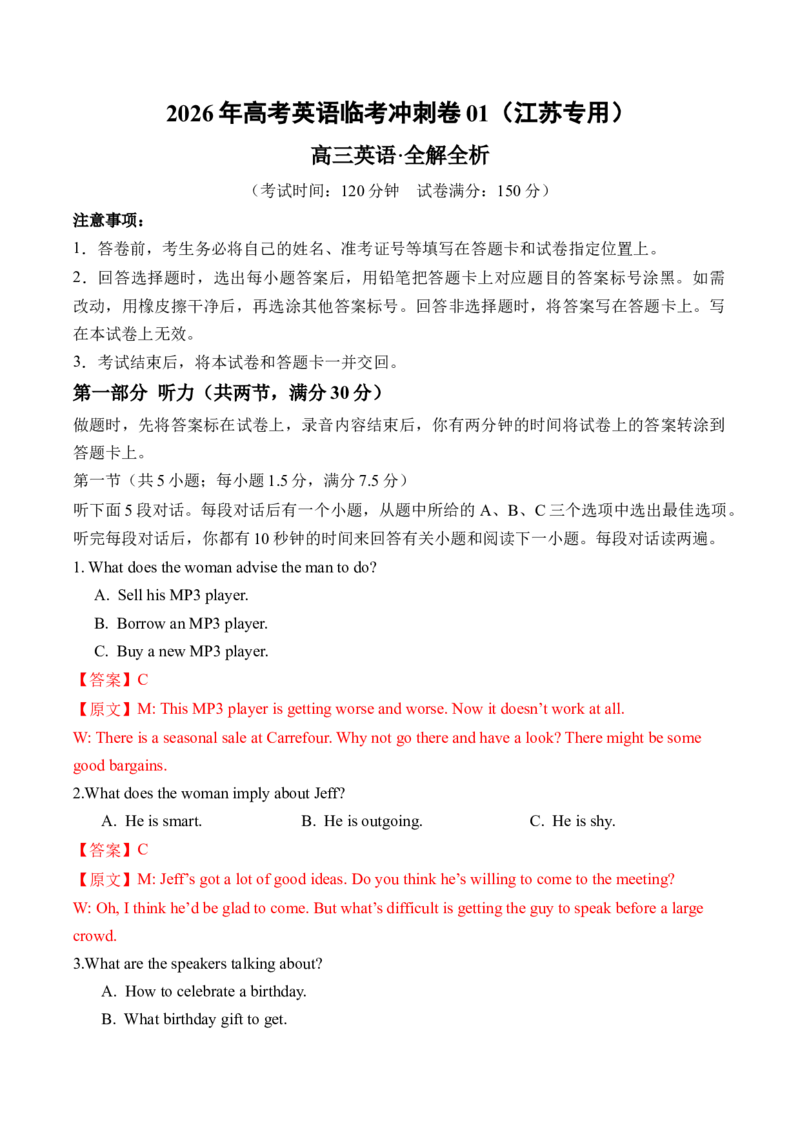
1. What does the woman advise the man to do?
A. Sell his MP3 player.
B. Borrow an MP3 player.
C. Buy a new MP3 player.
【答案】C
【原文】M: This MP3 player is getting worse and worse. Now it doesn’t work at all.
W: There is a seasonal sale at Carrefour. Why not go there and have a look? There might be some
good bargains.
2.What does the woman imply about Jeff?
A. He is smart.
B. He is outgoing.
C. He is shy.
【答案】C
【原文】M: Jeff’s got a lot of good ideas. Do you think he’s willing to come to the meeting?
W: Oh, I think he’d be glad to come. But what’s difficult is getting the guy to speak before a large
crowd.
3.What are the speakers talking about?
A. How to celebrate a birthday.
B. What birthday gift to get.
C. Where to hold a party.
【答案】B
【原文】W: Mike, your nephew’s birthday is next week. What are you going to get him?
M: I really have no idea what he likes. Any advice?
W: How about a sweater? I saw a really nice one in the mall the other day. Maybe we can go there
and take a look.
M: OK.
4.Why is Matt leaving the company?
A. He’s retiring.
B. He’s starting his own business.
C. He’s moving to a different country.
【答案】B
【原文】M: Joyce, have you heard that Matt is leaving the company?
W: Oh really? He’s worked here for 15 years. Is he retiring?
M: No, he is leaving to open his own company in a different industry.
5. How does the man find Jack?
A. He lacks related experience.
B. He isn’t a good team player.
C. He doesn’t have technical skills.
【答案】A
【原文】W: So what do you think about Jack for the team leader position?
M: Well, he’s very skilled technically and gets along well with others. But I’m not sure if he has
enough experience.
W: Hmm, I see your point.
M: Maybe we should assign him a smaller project first to see how he performs.
W: That’s probably a good idea.
第二节(共15 小题;每小题1.5 分,满分22.5 分)
听下面5 段对话或独白。每段对话或独白后有几个小题, 从题中所给的A、B、C 三个选项中
选出最佳选项。听每段对话或独白前, 你将有时间阅读各个小题, 每小题5 秒钟; 听完后,各小
题将给出5 秒钟的作答时间。每段对话或独白读两遍。
听第6 段录音,回答第6、7 题。
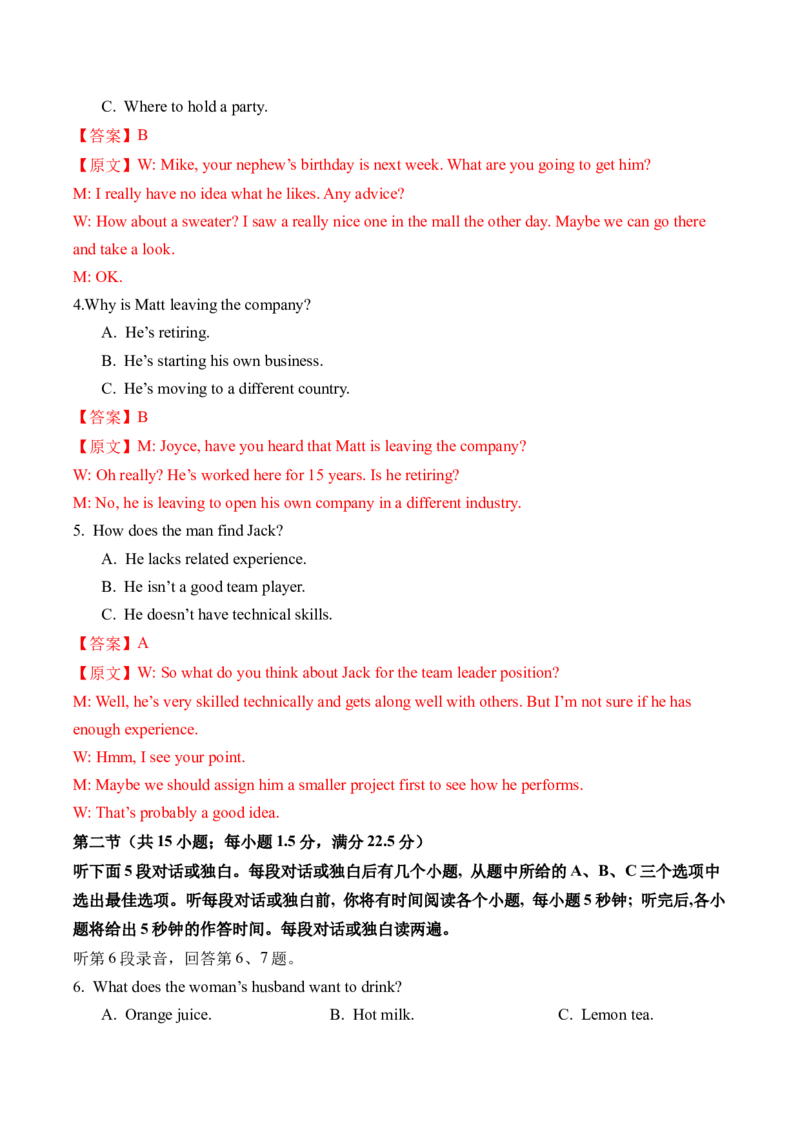
6. What does the woman’s husband want to drink?
A. Orange juice.
B. Hot milk.
C. Lemon tea.
7. When does the woman want the drinks?
A. At about 7: 30 am.
B. At about 8: 00 am.
C. At about 8: 30 am.
【答案】6. C    7. A
【详解】W: Hello, room service. This is Alice Brown in room 308. We’d like to order some drinks
M: Yes, madam. What would you like?
W: We’d like to start with fruit juice. Apple for me and orange for my daughter.
M: Right, Madam! Do you want any tea or milk?
W: No, thank you! Just some lemon tea for my husband, and some hot milk for my children.
M: OK! And What time do you want it brought to your room?
W: About 8 am. Oh, wait, please bring it half an hour earlier. We may leave early to go sightseeing in
the city.
M: OK!
听第7 段录音,回答第8 至10 题。
8. What is a feature of the swimming class?
A. It is designed for babies only.
B. It has outdoor swimming lessons.
C. It offers a particularly relaxing atmosphere.
9. When is the swimming class unavailable?
A. Monday.
B. Saturday.
C. Sunday.
10. What is the probable relationship between the speakers?
A. Husband and wife.
B. Brother and sister.
C. Fellow workers.
【答案】8. C    9. C    10. A
【原文】W: John, I’ve been thinking about signing Jim up for a swimming class. Look, I found this
place called Little Swim Stars in East Maitland.
M: Oh? Do they have lessons for Jim? He’s just two years old after all.
W: Yes. They have parent and child swimming lessons for babies and young children.
M: That sounds great. But is the environment safe?
W: Yeah, it’s in a heated indoor pool, and they create a relaxed, safe and caring environment. They
use songs and activities to teach basic skills like kicking and floating.
M: When are the lessons?
W: They offer lessons from Monday to Saturday all year round. I think it could be a great experience
for Jim.
M: OK, let’s take him to sign up this weekend.
听第8 段录音,回答第11 至13 题。
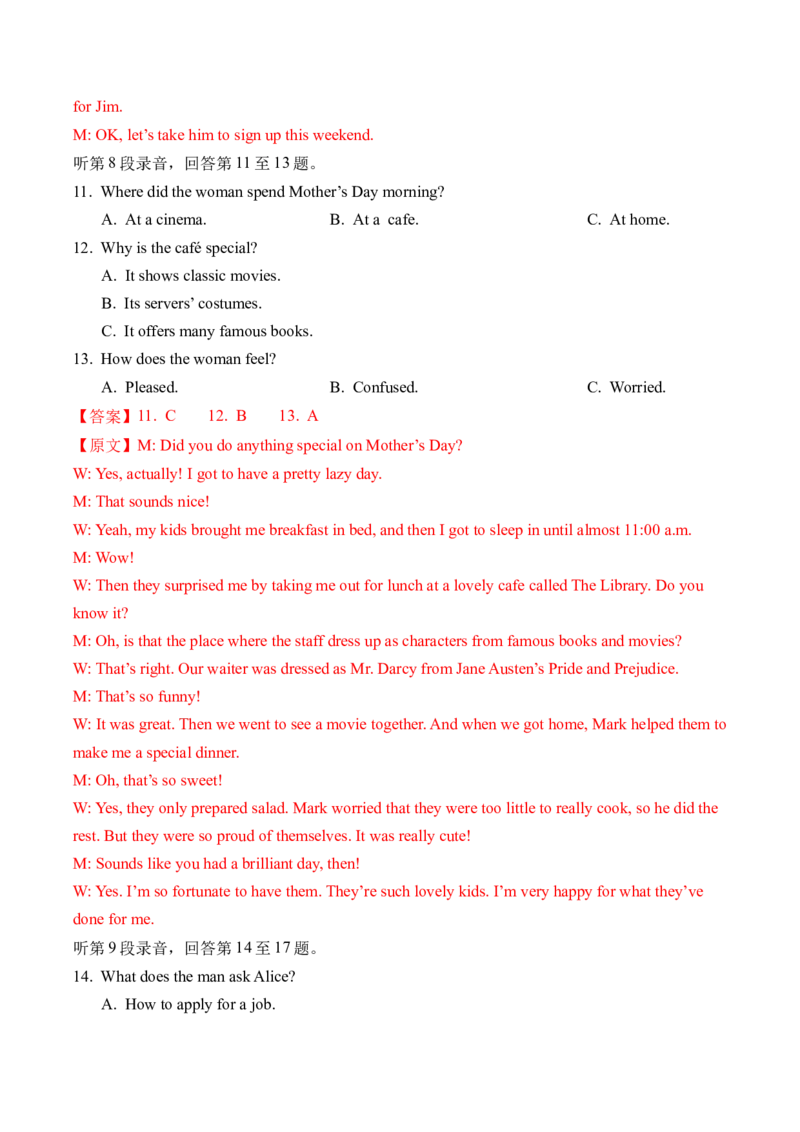
11. Where did the woman spend Mother’s Day morning?
A. At a cinema.
B. At a cafe.
C. At home.
12. Why is the café special?
A. It shows classic movies.
B. Its servers’ costumes.
C. It offers many famous books.
13. How does the woman feel?
A. Pleased.
B. Confused.
C. Worried.
【答案】11. C    12. B    13. A
【原文】M: Did you do anything special on Mother’s Day?
W: Yes, actually! I got to have a pretty lazy day.
M: That sounds nice!
W: Yeah, my kids brought me breakfast in bed, and then I got to sleep in until almost 11:00 a.m.
M: Wow!
W: Then they surprised me by taking me out for lunch at a lovely cafe called The Library. Do you
know it?
M: Oh, is that the place where the staff dress up as characters from famous books and movies?
W: That’s right. Our waiter was dressed as Mr. Darcy from Jane Austen’s Pride and Prejudice.
M: That’s so funny!
W: It was great. Then we went to see a movie together. And when we got home, Mark helped them to
make me a special dinner.
M: Oh, that’s so sweet!
W: Yes, they only prepared salad. Mark worried that they were too little to really cook, so he did the
rest. But they were so proud of themselves. It was really cute!
M: Sounds like you had a brilliant day, then!
W: Yes. I’m so fortunate to have them. They’re such lovely kids. I’m very happy for what they’ve
done for me.
听第9 段录音,回答第14 至17 题。
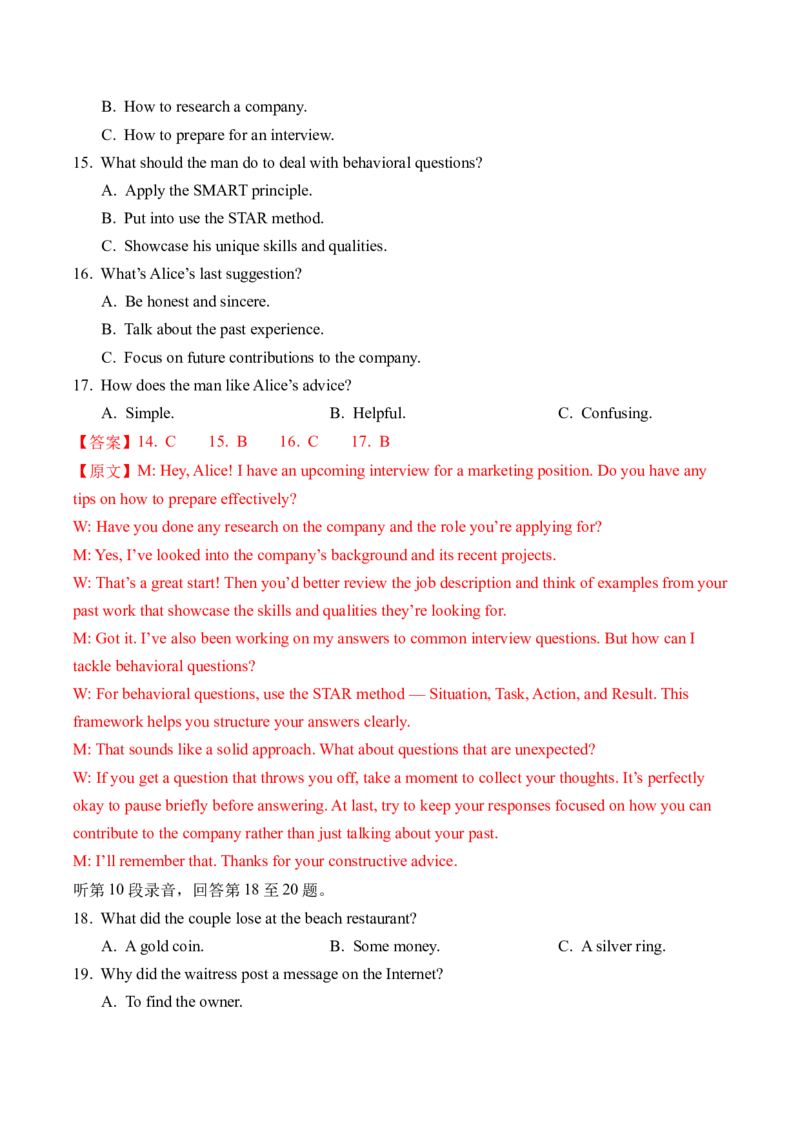
14. What does the man ask Alice?
A. How to apply for a job.
B. How to research a company.
C. How to prepare for an interview.
15. What should the man do to deal with behavioral questions?
A. Apply the SMART principle.
B. Put into use the STAR method.
C. Showcase his unique skills and qualities.
16. What’s Alice’s last suggestion?
A. Be honest and sincere.
B. Talk about the past experience.
C. Focus on future contributions to the company.
17. How does the man like Alice’s advice?
A. Simple.
B. Helpful.
C. Confusing.
【答案】14. C    15. B    16. C    17. B
【原文】M: Hey, Alice! I have an upcoming interview for a marketing position. Do you have any
tips on how to prepare effectively?
W: Have you done any research on the company and the role you’re applying for?
M: Yes, I’ve looked into the company’s background and its recent projects.
W: That’s a great start! Then you’d better review the job description and think of examples from your
past work that showcase the skills and qualities they’re looking for.
M: Got it. I’ve also been working on my answers to common interview questions. But how can I
tackle behavioral questions?
W: For behavioral questions, use the STAR method — Situation, Task, Action, and Result. This
framework helps you structure your answers clearly.
M: That sounds like a solid approach. What about questions that are unexpected?
W: If you get a question that throws you off, take a moment to collect your thoughts. It’s perfectly
okay to pause briefly before answering. At last, try to keep your responses focused on how you can
contribute to the company rather than just talking about your past.
M: I’ll remember that. Thanks for your constructive advice.
听第10 段录音,回答第18 至20 题。
18. What did the couple lose at the beach restaurant?
A. A gold coin.
B. Some money.
C. A silver ring.
19. Why did the waitress post a message on the Internet?
A. To find the owner.
B. To report the news.
C. To draw attention.
20. How much was the gold coin probably worth?
A. $100.
B. $2,000.
C. $5,000.
【答案】18. C    19. A    20. B
【原文】  W: Hello, listeners! On today’s “My Story”, we are going to hear about a couple’s
story. One year ago, a couple was enjoying a meal at a beach restaurant when the man’s wedding ring
fell from his hand and dropped through the gap in the wooden floor, seemingly lost forever. Recently,
when the restaurant manager began replacing the wooden platform, workers uncovered a silver ring
alongside an old gold coin and some $100 bills. A waitress shared a photo of the ring on social
media, hoping to find the owner. The post was shared about 5,000 times. Three days later, the couple
saw the post and contacted the restaurant to get back the lost ring. They sent photos as proof of
dining there. The restaurant returned the ring to the couple by mail. Meanwhile, the manager learned
that the gold coin was extremely valuable. It was from 1855 and worth as much as $2,000.
第二部分  阅读(共两节, 满分50 分)
第一节(共15 小题;每小题2.5 分, 满分37.5 分)
阅读下列短文, 从每题所给的A、B、C 和D 四个选项中选出最佳选项。
A
In today’s rapidly evolving world, early exposure to technology is essential for future success.
Robotics, a core element of STEM education, introduces young learners to programming and
technological concepts, preparing them for the dynamic job markets of tomorrow. Moonpreneur
offers specialized online robotics classes for students aged 7 to 18, designed by industry experts to
make learning both effective and engaging through a project-based approach that develops technical,
soft, and entrepreneurial skills.
Future-oriented curriculum
The course focuses on equipping students with vital technological competence and innovative
thinking needed for emerging professions. By applying robotics knowledge to address contemporary
challenges, learners develop the ability to connect technical skills with creative solutions, preparing
them to become active contributors in technology-driven fields.
Interactive learning approach
The curriculum employs an interactive approach that presents students with real-world
challenges, stimulating critical thinking and innovative problem-solving. This approach not only
deepens their understanding of robotics principles but also cultivates creativity and intellectual
adaptability, essential traits for future innovators.
Integrated skill development
This program uniquely combines technical robotics knowledge with essential soft skills and
business fundamentals. Students learn teamwork, communication, and basic entrepreneurial concepts
alongside programming and electronics, developing a comprehensive mindset that prepares them for
diverse academic and professional paths.
Practical project-based experience
Learning is driven by hands-on experimentation through carefully designed projects that
reinforce theoretical concepts. Students build functional prototypes, program robotic systems, and
test their creations, gaining practical experience that ensures deep, lasting understanding of both
engineering principles and their real-world applications.
21. What is Moonpreneur’s main purpose in offering the classes?
A. To monitor teenagers’ programming.
B.To provide entertainment for students.
C. To replace traditional technology education.
D. To equip learners with skills for future careers.
22. How does the interactive learning approach benefit students?
A. By combining theory with practice.
B. By deepening their memory of principles.
C. By avoiding conceptual research on robotics.
D. By exposing them to virtual- world challenges.
23. Which statement properly describes the classes of Moonpreneur?
A. They aim to train students to win robotic contests.
B. They focus on students’ well-rounded development.
C. They are designed for currently popular professions.
D. They separate technical learning from personal qualities.
答案: 21-23 DAB
话题: 在线机器人课程
文章大意: 文章介绍了Moonpreneur 为7 到18 岁学生开设的在线机器人课程,包括课程的未
来导向、互动学习方式、综合技能培养和实践项目等内容。
【解析】
21. 细节理解题。根据第一段中“Robotics, a core element of STEM education, introduces young
learners to programming and technological concepts, preparing them for the dynamic job markets of
tomorrow. Moonpreneur offers specialized online robotics classes for students aged 7 to 18, designed
by industry experts to make learning both effective and engaging through a project-based approach
that develops technical, soft, and entrepreneurial skills”可知,Moonpreneur 开设课程的主要目的
是让学习者掌握未来职业所需的技能。
22. 细节理解题。根据Interactive learning approach 部分“The curriculum employs an interactive
approach that presents students with real-world challenges, stimulating critical thinking and
innovative problem-solving. This approach not only deepens their understanding of robotics
principles but also cultivates creativity and intellectual adaptability, essential traits for future
innovators.”可知,互动学习方法能向学生呈现真实世界中的挑战,深化学生对机器人技术原
理的理解,激发批判性思维与创新解决问题的能力,也就是通过将理论与实践相结合使学生
受益。
23. 细节理解题。根据Integrated skill development 部分“This program uniquely combines
technical robotics knowledge with essential soft skills and business fundamentals. Students learn
teamwork, communication, and basic entrepreneurial concepts alongside programming and
electronics, developing a comprehensive mindset that prepares them for diverse academic and
professional paths.”可知,Moonpreneur 的课程注重学生的全面发展。
B
For as long as he could remember, Ben’s world had been defined by straight lines and precise
angles. His dream was to become an architect, and his sketchbook was filled with drawings of
modern-looking buildings and complex bridges. The messy, unpredictable world of living things held
little interest for him. That was, until his high school required a semester of community service.
Reluctantly, Ben signed up for “Green Guardians”, a program that involved tending to the
community garden. He was assigned to work with Mr. Henderson, a retired carpenter in his seventies
whose hands were rough and marked with years of labor, but whose eyes held a surprising
gentleness.
Their first task was to repair a broken brick path. Ben, eager to apply his “expertise”,
immediately pulled out a tape measure and began calculating. “The bricks need to be evenly spaced,
exactly 5 centimeters apart for structural integrity and visual appeal,” he announced.
Mr. Henderson laughed softly, wiping his brow with a handkerchief. “Son,” he said, “in a
garden, nothing is ever perfectly even. Look.” He pointed to a nearby oak tree. “See how its roots
have gently pushed these bricks up over the years? That’s not a mistake; it’s a story. Our job isn’t to
fight that story, but to work with it.”
Ben was puzzled. In his designs, irregularity was a flaw to be corrected. Yet, as the weeks
passed, he watched Mr. Henderson work. He didn’t just replace bricks; he observed how the sunlight
fell, where the rainwater pooled, and which plants were struggling for space. He repaired the path,
but also widened a curve to give a rose bush more room, and used slightly different colored bricks to
create a gentle pattern that guided the eye toward a beautiful, old bench.
One afternoon, as they were planting new young plants, a heavy rain suddenly began to fall. Ben
rushed to cover the plants with a plastic sheet, but Mr. Henderson stopped him. “Let them feel the
rain,” he said. “A little struggle makes the roots grow stronger.” They sat under the small building,
watching the rain nourish the earth. In that quiet moment, surrounded by the sound of rain and the
smell of wet soil, Ben felt a shift within himself. He realized that Mr. Henderson wasn’t just building
a path or tending plants; he was fostering a living, breathing ecosystem where every imperfection
had a purpose.
On the last day of the program, Ben looked at the garden — not as a collection of individual
plants and structures, but as a whole. The winding path, the uneven flower beds, the trees of different
heights — it all worked together in a harmonious, beautiful way. He opened his sketchbook to a new
page. This time, he didn’t draw a towering skyscraper. Instead, he began sketching a design for a
small, sustainable community library, one with lots of natural light, green walls, and pathways that
adapted to the existing trees.
He showed it to Mr. Henderson. The old man studied it for a long moment, then nodded, a slow
smile spreading across his face. “Now you’re not just drawing buildings,” he said. “You’re designing
a home for life.”
Ben finally understood. True design wasn’t about forcing order on the world. It was about
listening to it, learning from it, and creating spaces where both people and nature could thrive,
imperfectly and beautifully together.
24. Why did Ben initially feel uninterested in the community garden program?
A. He thought gardening was too physically demanding.
B. He believed it had nothing to do with his career goal.
C. He was afraid of getting his hands dirty.
D. He disliked working with elderly people.
25. What can be inferred about Mr. Henderson’s view of irregularities in the garden from his words
“That’s not a mistake; it’s a story.”?
A. He sees them as problems that must be fixed immediately.
B. He considers them evidence of poor past maintenance.
C. He values them as meaningful parts of the garden’s history and character.
D. He views them as artistic decorations that should be highlighted to attract visitors.
26. How did Mr. Henderson’s philosophy influence Ben’s work on the path?
A. Ben insisted on using more precise measurements.
B. Ben learned to include natural elements and stories into his work.
C. Ben decided to remove the old tree roots completely.
D. Ben convinced Mr. Henderson to follow his original design.
27. Which of the following best summarizes the main theme of the story?
A. True design originates from collaborating with nature.
B. Elderly people possess invaluable wisdom that the young often ignore.
C. Community service is a compulsory requirement for personal growth.
D. Academic knowledge is always superior to practical experience.
答案:24-27 BCBA
话题: 生活故事
文章大意: 本文讲述了原本梦想成为建筑师的Ben,通过参与社区花园服务项目,在退休木
匠Mr. Henderson 的影响下,逐渐理解到设计与自然和谐共处的重要性,并最终改变了自己的
设计理念的故事。
【解析】
24.推理判断题。根据第一段中“His dream was to become an architect, and his sketchbook was
filled with drawings of modern-looking buildings and complex bridges. The messy, unpredictable
world of living things held little interest for him. That was, until his high school required a semester
of community service.”和第二段中“Reluctantly, Ben signed up for “Green Guardians”, a program
that involved tending to the community garden.”可知,Ben 最初对社区花园项目不感兴趣是因为
他认为社区花园是杂乱无章、不可预测的生物世界,这与他的职业目标无关。
25.推理判断题。根据第四段中“He pointed to a nearby oak tree. “See how its roots have gently
pushed these bricks up over the years? That’s not a mistake; it’s a story. Our job isn’t to fight that
story, but to work with it.””可推知,Mr. Henderson 认为花园中的不规则性是花园历史和特征的
有意义的一部分,而不是需要立即修复的问题或过去维护不善的证据,也不是吸引游客的艺
术装饰。
26.推理判断题。根据第五段“Ben was puzzled. In his designs, irregularity was a flaw to be
corrected. Yet, as the weeks passed, he watched Mr. Henderson work. He didn’t just replace bricks;
he observed how the sunlight fell, where the rainwater pooled, and which plants were struggling for
space. He repaired the path, but also widened a curve to give a rose bush more room, and used
slightly different colored bricks to create a gentle pattern that guided the eye toward a beautiful, old
bench.”可推知,在Mr. Henderson 的影响下,Ben 学会了将自然元素和故事融入他的工作中,
而不是仅仅坚持精确的测量或完全按照自己的设计。
27.主旨大意题。通读全文,尤其是最后一段中“Ben finally understood. True design wasn’t
about forcing order on the world. It was about listening to it, learning from it, and creating spaces
where both people and nature could thrive, imperfectly and beautifully together.”可知,文章通过
Ben 在社区花园项目中的经历,展示了与自然合作、倾听自然并从中学习的设计理念,故事
的主题是真正的设计源于与自然的合作。
C
(原创)When a patient controls a robotic arm with thought alone, the future transforms from
science fiction into reality. Brain-computer interfaces (BCIs), once the realm of neuroscience labs,
are rapidly becoming central to national technology strategies. While clinical breakthroughs and
investment are driving the field forward, a more urgent question emerges: Do we have the talent to
match this moment?
BCIs are by nature interdisciplinary, merging neuroscience, electrical engineering, artificial
intelligence, clinical medicine and materials science. However, specialists who master a single
domain are no longer sufficient. The industry urgently needs “boundary-spanners” — hybrid
professionals who can translate neuroscience into robust hardware, who understand regulatory
pathways as well as algorithms, and who know a hospital ward as well as a clean room. Technical
fluency alone is not enough; engineers must learn clinical workflows, and clinicians should be fluent
in data science.
Meeting this challenge requires a redesign of talent pipelines. First, higher education must stop
operating in disciplinary silos. Universities should offer integrated degree tracks that deliberately
blend neuroscience, computing and clinical practice. Second, the real proving ground for BCI
expertise is industry. Deeper university-industry partnerships, such as joint research centers and co-
supervised doctoral projects, will allow students to work on market-facing problems. Finally, talent
assessment must change. Traditional metrics like single-discipline publications fail to reward
translational, cross-disciplinary work. Evaluation systems should recognize team science and
regulatory accomplishments.
Throughout all this, ethics cannot be an afterthought. Training must include rigorous coursework
on medical ethics, data protection and the societal implications of cognitive interfaces. The technical
bricks for an industrial BCI ecosystem have been laid. The missing mortar is talent shaped for
translation and scale. The task now is to pour that mortar by redesigning curricula and deepening
industry ties. Do it right, and a new generation of hybrid experts will carry BCIs from high-tech
demo rooms into everyday clinics and services.
28.What does the author say about the current development of BCIs?
A. It faces no major technical problems.
B. It relies entirely on government investment.
C. It has shifted from labs to industrial application.
D. It is still merely a concept in science fiction.
29. The underlined word "boundary-spanners" in paragraph 2 refers to people who ______.
A. work across different disciplinary fields
B. set regulations for medical devices
C. focus solely on theoretical research
D. specialize in a single area of science
30. What can be inferred about the traditional way of training talent?
A. It is highly effective for the BCI industry.
B. It emphasizes interdisciplinary cooperation.
C. It relies too heavily on industry partnerships.
D. It fails to produce professionals with broad expertise.
31. What is the main idea of the passage?
A. The future of BCIs depends on international cooperation.
B. BCIs have evolved from a lab curiosity into a mature industry.
C. Cultivating cross-disciplinary talent is key to BCI advancement.
D. Ethical concerns are the biggest challenge for BCI development.
答案:28-31 CADC
话题: 脑机接口(BCI)产业发展对跨学科复合型人才的需求及培养路径
文章大意: 本文讲述了脑机接口技术从实验室走向产业化过程中所面临的人才挑战,探讨了
如何通过教育改革、校企合作和评价机制创新来培养能够跨越神经科学、工程、医学等多学
科的“边界穿梭者”。
【解析】
28.细节理解题。根据第一段“Brain-computer interfaces (BCIs), once the realm of neuroscience
labs... are rapidly becoming central to national technology strategies.”以及“What was once a lab
curiosity is becoming an industrial trajectory”可知,BCIs 已经从实验室走向国家战略和产业发展
轨道。A 项“没有主要技术问题”与原文中提及的“人才问题比技术障碍更紧迫”不符;B
项“完全依赖政府投资”过于绝对,原文提到还有临床突破和风险投资;D 项“仍只是科幻
概念”与原文第一句“从科幻变成现实”相悖。
29.词句猜测题。根据划线词后的定语从句“who routinely leap between disciplines and stitch
them together”以及前文描述的“hybrid professionals”,可以推断出“boundary-spanners”指的是
能够跨越不同学科领域工作的人。B 项“为医疗设备制定法规”过于片面;C 项“只关注理
论研究”与原文强调的“懂硬件、懂临床”不符;D 项“专攻单一科学领域”是文中提到的
“specialists”,与“boundary-spanners”正好相反。
30.推理判断题。根据第三段“First, higher education must stop operating in disciplinary silos.”以
及第四段“Traditional metrics — single-discipline publications... fail to reward translational, cross-
disciplinary work.”可以推断出,传统的人才培养方式(学科孤岛、单一学科评价)无法培养
出BCI 行业所需的复合型人才。A 项“对BCI 行业非常有效”与文意相反;B 项“强调跨学
科合作”与事实相反;C 项“过于依赖行业合作”文中未提及传统方式的这个特点。
31.主旨大意。文章开篇提出BCI 发展中的关键问题是人才。第二段指出BCI 的跨学科本质,
并定义了所需人才是“复合型专业人士”。第三、四段详细阐述了如何从课程设置、校企合
作、人才评价机制等方面去重新设计和培养这种跨学科人才。最后一段再次强调培养复合型
人才的重要性。全文围绕“培养跨学科人才是BCI 发展的关键”这一核心展开。A 项“未来
取决于国际合作”只是文章第四段提到的一个方面,并非主旨;B 项“BCI 已从实验室发展
成为成熟产业”是背景信息,不是论述中心;D 项“伦理问题是最大挑战”文中虽有提及,
但不是核心论点。
D
(改编)Most of us were raised to think that smart people always know the right answers. From
gold stars in school to performance reviews in the office, we’re rewarded for certainty.
Yet as Bidhan Parmar, professor at the UVA Darden School of Business, argues in his new book,
Radical Doubt, “Certainty somehow blinds us. The only thing that spoon-feeding teaches us is the
shape of a spoon”. His point is unsettling: The very habits we rely on to feel smart — rushing toward
the final goals, simplifying complex problems, sugar-coating our initial reactions — are the ones that
keep us from making wise choices.
The hardest problems we face in life, whether in careers, relationships, or society, rarely come
with single right answers. They’re what Parmar calls “moments of unease”: multi-criteria choices
that involve competing goals, high risks, and deep uncertainty. The old playbook of being a “right-
answer getter” not only fails here, but backfires. As Parmar explains, “We often treat complex
problems like simple ones until we are faced with the reality.”
Our personal and professional environments are more uncertain than ever. Technology evolves
faster than regulation, workplaces are more diverse, and social standards are shifting. I’ve watched
firsthand that seasoned leaders ignore warning signs because they were addicted to “feeling right.”
They simplified the situation when they should have paused or explored, and missed the opportunity
that doubt was pointing them toward.
Our brains run on interconnected systems: the Pursue system (seek rewards), the Protect system
(avoid threats), and the Pause-and-Piece-Together system (engage doubt and reframe). Prior
evidence-based studies report that most of us let the first two dominate, charging ahead or
withdrawing in fear. Grounded in behavioral science, the wiser move is to take enough time to notice
complexity, question assumptions, and treat our intuition (直觉) not as the only decision but as an
alternative. In practice, this means holding competing goals side by side, and learning to say not “I
know,” but “I’m learning.”
32. What does the author mean by mentioning “spoon-feeding” in paragraph 2?
A. It provides essential knowledge for decision-making.
B. It limits our understanding to superficial appearances.
C. It helps simplify complex problems effectively.
D. It encourages us to question our initial reactions.
33. According to the passage, what mistake do seasoned leaders tend to make?
A. They rely too heavily on their intuition.
B. They withdraw in fear when facing risks.
C. They overlook the value of doubt and pause.
D. They adapt too slowly to shifting standards.
34. What can be inferred about the “Pause-and-Piece-Together” system?
A. It is the most dominant system in most people.
B. It helps us avoid threats and seek rewards.
C. It enables us to handle complexity wisely.
D. It conflicts with the other two brain systems.
35. What is the main idea of the passage?
A. The pursuit of certainty often leads to wiser choices.
B. Modern environments require faster decision-making.
C. Brain systems determine our success in careers and relationships.
D. Embracing doubt is essential for tackling complex problems.
答案:32-35 BCCD
话题: 社会问题与社会现象
文章大意:本文讲述了人们常被教导追求确定答案,但这会阻碍明智决策。复杂问题无唯一
解,过度追求确定性易适得其反。应善用大脑的审慎系统,拥抱怀疑,以学习心态应对不确
定性。
【解析】
32.词句猜测题。根据第二段帕尔马教授的话“Certainty somehow blinds us. The only thing that
spoon-feeding teaches us is the shape of a spoon.”可知,勺子代表事物表面,填鸭式教育只能让
人看到表面,而无法理解事物的本质和复杂性。因此,“spoon-feeding”在这里暗指只教会人
们表面知识,限制了人们对复杂问题的深入理解。A 项“提供决策所需的基本知识”与文意
相反;C 项“有效简化复杂问题”是作者批评的做法;D 项“鼓励质疑最初反应”与“spoon-
feeding”的内涵无关。
33.细节理解题。根据第四段“I've watched firsthand that seasoned leaders ignore warning signs
because they were addicted to 'feeling right.' They simplified the situation when they should have
paused or explored, and missed the opportunity that doubt was pointing them toward.”可知,领导者
犯的错误是忽视了怀疑的价值,没有在关键时刻停下来思考。A 项“过度依赖直觉”文中未
提及;B 项“面对风险时退缩”是“保护系统”主导时的表现,但文中领导者是“勇往直
前”而非退缩;D 项“适应变化标准太慢”与文意不符。
34.推理判断题。根据最后一段对“Pause-and-Piece-Together system”(暂停并整合系统)的描
述“engage doubt and reframe”(参与怀疑并重新构建)以及后文建议“take enough time to
notice complexity, question assumptions”(花足够时间注意复杂性,质疑假设)可知,该系统
能让人处理复杂性和不确定性,做出更明智的选择。A 项“是大多数人的主导系统”与文中
“most of us let the first two dominate”相悖;B 项“帮助我们避免威胁和寻求奖励”是前两个
系统的功能;D 项“与其他两个系统冲突”文中未提及,它们是“interconnected systems”
(相互连接的系统)。35.主旨大意。文章开篇指出追求确定性被社会推崇,但第二段通过帕
尔马的观点指出确定性会使人盲目,阻碍明智选择。第三段说明复杂问题没有唯一答案,
“怀疑时刻”需要谨慎对待。第四段以领导者为例说明忽视怀疑的后果。最后一段从脑科学
角度提出,激活“暂停并整合系统”、拥抱怀疑才是更明智的做法。全文围绕“怀疑”的价
值展开,核心论点是面对复杂问题时,拥抱怀疑比追求确定性更重要。A 项“追求确定性会
带来明智选择”与文意相反;B 项“现代环境需要更快决策”文中未提及;D 项“大脑系统
决定职业和人际关系成功”过于宽泛且偏离主旨。
第二节(共5 小题;每小题2. 5 分, 满分12. 5 分)
阅读下面短文, 从短文后的选项中选出可以填入空白处的最佳选项。选项中有两项为多余选
项。
Last night, I heard a story that left me thinking: a friend was driving home late on a rainy day
when a cat suddenly dashed out from the shadows. Before he could put on the brakes, he hit the cat.
As he stood by the side of the road, shaken, his first thought was: “It was just an accident — I didn’t
mean it.”     3

 6

  The question has stuck with me like a fish bone in the throat.
Neuroscience offers a clue: our brains are wired to protect our sense of being a “good person.”
3  7          . A similar phrase is “I had no choice”, which also allows us to avoid facing the complexity of
our decisions.
     3

 8

 . In the days that followed, he couldn’t shake the guilt. He replayed the drive
endlessly in his mind, and gradually, a different truth emerged: he had been tired, he’d taken a
shortcut that he knew was poorly lit, and he had been checking a text message just moments before.
3  9

  In the end, he posted about the incident online, no longer calling it an “accident”, and even
made a donation to a local animal rescue.
His story reveals a crucial truth: accidents are often the result of a series of choices we make
rather than pure randomness. In our daily life, we use “it is an accident” constantly.

 40

More often than not, we cannot blame the rain, the cat’s sudden dash, or any other external factor —
there are no real excuses. Instead, we must separate choices from accidents. True responsibility
A. These set the stage for the tragedy.
B. How can we lighten our moral load?
C. We truly bear no responsibility for the outcome.
D. But the label “accident” offered him no real comfort.
E. Life may happen to us, but it doesn’t fully excuse us.
F. Why do we reach for the word “accident” so quickly?
G. Calling something an “accident” often serves this purpose.
答案:36-40 FGDAE
话题: 哲理感悟
文章大意:本文主要讨论了人们常将意外事件归咎于偶然,而忽视了自身选择的作用,强调
应认清选择与意外的区别,勇于承担责任。
【解析】
36. 上文“Before he could put on the brakes, he hit the cat. As he stood by the side of the road,
shaken, his first thought was: “It was just an accident — I didn’t mean it.”(在他还没来得及踩刹车
的时候,就撞到了那只猫。当他站在路边,浑身颤抖着时,他的第一个念头是:“这只是个
意外——我不是故意的。”)”引出朋友用“意外”为自己开脱,下文“The question has stuck
with me like a fish bone in the throat.(这个问题像鱼刺一样卡在我喉咙里)”点明作者产生一个疑
问。空处应是一个问题,引出后文作者对这个问题的思考。选项F“Why do we reach for the
word “accident” so quickly?(为什么我们这么快就想到“意外”这个词?)”符合语境,与后文相
呼应。
37.上文“Neuroscience offers a clue: our brains are wired to protect our sense of being a “good
person.”(神经科学提供了一个线索:我们的大脑天生就倾向于保护我们作为“好人”的自我
认知)”指出大脑的本能。空处承接上文,解释“意外”这个词的作用。选项G“Calling
something an ‘accident’ often serves this purpose.(称某事为“意外”通常能达到这个目的)”符合
语境,解释了大脑保护我们作为“好人”的认知的一种方式,即称某事为“意外”,选项中
的this purpose 指代前文protect our sense of being a “good person”,进一步说明“意外”一词的
作用,与后文内容相呼应。
38. 上文提到大脑倾向于称某事为“意外”来保护我们作为“好人”的认知,下文“ In the
days that followed, he couldn’t shake the guilt.(在接下来的日子里,他无法摆脱内疚感)”讲述朋
友并未因“意外”的说法而安心。空处与前文形成转折,引出朋友的真实感受。选项D“But
the label “accident” offered him no real comfort.(但“意外”这个标签并没有给他带来真正的安
慰)”以But 转折,指出“意外”无法带来安慰,与后文愧疚感相衔接,符合语境。
39. 上文“He replayed the drive endlessly in his mind, and gradually, a different truth emerged: he
had been tired, he’d taken a shortcut that he knew was poorly lit, and he had been checking a text
message just moments before.(他在脑海中不停地回放这段旅程,渐渐地,一个不同的真相出现
了:他很累,他走了一条他知道光线不好的近路,就在刚才他还在看短信)”列举朋友之前的
一系列行为。空处总结这些行为带来的后果。选项A“These set the stage for the tragedy.(这些为
这场悲剧埋下了伏笔)”承接上文,说明这些错误选择与悲剧之间的关系,选项中的These 指代
前文朋友的一系列不当行为,总结其导致事故发生,符合语境。
40. 上文“In our daily life, we use “it is an accident” constantly.(在我们的日常生活中,我们经常
使用“这是个意外”)”指出人们的普遍做法,下文“More often than not, we cannot blame the
rain, the cat’s sudden dash, or any other external factor — there are no real excuses.(很多时候,我
们不能怪雨,不能怪猫的突然冲出,也不能怪任何其他外部因素——没有真正的借口)”强调
不能用意外推卸责任。空处承上启下,表达不能完全用意外开脱。选项E“Life may happen to
us, but it doesn’t fully excuse us.(生活可能发生在我们身上,但这并不能完全成为我们的借口)”
承接上文人们对意外的使用,引出后文没有真正借口的观点,起到过渡作用,符合语境。
第三部分 语言运用(共两节,满分30 分)
第一节(共15 小题,每小题1 分,满分15 分)
阅读下面短文, 从每题所给的A、B、C 和D 四个选项中选出可以填入空白处的最佳选项。
At 44, I never thought I’d dive headfirst — literally — into learning to swim. Yet, here I was. I
showed up for my first lesson, feeling     4

 1

  in my son’s old goggles (泳镜) and a bathing
suit more suitable for hanging around. It turned out that the coach and my classmates were     4

 2
. They told me by breaking the process down into     4

 3

  steps: first floating, then gliding, then
kicking. By the end of my first class, I had not only learned the basics but also     4

 4
something else: the beauty of the water.
It was the first time for me to     4

 5

  the length of the pool. In the process, the sense of
4  6

  was beyond words. With every cheer from my coach and classmates, I     4

 7

  that I
wasn’t just learning to swim — I was proving to myself that I could face a lifelong fear and come out
4  8

 .
Long after the lesson ended, that feeling

 49


  me. I found myself     5

 0
replaying it in my head: the cool water wrapping me, my arms and legs moving in a rhythm ( 节奏)
I’d never thought I’d master, and the     5

 1

  I felt when I finally touched the opposite wall. For
years, I’d     5

 2

  pools — even beach trips — because the fear of not knowing how to swim
made me feel small, like I was     5

 3

  something everyone else took for granted. But that day,
my life was     5

 4

 .
So, to other adults hesitant to try something new, my advice is to start small. Begin in the
shallow end and take it one step at a time — you just might give yourself a     5

 5

 .
41. A.proud
   B.inspired
      C.awkward         D.bored
42. A.relaxed
   B.demanding
      C.cheerful         D.supportive
43. A.familiar
   B.changeable
      C.necessary         D.manageable
44. A.discovered
   B.investigated      C.selected         D.anticipated
45. A.record
   B.cover
      C.measure         D.forget
46. A.belonging
   B.Responsibility     C.urgency
         D.accomplishment
47. A.insisted
   B.realized
      C.imagined         D.signaled
48. A.quieter
   B.healthier
      C.stronger         D.younger
49. A.protected
   B.stopped
      C.disturbed         D.seized
50. A.randomly
   B.eventually
      C.Constantly
 D.temporarily
51. A.relief
   B.freedom
      C.tiredness         D.curiosity
52. A.avoided
   B.designed
      C.stressed
         D.explored
53. A.going through   B.missing out on     C.setting down
    D.making up for
54. A.scheduled
   B.transformed      C.exposed         D.mirrored
55. A.goal
   B.choice
      C.surprise
         D.promise
答案:41-45 CDDAB   46-50 DBCDC  51-55 AABBC
话题: 哲理感悟、个人经历
文章大意:文章讲述了作者44 岁时决定学习游泳,在教练和同学们的帮助下克服恐惧,学会
游泳并获得成长的经历,最后作者给犹豫尝试新事物的成年人提出建议。
【解析】
41. 考查形容词词义辨析。句意:我戴着儿子的旧泳镜,穿着更适合闲逛的泳衣,出现在第
一堂课上,感觉很尴尬。A. proud 骄傲的;B. inspired 受鼓舞的;C. awkward 尴尬的;D.
bored 无聊的。根据后文“in my son’s old goggles (泳镜) and a bathing suit more suitable for
hanging around”可知,作者戴着儿子的旧泳镜,穿着不适合游泳的泳衣,所以感到尴尬。
42. 考查形容词词义辨析。句意:原来教练和同学们都很支持我。A. relaxed 放松的;B.
demanding 要求高的;C. cheerful 高兴的;D. supportive 支持的。根据后文“They told me by
breaking the process down into ____ steps”可知,教练和同学们帮助作者学习,所以是支持作者
的。
43. 考查形容词词义辨析。句意:他们告诉我,把这个过程分解成容易处理的步骤:先漂浮,
然后滑行,然后踢腿。A. familiar 熟悉的;B. changeable 可改变的;C. necessary 必要的;D.
manageable 易处理的,易控制的。根据后文“first floating, then gliding, then kicking”可知,学
习游泳的过程被分解成容易处理的步骤。
44. 考查动词词义辨析。句意:在第一节课结束时,我不仅学会了基本知识,还发现了其他
东西:水的美丽。A. discovered 发现;B. investigated 调查;C. selected 选择;D. anticipated 预
期。根据后文“the beauty of the water”可知,作者发现了水的美丽。故选A 项。
45. 考查动词词义辨析。句意:这是我第一次游完游泳池的长度。A. record 记录;B. cover 覆
盖,游过;C. measure 测量;D. forget 忘记。根据后文“the length of the pool”可知,此处指游
完游泳池的长度。
46. 考查名词词义辨析。句意:在这个过程中,成就感难以言表。A. belonging 归属感;B.
responsibility 责任;C. urgency 紧迫性;D. accomplishment 成就感。根据前文“It was the first
time for me to ____ the length of the pool.”可知,作者第一次游完游泳池的长度,所以有成就感。
47. 考查动词词义辨析。句意:随着教练和同学们的每一次欢呼,我意识到我不仅仅是在学
习游泳——我是在向自己证明,我可以面对一生的恐惧,并变得更强大。A. insisted 坚持;B.
realized 意识到;C. imagined 想象;D. signaled 示意。根据后文“I wasn’t just learning to swim
— I was proving to myself that I could face a lifelong fear and come out ____ .”可知,作者意识到
自己不仅仅是在学习游泳,还在克服恐惧,变得更强大。
48. 考查形容词词义辨析。句意:随着教练和同学们的每一次欢呼,我意识到我不仅仅是在
学习游泳——我是在向自己证明,我可以面对一生的恐惧,并变得更强大。A. quieter 更安静
的;B. healthier 更健康的;C. stronger 更强大的;D. younger 更年轻的。根据前文“I was
proving to myself that I could face a lifelong fear”可知,作者克服了恐惧,所以变得更强大。故
选C 项。
49. 考查动词词义辨析。句意:课程结束许久后,那种感觉仍紧紧抓住我的心。A. protected
保护;B. stopped 停止;C. disturbed 打扰;D. seized 抓住。根据后文“replaying it in my head”
可知,那种感觉没有消失,依然抓住作者的心。
50. 考查副词词义辨析。句意:我发现自己不断地在脑海中回放:清凉的水包裹着我,我的
胳膊和腿以一种我从未想过自己能掌握的节奏移动,当我终于触摸到对面的墙壁时,我感到
的宽慰。A. randomly 随机地;B. eventually 最终;C. constantly 不断地;D. temporarily 暂时地。
根据后文“replaying it in my head”可知,作者不断地在脑海中回放学习游泳的过程。
51. 考查名词词义辨析。句意:我发现自己不断地在脑海中回放:清凉的水包裹着我,我的
胳膊和腿以一种我从未想过自己能掌握的节奏移动,当我终于触摸到对面的墙壁时,我感到
的宽慰。A. relief 宽慰;B. freedom 自由;C. tiredness 疲劳;D. curiosity 好奇心。根据前文“I
was proving to myself that I could face a lifelong fear”和“when I finally touched the opposite wall”
可推知,作者原本怕水,所以在水中触摸到对面的墙壁会感到宽慰。
52. 考查动词词义辨析。句意:多年来,我一直避开游泳池——甚至去海滩旅行——因为不
知道如何游泳的恐惧让我感到渺小,就像我错过了一些每个人都认为理所当然的东西。A.
avoided 避免;B. designed 设计;C. stressed 强调;D. explored 探索。根据后文“because the
fear of not knowing how to swim made me feel small”可知,作者因为不会游泳,所以避开游泳
池。53. 考查动词短语辨析。句意:多年来,我一直避开游泳池——甚至去海滩旅行——因
为不知道如何游泳的恐惧让我感到渺小,就像我错过了一些每个人都认为理所当然的东西。
A. going through 经历;B. missing out on 错过;C. setting down 放下;D. making up for 弥补。
根据前文“I’d ____ pools — even beach trips — because the fear of not knowing how to swim
made me feel small”和后文“something everyone else took for granted”可知,作者因为不会游泳,
会避开游泳池,所以错过了别人认为理所当然的东西。
54. 考查动词词义辨析。句意:但那天,我的生活发生了改变。A. scheduled 安排;B.
transformed 改变;C. exposed 暴露;D. mirrored 反映。根据前文“By the end of my first class, I
had not only learned the basics but also ____ something else: the beauty of the water.” 和“I ____
that I wasn’t just learning to swim — I was proving to myself that I could face a lifelong fear and
come out ____ .”可知,作者克服了恐惧,学会了游泳,所以生活发生了改变。
55. 考查名词词义辨析。句意:从浅水区开始,一步一步来——你可能会给自己一个惊喜。
A. goal 目标;B. choice 选择;C. surprise 惊喜;D. promise 承诺。根据前文“They told me by
breaking the process down into ____ steps: first floating, then gliding, then kicking.By the end of my
first class, I had not only learned the basics but also ____ something else: the beauty of the water.”可
知,作者从小事做起,克服了恐惧,学会了游泳,感受到了水之美,生活发生了改变,这是
给自己的一个惊喜,所以他也建议其他人这样做,也会得到惊喜。
第二节(共10 小题;每小题1.5 分 ,满分15 分)
阅读下面短文,在空白处填入1 个适当的单词或括号内单词的正确形式。
Douglas, a tourist from the US, spent a leisurely day in Shanghai's ancient water town of
Zhujiajiao. “Around every corner, it seemed like a landscape painting

 56


 (come) to life for
me,” he said. Like Douglas, many overseas tourists are adding this water town to

 57


  (they)
itinerary.
Located in Qingpu district, it takes only about 40 minutes

 58


  (get) there from the
Shanghai Hongqiao transportation hub. In 2025, inbound tourists to Zhujiajiao surged to 2.27
million,

 a number that

 59


  (increase) by nearly 25 percent. In fact, it was the only
ancient town from Shanghai

 60


  made the national top 10 list for inbound tourists.
Foreign tourists love it not only for its streets, but also because it is a living historical site with
over 2,500 native residents. Neighbors can

 61


  (see) chatting on the streets,

 62

visitors can hear locals sing centuries-old folk songs. Italian visitor Alessandro Conti tried on hanfu
and enjoyed Kunqu Opera there. “I

 63


  (true) felt the deep lasting historical culture,” he
said.
The town has initiated quality enhancement work, which

 64


  (include) an ecological
water circulation system. Now, the water is clearer with fish often visible. As more inbound travelers
visit during layovers, the town is planning

 65


  (revive) traditional rituals to showcase its
charm.
答案:56. coming    57. their    58. to get    59. had increased    60. that   61. be seen
62. and    63. truly    64. including    65. to revive
话题:朱家角古镇
文章大意:本文通过外籍游客的视角,介绍了朱家角古镇的历史底蕴与文化魅力。文章指出,
凭借水乡风貌、原住民生活气息及传统文化体验,朱家角吸引了大量入境游客,成为上海唯
一入选全国入境游客最爱十大古镇的目的地。同时,古镇通过生态治理和复兴传统习俗等举
措,不断提升游客体验。
【解析】
56.考查非谓语动词。句意:每转过一个角落,仿佛都有一幅山水画在我眼前活了过来。固定
结构"seem like sth. doing"或此处为"seem like + 宾语 + 宾补",picture 与come 之间为主动关
系,故用现在分词coming 作宾补。
57.考查代词。句意:许多海外游客都将这个水乡古镇加入他们的行程中。修饰名词itinerary
需用形容词性物主代词,they 的形容词性物主代词为their。
58.考查非谓语动词。句意:从上海虹桥交通枢纽到那里只需大约40 分钟。固定句型"It takes
+ 时间 + to do sth.",意为"做某事花费多长时间",故填to get。
59.考查谓语动词。句意:2025 年,朱家角的入境游客激增至227 万人次,这一数字较前一年
增长了近25%。描述的是"2025 年的数字"相对于"前一年"的增长,即"过去的过去",应用过
去完成时,故填had increased。
60.考查定语从句关系词。句意:事实上,它是上海唯一入选全国入境游客十大榜单的古镇。
先行词被the only 修饰时,定语从句关系词只能用that,不能用which。
61.考查谓语动词。句意:经常可以看到邻居们在街上聊天。主语neighbors 与see 之间为被动
关系,且位于情态动词can 之后,故填be seen。
62.考查连词。句意:游客可以听到当地人唱流传数百年的民歌。和上一句构成并列关系,故
填and。
63.考查词性转换。句意:我真切地感受到了那里深厚而持久的历史文化。修饰动词felt 需用
副词,true 的副词形式为truly。
64.考查介词。句意:该镇还启动了品质提升工作,包括生态水循环系统。此处用介词
including 引出具体包含的内容,意为“包括”。
65.考查非谓语动词。句意:该镇正计划复兴传统习俗以展示其魅力。固定搭配plan to do
sth.,意为"计划做某事",故填to revive。
第四部分 写作(共两节, 满分40 分)
第一节(满分15 分)
(热门话题)假如你是李华,上周参加了学校举办的关于“防范网络安全风险”的主题讲座。
请你给校英文报写一篇短文投稿。内容要求如下:
(1)讲座内容;
(2)你的感想。
注意:
(1)写作词数应为80 左右;
(2)请按如下格式在答题卡的相应位置作答。
Guarding Against Cybersecurity Risks
_________________________________________________________________________________
_________________________________________________________________________________
_________________________________________________________________________________
_________________________________________________________________________________
_________________________________________________________________________________
_________________________________________________________________________________
_________________________________________________________________________________
_________________________________________________________________________________
高分范文
Guarding Against Cybersecurity Risks
Last week, I attended a lecture on guarding against cybersecurity risks hosted by our school. The
lecturer warned us against potential online risks, including cyber cheating, virus attacks and privacy
leaks. He also shared some real cases with us, where students suffered financial losses after clicking
unsafe links and their personal information was stolen due to weak passwords. Meanwhile, he put
forward some practical proposals, such as avoiding suspicious links and setting strong passwords.
This lecture is so instructive that it has boosted my awareness of cybersecurity and guided me to
use the Internet properly and safely. It is of great significance that we should learn to protect
ourselves in the digital age and step away from cyber dangers.
第二节(满分25 分)
阅读下面材料,根据其内容和所给段落开头语续写两段,使之构成一篇完整的短文。
(新情景)In a small town in Ohio, there was a middle school next to a vacant ( 空的) lot —
overgrown with weeds, filled with old trash, and ignored by most people. Among the school’s
students were four friends: Ella, who loved growing houseplants; Tyler, who helped his grandpa with
woodwork; Zoe, who liked drawing plans; and Jax, who was good at asking neighbors for help. They
often passed the lot and wished it could be something useful — until one day, their art teacher
suggested they turn it into a community garden for the town. The four jumped at the idea, eager to
make the empty space a place everyone could enjoy.
They started by making a plan: Zoe drew beds for vegetables and flowers, Tyler said he could
build wooden fences, Ella listed the seeds they needed, and Jax offered to ask local stores for free
tools. But challenges came fast: the lot’s soil was hard and full of rocks, they had only a few old
shovels ( 铲子), and a neighbor joked, “You kids will never fix this mess.” Worse, each faced
personal trouble: Ella had to take care of her little sister after school, leaving less time to work; Tyler
worried his fences would look messy; Zoe feared her plan was too big to finish; Jax felt discouraged
when a store said no to free tools. But they supported each other — Ella brought her sister to help
pull weeds, Tyler practiced fence-building with his grandpa, Zoe simplified the plan, and Jax found a
hardware store that donated old gloves and rakes.
After weeks of work, the garden started to take shape: they turned over the soil, built small
fences, and planted tomato and sunflower seeds. Then, a heavy rainstorm hit the town overnight. The
next morning, they rushed to the lot — only to find their newly built wooden fence knocked over by
strong winds, and some seed beds flooded. They stood there, staring at the mess, before Jax said,
“We’ve fixed hard things before. Let’s start again.”
注意:
(1)续写词数应为150 左右;
(2)请按如下格式在答题纸的相应位置作答。
Unfortunately, when they tried to rebuild the fence, some wooden boards were broken.
_________________________________________________________________________________
_________________________________________________________________________________
_________________________________________________________________________________
_________________________________________________________________________________
_________________________________________________________________________________
_________________________________________________________________________________
This time, with more neighbors helping, the garden looked better than ever.
_________________________________________________________________________________
_________________________________________________________________________________
_________________________________________________________________________________
_________________________________________________________________________________
_________________________________________________________________________________
_________________________________________________________________________________
高分范文
 Unfortunately, when they tried to rebuild the fence, some wooden boards were broken. Tyler felt
upset at first, but soon he thought of asking his grandpa for extra wood. Jax ran to the neighborhood
and told everyone about the garden’s trouble — many neighbors were moved and came with tools
and wood to help. Ella and Zoe cleared the flooded soil, sorted the wet seeds, and replanted new ones
carefully. No one complained; even Ella’s little sister handed out water to the helpers. They worked
together until the fence stood sturdier, and the seed beds were tidy again, their hearts full of hope
instead of disappointment.
This time, with more neighbors helping, the garden looked better than ever. There were more
flower beds, a stronger wooden fence, and even a small wooden bench Tyler built. Weeks later,
sunflowers bloomed tall, and tomato vines bore fruit. The once-empty lot became a colorful, lively
community garden — kids picked fresh tomatoes happily, elders sat on the bench chatting, and
everyone thanked the four friends. The four knew their hard work and teamwork didn’t fail them.
What started as a small idea turned into a warm place that connected the whole town, making their
little corner of Ohio much more beautiful.
【文章大意】本文以人物为线索展开,文章讲述小镇上有四个好朋友,决定把一块荒废空地
改造成社区花园。他们分工合作,却遇到土壤差、缺工具、他人质疑、各自的困难,还遭遇
暴雨破坏。但他们互相支持、不放弃,坚持重新开始。文章告诉我们:团结协作、坚定信念
就能克服困难,实现梦想。
【解析】
1.段落续写:
①由第一段首句内容“不幸的是,当他们试图重新修建围栏时,有些木板已经损坏了。”可
以预测续写这段主要内容:四人重建花园时遇木板损坏等困难,他们积极求助、邻里热心相
助,齐心修复后重燃希望。
②由第二段首句内容“这一次,在更多邻居的帮助下,花园变得比以往任何时候都更
美。”可以预测续写这段主要内容:在邻居帮助下,花园焕然一新,成为热闹的社区乐园,
四人的努力与合作让小镇更美好。
2.续写线索:重新修建围栏——遇困难——向邻里求助——得到帮助——花园焕然一新——
成为社区乐园
3.词汇激活
行为类
①帮助:help/assist/aid
②坐在……上:sit on/be seated on
③感激:thank/appreciate
情绪类
①沮丧的:upset/depressed/disheartened
②高兴地: happily/gladly/merrily
【点睛】[高分句型1] There were more flower beds, a stronger wooden fence, and even a small
wooden bench Tyler built. (运用了省略which 或that 的定语从句)
[高分句型2] What started as a small idea turned into a warm place that connected the whole town,
making their little corner of Ohio much more beautiful.(运用了what 引导的主语从句和现在分词
making 作状语)