2026 年高考英语临考冲刺卷01(浙江专用)
高三英语
(考试时间:120 分钟  试卷满分:150 分)
注意事项:
1.答卷前,考生务必将自己的姓名、准考证号等填写在答题卡和试卷指定位
置上。
2.回答选择题时,选出每小题答案后,用铅笔把答题卡上对应题目的答案标
号涂黑。如需改动,用橡皮擦干净后,再选涂其他答案标号。回答非选择题时,
将答案写在答题卡上。写在本试卷上无效。
3.考试结束后,将本试卷和答题卡一并交回。
第一部分 听力(共两节,满分30 分)
做题时,先将答案标在试卷上,录音内容结束后,你有两分钟的时间将试
卷上的答案转涂到答题卡上。
第一节(共5 小题:每小题1.5 分,满分7.5 分)
听下面5 段对话。每段对话后有一个小题,从题中所给的A、B、C 三个选
项中选出最佳选项。听完每段对话后,你都有10 秒钟的时间来回答有关小题和
阅读下一小题。每段对话读两遍。
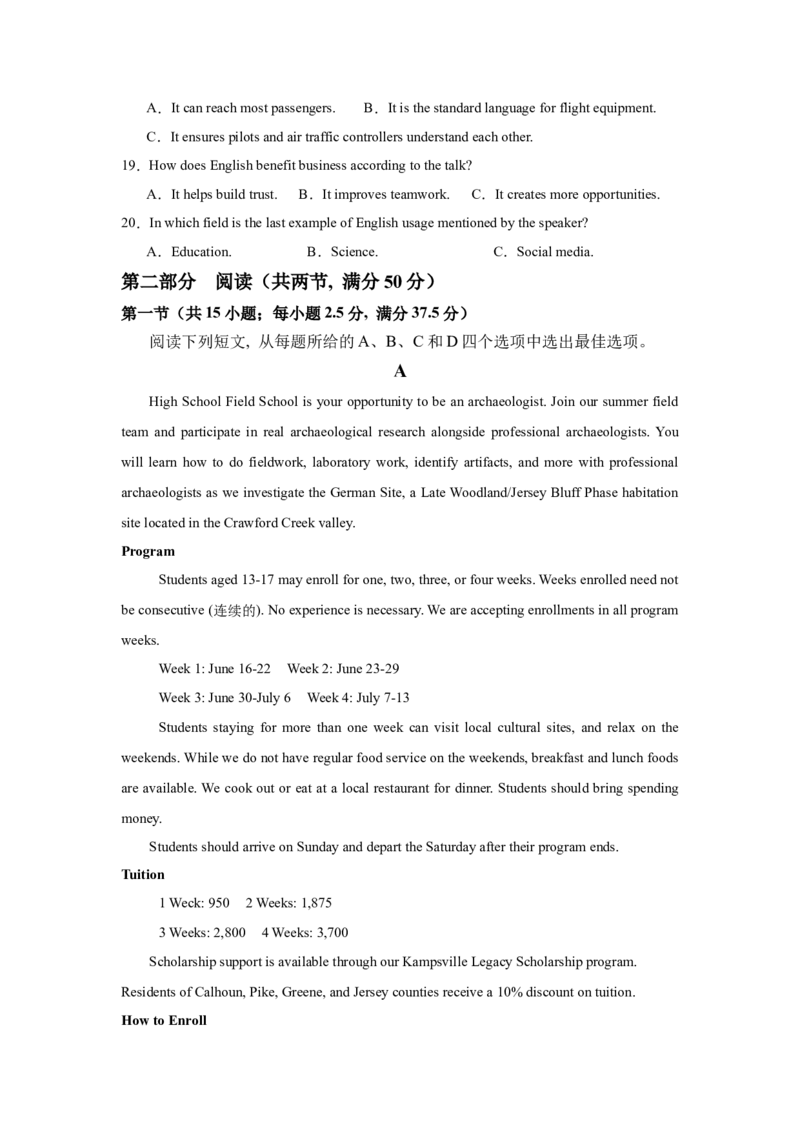
1.What will the speakers most likely do after lunch?
A.Write a paper.
B.Attend a workshop.
C.Visit a store.
2. What matters most to the woman?
A.Cost.
B.Convenience.
C.Comfort.
3.What is the problem with the woman?
A.She took a wrong turn.
B.She took a wrong bus.
C.She got off at a wrong stop.
4. What will the boy do next?
A.Help draft the poster.
B.Buy rubbish bags.
C.Collect plastic bottles.
5.How does the woman relieve anxiety?
A.She focuses on the joys of life.         B.She practices breathing exercises.
C.She pays close attention to her senses.
第二节(共15 小题;每小题1.5 分,满分22.5 分)
听下面5 段对话或独白。每段对话或独白后有几个小题, 从题中所给的A、
B、C 三个选项中选出最佳选项。听每段对话或独白前, 你将有时间阅读各个小
题, 每小题5 秒钟; 听完后,各小题将给出5 秒钟的作答时间。每段对话或独白读
两遍。
听第6 段材料,回答第6 至第7 小题。
6.Where does the conversation probably take place?
A.In a cafe.
B.At a grocery.
C.In a theatre.
7.How much should the man pay?
A.$5.
B.$20.
C.$25.
听第7 段材料,回答第8 至第10 小题。
8.Why can’t Tom meet Ms. Greenwell today?
A.Ms. Greenwell doesn’t prepare well.    B.It is not a good day for visits.
C.He makes an unannounced visit.
9.Why does Tom come here?
A.To call on his investors.  B.To have business discussions.  C.To attend a conference.
10.What does Tom want Ms. Greenwell to do?
A.Give him a call later.  B.Meet with him tomorrow.  C.Visit his company next week.
听第8 段材料,回答第11 至第13 小题。
11.Where did the woman spend Mother’s Day morning?
A.At a cinema.
B.At a café.
C.At home.
12.Why is the café special?
A.It shows classic movies.    B.Its servers’ costumes.  C.It offers many famous
books.
13.How does the woman feel?
A.Pleased.
B.Confused.
C.Worried.
听第9 段材料,回答第14 至第17 小题。
14.How much of the top platform's earnings are from the US?
A.57%.
B.66%.
C.69%.
15.What kind of Chinese short dramas are likely to grow overseas?
A.Romance dramas.
B.Office dramas.
C.Family dramas.
16.What is Anina's attitude toward applying AI to story creation?
A.Favorable.
B.Casual.
C.Unfavorable.
17.What is Anina probably doing?
A.Teaching a class.
B.Having a job interview.
C.Being a guest on a show.
听第10 段材料,回答第18 至第20 小题。
18.Why is English important in air traffic according to the talk?
A.It can reach most passengers.    B.It is the standard language for flight equipment.
C.It ensures pilots and air traffic controllers understand each other.
19.How does English benefit business according to the talk?
A.It helps build trust.   B.It improves teamwork.   C.It creates more opportunities.
20.In which field is the last example of English usage mentioned by the speaker?
A.Education.
B.Science.
C.Social media.
第二部分  阅读(共两节, 满分50 分)
第一节(共15 小题;每小题2.5 分, 满分37.5 分)
阅读下列短文, 从每题所给的A、B、C 和D 四个选项中选出最佳选项。
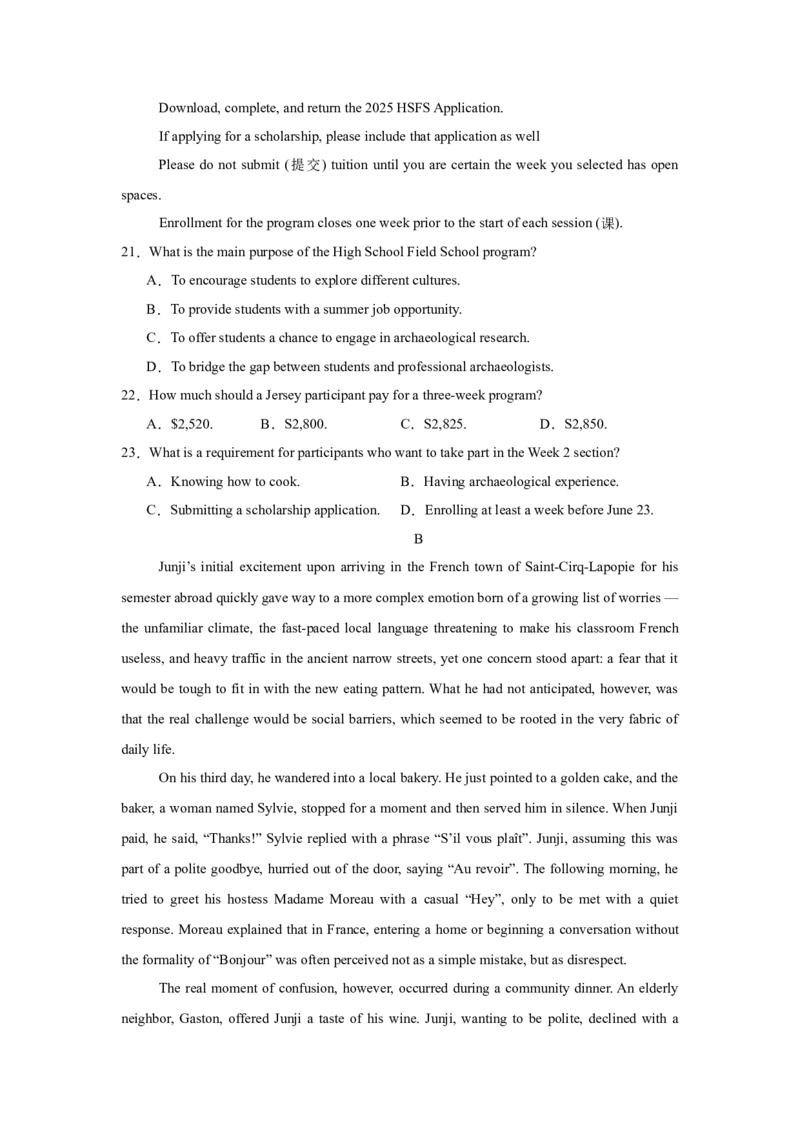
A
High School Field School is your opportunity to be an archaeologist. Join our summer field
team and participate in real archaeological research alongside professional archaeologists. You
will learn how to do fieldwork, laboratory work, identify artifacts, and more with professional
archaeologists as we investigate the German Site, a Late Woodland/Jersey Bluff Phase habitation
site located in the Crawford Creek valley.
Program
Students aged 13-17 may enroll for one, two, three, or four weeks. Weeks enrolled need not
be consecutive (连续的). No experience is necessary. We are accepting enrollments in all program
weeks.
Week 1: June 16-22    Week 2: June 23-29
Week 3: June 30-July 6    Week 4: July 7-13
Students staying for more than one week can visit local cultural sites, and relax on the
weekends. While we do not have regular food service on the weekends, breakfast and lunch foods
are available. We cook out or eat at a local restaurant for dinner. Students should bring spending
money.
Students should arrive on Sunday and depart the Saturday after their program ends.
Tuition
1 Weck: 950    2 Weeks: 1,875
3 Weeks: 2,800    4 Weeks: 3,700
Scholarship support is available through our Kampsville Legacy Scholarship program.
Residents of Calhoun, Pike, Greene, and Jersey counties receive a 10% discount on tuition.
How to Enroll
Download, complete, and return the 2025 HSFS Application.
If applying for a scholarship, please include that application as well
Please do not submit (提交) tuition until you are certain the week you selected has open
spaces.
Enrollment for the program closes one week prior to the start of each session (课).
21.What is the main purpose of the High School Field School program?
A.To encourage students to explore different cultures.
B.To provide students with a summer job opportunity.
C.To offer students a chance to engage in archaeological research.
D.To bridge the gap between students and professional archaeologists.
22.How much should a Jersey participant pay for a three-week program?
A.$2,520.
B.S2,800.
C.S2,825.
D.S2,850.
23.What is a requirement for participants who want to take part in the Week 2 section?
A.Knowing how to cook.
B.Having archaeological experience.
C.Submitting a scholarship application.
D.Enrolling at least a week before June 23.
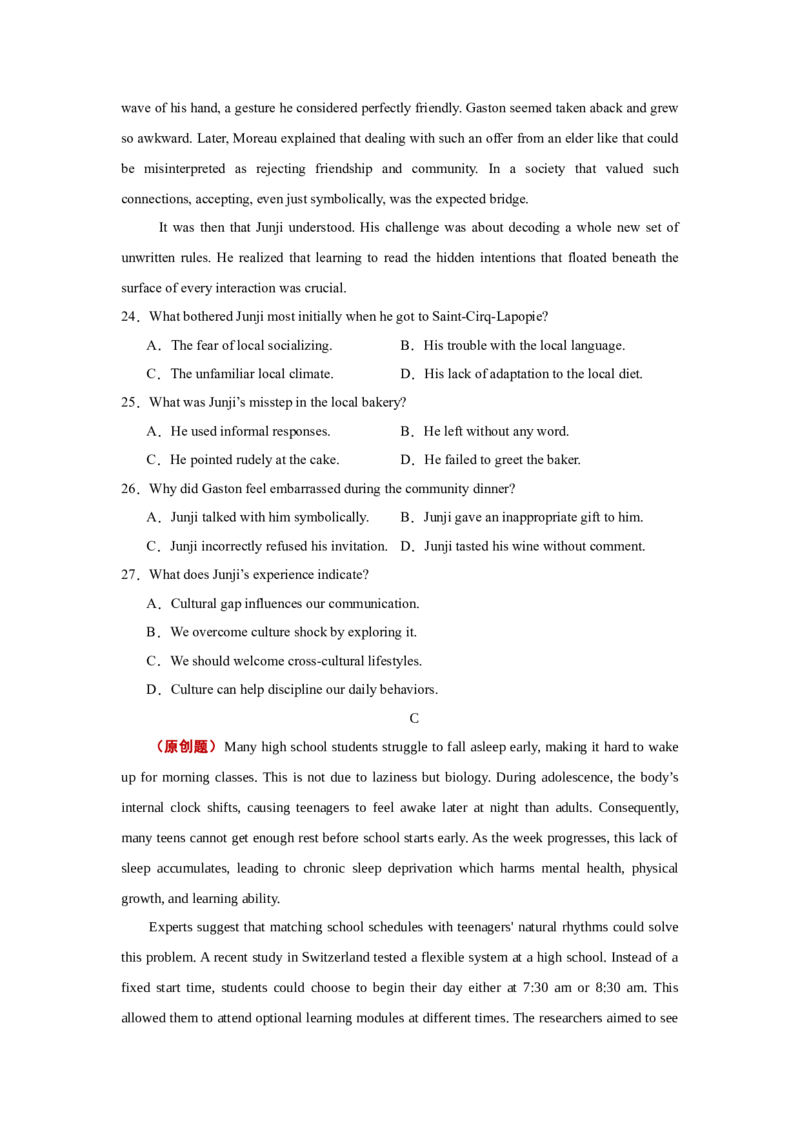
B
Junji’s initial excitement upon arriving in the French town of Saint-Cirq-Lapopie for his
semester abroad quickly gave way to a more complex emotion born of a growing list of worries —
the unfamiliar climate, the fast-paced local language threatening to make his classroom French
useless, and heavy traffic in the ancient narrow streets, yet one concern stood apart: a fear that it
would be tough to fit in with the new eating pattern. What he had not anticipated, however, was
that the real challenge would be social barriers, which seemed to be rooted in the very fabric of
daily life.
On his third day, he wandered into a local bakery. He just pointed to a golden cake, and the
baker, a woman named Sylvie, stopped for a moment and then served him in silence. When Junji
paid, he said, “Thanks!” Sylvie replied with a phrase “S’il vous plaît”. Junji, assuming this was
part of a polite goodbye, hurried out of the door, saying “Au revoir”. The following morning, he
tried to greet his hostess Madame Moreau with a casual “Hey”, only to be met with a quiet
response. Moreau explained that in France, entering a home or beginning a conversation without
the formality of “Bonjour” was often perceived not as a simple mistake, but as disrespect.
The real moment of confusion, however, occurred during a community dinner. An elderly
neighbor, Gaston, offered Junji a taste of his wine. Junji, wanting to be polite, declined with a
wave of his hand, a gesture he considered perfectly friendly. Gaston seemed taken aback and grew
so awkward. Later, Moreau explained that dealing with such an offer from an elder like that could
be misinterpreted as rejecting friendship and community. In a society that valued such
connections, accepting, even just symbolically, was the expected bridge.
It was then that Junji understood. His challenge was about decoding a whole new set of
unwritten rules. He realized that learning to read the hidden intentions that floated beneath the
surface of every interaction was crucial.
24.What bothered Junji most initially when he got to Saint-Cirq-Lapopie?
A.The fear of local socializing.
B.His trouble with the local language.
C.The unfamiliar local climate.
D.His lack of adaptation to the local diet.
25.What was Junji’s misstep in the local bakery?
A.He used informal responses.
B.He left without any word.
C.He pointed rudely at the cake.
D.He failed to greet the baker.
26.Why did Gaston feel embarrassed during the community dinner?
A.Junji talked with him symbolically.
B.Junji gave an inappropriate gift to him.
C.Junji incorrectly refused his invitation.
D.Junji tasted his wine without comment.
27.What does Junji’s experience indicate?
A.Cultural gap influences our communication.
B.We overcome culture shock by exploring it.
C.We should welcome cross-cultural lifestyles.
D.Culture can help discipline our daily behaviors.
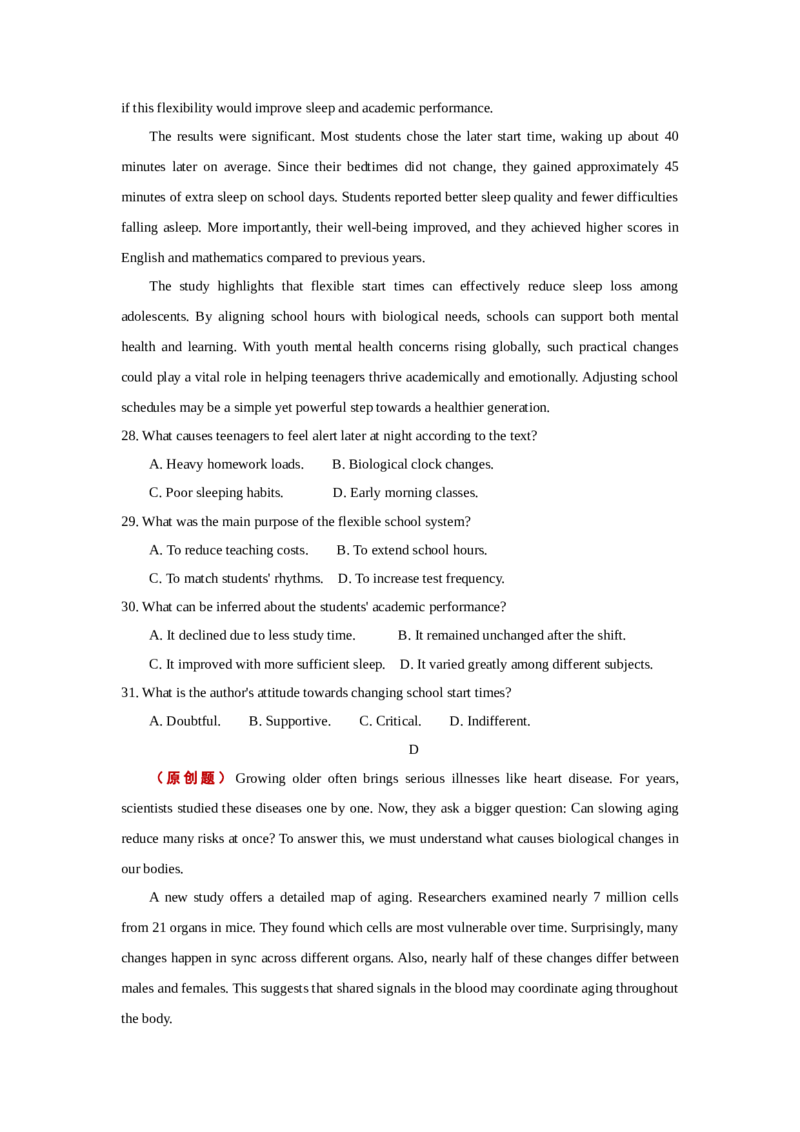
C
(原创题)Many high school students struggle to fall asleep early, making it hard to wake
up for morning classes. This is not due to laziness but biology. During adolescence, the body’s
internal clock shifts, causing teenagers to feel awake later at night than adults. Consequently,
many teens cannot get enough rest before school starts early. As the week progresses, this lack of
sleep accumulates, leading to chronic sleep deprivation which harms mental health, physical
growth, and learning ability.
Experts suggest that matching school schedules with teenagers' natural rhythms could solve
this problem. A recent study in Switzerland tested a flexible system at a high school. Instead of a
fixed start time, students could choose to begin their day either at 7:30 am or 8:30 am. This
allowed them to attend optional learning modules at different times. The researchers aimed to see
if this flexibility would improve sleep and academic performance.
The results were significant. Most students chose the later start time, waking up about 40
minutes later on average. Since their bedtimes did not change, they gained approximately 45
minutes of extra sleep on school days. Students reported better sleep quality and fewer difficulties
falling asleep. More importantly, their well-being improved, and they achieved higher scores in
English and mathematics compared to previous years.
The study highlights that flexible start times can effectively reduce sleep loss among
adolescents. By aligning school hours with biological needs, schools can support both mental
health and learning. With youth mental health concerns rising globally, such practical changes
could play a vital role in helping teenagers thrive academically and emotionally. Adjusting school
schedules may be a simple yet powerful step towards a healthier generation.
28. What causes teenagers to feel alert later at night according to the text?
A. Heavy homework loads.    B. Biological clock changes.
C. Poor sleeping habits.       D. Early morning classes.
29. What was the main purpose of the flexible school system?
A. To reduce teaching costs.    B. To extend school hours.
C. To match students' rhythms.  D. To increase test frequency.
30. What can be inferred about the students' academic performance?
A. It declined due to less study time.      B. It remained unchanged after the shift.
C. It improved with more sufficient sleep.  D. It varied greatly among different subjects.
31. What is the author's attitude towards changing school start times?
A. Doubtful.    B. Supportive.    C. Critical.    D. Indifferent.
D
(原创题)Growing older often brings serious illnesses like heart disease. For years,
scientists studied these diseases one by one. Now, they ask a bigger question: Can slowing aging
reduce many risks at once? To answer this, we must understand what causes biological changes in
our bodies.
A new study offers a detailed map of aging. Researchers examined nearly 7 million cells
from 21 organs in mice. They found which cells are most vulnerable over time. Surprisingly, many
changes happen in sync across different organs. Also, nearly half of these changes differ between
males and females. This suggests that shared signals in the blood may coordinate aging throughout
the body.
The study challenges old views. Scientists once thought aging only changed how cells work.
However, this research shows that the number of certain cell types also changes significantly.
Some muscle and kidney cells decline early, while immune cells expand. These shifts begin
surprisingly early, showing that aging is a continuous process, not just a late-life event.
Beyond cell numbers, researchers looked at DNA regions. They found specific "hotspots"
linked to inflammation and immune function that change with age. This proves aging is not
random genomic(基因组的) decay. Instead, specific regulatory areas are vulnerable. Drugs
targeting these areas or immune signals might slow down aging processes across multiple organs.
This research is a starting point for future therapies. By identifying vulnerable cells and
molecular hotspots, scientists can now develop interventions. The goal is to target the aging
process itself, potentially helping people stay healthier for longer. This shift from treating single
diseases to addressing root causes marks a new era in medical science.
32. What does the new study suggest about the timing of aging?
A. It starts only after middle age.          B. It affects only immune cells in the body.
C. It happens randomly in different organs.  D. It begins earlier than previously thought.
33. Why do researchers believe aging is coordinated across organs?
A. Because all organs lose cells at the same speed.
C. Because similar cellular changes occur together.
B. Because DNA decays randomly in every tissue.
D. Because males and females age in identical ways.
34. What can be inferred about future anti-aging treatments?
A. They will focus on curing single diseases separately.
B. They might target specific immune signals to work.
C. They will replace all damaged cells in the body.
D. They are unlikely to succeed due to complex genes.
35. How does the finding about cell numbers change previous understanding?
A. It proves cell function never changes with age.
B. It shows cell population shifts are part of aging.
C. It indicates that only rare cells disappear over time.
D. It suggests that muscle cells increase as animals age.
第二节(共5 小题;每小题2. 5 分, 满分12. 5 分)
阅读下面短文, 从短文后的选项中选出可以填入空白处的最佳选项。选项中
有两项为多余选项。
We live in an age when short dramas (短剧) slip easily into the gaps of daily life.     36
Like quick flashes of light, they deliver instant excitement and clearly defined emotions. In just a
few minutes, a conflict appears, rises, and disappears, offering immediate satisfaction with little
demand on our time. In a fast-paced world, they have become a natural companion.
Yet what comes quickly often fades (消逝) just as quickly. Short dramas rush from scene to
scene, leaving little room for thought to settle. Characters may seem vivid, but they remain
shallow — more like sketches than true portraits. Problems are solved before they are fully
experienced.     37     Gradually, watching turns into a habit of easy consumption rather than
active reflection.
The human mind is not built for endless speed. Beneath the desire for quick pleasure lies a
deeper need — to understand, to feel, and to think. We long for meaning that unfolds slowly,
emotions that stay with us, and stories that reflect our own struggles.     38
A film invites us to slow down. When the screen darkens, time seems to stretch. Scenes are
allowed to breathe. Silence begins to speak. Characters grow through choices, mistakes, and
moments of waiting. Meaning is not delivered all at once but revealed gently, like light at dawn.
Films do not rush viewers forward.     39
Think of the white feather drifting in Forrest Gump. Recall Andy Dufresne standing in the
rain in The Shawshank Redemption, arms open, finally free.     40     Beyond the fast stream
of short dramas lies the deep river of cinema — quiet, powerful, and always worth entering.
A.Their primary appeal lies in speed.
B.Viewers are entertained, but seldom challenged.
C.But not all people experience it in the same way.
D.These films are produced to offer quick relaxation.
E.Such moments stay with us long after the screen falls silent.
F.Instead, they draw us inward, asking for thought beyond the moment.
G.It is this quiet hunger that draws us toward the wider world of cinema.
第三部分 语言运用(共两节,满分30 分)
第一节(共15 小题,每小题1 分,满分15 分)
阅读下面短文, 从每题所给的A、B、C 和D 四个选项中选出可以填入空白
处的最佳选项。
Once upon a time, much of the world was populated by wolves. They    41    all over
the United States and Canada, Siberia and much of mainland Europe, as well as Great Britain, and
if humans hadn’t come along, they would still be there in great numbers. But man did come along,
farmed the land,    42    the wolves killing their livestock (家畜) and so gradually drove them
out of the homes that had once been theirs.
Wolves are not    43    in our language and literature, however. In fairy stories, they are
seen as evil and dangerous, always    44    to eat people. Remember the time when Little Red
Riding Hood thinks that a wolf is her grandmother? If you really want to see how English-
speaking humans think of the wolf, just look at the    45   ! “A wolf in sheep’s clothing” is not
a pleasant person and a “wolf-whistle” is not a pleasant sound!
Yet wolves are totally unlike the image we have of them from legend and language. For a
start, they don’t   46    humans; indeed, they do their best to keep out of our way. They are very
sociable animals, living in packs and looking after their young, which should make some humans
47    themselves. Instead of being   48  , the howl of the wolf — the cry of the whole pack —
as the full moon rises in a star-bright sky, is one of the most beautiful sounds in nature. They are
beautiful creatures which can run at speeds of up to 65 kph if they have to. And when they do   49
, their 42 large teeth are fearlessly effective.
But the    50    remains that we love the lion, the king of the jungle, while we demonize
(妖魔化) the wolf, one of the most beautiful animals in the world. Only     51   do writers treat
them nicely; for example, a she-wolf is supposed to have fed the twins Remus and Romulus, who
went on to    52    the city of Rome.
And so, while man kills animals in their millions, often just for the fun of it, the wolf
represents a state of natural    53    that we do not know and can never obtain, even though we
54    it in our hearts. Perhaps that’s why, in the end, we    55    the wolf so much — for
having something we can never get our hands on.
41.A.ruled
B.migrated
C.concentrated
D.ranged
42.A.set aside
B.approved of
C.objected to
D.worked out
43.A.killers
B.victims
C.characters
D.criminals
44.A.reluctant
B.ready
C.unlikely
D.sure
45.A.look
B.sound
C.language
D.behaviour
46.A.avoid
B.frighten
C.attack
D.protest
47.A.surprised at
B.pleased with
C.ashamed of
D.interested in
48.A.loud
B.peaceful
C.musical
D.soft
49.A.run
B.jump
C.kill
D.cry
50.A.possibility
B.mystery
C.evidence
D.fact
51.A.occasionally
B.recently
C.instantly
D.ultimately
52.A.found
B.ruin
C.pollute
D.mess
53.A.duty
B.grace
C.competition
D.skill
54.A.criticize
B.desire
C.neglect
D.learn
55.A.cage
B.keep
C.notice
D.hate
第二节(共10 小题;每小题1.5 分 ,满分15 分)
阅读下面短文,在空白处填入1 个适当的单词或括号内单词的正确形式。
Zhao Yang is a researcher at the Shapotou Desert Research Station,     56     is
celebrated for creating the straw-checkerboard technique (草方格沙障技术) used over 60 years.
His work aims to develop faster desert-control methods.
Naturally, the formation of a sand-stabilizing crust (固沙结皮) requires about a decade. In
contrast, combining lab-cultured cyanobacteria with a special bacterial strain
   57

(extract) from local soil, Zhao’s team has     58     (dramatic) reduced this period to a single
year, showcasing a significant technological leap.
All this represents the latest chapter in China’s continuous fight


 59

desertification. Decades ago, when China’s first desert railway opened in 1958, foreign experts
once predicted its     60     (bury) by sand within 30 years—a prediction defeated by the
simple yet highly effective straw-checkerboards, a technique pioneered in China.
Building on this legacy, a new highway across the Tengger Desert is now expected     61
(complete) in the near future. In recent years, the national campaign     62     (strengthen) on
a large scale, with millions of hectares treated annually.     63     (achieve) remarkable
success domestically, China has also actively shared its practical expertise with other countries
since 2005. For scientists like Zhao, the ultimate goal is not the elimination of deserts     64

the creation of a harmonious balance, recognizing them as     65     (value) parts of the
Earth’s ecosystem.
第四部分 写作(共两节, 满分40 分)
第一节(满分15 分)
66.假定你是校英文报记者李华,正在做关于“青少年阅读习惯”的调查研究,期间遇到
了一些困难。请你给外教David 写一封邮件,内容包括:(1)你的困难;(2)寻求建议。
注意:(1)写作词数应为80 个左右;(2)请按如下格式在答题卡的相应位置作答。
Dear David,
I am writing to seek your help.
_______________________________________________________________________________
_______________________________________________________________________________
_______________________________________________________________________________
_________________________________________________________________
Yours,
Li Hua
第二节(满分25 分)
67.阅读下面材料,根据其内容和所给段落开头语续写两段,使之构成一篇完整的短文。
The mountain trail (小道) was much steeper than we had expected. What started as a sunny
morning hike with my younger brother, Ben, soon turned into a real challenge. A thick, heavy fog
suddenly covered the mountains, hiding the path and making everything look strange and
unfamiliar. Ben, who always acts before thinking, decided he knew a better way. “Follow me! It’s
faster!” he shouted, and before I could stop him, he ran off the main trail. His bright blue jacket
disappeared into the fog, and my calls for him to come back were lost in the silence. He was gone.
Now I was alone, cold, and completely lost. The air was getting colder, and I began to feel
really scared. Just then, I heard a small, sad sound. It was a soft whimper (哀鸣). I pushed through
some bushes and saw a little German Shepherd puppy (幼犬). It was shaking, and its paw was
stuck between two rocks. The puppy looked up at me with big, scared eyes. It seemed just as
frightened as I was.
Even though I was in trouble myself, I couldn’t leave the puppy there. I tried to sound calm.
“It’s okay, little one. I’ll help you,” I said softly. I carefully moved the rocks until its paw was free.
Then I poured some water from my bottle to clean the small cut. The puppy gently licked my
hand, as if to say thank you. That simple act made me feel less alone.
I put the puppy inside my jacket to keep it warm. Now I had to find a way back. But which
way should I go? Everything looked the same in the fog. As I stood there unsure, the puppy moved
in my arms. It looked out and barked softly, pulling its head toward one direction. It acted like it
knew where to go. I had no other ideas, so I decided to trust it. “Alright,” I said to the puppy,
holding it close. “Let’s go your way.”
注意:
1. 续写词数应为150 个左右;
2. 请按如下格式在答题卡的相应位置作答。
Holding the puppy close, I started walking in the direction it had shown me.
_______________________________________________________________________________
_______________________________________________________________________________
_______________________________________________________________________________
_____________________________________________
Suddenly, the puppy began to bark excitedly.
_______________________________________________________________________________
_______________________________________________________________________________
_______________________________________________________________________________
_____________________________________________