【上好课】2025年高考一轮复习知识清单
专题41 阅读理解之主旨大意题(讲案)原卷版
(快问快答+思维导图+考法点拨+真题再练+名校模拟)
目录
一、阅读理解主旨大意题快问快答 P1
二、阅读理解主旨大意题高考考情 P 1
三、阅读理解主旨大意题命题特点 P2
四、阅读理解主旨大意题思维导图 P 3
五、阅读理解主旨大意题考法点拨 P 4
考法一:段落大意题 P 4
考法二:文章大意题 P 5
考法三:标题概括题 P 8
六、阅读理解主旨大意题真题演练(7 例) P 11
七、阅读理解主旨大意题名校模拟(8 篇) P 16
模拟一:段落大意题 P 16
模拟二:文章大意题 P 18
模拟三:记叙文标题概括题 P 21
模拟四:说明文标题概括题 P 23
一、阅读理解主旨大意题快问快答
Q1:阅读理解主旨大意题有什么特点?
A1:主旨大意题属于阅读理解较难题型,每年必考,占1-2题,需要有较强的阅读理解能力和做题技能。
Q2:阅读理解主旨大意题做题步骤如何?
A2:一是“找词”--先从题干中提取关键性(题眼),二是“定位”--寻找与此关键词相关的段落、语句做
好标记,尤其是关注文章体裁、文章结构,三是“比对”--仔细比对四个选项与文中原句关系,确认属于
哪一种主旨大意题,关注干扰项“偷换概念”“无中生有”“张冠李戴”等命题手段去伪存真确定答案。
Q3:阅读理解主旨大意题有哪些考查方法?
A3:阅读理解主旨大意题有三大考查方向:一是段落大意题,二是文章大意题,三是标题概括题。
Q4:如何提高阅读理解主旨大意题正答率?
A4:一要掌握阅读理解主旨大意题命题规律和选项特征,二要不断扩大词汇量,尤其是3500高考高频词
汇,三要广泛进行阅读实践和专项训练,积累推理判断经验,掌握主旨大意题整体阅读这一要旨,摸索
出一套行之有效的个性化做题模式,四要重视纠错,探寻错误原因,防止出现类似错误。
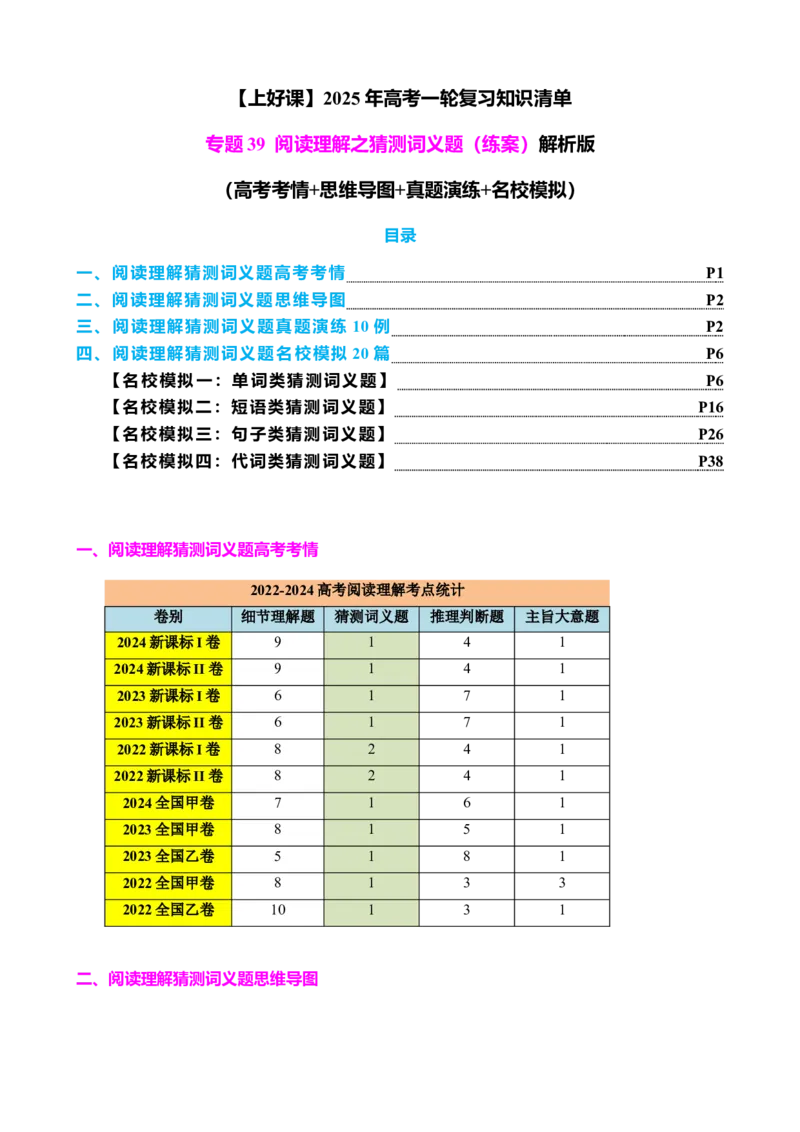
二、阅读理解主旨大意题高考考情
主旨大意题目主要的考查形式:理解段落大意、把握全文主旨和拟定文章标题。该类题目在文章中
没有明显的解题依据,需要考生从文章中提炼、抽取一些关键词、主干句进行加工概括,才能归纳出文
章的主旨。
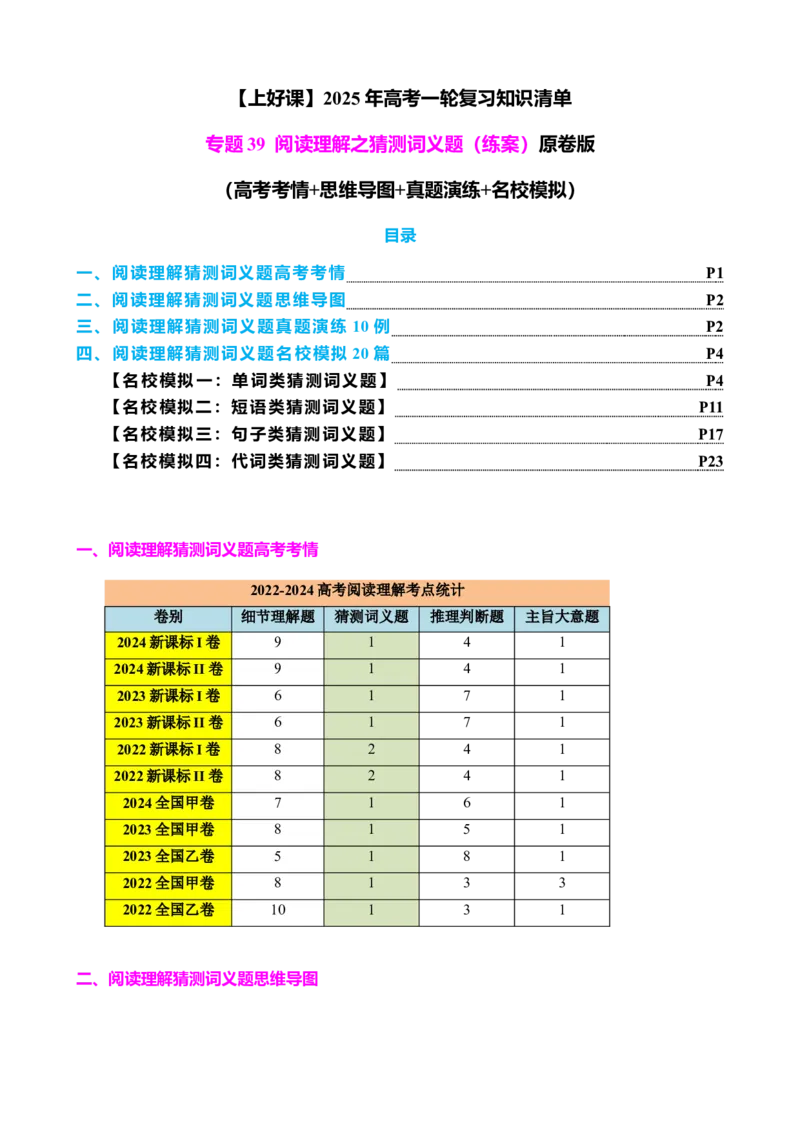
2022-2024高考阅读理解考点统计卷别 细节理解题 主旨大意题 主旨大意题 主旨大意题
2024新课标I卷 9 1 4 1
2024新课标II卷 9 1 4 1
2023新课标I卷 6 1 7 1
2023新课标II卷 6 1 7 1
2022新课标I卷 8 2 4 1
2022新课标II卷 8 2 4 1
2024全国甲卷 7 1 6 1
2023全国甲卷 8 1 5 1
2023全国乙卷 5 1 8 1
2022全国甲卷 8 1 3 3
2022全国乙卷 10 1 3 1
三、阅读理解主旨大意题命题特点
【设问特点】
特殊疑问句形式:以when、where、what、which、who、why、how等疑问词开头引出的问题;通常涉
及推断作者态度、文章出处、文章类型、写作意图、下段话题等。
特殊疑问句形式:以what等疑问词开头引出的问题;通常涉及段落大意、文章大意或者标题概括等。
26. What does paragraph 3 mainly talk about? (2024新课标I卷,段落大意题)
31. What does the text mainly talk about? (2024新课标II卷,文章大意题)
27. What is a suitable title for the text? (2024全国甲卷,标题概括题)
35. Which of the following is the best title for the text? (2024浙江1月卷,标题概括题)
32. What is the first paragraph mainly about? (2023全国乙卷,段落大意题)
31. What is the text mainly about? (2022全国甲卷,文章大意题)
【选项规律】
正确选项特征
概括性 涵盖性强,覆盖全文或全段
覆盖性 确定的范围恰当,既不太大,也不太小
精确性 精确性强,不会改变语言表意的程度及色彩
模糊性 不出现细节信息,不含过分肯定或绝对意义的词
干扰选项特征
主题扩大 所给选项内容概括的范围过大,超出文章所述内容
无中生有 符合常识,但不是文章的内容
曲解文意 与原文的内容极其相似,只是在某个细节处有些变动
颠倒是非 在意思上与原文大相径庭甚至完全相反偷换概念 所给选项被命题者有意识地把本属于A的内容放在B上
四、阅读理解主旨大意题思维导图
五、阅读理解主旨大意题考法点拨
考法一:段落大意题
每一篇文段都要围绕一个特定的主题,按照一定的逻辑顺序展开,所以段落的结构也有一定的规律
性。做题时要特别注意“首尾兼顾”,即所问段落的首句和尾句。一是因为它们往往体现主旨要义,二是
因为利用这些信息可以迅速提炼段落结构框架,在框架下判断主旨,其准确性更高。
【段落大意题干扰项特征】1.过于笼统,不知所云。所概括的内容超出原文的范围。
2.以偏概全,主次不分。以文章中的细节内容或个别词语做出选项内容。
3.移花接木,偷换概念。选项中定语和状语影响语意范围,或者把属于A的内容放在B上。
4.主观臆测,无中生有。选项中关键词也在文中提及,但选项的实际含义与文章主题无关。
【段落大意题两大抓手】
1.寻找段落主题句
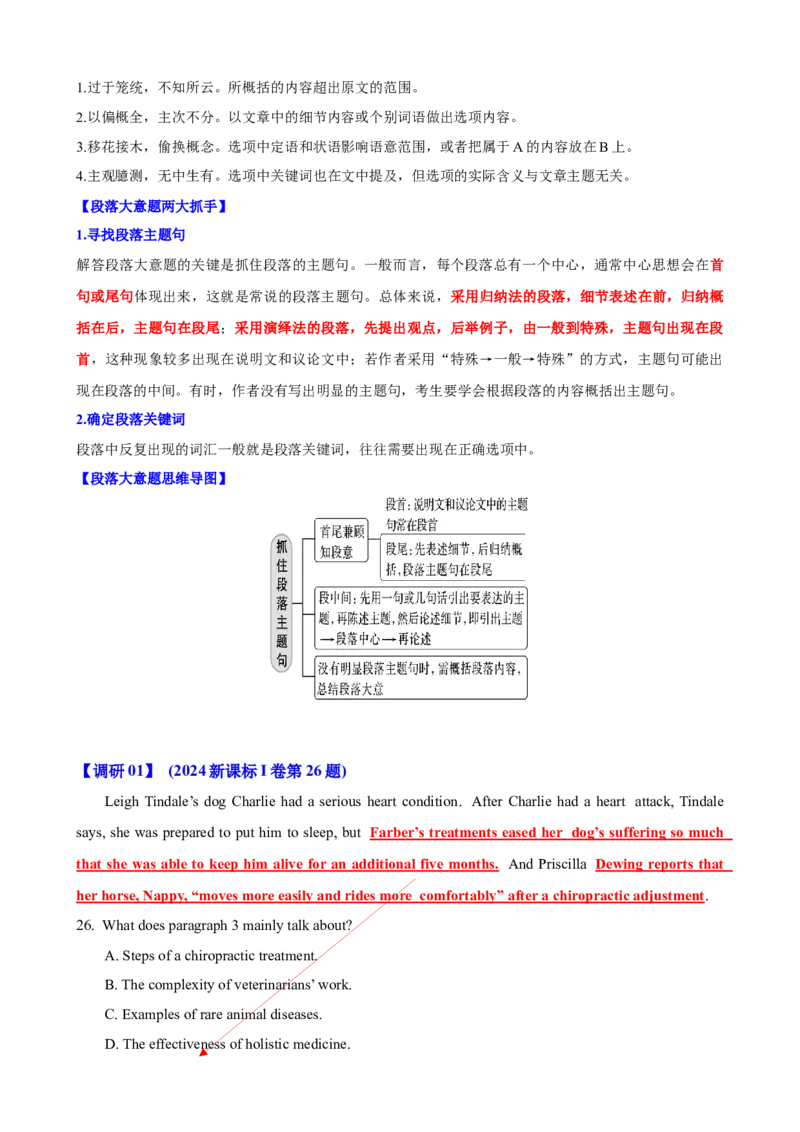
解答段落大意题的关键是抓住段落的主题句。一般而言,每个段落总有一个中心,通常中心思想会在首
句或尾句体现出来,这就是常说的段落主题句。总体来说,采用归纳法的段落,细节表述在前,归纳概
括在后,主题句在段尾;采用演绎法的段落,先提出观点,后举例子,由一般到特殊,主题句出现在段
首,这种现象较多出现在说明文和议论文中;若作者采用“特殊→一般→特殊”的方式,主题句可能出
现在段落的中间。有时,作者没有写出明显的主题句,考生要学会根据段落的内容概括出主题句。
2.确定段落关键词
段落中反复出现的词汇一般就是段落关键词,往往需要出现在正确选项中。
【段落大意题思维导图】
【调研01】 (2024新课标I卷第26题)
Leigh Tindale’s dog Charlie had a serious heart condition. After Charlie had a heart attack, Tindale
says, she was prepared to put him to sleep, but Farber’s treatments eased her dog’s suffering so much
that she was able to keep him alive for an additional five months. And Priscilla Dewing reports that
her horse, Nappy, “moves more easily and rides more comfortably” after a chiropractic adjustment .
26. What does paragraph 3 mainly talk about?
A. Steps of a chiropractic treatment.
B. The complexity of veterinarians’ work.
C. Examples of rare animal diseases.
D. The effectiveness of holistic medicine.【调研02】 (2023新课标I卷第32题)
This effect capitalizes on the fact that when people make errors, those errors aren’t always the same.
Some people will tend to overestimate, and some to underestimate. When enough of these errors are averaged
together, they cancel each other out, resulting in a more accurate estimate. If people are similar and tend to make
the same errors, then their errors won’t cancel each other out. In more technical terms, the wisdom of crowds
requires that people’s estimates be independent. If for whatever reasons, people’s errors become correlated or
dependent, the accuracy of the estimate will go down.
32. What is paragraph 2 of the text mainly about?
A. The methods of estimation. B. The underlying logic of the effect.
C. The causes of people’s errors. D. The design of Galton’s experiment.
【调研03】 (2023全国乙卷第32题)
If you want to tell the history of the whole world, a history that does not privilege one part of
humanity, you cannot do it through texts alone, because only some of the world has ever had texts,
while most of the world, for most of the time, has not. Writing is one of humanity’s later achievements,
and until fairly recently even many literate (有文字的) societies recorded their concerns not only in writing
but in things.
32. What is the first paragraph mainly about?
A. How past events should be presented. B. What humanity is concerned about.
C. Whether facts speak louder than words. D. Why written language is reliable.
考法二:文章大意题
文章中的每一段都是围绕某一主题展开的,把每个段落的主题句综合起来就可以概括出全文的中心
思想。该题型主要是测试考生对一篇文章的深层理解程度以及在速读中准确定位文章主旨大意的能力。
它要求考生在理解全文的基础上能较好地运用概括、判断、归纳、推理等逻辑思维的方法,对文章进行
高度概括或总结,属于高层次题。
【文章大意题答题策略】
题型一:利用主题句在段首位置推敲段落大意
技巧点拨:说明文和议论文学会关注“首段”和“段首”。借鉴“七选五”小标题类型特点,段首句统
领全段主旨大意,由此推断段落大意。
题型二:利用主题句在段中位置推敲段落大意
技巧点拨:有时主题句出现在段中某句,这就需要考生耐心阅读揣摩段落各句之间内在逻辑关系,确定
主题句位置,进而明确段落主旨大意。题型三:利用主题句在段尾位置推敲段落大意
技巧点拨:有时主题句出现在段尾,关注一些表征总结性,结论性的词: in brief/ short, all in all,
in conclusion, in a word等,这些词后面连接的通常是主题句。
题型四:利用段落没有主题句推敲段落大意
技巧点拨:有时候段落没有出现主题句,需要考生自己总结提炼,难度更大。
题型五:利用“总-分-总”结构推敲语篇主旨大意题
技巧点拨:有时候段落没有出现主题句,需要考生自己总结提炼,难度更大。
【文章大意题思维导图】
【调研04】 (2024新课标II卷第31题)
We all know fresh is best when it comes to food. However, most produce at the store went through weeks of
travel and covered hundreds of miles before reaching the table. While farmer’s markets are a solid choice to
reduce the journey, Babylon Micro-Farm (BMF) shortens it even more.
BMF is an indoor garden system. It can be set up for a family. Additionally, it could serve a larger audience
such as a hospital, restaurant or school. The innovative design requires little effort to achieve a reliable weekly
supply of fresh greens.
Specifically, it’s a farm that relies on new technology. By connecting through the Cloud, BMF is remotely
monitored. Also, there is a convenient app that provides growing data in real time. Because the system is
automated, it significantly reduces the amount of water needed to grow plants. Rather than watering rows of soil,
the system provides just the right amount to each plant. After harvest, users simply replace the plants with a new
pre-seeded pod (容器) to get the next growth cycle started.
Moreover, having a system in the same building where it’s eaten means zero emissions ( 排放) fromtransporting plants from soil to salad. In addition, there’s no need for pesticides and other chemicals that pollute
traditional farms and the surrounding environment.
BMF employees live out sustainability in their everyday lives. About half of them walk or bike to work.
Inside the office, they encourage recycling and waste reduction by limiting garbage cans and avoiding single-use
plastic. “We are passionate about reducing waste, carbon and chemicals in our environment,” said a BMF
employee.
28. What can be learned about BMF from paragraph 1?
A. It guarantees the variety of food. B. It requires day-to-day care.
C. It cuts the farm-to-table distance. D. It relies on farmer’s markets.
29. What information does the convenient app offer?
A. Real-time weather changes. B. Current condition of the plants.
C. Chemical pollutants in the soil. D. Availability of pre-seeded pods.
30. What can be concluded about BMF employees?
A. They have a great passion for sports.
B. They are devoted to community service.
C. They are fond of sharing daily experiences.
D They have a strong environmental awareness.
31. What does the text mainly talk about?
A. BMF’s major strengths. B. BMF’s general management.
C. BMF’s global influence. D. BMF’s technical standards.
【调研05】 (2022全国甲卷第31题)
As Ginni Bazlinton reached Antarctica, she found herself greeted by a group of little Gentoo penguins(企鹅)
longing to say hello. These gentle, lovely gatekeepers welcomed her and kick-started what was to be a trip Ginni
would never forget.
Ever since her childhood, Ginni, now 71, has had a deep love for travel. Throughout her career(职业) as a
professional dancer, she toured in the UK, but always longed to explore further When she retired from dancing
and her sons eventually flew the nest, she decided it was time to take the plunge.
After taking a degree at Chichester University in Related Arts, Ginni began to travel the world, eventually
getting work teaching English in Japan and Chile. And it was in Chile she discovered she could get last-minute
cheap deals on ships going to Antarctica from the islands off Tierra del Fuego, the southernmost tip of the South
American mainland. “I just decided wanted to go,” she says. “I had no idea about what I’d find there and I wasn’t
nervous, I just wanted to do it. And I wanted to do it alone as I always prefer it that way.”
In March 2008, Ginni boarded a ship with 48 passengers she’d never met before, to begin the journey
towards Antarctica. “From seeing the wildlife to witnessing sunrises, the whole experience was amazing.
Antarctica left an impression on me that no other place has,” Ginni says. “I remember the first time I saw a
humpback whale; it just rose out of the water like some prehistoric creature and I thought it was smiling at us. You
could still hear the operatic sounds it was making underwater.”
The realization that this is a precious land, to be respected by humans, was one of the biggest things that hit
home to Ginni.
28. Which of the following best explains “take the plunge” underlined in paragraph 2?
A. Try challenging things. B. Take a degree.C. Bring back lost memories. D. Stick to a promise.
29. What made Ginni decide on the trip to Antarctica?
A. Lovely penguins. B. Beautiful scenery.
C. A discount fare. D. A friend’s invitation.
30. What does Ginni think about Antarctica after the journey?
A. It could be a home for her. B. It should be easily accessible.
C. It should be well preserved. D. It needs to be fully introduced.
31. What is the text mainly about?
A. A childhood dream. B. An unforgettable experience.
C. Sailing around the world. D. Meeting animals in Antarctica.
考法三:标题概括题
标题是文章中心思想的精练表达。此类题目主要考查考生把握主题和理解中心思想的能力,要求考
生在理解文章的基础上运用判断、归纳、概括等方法,对文章的主题进行提炼或高度概括,最终准确地
选出文章的标题。记叙文、说明文和议论文三种文体涉及的不同话题的阅读材料都会考查到标题归纳题。
【标题概括题三大方法】
1.主题段法
标题段一般在文章的第一段和最后一段,一般来说第一段经常提出文章的主题或最后一段总结文章的主
题,知道了文章的主题也就知道了文章的中心,把中心概括成一句话或一个短语即是文章的标题。
2. 主题句法
解题的关键要抓住每段的首尾句,要注意贯穿文章始终的词语。通过寻找文章的主题句,并对主题句进
行概括和提炼,从而确定文章的标题。
2. 关键词法
任何一篇文章都是围绕某个主题展开的,因此有的文章中最明显的特点之一是有一个反复出现的中心词
即关键词,也叫做主题词。抓住了它,便容易抓住文章的中心。
【标题概括题三大策略】
1.正面肯定法
在理解文章主旨的基础上,揣摩哪个选项能准确概括主旨。
2.反面否定法
撇开原文,拿各个备选项去尝试用它们写出来的“文章”将是什么内容,然后和原文对照,一一排除荒
谬者。
3.排除干扰法
研究干扰项里面的中心词、修饰词的变化、结构、新奇性、概括性等。文章的标题应该新颖奇特,易激
发读者的好奇心,吸引读者注意力。
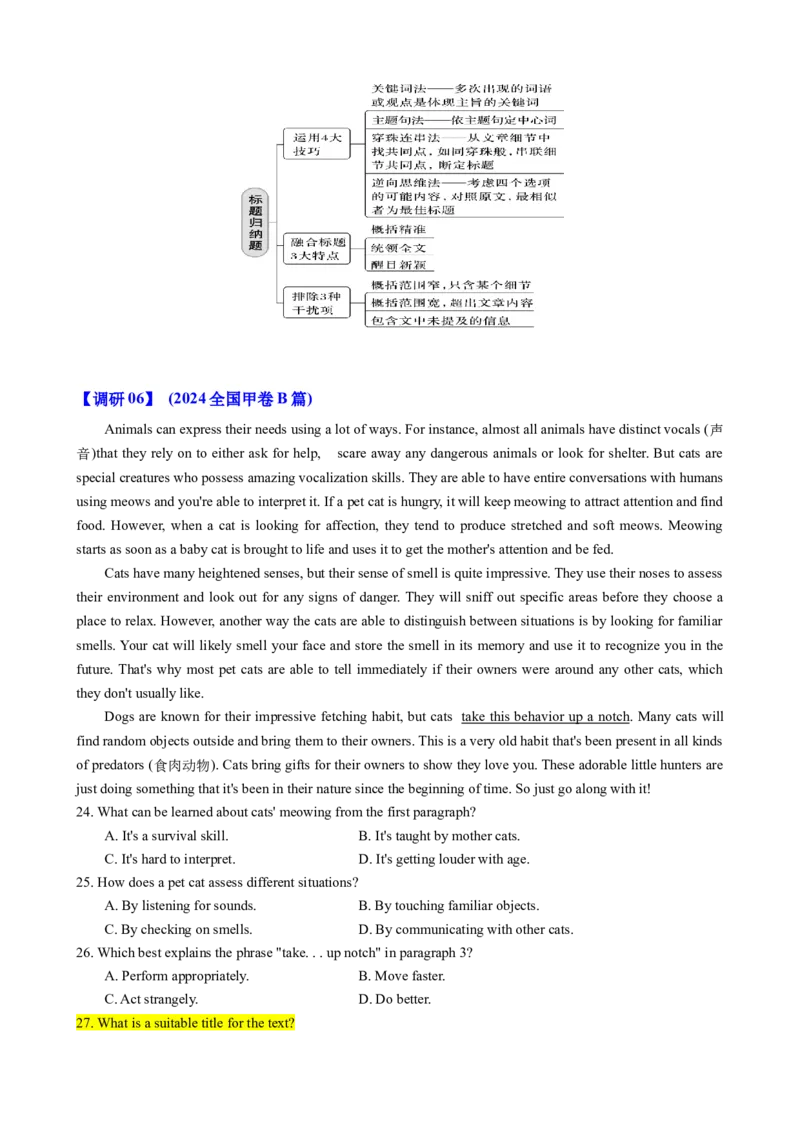
【标题概括题思维导图】【调研06】 (2024全国甲卷B篇)
Animals can express their needs using a lot of ways. For instance, almost all animals have distinct vocals (声
音)that they rely on to either ask for help, scare away any dangerous animals or look for shelter. But cats are
special creatures who possess amazing vocalization skills. They are able to have entire conversations with humans
using meows and you're able to interpret it. If a pet cat is hungry, it will keep meowing to attract attention and find
food. However, when a cat is looking for affection, they tend to produce stretched and soft meows. Meowing
starts as soon as a baby cat is brought to life and uses it to get the mother's attention and be fed.
Cats have many heightened senses, but their sense of smell is quite impressive. They use their noses to assess
their environment and look out for any signs of danger. They will sniff out specific areas before they choose a
place to relax. However, another way the cats are able to distinguish between situations is by looking for familiar
smells. Your cat will likely smell your face and store the smell in its memory and use it to recognize you in the
future. That's why most pet cats are able to tell immediately if their owners were around any other cats, which
they don't usually like.
Dogs are known for their impressive fetching habit, but cats take this behavior up a notch. Many cats will
find random objects outside and bring them to their owners. This is a very old habit that's been present in all kinds
of predators (食肉动物). Cats bring gifts for their owners to show they love you. These adorable little hunters are
just doing something that it's been in their nature since the beginning of time. So just go along with it!
24. What can be learned about cats' meowing from the first paragraph?
A. It's a survival skill. B. It's taught by mother cats.
C. It's hard to interpret. D. It's getting louder with age.
25. How does a pet cat assess different situations?
A. By listening for sounds. B. By touching familiar objects.
C. By checking on smells. D. By communicating with other cats.
26. Which best explains the phrase "take. . . up notch" in paragraph 3?
A. Perform appropriately. B. Move faster.
C. Act strangely. D. Do better.
27. What is a suitable title for the text?A. Tips on Finding a Smart Cat B. Understanding Your Cat's Behavior
C. Have Fun with Your Cat D. How to Keep Your Cat Healthy
【调研07】 (2023新高考II卷B篇)
Turning soil, pulling weeds, and harvesting cabbage sound like tough work for middle and high school kids.
And at first it is, says Abby Jaramillo, who with another teacher started Urban Sprouts, a school garden program at
four low-income schools. The program aims to help students develop science skills, environmental awareness, and
healthy lifestyles.
Jaramillo’s students live in neighborhoods where fresh food and green space are not easy to find and fast
food restaurants outnumber grocery stores. “The kids literally come to school with bags of snacks and large
bottles of soft drinks,” she says. “They come to us thinking vegetables are awful, dirt is awful, insects are awful.”
Though some are initially scared of the insects and turned off by the dirt, most are eager to try something new.
Urban Sprouts’ classes, at two middle schools and two high schools, include hands-on experiments such as
soil testing, flower-and-seed dissection, tastings of fresh or dried produce, and work in the garden. Several times a
year, students cook the vegetables they grow, and they occasionally make salads for their entire schools.
Program evaluations show that kids eat more vegetables as a result of the classes. “We have students who say
they went home and talked to their parents and now they’re eating differently,” Jaramillo says.
She adds that the program’s benefits go beyond nutrition. Some students get so interested in gardening that
they bring home seeds to start their own vegetable gardens. Besides, working in the garden seems to have a
calming effect on Jaramillo’s special education students, many of whom have emotional control issues. “They get
outside,” she says, “and they feel successful.”
24. What do we know about Abby Jaramillo?
A. She used to be a health worker. B. She grew up in a low-income family.
C. She owns a fast food restaurant. D. She is an initiator of Urban Sprouts.
25. What was a problem facing Jaramillo at the start of the program?
A. The kids’ parents distrusted her. B. Students had little time for her classes.
C. Some kids disliked garden work. D. There was no space for school gardens.
26. Which of the following best describes the impact of the program?
A. Far-reaching. B. Predictable.
C. Short-lived. D. Unidentifiable.
27. What can be a suitable title for the text?
A. Rescuing School Gardens B. Experiencing Country Life
C. Growing Vegetable Lovers D. Changing Local Landscape
七、阅读理解主旨大意题真题演练
【真题演练01】(2022全国甲卷D篇)
Sometime in the early 1960s, a significant thing happened in Sydney, Australia. The city discovered its
harbor. Then, one after another, Sydney discovered lots of things that were just sort of there — broad parks,
superb beaches, and a culturally diverse population. But it is the harbor that makes the city.
Andrew Reynolds, a cheerful fellow in his early 30s, pilots Sydney ferryboats for a living. I spent the whole
morning shuttling back and forth across the harbor. After our third run Andrew shut down the engine, and we went
our separate ways — he for a lunch break, I to explore the city.“I’ll miss these old boats,” he said as we parted.
“How do you mean?” I asked.
“Oh, they’re replacing them with catamarans. Catamarans are faster, but they’re not so elegant, and they’re
not fun to pilot. But that’s progress, I guess.”
Everywhere in Sydney these days, change and progress are the watchwords (口号), and traditions are
increasingly rare. Shirley Fitzgerald, the city’s official historian, told me that in its rush to modernity in the 1970s,
Sydney swept aside much of its past, including many of its finest buildings. “Sydney is confused about itself,” she
said. “We can’t seem to make up our minds whether we want a modern city or a traditional one. It’s a conflict that
we aren’t getting any better at resolving (解决).”
On the other hand, being young and old at the same time has its attractions. I considered this when I met a
thoughtful young businessman named Anthony. “Many people say that we lack culture in this country,” he told
me. “What people forget is that the Italians, when they came to Australia, brought 2000 years of their culture, the
Greeks some 3000 years, and the Chinese more still. We’ve got a foundation built on ancient cultures but with a
drive and dynamism of a young country. It’s a pretty hard combination to beat.”
He is right, but I can’t help wishing they would keep those old ferries.
32. What is the first paragraph mainly about? (段落大意题)
A. Sydney’s striking architecture. B. The cultural diversity of Sydney.
C. The key to Sydney’s development. D. Sydney’s tourist attractions in the 1960s.
33. What can we learn about Andrew Reynolds?
A. He goes to work by boat. B. He looks forward to a new life.
C. He pilots catamarans well. D. He is attached to the old ferries.
34. What does Shirley Fitzgerald think of Sydney?
A. It is losing its traditions. B. It should speed up its progress.
C. It should expand its population. D. It is becoming more international.
35. Which statement will the author probably agree with?
A. A city can be young and old at the same time.
B. A city built on ancient cultures is more dynamic.
C. modernity is usually achieved at the cost of elegance.
D. Compromise should be made between the local and the foreign.
【真题演练02】(2020全国III卷C篇)
With the young unable to afford to leave home and the old at risk of isolation(孤独), more families
are choosing to live together.
The doorway to peace and quiet, for Nick Bright at least, leads straight to his mother-in-law, she
lives on the ground floor, while he lives upstairs with his wife and their two daughters.
Four years ago they all moved into a three-storey Victorian house in Bristol — one of a growing
number of multigenerational families in the UK living together under the same roof. They share a front
door and a washing machine, but Rita Whitehead has her own kitchen, bathroom, bedroom and living
room on the ground floor.
“We floated the idea to my mum of sharing at a house,” says Kathryn Whitehead. Rita cuts in:
“We spoke more with Nick because I think it’s a big thing for Nick to live with his mother-in-law.”
And what does Nick think? “From my standpoint, it all seems to work very well. Would Irecommend it? Yes, I think I would.”
It’s hard to tell exactly how many people agree with him, but research indicates that the numbers
have been rising for some time. Official reports suggest that the number of households with three
generations living together had risen from 325,000 in 2002 to 419,000 in 2013.
Other varieties of multigenerational family are more common. Some people live with their elderly
parents; many more adult children are returning to the family home, if they ever left. It is said that
about 20% of 25-34-year-olds live with their parents, compared with 16% in 1991.The total number of
all multigenerational households in Britain is thought to be about 1.8 million.
Stories like that are more common in parts of the world where multigenerational living is more
firmly rooted. In India, particularly outside cities, young women are expected to move in with their
husband’s family when they get married.
28. Who mainly uses the ground floor in the Victorian house in Bristol?
A. Nick. B. Rita. C. Kathryn D. The daughters.
29. What is Nick’s attitude towards sharing the house with his mother-in -law?
A. Positive. B. Carefree. C. Tolerant. D. Unwilling.
30. What is the author’s statement about multigenerational family based on?
A. Family traditions. B. Financial reports.
C. Published statistics. D. Public opinions.
31. What is the text mainly about? (文章大意题)
A. Lifestyles in different countries. B. Conflicts between generations.
C. A housing problem in Britain. D. A rising trend of living in the UK.
【真题演练03】(2021浙江卷B篇)
We live in a town with three beaches. There are two parks less than 10 minutes’ walk from home where
neighbourhood children gather to play. However, what my children want to do after school is pick up a screen —
any screen — and stare at it for hours. They are not alone. Today’s children spend an average of four and a half
hours a day looking at screens, split between watching television and using the Internet.
In the past few years, an increasing number of people and organisations have begun coming up with plans to
counter this trend. A couple of years ago, film-maker David Bond realised that his children, then aged five and
three, were attached to screens to the point where he was able to say "chocolate" into his three-year-old son’s ear
without getting a response. He realised that something needed to change, and, being a London media type,
appointed himself "marketing director for Nature". He documented his journey as he set about treating nature as a
brand to be marketed to young people. The result was Project Wild Thing, a film which charts the birth of the
Wild Network a group of organisations with the common goal of getting children out into nature.
"Just five more minutes outdoors can make a difference," David Bond says. "There is a lot of really
interesting evidence which seems to be suggesting that if children are inspired up to the age of seven, then being
outdoors will be a habit for life." His own children have got into the habit of playing outside now: "We just send
them out into the garden and tell them not to come back in for a while."
Summer is upon us. There is an amazing world out there, and it needs our children as much as they need it.
Let us get them out and let them play.
24. What is the problem with the author’s children?
A. They often annoy the neighbours.B. They are tired of doing their homework.
C. They have no friends to play with.
D. They stay in front of screens for too long.
25. How did David Bond advocate his idea?
A. By making a documentary film.
B. By organizing outdoor activities.
C. By advertising in London media.
D. By creating a network of friends.
26. Which of the following can replace the underlined word "charts" in paragraph 2
A. records B. predicts C. delays D. confirms
27. What can be a suitable title for the text? (标题概括题)
A. Let Children Have Fun
B. Young Children Need More Free Time
C. Market Nature to Children
D. David Bond: A Role Model for Children
【真题演练04】(2020北京卷C篇)
For the past five years, Paula Smith, a historian of science, has devoted herself to re-creating long-forgotten
techniques. While doing research for her new book, she came across a 16th-century French manuscript (手稿)
consisting of nearly 1,000 sets of instructions, covering subjects from tool making to finding the best sand.
The author's intention remains as mysterious (神秘) as his name; he may have been simply taking notes for
his own records. But Smith was struck mainly by the fact that she didn't truly grasp any of the skills the author
described. "You simply can't get an understanding of that handwork by reading about it," she says.
Though Smith did get her hands on the best sand, doing things the old-fashioned way isn't just about playing
around with French mud. Reconstructing the work of the craftsmen(工匠) who lived centuries ago can reveal how
they viewed the world, what objects filled their homes, and what went on in the workshops that produced them. It
can even help solve present-day problems: In 2015, scientists discovered that a 10th-century English medicine for
eve problems could kill a drug- resistant virus.
The work has also brought insights for museums, Smith says. One must know how on object was made in
order to preserve it. What's more, reconstructions might be the only way to know what treasures looked like
before time wore them down. Scholars have seen this idea in practice with ancient Greek and Roman statues.
These sculptures were painted a rainbow of striking colours. We can't appreciate these kinds of details without
seeing works of art as they originally appeared-something Smith believes you can do only when you have a road
map.
Smith has put the manuscript's ideas into practice. Her final goal is to link the worlds of art and science back
together: She believes that bringing the old recipes to life can help develop a kind of learning that highlights
experimentation, teamwork, and problem solving.
Back when science--then called “the new philosophy” --took shape, academics looked to craftsmen for help
in understanding the natural world. Microscopes and telescopes were invented by way of artistic tinkering(修补),
as craftsmen experimented with glass to better bend light.
If we can rediscover the values of hands-on experience and craftwork, Smith says, we can marry the best of
our modern insights with the handiness of our ancestors.38. How did Smith, feel after reading the French manuscript?
A. Confused about the technical terms.
B. Impressed with its detailed instructions.
C. Discouraged by its complex structure.
D. Shocked for her own lack of hand skills.
39. According to Smith, the reconstruction work is done mainly to ___________.
A. restore old workshops
B. understand the craftsmen
C. improve visual effects
D. inspire the philosophers
40. Why does the author mention museums?
A. To reveal the beauty of ancient objects.
B. To present the findings of old science.
C. To highlight the importance of antiques.
D. To emphasise the values of hand skills.
41. Which would be the best title for this passage? (标题概括题)
A. Craftsmen Set the Trends for Artists
B. Craftsmanship Leads to New Theories
C. Craftsmanship Makes Better Scientists
D. Craftsmen Reshape the Future of Science
4.(2018▪全国I卷▪B篇)27题
Good Morning Britain’s Susanna Reid is used to grilling guests on the sofa every morning, but she is
cooking up a storm in her latest role – showing families how to prepare delicious and nutritious meals on a tight
budget.
In Save Money: Good Food, she visits a different home each week and with the help of chef Matt Tebbutt
offers top tips on how to reduce food waste, while preparing recipes for under £5 per family a day. And the Good
Morning Britain presenter says she’s been able to put a lot of what she’s learnt into practice in her own home,
preparing meals for sons, Sam, 14, Finn, 13, and Jack, 11.
“We love Mexican churros, so I buy them on my phone from my local Mexican takeaway restaurant,” she
explains. “I pay £5 for a portion (一份), but Matt makes them for 26p a portion, because they are flour, water,
sugar and oil. Everybody can buy takeaway food, but sometimes we’re not aware how cheaply we can make this
food ourselves.”
The eight-part series (系列节目), Save Money: Good Food, follows in the footsteps of ITV’s Save Money:
Good Health, which gave viewers advice on how to get value from the vast range of health products on the
market.
With food our biggest weekly household expense, Susanna and Matt spend time with a different family each
week. In tonight’s Easter special they come to the aid of a family in need of some delicious inspiration on a
budget. The team transforms the family’s long weekend of celebration with less expensive but still tasty recipes.
24. What do we know about Susanna Reid?
A. She enjoys embarrassing her guests.
B. She has started a new programme.
C. She dislikes working early in the morning.
D. She has had a tight budget for her family.
25. How does Matt Tebbutt help Susanna?
A. He buys cooking materials for her.B. He prepares food for her kids.
C. He assists her in cooking matters.
D. He invites guest families for her.
26. What does the author intend to do in paragraph 4?
A. Summarize the previous paragraphs.
B. Provide some advice for the readers.
C. Add some background information.
D. Introduce a new topic for discussion.
27. What can be a suitable title for the text? (标题概括题)
A. Keeping Fit by Eating Smart
B. Balancing Our Daily Diet
C. Making Yourself a Perfect ChefD.
D. Cooking Well for Less
七、阅读理解主旨大意题名校模拟
【名校模拟一:段落大意题】
【模拟01】(2024·湖南长沙·模拟预测)Ms. McIntyre, 38, worked as a publisher. She suffered brain cancer
and her health got worse despite some medical treatment. But she realized that in a way, she was luckier than
some other people. She had insurance to help pay for her medical care. But Ms. McIntyre and her husband, Mr.
Gregory, knew that many people with cancer face tough decisions because of the costs of medical care and wind
up owing far more than they can pay.
Though her health was failing, Ms. McIntyre decided to help pay off the medical debts of as many people
as she possibly could. The couple began donating money to a group called RIP Medical Debt, which is committed
to working to pay off the unpaid medical debts of others. The group can pay off medical bills for about 100 times
less money than they cost. In other words, for every 100 donated, the group can pay off 10,000 in unpaid medical
bills.
Unfortunately, Ms. McIntyre passed away before long. Mr. Gregory posted a message for Ms. McIntyre on
her social media accounts. “If you’re reading this, I have passed away,” the post began. Then the post explained,
“To celebrate my life, I’ve arranged to buy up others’ medical debts and then destroy the debts.”The couple had set up a page on a website to raise money for this purpose. They had hoped to raise about
$20,000. Nevertheless, Ms. McIntyre’s last post attracted a lot of attention. The donations on her web page
quickly passed the total goal. In less than a week, the site had raised 10 times more than expected and the
donations are still coming in. By November 22, 2023, Ms. McIntyre’s web page had raised over $627,000, or
enough money to pay off about $60 million in medical debts.
Mr. Gregory planned a special event in December to celebrate Ms. McIntyre’s life and to announce how
many millions of dollars of medical debts her efforts had paid for.
1.Why did Ms. McIntyre feel luckier than some other people?
A.The doctors eventually cured her.
B.Her disease didn’t become worse.
C.She had security about medical care.
D.She had a decent job before being ill.
2.How did Ms. McIntyre and her husband help others?
A.By paying for their daily debts.
B.By giving away money to them.
C.By purchasing medical insurance for them.
D.By ridding them of debts from treatments.
3.What is paragraph 4 mainly about?
A.The couple’s anticipation. B.The public involvement.
C.The operation of a website. D.The increase of medical debts.
4.Which of the following words can best describe Ms. McIntyre?
A.Influential and understanding. B.Humorous and elegant.
C.Cautious and promising. D.Enthusiastic and adaptable.
【模拟02】(2024·江苏南京·模拟预测)Last year I averaged 9,370 steps a day. My smartphone counted. My
daily aim? Ten thousand steps. Because goals.
Yet the concept of taking 10,000 steps a day to maintain health is rooted not in science but in marketing. In
the 1960s, a Japanese company invented an early pedometer (计步器). Because the Japanese character for
“10,000” looks like a person walking, the company called its device the 10,000-step meter. “It was just sort of a
catchy phrase,” says I-Min Lee, a scientist at Harvard Medical School.
In 2019, Lee published a study investigating the actual effects of meeting the 10,000-step goal. The result?
Some movement is good, and more is better, but the benefits decline at some point. Your personal peak depends
on your age. People younger than 60 should indeed walk 8,000 to 10,000 steps a day to get the best benefits interms of lifespan (寿命). People older than 60 show the most benefit between 6,000 and 8,000 steps.
The difference is energy consumption. “We basically relate energy consumption to health outcomes,” Lee
says. Walking for 60 minutes at 3.3 miles an hour and running for 30 minutes at 6 miles an hour use the same
amount of energy. “The older you are, the less efficient you are with your steps,” Lee says. “Per step, older people
use more energy.” Thus, they need fewer steps to achieve the same benefits.
Newer studies are moving beyond death rates to ask questions about the way steps may help to control
blood pressure and weight. The goal, after all, is not just to live longer but to live healthier. Ful results are not in
yet, so Lee’s advice is: “Tailor your steps according to what you are trying to achieve and according to who you
are.”
5.The concept of taking 10,000 steps daily arises from ______.
A.the findings of scientific surveys B.the formation of a Japanese character
C.a marketing trick D.a healthy habit
6.What does Lee’s research find?
A.Walking step targets vary with age.
B.Walking more makes one look younger.
C.Old people benefit more from walking longer.
D.Reaching 10,000 steps daily appeals to many.
7.What is paragraph 4 mainly about?
A.The difference in energy consumption among age groups.
B.The contrast between the benefits of walking and running.
C.The reason for setting different step goals based on age.
D.The link between energy consumption and health outcomes.
8.What will newer studies focus on?
A.How steps change one’s lifestyle. B.How steps affect one’s lifespan.
C.How steps reduce death rates. D.How steps boost healthy living.
【名校模拟二:主旨大意题】
【模拟 03】(2024·广西·一模)When a group of college students put their sorrows into action, they never
imagined the project would fuel a nationwide movement to help deal with hunger and control on food waste.
But that’s exactly what the Farmlink Project has done since 2020, bringing together hundreds of young
volunteers to rescue nearly 77 million pounds of excess food and deliver it to those in need. The organization’s
efforts help farmers, the environment, and people struggling to feed their families all at once.
“In the United States, 40 million Americans don’t have enough food to eat. They don’t know where theirnext meal is going to come from,” said Aidan Reilly, who co-founded Farmlink. “Meanwhile, in the United States
we’re throwing out over 100 billion pounds of food every year.”
Back in 2020, Reilly and his childhood friend James Kanoff were reading and watching news about food
shortages, and they learned that area farms were forced to destroy excess produce that they couldn’t sell,
especially with restaurants, schools and hotels closed. Reilly, Kanoff and a core group of friends worked together
over Zoom, texted and e-mailed to contact farms coast to coast. “We didn’t really set out to start a nonprofit,”
Reilly said. “We just thought, ‘There’re so many people suffering, if we can figure out one way to help, then
that’ll be great.’”
In California, they found a farmer who had 13,000 eggs that could be donated, and Reilly offered to do the
pickup and delivery himself. That was the first of many more deliveries. With “we’ll come to you,” as their
catchphrase (标语), the group rented U-Haul trucks and attempted to do all the food pickup and deliveries
themselves.
“We had a lot of hiccups in the beginning,” Reilly said. “We broke axles (车轴), loaded in 40,000 pounds
of potatoes in a wrong way and had to try to drag them out by using another truck and a rope. But we made it
work.”
“Farmlink has worked with more than 100 farms and 300 communities in the US, rescuing and moving
enough food to distribute more than 64 million meals,” Reilly said.
9.What can we learn about Farmlink Project from the text?
A.It cooperated with the farms worldwide. B.It helps relieve American poverty.
C.It was launched by college students. D.It is supported by the government.
10.According to the text, why did some farms waste lots of produce?
A.The produce was of poor quality. B.Nobody came to purchase the produce.
C.The farmers refuse to sell it at a low price. D.The produce was destroyed by natural disasters.
11.What was the obstacle of the students in the startup phase?
A.They were lack of experience. B.They overloaded the supply.
C.They are mistake-free. D.The vehicles are inadequate.
12.What is the text mainly about?
A.Americans faced a food shortage crisis.
B.How to reduce food waste in poor areas.
C.How to deliver farm produce to those in need.
D.Students took action to tackle hunger and food waste.
【模拟04】(2024·辽宁·模拟预测)Deep below the ground, radioactive elements break up water molecules(分子), producing substances that can fuel subsurface life. This process, known as radiolysis (辐射分解), has
supported bacteria in tiny cracks filled with water on Earth for millions to billions of years. Now a study published
in Astrobiology shows that radiolysis may have supported life in the Martian subsurface.
Dust storms, rays in the universe and solar winds ruin the Red Planet’s surface. But below, some life might
find shelter. “The best survival habitat on Mars is the subsurface,” said Jesse Tarnas, a planetary scientist at
NASA.Examining the Martian underground could help scientists learn whether life existed there. And the best
subsurface samples available today are Martian meteorites (陨石) that have crash-landed on Earth.
Tarnas and his colleague looked at the minerals on the Martian surface and how many radioactive elements
there were, using satellite and rover data. They used computers to simulate (模拟) radiolysis to see how efficiently
the process would have generated life-supporting hydrogen gas and other chemical substances. They reported that
if water was present, radiolysis could have supported life for billions of years and perhaps still could today.
Scientists had previously studied Mars radiolysis, but this marked the first estimate using Martian rocks to
see how habitable Mars underground might be. Tarnas and his colleagues also evaluated the potential richness of
life in Martian underground. They found that up to a million bacteria could exist. in just one kilogram of rock. The
most habitable seemed to be the southern highlands of Mars, which is the most ancient area on Mars, according to
Tarnas.
“Underground life would require water and it remains unknown if groundwater exists on the planet,” says
Lujendra Ojha, a planetary scientist at Rutgers University. Determining whether the Martian’ subsurface contains
water will be an important next step, but this investigation helps to motivate that search. Ojha says, “Where there
is groundwater, there could be life.”
13.What does radiolysis refer to according to the passage?
A.The formation of water deep underground.
B.The breakdown of rocks in the Earth’s core.
C.The production of energy from radioactive elements.
D.The process of radioactive elements splitting water molecule.
14.How did Tarnas and his colleague carry out their research?
A.By simulating with collected data. B.By comparing original data.
C.By engaging in a Martian field research.D.By conducting a survey.
15.Which can be inferred from the last 2 paragraphs?
A.Tarnas is the first to study Mars radiolysis.
B.The presence of groundwater is key to the findings.
C.Ojha questions that underground life exists on Mars.D.The southern highlands of Mars was home to millions of bacteria.
16.What is the research mainly about?
A.The reason for no life on the Martian surface.
B.The data source for the study of Martian habitability.
C.The possibility of Mars sustaining life through radiolysis.
D.The richness of radioactive elements below the Martian surface.
【名校模拟三:记叙文标题概括题】
【模拟05】(2024·贵州遵义·三模)Arriving in Beijing as a 20-year-old girl from Germany, I found
skateboarding to be my compass in exploring this vast and unfamiliar city.
My first impression of Beijing was its combination of ancient buildings and modern, futuristic architecture,
which provided a variety of skate spots. From historic landmarks to urban malls in commercial districts, each
location offered its own set of challenges and opportunities for creative expression. This contrasted with the skate
parks back home in Europe, which, while well-designed and functional, lacked the historical depth and aesthetic
(美学的) diversity in Beijing.
The skateboarding community in Beijing has also taken me by surprise. I remember the first time going out
on a street skating park. I had some concerns initially, fearing that people might keep me, a foreigner, at a
distance. However, with locals happy to communicate with me, my worries turned out to be unnecessary.
The first thing that caught my eye was a beautiful backside flip done by Seven, a Beijing skater who was
just as welcoming and free-spirited as any skaters I’d met in Europe. It’s this shared passion for skateboarding that
bonds this community together tightly across the globe.
In addition, even those outside the skateboarding community show curiosity and enthusiasm for the sport,
which impressed me a lot. Passersby, especially the elders and young children, often stop to watch us skate, with
some even daring to try it out for themselves. This openness and eagerness for exploration were refreshing for me,
and it provided a wonderful opportunity for cultural exchanges and mutual learning.
My skateboarding journey in China has truly been enlightening, one that bridges the gap between Eastern
and Western cultures. As I continue to navigate the streets and skate parks of Beijing, I do so with a deeper
appreciation for the culture diversity here and the unifying power of skateboarding, which brings people together
in the spirit of joy, freedom, and mutual respect.
17.What is special about skate spots in Beijing?
A.The creative design. B.The historical depth.
C.The modern landmark D.The commercial function.18.What worried the author in the beginning?
A.She might be too shy to join others.
B.She might feel lonely in a new place.
C.Locals could be unwilling to interact with her.
D.Locals could be uninterested in skateboarding.
19.What left a deep impression on the author?
A.Seven’s experience in Europe.
B.Children’s exploration in cultures.
C.The elders’ dangerous movements.
D.People’s great passion for skateboarding.
20.What can be the best title for the text?
A.Skateboarding across cultures. B.Learning skateboarding in Beijing.
C.Exchanging respect among cultures. D.Making friends in a foreign country.
【模拟06】(2024·河南驻马店·二模)The blind corners of Canadian Motorsports Park pushed Oscar
Casasola to the limits as he sped around the racetrack, expertly driving behind the wheel of a flashy Porsche 718
Cayman GT4. Then he powered down his computer and prepared for his lessons.
“I first fell in love with cars and motorsports when I watched the movie Cars with Lightning McQueen as
a young child”, the University of Maryland student said. “As I entered into my professional career, looking at my
marketing and finance degrees, I started to think about how I could fit those professional aspects into the
motorsports industry.”
That attraction to the action and excitement — combined with the high cost of becoming a race car driver
— eventually led him to simulated racing (模拟赛车). But as Casasola researched to upgrade his gaming gear (装
备), he noticed a gap in the product reviews, “What I came across was just outdated videos of people talking for,
like, half an hour long, 50-year-old guys going on about some wheel.”
He started posting his videos on TikTok, with reviews and racing content full of humor and commentary. As
the clips started racking up (积累) views, two major simulated racing companies, Thrustmaster and Next Level
Racing, sent him gear to feature. Things “snowballed from there,” Casasola said, with his YouTube channel
launching in 2020, companies emailing him weekly to review their products, and his audience steadily expanding.
Casasola’s experience in the Robert H. Smith School of Business, where he’s also working on his master’s
degree in management, has helped him promote the channel’s growth. Besides classes, he served as president of
marketing of the Student Association, working with a committee of five other students to maintain the
organization’s social media, boost its follower counts and upgrade its logos and branding.21.What excited Casasola’s interest in motorsports?
A.A trip to Canada. B.A childhood movie.
C.A computer game. D.A professional’s advice.
22.What did Casasola think of the gear review videos?
A.They were old-fashioned.
B.They appealed to the senior.
C.They gave wrong information.
D.They were too professional to understand.
23.The author mentions Casasola’s role in the Students Association to show ______.
A.Casasola’s contribution to the school
B.what Casasola’s interest has brought to him
C.relevant experiences matter to Casasola’s success
D.how other students help Casasola gain popularity
24.What can be a suitable title for the text?
A.Making Better Use of Video Platforms
B.Keeping Searching for Better Gaming Gear
C.From a Management Major to a Racing Driver
D.From Simulated Success to Real-world Opportunity
【名校模拟四:说明文标题概括题】
【模拟07】(2024·四川德阳·模拟预测)Tears, often associated with human emotions, have sparked
curiosity regarding their presence in nonhuman animals. While humans have long been recognized as the only
species to produce tears in response to emotions, recent studies delve into the possibility of similar occurrences in
other creatures.
Tears serve various purposes across species. The primary function of tears can maintain eye health, while
reflex tears combat external irritants. Emotional tears, however, remain a subject of debate. Historically, societies
deemed emotional crying as uniquely human, association it with expressions of sadness or vulnerability.
Although scientific consensus still favors emotional tears as a human trait, recent investigations suggest
otherwise. A study published in 2022 observed tear secretion in dogs during positive emotional encounters, such
as reuniting with their owners. This phenomenon, triggered by the hormone oxytocin, potentially strengthens the
bond between humans and dogs.
Moreover, observations of domestic pigs and rats have revealed tear-like secretions when in a state of
tension, indicating a possible emotional response. These findings challenge the notion of emotional tears beingexclusive to humans.
Despite anecdotal evidence of animals displaying signs of sadness, such as elephants, gorillas, and wolves,
scientific backing remains rare. Professionals working with animals have reported no instances of emotional
crying. Anecdotes often lead to anthropomorphism, attributing human behaviors to animals without solid
evidence. The viral video of a “crying” bison gained widespread attention, yet experts suggest a more reasonable
explanation, such as irritation from dust or wind. While ancient depictions, like the bi son painting in the Chauvet
cave, hint at tear-like imagery, concrete evidence is lacking.
In conclusion, while emotional tears remain primarily associated with humans, emerging research suggests
the possibility of similar phenomena in certain animal species. Further studies are needed to uncover the
complexities of emotional responses across the animal kingdom.
25.What is the first paragraph mainly about?
A.A topic of tears and human emotions. B.A topic on tears in nonhuman animals.
C.Human tears and those of other creatures. D.The emotional significance of human tears.
26.Which animals exhibit tear-like secretions during stressful conditions?
A.Dogs. B.Bison.
C.Domestic pigs and rats. D.Elephants and gorillas.
27.Why is the viral video of the “crying” bison mentioned Paragraph 5?
A.To suggest that animals are capable of emotional crying.
B.To emphasize the importance of viral videos in scientific research.
C.To highlight the need for further investigation into the behavior of bison.
D.To illustrate how anecdotes can lead to misconceptions about animal behavior.
28.Which can be the best title of the passage?
A.Why Do Animals Possess Emotional Tears?
B.Whether Do Animals Possess Emotional Tears?
C.Why Do Animals Possess Emotional Responses?
D.Whether Do Animals Possess Emotional Responses?
【模拟 08】(2024·北京昌平·二模)In 1992, Edward de Bono argued that “creativity is the most
important human resource of all.” But might computers have the capacity to be creative? Could artificial
intelligence outperform us in even the most human of phenomena? These questions have moved to the forefront of
society with the launch of ChatGPT and DALL-E, two powerful deep learning models capable of creating art.
Where human creativity comes from is a complex and heavily-debated topic. One theory supposes that
creativity emerges from solving problems in new ways. The game designer Mark Rosewater explains that “if youuse the same neural pathways, you get to the same answers, and with creativity, that’s not your goal.” But studies
from the University of Virginia suggest humans most default (默认) to solving problems by building on known
solutions, restricting originality. Some neuroscientists propose another theory regarding creativity. Research from
the University of Calgary reveals that when being creative, humans don’t use the same brain regions associated
with thought and problem-solving, implying that creativity is primarily an unconscious process. According to this
theory, the brain solves problems best when not directly focusing on them using the frontal lobe (前额叶) , instead
letting the other parts of the brain take over.
A.I. cannot currently emulate (仿真) the full complexity of the human mind. Do these deep learning
networks even have the required components that we use when we are creative? Douglas Hofstadter explains how
“emergent phenomena,” such as creativity, correspond to connections between levels within mental systems.
Similar connections could exist in artificial neural networks, even if the mechanics differ. For example, modern
artificial intelligence employs attention circuits that may cause it to behave similarly to the frontal lobe where
most of the brain’s focusing tendencies come from.
The emergent nature of creativity opens the door for similar tendencies in machines, but they are tuned so
carefully to copy existing ideas that it may not be enough for true originality. Mr. Rosewater’s theory on creativity
suggests that for A.I. to be creative, it should be able to solve problems in new ways, which is difficult because
A.I. is based so heavily on already existing ideas. Alternatively, if creativity is an unconscious process as the
University of Calgary research suggests, then it occurs mostly outside the frontal lobe and may not exist in
machine learning networks. Either way, current A.I. probably lacks the capacity for genuine creativity and
originality, but it can combine existing ideas in interesting ways.
The question of machine creativity has repercussions in many areas, such as developing copyright law
regarding A.I. works, considering A.I. submissions in art contests, and determining the use of ChatGPT as a
tool for school assignments. Creativity may be, at least for now, a unique human quality. Computers are not yet
starting revolutionary artistic movements, but they are already combining what exists into something new,
challenging us to look deeper into our own creativity.
29.About the source of human creativity, research from the University of Calgary discovers that ______.
A.human creativity heavily relies on the existing ideas
B.dealing with problems helps develop human creativity
C.being creative is closely related to certain brain regions
D.human creativity is a process that happens automatically
30.The author would probably agree that ______.
A.efforts should be put into the study of human creativityB.creativity can be attained consciously on most occasions
C.A.I. creates better than humans in some areas at present
D.humans need machines to be more creative in various areas
31.What does the underlined word “repercussions” in Paragraph 5 probably mean?
A.Influences. B.Objections. C.Doubts. D.Causes.
32.Which would be the best title for the passage?
A.Computing Creativity: Is it a good thing?
B.Computing Creativity: Can it be possible?
C.Human Creativity: Why does human develop it?
D.Human Creativity: How can A.I. help human create?