《2024高考英语考前十天冲刺宝典》
专题06 考前必做阅读理解难点突破1(名师点津+精准押题)原卷版
考前必做目录
段落大意题3篇 P2
【名师点津】 P 2
【精准押题】 P 2
文章大意题3篇 P5
【名师点津】 P 6
【精准押题】 P 6
态度推断题3篇 P9
【名师点津】 P 9
【精准押题】 P1 0
写作手法题3篇 P13
【名师点津】 P1 3
【精准押题】 P1 3
写作意图题3篇 P16
【名师点津】 P1 6
【精准押题】 P1 7
文章寓意题3篇 P20
【名师点津】 P2 0【精准押题】 P2 0
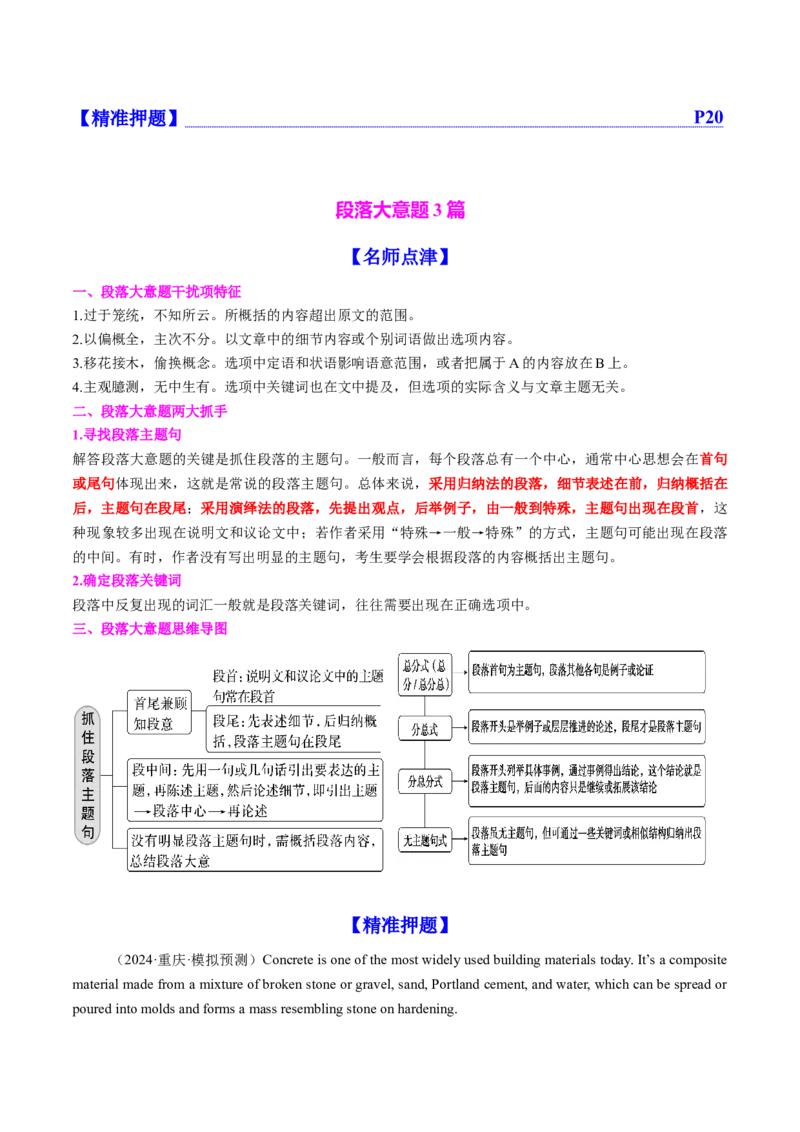
段落大意题3篇
【名师点津】
一、段落大意题干扰项特征
1.过于笼统,不知所云。所概括的内容超出原文的范围。
2.以偏概全,主次不分。以文章中的细节内容或个别词语做出选项内容。
3.移花接木,偷换概念。选项中定语和状语影响语意范围,或者把属于A的内容放在B上。
4.主观臆测,无中生有。选项中关键词也在文中提及,但选项的实际含义与文章主题无关。
二、段落大意题两大抓手
1.寻找段落主题句
解答段落大意题的关键是抓住段落的主题句。一般而言,每个段落总有一个中心,通常中心思想会在首句
或尾句体现出来,这就是常说的段落主题句。总体来说,采用归纳法的段落,细节表述在前,归纳概括在
后,主题句在段尾;采用演绎法的段落,先提出观点,后举例子,由一般到特殊,主题句出现在段首,这
种现象较多出现在说明文和议论文中;若作者采用“特殊→一般→特殊”的方式,主题句可能出现在段落
的中间。有时,作者没有写出明显的主题句,考生要学会根据段落的内容概括出主题句。
2.确定段落关键词
段落中反复出现的词汇一般就是段落关键词,往往需要出现在正确选项中。
三、段落大意题思维导图
【精准押题】
(2024·重庆·模拟预测)Concrete is one of the most widely used building materials today. It’s a composite
material made from a mixture of broken stone or gravel, sand, Portland cement, and water, which can be spread or
poured into molds and forms a mass resembling stone on hardening.Around 3000 BC, the Egyptians used early concrete forms in their building.
One of concrete’s key ingredients is cement (水泥), which is thought to have been devised in Europe in 1300
BC. Later, cement would be combined with other materials to make a substance more similar to what we know as
concrete today. The Romans, for example, are famed for their concrete; many structures built using it still stand
today. But it could be older than that.
Middle eastern builders coated the outside of their clay fortresses with a thin, moist layer of burned
limestone (石灰石), which chemically reacted with gasses in the air to form a hard, protective surface.
Around or before the third millennium BC, Nabataean traders or Bedouins built the first concrete-like
structures in the southern Syria and northern Jordan regions. By 700 BC, the significance of lime was known,
which led to the development of mortar supply kilns (窑厂) for the construction of rubble-wall houses, and concrete
floors.
In 1824, Portland cement was invented by Joseph Aspdin of England. George Bartholomew laid down the
first concrete-paved street in the US in 1893, which still exists.
By the end of the 19th century, steel-reinforced concrete was developed. In 1902, August Perret designed and
built an apartment building in Paris using steel-reinforced concrete. This building had wide admiration and
popularity for concrete and influenced the development of reinforced concrete.
In 1921, Eugene Freyssinet pioneered reinforced-concrete construction by building two airship hangars at
Orly Airport in Paris.
1. What is the third paragraph mainly about?
A. The composition of concrete. B. Early Roman buildings.
C. Early use of concrete in Europe. D. The invention of cement.
2. Why does the writer mention “burned limestone”?
A. To introduce it as a building material.
B. To stress the importance of protecting buildings.
C. To talk about early use of concrete in Middle East.
D. To describe middle eastern builders’ rich knowledge in chemistry.
3. When was the Portland cement invented?
A. In 700 BC. B. In 1300 BC. C. In the 18th century. D. In the 19th century.
4. How is the text developed?
A. By contrast. B. By giving examples.
C. By analyzing causes. D. By following time order.
(2024·湖南怀化·一模)Due to the fact that the average life expectancy in Ghana is 64 years old, and the
most common causes of death are largely treatable conditions, such as malaria, stroke, and respiratory infections.
Boateng, growing up in a small village in southern Ghana/struggling to access basic health care, felt an urgent call
to help and decided he would make it his life’s mission to bring health care to remote communities in Ghana.
Boateng worked hard in school, getting a scholarship to study biology at Cornell University in the US, and
ultimately earned his master’s in Healthcare Administration. Later he started his nonprofit, OKB Hope Foundation,
and converted a van into a mobile doctor’s office called the Hope Health Van to bring health care directly to thosein need in 2021.
A few times a week, the mobile clinic and medical team travel long distances to remote communities in
Ghana and provide free routine medical care. On each trip, Boateng’s team consists of a nurse, a physician’s
assistant, a doctor, and an operation assistant. In the van, they can run basic labs like bloodwork and urinalysis as
well as prescribe and provide medications. “It’s like a one-stop shop for people,” said Boateng, adding that most of
the people they see have one health issue or another.
Since its launch, Boateng says the Hope Health Van has served more than 4, 000 Ghanaians across more than
45 rural communities who otherwise don’t have easily accessible medical care. To supplement the mobile clinic,
Boateng’s organization has also trained 20 volunteers to serve as local health advocates. They check people’s vitals
and provide the medical team with timely data for assessing how to move forward with care and treatment,
especially for those whose health is at risk.
In the future, Boateng hopes to expand to provide more consistent and high-quality medical care not only to
those living in remote areas of Ghana but in other countries as well. “I believe that our model can be replicated in
sub-Saharan Africa,” he said.
5. What inspired Boateng to set his life goal?
A. He wanted to get a scholarship.
B. Many locals died of deadly diseases.
C. The birthplace of him was small and poor.
D. Basic health care was inaccessible for locals.
6. What is paragraph 3 mainly about?
A. How Boateng’s team functions. B. Why Boateng’s team was founded.
C. What Boateng’s team has achieved. D. Where Boateng’s team has travelled.
7. What is Boateng’s attitude to his team in the future?
A. Ambiguous. B. Ambitious. C. Indifferent. D. Doubtful.
8. What is the best title for the text?
A. A van bringing medical care to thousands
B. A country lacking basic health care
C. Efforts to provide people with medications
D. Mobile vans travelling through Ghana
(2024·河南周口·模拟预测)Scientists from Tufts University have developed tiny groups of human cells
that can move on their own-and in a lab experiment, these so-called “anthrobots” inspired sheets of human neurons
to repair themselves when damaged. The researchers hope the collections of cells could one day be used to treat
diseases or aid with healing in humans.
The study comes on the heels of earlier work from one of its authors, who produced tiny robots by stitching
together frog embryo cells. These robots, known as “xenobots”, could assemble themselves, move across surfaces
and travel through liquid.
Since they're not made from human cells, xenobots can't be used to treat humans, writes Matthew Hutson, a
freelance science writer. But the anthrobots in the new study could theoretically. Each anthrobot started with asingle cell from an adult human lung. It then grew into a multicellular biobot after being cultured (培养) for two
weeks.
These lung cells are covered in cilia. But at this point in the research, the cilia were growing inside the
clumps of cells. So, for the next week, the researchers grew the cells in a solution (溶液) that caused the cilia to
face outward instead, enabling these structures to move the anthrobots, which could move in tight loops, travel in
straight lines or wiggle in place. Their speed varied as well.
The researchers also tested how these robots might heal wounds. They mimicked (模拟) a wound by
scratching a layer of neurons in a dish. Then, they introduced anthrobots to the site of the scratch, and within days,
the neurons regrew, bridging the gap created by the wound. The findings show new structures that might have uses
in biomedical settings can be developed without gene editing and without having to design the structures manually,
the study authors write.
“Unlike xenobots, anthrobots don't require tools to give them shape, and we can use adult cells-even cells
from elderly patients-instead of embryonic cells,” says Gizem Gumuskaya, the paper's lead author. "We can
produce these robots in large amounts in parallel, which is a good start for developing a therapeutic tool.”
9. How are the advantages of the anthrobot highlighted in the text?
A. By showing comments from users. B. By explaining some terms.
C. By making comparisons. D. By listing the data of questionnaires.
10. What is paragraph 4 mainly about?
A. The weaknesses of the anthrobot. B. The culture of the anthrobot.
C. The structure of the anthrobot. D. The application of the anthrobot.
11. What is the feature of the anthrobot?
A. It can travel both on land and in water. B. It requires no genetic modification.
C. It can be applied in a controlled way. D. It can develop from any cells of humans.
12. What can the study benefit?
A. Regenerative medicine. B. New materials.
C. Environmental protection. D. Individualized education.
文章大意题3篇
【名师点津】
一、记叙文主旨大意题
1.看首段和尾段,以尾段为主
2.借助主题词或关键词归纳
二、说明文和议论文主旨大意题
1.看首段和每段段首句,以首段为主
2.借助主题词或关键词归纳
三、文章大意题错误选项典型错误
一是“以偏概全”:选项范围太窄,只表达局部信息或某一细节,不能概括整篇文章的主旨大意;二是“概括宽泛”:所表达的内容超出或多于文章阐述的内容;
三是“无中生有”:即文章中根本未提到或者不是指定段落的大意。
四、文章大意五种题型
题型一:利用主题句在段首位置推敲段落大意
技巧点拨:说明文和议论文学会关注“首段”和“段首”。借鉴“七选五”小标题类型特点,段首句统领
全段主旨大意,由此推断段落大意。
题型二:利用主题句在段中位置推敲段落大意
技巧点拨:有时主题句出现在段中某句,这就需要考生耐心阅读揣摩段落各句之间内在逻辑关系,确定主
题句位置,进而明确段落主旨大意。
题型三:利用主题句在段尾位置推敲段落大意
技巧点拨:有时主题句出现在段尾,关注一些表征总结性,结论性的词: in brief/ short, all in all,
in conclusion, in a word等,这些词后面连接的通常是主题句。
题型四:利用段落没有主题句推敲段落大意
技巧点拨:有时候段落没有出现主题句,需要考生自己总结提炼,难度更大。
题型五:利用“总-分-总”结构推敲语篇主旨大意题
技巧点拨:有时候段落没有出现主题句,需要考生自己总结提炼,难度更大。
五、文章大意题思维导图
【精准押题】
(2024·浙江金华·二模)Sometimes we only appreciate something when we realize we may lose it. That is
the story of the Everglades. A shallow slow-moving river, the Everglades once covered about 18,000 square miles
of southern Florida. Until the 1900s, few people lived in the grassy wetlands. Not much was understood about the
unique balance of nature that existed there. Plants, creatures, and water had formed a remarkable ecosystem.
By the early 1900s, Florida’s pleasant winters attracted more people. Visitors became new permanent
residents. They built homes and roads. The conditions looked good for farming, so the newcomers planted large
agricultural crops. But South Florida’s cycle of flooding was a problem. To address that, developers attempted to
drain (排水) the land. They also built structures to control water levels and flow.
Those changes made it easier for more people to live year-round in South Florida. However, they also
disturbed life in the Everglades, which depends on freshwater regularly refilling the land. The area’s growinghuman population needed freshwater. And large farms consumed large quantities of freshwater. By the mid-1900s,
water levels in southern Florida began to go down. Lack of freshwater wasn’t the only problem. As more and more
land was developed for people and farms, the Everglades’ historic boundaries contracted. Loss of habitat and
hunting threatened the survival of native species in the Everglades.
Some people hoped that the government’s recognition might save the Everglades. They fought for it.
Everglades National Park was established in 1947. It became the first park in the United States created for its
biodiversity.
Now, Everglades National Park protects 1.5 million acres along the southern tip of Florida. An amazing
variety of creatures live there. About 360 different species of birds have been sighted in the park. Nearly 300
different species of fish have been identified. About 40 species of mammals and 50 species of reptiles inhabit the
park. Nature still rules in the Everglades, a place worth understanding, appreciating, and protecting.
13. What was the Everglades like before the 1900s?
A. Naturally wild. B. Partly explored.
C. Completely lifeless. D. Thickly populated.
14. What problem did new residents cause for the Everglades?
A. A cycle of flooding.
B. Pollution of freshwater.
C. Possible extinction of native species.
D. The extension of historic boundaries.
15. Why are the figures mentioned in the last paragraph?
A. To attract visitors to the park.
B. To stress the great power of nature.
C. To call for more efforts to protect nature.
D. To show the successful conservation of the park.
16. What is the text mainly about?
A. How people adapted to life in the Everglades.
B. How Everglades National Park was established.
C. How humans harmed and saved the Everglades.
D. How the ecosystem of the Everglades was formed.
(2024·全国·二模)Halloween candy could be in for a California big change. State lawmakers last month
passed the California Food Safety Act, which bans four materials found in popular snacks and packaged foods -
including candy corm and other Halloween treats. Set to take effect in 2027, the ban will lead candy and food
producers to change their formulas for products sold both in California and elsewhere around the country.
The law bans the production and sale of some materials, which are used in processed foods including kinds
of instant potatoes and sodas, as well as candies. The additives (添加剂) have been linked to increased risks of
cancer and nervous system problems, according to the Environmental Working Group, which started the act, and
are already banned in many other countries.
Food producers and their lobbyists (说客) opposed the law, arguing the conclusion that the four additives areunhealthy should be made by the Food and Drug Administration (FDA). They thought that evaluating the safety of
food materials and additives should rely on the scientific accuracy of the FDA. But food safety advocates say the
FDA has moved far too slowly in regulating food chemicals. It’s unacceptable that the U.S. is so far behind the rest
of the world when it comes to food safety.
California’s act made headlines this year as a “Skittles (彩虹糖) ban” that would wipe popular candies off
California shelves. But supporters of the act said the intention is simply to require changes in the materials, as has
already happened in Europe. Perhaps the most standing-out material on California’s banned list is red dye No. 3. It
is allowed only in candied and cocktail cherries in the European Union but more than 3,000 products contain the
chemical in the U. S. The list includes items like frosted pretzels and scores of brand-name candies such as Peeps
and Pez. It also includes items like fruit cocktail cups, protein drinks, and yogurts.
17. How will Halloween candy in California change?
A. It will change its recipes. B. It will transform its shapes.
C. It will move out of California. D. It will disappear completely.
18. What idea do food producers have against the act?
A. FDA’s conclusion on the materials is wrong.
B. Four materials are allowed all over the world.
C. The materials’ safety needs to be reassessed.
D. FDA moves too fast in regulating food chemicals.
19. What can we infer about the act supporters’ request about Skittles?
A. They demand a complete ban on Skittles.
B. They wish the “Skittles ban” to be headlines.
C. They want to apply European policies to Skittles.
D. They hope more red dye No. 3 is used in Skittles.
20. What is the text mainly about?
A. California candy ban. B. Food safety in California.
C. The responsibility of FDA. D. Change of Halloween Candy.
(2024·云南昆明·三模)Few social networking platforms are known for inspiring positive social change these
days, but an Inuit-developed app is helping local communities from Alaska to Greenland advance their self-
determination.
Named SIKU after the Inuktitut word for “sea ice”, the app allows communities in the North to pull together
traditional knowledge and scientific data to track changes in the environment, trace local wild foods, and make
decisions about how to manage wildlife.
Over the years, SIKU has stepped forward in its development. Recently, the elders saw that the platform
could help address a familiar challenge: sharing knowledge with younger people who often have their noses in their
phones. In 2019, SIKU relaunched as a full-fledged social network—a platform where members can post photos
and notes about wildlife sightings, hunts and sea ice conditions. The app operates in multiple languages, such as
Inuktitut, Innu and Greenlandic. Since early 2024, over 25,000 people from at least 120 communities have made
more than 75,000 posts on SIKU.The app is also equipped with useful tools for life on the ice, including weather reports, sea ice forecasts, and
other critical safety information. “When I go out on the land with family, we go a long distance, and the SIKU app
can show which area we are in. It’s precise.” says Karen Nanook, who lives in Taloyoak, Nunavut.
The data held in SIKU is abundant and up to date, and communities are already using the app to inform
important decisions. In 2021, for example, elders in Sanikiluaq were worried the local reindeer population had
thinned, so the Hunters and Trappers Association used SIKU to survey hunters and look at recent reported harvest
rates. The analysis led the association to temporarily close the hunt to relieve pressure on the population and to
reintroduce hunting slowly once the number of reindeer increased. This decision shows how Inuit can use the
technology in combination with traditional wildlife management. “It’s part science and part Inuit knowledge. It can
work both ways, instead of one dominating the other,” says Arragutainaq, a manager at the association.
21. What do we know about SIKU?
A. It traces data to do researches. B. It gets tryout all over the world.
C. It allows people to post photos and notes.D. It mainly focuses on traditional knowledge.
22. What does the underlined word “full-fledged” in paragraph 3 mean?
A. Well-developed. B. Time-saving. C. Business-centered. D. Fancy-looking.
23. What is Karen’s attitude towards SIKU?
A. Favorable. B. Doubtful. C. Intolerant. D. Curious.
24. What is the text mainly about?
A. SIKU advocates the Inuit tradition. B. SIKU promotes technological advances.
C. SIKU tracks changes in the environment. D. SIKU helps local communities make decisions.
态度推断题3篇
【名师点津】
态度观点态度类试题的解题方法:
第一:结合题干人物和内容定位原文出现在哪一(些)段;然后仔细比对该句言外之意;
第二:加入自己的态度。要注意区分试题考查的是作者的态度还是作者引用别人的态度;
第三:态度没有明确提出时,要学会根据作者在文章中所运用词汇的褒贬性去判断作者的态度,尤其是动
词、形容词和副词,如wonderfully, successfully, unfortunately, doubtfully 等。
乐观支持类词汇:optimistic乐观的;positive肯定的;favorable 支持的,赞同的;supportive支持的;
approving赞成的
客观中立类词汇:objective客观的;neutral中立的;cautious谨慎的
消极反对类词汇:negative否定的;opposite相反的;unfair公正的;doubtful怀疑的;indifferent漠不关心
的;critical 批评的;ironic 讽刺的;skeptical 质疑的;disappointed 失望的;disapproving 不赞同的;
pessimistic悲观的;dismissive轻蔑的,不屑一顾的
【精准押题】
(2024·浙江杭州·一模)Google recently announced that it has begun using carbon-free electricity from ageothermal(地热能) project to power data centers in the state of Nevada.
Tim Latimer is chief and co-founder of Fervo Energy based in Houston, Texas. His company is working with
Google on its geothermal project. Latimer said that getting electricity on the grid from geothermal resources is an
event many new energy companies never reach. He added that he believes geothermal energy will become more
well-known than in the past.
The International Energy Agency(IEA) has long suggested geothermal could be an answer to climate change.
The IEA said in a 2011 document that geothermal could reach 3.5 percent of global electricity production each year
by 2050. The Paris-based international group says geothermal energy could prevent almost 800 million tonnes of
carbon dioxide emissions per year.
Fervo Energy is using this first test to launch other projects that will provide more electricity to the grid. The
company is currently completing some work in southwest Utah for a 400-megawatt project. Google and Fervo
Energy started working together in 2021 to develop geothermal power. The plant near Winnemucca, Nevada, is
now operating and is sending about 3.5 megawatts to the grid.
Google announced in 2020 that it would use what it calls “carbon-free” energy every hour of every day,
wherever it operates, by 2030. Many energy experts believe huge companies like Google can play a part in
increasing the use of clean energy.
Terrell noted the company was also an early supporter of wind and solar projects, helping those markets
grow to where they are today. “It’s a very similar situation. Now that we’ve set a goal to be 24/7 carbon-free
energy, we have found it will take more than just wind, solar and storage,” Terrell said.
The United States leads the world in using heat from the Earth for electricity production. U. S. Energy
Secretary Jennifer Granholm said earlier this year that advances in new geothermal systems will help introduce this
form of energy to areas where it has been thought to be impossible. This makes it possible to find energy in more
places.
29. What is Tim Latimer’s attitude to working with Google?
A. Supportive. B. Disapproving. C. Concerned. D. Indifferent.
30. What can we learn from the text?
A. Fervo Energy has launched many geothermal projects before.
B. Geothermal energy will take the place of solar energy.
C. Getting electricity from geothermal resources has been widely used.
D. Geothermal energy has the potential to tackle environmental problems.
31. What will most energy experts agree with?
A. CO emission is to blame for climate change.
2
B. Carbon-free electricity only exists in our dream.
C. Google is setting a good example in environmental protection.
D. Wind and solar projects are more important than geothermal project.
32. What would be the best title for the text?
A. Geothermal: an answer to climate change
B. Google: a company launching a new project
C. IEA: an organization contributing to global warmingD. CO : the leading factor to global warming
2
(2024·重庆·一模)In a small, rough shipyard on the Pacific coast of Costa Rica, a small team is building
what they say will be the world’s largest ocean-going clean cargo ship.
Ceiba is the first ship built by Sailcargo, a company trying to prove that zero-carbon shipping is possible, and
commercially available. Made largely of wood, Ceiba combines both very old and very new technology: sailing
masts stand alongside solar panels, a uniquely designed electric engine and batteries. Once on the water, she will be
capable of crossing oceans entirely without the use of fossil fuels, which sets her apart.
“The thing that is striking is the fact that she’ll have one of the largest marine electric engines of her kind in
the world,” Danielle Doggett said. The system also has the means to capture energy from underwater propellers (螺
旋桨) as well as solar power, so electricity will be available for the engine when needed. “Really, the only limit on
how long she can stay at sea is water and food on board for the crew.”
Despite some hold-ups due to the global disaster, the team hopes to get her on the water by the end of 2024
and operating by 2025, when she will begin transporting cargo between Costa Rica and Canada.
“There are actually loads of innovations happening that could transform shipping emissions, but few
companies are willing to apply them to building ships like Ceiba.” says Lucy Gilliam. “So it’s not that we don’t
have great ideas. The problem that we have is that fossil fuels are still too cheap. And we don’t have the rules to
force people to take up the new technology.”
When it comes to promoting this kind of boat, it has to be said that Ceiba is small for a cargo ship — tiny in
fact. She will carry around nine standard shipping containers. She is also relatively slow. Being a world-first, there
are some aspects of Ceiba’s design that have yet to be proven at sea.
33. What is unique about Ceiba as a cargo ship?
A. It is the world’s largest.
B. It is environment-friendly.
C. It is wooden with old technology.
D. It is modern with unique equipment.
34. What determines Ceiba’s length of staying at sea according to Danielle Doggett?
A. The size of the sail. B. The weather of the ocean.
C. The power of the electric engine. D. The quantity of the living supplies.
35. Why are companies unwilling to build ships like Ceiba?
A. The rules are disobeyed. B. The fuels are affordable.
C. The bigger ships are preferable. D. The innovations are distrusted.
36. What is the author’s attitude to the innovation of Ceiba?
A. Objective. B. Doubtful. C. Critical. D. Favorable.
(2024·河北·二模)From misremembering a movie quote to forgetting a vital ingredient from the shops for
an evening dinner, the human memory is not always reliable. Now, researchers have discovered that sleep may play
a key role in distorting (扭曲) memories, but perhaps in a good way.
As part of this study, researchers from the University of York’s Department of Psychology tested 488participants on their ability to recall a list of words 12 hours after seeing them, with some of the participants being
allowed to sleep in the 12-hour period.
They found that those who had slept remembered more of the words on the list than those who had not, but
they were also more likely to give words that weren’t on the list, but were related. The related incorrect words are
known as “lure words”. If a list contained words like nurse, hospital and sick, the false memories may include lure
words like doctor.
Dr Matthew Mak, first author of the study, said, “Participants may falsely recall the lure words because
‘doctor’ most probably represents the gist (要旨) of the word list, and humans are known to often rely on gist
encoding.” Co-author Professor Gareth Gaskell added, “Memories in some ways are more about our future than our
past. They exist to provide knowledge about our past that can be applied in a generalised way to help us to deal
with future events. So a gist-like representation might actually be more useful than a ‘perfect’detailed
representation. What sleep might be doing is helping us to store memories in a gist-like way that can then be better
applied to our future interactions.”
However, the researchers did recognize several limitations of their study, namely that all participants were
aged between 18 and 25, and that the tests were performed online, meaning that other distractions (干扰) and
environments could not be controlled.
25. What does paragraph 3 mainly tell us about the study?
A. Its purpose. B. Its process. C. Its subject. D. Its finding.
26. What is Gaskell’s attitude to a gist-like representation?
A. Negative. B. Doubtful. C. Favorable. D. Unclear.
27. What message does the author want to convey in the last paragraph?
A. The tests make little sense.
B. The study needs improving.
C. The conclusion is satisfying.
D. The participants are nervous.
28. Which can be a suitable title for the text?
A. Sleep May Bring About False Memories
B. Old People Tend to Have Short Memories
C. A Good Night’s Sleep Keeps Us Energetic
D. Rising Early Delivers a Promising Start
写作手法题3篇
【名师点津】
高考阅读理解主要考查下定义、分类说明、列举例证和对比等写作手法。其中“引用”和“例证”是
议论文和说明文中最常用的写作手法之一,其共同目的就是增强说服力,服务于段落或篇章的主旨。一、根据文章题材来判断。
①记叙文多采取以时间为序、以空间为序、以故事情节发展为序等叙事方式进行写作。
②说明文往往采取下定义、举例子、列数字、对比等方式使说明更清晰或更具说服力。
③议论文大多通过举例子、列数字、引名言、作对比是使得观点更可信,更有权威性。
二、根据“原文定位”来判断。
先根据题干判断是具体某段还是全文写作手法,然后寻找标志词,进而找到答案。
①by giving examples 通过举例。标志词:for example, for instance
②by analyzing causes通过分析原因。标志词:as a result/consequence
③by giving definitions通过下定义。标志词:that is to say
④by listing data/statistics通过列数字。标志词:具体数字
⑤by describing a process 通过描述过程。标志词:first, second, third, finally
⑥by following time order 遵循时间顺序。标志词:in 1920,in the 1940s, nowadays
⑦by making comparisons/contrast 通过对比。标志词:but, while,
⑧by making classifications 通过分类。标志词:first, next, then
⑨by analyzing cause and effect 通过分析因果。标志词:That is because….
⑩by following space order 遵循空间顺序。标志词:由近及远,由外到内
【精准押题】
(2024·宁夏银川·二模)From May to October in the southeastern US, five species of turtles, from
loggerheads to Kemp’s ridley, crawl (爬行) ashore under the cover of night to lay their eggs on the very beach they
were born. During this time, thousands of turtle-loving volunteers comb the shorelines looking for the turtles’ tracks
as part of an ongoing effort to gather population data and protect the nests.
However, it’s not easy to detect turtle eggs as female turtles frequently make “false crawls”, climbing out of
the water but returning without laying eggs. And since sea turtles disturb huge areas of sand to hide their nests from
predators (捕食者), human monitors are often left guessing where the eggs are.
Now, a new study suggests man’s best friend can do it better. A smell-detecting dog named Dory found the
location of sea turtle eggs more accurately than human volunteers, according to a recent study led by Rebekah
Lindborg, a conservationist with Disney’s Animals, Science, and Environment division.
Lindborg teamed up with Pepe Peruyero, a dog behaviorist who has trained smell-detecting dogs for over 20
years. Peruyero selected a rescue dog named Dory, a two-year-old terrier mix found wandering along a Florida
highway, as the project’s poster dog.
Over months of training on a 50-by-50-square-foot artificial beach, Peruyero trained Dory to alert (警觉) at
the smell of “cloacal mucus”, a sticky matter that coats a sea turtle’s freshly laid eggs, with Lindborg as her handler.
Then, the team convinced the Florida Fish and Wildlife Conservation Commission to allow a friendly competition.
During the peak nesting seasons, two groups went around a stretch of shoreline about five miles long in Vero
Beach, Florida.
The terrier identified 560 sea turtle nests from three species, while people found only 256. Dory was also
significantly better than people at choosing where to dig for eggs, greatly reducing the number of holes dug,
Lindborg reports. And while human volunteers couldn’t find the eggs in 14.8% of nests, Dory only failed to deliver5.7% of the time. “Dory has a keen nose for turtles, and this could be a game changer,” said Lindborg.
37. How do female turtles make egg detection more difficult?
A. They make misleading tracks in the sand.
B. They destroy their eggs deliberately.
C. They put their eggs in the water.
D. They build nests everywhere.
38. What is most helpful for Dory in finding turtle nests?
A. The nature of digging.
B. The sense of competition.
C. The warning from its trainer.
D. The matter on a turtle’s newly laid eggs.
39. How is paragraph 6 mainly developed?
A. By giving examples. B. By describing courses.
C. By making comparisons. D. By offering explanations.
40. What is the text mainly about?
A. The kindness of a man who protects turtle nests.
B. A dog that can find turtle nests successfully.
C. The difficulty of building turtle nests.
D. A new discovery about turtle nests
(2024·山西晋中·模拟预测)The nature of compassion fatigue (同情疲劳) means that many working in
traditional care-giving roles are likely to experience its symptoms. This includes first responders, medical
professionals, social workers, journalists, and lawyers specializing in family law or criminal law.
Kelli Collins, a licensed family therapist, remarks “Think about muscle fatigue—if you work out too hard,
your muscles might simply give out. In the same way, compassion fatigue means your ability to offer compassion
to others is dramatically affected.”
Collins herself experienced compassion fatigue as a young therapist working in a community mental health
setting, where she “had the strong desire to help” but quickly realized some things were out of her “rang of
influence”. She felt herself becoming easily annoyed with loved ones, sleeping very little, and fantasizing about
changing careers. It was an overwhelming time, during which she felt she was failing her clients.
“I thought that by giving endless compassion to my clients, I was ‘leaving it all on the field’. In fact, bearing
the responsibility for my clients’ pain without consideration for my own needs and limits meant that I wasn’t a
particularly effective therapist,” she says.
Lynne Hughes, who founded Comfort Zone in 1999 and now serves as CEO, lost both her parents as a child,
experiencing first-hand the lack of resources and support for grieving children. Hughes expresses similar feelings
about the challenge of compassion fatigue, stressing the importance of looking inward.
“Suffering from compassion fatigue does not mean you’re bad at helping or caring, it only means the scale
between caring for others and caring for yourself is no longer balanced,” she says. “When you’re in a role where
you’re nurturing and caring for others — it’s crucial to extend that nurture and care to yourself so that ‘your well’does not run dry.”
But both Hughes and Collins emphasize that it’s not only traditional caregivers who experience compassion
fatigue. “It is applicable to anyone in a caring role,” says Hughes, while Collins believes it is a uniquely human
condition, occupational or not.
49. Why does Collins mention the muscle fatigue?
A. To describe she is in a bad mood.
B. To show she is eager to give a hand.
C. To suggest she has limited pity for others.
D. To explain she is much tired of her customers.
50. Which of the following do Hughes and Collins agree with?
A. Care for yourself while caring for others.
B. Compassion fatigue has nothing to do with career.
C. Those with compassion fatigue are poor at helping.
D. Shy persons always tend to suffer compassion fatigue.
51. What does “your well” in Paragraph 6 refer to?
A. Pity. B. Nurture. C. Symptoms. D. Occupation.
52. How does the author develop the text?
A. By giving examples. B. By quoting arguments.
C. By making comparisons. D. By analyzing reasons and causes.
(2024·河北保定·二模)Total solar eclipses (日食) have scared people since time out of mind. The first
record of one, preserved on a clay tablet found at Ugarit, once a trade city but destroyed later in Syria, is believed
from its age and location to describe either an eclipse that happened in 1375 BC or one in 1223 BC. Legendary
explanations for eclipses include the Sun being eaten by dogs, frogs or dragons. The reality is not romantic. Why
are total ones, like the one coming on April 8, so rare?
Solar eclipses are a special case of phenomena called transits and occultations, in which an intervening (介于
中间的) heavenly body stops light from a star reaching an observer. If the blocking body appears smaller in the sky
than the star, the result is called a transit and looks like a dark spot crossing the star’s surface. If the blocking object
appears larger than the star, the star disappears completely—an occultation. A total eclipse is an occultation.
Solar eclipses may be either of these things, since the apparent sizes in the sky of the Sun and the Moon,
viewed from Earth, are almost identical. If the Moon orbited Earth in the same plane as Earth orbits the Sun,
eclipses would happen every month, but would be total only in the tropics (热带地区). In reality, the average
interval between total eclipses is 18 months, and they may be seen from time to time all over the world. The path of
totality across Earth’s surface is narrow and the period short (a maximum of just over seven and a half minutes).
Outside these boundaries, the Sun will appear partially eclipsed, looking like a pie that something has taken a bite
from.
The Great North American Eclipse, as it has been called, will be a sight to be hold on April 8. But it should
also be cherished, because total eclipses of the Sun will not happen for ever. Tidal friction (潮汐摩擦) causes the
Moon to move away from Earth at 3.8 cm a year, making it appear smaller and smaller in the sky. In 600 millionyears or so the last, short totality will occur.
1.What does the clay tablet of Ugarit represent?
A.Some figures of ancient animals.
B.The Sun being eaten by some animals.
C.Ancient people who were hunting for animals.
D.The earliest total solar eclipse recorded.
2.How does the author develop paragraph 2?
A.By listing statistics. B.By giving definitions.
C.By giving examples. D.By analyzing cause and effect.
3.What can we learn about total solar eclipses from paragraph 3?
A.Their duration is relatively longer. B.They take place every month actually.
C.They are visible only from a narrow path.D.They look like a bite taken out of the Sun.
4.What makes total solar eclipses so rare?
A.The moving-away Moon.
B.The stronger tide on Earth.
C.The smaller attraction of the Moon for Earth.
D.The changing distance between the Sun and Earth.
写作意图题3篇
【名师点津】
每篇文章都有一个特定的写作目的,或是向读者传递某个信息,或是愉悦读者,或是讲授某个道理。而这
些信息通常并不是明确表达出 来,而是隐含在文章 之中。因此,这类问题要求考生在理解文章总体内
容的基础上,去领会作者的言外之意。
1. 主旨推断法。
写作意图与文章主旨密切相关,因此,解答这类题跟解答主旨大意题和选择文章标题一样,用略读法,即
重点关注文章首尾段和各段的首尾句,找到主题句,抓住文章主旨,然后由主旨来推断作者的写作目的。
议论文、新闻报道、说明文等,其主题句多在文首。
2. 文体推断法。
①应用文广告的目的是吸引更多顾客、游客、读者、订户、观众等订阅或前往(to attract readers)。
②记叙文的目的是分享有趣的经历、告诉一个有趣的故事(to entertain readers)、或给读者某种启示。
③说明文的目的是使读者获得某种知识(to inform readers),提出建议、劝告或呼吁有关部门给予重视。
④议论文的目的通常是说服读者接受或赞同某一观点(to persuade readers),倡导某种做法等。
【精准押题】
(23-24高二下·云南大理·期中)Chaudhary quietly weaves together lengths of ropes, binding them with
grass collected from the riverbank. She skillfully shapes the materials into a jewelry box. Meanwhile, she’s
instructing a group of women to work out the materials. The ropes used were once the lifeline for climbers tacklingNepal’s mountains and were then discarded (扔掉). They are now finding new life, transformed by skilled hands
into items to sell.
Acharya, working with the cleaning campaign, owns a waste processing business in Kathmandu, also an
advocate for sustainable waste management. “Aluminum and other metal waste go through the recycling process,
but we found no way to recycle ropes and gas cans,” she says. It struck her that the non-recyclable waste could be
reused, but it wasn’t until she met Maya Rai that a solution emerged. Rai, leading Nepal Knotcraft Centre, helped
connect Acharya with Chaudhary’s team of craftswomen in hopes of turning the mountain waste into economic
opportunity. “While this seems insignificant compared to waste in the mountains, it’s a start. We aim to connect
local expertise, mountain waste and local economy,” says Acharya, proudly displaying a mat made from ropes left
on Mt. Qomolangma by climbers. Her goal is to ensure that no waste collected from mountains ends up in a landfill
again.
Finished crafts are sold at outlets and exhibitions. The craftswomen are paid according to how many items
they make and sell. With flexible hours, the project gives women an opportunity to earn money even as they
maintain household responsibilities.
Eventually, Acharya hopes to expand the program to involve more women and process more waste. But
progress has been slow. “We still have not found a sustainable business plan to make crafts in large quantities, ”she
says. Now, she is searching for cooperators to make a model that serves not only the mountain but the communities.
“After all, we are trying to craft a sustainable future.”
Each rope turned into a decorative item is a way to help local women earn a living and keep mountains
clean.
53. What is the author’s purpose in mentioning Chaudhary in paragraph 1?
A. To lead in the topic with her example.
B. To spread her environmental consciousness.
C. To show her patient instructions to the women.
D. To speak highly of her outstanding weaving skills.
54. What is the second paragraph mainly about?
A. A business involving waste processing.
B. A team transforming waste into treasure.
C. A campaign advocating sustainable management.
D. A solution connecting expertise, waste and economy.
55. Which of the following is the most likely reason for craftswomen to join in the project?
A. Selling crafts at outlets can earn more money.
B. Removing mountain waste generates a sense of pride.
C. Cooperating with local experts helps promote skills.
D. Work-life balance can be achieved due to flexible hours.
56. What is Acharya’s attitude towards expanding the program?
A. Hesitant. B. Positive. C. Suspicious. D. Disapproving.
(2024·上海长宁·二模)THE GLOBAL WASTE TRADE IS ESSENTIALLY BROKENCut into hillside in northern Malaysia stands a large, open-air warehouse. This is a recycling factory, which
opened last November. On a very hot afternoon in January, Shahid Ali was working his very first week on the job.
He stood knee-deep in soggy, white bits of plastic. Around him, more bits floated of the conveyor belt and fell to
the ground like snowflakes.
Hour after hour, Ali sorts through the plastic jumble moving down the belt, picking out pieces that look off-
color or soiled-rejects (废品) in the recycling process. Though it looks like backbreaking work, Ali says it is a great
improvement over his previous job, folding bed-sheets in a nearby textile factory, for much lower pay. Now, if he
eats simply, he can save money from his wages of just over $l an hour and send $250 a month to his parents and six
brothers and sisters in Peshawar, Pakistan, 2,700 miles away, “As soon as I heard about this work, I asked for a
job,” says Ali, 24, a bearded man with glasses and an easy smile. Still, he’s working 12 hours a day, seven days a
week. “If I take a day off, I lose a day’s wages,” he says.
In the warehouse, hundreds of bags are stacked more than 60 feet high-each stuffed with plastic wrappers and
bags thrown away weeks earlier by their original users in California. The fact that the waste has traveled to this
distant corner of the planet in the first place shows how badly the global recycling economy has failed to keep pace
with humanity’s plastics addiction. This is an ecosystem that is deeply dysfunctional, if not on the point of
collapse: About 90% of the millions of tons of plastic the world produces every year will eventually end up not
recycled, but burned, buried, or dumped.
Plastic recycling enjoys ever-wider support among consumers: Putting yogurt containers and juice bottles in a
blue bin is an eco-friendly act of faith in millions of households. But faith goes only so far. The tidal wave of plastic
items that enters the recycling stream each year is increasingly likely to fall right back out again, casualties of a
broken market. Many products that consumers believe (and industries claim) are “recyclable" are in reality not,
because of hard economics. With oil and gas prices near 20-year lows, so-called virgin plastic, a product of
petroleum feed-stocks, is now far cheaper and easier to obtain than recycled material. That unforeseen shift has
yanked the financial rug out from under what was until recently a practical recycling industry. “The global waste
trade is essentially broken,” says the head of the global plastics campaign at Greenpeace. “We are sitting on vast
amounts of plastic with nowhere to send it and nothing to do with it.”
57. What is the author’s attitude towards Shahid Ali?
A. Critical. B. Merciless. C. Indifferent. D. Sympathetic.
58. What most probably causes the problem of global waste recycling?
A. The prices of oil and gas have been increasing.
B. Tons of wastes travel so far before being recycled.
C. Recyclable products are not really recycled.
D. Governments don’t support the recycling industry.
59. What does the italicized word “dysfunctional” mean in the passage?
A. Out of stock. B. Far from pleased. C. Full of energy. D. Out of order.
60. What is the author’s purpose of writing this article?
A. To illustrate how plastic waste has been recycled in the world.
B. To warn people that the global waste trade is essentially broken.C. To analyze the relationship between consumers and factories.
D. To solve the conflict between the recycling industry and governments.
(2024·湖南长沙·三模)Rx4 Rhythm is one of the programs offered at the Johns Hopkins Centre for
Music and Medicine in Baltimore. The program is the brainchild of Dr Alexander Pantelyat, a violin player. He is
also a neurologist (神经科医生) who specializes in movement disorders like Parkinson’s. Applying music therapy
(疗法) to movement disorders is relatively new; previously, it was mainly used in cancer treatment. He explains,
“Just listening to music activates many regions of the brain at the same time.” Now, a growing body of scientific
evidence shows that music can be medicine, too.
One study from the Centre for Music and Medicine followed a choir composed of Parkinson’s patients to
learn how singing might impact the speaking voice of those patients. After 12 weeks, the singers’ speaking volumes
which often fade as Parkinson’s progresses grew demonstrably stronger. The Rx4 Rhythm drumming circle,
meanwhile, came out of a 2015 study that showed that Parkinson’s patients had improved their ability to walk after
six weeks of drumming practice.
In a review of 400 research papers looking into the neurochemistry of music, Daniel Levitin, a neuroscientist
at McGill University, found that playing and listening to music had clear mental and physical health benefits,
including improving our immune systems and reducing stress levels. It can also reduce the pain patients are
suffering.
Studies show that music can trigger memories and touch parts of the brain that other mediums cannot.
Sometimes music can work like miracle. One day, the nursing team at Toronto’s Princess Margaret Cancer Centre
asked Sarah, a music therapist, if she could reach out to a patient who was unwilling to engage with staff or be part
of any activities. As she started to play one piece of his favorite music on her keyboard, a change came over him.
He unfolded his arms, turned towards Black and started to cry. He said through tears. “It was as if the music went
places that nothing else could recalls.” He shared afterwards that the music showed up at a moment when it felt like
a hug.
1.What is the purpose of the program?
A.To treat cancer using music therapy. B.To help patients to appreciate music.
C.To treat Parkinson by activating the brain.D.To treat movement disorders with the help of music.
2.How has the program affected Parkinson’s patients?
A.They walk faster. B.They speak louder.
C.They grow stronger. D.Their memories fade.
3.What do the underlined words “trigger” mean in paragraph 4?
A.bring back B.refresh C.lose D.put back
4.What can be learned about the program from the last paragraphs?
A.It can help patients to recall places. B.It can help patients to comfort others.
C.It can help patients to interact with others.D.It can help patients to improve their ability to walk.
文章寓意题3篇【名师点津】
1. 关注选项格言或成语含义,甚至言外之意,做题留痕圈。
2. 找到原文相对应的段落或句子描述,进而提炼相应形容词。
3. 比对四个选项,留意答案往往是一对一错,选择最佳答案。
【精准押题】
(2024·四川成都·三模)When you are stuck on a problem, sometimes it is best to stop thinking about it —
consciously, anyway. Research has shown that taking a break or a nap can help the brain create pathways to a
solution. Now a new study expands on the effect by using sound cues (提示) to focus the sleeping mind on a
targeted problem.
When humans sleep, parts of the brain replay certain memories, strengthening and transforming them. About
a decade ago researchers developed a technique, called targeted memory reactivation (TMR), aimed at further
reinforcing selected memories: when a sound becomes associated with a memory and is later played during sleep,
that memory gets reactivated. In a study published last November in Psychological Science, scientists tested
whether revisiting the memory of a puzzle during sleep might also improve problem-solving.
About 60 participants visited the laboratory before and after a night of sleep. In an evening session, they
attempted spatial, verbal and conceptual puzzles, with a distinct music clip repeating in the background for each,
until they worked on six puzzles they could not solve. Overnight they wore electrodes to detect slow-wave sleep
and a device played the sounds assigned to three of the six unsolved puzzles. The next day, back at the lab, the
participants attempted the six puzzles again. All told, the subjects solved 32 percent of the sound-prompted puzzles
versus 21 percent of the untargeted puzzles — a boost of more than 50 percent.
The researchers “very bravely went for quite complex tasks that involved a lot of complex processing, and
remarkably they found these really strong effects in all of their tasks,” says Penny Lewis, a psychologist at Cardiff
University. “These are supercool results. Now we need to go out and try to understand them by firstly repeating the
tasks and secondly trying to work out the component processes that are actually being influenced.”
Beyond providing new evidence that humans restructure memories while sleeping, the research may have
practical implications. “In a futuristic world, maybe TMR could help us use sleep to work on our problems,” says
lead author Kristin Sanders, who was a graduate student at Northwestern University during the study. Sleep-
monitoring technology is increasingly accessible — and even without gadgets (小装置), prospective solvers can
focus on important problems before bed.
Still, sleep is not magic; people need to do their homework and load their heads with the puzzle pieces
involved. “I’m not going to solve cancer with this technique,” Sanders says, “because I don’t know anything about
cancer research.”
61. What is the function of sound cues in the new study?
A. To help the brain create pathways to a solution.
B. To direct the sleeping mind towards specific problems.
C. To monitor slow-wave sleep and detect reactivated memory.
D. To provide background music for participants attempting puzzles.62. What does the underlined word “them” in Paragraph 4 refer to?
A. The complex tasks. B. The strong effects.
C. The component processes. D. The expected results.
63. What can we know about the new study?
A. Participants attempted the puzzles with targeted music clips on.
B. Participants worked on six puzzles they couldn’t solve overnight.
C. The electrodes detected sleep and played the sounds assigned to the puzzles.
D. Subjects solved two more sound-prompted puzzles than untargeted puzzles.
64. What message does Sanders want to convey?
A. Necessity is the mother of invention.
B. Where there is a dream, there is a way.
C. We can’t make a cake without ingredients.
D. One will dream about what he thinks of.
(2024·河北衡水·模拟预测)Flaco the owl (猫头鹰) is gone, but his life had all the elements of a classic
hero’s story, not soon forgotten. Flaco lived a dozen years in a comfortable cage in the Central Park Zoo where little
happened and less was needed. His life was a safe existence without freedom. Then, a year ago, someone released
him.
On Friday, when he died of injury, perhaps from a collision (碰撞) with a Manhattan apartment building’s
glass windows, his death offered us a chance to reckon with the question at the heart of many a hero’s journey: Can
we put a price on freedom?
Flaco’s liberation from his cage came at a cost — he spent the final year of his life free, but threatened from
all sides by a booming city. Was it worth it?
Almost from the moment he was released, Flaco became a symbol of hope for many of the people who
followed his story and recognized parts of themselves in him. Some saw him as the symbol of the American dream,
an outsider who had come to Manhattan and made a life for himself here, like millions of others who arrived
penniless and unconnected in search of freedom.
As a result, he flew around the city. We were terrified that he’d succumb to (屈服于) the dangers of city life.
Flaco had no experience living outside a cage, and New Yorkers initially doubted his chances of survival. We
worried that he’d eat a rat with enough poison in its system to kill him. But Flaco never looked back. Perhaps
freedom itself was the home he’d discovered.
And though we feared for him, his new life excited us. How many of us, our circumstances familiar and sale,
are too frightened to seek our more fully realized selves?
How many of us, viewing our confinements as nothing out of the ordinary, have long stopped wondering
what our wings are for?
Have we not all desired a life beyond the range of the one we lead? Flaco showed that our desire is not
misplaced. His choice proved a truth that given a chance, living things choose freedom of movement.
65. What do the underlined words “reckon with” in Paragraph 2 probably mean?A. Bring up. B. Deal with. C. Reflect on. D. Look into.
66. What happened to Flaco the owl after he was released from his cage?
A. He died a natural death.
B. He was caught and returned to the zoo.
C. He died from a collision with a building.
D. He lived a free life but faced many threats.
67. What was the initial reaction of New Yorkers towards Flaco’s release?
A. They were excited and supportive.
B. They were worried about his survival.
C. They were indifferent and unconcerned.
D. They were angry and opposed to his release.
68. What does the author want to convey through the story of Flaco?
A. The importance of protecting wildlife.
B. The risks and rewards of seeking freedom.
C. The value of overcoming challenges in life.
D. The need for more awareness about animal rights.
(2024·湖北·二模)I have discovered that I have a second shadow these days as I go outside. This one,
however, has four legs instead of two. It is my daughter’s adopted, black cat: Miss Alice. Every time I go out the
door she is waiting on my front porch, meowing to be petted. Then she follows me down the hill to my car
sometimes running in front so she can get in my way for even more petting. And when I finally return home she is
there asking for attention again.
It wasn’t always this way. The very first time I saw Miss Alice she was hiding under my house just having
had a family of kittens. When I looked under there I got an angry hiss (嘘声) from her, warning me I was in for a
clawing if I got near her kittens. It took a lot of time, patience, kindness, love, and cat food from my daughter to
tame her. At first she didn’t want to be touched at all. Then she would only allow an occasional petting. Now my
daughter can pick her up and carry her up the road to her house like a little baby. It still makes me smile to see how
my daughter’s loving, caring and sympathetic spirit tamed this wild cat and made her as lovable as the most
affectionate dog.
I guess that is the power of love. It can heal a hurting heart. It can save a broken spirit. It can uplift a sunken
soul. It can free you from fear. It can transform your life. It can even take a violent, wild cat and turn her into a
puppy dog in a cat suit.
Embrace (拥抱) the love in your own life then. Welcome the love of your family and friends into your life.
And let your own love flow through everything you think, everything you say, and everything you do.
69. What do we know about the cat from the first paragraph?
A. It enjoys staying with the author. B. It tends to be in the author’s road.
C. It is often ignored by the daughter. D. It gets well along with the daughter.
70. What does the underlined word “tame” probably mean in Paragraph 2?A. Feed her up. B. Make her mild. C. Arrange for her. D. Dress her up.
71. What makes the author still smile?
A. The lovely dog. B. The daughter’s love. C. The cat’s babies. D. The harmonious family.
72. What message does the text convey?
A. Where there is life, there is hope.
B. A friend in need is a friend indeed.
C. Love is life in its fullness like the cup with its wine.
D. Do what you fear, and fear that nature will fade away.