专题11 阅读理解一轮复习难点突破2(名师点津+名校模拟) 原卷版
目录
人物性格题3 篇

 P2

【名师点津】

 P2

【高考真题】

 P2

【名校模拟】

 P3

事件评价题3 篇

 P5

【名师点津】

 P5

【高考真题】

 P5

【名校模拟】

 P6

隐含推断题3 篇

 P8

【名师点津】

 P8

【高考真题】

 P8

【名校模拟】

 P9

找共同点题3 篇

 P11


【名师点津】

 P11

【高考真题】

 P11

【名校模拟】

 P13

预测下段题3 篇

 P15


【名师点津】

 P15

【高考真题】

 P16

【名校模拟】

 P16

文章出处题3 篇

 P18


【名师点津】

 P18

【高考真题】

 P19

【名校模拟】

 P20

人物性格题3 篇
【名师点津】
人物“人物性格题”的最优处理方法:
第一、先整体把握人物经历、产品性能及文章主题,多为弘扬“真善美”主旋律主题。
第二、结合题干锁定原文答题区间,圈划关键词句,尤其是动词和形容词,注意提炼态度倾向。
第三、比对选项形容词的褒贬性,多为并列型,一对一错,采用“排除法”,去伪存真确定答案。
【高考真题】
(2024 新课标I 卷) “I am not crazy,” says Dr. William Farber, shortly after performing acupuncture (针
灸) on a rabbit. “I am ahead of my time.” If he seems a little defensive, it might be because even some of his
coworkers occasionally laugh at his unusual methods. But Farber is certain he’ll have the last laugh. He’s one
of a small but growing number of American veterinarians ( 兽医) now practicing “holistic” medicine –
combining traditional Western treatments with acupuncture, chiropractic (按摩疗法) and herbal medicine.
Farber, a graduate of Colorado State University, started out as a more conventional veterinarian. He
became interested in alternative treatments 20 years ago when he suffered from terrible back pain. He tried
muscle-relaxing drugs but found little relief. Then he tried acupuncture, an ancient Chinese practice, and was
amazed that he improved after two or three treatments. What worked on a veterinarian seemed likely to work
on his patients. So, after studying the techniques for a couple of years, he began offering them to pets.
Leigh Tindale’s dog Charlie had a serious heart condition. After Charlie had a heart attack, Tindale says,
she was prepared to put him to sleep, but Farber’s treatments eased her dog’s suffering so much that she was
able to keep him alive for an additional five months. And Priscilla Dewing reports that her horse, Nappy,
“moves more easily and rides more comfortably” after a chiropractic adjustment.
Farber is certain that the holistic approach will grow more popular with time, and if the past is any
indication, he may be right: Since 1982, membership in the American Holistic Veterinary Medical Association
has grown from 30 to over 700. “Sometimes it surprises me that it works so well,” he says. “I will do anything
to help an animal. That’s my job.”
24. What do some of Farber’s coworkers think of him?
A. He’s odd.
B. He’s strict.
C. He’s brave.
D. He’s rude.
25. Why did Farber decide to try acupuncture on pets?
A. He was trained in it at university.
B. He was inspired by another veterinarian.
C. He benefited from it as a patient.
D. He wanted to save money for pet owners.
26. What does paragraph 3 mainly talk about?
A. Steps of a chiropractic treatment.
B. The complexity of veterinarians’ work.
C. Examples of rare animal diseases.
D. The effectiveness of holistic medicine.
27. Why does the author mention the American Holistic Veterinary Medical Association?
A. To prove Farber’s point.
  B. To emphasize its importance.
C. To praise veterinarians.
  D. To advocate animal protection.
【名校模拟】
(25-26 高三上·海南省直辖县级单位·阶段练习)Life can feel terribly unfair. However, for some people,
when life hands them the worst lemon, they try their best to make a lemonade.
Jessie Joy Rees is just such a person. The blonde-haired, California kid with the big personality as fun as a
day at the beach became the voice of courage for kids with cancer. Athletic and energetic, Jessie had her whole
world in front of her until she was diagnosed with an inoperable brain tumor(肿瘤)in 2011. Doctors estimated
that she had just 1% chance of survival and less than a year to live. With no other treatment options, her family
entered Jessie for a clinical trial. For weeks she underwent 30 rounds of radiotherapy. Amazingly, the pain and
uncertainty never lessened her shine, and Jessie always remained positive throughout it all.
Three weeks into her treatment, Jessie asked a mature question for such a young girl. Looking out at the
other children who were also going through cancer treatment, she asked her parents: “How can we help them?”
“She was determined to make other cancer kids happy,” her father Erik tenderly remembers. “How could we not
help?”
Though 12-year-old Jessie had a slight chance of beating cancer, she resolved to make the most of her time.
The morning after her diagnosis, Jessie was at the kitchen table packing bags of toys for other cancer patients. The
packages became hospital-safe plastic jars stuffed with toys, crafts and activities to surprise children while they are
in the hospital for treatment. Joy Jars, named after Jessie’s middle name, contain a little bit of fun during ordinary
days, but mostly they contain a little bit of Jessie’s positive attitude that fills the room every time one is opened.
Jessie Joy Rees, a special soul who could radiate so much good in so short a time, passed away less than a
year from her diagnosis. But her parents keep the joy alive. More than 400,000 Joy Jars have been delivered to
children undergoing cancer treatment in all 50 states and over 50 countries, with each stamped with her life
philosophy “Never Ever Give Up”.
1. What can we learn about Jessie from paragraph 2?
A. She was a brain cancer patient.
B. She was a young athlete.
C. She refused treatment.
D. She was cured in California.
2. What inspired Jessie’s creation of Joy Jars?
A. Her goal to save her life.
B. Her goal to raise funds for her treatment.
C. Her wish to get rid of her pain.
D. Her wish to bring joy to fellow patients.
3. Which of the following can best describe Jessie?
A. Outgoing and responsible.
B. Sympathetic and optimistic.
C. Confident and graceful.
D. Unique and determined.
4. What does the article want to tell us?
A. It is never too late to mend.
B. Joy and sorrow are next-door neighbors.
C. Faith can move mountains.
D. When life gives you lemons, make lemonade.
(25-26 高三上·重庆万州·开学考试)I had studied civil engineering at college. Growing up in an
impoverished rural area, I was fascinated by architecture in cities, and I hoped to design buildings myself
someday.However, as my degree progressed, I became interested in research and wanted to continue my academic
journey. I wasn’t sure what to study at first. Then the flood came, and it all became clear.
After spending much of my summer volunteering in affected communities, I decided to focus my career on
natural disasters, exploring the various factors behind them, as well as their impacts on society. As a first step, I
applied for a master’s program in development studies — a multidisciplinary(多门学科的) program that included
coursework in sustainable development, geography, and economics, as well as hands-on community projects.
This decision shocked my friends and family. Relatives kept asking my parents why I was leaving
engineering to study social sciences. They warned my parents, who only have a primary education, that this path
might make it hard for me, their only son, to find a job.However, I was determined and went ahead with what I
thought was right for me.
The program, which exposed me to projects that helped communities plan for climate change and other
troubles, convinced me I was on the right path. I was excited to start the program and be surrounded by some of the
brightest minds in the country. Sharing what I’ve learned with people in my community has also given me
satisfaction.
There have been challenges along the way, but the opportunity to dig into an issue I care so passionately
about and try to help people makes it all worthwhile. Above all, my journey has taught me that it’s OK to follow my
heart, even when the path seems unconventional.
5. What motivated the author to shift his academic focus?
A. A natural disaster experience.
B. Exposure to urban architecture.
C. A great deal of pressure from his family.
D. Financial difficulties in his hometown.
6. What was the author’s relatives’ attitude to his decision?
A. Supportive.
B. Appreciative.
C. Disapproving.
D. Unemotional.
7. How did the program affect the author?
A. It made him question his career choice.
B. It strengthened his decision to change fields.
C. It convinced him to switch back to engineering.
D. It discouraged him from continuing his studies.
8. Which words can best describe the author?
A. Hesitant but passionate.
B. Cautious but interesting.
C. Determined and passionate.
D. Conventional and cautious.
事件评价题3 篇
【名师点津】
“事件评价题”的最优处理方法:
第一、先整体把握人物经历、产品性能及文章主题,多为弘扬“真善美”主旋律主题。
第二、结合题干锁定原文答题区间,圈划关键词句,尤其是动词和形容词,注意提炼态度倾向。
第三、比对选项形容词的褒贬性,多为并列型,一对一错,采用“排除法”,去伪存真确定答案。
【高考真题】
(2025 浙江1 月卷) A novel design approach to gardening has been gaining in popularity worldwide. Referred
to as matrix planting, this approach aims for nature to do a lot more of the heavy lifting in the garden, and even
some of the designing. Eschewing fertilizers (化肥) and power tools, it’s based on an elegantly simple principle:
to garden more like nature does.
The concept was born when German city planners sought to plant large areas of parkland after World War II in
a reproducible way that would need minimal maintenance. Planners created planting mixes that could be used
modularly (模块化). In a matrix garden, plants with similar cultural needs are grouped so that they will grow
together above and below ground, forming a cooperative ecosystem that conserves water and discourages weeds.
Dutch plantsman and designer Piet Oudolf’s gardens popularized this style, adding artistic flavors to the
planting mixes while playing with color and form, including four-season interest and serving the needs of wildlife.
Beautiful year-round, they invite you to enjoy the smallest detail, from the sound of grasses in the gentle wind to
the sculpture of odd-looking seed heads.
It takes a lot of thought to look this natural. While matrix gardens appear wild, they are carefully planned, with
cultural needs the first consideration. Led by the concept of “right plant, right place,” they match plants that enjoy
the same soil, sun and weather conditions, and arrange them according to their patterns of growth.
The benefits are substantial for both gardener and planet. With human inputs dramatically reduced, the
garden’s ecology can develop well. Established matrix gardens should not need the life support we give most
gardens: fertilizer, dividing, regular watering. Compared to traditional garden plots, they increase carbon
absorption, reduce storm water runoff and boost habitat and biodiversity significantly.
28. What does the underlined word “Eschewing” in the first paragraph mean?
A. Running out of.
B. Keeping away from.
C. Putting up with.
D. Taking advantage of.
29. Why was the idea of matrix planting introduced?
A. To control weeds in large gardens.
B. To bring in foreign species of plants.
C. To conserve soil and water resources.
D. To develop low-maintenance parkland.
30. Which of the following best describes Piet Oudolf’s gardens?
A. Traditional.
B. Odd-looking.
C. Tasteful.
D. Well-protected.
31. Which of the following can be a suitable title for the text?
A. The future of gardening is WILD
B. Nature treats all lives as EQUALS
C. Matrix gardens need more CARE
D. Old garden plots work WONDERS
【名校模拟】
(25-26 高三上·黑龙江·开学考试)Walk around most large cities in Europe and the United States, and
you’d be thinking that we’re living in a new world of affordable and effortless mobility for all, with the smartphone
in your pocket an entrance to shared bikes and electric cars. But if you’re disabled or elderly, living in a low-
income area or without a smartphone or credit card, using these shared mobility services becomes a lot more
difficult.
Shared mobility could be a key part of a more sustainable transportation system. But to be most effective, it
needs to include everyone. Right now, various initiatives and projects are seeking creative solutions to reach
underserved communities.
The E-Bike Library model was born in such context. E-bike libraries address a number of barriers: The bikes
are free, and the libraries are hosted by places that are already an important part of the community. In addition to
maintaining the bikes, the programs also organize training, group rides and educational events to familiarize people
with cycling culture and safety.
For Mobitwin, a social transportation service for elderly people and those with reduced mobility, personal
interactions and affordability are important. Founded by the Belgian mobility nongovernmental organization
Mpact, Mobitwin lets elderly people request a vehicle ride from a volunteer for a minimal fee. The program, which
has been running since the 1980s, currently serves around 40,000 people in Belgium.
Being able to get out and about is a crucial part of participating in society, and reduced mobility in old age
goes hand in hand with social isolation and loneliness, according to Esen Köse, project manager at Mpact. “We
want to make sure that people who are often not in the social cycle of going to work or school, who are actually
often left out, still have an option to get out of the house and do the simple daily things, like going to the grocery
store or seeing families,” he says, “our big goal is to engage as many people as possible in shared mobility, so
supporting service is essential to facilitate this shift.”
1. What is the problem with the current shared mobility according to the text?
A. Disturbance to traffic order.
B. Overdependence on smart devices.
C. Limited involvement of certain groups.
D. Heavy financial burden for vehicle users.
2. How does the E-Bike Library help underserved groups?
A. By upgrading cycling facilities.
B. By publishing cycling-related books.
C. By building a cycling-support community. D. By providing safety guarantees for cycling.
3. Which of the following words best describes Mobitwin?
A. Experimental.
B. Commercial.
C. Accessible.
D. Digital.
4. What can you infer from Esen Köse’s words?
A. Social mobility depends on financial aid.
B. Shared mobility promotes green travel shift.
C. Public mobility is mainly based on device updates.
D. Mobility is a key to the elderly’s emotional wellness.
(25-26 高三上·贵州贵阳·阶段练习)I initially became a Spanish teacher not out of passion but necessity
— like many in their twenties, stuck in a quarter-life crisis, trying to find a way to make some extra money.
That’s how one morning I found myself downloading a language app, creating a profile, and recording an
introduction video hoping to convince potential students to book a trial lesson with me. Despite watching tutorials
(教程) online for only seven hours, I pretended to be a qualified teacher.
But on the other side, my first student, Robert — an American living in Medellin, Spain — changed
everything. He wasn’t trying to master grammar or speak perfect textbook Spanish. He wanted to improve his
fluency and learn the local paisa slang, so he could understand the people in the street stands, the bakery guy, the
lady selling coffee.
I remember our first class vividly. I explained the difference between a rolo, a caleno, or a samario, which
led to discussions about regional accents, word meanings, and how everything changes depending on who says it
and how. Robert also shared his life in Ohio, experiences in Latin America, and his relationship with food and
people.
Our Spanish classes turned into a sort of cultural lab. In that back-and-forth of ideas, we unknowingly started
building bridges. It hit me that teaching a language goes far beyond teaching grammar. It’s about opening the door
to a new world and inviting someone else to walk through it.
I now believe language teaching is a powerful tool for building bridges across cultures and for revealing
stereotypes that divide us. In a globalized world, language teachers are perhaps — agents of change and social
transformation, sharing culture through lived experiences.
5. Why did the author download a language app?
A. To book a trial lesson.
B. To watch tutorials online.
C. To learn a new language.
D. To earn additional income.
6. What is Robert’s goal in taking the author’s lesson?
A. Speaking perfect textbook Spanish.
B. Making friends living in Medellin.
C. Understanding the locals accurately.
D. Acquiring Spanish grammar rules.
7. Which of the following best describes the author’s first class with Robert?
A. Organized and vivid.
B. Interactive and practical.
C. Serious and formal.
D. Academic and inspiring.
8. What is a language teacher supposed to do at present?
A. Strengthen stereotypes.
B. Evaluate unknown ideas.
C. Foster cultural exchanges.
D. Learn from experiences.
隐含推断题3 篇
【名师点津】
一、解题妙招
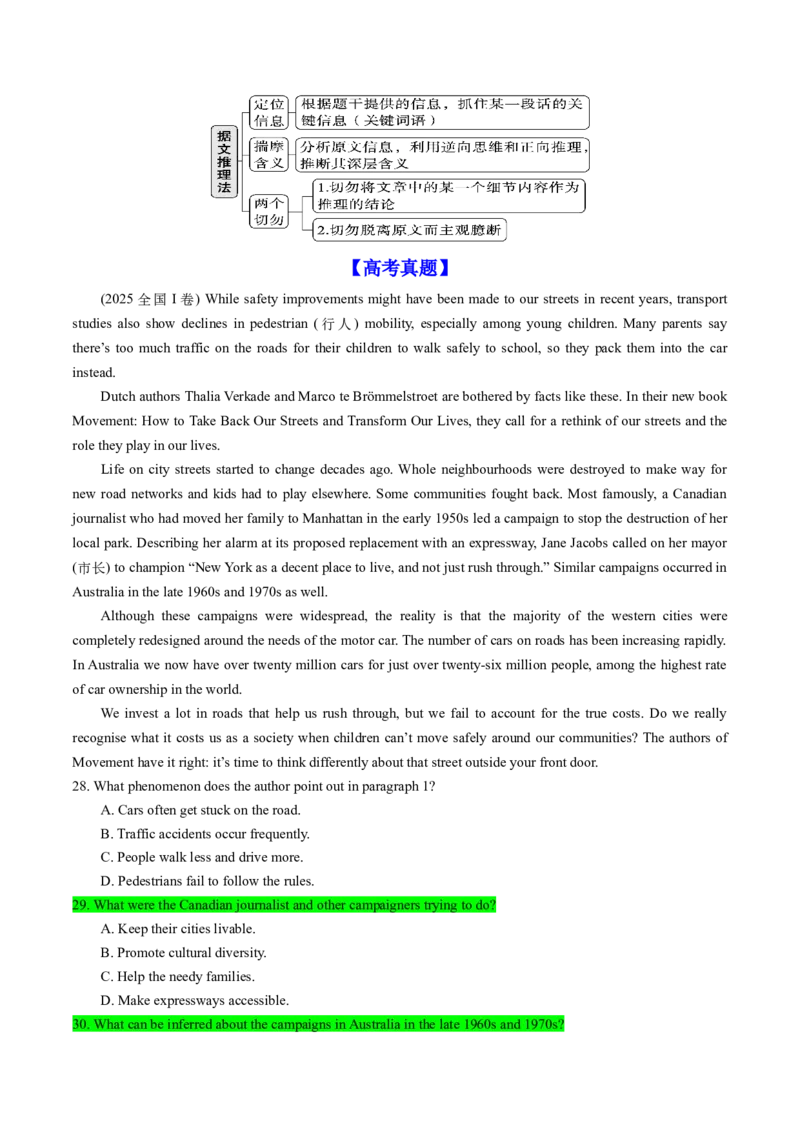
隐含推断题要求考生根据文中的信息进行合理的、适度的逻辑推断,推断出作者没有直接说明的内容,可能
会发生的事情,理解作者的言外之意等。考生只有正确把握文章的内在关系,理解关键词句的真正含义,才可
能作出准确的推断。此类题目的题干主要包括六个动词:infer( 推断),indicate( 象征, 暗示),imply( 暗
示),suggest(暗示),conclude(得出结论)和 assume(假定,设想)。
二、思维导图
【高考真题】
(2025 全国I 卷) While safety improvements might have been made to our streets in recent years, transport
studies also show declines in pedestrian ( 行人) mobility, especially among young children. Many parents say
there’s too much traffic on the roads for their children to walk safely to school, so they pack them into the car
instead.
Dutch authors Thalia Verkade and Marco te Brömmelstroet are bothered by facts like these. In their new book
Movement: How to Take Back Our Streets and Transform Our Lives, they call for a rethink of our streets and the
role they play in our lives.
Life on city streets started to change decades ago. Whole neighbourhoods were destroyed to make way for
new road networks and kids had to play elsewhere. Some communities fought back. Most famously, a Canadian
journalist who had moved her family to Manhattan in the early 1950s led a campaign to stop the destruction of her
local park. Describing her alarm at its proposed replacement with an expressway, Jane Jacobs called on her mayor
(市长) to champion “New York as a decent place to live, and not just rush through.” Similar campaigns occurred in
Australia in the late 1960s and 1970s as well.
Although these campaigns were widespread, the reality is that the majority of the western cities were
completely redesigned around the needs of the motor car. The number of cars on roads has been increasing rapidly.
In Australia we now have over twenty million cars for just over twenty-six million people, among the highest rate
of car ownership in the world.
We invest a lot in roads that help us rush through, but we fail to account for the true costs. Do we really
recognise what it costs us as a society when children can’t move safely around our communities? The authors of
Movement have it right: it’s time to think differently about that street outside your front door.
28. What phenomenon does the author point out in paragraph 1?
A. Cars often get stuck on the road.
B. Traffic accidents occur frequently.
C. People walk less and drive more.
D. Pedestrians fail to follow the rules.
29. What were the Canadian journalist and other campaigners trying to do?
A. Keep their cities livable.
B. Promote cultural diversity.
C. Help the needy families.
D. Make expressways accessible.
30. What can be inferred about the campaigns in Australia in the late 1960s and 1970s?
A. They boosted the sales of cars.
B. They turned out largely ineffective.
C. They won government support.
D. They advocated building new parks.
31. What can be a suitable title for the text?
A. Why the Rush?
B. What’s Next?
C. Where to Stay?
D. Who to Blame?
【名校模拟】
(25-26 高三上·湖北武汉·阶段练习)To keep a Hula-Hoop aloft (悬浮) with robots, it helps to be in
shape — literally. Experiments with hoop-slinging robots have revealed how these rings stay up despite the pull of
gravity. The shape of the robot’s body is a crucial factor, researchers report in the Jan. 7 Proceedings of the
National Academy of Sciences. The shape needs to have “hips” — a slope (斜面) that provides upward force to
balance gravity. And a “waist” arch — like an hourglass (沙漏) — keeps the hoop from moving up or down and
sliding off.
Inspired by performers near his home in Greenwich Village, applied mathematician Leif Ristroph of New
York University began considering the physics of Hula-Hoops. Previous studies, he and his coworkers realized,
hadn’t explained how the hoop stays aloft.
So Ristroph and his coworkers gave it a try. In experiments, a circling cylindrical robot couldn’t keep a hoop
from sliding down. It was missing the essential upward force, generated when a hoop swings over a sloped shape.
But a cone-shaped robot, with a slope but no waistlike curve, also failed. If the hoop began toward the top of the
cone, the upward force overpowered gravity, and the hoop would move up. If the hoop began toward the bottom,
the upward force wasn’t enough to keep it aloft, and it moved down. But an hourglass-shaped robot kept a hoop
stably aloft.
People should be able to hula-hoop regardless of the body shape, by adapting their gyrations (旋转) based on
position changes of the hoop. Indeed, the researchers were able to get a cone-shaped robot to hula-hoop by
adjusting the rate of gyration depending on how high the hoop slid.
A correct launch was also essential in the experiments. If the hoop started off too slow, the attempt would
fail. In successful sessions, the hoop lined up with the gyrating body, so that the hoop and the body always shifted
in the same direction. “That’s also the best way to launch a hoop,” Ristroph says.
“We were surprised that an activity as popular, fun, and healthy as hula hooping wasn’t understood even at a
basic physics level,” says Ristroph. “As we made progress on the research, we realized that the math and physics
involved are very subtle.”
1. Which body shape is ideal for Hula-Hooping according to the experiment?
A. Cone-shaped.
B. Hourglass-shaped.
C. Round.
D. Cylindrical.
2. What is the message implied in the fourth paragraph?
A. Hula-hooping can help shape people’s body gradually.
B. Robots are flexible in learning human body movements.
C. Anyone can do hula-hooping by adjusting their movements.
D. A perfect body shape is required to be a good hula-hoop player.
3. What was essential for a successful Hula-Hoop launch in the experiments?
A. Starting with the right shape.
B. Opposite movement of the hoop and the body.
C. Using a hoop of the proper size.
D. Same directional shifts of the hoop and the body.
4. Which can be used as a proper title for the text?
A. Scientists Identify the Perfect Hula Hoop “Body Type”
B. Hula-hooping Inspires NYU Mathematicians
C. How Do Hula Hoops Benefit Our Health?
D. What Do Hula Hoops Do for Your Body?
(25-26 高三上·河北·阶段练习)British gardens frequently fight with heavy rainfall and sudden cold
spells, which quickly turn the ground muddy and slippery. Maintaining a green and safe lawn ( 草坪) becomes a
tough task — wet weather often leaves lawns bare, and entire gardens end up unused for months. Traditional lawns
require constant care to stay healthy, yet poor weather easily makes them unplayable, leaving outdoor spaces
abandoned from late autumn through early spring.
Modern surface options offer effective fixes. Artificial grass has advanced greatly: New varieties use soft,
multitonal yarns (纱线) to copy real grass, creating a natural look that fits well with garden settings. These high-
quality artificial lawns have UV-resistant fibres and strong year-round durability, keeping their appearance even
after heavy use or sun exposure. Unlike natural grass, which goes fragile in winter, they stay usable all year, perfect
for families with kids or pets.
Permeable paving is another solid choice for walkways and courtyards, as it lets water drain through to avoid
puddles, though it lacks the warm, soft feel of grass. Proper installation is key, especially for drainage. A compacted
(压实的) crushed stone sub-base is a must for the artificial lawn — it prevents water from pooling underneath —
while using the wrong sand or skimping on sub-base depth leads to wet areas. Soil compaction also worsens wet
problems, cutting air and water flow by up to 30% versus well-aerated ground.
Environmentally, artificial lawns reduce water use by around 55% yearly, but traditional lawns need
hundreds of litres weekly in dry spells. Pairing modern surfaces with rainwater harvesting systems and native
planting schemes boosts sustainability, making gardens both practical and eco-friendly.
Zoning gardens — using artificial lawns for play areas, permeable paving for dining spots, and raised beds
for planting — plus adding small wildflower patches, creates functional year-round spaces. Demand for these
solutions is rising in northern UK regions like Greater Manchester and Yorkshire, helping homeowners overcome
waterlogging (水涝) and fully reclaim their outdoor areas.
5. Why do traditional British gardens stay unused in winter?
A. The gardens lack proper care.
B. The lawns need seasonal rest.
C. Bad weather ruins the lawns.
D. Indoor activities are more suitable.
6. What is a feature of the new artificial grass?
A. It is the same as real grass.
B. It fades in strong sunlight.
C. It reduces heavy rainfall.
D. It can be used all year round.
7. What can an improper sub-base for an artificial lawn bring about?
A. Increasing air flow.
B. Waterlogged ground.
C. A crowded garden.
D. The lawn’s expansion.
8. What does the text imply about sustainable garden design?
A. It mainly uses fully recyclable products.
B. It requires much water for native plants.
C. It abandons traditional lawns completely.
D. It combines modern features and eco-elements.
找共同点题3 篇
【名师点津】
一、解题小妙招
1.结构法:如果属于“总分总”结构,多从“总处”找依据;
2.排除法:可以运用排除法,只要一项不合要求就应该排除;
3.关键词法:依据题干圈划相应的关键词语,据此知道答案。
二、零失误小妙招
1.做题留痕,依据题干在原文圈划答题区间;
2.划掉错项,去伪存真,快速作答提升效率;
3.错题反思,专用笔记本记录错因举一反三。
【高考真题】
(2024 新课标II 卷)              Choice of Walks for Beginner and Experienced Walkers
The Carlow Autumn Walking Festival is a great opportunity for the beginner, experienced or advanced walker
to enjoy the challenges of Carlow’s mountain hikes or the peace of its woodland walks.
Walk 1 — The Natural World
With environmentalist Éanna Lamhna as the guide, this walk promises to be an informative tour. Walkers are
sure to learn lots about the habitats and natural world of the Blackstairs.
Date and Time: Saturday, 1st October, at 09:00
Start Point: Scratoes Bridge
Walk Duration: 6 hours
Walk 2 — Introduction to Hillwalking
Emmanuel Chappard, an experienced guide, has a passion for making the great outdoors accessible to all. This
mountain walk provides an insight into the skills required for hillwalking to ensure you get the most from future
walking trips.
Date and Time: Sunday, 2nd October, at 09:00
Start Point: Deerpark Car Park
Walk Duration: 5 hours
Walk 3 — Moonlight Under the Stars
Walking at night-time is a great way to step out of your comfort zone. Breathtaking views of the lowlands of
Carlow can be enjoyed in the presence of welcoming guides from local walking clubs. A torch (手电筒) along with
suitable clothing is essential for walking in the dark. Those who are dressed inappropriately will be refused
permission to participate.
Date and Time: Saturday, 1st October, at 18:30
Start Point: The Town Hall
Walk Duration: 3 hours
Walk 4 — Photographic Walk in Kilbrannish Forest
This informative walk led by Richard Smyth introduces you to the basic principles of photography in the wild.
Bring along your camera and enjoy the wonderful views along this well-surfaced forest path.
Date and Time: Sunday, 2nd October, at 11:45
Start Point: Kilbrannish Forest Recreation Area
Walk Duration: 1.5 hours
21. Which walk takes the shortest time?
A. The Natural World.
B. Introduction to Hillwalking.
C. Moonlight Under the Stars.
D. Photographic Walk in Kilbrannish Forest.
22. What are participants in Walk 3 required to do?
A. Wear proper clothes.
B. Join a walking club.
C. Get special permits.
D. Bring a survival guide.
23. What do the four walks have in common?
A. They involve difficult climbing.
B. They are for experienced walkers.
C. They share the same start point.
D. They are scheduled for the weekend.
 (2023 全国乙卷)                             PRACTITIONERS
21. What did Jacqueline and James have in common?
A. Doing teaching jobs.
B. Being hired as physicians.
C. Performing surgery.
D. Being banned from medicine.
22. How was Tan Yunxian different from the other practitioners?
Jacqueline Felice de Almania (c.1322) highlights the
suspicion that women practicing medicine faced. Born to a
Jewish family in Florence, she moved to Paris where she
worked as a physician and performed surgery. In 1322 she
was tried for practicing unlawfully. In spite of the court
hearing testimonials ( 证明) of her ability as a doctor, she
was banned from medicine.
James Barry (c.1789 — 1865) was born
Margaret Bulkley in Ireland but, dressed as a
man, she was accepted by Edinburgh University
to study medicine. She qualified as a surgeon in
1813, then joined the British Army, serving
overseas. Barry retired in 1859, having
practiced her entire medical profession living
and working as a man.
Tan Yunxian (1461 — 1554) was a Chinese physician
who learned her skills from her grandparents. Chinese
women at the time could not serve apprenticeships (学徒期)
with doctors. However, Tan passed the official exam. Tan
treated women from all walks of life. In 1511, Tan wrote a
book, Sayings of a Female Doctor, describing her life as a
physician.
Rebecca Lee Crumpler (1831 — 1895)
worked as a nurse for eight years before
studying in medical college in Boston in 1860.
Four years later, she was the first African
American woman to receive a medical degree.
She moved to Virginia in 1865, where she
provided medical care to freed slaves.
A. She wrote a book.
B. She went through trials.
C. She worked as a dentist.
D. She had formal education.
23. Who was the first African American with a medical degree?
A. Jacqueline Felice de Almania.
B. Tan Yunxian.
C. James Barry.
D. Rebecca Lee Crumpler.
【名校模拟】
(25-26 高三上·四川成都·阶段练习)London’s West End is renowned for its world-class theatrical
productions, drawing millions of visitors each year. While seeing a show might seem like a luxury, enjoying the
magic of theatre doesn’t have to break the bank. Below are some of the best theatres that make a night out both
memorable and affordable.
His Majesty’s Theatre
This historic theatre is known for its stunning architecture and excellent productions. Amazing offers:
· a variety of ticket options, including rock zone standing tickets for an immersive experience, as well as
balcony and box seats.
· an on-site café serving light meals and drinks before shows.
· up to 30% off for an early booking.
The Globe Playhouse
A family-friendly venue with a focus on Shakespearean plays.
Key comforts:
· Matinee performances with marked-down early bird ticket prices.
· Interactive workshops for children to learn about theatre.
Theatre Royal Drury Lane
A contemporary theatre offering innovative plays and musicals.
Highlights:
· Flexible seating: orchestra seats for clear views and mezzanine for affordability.
· Special sound-enhanced shows.
Lyceum Theatre
A mid-sized venue known for its intimate atmosphere and diverse performances.
Family-friendly features:
· Group discount tickets for families or large parties.
· Wheelchair-accessible entrances and seating.
· Located close to restaurants and parks for pre or post-show activities.
1. What can guests do at His Majesty’s Theatre?
A. Attend interactive workshops for children.
B. Get a discounted ticket by paying 30% of the original price.
C. Enjoy discounted meals at the on-site café.
D. Purchase rock zone tickets for close-up views.
2. Which theatre is the best choice for a family with a hearing-challenged member?
A. His Majesty’s Theatre.
B. The Globe Playhouse.
C. Theatre Royal Drury Lane.
D. Lyceum Theatre.
3. What do The Globe Playhouse and Lyceum Theatre have in common?
A. They both offer discounted tickets for certain groups.
B. They are known for rock zone ticket options.
C. They provide wheelchair-accessible seating.
D. They have outdoor performance areas.
(25-26 高三上· 重庆沙坪坝· 开学考试)At Boston Private Guide, we specialize in personalized
sightseeing tours that showcase the best of New England.
Boston Public Walking Tour
Duration:2.5 hours; Price(adults): $30,(children 5-12): $15
The tour takes visitors to some of the city's most iconic and historic landmarks, including Boston Common,
Boston Public Garden, the Freedom Trail, and Beacon Hill. It is an excellent way for visitors to gain some
fascinating insights into the city's rich heritage.
Experiencing Harvard
Duration:90 minutes; Price (adults): $30, (children 5-12): $10
This tour takes you through the heart of Harvard Yard, where history, tradition, and academic excellence
come to life. You’ll visit some of Harvard’s most well-known landmarks, including the John Harvard Statue,
Widener Library, Memorial Church, and Harvard Yard while discovering fascinating stories about the university's
spirit and tradition, and legendary alumni —— graduates and famous dropouts.
Martha's Vineyard
Duration:5 hours; Price: $500 per tour; Max number of travelers:6; Book in advance
Martha's Vineyard, with its rich history, scenic landscapes, and distinct charm, is the perfect destination for a
day trip. The island is home to six unique towns, each with its own character and appeal. While we explore them
all, we’ll also explore the island’s hidden back roads and fishing villages, offering a deeper glimpse into its
authentic coastal beauty.
Boston by Night
Duration:3 hours; Price: $50 per person; At least 3 participants
Step off the beaten path and discover Boston's nightlife through the eyes of a local. On our Boston by Night
tour, we’ll take you to hidden, off-the-radar pubs where you’ll enjoy exclusive cocktails from secret recipes only
locals know. As you enjoy one-of-a-kind drinks, you will engage in fun and lively conversations, and uncover
fascinating stories about Boston's past and culture.
4. Which tour has the longest duration?
A. Martha's Vineyard.
B. Experiencing Harvard.
C. Boston by Night.
D. Boston Public Walking Tour.
5. What are participants for Boston by Night required to do?
A. Pay a fixed group fee.
B. Share their own secret recipes.
C. Book in advance.
D. Join with at least 2 other people.
6. What do the four tours have in common?
A. They involve history and culture.
B. They take you to downtown Boston.
C. They are for experienced travelers.
D. They feature views of natural landscapes.
预测下段题3 篇
【名师点津】
一、解题小妙招
考生在阅读全文基础上,“预测下段”类试题应注意以下两点策略:
1. 从最后一段入手。
有时候,作者在最后一段提到一个话题,但是没有充分说明,因此需要在下一段就此问题深入分析、论述
或讨论。所以考生学会依据最后一段甚至最后一句话进行推断也不失为明智选择。
2. 从第一段入手。
实用类说明文往往采用“总分”或者“总分总”结构,即第一段总体概况说明,然后分段阐述。因此只要
考生把握好第一段即主题段内容,顺藤摸瓜,即可推断下段内容应该是主题段中尚未提及的内容。
二、零失误小妙招
1.做题留痕,依据题干在原文圈划答题区间;
2.划掉错项,去伪存真,快速作答提升效率;
3.错题反思,专用笔记本记录错因举一反三。
【高考真题】
(2023 全国乙卷) What comes into your mind when you think of British food? Probably fish and chips, or a
Sunday dinner of meat and two vegetables. But is British food really so uninteresting? Even though Britain has a
reputation for less-than-impressive cuisine, it is producing more top class chefs who appear frequently on our
television screens and whose recipe books frequently top the best seller lists.
It’s thanks to these TV chefs rather than any advertising campaign that Britons are turning away from meat-
and-two-veg and ready-made meals and becoming more adventurous in their cooking habits. It is recently reported
that the number of those sticking to a traditional diet is slowly declining and around half of Britain’s consumers
would like to change or improve their cooking in some way. There has been a rise in the number of students
applying for food courses at UK universities and colleges. It seems that TV programmes have helped change what
people think about cooking.
According to a new study from market analysts, 1 in 5 Britons say that watching cookery programmes on TV
has encouraged them to try different food. Almost one third say they now use a wider variety of ingredients (配料)
than they used to, and just under 1 in 4 say they now buy better quality ingredients than before. One in four adults
say that TV chefs have made them much more confident about expanding their cookery knowledge and skills, and
young people are also getting more interested in cooking. The UK’s obsession (痴迷) with food is reflected through
television scheduling. Cookery shows and documentaries about food are broadcast more often than before. With an
increasing number of male chefs on TV, it’s no longer “uncool” for boys to like cooking.
28. What do people usually think of British food?
A. It is simple and plain.
B. It is rich in nutrition.
C. It lacks authentic tastes.
D. It deserves a high reputation.
29. Which best describes cookery programme on British TV?
A. Authoritative.
B. Creative.
C. Profitable.
D. Influential.
30. Which is the percentage of the people using more diverse ingredients now?
A. 20%.
B. 24%.
C. 25%.
D. 33%.
31. What might the author continue talking about?
A. The art of cooking in other countries.
B. Male chefs on TV programmes.
C. Table manners in the UK.
D. Studies of big eaters.
【名校模拟】
(2025·陕西安康·模拟预测)At most art museums, there is a fundamental and well-established rule for
viewers: “Look but don’t touch.” This rule is in place to protect the precious artworks from potential damage.
However, the Sainsbury Centre in the United Kingdom is a refreshing exception.
The Sainsbury Centre recently initiated a groundbreaking new program. This program breaks the traditional
barriers between the audience and the art, inviting museumgoers to have an up-close and personal encounter with
the exhibits. A typical example is the invitation to hug Henry Moore’s 1932 sculpture Mother and Child.
Visitors to the centre listen to an audio tour recorded by the museum’s director, Jago Cooper. His voice
guides them not just to view Moore’s sculpture but to appreciate it! They’re asked to make eye contact with the
mother figure, close their eyes, and think of their earliest memory of being held as a child. “That feeling within you,
that feeling of protection, is what Henry was trying to create with this work,” the audio explains.
The exercise is designed to help visitors realize that art is an emotional state of mind, an idea that Moore
himself seemed to agree with. Cooper says there’s video footage ( 镜头) of the artist telling one of the centre’s
founders that anyone who thinks they understand his art without touching it doesn’t know anything about sculpture.
Usually museums discourage visitors from handling art because oils and dirt on people’s hands can damage
the works. People could also accidentally scratch ( 划伤) or break the art. Cooper acknowledges that allowing
people to physically interact with art must be done on a case-by-case basis. “Lots of works of art aren’t designed to
be touched,” he says. In those instances, they invite visitors to engage with art in other non-traditional ways. That
includes dancing with 1,200-year-old Tang Dynasty figures and lying in a hanging bed while telling a secret to a
1948 painting by Alberto Giacometti.
1. What is special about the Sainsbury Centre?
A. It allows visitors to merely view the works.B. It tolerates damage to artworks.
C. It encourages a touch on some exhibits.
D. It offers free audio tours to visitors.
2. What does the practice with Moore’s sculpture aim to do?
A. Get across the artist’s idea.
B. Draw visitors’ attention.
C. Appeal to viewers’ tastes.
D. Build up the artist’s reputation.
3. Why are Tang Dynasty figures mentioned in the last paragraph?
A. To illustrate the artworks’ long history.
B. To indicate the richness of the centre’s collection.
C. To contrast diverse methods of art-interaction.
D. To present a non-traditional art-interaction way.
4. What might the author continue talking about?
A. Clarification of physical art interaction.
B. Advanced methods for art preservation.
C. Examples of touch-friendly artworks.
D. More innovative ways to engage with art
(24-25 高三下· 河南· 阶段练习)Wildfires fueled by extreme winds have swept across the Pacific
Palisades area in Los Angeles County, destroying countless structures and forcing the evacuation (撤离) of more
than 30,000 people.
As of 9:30 pm ET, more than 2,900 acres have burned, fire officials said. The powerful Santa Ana winds are
challenging firefighting efforts. The evacuation order includes more than 10,000 homes and thousands of
businesses. Los Angeles County Fire Chief Anthony Marrone said on Tuesday afternoon during a news conference,
“We are not out of danger,” warning that the most significant threat will be between 10 pm and 5am PT when the
Santa Ana winds will be at their fiercest. Marrone urged people to be ready to evacuate at a moment’s notice
overnight.
Los Angeles City Councilwoman Traci Park, who represents the area, described the situation as “terrifying”.
She urged people to “be packed and ready to go” if people are told to evacuate. Already, tens of thousands of people
have been ordered to leave their homes and businesses as the fires are spreading violently into neighborhoods. Park
says “it may take a couple of days” to get the situation under control and “it may be some time before people can
return to their homes.”
As of 9:30 pm EST Tuesday, about 25,000 homes and businesses had their power cut off as crews battle the
Palisades Fire. California Gov. Gavin Newsom declared a state of emergency as the fire continued to burn through
Los Angeles County and more residents have been ordered to evacuate in the fire zones north and west of Los
Angeles. Newsom toured some of the neighborhoods consumed by wildfires. He applauded the efforts of crews to
pre-position firefighters, aircraft and other equipment ahead of the predicted firestorm. While this news conference
focused on the situation in Los Angeles County, forecasters warned of a potential worsening problem in Orange,
San Bernardino and Riverside Counties, just to the south and east.
5. What is the main difficulty faced by firefighters?
A. Strong winds spreading fires.
B. Limited evacuation routes.
C. Vast structural remains removal.
D. Lack of public cooperation.
6. What is the primary concern expressed by Marrone and Park?
A. Evacuation efforts are being delayed.
B. The danger period may extend further.
C. The fire is changing direction rapidly.
D. Firefighter resources are insufficient.
7. Which word best describes Newsom when he saw crews’ preparations?
A. Discouraged.
B. Appreciative.
C. Dismissive.
D. Unexpected.
8. What might the author continue talking about regarding the wildfires?
A. Firefighting equipment details.
B. Evacuation success stories.
C. Impact on nearby counties.
D. Residents’ personal experiences.
文章出处题3 篇
【名师点津】
一、解题小妙招
“推断文章出处”类试题应从文章的内容或结构入手来判断其出处:
研究报告类文章(a research paper):此类文章重点介绍科技领域最新研究成果:新发现、新思想、新发明。
第一段概括介绍,然后分段陈述。文章结构严谨,语言规范,句式复杂。
图书评论类文章(a book review):书评、影评类文章涉及到作者介绍,内容梗概、人物性格评论,写作特色
以及个人好恶等内容。
广告英语类文章(an advertisement):现代生活中广告无处不在,英语阅读理解也是如此。有时会考查微型
海报、通知、启示、时刻表、图表等。
科普杂志类文章(a science magazine):此类文章内容广泛,涉及到日常生活习惯、健康饮食、太空与海洋、
创造与发明、计算机发展、人类未来、动物世界等。其重点是普及科学知识,提高科学素养。
教材课本类文章(a geography textbook):此类文章内容比较正式,语言规范,往往涉及到学科术语、专业性
词汇、概念、理论等。
课件展示类文章(a class presentation):此类文章往往紧扣主题,口语性强、语言活泼,形式新颖,伴随有图
片、图表、文字介绍等信息。
网络网页类文章(an Internet page):此类文章往往会提供超级链接标志,如For more information, please click
here.
二、零失误小妙招
1.做题留痕,依据题干在原文圈划答题区间;
2.划掉错项,去伪存真,快速作答提升效率;
3.错题反思,专用笔记本记录错因举一反三。
【高考真题】
(2023 新课标II 卷)Reading Art: Art for Book Lovers is a celebration of an everyday object — the book,
represented here in almost three hundred artworks from museums around the world. The image of the reader
appears throughout history, in art made long before books as we now know them came into being. In artists’
representations of books and reading, we see moments of shared humanity that go beyond culture and time.
In this “book of books,” artworks are selected and arranged in a way that emphasizes these connections
between different eras and cultures. We see scenes of children learning to read at home or at school, with the book
as a focus for relations between the generations. Adults are portrayed (描绘) alone in many settings and poses —
absorbed in a volume, deep in thought or lost in a moment of leisure. These scenes may have been painted hundreds
of years ago, but they record moments we can all relate to.
Books themselves may be used symbolically in paintings to demonstrate the intellect (才智), wealth or faith of
the subject. Before the wide use of the printing press, books were treasured objects and could be works of art in
their own right. More recently, as books have become inexpensive or even throwaway, artists have used them as the
raw material for artworks — transforming covers, pages or even complete volumes into paintings and sculptures.
Continued developments in communication technologies were once believed to make the printed page
outdated. From a 21st-century point of view, the printed book is certainly ancient, but it remains as interactive as
any battery-powered e-reader. To serve its function, a book must be activated by a user: the cover opened, the pages
parted, the contents reviewed, perhaps notes written down or words underlined. And in contrast to our increasingly
networked lives where the information we consume is monitored and tracked, a printed book still offers the chance
of a wholly private, “off-line” activity.
8. Where is the text most probably taken from?
A. An introduction to a book.
B. An essay on the art of writing.
C. A guidebook to a museum.
D. A review of modern paintings.
9. What are the selected artworks about?
A. Wealth and intellect.
B. Home and school.
C. Books and reading.
D. Work and leisure.
10. What do the underlined words “relate to” in paragraph 2 mean?
A. Understand.
B. Paint.
C. Seize.
D. Transform.
11. What does the author want to say by mentioning the e-reader?
A. The printed book is not totally out of date.
B. Technology has changed the way we read.
C. Our lives in the 21st century are networked.
D. People now rarely have the patience to read.
 (2022 新课标I 卷)         Grading Policies for Introduction to Literature
Grading Scale
90-100, A; 80-89, B; 70-79, C; 60-69, D; Below 60, E.
Essays (60%)
Your four major essays will combine to form the main part of the grade for this course: Essay 1 = 10%; Essay
2 = 15%; Essay 3 = 15%; Essay 4 = 20%.
Group Assignments (30%)
Students will work in groups to complete four assignments (作业) during the course. All the assignments will
be submitted by the assigned date through Blackboard, our online learning and course management system.
Daily Work/In-Class Writings and Tests/Group Work/Homework (10%)
Class activities will vary from day to day, but students must be ready to complete short in-class writings or
tests drawn directly from assigned readings or notes from the previous class' lecture/discussion, so it is important to
take careful notes during class. Additionally, from time to time I will assign group work to be completed in class or
short assignments to be completed at home, both of which will be graded.
Late Work
An essay not submitted in class on the due date will lose a letter grade for each class period it is late. If it is not
turned in by the 4th day after the due date, it will earn a zero. Daily assignments not completed during class will get
a zero. Short writings missed as a result of an excused absence will be accepted.
21. Where is this text probably taken from?
A. A textbook.
B. An exam paper.
C. A course plan.
D. An academic article.
22. How many parts is a student’s final grade made up of?
A. Two.
B. Three.
C. Four.
D. Five.
23. What will happen if you submit an essay one week after the due date?
A. You will receive a zero.
B. You will lose a letter grade.
C. You will be given a test.
D. You will have to rewrite it.
【名校模拟】
(25-26 高三上·广西·阶段练习)Some foods are highly processed or ultra-processed (过度加工). Ultra-
processed foods (UPF) have become increasingly popular and range from chips to microwave meals and even
bread. Even just a casual glance at supermarket shelves reveals a collection of UPF offerings in delicate and
attractive packaging. Besides their affordability, UPF not only offer time-saving convenience, but also momentary
satisfaction filled with fat, sugar, salt and additives (添加剂). After all, who can resist enjoying a tasty snack
when lost in a football game or an exciting new TV series?
Although much is discussed about the direct negative impact of these products on our health, including
obesity, heart diseases and diabetes, little has been said about the impacts of UPF on the environment. The most
serious environmental impacts of UPF-rich diets mainly come from the post-farm stages, especially from the final
product creation and packaging processes.
One specific additive that has the most environmental impact is palm oil. Palm oil is responsible for
deforestation of some of the world’s big forests, which have diverse animals and plants. It is one of the world’s
most consumed vegetable oils that can be found in half of our food. The massive waste generated by over-packaged
UPF is another factor to consider. Their plastic packaging doesn’t degrade in landfills or in nature and has a
dramatic impact on soil health and life in the sea. One recent study published in Nature Sustainability demonstrates
that UPF processing and packaging stages have the greatest environmental impacts of the whole system and are a
major source of environmental waste worldwide.
The environmental impact of ultra-processed foods cannot be ignored any longer. While producers must take
action, it is our growing awareness of what we buy and how it is produced that drives real change. By choosing
wisely — whether by rejecting heavily processed options or supporting sustainable brands — we exercise the
power to shape a better food system, a responsibility we must embrace.
1. What can be learned about UPF from the first paragraph?
A. They are primarily consumed during casual leisure activities.
B. They are carefully produced to be environmentally friendly.
C. They are filled with various kinds of healthy added nutrients.
D. They are favored by many for their fancy packages and flavors.
2. Why was palm oil  introduced in the text?
A. To compare it with some other vegetable oils.
B. To explain UPF’s harmful environmental effects.
C. To show its relationship with animals and plants.
D. To discuss factors of UPF’s packaging-related pollution.
3. What does the author think of the role we play in fighting UPF?
A. Tiny.
B. Essential.
C. Replaceable.
D. Limited.
4. Where is the text probably taken from?
A. An environmental magazine.
B. A public health journal.
C. A food industry report.
D. An advertisement brochure.
(25-26 高三上·陕西咸阳·阶段练习)J. D. Salinger’s The Catcher in the Rye remains a classic novel of
adolescent rebellion and isolation, connecting with generations since its 1951 publication. Through the voice of
Holden Caulfield, a teenager kicked out of prep school, Salinger captures the raw emotions of youth — anger,
confusion, and a desperate search for realness in a world he dismisses as “phoney”. The novel’s lasting power lies
not in grand adventure but in its intimate portrayal of Holden’s internal struggles, which reflect universal teenage
experience.
Holden’s journey through New York City acts as a psychological exploration. He criticizes the hypocrisy (虚
伪) of the adult world, mocks social expectations, and fantasizes about escaping to a simpler life “away from all the
nonsense.” Yet beneath his cynical (愤世嫉俗的) appearance lies vulnerability.
Symbolism deepens the novel’s exploration of innocence and loss. The repeated image of the “catcher in the
rye” — Holden’s fantasy of saving children from falling off a cliff — symbolizes his wish to preserve childhood
innocence. His repeated visits to the Museum of Natural History, where displays stay unchanged, reveal his longing
for stability. The ducks in Central Park’s Lake, which mysteriously disappear each winter, mirror Holden’s anxiety
about life’s uncertainties. Even the novel’s preface as “authentic adolescent voice”, serves as a rebellion against
social norms, making Holden’s voice feel startlingly real.
Though set in the 1950s, The Catcher in the Rye continues to speak to modern teenagers. In an era
dominated by social media and artificial identities, Holden’s hatred of hypocrisy feels strikingly relatable. Unlike
today’s digital interactions, Holden’s handwritten letters and face-to-face encounters in the novel emphasize the
original pure nature of human connection. Salinger’s refusal to romanticize adolescence — offering no easy
answers to pain — challenges readers to confront their own struggles with growing up. The novel endures not as a
relic but as a timeless conversation about the confusion and struggles of youth.
5. Where is the text most probably taken from?
A. A news report about modern education.
B. A literary journal on figures of speech.
C. A publisher’s preface for a special edition.
D. A psychological study on teenage rebellion.
6. What does the underlined word “phoney” in paragraph 2 probably mean?
A. Fake.
B. Dangerous.
C. Traditional.
D. Complicated.
7. According to paragraph 3, what does the image “catcher in the rye” represent?
A. Holden’s admiration for rural life.
B. Holden’s desire to escape society.
C. Holden’s criticism of educational systems.
D. Holden’s wish to protect childhood purity.
8. What does Salinger agree with according to the last paragraph?
A. Adolescence deserves romanticizing.
B. Genuine human connections are vital.
C. Social media fosters sincere connections.
D. Teenagers require straightforward life solutions.