专题07 猜测词义题
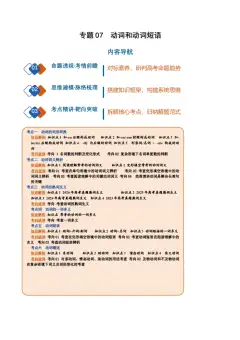
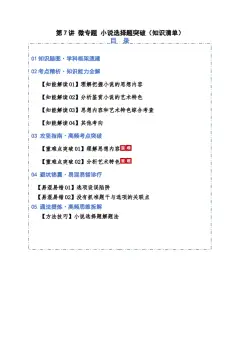
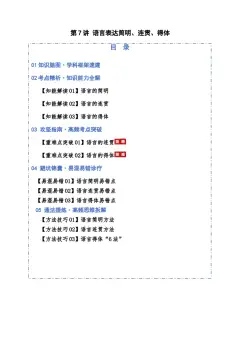
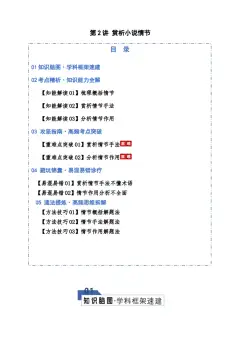
目录
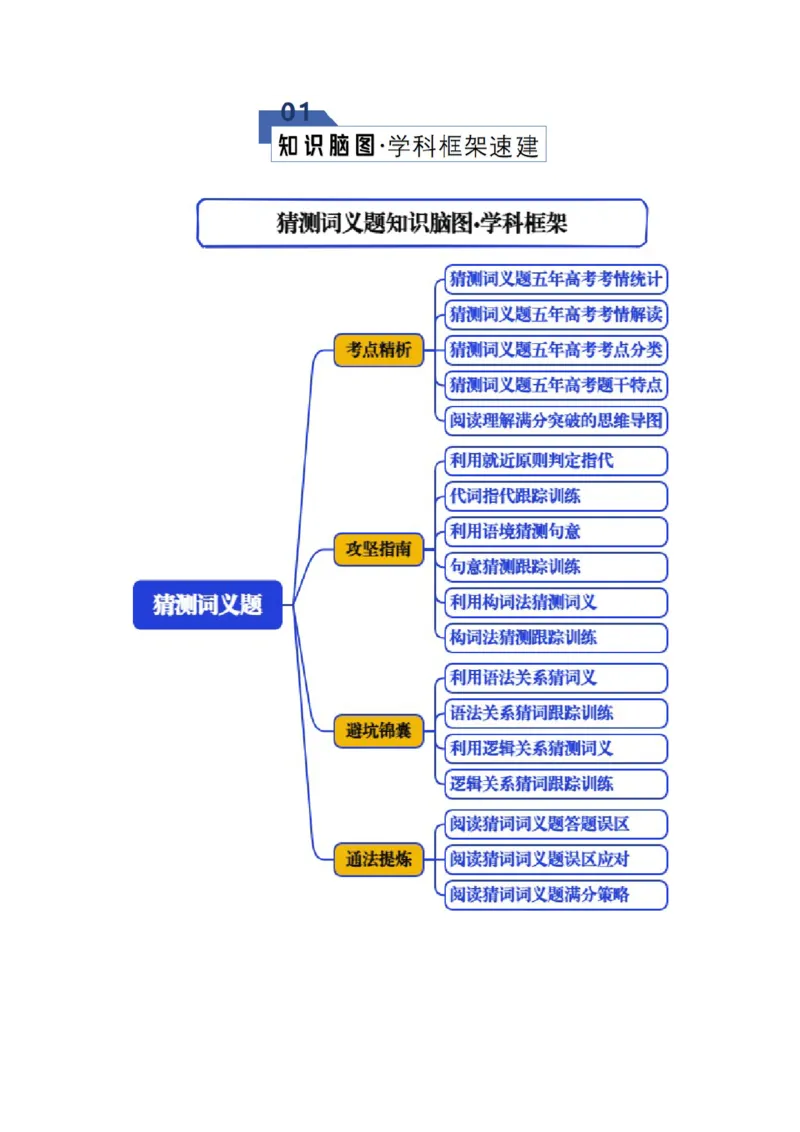
01 知识脑图·学科框架速建
02 考点精析·知识能力全解
【知能解读01】猜测词义题五年高考考情统计
【知能解读02】猜测词义题五年高考考情解读
【知能解读03】猜测词义题五年高考考点分类
【知能解读04】猜测词义题五年高考题干特点
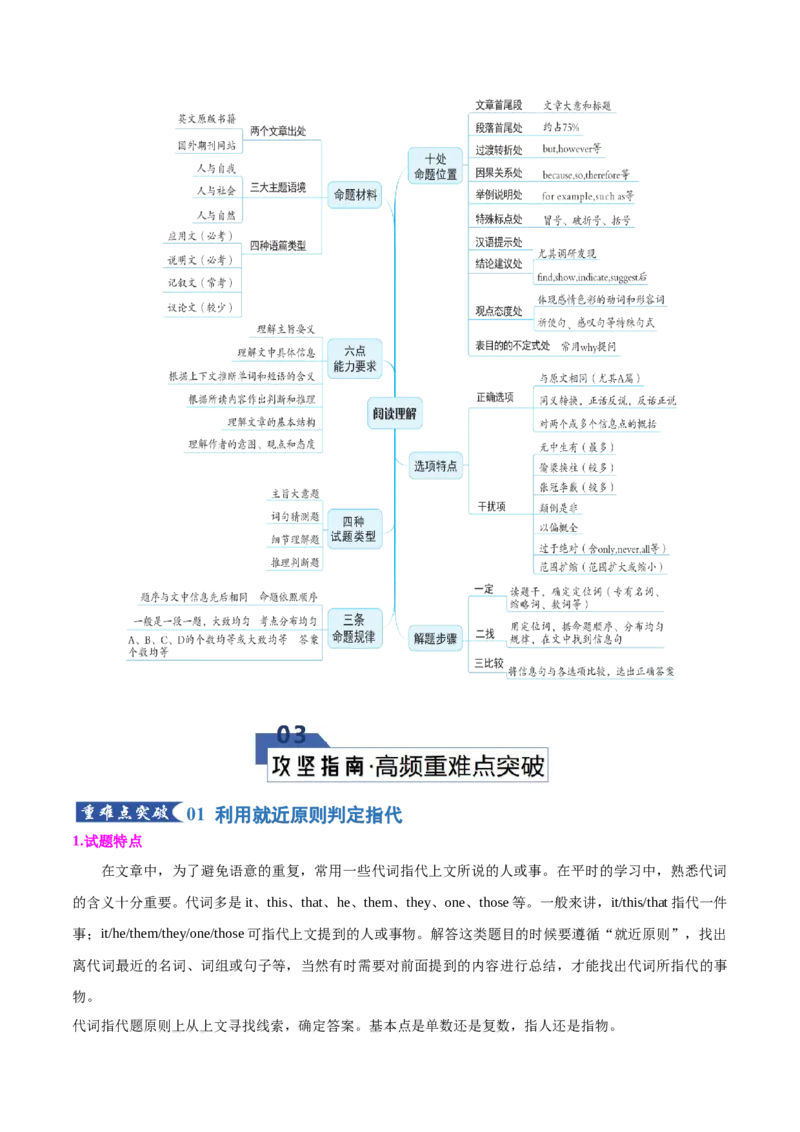
【知能解读05】阅读理解满分突破思维导图
03 攻坚指南·高频考点突破
【重难点突破01】利用就近原则判指代
【重难点突破02】代词指代跟踪训练
【重难点突破03】利用语境猜测句意
【重难点突破04】句意猜测跟踪训练
【重难点突破05】利用构词法猜测词义
【重难点突破06】构词法猜测跟踪训练
04 避坑锦囊·易混易错诊疗
【易混易错01】利用语法关系猜测词义
【易混易错02】语法关系猜词跟踪训练
【易混易错03】利用逻辑关系猜测词义
【易混易错04】逻辑关系猜词跟踪训练
05 通法提炼·高频思维拆解
【方法技巧01】阅读猜词词义题答题误区
【方法技巧02】阅读猜词词义题误区应对
【方法技巧03】阅读猜词词义题满分策略
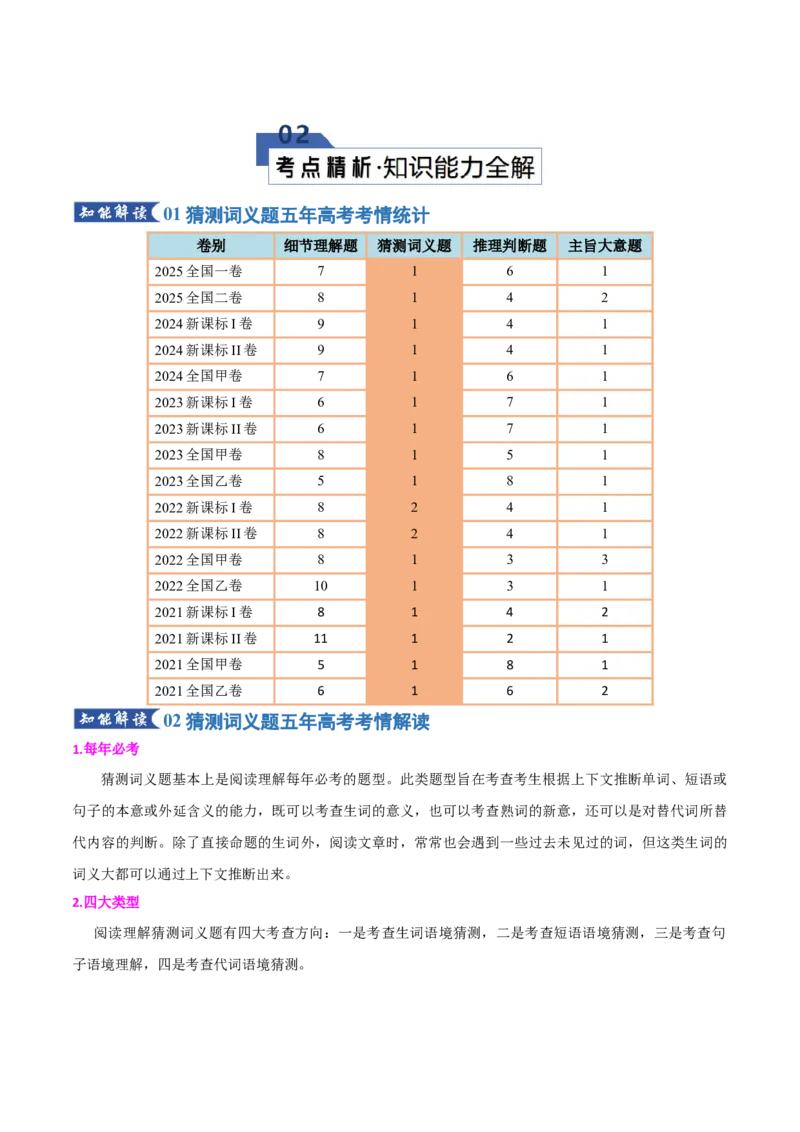
01 猜测词义题五年高考考情统计
卷别
细节理解题
猜测词义题
推理判断题
主旨大意题
2025 全国一卷
7
1
6
1
2025 全国二卷
8
1
4
2
2024 新课标I 卷
9
1
4
1
2024 新课标II 卷
9
1
4
1
2024 全国甲卷
7
1
6
1
2023 新课标I 卷
6
1
7
1
2023 新课标II 卷
6
1
7
1
2023 全国甲卷
8
1
5
1
2023 全国乙卷
5
1
8
1
2022 新课标I 卷
8
2
4
1
2022 新课标II 卷
8
2
4
1
2022 全国甲卷
8
1
3
3
2022 全国乙卷
10
1
3
1
2021 新课标I 卷
8
1
4
2
2021 新课标II 卷
11
1
2
1
2021 全国甲卷
5
1
8
1
2021 全国乙卷
6
1
6
2
02 猜测词义题五年高考考情解读
1.每年必考
猜测词义题基本上是阅读理解每年必考的题型。此类题型旨在考查考生根据上下文推断单词、短语或
句子的本意或外延含义的能力,既可以考查生词的意义,也可以考查熟词的新意,还可以是对替代词所替
代内容的判断。除了直接命题的生词外,阅读文章时,常常也会遇到一些过去未见过的词,但这类生词的
词义大都可以通过上下文推断出来。
2.四大类型
阅读理解猜测词义题有四大考查方向:一是考查生词语境猜测,二是考查短语语境猜测,三是考查句
子语境理解,四是考查代词语境猜测。
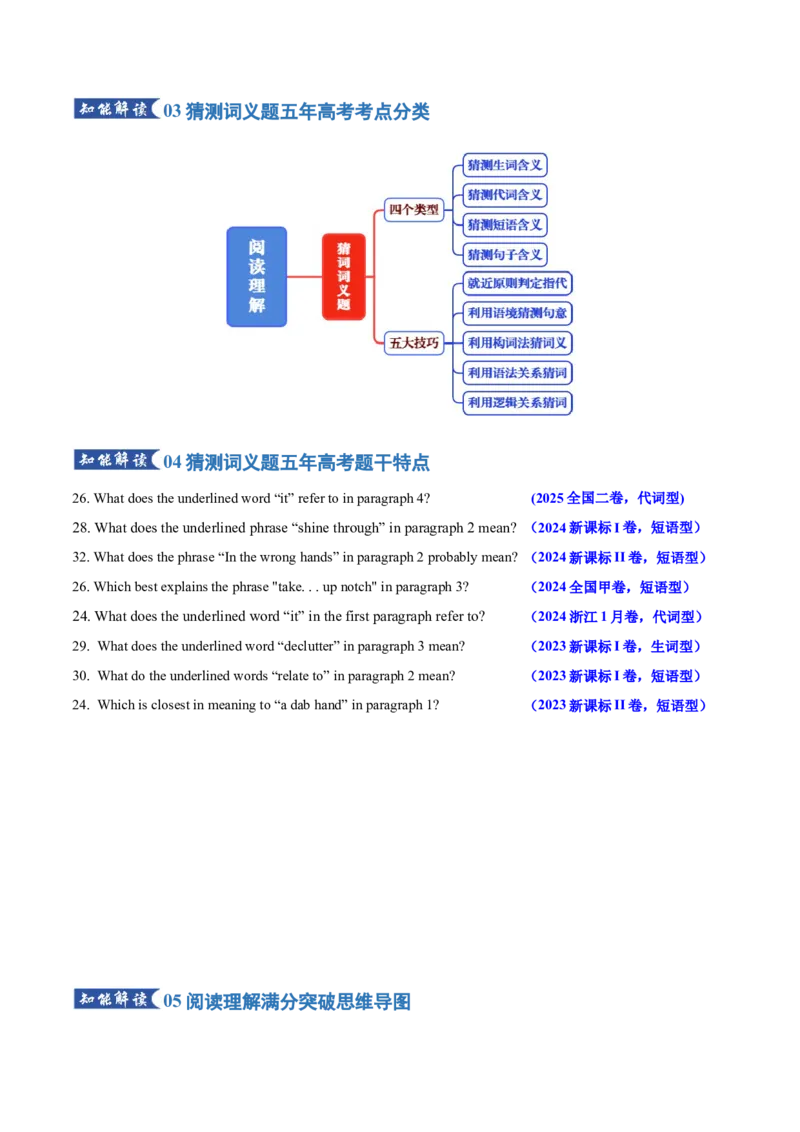
03 猜测词义题五年高考考点分类
04 猜测词义题五年高考题干特点
26. What does the underlined word “it” refer to in paragraph 4?
 (2025 全国二卷,代词型)
28. What does the underlined phrase “shine through” in paragraph 2 mean? (2024 新课标I 卷,短语型)
32. What does the phrase “In the wrong hands” in paragraph 2 probably mean? (2024 新课标II 卷,短语型)
26. Which best explains the phrase "take. . . up notch" in paragraph 3?
(2024 全国甲卷,短语型)
24. What does the underlined word “it” in the first paragraph refer to?
(2024 浙江1 月卷,代词型)
29. What does the underlined word “declutter” in paragraph 3 mean?
(2023 新课标I 卷,生词型)
30. What do the underlined words “relate to” in paragraph 2 mean?
(2023 新课标I 卷,短语型)
24. Which is closest in meaning to “a dab hand” in paragraph 1?
(2023 新课标II 卷,短语型)
05 阅读理解满分突破思维导图
01 利用就近原则判定指代
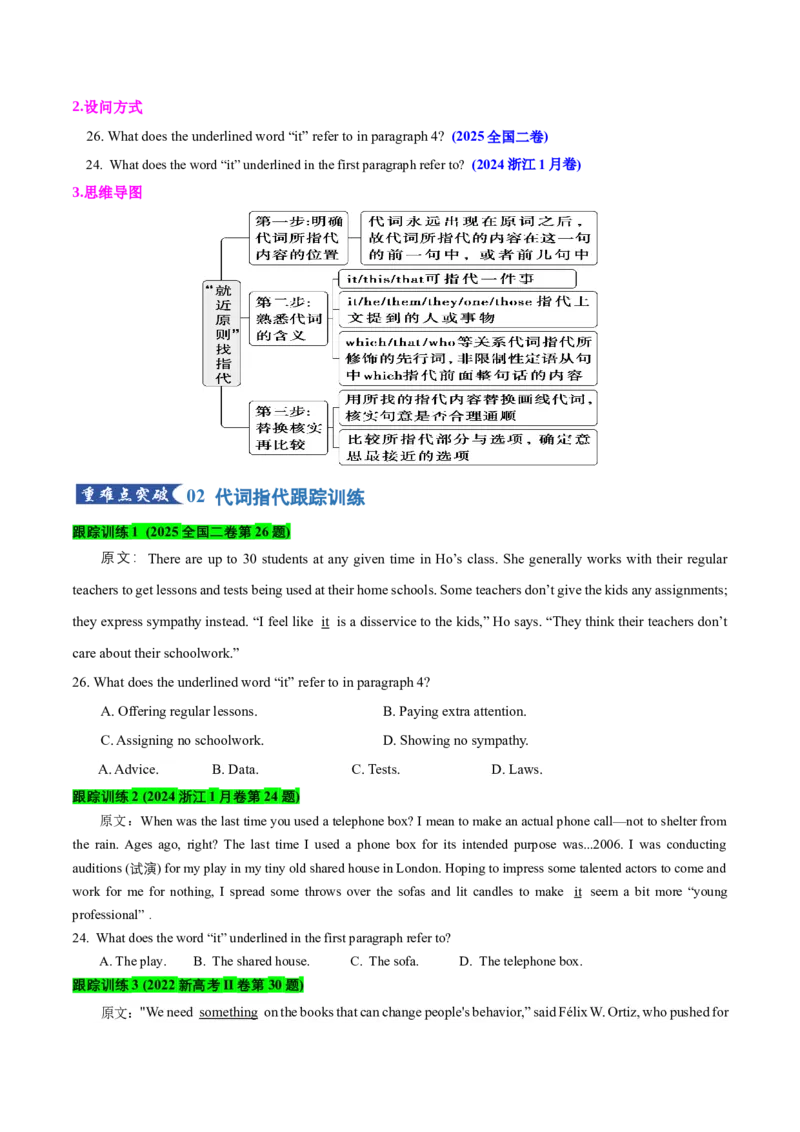
1.试题特点
在文章中,为了避免语意的重复,常用一些代词指代上文所说的人或事。在平时的学习中,熟悉代词
的含义十分重要。代词多是it、this、that、he、them、they、one、those 等。一般来讲,it/this/that 指代一件
事;it/he/them/they/one/those 可指代上文提到的人或事物。解答这类题目的时候要遵循“就近原则”,找出
离代词最近的名词、词组或句子等,当然有时需要对前面提到的内容进行总结,才能找出代词所指代的事
物。
代词指代题原则上从上文寻找线索,确定答案。基本点是单数还是复数,指人还是指物。
2.设问方式
26. What does the underlined word “it” refer to in paragraph 4? (2025 全国二卷)
24. What does the word “it” underlined in the first paragraph refer to? (2024 浙江1 月卷)
3.思维导图
02 代词指代跟踪训练
跟踪训练1 (2025 全国二卷第26 题)
原文:There are up to 30 students at any given time in Ho’s class. She generally works with their regular
teachers to get lessons and tests being used at their home schools. Some teachers don’t give the kids any assignments;
they express sympathy instead. “I feel like it is a disservice to the kids,” Ho says. “They think their teachers don’t
care about their schoolwork.”
26. What does the underlined word “it” refer to in paragraph 4?
A. Offering regular lessons.
B. Paying extra attention.
C. Assigning no schoolwork.
D. Showing no sympathy.
A. Advice.
B. Data.
C. Tests.
D. Laws.
跟踪训练2 (2024 浙江1 月卷第24 题)
原文:When was the last time you used a telephone box? I mean to make an actual phone call—not to shelter from
the rain. Ages ago, right? The last time I used a phone box for its intended purpose was...2006. I was conducting
auditions (试演) for my play in my tiny old shared house in London. Hoping to impress some talented actors to come and
work for me for nothing, I spread some throws over the sofas and lit candles to make it seem a bit more “young
professional”.
24. What does the word “it” underlined in the first paragraph refer to?
A. The play.    B. The shared house.      C. The sofa.
   D. The telephone box.
跟踪训练3 (2022 新高考II 卷第30 题)
原文:"We need something on the books that can change people's behavior,” said Félix W. Ortiz, who pushed for
the state's 2001 ban on hand-held devices by drivers. If the Textalyzer bill becomes law, he said, "people are going to
be more afraid to put their hands on the cell phone."
30. What does the underlined word "something" in the last paragraph refer to?
A. Advice.
B. Data.
C. Tests.
D. Laws.
03 利用语境猜测句意
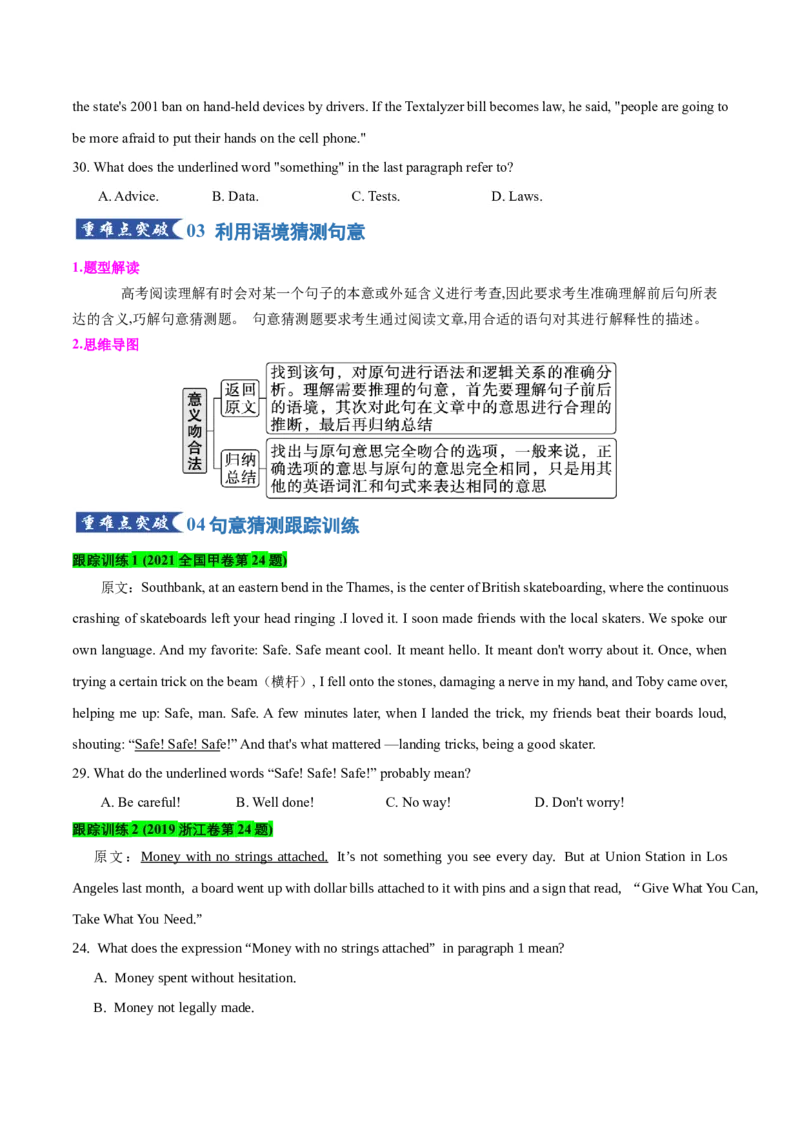
1.题型解读
高考阅读理解有时会对某一个句子的本意或外延含义进行考查,因此要求考生准确理解前后句所表
达的含义,巧解句意猜测题。 句意猜测题要求考生通过阅读文章,用合适的语句对其进行解释性的描述。
2.思维导图
04 句意猜测跟踪训练
跟踪训练1 (2021 全国甲卷第24 题)
原文:Southbank, at an eastern bend in the Thames, is the center of British skateboarding, where the continuous
crashing of skateboards left your head ringing .I loved it. I soon made friends with the local skaters. We spoke our
own language. And my favorite: Safe. Safe meant cool. It meant hello. It meant don't worry about it. Once, when
trying a certain trick on the beam(横杆), I fell onto the stones, damaging a nerve in my hand, and Toby came over,
helping me up: Safe, man. Safe. A few minutes later, when I landed the trick, my friends beat their boards loud,
shouting: “Safe! Safe! Safe!” And that's what mattered —landing tricks, being a good skater.
29. What do the underlined words “Safe! Safe! Safe!” probably mean?
A. Be careful!
B. Well done!
C. No way!
D. Don't worry!
跟踪训练2 (2019 浙江卷第24 题)
原文:Money with no strings attached. It’s not something you see every day. But at Union Station in Los
Angeles last month, a board went up with dollar bills attached to it with pins and a sign that read, “Give What You Can,

Take What You Need.”
24. What does the expression “Money with no strings attached” in paragraph 1 mean?
A. Money spent without hesitation.
B. Money not legally made.
C. Money offered without conditions.
D. Money not tied together.

05 利用构词法猜测词义
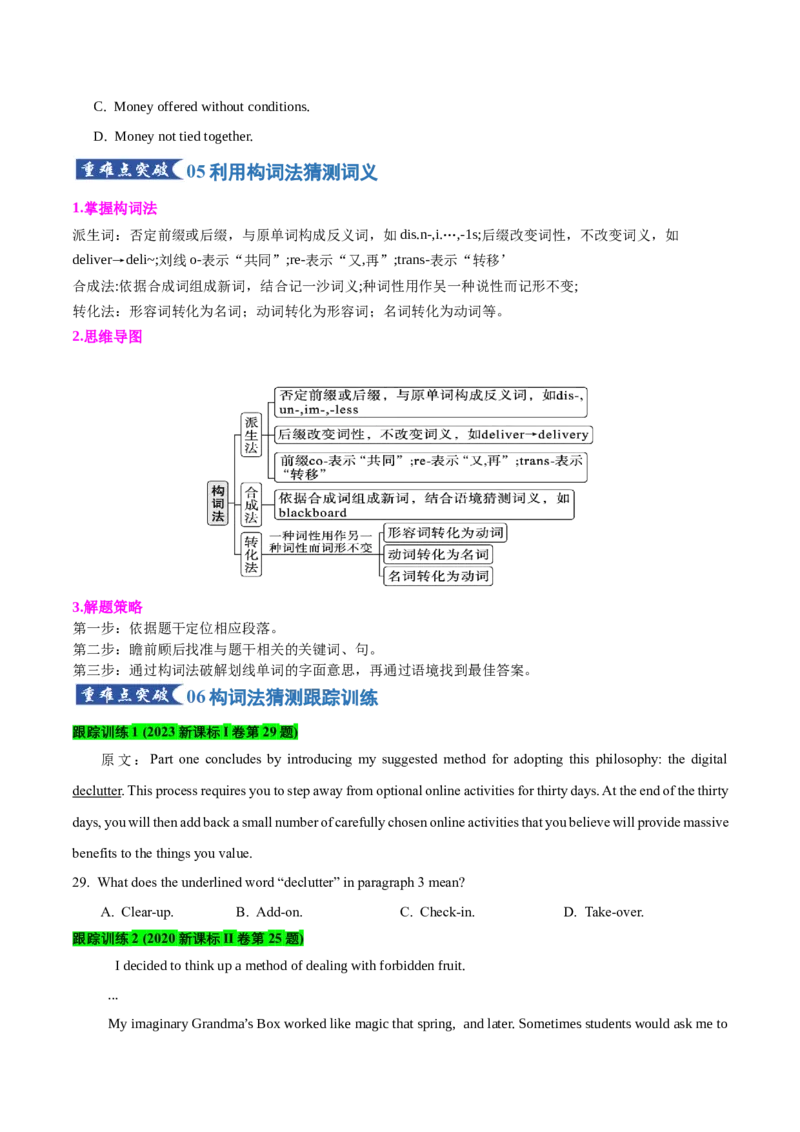
1.掌握构词法
派生词:否定前缀或后缀,与原单词构成反义词,如dis.n-,i.…,-1s;后缀改变词性,不改变词义,如
deliver→deli~;刘线o-表示“共同”;re-表示“又,再”;trans-表示“转移’
合成法:依据合成词组成新词,结合记一沙词义;种词性用作吴一种说性而记形不变;
转化法:形容词转化为名词;动词转化为形容词;名词转化为动词等。
2.思维导图
3.解题策略
第一步:依据题干定位相应段落。
第二步:瞻前顾后找准与题干相关的关键词、句。
第三步:通过构词法破解划线单词的字面意思,再通过语境找到最佳答案。
06 构词法猜测跟踪训练
跟踪训练1 (2023 新课标I 卷第29 题)
原文:Part one concludes by introducing my suggested method for adopting this philosophy: the digital
declutter. This process requires you to step away from optional online activities for thirty days. At the end of the thirty
days, you will then add back a small number of carefully chosen online activities that you believe will provide massive
benefits to the things you value.
29. What does the underlined word “declutter” in paragraph 3 mean?
A. Clear-up.
B. Add-on.
C. Check-in.
D. Take-over.
跟踪训练2 (2020 新课标II 卷第25 题)
I decided to think up a method of dealing with forbidden fruit.
...
My imaginary Grandma’s Box worked like magic that spring, and later. Sometimes students would ask me to
describe all the things I had in it. Then I would try to remember the different possessions I supposedly had taken
away — since I seldom actually kept them. Usually the offender would appear at the end of the day,and I would
return the belonging.
25. What do the underlined words “the offender” in paragraph 8 refer to?
A. The student’s parent.
B. The maker of the Grandma’s Box.
C. The author’s grandchild.
D. The owner of the forbidden fruit.

跟踪训练3 (2016 全国II 卷第27 题)
原文:Encouraging this kind of thinking has a downside. I ran the risk of losing those students who had a
different style of thinking. Without fail one would declare, “But I’m just not creative.”
27. What does the underlined word “downside” in Paragraph 4 probably mean?
A. Mistake.
B. Drawback.
C. Difficulty.
D. Burden.
01 利用语法关系猜词义
1.语法关系
下定义:be、mean、refer to、be called/named、namely、that is、be considered 等词语后面的内容是对前
面内容的注解性说明,相当于对前面的词语下定义。
同位语(从句):同位语(从句)是对其前内容的解释说明,也可以帮助猜测词义。
定语(从句):尤其注意后置定语和由which/who 引导的非限制性定语从句。
举例说明:for example、for instance、such as.like、include、including 等后面的内容也有助于猜测词义。
标点符号:注意破折号(-)、冒号(:)、分号(;)后面的内容,注意引号(“”)或括号中的内容。
2.思维导图
02 语法关系猜词跟踪训练
1.利用举例
在说明文尤其是科技类说明文中,作者通常会对一些关键词或专业术语进行解释。常见的有对该词下定义
或后跟同位语、定语从句、冒号、破折号、括号等引出解释说明部分。
跟踪训练1 (2022 全国乙卷第29 题)
原文:That includes huge savings in maintenance costs and better protection of railway personnel safety. It is
calculated that European railways alone spend approximately 20 billion euros a year on maintenance, including
sending maintenance staff, often at night, to inspect and repair the rail infrastructure. That can be dangerous work
that could be avoided with drones assisting the crews’ efforts.
29. What does “maintenance” underlined in paragraph 3 refer to?
A. Personnel safety.
B. Assistance from drones.
C. inspection and repair.
D. Construction of infrastructure.
2.利用破折号
跟踪训练2 (2021 全国乙卷第25 题)
原文:Still, 55 percent of Australians have a landline phone at home and only just over a quarter (29%) rely
only on their smartphones according to a survey (调查). Of those Australians who still have a landline, a third concede
that it’s not really necessary and they’re keeping it as a security blanket — 19 percent say they never use it while a
further 13 percent keep it in case of emergencies. I think my home falls into that category.
25. What does the underlined word “concede” in paragraph 3 mean?
A. Admit.       B. Argue.
C. Remember.
D. Remark.
3.利用同义关系
跟踪训练3 (2015 四川卷第44 题)
原文:And it is not just robins that are being kept awake by artificial light. Blackbirds and seagulls are also being
more nocturnal.
44. What does the underlined word “nocturnal” in Paragraph 5 mean?
A. Active at night.
B. Inactive at night.
C. Active during the day.
D. Inactive during the day.
4.利用释义关系
跟踪训练4 (2023 全国甲卷第24 题)
Terri Bolton is a dab hand when it comes to DIY (do-it-yourself). Skilled at putting up shelves and piecing
together furniture, she never pays someone else to do a job she can do herself.
24. Which is closest in meaning to “a dab hand” in paragraph 1?
A. An artist.
B. A winner.
C. A specialist.
D. A pioneer.
03 利用逻辑关系猜测词义
1.逻辑关系
反义关系:根据画线词的反义词猜测词义。表示转折:but,however,otherwisethough,even though;表示对
比:unlike,in contrast, while.on the contrary,on the other hand,rather than,instead of。
同义关系:根据画线词的相同或相近意义的词语猜测词义。表示类同:similarly,like,or,namelyin other
words,that is to say,justas,and,also,as well as,the same as.as...as。
因果关系:根据前后因果关系猜测词义。表原因:because,since,because ofdue to,thanks to,for,as a result of;
表结果:so,therefore,so that,sosuch...that...,lead to/result in/contribute to,as a result。
2.思维导图
3.解题思路
第一步:依据题干关键词定位原文相关词、句。
第二步:瞻前顾后抓关键词,如but, unlike, in other words, as a result 等。
第三步:“题干-原文-选项”三对照,从肯定否定逻辑和感情褒贬性入手作答。
04 逻辑关系猜词跟踪训练
1.利用因果关系猜词
若画线单词或短语前后句子之间构成因果关系,那我们便可以根据这种因果逻辑关系推知单词或短语
的意义。因果关系的语境通常由because, so, thus, therefore, as a result of, so that, so/such...that...等标志词体现。
跟踪训练1 (2019 全国II 卷第25 题)
原文:I guess that there’s probably some demanding work schedule, or social anxiety around stepping up to help
for an unknown sport. She may just need a little persuading. So I try again and tug at the heartstrings. I mention the
single parent with four kids running the show and I talk about the dad coaching a team that his kids aren’t even on …
At this point the unwilling parent speaks up, “Alright. Yes, I’ll do it.”
25. What does the underlined phrase “tug at the heartstrings” in Paragraph 2 mean?
A. Encourage team work.
B. Appeal to feeling.
C. Promote good deeds.
D. Provide advice.
2.利用对比关系猜词
运用转折对比描述事物或现象是写作时常用的一种手法,作者常借用一些信号词来提供相反信息,
抓住这些信号词,结合上下文意,我们就能够快速推测出词义。体现对比关系的词语很多,常见的有but,
yet, however, while, unlike, instead of, on the other hand, rather than, on the contrary 等。
跟踪训练2 (2020 新高考Ⅰ卷第33 题)
原文:According to a recent study in the Journal of Consumer Research, both the size and consumption habits of
our eating companions can influence our food intake. And contrary to existing research that says you should avoid
eating with heavier people who order large portions(份), it’s the beanpoles with big appetites you really need to
avoid.
33. What does the underlined word “beanpoles” in paragraph 1 refer to?
A. Big eaters.
B. Overweight persons.
C. Picky eaters.
D. Tall thin persons.
跟踪训练3 (2024 新课标II 卷第32 题)
   原文:In the wrong hands, such a book could prove as complicated to process as the computer code(代码) that
powers AI but, thankfully, Campbell has more than two decades’ professional experience translating the heady into
the understandable. She writes from the practical angle of a business person rather than as an academic, making
for a guide which is highly accessible and informative and which, by the close, will make you feel almost as smart
as AI.
32. What does the phrase “In the wrong hands” in paragraph 2 probably mean?
A. If read by someone poorly educated.
B. If reviewed by someone ill-intentioned.
C. If written by someone less competent.
D. If translated by someone unacademic.
3.利用同一关系猜词
跟踪训练4 (2023 新课标II 卷第30 题)
In this “book of books,” artworks are selected and arranged in a way that emphasizes these connections between
different eras and cultures. We see scenes of children learning to read at home or at school, with the book as a focus
for relations between the generations. Adults are portrayed (描绘) alone in many settings and poses —absorbed in a
volume, deep in thought or lost in a moment of leisure. These scenes may have been painted hundreds of years ago,
but they record moments we can all relate to.
30. What do the underlined words “relate to” in paragraph 2 mean?
A. Understand.         B. Paint.      C. Seize.
D. Transform.
01 阅读猜词词义题答题误区
1.忽视上下文语境,仅凭单词记忆作答
不少学生在遇到生词时,第一反应是在脑海中搜索该词的记忆释义,而忽略了单词所处的上下文语境。
例如:2023 年新高考 Ⅰ 卷的阅读文章中,“Part one concludes by introducing my suggested method for
adopting this philosophy: the digital declutter. This process requires you to step away from optional online activities
for thirty days.” 对于declutter 一词,如果仅从单词本身出发,学生可能难以知晓其含义。但结合下文
“This process requires you to step away from optional online activities for thirty days.” 可知,该过程要求人们
远离一些线上活动,由此可推断出declutter 有 “清理,整理(此处指对线上活动进行清理)” 的意思。
若学生不关注上下文,仅凭对clutter 杂乱)的模糊记忆,很难准确理解 “declutter” 在此处的含义。
2.误判逻辑关系,导致词义推导错误
阅读文章中词与词、句与句之间存在着各种逻辑关系,如因果、转折、对比、并列等,这些逻辑关系
是推测词义的重要线索。然而,学生在答题时常常误判这些逻辑关系。
例如:2022 年全国甲卷的阅读理解中,“Unlike her sister, who is always cheerful and talkative, Mary is
rather taciturn.” 句中“Unlike” 表明了对比关系,即 Mary 和她姐姐的性格相反,她姐姐 “cheerful and
talkative”(开朗健谈),那么可以推断出 “taciturn” 意为 “沉默寡言的”。若学生未能识别出 “Unlike”
所体现的对比逻辑,就可能无法正确猜出 “taciturn” 的词义。
3.对熟词生义缺乏认知,局限于常见释义
高考英语阅读常考查熟词在特定语境下的生僻含义,而学生往往局限于单词的常见释义。
例如:2024 年新高考 I 卷为例,“The course of the river has changed dramatically over the years.” 这里
的“course 并非学生熟悉的 “课程” 含义,而是 “路线,河道” 的意思。学生若只知道 “course” 的
常见义,就无法理解句子的准确意思。
4.无法准确判断代词指代内容
在阅读文章中,代词的准确指代对于理解文意至关重要。但学生在确定代词指代对象时经常出现错误。
例如,2023 年新高考 II 卷中的一段话,“The scientists conducted an experiment on a group of mice. They
found that the mice in the experimental group showed different behaviors compared to those in the control group.
This discovery could have important implications for future research.” 这里的 “This discovery” 指代的是前文
科学家们关于实验组小鼠与对照组小鼠行为差异的发现,若学生不能准确判断,就会影响对文章后续内容
的理解以及相关词义猜测题的解答。
02 阅读猜词词义题误区应对
1.强化语境意识,仔细研读上下文
在解答猜词词义题时,学生要树立强烈的语境意识。当遇到需猜测词义的单词或短语时,要认真阅读
其所在句子以及前后相邻的句子,从整体语境中寻找线索。
2.掌握逻辑关系词,借助逻辑推理
学生需要熟练掌握常见的逻辑关系词及其所表达的逻辑关系。在阅读过程中,一旦发现逻辑关系词,
就要高度关注,并据此分析句子之间的逻辑联系,进而推测词义。比如,看到 “but”“however”“yet” 等转
折词时,要意识到前后内容相反;看到 “and”“or”“similarly” 等表示并列或相似关系的词时,可知前后内
容在语义上相近或相关;看到 “because”“since”“as a result of” 等因果关系词时,可从原因推导结果或从结
果追溯原因。
3.积累熟词生义,拓宽词汇理解
平时学习中,学生要注重积累常见单词的生僻含义。可以通过整理高考真题、模拟题中出现的熟词生
义情况,建立专门的词汇笔记,定期复习。同时,在阅读英文文章、书籍、报刊时,遇到熟词在不同语境
下的特殊含义,要及时记录并理解记忆。
4.运用指代分析技巧,确定代词指代
对于代词指代题,学生可采用以下方法:首先,返回原文,找到代词所在位置;然后,向前(有时也
可能向后,但大部分情况是向前)搜索,寻找离代词最近的名词、名词短语或句子;最后,将找到的内容
代入代词处,看句子的逻辑和语义是否通顺合理。
03 阅读猜词词义题满分策略
1.建立熟词生义库:整理近5 年真题出现的熟词生义,每日复习5-10 个,重点记忆高频词。
2.强化逻辑词敏感度:总结常见逻辑关系词(如转折),结合真题例句进行逻辑推导训练。
3.构词法专项突破:掌握常见前缀、后缀、词根,遇到生词先拆分结构,再结合语境验证。
4.三步定位语境法:锁定生词句及前后2 句;圈出逻辑词、标点;代入原文检查是否通顺。
真题专区:研读高考真题,洞悉高考命题规律,探寻满分做题技巧和应试思维
猜测词义题综合能力提升
01 (2025 浙江1 月卷)
A novel design approach to gardening has been gaining in popularity worldwide. Referred to as matrix planting,
this approach aims for nature to do a lot more of the heavy lifting in the garden, and even some of the designing.
Eschewing fertilizers (化肥) and power tools, it’s based on an elegantly simple principle: to garden more like nature
does.
The concept was born when German city planners sought to plant large areas of parkland after World War II in
a reproducible way that would need minimal maintenance. Planners created planting mixes that could be used
modularly (模块化). In a matrix garden, plants with similar cultural needs are grouped so that they will grow together
above and below ground, forming a cooperative ecosystem that conserves water and discourages weeds.
Dutch plantsman and designer Piet Oudolf’s gardens popularized this style, adding artistic flavors to the planting
mixes while playing with color and form, including four-season interest and serving the needs of wildlife. Beautiful
year-round, they invite you to enjoy the smallest detail, from the sound of grasses in the gentle wind to the sculpture of
odd-looking seed heads.
It takes a lot of thought to look this natural. While matrix gardens appear wild, they are carefully planned, with
cultural needs the first consideration. Led by the concept of “right plant, right place,” they match plants that enjoy
the same soil, sun and weather conditions, and arrange them according to their patterns of growth.
The benefits are substantial for both gardener and planet. With human inputs dramatically reduced, the garden’s
ecology can develop well. Established matrix gardens should not need the life support we give most gardens: fertilizer,
dividing, regular watering. Compared to traditional garden plots, they increase carbon absorption, reduce storm water
runoff and boost habitat and biodiversity significantly.
28. What does the underlined word “Eschewing” in the first paragraph mean?
A. Running out of.
B. Keeping away from.
C. Putting up with.
D. Taking advantage of.
29. Why was the idea of matrix planting introduced?
A. To control weeds in large gardens.
B. To bring in foreign species of plants.
C. To conserve soil and water resources.
D. To develop low-maintenance parkland.
30. Which of the following best describes Piet Oudolf’s gardens?
A. Traditional.
B. Odd-looking.
C. Tasteful.
D. Well-protected.
31. Which of the following can be a suitable title for the text?
A. The future of gardening is WILD
B. Nature treats all lives as EQUALS
C. Matrix gardens need more CARE
D. Old garden plots work WONDERS
02 (2025 八省联考卷)
Jim Johnson, a mail carrier, was an institution in the leafy Westmoreland, Westhaven and Westover Hills
neighborhoods. just north of downtown Wilmington, where he delivered much more than the mail. He knew all the
kids and their pets by name; he carried in the groceries; he took note of unlocked doors, offered gardening advice,
and taught more than a few young boys the art of the curveball. When he wasn't doing all that, Jim was running
across a checkerboard of green lawns(草坪) to ensure the local postal service did not fall short of its daily promise.
Though the postal service is often disparaged now, the trust in local postal service lives on. In many communities,
that trust is won every day when life-saving medicine, greeting cards, social security checks, college acceptance
letters-even the bills-appear in mailboxes in front of the houses.
After more than three decades, Jim approached his final days on the job much like any other. He drove a boxy
postal truck to North DuPont Road for the first unofficial stop of the day. Butch, a dog who belonged to one of the
neighbors, was waiting just like every day before. And just like every day before, he got into the jump seat and they
were off. On the route, Jim and Butch had become inseparable. Now, the dog and the mailman would ride off to
retirement together. At every stop, Jim accepted the parting good wishes of families that had become his own.
There were tears and laughter, and hugs filled with warm memories.
It’s been 33 years since Jim left the route, but we are still reminded of the deep bond established between
community and letter carrier. That’s what the postal service means to us.
24. What do we know about Jim Johnson from the first paragraph?
A. He’s open-minded.
B. He’s sharp-eyed.
C. He’s warm-hearted.
D. He’s strong-willed.
25. What does the underlined word “disparaged” in paragraph 2 mean?
A. Refused.
B. Criticized.
C. Investigated.
D. Suspended.
26. What did Jim do besides daily delivery on his final days of work?
A. He drove Butch to its owner.
B. He sent presents to his friends.
C. He prepared a retirement party.
D. He said goodbye to the neighbors.
27. What is the author’s purpose in writing the text?
A. To remember a respected mail carrier.
B. To record an unforgettable experience.
C. To raise funds for the postal service.
D. To call for harmony in the community.
03 (2024 九省联考卷)
In his 1936 work How to Win Friends and Influence People, Dale Carnegie wrote: “I have come to the conclusion
that there is only one way to get the best of an argument — and that is to avoid it.” This distaste for arguments is
common, but it depends on a mistaken view of arguments that causes problems for our personal and social lives —
and in many ways misses the point of arguing in the first place.
Carnegie would be right if arguments were fights, which is how we often think of them. Like physical fights,
verbal (言语的) fights can leave both sides bloodied. Even when you win, you end up no better off. You would be
feeling almost as bad if arguments were even just competitions — like, say, tennis tournaments. Pairs of opponents
hit the ball back and forth until one winner comes out from all who entered. Everybody else loses. This kind of
thinking explains why so many people try to avoid arguments.
However, there are ways to win an argument every time. When you state your position, formulate ( 阐述) an
argument for what you claim and honestly ask yourself whether your argument is any good. When you talk with
someone who takes a stand, ask them to give you a reason for their view and spell out their argument fully. Assess
its strength and weakness. Raise objections (异议) and listen carefully to their replies. This method will require effort,
but practice will make you better at it.
These tools can help you win every argument — not in the unhelpful sense of beating your opponents but in the
better sense of learning about what divides people, learning why they disagree with us and learning to talk and work
together with them. If we readjust our view of arguments — from a verbal fight or tennis game to a reasoned exchange
through which we all gain respect and understanding from each other — then we change the very nature of what it
means to “win” an argument.
28. What is the author’s attitude toward Carnegie’s understanding of argument?
A. Critical.
B. Supportive.
C. Tolerant.
D. Uncertain.
29. Why do many people try to avoid arguments?
A. They lack debating skills.
B. They may feel bad even if they win.
C. They fear being ignored.
D. They are not confident in themselves.
30. What does the underlined phrase “spell out” in paragraph 3 probably mean?
A. Defend.
B. Explain.
C. Conclude.
D. Repeat.
31. What is the key to “winning” an argument according to the author?
A. Sense of logic.
B. Solid supporting evidence.
C. Proper manners.
D. Understanding from both sides.
模拟专区:精选名校真题好题,帮你锤炼做题技巧,助力冲刺备考圆梦高考
04 We studied a diverse group of birds typically found along coastlines, known as shorebirds. Heartbreakingly, their
global population has plummeted as they continue to battle habitat destruction, sea level rise, disturbance and
hunting.
04.What does the underlined word “plummeted” in Paragraph 5 mean?
A.Reduced sharply.
B.Increased rapidly.
C.Recovered slowly.
D.Changed gradually.
05 It was break time at noon. I headed down to the kitchen about five minutes early and gave my Coke such a hard
shake that I feared it may actually go off in my hands. I placed it back in the fridge. Then, I hid into a cupboard in
the kitchen, waiting for the right moment.
05 What does the underlined word “it” in paragraph 3 refer to?
A.The kitchen.
B.The drink.
C.The hand.
D.The fridge.
06 One theory that Brogaard says is that cell death caused by being struck by lightning could cause a one-time
flooding of the brain with neurotransmitters (神经递质) that are released from the dying neurons (神经元). This causes
a rewiring of neurons, providing access to areas of the brain that were previously inaccessible.
06 What does the underlined word “This” refer to in paragraph 5?
A.The cell death due to lightning strikes.
B.The flooding of brain’s neurotransmitters.
C.The rewiring of brain neurons.
D.The release of dying neurons.
07 Before I left school in December, I had a couple of tests called Mid-term Test. They all went pretty smooth,
mostly because I didn’t have too many hard classes. My favorite class was English, and also my hardest. Personally
I really liked English, where I could write essays (文章), challenge writing skills and improve English talking.
07 What does the underlined word “They” in the third paragraph refer to?
A.Classes
B.Tests
C.Games
D.Students
08 However, there are ways to win an argument every time. When you state your position, formulate (阐述) an
argument for what you claim and honestly ask yourself whether your argument is any good. When you talk with
someone who takes a stand, ask them to give you a reason for their view and spell out their argument fully. Assess
its strength and weakness. Raise objections (异议) and listen carefully to their replies. This method will require effort,
but practice will make you better at it.
08 What does the underlined phrase “spell out” in the paragraph probably mean?
A.Defend.
B.Explain.
C.Conclude.
D.Repeat.
09 For those who can stomach it, working out before breakfast may be more beneficial for health than eating first,
according to a study of meal timing and physical activity.
09 The underlined expression “stomach it” most probably means “_______”.
A.digest the meal easily
B.manage without breakfast
C.decide wisely what to eat
D.eat whatever is offered
10 The earthquake is one of the most common natural disasters. It may cause great damage. So it is wise to learn
some simple safety tips to protect yourself or your family members.
Fragile items like those made of glass are easily broken and should usually be placed on a lower surface, near
the ground instead of placing them on the cupboards higher up. Never place them near your bed, sofas and other
furniture where you would be sitting or lying down. When there is a strong movement, these pieces will fall on  the
floor directly and not on you.
10 The underlined word “Fragile” in Paragraph 2 probably means “________”.
A.Easily found.
B.Easily broken.
C.Expensive.
D.Heavy.
11 When 76-year-old Antoinette-Marie Williams played 17-year-old Emmett Daniels in chess for the first time, she
gave Daniels a run for his money. Paired through DOROT, a New York organization which was launched in 1976,
they are a perfect match. “I was a good opponent for him. I don’t think he expected it.” Williams told the CVS Health
blog Fortune Well. Their weekly games have led Daniels and Williams to a cross-generational relationship that they
both enjoy. Williams and Daniels’ relationship disproves the idea that people of different generations have little in
common.
11 What does the underlined sentence in paragraph 1 probably mean?
A.She had a running race with Daniels.
B.Daniels felt disappointed.
C.Daniels had a tough win.
D.She gave Daniels money as a gift of greeting.
12 When it comes to napping, one size definitely doesn’t fit all. If you are sleep deprived, a nap can be helpful or
even essential for making it through the day. However, for those with other sleep issues, a nap may make it harder to
fall asleep at night. For most of us, the timing and length of our nap will largely determine how beneficial it is to our
sleep routine.
12 What does the underlined sentence in paragraph 2 mean?
A.A nap benefits all the people.
B.Not all the people fit napping.
C.A nap works on one with sleep problems.
D.A nap works for you if you're lacking sleep.
13 We journalists live in a new age of storytelling, with many new multimedia tools. Many young people don’t even
realize it’s new. For them, it’s just normal.
This hit home for me as I was sitting with my 2-year-old grandson on a sofa over the Spring Festival holiday. I
had brought a children’s book to read. It had simple words and colorful pictures—a perfect match for his age.
13 What do the underlined words “hit home for me” mean in Paragraph 2?
A.Provided shelter for me.
B.Became very clear to me.
C.Took the pressure off me.
D.Worked quite well on me.
14(2025·湖南·三模)
As the first girl in my family, I was born in Venezuela, twelve months to the day before one of the biggest
earthquakes in the country’s history struck the capital city Caracas in 1967. I’ve always seen this as a sign of my
destiny.
Disasters have the potential to set back a nation’s development for years and even decades. However, my
personal experiences have taught me that the extent of damage often depends on whether there is a culture of
prevention within the affected society. .
I recall a time when I was living in an apartment building when a moderate earthquake struck. My reaction,
after the immediate “drop, cover, hold on” reflexes (反射动作), was to hope that the building would prove to be
structurally sound. As the shaking slowly stopped, I ran outside to wait for possible aftershocks. My fears, thankfully,
did not happen. It had resisted the quake because it followed the country’s building codes.
Occasions like this show the necessity of having updated building codes that include lessons learned from past
disasters. Had the building not followed these updated codes, I may not have survived. This experience has only
strengthened my belief in the value of prevention in mitigating the impact of disasters.
I have spent the past two years working on the Built Environment in Latin America and the Caribbean Project.
The project has developed risk-informed policies and engineering techniques in the six countries that were selected
for their particularly high exposure to earthquakes. This project fits perfectly with my professional and personal goals,
as it combines my passion and experience in risk reduction. Like the third little pig in the tale of Three Little Pigs,
who puts resilience (韧性) above convenience while building his house from bricks, I’m committed to building a
framework of prevention and resilience, as I know that early action today can prevent problems tomorrow.
1.What does the author refer to as her destiny?
A.Rebuilding cities after disasters.
B.Experiencing many earthquakes.
C.Doing work related to earthquakes.
D.Updating building codes in Venezuela.
2.Why did the earthquake mentioned in paragraph 3 impress the author?
A.She realized the danger of earthquakes.
B.She felt she did not respond well enough.
C.She was very lucky to escape with her life.
D.She recognized the importance of prevention.
3.What does the underlined word “mitigating” in paragraph 4 mean?
A.Causing.
B.Reducing.
C.Ignoring.
D.Avoiding.
4.What does the tale of Three Little Pigs imply?
A.Teamwork matters in preventing disasters.
B.Risk reduction work requires a lot of skills.
C.Damage caused by disasters can be avoided.
D.Building houses needs passion and experience.
15(2025·山东青岛·二模)
In primary school, I evolved from the class half-wit to the smart-alec, attracting scorn for being the teacher’s
pet. Mr Slavin, fair but partial to answers, favored me over boys like Thommo, who struggled to remember his name.
Thommo faced regular canings—four strokes from Mr Slavin or six from the Deputy Head. His screams echoed as
he fled each stroke. One day, police found his school case stuffed with stolen trinkets, and he vanished forever.
Despite Thommo’s fate, I envied his rebellious aura. As the despised “pet,” I craved respect. My desk at the
back, reserved for top students, isolated me. To rebel visibly, I carved railway tracks into the desk, pushing pencil
fragments with “chuffing” noises. Inspired by my firebug tendencies, I rubbed a ruler against the wood until smoke
—then flames—emerged. Mr Slavin’s gaze turned, and I earned four stinging strokes. The pain paled against the
glory of newfound notoriety.
This triumph spurred darker urges. Bullied by older boys, I mimicked their cruelty on younger ones but recoiled
instinctively. My aversion to inflicting pain clashed with a personality riddled with flaws. At home, I staged futile
escapes—packed with peanut butter sandwiches—only to linger near forbidden roads. Symbolic rebellion surfaced
in tunneling through chicken coops, emerging crowned in bird droppings.
My mother, oblivious to my school struggles, boasted of my intellect to neighbors like Nola Huthnance, whose
endless chatter rivaled her own. Even as I lapped up her praise, I sensed its toxicity. Unlike Gogol’s mother, who
credited her son with inventing the steam engine, mine saw genius in mundane report cards. Such adoration bred
isolation, compelling me to forge a contrary identity.
1.What can be inferred about the author's attitude toward his mother's praise?
A.He felt pressured to develop a rebellious identity.
B.He actively embraced her admiration as motivation.
C.He remained indifferent to her opinions.
D.He resented her comparisons with other families.
2.What does the underlined word “chuffing” most likely refer to?
A.Crying in pain.
B.Whispering secrets.
C.Making train-like noises.
D.Laughing mockingly.
3.How did Mr. Slavin treat the author compared to Thommo?
A.Strict but fair.
B.Partial but encouraging.
C.Hostile and dismissive.
D.Indifferent and detached.
4.Why was Thommo taken away by the police?
A.He set fire to the classroom.
B.He escaped during caning.
C.He bullied younger students.
D.He stole items from stores.
16(2025·山东青岛·三模)
In the digital age, teenagers are facing a challenge that has never happened — the constant battle for their
attention. A 2023 study published in the Journal of Adolescent Health reveals that the average teenager switches
between digital tasks every 19 seconds, resulting in a 40% decline in mental processes of understanding compared to
focused work.
Continuous partial attention, termed by researchers, occurs when individuals attempt to monitor multiple digital
streams together without fully concentrating on any single one. Unlike purposeful multitasking, this state leaves
teenagers in a repeated condition of mental overload. Professor Linda Stone, who first identified the behavior,
explains, “It’s not that teens can’t focus–it’s that their focus is always divided.”
The neurological (神经系统的) impacts are particularly concerning during the teenage years, a critical period
for brain development. MRI scans (扫描) demonstrate that heavy media multitaskers show less dense gray matter in
the anterior cingulate cortex(ACC), the brain region responsible for emotional control and decision-making. A 2021
Stanford study revealed that teens who engaged in frequent media multitasking had 15% weaker ACC activation
during tasks compared to those who focused on single tasks. This physical change correlates with increased anxiety
levels and decreased academic performance observed in numerous case studies.
However, the solution isn’t as simple as removing technology entirely. Digital literacy (读写能力) expert Dr.
Mark Prensky argues that digital natives process information differently than previous generations. Instead of
removing devices, educators should teach “attention literacy” — the skill of consciously choosing when and how to
engage with technology. Some schools experiment with focus training and they report 30% improvements in students’
sustained attention duration within six months.
Parents play an equally crucial role. One way to support this is to establish “protected spaces” in homes where
devices are set aside, allowing for uninterrupted face-to-face communication. The goal isn’t to blame technology
blindly but to help teens develop the wisdom to use it intentionally.
1.What does the underlined phrase “mental overload” in paragraph 2 refer to?
A.Constantly switching tasks.
B.Struggling to stay focused.
C.Taking in too much at once.
D.Feeling emotionally exhausted.
2.What is paragraph 3 mainly about?
A.How MRI scans are used to study the brain.
B.How avoiding screens benefits brain health.
C.Why media multitasking increases teen anxiety.
D.How media multitasking affects the teenage brain.
3.Why does the author mention schools experimenting with focus training?
A.To criticize the current trend.
B.To support a proposed solution.
C.To warn against technology overuse.
D.To introduce changes in modern education.
4.Why is “protected spaces” in homes suggested?
A.To support parental monitoring.
B.To promote mindful tech habits.
C.To improve academic performance.
D.To increase family time on digital devices.
17(2025·江西吉安·模拟预测)
When Leonardo da Vinci wasn’t painting masterpieces or dreaming up flying machines, he was exploring the
secrets of gravity. Considering himself a scientist and artist, this Renaissance thinker spent untold hours studying how
the “attraction of one object to another” affected phenomena like the flight of birds and the fall of water.
 Recent research published in the journal Leonardo reveals that da Vinci conducted detailed gravity
experiments over a century before Galileo and two centuries prior to Newton. “His thinking was far ahead of his
time,” said co-author Dr. Morteza Gharib. The study highlights Leonardo’s determination to find the law governing
the dynamics of falling objects.
 Dr. Gharib said he discovered the experiments while examining an online version of The Codex Arundel, a
collection of Leonardo’s notes from 1478 to 1518. Among its mirror-written texts, a drawing on Page 143 caught his
eye: a triangle (三角形) formed by cycles pouring from a pot. He used a computer program to flip (翻转) the triangle
and the nearby backward writing. Suddenly, the image came to life. “I could see motion,” Dr. Gharib recalled. “I
could see him pouring stuff out.” It was a eureka moment that revealed Leonardo’s forward-looking experiment.
 Gazing at Leonardo’s drawing, Dr. Gharib realized that the artist had separated gravity’s effects into two
components, revealing a normally hidden aspect of nature. Inspired by hail falling from fast-moving clouds, Leonardo
demonstrated through his drawing how gravity’s constant force causes a steady speed gain — shown by the increasing
gaps between falling objects as the pot moves.
 Despite his basic experimental setup 500 years ago, da Vinci calculated the gravitational constant to an
accuracy within 10 percent of the modern value. “It’s mind-boggling,” Dr. Gharib said. “That’s the beauty of what
Leonardo does.”
 However, Dr. Gharib hesitated to examine the Codex further. “I’m like a kid in a toy store, afraid to even
look at it,” he said. He noted that while art historians had studied it, scientists had not. “It’s an open book with so
much to discover.”
1.What is the main purpose of the text ?
A.To report da Vinci’s unknown research.
B.To compare da Vinci with other scientists.
C.To prove da Vinci’s artist and scientist role.
D.To show a way of analyzing da Vinci’s notes.
2.What does the underlined phrase “a eureka moment” in paragraph 3 refer to ?
A.Finding da Vinci’s secret drawings.
B.Detecting the need of mirror-writing.
C.Discovering the power of technology.
D.Realizing the triangle’s scientific meaning.
3.What is special about da Vinci’s experiments?
A.They were the first to explore the law of gravity.
B.They achieved high-level accuracy with simple tools.
C.They focused on the beauty of falling objects’ motion.
D.They integrated artistic strategy with scientific method.
4.What can we know about The Codex from Dr . Gharib’s words?
A.It contains unexplored scientific insights.
B.Historians misunderstood its real purpose.
C.Its artwork hasn’t been properly analyzed.
D.New tools are required to reveal its secrets.
18(25-26 高三上·河北保定·开学考试)
About halfway through the new ad for “the thinnest iPad ever”, almost every creative instrument artists and
consumers have used over the years — from record players to books and cameras — is flattened by a powerful
hydraulic press (液压机). But for me, the ugliest thing about the ad is the destruction of the musical instruments: a
piano, a guitar, a drum and a trumpet.
Perhaps, the ad is meant to communicate that this tiny, thin iPad can replace them all. You can make your
music with it. You can paint with it. You can play games on it. You can take your photos with it. So you can finally
destroy all those things that have been so burdensome, like the massive piano and messy paint.
But these are not practical items. Nobody owns a piano because it’s practical. Actually, it’s one of the least
practical things you can own. It is so heavy that it can damage your floor. If you happen to get a new place, you don’t
just need movers for it. You need special movers. You own a piano because your beloved ones sit down and play it.
Such shared moments will not and can not be replaced by iPads.
You can make beautiful music and digital art with an iPad. But that art should be made alongside other music,
other art, not at the cost of pianos and paint. If you think of digital artistic creation as an opportunity to shatter sculptures
or bottles of paint, you never understood art at all, and you never will. It doesn’t demand to destroy what is loved in
order to run after the fantasy that you can fit everything that matters into your pocket.
In certain circumstances, I am worried. For example, I am worried about the costs of art and its creation. But
I am not worried at all that art made by humans will ever be replaced by “the thinnest iPad ever”.
1.What does the new iPad ad intend to tell its viewers?
A.It can do a lot of things.
B.It will not be easily damaged.
C.Artists can store their information in it.
D.Customers should throw away their ugly stuff.
2.What does the underlined word “shatter” in paragraph 4 mean?
A.Create.
B.Purchase.
C.Break.
D.Exchange.
3.What is the best title for the text?
A.The New iPad Will Put Art in Danger
B.Art Won’t Be Flattened by the New iPad
C.The Costs of Art and Its Creation Are Rocketing
D.The New iPad Ad Is Depressing but Successful
4.What is the text?
A.An advertisement. B.An iPad description. C.A music review. D.An opinion piece.
19(25-26 高三上·四川巴中·开学考试)
Soy is found in almost everything we eat, from the vegetable oil to store-bought chocolate. While it may seem
like humans chose the soybean, it was arguably the soybean that chose people.
Soybeans have an innate ability to grow almost anywhere and survive almost anything. They can grow
anywhere from three to five feet tall and produce around 100 beans per plant. Soy can be grown everywhere from the
extremely harsh four seasons of Manitoba, Canada, to the grassland of Mpumalanga, South Africa.
Soy was likely domesticated in China approximately 6,000 to 9,000 years ago when ancient Chinese medical
healers used all parts of the plant as medicine. People also turned soy into noodles, tofu, and soy sauce. Soybeans
were initially sent to England to meet rising demands for soy sauce, which was becoming a staple in British cuisine.
It would not be long, though, before Americans found another use for the bean. During the Civil War, roasted
soybeans were used as coffee substitutes (替代) for economy and health considerations. And soon, soybeans became
the staple feed in the diets of non-human creatures, too, with one cup of raw soybeans containing 67.9 grams of
protein and 17.3 grams of fiber. In the US, chickens eat the most soy, followed by pigs, cows, and fish. These animals
eat over 70 percent of all soybeans grown in the US.
Nowadays, genetic modification contributes to massive quantities of soybeans all over the world, including
the Amazon rainforest, where they are replacing the trees that once stood there. Brazil now exports more soybeans
than any other country. Now some advocacy groups are calling for better land-use practices to safeguard the rainforest
and the soil. In 2023, policies brought on by new governments in South America began slowing rates of deforestation in
the Amazon.
Now many growers have expanded their soy operations to the Cerrado, a savannah-like region of Brazil.
Despite changing policies and practices around deforestation, this year is expected to be a record year for soybean
production.
1.What does the underlined word “innate” probably mean in the second Paragraph?
A.Important.
B.Inborn.
C.Immediate.
D.Initial.
2.What did the Americans use soy to do?
A.Treat the patients as medicine.
B.Enrich the kinds of cuisine.
C.Produce a wide range of food.
D.Offer staple food to livestock.
3.What affects the planting of soy now?
A.The communication across the globe.
B.The change of environment.
C.The updated government policies.
D.The deforestation in the Amazon.
4.In which section of a magazine is the text taken from?
A.Society.
B.Agriculture.
C.History.
D.Communication.
20(25-26 高三上·湖北·开学考试)
I remember opening my iPad one day in fifth grade after a silly conversation with my cousin about scary story
ideas. Hours later, I completed my first short story. Since then, I’ve written many stories, short and long. But also,
since then, I’ve read more and noticed just how well people my age could write. Since then, I also felt less and less
willing to share my work:what if my writing isn’t as good as everybody else's? What started off as something creative
that I could share with friends turned into competition changed by feelings of competence. Oftentimes, hobbies begin
as something just for fun. But eventually, what was once fun now contributes to feelings of stress and inadequacy. I
have plenty of memories of thinking I was going to pick up something new and stick with it, whether it be playing
the piano, or drawing. But there is always a part of me that expects myself to just magically be good at all of those
things. And when I’m not, the enjoyment tapers off as, slowly, I think mediocrity(平庸) isn’t acceptable anymore.
Writing is the only hobby that I have repeatedly come back to despite dropping it constantly. I can see the
growth in my writing all these years, but the expectations to be better and better is never satisfied. This is why I drop
writing for months at a time. This feeling of a hobby becoming, for a lack of better word, a chore, lowers the
satisfaction of said hobby.
But hobbies are there to give you a breath of fresh air from having to excel at everything, from academics to
your occupation. We must accept that it is okay to just suck at an activity but still doing it because it brings you joy.
There is a balance between joy and expectations, either set by others or by ourselves.
1.What does the author do in the first paragraph?
A.He challenges a tradition.
B.He relates an experience.
C.He envisions a coming trend.
D.He compares varied hobbies.
2.Which can best replace the underlined phrase “tapers off” in paragraph 1?
A.Thins out.
B.Tops out.
C.builds up.
D.Spreads around.
3.Why does the author drop writing constantly?
A.He is inadequate for it.
B.He prefers mediocrity.
C.He equates joy with achievement.
D.He receives bitter comment.
4.What message does the passage convey?
A.Mediocrity is the key to enjoyment.
B.A hobby shared is a hobby squared.
C.Excellence ensures academic success.
D.Enjoyment outweighs excellence in hobbies.