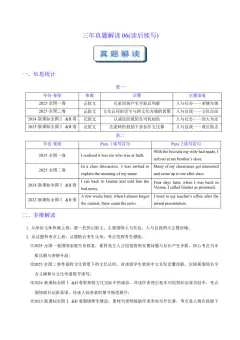
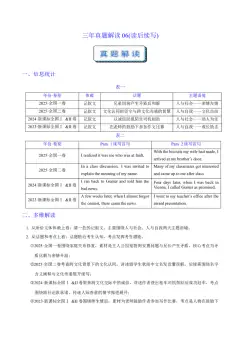
第02 讲 阅读理解——记叙文
目录
01 课标达标练
考向01 考查记叙文中的人物和事件的特征
考向02 考查主旨大意
考向03 考查细节理解题
考向04 考查写作目的
考向05 考查猜测词义
02 核心突破练
记叙文创新练
03 真题溯源练
考向01 考查记叙文中的人物和事件的特征
1.(2025 届四川省巴中市高三下学期三模)
On her 53rd birthday, Debra Ferrell received the usual well-wishes on Facebook, but she also got some
unusual messages. One was about a family in Minnesota who had just lost their four-year-old son to cancer. His
older brother, autistic (自闭症) and nonverbal, was struggling with grief. They were reaching out to Ferrell, seeking
any possible support. “Could you bring him some comfort?” they asked with deep sadness.
Ferrell’s heart ached when she read the message. She knew she had to do something. She sent them a wind
chime (风铃) with the message “Listen to the wind and know that I am near.” written on the clapper. It now hangs
in the four-year-old’s bedroom, where his brother can go to listen to it whenever he wants. Ferrell says, “I hope it
brings him some comfort. Sometimes, a small gesture can mean the world to someone going through a tough time.”
This is not the first time that Ferrell decided to give gifts for her birthday. In fact, for her 47th birthday in
2014, she founded Love with Skin On, an organization devoted to doing good deeds near her home in Roanoke,
Virginia, and beyond. Its motto is simple: Be Love, Do Stuff. “I believe that small acts of kindness can make a big
difference,” Ferrell explains. “It’s amazing to see the joy on people’s faces when you do something unexpected for
them.”
To celebrate her 53rd birthday, Ferrell decided to commit 53 random acts of kindness by the end of her birth
month. She put out a call on her Facebook page, asking for information on people who could use a little help. Over
the years, she has reached out and touched well over 100 strangers, some found through Facebook callouts, others
with help from her grandkids. In another act of giving, she shares her favourite inexpensive and creative gift ideas
on Pinterest for others to use. Her grandkids often join her on these missions, making it a family affair. “It’s
amazing to see the joy on people’s faces,” she says. “And it’s even more rewarding when my grandkids are
involved. They learn the value of kindness and compassion.”
Ferrell funds all these acts of kindness herself. She buys gift cards, makes pay-it-forward purchases at drive-
throughs, sends care packages, and even covers the gas to deliver these surprises. Her family often gives her extra
birthday cash, jokingly warning her not to spend it on others, but she always does. “I got a couple of Amazon gift
cards for my birthday this year and was like YESSS!” she says with a laugh. “It’s my party, and I’ll give if I want
to!”
1.On Deba Ferrell’s 53rd birthday, what did she receive?
A.Invitations to give a speech at a community event.
B.Beautiful birthday gifts from Love with Skin On.
C.Unique birthday wishes with moving stories.
D.Messages calling for help.
2.What does Deba Ferrell do on Pinterest?
A.She lets her grandkids participate in family activities.
B.She introduces innovative ideas.
C.She buys presents for strangers.
D.She distributes care packages.
3.What description matches Deba Ferrell most accurately?
A.Warm-hearted and generous.
B.Aggressive and demanding.
C.Modest and cautious.
D.Logical and cold.
4.What meaning does the story express?
A.The significance of founding organizations.
B.The pleasure of giving expensive gifts.
C.The power of small acts of kindness.
D.The desire for social media fame.
2.(2025 届湖南省长沙市周南中学普通高等学校招生全国统一考试模拟考试(三))
College professors these days face an ever-higher bar to grab the attention of their students. Yet, Tatiana
Erukhimova, who teaches physics at Texas A&M University in the United States, has managed to get her
students excited about science.
Known as “Dr. Tatiana”, the professor performs physics tricks with boundless energy and enthusiasm.
Videos of her theatrical demonstrations have racked up (积累) hundreds of millions of views across social media
platforms. In the videos, Erukhimova uses a range of everyday objects in her experiments, from ping pong balls
and toilet paper to bicycle wheels and hair dryers.
It’s clear she knows what it takes to get young people excited about a hard science. But it isn’t always that
way. When she first started teaching college freshman classes almost two decades ago, she struggled to grab the
attention of her younger students. She was used to teaching juniors (大三学生) and found it easier to teach them.
“By junior year, students enrolled in physics are determined to learn,” she says. “But when it comes to teaching a
large lecture hall of 100-plus first-year students, first impressions are important. Unfortunately, I did not grab their
attention on the first day — that was my mistake!”
By the second semester, she found her footing, adjusting her approach to make her lecture halls feel smaller
and get her students engaged. “Talk to your students before and after class. Walk up and down the stairs when you
teach your class rather than stay on the stage, she says. “And add showy demonstrations, which help students
connect the abstract concepts with real life.”
Erukhimova has earned more than just recognition on social media. In October 2023, she was honored with a
national award for science outreach “for leadership in bringing the excitement of physics through innovative
education programs.”
1.What can we infer about Erukhimova from the first two paragraphs?
A.She excites widespread interest in science.
B.She wants to be popular on social media.
C.She is passionate about making online videos.
D.She likes to play tricks on her students.
2.Why did Erukhimova find it easier to teach juniors?
A.Juniors could study entirely on their own.
B.She used simpler teaching methods for juniors.
C.She didn’t have to worry about first impressions.
D.Juniors showed a higher level of commitment to learning.
3.How did Erukhimova find her footing in the second semester?
A.By engaging them in smaller groups.
B.By following a traditional teaching method.
C.By reducing the number of students in the class.
D.By making herself approachable and her teaching engaging.
4.Which of the following best describes Erukhimova?
A.Humorous.
B.Enthusiastic.
C.Stubborn.
D.Demanding.
3.(2025·湖北省鄂东南高三下学期5 月联考)
Ghanaian photojournalist Paul Ninson arrived in New York five years ago with a passion for visual
storytelling. To his surprise, the city’s libraries and museums held more photographs documenting Africa’s past and
present than he had ever seen in Ghana. “How could our history be better kept here than at home?” he wondered.
This realization became the start of his life’s work: to build a library in Ghana where Africans could reclaim their
stories through photography.
Growing up, Ninson loved family stories told by his grandparents, but photography was seen as an unwise
career choice in Ghana. However, he sold his iPhone to buy a camera and taught himself the skill. His early
projects, like recording a Kenyan community started by women escaping violence, strengthened his belief that
Africans must own their visual history.
In 2019, Ninson joined a photography school in New York. There, he eagerly read hundreds of photobooks
— a clear difference from Ghana, where such books were rare. When museums refused to share their records,
Ninson promised to build his own library. He searched secondhand stores, asked publishers for help, and filled
storage units with over 30,000 books, even using up all his credit card limits. His friend Brandon Stanton’s $1.2
million online fundraiser made the dream possible. With the funds, Ninson shipped the books to Ghana and
established the library.
On a December morning in 2022, the Dikan Center — “take the lead” in Ghana’s Akan language — opened
in Accra, near the Gulf of Guinea’s historic coast. The library’s two collections celebrate African views: one
focuses on Africa and Africans living abroad, the other displays works by photographers worldwide. Among its
treasures is Ninson’s first New York purchase: The Gold Coast Yesterday and Today, a 1940s photobook
documenting Ghana’s history before it gained independence in 1957. “It reminds us where we’ve been and where
we’re going,” he says.
1.What inspired Ninson to create African’s own visual history?
A.Finding photobooks in secondhand stores.
B.Studying at a New York photography school.
C.Developing his family storytelling traditions.
D.Finding more African records overseas than locally.
2.Why is The Gold Coast Yesterday and Today important?
A.It contains stories from his grandparents.
B.It was donated by a photography school.
C.It shows Ghana’s history under foreign rule.
D.It was Ninson’s first photobook purchase in New York.
3.What best describes Paul Ninson’s character as highlighted in the text?
A.Ambitious and humorous.
B.Creative and sympathetic.
C.Conventional and home-centered.
D.Committed and forward-thinking.
4.What does Ninson’s story mainly inspire us to do?
A.Value teamwork in cultural projects.
B.Use technology to document history.
C.Pursue cultural goals through determined action.
D.Rely on external institutions for heritage protection.
考向02 考查主旨大意
1.(2025 届海南省华中师范大学琼中附属中学等校高三下学期高考仿真卷)
A few months ago, when I received an email about an available allotment( 小块菜园地)in my area, I
struggled to remember when I had signed up for one. It turns out I had done so two years ago, fuelled by my envy
for people who have their own gardens. Back then, all I wanted was a small bit of outdoor space that felt like my
own, to plant flowers, or herbs. A place where I could read and write in the sun, safe from distractions.
Fast forward to now, I spend hours a week sowing, weeding, watering and harvesting with my husband after
seeking guidance from family and watching beginner’s gardening YouTube videos. Given that I knew nothing
about gardening at the start, the fact that I’ve managed to grow anything feels like a miracle.
My summer at the allotment has so far offered countless lessons, but the most important one has been
learning more about how food actually grows. Take the humble cauliflower( 花椰菜)— a common sight in the
supermarket aisle (过道), yet the patience it demands lasts for up to six months, tending and nurturing, all for a
flash moment on the plate.
Seasonality has also taken on a new meaning. I knew of course that all fresh food has its “season”, yet
abundant harvests come with a lesson in impermanence(无常). Fresh produce goes off quickly once ripened and
picked. And so I’ve turned to the old craft of preservation — learning what to boil and freeze, pickle( 腌渍), or
make into jam — to make things last.
While gardening is a welcome escape from the chaos of the modern world, you can’t avoid the reality of the
climate crisis. This year, a wet summer in the UK meant terrible to most plants.
As I continue to tend my allotment, I do so with a sense of humility, wonder and excitement. What started as
a desire for a small patch of green has grown into something much more significant — a connection to my local
environment, a respect for the food I eat and an awareness of the fragile natural systems that sustain us. In the
beginning, I was worried I’d fail the allotment; instead, I’m finding myself growing alongside it and appreciate
what it has brought to me.
1.What inspired the author to sign up for an allotment two years ago?
A.Her love for reading in the sun.
B.Her wish to grow herbs for cooking.
C.Her envy of people with their own gardens.
D.Her need to escape from the modern world.
2.We can infer from the passage that the author ____________.
A.was always confident in her gardening skills B.has a deeper understanding of food and nature now
C.will stop gardening due to the climate crisis
D.only grows cauliflower in her allotment
3.What is the main idea of the fourth paragraph?
A.The new meaning of seasonality the author learned.
B.The ways to preserve fresh produce.
C.The importance of eating fresh food.
D.The author’s favorite recipes made from garden produce.
4.Which of the following would be the best title for the passage?
A.My Journey with the Allotment
B.The Miracle of Gardening
C.Lessons from the Climate Crisis
D.The Art of Growing Cauliflower
2.(2025 届湖南省邵阳市高考信息卷(一))
Timothée Chalamet, the son of a French father and Russian Jewish mother, grew up in an artistic family. In
his early twenties, the New York native had already been a longtime working actor. Since 2017, this young talent
has become a household name.
While filming his big-screen debut (首次亮相), Christopher Nolan’s drama Interstellar, Timothée Chalamet
knew very little of Hollywood, let alone the world. The young man had completed two short films and a role in a
TV play Homeland, but at 17 did not yet know how to drive a car. Thankfully for him, his onscreen father, Oscar
winner Matthew McConaughey, was there to give Chalamet some guidance, through the fields of corn and beyond.
Since Interstellar’s 2013 release, the actor has gotten his license, spent a year studying at Columbia
University, and worked on some films. He also learned to play a couple of musical instruments and picked up
Italian in preparation to star in the film Call Me By Your Name. The film conquered Sundance and became a
festival-circuit darling. To Chalamet, the whole scene was, understandably, strange. “Luca, Armie, and I were
watching the film together in a small box, which was a special moment in itself,” he said. “And when the credits
ended, they immediately put this blinding spotlight on us, so that we couldn’t see the audience, but we heard this
incredible reaction. I’m a theater guy at heart, so to have a film experience that mirrored the theater experience was
totally surreal.”
In a lengthy Instagram post, Chalamet said that the past year has changed the way he “see and feel about so
many things”. “I am learning that a good role isn’t the only criteria for accepting a job—that has become much
clearer to me in the past few months, having witnessed the birth of a powerful movement intended to end injustice,
inequality and, above all, silence,” he wrote.
1.What can be inferred about Timothée Chalamet when he filmed “Interstellar”?
A.He was already familiar with Hollywood culture. B.He had difficulty operating a vehicle.
C.He had starred in multiple feature films. D.He learned Italian for the role.
2.Why did Chalamet learn Italian?
A.To study at Columbia University.
B.To connect with his Russian Jewish heritage.
C.To communicate with his co-stars in “Hostiles”.
D.To prepare for his role in “Call Me By Your Name”.
3.What does the underlined word “surreal” in paragraph 3 mean?
A.Boring.
B.Confusing.
C.Dreamlike.
D.Frightening.
4.What is the primary focus of the passage?
A.Chalamet’s evolving career and reflections on artistic growth.
B.Chalamet’s struggles with addiction and social issues.
C.The challenges of Chalamet’s learning new languages for film roles.
D.The cultural impact of “Call Me By Your Name”.
3.(2025 届江苏省南通基地大联考高三下学期模拟预测)
When Strauss’s first wife passed away, it was a shock for him and their then-10-year-old daughter, Molly.
Seeing her facing a challenge she really wasn’t prepared for, Strauss naturally turned to what he knows best:
storytelling.
“I had the idea that perhaps stories of great heroes and the way they met challenges and hardships in their
lives could be inspirational to her,” Strauss says. The principal at his daughter’s elementary school had lost her own
mother when she was nine and developed a close bond with Molly. Her school hosted the first plays, and the
principal advised him to design the plays to fit in with the standard school curriculum, so that teachers could
achieve their education goals along with Strauss’s objectives.
Strauss calls his collection of plays the Spirit Series, “because it’s a celebration of the human spirit and
because our job is to spirit students over a threshold ( 门槛) in a transformative way”. Unlike in regular theater
plays, the Spirit Series plays leave room for the children to plug in their own dialogue, put themselves in the
historic figures’ shoes and write essays about big questions posed by the historic figures in the plays, for instance:
What do you want out of life when you grow up? Does popularity feed the soul?
The Spirit Series has been hosted by more than 100 schools and 60,000 students in California. The results
students and teachers report are striking: More than a quarter of students improve academically and in social and
emotional skills. More than 90 percent of students report improved teamwork after participating, and nearly 82
percent of participating teachers said that the series enhances focus.
Today, the Spirit Series has expanded into Spirit Corps, which provides video-assisted storytelling that
Strauss is rolling out more widely this year, and Spirit Works, a coaching program for teachers, “because you can’t
expect students to go where you can’t lead them,” Strauss says. “Transformative outcomes in classrooms begin
with self-transformation.”
1.Why did Strauss create the Spirit Series?
A.To express the love to his lost wife.
B.To help his daughter tackle the sorrow.
C.To offer standard curriculum to schools. D.To promote traditional theater education.
2.What makes the Spirit Series plays special?
A.They record major historic events.
B.They are a collection of students’ essays.
C.They are written by a less-known writer. D.They allow children to add their own creation.
3.What does paragraph 4 mainly talk about concerning the Spirit Series?
A.Its positive impacts.
B.Its high profitability. C.Its potential problems.
D.Its
great complexity.
4.What message does the underlined sentence in the last paragraph convey?
A.Teachers should improve their teaching aims. B.Teachers should be a model for the students.
C.Teachers should coach their students.
D.Teachers should reform their teaching.
考向03 考查细节理解题
1.(2025 届吉林地区普通高中高三下学期猜题信息)
Just over a decade ago, a story spread about a man who was trapped in his snow-covered car for two months
during an extremely cold Swedish winter. Peter Skyllberg, 44 years old at that time, became trapped in his car, near
the city of Umea in northeast Sweden.
He was discovered 60 days after he went missing — when two people on snowmobiles passed the buried car,
thinking it was abandoned. When they cleared the window and looked inside, they saw something moving and
informed emergency services. Ebbe Nyberg, a local police officer at the scene, said the man was in a sleeping bag
and could talk a little, but he was very weak. The man appeared to have survived by drinking melted snow, but
there was no food in the car.
Dr. Ulf Segerberg, the chief medical officer at Norrland University Hospital, said he had never seen a case
like it. He explained that the man survived thanks to the “igloo ( 冰屋) effect” created by his snow-covered car.
Even in very cold temperatures, igloos can be warm inside because body heat is kept in by the snow walls. The
man’s car, covered in thick snow, worked like a blanket.
The source of heat was his body’s metabolism (新陈代谢), though it must have been very low. Body heat is
produced when the body turns food into energy. Since the man hadn’t eaten properly for weeks, his metabolism
would have been very slow, but it produced enough heat to keep him alive, like a tiny candle in the dark. “If you
have good clothes, you would survive in those temperatures and be able to keep your body temperature,” said Dr.
Segerberg.
Although protected from the winter cold, his body temperature had dropped to around 31℃ — which is
dangerously low. A healthy person’s temperature is usually around 37℃. Skyllberg was lucky and only needed
treatment in a regular hospital ward. His story is remarkable and can provide some medical implications because of
both the extremely low temperatures and the extraordinary amount of time his body managed to stand them.
1.What did the two men do when they found Peter?
A.They made emergency calls.
B.They gave him some food.
C.They sent him a sleeping bag.
D.They wrapped him in a blanket.
2.How did Dr. Ulf Segerberg probably feel about Peter’s survival?
A.Universal.
B.Upsetting.
C.Unbelievable.
D.Unaccountable.
3.How did Peter mainly manage to stay alive during the 60 days?
A.By eating food.
B.By candlelight.
C.By wearing thick clothes.
D.By his body heat.
4.What can we know from the last paragraph?
A.The body’s metabolism speeds up in cold weather.
B.Peter’s case is meaningful in the medical field.
C.A slight drop of body temperature is deadly.
D.Peter needed long-term treatment.
2.(河北省部分校名校联考2025 届高三下学期5 月全仿真预测)
Eileanoir from Ireland began studying with The Open University (OU) at just 15 years old. What started as a
way to challenge herself while still at school, became her route into a role with a multinational start-up and a life of
exploring the world.
“I loved languages at school,” said Eileanoir, “but I didn’t feel like I was learning enough. My mum, who
had studied with the OU suggested I investigate the courses on offer.”
She continued, “After my headmaster agreed, I signed up for a Bachelor ( 学士) of Arts (Honors)Open
Degree with a focus on languages. I found the OU courses simple to follow and well organized.”
Eileanoir went on a trip to Spain, which was the first time she had been abroad without her family. Her
ability to use different languages made her really want to travel. Eileanoir has now travelled to over 30 countries,
including Brazil, Mexico and Morocco.
Eileanoir finished her OU degree at 20 and after obtaining a Masters in Marketing, she landed a position in a
company. Not only does she use her language knowledge every day, but there are also various transferrable (可转
换) skills that have come in handy.
“The OU prepared me for working independently — it made me good at organizing my own time and
staying focused on the task at hand. We worked on a major campaign in Quebec, so my French has been useful,
especially as I’m the only person on the team that can speak the language. It’s helped me stand out.”
For those that are about to start their studies with the OU or are considering beginning their journey into
further education, Eileanoir has some advice. “It’s always a good idea to have like a list written down so that you
have a clear idea of what you need to achieve each day. Trying to remember everything can be a real headache. It’s
also useful to map out the long-term goals, whether it’s deadlines or a career milestone.”
1.What was Eileanoir’s initial motivation for studying with the OU?
A.To challenge herself during her school days.
B.To follow in her mother’s footsteps.
C.To gain enough language skills for traveling.
D.To find a job in a multinational company.
2.What did Eileanoir think of the OU courses?
A.They were difficult to understand.
B.They focused mainly on marketing.
C.They required constant parental monitoring. D.They were well structured and easy to follow.
3.What can be inferred about Eileanoir’s experience in Quebec?
A.The campaign was not very successful. B.She struggled with the language barrier.
C.Her language skills were crucial for her team.D.She was the only one who could speak Spanish.
4.What is Eileanoir’s advice for students starting their studies with the OU?
A.They should focus on daily tasks.
B.They should prioritize language skills.
C.They should aim for great achievements.D.They should set clear goals and plan ahead.
3.(2025·湖北省襄阳市第五中学高三下学期一模)
Last summer at a bookstore, my son Henry was fascinated by the cover of the first novel from Peter Brown’s
middle-grade trilogy (三部曲). He then finished it in just two days. “Dad, why did The Wild Robot have to be so
sad?” He tearfully asked me.
The story is set on a remote island, where a robot named Roz learns to survive and communicate with the
island’s creatures, and becomes part of the community. For my son, it was the first book he discovered on his own;
the first to impact him with the mix of tragedy and joy.
When I finished the book, I knew why Henry loved it. In our book club discussion, he described how
Brown’s pictures and words had made the story feel real. When talking about its final scenes, where Roz leaves to
find repairs for her injured body, Henry cried again. His previous reading experiences had cheerful, “happily-ever-
after” endings, but this book introduced him to the beauty of complex emotions. I tried to explain how sadness can
enhance the meaning of happy moments, but failed to fully convince him.
Once our discussion ended, Henry requested to buy The Wild Robot Escapes and instantly fell in love with
it. He read the first two books repeatedly, so you can imagine his excitement when we finally got a copy of The
Wild Robot Protects.
We both agree it is worth the wait. Roz leaves the island again to stop an underwater threat: “the poison
tide.” Brown expertly balances between breathtaking adventure and unsettling ideas — not just happiness and
sadness, but also, given the climate-change undercurrents, hope and despair.
And, here’s something special about Roz: her physical clumsiness and confusion about life, conveyed
through her expressive eyes and downturned mouth. Her story reflects the challenges of surviving in a strange
place, much like a child’s journey. Readers love Roz. They learn from her. Even better, they learn alongside her.
Roz gave Henry the power to push through the first book’s sad parts, getting him ready to appreciate that,
sometimes, sadness isn’t a bad thing to feel.
1.What made the author read The Wild Robot?
A.Its tragic ending.
B.Its attractive cover.
C.Henry’s emotional response to it.
D.Henry’s tearful recommendation.
2.How was the trilogy different from books Henry had read?
A.It referred to the topic of robots.
B.It expressed complicated feelings.
C.It prevented an underwater threat.
D.It described the scene of an island.
3.What makes Roz in the trilogy special?
A.Her robotic power.
B.Her adventurous spirit.
C.Her strange expressions.
D.Her struggling experiences.
4.What does the author want to convey to us?
A.Misfortune inspires great literary works.
B.Robot stories work like magic on children.
C.Book discussions help kids survive tragedies.
D.Reading tragedies facilitates personal growth.
考向04 考查写作目的
1.(2025 届湖南省邵阳市大联考高三下学期三模)
In “Overcoming the Shadow of Failure”, we follow Lily, a young worker whose career suffered a big setback
a year ago. As the leader of an important project, she met unexpected problems and small mistakes that led to
failure. This bad event left her in deep self-doubt, guilt, and a deep fear of taking on new tasks. She started
avoiding work chances, thinking any challenge would end in failure, and finally asked a coach for help.
A coach’s real job, the story shows, is not to solve problems directly but to build inner strength. Over 10
months, Lily’s coach worked with her to create ways to manage stress and rebuild her confidence in her skills.
They made careful answers to hurtful comments like “Your project really failed, didn’t it?” to help her face such
words without breaking down.
During a key meeting, Lily still focused too much on her mistakes, seeing them as a sign of her lack of
ability. The coach then told a personal story: once, after preparing a lot for a public speech, they made mistakes in
some parts but were still praised for their try. This was to show that blaming oneself often exaggerates errors—
mistakes in what you do don’t decide your value.
Lily stopped and then said she had been being too hard on herself for no good reason. She realized failure
was a lesson, not the end of everything. Slowly, she started to take on small projects, each time telling herself about
her progress. Her worry reduced, and her courage came back.
Six months later, the coach received an email with an invitation to Lily’s promotion party. The invitation
showed her great change: from a woman defeated by one setback to a confident worker who saw challenges as
opportunities to grow. It proved that coaching is mainly about guiding the way to self-acceptance—turning the
shadow of failure into a step for success.
1.Why did Lily go to a coach?
A.A project failure caused her mental struggle.
B.She wanted to get a promotion quickly.
C.She had conflicts with her boss.
D.She lacked experience in teamwork.
2.How might Lily feel when colleagues mentioned the failed project at first?
A.Dismissive.
B.Heartbroken.
C.Unconcerned.
D.Worried.
3.What can we infer from Lily’s inviting the coach to her promotion party?
A.She wanted to show off her promotion.
B.The coach became her close friend.
C.The coach helped her regain professional confidence.
D.She needed the coach’s advice for her new position.
4.What is the author’s purpose in writing the passage?
A.To describe the process of career coaching.
B.To criticize the harm of self-blame.
C.To introduce a successful coach’s methods.
D.To encourage readers to face failure with self-empowerment.
2.(2025·陕西省咸阳市武功县普集高级中学高三下学期模拟)
Catherine Borowski and her partner Lee Baker are the founders of Graphic Rewilding (再野化), a project to
place huge nature-inspired artworks into the urban landscape. “We just want to add the colour and diversity of
nature into run-down (破败的) spaces, urging people to notice and find joy in the world around them,” says Baker.
Baker, a painter, has long understood the benefits of biophilic ( 热爱自然的) design. Having suffered a
breakdown 10 years ago, Baker found that drawing flowers was the only way to lift his spirit. It was around this
time that Baker met Borowski, and joined her production company as a creative director. The pair have worked
together ever since, launching Graphic Rewilding in 2021.
Since then, they’ve decorated many buildings at locations including Earl’s Court Underground Station,
Lewes Castle and Westfield Shopping Centre in Shepherd’s Bush — all hand-drawn by Baker. “We love galleries,
but we focus on public art. This way, our work is out there for everyone to enjoy,” Baker says.
The pair believe that flowers possess strong power, even when they’re not real. “We know that spending
time in nature is good for us, but studies show that even pictures of plants have a positive effect on the mind,” says
Baker. He cites the research, which found that images of plants in hospital waiting rooms can help reduce feelings
of stress in patients.
Even so, they admit that art is no match; for Mother Nature. “Some people expressed concern that our
project might hurt real rewilding efforts. But both can coexist.” says Borowski. “Of course, we want more green
spaces. But we aren’t gardeners. We’re artists. In the absence of nature, we want to create inspiring spaces through
art.”
Overall, the response has been hugely positive. “The joy that these artworks bring is evident,” says
Borowski, highlighting an early project in Crawley, West Sussex, where they painted on brick walls, billboards,
benches and even bins. “There were so many smiling faces,” she says. “Putting art into a place that previously felt
unloved feels like developing joy where there was none.”
1.What does Baker express in the first paragraph?
A.Intention of their project.
B.Features of their artworks.
C.People’s reaction to their project.
D.Difficulty in creating their artworks.
2.Why did Baker take to drawing flowers?
A.To display them at some exhibitions.
B.To sell them to others and make a living.
C.To recover from his depression and anxiety.
D.To attempt to publish them on social media.
3.Why does Baker mention the research in the fourth paragraph?
A.To prove their views.
B.To reveal its mistakes.
C.To doubt about its conclusion.
D.To improve their drawing skills.
4.What can we learn from the last two paragraphs?
A.Their paintings can’t fit in with nature.
B.The two wish to be gardeners in the future.
C.Their company is expected to take in more artists.
D.The two drew many pictures in Crawley, West Sussex.
3.(2025 届贵州省六盘水市纽绅中学高三下学期演练考试(一))
Chris Searle’s journey as a teacher at Sir John Cass Secondary School in Stepney, East London, began in
1970. He was driven by a strong connection to the area and a progressive vision for education. Having completed a
postgraduate thesis (论文) on Isaac Rosenberg, a poet from the East End, Searle saw Stepney as a place filled with
potential, in spite of its reputation as a hopeless community. He believed that education, particularly through poetry,
could transform the lives of his students, many of whom came from low-income, high-risk backgrounds.
Searle’s unconventional approach conflicted with the traditional views of the school’s governors and
teachers. At a time when discipline was harsh and students were often regarded as troublemakers, Searle viewed
these underachieving teenagers as individuals with untapped potential. He believed that poetry could unlock their
creativity and help them express their experiences, offering them a sense of hope and purpose.
His belief in poetry’s power materialized in the creation of Stepney Words, a collection of his students’
poems. Despite the pessimism from some staff who thought his methods too liberal, the poems gained attention,
and some of them were even published in The Sun newspaper by March 1971. The collection gave the students a
voice, but it also drew’ criticism from school officials who thought the poems were “too gloomy”.
Searle’s progressive ideals led to his dismissal from the school. However, his students, angered by the
decision, organized a protest led by 16-year-old Zenaida de la Cruz. The entire school quickly united, standing
together with Searle. On his return to the school, he found 800 students standing outside the gates in the rain,
showing their support.
Though the government eventually allowed him to return, he decided to leave the school in 1974. His
commitment to education did not end there — he continued to teach around the world and published his own
poetry, leaving behind a lasting impact of optimism, innovation, and faith in the power of education to bring about
change.
1.What did Chris Searle believe could change lives of his students?
A.Strict discipline.
B.Peaceful community.
C.Education through poetry.
D.Communication activities.
2.Why did Chris Searle believe poetry could help his students?
A.It was a required subject in the school curriculum.
B.It could foster creativity and bring them purpose.
C.The school governors encouraged ‘ poetry writing.
D.His students had already won poetry competitions,
3.Why does the author mention the publication of poems in The Sun?
A.To show the success of Searle’s approach despite criticism.
B.To prove that Searle’s methods were widely accepted.
C.To emphasize the students’ great academic struggles.
D.To criticize the media’s focus on negative topics.
4.What is the main purpose of the passage?
A.To criticize traditional teaching methods in London schools.
B.To argue that poetry is the most important subject in education.
C.To explain why students in Stepney faced academic challenges.
D.To describe Chris Searle’s innovative teaching approach and its impact.
考向05 考查猜测词义
1.(2025 届河北省部分校高三年级5 月份联考猜题信息卷(二))
The playground at Garfield High School in East Los Angeles was wet from the morning’s rain. But the bad
weather didn’t keep the Garfield graduates from gathering there to show their support for their former teacher,
Jaime Escalante, who was in the end stages of cancer.
Although the Bolivian-born teacher, who inspired the 1988 movie Stand and Deliver, did not become a
household name after Hollywood put his remarkable story on screen, he possessed a gift of inspiring his students to
see themselves not as they were but as they could be.
“To make it,” Escalante used to tell his students, “you need ambition.”
Ambition was Escalante’s battle cry, not just in motivating his students. He also kept pushing it to the
administrators and teachers. Stand and Deliver shows the tension perfectly in a scene: When Escalante announces
that he wants to teach calculus (微积分) and advanced math at Garfield High School, the other teachers think it’s a
joke, since Garfield is a school where the poor, hardened street kids are not even supposed to master mathematics.
Escalante admitted in an interview that Stand and Deliver was 90 percent truth, 10 percent drama. His
biggest complaint was that the movie left the impression that his students mastered advanced mathematics
overnight.
“The fact is that the kids ate, slept and lived mathematics,” Escalante said. “They arrived an hour before
school and stayed two hours after school. They studied on Saturdays and during summer vacations.”
Some parents hated it too, and they let Escalante know it. In 1991, Escalante resigned, in part, because he
was tired of the run-ins with those parents and his fellow teachers.
“But I want to be remembered as a teacher who sees potential everywhere,” he said. “You can’t be a good
teacher unless you see the potential in every student.”
That’s what made Jaime Escalante such a great teacher.
1.What did Escalante’s fellow teachers think of his plan?
A.Praise-worthy. B.Unambitious.
C.Unrealistic.
D.Motivating.
2.What can we say about Stand and Deliver?
A.It has played down the students’ efforts.
B.It has brought in donations for the teacher.
C.It has helped the teacher become a national star.
D.It has ignored the challenges faced by the teachers.
3.Which of the following best explains “run-ins” underlined in paragraph 7?
A.Formal discussion of an issue.
B.Joint effort towards a shared aim.
C.Regular meeting with someone.
D.Serious disagreement or argument.
4.According to the text, Jaime Escalante is a great teacher because ________.
A.he is good at communication
B.he sees potential in every student
C.he is very patient with the students
D.he can create a competitive atmosphere
2.(2025 届Z20 名校联盟(浙江省名校新高考研究联盟)高三下学期第三次模拟)
Amina’s lungs burned as she reached the summit of the hill, her feet pounding against the unfamiliar
pavement of her new hometown. As she ran, memories flashed through her mind.
Six months earlier, Amina had fled her war-torn homeland. When she finally reached this small town in a
country whose language she barely spoke, she felt more out of place than ever. That first week, she had hardly left
her tiny apartment. But on the eighth day, driven by a restlessness she couldn’t shake, Amina laced up her worn
running shoes and stepped outside.
At first, she ran to escape — from the memories, from the pitying looks of her new neighbors. But with each
day and each mile, something began to shift. The rhythmic pounding of her feet became a way to process the hurt
she’d endured and the challenges that lay ahead. Weeks later, Amina had explored every street of her new town.
She started recognizing faces on her runs: the elderly man waving from his porch, the smiling mother pushing a
stroller. One day, to her surprise, she found herself waving back.
Now, as Amina pushed up the last hill of her route, she realized how far she’d come. Running had become
her lifeline, a way to bridge the gap between her past and her present. When she approached the entrance of her
apartment building, she noticed her English teacher, Mrs. Thompson, standing with several other runners from the
community. They held a banner reading, “Walnut Grove Running Club.”
Mrs. Thompson stepped forward, smiling warmly. “Amina, we’ve seen you running every day. We wondered
if you’d like to join our club.”
Amina felt a lump form in her throat. She nodded, a smile spreading across her face. “Yes,” she said, her
accent still thick but her voice strong. As the group cheered and welcomed her, Amina realized she had been
running through more than just physical borders. With each step, she had been crossing the boundaries of fear,
isolation, and hurt.
1.What can be learned about Amina?
A.She was a distance runner at home.
B.She spoke the local language fluently.
C.She left her motherland because of war.
D.She missed her motherland very much.
2.What initially motivated Amina to start running?
A.To explore her new hometown.
B.To escape pain and loneliness.
C.To prepare for a running club.
D.To reach the summit of the hill.
3.What does “waving back” in paragraph 3 suggest about Amina?
A.She had learned the local customs.
B.She had mastered the local language.
C.She wanted to impress Mrs. Thompson.
D.She began developing social connections.
4.Which can be the best title for the text?
A.Running Through Borders
B.Running Toward a Peaceful Life
C.Overcoming Pain Through Sports
D.Breaking Barriers in a New Country
3.(2025·山西省临汾市高三适应性训练考试(一))My daughter is intelligent, but she’d never read an entire
chapter book for pleasure. She’d read books for school, but getting her to do that was like pulling teeth, and on her
own she’d read graphic novels and listened to “Harry Potter” audiobooks. None of those activities became a
gateway to deep reading.
As a lifelong reader, I understand how reading enhances life. Yet, I found it difficult to communicate this to
my daughter. She claimed to dislike reading and her friends also “weren’t into” reading. Certainly, my daughter’s
having landed a smartphone last year is part of the problem. Before the phone, I had a child who was like a social
Tigger, screaming with delight at something as simple as a new dessert. Post-phone, I had a monosyllabic blanket
slug who wanted only to stay in her room with the door closed, under a quilt, palming that little rectangle as if
unhanding it would make her social life disappear.
So I campaigned. I told her she needed to read because books are the best way to learn about how people’s
insides work. She said she could learn more from watching the people spilling their insides on social media. I said
books offer storytelling; she said Netflix did. … I realized I couldn’t win the debates because her arguments against
reading seemed valid. Still, I wanted her to experience the subtle magic of reading — when an author sums up a
feeling you didn’t even know you had, and lightbulbs go off on the top of your head.
So I offered her $ 100 to read a novel. She was surprised but agreed. We made a deal: $100 if she finished
“The Summer I Turned Pretty” in a month. She finished the book in seven days and then read the sequel ( 续篇) in
two weeks without extra pay.
Will this lead to a lifelong love of reading? I don’t know. But we’ve opened a new portal to the printed page
for her. I hope this quiet personal place will serve her for a lifetime.
1.What was the author’s concern about her daughter’s reading?
A.She lost interest in academic reading.
B.She preferred graphic novels to audio books.
C.She was missing out on the joy of deep reading.
D.She was discouraged from reading by her friends.
2.What does the term “blanket slug” refer to in paragraph 2?
A.A social butterfly.
B.A blanket-wrapped sleeper.
C.A bookworm beneath a blanket.
D.A physically inactive phone addict.
3.What does the author think of the deal made with her daughter?
A.Rewarding.
B.Short-sighted.
C.Amusing.
D.Short-lived.
4.What’s the suitable title for this passage?
A.How to Make Your Child Love Reading B.A $ 100-bet on Daughter’s Reading Habit
C.The Struggle of Parenting in the Digital Age
D.The Decline of Children’s Reading Interest
记叙文创新练
1.(2025·黑龙江省大庆实验中学高三下学期得分训练(六))
During my early years, I focused on eye-catching landscape photography. I spent time in the Himalayas,
Patagonia and Tasmania and returned with pictures of breathtaking beauty which I thought were “awesome”. But a
one-month camping trip to the Menindee lakes along Darling-Baaka in Australia shifted my perspective;
Photography is more than taking photos.
As I became increasingly familiar with the place, I learned that human activities led to widespread
deforestation and drought in the area, resulting in many dead trees. Driving across the region, I recalled that Sydney
was blanketed by smoke for months on end as bushfires swept through the east coast. Fortunately, the La Niña
weather cycle reached Australia, increasing rainfall and causing the continent’s short-lived rivers to spring back to
life. Yet, the image of bushfires stayed with me, and I felt driven to do something. That was when the photo Blaze
came into being.
I spoke to the local authority, explaining that I hoped to create a “burning” tree as a beacon ( 灯塔) to draw
people’s attention to deforestation. They showed great interest because fire is an integral part of the Australian
farming and the natives.
I connected a few of the gas canisters ( 罐) generally used for barbecues to flexible gas lines called
“slinkies”, which could be wired up the back of the tree, away from the tree and out of sight of the public. These
produced an outline of flames when I lit them, as if the tree were on fire. It was lit for 15 seconds while I got the
shot, and fire-fighting equipment was prepared. Even though the tree was dead, it was still a vital habitat. But the
gas flames did no damage and the insects that lived inside were unharmed.
I love that when people look at the photo, they can concretize the delicacy of our natural world while
appreciating Blaze.
1.What is the author’s new perception of photography?
A.It involves professional skills.
B.It should carry deep meanings.
C.It requires high-end equipment.
D.It should produce beautiful pictures.
2.What inspired the author to create Blaze?
A.Local environmental changes.
B.Traditional Australian farming.
C.Scenery of the Menindee lakes.
D.Support from the local authority.
3.Which of the following images best illustrates the photo Blaze?
A.
B.
C.
D.
4.What is the photo Blaze intended to be?
A.A means of enhancing artistic taste.
B.A strategy to beautify the landscape.
C.A call to raise public awareness.
D.A window to showcase local culture.
2.(2025·北京市房山区期中考试)
I was born with a rare disorder, for which I’ve lived with pain, both physical and mental, my whole life.
①
But things blew up in 2020 when I changed my job. And when I realized that I needed to slow down, I took up
things that required presence. So I slowed down. I took up birding, which required a huge amount of awareness. I
added it to my self-care routine.
To combine my new-found hobby with my long-standing passion: travel, my husband and I planned a trip
②
to Guatemala.
Knut, our guide, picked us up before dawn. We drove in sleepy silence to a nature reserve, where Knut
③
purposefully pulled over at a seemingly random place. Knut said it was a meeting place of owls (猫头鹰), a great
spot to see one.
In the completely black forest, unknown birds blew their evil clown whistles. “I can’t see my hand in front
④
of my face. How am I going to spot an owl?” I thought.
Knut pulled a speaker out. Then it let out a long calling sound. We waited and waited. Nothing happened.
⑤
Just as dawn was breaking and I was losing interest, a non-digital sound rang out. Our owl friend landed in
⑥
a nearby tree where I could barely make out its black shape. Knut quickly readied the scope and shone a flashlight
about five feet away from the bird. Watching the details of every feather through the scope, I muttered, “Thanks
owl, thanks universe.” After a few minutes, the bird disappeared without a sound.
More than 60 different species later, our two-day expedition was over and Knut invited us to his yard to go
⑦
over “the checklist.” Lists can memorialize a field day. While we were deeply involved in checking, Knut
interrupted at times to point out who was visiting his bird feeders. A clan, a redstar... I held my breath when the
violet sabrewing hummingbird touched down. Honestly, who designed these things? Incredible. At that moment, I
realized that hiking with Knut was a huge success, but observing the birds in his yard was definitely the highlight.
Now, I still like birding, which keeps reminding me that if I slow down and pay attention, what I’m
⑧
looking for is usually right in front of me.
1.Why did the author start birding?
A.To follow advice.
B.To explore nature.
C.To escape job stress.
D.To practice self-care.
2.How did the author feel when she saw the owl?
A.Anxious.
B.Depressed.
C.Grateful.
D.Calm.
3.Which part of the journey did the author like best?
A.Getting to know Knut.
B.Birding in Knut’s yard.
C.Going over the “checklist”.
D.Hiking in a nature reserve.
4.What can we learn from the passage?
A.Slowing down shows what lies in front.
B.Pursuing passion is the path to success.
C.Experiencing misfortune is a valuable lesson.
D.Being patience achieves what seems impossible.
3.(2025 届湖南省长沙市雅礼中学高三模拟试卷(三))
My fingers trembled as I signed the pre-medical application form. The watercolor brushes on my desk stared
back at me like abandoned friends. I’m Lora, an 18-year-old who secretly drew brain diagrams on napkins while
classmates drew cartoons. “Art feeds the soul but starves the body,” Mom always said. Her words haunted (萦绕)
me as my biology textbooks slowly buried my drawing pads.
Then came the school career fair that changed everything. Dr. Eleanor Whitman from Harvard asked us to
list our “hidden skills”. My hand shook as I wrote “observing details”—something I’d learned from painting flower
petals ( 花瓣). “That’s medical research’s most needed skill!” she exclaimed, sharing how a student turned
microbiology notes into textbook illustrations. My lab partner whispered, “Remember our photosynthesis (光合作
用) comic?” For the first time, my two worlds didn’t feel so separate.
The real surprise came during hospital volunteering. Watching surgeries, I noticed something—the steady
hands of doctors reminded me of my brushwork. When a boy struggled to describe his pain, I drew a fire-breathing
dragon on his cast. “You made medicine speak,” the nurse said. Slowly, my drawing pads filled with cells that
looked like colored-glass art and X-rays arranged like abstract paintings.
Mr. Dawson, our career counselor, helped connect these dots. On his whiteboard, my medical knowledge
and art skills overlapped in a bright yellow circle labeled “Medical Illustration”. He showed me job listings I never
knew existed—graphic designers for science apps, 3D modelers for anatomy (解剖) classes. “Your ‘impractical’
skill makes you stand out,” he said, pointing to my dragon drawing now used in pain management workshops.
Today, my microscope and paintbrushes share the same desk. The same hands that once hesitated between
them now create 3D models of viruses for vaccine education. Sometimes I teach young patients to draw their
feelings instead of describing them. My story isn’t about heart and reality canceling each other out—they just
multiply possibilities.
1.What can be inferred about Lora from paragraph 1?
A.She had given up the hobby of drawing.
B.She was excited about studying medicine.
C.She felt torn between art and medical study.
D.She regretted not practicing painting earlier.
2.Dr. Eleanor thought of Lora’s “hidden skills” as ______.
A.a plus
B.a leisure
C.a distraction
D.a burden
3.How did Lora’s hospital experience influence her?
A.It helped develop her surgical skills.
B.It directed her toward doctor training.
C.It boosted her enthusiasm for abstract art.
D.It convinced her of art’s role in healthcare.
4.What message does the author want to convey?
A.When in Rome, do as the Romans do.
B.A picture is worth a thousand words.
C.Don’t put all your eggs in one basket.
D.No skill is ever wasted.
4.(2025·陕西省九师联盟高三押题信息卷(四))
“I feel like I just came back from Egypt!” reported my friend after her experience at the Horizon of Khufu
Exhibition at Phoenix Center in Beijing.
“It’s even better than my in-person visit to the country,” another friend cut in.
After hearing all their crazy talks, I decided that I had to see it for myself. Being no stranger to VR gaming
experiences, I believe I can be more objective than my VR-virgin friends who were so impressed by this exhibition.
My verdict? It’s definitely worth a visit.
This traveling exhibition has already been in London, Montreal, and Atlanta before coming to Beijing. So
rest assured that language is not an issue, since visitors can choose from English, Chinese, and French for the whole
thing.
The 45-minute VR experience requires visitors to wear a VR headset that is among the most comfortable
ones I’ve worn — not slipping or shifting, no matter how hard I moved around.
The tour begins with a tent in Egypt at night, with an enthusiastic guide bringing me on an after-dark VIP
tour of the Great Pyramid of Giza. That sounds innocent enough to start and gives me time to get used to moving
around the space without walking into the walls, which appeared as red barriers in my headset. Then about the time
when I start getting comfortable, things get interesting when the lights go out and the goddess Bast shows up as a
huge floating cat… It is really amazing. You should definitely experience it yourself!
The Horizon of Khufu Exhibition is currently running until Aug 25 at Phoenix Center, 3 Chaoyang Park
Nanlu. Tickets are RMB 238 on weekdays, and RMB 298 on weekends. Children shorter than 1.1 m are not
allowed to enter. Visitors can buy their tickets at the door or online on popular ticketing platforms like Dianping by
searching “Hufu Skyline-Pyramid Chenjin Shitansuo Tiyanzhan”.
1.Which of the following can replace the underlined word “verdict” in paragraph 3?
A.Conclusion.
B.Evidence.
C.Experience.
D.Problem.
2.What did the author think of the VR headset?
A.It was unsafe.
B.It was satisfying.
C.It was too tight.
D.It was expensive.
3.What can be learned about the exhibit?
A.A lot of pictures are on display.
B.Tickets have to be booked online.
C.Kids below 1.1 m are not allowed in.
D.It will come to China on Aug 25.
4.Where is the text most probably taken from?
A.An advertisement.
B.A product description.
C.A tourist guidebook.
D.A post on social media.
1.【2025 年全国II 卷】Kathy Ho teaches high school inside Lucile Packard Children’s Hospital Stanford
(LPCH). “Sometimes I don’t like saying that I’m a teacher,” says Ho. “People get in their minds an idea of what
teachers do, but that’s not really what it is here.”
“Here” is room 386, where each year, about 500 LPCH patients also become students. The hospital school is
free of parents, doctors, and medical procedures. It’s a place of learning. About half of Ho’s students stay for a
week or less; others are there for more than a year. Most of Ho’s students will recover, which means that preparing
them to return to school is an increasingly important component of care.
Still, in room 386, academics don’t come first. Physical health and mental health are the priority. “If you’re
scared about something and thinking only about that, there’s no way you’re going to be able to learn,” Ho says.
“I’m a coach, an adviser, and a comforter, and that’s what it means to be a hospital teacher.”
There are up to 30 students at any given time in Ho’s class. She generally works with their regular teachers to
get lessons and tests being used at their home schools. Some teachers don’t give the kids any assignments; they
express sympathy instead. “I feel like it is a disservice to the kids,” Ho says. “They think their teachers don’t care
about their schoolwork.”
Ho recognizes the psychological benefit of helping kids keep up with their peers (同龄人) outside the hospital.
“I actually think the medicine is only a small piece for some problems,” says Julie Good, director of pain
management services at LPCH. “It’s about problem-solving around what it means to have a full life. Those kids
have dreams. School can keep those dreams alive by giving kids a way to learn and grow.”
4. Who does Ho teach at LPCH?
A. Sick children.
B. Young nurses.
C. Medical students.
D. Patients’ parents.
5. What is a characteristic of Ho’s job?
A. Prioritizing academics.
B. Encouraging innovation.
C. Treating various diseases.
D. Playing multiple roles.
6. What does the underlined word “it” refer to in paragraph 4?
A. Offering regular lessons.
B. Paying extra attention.
C. Assigning no schoolwork.
D. Showing no sympathy.
7. How does the hospital school benefit the students according to Good?
A. It eases peer pressure.
B. It helps them live in hope.
C. It frees them from aches.
D. It entertains them with stories.
2. 【2025 年全国I 卷】In my ninth-grade writing class last year, I met a cowboy who saved his town, a strict
father who demanded his son earn straight A’s, and a modern-day Juliet who died of heartbreak after her parents
rejected the love of her young life. More than once, I found myself wondering just how my students, who’d created
these people, knew their subjects so well.
But things were different for their first essay, which was about the question: “Why is writing important?” Most
of the essays filled less than one page, and few contained a sentence that could be interpreted as a thesis (论点)
statement. I was shocked. Then I realized that the problem was the question itself. They could have written pages
on the necessity of computers, but writing, in and of itself, simply didn’t strike them as important. This would have
to change.
As a new unit started, I asked everyone to write a persuasive piece on a health-related topic of their choice.
This time they found the exercise much more interesting. For the next two assignments, a personal-narrative unit
followed by a creative-writing workshop, I only required that the piece meet the specifications of its genre (体裁)
and that it contain a thesis. The results were staggering. The students took on diverse topics and turned in stories,
10 to 20 pages each, with characters that broadened my view and touched my heart.
I walked into class believing that writing is important as a means of communication. However, my students
demonstrated something more important to me. When the final bell rang in June, I walked away with a yearbook
full of messages about writing’s most powerful significance — the ability to connect people, to put us in another’s
skin, to teach us what it means to be human.
4. Who are the people mentioned at the beginning of paragraph 1?
A. Ninth graders.
B. Students’ parents.
C. Modern writers.
D. Fictional characters.
5. Why did the students perform poorly in writing their first essay?
A. They were not given enough time.
B. They had a very limited vocabulary.
C. They misunderstood the question.
D. They had little interest in the topic.
6. What does the underlined word “staggering” in paragraph 3 mean?
A. Mixed.
B. Amazing.
C. Similar.
D. Disturbing.
7. What does the author’s experience show?
A. Teaching is learning.
B. Still waters run deep.
C. Knowledge is power.
D. Practice makes perfect.
3.【2024 浙江1 月卷】When was the last time you used a telephone box? I mean to make an actual phone
call — not to shelter from the rain. Ages ago, right? The last time I used a phone box for its intended purpose
was…2006. I was conducting auditions (试演) for my play in my tiny old shared house in London. Hoping to
impress some talented actors to come and work for me for nothing, I spread some throws over the sofas and lit
candles to make it seem a bit more ”young professional”.
As I rushed outdoors to empty the wastepaper baskets, the door swung shut behind me. Suddenly I was locked
outside. My mobile phone was inside, but luckily there was a telephone box across the street. So, I called Directory
Assistance, got put through to our landlady’s managing agent, and had a spare key sent to me with just enough time
to get back in before the actors arrived.
As it has been many years since I last used one, I should hardly be surprised that then are no longer any public
telephones near my house. The last one standing has just been turn into a “mini community library”: any passer-by
can “borrow” a book from its shelves return it later, or replace it with another title from their own collection.
For a few months after the “library” opened, I didn’t bother taking a look, as I had assumed that it would be
stuffed full of cheese love stories. Then I noticed fork conducting spring cleans dropping boxes of voluminous
books on various subjects there. And these books were free. This unbeatable price-point encouraged me to
experiment with dozens of titles that I would never normally consider buying. And I’ve discovered some great
books!
If I ever get trapped outside my house again, my local telephone box will, sadly no longer be able to connect
me with my keys. But it can certainly keep me entertained while I wait for my wife to rescue me.
4. What does the underlined word “it” in the first paragraph refer to?
A. The play.
B. The shared house.
C. The sofa.
D. The telephone box.
5. Why did the author use the telephone box in 2006?
A. To place an urgent call.
B. To put up a notice.
C. To shelter from the rain.
D. To hold an audition.
6. What do we know about the “mini community library”?
A. It provides phone service for free.
B. Anyone can contribute to its collection.
C. It is popular among young readers.
D. Books must be returned within a month.
7. Why did the author start to use the “library”?
A. He wanted to borrow some love stories.
B. He was encouraged by a close neighbour.
C. He found there were excellent free books.
D. He thought it was an ideal place for reading.
4.【2021 年新高考全国Ⅱ 卷】I have worked as a keeper at the National Zoo, Paris for 11 years. Spot and
Stripe are the first tiger cubs that have ever been born here. Globally, a third of Sumatran cubs in zoos don't make it
to adulthood, so I decided to give them round-the-clock care at home.
I've got two children—the younger one, Kynan, was extremely happy about the tigers arriving - but all of us
really looked forward to being part of their lives and watching them grow. I wasn't worried about bringing them
into my home with my wife and kids. These were cubs. They weighed about 2.5 kg and were so small that there
was absolutely no risk.
As they grew more mobile, we let them move freely around the house during the day, but when we were
asleep we had to contain them in a large room, otherwise they'd get up to mischief. We'd come down in the
morning to find they'd turned the room upside down, and left it looking like a zoo.
Things quickly got very intense due to the huge amount of energy required to look after them. There were
some tough times and I just felt extremely tired. I was grateful that my family was there to help. We had to have a
bit of a production line going, making up “tiger milk”, washing baby bottles, and cleaning the floors.
When Spot and Stripe were four months old, they were learning how to open doors and jump fences, and we
knew it really was time for them to go. It was hard for us to finally part with them. For the first few days, Kynan
was always a bit disappointed that the cubs weren't there.
I'm not sad about it. I'm hands-on with them every day at the zoo, and I do look back very fondly on the time
that we had them.
4. Why did the author bring the tiger cubs home?
A. To ensure their survival.
B. To observe their differences.
C. To teach them life skills.
D. To let them play with his kids.
5. What do the underlined words “get up to mischief” mean in paragraph 3?
A. Behave badly.
B. Lose their way.
C. Sleep soundly.
D. Miss their mom.
6. What did the author think of raising the tiger cubs at home?
A. Boring.
B. Tiring.
C. Costly.
D. Risky.
7. Why did the author decide to send Spot and Stripe back to the zoo?
A. They frightened the children.
B. They became difficult to contain.
C. They annoyed the neighbours.
D. They started fighting each other.
5.【2021 年全国甲卷】When I was 9, we packed up our home in Los Angeles and arrived at Heathrow,
London on a gray January morning. Everyone in the family settled quickly into the city except me. Without my
beloved beaches and endless blue—sky days, I felt at a loss and out of place. Until I made a discovery.
Southbank, at an eastern bend in the Thames, is the center of British skateboarding, where the continuous
crashing of skateboards left your head ringing .I loved it. I soon made friends with the local skaters. We spoke our
own language. And my favorite: Safe. Safe meant cool. It meant hello. It meant don't worry about it. Once, when
trying a certain trick on the beam(横杆), I fell onto the stones, damaging a nerve in my hand, and Toby came
over, helping me up: Safe, man. Safe. A few minutes later, when I landed the trick, my friends beat their boards
loud, shouting: “ Safe! Safe! Safe!” And that's what mattered—landing tricks, being a good skater.
When I was 15, my family moved to Washington. I tried skateboarding there, but the locals were far less
welcoming. Within a couple of years, I'd given it up.
When I returned to London in 2004, I found myself wandering down to Southbank, spending hours there. I've
traveled back several times since, most recently this past spring. The day was cold but clear: tourists and Londoners
stopped to watch the skaters. Weaving(穿梭)among the kids who rushed by on their boards, I found my way to
the beam. Then a rail—thin teenager, in a baggy white T—shirt, skidded(滑)up to the beam. He sat next to me.
He seemed not to notice the man next to him. But soon I caught a few of his glances. “I was a local here 20 years
ago,” I told him. Then, slowly, he began to nod his head. “Safe, man. Safe.”
“Yeah,” I said. “Safe.”
8. What can we learn about the author soon after he moved to London?
A. He felt disappointed.
B. He gave up his hobby.
C. He liked the weather there.
D. He had disagreements with his family.
9. What do the underlined words “Safe! Safe! Safe!” probably mean?
A. Be careful!
B. Well done!
C. No way!
D. Don't worry!
10. Why did the author like to spend time in Southbank when he returned to London?
A. To join the skateboarding.
B. To make new friends.
C. To learn more tricks.
D. To relive his childhood days
11. What message does the author seem to convey in the text?
A. Children should learn a second language.
B. Sport is necessary for children's health.
C. Children need a sense of belonging
D. Seeing the world is a must for children.
6.【2021 年浙江卷6 月】We live in a town with three beaches. There are two parts less than 10 minutes’
walk from home where neighborhood children gather to play. However, what my children want to do after school is
pick up a screen — any screen — and stare at it for hours. They are not alone. Today's children spend an average of
four and a half hours a day looking at screens, split between watching television and using the Internet.
In the past few years, an increasing number of people and organisations have begun coming up with plans to
counter this trend. A couple of years ago film-maker David Bond realised that his children, then aged five and
three, were attached to screens to the point where he was able to say “chocolate” into his three-year-old son’s ear
without getting a response. He realised that something needed to change, and, being a London media type,
appointed himself “marketing director from Nature”. He documented his journey as he set about treating nature as a
brand to be marketed to young people. The result was Project Wild Thing, a film which charts the birth of the
World Network, a group of organisations with the common goal of getting children out into nature.
“Just five more minutes outdoors can make a difference,” David Bond says. “There is a lot of really interesting
evidence which seems to be suggesting that if children are inspired up to the age of seven, then being outdoors will
be on habit for life.” His own children have got into the habit of playing outside now: “We just send them out into
the garden and tell them not to come back in for a while.”
Summer is upon us. There is an amazing world out there, and it needs our children as much as they need it.
Let us get them out and let them play.
4. What is the problem with the author’s children?
A. They often annoy their neighbours.
B. They are tired of doing their homework.
C. They have no friends to play with
D. They stay in front of screens for too long.
5. How did David Bond advocate his idea?
A. By making a documentary film.
B. By organizing outdoor activities.
C. By advertising in London media.
D. By creating a network of friends.
6. Which of the following can replace the underlined word “charts” in paragraph 2?
A. records
B. predicts
C. delays
D. confirms
7. What can be a suitable title for the text?
A. Let Children Have Fun
B. Young Children Need More Free Time
C. Market Nature to Children
D. David Bond: A Role Model for Children
7.【2020 年新高考全国Ⅰ 卷(山东卷)】Jenifer Mauer has needed more willpower than the typical
college student to pursue her goal of earning a nursing degree. That willpower bore fruit when Jennifer graduated
from University of Wisconsin-Eau Claire and became the first in her large family to earn a bachelor's degree.
Mauer, of Edgar, Wisconsin, grew up on a farm in a family of 10 children. Her dad worked at a job away from
the farm, and her mother ran the farm with the kids. After high school, Jennifer attended a local technical college,
working to pay her tuition(学费), because there was no extra money set aside for a college education. After
graduation, she worked to help her sisters and brothers pay for their schooling.
Jennifer now is married and has three children of her own. She decided to go back to college to advance her
career and to be able to better support her family while doing something she loves: nursing. She chose the UW-Eau
Claire program at Ministry Saint Joseph's Hospital in Marshfield because she was able to pursue her four-year
degree close to home. She could drive to class and be home in the evening to help with her kids. Jenifer received
great support from her family as she worked to earn her degree: Her husband worked two jobs to cover the bills,
and her 68-year-old mother helped take care of the children at times.
Through it all, she remained in good academic standing and graduated with honors. Jennifer sacrificed(牺
牲)to achieve her goal, giving up many nights with her kids and missing important events to study. ''Some nights
my heart was breaking to have to pick between my kids and studying for exams or papers,'' she says. However, her
children have learned an important lesson witnessing their mother earn her degree. Jennifer is a first-generation
graduate and an inspiration to her family-and that's pretty powerful.
4. What did Jennifer do after high school?
A. She helped her dad with his work.
B. She ran the family farm on her own.
C. She supported herself through college.
D. She taught her sisters and brothers at home.
5. Why did Jennifer choose the program at Ministry Saint Joseph's Hospital in Marshfield?
A. To take care of her kids easily.
B. To learn from the best nurses.
C. To save money for her parents.
D. To find a well-paid job there.
6. What did Jennifer sacrifice to achieve her goal?
A. Her health.
B. Her time with family.
C. Her reputation.
D. Her chance of promotion.
7. What can we learn from Jenifer's story?
A. Time is money.
B. Love breaks down barriers.
C. Hard work pays off.
D. Education is the key to success.
8.【2019
Ⅰ
年全国卷
】For Canaan Elementary’s second grade in Patchogue, N.Y.,today is speech day ,and
right now it’s Chris Palaez’s turn. The 8-year-old is the joker of the class. With shining dark eyes, he seems like the
of kid who would enjoy public speaking.
But he’s, nervous.“I’m here to tell you today why you should … should…”Chris trips on the“-ld,”a.
pronunciation difficulty for many non-native English speakers. His teacher ,Thomas Whaley ,is next to him,
whispering support.“…Vote for …me …”Except for some stumbles, Chris is doing amazingly well. When he
brings his speech to a nice conclusion ,Whaley invites the rest of the class to praise him.
A son of immigrants, Chris stared learning English a little over three years ago. Whaley recalls(回想起)how at
the beginning of the year,when called upon to read,Chris would excuse himself to go to the bathroom.
Learning English as a second language can be a painful experience. What you need is a great teacher who lets
you make mistakes. “It takes a lot for any student,” Whaley explains,“especially for a student who is learning
English as their new language,to feel confident enough to say,‘I don’t know,but I want to know.’”
Whaley got the idea of this second-grade presidential campaign project when he asked the children one day to
raise their hands if they thought they could never be a president. The answer broke his heart. Whaley says the
project is about more than just learning to read and speak in public. He wants these kids to learn to boast(夸
耀)about themselves.
“Boasting about yourself,and your best qualities,” Whaley says,“is very difficult for a child who came into
the classroom not feeling confident.”
24. What made Chris nervous?
A. Telling a story.
B. Making a speech.
C. Taking a test.
D. Answering a question.
25. What does the underlined word “stumbles” in paragraph 2 refer to?
A. Improper pauses.
B. Bad manners.
C. Spelling mistakes.
D. Silly jokes.
26. We can infer that the purpose of Whaley’s project is to _________.
A. help students see their own strengths
B. assess students’ public speaking skills
C. prepare students for their future jobs
D. inspire students’ love for politics
27. Which of the following best describes Whaley as a teacher?
A. Humorous.
B. Ambitious.
C. Caring.
D. Demanding.
9.【2019
Ⅱ
年全国卷】“You can use me as a last resort(选择), and if nobody else volunteers,then I will do
it.” This was an actual reply from a parent after I put out a request for volunteers for my kids lacrosse(长曲棍
球)club.
I guess that there's probably some demanding work schedule, or social anxiety around stepping up to help for
an unknown sport. She may just need a little persuading. So I try again and tug at the heartstrings. I mention the
single parent with four kids running the show and I talk about the dad coaching a team that his kids aren’t even on
… At this point the unwilling parent speaks up,“Alright. Yes, I’ll do it.”
I’m secretly relieved because I know there’s real power in sharing volunteer responsibilities among many. The
unwilling parent organizes the meal schedule, sends out emails, and collects money for end-of-season gifts.
Somewhere along the way, the same parent ends up becoming an invaluable member of the team. The coach is able
to focus on the kids while the other parents are relieved to be off the hook for another season. Handing out sliced
oranges to bloodthirsty kids can be as exciting as watching your own kid score a goal.
Still, most of us volunteers breathe a sigh of relief when the season comes to a close. That relief is coupled
with a deep understanding of why the same people keep coming back for more: Connecting to the community(社
区)as you freely give your time, money, skills, or services provides a real joy. Volunteering just feels so good.
In that sense, I’m pretty sure volunteering is more of a selfish act than I’d freely like to admit. However, if
others benefit in the process, and I get some reward too, does it really matter where my motivation lies?
24. What can we infer about the parent from her reply in paragraph l?
A. She knows little about the club.
B. She isn't good at sports.
C. She just doesn't want to volunteer.
D. She's unable to meet her schedule.
25. What does the underlined phrase“tug at the heartstrings”in paragraph 2 mean ?
A. Encourage team work.
B. Appeal to feeling.
C. Promote good deeds.
D. Provide advice.
26. What can we learn about the parent from paragraph 3?
A. She gets interested in lacrosse.
B. She is proud of her kids.
C. She’ll work for another season.
D. She becomes a good helper.
27. Why does the author like doing volunteer work?
A. It gives her a sense of duty.
B. It makes her very happy.
C. It enables her to work hard.
D. It brings her material rewards.
10.【2018 年浙江卷11 月】I start every summer with the best of intentions:to attack one big book from the
past, a classic that I was supposed to have read when young and ambitious. Often the pairings of books and settings
have been purely accidental: "Moby Dick" on a three-day cross-country train trip: “The Magic Mountain” in a New
England beachside cottage with no locks on the doors, no telephones or televisions in the rooms, and little to do
beyond row on the salt pond. Attempting "The Man Without Qualities" on a return to Hawaii, my native state,
however, was less fruitful: I made it through one and a quarter volumes (册), then decided that I'd got the point and
went swimming instead.
But this summer I find myself at a loss. I’m not quite interested in Balzac, say, or “Tristram Shandy.” There’s
always War and Peace, which I've covered some distance several times, only to get bogged down in the "War"
part, set it aside for a while, and realize that I have to start over from the beginning again, having forgotten
everyone’s name and social rank. How appealing to simply fall back on a favorite-once more into “The Waves” or
“Justine,” which feels almost like cheating, too exciting and too much fun to properly belong in serious literature.
And then there’s Stendhal’s “The Red and the Black,” which happens to be the name of my favorite cocktail
(鸡尾酒) of the summer, created by Michael Cecconi at Savoy and BackForty. It is easy to drink, and knocking
back three or four seems like such a delightful idea. Cecconi's theory: "I take whatever’s fresh at the green market
and turn it into liquid." The result is a pure shot of afternoon in the park, making one feel cheerful and peaceful all
at once, lying on uncut grass with eyes shut, sun beating through the lids...
27.What can we infer about the author from the first paragraph?
A.He has a cottage in New England.
B.He shows talents for literature.
C.He enjoys reading when traveling.
D.He admires a lot of great writers.
28.What do the underlined words "get bogged down" in paragraph 2 mean?
A.Get confused.
B.Be carried away.
C.Be interrupted.
D.Make no progress.
29.Why does the author say reading his favorite books feels like cheating?
A.He finishes them quickly.
B.He should read something serious.
C.He barely understands them.
D.He has read them many times before.
30.What can be a suitable title for the text?
A.The Books of Summer
B.My Summer Holidays
C.To Read or Not to Read
D.It’s Never Too Late to Read