《2026 浙江1 月卷英语真题完全解读与考后提升》
专题02 2026 浙江1 月卷阅读理解B 篇(教师以趣教学)
 (解读+技巧+变式) 解析版
阅读理解关键词:记叙文,人与社会,丰富师生关系,数字时代教学创新手段,德智体美劳
When you’re a teacher, a big part of your job is battling student misconceptions. Often students come to the
classroom believing that learning can’t be fun and that what they learn isn’t relevant to the real world — much
less to their personal interests. I’ve discovered that if I show students how what they learn is relevant to my
hobbies, they’re much more willing to make connections to their personal interests and develop their own hobbies.
No matter what subject I’m teaching, I find ways to bring my hobbies into the classroom. For example, I’m a
car enthusiast, so when I teach physics, I contextualize concepts with my knowledge about cars. If we’re covering
friction, for example, I bring different tires (轮胎) into my classroom so that my students can conduct lab
experiments with them to see how friction works in real-life applications.
When I first brought my hobbies to my classroom, I was focused on how doing so would build engagement
and help my students understand concepts in science. But I quickly learned that the practice also helped me build
stronger relationships with them. When I let them see an aspect of my life outside of school, some students who
were also interested in cars connected with me more and became more engaged in my courses. Even those who
didn’t share that interest with me seemed more engaged once I showed a different side of myself.
What started as an experiment is now more of a philosophy. Even when I’m planning classes, I tend to think
about how I can bring in my hobbies. I find that doing so energizes my instruction, engages my students, and
demonstrates to them how abstract concepts play out in the real world. Best of all, my passion for my hobbies
seems to inspire them to be passionate about finding their own.
24. What poses a challenge to teachers according to the author?
A. Students’ misunderstandings about teachers.
B. Students’ false assumptions about learning.
C. The irrelevance of textbooks to students’ life.
D. The gap between teachers’ and students’ hobbies.
25. Why does the author bring tires into the classroom?
A. To teach an engineering skill.
B. To explain the structure of a car.
C. To share a real-life experience.
D. To illustrate a scientific concept.
26. What was the unexpected outcome of the author’s teaching method?
A. A higher class attendance rate.
B. Better examination results.
C. A closer teacher-student bond.
D. More spare time for students.
27. Which of the following best describes the author as a teacher?
A. Innovative.
B. Humorous.
C. Decisive.
D. Sympathetic.
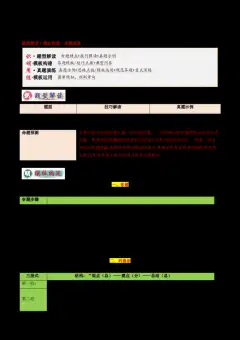
语篇解读
关键词
student, misconceptions, real world, hobby, engagement
语篇结构
本文是一篇记叙文,用文章采用“问题—实践—深化—升华”的递进式结构,首段点明
教育困境(学生认为学习无趣且脱离现实),并提出核心策略:作者通过个人教学经
验,阐述将个人爱好融入课堂如何有效纠正学生误解、 提升学习参与度并深化师生关
系。文章通过举例子(如汽车轮胎摩擦力实验)、作对比(初始目标与意外收获的差
异),并升华到教育哲学层面,强调真实生活连接对激发学生内在热情的价值。
引言(第1 段)
·纠正学生“学习无趣且无关现实”的误解·关联教师爱好激发学生个人兴趣
实践方法(第2 段)
·融入个人爱好教学(如汽车实例)·用真实物品演示抽象概念(摩擦力实验)
深层影响(第3 段)
·超越预期:增强师生关系·共同兴趣者更投入,无兴趣者因教师真实展现而专注
理念升华(第4 段)
·从实验发展为教学哲学·三重价值:激活教学、连接现实、启发学生探索热情
原文出处
本文节选自edutopia 网站的一篇名为 How Teachers Can Use Their Hobbies to Boost
Student Engagement 的文章。
https://www.edutopia.org/article/how-teachers-can-use-their-hobbies-boost-student-engagement/
重难点词
battle v 与……斗争;misconception n 误解;enthusiastn 热衷者;physics n 物理学;
contextualize v 把 ……与有关;背景一并考虑;cover v 涉及,讲解;friction n 摩擦
力); ; real-life adj 真实的;application n 应用;engagement n 参与;aspect n 方
面;engaged adj 感兴趣的;course n 课程;philosophy n 工作准则;energize v 使充满
活力;instruction n 指导;engage v 吸引,参与;demonstrate v 展示;passion n 激情
assumption n 假定;engineering n 工程学;illustrate v 解释;bond n 关系;innovative
adj 创新的;humorous adj 幽默的;decisive adj 果断的;sympathetic adj 同情的
重难点词块
make connection to 与……建立联系;conduct lab experiments 进行实验室实验;focus
on 注重;build relationship with sb 某人建立关系;bring in 引入;abstract concept 抽
象概念;play out 使发生;best of all 最重要的是;be passionate about 酷爱……;
attendance rate 出勤率
长难句分析
If we’re covering friction, for example, I bring different tires into my classroom so that my
students can conduct lab experiments with them to see how friction works in real-life
applications.
句意为:例如,当我们学习摩擦力时,我会把不同的轮胎带到教室, 以便学生能用它们
做实验,从而观察摩擦在现实应用中的工作原理。句子的主干为 I bring different tires
into my classroom。If 引导条件状语从句;so that 引导目的状语从句,说明带轮胎的目
的。
全文翻译
当老师时,你工作的很大一部分是与学生的误解作斗争。通常,学生来到教室时认为学习不会有趣,
而且他们所学的内容与现实世界无关,更不用说与他们的个人兴趣相关了。我发现,如果我向学生展示他
们所学的内容与我的爱好有什么关联,他们就更愿意将其与自己的个人兴趣联系起来,并培养自己的爱好。

无论我教什么科目,我都会想办法把我的爱好带进课堂。例如,我是个汽车爱好者,所以当我教物理
时,我会用我对汽车的了解来阐释物理概念。比如,如果我们正在学习摩擦力,我会把不同的轮胎带到教
室里,这样我的学生就可以用它们进行实验,了解摩擦力在实际应用中是如何起作用的。
当我最初把我的爱好带进课堂时,我关注的是这样做如何能提高学生的参与度,帮助他们理解科学概
念。但我很快发现,这种做法也有助于我与他们建立更紧密的关系。当我让他们了解我校外生活的一个方
面时,一些同样对汽车感兴趣的学生与我有了更多的交流,并且对我的课程更感兴趣了。即使是那些和我
没有相同兴趣的学生,在我展示出自己不同的一面后,似乎也更投入了。
最初的一次尝试现在更多地成了一种教学理念。即使在备课的时候,我也往往会思考如何融入我的爱
好。我发现,这样做能让我的教学更有活力,吸引学生的注意力,并向他们展示抽象概念在现实世界中是
如何体现的。最棒的是,我对爱好的热情似乎能激励他们去寻找自己热爱的事物。
24. 根据作者的说法,什么对教师构成了挑战?
A. 学生对教师的误解。
B. 学生对学习的错误认知。
C. 教材与学生生活不相关。
D. 教师和学生爱好之间的差距。
25. 作者为什么把轮胎带进教室?
A. 教授一项工程技能。
B. 解释汽车的结构。
C. 分享一次真实的生活经历。
D. 阐释一个科学概念。
26. 作者的教学方法产生了什么意想不到的结果?
A. 更高的课堂出勤率。
B. 更好的考试成绩。
C. 更紧密的师生关系。
D. 学生有更多的课余时间。
27. 以下哪一项最能描述作者这位老师?
A. 有创新精神的。
B. 幽默的。
C. 果断的。
D. 有同情心的。
       核心素养统领 综合能力导向
绍兴市第一中学 正高级教师、特级教师 蔡红
    金华市教育教学研究中心 高级教师 徐钰
2026 年1 月高考英语试卷坚持素养立意,全面反映学生的正确价值观、必备品格和关键能力,着重考
查学生在真实情境中运用英语分析与解决问题的能力,在人才选拔、教学反拨与考试改革示范等方面均发
挥了积极的导向作用。具体如下:
一、优化结构,彰显核心素养立意
中小学考试应“强化核心素养立意”“科学优化试卷内容结构、题型结构和难度结构”。在题型结构
稳定的前提下,本卷继续优化内容结构与难度结构,将核心素养的考查深度融入到整体设计之中。
内容结构上,本卷围绕三大主题多样化选材,从阅读A 篇“作品征集”、B 篇“教师以趣促学”、C 篇
“识别消费者评论的真伪”、D 篇“AI 辅助植物碳封存”、七选五“回读现象”,到完形填空“青年扎根
农场实现个人价值”、语法填空“用笑声点亮日常的母亲”,再到应用文“呼吁图书馆书籍保护”与读后
续写“控制母牛并帮其寻找主人”,整套试题要求学生在完成语言任务的同时,建构涵盖多元文化理解、
社会问题关注、自我成长意义探寻的认知体系,充分彰显学科育人的价值导向。
难度结构上,试题梯度设置合理,充分体现对思维品质考查的区分度与进阶性。如阅读C 篇,从理解
段落(28)与猜测词义(29),到分析事实(30),再到推断观点(31),需要学生逐步完成从理解、推理到判断的
思维跃迁。又如应用文写作,针对“图书馆书籍被勾画涂写”这一问题,学生不仅要“说明具体情况”并
“呼吁爱护书籍”,还需要建立“情况”与“呼吁”之间的逻辑关联,系统考查学生从信息整合、分析判
断到创造性表达的思维能力。
二、联系生活,凸显综合能力考查
情境是落实考查内容和考查要求的载体。本卷情境紧密联系学生的生活实际,具有真实交际意义。阅
读A 至C 篇、七选五、语法填空与应用文,涉及艺术修养、学习策略、信息素养、生活智慧与社会责任等,
均贴近学生的生活经验与认知水平。此外,阅读D 篇融入环保与科技主题,完形填空提供生涯规划与价值
取向的范例,读后续写则以生活趣事为背景,考查叙事与问题解决的能力。
生活化的试题情境能提供真实、多样的线索与条件,引导学生综合运用知识、技能和策略解决问题。
例如,阅读D 篇围绕“如何去碳以应对气候变化”这一问题,介绍“运用AI 增加植物碳封存”的方案;
从研究目的(32),到研究方法(33)与研究原理(34),再到研究意义(35),解决这一问题链,学生既需要理解
植物吸收二氧化碳的自然机制,又要认识AI 在该过程中的优化作用,进而理解科技协同自然应对环境问
题的现实路径。再如读后续写,面对“母牛迷路引起围观”这一生活事件,学生需要基于对事件脉络的把
握,按照“发现—控制—助归”的逻辑叙事,同时融入对公共安全、生命关怀和公民责任的认知与态度。
这一任务在考查学生叙事能力、问题解决策略与情感表达的同时,体现了语言运用与全人发展的有机统一。
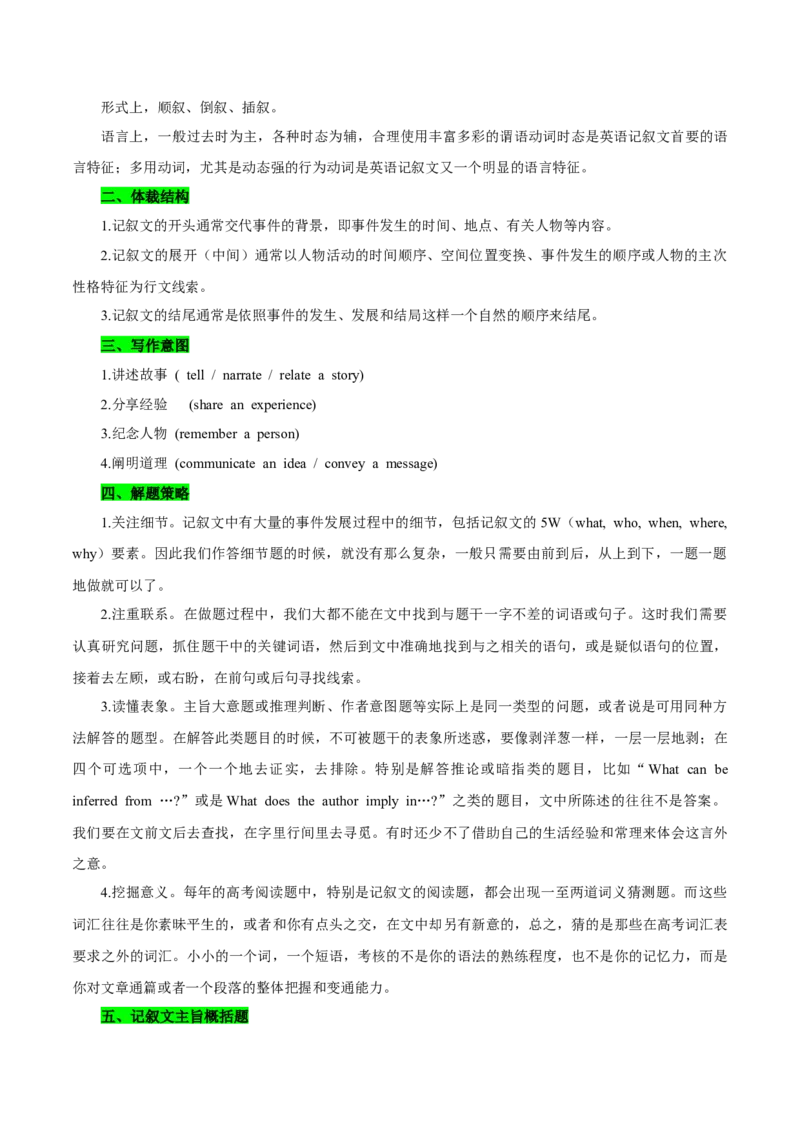
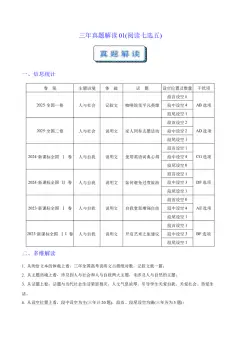
年份
卷别
主题
话题
2026
2026 浙江1 月卷
人与社会
2025
2025 新课标I 卷
人与社会
讲述了师生“教学相长”的故事
2025 新课标II 卷
人与社会
讲述了医学院教师的工作情况
2025 八省联考卷
人与社会
邮递员与社区的深厚情感
2024
2024 新课标I 卷
人与自然
中医针灸治疗动物
2024 新课标II 卷
人与社会
创新打印吸引顾客
2023
2023 新课标I 卷
人与自然
利用自然自我修复原理净化污水
2023 新课标II 卷
人与自我
学校科学项目
2023 全国甲卷
人与社会
DIY 成为女性新宠
2022
2022 新课标Ⅱ卷
人与自我
记者生活趣事
2022 全国甲卷
人与社会
悉尼发展遇到的问题
2020
2020 全国I 卷
人与自我
人与社会
逆境完成学业树榜样
书评
2020 全国II 卷
人与社会
宣传图书馆
2020 全国III 卷
人与社会
影视作品使用动物
英国多世同堂现象
一、题型解读
记叙文是以写人、记事、状物为主要内容,以记叙和描写为表达方式的文章。一篇记叙文,无论长短
都应该是一个完全独立的事实,描写人物、地点、事件和过程,表达作者的某种情感。主要具有以下特点:
内容上,记叙文应该包括六要素,即:时间、地点、人物、起因、经过和结果。可以按事件发生的时
间顺序写,也可以按事件发生的先后写。
命题上,主要集中在多个事件的先后顺序与人物的情感态度上。
选材上,新颖、生动、真实、典型的素材描写,让读者有身临其境的感觉。
7 年高考真题记叙文考点解读
阅读理解记叙文满分作答解题技巧
形式上,顺叙、倒叙、插叙。
语言上,一般过去时为主,各种时态为辅,合理使用丰富多彩的谓语动词时态是英语记叙文首要的语
言特征;多用动词,尤其是动态强的行为动词是英语记叙文又一个明显的语言特征。
二、体裁结构
1.记叙文的开头通常交代事件的背景,即事件发生的时间、地点、有关人物等内容。
2.记叙文的展开(中间)通常以人物活动的时间顺序、空间位置变换、事件发生的顺序或人物的主次
性格特征为行文线索。
3.记叙文的结尾通常是依照事件的发生、发展和结局这样一个自然的顺序来结尾。
三、写作意图
1.讲述故事 ( tell / narrate / relate a story)
2.分享经验  (share an experience)
3.纪念人物 (remember a person)
4.阐明道理 (communicate an idea / convey a message)
四、解题策略
1.关注细节。记叙文中有大量的事件发展过程中的细节,包括记叙文的5W(what, who, when, where,
why)要素。因此我们作答细节题的时候,就没有那么复杂,一般只需要由前到后,从上到下,一题一题
地做就可以了。
2.注重联系。在做题过程中,我们大都不能在文中找到与题干一字不差的词语或句子。这时我们需要
认真研究问题,抓住题干中的关键词语,然后到文中准确地找到与之相关的语句,或是疑似语句的位置,
接着去左顾,或右盼,在前句或后句寻找线索。
3.读懂表象。主旨大意题或推理判断、作者意图题等实际上是同一类型的问题,或者说是可用同种方
法解答的题型。在解答此类题目的时候,不可被题干的表象所迷惑,要像剥洋葱一样,一层一层地剥;在
四个可选项中,一个一个地去证实,去排除。特别是解答推论或暗指类的题目,比如“ What can be
inferred from …?”或是What does the author imply in…?”之类的题目,文中所陈述的往往不是答案。
我们要在文前文后去查找,在字里行间里去寻觅。有时还少不了借助自己的生活经验和常理来体会这言外
之意。
4.挖掘意义。每年的高考阅读题中,特别是记叙文的阅读题,都会出现一至两道词义猜测题。而这些
词汇往往是你素昧平生的,或者和你有点头之交,在文中却另有新意的,总之,猜的是那些在高考词汇表
要求之外的词汇。小小的一个词,一个短语,考核的不是你的语法的熟练程度,也不是你的记忆力,而是
你对文章通篇或者一个段落的整体把握和变通能力。
五、记叙文主旨概括题
1.首段法:首段主旨句;转折词后;破折号后
2.核心名词法:核心名词在文章中高频出现。可是“原词”或“同义词”不断曝光。
3.合并法:整合各段落大意,整合各段落首段信息
4.首位呼应法:整合首段和尾端信息
六、记叙文细节理解题
1.划出题干,选项关键词;
2.回忆文章结构,定位具体段落;
3.理解细节内容,最后找出答案;
4.正确选项的特征:原词复现/同义词、近义词替换;语言高度凝练概括。
七、实用答题妙招
1.阅读理解记叙文细节理解题居多,落实“题文同序”和“同义替换”。
2.数据计算题注重“原文定位”“细节理解”,弄清来龙去脉再计算。
3.文章寓意题要注意言外之意,尤其是首尾段做出合理推测判断。
4.人物性格描述题注意捕捉原文褒贬性词汇再进行同义替换和排除。
5.满分策略:读题干→找原文→做标记→留痕迹→看选项→扣字眼。
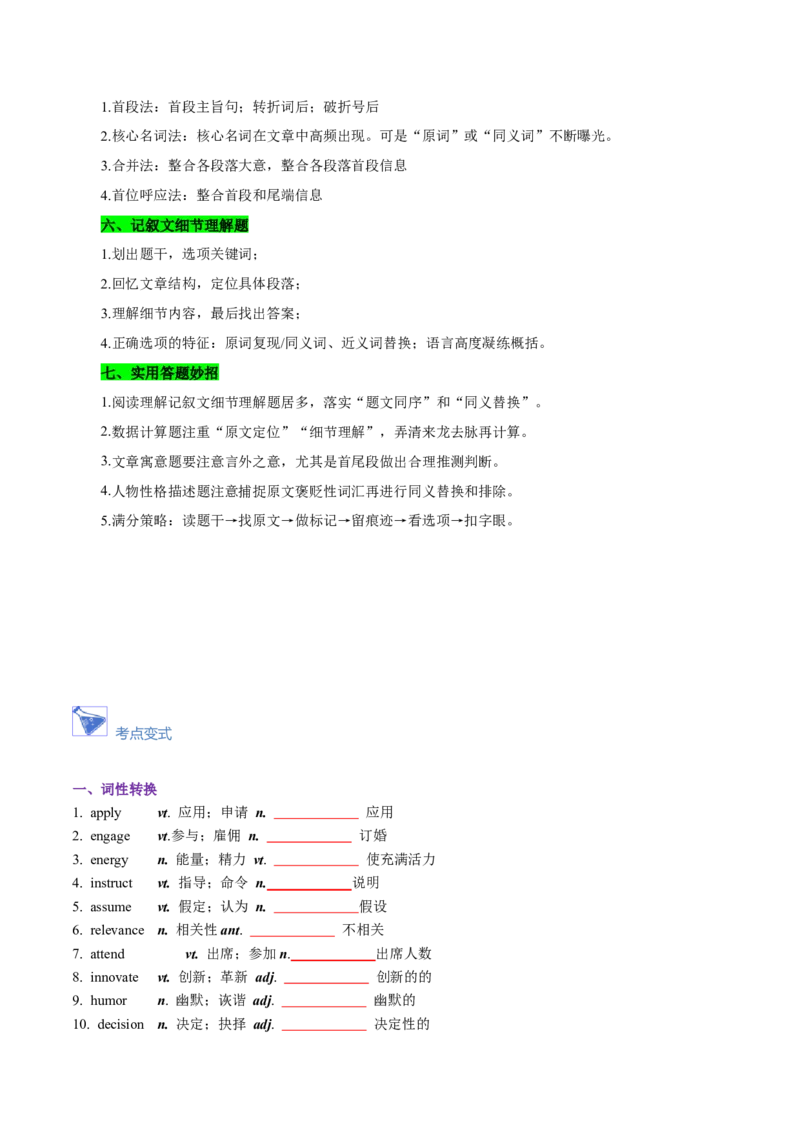
一、词性转换
1. apply
vt. 应用;申请 n.              应用
2. engage
vt.参与;雇佣 n.              订婚
3. energy
n. 能量;精力 vt.              使充满活力
4. instruct
vt. 指导;命令 n.            说明
5. assume
vt. 假定;认为 n.             假设
6. relevance n. 相关性ant.              不相关
7. attend
vt. 出席;参加n.            出席人数
8. innovate
vt. 创新;革新 adj.              创新的的
9. humor
n. 幽默;诙谐 adj.              幽默的
10. decision n. 决定;抉择 adj.              决定性的
考点变式
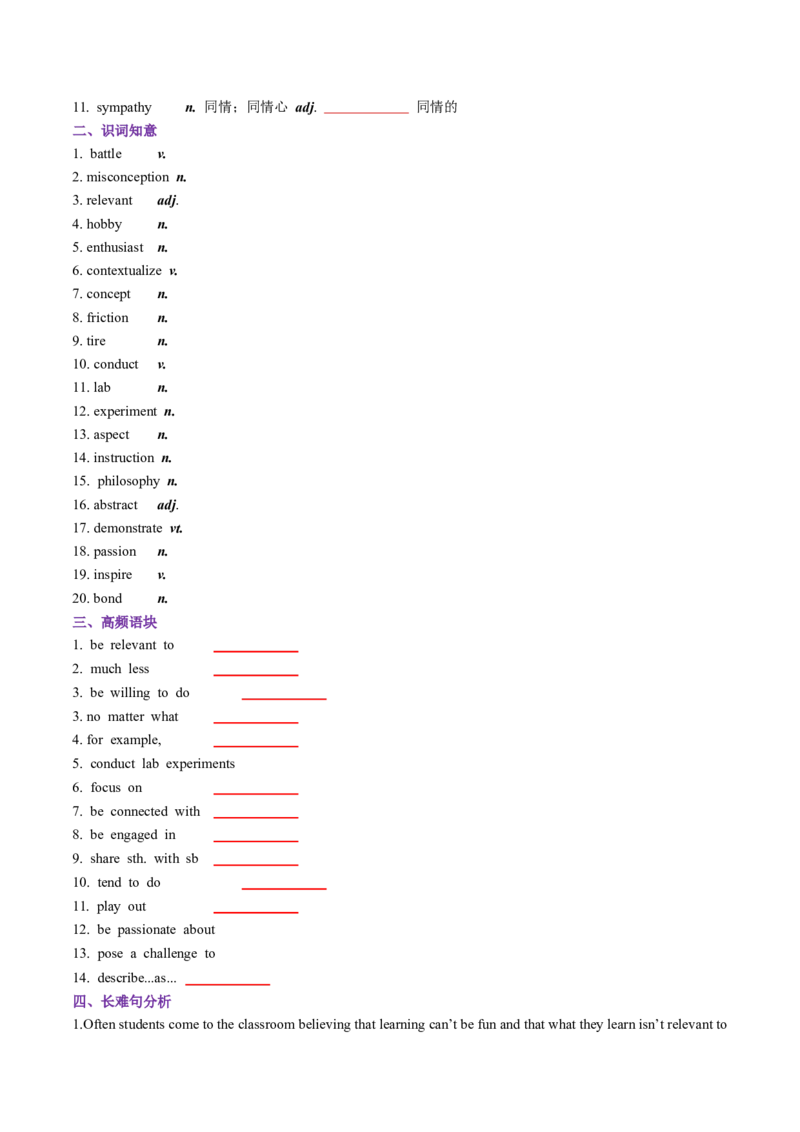
11. sympathy
n. 同情;同情心 adj.              同情的
二、识词知意
1. battle
v.
2. misconception n.
3. relevant
adj.
4. hobby
n.
5. enthusiast n.
6. contextualize v.
7. concept
n.
8. friction
n.
9. tire
n.
10. conduct
v.
11. lab
n.
12. experiment n.
13. aspect
n.
14. instruction n.
15. philosophy n.
16. abstract
adj.
17. demonstrate vt.
18. passion
n.
19. inspire
v.
20. bond
n.
三、高频语块
1. be relevant to

2. much less

3. be willing to do

3. no matter what

4. for example,

5. conduct lab experiments
6. focus on

7. be connected with

8. be engaged in

9. share sth. with sb
10. tend to do

11. play out

12. be passionate about
13. pose a challenge to
14. describe…as…
四、长难句分析
1.Often students come to the classroom believing that learning can’t be fun and that what they learn isn’t relevant to
the real world — much less to their personal interests.
2.I’ve discovered that if I show students how what they learn is relevant to my hobbies, they’re much more willing
to make connections to their personal interests and develop their own hobbies.
五、知识拓展
1.教育创新趋势:在现代教育领域,越来越多的教师开始尝试将个人兴趣爱好融入教学过程,这是一种创
新的教学方法,旨在提高学生的学习兴趣和参与度。这种教学方式被称为“兴趣驱动教学法”,它强调将
学生的兴趣与课程内容相结合,使学习变得更加主动和有趣。
2.兴趣驱动教学的好处:研究表明,当学生对学习内容感兴趣时,他们的学习动力和专注度会显著提高。
将教师的个人爱好引入课堂,可以为学生提供更加生动、具体的学习案例,帮助他们更好地理解抽象的概
念。此外,这种教学方式还可以增强师生之间的互动和沟通,建立更加良好的师生关系。
不同学科的应用案例:除了文中提到的物理学科,其他学科也可以采用类似的教学方法。例如,语文教师
可以分享自己的阅读爱好,引导学生进行文学鉴赏;艺术教师可以展示自己的绘画作品,激发学生的创作
灵感;体育教师可以分享自己的运动经历,鼓励学生积极参与体育活动。
   01【2025 浙江1 月卷】
When I was a child I was often told what not to eat. “You don’t want to get fat” was on constant repeat
throughout my childhood. It really messed up my relationship with food – something that took me years to
overcome. Because of this, I’m careful not to connect what my kids weigh with their worth as people. I encourage
my daughter to make healthy snack choices and often dissuade (劝阻) her from a second dessert. But one day when
I heard her saying “I think I’m too fat,” my heart sank. It made me wonder if giving her advice on snacks was
having an unintentionally negative impact.
According to Charlotte Markey, a professor of psychology, food is one of the rare subjects where, as parents,
典例引领
saying less is more. “There are so many things in parenting that are good to talk through, but I’m not convinced that
food is one of them,” she says. “It just creates some worries and insecurities in kids that aren’t necessarily healthy.”
Instead, she recommends applying a well-known concept among nutrition experts called the “Division of
Responsibility,” where parents provide a variety of mostly healthy foods to their kids at fixed times, and the kids
themselves decide what and how much they want to consume – even if that means occasionally eating more
cookies than carrots.
Allowing kids to eat what they want also exposes them to the natural consequences of their decisions. “When
your child says, ‘My stomach hurts,’ you can say, ‘Well you had a lot of sugary foods and you might feel better if
you made some other choices,’” says Markey. “Let them feel like they have some control over it.”
I’ve been trying out these strategies and I’ve found that when I’m less restrictive, they do make better
decisions. “Feeding is a long game,” says Markey. “The food you have available makes a huge difference. Even if
they don’t eat it, they’re seeing it. And then all of a sudden it clicks.”
24. What can be inferred about the author from the first paragraph?
A. She is upset by her kids’ weight.
B. She is critical of the way she was fed.
C. She is interested in making food.
D. She is particular about what she eats.
25. Which of the following would Markey disapprove of?
A. Allowing kids to eat cookies occasionally.
B. Offering various foods to kids at fixed times.
C. Explaining to kids the risks of taking snacks.
D. Talking with kids about school at mealtimes.
26. What should kids do according to the “Division of Responsibility”?
A. Make diet decisions on their own.
B. Share their food with other kids.
C. Eat up what is provided for them.
D. Help their parents do the dishes.
27. What does the author think of the strategies she has been following?
A. Costly.
B. Complex.
C. Workable.
D. Contradictory.
02【2024 浙江1 月卷】
When was the last time you used a telephone box? I mean to make an actual phone call — not to shelter
from the rain. Ages ago, right? The last time I used a phone box for its intended purpose was…2006. I was
conducting auditions (试演) for my play in my tiny old shared house in London. Hoping to impress some
talented actors to come and work for me for nothing, I spread some throws over the sofas and lit candles to
make it seem a bit more ”young professional”.
As I rushed outdoors to empty the wastepaper baskets, the door swung shut behind me. Suddenly I was
locked outside. My mobile phone was inside, but luckily there was a telephone box across the street. So, I
called Directory Assistance, got put through to our landlady’s managing agent, and had a spare key sent to me
with just enough time to get back in before the actors arrived.
As it has been many years since I last used one, I should hardly be surprised that then are no longer any
public telephones near my house. The last one standing has just been turn into a “mini community library”:
any passer-by can “borrow” a book from its shelves return it later, or replace it with another title from their
own collection.
For a few months after the “library” opened, I didn’t bother taking a look, as I had assumed that it would
be stuffed full of cheese love stories. Then I noticed fork conducting spring cleans dropping boxes of
voluminous books on various subjects there. And these books were free. This unbeatable price-point
encouraged me to experiment with dozens of titles that I would never normally consider buying. And I’ve
discovered some great books!
If I ever get trapped outside my house again, my local telephone box will, sadly no longer be able to
connect me with my keys. But it can certainly keep me entertained while I wait for my wife to rescue me.
24. What does the underlined word “it” in the first paragraph refer to?
A. The play.
B. The shared house.      C. The sofa.
D. The telephone box.
25. Why did the author use the telephone box in 2006?
A. To place an urgent call.
B. To put up a notice.
C. To shelter from the rain.
D. To hold an audition.
26. What do we know about the “mini community library”?
A. It provides phone service for free.
B. Anyone can contribute to its collection.
C. It is popular among young readers.
D. Books must be returned within a month.
27. Why did the author start to use the “library”?
A. He wanted to borrow some love stories.
B. He was encouraged by a close neighbour.
C. He found there were excellent free books.
D. He thought it was an ideal place for reading.
03【2023 浙江1 月卷】
Live with roommates? Have friends and family around you? Chances are that if you’re looking to live a more
sustainable lifestyle, not everyone around you will be ready to jump on that bandwagon.
I experienced this when I started switching to a zero waste lifestyle five years ago, as I was living with my
parents, and I continue to experience this with my husband, as he is not completely zero waste like me. I’ve learned
a few things along the way though, which I hope you’ll find encouraging if you’re doing your best to figure out
how you can make the change in a not-always-supportive household.
Zero waste was a radical lifestyle movement a few years back. I remember showing my parents a video of Bea
Johnson, sharing how cool I thought it would be to buy groceries with jars, and have so little trash! A few days
later, I came back with my first jars of zero waste groceries, and my dad commented on how silly it was for me to
carry jars everywhere. It came off as a bit discouraging.
Yet as the months of reducing waste continued, I did what I could that was within my own reach. I had my
own bedroom, so I worked on removing things I didn’t need. Since I had my own toiletries (洗漱用品), I was able
to start personalising my routine to be more sustainable. I also offered to cook every so often, so I portioned out a
bit of the cupboard for my own zero waste groceries. Perhaps your household won’t entirely make the switch, but
you may have some control over your own personal spaces to make the changes you desire.
As you make your lifestyle changes, you may find yourself wanting to speak up for yourself if others
comment on what you’re doing, which can turn itself into a whole household debate. If you have individuals who
are not on board, your words probably won’t do much and can often leave you feeling more discouraged.
So here is my advice: Lead by action.
24. What do the underlined words “jump on that bandwagon” mean in the first paragraph?
A. Share an apartment with you.
B. Join you in what you’re doing.
C. Transform your way of living.
D. Help you to make the decision.
25. What was the attitude of the author’s father toward buying groceries with jars?
A. He disapproved of it.
B. He was favorable to it.
C. He was tolerant of it.
D. He didn’t care about it.
26. What can we infer about the author?
A. She is quite good at cooking.
B. She respects others’ privacy.
C. She enjoys being a housewife.
D. She is a determined person.
27. What is the text mainly about?
A. How to get on well with other family members.
B. How to have one’s own personal space at home.
C. How to live a zero waste lifestyle in a household.
D. How to control the budget when buying groceries.
04【2025 全国一卷】
In my ninth-grade writing class last year, I met a cowboy who saved his town, a strict father who demanded
his son earn straight A’s, and a modern-day Juliet who died of heartbreak after her parents rejected the love of her
young life. More than once, I found myself wondering just how my students, who’d created these people, knew
their subjects so well.
But things were different for their first essay, which was about the question: “Why is writing important?” Most
of the essays filled less than one page, and few contained a sentence that could be interpreted as a thesis ( 论点)
statement. I was shocked. Then I realized that the problem was the question itself. They could have written pages
on the necessity of computers, but writing, in and of itself, simply didn’t strike them as important. This would have
to change.
As a new unit started, I asked everyone to write a persuasive piece on a health-related topic of their choice.
This time they found the exercise much more interesting. For the next two assignments, a personal-narrative unit
followed by a creative-writing workshop, I only required that the piece meet the specifications of its genre ( 体裁)
and that it contain a thesis. The results were staggering. The students took on diverse topics and turned in stories,
10 to 20 pages each, with characters that broadened my view and touched my heart.
I walked into class believing that writing is important as a means of communication. However, my students
demonstrated something more important to me. When the final bell rang in June, I walked away with a yearbook
full of messages about writing’s most powerful significance — the ability to connect people, to put us in another’s
skin, to teach us what it means to be human.
24. Who are the people mentioned at the beginning of paragraph 1?
A. Ninth graders.
B. Students’ parents.
C. Modern writers.
D. Fictional characters.
25. Why did the students perform poorly in writing their first essay?
A. They were not given enough time.
B. They had a very limited vocabulary.
C. They misunderstood the question.
D. They had little interest in the topic.
26. What does the underlined word “staggering” in paragraph 3 mean?
A. Mixed.
B. Amazing.
C. Similar.
D. Disturbing.
27. What does the author’s experience show?
A. Teaching is learning.
B. Still waters run deep.
C. Knowledge is power.
D. Practice makes perfect.
变式演练
变式一、师生交往类记叙文4 篇
01 (2026·河北沧州·一模)In 1907, 37-year-old Maria Montessori opened her first school: Children’s
House, a preschool that would transform children’s education.
Today, the ideas of the Italian woman who started Montessori schools are still used in preschools all over the
world. But back then, the idea that giving children fun activities would help them more than just memorize facts
and do drills was very new.
Though her innovations inspired a movement in young children’s learning, Montessori saw her work more
simply. “I did not invent a method of education,” she wrote in 1914. “I simply gave some little children a chance to
live.”
Montessori was passionate about education from a young age. Born in 1870 and raised in Rome, she took a
path that was different from what people expected for women at that time. Montessori studied engineering, and
then applied to medical school at the University of Rome, telling a professor during her interview, “I know I shall
become a doctor.” The school refused her because of her gender, so Montessori enrolled in( 入学)the general
university, studied physics, mathematics and natural sciences, and reapplied to medical school. She was admitted,
becoming the first woman to enter the university’s Faculty of Medicine, and in July 1896, she became one of Italy’s
first female doctors.
Montessori’s medical work led her to the University of Rome’s psychiatric (精神病的) clinic. As part of her
job, she visited institutions for children with mental disorders, searching for patients suitable for treatment at the
clinic. It was here that her interest in child development intensified.
She read extensively about children with learning differences. In 1898, Montessori spoke at Italy’s National
Medical Congress in Turin, advocating for the idea that lack of adequate support and care for children with mental
and emotional disorders caused them to misbehave. She developed her own teaching materials, and in 1907, she
opened her first school. Montessori’s “auto-education” approach soon had the five-year-old children reading and
writing. News of Montessori’s success spread quickly, and by 1908, her name was known around the world.
1.What was Montessori’s view on her educational method?
A.She believed it was a creative method.
B.She considered it a complex system of teaching.
C.She saw it as a way to challenge traditional education.
D.She thought it merely offered a chance for children to exist.
2.Why was Montessori initially refused admission to medical school?
A.She didn’t pass the entrance exam.
B.She lacked the necessary qualifications.
C.The university didn’t accept female students then.
D.She was rude to the professor during her interview.
3.What strengthened Montessori’s interest in child development?
A.Her medical studies.
B.Her passion for education.
C.Her work at the psychiatric clinic.
D.Her visit to children’s hospitals.
4.Which of the following can best describe Montessori?
A.Careful and talented.
B.Innovative and caring.
C.Humorous and helpful.
D.Generous and ambitious.
02(25-26 高三上·山东·月考)Education is essential. It is equally important that all students have excellent
educators in their life.
I’ve reflected on the impact my teachers have had, and will continue to have, in my life. From Mr. Bowker,
who challenged me in math, to Mr. Bernsteen, my health teacher who taught me the value of hard work, my
teachers have helped shape the student I am today. But one of the teachers who left a lasting impression on me was
my summer school teacher, Mr. Davis, who impacted me beyond the classroom. He found time to connect with me
on a personal level and talk to me after class. I felt like Mr. Davis cared about my academic success and was
committed to setting an example of what’s possible.
Mr. Davis could relate to what it was like to be a rising ninth-grade black male in today’s society. He taught
me how to speak up confidently and share my ideas with others. When I would put my hand down because I was
unsure of my answer, Mr. Davis would immediately say, “No courage, no triumph.” He never made me feel
inadequate; he encouraged me to always pursue knowledge because he, too, was learning every day. Mr. Davis
helped me brave the challenges and take advantage of the opportunities.
I think having more black male teachers like Mr. Davis in the classroom could increase student success. They
would share the background and experiences of many of their students and help build long-lasting teacher-student
relationships. But, unfortunately, as the student population becomes more ethnically diverse, teachers in Nevada
still are predominantly white. The numbers for black male teachers are more discouraging. Just 2 percent of
teachers nationwide are black men.
But you can help change the numbers. Whether you decide to study education in college or graduate school, I
hope more black males will consider teaching as a career. We, students of color need more examples of excellence
and success in classrooms — examples who look like us.
1.Why are Mr. Bowker and Mr. Bernstein mentioned in Paragraph 2?
A.To prove their greater impact on the author.
B.To introduce Mr. Davis and his deeper influence.
C.To extend gratitude for all their contributions.
D.To credit teachers for academic progress.
2.What does the underlined word “triumph” in Paragraph 3 mean?
A.Confusion.
B.Connection.
C.Victory.
D.Doubt.
3.What is the current situation of teachers in Nevada?
A.2% of the staff are black males.
B.Teachers have diverse ethnic backgrounds.
C.White teachers are in the majority.
D.Black male teachers are sufficient in number.
4.What is the purpose of the text?
A.To share memories of various teachers.
B.To urge black males to take up teaching.
C.To show the importance of educators.
D.To advertise for black male teachers.
03(25-26 高三上·天津武清·月考)Barditch High School decided to have an All-School Reunion. Over 450
people came to the event. There were tours of the old school building and a picnic at Confederate Park. Several
former teachers were on hand to tell stories about the old days. Ms. Mabel Yates, the English teacher for over fifty
years, was wheeled to the Park.
Some eyes rolled and there were a few low groans(嘟囔声)when Ms. Yates was about to speak. Many
started looking at their watches and coming up with excuses to be anywhere instead of preparing to listen to a
lecture from an old woman who had few kind words for her students and made them work harder than all the other
teachers combined.
Then Ms. Yates started to speak:
“I can’t tell you how pleased I am to be here. I haven’t seen many of you since your graduation, but I have
followed your careers and enjoyed your victories as well as crying for your tragedies. I have a large collection of
newspaper photographs of my students. Although I haven’t appeared in person, I have attended your college
graduations, weddings and even the births your children, in my imagination.”
Ms. Yates paused and started crying a bit. Then she continued:
“It was my belief that if I pushed you as hard as I could, some of you would succeed to please me and others
would succeed to annoy me. Regardless of our motives, I can see that you have all been successful in you chosen
path.”
“There is no greater comfort for an educator than to see the end result of his or her years of work. You have all
been a great source of pleasure and pride for me and I want you to know I love you all from the bottom of my
heart.”
There was a silence over the crowd for a few seconds and then someone started clapping. The clapping turned
into cheering, then into a deafening roar (呼喊). lawyers, truck drivers, bankers and models were rubbing their eyes
or crying openly with no shame all because of the words from a long forgotten English teacher from their
hometown.
1.What activity was organized for the school reunion?
A.Graduates’ reports in the old building.
B.Sightseeing in the park.
C.A picnic on the school playground.
D.Telling stories about past events.
2.What can be inferred from Paragraph 2?
A.Some graduates were too busy to listen to Ms. Yates’ speech.
B.Some people got tired from the reunion activities.
C.Many graduates disliked Ms. Yates’ ways of teaching.
D.Most people had little interest in the reunion.
3.What was Ms. Yates’ belief in teaching teenagers?
A.Hard-pushed students are more likely to succeed.
B.Pressure on students from teachers should be reduced.
C.Teachers’ knowledge is the key to students’ achievements.
D.Students’ respect is the best reward for teachers.
4.Which of the following can best describe Ms. Yates?
A.reliable and devoted.
B.Tough and generous.
C.Strict but caring.
D.Proud but patient.
04(2024 高三·天津·专题练习)Our teacher, Miss Chevalier was a small woman, with a moon face, fatty
fingers and curls that sprang straight up from her head, hence the funny name “Poodle (卷毛狗)”. She taught in our
reading club. Sometimes she would look in and ask what we were reading — not to check but to know.
That’s what happened the day my club was reading aloud a poem by Henry Longfellow. I guess I was better
than the others, for Miss Chevalier asked a while later, “Addie, I was wondering if you would recite the whole
poem to the Saturday evening’s club.” She said a famous professor was going to give a lecture about the poet, and a
presentation of that poem would be a fresh way to start.
She asked me to memorize it. “But that shouldn’t be a problem for a child of your ability,” she added. I’m
telling you, my happy feet barely touched the ground all the way home. To me, that was the biggest thing ever and I
soon learned the whole poem by heart, well prepared for our first rehearsal.
I was desperately nervous when I went to her office the next day. But the good thing was she always had the
smile that would make you feel like you just did something right.
Halfway through the poem, Miss Chevalier stopped me and asked if I knew what “impetuous” meant. Despite
her encouraging smile, I wanted to sink through the floor because I was unsure about its pronunciation as well as its
meaning. Miss Chevalier pretended not to have noticed my red face and handed me a dictionary, asking me to read
its definition aloud. “Impetuous has two definitions: rushing with great force or violence; acting suddenly, with
little thought. ”
She asked me which one fitted the poem. I read both definitions over again, trying to figure it out, but Miss
Chevalier must have read my mind. “There is no wrong answer,” she said, “I want to know your opinion, Addie.”
Hesitantly, I said, “Maybe… both.”
She liked that. “One has to be impetuous both ways or they wouldn’t dare to face up to any challenge. Would
you call yourself impetuous?”
I knew she was asking for an opinion. “My mother thinks being impetuous for girls is improper, anyway.”
She said my mom was somewhat right about that. “But girls should also be wise to take up challenges when
needed. I believe you are such a girl.”
After that, I would never call Miss Chevalier “Poodle” again.
1.Why did Addie feel happy on her way home?
A.An event was going to happen.
B.She was fully ready for her first rehearsal.
C.She gained recognition for her performance.
D.She memorized the poem sooner than others.
2.What can be learned about Miss Chevalier’s personality from the way she treated Addie?
A.Caring and considerate.
B.Easygoing and carefree.
C.Curious and open-minded.
D.Disciplined and strong-willed.
3.How did Miss Chevalier succeed in making Addie truly understand the word “impetuous”?
A.By asking Addie to define it in her own way.
B.By interpreting the two definitions separately.
C.By consulting the dictionary for its definitions.
D.By linking its definitions to Addie’s situations.
4.What is the probable reason that Addie would never call Miss Chevalier “Poodle” again?
A.She followed her mother’s advice.
B.She made up her mind to be a polite girl.
C.She was touched by Miss Chevalier’s trust.
D.She felt Miss Chevalier’s teaching funny.
变式二、教育创新类记叙文4 篇
01(25-26 高三上·北京朝阳·期中)My middle school taught the periodic table (元素周期表) in the eighth
grade. From the beginning, I fell in love with the element “Bismuth” (Bi). It comes in absolutely beautiful colours
and grows in square shapes that can be changed during the growing process with music.
Now, Bi is not exactly as common as Hydrogen or Oxygen so it wasn’t an element we talked about much in
class. However, whenever the opportunity arrived, I would bring it up and express how much I liked it. It kind of
became a joke that on the occasion when it was brought up, my classmates would look over at me and kind of
laugh.
One day we were in class like normal and I was in a bad mood. Mrs. Mennon, the teacher of this class, had a
rule that if you finished your work early, you had to do extra work. All I wanted to do was draw or play games. I
remember sitting there and just thinking, “She is out of her mind! What’s the point in making us do extra work?”
Literally as I was thinking about this, Mrs. Mennon called my name aloud, “Henry! Come here.” I was
worried I had somehow said my thoughts out loud, but that wasn’t it at all. When I got to the desk she explained
that she had been at a resource fair for science teachers to buy some new supplies for the class. She then held out
her hand and gave me a tiny piece of Bi, and said she had seen it and immediately thought of me. My face lit up
and couldn’t thank her enough. She said that was all and I went back to my seat.
In my head, I had been complaining about Mrs. Mennon and her rule all without knowing she had done
something extremely kind for me. I felt horrible. I have teachers in my family, and I’ve seen the trouble they have
to deal with, but I hadn’t been thinking about how much they had done for us.
It’s been a long time since then. The Bi was a gift I will always cherish, but Mrs. Mennon also gave me a
lesson. I needed to hear.
1.What made the author’s classmates laugh when Bi was mentioned?
A.Bi’s unusual name.
B.Bi’s unique properties.
C.The author’s knowledge of Bi.
D.The author’s predictable reaction to Bi.
2.Why did Mrs. Mennon give the author a piece of Bi?
A.To support his keen interest.
B.To comfort him for his low spirits.
C.To reward his extra work in the class.
D.To arouse his curiosity about her class.
3.How did the author feel after receiving the gift?
A.Moved but confused.
B.Excited but anxious.
C.Content but stressed.
D.Grateful but guilty.
4.What can you learn from the story?
A.Gifts blind your eyes.
B.Goodness favors growth.
C.A little interest goes a long way.
D.Youthful errors define your future.
02(25-26 高三上·江西宜春·月考)In the quiet oil town of Drumright, Oklahoma — where the highway
passes by empty shops and the population is just under 3,000 — Sarah Hagan is rewriting the rules of math
education.
The 25-year-old teacher, who turned down opportunities in bigger cities, now spends her days in a once-
worn-out classroom at Drumright High School, earning barely $30,000 a year. “When they offered me the job in
April before graduation, I just said ‘yes’,” recalls Hagan, whose passion outweighs the district’s limited resources.
What began as a simple room with uneven floorboards and mismatched walls has become a lively math
space under Hagan’s care. Every surface bursts with colorful creations: posters and paper fill every corner and a
handmade sign declares her the “Teacher of Awesome (Math).” This transformation mirrors her revolutionary
approach to education — one that relies not only on textbooks but also on student-crafted learning journals filled
with origami folds (折纸), hand-drawn diagrams, and lessons printed on rainbow-colored paper.
Hagan’s classroom is full of unconventional energy: algebra (代数) becomes speed-dating as students pair up
to name polynomials (多项式) and spaghetti strands (意大利面) demonstrate geometric principles. “She makes us
forget we’re learning,” says Jake Williams. Even math haters like Taylor Russell find themselves engaged: “This
year, I actually love it.”
The young educator’s “A, B, or Not Yet” grading system rules out failure as an option. Students reattempt
assignments until they master the material, with Hagan routinely staying hours after school to provide support.
During lunch breaks, students gather in her office for help with all subjects, not just math.
Fellow teacher Melinda Parker voices what many think: “We’re so lucky to have her in Drumright.” Though
the workload sometimes wears her out, her commitment never declines. In rare free moments, she shares her
innovative methods through her blog, appropriately titled Math equals Love — a philosophy that continues to
transform lives in this unlikely corner of rural Oklahoma.
1.What can we learn about Drumright?
A.Drumright is very populous.
B.People get high salaries in Drumright.
C.Math education is challenging in Drumright.
D.Drumright has limitless resources.
2.What is the key principle behind Hagan’s revolutionary teaching method?
A.Involve me and I learn.
B.Teach others to teach yourself.
C.Learn and grow together.
D.Seek truth from inner peace.
3.How does Sarah Hagan teach polynomials?
A.By using traditional textbooks.
B.Through math speed-dating activities.
C.By inventing the grading system.
D.Through office dialogues after class.
4.Which of the following words can best describe Sarah Hagan?
A.Conventional and committed.
B.Generous and reserved.
C.Talented and determined.
D.Creative and patient.
03(2025·福建泉州·一模)In the quiet oil town of Drumright, Oklahoma — where the highway passes by
empty shops and the population is just under 3,000 — Sarah Hagan is rewriting the rules of math education.
The 25-year-old teacher, who turned down opportunities in bigger cities, now spends her days in a once-
worn-out classroom at Drumright High School, earning barely $30,000 a year. “When they offered me the job in
April before graduation, I just said ‘yes’,” recalls Hagan, whose passion outweighs the district’s limited resources.
What began as a simple room with uneven floorboards and mismatched walls has become a lively math
space under Hagan’s care. Every surface bursts with colorful creations: posters and paper fill every corner and a
handmade sign declares her the “Teacher of Awesome (Math).” This transformation mirrors her revolutionary
approach to education — one that relies not only on textbooks but also on student-crafted learning journals filled
with origami folds (折纸), hand-drawn diagrams, and lessons printed on rainbow-colored paper.
Hagan’s classroom is full of unconventional energy: algebra becomes speed-dating as students pair up to
name polynomials (多项式) and spaghetti strands (意大利面) demonstrate geometric principles. “She makes us
forget we’re learning,” says Jake Williams. Even math haters like Taylor Russell find themselves engaged: “This
year, I actually love it.”
The young educator’s “A, B, or Not Yet” grading system rules out failure as an option. Students reattempt
assignments until they master the material, with Hagan routinely staying hours after school to provide support.
During lunch breaks, students gather in her office for help with all subjects, not just math.
Fellow teacher Melinda Parker voices what many think: “We’re so lucky to have her in Drumright.” Though
the workload sometimes wears her out, her commitment never declines. In rare free moments, she shares her
innovative methods through her blog, appropriately titled Math equals Love — a philosophy that continues to
transform lives in this unlikely corner of rural Oklahoma.
1.Why does the author mention the condition of Drumright?
A.To describe the falling of an oil town.
B.To highlight the value of Hagan’s choice.
C.To present the challenges of math education.
D.To inspire more donations of teaching resources.
2.What is the key principle behind Hagan’s revolutionary teaching method?
A.Involve me and I learn.
B.Teach others to teach yourself.
C.Learn and grow together.
D.Seek truth from inner peace.
3.How does Sarah Hagan teach polynomials?
A.By using traditional textbooks.
B.Through math speed-dating activities.
C.By inventing the grading system.
D.Through office dialogues after class.
4.What is the best title of the text?
A.The Teacher Believing Math equals Love
B.Teacher of Awesome: A Director of Vision
C.Talented Students Inspired
D.DIY Math: The Rules rewriten
04(25-26 高三上·山东泰安·开学考试)College professors these days face an ever-higher bar to grab the
attention of their students. Yet, Tatiana Erukhimova, who teaches physics at Texas A&M University in the USA, has
managed to get her students excited about science.
Known as “Dr. Tatiana”, the professor performs physics tricks with boundless energy and enthusiasm.
Videos of her theatrical demonstrations have racked up hundreds of millions of views across social media
platforms. In the videos, Erukhimova uses a range of everyday objects in her experiments, from ping pong balls and
toilet paper to bicycle wheels and hair dryers.
It’s clear she knows what it takes to get young people excited about a hard science. But it isn’t always that
way. When she first started teaching college freshman classes almost two decades ago, she struggled to grab the
attention of her younger students. She was used to teaching juniors (大三学生) and found it easier to teach them.
“By junior year, students enrolled in physics are determined to learn,” she says. “But when it comes to teaching a
large lecture hall of 100-plus first-year students, first impressions are important. Unfortunately, I did not grab their
attention—that was my mistakes.”
By the second semester, she found her footing, adjusting her approach to make her lecture halls feel smaller
and get her students engaged. “Talk to your students before and after class. Walk up and down the stairs when you
teach your class rather than stay on the stage,” she says. “And add showy demonstration, which helps students
connect the abstract concepts with real life.”
Erukhimova has earned more than just recognition on social media. In October 2023, she was honored with a
national award for science outreach “for leadership in bringing the excitement of physics through innovative
education programs.”
1.What can we infer about Erukhimova from the first two paragraphs?
A.She likes to play a trick on her students.
B.She wants to be popular on social media.
C.She excites widespread interest in science.
D.She is passionate about making online videos.
2.What’s the probable meaning of the underlined words “racked up” in paragraph 2?
A.Gained.
B.Controlled.
C.Protected.
D.Replaced.
3.Why did Erukhimova find it easier to teach juniors?
A.Juniors could study entirely on their own.
B.She used simpler teaching methods for juniors.
C.She didn’t have to worry about first impressions.
D.Juniors showed a higher level of commitment to learning.
4.How did Erukhimova find her footing in the second semester?
A.By improving her communication skills.
B.By following a traditional teaching method.
C.By reducing the number of students in the class.
D.By making herself approachable and her teaching engaging.