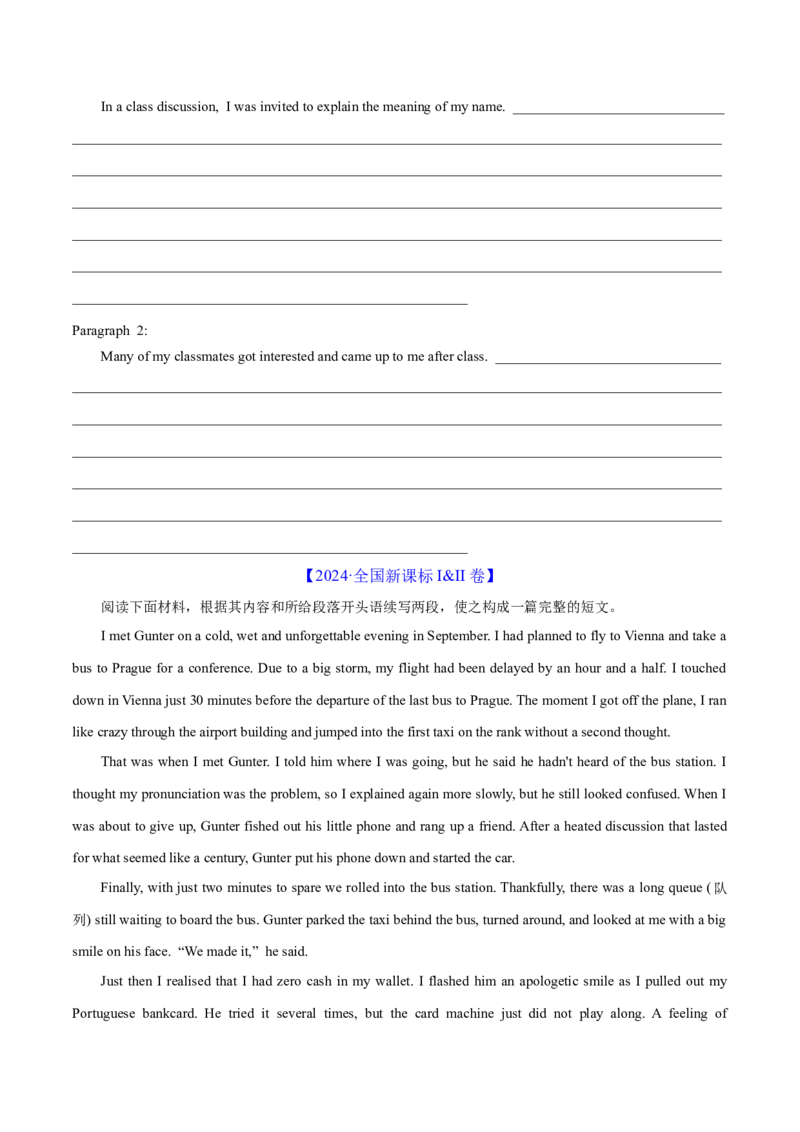
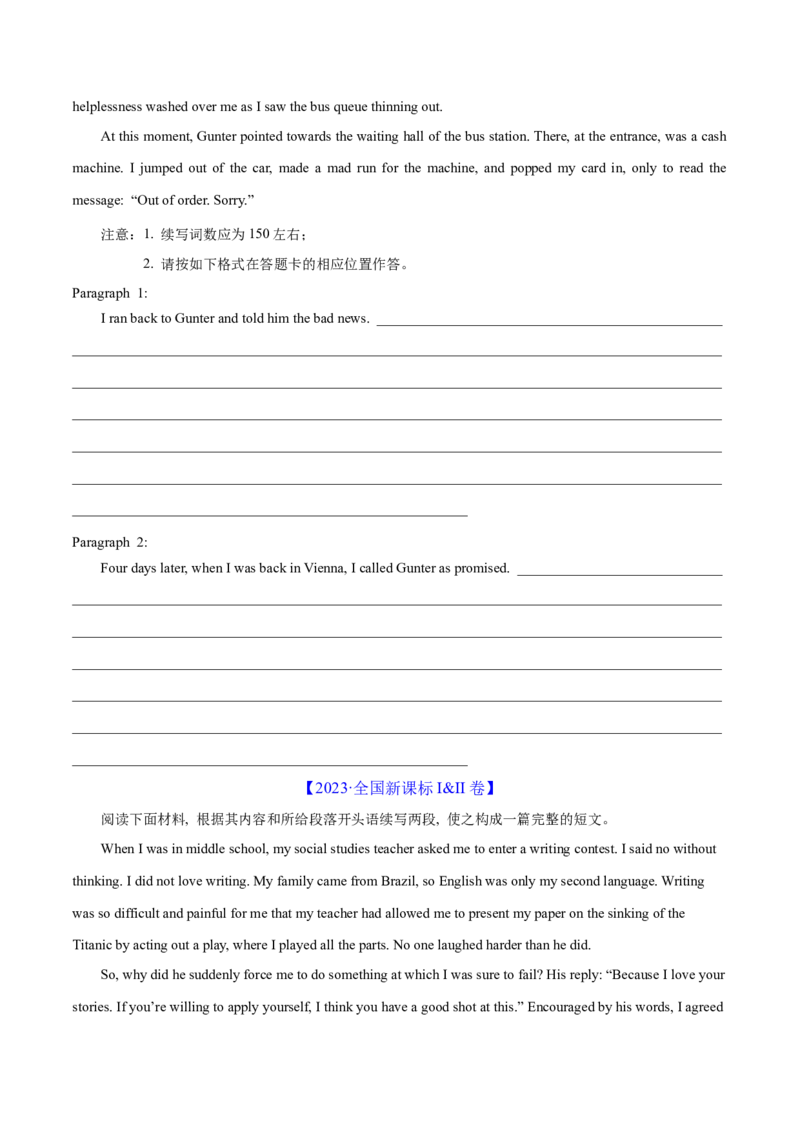
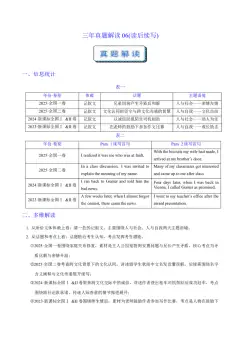
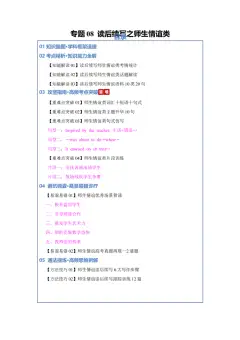
三年真题解读06(读后续写)
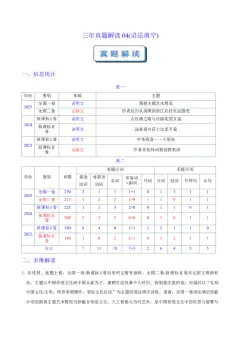
一、信息统计
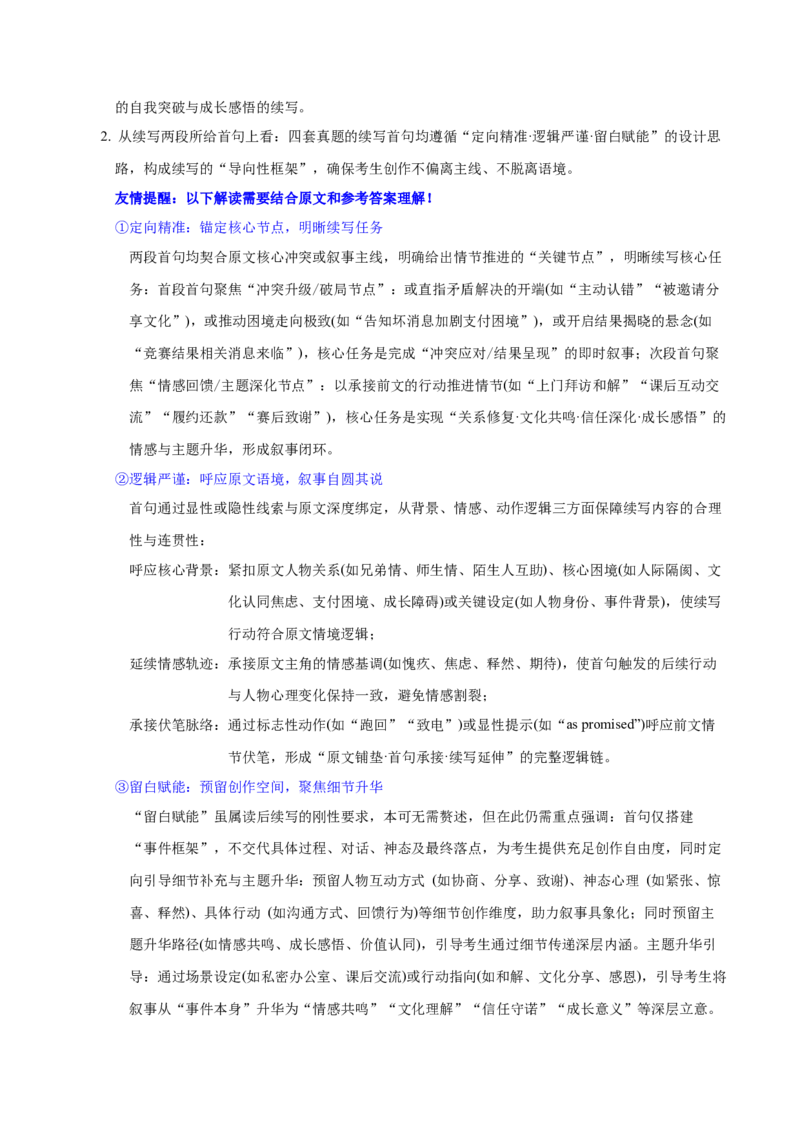
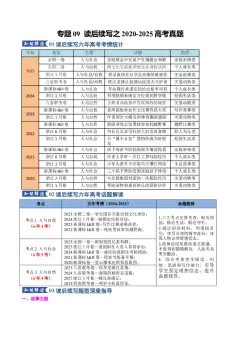
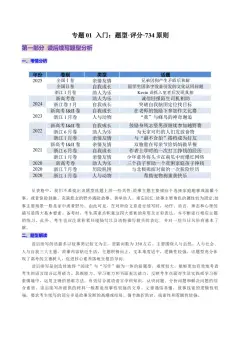
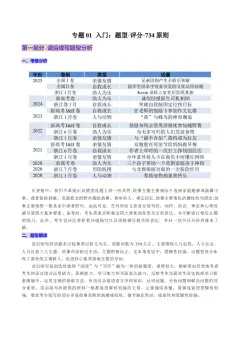
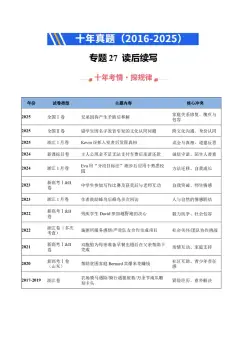
表一
年份·卷别
体裁
话题
主题语境
2025·全国一卷
记叙文
兄弟因狗产生矛盾后和解
人与社会——亲情友情
2025·全国二卷
记叙文
文化认同的坚守与跨文化沟通的智慧
人与自我——文化自信
2024·新课标全国Ⅰ &II 卷
记叙文
以诚信回报陌生司机相助
人与社会——助人为乐
2023·新课标全国Ⅰ &II 卷
记叙文
在老师的鼓励下参加作文比赛
人与自我——成长励志
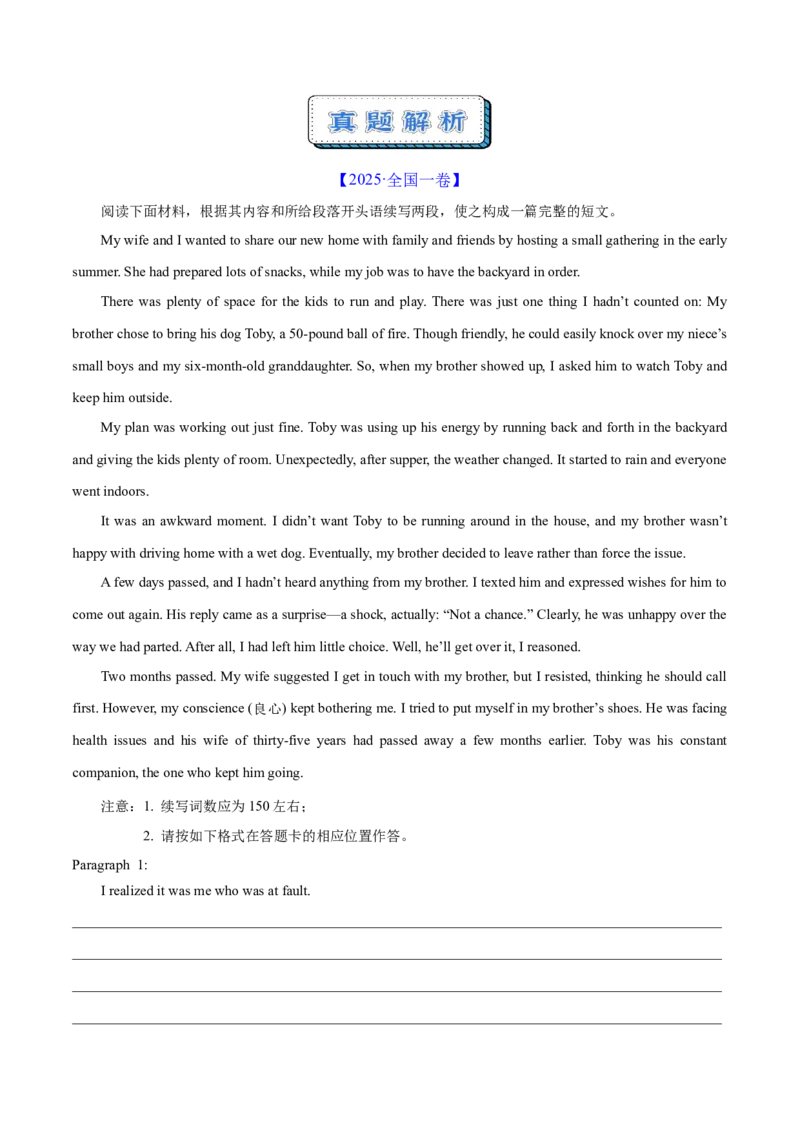
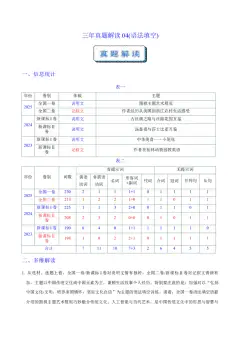
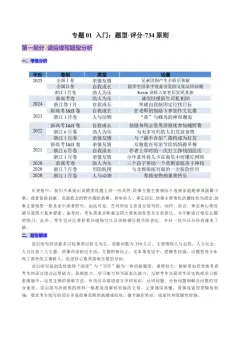
表二
年份·卷别
Para 1 续写首句
Para 2 续写首句
2025·全国一卷
I realized it was me who was at fault.
With the biscuits my wife had made, I
arrived at my brother’s door.
2025·全国二卷
In a class discussion, I was invited to
explain the meaning of my name.
Many of my classmates got interested
and came up to me after class.
2024·新课标全国Ⅰ &II 卷
I ran back to Gunter and told him the
bad news.
Four days later, when I was back in
Vienna, I called Gunter as promised.
2023·新课标全国Ⅰ &II 卷
A few weeks later, when I almost forgot
the contest, there came the news.
I went to my teacher’s office after the
award presentation.
二、多维解读
1. 从所给文体体裁上看:清一色的记叙文。主要围绕人与社会、人与自我两大主题语境;
2. 从话题和考点上看:话题贴近考生认知,考点发挥考生潜能。
①2025·全国一卷围绕家庭关系修复,素材是主人公因宠物狗安置问题与兄长产生矛盾,核心考点为矛
盾化解与亲情升温;
②2025·全国二卷考查跨文化背景下的文化认同,讲述留学生秋雨中文名发音遭误解,后续需围绕名字
含义阐释与文化传递展开续写;
③2024·新课标全国Ⅰ &II 卷聚焦跨文化交际中的诚信,讲述作者获出租车司机帮助后成功赶车,考点
围绕践行还款承诺、传递人际善意的情节推进展开;
④2023·新课标全国Ⅰ &II 卷围绕师生情谊,素材为老师鼓励作者参加写作比赛,考点是人物在鼓励下
的自我突破与成长感悟的续写。
2. 从续写两段所给首句上看:四套真题的续写首句均遵循“定向精准·逻辑严谨·留白赋能”的设计思
路,构成续写的“导向性框架”,确保考生创作不偏离主线、不脱离语境。
友情提醒:以下解读需要结合原文和参考答案理解!
①定向精准:锚定核心节点,明晰续写任务
两段首句均契合原文核心冲突或叙事主线,明确给出情节推进的“关键节点”,明晰续写核心任
务:首段首句聚焦“冲突升级/破局节点”:或直指矛盾解决的开端(如“主动认错”“被邀请分
享文化”),或推动困境走向极致(如“告知坏消息加剧支付困境”),或开启结果揭晓的悬念(如
“竞赛结果相关消息来临”),核心任务是完成“冲突应对/结果呈现”的即时叙事;次段首句聚
焦“情感回馈/主题深化节点”:以承接前文的行动推进情节(如“上门拜访和解”“课后互动交
流”“履约还款”“赛后致谢”),核心任务是实现“关系修复·文化共鸣·信任深化·成长感悟”的
情感与主题升华,形成叙事闭环。
②逻辑严谨:呼应原文语境,叙事自圆其说
首句通过显性或隐性线索与原文深度绑定,从背景、情感、动作逻辑三方面保障续写内容的合理
性与连贯性:
呼应核心背景:紧扣原文人物关系(如兄弟情、师生情、陌生人互助)、核心困境(如人际隔阂、文
化认同焦虑、支付困境、成长障碍)或关键设定(如人物身份、事件背景),使续写
行动符合原文情境逻辑;
延续情感轨迹:承接原文主角的情感基调(如愧疚、焦虑、释然、期待),使首句触发的后续行动
与人物心理变化保持一致,避免情感割裂;
承接伏笔脉络:通过标志性动作(如“跑回”“致电”)或显性提示(如“as promised”)呼应前文情
节伏笔,形成“原文铺垫·首句承接·续写延伸”的完整逻辑链。
③留白赋能:预留创作空间,聚焦细节升华
“留白赋能”虽属读后续写的刚性要求,本可无需赘述,但在此仍需重点强调:首句仅搭建
“事件框架”,不交代具体过程、对话、神态及最终落点,为考生提供充足创作自由度,同时定
向引导细节补充与主题升华:预留人物互动方式 (如协商、分享、致谢)、神态心理 (如紧张、惊
喜、释然)、具体行动 (如沟通方式、回馈行为)等细节创作维度,助力叙事具象化;同时预留主
题升华路径(如情感共鸣、成长感悟、价值认同),引导考生通过细节传递深层内涵。主题升华引
导:通过场景设定(如私密办公室、课后交流)或行动指向(如和解、文化分享、感恩),引导考生将
叙事从“事件本身”升华为“情感共鸣”“文化理解”“信任守诺”“成长意义”等深层立意。
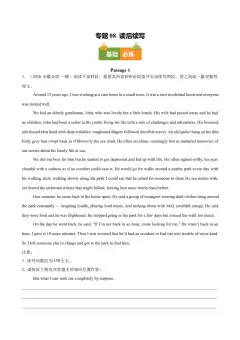
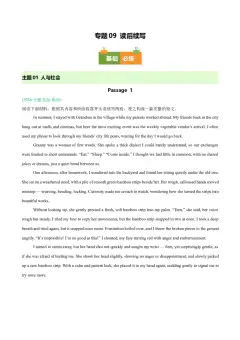
【2025·全国一卷】
阅读下面材料,根据其内容和所给段落开头语续写两段,使之构成一篇完整的短文。
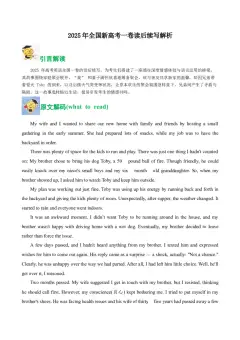
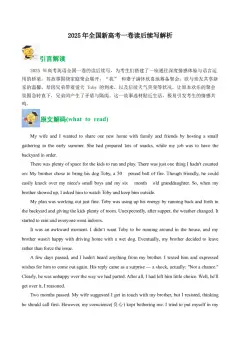
My wife and I wanted to share our new home with family and friends by hosting a small gathering in the early
summer. She had prepared lots of snacks, while my job was to have the backyard in order.
There was plenty of space for the kids to run and play. There was just one thing I hadn’t counted on: My
brother chose to bring his dog Toby, a 50-pound ball of fire. Though friendly, he could easily knock over my niece’s
small boys and my six-month-old granddaughter. So, when my brother showed up, I asked him to watch Toby and
keep him outside.
My plan was working out just fine. Toby was using up his energy by running back and forth in the backyard
and giving the kids plenty of room. Unexpectedly, after supper, the weather changed. It started to rain and everyone
went indoors.
It was an awkward moment. I didn’t want Toby to be running around in the house, and my brother wasn’t
happy with driving home with a wet dog. Eventually, my brother decided to leave rather than force the issue.
A few days passed, and I hadn’t heard anything from my brother. I texted him and expressed wishes for him to
come out again. His reply came as a surprise—a shock, actually: “Not a chance.” Clearly, he was unhappy over the
way we had parted. After all, I had left him little choice. Well, he’ll get over it, I reasoned.
Two months passed. My wife suggested I get in touch with my brother, but I resisted, thinking he should call
first. However, my conscience (良心) kept bothering me. I tried to put myself in my brother’s shoes. He was facing
health issues and his wife of thirty-five years had passed away a few months earlier. Toby was his constant
companion, the one who kept him going.
注意:1. 续写词数应为150 左右;
2. 请按如下格式在答题卡的相应位置作答。
Paragraph 1:
I realized it was me who was at fault.
____________________________________________________________________________________________
____________________________________________________________________________________________
____________________________________________________________________________________________
____________________________________________________________________________________________
____________________________________________________________________________________________
________________________________________________________
Paragraph 2:
With the biscuits my wife had made, I arrived at my brother’s door. _________________________________
____________________________________________________________________________________________
____________________________________________________________________________________________
____________________________________________________________________________________________
____________________________________________________________________________________________
____________________________________________________________________________________________
________________________________________________________
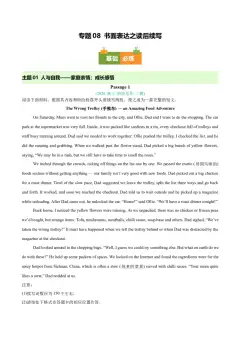
【2025·全国二卷】
阅读下面材料,根据其内容和所给段落开头语续写两段,使之构成一篇完整的短文。
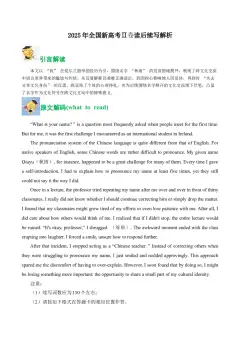
“What is your name? ” is a question most frequently asked when people meet for the first time. But for me, it
was the first challenge I encountered as an international student in Ireland.
The pronunciation system of the Chinese language is quite different from that of English. For native speakers
of English, some Chinese words are rather difficult to pronounce. My given name Qiuyu (秋雨), for instance,
happened to be a great challenge for many of them. Every time I gave a self-introduction, I had to explain how to
pronounce my name at least five times, yet they still could not say it the way I did.
Once in a lecture, the professor tried repeating my name after me over and over in front of thirty classmates. I
really did not know whether I should continue correcting him or simply drop the matter. I feared that my classmates
might grow tired of my efforts or even lose patience with me. After all, I did care about how others would think of
me. I realized that if I didn’t stop, the entire lecture would be ruined. “It’s okay, professor,” I shrugged (耸肩). The
awkward moment ended with the class erupting into laughter. I forced a smile, unsure how to respond further.
After that incident, I stopped acting as a “Chinese teacher.” Instead of correcting others when they were
struggling to pronounce my name, I just smiled and nodded approvingly. This approach spared me the discomfort
of having to over-explain. However, I soon found that by doing so, I might be losing something more important: the
opportunity to share a small part of my cultural identity.
注意:1. 续写词数应为150 左右;
2. 请按如下格式在答题卡的相应位置作答。
Paragraph 1:
In a class discussion, I was invited to explain the meaning of my name. ______________________________
____________________________________________________________________________________________
____________________________________________________________________________________________
____________________________________________________________________________________________
____________________________________________________________________________________________
____________________________________________________________________________________________
________________________________________________________
Paragraph 2:
Many of my classmates got interested and came up to me after class. ________________________________
____________________________________________________________________________________________
____________________________________________________________________________________________
____________________________________________________________________________________________
____________________________________________________________________________________________
____________________________________________________________________________________________
________________________________________________________
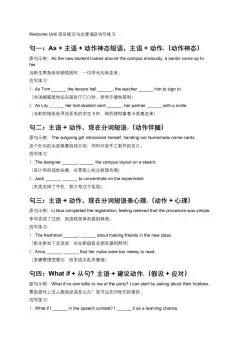
【2024·全国新课标I&II 卷】
阅读下面材料,根据其内容和所给段落开头语续写两段,使之构成一篇完整的短文。
I met Gunter on a cold, wet and unforgettable evening in September. I had planned to fly to Vienna and take a
bus to Prague for a conference. Due to a big storm, my flight had been delayed by an hour and a half. I touched
down in Vienna just 30 minutes before the departure of the last bus to Prague. The moment I got off the plane, I ran
like crazy through the airport building and jumped into the first taxi on the rank without a second thought.
That was when I met Gunter. I told him where I was going, but he said he hadn't heard of the bus station. I
thought my pronunciation was the problem, so I explained again more slowly, but he still looked confused. When I
was about to give up, Gunter fished out his little phone and rang up a friend. After a heated discussion that lasted
for what seemed like a century, Gunter put his phone down and started the car.
Finally, with just two minutes to spare we rolled into the bus station. Thankfully, there was a long queue ( 队
列) still waiting to board the bus. Gunter parked the taxi behind the bus, turned around, and looked at me with a big
smile on his face. “We made it,” he said.
Just then I realised that I had zero cash in my wallet. I flashed him an apologetic smile as I pulled out my
Portuguese bankcard. He tried it several times, but the card machine just did not play along. A feeling of
helplessness washed over me as I saw the bus queue thinning out.
At this moment, Gunter pointed towards the waiting hall of the bus station. There, at the entrance, was a cash
machine. I jumped out of the car, made a mad run for the machine, and popped my card in, only to read the
message: “Out of order. Sorry.”
注意:1. 续写词数应为150 左右;
2. 请按如下格式在答题卡的相应位置作答。
Paragraph 1:
I ran back to Gunter and told him the bad news. _________________________________________________
____________________________________________________________________________________________
____________________________________________________________________________________________
____________________________________________________________________________________________
____________________________________________________________________________________________
____________________________________________________________________________________________
________________________________________________________
Paragraph 2:
Four days later, when I was back in Vienna, I called Gunter as promised. _____________________________
____________________________________________________________________________________________
____________________________________________________________________________________________
____________________________________________________________________________________________
____________________________________________________________________________________________
____________________________________________________________________________________________
________________________________________________________
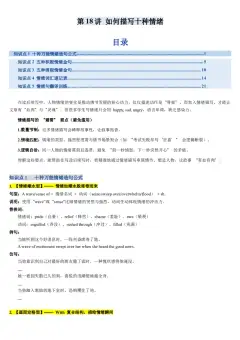
【2023·全国新课标I&II 卷】
阅读下面材料, 根据其内容和所给段落开头语续写两段, 使之构成一篇完整的短文。
When I was in middle school, my social studies teacher asked me to enter a writing contest. I said no without
thinking. I did not love writing. My family came from Brazil, so English was only my second language. Writing
was so difficult and painful for me that my teacher had allowed me to present my paper on the sinking of the
Titanic by acting out a play, where I played all the parts. No one laughed harder than he did.
So, why did he suddenly force me to do something at which I was sure to fail? His reply: “Because I love your
stories. If you’re willing to apply yourself, I think you have a good shot at this.” Encouraged by his words, I agreed
to give it a try.
I chose Paul Revere’s horse as my subject. Paul Revere was a silversmith (银匠) in Boston who rode a horse at
night on April 18, 1775 to Lexington to warn people that British soldiers were coming. My story would come
straight from the horse’s mouth. Not a brilliant idea, but funny; and unlikely to be anyone else’s choice.
What did the horse think, as he sped through the night? Did he get tired? Have doubts? Did he want to quit? I
sympathized immediately. I got tired. I had doubts. I wanted to quit. But, like Revere’s horse, I kept going. I
worked hard. I checked my spelling. I asked my older sister to correct my grammar. I checked out a half dozen
books on Paul Revere from the library. I even read a few of them.
When I handed in the essay to my teacher, he read it, laughed out loud, and said, “Great. Now, write it again.”
I wrote it again, and again and again. When I finally finished it, the thought of winning had given way to the
enjoyment of writing. If I didn’t win, I wouldn’t care.
注意:1. 续写词数应为150 左右;
2. 请按如下格式在答题卡的相应位置作答。
Paragraph 1:
A few weeks later, when I almost forgot the contest, there came the news. ____________________________
____________________________________________________________________________________________
____________________________________________________________________________________________
____________________________________________________________________________________________
____________________________________________________________________________________________
____________________________________________________________________________________________
________________________________________________________
Paragraph 2:
I went to my teacher’s office after the award presentation. _________________________________________
____________________________________________________________________________________________
____________________________________________________________________________________________
____________________________________________________________________________________________
____________________________________________________________________________________________
____________________________________________________________________________________________
________________________________________________________
一、文本解读
研读原文、抓住两线以及把握主题:圈出记叙文的六大因素;分析存在冲突、问题、矛盾或悬念(抓
住情节线);分析主要人物和次要人物的性格特征和情感变化(抓住情感线);细读各段首尾句,迅速提炼主
题。
二、情节构思
研读首句、构思框架、谋划情节:根据续写第一段首句顺推第一段第二句;根据续写第二段首句倒推
第一段结尾句;根据续写第二段首句顺推第二段第二句;设计第二段交待结局句和主题升华句;其余细节
的构思要围绕以上五句(第一段第二句、第一段结尾句、第二段第二句、结局句和主题升华句)展开合理想
象,确保情节的连贯和顺畅。
构思情节的原则:契合原文、衔接首句、先定后拓(定五句,拓其余<目前流行的说法叫做“十句五
定/五定十句”法>,此法我们将在后续专题里详细讲解)、过渡自然。
在做好上述两步的基础上,考生需要遣词造句、拟写初稿、精心打磨后誊写上卡。
【典例】
现以【2025·浙江1 月卷】为例演示与【解题锦囊】相匹配的解题过程(仅供考生自主练习或考试后反
思<复盘>时以及教师考后讲评时参考)。
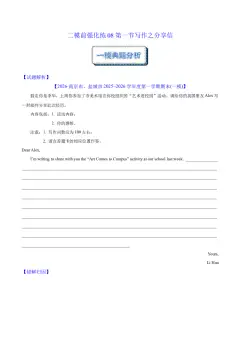
【2025·浙江1 月卷】
阅读下面材料,根据其内容和所给段落开头语续写两段,使之构成一篇完整的短文。
Kevin was pretty bored. His mother was at work, and his father had been away on business. Therefore, he
was left in the care of Mrs. Hill, an old lady who lived next door. His parents had raised the 12-year-old to be a
good boy. He never got into trouble, though sometimes he wanted to do risky things. Mrs. Hill was asleep. Kevin
sighed(叹息)and hoped something exciting would happen. Suddenly, a movement outside caught his eye.
Mrs. Hill’s front window faced Mr. and Mrs. Green’s house across the street. The couple had both gone to
work, so it was strange that someone was over there. Kevin stared at the man at their front door. Suddenly, the man
jumped through an open window into the house. With his heart in his mouth, Kevin grabbed Mrs. Hill’s home
phone and called the police.
Thinking that the man might get away with whatever he wanted before the police arrived, Kevin decided to
do something. He rushed out of Mrs. Hill’s house and crossed the street quickly. Grabbing a branch from a cut-
down tree, he jumped in through the window. “Stop right there! You must leave right now!” he called out, holding
the branch with both hands.
The man froze for a second, but when he saw the skinny boy he breathed a sigh of relief. “Hey, kid, put that
down. It was my home. My parents used to live here and my father’s watch was here,” he explained, trying to lift a
floorboard.
At that moment, the sounds of a police car echoed(回响)in the air. The man stood up in a panic, then ran
through the house toward the window and jumped out. Kevin followed out and told the arriving police officers
what had happened. They pursued and arrested the man.
Kevin went back to Mrs. Hill’s house. Somehow he wasn’t sure he had done the right thing. “What if he has told
the truth?” he thought to himself. The man’s words sounded pretty convincing.
注意:1. 续写词数应为150 左右;
2. 请按如下格式在答题卡的相应位置作答。
Paragraph 1:
When Mr. and Mrs. Green got home, Kevin went to talk to them. __________________________________
____________________________________________________________________________________________
____________________________________________________________________________________________
____________________________________________________________________________________________
____________________________________________________________________________________________
____________________________________________________________________________________________
________________________________________________________
Paragraph 2:
Kevin and Mr. Green took the watch they had found to the police station. ___________________________
____________________________________________________________________________________________
____________________________________________________________________________________________
____________________________________________________________________________________________
____________________________________________________________________________________________
____________________________________________________________________________________________
________________________________________________________
一、文本解读
1. 记叙文要素解读
Who:
When:
Where:
What:
Why:
How:
2. 两条线索解读
情节线索:
主角
(Main Character)
背景
(Setting)
冲突
(Conflict)
事件
(Events)
悬念
(Suspense)
情感线索:
3. 主旨大意解读
(浓缩为三段)Kevin’s parents were wrapped up in their own business, therefore, he was left to be
taken after by his neighbour, Mrs. Hill. Kevin was always feeling bored, hoping something exciting would
happen.(故事发生的背景)
Mrs. Hill’s front window faced Mr. and Mrs. Green’s house across the street. The couple had gong to
work. Suddenly, Kevin found a man jumping through an open window into the house. With his heart in his
mouth, Kevin grabbed Mrs. Hill’s phone and called the police. Thinking that the man might escape before
the police arrived, Kevin decided to do something. Grabbing a branch, he jumped in through the window,
ordering the man to stop and leave right now. However, the man said his parents used to live here and his
father’s watch was here.(故事的起因与发展)
At that moment, the sounds of a police car echoed in the air. The man ran through the window in a
panic. Kevin told the police officers what had happened. They pursued and arrested the man. Somehow
Kevin wasn’t sure he had done the right thing because the man’s words sounded pretty convincing.(故事的
阶段性结局)
(为故事转折设下伏笔:Kevin 开始动摇之前的想法,认为那个人也许不是小偷)
二、情节构思
先定(五句)
Para 1
Para 2
首句
When Mr. and Mrs. Green got
home, Kevin went to talk to them.
首句
Kevin and Mr. Green took the watch
they had found to the police station.
衔接句
Kevin 对Green 夫妇会怎样解释?
衔接句
到了警察局他们第一时间会做什么?
衔接句
(衔接第二段
首句)
弄清事情的来龙去脉后,他们决定
做什么?
结局句
结局出来后,Kevin 会有怎样感受?
升华句
经过这次事情,Kevin 会有怎样的收
获?
后拓(其余)
说明:其余细节的拓展“仁者见仁智者见智”,不是千篇一律的。但是无论你怎么拓展,都必须遵守
“契合原文、对接五句、环环相扣、连贯通畅”的原则。
Para 1
Para 2
首句
When Mr. and Mrs. Green got
home, Kevin went to talk to them.
首句
Kevin and Mr. Green took the
watch they had found to the police
station.
衔接句
衔接句
过渡句+细节
过渡句+细节
衔接句
结局句
升华句