一模前专题练03 阅读四选一之议论文、新闻报道&书评
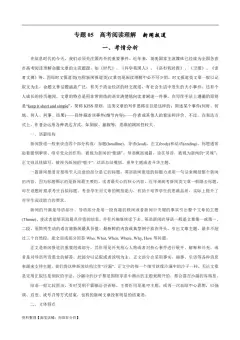
议论文
【体裁特点】
议论文是作者对某个问题或某件事情进行分析、评论,表明自己的观点、立场、态度、看法和主张
的一种文体。这类文章或从正面提出某种见解,或是驳斥别人的错误观点,以说服读者同意自己的观点为
主要目的。议论文一般有论点、论据和论证三个要素。论点是议论文的核心,是文章要表达的主要思想内
容;论据是作者所引用的用以证明和支持论点的材料,这些材料可以是名人名言、事实例证,或是统计数
据等,只要是对证明论点有利的材料都可以为作者所用;确定了论点和论据材料后,作者还需要将这些论
据合理地组织在一起,也就是通常所说的论证。
【考情概览】
议论文,有论点,有事实。作者往往根据一些很普通的事实,通过严谨的思维,缜密的推理得出一
个具有普遍性或指导性的观点。该类文章逻辑性强,命题往往从事实的有关细节以及文章的主旨或作者想
表达的意图等方面着手,考查思维能力和判定能力。
议论文常见的设题方式有:主旨大意题、细节理解题、推理判断题(包括对作者观点态度以及篇章结
构的推断)题、词义猜测题等。主旨大意题主要考察读者对议论文全篇思想内容的理解;细节理解题虽然可
以通过直接的查找的方法找出答案,但要注意选项中与文章的细微差别,避免扩大、缩小或误解作者的本
意;推理判断题和作者观点态度题的解答一般是建立在对议论文中心立场的基本把握上,在此基础上推断
出作者的“言外之意”、未言明的思想内涵以及篇章结构。
【解题锦囊】
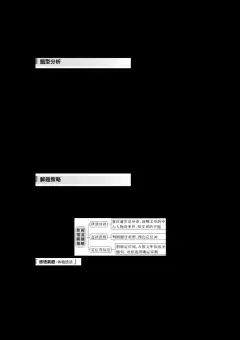
一、抓论点,找论据
议论文体裁的阅读理解主要考查考生对论点及论据的把握。因此在解题时,考生应该抓主题句的方法
来把握文章主旨,弄清作者的观点。一般来说,作者的论点通常在文章的首段被引出,接着是对这一论点
的逻辑推理和论证,最后得出结论。考生还应该注意的是:作者在对论点论证的过程中,每一段的首句通
常都是该段的主题句(也可能出现在段落的中间或末尾)。把握全文论点、弄清论证各段的主题句、理解文
章层次、找出中心论点的位置是理解议论文的关键。
二、析结构,理脉络
借助下列两个“了解”分析文章结构,以便理清文章脉络。
1.了解篇章结构的组织形式。从段落组织方式上讲,常见的篇章结构有三种:总分式结构(总→分;总
→分→总;分→总)、并列式结构(段落之间是平行关系,并且相对独立)、对照式结构(结构形式上是
一正一反)、递进式结构(几个段落之间属于递进关系);
2.了解文章的论证方法。从论证方法上讲,常见的议论文结构有以下两类:Put forward a question
→Analyze the question→Solve the question 即“ 提出问题、分析问题、解决问题” 的过程;
Argument/Idea→ Evidence→Conclusion/Restating the idea 即“提出论点、论述论点(论据)、呼应论点
(结论)”的过程。
三、重揣摩,善推理
体会文章语言特点,注重揣摩作者写作态度,善于进行推理判断。能否正确把握作者的观点和态度是
体现阅读能力的重要方面。一般来说,对作者的总的态度和倾向,必须在通读全文,掌握了论点和论据
后,方能做出判断。在判断作者观点态度时,考生应注意,有时候作者的观点和态度并不是明确地表达出
来的,需要我们认真体察。做推理判断时,一定要遵循逻辑规律,以事实为依据进行合理的推理。
【典例】
【2024·全国甲卷D 篇】
“I didn’t like the ending,” I said to my favorite college professor. It was my junior year of undergraduate, and
I was doing an independent study on Victorian literature. I had just finished reading The Mill on the Floss by
George Eliot, and I was heartbroken with the ending. Prof. Gracie, with all his patience, asked me to think about it
beyond whether I liked it or not. He suggested I think about the difference between endings that I wanted for the
characters and endings that were right for the characters, endings that satisfied the story even if they didn’t have a
traditionally positive outcome. Of course, I would have preferred a different ending for Tom and Maggie Tulliver,
but the ending they got did make the most sense for them.
This was an aha moment for me, and I never thought about endings the same way again. From then on, if I
wanted to read an ending guaranteed to be happy, I’d pick up a love romance. If I wanted an ending I couldn’t
guess, I’d pick up a mystery(悬疑小说). One where I kind of knew what was going to happen, historical fiction.
Choosing what to read became easier.
But writing the end — that’s hard. It’s hard for writers because endings carry so much weight with readers.
You have to balance creating an ending that's unpredictable, but doesn’t seem to come from nowhere, one that fits
what’s right for the characters.
That’s why this issue(期)of Writer’s Digest aims to help you figure out how to write the best ending for
whatever kind of writing you’re doing. If it’s short stories, Peter Mountford breaks down six techniques you can try
to see which one helps you stick the landing. Elizabeth Sims analyzes the final chapters of five great novels to see
what key points they include and how you can adapt them for your work.
This issue won’t tell you what your ending should be — that’s up to you and the story you’re telling — but it
might provide what you need to get there.
32. Why did the author go to Prof. Gracie?
A. To discuss a novel.
B. To submit a book report.
C. To argue for a writer.
D. To ask for a reading list.
33. What did the author realize after seeing Gracie?
A. Writing is a matter of personal preferences.
B. Readers are often carried away by character.
C. Each type of literature has its unique end.
D. A story which begins well will end well.
34. What is expected of a good ending?
A. It satisfies readers’ taste.
B. It fits with the story development.
C. It is usually positive.
D. It is open for imagination.
35. Why does the author mention Peter Mountford and Elizabeth Sims?
A. To give examples of great novelists.
B. To stress the theme of this issue.
C. To encourage writing for the magazine.
D. To recommend their new books.
新闻报道
【体裁特点】
新闻报道是高考英语阅读理解中常见的一种体裁,通常包括消息和通讯两大类。高考命题所选文章
话题广泛,有关于政治经济的时文报道,有社会生活中发生的大小事件,还有个人成长的经历趣闻等等。
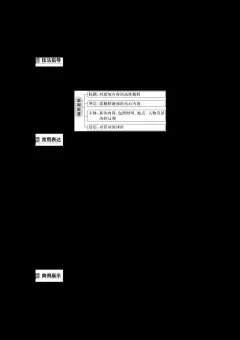
所选文章主要采取“〔标题(headline)(有时不给标题)〕——导语(lead)——主体(body)——结尾(end)”的结
构模式。新闻类语篇有以下几个特点:主题明确突出、信息准确客观、语言简洁风趣。实际上,新闻报道
类文章本质上不是以记叙为主的记叙文(明显特征是:夹叙夹议,主要是社会人文类新闻报道)就是以说明
为主的说明文(明显特征是:解释+少许评论,主要是科技新闻报道)。
【考情概览】
高考英语新闻报道类阅读理解题四种题型都有可能考到。“细节理解题”主要考查新闻事件的六要
素;“推理判断题”主要考查对新闻事件的观点或态度以及写作目的推断;“词义猜测题”一是考查对某
一特定词或者短语乃至句子意思的猜测;二是考查代词的指代,猜测代词的指代内容;“主旨大意题”考
查主旨的归纳或概括,包括最佳标题的选择。
【解题锦囊】
快速浏览原文,在(通过新闻独有的语篇特征,如导语、信息源等)确定体裁是新闻报道后,考生需要
做的是:
一、利用导语把握核心
重点阅读导语:导语是新闻的“浓缩精华”,主旨大意往往就在其中;关注高频词和核心概念:全
文反复出现的词汇或概念,通常是核心话题。
二、瞅准关键靶向定位
瞅准题干中的关键词,回归原文,靶向定位。
三、对症下药搞定答案
1. 信息比对搞定答案
将备选项与定位到的原文内容逐字比对。其中一个备选项中的细节表述与原文是否完全一致(包括
数字、范围、程度)的就是正确答案。
2. 层层推理搞定答案
①抓住关键的信息进行推理:善于捕捉文章中的关键词或短语,利用这些信息进行分析、推理和
判
断,从而推断出隐含的深层含义。
②结合语境与常识进行推理:利用文章的语境和已知常识进行逻辑推理,如通过语境的褒贬性来
推
断人物心理、作者意图等。
③甄别观点与事实进行推理:区分观点与事实,明确文章中哪些是作者的观点、态度,哪些是客
观
事实,避免将作者的观点误认为事实。
3. 两个“利用”搞定答案
①利用文章的结构和导语:新闻报道通常有明确的结构,如标题、导语、正文和结语。导语部分
往
往概括了文章的中心内容,是归纳主旨的关键。
②利用关键信息:从文章中提取出Who、What、When、Where、Why、How 等关键信息,然后对
这些信息进行整合,概括出文章的主题。
         注:词义猜测题的解题方法与其它体裁的阅读理解题相同。
【典例】
【2023·浙江1 月卷C 篇】
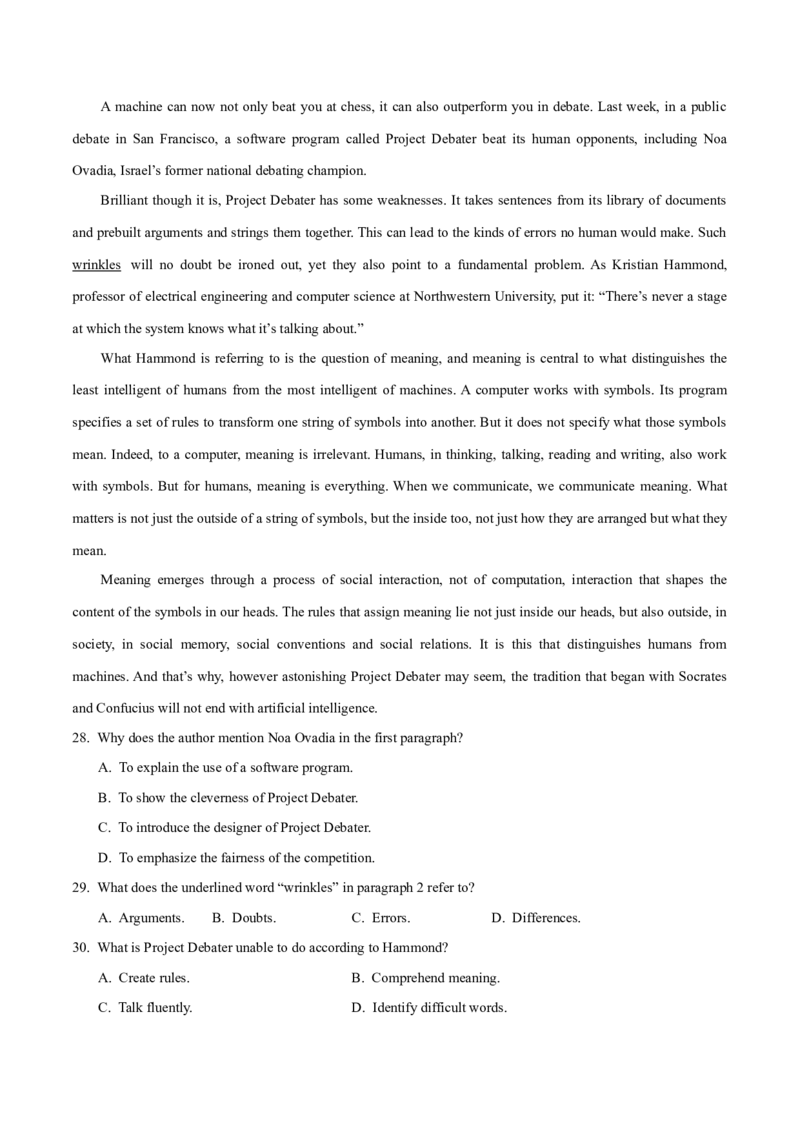
A machine can now not only beat you at chess, it can also outperform you in debate. Last week, in a public
debate in San Francisco, a software program called Project Debater beat its human opponents, including Noa
Ovadia, Israel’s former national debating champion.
Brilliant though it is, Project Debater has some weaknesses. It takes sentences from its library of documents
and prebuilt arguments and strings them together. This can lead to the kinds of errors no human would make. Such
wrinkles will no doubt be ironed out, yet they also point to a fundamental problem. As Kristian Hammond,
professor of electrical engineering and computer science at Northwestern University, put it: “There’s never a stage
at which the system knows what it’s talking about.”
What Hammond is referring to is the question of meaning, and meaning is central to what distinguishes the
least intelligent of humans from the most intelligent of machines. A computer works with symbols. Its program
specifies a set of rules to transform one string of symbols into another. But it does not specify what those symbols
mean. Indeed, to a computer, meaning is irrelevant. Humans, in thinking, talking, reading and writing, also work
with symbols. But for humans, meaning is everything. When we communicate, we communicate meaning. What
matters is not just the outside of a string of symbols, but the inside too, not just how they are arranged but what they
mean.
Meaning emerges through a process of social interaction, not of computation, interaction that shapes the
content of the symbols in our heads. The rules that assign meaning lie not just inside our heads, but also outside, in
society, in social memory, social conventions and social relations. It is this that distinguishes humans from
machines. And that’s why, however astonishing Project Debater may seem, the tradition that began with Socrates
and Confucius will not end with artificial intelligence.
28. Why does the author mention Noa Ovadia in the first paragraph?
A. To explain the use of a software program.
B. To show the cleverness of Project Debater.
C. To introduce the designer of Project Debater.
D. To emphasize the fairness of the competition.
29. What does the underlined word “wrinkles” in paragraph 2 refer to?
A. Arguments.
B. Doubts.
C. Errors.
D. Differences.
30. What is Project Debater unable to do according to Hammond?
A. Create rules.
B. Comprehend meaning.
C. Talk fluently.
D. Identify difficult words.
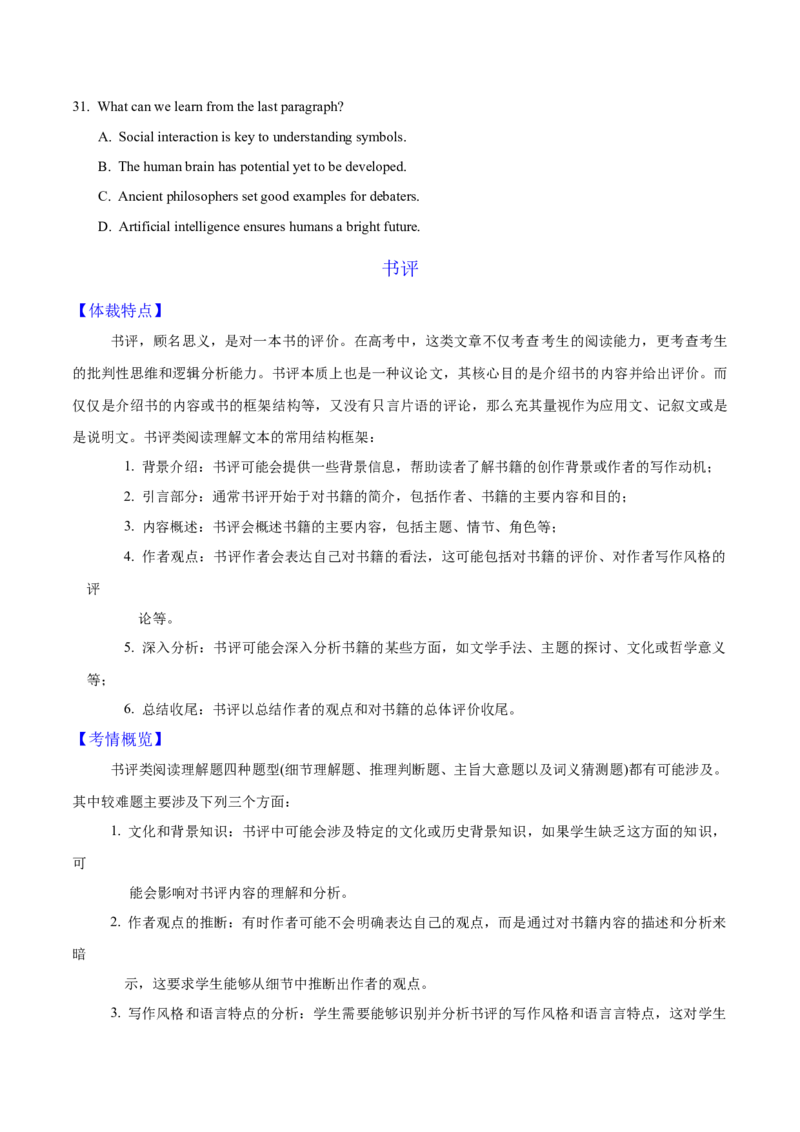
31. What can we learn from the last paragraph?
A. Social interaction is key to understanding symbols.
B. The human brain has potential yet to be developed.
C. Ancient philosophers set good examples for debaters.
D. Artificial intelligence ensures humans a bright future.
书评
【体裁特点】
书评,顾名思义,是对一本书的评价。在高考中,这类文章不仅考查考生的阅读能力,更考查考生
的批判性思维和逻辑分析能力。书评本质上也是一种议论文,其核心目的是介绍书的内容并给出评价。而
仅仅是介绍书的内容或书的框架结构等,又没有只言片语的评论,那么充其量视作为应用文、记叙文或是
是说明文。书评类阅读理解文本的常用结构框架:
1. 背景介绍:书评可能会提供一些背景信息,帮助读者了解书籍的创作背景或作者的写作动机;
2. 引言部分:通常书评开始于对书籍的简介,包括作者、书籍的主要内容和目的;
3. 内容概述:书评会概述书籍的主要内容,包括主题、情节、角色等;
4. 作者观点:书评作者会表达自己对书籍的看法,这可能包括对书籍的评价、对作者写作风格的
评
论等。
5. 深入分析:书评可能会深入分析书籍的某些方面,如文学手法、主题的探讨、文化或哲学意义
等;
6. 总结收尾:书评以总结作者的观点和对书籍的总体评价收尾。
【考情概览】
书评类阅读理解题四种题型(细节理解题、推理判断题、主旨大意题以及词义猜测题)都有可能涉及。
其中较难题主要涉及下列三个方面:
1. 文化和背景知识:书评中可能会涉及特定的文化或历史背景知识,如果学生缺乏这方面的知识,
可
能会影响对书评内容的理解和分析。
2. 作者观点的推断:有时作者可能不会明确表达自己的观点,而是通过对书籍内容的描述和分析来
暗
示,这要求学生能够从细节中推断出作者的观点。
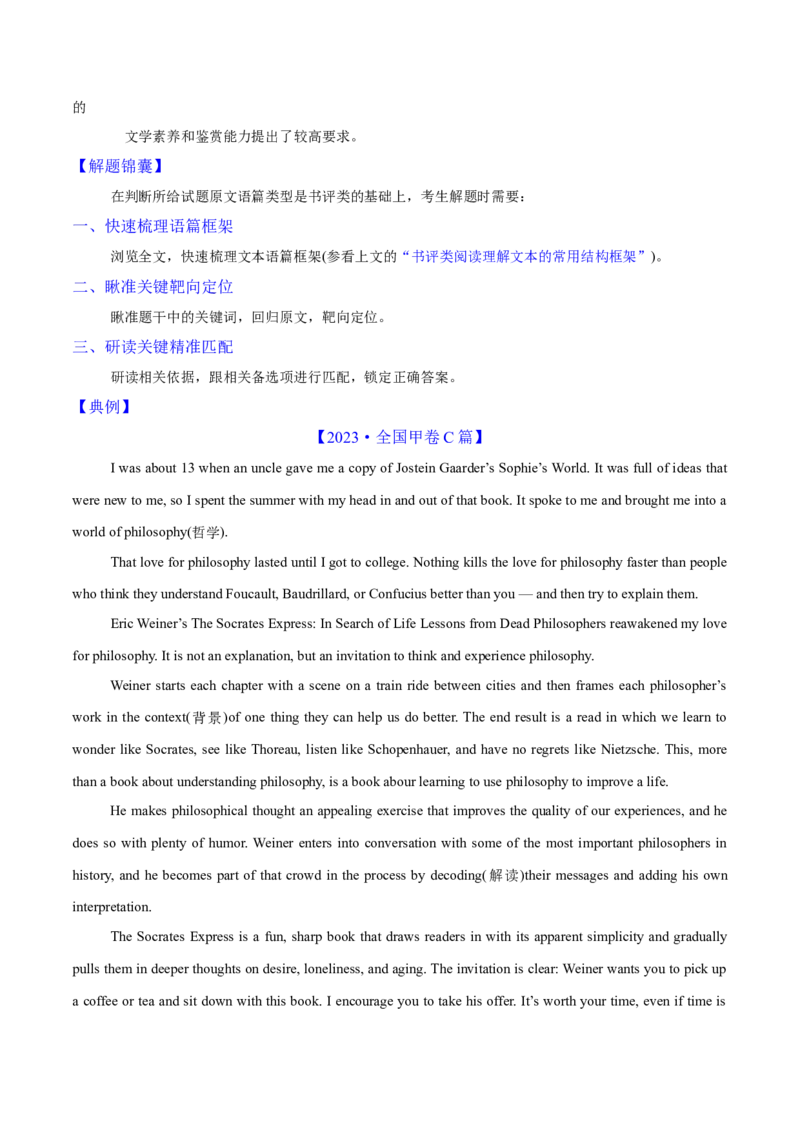
3. 写作风格和语言特点的分析:学生需要能够识别并分析书评的写作风格和语言言特点,这对学生
的
文学素养和鉴赏能力提出了较高要求。
【解题锦囊】
在判断所给试题原文语篇类型是书评类的基础上,考生解题时需要:
一、快速梳理语篇框架
浏览全文,快速梳理文本语篇框架(参看上文的“书评类阅读理解文本的常用结构框架”)。
二、瞅准关键靶向定位
瞅准题干中的关键词,回归原文,靶向定位。
三、研读关键精准匹配
研读相关依据,跟相关备选项进行匹配,锁定正确答案。
【典例】
【2023·全国甲卷C 篇】
I was about 13 when an uncle gave me a copy of Jostein Gaarder’s Sophie’s World. It was full of ideas that
were new to me, so I spent the summer with my head in and out of that book. It spoke to me and brought me into a
world of philosophy(哲学).
That love for philosophy lasted until I got to college. Nothing kills the love for philosophy faster than people
who think they understand Foucault, Baudrillard, or Confucius better than you — and then try to explain them.
Eric Weiner’s The Socrates Express: In Search of Life Lessons from Dead Philosophers reawakened my love
for philosophy. It is not an explanation, but an invitation to think and experience philosophy.
Weiner starts each chapter with a scene on a train ride between cities and then frames each philosopher’s
work in the context(背景)of one thing they can help us do better. The end result is a read in which we learn to
wonder like Socrates, see like Thoreau, listen like Schopenhauer, and have no regrets like Nietzsche. This, more
than a book about understanding philosophy, is a book abour learning to use philosophy to improve a life.
He makes philosophical thought an appealing exercise that improves the quality of our experiences, and he
does so with plenty of humor. Weiner enters into conversation with some of the most important philosophers in
history, and he becomes part of that crowd in the process by decoding( 解读)their messages and adding his own
interpretation.
The Socrates Express is a fun, sharp book that draws readers in with its apparent simplicity and gradually
pulls them in deeper thoughts on desire, loneliness, and aging. The invitation is clear: Weiner wants you to pick up
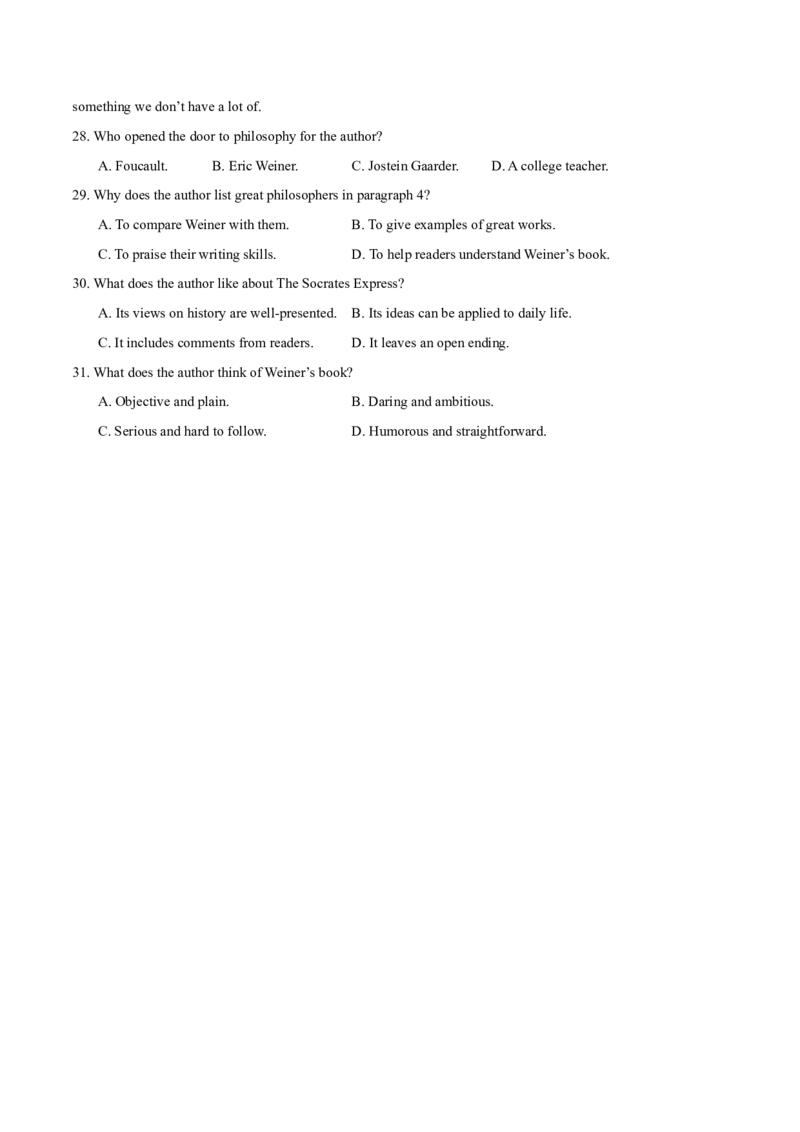
a coffee or tea and sit down with this book. I encourage you to take his offer. It’s worth your time, even if time is
something we don’t have a lot of.
28. Who opened the door to philosophy for the author?
A. Foucault.
B. Eric Weiner.
C. Jostein Gaarder.
D. A college teacher.
29. Why does the author list great philosophers in paragraph 4?
A. To compare Weiner with them.
B. To give examples of great works.
C. To praise their writing skills.
D. To help readers understand Weiner’s book.
30. What does the author like about The Socrates Express?
A. Its views on history are well-presented.
B. Its ideas can be applied to daily life.
C. It includes comments from readers.
D. It leaves an open ending.
31. What does the author think of Weiner’s book?
A. Objective and plain.
B. Daring and ambitious.
C. Serious and hard to follow.
D. Humorous and straightforward.
C-1
(2026 届河北省衡水市高三上学期第二次调研考试二)Computers have taken the crown in chess, Go and
poker, but when it comes to competitive coding, humans still have the edge — just.
Recently, Polish coder Przemyslaw Debiak, known online as Psyho, narrowly defeated OpenAI’s
algorithm(算法)at the 2025 AtCoder World Tour Finals in Tokyo. The 41-year-old, a former OpenAI employee who
retired five years ago, predicts he might be the last human to claim the title, given rapid tech progress. “That’s
probable,” he said, noting frustration at the thought of AI outperforming him, though he enjoys the competitions.
Psyho acknowledged the irony: coders are fueling their own potential obsolescence(淘汰). “Live by the sword, die
by the sword,” he expressed pre-contest, adding, “I helped develop AI and nearly lost to it — though I won, for
now.”
The 10-hour contest, featuring 11 top-ranked human coders and OpenAI’s algorithm(which finished second,
9.5% behind Psyho), involves solving complex optimization(最优化)problems like the traveling salesman puzzle
— simple to state but computationally tough. While ChatGPT handles repetitive code, AI’s showing in open-ended
logic problems impresses.
“Top humans still excel at reasoning and complex problem-solving,” Psyho said, but typing speed caps them.
AI, by contrast, rapidly tests small adjustments: “It’s like cloning a human to work at the same time — faster, and
sometimes quantity beats a single genius.”
Major firms like Meta and Microsoft now use AI for coding. Anthropic CEO Dario Amodei warned that AI
could replace 20% of white-collar jobs within five years. “All white-collar roles face this now; manual jobs are
safer a few more years,” Psyho noted. Like many in tech, he’s not sure about AI’s rise. “We face disinformation,
social impacts, and humans losing purpose,” he said. “Society evolves slowly, meanwhile, tech progress accelerates
faster and faster.”
28. What did Psyho imply by saying “Live by the sword, die by the sword”?
A. Coding is a dangerous job.
B. He regrets ever joining OpenAI.
C. OpenAI’s algorithm is too complex.
D. Coders speed up their own replacement.
29. According to Psyho, what limits top human coders?
A. Slow typing speed.
B. AI’s strong competition.
C. Poor reasoning capacity.
D. Inability to solve problems.
30. What is Psyho’s attitude towards AI’s rise?
A. Supportive.
B. Uncertain.
C. Critical.
D. Indifferent.
31. What would be the best title for the text?
A. OpenAI Loses Its Edge
B. The Last Human Champion
C. The Decline of Human Coders
D. Human Coder Narrowly Defeats AI
C-2
(2026 届山东省实验中学高三上学期一诊)Architect Liu Jiakun was awarded the 2025 Pritzker Architecture
Prize on Tuesday, making him the second winner from China to earn the highest honor in the field of architecture
after Wang Shu in 2012.
Living in Chengdu, the capital of southwestern China’s Sichuan province, Liu’s career spans four decades
and over 30 projects. He established Jiakun architects in 1999 and is devoted to creating an expansive collection of
works ranging from small, beautiful museums and monuments and vast commercial buildings to master plans for
cities. “The purpose of architecture is to create a beautiful, just and dignified living environment. People’s real
lives, happiness and dignity are what we strive for,” says Liu.
The prize’s jury statement says that “intertwining(交织)seemingly opposing things such as idealism versus
everyday existence, history versus modernity, and collectivism versus individuality, Liu offers affirming
architecture that celebrates the lives of ordinary citizens”.
Wang, the 2012 Pritzker recipient, tells China Daily that Liu’s winning is encouraging: “His works are very
local, yet modern, directly addressing the challenges facing the transformation of contemporary Chinese cities.”
Wang says both he and Liu pursue contemporary architecture rooted in tradition. Many architects around the world
attempt to do the same, yet their style has never become mainstream. “I believe Liu’s winning holds great
significance and will resonate with those architects,” he adds.
Liu’s focus on ordinary people is reflected in his largest project West Village, a five-story urban complex
completed in 2015 in Chengdu. The complex includes a football field, paths for cyclists and pedestrians, and a
market. The block has become a popular public space and a destination for the city’s residents to spend leisure time.
Hearing the news that Liu won the Pritzker Prize, many netizens who have visited the West Village and the
museums he designed expressed that his architecture reflects a precious sense of relaxation, much like the vibrant
city of Chengdu itself, which is known for its giant pandas, hotpot and leisurely pace.
28. What do we know about Liu Jiakun?
A. He is the first Chinese winner of the Pritzker Prize.
B. His career spans 40 years with over 30 projects.
C. He founded Jiakun architects in 2012 in Chengdu.
D. His works only include museums and monuments.
29. What is a feature of Liu Jiakun’s architectural works?
A. Pursuit of tradition-based modernity.
B. Concentration on outline.
C. Integration with surroundings.
D. Combination with foreign styles.
30. The example of West Village is used to illustrate that ________.
A. Liu Jiakun pays attention to the needs of ordinary people
B. Liu Jiakun’s projects are all large-scale urban complexes
C. public spaces in Chengdu are not popular among residents
D. football fields are unnecessary in urban complex design
31. Which of the following words can best describe Liu Jiakun?
A. Energetic and optimistic.
B. Outgoing and responsible.
C. Courageous and generous.
D. Committed and creative.
C-3
(2026 届黑龙江省大庆市高三上学期一模)Some might suggest that a doorstopper about “the influence of
the horse on human history” couldn’t possibly be interesting. No. I say no. In fact, Timothy C.  Winegard’s The
Horse is fantastic, offering a fresh view on how crucial horses were in human development. And it almost didn’t
happen.
Sudden climate changes at the end of the Ice Age drove horses to the edge of extinction. The rest of the
animals once found through much of the world were then largely limited to an area that runs roughly from Eastern
Europe to Central Asia — where they were hunted for food.
The horse might have gone the way of other animals had it not been tamed(驯化)like cattle. When someone
decided to jump on the back of one of the horses, it started “a revolution” that changed the world. Riding horses
helped farmers raise more sheep and goats, and hunters cover more ground. When horses replaced oxen, their
quicker speed allowed more land to be handled, increased yields and changed farmers to exporters.
Naturally, horses became instruments of war. The earliest known true cavalry(骑兵)formation belonged to
the Assyrian king Tukulti-Ninurta II. In relatively short order, cavalry units made the difference in battle. Those
nations that had horses won wars; those that didn’t tried to get them. In many ways, these conflicts created the
world we have today. Alexander extended the boundaries of his kingdom — and Greek culture — through Persia,
India and beyond because of the success of his cavalry. Besides, horses were the deciding factor in the Battle of
Hastings, where William, the Duke of Normandy — who had cavalry units — soundly defeated the Anglo-Saxon
King Harold Godwinson, creating the modern British state.
The Horse is extensively researched. It is interesting, charming and entertaining. But I know: I can lead you
to a bookstore, but I can’t make you read.
28. When did horses start to make the world different?
A. After people domesticated them for riding.
B. After Asians raised them as a food source.
C. After they were exported all over the world.
D. After the climate changed during the Ice Age.
29. What is the advantage of horses?
A. Power.
B. Bravery.
C. Efficiency.
D. Intelligence.
30. What is paragraph 4 mainly about?
A. The training of cavalry for battles.
B. The contributions of horses in wars.
C. The fantastic achievements of kings.
D. The expansion of powerful kingdoms.
31. What is the purpose of the text?
A. To astonish the curious readers.
B. To summarize the recent history.
C. To criticize an improper viewpoint.
D. To recommend an awesome book.
C-4
(陕西省咸阳市实验中学2025-2026 学年高三上学期第二次质量检测)J. D. Salinger’s The Catcher in the
Rye remains a classic novel of adolescent rebellion and isolation, connecting with generations since its 1951
publication. Through the voice of Holden Caulfield, a teenager kicked out of prep school, Salinger captures the raw
emotions of youth — anger, confusion, and a desperate search for realness in a world he dismisses as “phoney”.
The novel’s lasting power lies not in grand adventure but in its intimate portrayal of Holden’s internal struggles,
which reflect universal teenage experience.
Holden’s journey through New York City acts as a psychological exploration. He criticizes the hypocrisy(虚
伪)of the adult world, mocks social expectations, and fantasizes about escaping to a simpler life “away from all the
nonsense.” Yet beneath his cynical(愤世嫉俗的)appearance lies vulnerability.
Symbolism deepens the novel’s exploration of innocence and loss. The repeated image of the “catcher in the
rye” — Holden’s fantasy of saving children from falling off a cliff — symbolizes his wish to preserve childhood
innocence. His repeated visits to the Museum of Natural History, where displays stay unchanged, reveal his longing
for stability. The ducks in Central Park’s Lake, which mysteriously disappear each winter, mirror Holden’s anxiety
about life’s uncertainties. Even the novel’s preface as “authentic adolescent voice”, serves as a rebellion against
social norms, making Holden’s voice feel startlingly real.
Though set in the 1950s, The Catcher in the Rye continues to speak to modern teenagers. In an era
dominated by social media and artificial identities, Holden’s hatred of hypocrisy feels strikingly relatable. Unlike
today’s digital interactions, Holden’s handwritten letters and face-to-face encounters in the novel emphasize the
original pure nature of human connection. Salinger’s refusal to romanticize adolescence — offering no easy
answers to pain — challenges readers to confront their own struggles with growing up. The novel endures not as a
relic but as a timeless conversation about the confusion and struggles of youth.
28. Where is the text most probably taken from?
A. A news report about modern education.
B. A literary journal on figures of speech.
C. A publisher’s preface for a special edition.
D. A psychological study on teenage rebellion.
29. What does the underlined word “phoney” in paragraph 2 probably mean?
A. Fake.
B. Dangerous.
C. Traditional.
D. Complicated.
30. According to paragraph 3, what does the image “catcher in the rye” represent?
A. Holden’s admiration for rural life.
B. Holden’s desire to escape society.
C. Holden’s criticism of educational systems.
D. Holden’s wish to protect childhood purity.
31. What does Salinger agree with according to the last paragraph?
A. Adolescence deserves romanticizing.
B. Genuine human connections are vital.
C. Social media fosters sincere connections.
D. Teenagers require straightforward life solutions.
D-1
(2026 届福建省福州市高三上学期一模)Can you tell fact from fiction online? In a digital world, few
questions are more challenging than fighting misinformation. As an education researcher and former high school
history teacher, I know that history class can stimulate critical thinking — but only if teachers and schools
understand what it really means.
Some might consider critical thinking an ability that teachers can encourage. Or they might be referring to
specific skills — for instance, that students should learn a set of steps to take to assess information online.
Cognitive(认知的)scientists see critical thinking as a specific kind of reasoning that involves problem-solving and
making sound judgments. It can be learned, but it relies on specific content knowledge.
Since context is key to critical thinking, learning to analyze information about current events likely requires
knowledge about politics and history, as well as practice at tracing sources. Fortunately, that is what social studies
classes are for.
Social studies researchers often describe this kind of critical thinking as “historical thinking”: a way to
evaluate evidence about the past and assess its reliability. In social studies classrooms students can make relatively
quick progress on some of the surface features of historical thinking, such as learning to check a text’s date and
author.
Social studies classrooms can also build what researchers call “civic online reasoning.” Fact-checking is
complex. It is not enough to tell young people that they should be careful online, or to trust sites that end in “.org”
instead of “.com.” Rather than learning general principles about online media, civic online reasoning teaches
students specific skills for evaluating information about politics and social issues.
Therefore, the solution lies not in teaching critical thinking as a separate skill, but in preserving and
strengthening traditional social studies education that combines background knowledge with analytical capabilities.
Only then can we effectively prepare students to distinguish truth from fiction in our digital world.
32. How does the writer view critical thinking?
A. It naturally develops over time.
B. It is a kind of step-by-step learning.
C. It is a form of content-based reasoning.
D. It improves with teachers’ encouragement.
33. Why can social studies encourage critical thinking?
A. They focus on past evidence.
B. They question general principles.
C. They develop fact-checking skills.
D. They provide trustworthy websites.
34. Which can be considered “civic online reasoning” according to the text?
A. Trusting online news without tracing sources.
B. Assessing public matters via fact-checking.
C. Dismissing social media as unreliable.
D. Employing AI to spread news stories.
35. What solution does the author suggest?
A. Applying traditional social skills.
B. Highlighting historical knowledge.
C. Emphasizing social studies learning.
D. Teaching communication techniques.
D-2
(2026 届湖北省湖北省部分市州高三上学期9 月调研)In the digital era, where social media floods with
ceaseless sharing, 26-year-old illustrator Lina from Hangzhou stands as a striking example. She regularly posts
artworks and travel snapshots on Instagram but seldom replies to comments or engages in private conversations. “I
love sharing fragments( 碎片)of my life, yet building deep connections with strangers feels emotionally
exhausting”, she admits. Lina’s attitude represents a growing trend among today’s youth: light socializing, a pattern
that prioritizes self-expression over intensive emotional bonds in the virtual world.
Sociologist Min Li observes that social media, once a hub(中心)for developing relationships, has changed
into a “self-showcase” platform for the younger generation. Instead of seeking active interactions, they share
content like scenic photos or daily routines, with little expectation of feedback. Actions such as casually
unfollowing, blocking strangers or using 24-hour disappearing posts show their wish to avoid burdensome
“emotional labor” from shallow virtual ties. This shift comes from their desire to escape overwhelming pressure
from empty digital interactions.
While critics dismiss light socializing as a sign of “emotional coldness”, it actually reflects a thoughtful
adaptation. Psychologist Lu Chen argues that by embracing this approach, young people regain control over their
online space — sharing freely without the anxiety of meeting others’ expectations. Even social platforms have
evolved to meet this need: many now offer “silent modes”, such as hidden interaction records and one-way posting
features, acknowledging the widespread acceptance of light socializing.
In a world tightly bound by digital connections, light socializing strikes a delicate balance between self-
expression and privacy protection. It is not a refusal of social bonds but a wise pursuit of healthier, more
autonomous online engagement. This trend shows the younger generation’s maturity in safeguarding their mental
well-being, representing a forward-looking and thoughtful approach to modern social interactions.
32. What does Lina do on social media?
A. She only posts artworks.
B. She shares life but skips deep chats.
C. She never replies to comments.
D. She focuses on building deep online bonds.
33. According to Min Li, what has social media become for young people now?
A. A center for deep relationships.
B. A platform for personal display.
C. A tool to seek frequent interactions.
D. A space to reduce pressure by virtual ties.
34. What can we infer about “light socializing”?
A. It encourages safe online engagement.
B. It makes young people emotionally cold.
C. It relies mainly on platforms’ silent modes.
D. It abandons social bonds to protect mental health.
35. What can be a suitable title for the text?
A. Keep Silent Mode On
B. Keep the Digital Distance
C. Social Media: “Self-showcase” Platform D. Emotional Coldness: Online Life’s Secret
D-3
(辽宁省沈阳市东北育才学校等校2025-2026 学年高三上学期联合考试)"Regrets, I've had a few. But
then again, too few to mention,” Frank Sinatra chanted in his 1969 hit "My Way”. The song's idea is attractive: that
anyone can just declare what's done is done and move on. Some take the declaration a step further and claim they
have no regrets at all. Whether a boast or an actual attitude, "no regrets” suggests that life can and should be lived
without looking through the rear-view mirror.
Easier said than done, though.Author Daniel H. Pink launched the World Regret Survey, the largest ever
survey on the topic. With his research team, Pink asked more than 15,000 people in 105 countries, "How often do
you look back on your life and wish you had done things differently?” 82% said regret is at least an occasional part
of their life; roughly 21% said they feel regret "all the time.” Only 1% said they never feel regret.
If you are of the "no regrets” type, you might think that all this regret is a recipe for unhappiness. But that
isn't the case. True, being overwhelmed by regret is indeed bad for you. But going to the other extreme may be even
worse. To rid yourself of regrets doesn't free you from shame or sorrow; it leads you to make the same mistakes
again and again. To truly get over our guilt requires that we put regret in its proper place.
As uncomfortable as it is, regret is an amazing cognitive(认知)achievement. If today your relationship with
your partner has soured, your regret might mentally take you back to last year. You would remember your being
mean and sensitive, and then imagine yourself showing more patience, being kind instead of hurtful at key
moments. Then you would fast-forward to today and see how your relationship could be progressing instead of
languishing.
But regret doesn't have to be left unmanaged. The trick is to acknowledge it and use it for learning and
improvement. You can be honest with yourself about what went wrong and use that knowledge to enjoy better
relationships in the future.
32. What should we do if we have had a bitter quarrel with a close friend according to Frank Sinatra?
A. Attract more people to your argument.
B. Send him/her a letter of apology.
C. Boast about being more reasonable.
D. Forget about it and just let it go.
33. Why did the author mention the World Regret Survey?
A. To introduce the work of author Daniel H. Pink.
B. To provide statistical evidence that regret is widespread.
C. To show that the “no regrets” attitude is rare and unrealistic.
D. To compare different people's attitudes towards regret.
34. What does the underlined word “languishing” in paragraph 4 most probably mean?
A. Improving.
B. Healing.
C. Showing up.
D. Breaking up.
35. What does the author intend to tell us in this passage?
A. "No regrets” is a realistic and healthy attitude towards life.
B. It is better to feel overwhelming regret than to feel none at all.
C. Regret can be beneficial if people know how to handle it properly.
D. It is impossible and unwise for people to live a life without any regrets.
D-4
(2026 届湖北省武汉市部分高中高三上学期九月调研)Quick: what’s your best friend’s phone number?
Don’t feel bad if you couldn’t answer off the top of your head. You have no reason to commit phone numbers to
memory: it’s just there in your phone. Or perhaps you once had a phone book to store them. In either case, an object
does the remembering for you.
“Prosthetic memory”(人工记忆)is nothing new. Writing itself has been a means of storing information. Yet
the information revolution has generated more data than ever before. We are flooded with information. We’re
creating more of it, and keeping more of it, The storage capacity of the human brain has since been eclipsed. No
wonder, then, that we’re increasingly dependent on memory prostheses, from libraries to smartphones.
Not everyone thinks this trend in external memory is good. Historically, memory prostheses were expensive.
As technologies such as printing and photography become more affordable, sharing experiences with others is
easier than ever. So every breakfast, every sunset, every encounter with a cat finds its way on to social media. And
here comes the worry. When we devote ourselves to capturing and sharing the world in this way, something
immensely valuable is lost; when recording so much of our lives, we’re forgetting to actually live them. We put
something between ourselves and the world-a camera-instead of just being in the moment, and so disconnect
ourselves from experience.
But is our social media-driven transformation wholly bad? If we’re still creating and sharing memories like
this, perhaps this is because we’ve not had sufficient time to learn how to do these things without thinking about
what we’re doing. It is easy to ignore that the mass social media era is less than a decade old. That’s just a short
blink(眨眼)in human history, yet it has totally changed how we live. I suspect we’re not far off from being directly
faced with experience yet with the ability to share experience in ways less bounded by geography and time. After
all, technology can do what our fragile meat-computers can’t: protect all the moments of a life that would otherwise
be lost.
32. What can be inferred from paragraph 1?
A. We rely more on tools to memorize.
B. We are burdened with phone numbers.
C. Technology weakens our brains.
D. Technology distances us from our friends.
33. What does the underlined word “eclipsed” in paragraph 2 mean?
A. Improved.
B. Outperformed.
C. Restricted.
D. Undervalued.
34. What negative effect does online sharing bring about?
A. An overflow of posts.
B. High cost of digital devices.
C. Addiction to the virtual world.
D. Disregard for authentic experience.
35. What does the author advise us to do in the last paragraph?
A. Have faith in human brains.
B. Take time to adapt to digital age.
C. Quicken the pace of development.
D. Make efforts to enhance memory.