考向 28 阅读理解之议论文类
文体分析
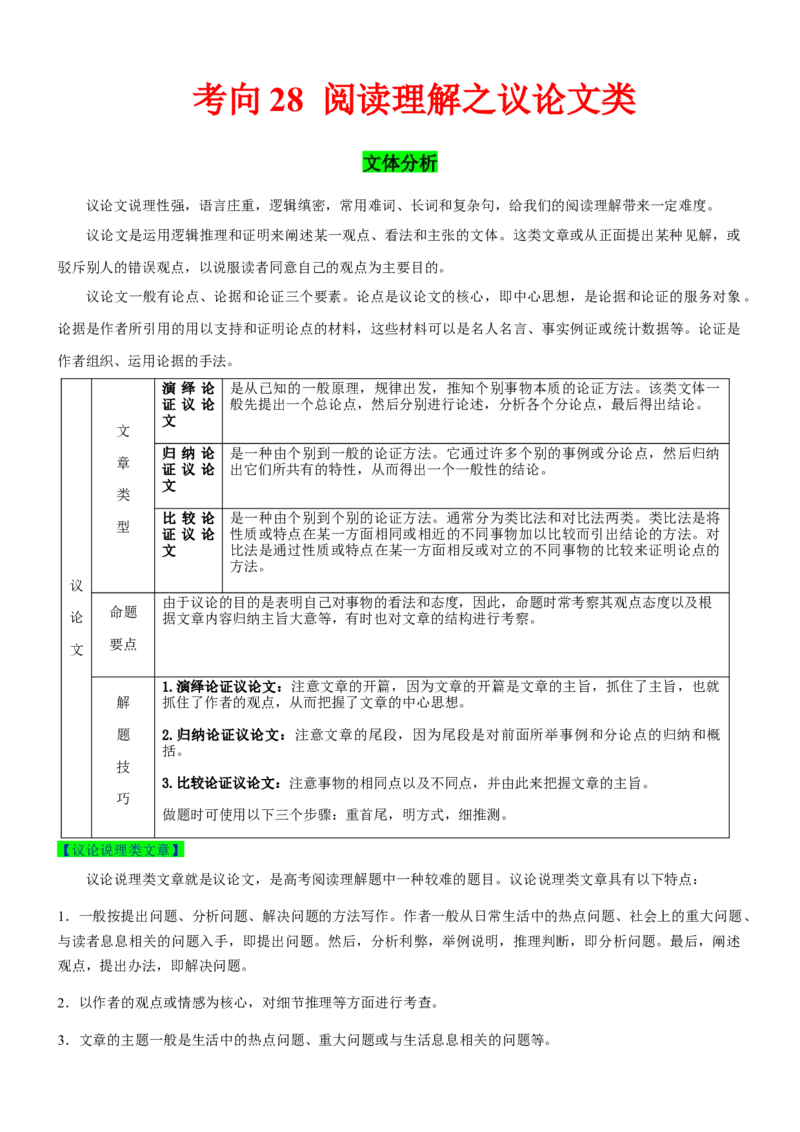
议论文说理性强,语言庄重,逻辑缜密,常用难词、长词和复杂句,给我们的阅读理解带来一定难度。
议论文是运用逻辑推理和证明来阐述某一观点、看法和主张的文体。这类文章或从正面提出某种见解,或
驳斥别人的错误观点,以说服读者同意自己的观点为主要目的。
议论文一般有论点、论据和论证三个要素。论点是议论文的核心,即中心思想,是论据和论证的服务对象。
论据是作者所引用的用以支持和证明论点的材料,这些材料可以是名人名言、事实例证或统计数据等。论证是
作者组织、运用论据的手法。
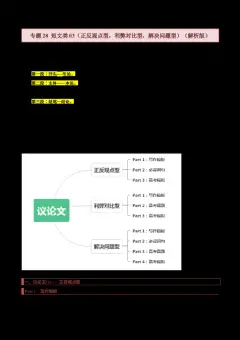
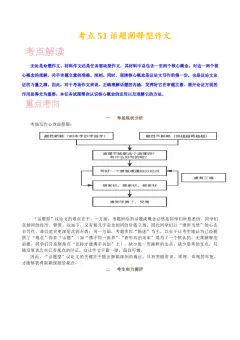
演 绎 论 是从已知的一般原理,规律出发,推知个别事物本质的论证方法。该类文体一
证 议 论 般先提出一个总论点,然后分别进行论述,分析各个分论点,最后得出结论。
文
文
归 纳 论 是一种由个别到一般的论证方法。它通过许多个别的事例或分论点,然后归纳
章
证 议 论 出它们所共有的特性,从而得出一个一般性的结论。
文
类
比 较 论 是一种由个别到个别的论证方法。通常分为类比法和对比法两类。类比法是将
型
证 议 论 性质或特点在某一方面相同或相近的不同事物加以比较而引出结论的方法。对
文 比法是通过性质或特点在某一方面相反或对立的不同事物的比较来证明论点的
方法。
议
由于议论的目的是表明自己对事物的看法和态度,因此,命题时常考察其观点态度以及根
命题
论 据文章内容归纳主旨大意等,有时也对文章的结构进行考察。
要点
文
1.演绎论证议论文:注意文章的开篇,因为文章的开篇是文章的主旨,抓住了主旨,也就
解 抓住了作者的观点,从而把握了文章的中心思想。
题 2.归纳论证议论文:注意文章的尾段,因为尾段是对前面所举事例和分论点的归纳和概
括。
技
3.比较论证议论文:注意事物的相同点以及不同点,并由此来把握文章的主旨。
巧
做题时可使用以下三个步骤:重首尾,明方式,细推测。
【议论说理类文章】
议论说理类文章就是议论文,是高考阅读理解题中一种较难的题目。议论说理类文章具有以下特点:
1.一般按提出问题、分析问题、解决问题的方法写作。作者一般从日常生活中的热点问题、社会上的重大问题、
与读者息息相关的问题入手,即提出问题。然后,分析利弊,举例说明,推理判断,即分析问题。最后,阐述
观点,提出办法,即解决问题。
2.以作者的观点或情感为核心,对细节推理等方面进行考查。
3.文章的主题一般是生活中的热点问题、重大问题或与生活息息相关的问题等。【典例示例】
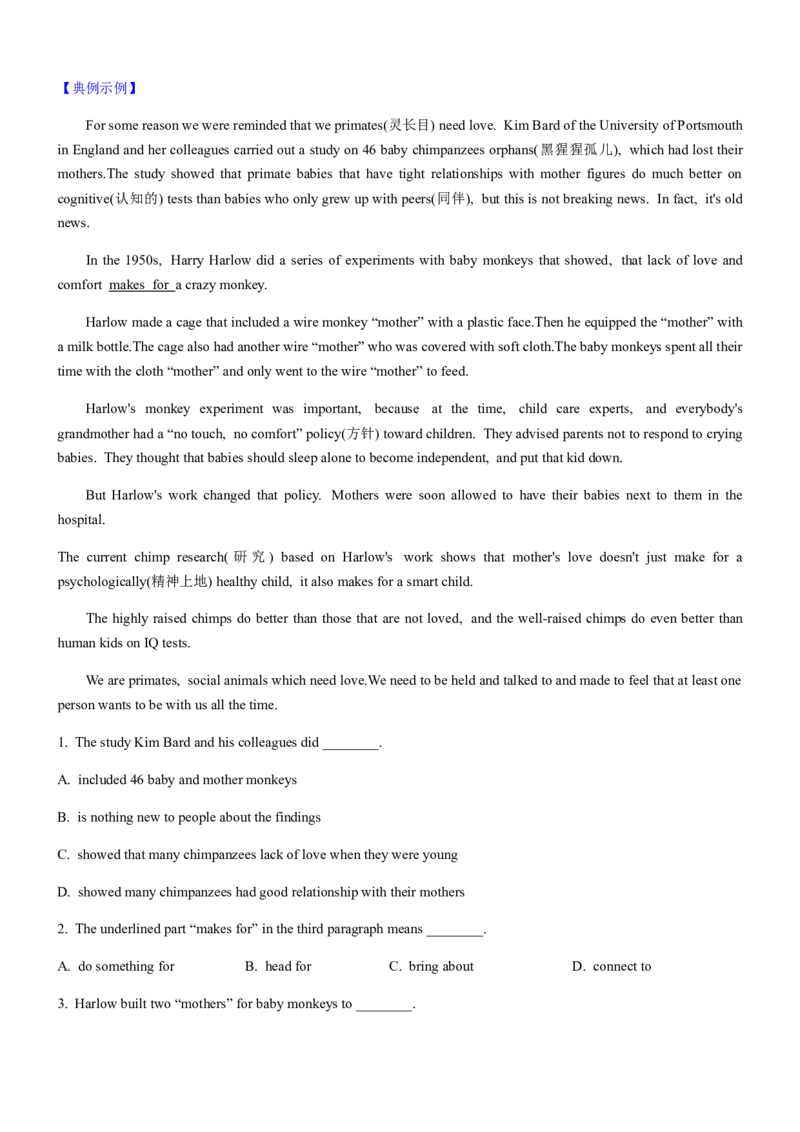
For some reason we were reminded that we primates(灵长目) need love. Kim Bard of the University of Portsmouth
in England and her colleagues carried out a study on 46 baby chimpanzees orphans(黑猩猩孤儿), which had lost their
mothers.The study showed that primate babies that have tight relationships with mother figures do much better on
cognitive(认知的) tests than babies who only grew up with peers(同伴), but this is not breaking news. In fact, it's old
news.
In the 1950s, Harry Harlow did a series of experiments with baby monkeys that showed, that lack of love and
comfort makes for a crazy monkey.
Harlow made a cage that included a wire monkey “mother” with a plastic face.Then he equipped the “mother” with
a milk bottle.The cage also had another wire “mother” who was covered with soft cloth.The baby monkeys spent all their
time with the cloth “mother” and only went to the wire “mother” to feed.
Harlow's monkey experiment was important, because at the time, child care experts, and everybody's
grandmother had a “no touch, no comfort” policy(方针) toward children. They advised parents not to respond to crying
babies. They thought that babies should sleep alone to become independent, and put that kid down.
But Harlow's work changed that policy. Mothers were soon allowed to have their babies next to them in the
hospital.
The current chimp research( 研究 ) based on Harlow's work shows that mother's love doesn't just make for a
psychologically(精神上地) healthy child, it also makes for a smart child.
The highly raised chimps do better than those that are not loved, and the well-raised chimps do even better than
human kids on IQ tests.
We are primates, social animals which need love.We need to be held and talked to and made to feel that at least one
person wants to be with us all the time.
1. The study Kim Bard and his colleagues did ________.
A. included 46 baby and mother monkeys
B. is nothing new to people about the findings
C. showed that many chimpanzees lack of love when they were young
D. showed many chimpanzees had good relationship with their mothers
2. The underlined part “makes for” in the third paragraph means ________.
A. do something for B. head for C. bring about D. connect to
3. Harlow built two “mothers” for baby monkeys to ________.A. make them live comfortably B. let them have more choices
C. give them more love D. make comparison well
4. Which of the following can we infer from the passage?
A. Well-raised chimps are better than people in IQ.
B. Sometimes it's not wrong to have no touch and no comfort to babies.
C. Chimps growing up in cages are less smarter than chimps growing up in wild.
D. Babies who sleep with mothers tend to be cleverer than babies sleep alone.
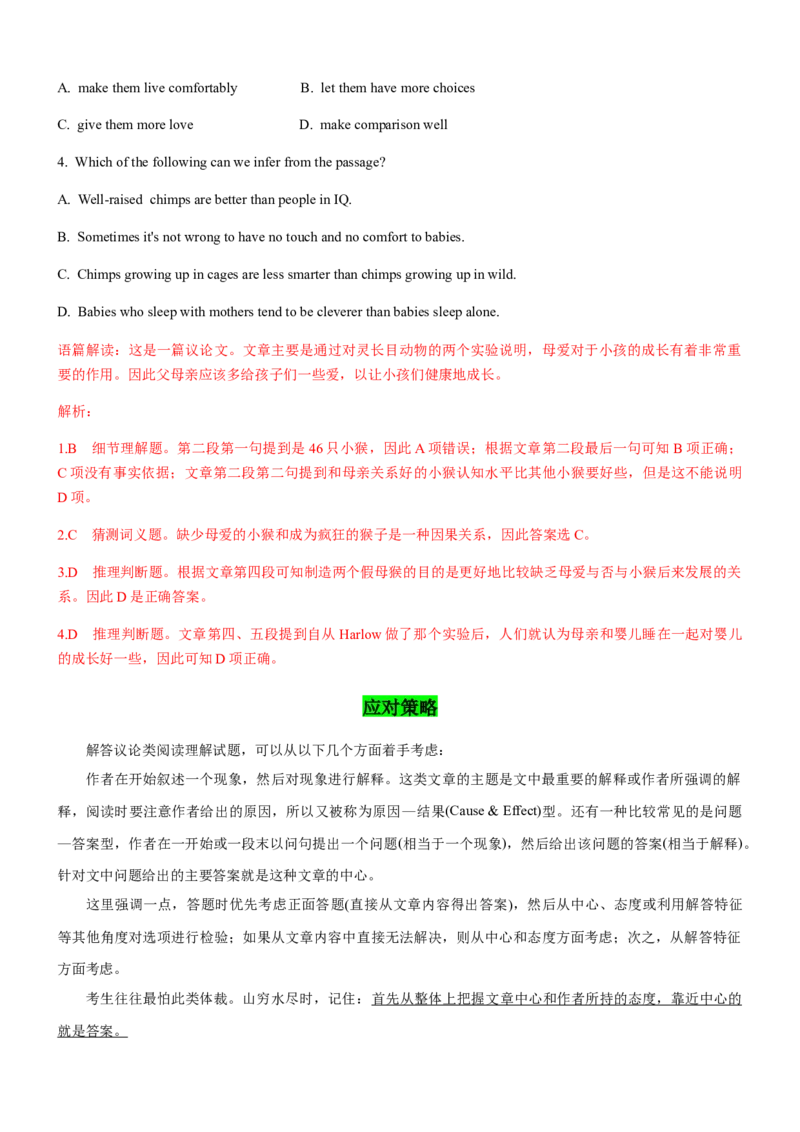
语篇解读:这是一篇议论文。文章主要是通过对灵长目动物的两个实验说明,母爱对于小孩的成长有着非常重
要的作用。因此父母亲应该多给孩子们一些爱,以让小孩们健康地成长。
解析:
1.B 细节理解题。第二段第一句提到是46只小猴,因此A项错误;根据文章第二段最后一句可知B项正确;
C项没有事实依据;文章第二段第二句提到和母亲关系好的小猴认知水平比其他小猴要好些,但是这不能说明
D项。
2.C 猜测词义题。缺少母爱的小猴和成为疯狂的猴子是一种因果关系,因此答案选C。
3.D 推理判断题。根据文章第四段可知制造两个假母猴的目的是更好地比较缺乏母爱与否与小猴后来发展的关
系。因此D是正确答案。
4.D 推理判断题。文章第四、五段提到自从Harlow做了那个实验后,人们就认为母亲和婴儿睡在一起对婴儿
的成长好一些,因此可知D项正确。
应对策略
解答议论类阅读理解试题,可以从以下几个方面着手考虑:
作者在开始叙述一个现象,然后对现象进行解释。这类文章的主题是文中最重要的解释或作者所强调的解
释,阅读时要注意作者给出的原因,所以又被称为原因—结果(Cause & Effect)型。还有一种比较常见的是问题
—答案型,作者在一开始或一段末以问句提出一个问题(相当于一个现象),然后给出该问题的答案(相当于解释)。
针对文中问题给出的主要答案就是这种文章的中心。
这里强调一点,答题时优先考虑正面答题(直接从文章内容得出答案),然后从中心、态度或利用解答特征
等其他角度对选项进行检验;如果从文章内容中直接无法解决,则从中心和态度方面考虑;次之,从解答特征
方面考虑。
考生往往最怕此类体裁。山穷水尽时,记住:首先从整体上把握文章中心和作者所持的态度,靠近中心的
就是答案。解题方法:
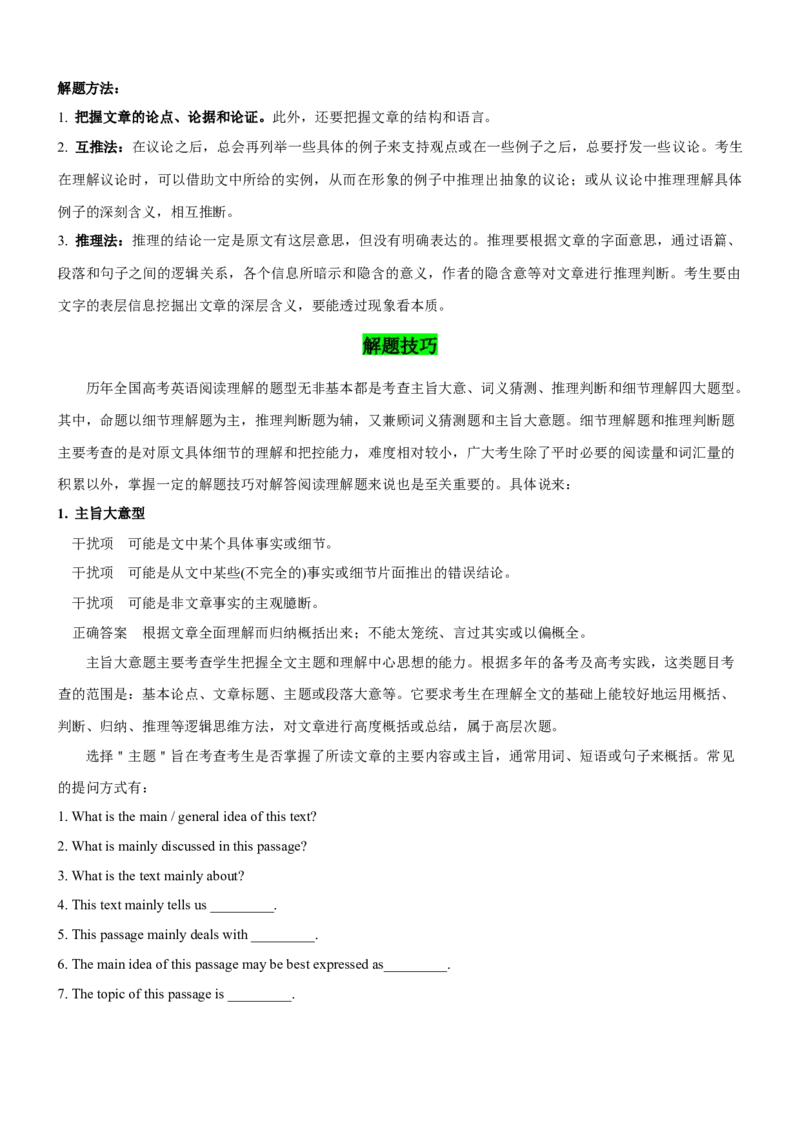
1. 把握文章的论点、论据和论证。此外,还要把握文章的结构和语言。
2. 互推法:在议论之后,总会再列举一些具体的例子来支持观点或在一些例子之后,总要抒发一些议论。考生
在理解议论时,可以借助文中所给的实例,从而在形象的例子中推理出抽象的议论;或从议论中推理理解具体
例子的深刻含义,相互推断。
3. 推理法:推理的结论一定是原文有这层意思,但没有明确表达的。推理要根据文章的字面意思,通过语篇、
段落和句子之间的逻辑关系,各个信息所暗示和隐含的意义,作者的隐含意等对文章进行推理判断。考生要由
文字的表层信息挖掘出文章的深层含义,要能透过现象看本质。
解题技巧
历年全国高考英语阅读理解的题型无非基本都是考查主旨大意、词义猜测、推理判断和细节理解四大题型。
其中,命题以细节理解题为主,推理判断题为辅,又兼顾词义猜测题和主旨大意题。细节理解题和推理判断题
主要考查的是对原文具体细节的理解和把控能力,难度相对较小,广大考生除了平时必要的阅读量和词汇量的
积累以外,掌握一定的解题技巧对解答阅读理解题来说也是至关重要的。具体说来:
1. 主旨大意型
干扰项 可能是文中某个具体事实或细节。
干扰项 可能是从文中某些(不完全的)事实或细节片面推出的错误结论。
干扰项 可能是非文章事实的主观臆断。
正确答案 根据文章全面理解而归纳概括出来;不能太笼统、言过其实或以偏概全。
主旨大意题主要考查学生把握全文主题和理解中心思想的能力。根据多年的备考及高考实践,这类题目考
查的范围是:基本论点、文章标题、主题或段落大意等。它要求考生在理解全文的基础上能较好地运用概括、
判断、归纳、推理等逻辑思维方法,对文章进行高度概括或总结,属于高层次题。
选择"主题"旨在考查考生是否掌握了所读文章的主要内容或主旨,通常用词、短语或句子来概括。常见
的提问方式有:
1. What is the main / general idea of this text?
2. What is mainly discussed in this passage?
3. What is the text mainly about?
4. This text mainly tells us _________.
5. This passage mainly deals with _________.
6. The main idea of this passage may be best expressed as_________.
7. The topic of this passage is _________.标题选择题则是让考生给所读的文章选择一个合适的标题。通常标题由一个名词或名词短语充当,用词简
短、精练。常见的提问方式有:
1. What would be the best title for the text?
2. Which of the following is the best / most suitable title for this text?
3. The best / most suitable title for this text would be __________.
不管是选择"主题"还是选择"标题",实质上都是要求考生从整体上理解语篇内容,找出贯穿语篇的主
线;不管是何种体裁的文章,都是围绕一个主题来展开的。在试题设计上,3个干扰项的内容一般在文章里或
多或少都有涉及,但并非主要内容,需要注意甄别。
【典例示例】
To err is human. To blame the other guy is even more human. …
These three popular misquotes(戏谑的引语)are meant to be jokes, and yet they tell us a lot about
human nature. To err, or to make mistakes, is indeed a part of being human, but it seems that most people
don’t want to accept the responsibility for having made a mistake. They naturally look for someone else who
could be responsible for the problem. Perhaps it is the natural thing to do. The original quote about human
nature went like this: “To err is human, to forgive, divine(神圣的).” This saying mirrors an ideal: people
should be forgiving of others’ mistakes. Instead, we tend to do the opposite—find someone else to pass the
blame on to. However, taking responsibility for something that went wrong is a mark of great maturity.
1. What does the author want to tell us most?(原创题)
A. to make as few mistakes as possible. B. to think seriously about our wrongdoings.
C. to bear responsibility for our mistakes. D. to pass the blame on to someone else.
解析:这是一篇典型的驳论文。作者先列出一个错误观点,即 To blame the other guy is even more
human,然后进行反驳。最后,通过关键词however一转折,说出了作者的观点,即为自己的错误承担责任是成
熟的标志。因此,选择C项。
2. 事实细节型
细节理解题主要考查考生对文章中某些细节或重要事实的理解能力。它一般包括直接理解题和语意理解题
两种。直接理解题的答案与原文直接挂钩,从阅读材料中可以找到。这种题难度低,只要考生读懂文章,就能
得分,属于低层次题。
做此类题时可以使用定位法与跳读法。定位法即根据题干和选项所提供的信息直接从原文中找到相应的句
子(即定位),然后进行比较和分析(尤其要注意一些同义转换),从而选出正确答案。跳读法即根据题干和选项所
提供的信息跳读原文,并找到相关的句子(有时可能是几个句子)或段落,然后进行简单分析、推理等,从而找
出正确答案。(1)解题原则:忠实于原文上下文及全篇的逻辑关系,决不能主观臆断。
文章中心是论点,事实细节是论据或主要理由;有关细节问题常对文中某个词语、某句子、某段落等细节
及事实进行提问,所提问题一般可直接或间接在文章中找到答案。
提问的特殊疑问词常有:what, who, which, where, how, why 等。
在阅读理解中,要求查找主要事实和特定细节的问题常有以下几种命题方式:
①Which of the following statements is true?
②Which of the following is not mentioned in the text?
③The author (or the passage) states that __________.
④According to the passage, when (where, why, how, who, what, which, etc.) __________?
(2)干扰项:范围过大、过小;偷换概念;正误并存,某个分句是正确的。
阅读理解中细节理解题的干扰项的设置有以下几个原则:
①包含项原则
在答案选项分析中,假如对A选项的理解概括了对其他三项 (或其中某一项)的理解,那么我们就说选项A
与其他三项是包含或概括关系,包含项A往往就是正确答案。如在"花"与"玫瑰"两选项中,正确答案肯定
是"花",花包含了玫瑰。
②正反项原则
所谓正反项,是指两选项陈述的命题完全相矛盾。两个相互矛盾的陈述不能都是假的,其中必有一真。所以,
假如四选项中A、B互为正反项,那我们通常先排除C、D项,正确答案一般在A、B项当中。
③委婉项原则
所谓委婉,这里是指说话不能说死,要留有余地。阅读理解选项中语气平和、委婉的往往是正确答案。这些
选项一般含有不十分肯定或试探性语气的表达,如:probably, possibly, may, usually, might, most of, more or
less, relatively, be likely to, not necessary, although, yet, in addition, tend to等等,而含有绝对语气的表达往
往不是正确答案,如:must, always, never, all, every, any, merely, only, completely, none, hardly, already等等。
④同形项原则
命题者往往先将正确答案设置在一个大命题范围,然后通过语言形式的细微变化来考查考生的理解能力与
分析能力。同形项原则告诉我们:词汇与句法结构相似的选项中有正确答案的存在。
⑤常识项原则
议论文中,那些符合一般常识、意义深刻富有哲理、符合一般规律、属于普遍现象的往往是正确答案。
⑥因果项原则
阅读理解的逻辑推理基本都是通过因果链进行的,前因后果,一步步循序渐进。然而,在推理题的选项中
有的选项会推理不到位(止于前因),或者推理过头(止于后果),这就是所谓的干扰项。因果项原则启示我们:假如四个选项中有两项互为同一事物推理过程中的因果关系,那么正确答案就是两个因果项中的其中之一。如果
因项可产生几个结果,那么答案就是因;如果果项可以对应几个原因,那么答案就是果。
解题方法:原文定位法。
查读法:(1)带着问题找答案,把注意力集中在与who, what, when, where问题有关的细节上。
(2)细心!
3. 词义猜测型
阅读理解的测试中经常有猜测词、短语、习语、句子意义的题目,近几年高考阅读中词义猜测题的考查方
法呈多样化,其中根据上下文语境推测词义将会越来越多。有时短文中出现一个需猜测其意义的词或短语,后
文接着会出现其定义、解释或例子,这就是判断该词或短语意义的主要依据。
除此之外,我们还可以根据转折或对比关系进行判断:根据上下句的连接词,如but,however,otherwise
等就可以看到前后句在意义上的差别,从而依据某一句的含义来确定另一句的含义。另外,分号(;)也可以表
示转折、对比或不相干的意义。还可以根据因果关系进行判断。俗话说,"有因必有果,有果必有因"。根据
原因可以预测结果,根据结果也可以找出原因。当然了,这些词、短语、习语要么是生词,要么是熟词新义,
单靠平时积累是不够的,还要掌握以下做题技巧。
(1)根据构词法(转化、合成、派生)进行判断。
(2)根据文中的定义、事例、解释猜生词。用事例或解释猜生词;用重复解释的信息猜生词。
(3)根据上下文的指代关系进行选择。文章中的代词it,that,he,him或them可以指上文提到的人或物,其中it
和that还可以指一件事。
(4)根据转折或对比关系进行判断。根据上下句的连接词如but,however,otherwise等可以看到前后句在意义上
的差别,从而依据某一句的含义,来确定另一句的含义。
(5)根据因果关系进行判断。俗话说,"有因必有果,有果必有因"。根据原因可以预测结果,根据结果也可以
找出原因。
(6)根据同位关系进行判断。阅读中有时出现新词、难词,后面跟着一个同位语,对前面的词进行解释。
(7)利用标点符号和提示词猜测词义。分号还可以表示转折、对比或不相干的意义;破折号表示解释说明。
常见的问题形式有:
(1)The word "…" in Line … means/can be best replaced by …
(2)As used in the passage, the phrase "…" suggests…
(3)From the passage, we can infer that the word/phrase /the sentence " … " is/refers to /
means…
(4)The word "…" is closest in meaning to …
常用应对方法:
同义法:常在词或短语之间有并列连词and或or,它们连接的两项内容在含义上是接近的或递进的,由此可以推测词义。
反义法:如hot and cold, give and receive等,或前句为肯定,后句为否定。总之,互为反义的词与词间都起
着互为线索的作用。
释义法:对文章中的生词用定语(从句)、表语,甚至用逗号、破折号等标点符号引出并加以解释说明。
此外,还有情景推断法、代词替代法等。
做题要领
(1)从文中找线索或信息词;
(2)根据熟悉的词及词义判断新词的意思;
(3)根据上下文判断新词在特定句中的确切意思。
(4)要特别注意熟词新意!
【典例示例】
For many parents, raising a teenager is like fighting a long war, but years go by without any clear
winner. Like a border conflict between neighboring countries, the parent-teen war is about boundaries: Where is
the line between what I control and what you do?
Both sides want peace, but neither feels it has any power to stop the conflict. In part, this is because
neither is willing to admit any responsibility for starting it. From the parents’ point of view, the only cause of
their fight is their adolescents’ complete unreasonableness. And of course, the teens see it in exactly the same
way , except oppositely . Both feel trapped.
56.What does the underlined part in Paragraph 2 mean?
A. The teens blame their parents for starting the conflict.
B. The teens agree with their parents on the cause of the conflict.
C. The teens accuse their parents of misleading them.
D. The teens tend to have a full understanding of their parents.
解析:本文首先提出论点:对很多家长来说,抚养孩子就像打一场长期战争一样,没有赢家。第二段提到
“战争”之长的原因:互不服气。抓住关键词:from the parent’s point of view; and of course, the teens, the
same way。再结合题支的表述,答案为A。
4. 推理判断型
做题要领:既要求学生透过文章表面文字信息推测文章的隐含意思,又要求学生对作者的态度、意图及
文章细节的发展作出正确的推理判断,力求从作者的角度考虑而不是固守自己的看法。常见的命题方式有:
(1)The passage implies (暗示) that _________.
(2)We can conclude (得出结论) from the passage that _________.
(3)Which of the following can be inferred (推论)?(4)What is the tone (语气) of the author?
(5)What is the purpose (目的) of this passage?
(6)The passage is intended to _________.
(7)Where would this passage most probably appear?
【典例示例】
Ask someone what they have done to help the environment recently and they will almost certainly mention
recycling. Recycling in the home is very important of course. However, being forced to recycle often means we already
have more material than we need. We are dealing with the results of that over-consumption in the greenest way possible,
but it would be far better if we did not need to bring so much material home in the first place.
The total amount of packaging increased by 12% between 1999 and 2020. It now makes up a third of a typical
household’s waste in the UK. In many supermarkets nowadays food items are packaged twice with plastic and
cardboard.
62. The author uses figures in Paragraph 2 to show ___________.
A. the tendency of cutting household waste B. the increase of packaging recycling
C. the rapid growth of super markets D. the fact of packaging overuse
解析:作者在第一段分析论证之后用了一个关键句式 “ …, but it would be far better if we …” 引出
了论点:我们与其回收利用废品,倒不如先不要过度包装。第二段用统计数字作为论据来证明上述论点。因此
选择D项。
【典例示例】
Why tell the truth when you can come up with a good excuse?
And what is wrong with a society that thinks that making up a good excuse is like creating a work of
art? One of common problems with making excuses is that people, especially young people, get the idea that
it’s okay not to be totally honest all the time. There is a corollary(直接推论)to that: if a good excuse is
“good” even if it isn’t honest, then where is the place of the truth?
54. What is the author’s opinion about a good excuse?
A. Making a good excuse is sometimes a better policy.
B. Inventing a good excuse needs creative ideas.
C.A good excuse is as rewarding as honesty.
D. Bitter truth is better than a good excuse.
解析:这是一篇驳论文。在第二段中作者用了两个疑问句和一个否定句,对 “a good excuse” 的怀疑态
度体现地淋漓尽致。因此选择D项。
【检测训练】1
When it comes to the jobs robots could never do, you would probably put doctors and teachers at the top of the list.
It's easy to imagine robot cleaners and factory workers, but some jobs need human connection and creativity. But are we
underestimating (低估) what robots can do? In some cases, they already perform better than doctors at diagnosing (诊断)
illness. Also, some patients might feel more comfortable sharing personal information with a machine than a person.
Could there be a place for robots in education after all?
British education expert Anthony Seldon thinks so. And he even has a date for the robot takeover of the classroom:
2027. He predicts robots will do the main job of transferring information and teachers will be like assistants. Intelligent
robots will read students' faces, movements and maybe even brain signals. Then they will adapt the information to each
student. However, it's not a popular opinion and it's unlikely that robots will ever have empathy (同理心) and the ability
to really connect with humans.
One thing is certain, though. A robot teacher is better than no teacher at all. In some parts of the world, there aren't
enough teachers. That problem could be partly solved by robots because they can teach anywhere and won't get stressed,
or tired, or move somewhere for an easier, higher-paid job.
Teachers all over the world are leaving because they feel overworked. Perhaps the question is not “Will robots
replace teachers?” but “How can robots help teachers?” Teachers waste a lot of time doing non-teaching work, including
more than 11 hours a week marking homework. If robots could cut the time teachers spend on marking homework and
writing reports, teachers would have more time and energy for the parts of the job humans do best.
1. In the opinion of most people, what kind of jobs are robots most likely to do?
A. Culture-related jobs. B. Mental jobs.
C. Physical jobs. D. Tiresome jobs.
2. What can be learned about Anthony Seldon's prediction in Paragraph 2?
A. It sounds disappointing. B. It seems to be puzzling.
C. It isn't widely accepted. D. It has become a reality.
3. What's the last paragraph mainly about ?
A. Why teachers are badly needed. B. Teachers' working conditions.
C. Disadvantages of robot teachers. D. How robots help teachers.
4. What's the author's attitude towards robot teachers?
A. Opposed. B. Favorable. C. Suspicious. D. Sympathetic.
2
The idea of low material desire, low consumption and refusing to work, marry and have children, concluded as a“lying down” lifestyle, recently struck a chord with many young Chinese who are eager to take pause to breathe in this
fast-paced and highly-competitive society.
Many millennials (千禧一代) and generation Zs complained to the Global Times that burdens, including work
stress, family disputes (纷争) and financial strains, have pushed them “against the wall”. They said they hate the
“involution (内卷),” joking that they would rather give up some of what they have than get trapped in an endless
competition against peers.
“Instead of always following the ‘virtues’ of struggle, endure and sacrifice to bear the stresses, they prefer a
temporary lying down as catharsis (宣泄) and adjustment,” said a scholar. “It is no wonder that some young people,
under the growing pressures from child-raising to paying the mortgage (按揭) today, would try to live in a simple way
and leave the worries behind.”
Interestingly, the majority of millennials and Gen Zs reached by the Global Times, who claim to be big fans of the
lying down philosophy, acknowledged that they only accept a temporary lying down as a short rest. It is true that with
the great improvement of living conditions, some Chinese youth have partially lost the spirit of hardship and are not
willing to bear too much hard work. But in fact, lying down is not entirely comfortable. Young people who lie down
always feel guilty about their constant loss of morale (士气) far beyond their reach.
“Young people on campus have both aspirations and confusion about their future, but most of us have rejected
setting ourselves up in chains to waste opportunities and challenges,” a postgraduate student told the Global Times. “It’s
no use running away. I have to ‘stand up’ and face the reality sooner or later.”
5. What does the underlined phrase in paragraph 1 mean?
A. Warned. B. Criticized.
C. Touched. D. Amused.
6. What might have caused the “lying down” lifestyle among the young?
A. Improvements in living conditions.
B. Growing pressure from family and social life.
C. Increasing material possessions from families.
D. Temporary adjustment to failure in competitions.
7. What’s the scholar’s attitude toward the “lying down” group?
A. Understanding. B. Intolerant.
C. Supportive. D. Unclear.
8. What can be inferred about the young generation from the text?
A. They never really drop their responsibilities.B. They really enjoy the “lying down” lifestyle.
C. They find their dreams far beyond their reach.
D. They would rather escape than take challenges.
3
A few years ago, I bought a flat. It was a triumph of hope and determination over property prices, and the peak of a
20-year dream. The day I got the keys should have been the most exciting day of my life and yet, the second I opened the
door, panic set in. I spent my first night as a homeowner in a hotel researching how to sell a flat and wondering if it was
too late to change my mind.
I didn't sell my flat because I remembered why I had wanted it in the first place — but there are times when we get
what we want and it simply isn't right. I've always found a strange disconnect between wanting something and getting it.
Wanting is a place of possibility and, in a state of lack, the desire is strong. We imagine how this thing — a new job or
relationship — can change our lives and at the same time forget that adding something to our life doesn't mean all our
problems disappear. We create a narrative around the desire and, when we get it, and it is different to how we pictured it,
we feel frustrated.
For me, this most often occurs in relationships. I have a habit of filling in the gaps with people, rather than getting
to know them. I go on a date with someone and, instead of piecing them together brick by brick, I start to imagine what
my life would be like with them in it. It shouldn't have been a shock that the reality in no way matched my fantasy — but
it was. I knew I wanted out, yet part of me felt committed: this was someone I thought I had wanted for so long, I
couldn't walk away, could I?
We tend to shame others for changing their minds. I think, however, it's far braver to move towards something that
will bring happiness than to stay in a miserable situation to protect your pride. So, when someone tells you they've
changed their minds, congratulate them on knowing themselves well enough, and being strong enough, to admit it. It
takes a lot to come clean about getting it wrong, but the relief of doing so — of setting ourselves free from a personal-
shaped hole, is worth it every time.
9. Why did the author spend her first night as a homeowner in a hotel?
A. The flat was under decoration.
B. She wanted to sell this terrible flat.
C. The flat was different from her desire.
D. She was too excited to sleep in the flat.
10. Which of the following is most advisable in relationships according to the author?
A. Filling in the gaps with people around you.B. Getting to know others little by little naturally.
C. Imagining what the life would be like with others.
D. Spending plenty of time to promote the relationship.
11. What message does the author try to tell us?
A. Never change your mind.
B. Never give up your first-time dream.
C. It is worthwhile to protect one's own pride.
D. It is brave to step out of a miserable situation.
12. What can be a suitable title for the text?
A. A new flat B. A personal-shaped hole
C. A proud soul D. An unexcepted accident
4
After years of observing human nature, I have decided that two qualities make the difference between men of great
achievement and men of average performance curiosity and discontent. I have never known an outstanding man who
lacked either. And I have never known an average man who had both. The two belong together.
Together, these deep human urges (驱策力) count for much more that ambition. Galileo was not merely ambitious
when he dropped objects of varying weights from the Leaning Tower at Pisa and timed their fall to the ground. Like
Galileo, all the great names in history were curious and asked in discontent, “Why? Why? Why?”
Fortunately, curiosity and discontent don’t have to be learned. We are born with them and need only recapture them.
“The great man,” said Mencius (孟子), “is he who does not lose his child’s heart.” Yet most of us do lose it. We stop
asking questions. We stop challenging custom. We just follow the crowd. And the crowd desires restful average. It
encourages us to occupy our own little corner, to avoid foolish leaps into the dark, to be satisfied.
Most of us meet new people, and new ideas, with hesitation. But once having met and liked them, we think how
terrible it would have been, had we missed the chance. We will probably have to force ourselves to waken our curiosity
and discontent and keep them awake.
How should you start? Modestly, so as not to become discouraged. I think of one friend who couldn’t arrange
flowers to satisfy herself. She was curious about how the experts did it. How she is one of the experts, writing books on
flower arrangement.
One way to begin is to answer your own excuses. You haven’t any special ability? Most people don’t; there are only
a few geniuses. You haven’t any time? That’s good, because it’s always the people with no time who get things done.
Harriet Stowe, mother of six, wrote parts of Uncle Tom’s Cabin while cooking. You’re too old? Remember that ThomasCostain was 57 when he published his first novel, and that Grandma Moses showed her first pictures when she was 78.
However you start, remember there is no better time to start than right now, for you’ll never be more alive than you
are at this moment.
13. In writing Paragraph 1, the author aims to ________.
A. propose a definition B. make a comparison
C. reach a conclusion D. present an argument
14. What does the example of Galileo tell us?
A. Trial and error leads to the finding of truth.
B. Scientists tend to be curious and ambitious.
C. Creativity results from challenging authority.
D. Greatness comes from a lasting desire to explore.
15. What can you do to recapture curiosity and discontent?
A. Observe the unknown around you. B. Develop a questioning mind.
C. Lead a life of adventure. D. Follow the fashion.
16. What can we learn from Paragraphs 6 and 7?
A. Gaining success helps you become an expert.
B. The genius tends to get things done creatively.
C. Lack of talent and time is no reason for taking no action.
D. You should remain modest when approaching perfection.
5
Vaccination(接种疫苗) is among the most effective ways to help us prevent diseases. For viruses that don't change
too much—the measles virus(麻疹病毒), for example—getting vaccinated is a once-and-for-all method to prevent you
from becoming infected with the virus. If you had two measles vaccines when you were a child, you would be protected
for life.
However, it's a different story when it comes to influenza(流行性感冒), commonly known as “the flu”, which
generally peaks between December and February. Flu vaccines cannot protect us in the long term.
There is no long-term immunity(免疫), according to Theodore Strange, associate medical director at Staten Island
University Hospital in New York. “The virus essentially ‘changes its coat’—H1N1, H2N3, and so on,” he told the
website Healthline.
Apart from a person's immune protection from flu vaccination declining over time, flu viruses are also constantly
changing. So the vaccines are likely to be updated from one season to the next to protect against the viruses that research
suggests may be the most common during the upcoming flu season.Thus, to develop effective flu vaccines, over 100 national influenza centers around the world conduct year-round
surveillance(监测) for influenza. Researchers will test thousands of influenza virus samples from patients, according to
the official website of the US Centers for Disease Control and Prevention(CDC). The World Health Organization also
suggests there are three or four influenza viruses that are most likely to spread among people during the upcoming flu
season.
But even when a vaccine is developed, getting it can prove to be difficult, as it is in high demand and short supply.
The timing of influenza vaccine production and distribution is unpredictable, thus the availability of the flu vaccine
supply does not always meet peak demand.
So scientists prioritize access to the vaccination. The CDC recommends key populations, such as medical staff,
teachers, students, children and those aged 60 and above, receive flu vaccines.
This year the situation seems more complicated, as the upcoming flu season coincides with the COVID-19
pandemic. This could overwhelm hospitals, straining(过度使用) resources and healthcare workers, time.
17. What do we know about influenza?
A. Influenza viruses are continuously changing.
B. It commonly peaks between November and December.
C. Getting two flu vaccines can protect people against the viruses.
D. H1N1 and H2N3 are the most easily infectious flu viruses.
18. How do researchers improve flu vaccines?
A. They update vaccines once a year.
B. They monitor the flu throughout the year.
C. They focus on one or two viruses during a period.
D. Influenza centers worldwide share virus samples from patients.
19. Why do scientists prioritize access to the vaccination?
A. Because not all people can afford it.
B. Because some people refuse to get vaccinated.
C. Because the vaccine is not safe for everyone.
D. Because the vaccine fails to meet the demand.
20. What does the author's attitude towards the upcoming flu season?
A. Worried. B. Positive.
C. Confident. D. Skeptical.
6
Most of us are already aware of the direct effect we have on our friends and family. But we rarely consider thateverything we think, feel, do, or say can spread far beyond the people we know. Conversely(相反地), our friends and
family serve as conduits(渠道) for us to be influenced by hundreds or even thousands of other people. In a kind of social
chain reaction, we can be deeply affected by events we do not witness that happen to people we do not know. As part of a
social network, we go beyond ourselves, for good or ill, and become a part of something much larger.
Our connectedness carries with it fundamental implications(影响) for the way we understand the human condition.
Social networks have value precisely because they can help us to achieve what we could not achieve on our own. Yet,
socialnetwork effects are not always positive. Depression, obesity, financial panic, and violence also spread. Social
networks, it turns out, tend to magnify(放大) whatever they are seeded with.
Partly for this reason, social networks are creative. And what these networks create does not belong to any one
individual—it is shared by all those in the network. In this way, a social network is like a commonly owned forest: We
all stand to benefit from it, but we also must work together to ensure it remains healthy and productive. While social
networks are fundamentally and distinctively human, and can be seen everywhere, they should not be taken for granted.
If you are happier or richer or healthier than others, it may have a lot to do with where you happen to be in the
network, even if you cannot recognise your own location. And it may have a lot to do with the overall structure of the
network, even if you cannot control that structure at all. And in some cases, the process feeds back to the network itself.
A person with many friends may become rich and then attract even more friends. This richgetricher dynamic means
social networks can dramatically reinforce two different kinds of inequality in our society: situational inequality and
positional inequality.
Lawmakers have not yet considered the consequences of positional inequality. Still, understanding the way we are
connected is an essential step in creating a more just society and in carrying out public policies affecting everything from
public health to the economy. We might be better off vaccinating(接种疫苗) centrally located individuals rather than
weak individuals. We might be better off helping interconnected groups of people to avoid criminal behaviour rather than
preventing or punishing crimes one at a time.
If we want to understand how society works, we need to fill in the missing links between individuals. We need to
understand how interconnections and interactions between people give rise to wholly new aspects of human experience
that are not present in the individuals themselves. If we do not understand social networks, we cannot hope to fully
understand either ourselves or the world we inhabit.
21. What can be inferred from the first paragraph?
A. We can't be easily affected by strangers.
B. We are connected and form a social network.
C. We have negative effects on other social members.D. We will not make a difference in a specific group.
22. Why is a social network like a commonly owned forest?
A. It remains healthy and productive.
B. It tends to magnify negative things.
C. It is creative and shared by people in the whole society.
D. What it creates can be enjoyed by everyone in the network.
23. We can learn from Paragraph 4 that ________.
A. whether we are richer depends on the number of friends we make
B. the wealth we possess has nothing to do with individual continuous efforts
C. sometimes our success may be largely due to our position in social networks
D. we won't succeed unless we fully control the overall structure of the network
24. What's the author's purpose in writing the passage?
A. To introduce the characteristics of social networks.
B. To urge people to understand how our society works.
C. To show the significance of understanding social networks.
D. To explain the possible consequences of ignoring social networks.
7
This is going to ruffle(激怒) a few feathers.
PepsiCo purposely packs fewer chips into its flavoured chip bags, Hugh Johnston, the company's CFO, told the
Associated Press.“There might be an ounce or two less in those bags, ” Johnston said. Actually, it's half an ounce less.
Regular Lay's are sold in 10ounce bags; flavoured Lay's are sold in 9.5ounce bags; and both are sold for the same $4.29
price. That might not sound like a lot, but it will sound like a lot with a bit of simple maths.
Americans buy some $1.6 billion worth of Lay's potato chips every year. Much of that is sold in bulk—or merely in
bags bigger than the standard ones mentioned above. But let's assume for a second that those 10ounce bags are the only
ones Lay's sells. That would mean the company sells more than 372 million bags of Lay's in the US each year—or 3.72
billion ounces of chips, at about 43 cents per ounce. It would also mean that that halfounce difference is worth about 21.5
cents per bag, and about $80 million in total per year.
That number is likely a good deal lower, but it's not entirely unreasonable. If Lay's is charging an extra payment for
the smaller flavoured chip bags, it's likely doing the same for the bigger ones, too. That tiny halfounce difference might
only mean a potato chip or two to you, but it's probably worth tens of millions of dollars to PepsiCo annually.
PepsiCo confirmed that flavoured and unflavoured Lay's chips are sold for the same price, but not in the same
quantity. “This allows us to keep the same price point across the brand, ” Jeff Dahncke said in an email. He alsosuggested that the chip difference has nothing to do with extra profit.“The reason why there is a slightly higher price per
ounce for flavoured chips is the added seasonings(调味品),” he said. But that doesn't appear to be the case.
Some of the markups are simply meant to make up for the added input costs of cheese, barbecue, sour cream and
onion, and other flavourings. But some of them are also there(or not there) to increase the potato chip maker's profits.
PepsiCo has a soft spot for its specialty potato chips, because its specialty potato chips are more profitable than its
regular ones, according to Johnston.
Perhaps that's why Lay's is getting ready to launch a mass of new specialty potato chip flavours. The launch is part
of PepsiCo's annual “Do Us a Flavour” contest, in which it lets customers participate in the flavour creation process.
25. What did PepsiCo do to arouse public dissatisfaction?
A. They raised the price of their flavoured chips.
B. They gave short weight to their flavoured chips.
C. They changed the flavours of their potato chips.
D. They put more seasonings into their potato chips.
26. How is Paragraph 3 mainly developed?
A. By listing figures. B. By giving examples.
C. By analysing causes. D. By making comparisons.
27. Why do Lay's flavoured chips charge more per ounce according to Jeff Dahncke?
A. To make more profits. B. To upgrade their products.
C. To balance additional costs. D. To satisfy more people's taste.
28. What does the underlined phrase “has a soft spot for” in the last but one paragraph mean?
A. Has a say in. B. Has a look at.
C. Has access to. D. Has affection for.
8
People worldwide are living longer. Today, for the first time in history, most people can expect to live into their
sixties and beyond. By 2050, the world’s population aged 60 years and older is expected to total 2 billion, up from 900
million in 2015. Today, 125 million people are aged 80 years or older. By 2050, there will be almost this many (120
million) living in China alone, and 434 million people in this age group worldwide.
The pace of population ageing around the world is also increasing dramatically. France had almost 150 years to
adapt to a change from 10% to 20% in the proportion of the population that was older than 60 years. However, places
such as Brazil, China and India will have slightly more than 20 years to make the same adaptation.
A longer life brings with it opportunities, not only for older people and their families, but also for societies as a
whole. Additional years provide the chance to pursue new activities such as further education, a new career or pursuing along neglected passion. Older people also contribute in many ways to their families and communities. Yet the extent of
these opportunities and contributions depends heavily on one factor: health.
There is, however, little evidence to suggest that older people today are experiencing their later years in better
health than their parents. While rates of severe disability have declined in high-income countries over the past 30 years,
there has been no significant change in mild to moderate disability over the same period.
If people can experience these extra years of life in good health and if they live in a supportive environment, their
ability to do the things they value will be of little difference from that of a younger person. If these added years are
affected by declines physically and mentally, the results for older people and for society are more negative.
29. What does the author want to tell in the first paragraph?
A. The whole world is faced with the problem of ageing.
B. Some countries witness people live longer than before.
C. China has the highest rate of ageing population at present.
D. By 2050, over half of the world’s population is ageing.
30. What is the most important for the ageing society?
A. The attitude of the older to life.
B. The contributions the older make.
C. The health of the older people.
D. The activities the older take part in.
31. What is the author’s attitude to the ageing world?
A. Concerned. B. Indifferent. C. Negative. D. Astonished.
32. What’s the author’s statement about ageing based on?
A. His perspectives. B. Some data.
C. Causes and effects. D. Comparisons.