考向 33 完形填空之议论文类
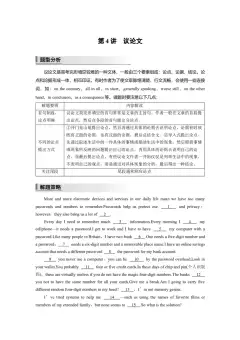
文体分析
议论文是一种剖析事物、论述事理、发表见解或提出主张的说理性文章。议论文的目的不仅是客观的解释
事物,还力图说服读者相信并接受某一观点。英语议论文不完全等同于汉语的议论文,它涉及的范围要小得多。
英语议论文主要是就某一主题,在摆出正反两方面观点的基础上,通过论证、推理辩论等手段,试图让读者最
终接受作者对这一主题的某种观点。尽管有时也不一定非常明确的交待正反观点,但力图通过推理让读者赞同
自己的观点始终是英语议论文的主要目的。
不管是在汉语中,还是在英语中,议论文都是由论点(作者的观点,也就是被证明的对象、论据(用来证
明论点的依据,是说明论点的理由和材料)和论证(运用论据证明论点的过程与方法),这三个要素构成的,
这也是一个提出问题——分析问题——解决问题的过程。因此,典型的议论文一般就由序论(提出问题,即
what)、本论(分析问题,即why)和结论(解决问题,即how)三个部分构成,其具体的结构模式又有以下
三种:
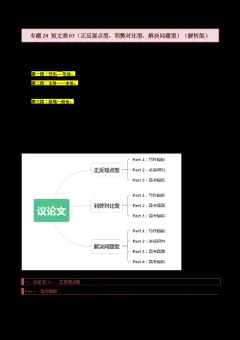
模式一:引言段(提出观点)——正方论点心(支持作者的观点的较弱论点)、正方论点 2(支持作者的
观点的较强论点)、正方论点3(支持作者观点的最强论点)——结论段(总结+解决方法,论断或建议)
在这种模式中,文章主体段(中间部分)的每一个部分论述一个论点,这些论点以其重要性按序排列,最
有力、最重要的论点在最后面,以示强调。
模式二:引言段(提出观点)——反面意见(反方观点+作者的反驳)、正方论点1(支持作者观点的较弱
论点)、正方论点2(支持作者观点的较强论点)、正方论点3(支持作者观点的最强论点)——结论段(总结
+解决方法,论断或建议)
在这种模式中,文章立体段的一开始就提出对立方的反面意见及作者对这种意见的反驳,以后各部分仍分
别陈述作者的不同论点。
模式三:引言段(提出观点)——反方观点1+进行反驳的正方论点、反方观点2+进行反驳的正方论点、反
方观点3+进行反驳的正方论点——结论段(总结+解决方法,论断或建议)在这种模式中,作者在文章主体段
的每一部分都先提出一个反面观点,然后再进行反驳。
英语议论文的语言特点
由于与其他文体相比,英语议论文类似英语说明文,因此,它具有英语说明文的一些语言特点,比如:时
态较为统一,多用现在时;强调语言表达的客观性;尽可能指明信息来源等等。但作为一种独立的文体,英语
议论文在语言上也有一些自己特有的表达形式:
1.较多使用表达委婉语气的词语和句子与英语说明文相比,英语议论文不仅需要说明自己的观点,而且还要让读者接受自己的观点,因此,
在词语表达上除了客观之外,还必须注意委婉。在英语中,常用虚拟语气,让步状语从句和情态动词can,
could,may,might,would,should等。请看下面两组有关“面试在招生过程中的重要性”的文字:
(1)No one should be admitted into(招收进)college without a personal interview(面试).What can
admissions people(招生人员)tell from a piece of paper?They can tell nothing.Only when they see a student face to
face,can they decide what kind of a person he is.
(2)Though admissions people can learn some things from a piece of paper,such as how well a person
writes and what he is interested in there may be many other things that an application (申请表)can not tell but can
only be seen in a personal interview.The way a person talks,the way he thinks about and answers questions,the way
he reacts(反应),are all important facts of a person which can not be found on a piece of paper.
两段文字都强调“大学生入学必须面试”,但相比之下,例(2)用了情态动词,though引导的让步状语
从句等表达方式,语气较为委婉,更容易为读者所接受。
2.使用有辩论、推理等含义的连接词和过渡词等词语结构
英语议论文讲究辩论推理的条理性和逻辑性,因此,往往较多地使用这类性质的过渡词和连接词,常用
的包括:since (既然),now that(既然), therefore(因而),consequently(因此),accordingly(因
此),hence(因而),in that case(在那种情况下),because(因为),so(所以)。另外,还有些句型也常
出现在英语议论文中,比如: It follows that…(因而……),If…,we may conclude that…(如果……,我们可
以这样下结论……), Should it be the case(如果是这样的话……),Idon't want to…,but…(我并不想……,
但是……), If you admit…,then…(如果你承认……,那么……),It is true that…,but…(诚然……,但
是……), Even if…(即使……)等。
(1)如“很多人很快就会发现,他们在物质上是富裕了,精神上却很贫乏”,可以这样达: Many people
will soon find themselves rich in goods,but ragged in spirit.(注:句中rich in与ragged in,goods与spirit具有正反
对比的关系和效果。)
(2)如“利远远大于弊”,可以这样表达: The advantages far outweigh the disadvantages.(注:句中
the advantages与the disadvantages具有正反对比的关系和效果。)
(3)如“他们注意到了这些说法中的一些道理,但他们却忽视了一个重要的事实”,可以这样表达:
They have noticed a grain of truth in the statements,but have ignored a more important fact.(注:句中have noticed
与have ignored,a grain of truth in the statements与a more important fact具有正反对比的关系和效果。)
(4)如“这样做既有积极效果也有消极效果”,可以这样表达:
It will have both negative and positive effects by so doing.(注:句中negative与positive具有正反对比的关系和效
果)3.使用重复。
英文一般讲求简洁,因此为表达强调偶尔使用重复可以使语句的强调内容得到突出。
(1)如“现在是忘掉过去一切的时候了。现在是言归正传的时候了。现在是为未来而奋斗的时候了”,可
以这样表达:
Now is the time to forget everything in the past. Now is the time to get down to the business. Now is the time to work
hard for the future.(注:此句为句首重复,重复部分为句首的now it the time to)
(2)如“我们渴望成功,而且正在为成功而努力工作”,可以这样表达:
We long for success and we are working hard for success.(注:此句为句尾重复,重复的部分为句尾的for
success.)
(3)如“我相信我们能够成功,我相信我们也一定会成功”,可以这样表达:
I am convinced that we can succeed,and I am convinced that we must succeed.(注:and所连接的两个语句的句首
与句尾部分同时重复,重复的部分为句首的I am convinced that与句尾的succeed)
(4)如“我们现在生活在一个新的时代,而一个改革充满着风险与机遇”,可以这样表达: We are now
living in a new era,and a new era of reform is always full of ventures and chances.(注:and之前的句尾与and之后
的句首重复,重复部分为a new era.)
4.使用倒装
倒装是进行强调的一种手段,它利用了语句句首(或句尾)的特殊位置。例如,如“充满着风险与机遇的
改革的新时代正向我们走来”,可以这样表达:
Now on coming to us is the new era of reform full of ventures and chances.
5.使用转义
转义是一种对词语灵活运用的修辞手段,主要有比喻、拟人、夸张、反语、婉转等,比喻又包括明喻、暗
喻、换喻、提喻等。
(1)如要表达“过去的经历就像图片一样总是在脑海中萦绕”,英文可为:
What had been experienced in the past was always looming in memory like a picture.(注:此句采用明喻,明喻的
特点是使用了like一词)
(2)如要表达“我们的英语老师就是我们最好的英语辞典”,英文可为:
Our English teacher is our best English dictionary.(注:此句采用暗喻,暗喻的特点是利用事物之间的相似之处
进行比喻,与明喻不同之处在于不使用like一词)
(3)如要表达“我正在读莎土比亚的书呢”,英文可为:
I am reading Shakespeare.(注:此句采用换喻,换喻的特点是直接借用一事物的名称宋代替另一事物的名称,
使用通过联想理解其含义,但不是所有的事物都是可以用换喻来表达的)
(4)如要表达“这里需要一个帮手”,英文可为:A hand is needed here.(注:此句采用提喻,提喻的特点是用一个事物的部分来代表事物的整体或用一个事物
的整体来代表事物的部分。这里用hand一词代表整个人)
题型分析
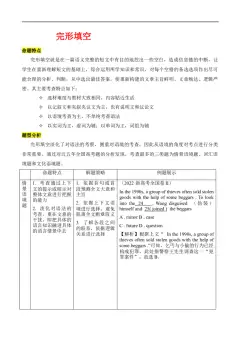
一、题型特点
议论文文体的完形填空一般是直接提出论点,通过论据论证,最后作者提出自己的看法或提出另一个话题
供大家讨论。
议论文文体的完形填空一般都是由论点(作者的观点,也就是被证明的对象)、论据(用来证明论点的依
据,是说明论点的理由和材料)和论证(运用论据证明论点的过程与方法)这三个要素构成,这也是一个提出
问题→分析问题→解决问题的过程。
另外,英语议论文不仅需要说明自己的观点,而且还要让读者接受自己的观点。因此,在词语表达上除
了客观之外,还比较注重委婉。作者的写作态度一般也较诚恳,在文章中通常使用的是与读者平等交流的语气,
不会给人以居高临下、以势居人、逼人接受的感觉,在遣词造句方面多使用虚拟语气、让步状语从句和 can,
may, might, could, would, should等情态动词。为了辩证推理的条理性和逻辑性,往往较多地使用像since, now
that, therefore, in that case, because, so, but, however等过渡词和连接词。
三、解答技巧
1. 把握首段和首句完整的信息,把握全文的主旨大意
【典例示例】
All of us go through some difficult times as we approach teenage years . It's the age when we have to deal with the
most 36_____ in our life . This transition(过渡) from childhood to adulthood is 37_____ for some , but rough for
others . The most important thing about being a teenager is 38______ . When we are teenagers , we would get blamed or
even punished for anything wrong we do.
36.A.chances B. changes C. feelings D. expectations
【解析】:在这个阶段我们需要面对生活中的很多改变(changes)。
37.A.smooth B. practical C. demanding D. necessary
【解析】:从童年到成年的过渡,对有些人来说是很顺利的(smooth),但是对另外一些人来说却很艰难。此处用
smooth“顺利的”,和后面的rough相对应。
38.A.knowledge B. independence C. confidence D. responsibility
【解析】:根据此空的下一句“当我们成为青少年时,我们会因犯错受到责备甚至是惩罚”可知,此处表示
“成为青少年最重要的一件事就是责任(responsibility)”。
【答案】:36.B 37.A 38.D
2. 把握作者的观点和态度议论文往往体现作者对某一事物的观点,而作者的观点就是文章的论点。考生要把握作者的观点,把握作
者对某一事物是襄还是贬,是赞成还是反对,而通常把握了作者的观点也就找准了文章的论点。
【典例示例】
You do not have to train yourself 6_______ to feel the psychological benefits of exercise.
What really matters is 7______, not intensity(强度)of your exercise. You can try walking for 30 minutes five
times per week or simply gardening on weekends.
6.A.hard B. everywhere C. carefully D. late
【解析】:根据下文作者强调运动的关键是频度而不是强度可知:你训练的时候强度没必要很大,故选A。
7.A.time B. length C. form D. frequency
【解析】:根据文章最后一段给出的建议每周五次散步可知,运动的关键是频度而不是强度,故选 D。
time“次”;length“长度”;form“形式,表格”;frequency“频度,频率”。
【答案】:6.B 7.D
3. 论点、论据互相结合,找出选项正确答案
一般说来,能说明论据主要内容的答案可以在论点里得到印证,而论点里的某些答案也可以与论据有机地
结合起来,使论点、论据形成相辅相成的关系,因而整个文章上下一致。如果我们所选的答案前后矛盾,论据
与论点相惊,最后的结论与论点相矛盾,那么我们就要重新回过头来理顺文章的各个部分,直到清楚为止,这
样才能选出正确答案。
【典例示例】
There are four of us now in the house, but over time I've had nine people come in and move on to other places. We'd
all be in 54 _______if we hadn't banded together .
The American Dream I believe in now is a shared one. It's not so much about what I can get for myself ; it's about
55_______we can all get by together
54.A.yards B. shelters C. camps D. cottages
【解析】:如果不是大家齐心协力,那么我们都将会栖身于避难所,因此选shelters。
55.A.when B. what C. whether D. how
【解析】:D 本句点明中心:美国梦不是关于一个人能够获得什么,而是关于我们在一起如何去实现它,因此
选how。
【答案】:54.B 55.D
4.通篇阅读,围绕主题(论点)推敲有疑问的题目,并最终确定答案
逐题按照文章的内容及语境选择完毕后,一篇完整的文章便呈现出来,此时,要注意一定要通读全文,以
验证个别题目的答案是否与主题偏离,以求更高的准确度。
【检测训练】1
My car sweeping past the green pastures(草地), I felt the cool breeze on my face,eyes closed. The breeze felt
refreshingly 1 and gave me a 2 of newly defined freedom and happiness. The breeze suddenly came to a halt
3 the car stopping due to a bit of traffic 4 by the grazing of some cute lambs.
Climbing out of the car in excitement,I 5 I was in a new world, 6 my only companion was the
sparkling beauty of nature all around me. Standing there, I 7 understood the meaning of freedom! In this fast paced
world,where smartphones are a(n) 8 and life without internet might just be the next step to insanity(疯狂), we’ve
9 the simple pleasures in life.
Just 10 for a moment to ask yourself 11 it’s been since you’ve just sat down for a while, doing
absolutely 12 yet feeling perfectly happy and contented!
People tend to find happiness in commodities or 13 around them, but the perfect place to start searching for
happiness is 14 within you!
Happiness is like a 15 . It can be spread to others, if only we are willing to splash (撒) a few 16 on
ourselves! True happiness is said to be 17 when we are the 18 behind a person’s beautiful smile and
immense happiness!
So the next time you see someone upset or feeling low, 19 them a bit of your time and support. It doesn’t cost
much, but doubles the happiness in your 20 !
1. A. familiar B. new C. old D. strange
2. A. sense B. kind C. type D. matter
3. A. as B. since C. with D. for
4. A. happened B. occurred C. invented D. created
5. A. realized B. thought C. recognized D. discovered
6. A. which B. when C. where D. what
7. A. suddenly B. finally C. gradually D. immediately
8. A. necessity B. equipment C. tool D. treasure
9. A. conducted B. finished C. remembered D. forgotten
10. A. wait B. stop C. hold D. stay
11. A. how long B. how often C. how many D. how much
12. A. something B. anything C. nothing D. everything
13. A. things B. goods C. data D. basics
14. A. correct B. right C. proper D. suitable
15. A. river B. well C. spring D. perfume16. A. drops B. bottles C. pieces D. bags
17. A. made B. achieved C. developed D. grew
18. A. possession B. component C. part D. reason
19. A. bring B. take C. lend D. give
20. A. soul B. mind C. heart D. spirit
2
Nine years ago when I went to an English corner for the first time, nobody tried to talk to me. However, I have now
become a(n) 21 participant at the English corner. I always give a(n) 22 smile to new comers.
There have been times when I feel unable to 23 those who have an excellent command of English. But as
long as I remember the 24 I received nine years ago, I feel better 25 for the challenge, for I 26
there is no point in being sorry for my own inability and the only 27 way forward is to start again from the very
beginning with full 28 .
The determination to start again indicates your 29 of the many opportunities ahead. You’ve all 30
read the novel Gone with the Wind, and are 31 by Scarlett, the heroine, who brings herself and the family
through the 32 years of the Civil War and Reconstruction and regains her footing in Atlanta. At the end of the
book, she says 33 , “After all, tomorrow is another day.” Scarlett’s persistence (坚持) and self-confidence in face
of difficulty probably 34 the ever-appealing attraction of the character, and the everlasting popularity of the
novel.
It is true that the age in which we live is not 35 . There are a lot of hardships and barriers ahead. But, if we
36 that we always have tomorrow before us, we will not be that 37 with everything around us now. Tomorrow
will be a new day. This is the 38 on which we rely. With this faith, we will 39 all that was disagreeable
yesterday and discover golden opportunities to achieve that which we’ve never before 40 .
21. A. rude B. anxious C. careless D. active
22. A. grateful B. encouraging C. familiar D. winning
23. A. keep up with B. take pride in C. get rid of D. make fun of
24. A. advice B. training C. treatment D. protection
25. A. allowed B. prepared C. blamed D. supported
26. A. suspect B. know C. promise D. remember
27. A. serious B. awkward C. proper D. bearable
28. A. schedule B. determination C. curiosity D. puzzlement
29. A. share B. experience C. memory D. awareness
30. A. probably B. gradually C. obviously D. frequently31. A. impressed B. annoyed C. scared D. confused
32. A. recent B. golden C. romantic D. bitter
33. A. casually B. wrongly C. hopefully D. naturally
34. A. admit B. explain C. predict D. reduce
35. A. perfect B. reasonable C. meaningful D. difficult
36. A. declare B. forget C. realize D. doubt
37. A. patient B. busy C. connected D. dissatisfied
38. A. pride B. reality C. faith D. benefit
39. A. throw away B. show up C. seek for D. depend on
40. A. analyzed B. accepted C. designed D. obtained
3
It is almost impossible to be left alone in a digital world, where people are meant to be connected. In this respect,
digital technologies have 41 our life.
The possibility to be connected all the time has brought our personal space to a(n) 42 as we've known it.
People have become so 43 in the world of networks that one can often be contacted even if they'd rather not be.
Today we can talk, text and e-mail, not only from our 44 , but from our mobile phones as well.
Most people have become 45 on digital technology simply because it has become a necessary part of life,
and at this point not 46 it would make them an social outsider. 47 , many jobs and careers require people
to be connected. From this point of view, being reachable might feel like a 48 to those who may not want to be
able to be contacted at all times.
But solitude(独处) still can be possible for those who 49 want it. Computers can be 50 and mobile
phones can be turned off. Of course, the choice to be “off” and “on” has many 51 as well as disadvantages.
When travelers end up 52 in mountains, and mobile phones can mean life or death, although they can also make
people feel 53 and forced to answer unwanted calls.
Actually, attitudes towards digital technologies as a society 54 widely. Some find them a gift. Others
consider them a curse. Whether you like it or not, it's hard to imagine what life would be like without the 55 in
digital technologies.
41. A. reshaped B. respected C. ignored D. preserved
42. A. alarm B. stage C. end D. balance
43. A. sensitive B. intelligent C. considerate D. reachable
44. A. neighbors B. computers C. friends D. monitors
45. A. impressed B. hard C. dependent D. focused46. A. finding B. using C. protecting D. changing
47. A. Also. B. Instead. C. Otherwise. D. Therefore.
48. A. pleasure B. benefit C. burden D. shame
49. A. slightly B. barely C. merely D. really
50. A. sold out B. broken up C. shut down D. joined in
51. A. aspects B. advantages C. weaknesses D. exceptions
52. A. hidden B. lost C. relaxed D. deserted
53. A. trapped B. excited C. confused D. amused
54. A. vary B. arise C. spread D. exist
55. A. hopes B. tests C. interests D. achievements
4
A famous theorist once said, “I don’t divide the world into the weak and the strong: or the successes and the
failures...I divide the world into the learners and the non-learners.”
What on earth would make someone a non-learner? Everyone is born with an intense 56 to learn. Babies
rise to the learning challenge daily. Not just for 57 tasks, but the most difficult ones of a lifetime, like leaning to
walk and talk. They never decide it’s too hard or not worth the 58 . Babies don’t worry about making mistakes or
59 themselves. They walk, they fall, they 60 .
What puts an end to this fearless learning? A fixed mindset. As soon as children become able to evaluate
themselves, some of them become 61 of challenges. They worry about not being 62 . My research team
have studied thousands of people from preschoolers on, and It’s breathtaking how many 63 an opportunity to
learn.
We offered four-year-olds a 64 :they could redo an easy jigsaw (拼图) or try a harder one. Even at this
young age, children with a fixed mindset stuck with the 65 one. They believe smart kids don’t make 66 .
Children with a growth mindset, however, thought it was a 67 choice. Why would anyone want to keep
doing the same puzzle 68 ? They chose increasingly difficult-ones instead.
Believing that success is about learning, children with a growth mindset seized the chance. But those with a fixed
mindset didn’t want to expose their 69 . This is how a fixed mindset makes people into 70 .
56. A. fear B. drive C. competition D. concentration
57. A. crucial B. mental C. ordinary D. particular
58. A. attention B. effort C. interest D. time
59. A. confusing B. behaving C. punishing D. hurting
60. A. get up B. give up C. show up D. shut up61. A. afraid B. ashamed C. confident D. ignorant
62. A. adorable B. curious C. modest D. smart
63. A. seize B. ruin C. reject D. require
64. A. lesson B. choice C. gift D. game
65. A. challenging B. interesting C. new D. simple
66. A. decisions B. jigsaws C. mistakes D. predictions
67. A. strange B. promising C. profitable D. difficult
68. A. repeatedly B. unwillingly C. automatically D. properly
69. A. secrets B. thoughts C. preferences D. weaknesses
70. A. theorists B. perfectionists C. non-learners D. risk-takers
5
The lazy beach vacations and study-abroad years are gone because of the pandemic (流行病). Many, who
believe travel is in their genes, find it 71 to be kept in the same place for so long. My friend James is one of them
and is growing bored and upset, 72 for the old travelling days. How to pull through the depressing situation?
There are many ways to answer the question, but “ being 73 is not one of them.
People always have a strong 74 to be on the go. However, it shows our true ability when that demand can't
be 75 instantly. Travel is a good way to meet new people and 76 new things, but we have 77 if
we can't make it.
We can go off the 78 path and travel in the off-season. By connecting with communities and spending our
money in ways that support 79 , it will be a more meaningful way to 80 the differences that make the
world colorful.
We can plan a trip instead while we can't 81 be there. “Expectations play a 82 role in our life. And
our future — mindedness can be a source of 83 if we know good things are 84 In every way, travel is a
great thing to 85 , ” said Matthew Killingsworth, a professor at the University of Pennsylvania. So 86 a
trip is nearly as enjoyable as actually taking one. Making plans is its own 87 It makes us remember there is a big,
88 world out there.
Many of us, me included, have taken what we have for granted. Tom Swick, a travel writer, tells me he 89 to
view travel as a routine. "Now, I look forward to experiencing it as a 90 , ” says he.
71. A. unbearable B. unpredictable C. unreliable D. uncertain
72. A. heading B. competing C. switching D. longing
73. A. optimistic B. active C. desperate D. hesitant
74. A. pressure B. sorrow C. fancy D. desire75. A. reserved B. satisfied C. explained D. ignored
76. A. experience B. recover C. risk D. provide
77. A. curiosity B. alternatives C. advances D. regret
78. A. hidden B. broken C. beaten D. frozen
79. A. hobbies B. shelters C. fictions D. locals
80. A. refuse B. appreciate C. decrease D. avoid
81. A. mentally B. rarely C. physically D. merely
82. A. negative B. mild C. valueless D. significant
83. A. concern B. chaos C. independence D. joy
84. A. off the track B. in the way C. around the comer D. to the point
85. A. look forward to B. look down on C. look out for D. look back at
86. A. canceling B. plotting C. adjusting D. denying
87. A. reward B. focus C. price D. form
88. A. frightening B. rolling C. appealing D. resting
89. A. used B. hoped C. agreed D. wanted
90. A. service B. gift C. trend D. play
6
Certainty:Over-rated and Over-rewarded
Type the words “kind of” or “perhaps” into an email in Microsoft Outlook and the program might well tell you to
think again. If the Al-powered “Microsoft Editor” judges that you are not sounding 91 enough, it will soon give
you a word of warning:“Words expressing uncertainty will 92 your impact.”
To me, this suggestion precisely expresses something we’ve got wrong in society. We live in a world that 93
those who speak with confidence-even when that is misplaced-and gives very little opportunity to perform to those who
94 doubt. “We tend to listen to those experts who tell us a simple, clear and confident story. Why? Because that’s
95 satisfying,” says Dan Gardner, author of Future Babble, “That’s saying let me sweep away the uncertainty for
you’.”
Research shows that the human brain is “programmed” to hate 96 :a 2016 study found that when
volunteers were given electric shocks, their stress levels were highest when they had no idea whether they were going to
be given a shock-higher even than subjects who were told they would 97 get one.
We should first know that while confident-sounding experts might be giving us what our brains desire, the 98
they are providing is probably false. Psychologist Philip Tetlock divided up forecasters into “foxes” and “hedgehogs”.
Foxes consider all sorts of different approaches sand perspectives, and combine those into distinct conclusions. 99, hedgehogs tend to view the world through the lens of one single defining idea. That makes the hedgehogs 100
forecasters but more likely to get attention.
Perhaps we care less about the truth and more about enjoying some sense of 101 however short-lived that
might be. But wouldn’t it be better if we held experts to account? Mr. Gardner suggests tagging speakers with some kind
of record of previous 102 much as we are given performance statistics for racehorses or baseball players.
Highly confident statements also 103 polarization(两极化), encouraging others to respond in the same
kind of language when they disagree. “There’s a natural tendency to push back with equal amounts of 104 says
Daniel Drezner, a political scientist.
Is it time to give a bit more attention to the 105 ? Full of certainty on the need to stop paying so much
attention to those expressing certainty, I say yes.
91. A. timid B. reasonable C. decisive D. mature
92. A. assess B. reverse C. enhance D. lessen
93. A. rewards B. relaxes C. confuses D. weakens
94. A. eliminate B. acknowledge C. emphasize D. conceal
95. A. physically B. psychologically C. politically D. professionally
96. A. uncertainty B. confidence C. dishonesty D. stress
97. A. readily B. fortunately C. definitely D. probably
98. A. desire B. depression C. shock D. relief
99. A. For instance B. In addition C. Even so D. In contrast
100. A. funnier B. worse C. less confident D. more reliable
101. A. achievement B. responsibility C. security D. justice
102. A. approaches B. attention C. predictions D. significance
103. A. prohibit B. promote C. sacrifice D. separate
104. A. firmness B. encouragement C. carefulness D. statement
105. A. foxes B. hedgehogs C. forecasters D. scientists