专题 14 完形填空夹叙夹议文,议论文和说明文特点分析+高
分策略
01专题网络·思维脑图
02考情分析·解密高考
03高频考点·以考定法
考点 完形填空
【高考解密】
命题点01 完形填空夹叙夹议文
命题点02 完形填空议论文和说明文
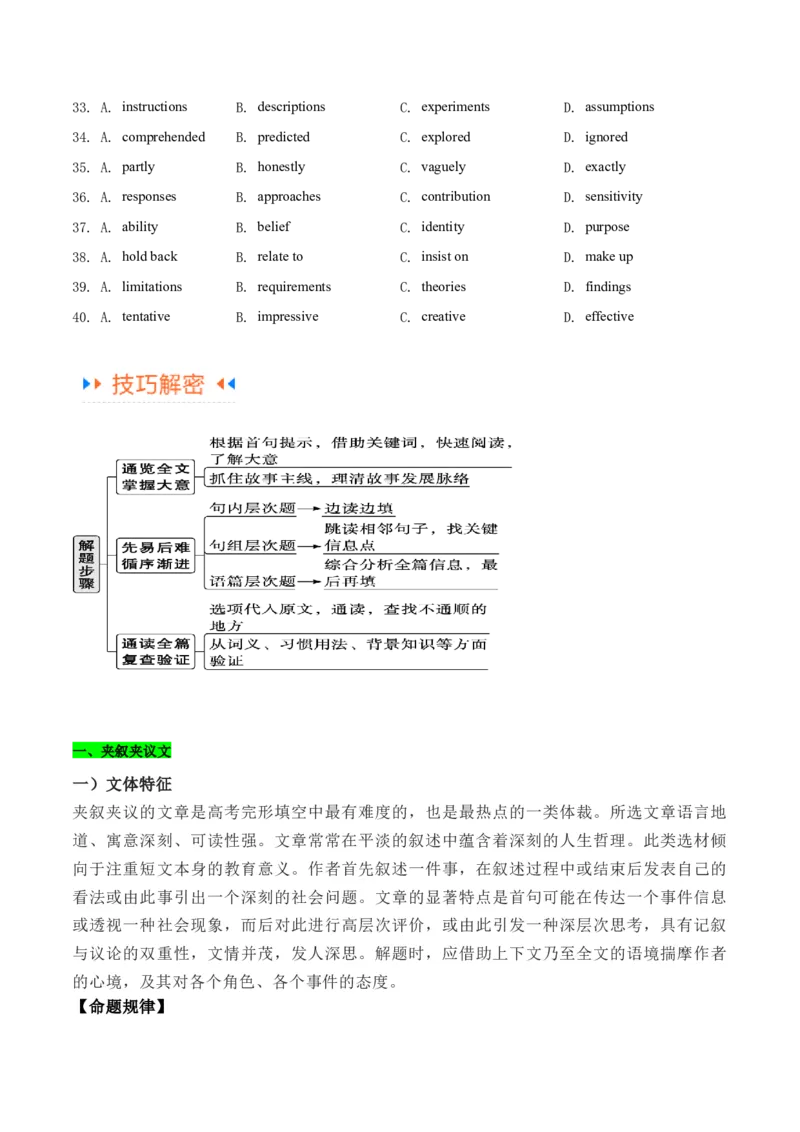
【技巧解密】
【考向预测】
04核心素养·微专题
微专题 名词词义辨析易错点
05创新好题·分层练主题 考查类型
名词 介词
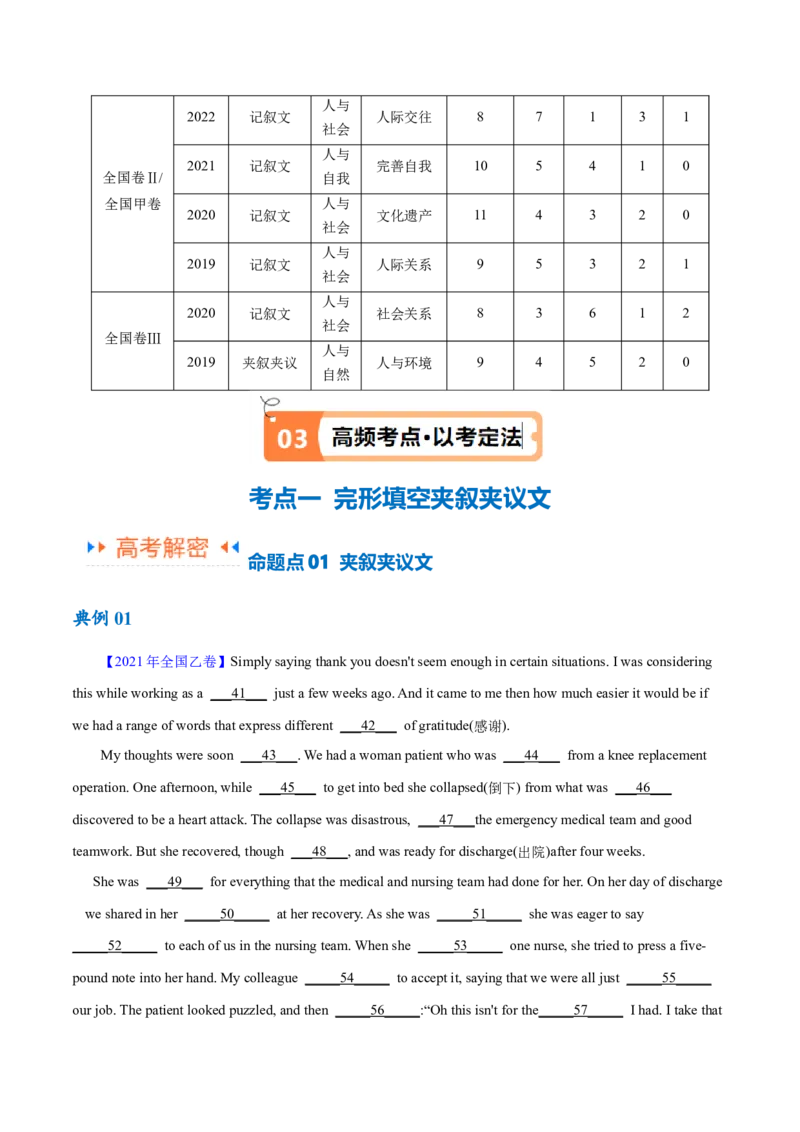
试卷 年份 体裁 (短语) 形容词 副
语境 内容 (短 (短
动词 (短语) 词
语) 语)
人与
全国乙卷 2023 记叙文 完善自我 12 3 5 1 0
自我
人与
全国甲卷 2023 记叙文 人际交往 8 4 7 0 1
社会
新高考Ⅰ 人与
2023 记叙文 人际关系 6 7 2 0 0
卷 社会
新高考Ⅱ 人与
2023 记叙文 人际关系 7 3 4 1 0
卷 社会
人与
2022 说明文 人际关系 7 7 4 2 0
社会
人与
2021 夹叙夹议 人际交往 10 7 1 2 0
全国卷Ⅰ/ 社会
全国乙卷 人与
2020 夹叙夹议 完善自我 6 8 3 2 1
自我
人与
2019 记叙文 环境保护 8 7 4 1 0
自然人与
2022 记叙文 人际交往 8 7 1 3 1
社会
人与
2021 记叙文 完善自我 10 5 4 1 0
全国卷Ⅱ/ 自我
全国甲卷 人与
2020 记叙文 文化遗产 11 4 3 2 0
社会
人与
2019 记叙文 人际关系 9 5 3 2 1
社会
人与
2020 记叙文 社会关系 8 3 6 1 2
社会
全国卷Ⅲ
人与
2019 夹叙夹议 人与环境 9 4 5 2 0
自然
考点一 完形填空夹叙夹议文
命题点01 夹叙夹议文
典例01
【2021年全国乙卷】Simply saying thank you doesn't seem enough in certain situations. I was considering
this while working as a ___41___ just a few weeks ago. And it came to me then how much easier it would be if
we had a range of words that express different ___42___ of gratitude(感谢).
My thoughts were soon ___43___. We had a woman patient who was ___44___ from a knee replacement
operation. One afternoon, while ___45___ to get into bed she collapsed(倒下) from what was ___46___
discovered to be a heart attack. The collapse was disastrous, ___47___the emergency medical team and good
teamwork. But she recovered, though ___48___, and was ready for discharge(出院)after four weeks.
She was ___49___ for everything that the medical and nursing team had done for her. On her day of discharge
,
we shared in her _____50_____ at her recovery. As she was _____51_____ she was eager to say
_____52_____ to each of us in the nursing team. When she _____53_____ one nurse, she tried to press a five-
pound note into her hand. My colleague _____54_____ to accept it, saying that we were all just _____55_____
our job. The patient looked puzzled, and then _____56_____:“Oh this isn't for the_____57_____ I had. I take thatas a _____58_____. No, this is for setting my hair yesterday.”
And there you have it. To many people,_____59_____lives is part of the job but styling hair is an
_____60_____ and should be rewarded.
41. A. cleaner B. chemist C. nurse D. doctor
42. A. grades B. meanings C. needs D. expectations
43. A. brushed aside B. put to the test C. brought under discussion D. taken into account
44. A. departing B. escaping C. retiring D. recovering
45. A. attempting B. choosing C. pausing D. promising
46. A. eventually B. fortunately C. casually D. secretly
47. A. assessing B. requiring C. forming D. proving
48. A. slightly B. accidentally C. slowly D. happily
49. A. grateful B. thoughtful C. sorrowful D. fearful
50. A. surprise B. delight C. curiosity D. disappointment
51. A. operating B. thinking C. hesitating D. leaving
52. A. sorry B. hello C. goodbye D. yes
53. A. reached B. consulted C. introduced D. persuaded
54. A. wished B. pretended C. failed D. refused
.
55 A. enjoying B. doing C. securing D. starting
56. A. repeated B. recited C. replied D. reported
57. A. courage B. patience C. duty D. care
58. A. goal B. given C. push D. greeting
59. A. risking B. changing C. saving D. building
60. A. honour B. ability C. opening D. extra
命题点02 议论文
典例01
【2022 年浙江卷 6 月】Small children are easy to throw up in the air and catch-and they ___16___ it.
“Again, Daddy, again!” Jacky shouts as I throw him skywards and catch him on the way back down again. He
throws his arms and legs out ___17___ he were flying, his eyes wide with ___18___. His trust in me is ___19___
which is quite a nice feeling, but at the same time gives me a huge sense of ___20___ .
I hope Jacky will always trust me fully, but I know that, as he gets ___21___ , it will need more effort andsound judgment____22____ . Trust is such an important part of a ___23___ relationship that it’s something that
can’t ___24___ to lose. Every time I ___25___ Jacky to something new, he’ll do it only because he trusts me and
feels ___26___ in the knowledge that he won’t get hurt .___27___ , teaching Jacky to swim means he has to
___28___ that, when he’s swimming in the big pool, I’ll come to his rescue if his doggy paddle lets him down.
___29___ in the workplace, trust is important for strong ___30___ . It is something that every manager
should work hard to ___31___ among their team. If people don’t trust you, they’re unlikely to ___32___ your
directions and willingly become a loyal (忠诚) team member. A ___33___ of trust can make people work against
you rather than for you. At the very least, it means that people are not going to be ___34___ you their best. Good
___35___, like good parenting, is a long-term commitment.
16. A. deserve B. miss C. love D. know
17. A. as if B. in case C. even though D. so that
18. A. fear B. excitement C. doubt D. astonishment
19. A. reasonable B. limited C. absolute D. important
20. A. relief B. satisfaction C. achievement D. responsibility
21. A. older B. busier C. quieter D. healthier
22. A. on my behalf B. on my part C. in my honor D. in my name
23. A. long-distance B. high-risk C. parent-child D. teacher-student
24. A. afford B. choose C. wait D. expect
25. A. attach B. compare C. adjust D. introduce
26. A. safe B. happy C. proud D. grateful
27. A. Above all B. In addition C. At first D. For example
28. A. admit B. believe C. suggest D. imagine
29. A. However B. Therefore C. Similarly D. Fortunately
30. A. affection B. determination C. friendship D. leadership
31. A. assess B. organize C. develop D. understand
32. A. repeat B. follow C. change D. forget
33. A. gesture B. measure C. bond D. lack
34. A. telling B. giving C. selling D. sending
35. A. management B. personality C. communication D. education
命题点03 说明文典例01
【2022年全国乙卷】Young children across the globe enjoy playing games of hide and seek. For them, there’s
something highly exciting about ___21___ someone else’s glance and making oneself unable to be seen.
However, we all witness that preschool children are remarkably ___22___ at hiding. They often cover only
their eyes with their hands, leaving the rest of their bodies ___23___ .
For a long time, this ineffective hiding method was ___24___ as evidence that children are hopelessly
“egocentric” (自我中心的) creatures. But our ___25___ research results in child developmental psychology
___26___ that idea.
We brought young children aged 2-4 into our Minds in Development Lab at USC. Each ___27___ sat down
with an adult who covered her own eyes or ___28___ . We then asked the child if she could ___29___ or hear the
adult. Surprisingly, children replied that they couldn’t. The same ___30___ happened when the adult covered her
own mouth: ___31___ children said that they couldn’t ___32___ to her.
A number of ___33___ ruled out that the children misunderstood what they were being asked. The results
were clear: Our young subjects ___34___ the questions and knew ___35___ what was asked of them. Their
___36___ to the questions reflected their true ___37___ that “I can see you only if you can see me, too.” They
simply ___38___ mutual (相互的) recognition and regard. Our ___39___ suggest when a child “hides” by
putting a blanket over her head, it is not a result of egocentrism. In fact, children consider this method ___40___
when others use it.
21. A. following B. taking C. escaping D. directing
22. A. clever B. bad C. scared D. quick
23. A. exposed B. examined C. untouched D. imbalanced
24. A. supported B. guaranteed C. imagined D. interpreted
25. A. disappointing B. mixed C. surprising D. desired
26. A. explained B. confirmed C. contradicted D. tested
27. A. parent B. child C. researcher D. doctor
28. A. feet B. nose C. hands D. ears
29. A. see B. help C. reach D. fool
30. A. event B. thing C. action D. accident
31. A. Yet B. Now C. Soon D. Once
32. A. speak B. listen C. turn D. wave33. A. instructions B. descriptions C. experiments D. assumptions
34. A. comprehended B. predicted C. explored D. ignored
35. A. partly B. honestly C. vaguely D. exactly
36. A. responses B. approaches C. contribution D. sensitivity
37. A. ability B. belief C. identity D. purpose
38. A. hold back B. relate to C. insist on D. make up
39. A. limitations B. requirements C. theories D. findings
40. A. tentative B. impressive C. creative D. effective
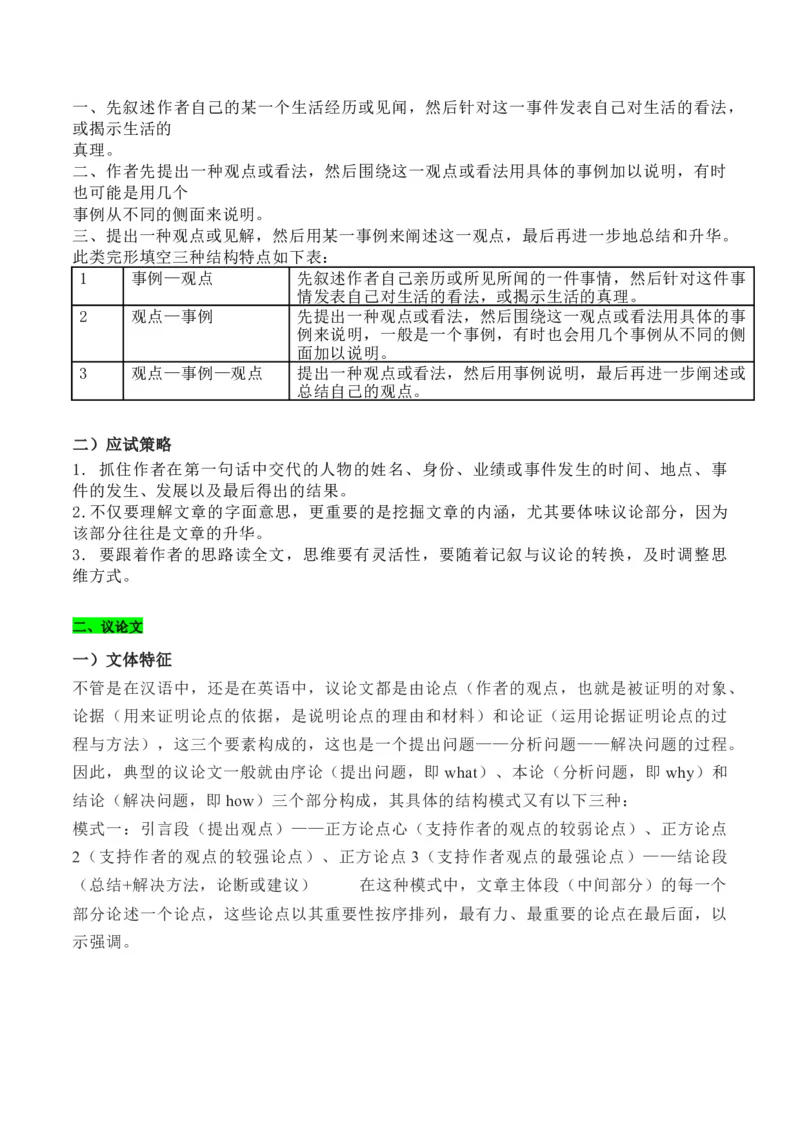
一、夹叙夹议文
一)文体特征
夹叙夹议的文章是高考完形填空中最有难度的,也是最热点的一类体裁。所选文章语言地
道、寓意深刻、可读性强。文章常常在平淡的叙述中蕴含着深刻的人生哲理。此类选材倾
向于注重短文本身的教育意义。作者首先叙述一件事,在叙述过程中或结束后发表自己的
看法或由此事引出一个深刻的社会问题。文章的显著特点是首句可能在传达一个事件信息
或透视一种社会现象,而后对此进行高层次评价,或由此引发一种深层次思考,具有记叙
与议论的双重性,文情并茂,发人深思。解题时,应借助上下文乃至全文的语境揣摩作者
的心境,及其对各个角色、各个事件的态度。
【命题规律】一、先叙述作者自己的某一个生活经历或见闻,然后针对这一事件发表自己对生活的看法,
或揭示生活的
真理。
二、作者先提出一种观点或看法,然后围绕这一观点或看法用具体的事例加以说明,有时
也可能是用几个
事例从不同的侧面来说明。
三、提出一种观点或见解,然后用某一事例来阐述这一观点,最后再进一步地总结和升华。
此类完形填空三种结构特点如下表:
1 事例—观点 先叙述作者自己亲历或所见所闻的一件事情,然后针对这件事
情发表自己对生活的看法,或揭示生活的真理。
2 观点—事例 先提出一种观点或看法,然后围绕这一观点或看法用具体的事
例来说明,一般是一个事例,有时也会用几个事例从不同的侧
面加以说明。
3 观点—事例—观点 提出一种观点或看法,然后用事例说明,最后再进一步阐述或
总结自己的观点。
二)应试策略
1. 抓住作者在第一句话中交代的人物的姓名、身份、业绩或事件发生的时间、地点、事
件的发生、发展以及最后得出的结果。
2.不仅要理解文章的字面意思,更重要的是挖掘文章的内涵,尤其要体味议论部分,因为
该部分往往是文章的升华。
3. 要跟着作者的思路读全文,思维要有灵活性,要随着记叙与议论的转换,及时调整思
维方式。
二、议论文
一)文体特征
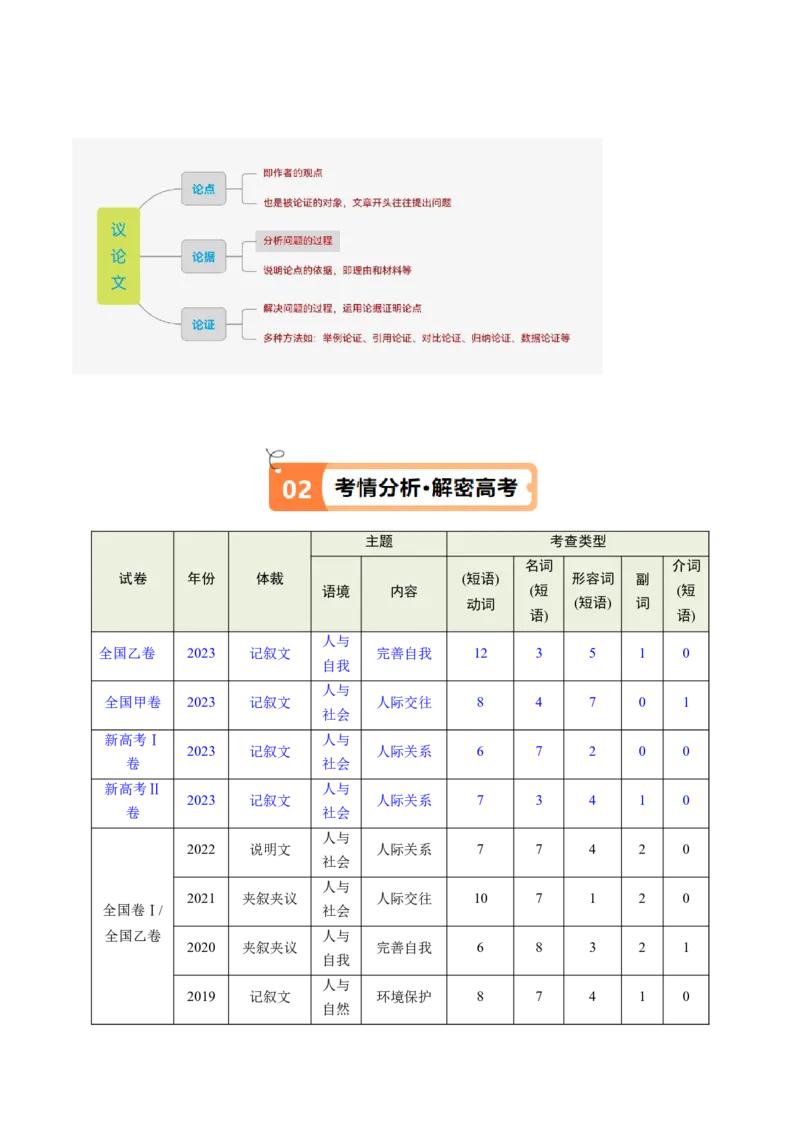
不管是在汉语中,还是在英语中,议论文都是由论点(作者的观点,也就是被证明的对象、
论据(用来证明论点的依据,是说明论点的理由和材料)和论证(运用论据证明论点的过
程与方法),这三个要素构成的,这也是一个提出问题——分析问题——解决问题的过程。
因此,典型的议论文一般就由序论(提出问题,即 what)、本论(分析问题,即 why)和
结论(解决问题,即how)三个部分构成,其具体的结构模式又有以下三种:
模式一:引言段(提出观点)——正方论点心(支持作者的观点的较弱论点)、正方论点
2(支持作者的观点的较强论点)、正方论点 3(支持作者观点的最强论点)——结论段
(总结+解决方法,论断或建议) 在这种模式中,文章主体段(中间部分)的每一个
部分论述一个论点,这些论点以其重要性按序排列,最有力、最重要的论点在最后面,以
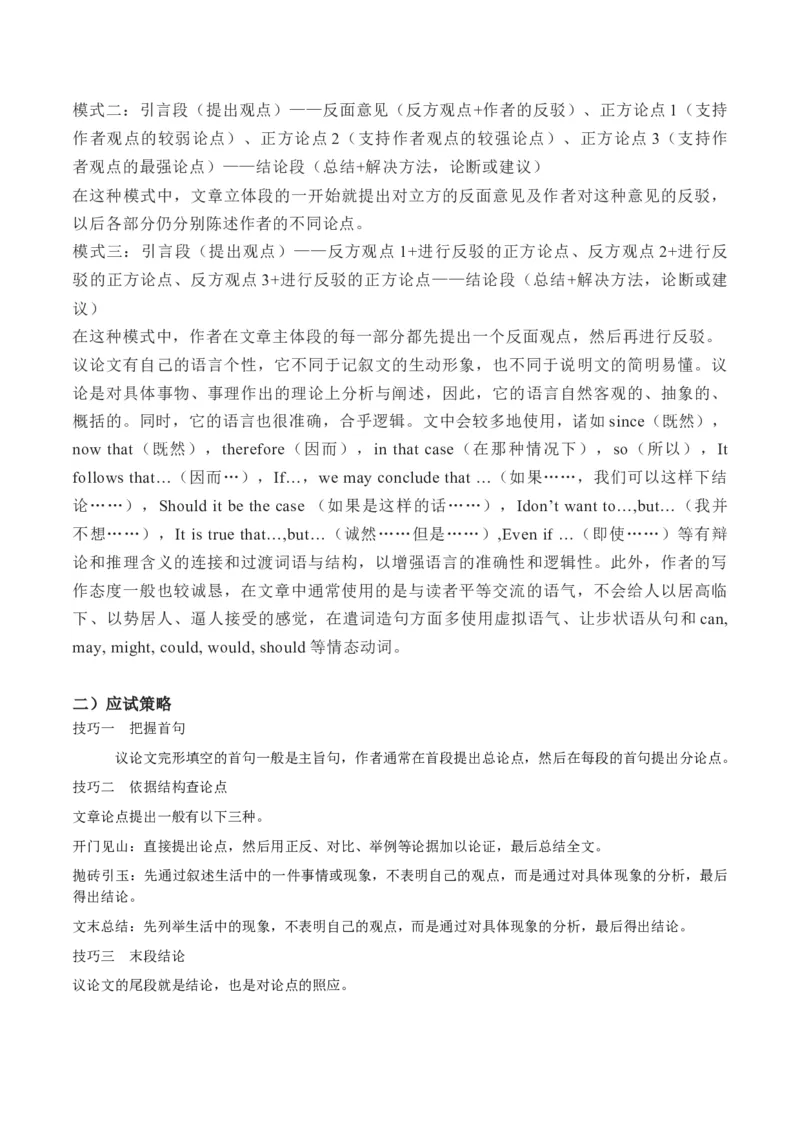
示强调。模式二:引言段(提出观点)——反面意见(反方观点+作者的反驳)、正方论点 1(支持
作者观点的较弱论点)、正方论点 2(支持作者观点的较强论点)、正方论点 3(支持作
者观点的最强论点)——结论段(总结+解决方法,论断或建议)
在这种模式中,文章立体段的一开始就提出对立方的反面意见及作者对这种意见的反驳,
以后各部分仍分别陈述作者的不同论点。
模式三:引言段(提出观点)——反方观点 1+进行反驳的正方论点、反方观点 2+进行反
驳的正方论点、反方观点 3+进行反驳的正方论点——结论段(总结+解决方法,论断或建
议)
在这种模式中,作者在文章主体段的每一部分都先提出一个反面观点,然后再进行反驳。
议论文有自己的语言个性,它不同于记叙文的生动形象,也不同于说明文的简明易懂。议
论是对具体事物、事理作出的理论上分析与阐述,因此,它的语言自然客观的、抽象的、
概括的。同时,它的语言也很准确,合乎逻辑。文中会较多地使用,诸如since(既然),
now that(既然),therefore(因而),in that case(在那种情况下),so(所以),It
follows that…(因而…),If…,we may conclude that …(如果……,我们可以这样下结
论……),Should it be the case (如果是这样的话……),Idon’t want to…,but…(我并
不想……),It is true that…,but…(诚然……但是……),Even if …(即使……)等有辩
论和推理含义的连接和过渡词语与结构,以增强语言的准确性和逻辑性。此外,作者的写
作态度一般也较诚恳,在文章中通常使用的是与读者平等交流的语气,不会给人以居高临
下、以势居人、逼人接受的感觉,在遣词造句方面多使用虚拟语气、让步状语从句和can,
may, might, could, would, should 等情态动词。
二)应试策略
技巧一 把握首句
议论文完形填空的首句一般是主旨句,作者通常在首段提出总论点,然后在每段的首句提出分论点。
技巧二 依据结构查论点
文章论点提出一般有以下三种。
开门见山:直接提出论点,然后用正反、对比、举例等论据加以论证,最后总结全文。
抛砖引玉:先通过叙述生活中的一件事情或现象,不表明自己的观点,而是通过对具体现象的分析,最后
得出结论。
文末总结:先列举生活中的现象,不表明自己的观点,而是通过对具体现象的分析,最后得出结论。
技巧三 末段结论
议论文的尾段就是结论,也是对论点的照应。三、说明文
一) 文体特征
说明文往往围绕一个问题从不同的侧面来加以说明,通常结构严谨,句子结构复杂,因此
也是高考完形填空题中较难理解的一种文体。其主要特点为:
1. 开头点题
在说明文类的完形填空中,作者一般在文章的首句直接提出说明的对象,这是掌握说明细
节的前提。
2.结构清晰
说明文一般按一定的顺序展开。理清文章的说明顺序,对于正确把握文意和上下文的逻辑
关系,选择正确答案具有重要意义。
3.难度较大
说明文往往采用比较正式的文体,表述准确严谨,生词术语较多,句子较长,结构较为复
杂。
4.遣词用字简练
说明文一般采用简练的语言,按一定的方法介绍事物的类别、性质、特点、构造、成因、
关系或事物的运动变化、发展的过程及其规律。
5.条理清晰
说明文十分讲究条理性,一般采取时间顺序、空间顺序、逻辑顺序或认知顺序来说明事物
或事理。
二)应试策略
1. 利用说明文的查找说明主体
2. 把握说明文的两种
(1)总分式。包括"总—分""分—总""总—分—总"等具体形式。
(2)递进式。事理说明文多用递进式结构,一层一层地剖析事理。具体包括:空间顺序——从上到下、
从外到内、从左到右、从南到北、从远到近、从中间到四周、从整体到部分;时间顺序——按照时间
先后顺序来安排,事物都有发生、发展、消亡的过程;逻辑顺序——有些说明文主要是剖析事理的,
在说明时就按照事理的逻辑关系进行安排,或者从主到次、从浅到深、从原因到结果,具有严密的条
理性。考向一 夹叙夹议文
(2023·江苏·统考二模)It wasn’t easy to practice gratitude (感激) every day. After I 1 Cushing’s
disease and had an operation a few years ago, my 2 was that everything would be OK. However, I was
wrong. I had ongoing aches and pains, and 3 myself to a new life was difficult for me. I began to notice
that I’d become a 4 person.
One day, I heard a discussion about gratitude by Dr Tony Evans. It 5 me and forced me to take a
long, hard, honest look at myself. I have a (n) 6 spouse (配偶) and parents. I’d heard the stories of other
people’s struggles with Cushing’s disease. Their spouses had left them and they didn’t have family to 7 . I
didn’t face any of these problems, yet I didn’t realize that.
I made a decision to start practicing gratitude daily. Once I decided that, my 8 improved, and I
began to approach situations 9 . Instead of viewing situations negatively, I started to see them as 10
.
This led me to practice the concept of sowing and reaping (收获), which I learned from my parents. They
didn’t just talk the talk, but rather they 11 this concept to us. 12 , it wasn’t until I had my
own experiences that I understood what it meant.
Let me explain. When I was 13 by my own pity, my harvest in life was ruined, because
everything I was 14 was negative. Since I started practicing gratitude, so many different doors of
opportunity have opened up for me.
My advice is starting practicing gratitude until it becomes a part of your daily 15 . Take note of
the difference it will make in your life.
1.A.caught B.treated C.studied D.spread
2.A.suggestion B.assumption C.description D.solution
3.A.referring B.abandoning C.releasing D.adjusting
4.A.reasonable B.considerate C.generous D.hateful
5.A.annoyed B.challenged C.fooled D.ignored
6.A.supportive B.creative C.sensitive D.active
7.A.turn up B.turn in C.turn to D.turn down
8.A.image B.taste C.mood D.character
9.A.obviously B.differently C.greedily D.frequently
10.A.opportunities B.responsibilities C.abilities D.difficulties11.A.reported B.explained C.performed D.demonstrated
12.A.Instead B.Besides C.However D.Therefore
13.A.consumed B.surprised C.protected D.judged
14.A.raising B.sowing C.meeting D.learning
15.A.burden B.supply C.routine D.struggle
考向二 议论文和说明文
(2023·河南郑州·统考模拟预测)A warm cup of tea can seem to heal the soul. A new study finds it may be
good for your 1 , too. Past studies in China and Japan have suggested that green tea 2 drinkers.
Now, scientists say 3 tea may show similar benefits.
Scientists from the United States National Cancer Institute carried out the 4 . They examined years of
data gathered about the tea drinking 5 of almost 500,000 adults in Britain for as many as 14 years. The
researchers 6 that people who drank two or more cups of tea daily 7 were less likely to have
8 from all causes than those who didn’t. The scientists said the 9 risk of death held true for the 10
with heart diseases and stroke. However, there was no clear finding in connection with deaths from 11 .
Researchers were not sure why. “It is 12 that there were too few confirmed cancer deaths to 13
,” explained Maki Inoue-Choi, who led the study.
All kinds of tea—green, black, oolong, and white—are produced from the same tree plant using different
14 methods. Antioxidants(抗氧化物) in black tea are major 15 to health benefits. A group of
antioxidants called Flavonoids are thought to be 16 for heart health. That’s why black tea helps drinkers
live longer.
The researchers do not offer enough 17 to advise people to start drinking tea or the change how
much they are 18 right now. They need more research to 19 the findings. But Inoue-Choi
said, “If you are already drinking tea, you can 20 doing so.”
1.A.brain B.feeling C.body D.work
2.A.strengthens B.comforts C.refreshes D.benefits
3.A.black B.green C.white D.oolong
4.A.task B.study C.experiment D.reform
5.A.behaviors B.burdens C.opinions D.interests
6.A.admitted B.understood C.suspected D.found
7.A.meanwhile B.afterwards C.therefore D.otherwise8.A.suffered B.died C.escaped D.recovered
9.A.increased B.removed C.lowered D.avoided
10.A.patients B.subjects C.Chinese D.Japanese
11.A.cancer B.heart disease C.stroke D.common illness
12.A.certain B.possible C.vital D.necessary
13.A.cure B.record C.measure D.count
14.A.packaging B.shipping C.marketing D.processing
15.A.approaches B.responses C.contributors D.entrances
16.A.unacceptable B.responsible C.famous D.ready
17.A.knowledge B.guidance C.evidence D.conclusion
18.A.growing B.purchasing C.storing D.drinking
19.A.round out B.pass round C.put down D.bring up
20.A.quit B.delay C.advocate D.continue
微专题 名词词义辨析易错点
1. ( 2022年新高考全国I卷)
Now, every year when my husband pulls our camper out of the garage, we are filled with a sense of 54 ,
wondering what camping fun and 55 we will experience next.
54. A. relief B. duty C. pride D. excitement
55. A. failure B. adventure C. performance D. conflict
2.(2022年1月浙江卷) When Beverley Burdeyney turned seventy four last year, she started having problems
with her ___16___ , notably dryness and discomfort.
"I was simply ___17___ a terrible experience, " Ms. Burdeyney said at her home in Toronto. "I felt so
helpless and insecure because the quality of my ___18___ was affected. "
......
Eventually, Ms. Burdeyney learned about plans for an eye research, ___23___ at Tel Aviv University inIsrael.
16. A. throat B. skin C. lungs D. eyes
17. A. getting over B. going through C. holding on D. passing down
18. A. story B. treatment C. life D. relationship
23. A. course B. program C. paper D. conference
完形填空
(2023 上·江苏·高三校联考期末)Most of us need to heal once in a while. Physically. Mentally.
Emotionally. Sometimes it’s all the above. For some of us, the 1 part of healing is simply to believe that
it’s possible.
Years ago, I was watching my oldest son 2 free throws. He made a dozen 3 through the
net without a miss.
“How do you do that?” I said.
“Before I release the ball,” he said, “I see it in my mind going 4 the net. I see it in my mind to make
it happen.”
I loved these words. It struck me that they might also 5 healing. We need to believe healing can
happen and picture it in our minds to see it in 6 . 7 doesn’t assure us of the outcome we hope
for. But it sets us in motion to move toward desired 8 .
Last year I had surgery for a broken 9 and spent eight weeks in a wheelchair. At the end of those
eight weeks, I 10 to start walking again. 11 , that didn’t happen. I then started going to
physical 12 . I believed it could help, so I kept at it just when it seemed I’d never 13 again as I
did before.
When hope grows dim (暗淡的), belief 14 the way and makes all things possible. We need to
believe 15 is possible. If we can see it in our minds, we can let go of the past, accept the present and
move toward a better future.1.A.simple B.emotional C.hardest D.reasonable
2.A.practice B.display C.release D.enjoy
3.A.attempts B.shots C.choices D.adjustments
4.A.against B.with C.for D.through
5.A.rely on B.apply to C.arise from D.respond to
6.A.reality B.detail C.turn D.person
7.A.Imagination B.Desire C.Belief D.Dreaming
8.A.outcome B.prize C.career D.option
9.A.hand B.ankle C.wrist D.arm
10.A.promised B.planned C.longed D.expected
11.A.Moreover B.Therefore C.Additionally D.However
12.A.strength B.beauty C.therapy D.examination
13.A.walk B.live C.wish D.recover
14.A.feels B.lights C.forces D.clears
15.A.success B.improvement C.healing D.breakthrough
(2024上·黑龙江哈尔滨·高三哈尔滨三中校考期末)Years ago, I lived in the English midlands and would
walk the same route along the local canal each evening. On winter mornings, I would see the 16 sight of
bird flocks dancing across the landscape, a distant cacophony (刺耳的嘈杂声) 17 above the fields. They
were jackdaws (寒鸦), the smallest member of the crow family.
Research led by Masters student Alex Dibnah asked: Why are jackdaws so loud when they 18 ?
Then he began to work with a team. The team’s 19 was that the morning calls might be a jackdaw
version of “ 20 ”. Each individual’s call might 21 as an “I’m in!” helping them coordinate(协
调) their 22 .
To test this, the researchers artificially 23 call levels during the jackdaws’ morning cacophony using
speakers at their sleeping sites. When extra calls were played, the jackdaws 24 earlier, showing they use
calls as a check-in system.
Individual jackdaws 25 from leaving with the flock because they get more social information like
where to find food, they can maximize their time spent finding food, and they’re less 26 being
attacked. This sort of decision-making isn’t 27 to jackdaws — it’s been reported in other species as
well.So, the cacophony of jackdaws in the morning is a clever solution to 28 a large group. If you’re
29 by the noise, find comfort in the fact that the louder they get, the sooner they’ll leave you in 30
.
16.A.frightening B.peaceful C.familiar D.unusual
17.A.fading B.stopping C.changing D.rising
18.A.fly B.gather C.appear D.return
19.A.evidence B.theory C.experiment D.difficulty
20.A.fitting in B.breaking in C.stepping in D.signing in
21.A.resign B.count C.check D.rank
22.A.movement B.progress C.gesture D.demand
23.A.created B.graded C.increased D.maintained
24.A.settled B.left C.escaped D.arrived
25.A.benefit B.learn C.suffer D.keep
26.A.in defense of B.in control of C.at risk of D.at the sight of
27.A.common B.essential C.open D.unique
28.A.joining B.organizing C.mastering D.warning
29.A.bothered B.impressed C.surprised D.fascinated
30.A.trouble B.wonder C.peace D.charge
(2023上·广东深圳·高三珠海市第一中学校联考期末)I am a professor of psychology. Some time ago, I
got halfway through a day of teaching before a co-worker pointed out to me I was quite 31 wearing a
different pair of shoes, one red and one black. I felt so 32 and upset but I would have to go to teach my
33 like this. When I noticed how much I wanted to disappear and avoid this 34 , I was determined to
face it 35 . I walked into class and 36 to the students that I was wearing two shoes from 37
pairs, and directed their attention to my feet. Everyone laughed and we went on with class. Years later, a 38
in that class told me that this was the moment she first thought that maybe, just maybe, she could be a professor,
too.
I 39 my mistake because I realized that trying to hide it was weakening my ability to concentrate my
mind on my teaching — but I had no idea that it would also help shorten the 40 distance between my
students and myself.
Many contexts may 41 or shame people for making mistakes. Our efforts to avoid them 42our desires for success, and how others will respond to our mistakes. We might feel 43 and shame if we do
make some.
However, mistake-making is part of learning new things, and it can 44 us closer to others. It 45
up the possibility of accepting mistakes gladly, letting us be more open and engaged in what we are doing.
31.A.impatiently B.carelessly C.quietly D.slowly
32.A.confused B.touched C.terrified D.embarrassed
33.A.aim B.book C.course D.feeling
34.A.situation B.direction C.operation D.option
35.A.besides B.moreover C.instead D.otherwise
36.A.shouted B.appealed C.called D.announced
37.A.beautiful B.fancy C.different D.colorful
38.A.worker B.teacher C.student D.peer
39.A.shared B.made C.avoided D.corrected
40.A.physical B.psychological C.critical D.economical
41.A.recognize B.stop C.help D.punish
42.A.result from B.come out C.give off D.take on
43.A.self-control B.self-respect C.self-confidence D.self-criticism
44.A.draw B.force C.push D.affect
45.A.clears B.opens C.turns D.uses
(2023上·上海浦东新·高三统考期末)A skywell, or "tian jing", is a typical feature of a traditional home in
China. 46 a northern Chinese courtyard, or “yuan zi”a skywell is smaller and less exposed to the outdoor
environment. They are 47 seen in homes dating to Ming and Qing dynasties, which were designed to 48
different generations of relatives.
Although a skywell's size and design vary from region to region, it is always rectangular and located in the
Core of a house, either 49 by rooms on four sides or three sides plus a wall. Skywells were designed to
cool buildings before air-conditioning existed. When wind blows above a skywell house, it can enter the indoor
space through the opening. Because outdoor air is often cooler than indoor air, the 50 breeze travels down
the walls to the lower storeys and create air 51 by replacing warmer indoor air, which rises and leaves
through the opening.
The main purpose of a skywell is to allow in light, improve ventilation (通风) and 52 rainwater. InHuizhou, a skywell is small but tall, and the rooms around it can 53 sunlight on hot days, enabling the
bottom of the skywell to stay cool. 54 hot air inside the house can rise and escape through the opening
above the skywell, which“works just like a 55 ”
As a(n) 56 space between indoor life and the outdoor environment, a skywell acts as an effective
heat buffer(缓冲)to shield residents from the hot air outside. But the largest part of skywell's cooling effect actually
comes when there are bodies of water in the enclosure.
Evaporated water cools hot air, a process known as evaporative cooling which is 57 in Huizhou
skywells. In the past, Huizhou families collected rainwater in their skywells because they believed this could
safeguard and boost their wealth. Skywells therefore have channels around them to 58 rainwater coming
from the roofs.
Though existing in China for hundreds of years, in recent times they have often been forgotten by people who
prefer modern 59 . Over the past two decades, however, due to a 60 of traditional Chinese
architecture, skywell buildings have been making a comeback.
46.A.Parallel with B.Different from C.Close to D.Symbolic of
47.A.commonly B.rarely C.apparently D.currently
48.A.bind B.gather C.house D.honor
49.A.enclosed B.separated C.accompanied D.replaced
50.A.calming B.refreshing C.incoming D.upcoming
51.A.pollution B.pressure C.current D.circulation
52.A.promise B.harvest C.stop D.process
53.A.block out B.bathe in C.allow for D.let out
54.A.Nevertheless B.Meanwhile C.Similarly D.Rather
55.A.well B.column C.chimney D.ceiling
56.A.ideal B.leisure C.alternative D.transition
57.A.well-reflected B.well-shaded C.well-developed D.well-organized
58.A.collect B.purify C.drain D.evaporate
59.A.techniques B.facilities C.styles D.inventions
60.A.reunion B.reminder C.renewal D.rearrangement