议论类完形填空
议论文是一种剖析事理、论述事物、发表见解或提出主张的说理性文章。议论文的目的不仅是
客观地解释事物,还力图说服读者相信并接受某一观点。
议论文是高考完形填空题中较难的一种体裁,它一般由三个要素组成:论点、论据和结论。做
好这类题的关键在于要抓住作者的论点。
议论文中对于论点的提出通常有三种形式:
1.开门见山.直接提出论点
在有些议论文中作者开头就提出论点,通过论证,最后提出自己的看法,或提出另一个话题供
大家讨论。一般来说,这种形式的议论文,作者态度明确,我们也能很容易地把握作者对某一件事
的看法。
2.导入式提出论点
在有些议论文中作者并不是直接提出自己的观点,而是通过对某一现象的论述来赞扬或批评某
一事物,进而提出自己的观点,然后再用具体的论据去证明自己的观点。
3.水到渠成式得出结论
在有些议论文中作者开头只是列举一系列生活中的现象,而不是表明自己的观点,通过对具体
现象的分析,最后自然得出结论,而此结论就是文章的论点。
议论文形式的完形填空不像记叙文形式的完形填空那么有情景。因此,我们对整个文章的把握
相对来说也难得多。解答这类题要遵循下列原则:
1.从首尾句入手.抓住中心
议论文的写作思路一般为:提出问题一分析问题一解决问题。因此,文章的第一、二句话通常
为文章的主题句.而文章的结尾句常为文章的结论。由此可见,我们必须充分利用文章的首尾句,
推测出文章的中心,从而理解全文。
2.紧扣信息词.把握作者观点
考生要弄清文章的行文逻辑,如转折关系、因果关系、递进关系、对比关系、让步关系、指代
关系等。有时文章的第一、二段并不是作者的观点,而是对某个事物的介绍或者描述.然后用信息
词,如but,however,yet等将自己自己的观点引出,因此,阅读时一定要特别留意这些信息词。
3.从语境入手.确定逻辑关系
句与句之间总要反映出因果、假设、条件、类推等逻辑关系。这些逻辑关系常常通过 on the
one hand,on the other hand, as a result, as a consequence, on the contrary, above all,first of all,
secondly,finally,in case等单词或短语表达出来。但有时作者并不使用这些单词或短语,而是将逻辑关系暗含于文章中,这就需要考生根据语境来确定逻辑关系。
4.理清文章的论点、论据和结论
如果我们连论点、论据、结论都没把握住的话,只能漫无目的地选择答案了。一般说来,能说
明论点的答案可以在论据里得到印证,且作为论点的某些答案也可以与论据有机地结合起来,使论
点与论据相辅相成,从而使整篇文章上下一致。如果我们所选的答案前后矛盾,论点与论据相悖,
最后的结论与论点自相矛盾,那就说明我们对文章的把握缺乏条理性和系统性,我们就需重新来理
顺文章的各个部分,直到条理清楚为止,然后再根据自己对文章的把握和各部分的逻辑关系选出答
案。
Step I 议论文类完形填空的命题特点
议论文是高考完形填空题中较难的一种文体,它一般由三个要素组成:论点、论据、结论。要
做好议论文型完形填空,最重要的是抓住作者的论点。
Step II 真题再现 (1)(2014·新课标卷Ⅰ卷)
As a general rule, all forms of activity lead to boredom when they are performed on a routine(常
规)basis. As a matter of fact, we can see this__1___at work in people of all___2___. For example, on
Christmas morning, children are excited about___3___with their new toys. But their__4___soon wears off
and by January those___5___toys can be found put away in the basement. The world is full
of___6___stamp albums and unfinished models, each standing as a monument to someone’s
___7___interest. When parents bring home a pet, their child ___8___bathes it and brushes its fur. Within a
short time, however, the___9___of caring for the animal is handed over to the parents. Adolescents enter
high school with great__10___but are soon looking forward to___11___. The same is true of the young
adults going to college. And then, how many__12__, who now complain (抱怨) about the long drives to
work,___13__drove for hours at a time when they first__14__their driver’s license (执照)? Before people
retire, they usually__15__to do a lot of ___16___things, which they never had__17__to do while working.
But__18__after retirement, the golfing, the fishing, the reading and all of the other pastimes become as
boring as the jobs they__19__. And, like the child in January, they go searching for new___20__.
1. A. principle B. habit C. weaker D. power
2. A. parties B. races C. countries D. ages
3. A. working B. living C. playing D. going
4. A. confidence B. interest C. anxiety D. sorrow
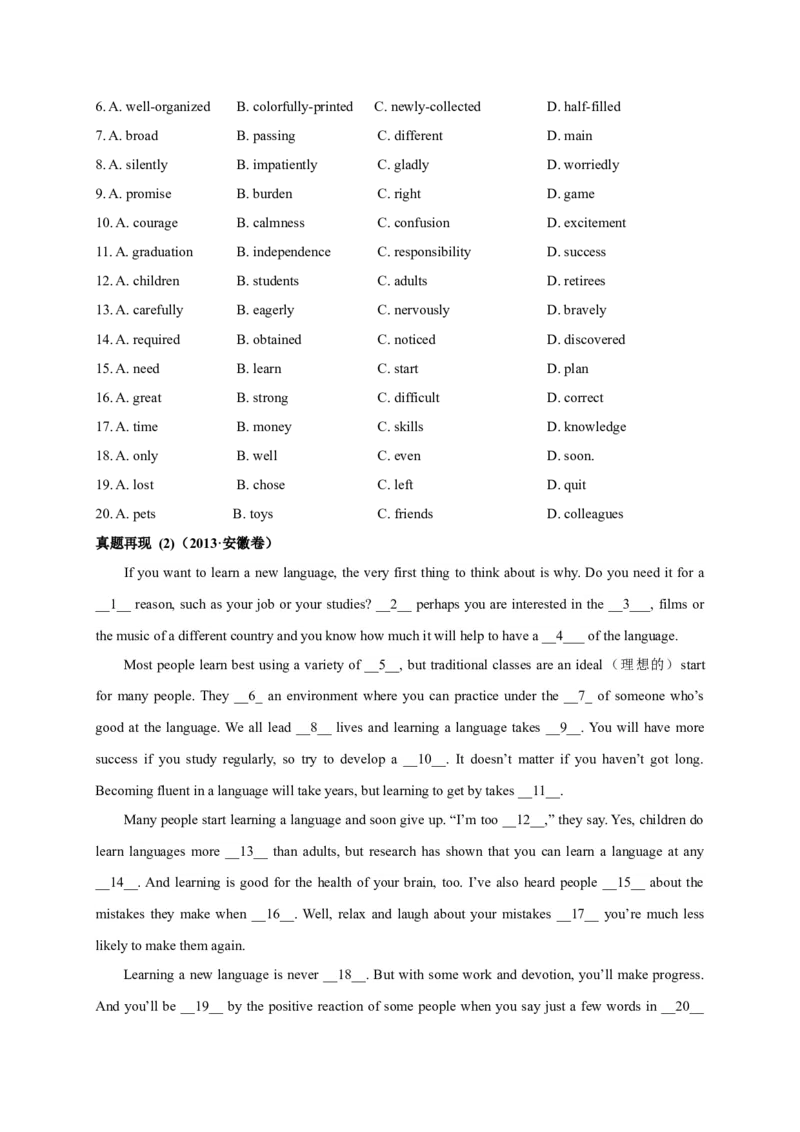
5. A. same B. extra C. funny D. expensive6. A. well-organized B. colorfully-printed C. newly-collected D. half-filled
7. A. broad B. passing C. different D. main
8. A. silently B. impatiently C. gladly D. worriedly
9. A. promise B. burden C. right D. game
10. A. courage B. calmness C. confusion D. excitement
11. A. graduation B. independence C. responsibility D. success
12. A. children B. students C. adults D. retirees
13. A. carefully B. eagerly C. nervously D. bravely
14. A. required B. obtained C. noticed D. discovered
15. A. need B. learn C. start D. plan
16. A. great B. strong C. difficult D. correct
17. A. time B. money C. skills D. knowledge
18. A. only B. well C. even D. soon.
19. A. lost B. chose C. left D. quit
20. A. pets B. toys C. friends D. colleagues
真题再现 (2)(2013·安徽卷)
If you want to learn a new language, the very first thing to think about is why. Do you need it for a
__1__ reason, such as your job or your studies? __2__ perhaps you are interested in the __3___, films or
the music of a different country and you know how much it will help to have a __4___ of the language.
Most people learn best using a variety of __5__, but traditional classes are an ideal(理想的)start
for many people. They __6_ an environment where you can practice under the __7_ of someone who’s
good at the language. We all lead __8__ lives and learning a language takes __9__. You will have more
success if you study regularly, so try to develop a __10__. It doesn’t matter if you haven’t got long.
Becoming fluent in a language will take years, but learning to get by takes __11__.
Many people start learning a language and soon give up. “I’m too __12__,” they say. Yes, children do
learn languages more __13__ than adults, but research has shown that you can learn a language at any
__14__. And learning is good for the health of your brain, too. I’ve also heard people __15__ about the
mistakes they make when __16__. Well, relax and laugh about your mistakes __17__ you’re much less
likely to make them again.
Learning a new language is never __18__. But with some work and devotion, you’ll make progress.
And you’ll be __19__ by the positive reaction of some people when you say just a few words in __20__own language. Good luck!
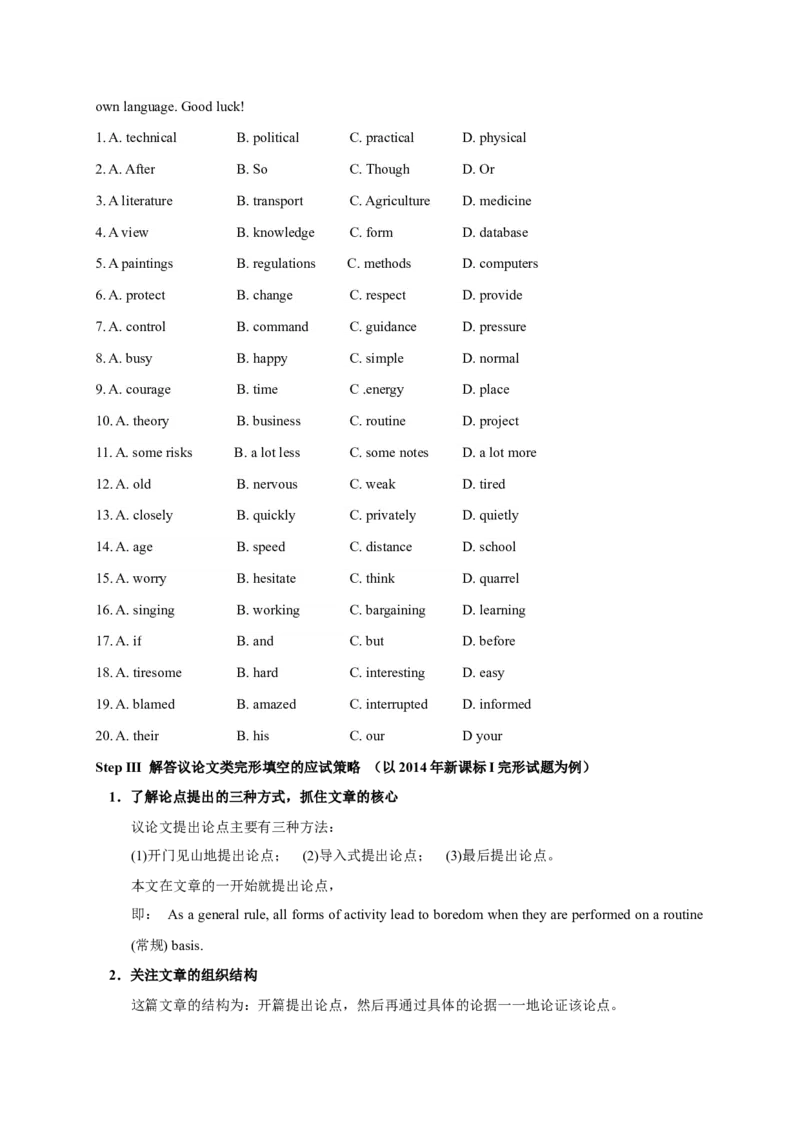
1. A. technical B. political C. practical D. physical
2. A. After B. So C. Though D. Or
3. A literature B. transport C. Agriculture D. medicine
4. A view B. knowledge C. form D. database
5. A paintings B. regulations C. methods D. computers
6. A. protect B. change C. respect D. provide
7. A. control B. command C. guidance D. pressure
8. A. busy B. happy C. simple D. normal
9. A. courage B. time C .energy D. place
10. A. theory B. business C. routine D. project
11. A. some risks B. a lot less C. some notes D. a lot more
12. A. old B. nervous C. weak D. tired
13. A. closely B. quickly C. privately D. quietly
14. A. age B. speed C. distance D. school
15. A. worry B. hesitate C. think D. quarrel
16. A. singing B. working C. bargaining D. learning
17. A. if B. and C. but D. before
18. A. tiresome B. hard C. interesting D. easy
19. A. blamed B. amazed C. interrupted D. informed
20. A. their B. his C. our D your
Step III 解答议论文类完形填空的应试策略 (以2014年新课标I完形试题为例)
1.了解论点提出的三种方式,抓住文章的核心
议论文提出论点主要有三种方法:
(1)开门见山地提出论点; (2)导入式提出论点; (3)最后提出论点。
本文在文章的一开始就提出论点,
即: As a general rule, all forms of activity lead to boredom when they are performed on a routine
(常规) basis.
2.关注文章的组织结构
这篇文章的结构为:开篇提出论点,然后再通过具体的论据一一地论证该论点。3.体会文章中的语言感情色彩
作者在写作时往往赋予了文章一定的感情色彩,语气和感情色彩的和谐会贯穿于全文。对语
言感情色彩和谐性的掌握会为理解全文提供帮助。本文中 boredom, wear off, unfinished, complain,
boring 等消极词汇的大量运用,表示出作者对于那些不能善始善终 忘却初心的人们的一种批评态
度。
Step IV 解答议论文类完形填空的3个解题步骤
第一步:通读全文,从首(尾)句入手,抓住中心
议论文的写作思路一般为:提出问题——分析问题——解决问题。因此文章的第一、二句话通
常为文章的主题句,而最后通常为文章的结论。
(1)该篇文章是“论点——论据”结构,考生必须利用文章的首句推测出文章的中心,找到理
解文章的正确方向。利用这一方法可以得出这篇文章的大意:在人的一生中会有很多兴趣与爱好,
但是当这些兴趣和爱好成为常规,即经常要做的事情时,人们很快就会失去对它们的兴趣,转而寻
找新的兴趣与爱好了。
作者在本文中通过孩子厌倦玩具、少年厌倦高中、青年厌倦大学、成人厌倦开车、老年人厌倦
退休后的生活的例子告诉了我们这个道理。
(2)本文是一篇关于学习新语言的议论文。首先要搞清楚学习的原因;然后谈到定期学习更容易
成功,贵在坚持,不要怕犯错误,多努力,一定会取得进步的
第二步:综合考虑,逐项填空
在解题的过程中,首先要把握作者的观点和态度。议论文往往体现作者对某一事物的鲜明观点,
而作者的观点即文章的论点。另外,还要注意段与段之间的逻辑关系。议论文的每一段往往就是一
个论据,而论据间又是互为补充、互为联系的。本文的逻辑关联词如:as a matter of fact, however,
but等。
第三步:复核全文,整体把握
通读全文,检验是否每条论据都合情合理,都能强有力地支撑论点.
step V 随堂演练
(一)
Less is more. This is why we say: reduce things by half instead of doubling them, get rid of junk
instead of piling it up, slow down instead of 1 . Apply these 2 in your everyday life, and you will
find yourself being on your journey to simplification.
When you concentrate on one task, you will find you have 3 that you didn’t even know you had.
Just imagine: you are at a fair and you have to 4 two heavy pigs over 100 yards. If you keep 5 oneand then the other, it will take a long time, 6 one of them will keep slipping out of your hand and 7 .
But if you tie one pig in a place, pick up the other, gather all your 8 , make a dash for the finish line,
pause for a moment, run back, get 9 one, and with great determination, carry the second pig to the finish
line, and then you can be sure of success.
The stress of work is now 10 almost in all occupations. In the modern nuclear family, the stress that
formerly would have been 11 among all the relatives is now 12 on the individual partner.
If you have the feeling that 24 hours per day is not 13 , then it’s not becausse the day has too
14__ hours, but because you have too many activities. A simple fact is that 15 people tend to forget. The
16 is equally simple: refuse to accept so many assignments.
“I can handle stress” is regarded as a positive statement. People who can handle stress are given more—
until one day they 17 . Pay careful attention to the signs that tell you that you are under more stress than
you can 18 . These signs come from various 19 of life. You become ill, or your work efficiency
20 .
If you have any of these symptoms, change your life goals and decrease your tolerance of stress. Say
openly, “I can’t manage that.”
1. A. bringing up B. taking up C. giving up D. speeding up
2. A. principles B. advantages C. operations D. relations
3. A. appetite B. gift C. energy D. excuse
4. A. carry B. fetch C. bring D. take
5. A. pushing B. enjoying C. grabbing D. exchanging
6. A. and B. because C. so D. but
7. A. running off B. turning off C. catching up D. lying down
8. A. labor B. strength C. power D. force
9. A. another B. others C. other D. the other
10. A. small B. true C. great D. wrong
11. A. shared B. given C. realized D. influenced
12. A. contracted B. concentrated C. constructed D. congratulated
13. A. enough B. short C. important D. proper
14. A. little B. much C. few D. many
15. A. overslept B. overdeveloped C. overcrowded D. overloaded
16. A. answer B. destination C. problem D. solution17. A. break up B. break down C. break out D. break off
18. A. put with B. deal with C. suffer from D. do with
19. A. qualities B. ways C. areas D. stages
20. A. is improved B. advances C. inecreases D. is affected
(二)
The new science of spending comes to a surprising conclusion. How we use our money
may___1____ as much or more than how much we’ve got it.Money spent on experiences, rather than
material goods, ___2____ more happiness.Imagine that you wake up tomorrow morning to ___3___ $1
million under your bed .What would you do___4___that cash?
The money will probably make you think about one thing ___5___ all else— yourself. A large
amount of research reveals that money___6___our selfish sides. We will___7____much on what that
money can do for us alone. Perhaps you are imagining buying a faster car, or even a new house.
But studies show that___8____goods often fail to deliver ___9____ happiness. Fortunately, our
ongoing research ___10____many ways to get more happiness from every dollar you spend. Changing
how you spend money can increase your happiness.
But making these___11____ needs to challenge some of our ideas of spending. It’s hard not to
___12____buying a house as a wise investment. But research shows it brings very little happiness. A
study in the United States found that homeowners, on average, were no happier than___13____.
So, working hard to save money for a house might not be such a good idea ___14____ it means
spending less time with your families and friends. And dozens of studies show that people get more
happiness from buying ___15____ than material things. Experimental purchases—such as trips, concerts
and special meals –are more ___16____connected to our sense of self.
And experiences come with one more___17____. They tend to bring us___18____to other people,
but more often, material things are enjoyed ___19____.So social contacts are important to ___20____
mental and physical health.
1. A. present B. matter C. appear D. equal
2. A. leads to B. breaks out C. holds on D. brings along
3. A. keep B. own C. discover D. count
4. A. to B. with C. about D. for
5. A. above B. below C. before D. after
6. A. shows B. explains C. proves D. designs7. A. depend B. concentrate C. take D. look
8. A. mental B. material C. beautiful D. clever
9. A. outgoing B. lasting C. willing D. exciting
10. A. invites B. offers C. prefers D. follows
11. A. changes B. plans C. decisions D. mistakes
12. A. know B. view C. dream D. judge
13. A. buyers B. sellers C. builders D. renters
14. A. if B. how C. unless D. though
15. A. houses B. cars C. experiences D. health
16. A. clearly B. hardly C. generally D. deeply
17. A. advantage B. conclusion C. purpose D. identity
18. A. familiar B. close C. proper D. native
19. A. completely B. worldwide C. secretly D. alone
20. A. gain B. damage C. improve D. Build
答案 讲解部分: ADCBA DBCBD ACBBD AADCB
CDABC DCABC BABAA DBDBA
随堂练习:(一) DACAC BABDC ABACD DBBCD
(二) BDCBA ABBBB ABDAC DABDC