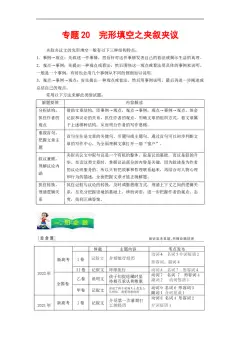
考向 34 完形填空之夹叙夹议
文体分析
一般说来,“夹叙夹议”中的“叙”常见的有三种情况:记叙性叙述、描写性叙述和议论性叙述。记叙性
叙述带有很强的叙事性。描写性叙述有浓厚的描写色彩。议论性叙述往往由几个事例构成,常采用排比的句式,
酣畅淋漓,大气磅礴,表达出飞扬的激情和深邃的思想,极具感染力。这种“叙”难说是叙还是议,实际上是
理性化的叙述,叙议一体,渗透了作者的思想与情感。这三种叙述方法,记叙性叙述要把事件的过程写清楚,
适合举一个事例时使用;描写性叙述要有对人物和情节的想像再造,适合对一个场景或情境的描述;议论性叙
述要选择几个相关的事例,具有概括性,适合列举一组典型事例时使用。
“议”是“夹叙夹议”语段的核心、灵魂,是事例叙述的意义之所在。“议”,有四种常见的议论方式。
(1)分析性议论。这是一种最常见的议论形式,是对叙述的事例加以分析,揭示事例的内涵,阐释事例的
意义,透析事例的实质,使读者能够悟道明理。
(2)感悟性议论。这种议论在叙述事例之后生发开去,着重表达作者的感想和领悟。
(3)联想性议论。由事例引发联想,由此及彼,联想到过去、现实、未来,联想到包含着类似道理的事例,
表达出作者对客观世界的一种认知。
(4)对比性议论。先是对所叙述的事例阐述、挖掘,然后再举出事例与之比较分析,找出二者的相同点或
不同点,通过对比,孰优孰劣,褒贬分明。
题型分析
一、题型解读
在夹叙夹议形式的完形填空中,作者首先叙述一件事,然后就此事提出自己的见解或由此事引出一个深刻的
社会主题。夹叙夹议类型的完形填空常见的有以下三种形式:
1.先叙述最后得出结论
首先作者讲述一个事件,并且利用了主要的篇幅讲述整个事件的发生、发展、高潮、结局,然后作者就此
展开议论,或者阐述一个深刻的社会热点,或者自己对生活的感悟等。
2.先议论再叙述
这也是我们平时见得比较多的完形填空类型。文章首先提出一个深刻的社会话题,或者提出一个人生哲理,
然后通过一个事件来印证这个深刻的道理,让人们在具体的事例中体会作者的观点。
3.叙述议论多方结合
这一类文章包括“议论+叙述+议论”型、“叙述+议论+叙述+议论”型。这两种模式都可以概括为多层
叙述与议论。也就是针对每一部分论点用事例说明,然后再提出论点再进行论证,或者采用叙述,然后议论的
形式。二、解答技巧
夹叙夹议型文章的思路跳跃性强,按照一般的命题要求,文章的首句或者是一个完整的富有哲理的句子,这个
句子不容忽视,往往是全文的关键句,甚至是文章的主题;或者是一小段叙述文,作者下文要对此展开议论。夹叙
夹议文的主题明确,那就是告诉读者一个道理。因此,正确理解首句和开头段落以及它们在文章中的作用是非常重
要的。
夹叙夹议型完形填空是记叙和议论在文中交错运用,这样,不但可以大大充实文章的内容,而且能增强文章的
说服力,从而既易于读者理解,又引发读者思考。只要抓住文章的线索,弄明白文章的逻辑关系,就能确定比较明确
的、直接的答案。
夹叙夹议型文章的基本结构模式是:①用一段概括性的话引入要叙述的经历(话题);②叙述先前的经历及
其感悟或发现;③叙述接下来的经历及其感悟或发现;④作出总结或结论。文章通常使用对比、附加、强调、
让步、举例、结论、顺序和对照等手段。因此考生应注意观察文章的结构特点,根据故事情节的发展模式,确定恰
当的衔接词。常见的语篇标志词有:表示逻辑关系的,如thus,therefore,so,though等;表示改变话题的,如by the
way等;表示递进关系的,如besides,further,furthermore,what is more等。
【典例示例】 (2019·全国卷I)
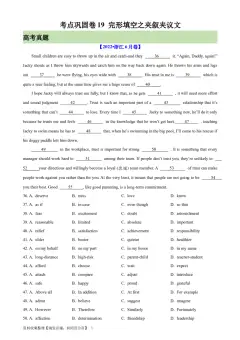
Every year about 40,000 people attempt to climb Kilimanjaro, the highest mountain in Africa. They 41 with
them lots of waste. The 42 might damage the beauty of the place. The glaciers(冰川)are disappearing, changing
the 43 of Kilimanjaro.
Hearing these stories, I’m 44 about the place — other destinations are described as “purer” natural
experiences.
However, I soon 45 that much has changed since the days of disturbing reports of 46 among tons of
rubbish. I find a 47 mountain, with toilets at camps and along the paths. The environmental challenges are 48
but the efforts made by the Tanzania National Park Authority seem to be 49 .
The best of a Kilimanjaro 50 , in my opinion, isn’t reaching the top. Mountains are 51 as spiritual places
by many cultures. This 52 is especially evident on Kilimanjaro as 53 go through five ecosystems(生态系
统)in the space of a few kilometers. At the base is a rainforest. It ends abruptly at 3, 000 meters, 54 lands of low
growing plants. Further up, the weather 55 — low clouds envelope the mountainsides, which are covered with
thick grass. I 56 twelve shades of green from where I stand. Above 4, 000 meters is the highland 57 : gravel
(砾石), stones and rocks. 58 you climb into an arctic-like zone with 59 snow and the glaciers that may
soon disappear.
Does Kilimanjaro 60 its reputation as a crowded mountain with lines of tourists ruining the atmosphere of
peace?I found the opposite to be true.
41. A. keep B. mix C. connect D. bring
42. A. stories B. buildings C. crowds D. reporters
43. A. position B. age C. face D. name
44. A. silent B. skeptical C. serious D. crazy
45. A. discover B. argue C. decide D. advocate46. A. equipment B. grass C. camps D. stones
47. A. remote B. quiet C. all D. clean
48. A. new B. special C. significant D. necessary
49. A. paying off B. spreading out C. blowing up D. fading away
50. A. atmosphere B. experience C. experiment D. sight
51. A. studied B. observed C. explored D. regarded
52. A. view B. quality C. reason D. purpose
53. A. scientists B. climbers C. locals D. officials
54. A. holding on to B. going back to C. living up to D. giving way to
55. A. changes B. clears C. improves D. permits
56. A. match B. imagine C. count D. add
57. A. village B. desert C. road D. lake
58. A. Obviously B. Easily C. Consequently D. Finally
59. A. permanent B. little C. fresh D. artificial
60. A. enjoy B. deserve C. save D. acquire
【文章大意】文章讲述了乞力马扎罗山的特征以及与之相关的环境问题。
41.D
【解析】A. keep保持;B. mix混合;C. connect联系;D. bring带来。句意:他们带来了很多的垃圾。由“lots of
waste”可知,登山者带来了很多的垃圾。故D选项切题。
【考点】动词辨析
42.C
【解析】A. stories故事;B. buildings建筑物;C. crowds人群;D. reporters记者。句意:人群可能会破坏这个地
方的美。由“40,000”可知,这是一个庞大的群体。故C选项切题。
【考点】名词辨析
43.C
【解析】A. position位置;B. age年龄;C. face外貌,表面;D. name名字。句意:冰川正在消失,改变着乞力
马扎罗山的地貌。冰川是乞力马扎罗山的地貌之一,所以冰山融化会改变它的地貌。故C选项切题。
【考点】名词辨析
44.B
【解析】A. silent沉默的;B. skepetical怀疑的;C. serious严肃的;D. crazy疯狂的。句意:听到这些故事,我
对这个地方产生了怀疑——其他旅游地被描述为“更纯粹”的自然体验。由下文可知,作者亲自来到了乞力马
扎罗山,作者想解开这个怀疑。故B选项切题。
【考点】形容词辨析
45.A
【解析】A. discover发现;B. argue争论;C. decide决定;D. advocate提倡。句意:然而,我很快发现,自从那
些令人不安的关于营地周围有成吨的垃圾的报道出现以来,情况发生了很大的变化。由“much has changed”可知,
作者发现了很大的变化。故A选项切题。【考点】动词辨析
46.C
【解析】A. equipment装备;B. grass草;C. camps营地;D. stone石头。句意:我很快发现,自从那些令人不安
的关于营地周围有成吨的垃圾的报道出现以来,情况发生了很大的变化。由下文“at camps”可知,本句属于原词
再现。故C选项切题。
【考点】名词辨析
47.D
【解析】A. remote遥远的;B. quiet安静的;C. tall高的;D. clean干净的。句意:我发现了一座干净的山,营
地里和路边都有厕所。由“with tolilet at camps and along the paths”可知,营地里和路边都有厕所,所以这是一座
干净的山。故D选项切题。
【考点】形容词辨析
48.C
【解析】A. new新的;B. special特殊的;C. significant重大的;D. necessary必要的。句意:环境挑战是巨大的,
但坦桑尼亚国家公园管理局所做的努力似乎正在得到回报。根据前文可知,很多的登山者来到乞力马扎罗山以
及冰川可能会消失,这对于环境来说是一个巨大的挑战。故C选项切题。
【考点】形容词辨析
49.A
【解析】A. paying off还清,报偿;B. spreading out伸展;C. blowing up爆炸;D. fading away逐渐消退。句意:
环境挑战是巨大的,但坦桑尼亚国家公园管理局所做的努力似乎正在得到回报。由“but”可知,前后表示转折关
系,说明坦桑尼亚国家公园管理局所做的努力似乎正在得到回报。故A选项切题。
【考点】动词短语辨析
50.B
【解析】A. atmosphere氛围;B. experience经历;C. experiment实验;D. sight视力。句意:在我看来,来乞力
马扎罗最好的经历并不是到达顶峰。登山就是人生的一种经历。故B选项切题。
【考点】名词辨析
51.D
【解析】A. studied学习;B. observed观察;C. explored探索;D. regarded认为。句意:山被许多文化视为精神
场所。由“spiritual space”可知,山被许多文化视为精神场所。be regarded as被视为……。故D选项切题。
【考点】动词辨析
52.A
【解析】A. view景色;B. quality质量;C. reason原因;D. purpose目的。句意:在乞力马扎罗,当登山者在几
公里的空间里穿越五个生态系统时,景色差异尤为明显。有五个生态系统,所以景色也是明显的不同。故A选
项切题。
【考点】名词辨析
53.B
【解析】A. scientists科学家;B. climbers登山者;C. locals当地人;D. officials官员。句意:在乞力马扎罗,当
登山者在几公里的空间里穿越五个生态系统时,景色尤为明显。故A选项切题。来到乞力马扎罗都是为了登山,
也只有登山者能体验到五个生态系统。故B选项切题。【考点】名词辨析
54.D
【解析】A. holding on to抓住;B. going back to回到(原来的话题);C. living up to达到,履行;D. giving way
to向……让步。句意:热带雨林在海拔3000米处突然到了尽头,让位于大片的低矮植物。这里指热带雨林在海
拔3000米处突然到了尽头,所以海拔3000米以上就是大片的低矮植物。故D选项切题。
【考点】动词短语辨析
55.A
【解析】A. changes改变;B. clears放晴;C. improves提高;D. permits允许。句意:再往上走,天气变了——
低云笼罩着被厚厚的草覆盖的山腰。由“low clouds”可知,海拔变了,天气也是不同的,是变化的。故A选项切
题。
【考点】动词辨析
56.C
【解析】A. match匹配;B. imagine想象;C. count数;D. add增加。句意:我从站的地方数出了十二种绿色。
由“twelve shades of green”可知,作者数出了十二种绿色。故C选项切题。
【考点】动词辨析
57.B
【解析】A. village村庄;B. desert沙漠,荒地;C. road马路;D. lake湖。句意:海拔4000米以上是高山荒漠:
砾石、石头和岩石。由“grave, stones and rocks”可知,海拔4000米以上是高山荒漠。故B选项切题。
【考点】名词辨析
58.D
【解析】A. Obviously明显地;B. Easily容易地;C. Consequently结果;D. Finally最后地。句意:海拔4000米
以上是高地荒漠:砾石、石头和岩石。生态系统最顶端也是最后一个生态系统是冰川地区。故D选项切题。
【考点】副词辨析
59.A
【解析】A. permanent永久的;B. little小的;C. fresh新鲜的;D. artificial人造的。句意:很明显,你爬进了一
个类似北极的地带,那里有着永久性的积雪和可能很快消失的冰川。由“arctic-like zone”可知,这是一个类似北
极的地带,所以有永久性的积雪。故A选项切题。
【考点】形容词辨析
60.B
【解析】A. enjoy享受;B. deserve值得;C. save挽救;D. acquire获得。句意:乞力马扎罗山是一座拥挤的山,
挤满了成群的游客,破坏了宁静的气氛,它值得这样的名声吗?这里作者在质疑乞力马扎罗山是不是应该被誉
为一座挤满了破坏宁静氛围的游客的拥挤的山峰,以此在对后面的回答做好铺垫。故B选项切题。
【考点】动词辨析
【检测训练】
1
I was 11 years old standing outside in just my underwear while I watched the house that I grew up in rapidly burn to
the ground.A few minutes earlier I had been in bed when a 1 woke me up. A fire had 2 in my grandma’s room
and awakened her. 3 hearing her, my brother had jumped into 4 , running from room to room quickly
waking everyone in the house. 5 we could do anything, the fire consumed it. We all barely 6 it outside
before the flames had taken hold of every room.
I stood there 7 while the fire destroyed my books, clothes, and toys. I watched 8 while my mom
cried and my dad sighed. I wondered what was going to happen to us 9 we had lost all of our things.
As I looked around, though, I 10 something for the first time: The things that 11 aren’t things. I
saw my brother running across the swinging bridge by our house to get help. I saw my grandma and dad wrapped in each
other’s arms and my mom 12 our little dog. I realized at that moment that we were all 13 . Everything
that was 14 had survived the fire. Our life would 15 . We would survive without the “stuff” that was
16 . We would all be around to love each other for many years to come. And that was all that mattered.
I still think of that fire in the night. It helped me to become who I am today. It showed me for the very first time
what was 17 valuable in this life. It helped me to learn that the 18 we share is far more important than
the things we own.
Live your life for the things that matter, not for the things you 19 . Love your family. Love others. Let the
fire inside of you make this world a 20 place. Let your soul shine bright.
1. A. scream B. dream C. thunderstorm D. bell
2. A. turned down B. shown up C. broken out D. faded away
3. A. Without B. As C. Beyond D. Upon
4. A. water B. bed C. conclusion D. action
5. A. Until B. When C. Before D. After
6. A. put B. made C. got D. took
7. A. trembling B. twisting C. wondering D. dreaming
8. A. carelessly B. helplessly C. uselessly D. fearlessly
9. A. even though B. now that C. as if D. in case
10. A. supposed B. predicted C. remembered D. realized
11. A. matter B. weigh C. inspire D. improve
12. A. raising B. holding C. feeding D. cleaning
13. A. afraid B. alike C. alone D. alive
14. A. delicate B. essential C. beneficial D. profitable
15. A. stop B. remain C. continue D. progress
16. A. burning B. appearing C. coming D. leaving17. A. barely B. simply C. nearly D. truly
18. A. dog B. fire C. love D. luck
19. A. deserve B. reserve C. possess D. value
20. A. warmer B. cooler C. quieter D. safer
2
I was always complaining about wind or rain. Although it was nothing unusual for the arrival of wind or rain, it
caused inconvenience for me to go out, and sometimes it even created an awful atmosphere, so I 21 it strongly.
On a rainy day a meteorologist (气象学家) I met was very 22 at my great anger caused by rain that made a
little inconvenience for me.
He asked, “Have you ever seen typhoon? Do you know what would happen to the world if there were no typhoon?”
I shook my head. I had no experience of how overwhelming it was when it 23 everything away in its way.
“Well, let me tell you,” the meteorologist said. “Without it the 24 of fresh water will be more serious, for it
is a great 25 of water supply on earth. Without it, there would be a greater imbalance in the distribution of 26
. The equatorial area that receives the most sunshine on earth 27 entirely on typhoon to disperse (驱散) heat.
Without typhoon the tropics would be even 28 while the frigid zones much colder. As a result the temperate
zones (温带) would 29 from the world...”
Ignorance made me 30 . I disliked wind only because it ruffled (吹乱) my hair. I hated rain merely because I
had to carry an umbrella. But I had no idea at all that typhoon—something much more violent, something a thousand
times more 31 than wind or rain—was a(n) 32 to the existence of mankind.
33 no road on earth goes all the way on level ground, there’s no person in the world who can do whatever he
pleases. Wrong as it is for people to guard against typhoon, it is advisable for a man to stop to think for a moment before
he complains. “ 34 typhoon disappeared all together? What would the world become then?” The 35 will
keep him calm and lead him closer to truth—he will be better aware of the world he lives in.
21. A. blamed B. refused C. fought D. punished
22. A. excited B. puzzled C. delighted D. encouraged
23. A. frightened B. washed C. swept D. swung
24. A. supply B. shortage C. waste D. amount
25. A. power B. resource C. source D. strength
26. A. time B. wealth C. energy D. warmth
27. A. moves B. relies C. keeps D. holds
28. A. better B. cooler C. hotter D. warmer
29. A. remove B. escape C. move D. disappear30. A. shortsighted B. anxious C. frightened D. worried
31. A. frightening B. appealing C. disturbing D. exciting
32. A. success B. advantage C. lead D. must
33. A. As B. Since C. While D. When
34. A. What about B. How come C. Even if D. What if
35. A. answers B. theories C. complaints D. phenomena
3
Having repeatedly heard “good manners”, do you really understand what the basic elements of good manners are?
Certainly, a strong sense of justice is one—(from this angle) politeness is often 36 but a highly developed sense
of fair play. A friend of mine once told me of him 37 along a one-lane dirt road. 38 was another car that
produced clouds of choking 39 , and it was a long way to the nearest highway. Suddenly, at a 40 place,
the car in front pulled off the road. 41 that its owner might have engine trouble, my friend stopped and asked if
anything was wrong. “ 42 ”, said the other driver, “but you’ve tolerated my dust this far; I’ll 43 yours the
rest of the way.”
Another element of politeness is empathy, a (an) 44 that enables a person to see into the mind or heart of
someone else, to 45 the pain or suffering there and to do something to minimize it. A man 46 alone in a
restaurant was trying to unscrew (拧开) the cap of a beer bottle. 47 he couldn’t do it because of badly injured
48 . He turned to a young kid for help. The kid took the bottle. 49 and loosened the cap without difficulty.
Then he 50 it again. Tuning back to the man, he 51 to make great efforts to open the bottle without
success 52 he took it into the kitchen and returned shortly, saying that he had 53 to loosen it—but only
with a pair of pliers (钳子).
Last but not least, the ability to treat all people 54 is also an element of politeness, regardless of status or
importance. 55 when you have doubts about some people, act as if they are worthy of your best manners. Are
you astonished to find out the basic factors of “politeness”?
36. A. nothing B. anything C. something D. everything
37. A. walking B. running C. riding D. driving
38. A. After B. Before C. Behind D. Ahead
39. A. ash B. smoke C. dust D. steam
40. A. cleaner B. wider C. flatter D. straighter
41. A. Consuming B. Guessing C. Finding D. Confirming
42. A. Not necessarily B. Not really C. No problem D. No kidding43. A. put up with B. do away with C. catch up with D. go on with
44. A. technique B. personality C. behavior D. quality
45. A. reduce B. accept C. understand D. remove
46. A. working B. begging C. dining D. performing
47. A. However B. Otherwise C. Therefore D. Meanwhile
48. A. legs B. heart C. fingers D. mouth
49. A. sat down B. turned around C. took a look D. thought twice
50. A. watched B. checked C. tightened D. covered
51. A. seemed B. managed C. pretended D. happened
52. A. Luckily B. Finally C. Happily D. Sadly
53. A. tried B. failed C. managed D. meant
54. A. alike B. nicely C. warmly D. happily
55. A. Ever B. Specially C. Especially D. Even
4
My first year living in Los Angeles, I was a birthday-party clown. I struggled a lot with my identity because, though
I viewed myself as a 56 everyone in my life associated me with this 57 day job. To make matters more
confusing, being a clown is 58 an identity-masking job.
One night, someone said: .“Tomorrow you’re going to be Batman.” At the time I had a giant mustache. I knew: a
clown with a mustache—that’s a huge red 59 for parents. But I hadn’t wanted to 60 my physical
appearance for that job.
The next day, I went to the party and I had to leave my car 61 far enough away so that the kids couldn’t see
Batman 62 in a PT Cruiser(PT漫步车). I popped in through the front door : “Surprise! Batman’s here!” All the
kids 63 . But they didn’t want to see Batman sweaty and panting from a brisk jog, so I just kept 64 . I
started to regret my choice to not 65 . I’m thinking, “Gosh, this party is not going to go well.” I’m so
embarrassed. I wanted to 66 and run back to my Bat mobile. But then the laughter kind of merges and changes
into cheering and applause.
Then I was still about 20 yards away from the party 67 I just started running and my cape was billowing(鼓
起) in the 68 , and—mustache or not—in that moment, I was Batman.
I saw the birthday boy with his dad, and the 69 was laughing, saying, “You see, son. I told you Batman had a
mustache.”Just then I saw the 70 birthday cake with a frosting Batman drawn on it, and the Batman has a
mustache. I just stared at it in 71 . It looked just like my mustache.
Those kids were at the perfect age where they still believed in miracles and heroes and that the world is an 72good place—all the stuff that’s so difficult for us to keep believing 73 we grow up in a cold and complicated
world.
That year, I struggled a lot with my 74 ; was I a filmmaker, or was I a clown? But that day, at least, there was
75 in my mind what I was. I may not have been the hero that they expected. But that day, I was the hero that they
needed.
56. A. editor B. director C. filmmaker D. conductor
57. A. luxurious B. ambitious C. ambiguous D. ridiculous
58. A. himself B. herself C. itself D. themselves
59. A. banner B. flag C. scarf D. shirt
60. A. alter B. protect C. lose D. introduce
61. A. left B. parked C. dropped D. abandoned
62. A. pulling up B. pulling out C. pulling off D. putting up
63. A. went hungry B. went red C. went out D. went crazy
64. A. crying B. running C. walking D. smiling
65. A. shave B. shake C. wave D. take
66. A. turn down B. turn off C. turn out D. turn around
67. A. then B. when C. where D. while
68. A. gale B. rain C. sun D. wind
69. A. dad B. son C. author D. passerby
70. A. tiny B. small C. huge D. middle
71. A. belief B. disbelief C. trust D. faith
72. A. unnaturally B. inherently C. impossibly D. unnecessarily
73. A. because B. since C. for D. as
74. A. identity B. background C. position D. post
75. A. no response B. no way C. no doubt D. no comment
5
It’s funny how a small corner of the earth can have outsized relevance in life. For me, it’s a swing set on a
playground.
I decided to take my six year old son Joe on a weekend trip to the University of Virginia, my alma mater (母校). I
planned out every detail 76 and wanted my son to become familiar with something dear to me, 77 he did
not fully understand. I took Joe to my favorite breakfast spot. I 78 him my dorm and fraternity (兄弟会) house,
and then the bar where I’d worked in college. We even went to a lacrosse (长曲棍球) game. All of this registered withmy son, but without the 79 I expected. 80 , we were running out of things to do. I asked Joe what he
wanted to see. I would never 81 his response: “I would not mind finding a swing set.” That’s when it hit me. For
a guy who thought he 82 every inch of his college town, the question caught me flat-footed: I had no idea where
to look. 83 , I remembered the Venable Elementary School, something I’d 84 countless times but never
really noticed. We parked in the lot, empty on a Saturday, and I 85 my son and watched him delightedly swing
back and forth. It was the joy I had sought for him on my terms, 86 he only found on his.
What did I learn on that trip? First, travel is great fun and often leads to 87 . But our world will always
assure us greater happiness which is just around the corner. Second, do not rely too much on your 88 . Do your
best but stay 89 , and always remember what John Lennon said: Life is what happens to you while you are busy
making other plans. Third, there is always a new way to 90 things, no matter how much you think you know. I’m
sure I would have missed the lesson if Joe hadn’t made his old man stop at the swings in Charlottesville. For that, I will
always be grateful.
76. A. in total B. in fact C. in advance D. in order
77. A. even if B. as if C. as to D. as though
78. A. gave B. showed C. offered D. invited
79. A. interest B. response C. impression D. effect
80. A. Worse B. Still C. Again D. However
81. A. ignored B. understood C. missed D. forgot
82. A. analyzed B. stepped C. knew D. loved
83. A. Hardly B. Eventually C. Undoubtedly D. Surprisingly
84. A. passed B. saw C. visited D. approached
85. A. pushed B. encouraged C. amused D. stared
86. A. and B. even C. but D. so
87. A. joy B. happiness C. excitement D. surprise
88. A. schedules B. others C. plans D. details
89. A. relaxed B. independent C. grateful D. flexible
90. A. look at B. look through C. look for D. look into
6
Fear Can Be Positive
A small village by the sea depended on 91 to survive. Each year the villagers had to go farther and farther
from shore to catch enough fish to 92 the population.
But as the villagers went farther away, they 93 a problem. Their usual 94 was to put the fish theycaught in big tanks to keep them 95 until they returned home. But the fish grew inactive in the tanks, and many
96 before the boat could reach shore again.
After much 97 , one villager 98 a solution. On their next fishing trip, they caught a 99 shark
and placed it in the tank along with the fish. The shark ate only a few fish, but the rest swam 100 around the tank
trying to keep away from the shark—and made it to shore fresh and healthy for the villages.
Sometimes a little fear is what we need to stay active and 101 . People usually lose 102 and focus
when they begin to coast and 103 best when they have a little anxiety or fear.
A little fear can be 104 . Fear can hold a lot of people back and stop them from living life to the fullest. I
understand that feeling of being afraid. 105 , there is only one thing worse than 106 , and that is being
afraid to begin. There are no hopeless situations; there are only people who have grown 107 about them.
Dale Carnegie once said, “Inaction 108 to doubt and fear. Action breeds 109 and courage. If you
want to 110 fear, do not sit home and think about it. Go out and get busy. ”
91. A. hunting B. fishing C. farming D. planting
92. A. expand B. protect C. attract D. feed
93. A. encountered B. designed C. explained D. answered
94. A. route B. idea C. practice D. reflection
95. A. fresh B. precious C. nutritious D. unique
96. A. fled B. jumped C. died D. recovered
97. A. fight B. thought C. quarrel D. consultation
98. A. looked for B. long for C. make up D. hit upon
99. A. fierce B. small C. big D. rare
100. A. quietly B. wildly C. happily D. slowly
101. A. alive B. cheerful C. strong D. normal
102. A. strength B. decision C. consideration D. concentration
103. A. create B. experiment C. perform D. respond
104. A. healthy B. desperate C. horrible D. ridiculous
105. A. Lastly B. Therefore C. Instead D. However
106. A. starting B. quitting C. joining D. continuing
107. A. hopeless B. sensitive C. hopeful D. optimistic
108. A. appeals B. sticks C. objects D. leads
109. A. confusion B. disappointment C. confidence D. cooperation
110. A. acquire B. limit C. conquer D. advocate