考点 24 阅读理解议论文和其它文体(核心考点精
讲精练)
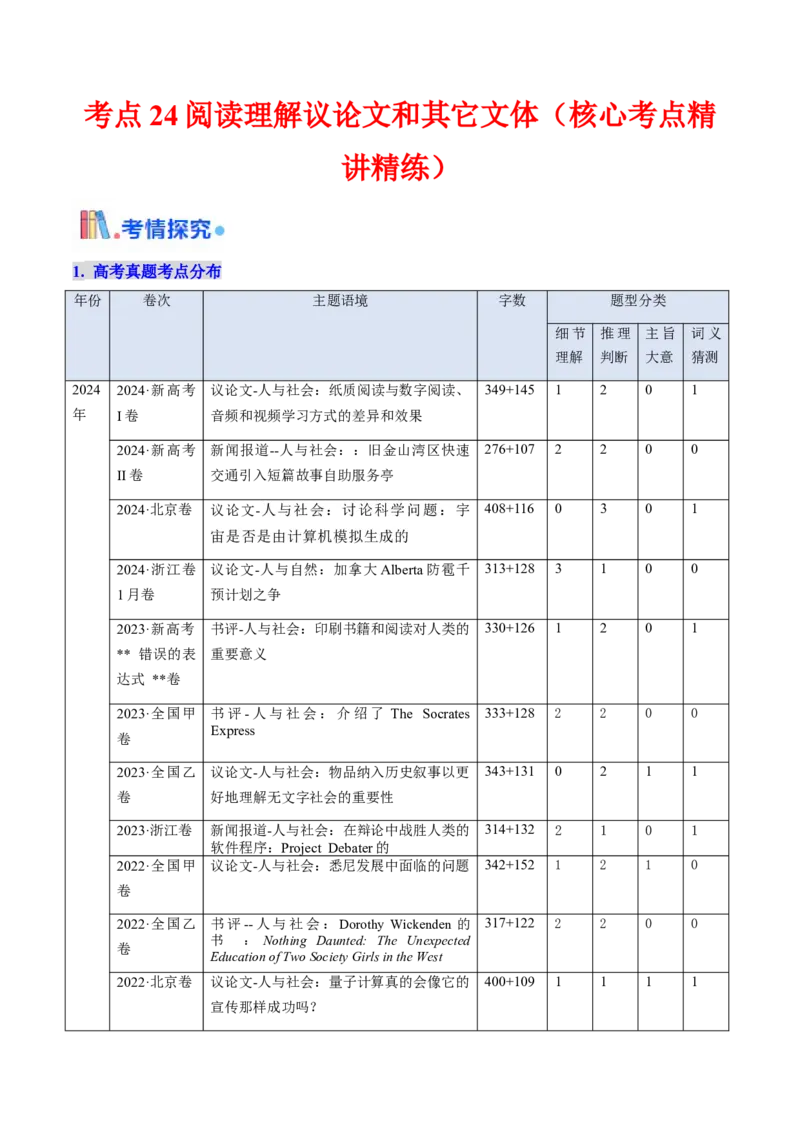
1. 高考真题考点分布
年份 卷次 主题语境 字数 题型分类
细节 推理 主旨 词义
理解 判断 大意 猜测
2024 2024·新高考 议论文-人与社会:纸质阅读与数字阅读、 349+145 1 2 0 1
年 I卷 音频和视频学习方式的差异和效果
2024·新高考 新闻报道--人与社会::旧金山湾区快速 276+107 2 2 0 0
II卷 交通引入短篇故事自助服务亭
2024·北京卷 议论文-人与社会:讨论科学问题:宇 408+116 0 3 0 1
宙是否是由计算机模拟生成的
2024·浙江卷 议论文-人与自然:加拿大Alberta防雹千 313+128 3 1 0 0
1月卷 预计划之争
2023·新高考 书评-人与社会:印刷书籍和阅读对人类的 330+126 1 2 0 1
** 错误的表 重要意义
达式 **卷
2023·全国甲 书评-人与社会:介绍了 The Socrates 333+128 2 2 0 0
Express
卷
2023·全国乙 议论文-人与社会:物品纳入历史叙事以更 343+131 0 2 1 1
卷 好地理解无文字社会的重要性
2023·浙江卷 新闻报道-人与社会:在辩论中战胜人类的 314+132 2 1 0 1
软件程序:Project Debater的
2022·全国甲 议论文-人与社会:悉尼发展中面临的问题 342+152 1 2 1 0
卷
2022·全国乙 书评--人与社会:Dorothy Wickenden 的 317+122 2 2 0 0
书 : Nothing Daunted: The Unexpected
卷
Education of Two Society Girls in the West
2022·北京卷 议论文-人与社会:量子计算真的会像它的 400+109 1 1 1 1
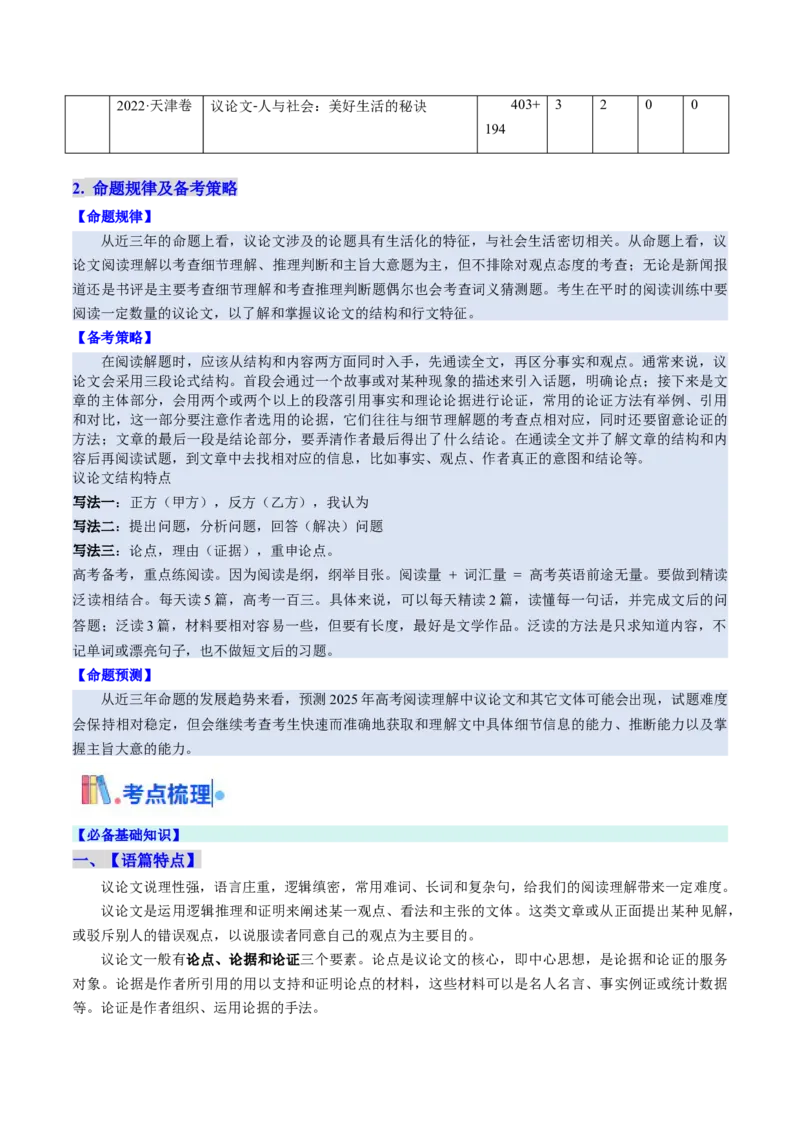
宣传那样成功吗?2022·天津卷 议论文-人与社会:美好生活的秘诀 403+ 3 2 0 0
194
2. 命题规律及备考策略
【命题规律】
从近三年的命题上看,议论文涉及的论题具有生活化的特征,与社会生活密切相关。从命题上看,议
论文阅读理解以考查细节理解、推理判断和主旨大意题为主,但不排除对观点态度的考查;无论是新闻报
道还是书评是主要考查细节理解和考查推理判断题偶尔也会考查词义猜测题。考生在平时的阅读训练中要
阅读一定数量的议论文,以了解和掌握议论文的结构和行文特征。
【备考策略】
在阅读解题时,应该从结构和内容两方面同时入手,先通读全文,再区分事实和观点。通常来说,议
论文会采用三段论式结构。首段会通过一个故事或对某种现象的描述来引入话题,明确论点;接下来是文
章的主体部分,会用两个或两个以上的段落引用事实和理论论据进行论证,常用的论证方法有举例、引用
和对比,这一部分要注意作者选用的论据,它们往往与细节理解题的考查点相对应,同时还要留意论证的
方法;文章的最后一段是结论部分,要弄清作者最后得出了什么结论。在通读全文并了解文章的结构和内
容后再阅读试题,到文章中去找相对应的信息,比如事实、观点、作者真正的意图和结论等。
议论文结构特点
写法一:正方(甲方),反方(乙方),我认为
写法二:提出问题,分析问题,回答(解决)问题
写法三:论点,理由(证据),重申论点。
高考备考,重点练阅读。因为阅读是纲,纲举目张。阅读量 + 词汇量 = 高考英语前途无量。要做到精读
泛读相结合。每天读5篇,高考一百三。具体来说,可以每天精读2篇,读懂每一句话,并完成文后的问
答题;泛读3篇,材料要相对容易一些,但要有长度,最好是文学作品。泛读的方法是只求知道内容,不
记单词或漂亮句子,也不做短文后的习题。
【命题预测】
从近三年命题的发展趋势来看,预测2025年高考阅读理解中议论文和其它文体可能会出现,试题难度
会保持相对稳定,但会继续考查考生快速而准确地获取和理解文中具体细节信息的能力、推断能力以及掌
握主旨大意的能力。
【必备基础知识】
一、【语篇特点】
议论文说理性强,语言庄重,逻辑缜密,常用难词、长词和复杂句,给我们的阅读理解带来一定难度。
议论文是运用逻辑推理和证明来阐述某一观点、看法和主张的文体。这类文章或从正面提出某种见解,
或驳斥别人的错误观点,以说服读者同意自己的观点为主要目的。
议论文一般有论点、论据和论证三个要素。论点是议论文的核心,即中心思想,是论据和论证的服务
对象。论据是作者所引用的用以支持和证明论点的材料,这些材料可以是名人名言、事实例证或统计数据
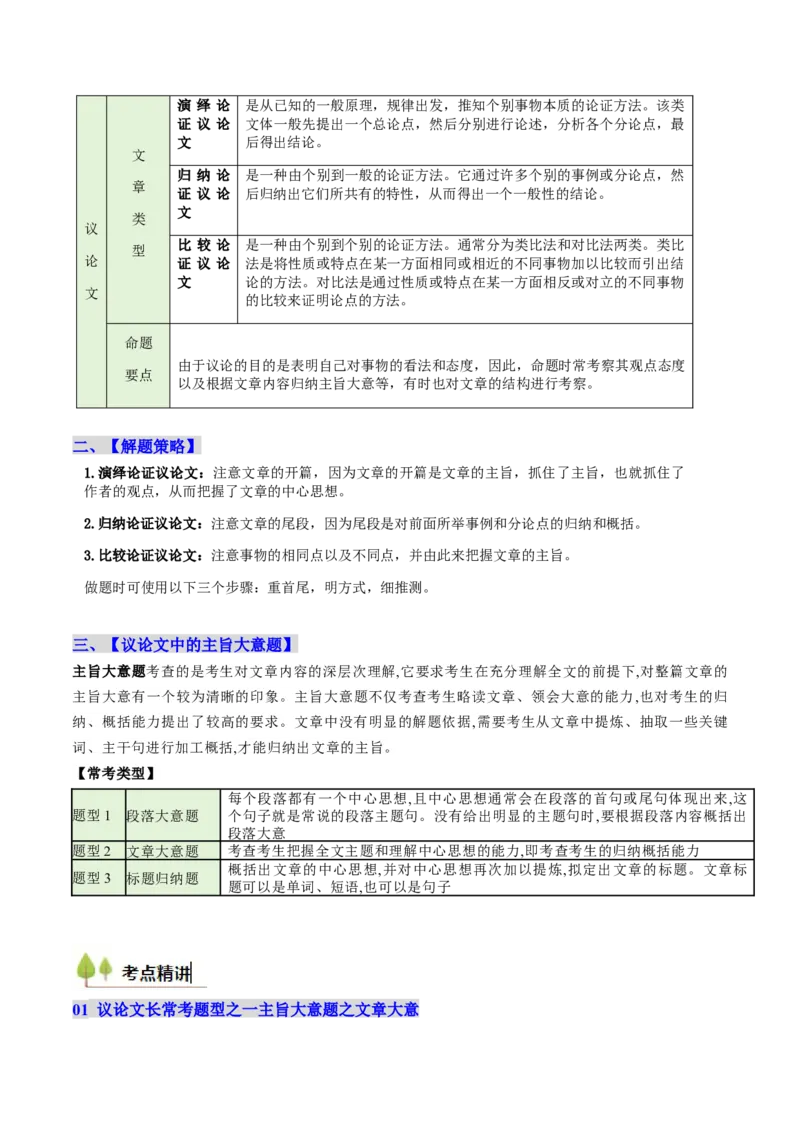
等。论证是作者组织、运用论据的手法。演 绎 论 是从已知的一般原理,规律出发,推知个别事物本质的论证方法。该类
证 议 论 文体一般先提出一个总论点,然后分别进行论述,分析各个分论点,最
文 后得出结论。
文
归 纳 论 是一种由个别到一般的论证方法。它通过许多个别的事例或分论点,然
章
证 议 论 后归纳出它们所共有的特性,从而得出一个一般性的结论。
文
类
议
比 较 论 是一种由个别到个别的论证方法。通常分为类比法和对比法两类。类比
型
论 证 议 论 法是将性质或特点在某一方面相同或相近的不同事物加以比较而引出结
文 论的方法。对比法是通过性质或特点在某一方面相反或对立的不同事物
文
的比较来证明论点的方法。
命题
由于议论的目的是表明自己对事物的看法和态度,因此,命题时常考察其观点态度
要点
以及根据文章内容归纳主旨大意等,有时也对文章的结构进行考察。
二、【解题策略】
1.演绎论证议论文:注意文章的开篇,因为文章的开篇是文章的主旨,抓住了主旨,也就抓住了
作者的观点,从而把握了文章的中心思想。
2.归纳论证议论文:注意文章的尾段,因为尾段是对前面所举事例和分论点的归纳和概括。
3.比较论证议论文:注意事物的相同点以及不同点,并由此来把握文章的主旨。
做题时可使用以下三个步骤:重首尾,明方式,细推测。
三、【议论文中的主旨大意题】
主旨大意题考查的是考生对文章内容的深层次理解,它要求考生在充分理解全文的前提下,对整篇文章的
主旨大意有一个较为清晰的印象。主旨大意题不仅考查考生略读文章、领会大意的能力,也对考生的归
纳、概括能力提出了较高的要求。文章中没有明显的解题依据,需要考生从文章中提炼、抽取一些关键
词、主干句进行加工概括,才能归纳出文章的主旨。
【常考类型】
每个段落都有一个中心思想,且中心思想通常会在段落的首句或尾句体现出来,这
题型1 段落大意题 个句子就是常说的段落主题句。没有给出明显的主题句时,要根据段落内容概括出
段落大意
题型2 文章大意题 考查考生把握全文主题和理解中心思想的能力,即考查考生的归纳概括能力
概括出文章的中心思想,并对中心思想再次加以提炼,拟定出文章的标题。文章标
题型3 标题归纳题
题可以是单词、短语,也可以是句子
01 议论文长常考题型之一主旨大意题之文章大意【常见设问形式】
①This passage chiefly deals with ________.
②What's the topic of the article?
③What is the subject discussed in the text?
④What is the main idea of the...paragraph/the passage?
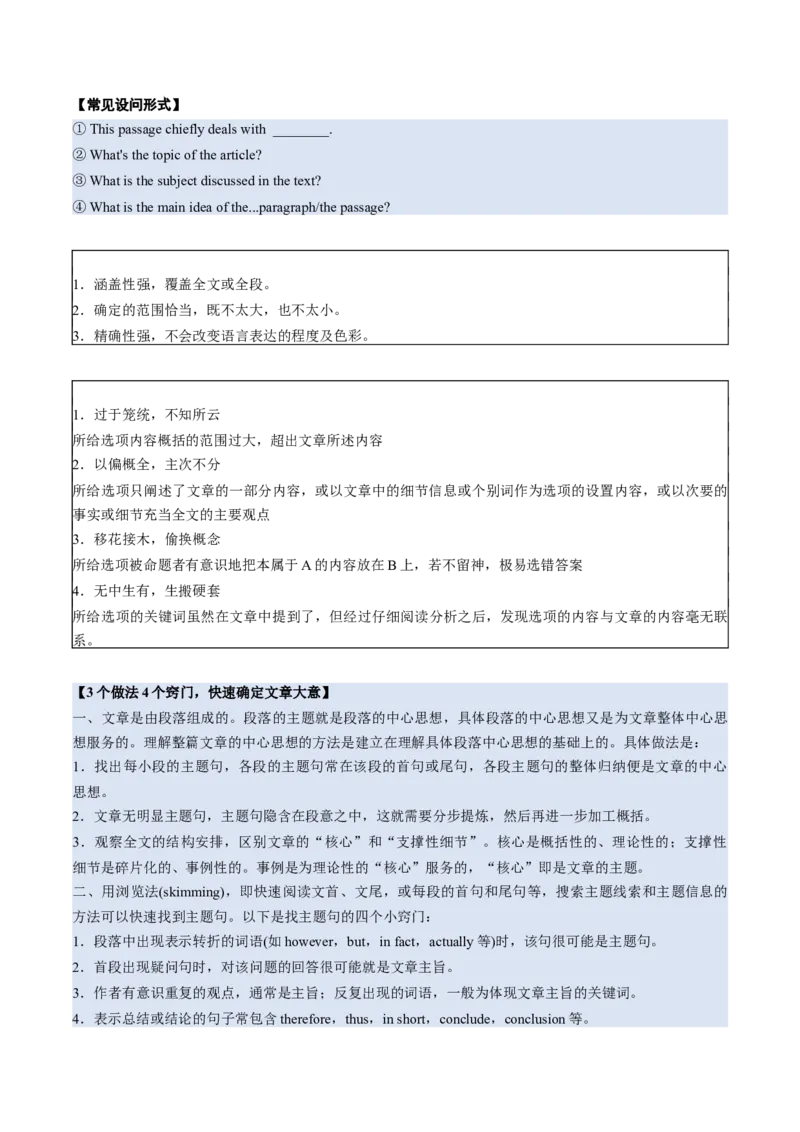
1.涵盖性强,覆盖全文或全段。
2.确定的范围恰当,既不太大,也不太小。
3.精确性强,不会改变语言表达的程度及色彩。
1.过于笼统,不知所云
所给选项内容概括的范围过大,超出文章所述内容
2.以偏概全,主次不分
所给选项只阐述了文章的一部分内容,或以文章中的细节信息或个别词作为选项的设置内容,或以次要的
事实或细节充当全文的主要观点
3.移花接木,偷换概念
所给选项被命题者有意识地把本属于A的内容放在B上,若不留神,极易选错答案
4.无中生有,生搬硬套
所给选项的关键词虽然在文章中提到了,但经过仔细阅读分析之后,发现选项的内容与文章的内容毫无联
系。
【3个做法4个窍门,快速确定文章大意】
一、文章是由段落组成的。段落的主题就是段落的中心思想,具体段落的中心思想又是为文章整体中心思
想服务的。理解整篇文章的中心思想的方法是建立在理解具体段落中心思想的基础上的。具体做法是:
1.找出每小段的主题句,各段的主题句常在该段的首句或尾句,各段主题句的整体归纳便是文章的中心
思想。
2.文章无明显主题句,主题句隐含在段意之中,这就需要分步提炼,然后再进一步加工概括。
3.观察全文的结构安排,区别文章的“核心”和“支撑性细节”。核心是概括性的、理论性的;支撑性
细节是碎片化的、事例性的。事例是为理论性的“核心”服务的,“核心”即是文章的主题。
二、用浏览法(skimming),即快速阅读文首、文尾,或每段的首句和尾句等,搜索主题线索和主题信息的
方法可以快速找到主题句。以下是找主题句的四个小窍门:
1.段落中出现表示转折的词语(如however,but,in fact,actually等)时,该句很可能是主题句。
2.首段出现疑问句时,对该问题的回答很可能就是文章主旨。
3.作者有意识重复的观点,通常是主旨;反复出现的词语,一般为体现文章主旨的关键词。
4.表示总结或结论的句子常包含therefore,thus,in short,conclude,conclusion等。(2023 年 1 月·浙江高考·B 篇)Live with roommates? Have friends and family around you? Chances are that if
you’re looking to live a more sustainable lifestyle, not everyone around you will be ready to jump on that
bandwagon.
I experienced this when I started switching to a zero waste lifestyle five years ago, as I was living with my parents,
and I continue to experience this with my husband, as he is not completely zero waste like me.I’ve learned a few
things along the way though, which I hope you’ll find encouraging if you’re doing your best to figure out how you
can make the change in a not-always-supportive household.
Zero waste was a radical lifestyle movement a few years back.I remember showing my parents a video of Bea
Johnson, sharing how cool I thought it would be to buy groceries with jars, and have so little trash! A few days
later, I came back with my first jars of zero waste groceries, and my dad commented on how silly it was for me to
carry jars everywhere.It came off as a bit discouraging.
Yet as the months of reducing waste continued, I did what I could that was within my own reach.I had my own
bedroom, so I worked on removing things I didn’t need.Since I had my own toiletries (洗漱用品), I was able to
start personalising my routine to be more sustainable.I also offered to cook every so often, so I portioned out a bit
of the cupboard for my own zero waste groceries.Perhaps your household won’t entirely make the switch, but you
may have some control over your own personal spaces to make the changes you desire.
As you make your lifestyle changes, you may find yourself wanting to speak up for yourself if others comment on
what you’re doing, which can turn itself into a whole household debate.If you have individuals who are not on
board, your words probably won’t do much and can often leave you feeling more discouraged.
So here is my advice: Lead by action.
27.What is the text mainly about?
A.How to get on well with other family members.
B.How to have one’s own personal space at home.
C.How to live a zero waste lifestyle in a household.
D.How to control the budget when buying groceries.
(2024·陕西·模拟预测)You may feel like a master multitask er as you drink your morning coffee, catch
up on email and tune into a conference call. But did you know for most people, in most situations, multitasking
makes us less efficient and more likely to make a mistake.
This might not be as apparent when we’re doing simple and routine tasks, like listening to music while
walking, or folding laundry while watching TV. But when the stakes are higher and the tasks are more complex,
trying to multitask can negatively impact our lives — or even be dangerous.
So-called multitasking divides our attention. It makes it harder for us to give our full attention to one thing.
For example, attempting to complete additional tasks during a driving simulation led to poorer driving
performance. It can also affect our ability to learn, because in order to learn, we need to be able to focus. Dr. Kubu,a neuropsychologist, says, “If we’re constantly attempting to multitask, we don’t practice tuning out the rest of the
word to engage in deeper processing and learning.” Another pitfall (缺陷) is that trying to do too much at once
makes it harder to be mindful and truly present in the moment — and mindfulness comes with a plethora (过量) of
benefits for our minds and our bodies. In fact, many therapies based on mindfulness can even help patients
suffering from depression, anxiety and other conditions.
Choosing to focus on one task at a time can benefit many aspects of our life. Take surgeons for example.
“People assume a surgeon’s skill is primarily in the precision and steadiness of their hands. While there’s some
truth to that, the true gift of a surgeon is the ability to single-mindedly focus on one person and complete a series of
task over the course of many hours.” Dr. Kubu explains. But surgeons aren’t necessarily born with this ability to
monotask. Rather, they develop and perfect it through hours of practice. It is true that we perform best one thing at
a time. Why not give it a try?
8.What is the text mainly about?
A.Why multitasking doesn’t work. B.How to improve daily performance.
C.Which career less needs multitasking. D.What positive effects multitasking has.
02 议论文长常考题型之一主旨大意题之标题归纳
【常见设问形式】
①The best title/headline for this passage might be ________.
②What is the best title for the passage?
③Which of the following would be suitable as a title for the passage?
【解题技巧】
理解标题的三大特点,巧用三大方法确定文章标题。
一个好的标题应具备三大特点:
1.概括——准确而又简短;
2.针对性——标题外延正好与文章内容相符;
3.醒目——能引发读者的阅读欲望。
因此有必要掌握以下三大方法:
1.正面肯定法:在理解文章主旨的基础上,揣摩哪个选项能准确概括主旨;
2.反面否定法:撇开原文,拿各个备选项去设想用它们写出来的“文章”将是什么内容,然后和原文章
对照,一一排除不符选项;
3.研读备选项本身:研读备选项里面的中心词、修饰词的变化、结构、概括性等。
【2022 年北京卷】Quantum ( 量子 ) computers have been on my mind a lot lately. A friend has been
sending me articles on how quantum computers might help solve some of the biggest challenges we face ashumans. I’ve also had exchanges with two quantum-computing experts. One is computer scientist Chris Johnson
who I see as someone who helps keep the field honest. The other is physicist Philip Taylor.
For decades, quantum computing has been little more than a laboratory curiosity. Now, big tech companies
have invested in quantum computing, as have many smaller ones. According to Business Weekly, quantum
machines could help us “cure cancer, and even take steps to turn climate change in the opposite direction.” This is
the sort of hype ( 炒作 ) that annoys Johnson. He worries that researchers are making promises they can’t keep.
“What’s new,” Johnson wrote, “is that millions of dollars are now potentially available to quantum computing
researchers.”
As quantum computing attracts more attention and funding, researchers may mislead investors, journalists, the
public and, worst of all, themselves about their work’s potential. If researchers can’t keep their promises,
excitement might give way to doubt, disappointment and anger, Johnson warns. Lots of other technologies have
gone through stages of excitement. But something about quantum computing makes it especially prone to hype,
Johnson suggests, perhaps because “‘quantum’ stands for something cool you shouldn’t be able to understand.” And
that brings me back to Taylor, who suggested that I read his book Q for Quantum.
After I read the book, Taylor patiently answered my questions about it. He also answered my questions about
PyQuantum, the firm he co-founded in 2016. Taylor shares Johnson’s concerns about hype, but he says those
concerns do not apply to PyQuantum.
The company, he says, is closer than any other firm “by a very large margin ( 幅度 )” to building a “useful”
quantum computer, one that “solves an impactful problem that we would not have been able to solve otherwise.”
He adds, “People will naturally discount my opinions, but I have spent a lot of time quantitatively comparing what
we are doing with others.”
Could PyQuantum really be leading all the competition “by a wide margin”, as Taylor claims? I don’t know.
I’m certainly not going to advise my friend or anyone else to invest in quantum computers. But I trust Taylor, just
as I trust Johnson.
34. Which would be the best title for the passage?
A. Is Johnson More Competent Than Taylor?
B. Is Quantum Computing Redefining Technology?
C. Will Quantum Computers Ever Come into Being?
D. Will Quantum Computing Ever Live Up to Its Hype?
(2024·湖南衡阳·模拟预测)In a world where everyone has their own opinions on just about everything,
it’s common for people to be critical of each other’s mistakes and imperfections without noticing their own. Some
individuals mistakenly think it’s their responsibility to make you into a better person. They do this by first pointing
out your shortcomings directly and then providing advice on how you can improve.
So what is the possible solution to criticism? If you are the one forcing others to feel ashamed of themselves,
please stop. Make a conscious decision rather than highlight the negative aspect of a person’s performance or
attitudes. You are more likely to offer helpful suggestions from the beginning. If you are on the receiving end ofcriticism, the “OK” response is a perfect solution. When someone comments negatively on a task you are doing or
a personality issue of yours, a natural response is to defend and attack. However, this approach is rarely effective as
it puts both parties on the defensive. Instead, simply reply with “OK”. This brief one-word response acknowledges
the other person’s comment without agreeing with it or feeling necessary to engage in a debate about it.
It’s crucial to stay connected to what the other person is talking about, and listen without getting upset, to be
an objective observer. In fact, there is much that one can learn from a negative review. You can ask yourself: Did I
make a mistake? Could I have done better? Did I give 100% of myself to the task at hand? If so, how can I improve
myself? As for chronic criticizers: It is important to set strict boundary with them. Remove yourself from their
presence when necessary.
In any case, one can learn to be “OK” with criticism and not allow it to negatively impact your life or
relationship with the other party.
20.What is the most suitable title for the text?
A.The Art of Giving Criticism B.Mastering Self-Defense against Criticism
C.Dealing with Personal Relationships Flexibly D.The Path to Self-Improvement through Criticism
03议论文中的段落大意题
【常见设问方式】
What does the author tell us in Paragraph ...?
The main idea of the second paragraph probably is ________.
The first paragraph is mainly about ________.
Which of the following can best summarize Para.1?
What is the first paragraph mainly about?
【归纳段落大意的2种方法】
方法1:概括段落大意
要准确概括某段的大意,务必要知道该段的逻辑结构。
(1)如果该段是按总分顺序组织,首句做总的说明,其他句子对其进行具体论述,这种结构的主题句就在段
首;
(2)如果按分总顺序组织,主题句就在段尾;
(3)如果按分总分的顺序组织,则主题句就在这段话的中间;
(4)如果按总分总的顺序,段落结构相对难度较低,我们可以很明显的看到一段的首句和末句的内容几乎完
全一致,正确答案就呼之欲出了;
(5)如果按并列式行文,这种结构的段落一般会在一段中讨论两个平行的内容,整个段落可以从中间处分开,
前后是平行关系,这样的段落结构对应的答案通常也会是很明显的并列关系;
(6)如果对比各事物,那么它们的共同点或不同点就是该段大意。
方法2:揣摩段落大意有时,作者可能不直接写出主题句,而是通过各种方法暗示给读者,这就需要充分发挥读者的想象力与判
断力,揣摩段落大意。
【2023年全国乙卷D片段】If you want to tell the history of the whole world, a history that does not privilege
one part of humanity, you cannot do it through texts alone, because only some of the world has ever had texts,
while most of the world, for most of the time, has not. Writing is one of humanity’s later achievements, and until
fairly recently even many literate (有文字的) societies recorded their concerns not only in writing but in things.
32. What is the first paragraph mainly about?
A. How past events should be presented. B. What humanity is concerned about.
C. Whether facts speak louder than words. D. Why written language is reliable.
1、(2024·湖南长沙·模拟预测)“Woman reading book, under a night sky, dreamy atmosphere,” I type
into Deep Dream Generator’s Text 2 Dream feature. In less than a minute, an image is returned tom e showing what
I’ve described.
Welcome to the world of AI image generation, where you can create what on the surface looks like top-rank
artwork using just a few text prompts (提示). But closer examination shows oddities. The face of the woman in my
image has very odd features, and appears to be holding multiple books. And, while there’s an initial thrill at seeing
an image appear, there’s no creative satisfaction.
AI image generation could impact everything from film to graphic novels and more. Children’s illustrators
were quick to raise concerns about the technology. They say AI-generated art is the exact opposite of what art is
believed to be. Fundamentally, art is all about translating something that you feel internally into something that
exists externally. Whatever form it takes, true art is about the creative process much more than it’s about the final
piece. And simply pressing a button to generate an image is not a creative process.
Beyond creativity, there are deeper issues. To create images from prompts, AI generator s rely on databases
of already existing art and text. This could lead to the creation of images that are intentionally meant to imitate the
style of other artists, without their agreement. There is an argument that Al generators work no differently to
humans when it comes to being influenced by others’ work, However, a human artist is also adding emotion and
nuance (细微差别) into the mix. AI doesn’t do the same — it can only copy.
The increasing use of AI will also lead to a devaluing of the work of artists. There’s already a negative
prejudice towards the creative industry. People will begin to think that their “work” is as valid as that created by
someone who has spent a career making art. It’s nonsense, of course. You can use your mobile phone to take a nice
picture of your daughters, but you are no match for professionals.
4.Which of the following best summarizes the last paragraph?
A.Art is the mirror of life. B.Rome is not built in a day.
C.No man can do two things at once. D.Jack of all trades, master of none.2.(2024·湖北武汉·模拟预测)Is forgiveness against our human nature? To answer our question, we need to ask
a further question: What is the essence of our humanity? For the sake of simplicity, people consider two distinctly
different views of humanity. The first view involves dominance and power. In an early paper on the psychology of
forgiveness, Droll (1984) made the interesting claim that humans’ essential nature is more aggressive than forgiving
allows. Those who forgive are against their basic nature, much to their harm. In his opinion, forgivers are
compromising their well-being as they offer mercy to others, who might then take advantage of them.
The second view involves the theme of cooperation, mutual respect, and even love as the basis of who we
are as humans. Researchers find that to fully grow as human beings, we need both to receive love from and offer
love to others. Without love, our connections with a wide range of individuals in our lives can fall apart. Even
common sense strongly suggests that the will to power over others does not make for harmonious interactions. For
example, how well has slavery worked as a mode of social harmony?
From this second viewpoint of who we are as humans, forgiveness plays a key role in the biological and
psychological integrity of both individuals and communities because one of the outcomes of forgiveness, shown
through scientific studies, is the decreasing of hatred and the restoration of harmony. Forgiveness can break the
cycle of anger. At least to the extent the people from whom you are estranged accept your love and forgiveness and
are prepared to make the required adjustments. Forgiveness can heal relationships and reconnect people.
As an important note, when we take a Classical philosophical perspective, that of Aristotle, we see the
distinction between potentiality and actuality. We are not necessarily born with the capacity to forgive, but instead
with the potential to learn about it and to grow in our ability to forgive. The actuality of forgiving, its actual
appropriation in conflict situations, develops with practice.
16.What is message of the last paragraph?
A.Forgiveness is in our nature. B.Forgiveness grows with time.
C.Actuality is based on potentiality. D.It takes practice to forgive.
04词义猜测题
一、【设问方式】
By saying that “...” in the first (second ...) paragraph, the author means that ________.
In Paragraph ..., “...” can be replaced by “______”.
The meaning of “...” in Paragraph ... is related to ________.
Which of the following has the closest meaning to ... (Paragraph ...)?
As is used in Line ..., the word “...” refers to ________.
The underlined sentence in the ... paragraph probably means that ________.
二、【词义猜测题7大猜词技巧】
要做好词义猜测题,考生除了必须熟练掌握《考试大纲》规定的词汇外,在平时的训练中还要注意积
累生词和短语,掌握构词法的基本知识,对于各种前、后缀的变化形式了然于心,还要学会根据上下
文语境进行合理推测,掌握一定的解题技巧。
1.根据定义或上下文解释进行猜测有时短文中出现一个需要猜测其意义的词或短语,下面接着出现其定义或解释。标点符号,如逗号后
的解释(名词同位语)、破折号后的解释、括号内的解释等。这都是判断该词或短语意义的主要依据。例
如:
①Annealing is a way of making metal softer by heating it and then letting it cool very slowly.
句子给予了annealing一个明确的定义,即“退火”。
②It will be very hard but also very brittle — that is, it will break easily.
从that is(也就是说)后的解释中我们可以了解到,brittle是“脆的”意思。
③The herdsman, _who looks after sheep, earns about 650 yuan a year.
定语从句中looks after sheep就表明了herdsman的词义为“牧人”。
④The weather in this area is treacherous; _its sudden changes often endanger the lives of sailors.
分号后的句子在解释什么样的天气是treacherous, sudden change与treacherous在语义上相对应,因此
含义是“突变的”。
⑤Some good readers find it helpful to use their sense to visualize — or picture — what they read.
visualize的意思由破折号后的picture(想象)给出了说明,因此含义为“想象”。
⑥When President Torrijos of Panama met Carter, he tried to give him a friendly abrazo (hug).
abrazo对大多数人来说都很陌生,但由括号内的hug(拥抱),我们不难推测abrazo也是“拥抱”的意思。
例子1
Soon afterwards, many of those people started settling down to become farmers, and their languages
too became more settled and fewer in number. In recent centuries, trade, industrialisation, the
development of the nationstate and the spread of universal compulsory education, especially globalisation
and better communications in the past few decades, all have caused many languages to disappear,
and dominant languages such as English, Spanish and Chinese are increasingly taking over.
29.Which of the following best explains “dominant” underlined in paragraph 2?
A.Complex. B.Advanced.
C.Powerful. D.Modern.
2.根据同位关系进行猜测
阅读中出现的难词有时后面紧跟一个同位语,对前面的词进行解释,因此可利用同位关系对前面的词
义或句意进行猜测。例如:
①They traveled a long way, at last got to a castle, _a large building in old times.
同位语部分“a large building in old times”给出了castle的确切词义,即古时候的“城堡”。
②We are on the night _shift — from midnight to 8 a.m. — this week.
两个破折号之间的短语很清楚地表明night shift是“夜班”的意思。
③The “Chunnel ”, a tunnel (隧道) connecting England and France, is now complete.
此句中“a tunnel (隧道) connecting England and France”是Chunnel的同位语。因此,Chunnel指的就
是英法之间的海底隧道。
例子2I am Peter Hodes, a volunteer stem cell courier . Since March 2012, I've done 89 trips — of those, 51 have
been abroad. I have 42 hours to carry stem cells (干细胞) in my little box because I've got two ice packs
and that's how long they last. In all, from the time the stem cells are harvested from a donor (捐献者) to
the time they can be implanted in the patient, we've got 72 hours at most. So I am always conscious of
time.
29.Which of the following can replace the underlined word “courier” in Paragraph 1?
A.provider B.delivery man
C.collector D.medical doctor
3.根据构词法(前缀、后缀、派生等)进行猜测
在英语中,有很多词可以通过增加前缀和后缀的方式,构成新词。乍看起来,这个词可能是新词,但
在掌握了一定的构词知识之后,就不难猜出它的词义。例如:
①“Our parties are aimed for children 2 to 10 ,” Anaclerio said, “and they're very interactive and
creative in that they built a sense of drama based on a subject.”
文中interactive是由前缀inter(相互的)和active(活动的,活跃的)构成的,同时根据上下文的意思可以
判断,该词的含义应是“互动的”。
②Perhaps, we can see some possibilities for next fifty years. But the next hundred?
possibility是possible的同根名词,据此可以判断possibility的意思是“可能性”。
例子3
A silence in a conversation may also show stubbornness, uneasiness, _or worry.
4.根据因果关系进行猜测
在一篇阅读文章中,根据原因可以预测结果,根据结果也可以找出原因。例如:
①The lack of movement caused the muscles to weaken. Sometimes the weakness was permanent . So the
player could never play the sport again.
从后面的结果“永远不能再运动”可以推测permanent的意思为“永远的,永久的”。
②Mary didn't notice me when I came into the classroom, because she was completely engrossed in her
reading.
从前面的结果“当我走进教室时,玛丽没有注意到我”可以推测engrossed的意思为“全神贯注的”。
③Our vision was obscured by the trees, so we couldn't see the lake from our window.
由后面的结果couldn't see(看不见)可知,我们的视线被树遮挡住(obscured)了。
例子4
If you have a _juicer, _you can simply feed in frozen bananas and some berries or sliced fruit. Out comes a
“softserve” creamy dessert, to be eaten right away. This makes a fun activity for a children's party; they
love feeding the fruit and frozen bananas into the top of the machine and watching the ice cream come
out below.
26.What is “a juicer” in the last paragraph?
A.A dessert. B.A drink.C.A container. D.A machine.
5.根据上下文的指代关系进行猜测
文章中的代词it, that, he, him或them可以指代上文提到的人或物,其中 it和that还可以指代一件事。
有时代词指代的对象相隔较远,要认真查找;有时也需要对前面提到的内容进行总结,才能得出代词
所指代的事物。例如:
①Like Schmid, the editors of several selfpublished art magazines also champion ( 捍 卫 ) found
photographs. One of them, _called simply Found, was born one snowy night in Chicago, when Davy
Rothbard returned to his car to find under his wiper ( 雨 刷 ) an angry note intended for someone
else:“Why's your car HERE at HER place?”
them指的是前面出现的selfpublished art magazines。
②However, the question that “moon people” asked is still an interesting one. A growing number of
scientists are seriously thinking about it .
it指的是月球人(moon people)所问的问题(the question)。
例子5
[2]Despite the celebrations, though, in the U.S.the jazz audience continues to shrink and grow older,
and the music has failed to connect with younger generations.
[3]It's Jason Moran's job to help change that .As the Kennedy Center's artistic adviser for jazz, Moran
hopes to widen the audience for jazz, make the music more accessible, and preserve its history and
culture.
…
29.What does the underlined word “that” in paragraph 3 refer to?
A.Jazz becoming more accessible.
B.The production of jazz growing faster.
C.Jazz being less popular with the young.
D.The jazz audience becoming larger.
6.根据同义或近义关系进行猜测
在同一句、同一段或同一篇文章中,作者为了避免语言的单调、重复,有时会使用意思相同或相近的
词。因此,考生只要读懂上下文,知道其中一个词的意思,就能猜出另外一个词的意思。
[ 例 ] Adults understand what it feels like to be flooded with objects. Why do we often assume
that more _is _more when it comes to kids and their belongings? The good news is that I can help my own
kids learn earlier than I did how to live more with less.
例子6…
32.What do the words “more is more” in paragraph 1 probably mean?
A.The more, the better.
B.Enough is enough.C.More money, more worries.
D.Earn more and spend more.
7.根据转折或对比关系进行猜测
根据上下句的连接词,如but, however, otherwise等可以推断上下文之间的逻辑关系,从而可以依据某
一句的含义,来确定另一句的含义。另外,分号也可以表示转折、对比或不相干的意义。例如:
①A child's birthday party doesn't have to be a hassle; _it can be a basket of fun.
从分号前后两句的意思可以看出,hassle和a basket of fun是相反的意义,所以不难判断hassle的意思
是“困难,麻烦”。
②She is usually prompt for all her class, but today she arrived in the middle of her first class.
but一词表示转折,因此but前后的意思正好相反。根据后半句的意思“她今天第一节课上了一半
才来”,可得出她平时一向“准时”的结论。
③The players in the World Cup are professionals, while those who play in the Olympics must
be amateurs .
由于转折词“while”引导的两个分句前后意义相反,我们可推测出amateurs是professionals(专业人士)
的反义词,意思为“业余人士,业余选手”。
例子7…
Gray wolves once were seen here and there in the Yellowstone area and much of the continental United
States, but they were gradually displaced by human development. By the 1920s, wolves had practically
disappeared from the Yellowstone area. They went farther north into the deep forests of Canada, where
there were fewer humans around.
…
29.What does the underlined word “displaced” in paragraph 2 mean?
A.Tested. B.Separated.
C.Forced out. D.Tracked down.
【2024新课标Ⅰ卷】Is comprehension the same whether a person reads a text onscreen or on paper? And are
listening to and viewing content as effective as reading the written word when covering the same material? The
answers to both questions are often “no”. The reasons relate to a variety of factors, including reduced concentration,
an entertainment mindset (心态) and a tendency to multitask while consuming digital content.
When reading texts of several hundred words or more, learning is generally more successful when it’s on
paper than onscreen. A large amount of research confirms this finding. The benefits of print reading particularly
shine through when experimenters move from posing simple tasks — like identifying the main idea in a reading
passage — to ones that require mental abstraction — such as drawing inferences from a text.
The differences between print and digital reading results are partly related to paper’s physical properties. With
paper, there is a literal laying on of hands, along with the visual geography of distinct pages. People often link their
memory of what they’ve read to how far into the book it was or where it was on the page.28. What does the underlined phrase “shine through” in paragraph 2 mean?
.
A Seem unlikely to last. B. Seem hard to explain.
C. Become ready to use. D. Become easy to notice.
(2023·安徽马鞍山·模拟预测)The Internet offers us an opportunity to know more people (without
actually needing to “know them”), with very little effort. But are online friendships the same as in-real-life (IRL)
friendships?
How people see online friendships and IRL friendships depends on their age. While digital immigrants (such
as I) support scientist John Suler’s belief that people “separate their online lives from their offline lives”, the digital
natives growing with Facebook and Instagram find differences between online and offline friendships more unclear.
The Pew Research Center (PRC) finds that 57% of American teens make new friends online. But, it also
finds that most “digital friendships” stay in the digital space with only 20% of teens having met an online friend in
person. It seems that real-time friendships are considered more valuable than digital friendships even among the
digital natives. Best friends meet most often at schools and homes, although online meetings come a close third.
The reason why online friendships are placed below IRL friendships is the absence of physical intimacy (亲密).
So, is the Internet bad for relationships? Obviously not. But for the net, I could have never kept in touch with
or met my high school friend after a quarter of a century. But even if there is no physical separation, the digital
native seems to find online interactions with real-life friends beneficial. 83% of teen social media users believe that
social media makes them feel more connected to their friends’ lives. 78% of online gaming teens (mostly boys) feel
more connected to existing friends with whom they play games.
However, online interactions can have an adverse effect on existing relationships. 68% of teen social media
users report having experienced unpleasant feelings toward their friends on social media and 26% of all teens have
had an argument with a friend over something that happened online or over text messages.
The Internet is undoubtedly an invaluable link between people separated by distance. But this link must be
based on intimacy and familiarity and a balance of online and offline interactions will pave the way for better
relationships in the world.
3.What does the underlined word “adverse” in paragraph 5 mean?
A.Lasting. B.Harmful. C.Decisive. D.Noticeable.
(最新模拟试题演练)
Passage 1
(2024·江西·模拟预测)Survival is every living being’s basic instinct. Animals, you may have noticed,
know how to make do in the worst of the situations; they can manage for days without food, water, and decenthabitat. Humans too had the same survival instincts and the ability to care for themselves and their kind.
With the development of the society, we have gained a lot of comfort and ease in our lifestyle, but
unfortunately, with this cozy life, we have lost touch with our basic instincts. We are so dependent on the comforts
around us that if you take them away, we do not know how to make do without them. We instantly begin to panic
and fail to think logically.
Man is the most intelligent of nature’s creation. Our achievements in every field are a distinct example of
that. Then why is it that we become so dependent on our creations that we begin to trust the creation more than the
creator? If you do not agree with me, then look around at the state of panic and chaos we are currently in. What is
the cause of it? A virus outbreak? No. It’s the inability to deal with it calmly and the lack of faith in our abilities to
get through it safely. We are looking at our governments for help. Why in such urgent circumstances are we still
being needy and dependent? We are well equipped with skills to look after ourselves, pull through this and protect
our loved ones; more and in a better way than any government ever could. All we need to do is be prepared for the
worst like the world is coming to an end, and only then will you be able to survive.
Frank Marshall’s Ultimate Survival Code will walk you through, step by step and help you restore the lost
faith in yourself. It will guide you on to what you should do to survive any disaster, man-made or natural, on your
own, with the right kind of advance preparation. It talks about disaster management at the most basic levels and
how being prepared at an early stage can save you a lot of grief later. It is a survival guide based on the real-life
experiences of an army man aiming to teach you the basic survival methods when a disaster strikes.
5.What does the underlined word ”creator“ in paragraph 3 refer to?
A.Nature. B.Achievement. C.Mankind. D.Government.
6.What does the writer recommend us to do in disasters?
A.Be equipped with multiple skills.
B.Be appreciative of human’s creations.
C.Be calm and dependent on our capabilities.
D.Be faithful about the help from governments.
7.What might the writer agree with?
A.A full preparation can help you survive the disasters.
B.Animals are better survivors than humans in disasters.
C.A pandemic is the cause of the loss of logical thinking.
D.Modernization is to blame for the panic we are in.
8.What might Frank Marshall be?
A.A noted psychologist. B.A retired soldier.
C.A film review writer. D.A magazine publisher.
Passage 2
(23-24高三下·江西赣州·期中)The 3D Dinosaur
John SimpsonCall me the youngest dinosaur in the world. Not the kind who attacks you in a 3D movie. The other kind: a
dinosaur of old-fashioned opinion. How old-fashioned? Let’s just say I consider 3D physically dangerous,
economically greedy, artistically self-defeating and imaginatively silly.
That kind of dinosaur.
When you watch a 3D film, your brain receives two slightly different 2D images and is forced to make sense
of them by combining them into one. The immediate result of this combination is an enhanced sense of apparent
depth (the “third” dimension). The not-so-immediate result is, for at least 15 percent of us, eye strain, headaches
and a dangerous dis-orientation (定向障碍). These risks are greatest for children and teenagers. It is even possible
that children will develop permanent problems with depth perception (感知) if they are over-exposed to 3D.
Why do film-makers bring about these risks on us? So they can charge us extra at the ticket office. Who wins
out of this? Not us. So who does? The film-makers themselves?
They might think they do, but they should think again. If 3D becomes the new standard, we will see a shift in
the kind of films that are made. Setting and action take over. Character, relationships and plot become weaker. No
film that lacks the promise of a 3D thrill will even find the financial backing to be made. So stand back, all you
serious film-makers, and make room for kids’ movies and animation.
But the most annoying thing about 3D is that it is not necessary. There is already depth in 2D media. The
imagination finds it there. If we depend on special glasses to find it, we have already begun to replace the wonders
of imagination with the tricks of technology.
I heard a child leaving a cinema recently announce, “I wish life was 3D!”That should be sad, not just to us
dinosaurs, but to everyone.
9.What kind of dinosaur does John Simpson claim to be?
A.The kind that is youthful and creative. B.The kind that is found in many forms.
C.The kind that disapproves of new ideas. D.The kind that appears in many popular films.
10.Why are the incomplete sentences used in the first two paragraphs?
A.They make people feel the language of a debate.
B.They cast doubt on John Simpson’s credibility.
C.They suggest John Simpson is a hesitant character.
D.They show that the subject of the text is not serious.
11.Which aspect of 3D films does the text emphasize most strongly?
A.The cost of production. B.The number of films made.
C.The effect on audiences. D.The special skills of film-makers.
12.What does the author claim to find most disturbing about 3D films?
A.They make people feel unwell. B.Their ticket prices are too high.
C.They lead to a loss of imagination. D.They reduce the range of films available.
Passage 3
(2024·山东·三模)We all enjoy being part of a group — there’s no better work than teamwork, right?Actually, I disagree. Teamwork can be hard. In fact, it was so difficult that I left my office job and started working
from home on my own. It’s a much better fit for me, and it has made me think about why teamwork can make our
jobs harder rather than easier.
Personalities can make teamwork difficult. There’s often someone on the team that puts their needs first. The
team often goes along with this person, whose ideas might not be the best, just the loudest. Just one difficult
personality can make teamwork hard. Combining (结合) several challenging personality types is even harder.
Not having enough time together can also make teamwork challenging. To successfully work as a team, you
need time together — and lots of it.
A final reason why teamwork is difficult is that there’s often no training on how to work on a team. You can’t
just put people in a room and expect them to work well with each other. You need to build trust with your team
members.
Teamwork can be hard, but working alone has its challenges, too. When I have a great idea, I don’t have
anyone to share it with to see if it really is a great idea. Don’t get me wrong — I still like my team of one and enjoy
making all of the important decisions by myself. But now I realize what was wrong with the teamwork I did in the
past and how good teamwork could be if done correctly. And that’s useful information because one day I might
want to turn my ME TEAM into a WE TEAM.
21.Why did the writer choose to work from home on his own?
A.To keep himself busier. B.To keep himself healthier.
C.To make his job easier. D.To make his team harder.
22.Which of the following makes teamwork difficult?
A.Strong personalities. B.Lots of teamwork time.
C.Challenging ideas. D.More training on teamwork.
23.What do you need to do if you want to work on a team?
A.You need to work with others in a room.
B.You need to build trust with your team members.
C.You just need to make all decisions by yourself.
D.You need to have different ideas with your team members.
24.What can we learn from the last paragraph?
A.A WE TEAM has hardly any advantages.
B.A ME TEAM needs a lot of IT engineers.
C.A ME TEAM has no challenges for the writer.
D.A WE TEAM may be the writer’s choice one day.
25.What is the purpose of the passage?
A.To show the advantages of teamwork. B.To explain the difficulties of teamwork.
C.To introduce the influence of teamwork.D.To tell the importance of teamwork.
Passage 4(2024·湖北·模拟预测)In Georgia students will be required to build “background knowledge” by reciting
all or part of significant poems and speeches. The Arkanses plan calls for students to recite a passage from a well-
known poem, play or speech. That’s it: an old-fashioned demand that students memorize the Gettysburg Address or
Hamlet’s “To be or not to be” or Gwendolyn Brooks’s We Real Cool and recite it to an audience.
Most parents would probably call this a worthy exercise once abandoned for long, gathering the courage to
speak in public and firing the adolescent imagination. Who could object to store memorable words in teenage heads
otherwise packed with short videos?
English teachers, that’s who. Modern educators view memorization as empty repetition, mechanical and
prescriptive (规定的) rather than creative or thoughtful. Reciting texts from memory, they say, merely drops
information into students’ minds. It’s repetitive learning instead of critical analysis.
That’s wrong. Recitation allows students to experience a text as a living thing, ready to be taken up by a new
generation. Committing a poem or speech to memory means stepping into the author’s shoes and pondering what
he meant. Deciding which words to stress when reciting means thinking about what those words mean.
In our age of social media and artificial intelligence, the practice of recitation has never been more needed.
Memorizing classic words reminds us that they are alive.
Watch the faces of parents as they listen to their children urging us all toward what Martin Luther King
called “a dream deeply rooted in the American dream,” or saying with Robert Frost, “I have been one acquainted
with the night,” or with Shakespeare, “Tomorrow and tomorrow and tomorrow...”
When young reciters return to their seats, they know they have made ageless words their own. What parents
and students feel at that moment transcends (超越) a good grade. For a few minutes, hardworking teens become
King, Frost or Shakespeare.
26.Why are educators against storing memorable words in teenage heads?
A.Memorization is nothing but thoughtful learning.
B.Memorization is anything but repetitive learning.
C.Memorization does injure teenagers’ heads.
D.Memorization does no good to critical analysis.
27.What is the author’s attitude toward recitation?
A.Supportive. B.Objective.
C.Opposed. D.Unclear.
28.What does the underlined word “pondering” in paragraph 4 mean?
A.Learning from. B.Reflecting on.
C.Bringing out. D.Arguing against.
29.How does the author stress the importance of recitation in the social media and AI times?
A.By giving examples. B.By analyzing causes.
C.By displaying methods. D.By listing figures.
Passage 5(2024·河北唐山·二模)I like an organized, clean house. I am, however, often in the minority in the house.
Every time I walk in the front door and make the turn to hang my coat in the mudroom (Amudroom is a
space set aside in a house where people can take off their outdoor clothing, remove their soiled shoes, store
equipment), I frown at the mess that meets my eyes. Lots of shoes littered all over the floor, along with slippers (拖
鞋) and anything you can imagine. No matter how many times I attempt to restore the scene, this room immediately
ends up back in mess.
The other day I started to think about why the mu droom is the most challenging room to keep in order. I
came to the realization that it is because the mu droom is both the beginning and the end, it is the jumping off point
to the adventures of our day and it is the storage ground when the sun sets. In turn, those four walls have become a
holder of memories, and a museum of my family’s treasures, as each item tells a story of those that I love most.
The bright white Nike high tops cast off on the floor belong to my oldest son, nearing 12,presenting his
emerging fashion sense. The worn black and blue runners introduce my youngest,a lively tornado in a 10-year-old’s
body.
The slippers belong to my husband. They were a Christmas present from the boys and me many years ago.
During the colder months, it is the first thing that my husband does when he return s home from work, he slips on
those grey wool slippers and continues to settle in. He loves and wears them so much that the initial pair wore right
through the toe. He won’t part with those treasures but now has a second pair; the exact same make and model.
Recently it occurred to me that my annoyance at the mudroom chaos is temporary. This disorder will last
only a few years. The boys are getting older, and the toys and mess will move on ... as will my sons eventually. This
makes me sad for what I know will feel like a big loss. Each day that I see that collection of goods means that my
house is full of love, energy, passion and family.
30.What does the author intend to tell us in paragraph 2?
A.Intense desire to be clean. B.Strong ha te of the mudroom.
C.Ongoing struggle to maintain order. D.Great tension between her and her family.
31.What can we learn from the author’s reflection?
A.Her regret and restart. B.Her wonder and willpower.
C.Her frustration and forgiveness. D.Her acceptance and appreciation.
32.Why does the story refer to the husband’s slippers?
A.To prove their comfort. B.To show their emotional value.
C.To offer insight into his daily life. D.To praise his money management.
33.What is the best title of the text?
A.Loss? Universal Gain! B.Chaos? Life’s Loving Marks!
C.Litter? Proof of Daily Routine! D.Mudroom? Family’s Obligation!
Passage 6
(2024·重庆·模拟预测)Independent will is what really makes effective self-management possible. It is the
ability to make decisions and choices and to act in accordance with them. It is the ability to act rather than to beacted upon.
The human will is an amazing thing. Time after time, it has won against unbelievable difficulties. The Helen
Kellers of this world give dramatic evidence to the value, the power of the independent will. But as we examine it
in the context of effective self-management, we realize it’s usually not the dramatic, the visible, the once-in-a-
lifetime effort that brings enduring success. Empowerment comes from learning how to use independent will in the
decisions we make every day.
The degree to which we have developed our independent will in our everyday lives is measured by our
personal integrity. Integrity is, fundamentally, the value we place on ourselves. It’s our ability to make and keep
commitments to ourselves — to “walk our talk.” It’s honor with self, a fundamental part of the character ethic, the
essence of active growth.
Effective management is putting first things first. While leadership decides what “first things” are, it is
management that puts them first, day-by-day, moment-by-moment. Management is discipline, carrying it out.
Discipline stems from disciple (追随者) — disciple to a philosophy, disciple to a set of principles, disciple to
a set of values, and disciple to an ultimate. purpose. In other words, if you are an effective manager of your self,
your discipline comes from within; it is a function of your independent will. You are a disciple, a follower, of your
own deep values and their source. And you have the will, the integrity, to place your feelings, your urges, your
moods after those values.
That placement requires a purpose, a mission. It also requires independent will, the power to do something
when you don’t want to do it, to be a function of your values rather than a function of the urge or desire of any
given moment. It’s the power to act with integrity to your first creation.
34.What is the author’s purpose in mentioning “the Helen Kellers” in paragraph 2?
A.To explain a reason. B.To highlight a point.
C.To make a prediction. D.To give a definition.
35.What do the underlined words “walk our talk” in paragraph 3 mean?
A.Put words into deeds. B.Display confidence.
C.Stop talking big. D.Strike a balance.
36.To achieve effective self-management, what will the author probably recommend?
A.Seeking external support. B.Undertaking more missions.
C.Sticking to one’s own values. D.Following one’s desires.
37.Which of the following is the best title for the text?
A.The Secret Behind Self-discipline B.The Magic of Personal Integrity
C.The Power of Independent Will D.The Road to Effective Management
Passage 7
(2024·安徽合肥·三模)In Nathaniel Hawthorne’s short story The Birth-Mark, a chemist called Aylmer
marries a young woman, Georgiana, whose only imperfection is a red spot on her left cheek. He considers it a
“terrible flaw”. So she asks him to use his skills to remove it. At length Aylmer creates a medicine that has the
desired effect: to kill her without pain.
Hawthorne’s story illustrates the harm of perfectionism. It is Thomas Curran’s starting-point for a study ofwhat he calls a “hidden epidemic(流行病)”. He thinks the endless efforts for higher standards is mainly a disaster.
As a social psychologist at the London School of Economics, Mr. Curran describes himself as “a recovering
perfectionist”. Drawing on both academic research and his own experiences, he makes a convincing case.
Mr. Curran distinguishes between two sorts of perfectionism. The first, which looks inward, is the
unforgiving self-criticizing of the hardworking employees. A second version, directed towards others, is commonly
found in bosses who have unrealistic expectations of their staff and sharply criticize their supposed failings. Its
victims tend to feel lonely. Often they think about harming themselves.
Having noted the potential negative effects, Mr. Curran suggests some causes. These include a lack of job
security, unreasonable requirements by helicopter parents and the unhealthy advertising, which fuel consumption
and anxiety.
“The economy”, he claims, “is based on our discontent. Social media flood users with images of finely
sculpted bodies, seemingly perfect dresses and unbelievably romantic weddings.”
His greatest attack, though, is directed at society. In this he draws on the thinking of Michael Sandel, a
philosopher at Harvard. Especially in the book, The Tyranny of Merit, Professor Sandel has argued that using
achievements as a sorting machine leads to a society that is divided into just winners and losers, while ignoring the
common good. Like Mr. Curran, Professor Sandel has a good point.
38.Who can be considered as the second type of perfectionist by Thomas Curran?
A.Aylmer. B.Georgiana. C.Michael Sandel. D.Nathaniel Hawthorne.
39.According to Thomas Curran, a healthy economy should .
A.not have winners or losers B.provide job security for everyone
C.be free from advertisements D.not be driven just by anxiety
40.What does the author think of Michael Sandel’s criticism of the society?
A.Unfair. B.Convincing. C.Misleading. D.Gentle.
41.Which of the following can be the best title for the text?
A.The Imperfection of Our Society B.A Review of The Tyranny of Merit
C.Comments on Thomas Curran’s Study D.Effective Ways to Deal With Perfectionism
Passage 8
(2024·天津河北·二模)Lining up to board a plane has become a star k indicator of how our society has
commodified (商品化的) the very act of waiting. The more you pay, the sooner you can get on the plane and the
less likely you will have to check a bag. It’s not just airlines, it’s also museums, online purchases and amusement
parks where VIP status can help you avoid lines. When did the act of waiting get such a bad reputation?
The very act of waiting can enhance our appreciation of something. We savor (欣赏) the anticipation like a
child waiting for Christmas or summer vacation. Perhaps the person waiting in line to see his favorite singer
perform in concert relishes the night more because of the time invested in getting into the venue.
As our world has sped up, this desirable balance between instant and delayed gratification (满足) is at ever
greater odds with the current expectations of many people. This change has a negative impact on mental health both
individually and collectively. When we look down upon the act of waiting, we risk losing an important part of ourshared humanity. Being forced to wait is often seen as a sign of being less well off or ‘not in the game’. It
encourages privileged impatience and disrespect for those who are caught waiting.
The ability to wait patiently is very important for a civitized society; it’s a key skill we all need. If we lose
our patience and can’t wait in line or for our turn, we end up feeling the stress of a fast-paced world. Furthermore, if
we call people who wait “losers”, we are being unfair and may act without thinking about how our actions affect
others. This kind of thinking makes us see those who wait as different and less important, which is a harmful way to
treat others.
Of course, we should not have to wait patiently for everything. For example, there are times when injustice
deserves immediate action. Asking people to wait can be a calculated block to change. In a larger context though, it
behoves (理应) all of us to understand the act of waiting not only as a necessary evil but also as an important
function which allows us to participate fully alongside our fellow travelers in life.
42.What is the purpose of the author’s writing Paragraph 1?
A.To reach a conclusion. B.To make a comparison.
C.To propose a suggestion. D.To present a phenomenon.
43.What benefit of waiting is emphasized by the author?
A.Enhanced appreciation of experiences. B.Increased frustration and impatience.
C.Immediate access to all desires. D.Decreased value of time.
44.What factor contributes to a stable attitude while waiting?
A.. Growing expectations for speedy service.
B.Appreciating the moment and anticipating.
C.Understanding through technological progress.
D.Experiencing the quickening pace of everyday life.
45.Which statement will the author probably agree with?
A.Waiting is an important part of our shared humanity.
B.Waiting means that one is at a disadvantage state.
C.Waiting is wrong and should be avoided.
D.Waiting helps us treat each other better.
46.What point is made in the last paragraph about waiting?
A.Immediate action is sometimes necessary and justified.
B.Waiting is a waste of time without real purpose.
C.Patience is no longer a virtue in today’s society.
D.Waiting always fences the change.
Passage 9
(2024·湖南怀化·三模)Educational optimists predict that AI will soon provide amazing efficiencies and
progress in teaching and learning. But are efficiency and machine logic what our students need most?
It’s certainly true that AI is a wonderful new tool dramatically transforming human life. AI is improving inspeed and scope to recognize patterns in extremely complex data sets of all types, allowing it to make predictions
about what might come next, be it a purchase of a customer, a word in a sentence , a sound in spoken language, or
countless other processes.AI can answer specific complex questions or perform complex calculations at a rate
impossible for the human mind to comprehend, let alone compete with. It can also create images and speeches
which not only imitate reality but surpass it to meet programmed standards of excellence.
However, although these may be helpful to adults seeking to improve productivity, it is necessary to follow
G.K. Chesterton’s advice that children should not be subjected to educational projects and ideas younger than they
are. Allowing students to avoid traditional learning methods with AI will have uncertain and potentially harmful
results. The same could be true of educators’dependence on AI for student assessment and lesson planning. In
education at least, it is quite possible that AI will work against natural human development and provide not a
shortcut to human formation but a short circuit.
Despite AI’s influence, traditional learning and writing assignments are crucial for promoting learning and
cognitive development. Homework, similar to music practice, teaches discipline and skills essential for personal
growth and future success. Deceptive(欺诈的)practices harm genuine learning, spoiling students’ competitiveness
in an AI-dominated job market. Reliance on AI-generated content weakens critical thinking and creativity,
damaging students’ intellectual growth. Moreover, it devalues the role of teachers in guiding students’development.
In contrast, real engagement with homework cultivates invaluable human qualities essential in an AI-driven world,
ensuring students’ competitive advantage and overall development.
47.Which best describes AI according to paragraph 2?
A.Unavoidable. B.Dangerous.
C.Time-consuming. D.Life-changing.
48.What’s the author’s purpose in writing paragraph 3?
A.To argue against the involvement of AI in education.
B.To clarify the role of AI in promoting efficiency.
C.To explore the possibility of applying AI to study.
D.To present educators’reliance on AI in class.
49.What does the author say about traditional learning methods?
A.They are out of date now.
B.They have a fair reason to stay.
C.They make students less competitive.
D.They weaken students’overall development.
50.What would be a suitable title for the text?
A.The Rise of AI
B.The Role of Traditional Learning
C.Do Students Really Need AI?
D.Does AI Help with Productivity?Passage 10
(2024·北京东城·二模)You might not think that an AI capable of making music would stimulate your
emotion, but others think differently, particularly those who gathered at Mexico City’s Symphony Hall in 2019 for
Schubert’s Unfinished Symphony, which I finished using melodies generated by an AI.
As the orchestra (管弦乐团) finished Schubert’s original work and began the music the AI and I had written,
I could feel the crowd’s energy shift from astonishment to indignation and fear. They seemed afraid that an AI
might be able to make emotional symphonic music. You can see their point: an AI that makes emotional music
could affect the emotional lives of thousands or even millions of people in a small, but profound way, just like a
human musician does.
Positive and negative, people reacted very strongly to AI’s symphonic debut (首秀). Even though most
people don’t believe that AI can create something enjoyable, they, at least partly, did enjoy the Unfinished
Symphony.
Enjoyment in music implies that there’s something in the music that the listener connects to, a perception of
shared emotion. But, in the case of AI music, an emotion shared with who? AI, as of yet, has no emotions. So what
is the meaning of music made without an emotional composer? The unsatisfying answer is that music has no
objective meaning. A composer can decide how a piece of music sounds, but it’s the listener that decides what it
means.
No matter how it’s created, music doesn’t exist in a vacuum (真空) to the listener. The meaning we assign to
music depends on its context — how the piece connects to other elements in our lives. Without context, music is
like the results of a game whose rules have been lost. The context for a music is part of who you are. The music is
emotional to you because you have the context to appreciate it. As it continues to evolve, AI music will develop its
own context. Certainly, it’ll be different from human-made music. It’ll mix existing genres to create new ones; it’ll
combine instruments that we wouldn’t think of combining. Its rules will be different.
I’m now always asked the same question: “Who put the emotion in that music: you, the composer, or the
AI?” But that’s not the question they really want to ask, though. There’s a deeper question that most people are too
afraid to ask right now: “Are my emotions so simple that they can be maneuvered by a machine?”
In my experience, this could be possible one day. If a modestly capable music AI in 2019 could stir up
emotions of an audience, maybe AI can have a more powerful effect on our emotional lives than we’d like to admit.
51.The audience reacted strongly to the symphony mainly due to ______.
A.their doubts about AI’s capabilities B.their uneasiness about AI’s influence
C.the orchestra’s brilliant presentation of AI music D.the likeness between AI music and the original
work
52.What might the author agree with?
A.AI poses little impact on people’s emotions.
B.Music bears no intended emotional meaning.
C.AI music will outperform human-made music.
D.The context reflects people’s interpretation of music.
53.What does the word “maneuvered” underlined in Paragraph 6 most probably mean?A.Refreshed. B.Challenged. C.Revealed. D.Directed.
54.Which would be the best title for the passage?
A.Are Composers To Be Replaced? B.Would AI Music Be a Rising Trend?
C.Could AI Make Music That Moves You?D.Was the Unfinished Symphony Successful?
Passage 11
(2024·河南·模拟预测)An overall transformation is needed for the planet to adapt people’s pursuit of
well-being. A new study by an international team of researchers explores a Theory of Planetary Social Pedagogy as
a driver of a transformative process based on a learning society.
The Theory of Planetary Social Pedagogy is a way of learning applicable to all societal sectors. According to
it, people, societies and the world are an interlinked, systemic body. Such a worldview can make life meaningful,
increase people’s experiences of belonging and inclusion, expand the scope of care, and help people identify their
opportunities to influence.
In a time marked by crises, learning to be one with the world is increasingly essential. In many ways, our
everyday lives are linked with all other life on Earth. According to Professor Arto O. Salonen of the University of
Eastern Finland, the study’s lead author, the most important reason behind the upgrading (升级) planetary crises is
people’s being separated from their surrounding reality.
He says, “As we try for a comprehensive sustainability transition (转变), we need increasingly powerful and
more systemic interpretations of reality. ” The current strategy for a sustainable future emphasizes economic and
technological progress,but that is not enough. Learning is needed, too. A learning society relies on changes in its
citizens’ values, beliefs and worldviews.
“How we become aware of our everyday connection to other people and nature at the level of our emotions,
body and mind stands at the core of the sustainability transition,” says Erkka Laininen, a co-author of the study.
Having an experience of belonging to and being part of the world strengthens people’s sense of meaningfulness and
their agency needed in building a sustainable future.
The transformative power of a learning society can be a key factor in the green transformation going into all
society, in which citizens’ consumer behaviour and ways of living, moving and producing food and energy are
organized in new ways. Conceptions of work and the economy can be reformed, too.
A sustainable future is not about life becoming more miserable—it’s about life becoming richer and more
meaningful as hope for the future grows stronger.
5.Why is Theory of Planetary Social Pedagogy mentioned?
A.To stress learning to be one with the world.
B.To suggest reforming citizens’ ways of living.
C.To describe how the theory is being improved.
D.To tell if a sustainable future is significant.
6.What is the main reason for increasing global crises according to Professor Salonen?
A.The planet is reaching its limits.
B.Humans break away from the reality.C.Old ideas of well-being are being questioned.
D.Progress in economy and technology is unbalanced.
7.What can we conclude from the text?
A.A sustainable future is based on a learning society.
B.Humans, societies and the world were connected more.
C.Ending the present strategy for future is needed.
D.Global crises have resulted in wrong worldviews.
8.How does the author support the theme of the text?
A.By introducing a theory. B.By making a comparison.
C.By using researchers’ arguments. D.By providing study processes.
Passage 12
(2024·四川成都·模拟预测)We sometimes think that everything was much better and easier in the past.
It’s one of the tricks our minds play on us, especially when we arc in low spirits.
Actually, it’s unlikely that things were objectively better in the past. This form of thinking is called rosy
retrospection,which is a well-studied cognitive bias. It happens because when we think about the past, we are more
likely to focus on positive generalities than annoying details.
If you think back to a holiday with your family five years ago, you’re likely to recall the beautiful views
rather than the uncomfortable bed. In other words,the negative details disappear from our memory over time while
the positive ones remain.
Rosy retrospection can influence how we make decisions, and it’s one of the reasons why we easily return
into problematic relationships. The longer it is since we experienced the negative influence of a relationship, the
more likely we are to let the good memories outweigh the bad memories and to perhaps forgive unforgivable
behavior. It’s always a good idea to review our nostalgic (怀旧的) feelings with a healthy degree of doubt.
But rosy retrospection does serve an important purpose. It keeps us in a positive state of mind in the present
and is important to our psychological wellbeing. In fact, people who tend to remember negative experiences more
than positive ones are likely to exhibit psychological disorders. Research generally suggests that our happiest days
are still to come. And even if they’re not, it’s still important to believe that they are. Don’t shy away from looking
upon the past with a certain degree of nostalgia. But, for the same reason, don’t use the past as an excuse to be
unhappy in the present.
9.What does the underlined phrase “rosy retrospection” in Paragraph 2 mean?
A.Having a preference for good memories.B.Remembering exactly about the details.
C.Concentrating on impossible things. D.Thinking objectively about the past:
10.Which of the following is encouraged by the author according to Paragraph 4?
A.Reviewing the nostalgic feelings critically.
B.Ignoring the nostalgic feelings absolutely.
C.Forgiving the unacceptable behavior generously.D.Getting back to the problematic relationships bravely.
11.What’s the main idea of the last paragraph?
A.The good excuse for present unhappiness.
B.The accuracy of remembering past details.
C.The importance of maintaining a positive mindset.
D.The negative impact of recalling past experiences.
12.What is the author’s attitude toward rosy retrospection according to the passage?
A.Negative. B.Cautious. C.Favorable. D.Objective.
Passage 13
(2024·湖北·二模)It is natural for young people to be critical of their parents at times and to blame them
for most of the misunderstandings between them. They have always complained, more or less justly, that their
parents are out of touch with modern ways; that they do not trust their children to deal with crisis; that they talk too
much about certain problems; and that they have no sense of humor, at least in parent-child relationships.
I think it is true that parents often underestimate their teenage children and also forget how they themselves
felt when young.
Young people often annoy their parents with their choices in clothes and hairstyles, in the entertainers and
music. This is not their motive. They feel cut off from the adult world into which they have not yet been accepted.
So they create a culture and society of their own. Then it turns out that their music or entertainers or clothes or
hairstyles annoy their parents. This gives them additional enjoyment. At least in a small way, they are leaders in
style and taste.
Sometimes you are proud, because your parents can’t change what you do. If they do approve, it looks as if
you are betraying (背叛) your own age group. But in that case, you are assuming that you are an underdog: you
can’t win, but at least you can keep your honor. This is a passive way of looking at things. It is natural enough after
long years if you were completely under your parents’ control in your childhood. But it ignores the fact that you
should be responsible for yourself.
From my teaching experience for ages, I want to give you young people the following advice that perhaps
can help deal with the generation gap properly. If you plan to control your life, co-operation can be part of that plan.
You can charm your parents into doing things the way you want. You can impress them with your sense of
responsibility, so that they will give you the authority to do what you want to do.
3.What can we know from the young people's views in Paragraph 1?
A.Parents are lacking in humor and like talking a lot.
B.Parents always know much and keep pace with the times.
C.Parents should be responsible for all the misunderstandings.
D.Parents believe their children's ability to solve any problems.
4.What can be inferred about the young people in Paragraph 3?
A.They find extra fun from their annoying actions.B.They are quite content to be away from the adult society.
C.They make full use of their music to speed up their lives.
D.They always annoy their parents in order to enjoy music.
5.Which of the following is the closest to the meaning of the underlined word “underdog” in Paragraph 4?
A.Lovely dog. B.Failure. C.Partner. D.Looker.
6.What does the author do according to the text?
A.A capable chef. B.A famous writer.
C.A senior teacher. D.A trusted entertainer.
Passage 14
(2024·浙江金华·模拟预测)It is William Shakespeare, the great coiner, who is given credit for the word.
Coriolanus, one of his characters, compares going into exile (流放) to a “lonely dragon” retiring to his cave. He
was talking about a physical state: someone who was lonely was simply alone. Then, thanks to the Romantic poets,
the word took on emotional meanings. Loneliness became a condition of the soul. For William Wordsworth, who
famously “wandered lonely as a cloud”, the natural world offered an escape from negative feelings of loneliness —
a host of flowers could provide “cheerful company”. Today, loneliness is often seen as a serious public-health
problem, creating the feeling of disconnection.
In his book Solitude, Netta Weinstein, a psychology professor wonders the rewards of time spent alone. He
begins with an account of stories of solitude created by figures such as Michel Montaigne, a writer, and Edward
Hopper, a painter. Netta then draw on laboratory work, interviews and surveys to clarify how being alone really
affects the human mind.
It is common to treat loneliness and solitude as synonyms (同义词), but they are not. The author suggests
that what is negatively described as one state can be positively expressed as the other. Loneliness, often perceived
as negative, can potentially be transformed into a positive experience of solitude. To this end he emphasizes how
being alone can help restore people and offers practical advice. In a noisy world, he argues, people should make
time to be alone, away from attention-grabbing motives.
The book’s interviewees mostly regard a lack of company as a contributor to autonomy (自主). But this
depends on whether solitude is desirable or not. Enforced solitude, such as that experienced by prisoners, typically
leads to nothing but suffering. Elective solitude, by contrast, affords space for self-reflection. It can open the door
to “peak experiences” such as wonder, harmony, and happiness. However, it is a pity that in a highly-connected
digital age, many readers don’t like their chances of ever taking a long enough break to have such experiences.
7.How does paragraph 1 introduce the concept of loneliness?
A.By tracing its development. B.By analyzing causes.
C.By making a point to be argued. D.By sharing a romantic story.
8.What does Netta Weinstein’s book Solitude focus on?
A.The various terms of solitude. B.The societal impact of solitude.
C.The long-standing history of solitude. D.The psychological benefits of solitude.
9.Netta describes the state of loneliness as _______.A.stressful B.essential C.changeable D.harmful
10.What does Netta most probably agree with according to the last paragraph?
A.Enforced solitude is a matter of choice.
B.Enforced solitude contributes to autonomy.
C.Elective solitude is rare in the digital world.
D.Elective solitude interrupts peak experiences.
2024年
Passage 1
【2024新课标Ⅰ卷】Is comprehension the same whether a person reads a text onscreen or on paper? And are
listening to and viewing content as effective as reading the written word when covering the same material? The
answers to both questions are often “no”. The reasons relate to a variety of factors, including reduced concentration,
an entertainment mindset (心态) and a tendency to multitask while consuming digital content.
When reading texts of several hundred words or more, learning is generally more successful when it’s on
paper than onscreen. A large amount of research confirms this finding. The benefits of print reading particularly
shine through when experimenters move from posing simple tasks — like identifying the main idea in a reading
passage — to ones that require mental abstraction — such as drawing inferences from a text.
The differences between print and digital reading results are partly related to paper’s physical properties. With
paper, there is a literal laying on of hands, along with the visual geography of distinct pages. People often link their
memory of what they’ve read to how far into the book it was or where it was on the page.
But equally important is the mental aspect. Reading researchers have proposed a theory called “shallowing
hypothesis (假说)”. According to this theory, people approach digital texts with a mindset suited to social media,
which are often not so serious, and devote less mental effort than when they are reading print.
Audio (音频) and video can feel more engaging than text, and so university teachers increasingly turn to these
technologies — say, assigning an online talk instead of an article by the same person. However, psychologists have
demonstrated that when adults read news stories, they remember more of the content than if they listen to or view
identical pieces.
Digital texts, audio and video all have educational roles, especially when providing resources not available in
print. However, for maximizing learning where mental focus and reflection are called for, educators shouldn’t
assume all media are the same, even when they contain identical words.
28. What does the underlined phrase “shine through” in paragraph 2 mean?
.
A Seem unlikely to last. B. Seem hard to explain.
C. Become ready to use. D. Become easy to notice.
29. What does the shallowing hypothesis assume?
A. Readers treat digital texts lightly. B. Digital texts are simpler to understand.
C. People select digital texts randomly. D. Digital texts are suitable for social media.30. Why are audio and video increasingly used by university teachers?
A. They can hold students' attention. B. They are more convenient to prepare.
C. They help develop advanced skills. D. They are more informative than text.
31. What does the author imply in the last paragraph?
A. Students should apply multiple learning techniques.
B. Teachers should produce their own teaching material.
C. Print texts cannot be entirely replaced in education.
D. Education outside the classroom cannot be ignored.
Passage 2
【2024全国甲卷】“I didn’t like the ending,” I said to my favorite college professor. It was my junior year
of undergraduate, and I was doing an independent study on Victorian literature. I had just finished reading The Mill
on the Floss by George Eliot, and I was heartbroken with the ending. Prof. Gracie, with all his patience, asked me
to think about it beyond whether I liked it or not. He suggested I think about the difference between endings that I
wanted for the characters and endings that were right for the characters, endings that satisfied the story even if they
didn’t have a traditionally positive outcome. Of course, I would have preferred a different ending for Tom and
Maggie Tulliver, but the ending they got did make the most sense for them.
This was an aha moment for me, and I never thought about endings the same way again. From then on, if I
wanted to read an ending guaranteed to be happy, I’d pick up a love romance. If I wanted an ending I couldn’t
guess, I’d pick up a mystery (悬疑小说). One where I kind of knew what was going to happen, historical fiction.
Choosing what to read became easier.
But writing the end—that’s hard. It’s hard for writers because endings carry so much weight with readers. You
have to balance creating an ending that's unpredictable, but doesn’t seem to come from nowhere, one that fits
what’s right for the characters.
That’s why this issue (期) of Writer’s Digest aims to help you figure out how to write the best ending for
whatever kind of writing you’re doing. If it’s short stories, Peter Mountford breaks down six techniques you can try
to see which one helps you stick the landing. Elizabeth Sims analyzes the final chapters of five great novels to see
what key points they include and how you can adapt them for your work.
This issue won’t tell you what your ending should be—that’s up to you and the story you’re telling—bu it
might provide what you need to get there.
12. Why did the author go to Prof. Gracie?
A. To discuss a novel. B. To submit a book report.
C. To argue for a writer. D. To ask for a reading list.
13. What did the author realize after seeing Gracie?
A. Writing is a matter of personal preferences.
B. Readers are often carried away by character.
C. Each type of literature has its unique end.
D. A story which begins well will end well.14. What is expected of a good ending?
.
A It satisfies readers’ taste. B. It fits with the story development.
C. It is usually positive. D. It is open for imagination.
15. Why does the author mention Peter Mountford and Elizabeth Sims?
A. To give examples of great novelists. B. To stress the theme of this issue.
C. To encourage writing for the magazine. D. To recommend their new books.
Passage 3
【2024北京卷】The notion that we live in someone else’s video game is irresistible to many. Searching the
term “simulation hypothesis” (模拟假说) returns numerous results that debate whether the universe is a computer
simulation —— a concept that some scientists actually take seriously. Unfortunately, this is not a scientific
question. We will probably never know whether it’s true. We can, instead, use this idea to advance scientific
knowledge.
The 18th-century philosopher Kant argued that the universe ultimately consists of things-in-themselves that
are unknowable. While he held the notion that objective reality exists, he said our mind plays a necessary role in
structuring and shaping our perceptions. Modern sciences have revealed that our perceptual experience of the world
is the result of many stages of processing by sensory systems and cognitive (认知的) functions in the brain. No one
knows exactly what happens within this black box. If empirical (实证的) experience fails to reveal reality,
reasoning won’t reveal reality either since it relies on concepts and words that are contingent on our social,
cultural and psychological histories. Again, a black box.
So, if we accept that the universe is unknowable, we also accept we will never know if we live in a computer
simulation. And then, we can shift our inquiry from “Is the universe a computer simulation?” to “Can we model the
universe as a computer simulation? ” Modelling reality is what we do. To facilitate our comprehension of the world,
we build models based on conceptual metaphors (隐喻) that are familiar to us. In Newton’s era, we imagined the
universe as a clock. In Einstein’s, we uncovered the standard model of particle (粒子) physics.
Now that we are in the information age, we have new concepts such as the computer, information processing,
virtual reality, and simulation. Unsurprisingly, these new concepts inspire us to build new models of the universe.
Models are not the reality, however. There is no point in arguing if the universe is a clock, a set of particles or an
output of computation. All these models are tools to deal with the unknown and to make discoveries. And the more
tools we have, the more effective and insightful we can become.
It can be imagined that comparable to the process of building previous scientific models, developing the
“computer simulation” metaphor-based model will also be a hugely rewarding exercise.
28. What does the author intend to do by challenging a hypothesis?
A. Make an assumption. B. Illustrate an argument.
C. Give a suggestion. D. Justify a comparison.
29. What does the phrase “contingent on” underlined in Paragraph 2 probably mean?
A. Accepted by. B. Determined by. C. Awakened by. D. Discovered by.
30. As for Kant’s argument, the author is _________.A. appreciative B. doubtful C. unconcerned D. disapproving
31. It is implied in this passage that we should _________.
A. compare the current models with the previous ones
B. continue exploring the classical models in history
C. stop arguing whether the universe is a simulation
D. turn simulations of the universe into realities up.
Passage 4
【2024新课标ⅠⅠ卷】 Do you ever get to the train station and realize you forgot to bring something to
read? Yes, we all have our phones, but many of us still like to go old school and read something printed.
Well, there’s a kiosk (小亭) for that. In the San Francisco Bay Area, at least.
“You enter the fare gates (检票口) and you’ll see a kiosk that is lit up and it tells you can get a one-minute, a
three-minute, or a five-minute story,” says Alicia Trost, the chief communications officer for the San Francisco Bay
Area Rapid Transit — known as BART. “You choose which length you want and it gives you a receipt-like short
story.”
It’s that simple. Riders have printed nearly 20,000 short stories and poems since the program was launched last
March. Some are classic short stories, and some are new original works.
Trost also wants to introduce local writers to local riders. “We wanted to do something where we do a call to
artists in the Bay Area to submit stories for a contest,” Trost says. “And as of right now, we’ve received about 120
submissions. The winning stories would go into our kiosk and then you would be a published artist.”
Ridership on transit (交通) systems across the country has been down the past half century, so could short
stories save transit?
Trost thinks so.
“At the end of the day all transit agencies right now are doing everything they can to improve the rider
experience. So I absolutely think we will get more riders just because of short stories,” she says.
And you’ll never be without something to read.
4. Why did BART start the kiosk program?
A. To promote the local culture. B. To discourage phone use.
C. To meet passengers’ needs. D. To reduce its running costs.
5. How are the stories categorized in the kiosk?
A. By popularity. B. By length.
C. By theme. D. By language.
6. What has Trost been doing recently?
A. Organizing a story contest. B. Doing a survey of customers.
C. Choosing a print publisher. D. Conducting interviews with artists.
7. What is Trost’s opinion about BART’s future?
A. It will close down. B. Its profits will decline.
C. It will expand nationwide. D. Its ridership will increase.
Passage 5【2024新课标ⅠⅠ卷】Given the astonishing potential of AI to transform our lives, we all need to take
action to deal with our AI-powered future, and this is where AI by Design: A Plan for Living with Artificial
Intelligence comes in. This absorbing new book by Catriona Campbell is a practical roadmap addressing the
challenges posed by the forthcoming AI revolution (变革).
In the wrong hands, such a book could prove as complicated to process as the computer code (代码) that
powers AI but, thankfully, Campbell has more than two decades’ professional experience translating the heady into
the understandable. She writes from the practical angle of a business person rather than as an academic, making for
a guide which is highly accessible and informative and which, by the close, will make you feel almost as smart as
AI.
As we soon come to learn from AI by Design, AI is already super-smart and will become more capable,
moving from the current generation of “narrow-AI” to Artificial General Intelligence. From there, Campbell says,
will come Artificial Dominant Intelligence. This is why Campbell has set out to raise awareness of AI and its future
now-several decades before these developments are expected to take place. She says it is essential that we keep
control of artificial intelligence, or risk being sidelined and perhaps even worse.
Campbell’s point is to wake up those responsible for AI-the technology companies and world leaders-so they
are on the same page as all the experts currently developing it. She explains we are at a “tipping point” in history
and must act now to prevent an extinction-level event for humanity. We need to consider how we want our future
with Al to pan out. Such structured thinking, followed by global regulation, will enable us to achieve greatness
rather than our downfall.
AI will affect us all, and if you only read one book on the subject, this is it.
12. What does the phrase “In the wrong hands” in paragraph 2 probably mean?
A. If read by someone poorly educated. B. If reviewed by someone ill-intentioned.
C. If written by someone less competent. D. If translated by someone unacademic.
13. What is a feature of AI by Design according to the text?
A. It is packed with complex codes. B. It adopts a down-to-earth writing style.
C. It provides step-by-step instructions. D. It is intended for AI professionals.
14. What does Campbell urge people to do regarding AI development?
A. Observe existing regulations on it.
B. Reconsider expert opinions about it.
C. Make joint efforts to keep it under control.
D. Learn from prior experience to slow it down.
15. What is the author’s purpose in writing the text?
A. To recommend a book on AI. B. To give a brief account of AI history.
C. To clarify the definition of AI. D. To honor an outstanding AI expert.
2023年阅读理解议论文
【2023年全国甲卷】 I was about 13 when an uncle gave me a copy of Jostein Gaarder’s Sophie’s World. Itwas full of ideas that were new to me, so I spent the summer with my head in and out of that book. It spoke to me
and brought me into a world of philosophy (哲学).
That love for philosophy lasted until I got to college. Nothing kills the love for philosophy faster than people
who think they understand Foucault, Baudrillard, or Confucius better than you — and then try to explain them.
Eric Weiner’s The Socrates Express: In Search of Life Lessons from Dead Philosophers reawakened my love
for philosophy. It is not an explanation, but an invitation to think and experience philosophy.
Weiner starts each chapter with a scene on a train ride between cities and then frames each philosopher’s work
in the context (背景) of one thing they can help us do better. The end result is a read in which we learn to wonder
like Socrates, see like Thoreau, listen like Schopenhauer, and have no regrets like Nietzsche. This, more than a
book about understanding philosophy, is a book abour learning to use philosophy to improve a life.
He makes philosophical thought an appealing exercise that improves the quality of our experiences, and he
does so with plenty of humor. Weiner enters into conversation with some of the most important philosophers in
history, and he becomes part of that crowd in the process by decoding (解读) their messages and adding his own
interpretation.
The Socrates Express is a fun, sharp book that draws readers in with its apparent simplicity and gradually
pulls them in deeper thoughts on desire, loneliness, and aging. The invitation is clear: Weiner wants you to pick up
a coffee or tea and sit down with this book. I encourage you to take his offer. It’s worth your time, even if time is
something we don’t have a lot of.
28. Who opened the door to philosophy for the author?
A. Foucault. B. Eric Weiner.
C. Jostein Gaarder. D. A college teacher.
29. Why does the author list great philosophers in paragraph 4?
A. To compare Weiner with them.
B. To give examples of great works.
C. To praise their writing skills.
D. To help readers understand Weiner’s book.
30. What does the author like about The Socrates Express?
A. Its views on history are well-presented.
B. Its ideas can be applied to daily life.
C. It includes comments from readers.
D. It leaves an open ending.
31. What does the author think of Weiner’s book?
A. Objective and plain.
B. Daring and ambitious.
C. Serious and hard to follow.
D. Humorous and straightforward.
D. Humorous and straightforward.
Passage2【2023年浙江1月卷】A machine can now not only beat you at chess, it can also outperform you in debate.
Last week, in a public debate in San Francisco, a software program called Project Debater beat its human
opponents, including Noa Ovadia, Israel’s former national debating champion.
Brilliant though it is, Project Debater has some weaknesses. It takes sentences from its library of documents
and prebuilt arguments and strings them together. This can lead to the kinds of errors no human would make. Such
wrinkles will no doubt be ironed out, yet they also point to a fundamental problem. As Kristian Hammond,
professor of electrical engineering and computer science at Northwestern University, put it: “There’s never a stage
at which the system knows what it’s talking about.”
What Hammond is referring to is the question of meaning, and meaning is central to what distinguishes the
least intelligent of humans from the most intelligent of machines. A computer works with symbols. Its program
specifies a set of rules to transform one string of symbols into another. But it does not specify what those symbols
mean. Indeed, to a computer, meaning is irrelevant. Humans, in thinking, talking, reading and writing, also work
with symbols. But for humans, meaning is everything. When we communicate, we communicate meaning. What
matters is not just the outside of a string of symbols, but the inside too, not just how they are arranged but what they
mean.
Meaning emerges through a process of social interaction, not of computation, interaction that shapes the
content of the symbols in our heads. The rules that assign meaning lie not just inside our heads, but also outside, in
society, in social memory, social conventions and social relations. It is this that distinguishes humans from
machines. And that’s why, however astonishing Project Debater may seem, the tradition that began with Socrates
and Confucius will not end with artificial intelligence.
28.Why does the author mention Noa Ovadia in the first paragraph?
A.To explain the use of a software program.
B.To show the cleverness of Project Debater.
C.To introduce the designer of Project Debater.
D.To emphasize the fairness of the competition.
29.What does the underlined word “wrinkles” in paragraph 2 refer to?
A.Arguments. B.Doubts. C.Errors. D.Differences.
30.What is Project Debater unable to do according to Hammond?
A.Create rules. B.Comprehend meaning.
C.Talk fluently. D.Identify difficult words.
31.What can we learn from the last paragraph?
A.Social interaction is key to understanding symbols.
B.The human brain has potential yet to be developed.
C.Ancient philosophers set good examples for debaters.
D.Artificial intelligence ensures humans a bright future.
Passage 3
【2023年全国乙卷】If you want to tell the history of the whole world, a history that does not privilege onepart of humanity, you cannot do it through texts alone, because only some of the world has ever had texts, while
most of the world, for most of the time, has not. Writing is one of humanity’s later achievements, and until fairly
recently even many literate (有文字的) societies recorded their concerns not only in writing but in things.
Ideally a history would bring together texts and objects, and some chapters of this book are able to do just that,
but in many cases we simply can’t. The clearest example of this between literate and non-literate history is perhaps
the first conflict, at Botany Bay, between Captain Cook’s voyage and the Australian Aboriginals. From the English
side, we have scientific reports and the captain’s record of that terrible day. From the Australian side, we have only
a wooden shield (盾) dropped by a man in flight after his first experience of gunshot. If we want to reconstruct what
was actually going on that day, the shield must be questioned and interpreted as deeply and strictly as the written
reports.
In addition to the problem of miscomprehension from both sides, there are victories accidentally or
deliberately twisted, especially when only the victors know how to write. Those who are on the losing side often
have only their things to tell their stories. The Caribbean Taino, the Australian Aboriginals, the African people of
Benin and the Incas, all of whom appear in this book, can speak to us now of their past achievements most
powerfully through the objects they made: a history told through things gives them back a voice. When we consider
contact (联系) between literate and non-literate societies such as these, all our first-hand accounts are necessarily
twisted, only one half of a dialogue. If we are to find the other half of that conversation, we have to read not just
the texts, but the objects.
12. What is the first paragraph mainly about?
A. How past events should be presented. B. What humanity is concerned about.
C. Whether facts speak louder than words. D. Why written language is reliable.
13. What does the author indicate by mentioning Captain Cook in paragraph 2?
A. His report was scientific. B. He represented the local people.
C. He ruled over Botany Bay. D. His record was one-sided.
14. What does the underlined word “conversation” in paragraph 3 refer to?
A. Problem. B. History. C. Voice. D. Society.
15. Which of the following books is the text most likely selected from?
A. How Maps Tell Stories of the World B. A Short History of Australia
C. A History of the World in 100 Objects D. How Art Works Tell Stories
2022年阅读理解议论文
Passage1
【2022年全国甲卷】Sometime in the early 1960s, a significant thing happened in Sydney, Australia. The
city discovered its harbor. Then, one after another, Sydney discovered lots of things that were just sort of there —
broad parks, superb beaches, and a culturally diverse population. But it is the harbor that makes the city.
Andrew Reynolds, a cheerful fellow in his early 30s, pilots Sydney ferryboats for a living. I spent the whole
morning shuttling back and forth across the harbor. After our third run Andrew shut down the engine, and we went
our separate ways — he for a lunch break, I to explore the city.“I’ll miss these old boats,” he said as we parted.
“How do you mean?” I asked.
“Oh, they’re replacing them with catamarans. Catamarans are faster, but they’re not so elegant, and they’re not
fun to pilot. But that’s progress, I guess.”
Everywhere in Sydney these days, change and progress are the watchwords (口号), and traditions are
increasingly rare. Shirley Fitzgerald, the city’s official historian, told me that in its rush to modernity in the 1970s,
Sydney swept aside much of its past, including many of its finest buildings. “Sydney is confused about itself,” she
said. “We can’t seem to make up our minds whether we want a modern city or a traditional one. It’s a conflict that
we aren’t getting any better at resolving (解决).”
On the other hand, being young and old at the same time has its attractions. I considered this when I met a
thoughtful young businessman named Anthony. “Many people say that we lack culture in this country,” he told me.
“What people forget is that the Italians, when they came to Australia, brought 2000 years of their culture, the
Greeks some 3000 years, and the Chinese more still. We’ve got a foundation built on ancient cultures but with a
drive and dynamism of a young country. It’s a pretty hard combination to beat.”
He is right, but I can’t help wishing they would keep those old ferries.
12. What is the first paragraph mainly about?
A. Sydney’s striking architecture. B. The cultural diversity of Sydney.
C. The key to Sydney’s development. D. Sydney’s tourist attractions in the 1960s.
13. What can we learn about Andrew Reynolds?
A. He goes to work by boat. B. He looks forward to a new life.
C. He pilots catamarans well. D. He is attached to the old ferries.
14. What does Shirley Fitzgerald think of Sydney?
A. It is losing its traditions. B. It should speed up its progress.
C. It should expand its population. D. It is becoming more international.
15. Which statement will the author probably agree with?
A. A city can be young and old at the same time.
B. A city built on ancient cultures is more dynamic.
C. modernity is usually achieved at the cost of elegance.
D. Compromise should be made between the local and the foreign.
Passage2
【2022 年北京卷】Quantum ( 量子 ) computers have been on my mind a lot lately. A friend has been
sending me articles on how quantum computers might help solve some of the biggest challenges we face as
humans. I’ve also had exchanges with two quantum-computing experts. One is computer scientist Chris Johnson
who I see as someone who helps keep the field honest. The other is physicist Philip Taylor.
For decades, quantum computing has been little more than a laboratory curiosity. Now, big tech companies
have invested in quantum computing, as have many smaller ones. According to Business Weekly, quantum
machines could help us “cure cancer, and even take steps to turn climate change in the opposite direction.” This isthe sort of hype ( 炒作 ) that annoys Johnson. He worries that researchers are making promises they can’t keep.
“What’s new,” Johnson wrote, “is that millions of dollars are now potentially available to quantum computing
researchers.”
As quantum computing attracts more attention and funding, researchers may mislead investors, journalists, the
public and, worst of all, themselves about their work’s potential. If researchers can’t keep their promises,
excitement might give way to doubt, disappointment and anger, Johnson warns. Lots of other technologies have
gone through stages of excitement. But something about quantum computing makes it especially prone to hype,
Johnson suggests, perhaps because “‘quantum’ stands for something cool you shouldn’t be able to understand.” And
that brings me back to Taylor, who suggested that I read his book Q for Quantum.
After I read the book, Taylor patiently answered my questions about it. He also answered my questions about
PyQuantum, the firm he co-founded in 2016. Taylor shares Johnson’s concerns about hype, but he says those
concerns do not apply to PyQuantum.
The company, he says, is closer than any other firm “by a very large margin ( 幅度 )” to building a “useful”
quantum computer, one that “solves an impactful problem that we would not have been able to solve otherwise.”
He adds, “People will naturally discount my opinions, but I have spent a lot of time quantitatively comparing what
we are doing with others.”
Could PyQuantum really be leading all the competition “by a wide margin”, as Taylor claims? I don’t know.
I’m certainly not going to advise my friend or anyone else to invest in quantum computers. But I trust Taylor, just
as I trust Johnson.
31. Regarding Johnson’s concerns, the author feels ________.
A. sympathetic B. unconcerned C. doubtful D. excited
32. What leads to Taylor’s optimism about quantum computing?
A. His dominance in physics. B. The competition in the field.
C. His confidence in PyQuantum. D. The investment of tech companies.
33. What does the underlined word “prone” in Paragraph 3 most probably mean?
A. Open. B. Cool. C. Useful. D. Resistant.
34. Which would be the best title for the passage?
A. Is Johnson More Competent Than Taylor?
B. Is Quantum Computing Redefining Technology?
C. Will Quantum Computers Ever Come into Being?
D. Will Quantum Computing Ever Live Up to Its Hype?
Passage3
【2022年天津卷第二次】Ralph Emerson once said that the purpose of life is not to be happy, but to be
useful, to be loving, to make some difference in he world. While we appreciate such words of wisdom, we rarely
try to follow them in our lives.
Most people prefer to live a good life themselves, ignoring their responsibilities for the world. This narrow
perception of a good life may provide short-term benefits, but is sure to lead to long-term harm and suffering. A
good life based on comfort and luxury may eventually lead to more pain be-cause we spoil our health and even ourcharacter, principles, ideals, and relationships.
What then, is the secret of a good life? A good life is a process, not a state of being : a direction, not a
destination. We have to earn a good life by first serving others without any expectation in return because their
happiness is the very source of our own happiness. More importantly, we must know ourselves inside out. Only
when we examine ourselves deeply can we discover our abilities and recognize our limitations, and then work
accordingly to create a better world.
The first requirement for a good life is having a loving heart. When we do certain right things merely as a duty,
we find our job so tiresome that we’ll soon burn out. However, when we do that same job out of love, we not only
enjoy what we do, but also do it with an effortless feeling.
However, love alone is insufficient to lead a good life. Love sometimes blinds us to the reality. Consequently,
our good intentions may not lead to good results. To achieve desired outcome, those who want to do good to others
also need to equip themselves with accurate world knowledge. False knowledge is more dangerous than ignorance.
If love is the engine of a car knowledge is the steering wheel(方向盘). If the engine lacks power, th car can’t move;
if the driver loses control of the steering, a road accident probably occurs. Only with love in heart and the right
knowledge in mind can we lead a good life.
With love and knowledge, we go all out to create a better world by doing good to others. When we see the
impact of our good work on the world we give meaning to our life and earn lasting joy and happiness.
51. What effect does the narrow perception of a good life have on us?
A. Making us simple-minded B. Making us short-signted.
C. Leading us onto a busy road. D. Keeping us from comfort and luxury.
52. According to the author, how can one gain true happiness?
A. Through maintaining good health.
B. By going through pain and suffering.
C. By recognizing one’s abilities and limitations.
D. Through offering help much needed by others.
53. According to Paragraph 4, doing certain right things with a loving heart makes one________.
A. less selfish B. less annoying
C. more motivated D. more responsible
54. In what case may good intentions fail to lead to desired results?
A. When we have wrong knowledge of the world.
B. When our love for the world is insufficient.
C. When we are insensitive to dangers in life.
D. When we stay blind to the reality.
55. According to Paragraph 5, life can be made truly good when ________.
A. inspired by love and guided by knowledge
B. directed by love and pushed by knowledge
C. purified by love and enriched by knowledge
D. promoted by love and defined by knowledgePassage4
【2022年全国乙卷】In 1916, two girls of wealthy families, best friends from Auburn, N. Y.—Dorothy
Woodruff and Rosamond Underwood—traveled to a settlement in the Rocky Mountains to teach in a one-room
schoolhouse. The girls had gone to Smith College. They wore expensive clothes. So for them to move to Elkhead,
Colo. to instruct the children whose shoes were held together with string was a surprise. Their stay in Elkhead is the
subject of Nothing Daunted: The Unexpected Education of Two Society Girls in the West by Dorothy Wickenden,
who is a magazine editor and Dorothy Woodruff’s granddaughter.
Why did they go then? Well, they wanted to do something useful. Soon, however, they realized what they had
undertaken.
They moved in with a local family, the Harrisons, and, like them, had little privacy, rare baths, and a blanket of
snow on their quilt when they woke up in the morning. Some mornings, Rosamond and Dorothy would arrive at the
schoolhouse to find the children weeping from the cold. In spring, the snow was replaced by mud over ice.
In Wickenden’s book, she expanded on the history of the West and also on feminism, which of course
influenced the girls’ decision to go to Elkhead. A hair-raising section concerns the building of the railroads, which
entailed (牵涉) drilling through the Rockies, often in blinding snowstorms. The book ends with Rosamond and
Dorothy’s return to Auburn.
Wickenden is a very good storyteller. The sweep of the land and the stoicism (坚忍) of the people move her to
some beautiful writing. Here is a picture of Dorothy Woodruff, on her horse, looking down from a hill top: “When
the sun slipped behind the mountains, it shed a rosy glow all around them. Then a full moon rose. The snow was
marked only by small animals: foxes, coyotes, mice, and varying hares, which turned white in the winter.”
4. Why did Dorothy and Rosamond go to the Rocky Mountains?
A. To teach in a school. B. To study American history.
C. To write a book. D. To do sightseeing.
5. What can we learn about the girls from paragraph 3?
A. They enjoyed much respect. B. They had a room with a bathtub.
.
C They lived with the local kids. D. They suffered severe hardships.
6. Which part of Wickenden’s writing is hair-raising?
A. The extreme climate of Auburn. B. The living conditions in Elkhead.
C. The railroad building in the Rockies. D. The natural beauty of the West.
7. What is the text?
A. A news report. B. A book review. C. A children’s story. D. A diary entry.
2021年阅读理解议论文
Passage1
【2021年全国甲卷】Who is a genius? This question has greatly interested humankind for centuries.
Let's state clearly: Einstein was a genius. His face is almost the international symbol for genius. But we want
to go beyond one man and explore the nature of genius itself. Why is it that some people are so much more
intelligent or creative than the rest of us? And who are they?In the sciences and arts, those praised as geniuses were most often white men, of European origin. Perhaps this
is not a surprise. It's said that history is written by the victors, and those victors set the standards for admission to
the genius club. When contributions were made by geniuses outside the club—women, or people of a different
color or belief—they were unacknowledged and rejected by others.
A study recently published by Science found that as young as age six, girls are less likely than boys to say
that members of their gender(性别)are “really, really smart.” Even worse, the study found that girls act on that
belief: Around age six they start to avoid activities said to be for children who are “really, really smart.” Can our
planet afford to have any great thinkers become discouraged and give up? It doesn't take a genius to know the
answer: absolutely not.
Here's the good news. In a wired world with constant global communication, we're all positioned to see flashes
of genius wherever they appear. And the more we look, the more we will see that social factors(因素)like gender,
race, and class do not determine the appearance of genius. As a writer says, future geniuses come from those with
“intelligence, creativity, perseverance(毅力), and simple good fortune, who are able to change the world.”
12. What does the author think of victors' standards for joining the genius club?
A. They're unfair. B. They're conservative.
C. They're objective. D. They're strict.
13. What can we infer about girls from the study in Science?
A. They think themselves smart.
B. They look up to great thinkers.
C. They see gender differences earlier than boys.
D. They are likely to be influenced by social beliefs
14. Why are more geniuses known to the public?
A. Improved global communication.
B. Less discrimination against women.
C. Acceptance of victors' concepts.
D. Changes in people's social positions.
15. What is the best title for the text?
A. Geniuses Think Alike B. Genius Takes Many Forms
C. Genius and Intelligence D. Genius and Luck
Passage2
【2021年全国乙卷】When almost everyone has a mobile phone, why are more than half of Australian
homes still paying for a landline(座机)?
These days you’d be hard pressed to find anyone in Australia over the age of 15 who doesn’t own a mobile
phone. In fact plenty of younger kids have one in their pocket. Practically everyone can make and receive calls
anywhere, anytime.
Still, 55 percent of Australians have a landline phone at home and only just over a quarter (29%) rely only
on their smartphones according to a survey (调查). Of those Australians who still have a landline, a third
concede that it’s not really necessary and they’re keeping it as a security blanket — 19 percent say they never use itwhile a further 13 percent keep it in case of emergencies. I think my home falls into that category.
More than half of Australian homes are still choosing to stick with their home phone. Age is naturally a factor
(因素)— only 58 percent of Generation Ys still use landlines now and then, compared to 84 percent of Baby
Boomers who’ve perhaps had the same home number for 50 years. Age isn’t the only factor; I’d say it’s also to do
with the makeup of your household.
Generation Xers with young families, like my wife and I, can still find it convenient to have a home phone
rather than providing a mobile phone for every family member. That said, to be honest the only people who ever
ring our home phone are our Baby Boomers parents, to the point where we play a game and guess who is calling
before we pick up the phone(using Caller ID would take the fun out of it).
How attached are you to your landline? How long until they go the way of gas street lamps and morning milk
deliveries?
24. What does paragraph 2 mainly tell us about mobile phones?
A. Their target users. B. Their wide popularity.
C. Their major functions. D. Their complex design.
25. What does the underlined word “concede” in paragraph 3 mean?
A. Admit. B. Argue.
C. Remember. D. Remark.
26. What can we say about Baby Boomers?
A. They like smartphone games. B. They enjoy guessing callers’ identity.
C. They keep using landline phones. D. They are attached to their family.
27. What can be inferred about the landline from the last paragraph?
A. It remains a family necessity.
B. It will fall out of use some day.
C. It may increase daily expenses.
D. It is as important as the gas light.
Passage3
【2021年北京卷】Early fifth-century philosopher St.Augustine famously wrote that he knew what time
was unless someone asked him.Albert Einstein added another wrinkle when he theorized that time varies
depending on where you measure it.Today's state-of-the-art atomic(原子的) clocks have proven Einstein
right.Even advanced physics can't decisively tell us what time is, because the answer depends on the question
you're asking.
Forget about time as an absolute.What if,instead of considering time in terms of astronomy,we related time
to ecology?What if we allowed environmental conditions to set the tempo(节奏) of human life?We're
increasingly aware of the fact that we can't control Earth systems with engineering alone,and realizing that we
need to moderate(调节)our actions if we hope to live in balance.What if our definition of time reflected that?
Recently,I conceptualized a new approach to timekeeping that's connected to circumstances on our planet,
conditions that might change as a result of global warming.We're now building a clock at the Anchorage Museum
that reflects the total flow of several major Alaskan rivers,which are sensitive to local and global environmentalchanges.We've programmed it to match an atomic clock if the waterways continue to flow at their present rate.If
the rivers run faster in the future on average,the clock will get ahead of standard time.If they run slower,you'll
see the opposite effect.
The clock registers both short-term irregularities and long-term trends in river dynamics.It's a sort of
observatory that reveals how the rivers are behaving from their own temporal frame(时间框架),and allows us
to witness those changes on our smartwatches or phones.Anyone who opts to go on Alaska Mean River Time will
live in harmony with the planet.Anyone who considers river time in relation to atomic time will encounter a
major imbalance and may be motivated to counteract it by consuming less fuel or supporting greener policies.
Even if this method of timekeeping is novel in its particulars,early agricultural societies also connected time
to natural phenomena.In pre-Classical Greece,for instance,people“corrected”official calendars by shifting
dates forward or backward to reflect the change of season.Temporal connection to the environment was vital to
their survival.Likewise,river time and other timekeeping systems we're developing may encourage
environmental awareness.
When St.Augustine admitted his inability to define time, he highlighted one of time 's most noticeable
qualities:Time becomes meaningful only in a defined context.Any timekeeping system is valid,and each is as
praiseworthy as its purpose.
.
31 What is the main idea of Paragraph 1?
A. Timekeeping is increasingly related to nature.
B. Everyone can define time on their own terms.
C. The qualities of time vary with how you measure it.
D. Time is a major concern of philosophers and scientists.
32. The author raises three questions in Paragraph 2 mainly to________.
A. present an assumption B. evaluate an argument
C. highlight an experiment D. introduce an approach
33. What can we learn from this passage?
A. Those who do not go on river time will live an imbalanced life.
B. New ways of measuring time can help to control Earth systems.
C. Atomic time will get ahead of river time if the rivers run slower.
D. Modern technology may help to shape the rivers’ temporal frame.
34. What can we infer from this passage?
A. It is crucial to improve the definition of time.
B. A fixed frame will make time meaningless.
C. We should live in harmony with nature.
D. History is a mirror reflecting reality.
Passage4
【2021年天津卷第一次】About five weeks ago, I noticed the skin of our pet lizard was growing dusty. It
worried me. I reported the strange surface on the skin of the lizard to my husband and children the next morning.Seconds later, our lizard emerged from its tank with its old skin flowing behind it.
I didn't think about it much until a morning last week when I knocked my favorite teapot off the table. It burst
into hundreds of pieces. As I swept up the mess, I wondered why we had been breaking so many things over the
months.
The destruction started three months ago. It was my husband's birthday. He had just lost his job. The
uncertainty was starting to wear on us, so I wanted to do something special.
“Let's make a cake for Dad!” I cried.
My kids screamed with joy. We baked, iced and sprinkled for most of the day. Candles on the cake! Balloons
on the walls! Flowers on the table!
Two hours before my husband came back home from another job interview, my daughter climbed up to grab a
glass vase from a high shelf. It fell and crashed beside the cake. Tiny pieces of glass were everywhere. She sobbed
loudly as I threw the cake away. My husband had banana pudding for his birthday.
Three days ago, the light in our living room suddenly went out. After several frustrating hours of unsuccessful
attempts to fix it, my husband suggested watching the Michael Jordan documentary series The Last Dance.
The poignancy of Jordan retiring from his beloved basketball to play baseball and what had pushed him to
make such a tough decision took me by surprise. As I watched him take off his basketball uniform and replace it
with a baseball uniform, I saw him leaving behind the layer that no longer served him, just as our lizard had.
Neither of them chose the moment that had transformed them. But they had to live with who they were after
everything was different. Just like us. I realized that we have to learn to leave the past behind.
Humans do not shed skin as easily as other animals. The beginning of change is upsetting. The process is
tiring. Damage changes us before we are ready. I see our lizard, raw and nearly new.
Jordan said that no matter how it ends, it starts with hope. With our tender, hopeful skin, that is where we
begin.
40.What can we learn about the pet lizard from Paragraph 1?
A.Its tank grew dirty. B.Its old skin came off.
C.It got a skin disease. D.It went missing.
41.Why did the author's husband have banana pudding for his birthday?
A.The birthday cake was ruined. B.The author made good puddings.
C.Pudding was his favorite dessert. D.They couldn't afford a birthday cake.
42.Why does the author mention The Last Dance in the passage?
A.To prove a theory. B.To define a concept.
C.To develop the theme. D.To provide the background.
43.The underlined part "leaving behind the layer" in Paragraph 8 can be understood as .
A.letting go of the past B.looking for a new job
C.getting rid of a bad habit D.giving up an opportunity
44.What does the author most likely want to tell us?
A.Love of family helps us survive great hardships. B.It's not the end of the world if we break things.
C.We should move on no matter what happens.D.Past experiences should be treasured.Passage5
【2021年天津卷第一次】There is something to be said for being a generalist, even if you are a specialist.
Knowing a little about a lot of things that interest you can add to the richness of a whole, well-lived life.
Society pushes us to specialize, to become experts. This requires commitment to a particular occupation,
branch of study or research. The drawback to being specialists is we often come to know more and more about less
and less. There is a great deal of pressure to master one's field. You may pursue training, degrees, or increasing
levels of responsibility at work. Then you discover the pressure of having to keep up.
Some people seem willing to work around the clock in their narrow specialty. But such commitment can also
weaken a sense of freedom. These specialists could work at the office until ten each night, then look back and
realize they would have loved to have gone home and enjoyed the sweetness of their family and friends, or traveled
to exciting places, meeting interesting people. Mastering one thing to the exclusion (排 除)of others can hold
back your true spirit.
Generalists, on the other hand, know a lot about a wide range of subjects and view the whole with all its
connections. They are people of ability, talent, and enthusiasm who can bring their broad perspective (视角)into
specific fields of expertise (专长).The doctor who is also a poet and philosopher is a superior doctor, one who
can give so much more to his patients than just good medical skills.
Things are connected. Let your expertise in one field fuel your passions in all related areas. Some of your
interests may not appear to be connected but, once you explore their depths, you discover that they are. My editor
Toni, who is also a writer, has edited several history books. She has decided to study Chinese history. Fascinated by
the structural beauty of the Forbidden City as a painter, she is equally interested to learn more about Chinese
philosophy. "I don't know where it will lead, but I'm excited I'm on this pursuit."
These expansions into new worlds help us by giving us new perspectives. We begin to see the
interconnectedness of one thing to another in all aspects of our life, of ourselves and the universe. Develop broad,
general knowledge and experience. The universe is all yours to explore and enjoy.
51.To become a specialist, one may have to_____.
A.narrow his range of knowledge
B.avoid responsibilities at work
C.know more about the society
D.broaden his perspective on life
52.The specialists mentioned in Paragraph 3 tend to______.
A.treasure their freedom
B.travel around the world
C.spend most time working
D.enjoy meeting funny people
53.According to the author, a superior doctor is one who_____.
A.is fully aware of his talent and ability
B.is a pure specialist in medicineC.should love poetry and philosophy
D.brings knowledge of other fields to work
54.What does the author intend to show with the example of Toni?
A.Passion alone does not ensure a person's success.
B.In-depth exploration makes discoveries possible.
C.Everyone has a chance to succeed in their pursuit.
D.Seemingly unrelated interests are in a way connected.
55.What could be the best title for the passage?
A.Be More a Generalist Than a Specialist
B.Specialist or Generalist: Hard to Decide
C.Turn a Generalist into a Specialist
D.Ways to Become a Generalist