2011 年 12 月大学英语六级真题及答案解析
Part I Writing (30 minutes)
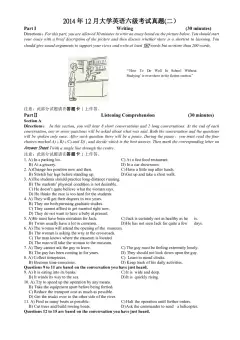
Directions: For this part, you are allowed 30 minutes to write a short essay entitled The Way to
Success by commenting on Abraham Lincoln's famous remark, "Give me six hours to
chop down a tree, and I will spend, the first four sharpening the axe." You should
writeatleast150wordsbutnomorethan200words.
TheWaytoSuccess
注意:此部分试题请在答题卡1上作答。
Part II Reading Comprehension (Skimming and Scanning)
(15 minutes)
Directions: In this part, you will have 15 minutes to go over the passage quickly and answer
thequestions on Answer Sheet 1. For questions 1-7, choose the best answer from the
fourchoicesmarkedA),B),C)andD).Forquestions8-10,completethesentenceswith
theinformationgiveninthepassage.
Google'sPlanforWorld'sBiggestOnlineLibrary:PhilanthropyOrActofPiracy?
In recent years, teams of workers dispatched by Google have been working hard to
make digital copies of books. So far, Google has scanned more than 10 million titles from libraries
in America and Europe - including half a million volumes held by the Bodleian in Oxford. The
exactmethoditusesisunclear;thecompanydoesnotallowoutsiderstoobservetheprocess.
Why is Google undertaking such a venture? Why is it even interested in all those
out-of-printlibrarybooks,mostofwhichhavebeengatheringdustonforgottenshelvesfordecades?
Thecompany claims its motives are essentially public-spirited. Its overall mission, after all, is to
"organisetheworld'sinformation",soitwouldbeoddifthatinformationdidnotincludebooks.
The company likes to present itself as having lofty aspirations. "This really isn't about making
money.Wearedoingthisforthegoodofsociety."AsSantiagodelaMora,headofGoogleBooksfor
Europe, puts it: "By making it possible to search the millions of books that exist today, we hope to
expandthefrontiersofhumanknowledge."
DanClancy,thechiefarchitectofGoogleBooks,doesseemgenuineinhisconvictionthatthisis
primarilya philanthropic(慈善的) exercise."Google's corebusinessis searchandfind,so obviously
what helps improve Google's search engine is good for Google," he says. "But we have never built
aspreadsheet(电子数据表) outlining thefinancialbenefitsofthis,and Ihave never hadto justify
theamountIamspendingtothecompany'sfounders."
Itiseasy,talkingtoClancyandhiscolleagues,tobesweptalongbytheirmissionarypassion.But
Google's book-scanning projectis proving controversial.Severalopponentshave recently emerged,
rangingfromrivaltechgiantssuchasMicrosoftandAmazontosmallbodiesrepresentingauthorsand
publishers across the world. In broad terms, these opponents have levelled two sets of criticisms at
Google.First, they have questioned whether the primary responsibility for digitally archiving the
world'sbooksshouldbeallowedtofalltoacommercialcompany.InarecentessayintheNewYork
ReviewofBooks,RobertDarnton,theheadofHarvardUniversity'slibrary,arguedthatbecausesuch
booksareacommonresource–thepossessionofusall–onlypublic,not-for-profitbodiesshouldbe
giventhepowertocontrolthem.
Thesecondrelated criticismis thatGoogle's scanningof booksis actuallyillegal.Thisallegation
has led to Google becoming mired in (陷入) a legal battle whose scope and complexity makes the
JarndyceandJarndycecaseinCharlesDickens'BleakHouselookstraightforward.
At its centre, however, is one simple issue: that of copyright. The inconvenient fact about
most books, to which Google has arguably paid insufficient attention, is that they are protected
by copyright. Copyright laws differ from country to country, but in general protection extends for
the durationof anauthor's lifeandfora substantialperiodafterwards,thusallowingtheauthor's heirs
to benefit. (In Britain and America, this post-death period is 70 years.) This means, of course,
that almost all of the books published in the 20th century are still under copyright – and the last
century saw more books published than in all previous centuries combined. Of the roughly 40
millionbooksinUSlibraries,forexample,anestimated32millionareincopyright.Ofthese,some
27millionareoutofprint.
OutsidetheUS,Googlehasmadesureonlytoscanbooksthatareoutofcopyrightandthusinthe
"publicdomain"(workssuchastheBodleian'sfirsteditionofMiddlemarch,whichanyonecanreadfor
freeonGoogleBooksSearch).
But, within the US, the company has scanned both in-copyright and out-of-copyright works. In its
defence, Google points out that it displays only small segments of books that are in
copyright– arguing that such displays are "fair use". But critics allege that by making
electronic copies of thesebookswithoutfirstseekingthepermissionofcopyrightholders,Google
hascommittedpiracy.
"The key principle of copyright law has always been that works can be copied only
once authors have expressly given their permission," says Piers Blofeld, of the Sheil Land literary
agencyinLondon."Googlehasreversedthis–ithassimplycopiedalltheseworkswithoutbothering
toask."
In 2005, the Authors Guild of America, together with a group of US publishers, launched a
classactionsuit(集团诉讼)againstGooglethat,aftermorethantwoyearsofnegotiation,endedwith
an announcement last October that Google and the claimants had reached an out-of-court
settlement. The full details are complicated - the text alone runs to 385 pages– and trying to sum
arise it is no easy task. "Part of the problem is that it is basically incomprehensible," says Blofeld,
oneofthesettlement'smostvocalBritishcritics.
Broadly, the deal provides a mechanism for Google to compensate authors and
publisherswhoserightsithasbreached(includinggivingthemashareofanyfuturerevenueitgenerates
fromtheirworks).Inexchangeforthis,therightsholdersagreenottosueGoogleinfuture.
This settlement hands Google the power - but only with the agreement of individual rights
holders – toexploititsdatabaseof out-of-printbooks. Itcaninclude theminsubscriptiondeals sold
tolibrariesorsellthemindividuallyunderaconsumerlicence.Itisthesecommercialprovisions that
areprovingthesettlement'smostcontroversialaspect.Critics point out that, by giving Google the right to commercially exploit its database, the
settlementpavesthewayforasubtleshiftinthecompany'srolefromproviderofinformationtoseller.
"Google'sbusinessmodelhasalwaysbeentoprovideinformationforfree,andselladvertisingonthe
basis of the traffic this generates," points out James Grimmelmann, associate professor at New York
LawSchool.Now,hesays,becauseofthesettlement'sprovisions,Googlecouldbecome a significant
forceinbookselling.
Interest in this aspect of the settlement has focused on "orphan" works, where there is
noknown copyright holder – these make up an estimated 5-10% of the books Google has
scanned. Under the settlement, when no rights holders come forward and register their interest in a
work, commercialcontrolautomaticallyrevertstoGoogle.Googlewillbeabletodisplayup to 20%
of orphan works for free, include them in its subscription deals to libraries and sell them to
individualbuyersundertheconsumerlicence.
It is by no means certain that the settlement will be enacted (执行) – it is the subject of a
fairness hearing in the US courts. But if it is enacted, Google will in effect be off the hook as far
as copyright violations in the US are concerned. Many people are seriously concerned by this - and
thecompanyislikelytofacechallengesinothercourtsaroundtheworld.
No one knows the precise use Google will make of the intellectual property it has gained by
scanningtheworld'slibrarybooks,andthetruth,asGleick,anAmericansciencewriterandmemberof
the Authors Guild, points out, is that the company probably doesn't even know itself. But what is
certainisthat,insomewayorother,Google'sentranceintodigitalbooksellingwillhavea significant
impactonthebookworldintheyearstocome.
注意:此部分试题请在答题卡1上作答。
1.Googleclaimsitsplanfortheworld'sbiggestonlinelibraryis_____.
A) toservetheinterestofthegeneralpublic
B) toencouragereadingaroundtheworld
C) tosaveout-of-printbooksinlibraries
D) topromoteitscorebusinessofsearching
2.AccordingtoSantiagodelaMora,Google'sbook-scanningprojectwill_____.
A) broadenhumanity'sintellectualhorizons
B) helpthebroadmassesofreaders
C) revolutionisetheentirebookindustry
D) makefulluseofthepowerofitssearchengine
3. Opponents of Google Books believe that digitally archiving the world's books should be
controlledby_____.
A) non-profitorganisations C)multinationalcompanies
B) theworld'sleadinglibraries D)theworld'stechgiants
4.Googlehasinvolveditselfinalegalbattleasitignored_____.
A) thecopyrightofauthorsofout-of-printbooks
B) thecopyrightofthebooksitscannedC) theinterestoftraditionalbooksellers
D) thedifferencesofin-printandout-of-printbooks
5.Googledefendsitsscanningin-copyrightbooksbysayingthat_____.
A) itdisplaysonlyasmallpartoftheircontent
B) itiswillingtocompensatethecopyrightholders
C) makingelectroniccopiesofbooksisnotaviolationofcopyright
D) theonlinedisplayofin-copyrightbooksisnotforcommercialuse
6.WhatdowelearnabouttheclassactionsuitagainstGoogle?
A) ItendedinavictoryfortheAuthorsGuildofAmerica.
B) Itwassettledaftermorethantwoyearsofnegotiation.
C) ItfailedtoprotecttheinterestsofAmericanpublishers.
D) Itcouldleadtomoreout-of-courtsettlementsofsuchdisputes.
7.Whatremainedcontroversialaftertheclassactionsuitended?
A) Thecompensationforcopyrightholders.
B) ThechangeinGoogle'sbusinessmodel.
C) Google'sfurtherexploitationofitsdatabase.
D) Thecommercialprovisionsofthesettlement.
8.While_____,Googlemakesmoneybysellingadvertising.
9.Bookswhosecopyrightholdersarenotknownarecalled_____.
10.Google'sentranceintodigitalbooksellingwilltremendously_____inthefuture.
PartIIIListeningComprehension (35minutes)
SectionA
Directions: In this section, you will hear 8 short conversations and 2 long conversations. At the
end of each conversation, one or more questions will be asked about what was said.
Boththeconversation andthe questionswillbespoken onlyonce.After eachquestion
therewillbeapause.Duringthepause,youmustreadthefourchoicesmarkedA),B),
C) and D), and decide which is the best answer. Then mark the corresponding letter
onAnswerSheet2withasinglelinethroughthecentre.
注意:此部分试题请在答题卡2上作答。
11.A)Cancelthetriptoprepareforthetest.
B) ReviewhisnotesoncehearrivesinChicago.
C) Listentotherecordednoteswhiledriving.
D) Prepareforthetestafterthewedding.
12.A)Thewomanwillhelpthemanrememberthelines.
B) Themanlacksconfidenceinplayingthepart.C) Themanhopestochangehisroleintheplay.
D) Thewomanwillpromptthemanduringtheshow.
13.A)Preparationsforanoperation. C)Arrangingabedforapatient.
B)Acomplicatedsurgicalcase. D)Rescuingthewoman'suncle.
14.A)Heisinterestedinimprovinghiseditingskills.
B) Heiseagertobenominatedtheneweditor.
C) HeissuretodoabetterjobthanSimon.
D) Heistoobusytoacceptmoreresponsibility.
15.A)Hehaslefthispositioninthegovernment.
B) Hehasalreadyreachedtheretirementage.
C) Hemadeastupiddecisionatthecabinetmeeting.
D) HehasbeensuccessfullyelectedPrimeMinister.
16.A)Thisyear'sshuttlemissionisabigstepinspaceexploration.
B) Themaniswellinformedaboutthespaceshuttlemissions.
C) Theshuttleflightwillbebroadcastliveworldwide.
D) Themanisexcitedatthenewsoftheshuttleflight.
17.A)Atanautorescuecenter. C)Atasuburbangarage.
B)Atacarrentingcompany. D)Atamountaincamp.
18.A)Hegothisspeakersfixed. C)Helistenedtosomeseriousmusic
B)Hewentshoppingwiththewoman. D)Heboughtastereosystem.
Questions19to21arebasedontheconversationyouhavejustheard.
19.A)Providingaidtothedisabled.
B) Printinglabelsformanufacturedgoods.
C) Promotingproductsformanufacturers.
D) Sellingproductsmadeforleft-handers.
20.A)Mostofthemarespeciallymadeforhisshop.
B) Allofthemaremanufacturedinhisownplant.
C) Thekitchenwareinhisshopisofuniquedesign.
D) Abouthalfofthemareunavailableonthemarket.
21.A)Theyspecialiseinoneproductonly. C)TheyrunchainstoresincentralLondon.
B)TheyhaveoutletsthroughoutBritain. D)Theysellbymailorderonly.
Questions22to25arebasedontheconversationyouhavejustheard.
22.A)Itpublishesmagazines. C)Itrunssalespromotioncampaigns.
B)Itsponsorstradefairs. D)Itisengagedinproductdesign.23.A)Theadspecificationshadnotbeengivenindetail.
B) Thewoman'scompanymadelast-minutechanges.
C) Thewoman'scompanyfailedtomakepaymentsintime.
D) Organisingthepromotionwasreallytime-consuming.
24.A)Extendthecampaigntonextyear. C)Runanotherfour-weekcampaign.
B)Cutthefeebyhalfforthisyear. D)Givehera10percentdiscount.
25.A)Stopnegotiatingforthetimebeing. C)Reflectontheirrespectivemistakes
B)Calmdownandmakepeace. D)Improvetheirpromotionplans.
SectionB
Directions:Inthis section,youwillhear 3 shortpassages.Attheendofeachpassage,youwillhear
some questions. Boththe passage and the questions will be spokenonly once. After you
hear a question, you mustchoose the best answer from the four choices marked A), B),
C) and D). Then mark the corresponding letter on Answer Sheet 2 with a single line
throughthecentre.
注意:此部分试题请在答题卡2上作答。
PassageOne
Questions26to29arebasedonthepassageyouhavejustheard.
26.A)Theylookspotlesslycleanthroughouttheirlives.
B) Theyarelookedafterbyanimal-careorganizations.
C) Theysacrificetheirlivesforthebenefitofhumans.
D) Theyarelabeledpetanimalsbytheresearchers.
27.A)Theymayaffecttheresultsofexperiments.
B) Theymaybehaveabnormally.
C) Theymaybreedoutofcontrol.
D) Theymaycausedamagetotheenvironment.
28.A)Whentheybecomeescapees. C)Whentheygettooold.
B)Whentheyarenolongeruseful. D)Whentheybecomeill.
29.A)Whilelaunchinganimalprotectioncampaigns,theyweretrappingkitchenmice.
B) Whileholdingaburialceremonyforapetmouse,theywerekillingpestmice.
C) Whileadvocatingfreedomforanimals,theykepttheirpetmouseinacage.
D) Whilecallingforanimalrights,theyallowedtheirkidstokeeppetanimals.
PassageTwo
Questions30to32arebasedonthepassageyouhavejustheard.
30.A)Theytakeitforgranted. C)Theycontributemosttoit.B)Theyarecrazyaboutit. D)Theyoftenfindfaultwithit.
31.A)Heatandlight. C)Historicalcontinuity.
B)Economicprosperity. D)Tidalrestlessness.
32.A)Theyfindthecityalientothem.
B) Theyareadventurersfromallovertheworld.
C) Theylackknowledgeofthecultureofthecity.
D) Theyhavedifficultysurviving.
PassageThree
Questions33to35arebasedonthepassageyouhavejustheard.
33.A)Apoliticaldebate. C)Adocumentary.
B)Afootballgame. D)Amurdermystery.
34.A)Itenhancesfamilyrelationships. C)Ithelpsbroadenone’shorizons.
B)Itisasheerwasteoftime. D)Itisunhealthyfortheviewers.
35.A)HewatchesTVprogramsonlyselectively.
B) Hecan'tresistthetemptationofTVeither.
C) Hedoesn'tlikewatchingsportsprograms.
D) Heisnotamanwhocankeephispromise.
SectionC
Directions: In thissection,you will heara passage threetimes.Whenthe passage is read for thefirst
time, you should listen carefully for its general idea. When the passage is read for the
secondtime,youarerequiredtofillintheblanksnumberedfrom36to43withtheexact
wordsyouhavejustheard.Forblanksnumberedfrom44to46youarerequiredtofillin
the missing information. For these blanks, you can either use the exact words you have
just heard or write down the main points in your own words.Finally,whenthepassage
isreadforthethirdtime,youshouldcheckwhatyouhavewritten.
注意:此部分试题请在答题卡2上作答。
In the past, one of the biggest disadvantages of machines has been their inability to work on
a micro-scale.Forexample,doctorsdidnothavedevicesallowingthemtogoinsidethehumanbodyto
(36) _____ health problems or to perform (37) _____ surgery. Repair crews did not have a way of
(38)_____broken pipes located deepwithin ahigh-rise (39) _____ building.However,that'sabout
tochange.Advancesincomputersandbiophysicshavestartedamicrominiature(超微)(40)_____that
allowsscientiststoenvision–andinsomecasesactuallybuild– microscopicmachines.Thesedevices
promiseto(41)_____changethewayweliveandwork.
Micromachines already are making an impact. At Case Western Reserve University in Cleveland,
Ohio, research scientists have designed a 4-inch silicon chip that holds 700 tiny (42) _____motors.
AtLucasNovaSensorinFremont,California,scientistshaveperfectedtheworld'sfirstmicroscopic blood-pressure sensor. Threaded through a person's blood (43) _____, the sensor can
providebloodpressurereadingsatthevalveoftheheartitself.
(44) ______________________________________________________________________.
Auto manufacturers, for example, are trying to use tiny
devices_______________________________________________________
(45)___________________________________________________________________________.
Some futuristsenvision nanotechnology (纳米技术) alsobeing used to explore the deep sea in small
submarines,oreventolaunchfinger-sizedrocketspackedwithmicrominiatureinstruments.
Thereisanexplosionofnewideasandapplications.So,(46)_____________________________
____________________________________________________________.
Part IV Reading Comprehension (Reading in Depth) (25 minutes)
SectionA
Directions: In this section, there is a short passage with 5 questions or incomplete statements.
Read the passage carefully. Then answer the questions or complete the statements in
thefewestpossiblewords.PleasewriteyouranswersonAnswerSheet2.
Questions47to51arebasedonthefollowingpassage.
Leadership is the most significant word in today's competitive business environment because
it directs the manager of a business to focus inward on their personal capabilities and style.
Experts on leadership will quickly point out that "how things get done" influences the success of
theoutcomes andindicatesa right wayandawrongway todothings. When anotedleaderon the
art of management, Peter Drucker, coined the phrase "Management is doing things right;
leadership is doing the right things," he was seeking to clarify the distinctions he associates with
theterms.
When Stephen Covey, founder and director of the Leadership Institute, explored leadership
stylesinthepastdecade,hefocusedonthehabitsofagreatnumberofhighlyeffectiveindividuals.
His Seven Habits of Highly Effective People became a popular bestseller very quickly. His ideas
forced a reexamination of the early leadership paradigm (范例), which he observed centered on
traits found in the character ethic and the personality ethic. The former ethic suggested success
was founded on integrity, modesty, loyalty, courage, patience, and so forth. The personality ethic
suggesteditwasone'sattitude,notbehavior,thatinspiredsuccess,andthisethicwasfoundedona
belief of positive mental attitude. In contrast to each of these ideas, Covey advocates that leaders
need to understand universal principles of effectiveness, and he highlights how vital it is for
leaders to first personally manage themselves if theyare to enjoyany hope ofoutstanding success
in their work environments. To achieve a desired vision for your business,it is vital thatyou have
a personal vision of where you are headed and what you value. Business leadership means that
managers need to "put first things first," which implies that before leading others, you need to be
clearonyourownvalues,abilities,andstrengthsandbeseenastrustworthy.
注意:此部分试题请在答题卡2上作答。47. Tobegoodleaders,managersmustpaycloseattentiontotheirown_____.
48. AccordingtoPeterDrucker,leadersshouldbegoodat_____.
49. Thepersonalityethicsuggeststhatpeoplearelikelytosucceediftheyhave_____.
50. According to Stephen Covey, leaders who hope to achieve outstanding success need first of
allto_____.
51. Goodleadershiprequiresonetoknowone'sownstrengthsandbeabletowinpeople's_____.
SectionB
Directions: There are 2 passages in this section. Each passage is followed by some questions or
unfinished statements. For each of them there are four choices marked A), B), C) and
D). You should decide on the best choice and mark the corresponding letter
onAnswerSheet2withasinglelinethroughthecentre.
PassageOne
Questions52to56arebasedonthefollowingpassage.
What's the one word of advice a well-meaning professional would give to a recent college
graduate?China"}India!Brazil!Howabouttrade!
WhentheCommerceDepartmentreportedlastweekthatthetradedeficitin Juneapproached
$50 billion, it set off a new round of economic doom saying. Imports, which soared to $200.3
billion in the month, are subtracted in the calculation of gross domestic product. The larger the
trade deficit, the smaller the GDP. Should such imbalances continue, pessimists say, they could
contributetoslowergrowth.
But there's another way of looking at the trade data. Over the past two years, the figures on
imports and exports seem not to signal a double-dip recession – a renewed decline in the broad
levelofeconomicactivityintheUnitedStates–butaneconomicexpansion.
The rising volume of trade – more goods and services shuttling in and out of the United
States – is good news for many sectors. Companies engaged in shipping, trucking, rail freight,
delivery,
and logistics (物流) have all been reporting better than expected results. The rising numbers
signify growing vitality in foreign markets – when we import more stuff, it puts more cash in the
hands of people around the world, and U.S. exports are rising because more foreigners have the
ability to buy the things we produce and market. The rising tide of trade is also good news for
people who work in trade-sensitive businesses, especially those that produce commodities for
whichglobaldemandsetstheprice–agriculturalgoods,mining,metals,oil.
And while exports always seem to lag, U.S. companies are becoming more involved in the
global economy with each passing month. General Motors sells as many cars in China as in
America each month. While that may not do much for imports, it does help GM's balance sheet
–andhencemakesthejobsofU.S.-basedexecutivesmorestable.
One great challenge for the U.S. economy is slack domestic consumer demand. Americans
are
paying down debt, saving more, and spending more carefully. That's to be expected, given whatwe've been through. But there's a bigger challenge. Can U.S.-based businesses, large and small,
figureouthowto geta pieceof growing globaldemand? Unlessyou wantto pickupandmove to
India,orBrazil,orChina,thebestwaytodothatisthroughtrade.Itmayseemobvious,butit's no
longerenoughsimplytodobusinesswithourfriendsandneighborshereathome.
Companiesandindividuals whodon'thaveastrategy toexportmore,ortogetmoreinvolved
in foreign markets, or to play a role in global trade, are shutting themselves out of the lion's share
ofeconomicopportunityinourworld.
注意:此部分试题请在答题卡2上作答。
52.HowdopessimistsinterprettheU.S.tradedeficitinJune?
A) ItreflectsAmericans'preferenceforimportedgoods.
B) ItsignifiesachangeinAmericaneconomicstructure.
C) ItistheresultofAmerica'sgrowingfocusondomesticmarket.
D) Itcouldleadtoslowergrowthofthenationaleconomy.
53.Whatdoestheauthorsayaboutthetradedataofthepasttwoyears?
A) ItindicatesthateconomicactivitiesintheU.S.haveincreased.
B) ItshowsthatU.S.economyisslippingfurtherintorecession.
C) Itsignalsdecreasingdomesticdemandforgoodsandservices.
D) Itreflectsthefluctuationsintheinternationalmarket.
54.Whoparticularlybenefitfromtherisingvolumeoftrade?
A) Peoplewhohaveexpertiseininternationaltrade.
B) Consumerswhofavorimportedgoodsandservices.
C) Producersofagriculturalgoodsandrawmaterials.
D) Retailersdealinginforeigngoodsandservices.
55.WhatisoneofthechallengesfacingtheAmericaneconomy?
A) Competitionfromoverseas. C)Slacktradeactivities.
B) People'sreluctancetospend. D)Decreasingproductivity.
56.Whatistheauthor'sadvicetoU.S.companiesandindividuals?
A) Toimportmorecheapgoodsfromdevelopingcountries.
B) Tomovetheircompaniestowherelaborischeaper.
C) Toincreasetheirmarketshareoverseas.
D) Tobealerttofluctuationsinforeignmarkets.
PassageTwo
Questions57to61arebasedonthefollowingpassage.
A recurring criticism of the UK's university sector is its perceived weakness in translating
newknowledgeintonewproductsandservices.Recently, the UK National Stem Cell Network warned the UK could lose its place among the
world leaders in stem cell research unless adequate funding and legislation could be assured.
Weshouldtakethisconcernseriouslyasuniversitiesarekeyinthenationalinnovationsystem.
However,wedohavetochallengetheunthinkingcomplaintthatthesectordoesnotdoenoughin
takingideastomarket.Themostrecentcomparativedataontheperformanceofuniversitiesandresearch
institutionsinAustralia,Canada,USAandUKshowsthat,fromarelativelyweakstartingposition, the
UKnowleadsonmanyindicatorsofcommercialisationactivity.
When viewed at the national level, the policy interventions of the past decade have helped
transform the performance of UK universities. Evidence suggests the UK's position is much stronger
thanintherecentpastandisstillshowingimprovement.Butnationaldatamaskstheverylargevariation
in the performance of individual universities. The evidence shows that a large number of universities
havefallenoffthebackofthepack,afewperformstronglyandtherestchasetheleaders.
ThistypeofunevendistributionisnotpeculiartotheUKandismirroredacrossothereconomies.In
theUK,researchisconcentrated:lessthan25%ofuniversitiesreceive75%oftheresearchfunding.
These same universities are also the institutions producing the greatest share of PhD graduates,
science citations, patents and licence income. The effect of policies generating long-term resource
concentrationhasalsocreatedadistinctivesetofuniversitieswhichareresearch-ledandcommercially
active. It seems clear that the concentration of research and commercialisation work creates
differencesbetweenuniversities.
The core objective for universities which are research-led must be to maximise the impact of
theirresearchefforts.Theseuniversitiesshouldbegeneratingthewidestrangeofsocial,economic and
environmentalbenefits.Inreturnforthescaleofinvestment,theyshouldsharetheirexpertisein order
tobuildgreaterconfidenceinthesector.
Part of the economic recovery of the UK will be driven by the next generation of research
commercialisation spilling out of our universities. There are three dozen universities in the UK
whichareactivelyengagedinadvancedresearchtrainingandcommercialisationwork.
Iftherewasagreatercoordinationoftechnologytransferofficeswithinregionsandasimultaneous
investmentinthescaleandfunctionsofourgraduateschools,universitiescould,andshould,play a key
roleinpositioningtheUKforthenextgrowthcycle.
注意:此部分试题请在答题卡2上作答。
57.WhatdoestheauthorthinkofUKuniversitiesintermsofcommercialisation?
A) Theyfailtoconvertknowledgeintomoney.
B) Theydonotregarditastheirresponsibility.
C) Theystillhaveaplaceamongtheworldleaders.
D) Theyhavelosttheirleadingpositioninmanyways.
58. What does the author say about the national data on UK universities' performance in
commercialisation?
A) Itmasksthefatalweaknessesofgovernmentpolicy.
B) ItdoesnotrankUKuniversitiesinascientificway.
C) Itdoesnotreflectthedifferencesamonguniversities.D) Itindicatestheirineffectiveuseofgovernmentresources.
59.WecaninferfromParagraph5that"policyinterventions"(Line1,Para.4)refersto_____.
A) governmentaidtonon-research-orienteduniversities
B) compulsorycooperationbetweenuniversitiesandindustries
C) fairdistributionoffundingforuniversitiesandresearchinstitutions
D) concentrationofresourcesinalimitednumberofuniversities
60.Whatdoestheauthorsuggestresearch-leduniversitiesdo?
A) Publicisetheirresearchtowininternationalrecognition.
B) Fullyutilisetheirresearchtobenefitallsectorsofsociety.
C) Generouslysharetheirfacilitieswiththoseshortoffunds.
D) Spreadtheirinfluenceamongtopresearchinstitutions.
61.HowcantheuniversitysectorplayakeyroleintheUK'seconomicgrowth?
A) Byestablishingmoreregionaltechnologytransferoffices.
B) Byaskingthegovernmenttoinvestintechnologytransferresearch.
C) Bypromotingtechnologytransferandgraduateschooleducation.
D) Byincreasingtheefficiencyoftechnologytransferagencies.
Part V Cloze (15 minutes)
Directions: There are 20 blanks in the following passage. For each blank there are four choices
marked A), B), C) and D) on the right side of the paper. You should choose the ONE
that best fits into the passage. Then mark the corresponding letter on Answer Sheet
2withasinglelinethroughthecentre.
注意:此部分试题请在答题卡2上作答。
If you know where to find a good plastic-free shampoo, can you tell Jeanne Haegele? Last
September, the 28-year-old Chicago resident __62__ to cut plastics out of her life. The marketing
coordinator was concerned about __63__ the chemicals coming out of some common types of
plastic might be doing to her body. She was also worried aboutthe damage all the plastic __64__
was doing to the environment. So she __65__ on her bike and rode to the nearest grocery store to
see what she could find that didn't __66__ plastic. "I went in and __67__ bought anything,"
Haegele says. She did __68__ some canned food and a carton (纸盒) of milk – to discover later
thatbothcontainerswere__70__withplastic resin(树脂)."Plastic,"shesays, "justseemedlike it
wasineverything."
She's right. Back in the 1960s, plastic was well __71__ its way to becoming a staple of
American life. The U.S. produced 28 million tons of plastic waste in 2005 – 27 million tons of
which __72__ in landfills (垃圾填埋场). Our foodand water come __73__ in plastic. It's used in
our phones and our computers, the cars we drive and the planes we ride in. But the __74__
adaptable substance has its dark side.Environmentalistsfeelworriedaboutthepetroleumneededto
make it. Parents worry about the possibility of __75__ chemicals making their way from 76plasticinto children's bloodstreams. WhichmeansHaegeleisn'ttheonlypersontryingto cutplastic outof
her life – she isn't __77__ the onlyone blogging aboutthiskindof __78__. Butthosewho'vetried
know it's __79__ from easy to go plastic-free. "These things seem to be so common __80__ it is
practicallyimpossibletoavoidcominginto__81__withthem,"saysFrederickvomSaal,abiologist
attheUniversityofMissouri.
62.A)resolved B)recovered C)removed D)retreated
63.A)when B)what C)who D)why
64.A)essence B)unit C)crust D)rubbish
65.A)hinged B)hopped C)stretched D)dipped
66.A)include B)induce C)compose D)consist
67.A)slightly B)nearly C)roughly D)barely
68.A)pursue B)prescribe C)preserve D)purchase
69.A)rather B)ever C)merely D)only
70.A)probed B)coupled C)lined D)combined
71.A)by B)over C)on D)under
72.A)endedup B)pulledup C)putup D)setup
73.A)trapped B)adapted C)wrapped D)adopted
74.A)interactively B)remotely C)infinitely D)resolutely
75. A)sensible B)toxic C)attractive D)absurd
76. A)household B)family C)internal D)civil
77. A)hardly B)largely C)even D)still
78. A)endeavor B)recreation C)accomplishmentD)diligence
79. A)well B)little C)far D)much
80. A)while B)which C)but D)that
81. A)fashion B)approach C)contact D)agreement
Part VI Translation (5minutes)
Directions: Complete the sentences by translating into English the Chinese given in brackets.Please
writeyourtranslationonAnsw&rSheet2.
注意:此部分试题请在答题卡2上作答,只需写出译文部分。
82.Youshouldn'thaverunacrosstheroadwithoutlooking.You______________________________
(也许会被车撞倒的).
33.Bynomeans______________________________(他把自己当成专家) althoughheknowsalot
aboutthefield.
84. He doesn't appreciate the sacrifice his friends have made for
him,______________________________(把他们所做的视作理所当然).85.Janettoldmethatshewouldratherhermother______________________________(不干涉她的
婚姻).
86. To keep up with the expanding frontiers of scholarship, Edward Wilson found
himself______________________________(经常上网查找信息).