机密★启用前
大 学 英 语 六 级 考 试
COLLEGE ENGLISH TEST
—Band Six
一
(2018年 12月第1套)
试 题 册
☆☆☆☆☆☆☆☆☆☆☆☆☆☆☆☆☆☆☆☆☆☆☆☆☆☆☆☆☆☆☆☆☆☆☆☆☆☆☆☆
敬 告 考 生
一、在答题前,请认真完成以下内容:
1 .请检查试题册背面条形码粘贴条、答题卡的印刷质量,如有问题及时向监考员反映,
确认无误后完成以下两点要求。
2 .请将试题册背面条形码粘贴条揭下后粘贴在答题卡1 的条形码粘贴框内,并将姓名和
准考证号填写在试题册背面相应位置。
3 .请在答题卡1和答题卡2 指定位置用黑色签字笔填写准考证号、姓名和学校名称,并
用 HB-2B铅笔将对应准考证号的信息点涂黑。
二、在考试过程中,请注意以下内容:
1 . 所有题目必须在答题卡上规定位置作答,在试题册上或答题卡上非规定位置的作答一
律无效。
2 .请在规定时间内在答题卡指定位置依次完成作文、听力、阅读、翻译各部分考试,作
答作文期间不得翻阅该试题册。听力录音播放完毕后,请立即停止作答,监考员将立
即收回答题卡1 ,得到监考员指令后方可继续作答。
3 .作文题内容印在试题册背面,作文题及其他主观题必须用黑色签字笔在答题卡指定区
域内作答。
4 .选择题均为单选题,错选、不选或多选将不得分,作答时必须使用HB-2B铅笔在答题
卡上相应位置填涂,修改时须用橡皮擦净。
三、以下情况按违规处理:
1 .未正确填写(涂)个人信息,错贴、不贴、毁损条形码粘贴条。
2 . 未按规定翻阅试题册、提前阅读试题、提前或在收答题卡期间作答。
3 .未用所规定的笔作答、折叠或毁损答题卡导致无法评卷。
4 .考试期间在非听力考试时间佩戴耳机。
全国大学英语四、六级考试委员会Part II Listening Comprehension (30 minutes)
Section A
Directions : In this section, you will hear two long conversations. At the end of each conversation, you
will hear four questions. Both the conversation and the questions will be spoken only once.
After you hear a question, you must choose the best answer from the four choices marked
4) , B) , C) and D). Then mark the corresponding letter on Answer Sheet 1 with a
single line through the centre.
回怒蛭回
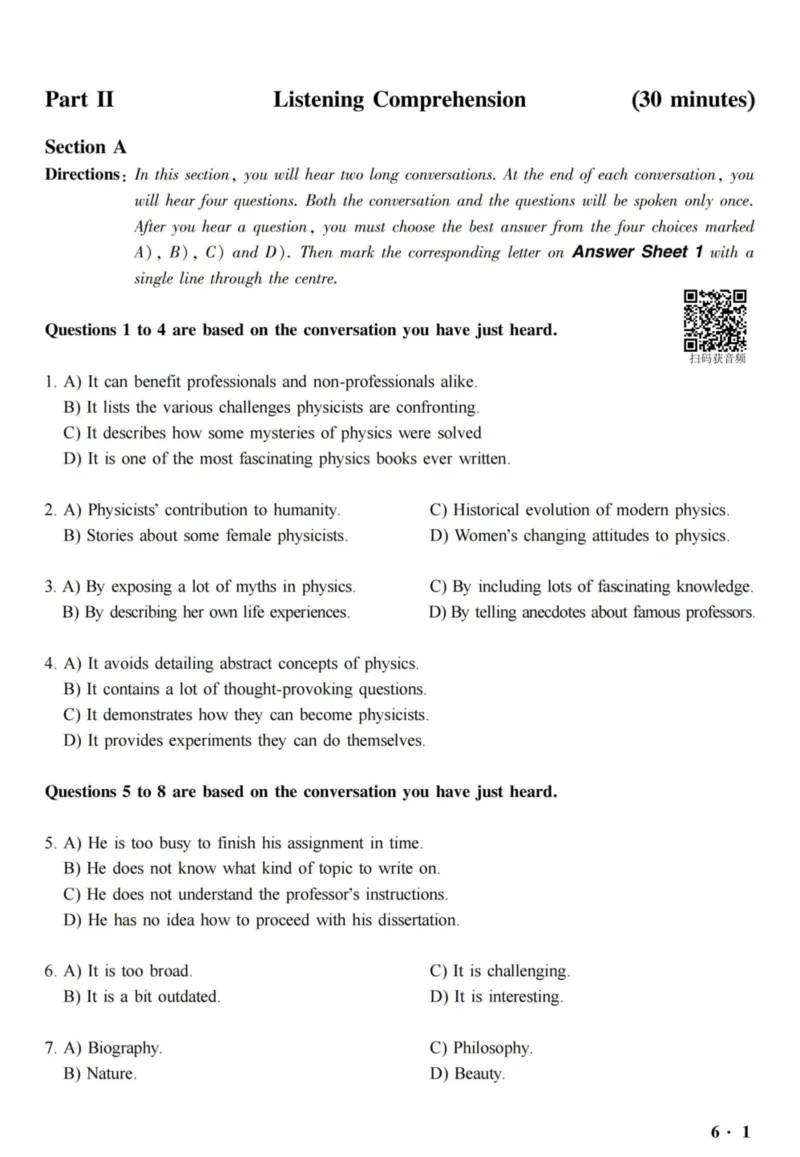
Questions 1 to 4 are based on the conversation you have just heard.
1. A) It can benefit professionals and non-professionals alike.
B) It lists the various challenges physicists are confronting.
C) It describes how some mysteries of physics were solved
D) It is one of the most fescmating physics books ever written.
2. A) Physicists, contribution to humanity. C) Historical evolution of modern physics.
B) Stories about some female physicists. D) Women's changing attitudes to physics.
3. A) By exposing a lot of myths in physics. C) By including lots of fascinating knowledge.
B) By describing her own life experiences. D) By telling anecdotes about famous professors.
4. A) It avoids detailing abstract concepts of physics.
B) It contains a lot of thought-provoking questions.
C) It demonstrates how they can become physicists.
D) It provides experiments they can do themselves.
Questions 5 to 8 are based on the conversation you have just heard.
5. A) He is too busy to finish his assignment in time.
B) He does not know what kind of topic to write on.
C) He does not understand the professofs instructions.
D) He has no idea how to proceed with his dissertation.
6. A) It is too broad. C) It is challenging.
B) It is a bit outdated. D) It is interesting.
7. A) Biography. C) Philosophy.
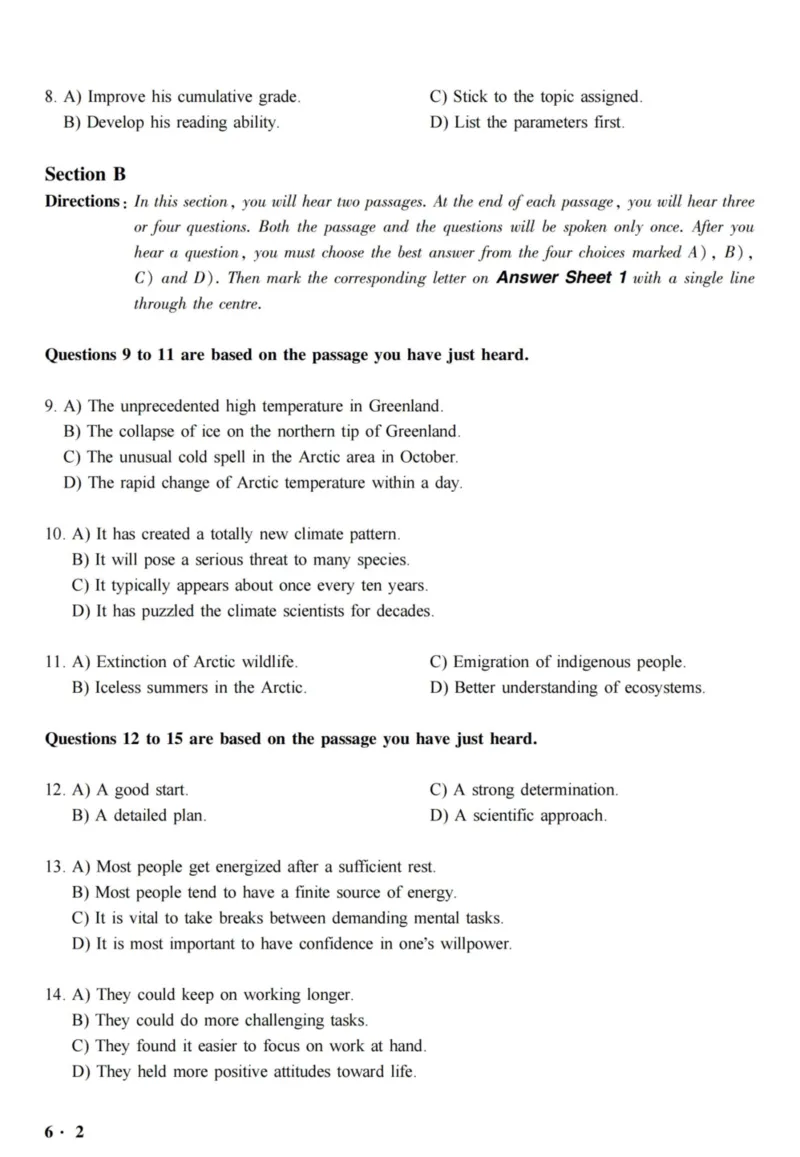
B) Nature. D) Beauty.8. A) Improve his cumulative grade. C) Stick to the topic assigned.
B) Develop his reading ability. D) List the parameters first.
Section B
Directions : In this section, you will hear two passages. At the end of each passage, you will hear three
or four questions. Both the passage and the questions will be spoken only once. After you
hear a question, you must choose the best answer from the four choices marked A) , B),
C) and D). Then mark the corresponding letter on Answer Sheet 1 with a single line
through the centre.
Questions 9 to 11 are based on the passage you have just heard.
9. A) The unprecedented high temperature in Greenland.
B) The collapse of ice on the northern tip of Greenland.
C) The unusual cold spell in the Arctic area in October.
D) The rapid change of Arctic temperature within a day.
10. A) It has created a totally new climate pattern.
B) It will pose a serious threat to many species.
C) It typically appears about once every ten years.
D) It has puzzled the climate scientists for decades.
11. A) Extinction of Arctic wildlife. C) Emigration of indigenous people.
B) Iceless summers in the Arctic. D) Better understanding of ecosystems.
Questions 12 to 15 are based on the passage you have just heard.
12. A) A good start. C) A strong determination.
B) A detailed plan. D) A scientific approach.
13. A) Most people get energized after a sufficient rest.
B) Most people tend to have a finite source of energy.
C) It is vital to take breaks between demanding mental tasks.
D) It is most important to have confidence in one's willpower.
14. A) They could keep on working longer.
B) They could do more challenging tasks.
C) They found it easier to focus on work at hand.
D) They held more positive attitudes toward life.
6 • 215. A) They are part of their nature. C) They are related to culture.
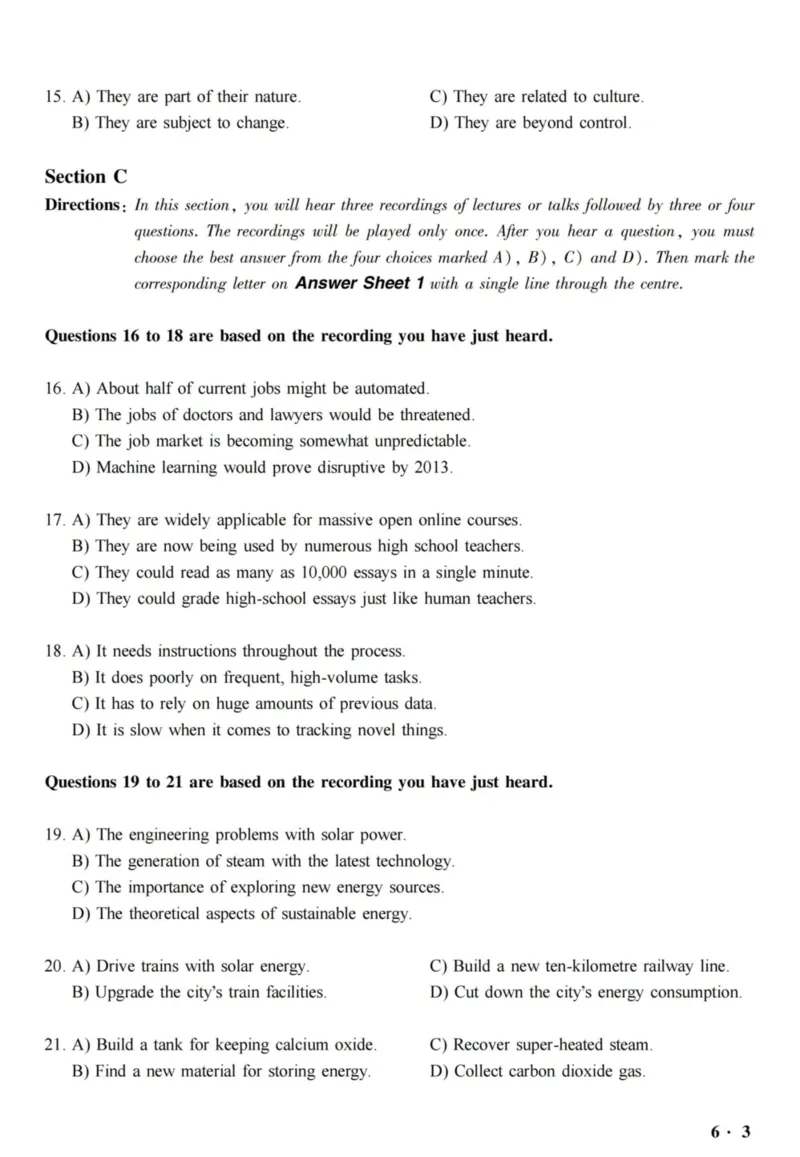
B) They are subject to change. D) They are beyond control.
Section C
Directions : In this section, you will hear three recordings of lectures or talks followed by three or four
questions. The recordings will be played only once. After you hear a question, you must
choose the best answer from the four choices marked A) , B) , C) and D). Then mark the
corresponding letter on Answer Sheet 1 with a single line through the centre.
Questions 16 to 18 are based on the recording you have just heard.
16. A) About half of current jobs might be automated.
B) The jobs of doctors and lawyers would be threatened.
C) The job market is becoming somewhat unpredictable.
D) Machine learning would prove disruptive by 2013.
17. A) They are widely applicable for massive open online courses.
B) They are now being used by numerous high school teachers.
C) They could read as many as 10,000 essays in a single minute.
D) They could grade high-school essays just like human teachers.
18. A) It needs instructions throughout the process.
B) It does poorly on frequent, high-volume tasks.
C) It has to rely on huge amounts of previous data.
D) It is slow when it comes to tracking novel things.
Questions 19 to 21 are based on the recording you have just heard.
19. A) The engineering problems with solar power.
B) The generation of steam with the latest technology.
C) The importance of exploring new energy sources.
D) The theoretical aspects of sustainable energy.
20. A) Drive trains with solar energy. C) Build a new ten-kilometre railway line.
B) Upgrade the city's train facilities. D) Cut down the city's energy consumption.
21. A) Build a tank fbr keeping calcium oxide. C) Recover super-heated steam.
B) Find a new material for storing energy. D) Collect carbon dioxide gas.
6 • 3Questions 22 to 25 are based on the recording you have just heard.
22. A) The lack of supervision by both the national and local governments.
B) The impact of the current economic crisis at home and abroad.
C) The poor management of day centres and home help services.
D) The poor relation between national health and social care services.
23. A) It was mainly provided by voluntary services.
B) It mainly caters to the needs of the privileged.
C) It called for a sufficient number of volunteers.
D) It has deteriorated over the past sixty years.
24. A) Their longer lifespans. C) Their preference for private services.
B) Fewer home helpers available. D) More of them suffering serious illnesses.
25. A) They are unable to pay for health services. C) They are vulnerable to illnesses and diseases.
B) They have long been discriminated against. D) They have contributed a great deal to society.
Part III Reading Comprehension (40 minutes)
Section A
Directions : In this section, there is a passage with ten blanks. You are required to select one word for
each blank from a list of choices given in a word bank following the passage. Read the
passage through carefully before making your choices. Each choice in the bank is identified
by a letter. Please mark the corresponding letter for each item on Answer Sheet 2 with a
single line through the centre. You may not use any of the words in the bank more than once.
Just off the coast of Southern California sits Santa Cruz Island, where a magical creature called
the island fox 26 A decade ago, this island's ecosystem was in 27 . Wild pigs attracted
golden eagles from the mainland, and those flying 28 crashed the fbx population. So the Nature
Conservancy launched a 29 war against the pigs, complete with helicopters and sharp shooters.
And it worked. Today, federal agencies are pulling the island fox from the Endangered Species
List. Ifs the fastest-ever recovery of a mammal, joining peers like the Louisiana black bear as
glowing successes in the history of the Endangered Species Act.
But the recovery of Santa Cruz Island isn't just about the fbx. The Nature Conservancy has
30 war on a multitude of invasive species here, from sheep to plants to the 31 Argentine
ant. " Our philosophy with the island has always been, ' OK, 32 the threats and let the island go
back to what it was,' " says ecologist Christina Boser. And it appears to be working. Native plants are
coming back, and the fox once again bounds about carefree.
But keeping those foxes from harm will occupy Boser and her colleagues for years to come. You
6 , 4see, humans are still allowed on Santa Cruz Island, and they bring dogs. So Boser has to vaccinate
her fbxes against various diseases. "We're obligated to keep a pulse on the population for at least five
years after the foxes are delisted," says Boser. That includes tagging the foxes and 33 their
numbers to ensure nothing goes wrong.
This is the story of the little fox that has come back, and the people who have 34 their lives
to protecting it. This is the story of wildlife conservation in the age of mass 35
A) aggressive I) hinders
B) chaos J) mammal
C) configuration K) monitoring
D) declared L) predators
E) dedicated M) remove
F) dwells N) tempt
G) extinction 0) underlying
H) fierce
Section B
Directions : In this section, you are going to read a passage with ten statements attached to it. Each
statement contains information given in one of the paragraphs. Identify the paragraph from
which the information is derived. You may choose a paragraph more than once. Each
paragraph is marked with a letter. Answer the questions by marking the corresponding letter
on Answer Sheet 2.
Do Parents Invade Children's Privacy When They Post Photos Online?
[A] When Katlyn Burbidge's son was 6 years old, he was performing some ridiculous song and
dance typical of a first-grader. But after she snapped a photo and started using her phone, he
asked her a serious question: uAre you going to post that online?" She laughed and answered,
“Yes, I think I will." What he said next stopped her. uCan you not?"
[B] Thafs when it dawned on her: She had been posting photos of him online without asking his
permission. "We're big advocates of bodily autonomy and not forcing him to hug or kiss people
unless he wants to, but it never occurred to me that I should ask his permission to post photos of
him online," says Burbidge, a mom of two in Wakefield, Massachusetts. 44 Now when I post a
photo of him online, I show him the photo and get his okay.”
[C ] When her 8-month-old is 3 or 4 years old, she plans to start asking him in an age-appropriate
way, uDo you want other people to see this?" Thafs precisely the approach that two researchers
advocated before a room of pediatricians (儿科医生)last week at the American Academy of
6 - 5Pediatrics meeting, when they discussed the 21st century challenge of “ sharenting,“ a new term for
parents5 online sharing about their children. "As advocates of children's rights, we believe that
children should have a voice about what information is shared about them if possible,n says Stacey
Steinberg, a legal skills professor at the University of Florida Levin College of Law in Gainesville.
[D] Whether ifs ensuring that your child isn't bullied over something you post, that their identity
isn't digitally “kidnapped”, or that their photos don,t end up on a half dozen child pornography
(色情)sites, as one Australian mom discovered, parents and pediatricians are increasingly
aware of the importance of protecting children's digital presence. Steinberg and Bahareh Keith,
an assistant professor of pediatrics at the University of Florida College of Medicine, say most
children will likely never experience problems related to what their parents share, but a tension
still exists between parents, rights to share their experiences and their children's rights to privacy.
[E] "We're in no way trying to silence parents, voices,n Steinberg says. "At the same time, we
recognize that children might have an interest in entering adulthood free to create their own
digital footprint.v They cited a study presented earlier this year of 249 pairs of parents and their
children in which twice as many children as parents wanted rules on what parents could share.
“The parents said, ' We don't need rules - we're fine,' and the children said, ' Our parents
need rules,5 " Keith says, "The children wanted autonomy about this issue and were worried
about their parents sharing information about them."
[F] Although the American Academy of Pediatrics offers guidelines recommending that parents
model appropriate social media use for their children, it does not explicitly discuss oversharing
by parents. "I think this is a very legitimate concern, and I appreciate their drawing our
attention to it,“ David Hill, a father of five, says. He sees a role for pediatricians to talk with
parents about this, but believes the messaging must extend far beyond pediatricians' offices. 141
look forward to seeing researchers expand our understanding of the issue so we can translate it
into effective education and policy," he says.
[G] There's been little research on the topic, Steinberg wrote in a law article about this issue. While
states could pass laws related to sharing information about children online, Steinberg feels
parents themselves are generally best suited to make these decisions for their families. u While
we didn't want to create any unnecessary panic, we did find some concerns that were
troublesome, and we thought that parents or at least physicians should be aware of those
potential risks,“ Steinberg says. They include photos repurposed for inappropriate or illegal
means, identity theft, embarrassment, bullying by peers or digital kidnapping.
[H] But thafs the negative side, with risks that must be balanced against the benefits of sharing.
Steinberg pointed out that parental sharing on social media helps build communities, connect
spread-out families, provide support and raise awareness around important social issues for
which parents might be their child's only voice.
6 • 6[I] A C.S. Mott survey found among the 56 percent of mothers and 34 percent of fathers who
discussed parenting on social media, 72 percent of them said sharing made them feel less alone,
and nearly as many said sharing helped them worry less and gave them advice from other
parents. The most common topics they discussed included kids' sleep, nutrition, discipline,
behavior problems and day care and preschool.
[J] "There's this peer-to-peer nature of health care these days with a profound opportunity for
parents to learn helpful tips, safety and prevention efforts, pro-vaccine messages and all kinds of
other messages from other parents in their social communities," says Wendy Sue Swanson, a
pediatrician and executive director of digital health at Seattle Children's Hospital, where she
blogs about her own parenting journey to help other parents. " They're getting nurtured by
people they've already selected that they trust,“ she says.
[K] "How do we weigh the risks, how do we think about the benefits, and how do we alleviate the
risks?" she says. u Those are the questions we need to ask ourselves, and everyone can have a
different answer."
[L] Some parents find the best route for them is not to share at all. Bridget O'Hanlon and her
husband, who live in Cleveland, decided before their daughter was born that they would not post
her photos online. When a few family members did post pictures, O'Hanlon and her husband
made their wishes clear. "It's been hard not to share pictures of her because people always want
to know how babies and toddlers (学走路的孩子)are doing and to see pictures, but we made
the decision to have social media while she did not," O'Hanlon said. Similarly, Alison Jamison
of New York decided with her husband that their child had a right to their own online identity.
They did use an invitation-only photo sharing platform so that friends and family, including
those far away, could see the photos, but they stood firm, simply refusing to put their child's
photos on other social media platforms.
[M] "For most families, ifs a journey. Sometimes it goes wrong, but most of the time it doesn,t,^^
says Swanson, who recommends starting to ask children permission to post narratives or photos
around ages 6 to 8. u We'll learn more and more what our tolerance is. We can ask our kids to
help us learn as a society whafs okay and whafs not."
[N ] Indeed, that learning process goes both ways. Bria Dunham, a mother in Somerville,
Massachusetts, was so excited to watch a moment of brotherly bonding while her first-grader
and baby took a bath together that she snapped a few photos. But when she considered posting
them online, she took the perspective of her son: How would he feel if his classmates, parents
saw photos of him chest-up in the bathtub? u It made me think about how I am teaching him to
have ownership of his own body and how what is shared today endures into the future,"
Dunham says. " So I kept the pictures to myself and accepted this as one more step in
supporting his increasing autonomy.n
6 ・ 736. Steinberg argued parental sharing online can be beneficial.
37. According to an expert, when children reach school age, they can help their parents learn what
can and cannot be done.
38. One mother refrained from posting her son's photos online when she considered the matter from
her son's perspective.
39. According to a study, more children than parents think there should be rules on parents5 sharing.
40. Katlyn Burbidge had never realized she had to ask her son's approval to put his photos online.
41. A mother decided not to post her son's photo online when he asked her not to.
42. A woman pediatrician tries to help other parents by sharing her own parenting experience.
43. There are people who decide simply not to share their children's photos online.
44. Parents and physicians should realize sharing information online about children may involve risks.
45. Parents who share their parenting experiences may find themselves intruding into their children's
privacy.
Section C
Directions : There are 2 passages in this section. Each passage is followed by some questions or
unfinished statements. For each of them there are four choices marked A ) , B ) , C) and
O). You should decide on the best choice and mark the corresponding letter on Answer
Sheet 2 with a single line through the centre.
Passage One
Questions 46 to 50 are based on the following passage.
Perhaps it is time fbr farmers to put their feet up now that robots are used to inspect crops, dig
up weeds, and even have become shepherds, too. Commercial growing fields are astronomically huge
and take thousands of man-hours to operate. One prime example is one of Australia's most isolated
cattle stations, Suplejack Downs in the Northern Territory, extending across 4,000 square kilometers,
taking over 13 hours to reach by car from the nearest major town—Alice Springs.
The extreme isolation of these massive farms leaves them often unattended, and monitored only
once or twice a year, which means if the livestock falls ill or requires assistance, it can be a long time
for farmers to discover.
However, robots are coming to the rescue.
6 • 8Robots are currently under a two-year trial in Wales which will train “ farmbotsn to herd,
monitor the health of livestock, and make sure there is enough pasture for them to graze on. The
robots are equipped with many sensors to identify conditions of the environment, cattle, and food,
using thermal and vision sensors that detect changes in body temperature.
"You've also got color, texture and shape sensors looking down at the ground to check pasture
quality,says Salah Sukkarieh of the University of Sydney, who will carry out trials on several farms
in central New South Wales.
During the trials, the robot algorithms (算法)and mechanics will be fine-tuned to make it better
suited to ailing livestock and ensure it safely navigates around potential hazards including trees, mud,
swamps, and hills.
“We want to improve the quality of animal health and make it easier for farmers to maintain
large landscapes where animals roam free,n says Sukkarieh.
The robots are not limited to herding and monitoring livestock. They have been created to count
individual fruit, inspect crops, and even pull weeds.
Many robots are equipped with high-tech sensors and complex learning algorithms to avoid
injuring humans as they work side by side. The robots also learn the most efficient and safest passages,
and allow engineers and farmers to analyze and better optimize the attributes and tasks of the robot, as
well as provide a live stream giving real-time feedback on exactly what is happening on the farms.
Of course, some worry lies in replacing agricultural workers. However, it is farmers that are
pushing for the advancements due to ever-increasing labor vacancies, making it difficult to maintain
large-scale operations.
The robots have provided major benefits to farmers in various ways, from hunting and pulling
weeds to monitoring the condition of every single fruit. Future farms will likely experience a greater
deal of autonomy as robots take up more and more farm work efficiently.
46. What may farmers be able to do with robots appearing on the farming scene?
A) Upgrade farm produce. C) Modify the genes of crops.
B) Enjoy more leisure hours. D) Cut down farming costs.
47. What will u farmbots" be expected to do?
A) Take up many of the farmers' routines.
B) Provide medical treatments for livestock.
C) Lead the trend in forming the world over.
D) Improve the quality of pastures for grazing.
48. What can robots do when equipped with high-tech sensors and complex learning algorithms?
A) Help farmers choose the most efficient and safest passages.
B) Help farmers simplify their farming tasks and management.
C) Allow farmers to learn instantly what is occurring on the farm.
D) Allow farmers to give them real-time instructions on what to do.
6 - 949. Why are farmers pressing fbr robotic farming?
A) Farming costs are fast increasing. C) Robotic farming is the trend.
B) Robotics technology is maturing. D) Labor shortage is worsening.
50. What does the author think future forms will be like?
A) More and more automated. C) Larger and larger in scale.
B) More and more productive. D) Better and better in condition.
Passage Two
Questions 51 to 55 are based on the following passage.
The public must be able to understand the basics of science to make informed decisions. Perhaps
the most dramatic example of the negative consequences of poor communication between scientists
and the public is the issue of climate change, where a variety of fectors, not the least of which is a
breakdown in the transmission of fundamental climate data to the general public, has contributed to
widespread mistrust and misunderstanding of scientists and their research.
The issue of climate change also illustrates how the public acceptance and understanding of
science (or the lack of it) can influence governmental decision-making with regard to regulation,
science policy and research funding.
However, the importance of effective communication with a general audience is not limited to
hot issues like climate change. It is also critical for socially charged neuroscience issues such as the
genetic basis fbr a particular behavior, the therapeutic potential of stem cell therapy for
neurodegenerative diseases, or the use of animal models, areas where the public understanding of
science can also influence policy and funding decisions. Furthermore, with continuing advances in
individual genome (基 因 组 )sequencing and the advent of personalized medicine, more non
scientists will need to be comfortable analyzing complex scientific information to make decisions that
directly affect their quality of life.
Science journalism is the main channel for the popularization of scientific information among the
public. Much has been written about how the relationship between scientists and the media can shape
the efficient transmission of scientific advances to the public. Good science journalists are specialists
in making complex topics accessible to a general audience, while adhering to scientific accuracy.
Unfortunately, pieces of science journalism can also oversimplify and generalize their subject
material to the point that the basic information conveyed is obscured or at worst, obviously wrong. The
impact of a basic discovery on human health can be exaggerated so that the public thinks a miraculous
cure is a few months to years away when in reality the significance of the study is far more limited.
Even though scientists play a part in transmitting information to journalists and ultimately the
public, too often the blame for ineffective communication is placed on the side of the journalists. We
believe that at least part of the problem lies in places other than the interaction between scientists and
members of the media, and exists because for one thing we underestimate how difficult it is for
scientists to communicate effectively with a diversity of audiences, and for another most scientists do
not receive formal training in science communication.
6 - 1051. What does the example of climate change serve to show?
A) The importance of climate data is increasingly recognized.
B) Adequate government funding is vital to scientific research.
C) Government regulation helps the public understand science.
D) Common fblks, scientific knowledge can sway policy making.
52. What should non-scientists do to ensure their quality of life?
A) Seek personalized medical assistance from doctors.
B) Acquire a basic understanding of medical science.
C) Have their individual genome sequenced.
D) Make informed use of animal models.
53. Why is it important fbr scientists to build a good relationship with the media?
A) It helps them to effectively popularize new scientific information.
B) It enables the public to develop a positive attitude toward science.
C) It helps them to establish a more positive public image.
D) It enables them to apply their findings to public health.
54. What does the author say is the problem with science journalism?
A) It is keen on transmitting sensational information.
B) It tends to oversimplify people's health problems.
C) It may give inaccurate or distorted information to the public.
D) It may provide information open to different interpretations.
55. What should scientists do to impart their latest findings to the public more effectively?
A) Give training to science journalists. C) Seek timely assistance from the media.
B) Stimulate public interest in science. D) Improve their communication skills.
Part IV Translation (30 minutes)
Directions : For this part, you are allowed 30 minutes to translate a passage from Chinese into English.
You should write your answer on Answer Sheet 2.
近年来,中国越来越多的博物馆免费向公众开放。博物馆展览次数和参观人数都明显增
长。在一些广受欢迎的博物馆门前,排长队已很常见。这些博物馆必须采取措施限制参观人
数。如今,展览形式越来越多样。一些大型博物馆利用多媒体和虚拟现实等先进技术,使展览
更具吸引力。不少博物馆还举办在线展览,人们可在网上观赏珍稀展品。然而,现场观看展品
的体验对大多数参观者还是更具吸引力。
6 • 11未得到监考教师指令前,不得翻阅该试题册!
Part I Writing (30 minutes)
(请于正式开考后半小时内完成该部分,之后将进行听力考试)
Directions : For this part, you are allowed 30 minutes to write an essay on how to balance work
and leisure. You should write at least 150 words but no more than 200 words.
请用黑色签字笔在答题卡1指定区域内作答作文题,在试题册上的作答无效!
请认真填写以下信息:
准考证号:
姓 名:_
错填、未填以上信息,按违规处理!机密★启用前
大 学 英 语 六 级 考 试
COLLEGE ENGLISH TEST
—Band Six
一
(2018年 12月第2 套)
试 题 册
☆☆☆☆☆☆☆☆☆☆☆☆☆☆☆☆☆☆☆☆☆☆☆☆☆☆☆☆☆☆☆☆☆☆☆☆☆☆☆☆
敬 告 考 生
一、在答题前,请认真完成以下内容:
1 .请检查试题册背面条形码粘贴条、答题卡的印刷质量,如有问题及时向监考员反映,
确认无误后完成以下两点要求。
2 .请将试题册背面条形码粘贴条揭下后粘贴在答题卡1 的条形码粘贴框内,并将姓名和
准考证号填写在试题册背面相应位置。
3 .请在答题卡1和答题卡2 指定位置用黑色签字笔填写准考证号、姓名和学校名称,并
用 HB-2B铅笔将对应准考证号的信息点涂黑。
二、在考试过程中,请注意以下内容:
1 . 所有题目必须在答题卡上规定位置作答,在试题册上或答题卡上非规定位置的作答一
律无效。
2 .请在规定时间内在答题卡指定位置依次完成作文、听力、阅读、翻译各部分考试,作
答作文期间不得翻阅该试题册。听力录音播放完毕后,请立即停止作答,监考员将立
即收回答题卡1 ,得到监考员指令后方可继续作答。
3 .作文题内容印在试题册背面,作文题及其他主观题必须用黑色签字笔在答题卡指定区
域内作答。
4 .选择题均为单选题,错选、不选或多选将不得分,作答时必须使用HB-2B铅笔在答题
卡上相应位置填涂,修改时须用橡皮擦净。
三、以下情况按违规处理:
1 .未正确填写(涂)个人信息,错贴、不贴、毁损条形码粘贴条。
2 . 未按规定翻阅试题册、提前阅读试题、提前或在收答题卡期间作答。
3 .未用所规定的笔作答、折叠或毁损答题卡导致无法评卷。
4 .考试期间在非听力考试时间佩戴耳机。
全国大学英语四、六级考试委员会Part II Listening Comprehension (30 minutes)
Section A
Directions : In this section, you will hear two long conversations. At the end of each conversation, you
will hear four questions. Both the conversation and the questions will be spoken only once.
After you hear a question, you must choose the best answer from the four choices marked
4) , B) , C) and D). Then mark the corresponding letter on Answer Sheet 1 with a
single line through the centre.
Questions 1 to 4 are based on the conversation you have just heard.
扫码获音频
1. A) Stop worrying about him. C) Take a picture of him.
B) Keep away from the statue. D) Put on a smile for the photo.
2. A) Gaining great fame on the Internet. C) Collecting the best photos in the world.
B) Publishing a collection of his photos. D) Becoming a professional photographer.
3. A) Surfing various websites and collecting photos.
B) Editing his pictures and posting them online.
C) Following similar accounts to compare notes.
D) Studying the pictures in popular social media.
4. A) They are fer from satisfactory. C) They make an impressive album.
B) They are mostly taken by her mom. D) They record her fbnd memories.
Questions 5 to 8 are based on the conversation you have just heard.
5. A) A journal reporting the latest progress in physics.
B) An introductory course of modern physics.
C) An occasion fbr physicists to exchange ideas.
D) A series of interviews with outstanding physicists.
6. A) The future of the physical world. C) Sources of radiation.
B) The origin of the universe. D) Particle theory.
7. A) How matter collides with anti-matter. C) Why there exists anti-matter.
B) Whether the universe will turn barren. D) Why there is a universe at all.
8. A) Matter and anti-matter are opposites of each other.
B) Anti-matter allowed humans to come into existence.
6 ・ 1C) The universe formed due to a sufficient amount of matter.
D) Anti-matter exists in very high-temperature environments.
Section B
Directions : In this section, you will hear two passages. At the end of each passage, you will hear three
or four questions. Both the passage and the questions will be spoken only once. After you
hear a question, you must choose the best answer from the four choices marked A) , B),
C) and D). Then mark the corresponding letter on Answer Sheet 1 with a single line
through the centre.
Questions 9 to 11 are based on thepassage you have just heard.
9. A) She found herself speaking a foreign language.
B) She woke up speaking with a different accent.
C) She found some symptoms of her illness gone.
D) She woke up finding herself in another country.
10. A)It is usually caused by a stroke or brain injury.
B) It has not yet found any effective treatment.
C)It leaves the patient with a distorted memory.
D) It often happens to people with speech defects.
11. A) British. B) Irish. C) Russian. D) Australian.
Questions 12 to 15 are based on the passage you have just heard.
12. A) Water sports. C) Stories about women swimmers.
B) Racing in rivers. D) Books about swimming.
13. A) She succeeded in swimming across the English Channel.
B) She published a guide to London's best swimming spots.
C) She told her story of adventures to some young swimmers.
D) She wrote a book about the history of swimwear in the UK.
14. A) They loved vacationing on the seashore.
B) They had a unique notion of modesty.
C) They were prohibited from swimming.
D) They were fully dressed when swimming.
6 • 215. A) She designed lots of appropriate swimwear for women.
B) She once successfully competed against men in swimming.
C) She was the first woman to swim across the English Channel.
D) She was an advocate of women's right to swim in public pools.
Section C
Directions : In this section, you will hear three recordings of lectures or talks followed by three or four
questions. The recordings will be played only once. After you hear a question, you must
choose the best answer from the four choices marked A) , B) , C) and D). Then mark the
corresponding letter on Answer Sheet 1 with a single line through the centre.
Questions 16 to 18 are based on the recording you have just heard.
16. A) Build a machine that can detect lies.
B) Develop a magnetic brain scanner.
C) Test the credibility of court evidence.
D) Win people's complete trust in them.
17. A) They are optimistic about its potential. C) They think it is but business promotion.
B) They are sceptical of its reliability. D) They celebrate it with great enthusiasm.
18. A) It is not to be trusted at all. C) It may intrude into people's privacy.
B) It does not sound economical. D) It may lead to overuse in court trials.
Questions 19 to 21 are based on the recording you have just heard.
19. A) Most of its residents speak several languages.
B) Some of its indigenous languages are dying out.
C) Each village there speaks a totally different language.
D) Its languages have interested researchers the world over.
20. A) They are spread randomly across the world.
B) Some are more difficult to learn than others.
C) More are found in tropical regions than in the mild zones.
D) They enrich and impact each other in more ways than one.
21. A) They used different methods to collect and analyze data.
B) They identified distinct patterns of language distribution.
C) Their conclusions do not correspond to their original hypotheses.
D) There is no conclusive account fbr the cause of language diversity.
6 • 3Questions 22 to 25 are based on the recording you have just heard.
22. A) Its middle-class is disappearing. C) Its population is rapidly growing.
B) Its wealth is rationally distributed. D) Its cherished dream is coming true.
23. A) Success was but a dream without conscientious effort.
B) They could realize their dreams through hard work.
C) A few dollars could go a long way.
D) Wealth was shared by all citizens.
24. A) Better working conditions. C) High social status.
B) Better-paying jobs. D) Full employment.
25. A) Reduce the administrative costs. C) Hire part-time employees only.
B) Adopt effective business models. D) Make use of the latest technology.
Part III Reading Comprehension (40 minutes)
Section A
Directions : In this section, there is a passage with ten blanks. You are required to select one word for
each blank from a list of choices given in a word bank following the passage. Read the
passage through carefully before making your choices. Each choice in the bank is identified
by a letter. Please mark the corresponding letter for each item on Answer Sheet 2 with a
single line through the centre. You may not use any of the words in the bank more than
once.
Surfing the Internet during class doesn't just steal focus from the educator; it also hurts students
who're already struggling to 26 the material. A new study from Michigan State University,
though, argues that all students- including high achievers- see a decline in performance when they
browse the Internet during class for non-academic purposes.
To measure the effects of Internet-based distractions during class, researchers 27 500
students taking an introductory psychology class at Michigan State University. Researchers used ACT
scores as a measure of intellectual 28 . Because previous research has shown that people with
high intellectual abilities are better at 29 out distractions, researchers believed students with high
ACT scores would not show a 30 decrease in performance due to their use of digital devices. But
students who surfed the web during class did worse on their exams regardless of their ACT scores,
suggesting that even the academically smartest students are harmed when they're distracted in class.
College professors are increasingly 31 alarm bells about the effects smartphones, laptops,
and tablets have on academic performance. One 2013 study of college students found that 80% of
students use their phones or laptops during class, with the average student checking their digital
6 , 4device 11 times in a 32 class. A quarter of students report that their use of digital devices during
class causes their grades to 33 .
Professors sometimes implement policies designed to 34 students1 use of digital devices, and
some instructors even confiscate(没收)tablets and phones. In a world where people are increasingly
dependent on their phones, though, such strategies often fail. One international study found that 84%
of people say they couldn't go a day without their smartphones. Until students are able to 35 the
pull of social networking, texting, and endlessly surfing the web, they may continue to struggle in
their classes.
A) aptitude I) obscure
B) eradication J) obsess
C) evaluated K) raising
D) evaporated L) resist
E) filtering M) significant
F) grasp N) suffer
G) legacy 0) typical
H) minimize
Section B
Directions : In this section, you are going to read a passage with ten statements attached to it. Each
statement contains information given in one of the paragraphs. Identify the paragraph from
which the information is derived. You may choose a paragraph more than once. Each
paragraph is marked with a letter. Answer the questions by marking the corresponding letter
on Answer Sheet 2.
A Pioneering Woman of Science Re-emerges after 300 Years
[A] Maria Sibylla Merian, like many European women of the 17th century, stayed busy managing a
household and rearing children. But on top of that, Merian, a German-born woman who lived in
the Netherlands, also managed a successful career as an artist, botanist, naturalist and entomologist
(昆虫学家).
[B] " She was a scientist on the level with a lot of people we spend a lot of time talking about,“ said
Kay Etheridge, a biologist at Gettysburg College in Pennsylvania who has been studying the
scientific history of Merian's work. 41 She didn't do as much to change biology as Charles Darwin,
but she was significant."
[C] At a time when natural history was a valuable tool for discovery, Merian discovered facts about
plants and insects that were not previously known. Her observations helped dismiss the popular
6 - 5belief that insects spontaneously emerged from mud. The knowledge she collected over decades
didn't just satisfy those curious about nature, but also provided valuable insights into medicine
and science. She was the first to bring together insects and their habitats, including food they ate,
into a single ecological composition.
[D] After years of pleasing a fascinated audience across Europe with books of detailed descriptions
and life-size paintings of familiar insects, in 1699 she sailed with her daughter nearly 5,000 miles
from the Netherlands to South America to study insects in the jungles of what is now known as
Suriname. She was 52 years old. The result was her masterpiece, Metamorphosis Insectorum
Surinamensium.
[E] In her work, she revealed a side of nature so exotic, dramatic and valuable to Europeans of the
time that she received much acclaim. But a century later, her findings came under scientific
criticism. S/ioddy(粗糙的)reproductions of her work along with setbacks to women's roles in
18th- and 19th-century Europe resulted in her efforts being largely forgotten. "It was kind of
stunning when she sort of dropped off into ob/ioiozi(遗忘)," said Dr. Etheridge. 41 Victorians
started putting women in a box, and they're still trying to crawl out of it.”
[F] Today, the pioneering woman of the sciences has re-emerged. In recent years, feminists, historians
and artists have all praised Merian's tenacity(坚韧), talent and inspirational artistic compositions.
And now biologists like Dr. Etheridge are digging into the scientific texts that accompanied her
art. Three hundred years after her death, Merian will be celebrated at an international symposium
in Amsterdam this June.
[G] And last month, Metamorphosis Insectorum Surinamensium was republished. It contains 60 plates
(插图)and original descriptions, along with stories about Merian's life and updated scientific
descriptions. Before writing Metamorphosis, Merian spent decades documenting European plants
and insects that she published in a series of books. She began in her 20s, making textless,
decorative paintings of flowers with insects. "Then she got really serious," Dr. Etheridge said.
Merian started raising insects at home, mostly butterflies and caterpillars. " She would sit up all
night until they came out of the pupa (蛹)so she could draw them,“ she said.
[H] The results of her decades5 worth of careful observations were detailed paintings and descriptions
of European insects, followed by unconventional visuals and stories of insects and animals from a
land that most at the time could only imagine. Ifs possible Merian used a magnifying glass to
capture the detail of the split tongues of sphinx moths (斯芬克斯飞蛾)depicted in the painting.
She wrote that the two tongues combine to form one tube for drinking nectar (花蜜).Some
criticized this detail later, saying there was just one tongue, but Merian wasn't wrong. She may
have observed the adult moth just as it emerged from its pupa. For a brief moment during that
stage of its life cycle, the tongue consists of two tiny half-tubes before merging into one.
6 • 6[I] It may not have been ladylike to depict a giant spider devouring a hummingbird, but when Merian
did it at the turn of the 18th century, surprisingly, nobody objected. Dr. Etheridge called it
revolutionary. The image, which also contained novel descriptions of ants, fescinated a European
audience that was more concerned with the exotic story unfolding before them than the gender of
the person who painted it.
[J] u All of these things shook up their nice, neat little view," Dr. Etheridge said. But later, people of
the Victorian era thought differently. Her work had been reproduced, sometimes incorrectly. A
few observations were deemed impossible. " She'd been called a silly woman for saying that a
spider could eat a bird," Dr. Etheridge said. But Henry Walter Bates, a friend of Charles Darwin,
observed it and put it in book in 1863, proving Merian was correct.
[K] In the same plate, Merian depicted and described leaf-cutter ants for the first time. uIn America
there are large ants which can eat whole trees bare as a broom handle in a single night,n she
wrote in the description. Merian noted how the ants took the leaves below ground to their young.
And she wouldn't have known this at the time, but the ants use the leaves to farm fungi (菌类)
underground to feed their developing babies.
[L] Merian was correct about the giant bird-eating spiders, ants building bridges with their bodies and
other details. But in the same drawing, she incorrectly lumped together army and leaf-cutter ants.
And instead of showing just the typical pair of eggs in a hummingbird nest, she painted four. She
made other mistakes in Metamorphosis Insectorum Surinamensium as well: not every caterpillar
and butterfly matched.
[M] Perhaps one explanation for her mistakes is that she cut short her Suriname trip after getting sick,
and completed the book at home in Amsterdam. And errors are common among some of history's
most-celebrated scientific minds, too. These errors no more invalidate Ms. Merian's work than
do well-known misconceptions published by Charles Darwin or Isaac Newton," Dr. Etheridge
wrote in a paper that argued that too many have wrongly focused on the mistakes of her work.
[N] Merian's paintings inspired artists and ecologists. In an 1801 drawing from his book, General
Zoology Amphibia, George Shaw, an English botanist and zoologist, credited Merian fbr
describing a frog in the account of her South American expedition, and named the young tree
frog after her in his portrayal of it. It wouldn't be fair to give Merian all the credit. She received
assistance naming plants, making sketches and referencing the work of others. Her daughters
helped her color her drawings.
[O] Merian also made note of the help she received from the natives of Suriname, as well as slaves or
servants that assisted her. In some instances she wrote moving passages that included her helpers
in descriptions. As she wrote in her description of the peacock flower, uThe Indians, who are not
6 - 7treated well by their Dutch masters, use the seeds to abort their children, so that they will not
become slaves like themselves. The black slaves from Guinea and Angola have demanded to be
well treated, threatening to refuse to have children. In fact, they sometimes take their own lives
because they are treated so badly, and because they believe they will be born again, free and
living in their own land. They told me this themselves.n
[P] Londa Schiebinger, a professor of the history of science at Stanford University, called this passage
rather astonishing. Ifs particularly striking centuries later when these issues are still prominent in
public discussions about social justice and women's rights. " She was ahead of her time," Dr.
Etheridge said.
36. Merian was the first scientist to study a type of American ant.
37. The European audience was more interested in Merian's drawings than her gender.
38. Merian's masterpiece came under attack a century after its publication.
39. Merian's mistakes in her drawings may be attributed to her shortened stay in South America.
40. Merian often sat up the whole night through to observe and draw insects.
41. Merian acknowledged the help she got from natives of South America.
42. Merian contributed greatly to people's better understanding of medicine and science.
43. Merian occasionally made mistakes in her drawings of insects and birds.
44. Now, Marian's role as a female forerunner in sciences has been re-established.
45. Merian made a long voyage to South America to study jungle insects over three centuries ago.
Section C
Directions : There are 2 passages in this section. Each passage is followed by some questions or
unfinished statements. For each of them there are four choices marked A ) , B ) , C) and
JD). You should decide on the best choice and mark the corresponding letter on Answer
Sheet 2 with a single line through the centre.
Passage One
Questions 46 to 50 are based on the following passage.
While human achievements in mathematics continue to reach new levels of complexity, many of
6 • 8us who aren't mathematicians at heart (or engineers by trade) may struggle to remember the last time
we used calculus (微积分).
Ifs a fact not lost on American educators, who amid rising math failure rates are debating how
math can better meet the real-life needs of students. Should we change the way math is taught in
schools, or eliminate some courses entirely?
Andrew Hacker, Queens College political science professor, thinks that advanced algebra and
other higher-level math should be cut from curricula in favor of courses with more routine usefulness,
like statistics.
“We hear on all sides that we're not teaching enough mathematics, and the Chinese are running
rings around us,“ Hacker says. "I'm suggesting we're teaching too much mathematics to too many
people... not everybody has to know calculus. If you're going to become an aeronautical (航空的)
engineer, fine. But most of us aren,t.^^
Instead, Hacker is pushing for more courses like the one he teaches at Queens College:
Numeracy 101. There, his students of u citizen statistics" learn to analyze public information like the
federal budget and corporate reports. Such courses, Hacker argues, are a remedy for the numerical
illiteracy of adults who have completed high-level math like algebra but are unable to calculate the
price of, say, a carpet by area.
Hackefs argument has met with opposition from other math educators who say whafs needed is
to help students develop a better relationship with math earlier, rather than teaching them less math
altogether.
Maria Droujkova is a founder of Natural Math, and has taught basic calculus concepts to 5-year-
olds. For Droujkova, high-level math is important, and what it could use in American classrooms is
an injection of childlike wonder.
“Make mathematics more available/5 Droujkova says. 44Redesign it so it's more accessible to
more kinds of people: young children, adults who worry about it, adults who may have had bad
experiences."
Pamela Harris, a lecturer at the University of Texas at Austin , has a similar perspective. Harris
says that American education is suffering from an epidemic offake math”- an emphasis on the rote
memorization (死 3己硬背)of formulas and steps, rather than an understanding of how math can
influence the ways we see the world.
Andrew Hacker, for the record, remains skeptical.
"I'm going to leave it to those who are in mathematics to work out the ways to make their
subject interesting and exciting so students want to take it,“ Hacker says. " All that I ask is that
alternatives be offered instead of putting all of us on the road to calculus."
46. What does the author say about ordinary Americans?
A) They struggle to solve math problems.
B) They think math is a complex subject.
C) They find high-level math of little use.
D) They work hard to learn high-level math.
6 - 947. What is the general complaint about America's math education according to Hacker?
A) America is not doing as well as China.
B) Math professors are not doing a good job.
C) It doesn't help students develop their literacy.
D) There has hardly been any innovation fbr years.
48. What does Andrew Hackefs Numeracy 101 aim to do?
A) Allow students to learn high-level math step by step.
B) Enable students to make practical use of basic math.
C) Lay a solid foundation fbr advanced math studies.
D) Help students to develop their analytical abilities.
49. What does Maria Droujkova suggest math teachers do in class?
A) Make complex concepts easy to understand.
B) Start teaching children math at an early age.
C) Help children work wonders with calculus.
D) Try to arouse students5 curiosity in math.
50. What does Pamela Harris think should be the goal of math education?
A) To enable learners to understand the world better.
B) To help learners to tell feke math from real math.
C) To broaden Americans, perspectives on math.
D) To exert influence on world development.
Passage Two
Questions 51 to 55 are based on the following passage.
For years, the U. S. has experienced a shortage of registered nurses. The Bureau of Labor
Statistics projects that while the number of nurses will increase by 19 percent by 2022, demand will
grow faster than supply, and that there will be over one million unfilled nursing jobs by then.
So whafs the solution? Robots.
Japan is ahead of the curve when it comes to this trend. Toyohashi University of Technology has
developed Terapio, a robotic medical cart that can make hospital rounds, deliver medications and
other items, and retrieve records. It follows a specific individual, such as a doctor or nurse, who can
use it to record and access patient data. This type of robot will likely be one of the first to be
implemented in hospitals because it has fairly minimal patient contact.
Robots capable of social engagement help with loneliness as well as cognitive functioning, but
the robot itself doesn't have to engage directly——it can serve as an intermediary for human
communication. Telepresence robots such as MantaroBot, Vgo, and Giraff can be controlled through a
computer, smartphone, or tablet, allowing family members or doctors to remotely monitor patients or
6 - 10Skype them, often via a screen where the robot's ' face5 would be. If you can't get to the nursing
home to visit grandma, you can use a telepresence robot to hang out with her. A 2016 study found
that users had a “ consistently positive attitude“ about the Giraff robofs ability to enhance
communication and decrease feelings of loneliness.
A robofs appearance affects its ability to successfully interact with humans, which is why the
RIKEN-TRI Collaboration Center for Human-Interactive Robot Research decided to develop a robotic
nurse that looks like a huge teddy bear. RIBA (Robot for Interactive Body Assistance), also known as
“Robear,“ can help patients into and out of wheelchairs and beds with its strong arms.
On the less cute and more scary side there is Actroid F, which is so human-like that some
patients may not know the difference. This conversational robot companion has cameras in its eyes,
which allow it to track patients and use appropriate facial expressions and body language in its
interactions. During a month-long hospital trial, researchers asked 70 patients how they felt being
around the robot and uonly three or four said they didn't like having it around."
Ifs important to note that robotic nurses don't decide courses of treatment or make diagnoses
(though robot doctors and surgeons may not be far off). Instead, they perform routine and laborious
tasks, freeing nurses up to attend to patients with immediate needs. This is one industry where it
seems the integration of robots will lead to collaboration, not replacement.
51. What does the author say about Japan?
A) It delivers the best medications fbr the elderly.
B) It takes the lead in providing robotic care.
C) It provides retraining fbr registered nurses.
D) It sets the trend in future robotics technology.
52. What do we learn about the robot Terapio?
A) It has been put to use in many Japanese hospitals.
B) It provides specific individualized care to patients.
C) It does not have much direct contact with patients.
D) It has not revolutionized medical service in Japan.
53. What are telepresence robots designed to do?
A) Directly interact with patients to prevent them from feeling lonely.
B) Cater to the needs of patients for recovering their cognitive capacity.
C) Closely monitor the patients, movements and conditions around the clock.
D) Facilitate communication between patients and doctors or family members.
54. What is one special feature of the robot Actroid F?
A) It interacts with patients just like a human companion.
B) It operates quietly without patients realizing its presence.
C) It likes to engage in everyday conversations with patients.
6 • 11D) It uses body language even more effectively than words.
55. What can we infer from the last paragraph?
A) Doctors and surgeons will soon be laid off.
B) The robotics industry will soon take off.
C) Robots will not make nurses redundant.
D) Collaboration will not replace competition.
Translation (30 minutes)
Directions : For this part, you are allowed 30 minutes to translate a passage from Chinese into English.
You should write your answer on Answer Sheet 2.
中国越来越重视公共图书馆,并鼓励人们充分加以利用。新近公布的统计数字表明,中国
的公共图书馆数量在逐年增长。许多图书馆通过翻新和扩建,为读者创造了更为安静、舒适的
环境。大型公共图书馆不仅提供种类繁多的参考资料,而且定期举办讲座、展览等活动。近年
来,也出现了许多数字图书馆,从而节省了存放图书所需的空间。一些图书馆还推出了自助服
务系统,使读者借书还书更加方便,进一步满足了读者的需求。
6 • 12未得到监考教师指令前,不得翻阅该试题册!
Part I Writing (30 minutes)
(请于正式开考后半小时内完成该部分,之后将进行听力考试)
Directions : For this part, you are allowed 30 minutes to write an essay on how to balance job
responsibilities and personal interests. You should write at least 150 words but no more
than 200 words.
请用黑色签字笔在答题卡1指定区域内作答作文题,在试题册上的作答无效!
请认真填写以下信息:
准考证号:
姓 名:_
错填、未填以上信息,按违规处理!机密★启用前
大 学 英 语 六 级 考 试
COLLEGE ENGLISH TEST
—Band Six一
(2018年 12月第3套)
试 题 册
☆☆☆☆☆☆☆☆☆☆☆☆☆☆☆☆☆☆☆☆☆☆☆☆☆☆☆☆☆☆☆☆☆☆☆☆☆☆☆☆
敬 告 考 生
一、在答题前,请认真完成以下内容:
1 .请检查试题册背面条形码粘贴条、答题卡的印刷质量,如有问题及时向监考员反映,
确认无误后完成以下两点要求。
2 .请将试题册背面条形码粘贴条揭下后粘贴在答题卡1 的条形码粘贴框内,并将姓名和
准考证号填写在试题册背面相应位置。
3 .请在答题卡1和答题卡2 指定位置用黑色签字笔填写准考证号、姓名和学校名称,并
用 HB-2B铅笔将对应准考证号的信息点涂黑。
二、在考试过程中,请注意以下内容:
1 . 所有题目必须在答题卡上规定位置作答,在试题册上或答题卡上非规定位置的作答一
律无效。
2 .请在规定时间内在答题卡指定位置依次完成作文、听力、阅读、翻译各部分考试,作
答作文期间不得翻阅该试题册。听力录音播放完毕后,请立即停止作答,监考员将立
即收回答题卡1 ,得到监考员指令后方可继续作答。
3 .作文题内容印在试题册背面,作文题及其他主观题必须用黑色签字笔在答题卡指定区
域内作答。
4 .选择题均为单选题,错选、不选或多选将不得分,作答时必须使用HB-2B铅笔在答题
卡上相应位置填涂,修改时须用橡皮擦净。
三、以下情况按违规处理:
1 .未正确填写(涂)个人信息,错贴、不贴、毁损条形码粘贴条。
2 . 未按规定翻阅试题册、提前阅读试题、提前或在收答题卡期间作答。
3 .未用所规定的笔作答、折叠或毁损答题卡导致无法评卷。
4 .考试期间在非听力考试时间佩戴耳机。
全国大学英语四、六级考试委员会Part II Listening Comprehension (30 minutes)
? 特别说明 分
l 六级考试每次仅考两套听力 I
I 第三套听力试题同第一套或第二套试题一致I
V^ » » » » » » » » » » » » » » » » » » » » » » » » » » » » 7 1
Part III Reading Comprehension (40 minutes)
Section A
Directions : In this section, there is a passage with ten blanks. You are required to select one word for
each blank from a list of choices given in a word bank following the passage. Read the
passage through carefully before making your choices. Each choice in the bank is identified
by a letter. Please mark the corresponding letter for each item on Answer Sheet 2 with a
single line through the centre. You may not use any of the words in the bank more than once.
In whafs probably the craziest headline Fve ever written, Fve reported that 26 in livestock
protection are happening with scientists painting eyes on the butts of cows. The experiment is based
upon the idea that farmers who're protecting their herd from lions would shoot and kill lions in an
effort to protect their livestock. While this makes a lot of sense, it results in many lion deaths that
27 would have been unnecessary. Researchers in Australia have been 28 and testing a method
of trickery to make lions think they are being watched by the painted eyes on cow butts.
This idea is based on the principle that lions and other 29 are far less likely to attack when they
feel they are being watched. As conservation areas become smaller, lions are increasingly coming into
contact with human populations, which are expanding to the 30 of these protected areas.
Efforts like painting eyes on cow butts may seem crazy at first, but they could make actual
headway in the fight for conservation. "If the method works, it could provide farmers in Botswana —
and 31 - with a low-cost, sustainable tool to protect their livestock, and a way to keep lions
safe from being killed."
Lions are 32 ambush (埋 伏 )hunters, so when they feel their prey has 33 them, they
usually give up on the hunt. Researchers are 34 testing their idea on a select herd of cattle. They
have painted half of the cows with eyes and left the other half as normal. Through satellite tracking of
both the herd and the lions in the area, they will be able to 35 if their psychological trickery will
work to help keep farmers from shooting lions.
6 - 1A) advances I) otherwise
B) boundaries J) predators
C) challenging K) primarily
D) currently L) retorted
E) determine M) spotted
F) devising N) testimonies
G) elsewhere 0) wrestle
H) nevertheless
Section B
Directions : In this section, you are going to read a passage with ten statements attached to it. Each
statement contains information given in one of the paragraphs. Identify the paragraph from
which the information is derived. You may choose a paragraph more than once. Each
paragraph is marked with a letter. Answer the questions by marking the corresponding letter
on Answer Sheet 2.
Resilience Is About How You Recharge, Not How You Endure
[A] As constant travelers and parents of a 2-year-old, we sometimes fantasize about how much work
we can do when one of us gets on a plane, undistracted by phones, friends, or movies. We race
to get all our ground work done: packing, going through security, doing a last-minute work call,
calling each other, then boarding the plane. Then, when we try to have that amazing work
session in flight, we get nothing done. Even worse, after refreshing our email or reading the
same studies over and over, we are too exhausted when we land to soldier on with (继续处理)
the emails that have inevitably still piled up.
[B] Why should flying deplete us? We're just sitting there doing nothing. Why can't we be tougher
—— more resilient (有复原力的)and determined in our work so we can accomplish all of the
goals we set for ourselves? Based on our current research, we have come to realize that the
problem is not our hectic schedule or the plane travel itself; the problem comes from a
misconception of what it means to be resilient, and the resulting impact of overworking.
[C] We often take a militaristic, “tough“ approach to resilience and determination like a Marine
pulling himself through the mud, a boxer going one more round, or a football player picking
himself up off the ground for one more play. We believe that the longer we tough it out, the
tougher we are, and therefore the more successful we will be. However, this entire conception is
scientifically inaccurate.
[D] The very lack of a recovery period is dramatically holding back our collective ability to be
6 • 2resilient and successful. Research has found that there is a direct correlation between lack of
recovery and increased incidence of health and safety problems. And lack of recovery 一
whether by disrupting sleep with thoughts of work or having continuous cognitive arousal by
watching our phones — is costing our companies $ 62 billion a year in lost productivity.
[E] And just because work stops, it doesn't mean we are recovering. We “stop" work sometimes at
5 pm, but then we spend the night wrestling with solutions to work problems, talking about our
work over dinner, and falling asleep thinking about how much work well do tomorrow. In a
study just released, researchers from Norway found that 7.8% of Norwegians have become
workaholics (工作狂). The scientists cite a definition of “ workaholism" as " being overly
concerned about work, driven by an uncontrollable work motivation, and investing so much
time and effort in work that it impairs other important life areas.”
[F] We believe that the number of people who fit that definition includes the majority of American
workers, which prompted us to begin a study of workaholism in the U.S. Our study will use a
large corporate dataset from a major medical company to examine how technology extends our
working hours and thus interferes with necessary cognitive recovery, resulting in huge health
care costs and turnover costs fbr employers.
[G] The misconception of resilience is often bred from an early age. Parents trying to teach their children
resilience might celebrate a high school student staying up until 3 am to finish a science fair project.
What a distortion of resilience! A resilient child is a well-rested one. When an exhausted student
goes to school, he risks hurting everyone on the road with his impaired driving; he doesn't have the
cognitive resources to do well on his English test; he has lower seli-control with his friends; and at
home, he is moody with his parents. Overwork and exhaustion are the opposite of resilience and
the bad habits we acquire when we're young only magnify when we hit the workforce.
[H] As Jim Loehr and Tony Schwartz have written, if you have too much time in the performance
zone, you need more time in the recovery zone, otherwise you risk burnout. Gathering your
resources to “try hard” requires burning energy in order to overcome your currently low
arousal level. It also worsens exhaustion. Thus the more imbalanced we become due to
overworking, the more value there is in activities that allow us to return to a state of balance.
The value of a recovery period rises in proportion to the amount of work required of us.
[I] So how do we recover and build resilience? Most people assume that if you stop doing a task
like answering emails or writing a paper, your brain will naturally recover, so that when you start
again later in the day or the next morning, you'll have your energy back. But surely everyone
reading this has had times when you lie in bed fbr hours, unable to fall asleep because your brain
is thinking about work. If you lie in bed for eight hours, you may have rested, but you can still
feel exhausted the next day. Thafs because rest and recovery are not the same thing.
6 • 3[J] If you're trying to build resilience at work, you need adequate internal and external recovery
periods. As researchers Zijlstra, Cropley and Rydstedt write in their 2014 paper: uInternal recovery
refers to the shorter periods of relaxation that take place within the frames of the work day or the
work setting in the form of short scheduled or unscheduled breaks, by shifting attention or
changing to other work tasks when the mental or physical resources required for the initial task are
temporarily depleted or exhausted. External recovery refers to actions that take place outside of
work一e.g. in the free time between the work days, and during weekends, holidays or vacations/'
If after work you lie around on your bed and get irritated by political commentary on your phone
or get stressed thinking about decisions about how to renovate your home, your brain has not
received a break from high mental arousal states. Our brains need a rest as much as our bodies do.
[K] If you really want to build resilience, you can start by strategically stopping. Give yourself the
resources to be tough by creating internal and external recovery periods. Amy Blankson describes
how to strategically stop during the day by using technology to control overworking. She
suggests downloading the Instant or Moment apps to see how many times you turn on your phone
each day. You can also use apps like Offiime or Unplugged to create tech free zones by strategically
scheduling automatic airplane modes. The average person turns on their phone 150 times every day.
If every distraction took only 1 minute, that would account for 2.5 hours a day.
[L] In addition, you can take a cognitive break every 90 minutes to charge your batteries. Try to not
have lunch at your desk, but instead spend time outside or with your friends - not talking about
work. Take all of your paid time off, which not only gives you recovery periods, but raises your
productivity and likelihood of promotion.
[M] As for us, we've started using our plane time as a work-free zone, and thus time to dip into the
recovery phase. The results have been fantastic. We are usually tired already by the time we get
on a plane, and the crowded space and unstable internet connection make work more
challenging. Now, instead of swimming upstream, we relax, sleep, watch movies, or listen to
music. And when we get off the plane, instead of being depleted, we feel recovered and ready
to return to the performance zone.
36. It has been found that inadequate recovery often leads to poor health and accidents.
37. Mental relaxation is much needed, just as physical relaxation is.
38. Adequate rest not only helps one recover, but also increases one's work efficiency.
39. The author always has a hectic time before taking a flight.
40. Recovery may not take place even if one seems to have stopped working.
6 , 441. It is advised that technology be used to prevent people from overworking.
42. Contrary to popular belief, rest does not equal recovery.
43. The author has come to see that this problem results from a misunderstanding of the meaning of
resilience.
44. People's distorted view about resilience may have developed from their upbringing.
45. People tend to think the more determined they are, the greater their success will be.
Section C
Directions : There are 2 passages in this section. Each passage is followed by some questions or
unfinished statements. For each of them there are four choices marked A ) , B ) , C) and
D). You should decide on the best choice and mark the corresponding letter on Answer
Sheet 2 with a single line through the centre.
Passage One
Questions 46 to 50 are based on the following passage.
Children with attention problems in early childhood were 40% less likely to graduate from high
school, says a new study from Duke University.
The study included 386 kindergarteners from schools in the Fast Track Project, a multi-site
clinical trial in the U.S. that in 1991 began tracking how children developed across their lives.
With this study, researchers examined early academic attention and socio-emotional skills and
how each contributed to academic success into young adulthood.
They found that early attention skills were the most consistent predictor of academic success, and
that likability by peers also had a modest effect on academic performance.
By fifth grade, children with early attention difficulties had lower grades and reading achievement
scores than their peers. As fifth-graders, children with early attention problems obtained average reading
scores at least 3% lower than their contemporaries, and grades at least 8% lower than those of their
peers. This was after controlling for IQ, socio-economic status and academic skills at school entry.
Although these may not seem like large effects, the impact of early attention problems continued
throughout the children's academic careers. Lower reading achievement scores and grades in fifth
grade contributed to reduced grades in middle school and thereby contributed to a 40% lower high
school graduation rate.
“The children we identified as having attention difficulties were not diagnosed with attention
deficit hyperactivity disorder (注意力缺乏多动症)(ADHD), although some may have had the
disorder. Our findings suggest that even more modest attention difficulties can increase the risk of
negative academic outcomes,v said David Rabiner, an associate dean of Duke's Trinity College of
6 - 5Arts & Sciences, whose research has focused on ADHD and interventions to improve academic
performance in children with attention difficulties.
Social acceptance by peers in early childhood also predicted grades in fifth grade. Children not
as liked by their first-grade peers had slightly lower grades in fifth grade, while those with higher
social acceptance had higher grades.
“This study shows the importance of so-called ' non-cognitive' or soft skills in contributing to
children's positive peer relationships, which, in turn, contribute to their academic success," said
Kenneth Dodge, director of the Duke Center for Child and Family Policy.
The results highlight the need to develop effective early interventions to help those with attention
problems stay on track academically and for educators to encourage positive peer relationships, the
researchers said.
"We're learning that student success requires a more comprehensive approach, one that
incorporates not only academic skills but also social, self-regulatory and attention skills," Dodge said.
“If we neglect any of these areas, the child's development lags. If we attend to these areas, a child's
success may reinforce itself with positive feedback loops."
46. What is the focus of the new study from Duke University?
A) The contributors to children's early attention.
B) The predictors of children's academic success.
C) The factors that affect children's emotional well-being.
D) The determinants of children's development of social skills.
47. How did the researchers ensure that their findings are valid?
A) By attaching equal importance to all possible variables examined.
B) By collecting as many typical samples as were necessary.
C) By preventing them from being affected by factors not under study.
D) By focusing on the family background of the children being studied.
48. What do we learn from the findings of the Duke study?
A) Modest students are generally more attentive than their contemporaries.
B) There are more children with attention difficulties than previously thought.
C) Attention deficit hyperactivity disorder accounts for most academic failures.
D) Children's academic performance may suffer from even slight inattention.
49. What does the Duke study find about children better accepted by peers?
A) They do better academically. C) They are teachers, favorites.
B) They are easy to get on with. D) They care less about grades.
50. What can we conclude from the Duke study?
A) Children's success is related to their learning environment.
6 • 6B) School curriculum should cover a greater variety of subjects.
C) Social skills are playing a key role in children's development.
D) An all-round approach should be adopted in school education.
Passage Two
Questions 51 to 55 are based on the following passage.
On Jan. 9, 2007, Steve Jobs formally announced Apple's u revolutionary mobile phone”- a
device that combined the functionality of an iPod, phone and Internet communication into a single
unit, navigated by touch.
It was a huge milestone in the development of smartphones, which are now owned by a majority
of American adults and are increasingly common across the globe.
As smartphones have multiplied, so have questions about their impact on how we live and how
we work. Often the advantages of convenient, mobile technology are both obvious and taken fbr
granted, leaving more subtle topics fbr concerned discussion: Are smartphones disturbing children's
sleep? Is an inability to get away from work having a negative impact on health? And what are the
implications for privacy?
But today, on the 10th anniversary of the iPhone, lets take a moment to consider a less obvious
advantage: the potential fbr smartphone technology to revolutionize behavioral science. Thafs
because, fbr the first time in human history, a large proportion of the species is in continuous contact
with technology that can record key features of an individual's behavior and environment.
Researchers have already begun to use smartphones in social scientific research, either to query
people regularly as they engage in their normal lives or to record activity using the device's built-in
sensors. These studies are confirming, challenging and extending whafs been found using more
traditional approaches, in which people report how they behaved in real life or participate in relatively
short and artificial laboratory-based tasks.
Such studies are just first steps. As more data are collected and methods for analysis improve,
researchers will be in a better position to identify how different experiences, behaviors and
environments relate to each other and evolve over time, with the potential to improve people's
productivity and wellbeing in a variety of domains. Beyond revealing population-wide patterns, the
right combination of data and analysis can also help individuals identify unique characteristics of their
own behavior, including conditions that could indicate the need for some form of intervention- such
as an unusual increase in behaviors that signal a period of depression.
Smartphone-based data collection comes at an appropriate time in the evolution of psychological
science. Today, the field is in transition, moving away from a fbcus on laboratory studies with
undergraduate participants towards more complex, real-world situations studied with more diverse
groups of people. Smartphones offer new tools fbr achieving these ambitions, providing rich data
about everyday behaviors in a variety of contexts.
So here's another way in which smartphones might transform the way we live and work: by
offering insights into human psychology and behavior and, thus, supporting smarter social science.
6 ・ 751. What does the author say about the negative impact of smartphones?
A) It has been overshadowed by the positive impact.
B) It has more often than not been taken for granted.
C) It is not so obvious but has caused some concern.
D) It is subtle but should by no means be overstated.
52. What is considered a less obvious advantage of smartphone technology?
A) It systematically records real human interactions.
B) It helps people benefit from technological advances.
C) It brings people into closer contact with each other.
D) It greatly improves research on human behavior.
53. What characterizes traditional psychological research?
A) It is based on huge amounts of carefully collected data.
B) It relies on lab observations and participants7 reports.
C) It makes use of the questionnaire method.
D) It is often expensive and time-consuming.
54. How will future psychological studies benefit individuals?
A) By helping them pin down their unusual behaviors.
B) By helping them maintain a positive state of mind.
C) By helping them live their lives in a unique way.
D) By helping them cope with abnormal situations.
55. What do we learn about current psychological studies?
A) They are going through a period of painful transition.
B) They are increasingly focused on real-life situations.
C) They are conducted in a more rigorous manner.
D) They are mainly targeted towards undergraduates.
Part IV Translation (30 minutes)
Directions : For this part, you are allowed 30 minutes to translate a passage from Chinese into English.
You should write your answer on Answer Sheet 2.
近年来,中国政府进一步加大体育馆建设投资,以更好地满足人们快速增长的健身需求。
除了新建体育馆外,许多城市还采取了改造旧工厂和商业建筑等措施,来增加当地体育馆的数
量。在政府资金的支持下,越来越多的体育馆向公众免费开放,或者只收取少量费用。许多体
育馆通过应用现代信息技术大大提高了服务质量。人们可以方便地在线预订场地和付费。可
以预见,随着运动设施的不断完善,愈来愈多的人将会去体育馆健身。
6 - 8未得到监考教师指令前,不得翻阅该试题册!
Part I Writing (30 minutes)
(请于正式开考后半小时内完成该部分,之后将进行听力考试)
Directions : For this part, you are allowed 30 minutes to write an essay on how to balance
academic study and extracurricular activities. You should write at least 150 words
but no more than 200 words.
请用黑色签字笔在答题卡1指定区域内作答作文题,在试题册上的作答无效!
请认真填写以下信息:
准考证号:
姓 名:_
错填、未填以上信息,按违规处理!