三年真题解读01(阅读四选一)
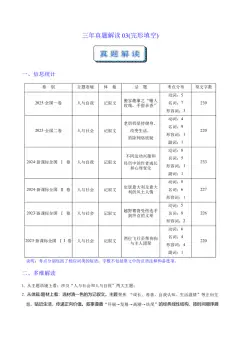
说明:经初步统计三年(2023-2025)英语高考真题共有18 套试卷(全国卷+地方卷):(2023)4+3 套、
(2024)3+3 套、(2025)2+3 套共18 套。限于篇幅,本资料所有专题三年真题解读只涉及:全国
一卷(原新课标/新高考 Ⅰ 卷)和全国二卷(原新课标/新高考 Ⅱ 卷)。以下各专题同,不再
另外说明!
三年真题解析见后。
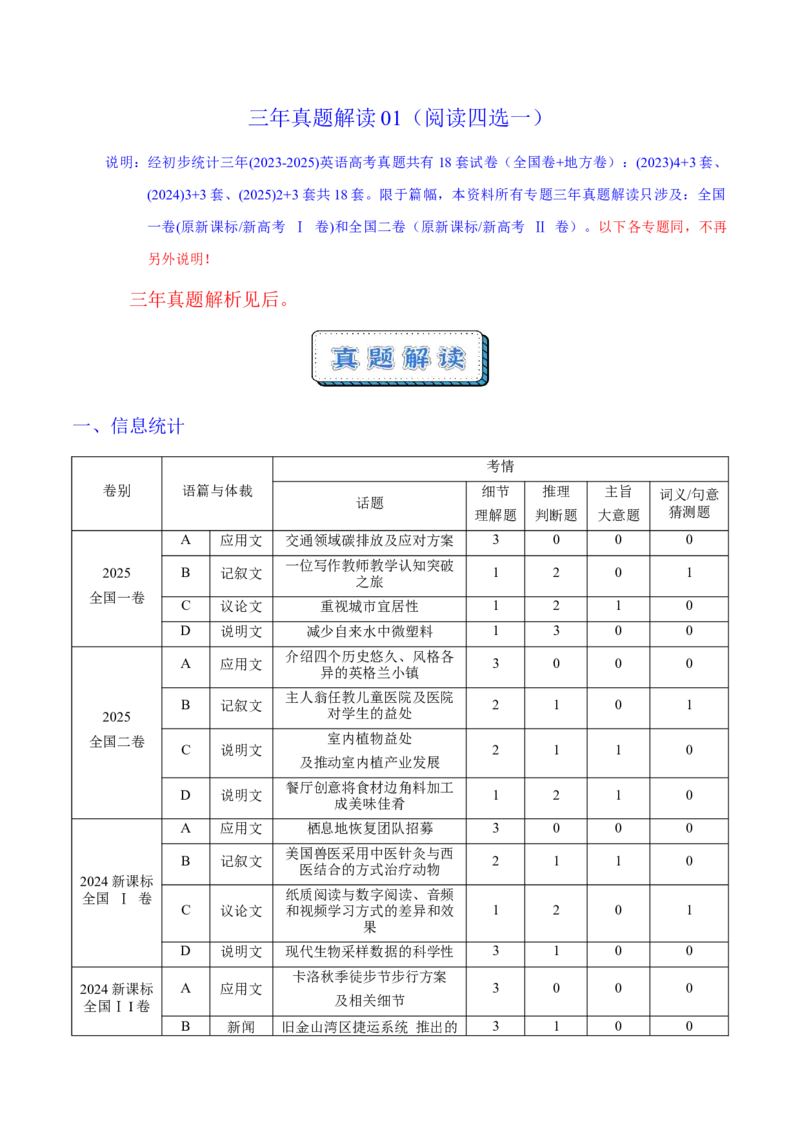
一、信息统计
卷别
语篇与体裁
考情
话题
细节
理解题
推理
判断题
主旨
大意题
词义/句意
猜测题
2025
全国一卷
A
应用文
交通领域碳排放及应对方案
3
0
0
0
B
记叙文
一位写作教师教学认知突破
之旅
1
2
0
1
C
议论文
重视城市宜居性
1
2
1
0
D
说明文
减少自来水中微塑料
1
3
0
0
2025
全国二卷
A
应用文
介绍四个历史悠久、风格各
异的英格兰小镇
3
0
0
0
B
记叙文
主人翁任教儿童医院及医院
对学生的益处
2
1
0
1
C
说明文
室内植物益处
及推动室内植产业发展
2
1
1
0
D
说明文
餐厅创意将食材边角料加工
成美味佳肴
1
2
1
0
2024 新课标
全国 Ⅰ 卷
A
应用文
栖息地恢复团队招募
3
0
0
0
B
记叙文
美国兽医采用中医针灸与西
医结合的方式治疗动物
2
1
1
0
C
议论文
纸质阅读与数字阅读、音频
和视频学习方式的差异和效
果
1
2
0
1
D
说明文
现代生物采样数据的科学性
3
1
0
0
2024 新课标
全国ⅠI 卷
A
应用文
卡洛秋季徒步节步行方案
及相关细节
3
0
0
0
B
新闻
旧金山湾区捷运系统 推出的
3
1
0
0
提升乘客出行体验的举措
C
说明文
巴比伦微农场的
一些主要优势
2
1
1
0
D
说明文
《AI by Design》一书介绍
及人工智能安全发展主张
1
2
0
1
2023 新课标
全国 Ⅰ 卷
A
应用文
阿姆斯特丹自行车租赁
与雇佣导游项目介绍
2
1
0
0
B
记叙文
John Todd 造生态机器净污水
2
2
0
0
C
说明文
极简生活与数字生活方式
1
2
0
1
D
说明文
群体智慧效应
1
2
1
0
2023 新课标
全国 ⅠI
卷
A
应用文
黄石公园护林员项目
3
0
0
0
B
记叙文
Abby Jaramillo 发起
Urban Sprouts 花园项目
1
2
1
0
C
说明文
纸质书籍和阅读
1
2
0
1
D
说明文
保护城市中的野生生态
1
3
0
0
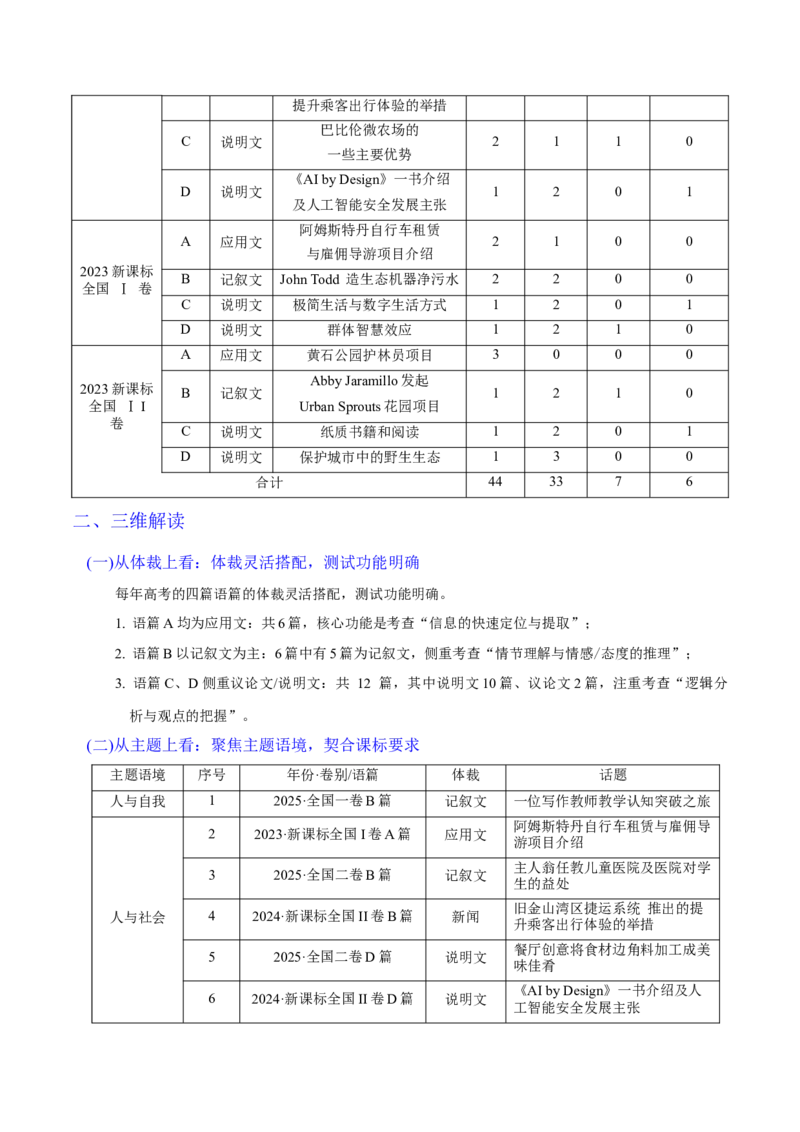
合计
44
33
7
6
二、三维解读
(一)从体裁上看:体裁灵活搭配,测试功能明确
每年高考的四篇语篇的体裁灵活搭配,测试功能明确。
1. 语篇A 均为应用文:共6 篇,核心功能是考查“信息的快速定位与提取”;
2. 语篇B 以记叙文为主:6 篇中有5 篇为记叙文,侧重考查“情节理解与情感/态度的推理”;
3. 语篇C、D 侧重议论文/说明文:共 12 篇,其中说明文10 篇、议论文2 篇,注重考查“逻辑分
析与观点的把握”。
(二)从主题上看:聚焦主题语境,契合课标要求
主题语境
序号
年份·卷别/语篇
体裁
话题
人与自我
1
2025·全国一卷B 篇
记叙文
一位写作教师教学认知突破之旅
人与社会
2
2023·新课标全国I 卷A 篇
应用文
阿姆斯特丹自行车租赁与雇佣导
游项目介绍
3
2025·全国二卷B 篇
记叙文
主人翁任教儿童医院及医院对学
生的益处
4
2024·新课标全国II 卷B 篇
新闻
旧金山湾区捷运系统 推出的提
升乘客出行体验的举措
5
2025·全国二卷D 篇
说明文
餐厅创意将食材边角料加工成美
味佳肴
6
2024·新课标全国II 卷D 篇
说明文
《AI by Design》一书介绍及人
工智能安全发展主张
7
2023·新课标全国I 卷C 篇
说明文
极简生活与数字生活方式
8
2023·新课标全国I 卷D 篇
说明文
群体智慧效应
9
2023·新课标全国II 卷C 篇
说明文
纸质书籍和阅读
10
2025·全国一卷C 篇
议论文
重视城市宜居性
11
2024·新课标全国I 卷C 篇
议论文
纸质阅读与数字阅读、音频和视
频学习方式的差异和效果
人与自然
12
2025·全国一卷A 篇
应用文
交通领域碳排放及应对方案
13
2025·全国二卷A 篇
应用文
介绍四个历史悠久、风格各异的
英格兰小镇
14
2024·新课标全国I 卷A 篇
应用文
栖息地恢复团队招募
15
2024·新课标全国II 卷A 篇
应用文
卡洛秋季徒步节步行方案及相关
细节
16
2023·新课标全国II 卷A 篇
应用文
黄石公园护林员项目
17
2024·新课标全国I 卷B 篇
记叙文
美国兽医采用中医针灸与西医结
合的方式治疗动物
18
2023·新课标全国I 卷B 篇
记叙文
John Todd 造生态机器净污水
19
2023·新课标全国II 卷B 篇
记叙文
Abby Jaramillo 发起 Urban
Sprouts 花园项目
20
2025·全国一卷D 篇
说明文
减少自来水中微塑料
21
2025·全国二卷C 篇
说明文
室内植物益处及推动室内植产业
发展
22
2024·新课标全国I 卷D 篇
说明文
现代生物采样数据的科学性
23
2024·新课标全国II 卷C 篇
说明文
巴比伦微农场的一些主要优势
24
2023·新课标全国II 卷D 篇
说明文
保护城市中的野生生态
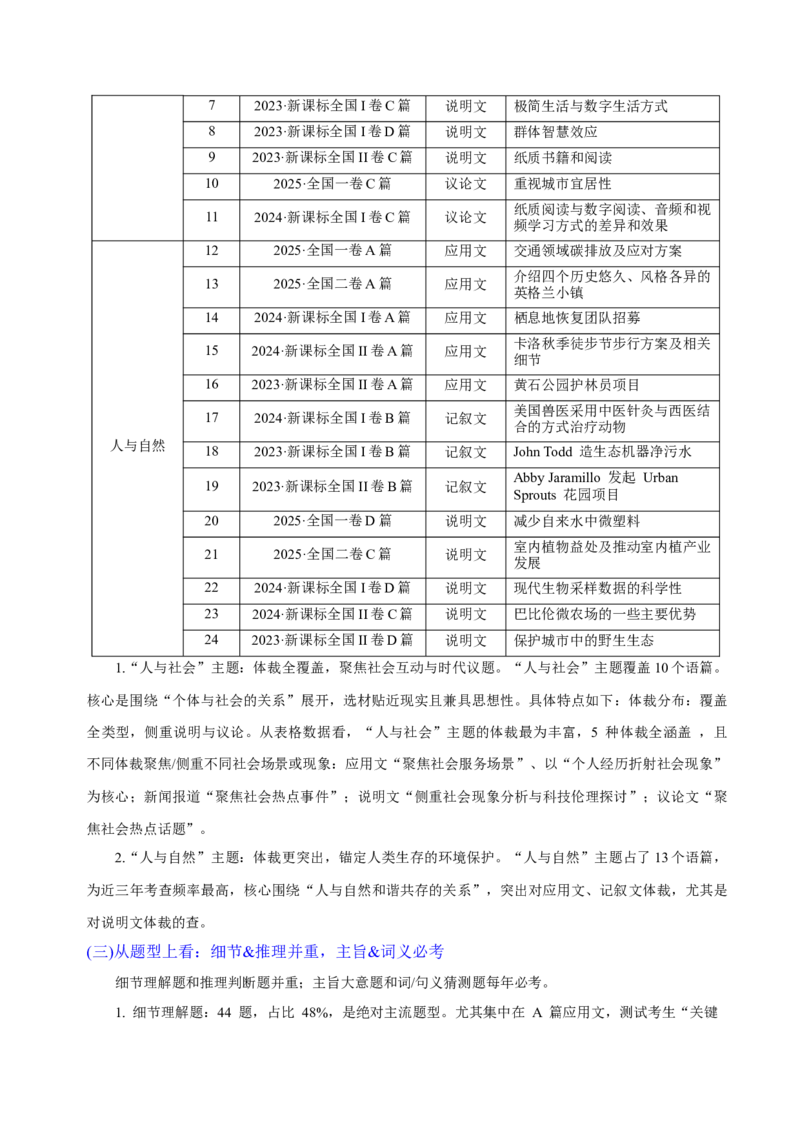
1.“人与社会”主题:体裁全覆盖,聚焦社会互动与时代议题。“人与社会”主题覆盖10 个语篇。
核心是围绕“个体与社会的关系”展开,选材贴近现实且兼具思想性。具体特点如下:体裁分布:覆盖
全类型,侧重说明与议论。从表格数据看,“人与社会”主题的体裁最为丰富,5 种体裁全涵盖 ,且
不同体裁聚焦/侧重不同社会场景或现象:应用文“聚焦社会服务场景”、以“个人经历折射社会现象”
为核心;新闻报道“聚焦社会热点事件”;说明文“侧重社会现象分析与科技伦理探讨”;议论文“聚
焦社会热点话题”。
2.“人与自然”主题:体裁更突出,锚定人类生存的环境保护。“人与自然”主题占了13 个语篇,
为近三年考查频率最高,核心围绕“人与自然和谐共存的关系”,突出对应用文、记叙文体裁,尤其是
对说明文体裁的查。
(三)从题型上看:细节&推理并重,主旨&词义必考
细节理解题和推理判断题并重;主旨大意题和词/句义猜测题每年必考。
1. 细节理解题:44 题,占比 48%,是绝对主流题型。尤其集中在 A 篇应用文,测试考生“关键
信息定位、信息同义替换”的能力。
2. 推理判断题:33 题,占比 36%,仅次于细节题。多分布在 B 篇记叙文(如“人物态度推
理”)和 C/D 篇说明/议论文(如“观点逻辑推理”),测试考生“上下文逻辑分析”的能力。
3. 主旨大意题:7 题,占比 8%,数量最少。仅出现在C/D 篇(如“议论文核心观点”“说明文
主旨概括”),测试考生“整体把握篇章”的能力。
4. 词(句)义猜测题:6 题,占比 8%,与主旨题持平。多分布在记叙文和说明文(如“陌生词汇、
指代关系”),测试考生“利用语境进行推导”的能力。
说明:按照三大主题语境(人与自我、人与社会和人与自然)归类。
一、“人与自我”类
记叙文
【2025·全国一卷】
B
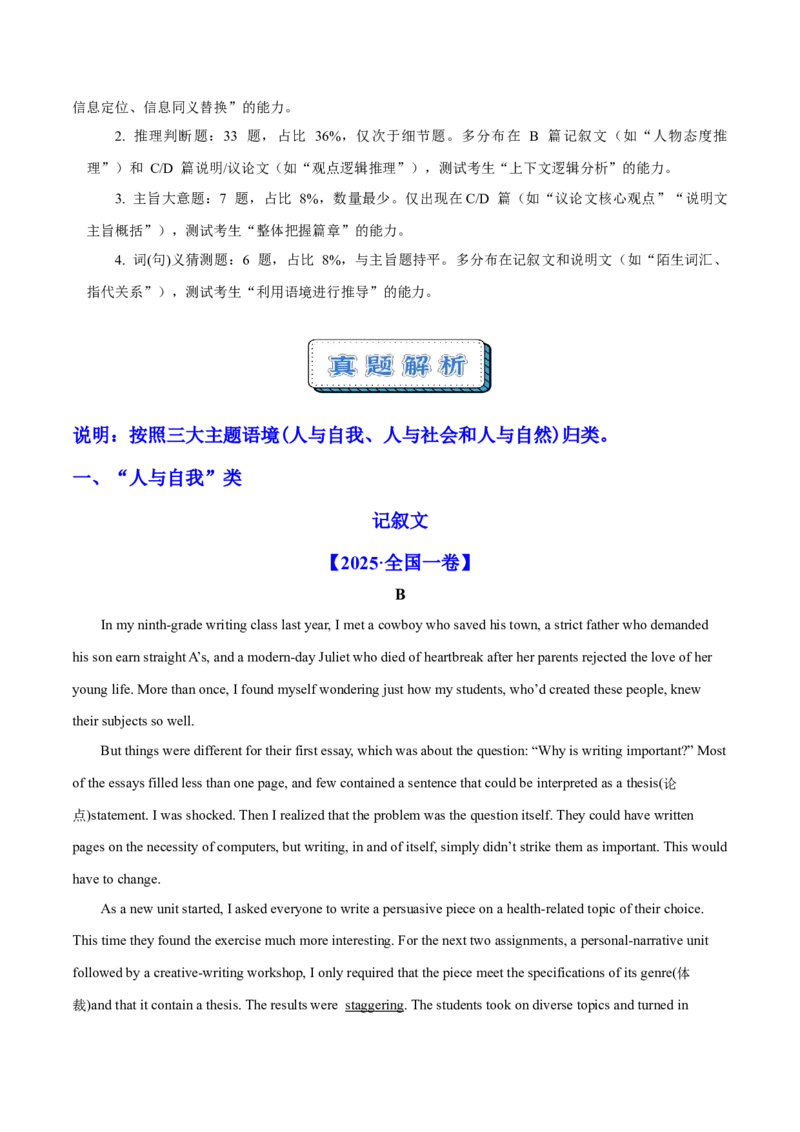
In my ninth-grade writing class last year, I met a cowboy who saved his town, a strict father who demanded
his son earn straight A’s, and a modern-day Juliet who died of heartbreak after her parents rejected the love of her
young life. More than once, I found myself wondering just how my students, who’d created these people, knew
their subjects so well.
But things were different for their first essay, which was about the question: “Why is writing important?” Most
of the essays filled less than one page, and few contained a sentence that could be interpreted as a thesis(论
点)statement. I was shocked. Then I realized that the problem was the question itself. They could have written
pages on the necessity of computers, but writing, in and of itself, simply didn’t strike them as important. This would
have to change.
As a new unit started, I asked everyone to write a persuasive piece on a health-related topic of their choice.
This time they found the exercise much more interesting. For the next two assignments, a personal-narrative unit
followed by a creative-writing workshop, I only required that the piece meet the specifications of its genre(体
裁)and that it contain a thesis. The results were staggering. The students took on diverse topics and turned in
stories, 10 to 20 pages each, with characters that broadened my view and touched my heart.
I walked into class believing that writing is important as a means of communication. However, my students
demonstrated something more important to me. When the final bell rang in June, I walked away with a yearbook
full of messages about writing’s most powerful significance — the ability to connect people, to put us in another’s
skin, to teach us what it means to be human.
24. Who are the people mentioned at the beginning of paragraph 1?
A. Ninth graders.
B. Students’ parents.
C. Modern writers.
D. Fictional characters.
25. Why did the students perform poorly in writing their first essay?
A. They were not given enough time.
B. They had a very limited vocabulary.
C. They misunderstood the question.
D. They had little interest in the topic.
26. What does the underlined word “staggering” in paragraph 3 mean?
A. Mixed.
B. Amazing.
C. Similar.
D. Disturbing.
27. What does the author’s experience show?
A. Teaching is learning.
B. Still waters run deep.
C. Knowledge is power.
D. Practice makes perfect.
二、“人与社会”类
应用文
【2023·新课标全国 Ⅰ 卷】
A
Bike Rental & Guided Tours
Welcome to Amsterdam, welcome to MacBike. You see much more from the seat of a bike! Cycling is the
most economical, sustainable and fun way to explore the city, with its beautiful canals, parks, squares and countless
lights. You can also bike along lovely landscapes outside of Amsterdam.
Why MacBike
MacBike has been around for almost 30 years and is the biggest bicycle rental company in Amsterdam. With
over 2,500 bikes stored in our five rental shops at strategic locations, we make sure there is always a bike available
for you. We offer the newest bicycles in a wide variety, including basic bikes with foot brake(刹车), bikes with
hand brake and gears(排挡), bikes with child seats, and children’s bikes.
Prices
Hand Brake, Three Gears
Foot Brake, No Gears
1 hour
€7.50
€5.00
3 hours
€11.00
€7.50
1 day(24 hours)
€14.75
€9.75
Each additional day
€8.00
€6.00
Guided City Tours
The 2.5-hour tour covers the Gooyer Windmill, the Skinny Bridge, the Rijksmuseum, Heineken Brewery and
much more. The tour departs from Dam Square every hour on the hour, starting at 1:00 pm every day. You can buy
your ticket in a MacBike shop or book online.
21. What is an advantage of MacBike?
A. It gives children a discount.
B. It offers many types of bikes.
C. It organizes free cycle tours.
D. It has over 2,500 rental shops.
22. How much do you pay for renting a bike with hand brake and three gears for two days?
A. €15.75.
B. €19.50.
C. €22.75.
D. €29.50.
23. Where does the guided city tour start?
A. The Gooyer, Windmill.
B. The Skinny Bridge.
C. Heineken Brewery.
D. Dam Square.
记叙文&新闻报道
【2025·全国二卷】
B
Kathy Ho teaches high school inside Lucile Packard Children’s Hospital Stanford(LPCH). “Sometimes I don’t
like saying that I’m a teacher,” says Ho. “People get in their minds an idea of what teachers do, but that’s not really
what it is here.”
“Here” is room 386, where each year, about 500 LPCH patients also become students. The hospital school is
free of parents, doctors, and medical procedures. It’s a place of learning. About half of Ho’s students stay for a
week or less; others are there for more than a year. Most of Ho’s students will recover, which means that preparing
them to return to school is an increasingly important component of care.
Still, in room 386, academics don’t come first. Physical health and mental health are the priority. “If you’re
scared about something and thinking only about that, there’s no way you’re going to be able to learn,” Ho says.
“I’m a coach, an adviser, and a comforter, and that’s what it means to be a hospital teacher.”
There are up to 30 students at any given time in Ho’s class. She generally works with their regular teachers to
get lessons and tests being used at their home schools. Some teachers don’t give the kids any assignments; they
express sympathy instead. “I feel like it is a disservice to the kids,” Ho says. “They think their teachers don’t care
about their schoolwork.”
Ho recognizes the psychological benefit of helping kids keep up with their peers(同龄人)outside the hospital.
“I actually think the medicine is only a small piece for some problems,” says Julie Good, director of pain
management services at LPCH. “It’s about problem-solving around what it means to have a full life. Those kids
have dreams. School can keep those dreams alive by giving kids a way to learn and grow.”
24. Who does Ho teach at LPCH?
A. Sick children.
B. Young nurses.
C. Medical students.
D. Patients’ parents.
25. What is a characteristic of Ho’s job?
A. Prioritizing academics.
B. Encouraging innovation.
C. Treating various diseases.
D. Playing multiple roles.
26. What does the underlined word “it” refer to in paragraph 4?
A. Offering regular lessons.
B. Paying extra attention.
C. Assigning no schoolwork.
D. Showing no sympathy.
27. How does the hospital school benefit the students according to Good?
A. It eases peer pressure.
B. It helps them live in hope.
C. It frees them from aches.
D. It entertains them with stories.
【2024·新课标全国 Ⅱ 卷】
B
Do you ever get to the train station and realize you forgot to bring something to read? Yes, we all have our
phones, but many of us still like to go old school and read something printed.
Well, there’s a kiosk(小亭)for that. In the San Francisco Bay Area, at least.
“You enter the fare gates(检票口)and you’ll see a kiosk that is lit up and it tells you can get a one-minute, a
three-minute, or a five-minute story,” says Alicia Trost, the chief communications officer for the San Francisco Bay
Area Rapid Transit — known as BART. “You choose which length you want and it gives you a receipt-like short
story.”
It’s that simple. Riders have printed nearly 20,000 short stories and poems since the program was launched last
March. Some are classic short stories, and some are new original works.
Trost also wants to introduce local writers to local riders. “We wanted to do something where we do a call to
artists in the Bay Area to submit stories for a contest,” Trost says. “And as of right now, we’ve received about 120
submissions. The winning stories would go into our kiosk and then you would be a published artist.”
Ridership on transit(交通)systems across the country has been down the past half century, so could short
stories save transit?
Trost thinks so.
“At the end of the day all transit agencies right now are doing everything they can to improve the rider
experience. So I absolutely think we will get more riders just because of short stories,” she says.
And you’ll never be without something to read.
24. Why did BART start the kiosk program?
A. To promote the local culture.
B. To discourage phone use.
C. To meet passengers’ needs.
D. To reduce its running costs.
25. How are the stories categorized in the kiosk?
A. By popularity.
B. By length.
C. By theme.
D. By language.
26. What has Trost been doing recently?
A. Organizing a story contest.
B. Doing a survey of customers.
C. Choosing a print publisher.
D. Conducting interviews with artists.
27. What is Trost’s opinion about BART’s future?
A. It will close down.
B. Its profits will decline.
C. It will expand nationwide.
D. Its ridership will increase.
说明文
【2025·全国二卷】
D
Does your soul die a little every time you throw away unused food? Mine does. Maybe that feeling comes
from growing up in South Africa, where the phrase “there are children starving in Africa” was more of an
uncomfortable reminder of fact than a prayer at dinner time.
Food waste is a growing concern in the restaurant, supermarket, and supply chain industries. From
technological solutions to educational campaigns, food producers and sellers are looking for ways to use more of
what we’re already growing. But last month, one popular New York City restaurant tried a different way: It
changed its menu to exclusively(专门)offer food that would otherwise be thrown away.
For two weeks in March, Greenwich Village’s Blue Hill restaurant was renamed wastED, and served items
like fried skate cartilage, a juice pulp burger, and a dumpster diver’s vegetable salad. Each dish was tailor-made to
raise awareness regarding food waste.
A study by the Food Waste Alliance determined that the average restaurant generates 33 pounds of food waste
for every $1,000 in revenue(收入), and of that waste only 15.7% is donated or recycled. Up to 84.3% is simply
thrown out. Restaurants like Silo in the UK have experimented with zero-waste systems, but wastED took the
concept to its logical conclusion.
It should be noted that none of the items on wastED’s menu was technically made from garbage. Instead, all
the ingredients(配料)used were examples of meat cuts and produce that most restaurants would never consider
serving. Things like kale ribs, fish collars, rejected sweet potatoes, and cucumber butts were all re-appropriated and,
with the help of a number of good chefs, turned into excellent cuisine.
Though wastED received enthusiastic reviews, it was designed from the start as a short-lived experiment; Blue
Hill has since returned to its regular menu. Nevertheless, it serves as a reminder that there are many ways to address
problems of sustainability, and that you can make an amazing meal out of almost anything.
32. What can be inferred about the author’s early life?
A. He witnessed food shortage.
B. He enjoyed the local cuisine.
C. He donated food to Africans.
D. He helped to cook at home.
33. Why did Blue Hill carry out the experiment?
A. To customize dishes for guests.
B. To make the public aware of food waste.
C. To test a food processing method.
D. To improve the UK’s zero-waste systems.
34. What is paragraph 5 mainly about?
A. Why the ingredients were used.
B. Which dishes were best liked.
C. What the dishes were made of.
D. Where the ingredients were bought.
35. What can we learn about wastED?
A. It has ended as planned.
B. It is creating new jobs.
C. It has regained popularity.
D. It is criticized by top chefs.
【2024·新课标全国 Ⅱ 卷】
D
Given the astonishing potential of AI to transform our lives, we all need to take action to deal with our AI-
powered future, and this is where AI by Design: A Plan for Living with Artificial Intelligence comes in. This
absorbing new book by Catriona Campbell is a practical roadmap addressing the challenges posed by the
forthcoming AI revolution(变革).
In the wrong hands, such a book could prove as complicated to process as the computer code(代码)that
powers AI but, thankfully, Campbell has more than two decades’ professional experience translating the heady into
the understandable. She writes from the practical angle of a business person rather than as an academic, making for
a guide which is highly accessible and informative and which, by the close, will make you feel almost as smart as
AI.
As we soon come to learn from AI by Design, AI is already super-smart and will become more capable,
moving from the current generation of “narrow-AI” to Artificial General Intelligence. From there, Campbell says,
will come Artificial Dominant Intelligence. This is why Campbell has set out to raise awareness of AI and its future
now — several decades before these developments are expected to take place. She says it is essential that we keep
control of artificial intelligence, or risk being sidelined and perhaps even worse.
Campbell’s point is to wake up those responsible for AI—the technology companies and world leaders—so
they are on the same page as all the experts currently developing it. She explains we are at a “tipping point” in
history and must act now to prevent an extinction-level event for humanity. We need to consider how we want our
future with AI to pan out. Such structured thinking, followed by global regulation, will enable us to achieve
greatness rather than our downfall.
AI will affect us all, and if you only read one book on the subject, this is it.
32. What does the phrase “In the wrong hands” in paragraph 2 probably mean?
A. If read by someone poorly educated.
B. If reviewed by someone ill-intentioned.
C. If written by someone less competent.
D. If translated by someone unacademic.
33. What is a feature of AI by Design according to the text?
A. It is packed with complex codes.
B. It adopts a down-to-earth writing style.
C. It provides step-by-step instructions.
D. It is intended for AI professionals.
34. What does Campbell urge people to do regarding AI development?
A. Observe existing regulations on it.
B. Reconsider expert opinions about it.
C. Make joint efforts to keep it under control.
D. Learn from prior experience to slow it down.
35. What is the author’s purpose in writing the text?
A. To recommend a book on AI.
B. To give a brief account of AI history.
C. To clarify the definition of AI.
D. To honor an outstanding AI expert.
【2023·新课标全国 Ⅰ 卷】
C
The goal of this book is to make the case for digital minimalism, including a detailed exploration of what it
asks and why it works, and then to teach you how to adopt this philosophy if you decide it’s right for you.
To do so, I divided the book into two parts. In part one, I describe the philosophical foundations of digital
minimalism, starting with an examination of the forces that are making so many people’s digital lives increasingly
intolerable, before moving on to a detailed discussion of the digital minimalism philosophy.
Part one concludes by introducing my suggested method for adopting this philosophy: the digital declutter.
This process requires you to step away from optional online activities for thirty days. At the end of the thirty days,
you will then add back a small number of carefully chosen online activities that you believe will provide massive
benefits to the things you value.
In the final chapter of part one, I’ll guide you through carrying out your own digital declutter. In doing so, I’ll
draw on an experiment I ran in 2018 in which over 1,600 people agreed to perform a digital declutter. You’ll hear
these participants’ stories and learn what strategies worked well for them, and what traps they encountered that you
should avoid.
The second part of this book takes a closer look at some ideas that will help you cultivate(培养)a sustainable
digital minimalism lifestyle. In these chapters, I examine issues such as the importance of solitude(独处)and the
necessity of cultivating high-quality leisure to replace the time most now spent on mindless device use. Each
chapter concludes with a collection of practices, which are designed to help you act on the big ideas of the chapter.
You can view these practices as a toolbox meant to aid your efforts to build a minimalist lifestyle that works for
your particular circumstances.
28. What is the book aimed at?
A. Teaching critical thinking skills.
B. Advocating a simple digital lifestyle.
C. Solving philosophical problems.
D. Promoting the use of a digital device.
29. What does the underlined word “declutter” in paragraph 3 mean?
A. Clear-up.
B. Add-on.
C. Check-in.
D. Take-over.
30. What is presented in the final chapter of part one?
A. Theoretical models.
B. Statistical methods.
C. Practical examples.
D. Historical analyses.
31. What does the author suggest readers do with the practices offered in part two?
A. Use them as needed.
B. Recommend them to friends.
C. Evaluate their effects.
D. Identify the ideas behind them.
【2023·新课标全国 Ⅰ 卷】
D
On March 7, 1907, the English statistician Francis Galton published a paper which illustrated what has come
to be known as the “wisdom of crowds” effect. The experiment of estimation he conducted showed that in some
cases, the average of a large number of independent estimates could be quite accurate.
This effect capitalizes on the fact that when people make errors, those errors aren’t always the same. Some
people will tend to overestimate, and some to underestimate. When enough of these errors are averaged together,
they cancel each other out, resulting in a more accurate estimate. If people are similar and tend to make the same
errors, then their errors won’t cancel each other out. In more technical terms, the wisdom of crowds requires that
people’s estimates be independent. If for whatever reasons, people’s errors become correlated or dependent, the
accuracy of the estimate will go down.
But a new study led by Joaquin Navajas offered an interesting twist(转折)on this classic phenomenon. The key
finding of the study was that when crowds were further divided into smaller groups that were allowed to have a
discussion, the averages from these groups were more accurate than those from an equal number of independent
individuals. For instance, the average obtained from the estimates of four discussion groups of five was
significantly more accurate than the average obtained from 20 independent individuals.
In a follow-up study with 100 university students, the researchers tried to get a better sense of what the group
members actually did in their discussion. Did they tend to go with those most confident about their estimates? Did
they follow those least willing to change their minds? This happened some of the time, but it wasn’t the dominant
response. Most frequently, the groups reported that they “shared arguments and reasoned together”. Somehow,
these arguments and reasoning resulted in a global reduction in error. Although the studies led by Navajas have
limitations and many questions remain, the potential implications for group discussion and decision-making are
enormous.
32. What is paragraph 2 of the text mainly about?
A. The methods of estimation.
B. The underlying logic of the effect.
C. The causes of people’s errors.
D. The design of Galton’s experiment.
33. Navajas’ study found that the average accuracy could increase even if ________.
A. the crowds were relatively small
B. there were occasional underestimates
C. individuals did not communicate
D. estimates were not fully independent
34. What did the follow-up study focus on?
A. The size of the groups.
B. The dominant members.
C. The discussion process.
D. The individual estimates.
35. What is the author’s attitude toward Navajas’ studies?
A. Unclear.
B. Dismissive.
C. Doubtful.
D. Approving.
【2023·新课标全国 Ⅱ 卷】
C
Reading Art: Art for Book Lovers is a celebration of an everyday object — the book, represented here in
almost three hundred artworks from museums around the world. The image of the reader appears throughout
history, in art made long before books as we now know them came into being. In artists’ representations of books
and reading, we see moments of shared humanity that go beyond culture and time.
In this “book of books,” artworks are selected and arranged in a way that emphasizes these connections
between different eras and cultures. We see scenes of children learning to read at home or at school, with the book
as a focus for relations between the generations. Adults are portrayed(描绘)alone in many settings and poses —
absorbed in a volume, deep in thought or lost in a moment of leisure. These scenes may have been painted hundreds
of years ago, but they record moments we can all relate to.
Books themselves may be used symbolically in paintings to demonstrate the intellect(才智), wealth or faith of
the subject. Before the wide use of the printing press, books were treasured objects and could be works of art in
their own right. More recently, as books have become inexpensive or even throwaway, artists have used them as the
raw material for artworks — transforming covers, pages or even complete volumes into paintings and sculptures.
Continued developments in communication technologies were once believed to make the printed page
outdated. From a 21st-century point of view, the printed book is certainly ancient, but it remains as interactive as
any battery-powered e-reader. To serve its function, a book must be activated by a user: the cover opened, the pages
parted, the contents reviewed, perhaps notes written down or words underlined. And in contrast to our increasingly
networked lives where the information we consume is monitored and tracked, a printed book still offers the chance
of a wholly private, “off-line” activity.
28. Where is the text most probably taken from?
A. An introduction to a book.
B. An essay on the art of writing.
C. A guidebook to a museum.
D. A review of modern paintings.
29. What are the selected artworks about?
A. Wealth and intellect.
B. Home and school.
C. Books and reading.
D. Work and leisure.
30. What do the underlined words “relate to” in paragraph 2 mean?
A. Understand.
B. Paint.
C. Seize.
D. Transform.
31. What does the author want to say by mentioning the e-reader?
A. The printed book is not totally out of date.
B. Technology has changed the way we read.
C. Our lives in the 21st century are networked.
D. People now rarely have the patience to read.
议论文
【2025·全国一卷】
C
While safety improvements might have been made to our streets in recent years, transport studies also show
declines in pedestrian(行人)mobility, especially among young children. Many parents say there’s too much traffic
on the roads for their children to walk safely to school, so they pack them into the car instead.
Dutch authors Thalia Verkade and Marco te Brömmelstroet are bothered by facts like these. In their new book
Movement: How to Take Back Our Streets and Transform Our Lives, they call for a rethink of our streets and the
role they play in our lives.
Life on city streets started to change decades ago. Whole neighbourhoods were destroyed to make way for
new road networks and kids had to play elsewhere. Some communities fought back. Most famously, a Canadian
journalist who had moved her family to Manhattan in the early 1950s led a campaign to stop the destruction of her
local park. Describing her alarm at its proposed replacement with an expressway, Jane Jacobs called on her
mayor(市长)to champion “New York as a decent place to live, and not just rush through.” Similar campaigns
occurred in Australia in the late 1960s and 1970s as well.
Although these campaigns were widespread, the reality is that the majority of the western cities were
completely redesigned around the needs of the motor car. The number of cars on roads has been increasing rapidly.
In Australia we now have over twenty million cars for just over twenty-six million people, among the highest rate
of car ownership in the world.
We invest a lot in roads that help us rush through, but we fail to account for the true costs. Do we really
recognise what it costs us as a society when children can’t move safely around our communities? The authors of
Movement have it right: it’s time to think differently about that street outside your front door.
28. What phenomenon does the author point out in paragraph 1?
A. Cars often get stuck on the road.
B. Traffic accidents occur frequently.
C. People walk less and drive more.
D. Pedestrians fail to follow the rules.
29. What were the Canadian journalist and other campaigners trying to do?
A. Keep their cities livable.
B. Promote cultural diversity.
C. Help the needy families.
D. Make expressways accessible.
30. What can be inferred about the campaigns in Australia in the late 1960s and 1970s?
A. They boosted the sales of cars.
B. They turned out largely ineffective.
C. They won government support.
D. They advocated building new parks.
31. What can be a suitable title for the text?
A. Why the Rush?
B. What’s Next?
C. Where to Stay?
D. Who to Blame?
【2024·新课标全国 Ⅰ 卷】
C
Is comprehension the same whether a person reads a text onscreen or on paper? And are listening to and
viewing content as effective as reading the written word when covering the same material? The answers to both
questions are often “no”. The reasons relate to a variety of factors, including reduced concentration, an
entertainment mindset(心态)and a tendency to multitask while consuming digital content.
When reading texts of several hundred words or more, learning is generally more successful when it’s on
paper than onscreen. A large amount of research confirms this finding. The benefits of print reading particularly
shine through when experimenters move from posing simple tasks — like identifying the main idea in a reading
passage — to ones that require mental abstraction — such as drawing inferences from a text.
The differences between print and digital reading results are partly related to paper’s physical properties. With
paper, there is a literal laying on of hands, along with the visual geography of distinct pages. People often link their
memory of what they’ve read to how far into the book it was or where it was on the page.
But equally important is the mental aspect. Reading researchers have proposed a theory called “shallowing
hypothesis(假说)”. According to this theory, people approach digital texts with a mindset suited to social media,
which are often not so serious, and devote less mental effort than when they are reading print.
Audio(音频)and video can feel more engaging than text, and so university teachers increasingly turn to these
technologies — say, assigning an online talk instead of an article by the same person. However, psychologists have
demonstrated that when adults read news stories, they remember more of the content than if they listen to or view
identical pieces.
Digital texts, audio and video all have educational roles, especially when providing resources not available in
print. However, for maximizing learning where mental focus and reflection are called for, educators shouldn’t
assume all media are the same, even when they contain identical words.
28. What does the underlined phrase “shine through” in paragraph 2 mean?
A. Seem unlikely to last.
B. Seem hard to explain.
C. Become ready to use.
D. Become easy to notice.
29. What does the shallowing hypothesis assume?
A. Readers treat digital texts lightly.
B. Digital texts are simpler to understand.
C. People select digital texts randomly.
D. Digital texts are suitable for social media.
30. Why are audio and video increasingly used by university teachers?
A. They can hold students' attention.
B. They are more convenient to prepare.
C. They help develop advanced skills.
D. They are more informative than text.
31. What does the author imply in the last paragraph?
A. Students should apply multiple learning techniques.
B. Teachers should produce their own teaching material.
C. Print texts cannot be entirely replaced in education.
D. Education outside the classroom cannot be ignored.
三、“人与自然”类
应用文
【2025·全国一卷】
A
The greening of planes, trains and automobiles
Moving goods and people around the world is responsible for a large part of global CO2 emissions(排放). As
the world races to decarbonize everything, it faces particular problems with transportation — which accounts for
about a quarter of our energy-related greenhouse gas emissions. Here’s the breakdown of the emissions in 2018 for
different modes of transport.
The fuels for transport need to be not just green, cheap and powerful, but also lightweight and safe enough to
be carried around. Each mode of transport has its specific fuel needs. Much is still to be settled, but here are some
of the solutions to get us going green.
PLANES — Synthetic hydrocarbons
The hardest sector to decarbonize is aviation.
One long-term option for sustainable fuel for
planes is to make hydrocarbons from recycled
air.
CARS — Batteries
Batteries are energy-efficient and electric
cars can plug into existing systems and
services. New solid-state batteries will take a
car farther on a single charge.
TRAINS — Electricity
Some trains are already
electrified through rails or
wires; others can be made
electric in pretty simple
ways.
TRUCKS — Hydrogen
fuel cells
Hydrogen fuel cells are a
lighter choice than batteries
for trucks, but making green
hydrogen is expensive.
SHIPS — Liquid ammonia
Liquid ammonia is easy to
keep and transport, but it is
hard to ignite( 点燃)and
requires an engine redesign.
This energy transition(变革)is global, and the amount of renewable energy the world will need is “a little bit
mind-blowing,” says mechanical engineer Keith Wipke at the National Renewable Energy Laboratory. It’s
estimated that the global demand for electricity could more than double by 2050. Fortunately, analyses suggest that
renewables are up to the task. “We need to speed up the development of green energy, and it will all get used,” says
Wipke.
21. What percentage of global transport emissions did road vehicles account for in 2018?
A. 11.6%.
B. 45.1%.
C. 74.5%.
D. 86.1%.
22. Which mode of transport can go green comparatively easily?
A. Planes.
B. Trucks.
C. Trains.
D. Ships.
23. What does Wipke suggest regarding energy transition?
A. Limiting fuel consumption.
B. Putting more effort into renewables.
C. Improving energy efficiency.
D. Making electricity more affordable.
【2025·全国二卷】
A
English Market Towns to Visit in the UK
English market towns come in many shapes and sizes. Each has a personality shaped by the goods and
services produced and traded for centuries. But each town has more to do than shop.
Hereford, Herefordshire
Hereford has remained a lively market town since 1189. Skirting the town square, you’ll find lovely shops,
eateries, and the Black and White House Museum. The Hereford Cathedral is the most impressive building in town.
It’s also home to an ancient library. One of the four original copies of the Magna Carta is displayed there.
Ludlow, Shropshire
Ludlow is known as the Foodie Center of England. Butcher shops, greengrocers, bakeries, and cheese shops
line the town square. Bordering the square, the Ludlow Castle is a “must explore” medieval stronghold. The three-
day Ludlow Food Festival is held each September.
Shrewsbury, Shropshire
Getting to Shrewsbury Town Center from London is challenging but worth the anxiety. The River Severn has a
significant turn through town, almost making an island of Shrewsbury Town Center. The shape creates a perfect
market where goods could be shipped and received using the river as a highway. Flowers are everywhere-hanging
baskets, window boxes, and planters-just what you imagine in an attractive English market town.
Mevagissey, Cornwall
Even if you haven’t been to the small fishing village Mevagissey, you’ve probably seen it in a movie or British
TV show. The working harbor(港口)took shape in 1774. Fishermen go out to sea daily and sell their fish in harbor-
side markets. Don’t leave the harbor without a traditional Cornish pie. It’s delicious.
21. Where can you find an original copy of the Magna Carta?
A. In the Ludlow Castle.
B. In the Foodie Center of England.
C. In the Hereford Cathedral.
D. In the Black and White House Museum.
22. What is a feature of Shrewsbury Town Center?
A. It’s situated near a big island.
B. It’s almost surrounded by water.
C. It’s known for its flower festival.
D. It’s easily accessible from London.
23. What does the author suggest visitors do in Mevagissey?
A. Try the Cornish pie.
B. Watch a British TV show.
C. Go fishing in the sea.
D. Take pictures of the harbor.
【2024·新课标全国 Ⅰ 卷】
A
HABITAT RESTORATION TEAM
Help restore and protect Marin’s natural areas from the Marin Headlands to Bolinas Ridge. We'll explore
beautiful park sites while conducting invasive(侵入的)plant removal, winter planting, and seed collection. Habitat
Restoration Team volunteers play a vital role in restoring sensitive resources and protecting endangered species
across the ridges and valleys.
GROUPS
Groups of five or more require special arrangements and must be confirmed in advance. Please review the List
of Available Projects and fill out the Group Project Request Form.
AGE, SKILLS, WHAT TO BRING
Volunteers aged 10 and over are welcome. Read our Youth Policy Guidelines for youth under the age of 15.
Bring your completed Volunteer Agreement Form. Volunteers under the age of 18 must have the
parent/guardian approval section signed.
We'll be working rain or shine. Wear clothes that can get dirty. Bring layers for changing weather and a
raincoat if necessary.
Bring a personal water bottle, sunscreen, and lunch.
No experience necessary. Training and tools will be provided. Fulfills(满足)community service requirements.
UPCOMING EVENTS
Time
Meeting Location
Sunday, Jan. 15  10:00 am — 1:00 pm
Battery Alexander Trailhead
Sunday, Jan. 22  10:00 am — 2:30 pm
Stinson Beach Parking Lot
Sunday, Jan. 29  9:30 am — 2:30 pm
Coyote Ridge Trailhead
21. What is the aim of the Habitat Restoration Team?
A. To discover mineral resources.
B. To develop new wildlife parks.
C. To protect the local ecosystem.
D. To conduct biological research.
22. What is the lower age limit for joining the Habitat Restoration Team?
A. 5.
B. 10.
C. 15.
D. 18.
23. What are the volunteers expected to do?
A. Bring their own tools.
B. Work even in bad weather.
C. Wear a team uniform.
D. Do at least three projects.
【2024·新课标全国 Ⅱ 卷】
A
Choice of Walks for Beginner and Experienced Walkers
The Carlow Autumn Walking Festival is a great opportunity for the beginner, experienced or advanced walker
to enjoy the challenges of Carlow’s mountain hikes or the peace of its woodland walks.
Walk 1 — The Natural World
With environmentalist Éanna Lamhna as the guide, this walk promises to be an informative tour. Walkers are
sure to learn lots about the habitats and natural world of the Blackstairs.
Date and Time: Saturday, 1st October, at 09:00
Start Point: Scratoes Bridge
Walk Duration: 6 hours
Walk 2 — Introduction to Hillwalking
Emmanuel Chappard, an experienced guide, has a passion for making the great outdoors accessible to all. This
mountain walk provides an insight into the skills required for hillwalking to ensure you get the most from future
walking trips.
Date and Time: Sunday, 2nd October, at 09:00
Start Point: Deerpark Car Park
Walk Duration: 5 hours
Walk 3 — Moonlight Under the Stars
Walking at night-time is a great way to step out of your comfort zone. Breathtaking views of the lowlands of
Carlow can be enjoyed in the presence of welcoming guides from local walking clubs. A torch(手电筒)along with
suitable clothing is essential for walking in the dark. Those who are dressed inappropriately will be refused
permission to participate.
Date and Time: Saturday, 1st October, at 18:30
Start Point: The Town Hall
Walk Duration: 3 hours
Walk 4 — Photographic Walk in Kilbrannish Forest
This informative walk led by Richard Smyth introduces you to the basic principles of photography in the wild.
Bring along your camera and enjoy the wonderful views along this well-surfaced forest path.
Date and Time: Sunday, 2nd October, at 11:45
Start Point: Kilbrannish Forest Recreation Area
Walk Duration: 1.5 hours
21. Which walk takes the shortest time?
A. The Natural World.
B. Introduction to Hillwalking.
C. Moonlight Under the Stars.
D. Photographic Walk in Kilbrannish Forest.
22. What are participants in Walk 3 required to do?
A. Wear proper clothes.
B. Join a walking club.
C. Get special permits.
D. Bring a survival guide.
23. What do the four walks have in common?
A. They involve difficult climbing.
B. They are for experienced walkers.
C. They share the same start point.
D. They are scheduled for the weekend.
【2023·新课标全国 Ⅱ 卷】
A
Yellowstone National Park offers a variety of ranger programs throughout the park, and throughout the year.
The following are descriptions of the ranger programs this summer.
Experiencing Wildlife in Yellowstone(May 26 to September 2)
Whether you’re hiking a backcountry trail(小径), camping, or just enjoying the park’s amazing wildlife from
the road, this quick workshop is for you and your family. Learn where to look for animals and how to safely enjoy
your wildlife watching experience. Meet at the Canyon Village Store.
Junior Ranger Wildlife Olympics(June 5 to August 21)
Kids can test their skills and compare their abilities to the animals of Yellowstone. Stay for as little or as long
as your plans allow. Meet in front of the Visitor Education Center.
Canyon Talks at Artist Point(June 9 to September 2)
From a classic viewpoint, enjoy Lower Falls, the Yellowstone River, and the breathtaking colors of the
canyon(峡谷)while learning about the area’s natural and human history. Discover why artists and photographers
continue to be drawn to this special place. Meet on the lower platform at Artist Point on the South Rim Drive for
this short talk.
Photography Workshops(June 19 & July 10)
Enhance your photography skills — join Yellowstone’s park photographer for a hands-on program to inspire
new and creative ways of enjoying the beauty and wonder of Yellowstone.
6/19 — Waterfalls &Wide Angles: meet at Artist Point.
7/10 — Wildflowers &White Balance: meet at Washburn Trailhead in Chittenden parking area.
21. Which of the four programs begins the earliest?
A. Photography Workshops.
B. Junior Ranger Wildlife Olympics.
C. Canyon Talks at Artist Point.
D. Experiencing Wildlife in Yellowstone.
22. What is the short talk at Artist Point about?
A. Works of famous artists.
B. Protection of wild animals.
C. Basic photography skills.
D. History of the canyon area.
23. Where will the participants meet for the July 10 photography workshop?
A. Artist Point.
B. Washburn Trailhead.
C. Canyon Village Store.
D. Visitor Education Center.
记叙文
【2024·新课标全国 Ⅰ 卷】
B
“I am not crazy,” says Dr. William Farber, shortly after performing acupuncture(针灸)on a rabbit. “I am ahead
of my time.” If he seems a little defensive, it might be because even some of his coworkers occasionally laugh at
his unusual methods. But Farber is certain he’ll have the last laugh. He’s one of a small but growing number of
American veterinarians(兽医)now practicing “holistic” medicine-combining traditional Western treatments with
acupuncture, chiropractic(按摩疗法)and herbal medicine.
Farber, a graduate of Colorado State University, started out as a more conventional veterinarian. He became
interested in alternative treatments 20 years ago when he suffered from terrible back pain. He tried muscle-relaxing
drugs but found little relief. Then he tried acupuncture, an ancient Chinese practice, and was amazed that he
improved after two or three treatments. What worked on a veterinarian seemed likely to work on his patients. So,
after studying the techniques for a couple of years, he began offering them to pets.
Leigh Tindale’s dog Charlie had a serious heart condition. After Charlie had a heart attack, Tindale says, she
was prepared to put him to sleep, but Farber’s treatments eased her dog’s suffering so much that she was able to
keep him alive for an additional five months. And Priscilla Dewing reports that her horse, Nappy, “moves more
easily and rides more comfortably” after a chiropractic adjustment.
Farber is certain that the holistic approach will grow more popular with time, and if the past is any indication,
he may be right: Since 1982, membership in the American Holistic Veterinary Medical Association has grown from
30 to over 700. “Sometimes it surprises me that it works so well,” he says. “I will do anything to help an animal.
That’s my job.”
24. What do some of Farber’s coworkers think of him?
A. He’s odd.
B. He’s strict.
C. He’s brave.
D. He’s rude.
25. Why did Farber decide to try acupuncture on pets?
A. He was trained in it at university.
B. He was inspired by another veterinarian.
C. He benefited from it as a patient.
D. He wanted to save money for pet owners.
26. What does paragraph 3 mainly talk about?
A. Steps of a chiropractic treatment.
B. The complexity of veterinarians’ work.
C. Examples of rare animal diseases.
D. The effectiveness of holistic medicine.
27. Why does the author mention the American Holistic Veterinary Medical Association?
A. To prove Farber’s point.
B. To emphasize its importance.
C. To praise veterinarians.
D. To advocate animal protection.
【2023·新课标全国 Ⅰ 卷】
B
When John Todd was a child, he loved to explore the woods around his house, observing how nature solved
problems. A dirty stream, for example, often became clear after flowing through plants and along rocks where tiny
creatures lived. When he got older, John started to wonder if this process could be used to clean up the messes
people were making.
After studying agriculture, medicine, and fisheries in college, John went back to observing nature and asking
questions. Why can certain plants trap harmful bacteria(细菌)? Which kinds of fish can eat cancer-causing
chemicals? With the right combination of animals and plants, he figured, maybe he could clean up waste the way
nature did. He decided to build what he would later call an eco-machine.
The task John set for himself was to remove harmful substances from some sludge(污泥). First, he constructed
a series of clear fiberglass tanks connected to each other. Then he went around to local ponds and streams and
brought back some plants and animals. He placed them in the tanks and waited. Little by little, these different kinds
of life got used to one another and formed their own ecosystem. After a few weeks, John added the sludge.
He was amazed at the results. The plants and animals in the eco-machine took the sludge as food and began to
eat it! Within weeks, it had all been digested, and all that was left was pure water.
Over the years, John has taken on many big jobs. He developed a greenhouse — like facility that treated
sewage(污水)from 1,600 homes in South Burlington. He also designed an eco-machine to clean canal water in
Fuzhou, a city in southeast China.
“Ecological design” is the name John gives to what he does. “Life on Earth is kind of a box of spare parts for
the inventor,” he says. “You put organisms in new relationships and observe what’s happening. Then you let these
new systems develop their own ways to self-repair.”
24. What can we learn about John from the first two paragraphs?
A. He was fond of traveling.
B. He enjoyed being alone.
C. He had an inquiring mind.
D. He longed to be a doctor.
25. Why did John put the sludge into the tanks?
A. To feed the animals.
B. To build an ecosystem.
C. To protect the plants.
D. To test the eco-machine.
26. What is the author’s purpose in mentioning Fuzhou?
A. To review John’s research plans.
B. To show an application of John’s idea.
C. To compare John’s different jobs.
D. To erase doubts about John’s invention.
27. What is the basis for John’s work?
A. Nature can repair itself.
B. Organisms need water to survive.
C. Life on Earth is diverse.
D. Most tiny creatures live in groups.
【2023·新课标全国 Ⅱ 卷】
B
Turning soil, pulling weeds, and harvesting cabbage sound like tough work for middle and high school kids.
And at first it is, says Abby Jaramillo, who with another teacher started Urban Sprouts, a school garden program at
four low-income schools. The program aims to help students develop science skills, environmental awareness, and
healthy lifestyles.
Jaramillo’s students live in neighborhoods where fresh food and green space are not easy to find and fast food
restaurants outnumber grocery stores. “The kids literally come to school with bags of snacks and large bottles of
soft drinks,” she says. “They come to us thinking vegetables are awful, dirt is awful, insects are awful.” Though
some are initially scared of the insects and turned off by the dirt, most are eager to try something new.
Urban Sprouts’ classes, at two middle schools and two high schools, include hands-on experiments such as soil
testing, flower-and-seed dissection, tastings of fresh or dried produce, and work in the garden. Several times a year,
students cook the vegetables they grow, and they occasionally make salads for their entire schools.
Program evaluations show that kids eat more vegetables as a result of the classes. “We have students who say
they went home and talked to their parents and now they’re eating differently,” Jaramillo says.
She adds that the program’s benefits go beyond nutrition. Some students get so interested in gardening that
they bring home seeds to start their own vegetable gardens. Besides, working in the garden seems to have a calming
effect on Jaramillo’s special education students, many of whom have emotional control issues. “They get outside,”
she says, “and they feel successful.”
24. What do we know about Abby Jaramillo?
A. She used to be a health worker.
B. She grew up in a low-income family.
C. She owns a fast food restaurant.
D. She is an initiator of Urban Sprouts.
25. What was a problem facing Jaramillo at the start of the program?
A. The kids’ parents distrusted her.
B. Students had little time for her classes.
C. Some kids disliked garden work.
D. There was no space for school gardens.
26. Which of the following best describes the impact of the program?
A. Far-reaching.
B. Predictable.
C. Short-lived.
D. Unidentifiable.
27. What can be a suitable title for the text?
A. Rescuing School Gardens
B. Experiencing Country Life
C. Growing Vegetable Lovers
D. Changing Local Landscape
说明文
【2025·全国一卷】
D
Microplastics have become a common source of pollution across the Earth — they have settled in the deep sea
and on the Himalayas, stuck inside volcanic rocks, filled the stomachs of seabirds and even fallen in fresh Antarctic
snow. They are even appearing inside humans.
Now, new research suggests that a simple, cheap measure may significantly reduce the level of microplastics
in water from your tap(水龙头): boiling and filtering(过滤)it. In a study published Wednesday in Environmental
Science & Technology Letters, researchers from China found that boiling tap water for just five minutes — then
filtering it after it cools — could remove at least 80 percent of its microplastics.
Crucially, this process relies on the water containing enough calcium carbonate(碳酸钙)to trap the plastics. In
the study, boiling hard water containing 300 milligrams of calcium carbonate led to an almost 90 percent drop in
plastics. But in samples with less than 60 milligrams of calcium carbonate, boiling reduced the level of plastics by
just 25 percent. Additionally, the research didn’t include all types of plastics. The team focused only on three
common types — polystyrene, polyethylene and polypropylene — and they didn’t study other chemicals previously
found in water such as vinyl chloride.
Still, the findings show a potential path forward for reducing microplastic exposure — a task that’s becoming
increasingly difficult. Even bottled water, scientists found earlier this year, contains 10 to 1,000 times more
microplastics than originally thought.
Scientists are still trying to determine how harmful microplastics are — but what they do know has raised
concerns. The new study suggests boiling tap water could be a tool to limit intake. “The way they demonstrated
how microplastics were trapped through the boiling process was nice,” Caroline Gauchotte-Lindsay, an
environmental engineer of the University of Glasgow in Scotland who was not involved in the research, tells New
Scientist. “We should be looking into upgrading drinking water treatment plants so they remove microplastics.”
32. How does the author present the issue in the first paragraph?
A. By quoting an expert.
B. By defining a concept.
C. By giving examples.
D. By providing statistics.
33. What determines the effectiveness of trapping microplastics in water?
A. The hardness of water.
B. The length of cooling time.
C. The frequency of filtering.
D. The type of plastic in water.
34. What does the author try to illustrate by mentioning bottled water in paragraph 4?
A. The importance of plastic recycling.
B. The severity of the microplastic problem.
C. The danger in overusing pure water.
D. The difficulty in treating polluted water.
35. What is Gauchotte-Lindsay’s suggestion about?
A. Choice of new research methods.
B. Possible direction for further study.
C. Need to involve more researchers.
D. Potential application of the findings.
【2025·全国二卷】
C
When Sonja Detrinidad opened her online shop selling houseplants, she didn’t have high hopes for it. But the
opposite happened: She was flooded, shipping out 1,200 orders in June of 2020 alone. In the past year, Detrinidad
sent out more than 70,000 plants. Her success is just one example of increased time at home leading to an explosion
in the houseplant industry.
“Plants are in fashion right now,” says Dr. Melinda Knuth, a researcher from the University of Florida.
“People who live in plant-rich environments report a higher life satisfaction rating, ” she says. “Adding more nature
to our environment can change our mood and how we think.” Plants can improve our state of mind in a few ways
but the biggest is by decreasing our level of cortisol, the stress hormone(激素)in our body.
“Students who are around plants perform better academically than students who are in a classroom without
plants,” says Knuth. “This productivity also translates into the workplace for adults. Our study showed that there
was a 30% decrease in sick leave for people who were in plant-rich workplaces.”
If you’re among the groups of people who are enjoying the mental and physical health benefits of surrounding
yourself with plants, don’t beat yourself up if one(or a few!)doesn’t make it. “Doctors practice medicine and
lawyers practice law and you should allow yourself the practice it takes to sustain a plant. Tending to plants is an
exercise in patience and learning. Be invested in taking care of it, but if it dies, go get another one,” Detrinidad
says.
28. How was Detrinidad’s business when it started?
A. It faced tough competition.
B. It suffered a great loss.
C. It got lots of financial support.
D. It went surprisingly well.
29. What is one of Knuth’s findings about plants?
A. They appeal more to students.
B. They purify the environment.
C. They raise the cortisol level.
D. They enhance productivity.
30. What does Detrinidad try to explain by mentioning doctors and lawyers?
A. The necessity of social skills.
B. The meaning of sustainability.
C. The importance of repeated efforts.
D. The value of professional opinions.
31. What can be a suitable title for the text?
A. Time to Replace Houseplants
B. Plants Boost Your Mood
C. Tips on Choosing Houseplants
D. Plants Brighten Your Home
【2024·新课标全国 Ⅰ 卷】
D
In the race to document the species on Earth before they go extinct, researchers and citizen scientists have
collected billions of records. Today, most records of biodiversity are often in the form of photos, videos, and other
digital records. Though they are useful for detecting shifts in the number and variety of species in an area, a new
Stanford study has found that this type of record is not perfect.
 “With the rise of technology it is easy for people to make observations of different species with the aid of a
mobile application,” said Barnabas Daru, who is lead author of the study and assistant professor of biology in the
Stanford School of Humanities and Sciences. “These observations now outnumber the primary data that comes
from physical specimens(标本), and since we are increasingly using observational data to investigate how species
are responding to global change, I wanted to know: Are they usable?”
Using a global dataset of 1.9 billion records of plants, insects, birds, and animals, Daru and his team tested
how well these data represent actual global biodiversity patterns.
“We were particularly interested in exploring the aspects of sampling that tend to bias(使有偏差)data, like the
greater likelihood of a citizen scientist to take a picture of a flowering plant instead of the grass right next to it,”
said Daru.
Their study revealed that the large number of observation-only records did not lead to better global coverage.
Moreover, these data are biased and favor certain regions, time periods, and species. This makes sense because the
people who get observational biodiversity data on mobile devices are often citizen scientists recording their
encounters with species in areas nearby. These data are also biased toward certain species with attractive or eye-
catching features.
What can we do with the imperfect datasets of biodiversity?
“Quite a lot,” Daru explained. “Biodiversity apps can use our study results to inform users of oversampled
areas and lead them to places — and even species — that are not well-sampled. To improve the quality of
observational data, biodiversity apps can also encourage users to have an expert confirm the identification of their
uploaded image.”
32. What do we know about the records of species collected now?
A. They are becoming outdated.
B. They are mostly in electronic form.
C. They are limited in number.
D. They are used for public exhibition.
33. What does Daru’s study focus on?
A. Threatened species.
B. Physical specimens.
C. Observational data.
D. Mobile applications.
34. What has led to the biases according to the study?
A. Mistakes in data analysis.
B. Poor quality of uploaded pictures.
C. Improper way of sampling.
D. Unreliable data collection devices.
35. What is Daru’s suggestion for biodiversity apps?
A. Review data from certain areas.
B. Hire experts to check the records.
C. Confirm the identity of the users.
D. Give guidance to citizen scientists.
【2024·新课标全国 Ⅱ 卷】
C
We all know fresh is best when it comes to food. However, most produce at the store went through weeks of
travel and covered hundreds of miles before reaching the table. While farmer’s markets are a solid choice to reduce
the journey, Babylon Micro-Farm(BMF)shortens it even more.
BMF is an indoor garden system. It can be set up for a family. Additionally, it could serve a larger audience
such as a hospital, restaurant or school. The innovative design requires little effort to achieve a reliable weekly
supply of fresh greens.
Specifically, it’s a farm that relies on new technology. By connecting through the Cloud, BMF is remotely
monitored. Also, there is a convenient app that provides growing data in real time. Because the system is
automated, it significantly reduces the amount of water needed to grow plants. Rather than watering rows of soil,
the system provides just the right amount to each plant. After harvest, users simply replace the plants with a new
pre-seeded pod(容器)to get the next growth cycle started.
Moreover, having a system in the same building where it’s eaten means zero emissions(排放)from transporting
plants from soil to salad. In addition, there’s no need for pesticides and other chemicals that pollute traditional
farms and the surrounding environment.
BMF employees live out sustainability in their everyday lives. About half of them walk or bike to work. Inside
the office, they encourage recycling and waste reduction by limiting garbage cans and avoiding single-use plastic.
“We are passionate about reducing waste, carbon and chemicals in our environment,” said a BMF employee.
28. What can be learned about BMF from paragraph 1?
A. It guarantees the variety of food.
B. It requires day-to-day care.
C. It cuts the farm-to-table distance.
D. It relies on farmer’s markets.
29. What information does the convenient app offer?
A. Real-time weather changes.
B. Current condition of the plants.
C. Chemical pollutants in the soil.
D. Availability of pre-seeded pods.
30. What can be concluded about BMF employees?
A. They have a great passion for sports.
B. They are devoted to community service.
C. They are fond of sharing daily experiences.
D. They have a strong environmental awareness.
31. What does the text mainly talk about?
A. BMF’s major strengths.
B. BMF’s general management.
C. BMF’s global influence.
D. BMF’s technical standards.
【2023·新课标全国 Ⅱ 卷】
D
As cities balloon with growth, access to nature for people living in urban areas is becoming harder to find. If
you’re lucky, there might be a pocket park near where you live, but it’s unusual to find places in a city that are
relatively wild.
Past research has found health and wellness benefits of nature for humans, but a new study shows that
wildness in urban areas is extremely important for human well-being.
The research team focused on a large urban park. They surveyed several hundred park-goers, asking them to
submit a written summary online of a meaningful interaction they had with nature in the park. The researchers then
examined these submissions, coding(编码)experiences into different categories. For example, one participant’s
experience of “We sat and listened to the waves at the beach for a while” was assigned the categories “sitting at
beach” and “listening to waves.”
Across the 320 submissions, a pattern of categories the researchers call a “nature language” began to emerge.
After the coding of all submissions, half a dozen categories were noted most often as important to visitors. These
include encountering wildlife, walking along the edge of water, and following an established trail.
Naming each nature experience creates a usable language, which helps people recognize and take part in the
activities that are most satisfying and meaningful to them. For example, the experience of walking along the edge
of water might be satisfying for a young professional on a weekend hike in the park. Back downtown during a
workday, they can enjoy a more domestic form of this interaction by walking along a fountain on their lunch break.
“We’re trying to generate a language that helps bring the human-nature interactions back into our daily lives.
And for that to happen, we also need to protect nature so that we can interact with it,” said Peter Kahn, a senior
author of the study.
32. What phenomenon does the author describe at the beginning of the text?
A. Pocket parks are now popular.
B. Wild nature is hard to find in cities.
C. Many cities are overpopulated.
D. People enjoy living close to nature.
33. Why did the researchers code participant submissions into categories?
A. To compare different types of park-goers.
B. To explain why the park attracts tourists.
C. To analyze the main features of the park.
D. To find patterns in the visitors’ summaries.
34. What can we learn from the example given in paragraph 5?
A. Walking is the best way to gain access to nature.
B. Young people are too busy to interact with nature.
C. The same nature experience takes different forms.
D. The nature language enhances work performance.
35. What should be done before we can interact with nature according to Kahn?
A. Language study.
B. Environmental conservation.
C. Public education.
D. Intercultural communication.
细节理解题
细节理解题的题干是针对原文的具体叙述进行设题的,主要考查考生对所阅读的材料中的某一个特定
细节、原文中的主要事实的甄别能力。细节理解题所考查的内容主要有:直接信息题和间接信息题。
1. 直接信息题的答案几乎可以直接从原文中找出来,考生只要根据题干中的关键词与原文进行对照,
就能找到答案;
2. 间接信息题,也就是语义转化题(需要将题目信息与原文相关信息进行语义上的转换,两者存在表
达上的差异,有时需要进行加工或整理后方能得出结论)。这类题目要求考生能理解原文中某个短语或句子
的含义,从而找到与答案意思相同的词语和句子。这种题属于中档层次题,包括数字计算题、排列顺序
题、图表图画题等。
    3. 信息融合题,是指需要综合考量一处以上的细节才能搞定正确答案的题。
【锦囊1】题文比对法
用“题文比对”法解直接信息题。所谓“题文比对”就是在我们解题时,把题干中的“关键词”与原
文中“有关信息”比对后定答案。
1. 从题干中(包括备选项)提取关键词语(题眼),锁定答题方向;
2. 以这些“关键词语”为线索,运用略读及寻读的技巧快速在原文中找到与此关键词语相关的信息;
3. 仔细比对所给选项与原文中相关信息,与原文信息吻合的选项就是正确答案。
【典例】(引用原题号,以后各专题同)
【2024·浙江1 月卷】
Tom Sawyer Play Is an Adventure
A 35-minute hand-clapping, foot-stomping musical version of a Mark Twain favorite returns with this Tall
Stacks festival.
“Tom Sawyer: A River Adventure” has all the good stuff, including the fence painting, the graveyard, the
island and the cave. It is adapted by Joe McDonough, with music by David Kisor. That’s the local stage writing
team that creates many of the Children’s Theatre of Cincinnati’s original musicals, along with the holiday family
musicals at Ensemble Theatre.
This year Nathan Turner of Burlington is Tom Sawyer, and Robbie McMath of Fort Mitchell is Huck Finn.
Tumer, a 10th-grader at School for Creative and Performing Arts, is a familiar presence on Cincinnati’s stages.
He is a star act or of Children’s Theatre, having played leading roles in “The Legend of Sleepy Hollow” and “The
Wizard of Oz,” and is fresh from Jersey Production “Ragtime”.
McMath is a junior at Beechwood High School. He was in the cast of “Tom Sewyer” when it was first
performed and is a Children’s Theatre regular, with five shows to his credit. This summer he attended Kentucky’s
Governor’s School for the Arts in Musical Theatre.
Note to teachers: Children’s Theatre has a study guide demonstrating how math and science can be taught
through “Tom Sawyer.” For downloadable lessons, visit the official website of Children’s Theatre.
21. Who wrote the music for “Tom Sawyer: A River Adventure”?
A. David Kisor.
B. Joe McDonough.
C. Nathan Turner.
D. Robbie McMath.
22. What can we learn about the two actors?
A. They study in the same school.
B. They worked together in “Ragtime”.
C. They are experienced on stage.
D. They became friends ten years ago.
23. What does Children’s Theatre provide for teachers?
A. Research funding.
B. Training opportunities.
C. Technical support.
D. Educational resources.
【锦囊2】“‘断章’取义”法
用“定‘章’取义”法解间接信息题。所谓“‘断章’取义”是指在解题时,抓住题干中的关键词先
断定到原文相关处或段落处,锁定关键信息(包括有关数据),这就是“断章”。然后准确理解每个选项的
意思后“取义”(寻找与原文信息相关的同义词、近义词或反义词),比对选项与原文信息或经过简单计
算,搞定正确选项。
【典例】
【2021·全国乙卷D 篇节选】
During an interview for one of my books, my interviewer said something I still think about often. Annoyed by
the level of distraction(干扰)in his open office, he said, “That’s why I have a
membership at the coworking space across the street—so I can focus”. His comment struck me as strange. After all,
coworking spaces also typically use an open office layout(布局). But I recently came across a study that
shows why his approach works.
The researchers examined various levels of noise on participants as they completed tests of creative thinking.
They were randomly divided into four groups and exposed to various noise levels in the background, from total
silence to 50 decibels(分贝), 70 decibels, and 85 decibels. The differences between most of the groups were
statistically insignificant; however, the participants in the 70 decibels group—those exposed to a level of noise
similar to background chatter in a coffee shop—significantly outperformed the other groups. Since the effects were
small, this may suggest that our creative thinking does not differ that much in response to total silence and 85
decibels of background noise...
32. Why does the interviewer prefer a coworking space?
A. It helps him concentrate.
B. It blocks out background noise.
C. It has a pleasant atmosphere.
D. It encourages face-to-face interactions.
【典例】
【2022·新课标I 卷A 篇节选】
Essays (60%)
Your four major essays will combine to form the main part of the grade for this course: Essay 1 = 10%; Essay
2 = 15%; Essay 3 = 15%; Essay 4 = 20%.
Group Assignments (30%)
Students will work in groups to complete four assignments (作业) during the course. All the assignments will
be submitted by the assigned date through Blackboard, our online learning and course management system.
Daily Work/In-Class Writings and Tests/Group Work/Homework (10%)
Class activities will vary from day to day, but students must be ready to complete short in-class writings or
tests drawn directly from assigned readings or notes from the previous class' lecture/discussion, so it is important to
take careful notes during class. Additionally, from time to time I will assign group work to be completed in class or
short assignments to be completed at home, both of which will be graded.
22. How many parts is a student’s final grade made up of?
A. Two.
B. Three.
C. Four.
D. Five.
【锦囊3】“息息相关”法
用“息息相关”法解信息融合题。所谓“息息相关”是指在解题时,根据题干从原文中筛选出相关的
信息,然后综合考量,选取各个相关信息的核心指向,搞定正确选项。
【典例】
【2023·全国乙卷A 篇节选】
PRACTITIONERS
Jacqueline Felice de Almania (c.1322) highlights
the suspicion that women practicing medicine faced.
Born to a Jewish family in Florence, she moved to Paris
where she worked as a physician and performed surgery.
In 1322 she was tried for practicing unlawfully. In spite
of the court hearing testimonials (证明) of her ability as
a doctor, she was banned from medicine.
James Barry (c.1789 — 1865) was born
Margaret Bulkley in Ireland but, dressed as a man,
she was accepted by Edinburgh University to study
medicine. She qualified as a surgeon in 1813, then
joined the British Army, serving overseas. Barry
retired in 1859, having practiced her entire medical
profession living and working as a man.
21. What did Jacqueline and James have in common?
A. Doing teaching jobs.
B. Being hired as physicians.
C. Performing surgery.
D. Being banned from medicine.
推理判断题
推理判断题阅读理解中对考生推理判断能力的考查要求考生在理解原文字面意义的基础上,通过对
文中细节中隐含的信息和语篇逻辑关系的分析作出一定的推理判断,从而理解作者所要传达的信息、得出
文草的深层意义及隐含意义。具体的说考查:特定细节推断、(文章作者、文中人物或组织的)态度观点推
断、写作意图推断、文章的文体/出处/来源推断等。此外,高考偶尔还会考查对篇章结构或框架构成乃至
文章的后续/读者对象/写作手法等的推断。
【锦囊1】“顺藤摸瓜”解特定细节推断题
 “顺藤摸瓜”解特定细节推断题,指的是顺着“题干中的关键词”这根“藤”定位到原文相关处,
将题干中的一窜“瓜(四个备选项)”与原文相关处仔细分析比对,最终摘到那个隐藏的真正的“瓜(即正确
答案)”(一般来说特定细节推断题都是话里有话,需要考生把其中隐含的信息推理出来)。
【典例】
【2022·天津卷B 篇节选】
Born and raised in Africa,I had always taken my African origin as burden. My self-dislike was further fueled
when my family had to relocate to Norway, where I attended a high school. Compared to all the white girls around
me, with their golden hair and delicate lips, I, a black girl, had curly hair and full, red lips. My nose often had a thin
sheet of sweat on it, whatever the weather was. I just wanted to bury myself in my shell crying “I’m so different!”
41. What affected the author’s adjustment to her school life in Norway?
A. Her appearance
B. Social discrimination.
C. Her changing emotions.
D. The climate in Norway.
【锦囊2】“看‘裁’吃饭”解态度观点推断题
“看‘裁’吃饭”解态度观点推断题,指的是根据原文的体裁不同特点来推断作者的观点态度。记叙
文的特点是:文章作者不是直接提出观点,但常常有某种倾向性,因而考生在读原文时要非常仔细的捕捉
表达或暗示情感态度的单词和短语。说明文的特点是:作者往往采取中立的态度;议论文的特点是:文章
的论点往往会直接或间接表明作者的态度立场。另外,考生要对表达观点态度的常见词汇了如指掌。表示
积极或支持态度的:appreciate, appreciative, approve, approving, be for, confident, enthusiastic, favourable,
hopeful, humorous, impressive, optimistic, pleasant, positive, praise, support,
supportive, in favour of 等等;
表示消极或反对的态度:critical, disappointed, disapproving, disgusted, doubtful, indifferent, intolerant,
negative, opposed, pessimistic, subjective, unconcerned, uninterested 等等;
表示中立态度的:ambiguous(模棱两可的), cautious(谨慎的), impartial(不偏不倚的), objective(客观的),
neutral(中立的), unclear(不清楚的)等等。
【典例】
【2021·全国新高考I 卷D 篇节选】
Although popular beliefs regarding emotional intelligence run far ahead of what research can reasonably
support, the overall effects of the publicity have been more beneficial than harmful. The most positive aspect of this
popularization is a new and much needed emphasis(重视)on emotion by employers, educators and others interested
in promoting social well-being. The popularization of emotional intelligence has helped both the public and
researchers re-evaluate the functionality of emotions and how they serve people adaptively in everyday life.
34. What is the author’s attitude to the popularization of emotional intelligence?
A. Favorable.
B. Intolerant.
C. Doubtful.
D. Unclear.
【典例】
【2024·全国甲卷C 篇节选】
Doctors see up to 150 patients every day. The train’s equipment allows for basic checkups. “I was very
impressed by the doctors and their assistants working and living in such little space but still staying focused and
very concerned,” says Ducke. “They were the best chance for many rural people to get the treatment they want. ”
31. What is Ducke’s attitude toward the Saint Lukas’ services?
A. Appreciative.
B. Doubtful
C. Ambiguous.
D. Cautious.
【锦囊3】“量体裁衣/量‘法’而行”解写作意图推断题
 “量体裁衣/量‘法’而行”解写作意图推断题,指的是根据原文写作文体和写作手法,透过字里行
间(要关注逻辑关系和细节暗示),推断出作者的写作意图。
  从写作文体上看:应用文有明显支持倾向的语言,以此说明写作意图是告知、推销还是吸引参观者、
读者等;记叙文段首、段尾的高度概括句,或者哲理性的语言都会体现写作意图;说明文把握文章主旨,
找准主旨句进而推断出写作意图;议论文提出论点,进行论证,然后得出结论。而写作意图往往就在最后
的结论中。
从写作手法上看:开头提出问题引出主题或写作目的;介绍与主题有关的事情或事物表达作者的观点
与写作意图。
【典例】
【2020·新高考I 卷C 篇节选】
(2020· 新高考I 卷C 篇节选)In the mid-1990s, Tom Bissell taught English as a volunteer in
Uzbekistan. He left after seven months, physically broken and having lost his mind. A few years later,
still attracted to the country, he returned to Uzbekistan to write an article about the disappearance of the
Aral Sea.
His visit, however, ended up involving a lot more than that. Hence this book, Chasing the Sea: Lost
Among the Ghosts of Empire in Central Asia, which talks about a road trip from Tashkent to
Karakalpakstan, where millions of lives have been destroyed by the slow drying up of the sea. It is the
story of an American travelling to a strange land, and of the people he meets on his way: Rustam, his
translator, a lovely 24-year-old who picked up his colorful English in California, Oleg and Natasha, his
hosts in Tashkent, and a string of foreign aid workers.
31. What is the purpose of this text?
A. To introduce a book.
B. To explain a cultural phenomenon.
C. To remember a writer.
D. To recommend a travel destination.
【锦囊4】“对号入座”解文章出处推断题
  文章出处推断题只要考生具备一定的文体常识,然后“对号入座”,就可以搞定答案。比如,对于
newspaper/news report, advertisement, website, travel guide/brochure, magazine/journal/entertainment section,
science report/study report/research, biography/autobiography, book/film review, course plan 等等上面应该刊
载/登载什么类别的文章,考生都应该有所了解。
【典例】
【2020·浙江1 月卷A 篇节选】
I never knew anyone who’ d grown up in Jackson without being afraid of Mrs. Calloway, our librarian. She
ran Jackson’s Carnegie Library absolutely by herself. SILENCE in big black letters was on signs hung
everywhere. If she thought you were dressed improperly, she sent you straight back home to change your clothes. I
was willing; I would do anything to read
My mother shared this feeling of mine. Now, I think of her as reading so much of the time while doing
something else. I remember her reading a magazine while taking the part of the Wolf in a game of "Little Red
Riding Hood “with my brother’s two daughters. She’d just look up at the right time, long enough to answer-in
character—“The better to eat you with, my dear,” and go back to her place in the magazine article.
My mother was not afraid of Mrs. Calloway. She wished me to have my own library card to check out books
for myself. She took me in to introduce me. “Eudora is nine years old and has my permission to read any book she
wants from the shelves, children or adults,” Mother said.
23. Where is the text probably from?
A. A guidebook.     B. An autobiography.   C. A news report.     D. A book review.
【锦囊5】“整体把握”解篇章结构推断题
篇章结构题的考查对象无非是整个篇章或其中的某个段落,在解答此类题目之前,有必要对全篇或被
考查的段落进行通读以了解其大意。然后:
①了解篇章结构的组织形式。从段落组织方式上讲,常见的篇章结构有三种:总分式结构(总→分;总
→分→总;分→总)、并列式结构(段落之间是平行关系,并且相对独立)、对照式结构(结构形式上是一正一
反)、递进式结构(几个段落之间属于递进关系);
②了解文章的论证方法。从论证方法上讲, 常见的议论文结构有以下两类: Put forward a question
→Analyze the question→Solve the question 即“提出问题、分析问题、解决问题”的过程;Argument/Idea→
Evidence→Conclusion/Restating the idea 即“由论点到论据到结论/强调论点”的过程。
③了解文章的写作手法。从写作手法上讲,在高考阅读理解中主要考查下定义、分类说明、列举例证
和对比等写作手法。其中,“引用”和“例证”是议论文和说明文中最常用的写作手法之一,是历年高考
阅读试题中必不可缺的命题方向。“引用”和“例证”的共同目的就是增强说服力,以更好地达到说理、
说明的目的。“引用”和“例证”的共同功能就是服务于段落或篇章的主题。
【典例】
【2021·山东省潍坊市高三二模D 篇】
Most parents can remember the artful mix of excitement and anxiety accompanying the choice of their
baby’s name—it will follow the child his or her entire life. But the effect could be even more significant. In
research recently published in the Journal of Personality and Social Psychology, our research team shows that the
stereotype (模式思维) that a given society has of a first name can influence the way people look.
In eight studies, we found that participants shown ID-style photos of people they’d never met were able to
recognize the first name of the described person well above the chance level. In other words, there is something
about an Emily that…just looks like an Emily.
If an Emily really does look like an Emily, even a computer should be able to guess her true name. The
computer was even able to produce a “heat map” for each name, a face with the features that “betray” a person
carrying that name shown in red or orange colors. How should we understand this effect? Until now, social
psychologists knew that our facial appearance influences the extent to which others perceive us as attractive,
intelligent, trustworthy or warm. These studies show that others’ perceptions of our first name are reflected in our
faces.
Interestingly, the face-name effect occurs even if we can only see the hair of a person. Our hair is possibly
the part of our face that we control with the most ease. The fact that this alone can produce the face name effect
further illustrates the suspected self-fulfilling mechanism behind it.
Together, the eight studies suggest that we wear our social belonging on our face, and that we actively shape
our features to be recognized by our reference group. Choosing baby names remains exciting. Whatever the first
name you give to your child, he or she will end up wearing it.
Which of the following shows the structure of the whole text?
P=Paragraph
A.
B.
C.
D.
【锦囊6】“见微知著”解文章后续推断题
文章后续推断题的特点是:文中已经给出要叙述的部分内容,未叙述的部分要求考生推断。所谓“见
微知著”解题法就是通过文章已给出的部分(“微”),如开头、关键词、(为下文埋下伏笔的)关键句、语气
等细节,来推断出文章未明确写出的后续发展(“著”)。
【典例】
【2023·全国乙卷】
What comes into your mind when you think of British food? Probably fish and chips, or a Sunday dinner of
meat and two vegetables. But is British food really so uninteresting? Even though Britain has a reputation for less-
than-impressive cuisine, it is producing more top class chefs who appear frequently on our television screens and
whose recipe books frequently top the best seller lists.
It’s thanks to these TV chefs rather than any advertising campaign that Britons are turning away from meat-
and-two-veg and ready-made meals and becoming more adventurous in their cooking habits. It is recently reported
that the number of those sticking to a traditional diet is slowly declining and around half of Britain’s consumers
would like to change or improve their cooking in some way. There has been a rise in the number of students
applying for food courses at UK universities and colleges. It seems that TV programmes have helped change what
people think about cooking.
According to a new study from market analysts, 1 in 5 Britons say that watching cookery programmes on TV
has encouraged them to try different food. Almost one third say they now use a wider variety of ingredients (配料)
than they used to, and just under 1 in 4 say they now buy better quality ingredients than before. One in four adults
say that TV chefs have made them much more confident about expanding their cookery knowledge and skills, and
young people are also getting more interested in cooking. The UK’s obsession (痴迷) with food is reflected through
television scheduling. Cookery shows and documentaries about food are broadcast more often than before. With an
increasing number of male chefs on TV, it’s no longer “uncool” for boys to like cooking.
31. What might the author continue talking about?
A. The art of cooking in other countries.
B. Male chefs on TV programmes.
C. Table manners in the UK.
D. Studies of big eaters.
主旨大意题
主旨大意题是阅读理解中考生容易失分的题目,因为该类试题不仅考查考生略读文章、领会大意的能
力,也对考生的归纳、概括能力提出了较高的要求。此类题型一般在文章中没有明显的解题依据,需要考
生从文章中提炼、抽取一些关键词、主题句进行加工概括,才能归纳出文章或段落的主旨,也包括提炼最
佳标题。
【锦囊1】厘清框架归纳段意
段落框架大体可以分成以下三种:
1.“总——分”式框架:段落首句为主题句。段落的其他各句都是为主题句服务的:举例、论证等;
2.“分——总”式框架:段落尾句为主题句,段落的其他各句都是为主题句服务的:举例、论证等;
3.“分——总——分”式框架:主题句在段中。段落开头列举具体事例或现象,通过分析这些事例或
现象得出结论(即主题句),后面的内容只是继续或拓展结论。
另外还有“无主题句式”:段落主题隐含在全段中,没有明确的主题句。尽管如此,但可以通过某
些关键词句的解读归纳出段落大意。
【典例】
【2021·浙江6 月卷C 篇节选】
“With our study, we think we can now confidently conclude that at least some dogs can distinguish human
facial expressions,” Muller told Live Science.
At this point, it is not clear why dogs seem to be equipped with the ability to recognize different facial
expressions in humans. “To us, the most likely explanation appears to be that the basis lies in their living with
humans, which gives them a lot of exposure to human facial expressions, and this exposure has provided them with
many chances to learn to distinguish between them,” Muller said.
30. What is the last paragraph mainly about?
A. A suggestion for future studies.
B. A possible reason for the study findings.
C. A major limitation of the study
D. An explanation of the research method.
【锦囊2】有的放矢寻找主题
1. 关注首段:开门见山提出了主题或在首段末句给出主题;
2. 关注中段:开头段列举具体事例或现象,中间段通过分析这些事例或现象得出结论(即主题句),文
末段只是继续或拓展结论;
3. 关注末段:文末概括主题;
4. 关注首尾:首段揭示主题,末段再次点题。
另外还有“无主题句”:文章中心主题隐含在全文中,没有明确的主题句。尽管如此,但可以通过
删除某些细节、事实、例子后凝练出核心部分,也就是全文主旨大意。
5. 关注“标志”
标志一“转折词”:转折词后的句子可能就是主题句;
标志二“总结词”:总结词后的句子一般就是主题句;
标志三“疑问词”:对疑问句后所回答的内容可能就是主题句;
标志四“复现词”:反复出现的高频词往往是文章的主题词,抓住高频词也就抓住了主题。
特别提醒:解主旨大意题最容易犯的几个错误:
①以偏概全:以文章的局部信息代替文章的主旨;
②过度延伸:以过度延申文章主要讨论的内容代替文章的主旨;
③混淆视听:以“张冠李戴或断章取义”的方式混淆段落大意和文章主旨,混淆次要
的事实、细节和文章主旨。
【典例】
【2022·全国甲卷C 篇】
As Ginni Bazlinton reached Antarctica, she found herself greeted by a group of little Gentoo penguins(企
鹅)longing to say hello. These gentle, lovely gatekeepers welcomed her and kick-started what was to be a trip Ginni
would never forget.
Ever since her childhood, Ginni, now 71, has had a deep love for travel. Throughout her career(职业)as a
professional dancer, she toured in the UK, but always longed to explore further. When she retired from dancing
and her sons eventually flew the nest, she decided it was time to take the plunge.
After taking a degree at Chichester University in Related Arts, Ginni began to travel the world, eventually
getting work teaching English in Japan and Chile. And it was in Chile she discovered she could get last-minute
cheap deals on ships going to Antarctica from the islands off Tierra del Fuego, the southernmost tip of the South
American mainland. “I just decided wanted to go,” she says. “I had no idea about what I’d find there and I wasn’t
nervous, I just wanted to do it. And I wanted to do it alone as I always prefer it that way.”
In March 2008, Ginni boarded a ship with 48 passengers she’d never met before, to begin the journey towards
Antarctica. “From seeing the wildlife to witnessing sunrises, the whole experience was amazing. Antarctica left an
impression on me that no other place has,” Ginni says. “I remember the first time I saw a humpback whale; it just
rose out of the water like some prehistoric creature and I thought it was smiling at us. You could still hear the
operatic sounds it was making underwater.”
The realization that this is a precious land, to be respected by humans, was one of the biggest things that hit
home to Ginni.
31. What is the text mainly about?
A. A childhood dream.
B. An unforgettable experience.
C. Sailing around the world.
D. Meeting animals in Antarctica.
【锦囊3】借助抓手提炼标题
抓手一“掐住关键词”:要掐住反复出现的词语,多次强调的观点,这些其实就是体现主旨的关键
词,也是提炼标题的关键词;
抓手二“浓缩主题句”:找准主题句,将主题句进行凝练浓缩,提炼出其中的核心词汇,而这往往
就是标题的核心词汇;
抓手三“串联诸细节”:分析原文重要细节,找出其中的共同点,串联这些共同点提炼标题;
抓手四“正误皆可试”:一是试“对”法(解题节省时间而保险系数低)。用最可能的选项去验证其
与原文内容的相似度,最相似者为最佳选项;
二是试“错”法(保险系数大而解题耗时太多)。把四个选项与原文内容一
一比对,逐一排除错误选项。
【典例】
【2022·全国甲卷B 篇】
Goffin’s cockatoos, a kind of small parrot native to Australasia, have been shown to have similar shape-
recognition abilities to a human two-year-old. Though not known to use tools in the wild, the birds have proved
skilful at tool use while kept in the cage. In a recent experiment, cockatoos were presented with a box with a nut
inside it. The clear front of the box had a “keyhole” in a geometric shape, and the birds were given five differently
shaped “keys” to choose from. Inserting the correct “key” would let out the nut.
In humans, babies can put a round shape in a round hole from around one year of age, but it will be another
year before they are able to do the same with less symmetrical(对称的)shapes. This ability to recognize that a shape
will need to be turned in a specific direction before it will fit is called an “allocentric frame of reference”. In the
experiment, Goffin’s cockatoos were able to select the right tool for the job, in most cases, by visual recognition
alone. Where trial-and-error was used, the cockatoos did better than monkeys in similar tests. This indicates that
Goffin’s cockatoos do indeed possess an allocentric frame of reference when moving objects in space, similar to
two-year-old babies.
The next step, according to the researchers, is to try and work out whether the cockatoos rely entirely on visual
clues(线索), or also use a sense of touch in making their shape selections.
25. Which can be a suitable title for the text?
A. Cockatoos: Quick Error Checkers
B. Cockatoos: Independent Learners
C. Cockatoos: Clever Signal-Readers
D. Cockatoos: Skilful Shape-Sorters
词义/句意猜测题
词义、句意猜测题,主要考查考生根据上下文推测词义和句意的能力,突出考查考生对语境的分析
和把握能力。该题型在高考阅读理解考查里面尽管所占比例最小,但它是必考的题型之一。具体考查内容
为:生词的本义(对划线超课标词的本义解释)、熟词的僻意(对划线熟词作出僻意的解释)、代词的指代(对
划线代词逻辑指代的解释)和句子的含义(对原句隐性意义的显性解释)。在阅读理解题中,所考查的词或短
语的意义往往不停留在字面上,而要根据短文提供的语境,通过阅读上下文,根据已知的信息或常识来推
测尚不熟悉的词、短语的意义、代词的指代或句子的隐含意义。
【锦囊1】利用划线词与邻里关系解词义猜测题
    除了通常所用的构词法来解词义猜测题外,我们还可以借助下列关系来解词义猜测题。划线词与邻里
关系主要有下列几种:
1. 逻辑关系:同义/近义关系、反义关系、因果关系、让步/转折关系、对比关系、相似关系、例证关
系等等(以上关系都有明显的标志词);
2. 语法关系:同位关系(同位语及其从句)、限制关系(限制性定语从句)、解释关系(非限制性定语从
句、下定义)等等。
注意:同位关系和解释关系有时也使用破折号、冒号、分号、引号和括号等表示。
【典例】
【2025·浙江1 月卷C 篇节选】
A novel design approach to gardening has been gaining in popularity worldwide. Referred to as matrix
planting, this approach aims for nature to do a lot more of the heavy lifting in the garden, and even some of the
designing. Eschewing fertilizers(化肥)and power tools, it’s based on an elegantly simple principle: to garden more
like nature does.
28. What does the underlined word “Eschewing” in the first paragraph mean?
A. Running out of.
B. Keeping away from.
C. Putting up with.
D. Taking advantage of.
【典例】
【2021·新高考I 卷C 篇节选】
When the explorers first set foot upon the continent of North America, the skies and lands were alive with an
astonishing variety of wildlife. Native Americans had taken care of these precious natural resources wisely.
Unfortunately, it took the explorers and the settlers who followed only a few decades to decimate a large part of
these resources. Millions of waterfowl(水禽)were killed at the hands of market hunters and a handful of overly
ambitious sportsmen. Millions of acres of wetlands were dried to feed and house the ever-increasing populations,
greatly reducing waterfowl habitat.
29. What does the underlined word “decimate” mean in the first paragraph?
A. Acquire.
B. Export.
C. Destroy.
D. Distribute.
【典例】
【2020·北京卷D 篇节选】
Certain forms of AI are indeed becoming ubiquitous. For example, algorithms(算法) carry out huge volumes
of trading on our financial markets, self-driving cars are appearing on city streets, and our smartphones are
translating from one language into another. These systems are sometimes faster and more perceptive than we
humans are. But so far that is only true for the specific tasks for which the systems have been designed. That is
something that some AI developers are now eager to change.
42. What does the underlined word “ubiquitous” in Paragraph I probably mean?
A. Enormous in quantity.
B. Changeable daily.
C. Stable in quality.
D. Present everywhere.
【锦囊2】利用原句(意)与选项比对解句意猜测题
寻找原句前后的关键信息,细读并分析这些关键信息,推断出原句的大体意思,将其与备选项进行
比对,内容契合度最高的就是正确答案。
【典例】
【2021·天津高三专题练节选】
If you are uncomfortable, being silent will only make it worse and make the other person uncomfortable as
well. So when all else fails, follow through with small talk until a common topic appears.
A good way to keep a conversation going is to ask the other person questions. People love to talk about
themselves and if you do this, they will leave the conversation, thinking very highly of you. Learning good
communication skills is not something out of reach. If you make an effort, you will succeed.
20. What’s the meaning of the underlined sentence?
A. You will be good at communication if you try.
B. Good communication skills can be learned if you try.
C. Not all people can learn good communication skills.
D. Communication skills can be improved easily.
【锦囊3】利用定位与代入替换解代词指代题
判断被指代的部分是指代上文还是指代下文,将该被指代部分的内容代入原文替换这个代词,核实
句意是否符合上下文的语境,符合的就是正确答案。
【典例】
【2020·<山东高考>新高考I 卷C 篇节选】
In the mid-1990s, Tom Bissell taught English as a volunteer in Uzbekistan. He left after seven months,
physically broken and having lost his mind. A few years later, still attracted to the country, he returned to
Uzbekistan to write an article about the disappearance of the Aral Sea.
His visit, however, ended up involving a lot more than that. Hence this book, Chasing the Sea: Lost Among
the Ghosts of Empire in Central Asia, which talks about a road trip from Tashkent to Karakalpakstan, where
millions of lives have been destroyed by the slow drying up of the sea ...
29. What does the underlined word “that” in paragraph 2 refer to?
A. Developing a serious mental disease.
B. Taking a guided tour in Central Asia.
C. Working as a volunteer in Uzbekistan.
D. Writing an article about the Aral Sea.
【锦囊4】利用构词法解词义猜测题
判断划线词是否是由“转化、合成、派生”而来的词,如果是就可以借用三大构词法猜出该词的意
思。
【典例】
【2020·<海南高考>新高考II 卷B 篇节选】
The end of school year was in sight and spirits were high. I was back teaching after an absence of 15 years,
dealing with the various kinds of “forbidden fruit” that come out of book bags. Now was the spring of the water
pistol(手枪).
I decided to think up a method of dealing with forbidden fruit.
...
My imaginary Grandma's Box worked like magic that spring, and later. Sometimes students would ask me to
describe all the things I had in it. Then I would try to remember the different possessions I supposedly had taken
away—since I seldom actually kept them. Usually the offender would appear at the end of the day, and I would
return the belonging.
5. What do the underlined words “the offender” refer to?
A. The student's parent.
B. The maker of the Grandma's Box.
C. The author's grandchild.
D. The owner of the forbidden fruit.