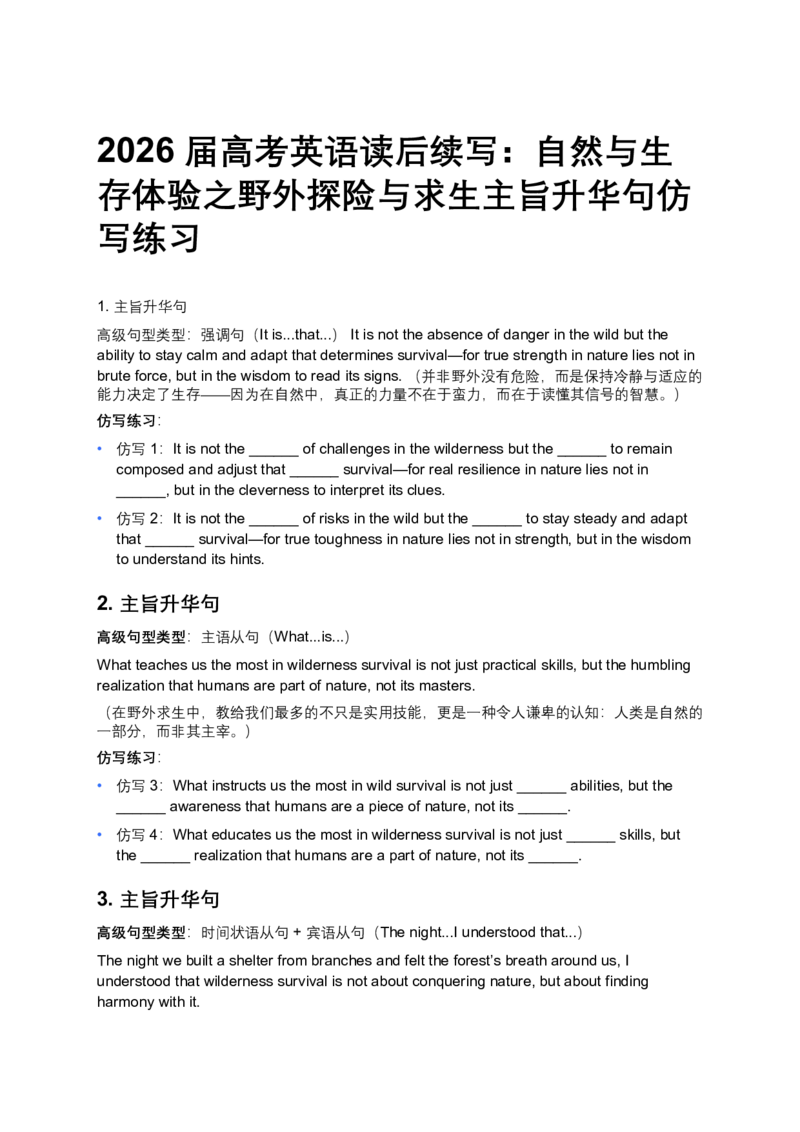
2026 届高考英语读后续写:自然与生
存体验之野外探险与求生主旨升华句仿
写练习
1. 主旨升华句
高级句型类型:强调句(It is...that...) It is not the absence of danger in the wild but the
ability to stay calm and adapt that determines survival—for true strength in nature lies not in
brute force, but in the wisdom to read its signs. (并非野外没有危险,而是保持冷静与适应的
能力决定了生存——因为在自然中,真正的力量不在于蛮力,而在于读懂其信号的智慧。)
仿写练习:
•
仿写 1:It is not the ______ of challenges in the wilderness but the ______ to remain
composed and adjust that ______ survival—for real resilience in nature lies not in
______, but in the cleverness to interpret its clues.
•
仿写 2:It is not the ______ of risks in the wild but the ______ to stay steady and adapt
that ______ survival—for true toughness in nature lies not in strength, but in the wisdom
to understand its hints.
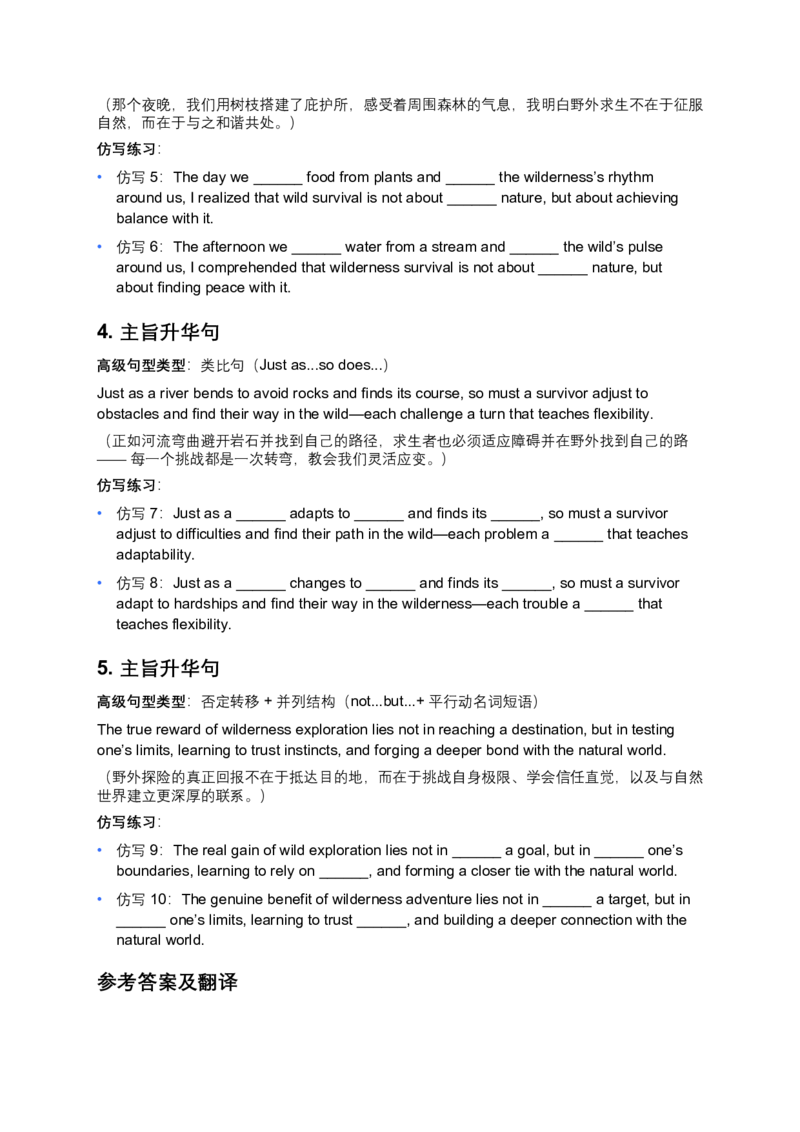
2. 主旨升华句
高级句型类型:主语从句(What...is...)
What teaches us the most in wilderness survival is not just practical skills, but the humbling
realization that humans are part of nature, not its masters.
(在野外求生中,教给我们最多的不只是实用技能,更是一种令人谦卑的认知:人类是自然的
一部分,而非其主宰。)
仿写练习:
•
仿写 3:What instructs us the most in wild survival is not just ______ abilities, but the
______ awareness that humans are a piece of nature, not its ______.
•
仿写 4:What educates us the most in wilderness survival is not just ______ skills, but
the ______ realization that humans are a part of nature, not its ______.
3. 主旨升华句
高级句型类型:时间状语从句 + 宾语从句(The night...I understood that...)
The night we built a shelter from branches and felt the forest’s breath around us, I
understood that wilderness survival is not about conquering nature, but about finding
harmony with it.
(那个夜晚,我们用树枝搭建了庇护所,感受着周围森林的气息,我明白野外求生不在于征服
自然,而在于与之和谐共处。)
仿写练习:
•
仿写 5:The day we ______ food from plants and ______ the wilderness’s rhythm
around us, I realized that wild survival is not about ______ nature, but about achieving
balance with it.
•
仿写 6:The afternoon we ______ water from a stream and ______ the wild’s pulse
around us, I comprehended that wilderness survival is not about ______ nature, but
about finding peace with it.
4. 主旨升华句
高级句型类型:类比句(Just as...so does...)
Just as a river bends to avoid rocks and finds its course, so must a survivor adjust to
obstacles and find their way in the wild—each challenge a turn that teaches flexibility.
(正如河流弯曲避开岩石并找到自己的路径,求生者也必须适应障碍并在野外找到自己的路
—— 每一个挑战都是一次转弯,教会我们灵活应变。)
仿写练习:
•
仿写 7:Just as a ______ adapts to ______ and finds its ______, so must a survivor
adjust to difficulties and find their path in the wild—each problem a ______ that teaches
adaptability.
•
仿写 8:Just as a ______ changes to ______ and finds its ______, so must a survivor
adapt to hardships and find their way in the wilderness—each trouble a ______ that
teaches flexibility.
5. 主旨升华句
高级句型类型:否定转移 + 并列结构(not...but...+ 平行动名词短语)
The true reward of wilderness exploration lies not in reaching a destination, but in testing
one’s limits, learning to trust instincts, and forging a deeper bond with the natural world.
(野外探险的真正回报不在于抵达目的地,而在于挑战自身极限、学会信任直觉,以及与自然
世界建立更深厚的联系。)
仿写练习:
•
仿写 9:The real gain of wild exploration lies not in ______ a goal, but in ______ one’s
boundaries, learning to rely on ______, and forming a closer tie with the natural world.
•
仿写 10:The genuine benefit of wilderness adventure lies not in ______ a target, but in
______ one’s limits, learning to trust ______, and building a deeper connection with the
natural world.
参考答案及翻译
1. It is not the lack of challenges in the wilderness but the capacity to remain composed
and adjust that ensures survival—for real resilience in nature lies not in strength, but in
the cleverness to interpret its clues.
(并非野外没有挑战,而是保持镇定与调整的能力确保了生存 —— 因为在自然中,真正的韧
性不在于力量,而在于解读其线索的机敏。)
2. It is not the absence of risks in the wild but the skill to stay steady and adapt that
guarantees survival—for true toughness in nature lies not in strength, but in the wisdom
to understand its hints.
(并非野外没有风险,而是保持稳定与适应的技能保证了生存 —— 因为在自然中,真正的坚
韧不在于力量,而在于理解其暗示的智慧。)
3. What instructs us the most in wild survival is not just practical abilities, but the humbling
awareness that humans are a piece of nature, not its rulers.
(在野外求生中,教给我们最多的不只是实用能力,更是一种令人谦卑的认知:人类是自然的
一部分,而非其统治者。)
4. What educates us the most in wilderness survival is not just basic skills, but the
sobering realization that humans are a part of nature, not its masters.
(在野外求生中,教育我们最多的不只是基本技能,更是一种清醒的认知:人类是自然的一部
分,而非其主宰。)
5. The day we gathered food from plants and sensed the wilderness’s rhythm around us, I
realized that wild survival is not about defeating nature, but about achieving balance with
it.
(那天,我们从植物中采集食物,感受到周围野外的节奏,我意识到野外求生不在于战胜自
然,而在于与之取得平衡。)
6. The afternoon we collected water from a stream and felt the wild’s pulse around us, I
comprehended that wilderness survival is not about controlling nature, but about finding
peace with it.
(那个下午,我们从溪流中取水,感受到周围野外的脉动,我明白野外求生不在于控制自然,
而在于与之和平共处。)
7. Just as a plant adapts to climate and finds its growth, so must a survivor adjust to
difficulties and find their path in the wild—each problem a lesson that teaches
adaptability.
(正如植物适应气候并找到自己的生长方式,求生者也必须适应困难并在野外找到自己的路
—— 每一个问题都是一次教训,教会我们适应能力。)
8. Just as a bird changes to seasons and finds its nest, so must a survivor adapt to
hardships and find their way in the wilderness—each trouble a guide that teaches
flexibility.
(正如鸟类适应季节并找到自己的巢穴,求生者也必须适应艰辛并在野外找到自己的路 ——
每一个麻烦都是一个向导,教会我们灵活应变。)
9. The real gain of wild exploration lies not in reaching a goal, but in pushing one’s
boundaries, learning to rely on intuition, and forming a closer tie with the natural world.
(野外探险的真正收获不在于达成目标,而在于突破自身界限、学会依赖直觉,以及与自然世
界建立更紧密的联系。)
10.
The genuine benefit of wilderness adventure lies not in hitting a target, but in testing
one’s limits, learning to trust instincts, and building a deeper connection with the natural
world.
(野外冒险的真正益处不在于击中目标,而在于挑战自身极限、学会信任直觉,以及与自然世
界建立更深厚的联系。)