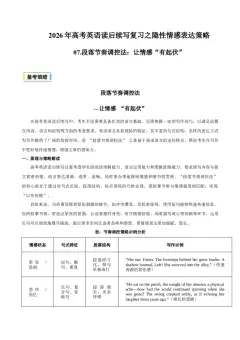
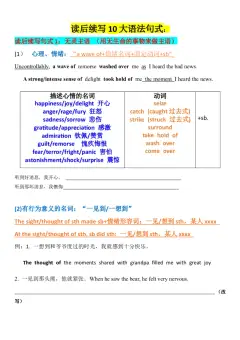
《传统文化与现代融合:非遗艺术与技
艺读后续写句式练习》
句一:(老艺人传授传统技艺)
原句:As the teenager fumbled with the bamboo strips, the old weaver’s rough hands
covered his, guiding the pattern step by step. (当少年笨拙地摆弄竹条时,老织工粗糙的
手覆在他的手上,一步步指导着编织图案。)
仿写练习:
1. As the apprentice _________ the clay on the wheel, the master potter’s _________
hands _________ his, shaping the vase with steady movements.
(当学徒在轮盘上揉捏黏土时,陶艺大师灵巧的手握住他的手,以稳健的动作塑造着花瓶。)
句二:(非遗技艺与现代设计结合)
原句:Lila scanned the embroidery with her phone, the app digitizing the traditional pattern
to print on modern T-shirts—old threads meeting new technology.
(莱拉用手机扫描刺绣,应用程序将传统图案数字化,以便印在现代 T 恤上 —— 古老丝线与
新技术相遇。)
仿写练习:
2. Tom _________ the paper-cutting into the computer, the software _________ the classic
motifs to use in digital animations—ancient _________ merging with modern media.
(汤姆将剪纸扫描进电脑,软件编辑经典图案用于数字动画 —— 古老艺术与现代媒体融
合。)
句三:(年轻人对非遗的重新发现)
原句:Jake had once thought kite-making outdated, but as he held the finished swallow kite,
its wings painted with neon colors, he smiled—tradition felt new.
(杰克曾认为风筝制作已经过时,但当他握住做好的燕子风筝,其翅膀涂着霓虹色时,他笑了
—— 传统焕发新生。)
仿写练习:
3. Clara had once _________ shadow puppetry _________, but as she _________ the
updated figures, their costumes featuring pop culture elements, she _________—heritage
felt fresh.
(克拉拉曾认为皮影戏老套,但当她操纵改良后的皮影,其服饰融入流行文化元素时,她惊叹
—— 非遗焕然一新。)
句四:(非遗技艺在国际舞台的展示)
原句:The Peking Opera mask maker stood back, watching foreign visitors take photos of
his works—some decorated with English phrases, bridging cultures.
(京剧脸谱制作人退后一步,看着外国游客为他的作品拍照 —— 有些脸谱饰有英文短语,搭
建起文化桥梁。)
仿写练习:
4. The _________ craftsman smiled, observing international guests _________ videos of his
_________—some inscribed with global symbols, connecting traditions.
(景泰蓝工匠微笑着,看着国际友人拍摄他的作品视频 —— 有些刻有全球符号,联结不同传
统。)
句五:(非遗传承中的代际对话)
原句:Grandma showed Mia how to tie the silk knots, her stories of the past mixing with
Mia’s ideas to make keychains—memories weaving with innovation.
(奶奶教米娅如何打丝结,她的过往故事与米娅制作钥匙链的想法交织 —— 回忆与创新编织
在一起。)
仿写练习:
5. Grandpa _________ Leo how to carve woodblocks, his tales of _________ blending with
Leo’s plans to make phone cases—history _________ with creativity.
(爷爷教利奥如何雕刻木版,他的旧时传说与利奥制作手机壳的计划融合 —— 历史与创造力
交融。)
句六:(非遗技艺应对现代需求)
原句:The bamboo craftsman adjusted his weaving technique, making the baskets lighter to
suit urban living—old skills adapting to new lifestyles.
(竹艺工匠调整编织技法,将篮子做得更轻便以适应城市生活 —— 古老技艺适应新的生活方
式。)
仿写练习:
6. The _________ tailor modified her stitching methods, making the cheongsam _________
to fit modern occasions—traditional _________ catering to contemporary needs.
(苏绣裁缝改良缝纫方法,将旗袍设计得更简约以适应现代场合 —— 传统工艺迎合当代需
求。)
句七:(非遗教育走进现代课堂)
原句:Students crowded around the paper umbrella maker, their tablets recording his
demonstration—learning the craft through both hands-on practice and digital notes.
(学生们围在纸伞制作人身边,平板电脑记录着他的演示 —— 通过动手实践和数字笔记学习
这项工艺。)
仿写练习:
7. Pupils _________ the _________ artist, their smartwatches _________ his explanations
—mastering the skill via both physical training and audio records.
(小学生们围在糖画艺人身边,智能手表录下他的讲解 —— 通过实际操作和音频记录掌握这
项技能。)
句八:(非遗元素融入现代节庆)
原句:The Lantern Festival display featured 3D-printed frames, each holding a traditional
red lantern—LED lights glowing inside, blending old and new celebrations.
(元宵节展览展出 3D 打印框架,每个框架都挂着传统红灯笼 ——LED 灯在内部闪耀,融合
新旧庆祝方式。)
仿写练习:
8. The Mid-Autumn gathering _________ projection mapping, each _________ showing a
classic moon myth—digital animations _________ with traditional stories, mixing ancient and
modern festivities.
(中秋聚会运用投影映射,每个灯笼都展示经典月亮神话 —— 数字动画与传统故事结合,融
合古今节庆。)
句九:(非遗技艺的商业化创新)
原句:The lacquerware maker launched an online store, selling mini boxes with traditional
patterns—customers customizing them with names, tradition meeting personalization.
(漆器匠人开设网店,售卖带有传统图案的迷你盒子 —— 顾客可定制姓名,传统与个性化结
合。)
仿写练习:
9. The _________ artist started a social media shop, _________ small figurines with classic
designs—buyers _________ them with messages, heritage meeting individualization.
(面塑艺人开设社交媒体店铺,售卖带有经典设计的小塑像 —— 买家可定制留言,非遗与个
性化结合。)
句十:(非遗传承的未来展望)
原句:As the young weavers posed with their digital looms, the old master nodded—
knowing the craft would live on, woven with threads of both past and future.
(当年轻织工与他们的数字织机合影时,老大师点了点头 —— 知道这项工艺将延续下去,编
织着过去与未来的丝线。)
仿写练习:
10. As the teenage potters _________ with their _________ kilns, the senior craftsman
_________—aware the art would endure, shaped by both history and tomorrow.
(当少年陶工与他们的智能窑炉合影时,老工匠笑了 —— 明白这项艺术将传承下去,融合历
史与未来的印记。)
参考答案及翻译:
1. As the apprentice kneaded the clay on the wheel, the master potter’s skilled hands
covered his, shaping the vase with steady movements.
(当学徒在轮盘上揉捏黏土时,陶艺大师灵巧的手握住他的手,以稳健的动作塑造着花瓶。)
2. Tom scanned the paper-cutting into the computer, the software editing the classic motifs
to use in digital animations—ancient art merging with modern media.
(汤姆将剪纸扫描进电脑,软件编辑经典图案用于数字动画 —— 古老艺术与现代媒体融
合。)
3. Clara had once considered shadow puppetry old-fashioned, but as she moved the
updated figures, their costumes featuring pop culture elements, she marveled—heritage
felt fresh.
(克拉拉曾认为皮影戏老套,但当她操纵改良后的皮影,其服饰融入流行文化元素时,她惊叹
—— 非遗焕然一新。)
4. The cloisonné craftsman smiled, observing international guests filming videos of his
works—some inscribed with global symbols, connecting traditions.
(景泰蓝工匠微笑着,看着国际友人拍摄他的作品视频 —— 有些刻有全球符号,联结不同传
统。)
5. Grandpa taught Leo how to carve woodblocks, his tales of old times blending with Leo’s
plans to make phone cases—history mingling with creativity.
(爷爷教利奥如何雕刻木版,他的旧时传说与利奥制作手机壳的计划融合 —— 历史与创造力
交融。)
6. The Suzhou embroidery tailor modified her stitching methods, making the cheongsam
simpler to fit modern occasions—traditional craftsmanship catering to contemporary
needs.
(苏绣裁缝改良缝纫方法,将旗袍设计得更简约以适应现代场合 —— 传统工艺迎合当代需
求。)
7. Pupils surrounded the sugar painting artist, their smartwatches recording his
explanations—mastering the skill via both physical training and audio records.
(小学生们围在糖画艺人身边,智能手表录下他的讲解 —— 通过实际操作和音频记录掌握这
项技能。)
8. The Mid-Autumn gathering used projection mapping, each lantern showing a classic
moon myth—digital animations combining with traditional stories, mixing ancient and
modern festivities.
(中秋聚会运用投影映射,每个灯笼都展示经典月亮神话 —— 数字动画与传统故事结合,融
合古今节庆。)
9. The dough modeling artist started a social media shop, selling small figurines with
classic designs—buyers personalizing them with messages, heritage meeting
individualization.
(面塑艺人开设社交媒体店铺,售卖带有经典设计的小塑像 —— 买家可定制留言,非遗与个
性化结合。)
10.
As the teenage potters posed with their smart kilns, the senior craftsman smiled—
aware the art would endure, shaped by both history and tomorrow.
(当少年陶工与他们的智能窑炉合影时,老工匠笑了 —— 明白这项艺术将传承下去,融合历
史与未来的印记。)